
Relentless Off, To, and After the Ball

By Jason Their

Defensive Coordinator

University of Mary


Editor’s Note:  After collegiate coaching stints at a variety of levels, Jason Thier joins the University of Mary as the Marauders defensive coordinator for the 2014 season, where he once again will have the opportunity to work with U-Mary head coach Josh Kotelnicki.  Thier (rhymes with fear) served as inside linebackers coach at the University of North Dakota in 2013, where he coached an all-conference linebacker. Kotelnicki was the defensive coordinator for UND that season.

The defensive coordinator at NAIA Division I University of Montana Western for two seasons (2011-12), Thier was also responsible for linebackers one season and defensive backs the other. In 2011 the defensive secondary was ranked second in the Frontier Conference and the squad had an all-conference defensive lineman and linebacker. The 2012 squad doubled its win total from the previous season, takeaways increased by 13 and a defensive back earned all-conference recognition.

Thier began his full-time coaching experience at Augustana College as a graduate assistant, working one season with defensive backs and a second with linebackers while also serving a year as the video coordinator and kickoff coordinator. In 2009 the Viking finished 8-4 overall to place third in the Northern Sun and earn a spot in the Mineral Water Bowl. Augie followed up with a trip to the NCAA Division II quarterfinals in 2010, posting an 11-2 record and winning a playoff game for the first time in school history. Three of his linebackers earned all-league honors and one was all-region.

Introduction

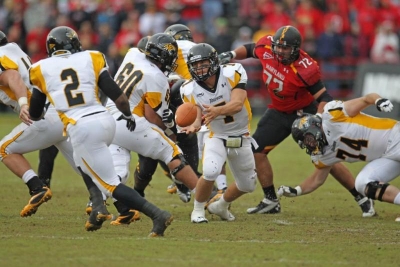
1775-thumb“Relentless off the ball, to the ball, and after the ball.” I first heard this phrase entering my senior year at Truman State University in 2008. At the time it seemed like just another coaching slogan, something used to motivate players to play hard. Six years later, that single phrase embodies my entire philosophy on the way defensive football should be played. Relentless off the ball (keys and reads), to the ball (pursuit), and after the ball (tackling and takeaways).  In January of this year when I was hired as the Defensive Coordinator at the University of Mary, that was my first message to our defense. Above everything, the style of defense that we play is more important than the scheme that we install. Having just completed our first spring ball, myself and our defensive staff put a major emphasis on just that; pursuit, tackling, and takeaways. Throughout this article I plan to explain how we teach pursuit angles, categorize tackles, and when we believe going after the ball should be the number one priority.

Pursuit

I know that every defensive coach in the country talks to their players about the importance of pursuit, but talking about pursuit is not enough. You must set a clear standard for what proper pursuit is, demand that players reach that standard on every play, and be willing to do the work as coaches to grade and regulate this standard for each player on every snap. At the University of Mary pursuit all starts with a mindset that good things will happen when we are around the football. The more players around the ball, the better chance we have to eliminate extra yardage after a missed tackle, create takeaways, and recover the ball. The standards we set for pursuit are simple but high; a defensive player’s commitment to his teammates can be measured by his distance from the ball at the end of each play. This standard gives our coaching staff a clear way to evaluate the commitment of every defensive player on the field. They were either running after the football or they were not. Players are not rewarded or praised for proper pursuit; it is an expectation, a non-negotiable item. However when a player is not executing proper pursuit, it is addressed as a LOAF. Every player on our team is given the definition of a LOAF before the first practice so there is no debate about what equates to a LOAF.

What is a LOAF?

  • When a teammate passes you up on the way to the ball.
  • When you change speeds – going from 2nd to 1st gear based on realizing the ball-carrier isn’t down.
  • When you get cut or fall down and you stay on the ground. Get up on your way down!
  • When you are rushing the passer or in coverage and you don’t “turn and run” when the ball is thrown.

Again, what good are standards if coaches are not going to regulate and demand that they are reached? After every practice as a coaching staff we grade each play for LOAFs and keep a running count on every player. The LOAFs are then posted the next morning outside our locker room for everyone to see. It may take extra time from the coaches when watching practice, but you get what you emphasize. We have seen great results from posting the LOAFs, because players start to hold one another accountable for their effort.  There is no bigger motivator in a football locker room than peer pressure and no one wants to be questioned by their teammates on why they had multiple LOAFs the day before. As a matter of fact, we have even seen players get upset over LOAFs and demand to see the plays that they LOAFed on. I was elated to see this because it showed a real pride in performance. Pursuit was no longer something we were talking to our players about, it was something our players were demanding from one another.

Read More

Is This the Most Powerful Play in Football?

By Steve Girolmo, Former HC, Livonia HS (NY)

and 


Scott Girolmo, OC, Liberty HS (VA)


CaptureHello my name is Steve Girolmo and it’s my great pleasure to present to you an offensive play that helped my teams at Livonia find continued success on the ground. Call it what you like; Sweep, Super Power, 134… This is the most powerful play I have known in 47 years of playing and coaching football. We have run it from a variety of backfield sets, (2 wings, Wishbone, I, Gun, Wildcat, Slots) and have adapted it to unbalanced lines as well. It doesn’t lose potency, it really is that effective.
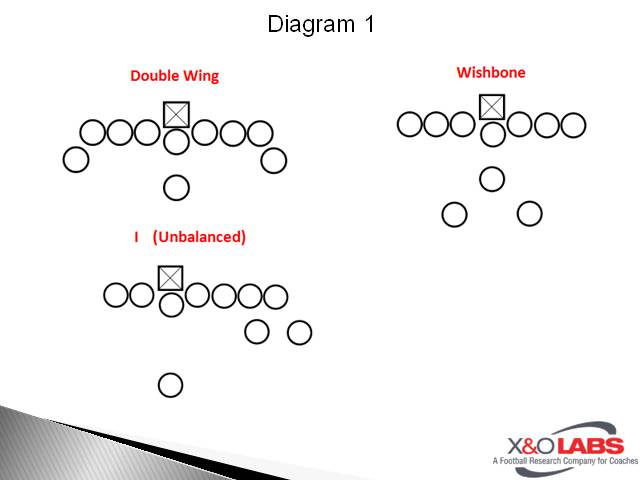
The scheme itself (hereafter called ‘sweep’) contains very few rules for players. Its simplicity makes repetitions easier during installation and practice. For our purposes here we will diagram and describe the sweep from a 2 tight end, 2 wing formation.

Slide1


Line Rules:

Offensive Line Alignment:   Foot to foot splits max 1 inch.

Play Side: C, G, T, TE will block gap down. (Occasionally against a great DT, we will isolate a double team on that player). In the gap down scheme, we try to emphasize each lineman getting his head on his brother’s shoulder to create a wall. The overlapping structure serves an important purpose in the play’s consistent success because it eliminates gaps on the front-side and forces defenders behind and around the wall. In the space left from their dispersal, we insert pullers and a runner. Every time a defender retreats, and our players fill the void, we gain yardage. Watch the movie “300” and see the Spartan Phalanx operate in the Battle of Thermopylae. It is an incredibly similar concept to gaining tactical advantage of space, and maximizing personnel through structure.

Slide2


RB (WING):  Either; arc inside to seal play side ILB, or arc outside to kick Corner. He can also be used to add an additional DOWN block if you want to personnel a blocking back or extra TE in here.

Back Side: G, T will skip pull to play side and lead up in C gap, looking IN to scraping LB’s. TE will cut off or CUT BLOCK inside (5, 4, 4i, 3 tech’s). This may SOUND crazy, however when aligned foot to foot, even an unathletic TE can reach and crawl his way to cut off a 3-tech, because they are so closely aligned. See the film for yourself.

Slide3


Backfield Rules:

QB: Reverse pivot, dead toss ball to RB (back side WING), continue turn and assist FB blocking the DE.

Read More

8 New Progressions in the No Huddle for 2014

By Mike Kuchar

Senior Research Manager

X&O Labs


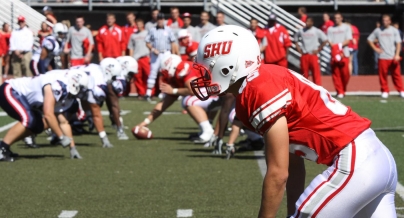
westconn2Last Spring, XandOLabs.com releases its special report on the No-Huddle System.  Now that coaches have had another full off-season to retune their system, we wanted to present a follow up on how successful coaches are tweaking the no-huddle.   So, we polled those coaches with winning percentages over .500 over the last three seasons using the no-huddle and presented them with two questions:

1.  Are you making any changes to your no huddle approach this year?  Is so, what are you changing?

2.  Why are you making that change / what factors led to you feeling the need to make that change?

We presented the responses below based on 8 categories.  Within each category, we provide the change and the reasoning for the change.

Advancement 1:  Verbally Calling Out Motions

Reasoning:

Some of the coaches we spoke with mentioned that common no-huddle tools such as big boards, wristbands and signals were too lengthy a process to get the call communicated.  So now, these coaches are moving towards sideline commands to get their players in the right spot pre-snap.  Their responses to our surveys are below:

Responses:

Scott Burton, Marietta High School (GA)

“The only change we’re making is we are now verbally calling out motions and shifts instead of using hand signals. We have always verbally called out the formation because we’ve felt this allows the kids to get in formation while looking for the signal.  To cut down on the number of signals, we’ve now decided to also include shifts and motions verbally.  We feel this will be more efficient, allow us to save time, and not overload the kids with excessive signals.”

Gary Jeffers, Payallup High School (WA)

“We need to go faster because that is the ticket to making defenses vanilla.  If defense is vanilla the advantage goes to offense.   Remove the boards, hand signals, etc. I may just yell in the concept number because it is faster.”

Advancement 2:  One Word Play Calls

Reasoning:

Along the lines of a verbal cue, the one-word play call has now generated some steam among successful no-huddle coaches.  Now only one word (which can contain the formation, motion and concept) and be signaled in- or shouted out- to the entire offensive unit.  The coaches that are using this methodology share their responses below.

Responses: 

Erick Wills, Madison High School

“We have changed a few things this year.  We are getting rid of the wrist band and going strictly to key word signal calling.  We want to go even faster and yet simplify our play calling.”

Aric Galliano, San Jacinto High School, (CA)

“For our no huddle this year we are adding in a tempo series where we can get plays off in about 10 seconds by just saying a word. The word is the play, formation, and snap count in one. We will also have a built that we will automatically do when we have a play over 20 yds. Our whole goal of our no huddle is to run as many plays as possible. This also does not allow the defense to make changes and makes them play a vanilla or base defense with not a lot of adjustments.”

Drew Gibbs, Ramapo High School (NJ)

“If you are playing fast, try to find a way to play faster.  We like many other programs are adding more one word calls.  Meaning one word or signal gives the entire formation, motion and play call.  The NFL style of verbiage where the play call can be 12 or more words and there is a description or term for almost every player is out in favor of shorter calls that can be used week in and week out or modified to fit a specific opponent or game plan.”

Charles Bussey, Valhalla High School (CA)

“We are simplifying our base play calls to make them shorter and faster to relay.  We are also spending more time on procedure in practice then before like drilling the receivers and running backs to get the ball back to the middle after the plays instead of to the sideline judge instead of just talking about it.  More importantly, we will be drilling getting the center and receivers to sprint to the line after plays.  We typically haven’t used wristbands because they slow things down but we will use them for more complex play calls and formations. When we aren’t looking to go as fast, running the fastest tempo possible is very important to us.  Along with the typical reasons coaches always mention for a fast pace no huddle, our players just seem to play better when we go fast. Maybe it keeps them more focused or doesn’t let them think too much, but some of it is unexplainable.  There is a very significant difference to the way our offense works when we are going fast as opposed to slowing down.  There are times however when you want to run a trick play or complex motions, shifts, or backside tags where a long drawn-out play call is necessary.  We will 10-20 of these a game that will be put on a wristband.   The rest of our plays take 2-3 words to call.”

Joe Metzka

“We are changing some verbiage both for the sake of brevity and because other guys in the league are figuring out some calls.  Limiting the package to game-planned “one word” calls and various combined concepts, such as stick-draw and option screens.   Too many teams are trending to all no huddle & it taxed the defense too much to provide any legitimate advantage in 2013.  I only plan to use it when a tactical advantage presents itself, either by game plan or as an in-game adjustment.  Mixing up tempos instead.”

Read More

SHU’s Flexible Quick Game Concepts


By Matt Gardner

Quarterbacks Coach

Sacred Heart University


Editor’s Note:  2014 marks Matt Gardner’s seventh season as an assistant coach for the Sacred Heart University Pioneers. Gardner will work with the quarterbacks again this fall.  Under Coach Gardner, first-year QB R.J Noel had one of the best single seasons in Sacred Heart history in 2014. The redshirt freshman tossed for 2,203 yards and rushed for 689 more, while accounting for 31 total touchdowns. Noel was named Northeast Conference Rookie of the Week seven times on his way to NEC Rookie of the Year honors. Noel tossed only 9 interceptions and his 23:9 touchdown to interception ratio was tops in the Conference.  Upon his arrival at SHU, Gardner worked on the defensive side of the ball coaching the outside linebackers before moving to the offensive coaching the wide receivers. He came to Sacred Heart after four coaching seasons with the Colorado Crush of the Arena Football League where he coached the wide receivers, linebackers and oversaw all aspects of special teams. Gardner earned his Master’s Degree from Sacred Heart University in May, 2011 and he and his wife currently reside in Norwalk, CT.

Coach Gardner also wants to thank Sacred Heart’s WR Coach, Jim Jeffers for his help on this project. 


Introduction:

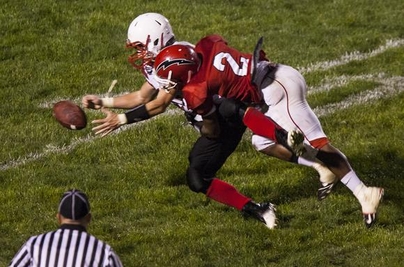
web team 2The following quick game pass concepts have developed into an extension of our run game.  We tell our players that we are looking to get 4 yards on a run and our quick throws are designed to get us at least 4 yards.  We like the quick game concepts listed below because it allows our offensive linemen to continue to be aggressive at the point of attack with a quick setting protection.  In our system, that type of protection is called “Cut protection” and involves the offensive line taking short set and then block the defenders by taking out their legs or (cutting them down).  Their goal is to put their helmet on the opponents outside leg just above the knee.)  Quick game also allows to be more balanced on 1st and 2nd down and it is an efficient way to get the ball to our playmakers.       
Basic QB Rules:

Coverage ID:  To ID the coverage we will start with the alignment of the safeties, how many are there (1 high vs 2 high) where are the aligned (inside the hash/on the hash/outside the hash).  Then we will look at the alignments of the corners, do they appear to be playing a soft alignment (Cov. 3 or Cov. 4) or a tighter alignment square hipsC. 2 or man coverage).  Choose the side you are going to work by identifying the coverage and working the correct side.  If it is man the thought process should be softest corner shortest throw If you see pressure replace it with the throw. 

For example, if there is a single high safety, that alerts the QB to the coverage possibilities.  Of course this is likely Cover. 3 or Cover. 1 and against this opponent, that is what the scouting report told us to expect.  There is a chance that they would roll to cover 2 or Cover 4 by having the SS safety that is lined up to the field over our #2 receiver run back and get on the field hash at 12 yards and if that were something we were expecting we would build that into the scouting report.  After he has looked at the safeties he will check the Corners.  The corners here are sitting at a depth of 8 to 9 yards with inside leverage so they are probably not playing man coverage.  We also teach that QB to  read the safety alignment to confirm if it is cover 3.  If the SS is at a depth of 6 yards from the ball 2 to 3 yards inside our #2 receiver our QB’s will assume C3.  It is generally hard to play man coverage from this alignment. 

Read More

Defending the Double Wing with the 4-2-5

By Josh Patrick

Assistant Football Coach

Jacksonville High School (IL)

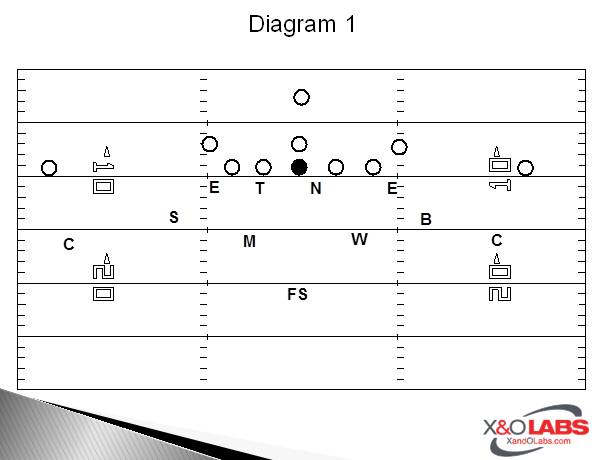
jacksonvilleIn today’s football world, we all know that there has been a huge surge to spread offenses.  In fact, so are we.  But, there is always that one or two teams on your schedule who still run a double wing or wing-t style of offense.  Some are even running it out of the gun.  Another issue is that we don’t play these teams back to back, but something like week 3 and week 7.  I have nothing against this style of offense, but as a defensive coordinator it can throw a huge wrench in your defensive scheme if you don’t have a plan to defend it.  We run a base front out of the 4-2-5.  I believe that you will be most successful by keeping your current principles in place and have an answer for this team.  If you try to install a defense that is only for a specific team, you are setting yourself, and most importantly, your team up for failure.  In our league, we see more double wing offenses than wing-t, however we would defend the wing-t the same way.

TROUBLE WITH DOUBLE WING/WING-T

The trouble with this offense is how good they are at misdirection.  There is a lot going on in the backfield with motion and counters and boots.  It’s all designed to get you out of position and take advantage of blocking angles on your defense.  And, they will try to get tricky and use formations and motions to get you out numbered at the point of attack.  The key for us is to use motion adjustments to keep the numbers in our favor and be disciplined at each position.  Most of these teams aren’t going to be breaking too many records throwing the ball.  Their success throwing comes from establishing a strong running attack.  If you can stop the run and make them throw when they have to instead of when they want to, you’re going to have a great chance at being successful. 

COMMUNICATION

Any successful defense is great at communicating with each other.  It’s even more important defending this style of offense.  Your players have to be disciplined and know their assignments.  For us, no matter who we are playing, we have defensive positions that are responsible for communicating specifics to the rest of the defense.  For example, our strong outside linebacker is responsible for how many backs are in the backfield.  Our strong safety is responsible for the formation to get the secondary lined up correctly.  Our Mike baker sets the front and makes any adjustments.  Our Will baker tells the down and distance.  All of this plays into tendencies that we have picked up as coaches and then given to our players on Hudl, in our scouting report, and then drilled all week long.  The kids must be talking the entire time we are in a team segment.  All of this is being announced to the defense and before you know it, you are hearing plays being called that they have learned are the opponents favorites.  Like I said earlier, this is very important for defending double wing/wing-t teams.  We add they type of motion we see, deep pitch motion or jet sweep motion, to our list of communicators for these teams. 

PREDICTABLE

I like to use something I’ve heard over the years when we are getting ready to play one of these teams after playing several spread offenses in a row.  The kids are a little jittery when facing a “different” offensive attack.  To put them at ease and keep their confidence high, I tell them that these teams have an 85% tendency to run plays that go with their pre-snap motion.  And, for the most part that’s the truth.  In fact, we have seen teams that are as high as 96% tendency!    As a defensive coordinator, I will take either of those percentages any day. 

If they don’t use motion, there is even a higher percentage for it being a passing play.  Even if it’s not, they are limited in the running plays they can run, or the wing back is going to be way behind and have trouble catching up. 

ALIGNMENTS

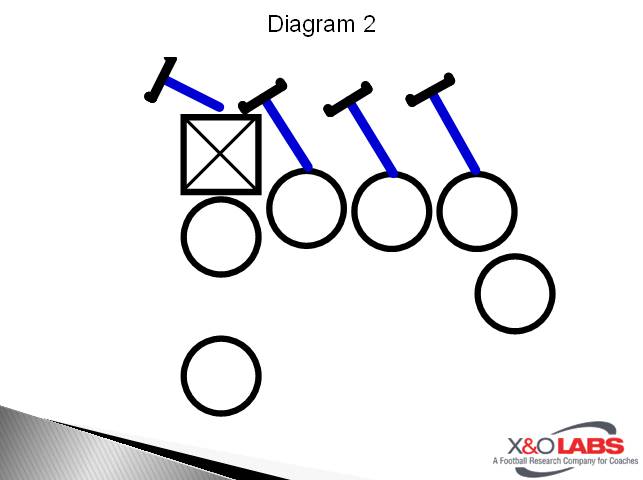
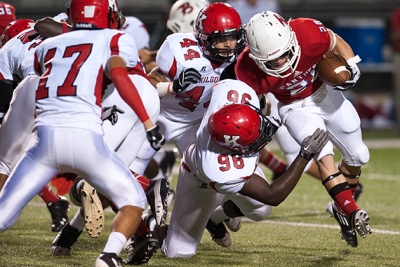
Keeping our principles and fundamentals the same, we align to the double wing offense as we would any other offense.  Except, we roll down our weak side safety and play him as an outside linebacker (Diagram 1)

Slide1


$1·         *DE: align in gap between offensive tackle and wing back.  No wing, wide 5 tech.

Read More

4 Stunts to Defend Zone and Power Read


By TJ Gillen-Hall

Defensive Line Coach

Kilgore High School (TX)


Introduction

kiogorefbOffenses are continuing to evolve and add more run read plays for the quarterback. As a defensive coach, you have to have answers that allow your kids can play fast while accounting for different looks so that the quarterback doesn’t get the same read every time. At Kilgore HS (TX), we will have developed four different ways to play the various read schemes by change-ups for our defensive line.  Many of these are ideas are borrowed from past experience defending the triple option and veer teams. Even though some of these schemes on offense seem new, for the defense it still comes down to the old cliché of “assignment football”. These change-ups allow us to be able to dictate to the offense that we want to carry the ball in the read game based on opponent tendencies and our calls. Each of these stunts, discussed below, is primarily for our defensive ends since they are usually the players being read.
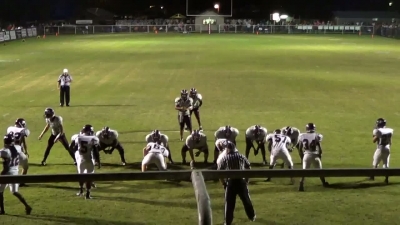

Base Scheme

We base out of a 4-2-5 defense and we play “attack and react” with our d-line 85-90% of the time.  With that in mind, we spend most of our time working block recognition and destruction and expect our defensive lineman to win the line of scrimmage. Generally, we play a heavy seven technique to the tight end side reading the tight end first. We put a lot of emphasis on winning this battle with our ends.  On the weak side of the formation, we play an open five technique. These stunts can be easily adapted to and run from other fronts and shades, in the film you will see us running them from a 9 technique as well. 


Stunt #1: “First Threat”

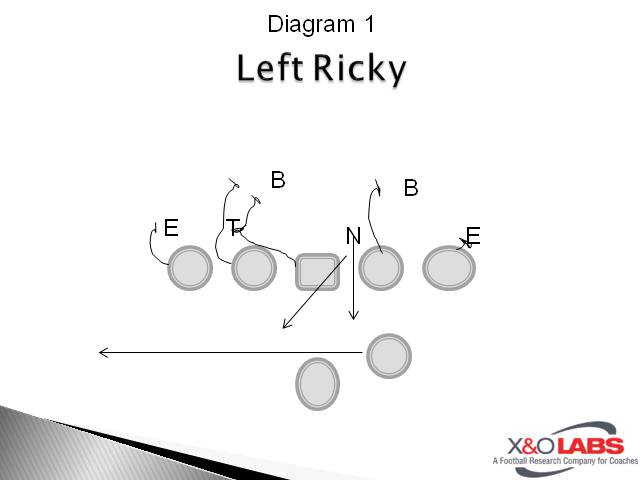
7-Technique Reaction: When the 7-technique is getting read he will get an outside release from the tight end (Diagram 1). As he realizes he is getting a non-aggressive block, his eyes will immediately go to the tackle and he will squeeze the gap. If he gets a down block out of the tackle he will continue to squeeze and look for a kick out block or look to the quarterback. We teach them the mantra “if he’s reading me, I’m reading him.” Our ends are taught to take “first threat” because with all of the different reads, you can’t say he always has the quarterback or always has the back. By assigning him the first threat we eliminate that confusion. He will squeeze and take the first thing off the tackle’s block.

Even though this is the base way we play it, it’s probably the hardest for most of our players. They don’t want to trust and stay patient, they feel like they have to go somewhere and get out of position on any type of Read play. 

Read More

A Communication System for Reading Box Defenders


By Josh Puckett – @CoachPuckett25

Head Coach

Lake County High School


puckett picture

Introduction:

Everyone in America either ran or defended the normal Zone Read over the last ten years. A few years back, I noticed when Auburn played Oregon in the National Championship game that Oregon was trying (unsuccessfully thanks to Nick Fairley) to read defensive tackles from the gun. I got out the trusty white board and started tinkering with things and what has developed over the last two years has given us ways to affect defenses giving them the same look as our base plays.

Reading First Level Defenders:

Essentially, this play is the same concept as Midline just done from the gun (Diagram 1). For us, the most challenging part was coming up with a way to communicate this to our players. We found that naming the defensive tackles and tagging them onto our base run plays was the simplest and most effective way to make this happen (seen below). 

Slide1

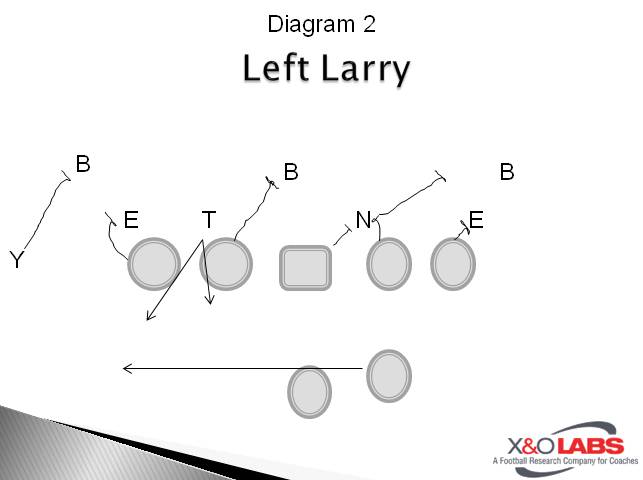
We first started tagging the reads to the end of our Outside Zone play. Let’s say, for example, that our Outside Zone play is called Right and Left. If we go left, we are automatically reading the back side end so we don’t have to tag him. We simply call Left and off we go. We see lots of teams that put the 3-technique away from the back to help with the Zone plays. So if we want to read an active 3-technique we would call Left Larry (Diagram 2). Now the back side tackle just latches onto the back side end and we read the three. On the front side, the tackle reaches the defensive end to protect the give for Outside Zone. The guard lets the 3-technique go and goes as flat as possible to the play side inside backer. The center and back side guard combo up to the back side linebacker. We don’t read the front side DE a lot off of this look because we run Power Read, but it’s not overly hard to have in the bag just in case you need it. We call him Ed and can tag him if we’re worried about back side run through on Power Read.

Slide2

To see video of first level defender reads, click on the video below:

Read More

Applying OL Pre-Snap Thought Process in the Middle Zone


John Donatelli – @jdonatelli53

Offensive Line Coach

Towson University


towsonIntroduction:

In teaching linemen to asses the defense pre-snap you will be teaching them to not necessarily identify the overall front structure, but training them to asses the alignment of the defenders and then process what attack angles or movement can be produced from the defender’s individual alignments.

In order to execute what I call a proper “Pre-Snap Cerebral Process,” linemen must walk themselves through a few simple questions before the snap of the ball. We have found that this approach has a variety of benefits. Understanding the play concept completely allows linemen to truly get an understanding before the snap of the ball as to how the defense will react to and fit the play. We are able to push our players far past their particular assignment and deepen their knowledge. We have found that this approach speaks to the individual player’s knowledge of the play and gives them a process to understand how their role in the scheme is impacted by those around them. 

Here is the progression that our players here at Towson work through each play and the benefit of each individual question:

What is the play’s point of attack?

We teach our players that this process starts with understanding “attack point” of the play. This forces the player to take his assignment to be more than just a line on a page. Instead, he is forced to determine how he can execute his assignment to enhance our team’s ability at the point of attack.

What is the alignment of the defenders?

Analyzing the alignment of the defenders pre-snap is crucial to success. For us, that means taking account for more than just the defender lined up over him. We teach our players that they also must process how the two hard defenders to his right and left are aligned. Examples below:

  • OT Alignment Keys: Includes the DE and DT or NT
  • OG Alignment Keys: Includes the NT and DT or DE
  • C Alignment Keys: Include the DT and NG

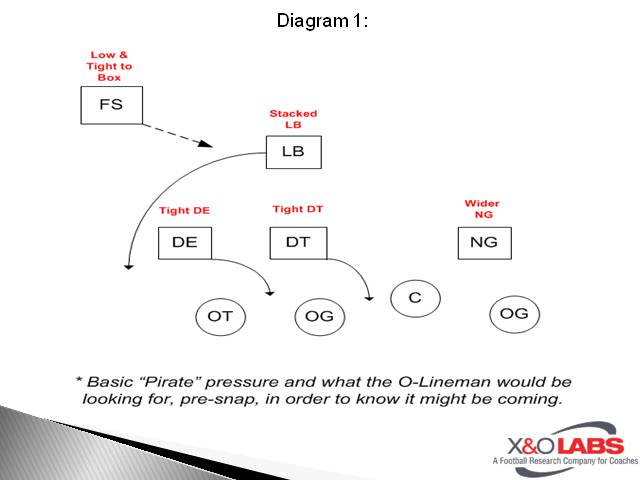
In each case, the lineman will assess the width of each defender in regards to how tight or lose in alignment they are. The linemen must be trained to then turn their attention to the alignment of the LB over him. When assessing the linebacker, the lineman must be sure to account for both the width and depth of LB’s position.

Assessing these three points will provide the lineman with a base understanding of what could possibly be occurring on the other side of the ball. In order to further his knowledge of the defense, the player must take his assessment to the next level and process more than just those three points, two hard defenders and one linebacker. 

Once they get a handle on understanding those three points, we teach our players to assess their entire half of the defense. This would mean reading the pre-snap alignment of all the hard defenders (including opposite NG for the guards), linebackers and safeties on their side of the ball. Each individual lineman’s ability to process the alignment of these defenders will unlock the defense’s intentions (most of the time), giving your linemen the advantage.

What can the defenders do from that alignment?

After processing the alignment of the defenders, linemen will have a very good understanding of what the movement or pressure the defense is about to employ on any given play.  At this point, the alignment information will converge with what each lineman has learned through the week of preparation and film study. In most cases, our players will have a very good idea what tactic the defense is about to employ based on the details of the alignments against our particular formation. This information helps the player make decisions about what tools to use (next step).  The best part of this process is that over time we see our lineman being able to apply this knowledge of defensive structures on the fly. In some cases, they not need much specific film study to understand by pre-snap alignment what the defense is about to do. When your lineman get to that point, your offense is going to be able to able to adjust to almost anything in game situations.

diagram1

What tools are needed to solve the problem presented by the defense?

The last step in training the eyes to unlock the defense is what “tools” are needed to solve the problem that is being presented. This speaks specifically to the individual lineman’s choice of footwork and what steps he will use on his angle of departures to allow him to be the most efficient. Of course, every blocking scheme or concept we teach has a certain base set of footwork principles to go along with it. However, it is critical for us to teach the player that the footwork often is and should be based off of the defender’s alignment. That is where the technique meets the situation and the player must learn to make the small changes needed to address the scheme.

How this relates to our most proficient run scheme: Middle Zone Scheme

We use all of these processes to design our Middle Zone concept, which has averaged over five yards per play the last two seasons. Once my linemen are able to understand the relevance of these questions, they are able to transfer that knowledge into successfully blocking our Middle Zone concept, which is detailed in its entirety below.

The Mid Zone is an underutilized concept in college football today. Most Zone attacks focus on and are structured to attack the Inside Zone , between the tackles or Stretch concept attacking  a landmark outside the tight e

Read More

Villanova’s Dig-Drag-Post Concept

By Brian Flinn – @Coach_Flinn

Wide Receiver Coach

Villanova University


vufbEditor’s Note:Brian Flinn returns for his ninth season as Villanova’s wide receivers coach in 2013. Flinn will also oversee Villanova’s national recruiting efforts as the program’s Recruiting Coordinator for the fourth straight season. He is currently in his second stint on the Main Line. He was previously at Villanova from 2000-01 where he coached the tight ends and assisted with the offensive line. His specific recruiting area will consist of Western Pennsylvania, Ohio and Northern New Jersey.

In 2010, Flinn helped guide junior wide receiver Norman White to a breakout year. White made 69 receptions for 886 yards and 11 touchdowns en route to first team All-CAA honors. Last year, White earned All-CAA accolades for the second time in his career when he was a third team All-CAA choice.


Introduction:

In the pantheon of the great drop back-passing concepts there is a special place reserved for “Dig-Drag-Post” (DDP).  Along with classics like Stick, Snag and Smash, DDP was one of the first pass plays many of us learned, ran, drew up or broke down.  It is a classic “Touchdown-Check down” read that was run so often by so many it earned the deserving nickname “NCAA”.  Unfortunately for DDP, over the past decade as we began to pare down our passing game to a small number of base concepts D-D-P was deemphasized and almost completely taken out of our plans.

During the past couple of seasons DDP has enjoyed a renaissance as a compliment to our intermediate passes out of empty.  This “pro-style” concept has returned as a staple play out of the most spread out of our formations.  The results have been outstanding, with the rebirth of the “NCAA” pattern in our passing came as a way to attack down the field and underneath. This article will break down three different examples of our Empty DDP, and discuss both the scheme and how we read it here at Villanova.

Dig, Drag, Post from Boundary

In our empty formations we have historically thrown the ball in the short and intermediate zones.  Dig-Drag-Post gives us a deep rhythm throw for the quarterback and the chance at an explosive play out of empty.  This allows us to take a shot down the field versus aggressive safeties who try to drive on the dig.  Our quarterback will look first to the post at the top of his drop (Red #1).  If the free safety (deepest defender circled in green) steps down to cover the dig and leaves the post uncapped/uncovered deep, the QB will take the deep route when he hits the top of his drop.

Read More

Run/Pass Option: Game Week Installation Progression


By Henry Stanford

Offensive Coordinator

Hiram College (OH)


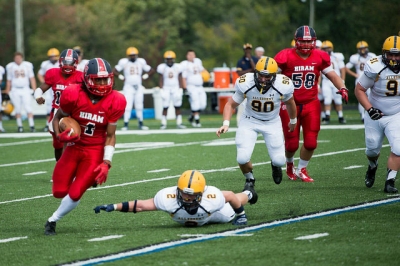
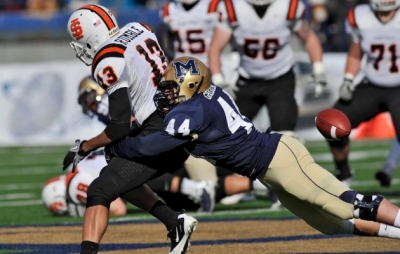
hcgamwWhen it comes to the Run/Pass Option Series (RPOS), you want to spend time preparing your quarterback to become efficient with their reads. This can be accomplished in the classroom, film room and on the practice field. You want to show them a preview of game day early in the week. This article will discuss the process of training your quarterback for game day. The example will follow training days from Monday to Saturday.

Sunday:

On Sunday, you have your opponent’s breakdown from the season and their last game. While viewing the film, take a look at the teams the opponent faced and look for any similar plays that were ran. Since we are looking for reaction of players to play types, look for schemes where the defender has to react.  Based on your breakdown, you will run more than one type of RPOS and select the type of play for your given opponent. We will begin to collect these looks on film to evaluate.

Also while viewing the film, look for any tendencies; such as checking to see if the opponent’s defensive lines are square shoulder vs. turned shoulder, fast shuffle vs. slow shuffle, moving vs. stationary type reaction. Continue to check whether the linebackers are aggressive vs. passive, sliders vs. runners, moving vs. stationary type reaction defenders. Are their secondary aggressive vs passive, eyes in the backfield vs. receiver conscious defenders? After viewing the film, you will be able to determine if they are executing what was taught or, are they just playing without rules.

Read More

Montana State’s 3 Deep, 2 Under Pressure Package


By Jamie Marshall

Assistant Head Coach, Defensive Coordinator, and Secondary Coach

Montana State University

and

Bo Beck

Recruiting Coordinator and Defensive Line Coach

Montana State University


Introduction:

mtsuIn our clinic report, we wanted to share two of our open front, three deep, two under zone pressures.The overall philosophy of this pressure package to be aggressive by bringing six man pressure.
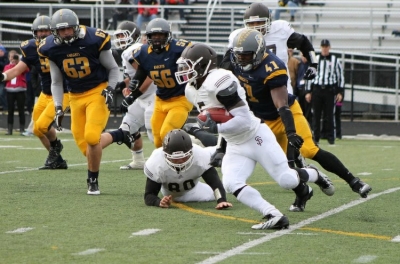
The coverage philosophy is to have five sets of eyes on the QB and be able to break on his intentions; see the run and fit outside in (SCIF players); and have the ability to have “knock down” defenders if the ball carrier is to break free. We believe that these points lend this coverage to be better than a cover-zero man principled coverage. Because we are bringing six, we do not believe that the QB is going to have enough time to look the defenders off; get to his second read, or pump fake the defenders. Both of these pressures are installed as six-man pressure with no peel responsibility, however we do have the ability to tag each pressure to ensure peel contain.

The coverage principal for both of these blitz concepts is a 3 deep, 2 under zone, which remains identical in structure to our base press Quarters coverage scheme. The only difference between the coverages is the position responsible for being the post player and the SCIF players. Our pre-snap structure will look exactly like our press Quarters coverage. This blitz package is a tremendous compliment to our base package. We believe that the simplicity and aggressiveness of these pressures is the reason for their success.

Coverage Player Responsibilities

The 3 deep, 2 under coverage principles are as follows:

Corner:

  • Play bail technique
  • As you bail, work to gain width on the outside WR.
  • You must read the QB and be ready to break on the ball.

The corners are responsible for their deep third. They must use a press-bail technique and have vision on the quarterback, while having an awareness of where their immediate threats are located. We tell them to bail to the outside shoulder of the #1 wide receiver to their side.

Post Player:

  • Key EMOL for run/pass.
  • Versus pass, open up to the inside and push shuffle with eyes on the QB.
  • Your landmark is inside the nearest vertical threat.
  • You must read the QB and be ready to break on his intentions.

The post player will open inside and take two shuffle steps before committing to the post. He will also have eyes on the QB. If the QB throws the ball, the post player must break on the intentions of the QB.  Although he is ultimately responsible for the post, he will lean heavier to his near threat, which will be #2 or #3 depending on the formation. We expect the ball to come out hot, thus allowing him to be slow to the post and read the QB intentions.

Strong SCIF (Seam, Curl, Flat Player):

  • Key EMOL for run/pass.
  • Versus a pass, work to your landmark. Your landmark is inside #2, eight to 10 yards deep.
  • You must read the QB and be ready to break on his intentions.
  • While reading the QB’s eyes you must be able to feel the routes of the near WRs.
  • Versus a run, your fit will be determined by the blitz called.
  • Versus speed option, you are the pitch player.

Weak SCIF:

Read More

Adding Trap to Power Read

By Will Cinelli

Assistant Coach

University of Saint Francis (IL)


Introduction:

sfilIt is astounding how universal the Power Read play has become in such a short period of time. This new innovation has changed the run game at every level of football and has become one of the most trusted weapons in the arsenal of many offensive coordinators. For a long time, it was almost like stealing every time an offense called this play. The defense couldn’t be right! Of course, the guys on that side of the ball are good coaches, too, and have started to catch up. Defensive coordinators have lots of new tricks to stop this play, especially if offenses become over-reliant upon Power Read. That is why we at the University of St. Francis (IL) now utilize the complementary Trap Read play.
Philosophy of Concept:

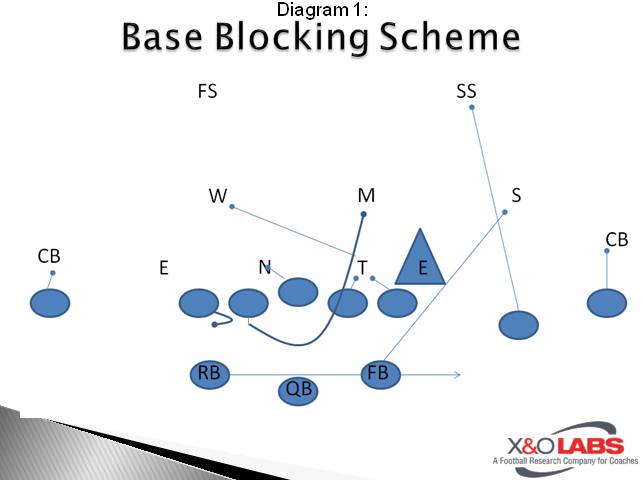
At St. Francis, we had become a big Power Read team. Our quarterback was an excellent runner and we felt the play fit our personnel. Our main two ways of running the play were out of 20-personnel or with some sort of Jet motion. For the purpose of simplicity, my diagrams will be mostly out of the 20-personnel set. We prefer to run the Power Read to an open side (with no tight end attached to that side of the formation), so that we can read someone who is closer to the quarterback. We feel that this makes the read easier and quicker for the quarterbacks and reduces the “gray area” of the play. We have always had the rule “give… unless” for all of our read game, whether in Zone Read or Power Read. We want the ball to be handed off unless the quarterback is sure that his read will make the tackle. Then, he can keep it (Diagram 1).

Slide1

Why the Trap Read Instead of the Power Read?

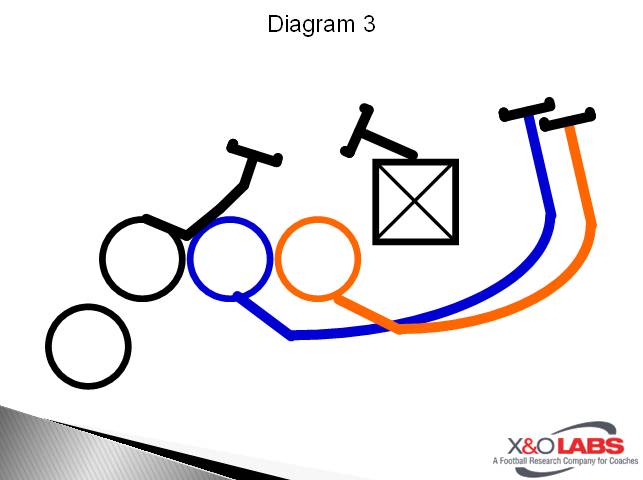
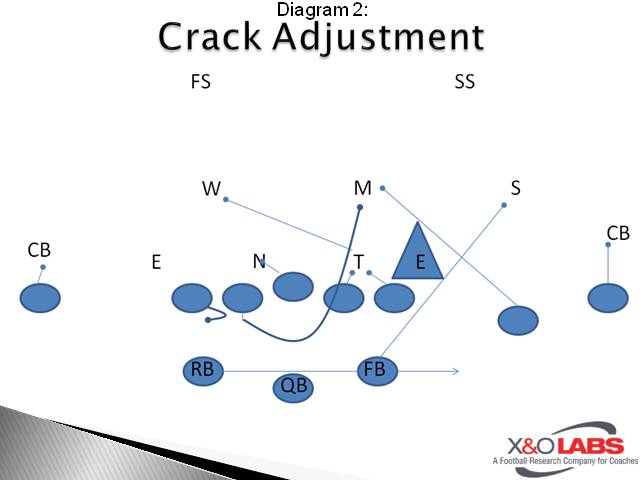
We had tremendous success with this play for a long period of time. As I mentioned in my introduction, though, defenses began to understand the play better and now do things to take it away.The biggest problem was when the defensive end would tackle the dive (in this case the quarterback) and the play side linebacker would scrape over the top and chase down the give. This requires tremendous discipline by the defensive end to always do his job and come flat down the line every time. But, as the Power Read play has become more popular and defensive coordinators have dedicated more time to practicing their defensive responsibilities, they have also become better at this defensive technique. This was especially problematic whenever we would run Jet motion, a crucial component of our offensive system. The linebackers would already be moving naturally with the flow of the motion, which allowed them to get a running start. As long as the defense had a good athlete at the play side linebacker spot and correctly executed their responsibilities, they could limit the amount of success we had with this play. We would “crack” the box with our receiver to that side. This enhanced the effectiveness of the play (Diagram 2).

Slide2

As we continued to run the play, linebackers got even better at shooting the gap and attacking the outside give. Sometimes they would scrape so tight to the edge of the box that our slot receiver could not get there. There were times where we did block him but it would happen so close to the runner that it would bounce the play outside and allow the rest of the defense to rally and make the tackle for a minimal gain.

Read More

Double Wing Power: 7.5 Yards Per Play


By Michael Harrison

Head Coach

Wilde Lake High School (MD)


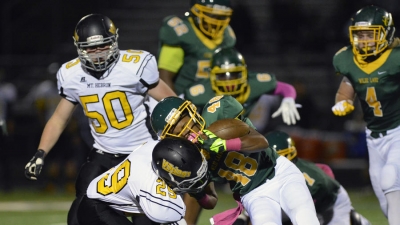
wlhs1For nearly twenty years, Wilde Lake had run a Bone offense with the Power as the base play. During the 2006 season our coaching staff felt like we had hit a crossroads and made a switch to the Double Wing offense again with the Power as the base play. Since changing to the Double Wing Wilde Lake has averaged 3,000 rushing yards and 31 rushing touchdowns per season. 
For teams looking for a physical style offense, the Double Wing has its advantages. In the base formation, double tight end double wing, a defense must account for 10 gaps on the line of scrimmage creating stress on a defense’s run fits. Smaller, quicker lineman can excel in the offense due to the high use of pulls, double team and down blocks. The Double Wing combines both power and deception in its play series. Where a Spread style offense gets the ball to multiple athletes by throwing the ball; the Double Wing allows multiple athletes to run the ball. Perhaps most important, the Double Wing is not a quarterback dependent offense. The Double Wing thrives with physical quarterbacks, great passers, or great runners. The offense has its critics, but when executed properly it can be very difficult to stop.

There are several core plays in the Double Wing offense, but the Power is always our first install on day one. The play combines a single blocking rule that accounts for multiple defensive fronts and stunts, with a double team block at the point of attack, and mass at the point of attack through the use of several lead blockers. The ability to run Power to every back out of multiple formations has made the Power play the foundation of our Double Wing offense. Our goal is to be able to run Power against any defense at anytime – when in doubt run Power. In fact over the past seven years we have called Power over 40% of the time and have had games where the play was as high as 60% of our plays called.

Power Fundamentals:

Our linemen are split six inches across the front and have their helmets on the hip of the center. We emphasize with our linemen that we want to tighten up our splits and never crowd the ball. The desire is to have more room to adjust and pull at the line of scrimmage. Our experience is that many teams will crawl, dirt dive, or attempt to hold our linemen after the snap; so being backed off of the ball eliminates a lot of the advantage a team gains using those tactics. We do not switch sides with our linemen, so they must all learn the play side and back side blocking assignments and techniques. Early in the season we drill the blocking scheme by presenting different defensive looks to our players. We call this period “Power Hour.” We start in a front and run the Power play to perfection. When the blocking scheme is mastered a coach will add a 12th defender to the defense without informing the offense. When we are successful another defender is added. We have mastered the Power while blocking 14 defenders at a time. Most of the time our players do not notice the extra defenders until there is an unblocked safety on the third level of the defense. This is a great way to prepare athletes for success. Imagine the confidence that your offense will have after successfully executing a play versus 14 defenders. Our Power blocking scheme is essentially a Gap blocking scheme as shown in the table below. 

Power Assignment and Blocking Rule

PSW

POA (Point of Attack): Block the most dangerous 2nd level defender inside of the point of attack usually the first linebacker to his inside.

PSTE

IHP (Inside, Head up, POA): Block any 1st level defender inside (this usually creates the double team), or block any 1st level defender head up, or block any 2nd level defender inside of the point of attack. Remember we are kicking out the last man on the LOS with the FB.

PST

IHOP (Inside, Head up, Outside, POA): Block any 1st level defender inside, or block any 1st level defender head up, or block any 1st level defender outside, or  block any 2nd level defender inside of the point of attack. His eyes must remain inside to prevent linebacker run throughs.

Read More

South Dakota State’s Arm-Pin Move for Pass Rush


By Jesse Currier

Defensive Tackles and Recruiting Coordinator

South Dakota State University

Twitter: @coachjcurrier


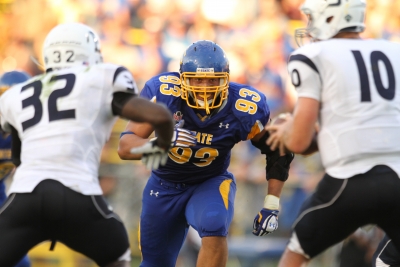
sdstateIntroduction:

At the defensive tackle position, the top priority is always having guys that are physical at the point of attack vs. the run. The commonly used phrase, “You have to earn the right to rush the QB,” will always hold true because most teams will continue to run the ball until you prove you can stop it.

With that being said, disruptive pass rushers on the inside can change a game and force offensive coordinators to adjust their pass protection schemes.

At South Dakota State University, we have been very fortunate to have some gifted pass rushers on the interior of our defensive line. We have had a different defensive tackle finish the season with at least six sacks in the last three consecutive seasons. The most successful of those pass rushers led all 2013 Missouri Valley Football Conference linemen with nine sacks.

Fundamentals of Pass Rush:

When teaching pass rush, there are four fundamentals that we focus on. These fundamentals are not specific to the defensive tackle position, but they are an essential starting point.

  1. Eyes:  The area that young players struggle with the most is their eye discipline. The biggest reason for this is they were able to be successful at the high school level simply by over-matching their opponent. The natural reaction to a pass read by a young lineman is to get their eyes to the QB immediately. The coaching point that has helped guys understand the importance of where their eyes are is by relating it to a boxing match. You cannot hit what you don’t see. If you are looking at the QB, you will get punched by the blocker and not be able to react because you don’t even see the hit coming.
  2. Hands: Violent and quick hands are an invaluable asset when rushing the QB. As a pass rusher, we want to avoid getting locked up with a blocker. We want to attack the edge of blockers and keep their hands off of us. In order to do this, we must always have our hands ready. Relating it to boxing again helps. When you are throwing a punch you can’t wind up and swing wildly. You have to be compact, quick, and violent. The other key aspect to using your hands when rushing the passer is that your hands and feet need to be tied together. We use the common coaching point of “same arm, same foot.” This is something that needs to be drilled consistently because it is a very unnatural movement.
  3. Hips: An indispensable attribute for successful pass rushers is hip flexibility. A pass rusher’s ability to rotate their hips accomplishes three things. The first is that it reduces the surface area for the offensive lineman’s block. The second is that it generates more force when striking the blocker’s arms. The last benefit to hip flexibility is that it enables pass rushers to square up the quarterback when they come free. Many opportunities for sacks are missed because the rusher is unable to get their hips to the quarterback and they are left reaching out to grab with one arm.
  4. Feet: The key coaching point for feet is that you don’t want your feet to come together or cross over. The reason for that is we don’t want to be off balance when the blocker tries to punch.

Once we have established the ground-work of fundamentals, we work on trying to find what is going to be the most successful go-to move for each guy. I encourage guys to find one move that they feel comfortable with and focus on refining that move every day. We will introduce and drill a variety of moves so guys have options, but I guard against trying to be a ‘jack-of-all trades’ when it comes to pass rush.

Read More

Split Screen: Adjusting Perimeter Blocking Landmarks

By James Guest

Former Offensive Coordinator and Quarterback Coach

Cocoa Beach Jr./Sr. High School (FL)

Current Running Backs Coach at the University of Tennessee – Martin 

Twitter: @j7guest


Introduction:

guestscreenGoing into this past season we knew that based on our physical size and numbers that we had to be very multiple by look, yet very simple by concept. We had a few guys that were dangerous with the ball, but a very young and inexperienced offensive line that would not be able to handle the load. So the mindset of, “If you can’t block them…then don’t,” crept its way into the playbook.

We started out as an 11-personnel (1RB, 1TE) Pistol/Shotgun zone read offense coupled with a sprint out and quick passing game with a 65 to 35% run/pass ratio. After a handful of key injuries we transformed into a full 10-personnel (1RB, 0TE) spread attack where the ball saw more flight time at more of a 45/55% pass ratio. Did we throw it more? Sure. But the way we did was unique. We had a crafty 5’ 11” 150 lbs. athlete taking his first snaps at QB who finished with 1,804 yards and 18 touchdowns. More than half of those yards were produced by our multiple screen game. This is how we did it.

Roger/Larry WR Slip Screen:

This is our wide receiver slip screen. I’m sure quite a few of you carry some variation of it on game days. We used this screen and its rules as a template to become more multiple. This is how we broke it down…

Note: We had a left handed QB, so “Larry” was the most popular.

Q:

Roger: Quick ball fake, retreat two steps, high release soft arching ball thrown at LOS.

Larry: Small open step, cross over and plant. Swivel head to target while retreating two steps, throw a soft arching ball at the LOS.

T:

Based on tagged play action.

Y:

45-degree spring block. Nearest 3rd level defender.

Z:

45-degree spring block. Far 3rd level defender.

M:

Read More