The Five Actualities For Installing Non-Traditional Tampa

By Mike Kuchar
Co-Founder & Senior Researcher
X&O Labs
@MikekKuchar


This veteran Power 4 DC (I won’t reveal his identity) has been playing some form of Tampa Two since the early 90’s. Much respect! For this coach, it was an answer for wishbone offense so that corners can play the pitch and the middle safety can run the alley as an extra QB player. While he learned it as an option coverage,  most of the coaches I spoke with putting together this report have adapted it as an all-down coverage. So, when I finished putting together our study on Non-Traditional Tampa, I figured he would have some input. Boy, did he. After first telling me that “Tampa is the easiest sh** there is to install,” he went about highlight what he felt were the five vitals in installing the coverage. Enjoy his perspective. But before you do that…some important pieces of clarification.


Why it’s Not Traditional Tampa:

Before getting into what makes this coverage so adaptable, let’s clarify what it is not:

  • It is not a pure three-safety defense (at least pre-snap), although it will transform into one post-snap.
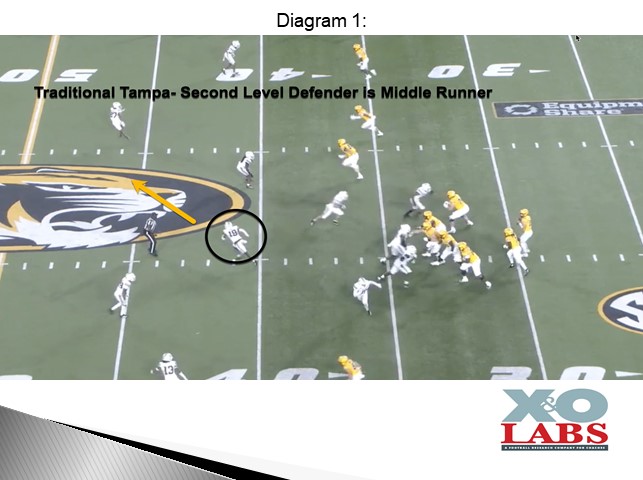
  • An inside linebacker is not used as the middle runner


“Non-Traditional” Tampa: The Definition:

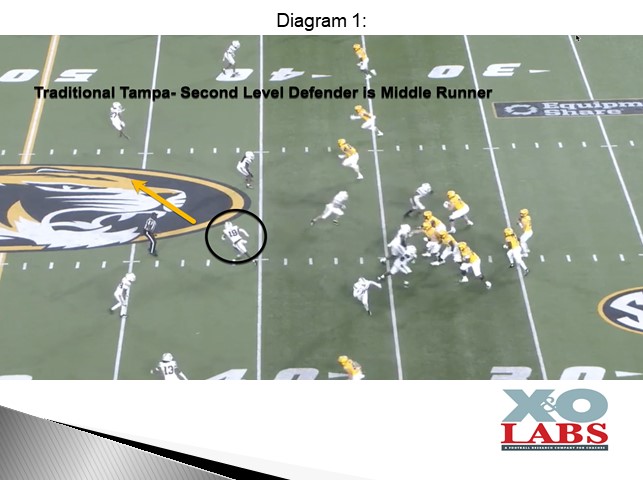
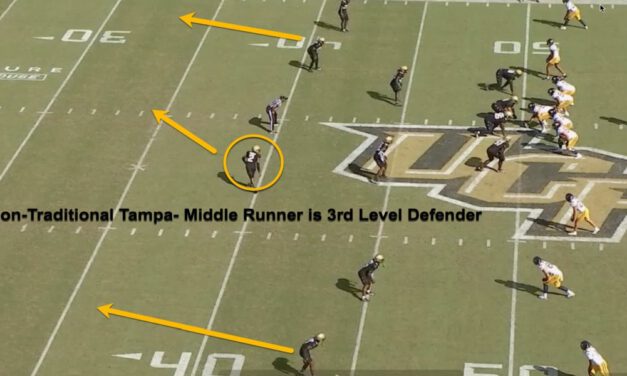
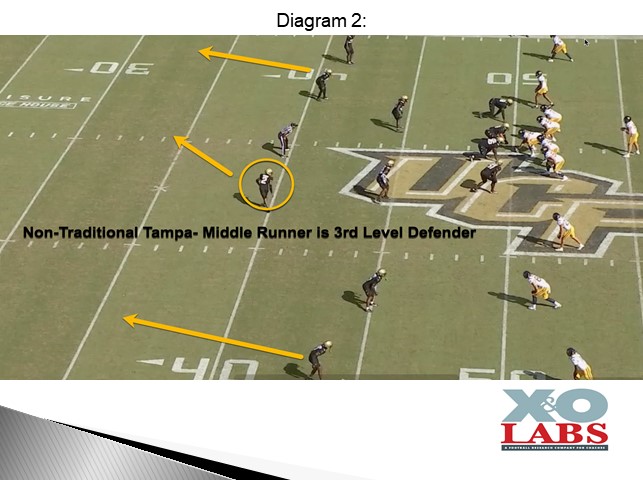
The difference in “Non-Traditional” Tampa is that the middle runner cannot be an inside linebacker, it must be a third-level defender (Boundary Safety, Free Safety or Nickel). I’ll explain why that’s important later. As you’ll notice in this study, this coverage is used in both static four-down fronts and simulated pressures with the purpose to show one-high looks as much as possible.

Inside the full report a Power 4 DC who’s been running Tampa for more than 20 years will walk you through exactly where the “bodies are buried” when you install this coverage, where the pain points are, and how to protect against them. Log in to get his full breakdown, including:

  • The single biggest myth about NTT he flatly dispelled — and the run-fit math behind why two of our sources are playing it on more than 50% of downs next season, regardless of distance.
  • Why this veteran breaks from the crowd and refuses to hard-call the coverage — and the split-based rule he hands his players instead.
  • The teaching philosophy he uses in place of landmark drops entirely — and why he’s convinced it clouds the QB’s vision better than anything else.
  • The two route concepts that give NTT the most trouble — and the precise middle-runner and corner techniques he teaches to take them away.
  • The depth and read progression he coaches for the middle runner so a defender can diagnose run/pass without over-running his landmark.
  • The one pre-snap presentation you MUST pair with NTT — even if you’re not a man team — and how he disguises it snap to snap.


Read More

Loaded Presentations: How to Manipulate the 4-Man Slide

By Mike Kuchar
Co-Founder/Senior Researcher
X&O Labs
@MikeKKuchar


“Who knew that by keeping our base pressures and moving one defender over six feet would have such a significant impact on our hurry and sack ratio?”
– anonymous FBS Defensive Coordinator


If you can’t dictate the protection, then you’re not going to beat it. And if you can’t dictate the protection, then why do it? That was the attitude of the many coaches I’ve worked with in this loaded presentation study. The entire premise of using these loaded (three-to-a-side) fronts is to declare the protection and beat it. How you beat it is the beauty of these loaded presentation tools.

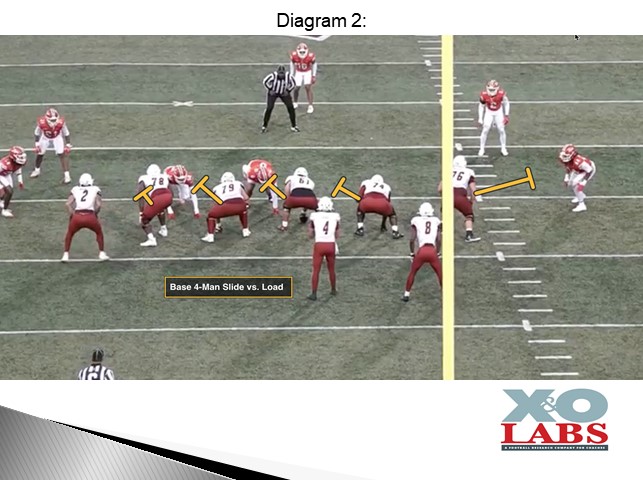
For clarification purposes a presentation is a pre-snap picture, not a post-snap movement — built to force the offense to declare and slide its protection so the defense can attack the isolated (man) side away from it. “There are only so many ways you are going to protect it,” said one of my sources. He’s right…and these are the only ways:

  1. Four-man slide
  2. 5-0 it on the most dangerous rusher with the back scanning the other LB or the boundary blitzer.
  3. Full side it one way or the other and put the back on the end and plan that you will drop the end.


I will tell you though that after studying over 300 clips of loaded front presentations from this season, the most common way offenses are protected is by forcing the offense to generate a four-man slide and then exploit it using a four-man rush.


Why The 4-Man Pass Off?

You want to generate a four-man pass off to the slide side of protection. Most of the time, the offense is forced into tying the open side Guard into the slide side of protection, generating a four-man slide and leaving the backside Tackle on an island by himself (we’ll get to that later).


That being said, it’s the job of the defensive coordinator to study how that protection works against the front and more importantly, where the weak link is in the protection and how you can affect him. One of the more insightful tidbits that were revealed during my research were these “essential questions” that every DC should ask before implementing these loaded presentations (hint…these same questions we will have answered by the time you’re done reading the report):


Loaded Presentation Essential Questions:

  1. Do we want to attack the personnel or the protection?
  2. Do we want to attack the protection without pressure?
  3. Do we want to line up in these fronts and bring a field or boundary pressure because an offense struggles in space even though they can protect it?
  4. Do we know how the QB will move with pressure in his face? In which direction will he escape? How accurate is he when he doesn’t set his feet?


I’ve found that those are the cornerstones of how to build out these loaded front presentations. In this report, I’m going to take you through how some of the sources I spoke with worked through each of these scenarios on their way to exploiting these four-man pass offs.

And when it’s all said and done, you’ll be able to track the efficiency of these loaded front presentations by using the guidelines below:


Efficiency Definitions:

You’re going to need to measure your efficiency using these loaded presentations. And here are the top questions our sources answered when breaking down the efficacy of these loads:

  1. How many times did he get hit?
  2. How many times did he get picked up off the ground?
  3. How many times did he change his launch point?


Ok. I’m ready to dig right into my findings. But, first, a very important note:

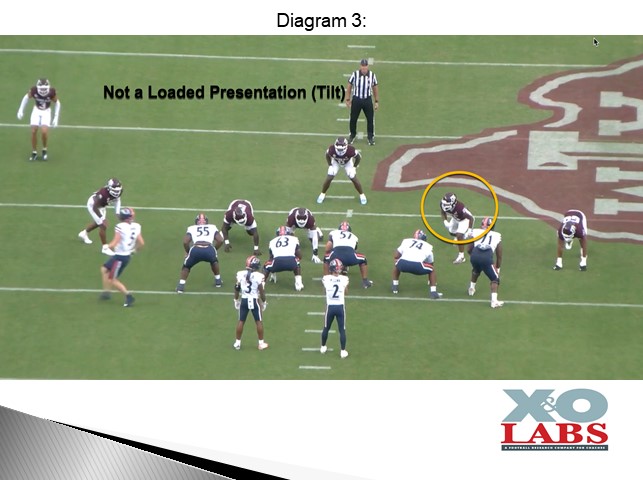
A Very Important Note: This study is built around three-to-a-side (or tilt) fronts. That does not include any away-side mug looks that some coaches still refer to as “loaded presentations.”


Those presentations will be the focus of another install and almost always ensure a 5-0 protection scheme. Therefore, they need to be treated differently.


Introducing…X&O Labs Install Anthologies: Loaded Front Presentations

These Loaded Front presentations – including the complementary pressures that are built off them- are included in our Installation series. It’s a new series designed to prepare you with everything you need to know installing and utilizing these loaded presentations heading into this season and its exclusive to our X&O Labs members.

Here’s what you find in the full report (login below):

  • Declare and dictate the offense’s protection before the ball is snapped — forcing the center to slide 93% of the time — so you pick the side you attack instead of guessing.
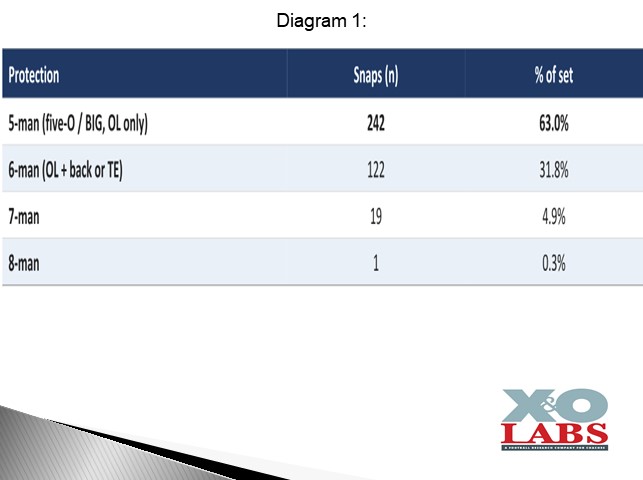
  • Beat six-man protection with a four-man rush and still get home, using the simulated-pressure library that made up 64% of our entire study.
  • Isolate your best rusher on the offense’s weakest protector — an edge on a struggling Tackle, or your top blitzer matched up on the back.
  • Install the two build-ins that manufacture the four-man pass off: pressure to the load and pressure away from the load.
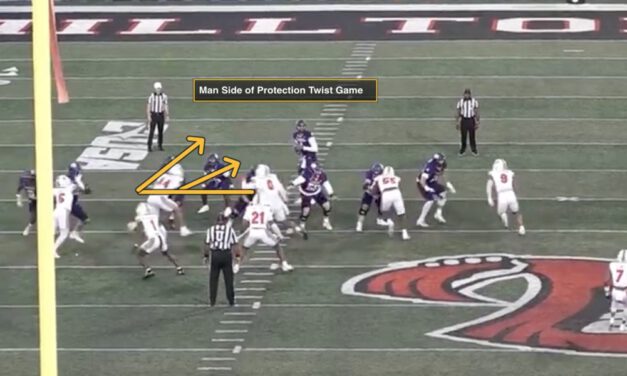
  • Add the man-side and zone-side twist games — up-and-under, pick, and loop rushes — that turn the Tackle and attack the interior gaps, where pressure gets home two-tenths of a second faster.
  • Turn this into your third-down “get-off-the-field” call and measure its efficiency with the exact benchmarks our sources used.
  • Layer the concept four ways — to the boundary, to the field, to the back (“Buick”), and away from it (“Audi”) — so it keeps working when offenses adjust.


Read More

Sacred Heart’s Q Duo and Duo Read Package

By Mike Kuchar with Brad Tiernan
Offensive Line Coach
Sacred Heart University (CT)
@CoachTiernan


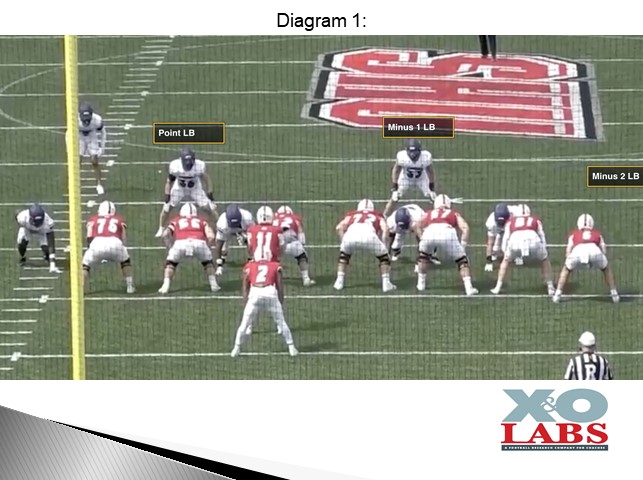
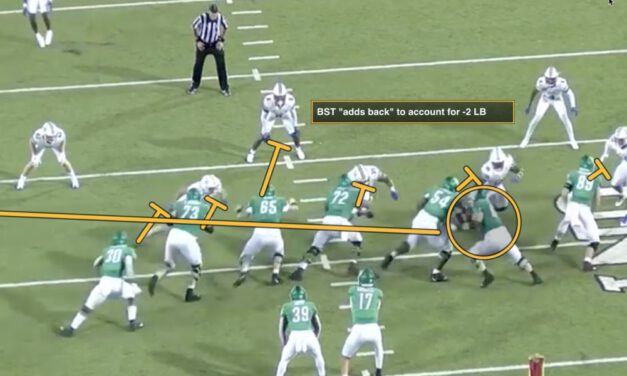
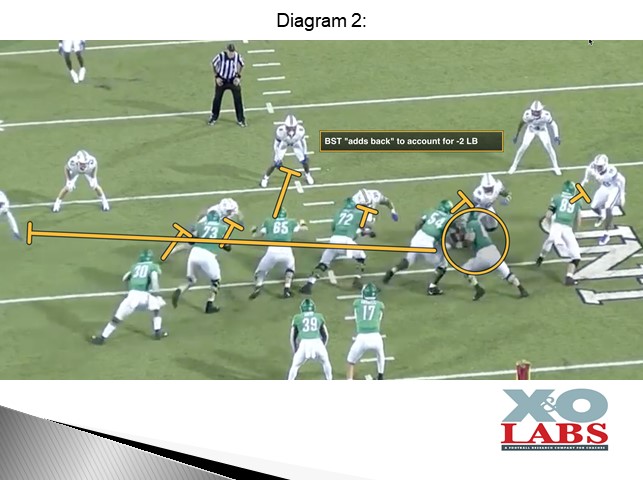
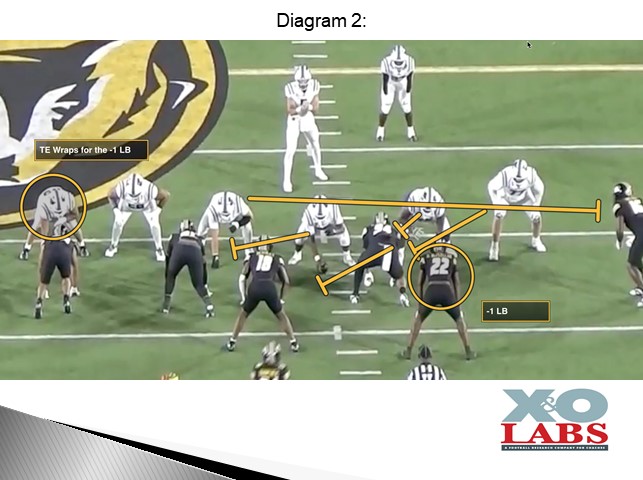
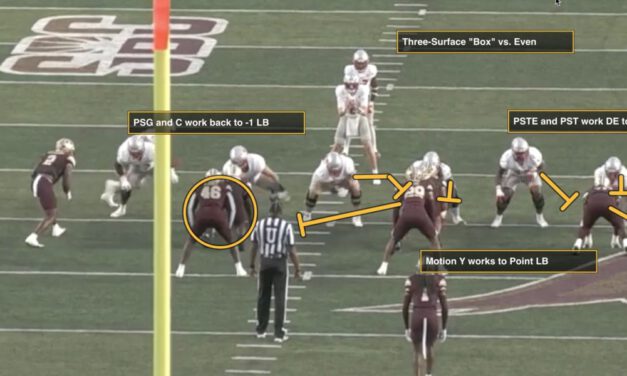
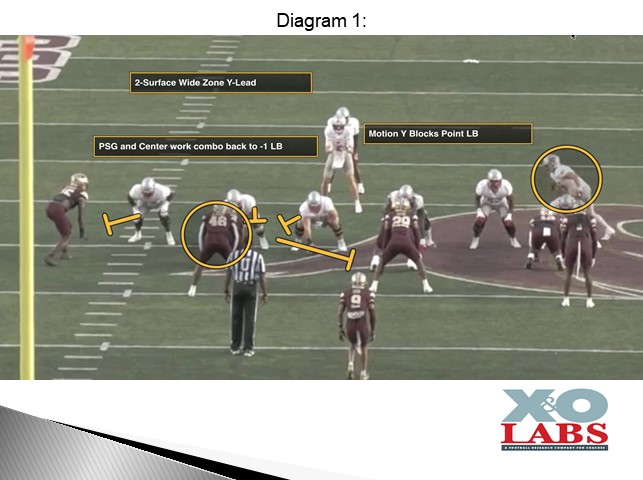
Gotta keep it simple for the big boys up front- we all know that as offensive line coaches. So, for the Hogs in Fairfield CT, Duo is inside zone and inside zone is Duo. The expensive piece in these concepts comes with educating the tight ends and running backs on their roles. When the offensive staff design the Q Duo and Duo read principle, it’s treated like inside zone. So, against four down structure the first combination works to the Point LB, the second combination works to the minus one LB and the third combination works to the minus two LB.


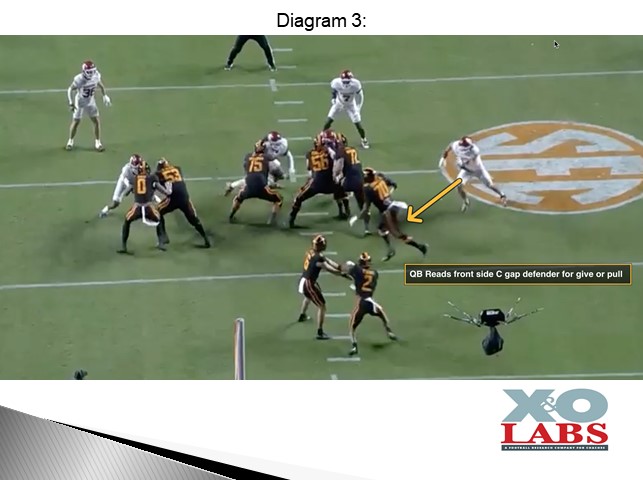
Now, the uniqueness of the scheme comes with how the staff is manipulating the edge of the surface. Sacred Heart has two different concepts off its Duo play- one is a read concept and one is pure QB Duo. In the read concept, the staff can tag it as a C gap, D gap or E gap read from the sideline. Or, the QB can make a call based on who they read to give us the best numbers. “We try to deploy the tight ends to put us in the best situation,” said Coach Tiernan.

The other concept SHU pairs its Duo scheme with is pure QB Duo, when the back blocks his responsibility for the QB run. There is no read in this concept.

That’s the framework. The rest of the report gets into the details Coach Tiernan uses to make both concepts work — the rules, the reads, and the film. When you log in, you’ll get:

  • The one blocking assignment that makes pure QB Duo work without a read — including where the back must hit his entry point to force second-level backers to trigger downhill faster.
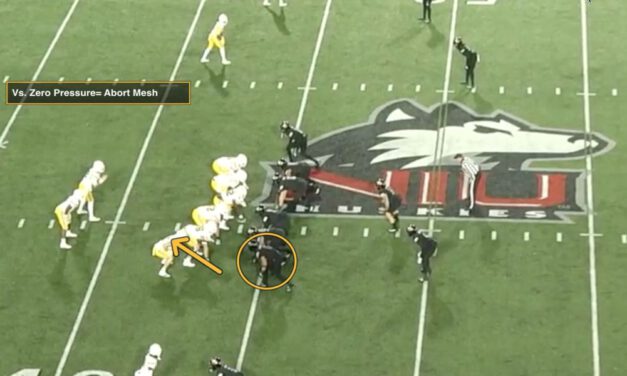
  • The single pressure indicator that tells the QB to abort the mesh immediately — and exactly where the back goes when it happens.
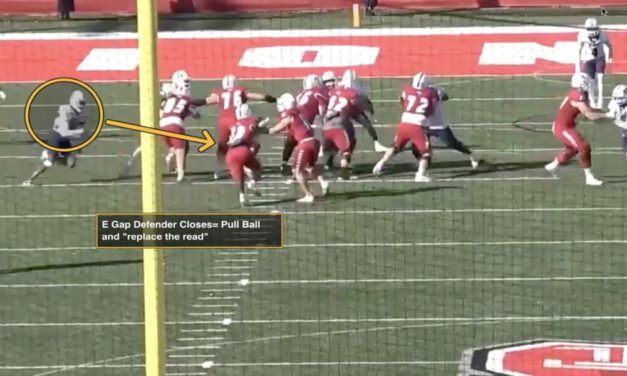
  • How SHU tags C gap, D gap, and E gap reads from the sideline to manipulate defensive personnel and structure — plus the one non-negotiable coaching point for the QB anytime he pulls the ball.
  • The two E-gap looks where the QB should still give the ball — even when most staffs would coach a pull — and why Tiernan trusts the give in both.
  • The arc answer SHU built for dominant 5-techniques who were closing down the dive at the line of scrimmage.


Plus, you’ll get five pieces of game film in our Film Room — raw cutups of QB Duo and each read principle, along with the full narrated breakdown of the entire package.


Read More

Full Install: Duo Pull Variants

By Mike Kuchar
Co-Founder & Senior Researcher
X&O Labs
@MikekKuchar


“To the offense it’s Duo, to the defense its gap scheme and to the football population it’s a complete misnomer. You’re not going to find this scheme in a category in PFF.”
– FCS Offensive Line Coach


The genesis of these Duo pulls variants are directly aligned with the advent of Mint fronts. You’d have to trace it back three seasons ago when these 4-0-4 fronts defenses were all the rage in football. The cancellation of gaps at the line of scrimmage completely stymied the efficiency of tight zone or Duo runs and the ball would get pushed out to a Nickel defender for a gain of a yard.

So, credit should start in the Art Briles coaching tree, where these staffs started to pull the play side Tackle (or Guard based on front) to gain numbers back to the offense. It was a simple solution to a complex problem. This is the story of those programs that benefitted from using it.


But First…A Clarification on Duo vs. Tight Zone:

Asking a coach if they run Duo or Inside zone is like asking a basketball junkie who is better, Lebron or Jordan. Most coaches equate Duo with inside zone and vice versa. While there are completely valid similarities to these points, I’m just giving you the definition: Duo is a run game built off a guarantee of two double teams at the line of scrimmage, thus the term “Duo.”

There were sources I worked with that called this inside zone and others that called it Duo. And when used from multi-surface alignments, there is a distinct possibility of generating up to three double teams at the point of attack- or what’s known as the backside- of the play. It is exactly what makes the play so dynamic. Bodies on bodies, vertical movement at the point of attack and a back that is able to bend the ball back by reading the backside linebacker. It’s a perfect marriage for lovers of running the football.


The play feeds on light boxes and dies against “no-double-team” fronts

Because duo is a double-team scheme, it needs a defender to double. Against a 6-man box it averages 9.35 yards and goes explosive 30.7% of the time; against an 8-plus box it drops to 6.80 and 15.8%. And the only fronts in the whole library that hold it under ~5.3 yards are exactly the ones that take the double teams away — Bear (5.30) and Double Plug (5.05) — because everyone is covered and there is no one to combo. This is the single most important defensive cross-reference in the file, and the coaches name it independently:

So, the reasoning of these Duo pulls are simple: if you’re not going to get double teams, and the opportunity presents itself to pull an additional lineman to the entry point of the play then by all means do it!


“The Explosives Live in the C and D Gap:”

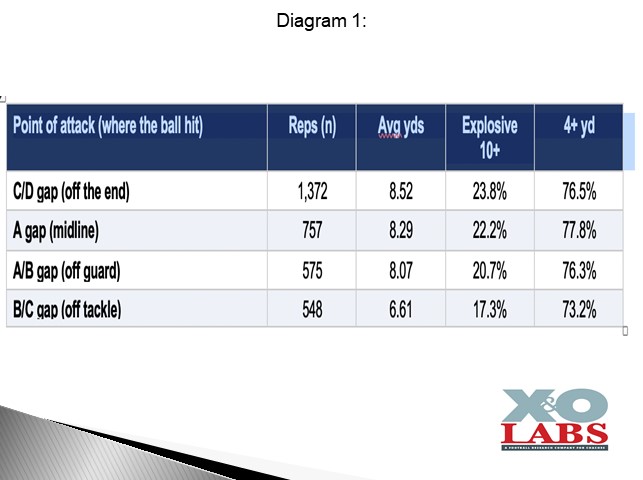
Harvard offensive line coach Jim Jackson states it flatly: “that’s where the explosives are in duo, coach — the C and D gap.” Our charting and analysis agrees. Sorting all 3,260 reps by where the ball actually hit, the edge (C/D gap) is both the most common point of attack (1,372 reps) and the most productive (8.52 yards, 23.8% explosive), while the B/C gap behind the tackle is the weakest landmark (6.61, 17.3%).

We are all doing everything we can to secure the cutback (spray) in Duo because hat’s where the explosivity lies. That’s not an assumption. The sweet spot in Duo seems to fall within the backside (or what coaches call the frontside) C or D gap. When Duo hits in the C gap it averages over 13.8 yards a play, and when it hits in the D gap it averages 13.5 yards a play. Fact is  63% of all Duo explosives hit in the D and E gaps.


If you’re familiar with the structure of the Duo play, then you know that the common denominator in efficiency lies in allocating more hats to the concept’s backside (which becomes the front side). Duo’s beauty lies in its flexibility. Unlike traditional gap schemes, your back can press, bend, and bounce based on the reaction of the backside linebacker. Our data shows that when backs are forced to redirect, they are often finding the explosive crease.

Duo is built off the backside because that’s where the entry point of the back lies.  Defenses know that too, so they do everything they can to tighten gaps and add hats to the backside, which includes dropping safeties, plussing linebackers and rotating coverage to eliminate the cutback. So, offensive coordinators had to pivot and think outside of the box by building in tools to secure the cutback. And there is a small, select group of coaches that are choosing to use these pulls to protect their beloved Duo run scheme.

Before I get into exactly what this play is- and how to install it, allow me to educate you on what it’s not. Sorry, Twitter trolls. This is not from my language. It’s from the language of those coaches that have installed the scheme.


Why It’s Not True Tight Zone or Duo:

This concept looks completely different to the defense because you’re bringing an extra hat to the backside of the play. So, the defense has to find a way to account for that extra hat. Quite simply, it looks like a gap scheme but fits like a zone scheme. So, defenses can’t find a way to fit it.


Why It’s Not Power:

In traditional terms, the power concept is designed where a puller accounts for the play side backer and there is some type of pre-snap control- RPO, etc.- to handle the edge defender. In these Duo pull variants, the edge is handled by the read of the quarterback with the purpose being to create something where the QB can hand the ball off automatically.


Why It’s Not Tackle Trap:

This concept is not a Tackle trap for the following reasons. This concept is only run to the three or four surface formation side where combinations are taught as zone combinations and not gap combinations. This is different from a Dart concept, which is traditionally run to the two surface side. Again, the back is on a downhill A-gap track, which would contradict a typical gap scheme track.


The beauty of utilizing Duo with pulls is two fold: you can keep the vertical-style combinations to the backside of Duo, and you can add a body to the play side without wasting him to the front side.  Now, I’m ready to show you exactly how these programs are building these Duo pulls into their offensive system and how they are alternating who the pullers are based on the defensive front.

Now that I’ve clarified the bones of the play, these are the stories of the programs that have used it with a great deal of success the last couple of seasons.


Introducing…X&O Labs Install Anthologies: Volume 3: Duo Pull Variants

These Duo pulls are included in our Install Series. It’s a new series designed to prepare you with everything you need to know about installing and utilizing these Duo concepts heading into this season, and it’s exclusive to our X&O Labs members.

In the full report, you’ll get everything you need to install these Duo pull variants in your program:

  • Get the full install from three programs — William & Mary, Harvard, and Villanova — that turned Duo into a Mint and Odd front killer, including exactly which lineman they pull and how that changes based on the front.
  • Add a hat to the play side without touching your Duo combinations — so you’re layering onto the scheme you already run, not installing a new one.
  • Get the four teaching rules our sources agree on for keeping the double team intact long enough to spring the explosive — including the cue one coach calls “smelling the breath of the linebacker.”
  • See how Harvard packages Power and Duo off a single read, and how the call flips between the two based on where the minus-one linebacker lines up.
  • Walk the build-in layers — Arc Tags, the Guard-pull switch, QB Duo, and the full Power/Duo marriage — each rated 1 to 5 for install difficulty so you only put in what fits your menu.
  • Solve the 3×1 force-defender problem that stalls most Duo teams, plus a built-in answer to weak-side pressure that doesn’t cost you formationally.
  • Watch it on film — cutups from William & Mary, Tennessee, and North Texas running every variant in The Film Room.


Read More

Full Install: Non-Traditional Tampa

By Mike Kuchar
Co-Founder & Senior Researcher
X&O Labs
@MikekKuchar


“Invert defenses now have trumped quarters because of the transfer portal or the way that football has evolved. We have now said screw it; we will play this on first down. If you run the ball for four, we figure you won’t do that all game.”
– Power 4 Defensive Coordinator


This isn’t your grandfather’s Tampa coverage. The late great Monte Kiffin is longer on the whiteboard and Brian Urlacher is no longer on a dead sprint to the middle of the field as Mike backer. This is the new Tampa, the non-traditional form where a third level player is tasked with being the middle runner to not only handle vertical pipes but also be an extra fitter in the run game. And it’s no longer a tool on 3rd and 10 to get an offense to throw the ball short while the defense can rally late and get off the field.

This is an all-down defense. One where some of the top programs in the country are playing it on non-consequential downs like first and ten and second and short. It holds up against the run and pass equally, and it does so for the following reasons:

  • It removes the run/pass conflict from a second level defender. The middle runner (ideally a safety from depth) is a true post player with no gap. A source noted the production “disparity of the safety playing the middle run through vs. the linebacker doing it was like three to one.” It takes the Mike out of conflict entirely.
  • It defends vertical seams while still pressuring with four. It leverages and reroutes verticals and forces the ball underneath, fixing the bender vulnerability of pure man / Cover-1 creepers.
  • It provides disguise and unpredictability for the QB. Defenders cover down to show man-free or Cover 3, and by rotating who is force / hook / half / runner each snap, the offense cannot identify where the extra fitter is coming from — “front multiplicity with coverage consistency.”


Essentially, it’s a coverage concept that exists to solve the classic single-high pressure problem — vulnerable seams and benders — while still generating rush and remaining gap-sound against the run.


Why it’s Not Traditional Tampa:

Before getting into what makes this coverage so adaptable, let’s clarify what it is not:

  • It is not a pure three-safety defense (at least pre-snap), although it will transform into one post-snap.
  • An inside linebacker is not used as the middle runner


“Non-Traditional” Tampa: The Definition:

The difference in “Non-Traditional” Tampa is that the middle runner cannot be an inside linebacker, it must be a third-level defender (Boundary Safety, Free Safety or Nickel). I’ll explain why that’s important later. As you’ll notice in this study, this coverage is used in both static four-down fronts and simulated pressures with the purpose to show one-high looks as much as possible.


So, the typical structure of Tampa hasn’t changed, but personnel pieces around it has. “We are just changing X’s and we are changing bodies,” one Power 4 safeties coach told me. And it’s replaced quarters and cover 6 as the “go-to” coverage of choice on first and second down. “Teams are not as much quarter, quarter half on early downs anymore,” another Power 4 DC told me. “It’s hard to beat this coverage. And it’s harder than offensive guys think. It’s wonky. Offensive playbooks are drawn to beat cover three, quarters and traditional cover two. It’s the new wave- this will be 50% of our snaps will be in this coverage this season playing this coverage.”


Exhibit A: The Notre Dame Story

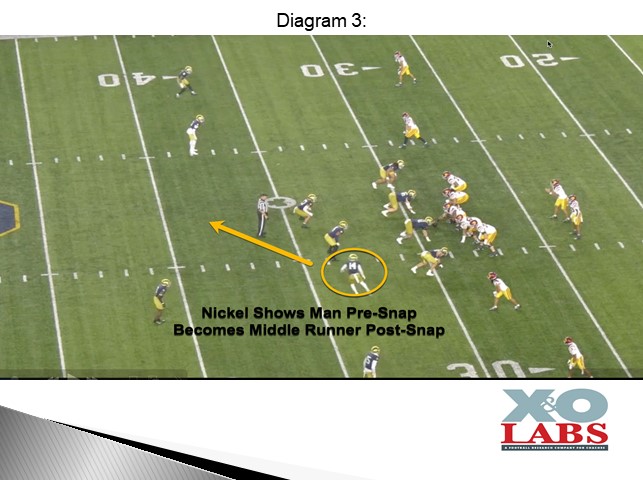
If you watched Notre Dame play this season, you saw this coverage live and in color in a battle against USC in week seven. Irish defensive coordinator Chris Ash knew his nickel corner (Dallas Golden) was a little too green to handle Trojan stud Makai Lemon in the slot, so Coach Ash built his non-traditional Tampa package that week to show man, only to have Golden be a middle run-through defender. It  would present like man coverage and then he would take off and go to the middle of the field to be the middle run through defender. It was something Coach Ash did to keep him out of the action as a true freshman and having to defend the best player on the field.


It wound up altering the picture for QB Jayden Maiava who struggled with making his reads on time. His 52.4 completion percentage that week was 13 percentage points lower than his average and among the lowest he posted last season, leading to a 34-24 Irish win.

Presenting a completely different picture for the QB is just one advantage for this coverage, hiding potential mismatches is another.


Exhibit B: The UCF Story

The University of Central Florida is more of a “portal team” than a high school team by all accounts, including those within the walls of the program. So, each January after the portal closes in mid-December, there are several new faces in the defensive back room in Orlando. In order to get them prepped for spring ball, the Golden Knight staff made a conscious effort to reduce the amount of teaching with the purpose of getting them to play collectively. The high turnover year after year, forced the defensive staff to hang its hat on one coverage- Non-Traditional Tampa- and major in teaching it. Non-Traditional Tampa consisted of over 60% of UCF’s defensive snaps last season.

“We had such a high turnover year after year, so we had to do something to keep cohesion in the back end, and do something year after year,” linebacker coach Mark D’Onofrio told me.

“We didn’t want to have all the quarters rules, and we didn’t want all the 3 match rules that people are playing so we decided to play non-traditional Tampa with four down and keep zone integrity. It was something simple that they could get good at playing. And it gave us a chance to play quarter, quarter half and not have a whole bunch of rules. You can keep the coverage checks simple by staying out of the quarter’s world.”

Under the direction of defensive coordinator Alex Grinch and his defensive staff, UCF ranked 25th nationally in passing yards allowed and third in the Big 12 in that category, while finishing fourth in the conference in total defense. The Knights allowed just 185.1 passing yards per game, the third-lowest mark in program history since becoming an FBS program in 1996 and the lowest since the 2001 season.


The Analysis:

Using our X&O Labs analytics, we studied 5,226 charted plays (all drop backs) from the 2025-season against this coverage and here’s at the crux of what we found:

The Analysis: 95.9% of all completions against this family came at 8 yards or shallower, a third of them to the running back, at 2.35 net yards per catch — while the vertical menu completed 3.5% with a 15% interception rate.

The Translation: The funnel is the scheme. Defenses were able to get off the field more quickly.

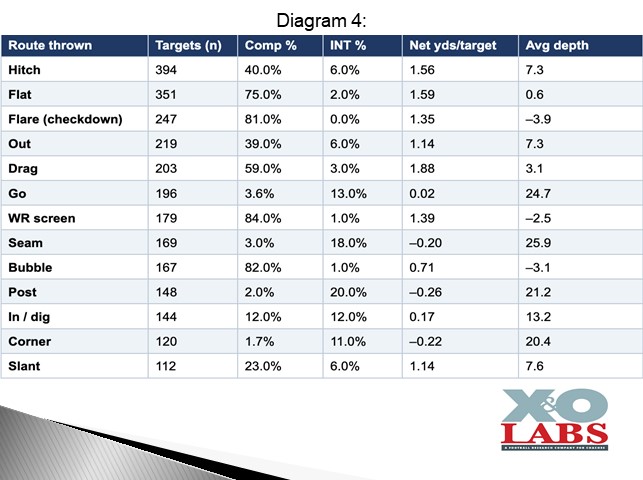
The Analysis: Most Targeted Routes in This Coverage


The Translation:

  • The funnel works exactly as designed. Two-thirds of all throws (67.3%) came at 8 yards or less; one in four was behind the line of scrimmage. The underneath family (hitch, flat, flare, drag, screens, etc.) absorbed 2,000 targets at 66.6% completion but produced only 2.23 net yards per completion — the rally-and-vice tackle showing up in the numbers. Fully 33% of all completions went to the running back, the highest-volume completion target on the sheet.
  • Most effective against, by route: four verticals / seam benders (3.0% comp, 30 INTs on the seam alone), the post (2.0%, 30 INTs), the deep corner (1.7%) and the deep over (7.8%, 13 INTs). The middle runner plus two hash droppers turn the entire middle-of-field shot menu into the most intercepted throws in the collection.
  • The contested zone is the curl/hitch concept. The hitch is where offenses attacked most (394 targets) and where the directional/delivery eye discipline pays — 40.0% completion and 24 INTs in this set.
  • What the coaches say still stresses it (keep these in the article even though the curated data flatters them): the boundary 7-cut / corner route high-lowing a squat corner “this is always a constant issue, the seven cut,” said one source. “Y-cross with a weak-side lateral progression, China/scissors off the cloud corner, the middle sit-down used as bait to pull the runner shallow before the bender goes over his head, and four-verts-from-empty designed “to mess with our middle runner rules.”


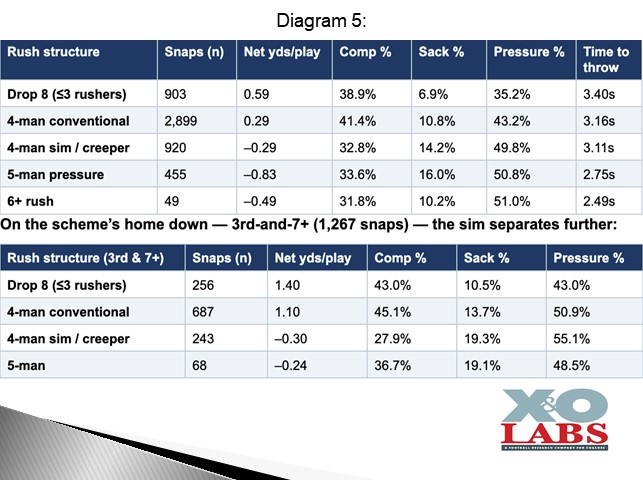
The Analysis: The Most Effective Pressure Pattern in this Coverage:


The Translation The four-man sim is five-man pressure at a four-man price — and it is at its best exactly where the coaches call it. And we will report on the specifics of these concepts later in the report.

  • The most efficient pattern in the data is the simulated four-man, and adding a mug presentation sharpens it further: within the sims, single-mug snaps allowed 25.3% completions and double-mug 28.2% (vs. 36.0% with no mug), with sack rates of 15–19%. That is the Ron Roberts blueprint — Mug/5-0 looks that force the center to declare, with the pressure defender chosen off the center’s point.
  • Drop 8 is the soft setting. It is the worst structure on the sheet (0.59 net yds/play; 1.40 on 3rd-and-long) — useful as a changeup, but the materials and the data agree the package’s teeth are in the simulated rush, not the extra dropper.


The beauty of this coverage is changing those coverage triangles to produce different pictures for the quarterback all while being gapped out in the run game.  Now, I’m ready to show you exactly how these programs are building non-traditional Tampa into their defensive system and how they are changing the triangles around the middle runners to cause confusion for the quarterback. And, how they are mixing these coverage structures with simulated pressure.


Introducing…X&O Labs Install Anthologies: Volume 2: Non-Traditional Tampa


Non-Traditional Tampa- including the pressure sims built off of them- are included in the Summer Install Series. It’s a new series designed to prepare you with everything you need to know about installing and utilizing Non-Traditional Tampa concepts heading into this season, and it’s exclusive to our X&O Labs members.

The rest of this report is the install — the exact tools, calls, and teaching progressions the coaches I spoke with are using right now. Here’s what you’ll be able to do once you have it:

  • Install the disguise that shows the quarterback a one-high look pre-snap and rotates into a three-high structure post-snap — so he never knows where that extra fitter is coming from.
  • Build the coverage triangles and rotate the “middle runner” snap to snap, changing the picture for the quarterback without changing a single rule for your players.
  • Hard-call the entire coverage so your DBs never have to make a check — including the exact “bucketing” systems three different programs use to declare who runs the middle.
  • Adjust to every formation you’ll see — 2×2, 3×1, empty, FIB, two-detached, and bunch — with built-in answers instead of on-field communication.
  • Apply the field-side and boundary-side rotation tools (invert, cloud, sky, double invert, double cloud) and know which one fits your corners, your nickel, and your safeties.
  • Layer simulated four-man pressure on top of the coverage — field activations, middle activations, cross-dogs, and Mug/5-0 presentations — to get five-man pressure at a four-man price.
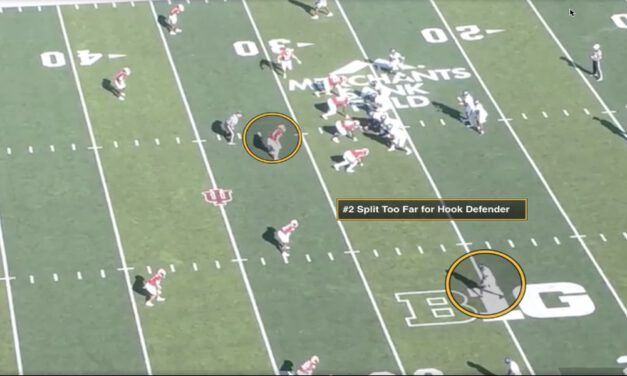
  • Teach the middle-runner position the way Wisconsin and Indiana teach it, including the “empty hands vs. full hands” reads that turn your safety into an extra hat in the run game.
  • Follow the same 8-step installation progression these staffs used to build it from a base four-man rush all the way up to the non-traditional layer.
  • Use the difficulty rating on every build-in so you install only what fits your personnel — and know which pieces are worth building your defense around.
  • Watch the cutups — every rotation, pressure, and adjustment, shown on film from the programs that majored in it last season.


Read More

Wide Zone Install: Double Swipe Principle & Complementary RPOs

By Mike Kuchar
Co-Founder & Senior Researcher
X&O Labs
@MikekKuchar


“It’s my favorite way to run wide zone because you have two gaps moving away from the play at the same time. The Nickel gets caught up looking at the motion, and the minus one defender is caught defending grass.  Everywhere I’ve been, I’ve found that defenses can’t fit it.”
– one Big 10 Offensive Line Coach


If you’re reading any of the research I’ve been putting out on wide zone over the last few months, you would know that the play is most explosive when it hits behind the Center. That’s why so many coaches are teaching the back to “tempo the Center,” which means he has to track the backside hip of the Center. In fact, one FBS coach told me the other day that he will go as far as telling the back to wait until the quarterback receives the snap before starting his mesh. It helped the back get the right timing on the rhythm of the wide zone.

And in speaking to all of the coaches that I spoke with regarding wide zone, most of them will tell you that they want the ball to hit the front side. Because that’s where all the big hitters occur. And this week, I’m going to tell you what they are doing to almost ensure a front-side entry point for the back. But before I do, I have to provide some context by telling the story of two programs that have used what I’m about to show you with a great deal of success.


Exhibit A: The South Dakota State Story:

For nearly two decades, North Dakota State was the golden standard at the FCS level. Heading into the 2020 season, the Bison won 8 out of the last 10 FCS championships. So, when COVID pushed back the 2020 season into the spring of 2021, most people assumed NDSU would be crowned again after an abbreviated season. But its biggest rival, South Dakota State, was plotting otherwise. And driving this confidence was something that former offensive coordinator (and now New Mexico head coach) Jason Eck noticed about how the Bison were fitting the wide zone, particularly with motion.

“They couldn’t fit a double-swipe wide zone, and it was obvious,” one of the offensive coaches on staff remembered. “So, every time we played them after that, we would find a new way to run it.”

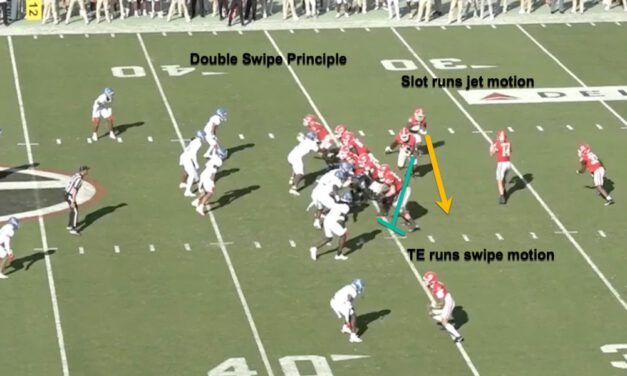
Simply, a double swipe is a combination of a jet motion by a receiver and a slice action by the tight end. It can be built to the boundary or to the field.
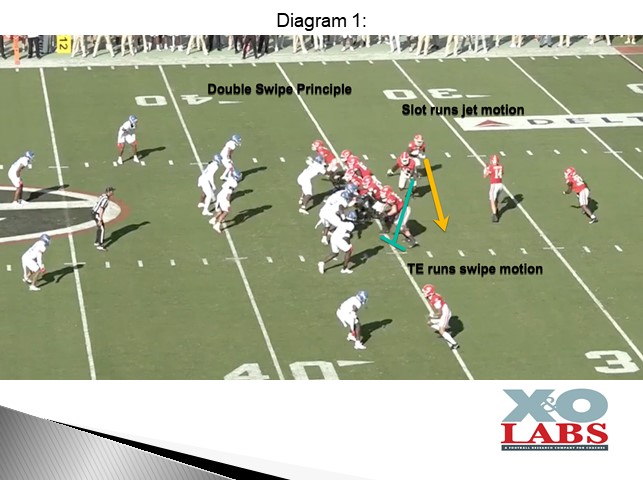
 

The movement of the slot forced second-level defenders to “rock back” away from the motion, while the cut action of the Y produced enough hesitation in backers for the ball to hit the front side. And if you already know that defenses are going to back-gap your wide zone, then adding the motion element will almost ensure the ball hits the front side. These two elements equate to a front-side entry point for the back, which most of the time equates to an explosive run.

The double swipe motion often forced the backside linebacker to misfit the play, allowing the ball to get pushed to the front side. Knowing this would happen, the Jackrabbits’ mammoth offensive line was able to push the point out to a smaller Nickel linebacker, and SDSU rode the scheme to its first victory against NDSU since 2017.

Five seasons later, the “Double Swipe” principle has evolved to become the most explosive way to run a wide zone.


Exhibit B: How Lehigh Evolved It

Lehigh University (PA) has been playing intercollegiate football since 1884, and produced 12 wins last season, one of its best seasons in the history of the school. And it did so by generating over 230 yards a game on the ground. It was offensive line coach Mike Morita who saw the University of Utah carve up defenses using the same concept two seasons ago. So, Coach Morita decided to install these principles immediately in game one against Richmond, knowing full well the Spiders were going to back-gap the split zone action that Lehigh showed them the year before. It worked so well that they used it the rest of the season.

I worked with Coach Morita this past January and talked to him about how he was using these double swipes to put the minus one backer in conflict. Lehigh built in a quarterback run off the double swipe action to really mess with his reads.


Why Double Swipe? A couple of reasons:


Reason 1: The Data is the Data:

Most explosives occur when the ball is inserted from the play side B gap to the backside A gap. This was a completely different perspective than the “circle the defense” mantra that surrounded the philosophy in the wide zone. While it was proven that wide zone hits best when run north to south, the question became how coaches are getting that to happen. If you want to generate explosives in wide zone, you’re going to want the ball to insert from the play side B gap to the backside A gap. And…running double swipe significantly increases the chances of that happening! I analyzed 1507 total wide zone runs from the 2025 football season. Many plays came from the top 20 programs at the FCS and FBS level who were most efficient in the wide zone, including UCONN, Cincinnati, Montana State, Lehigh, Nicholls State, Notre Dame, South Dakota, etc. I found that 537 of those runs generated explosivity, which were runs of 10+ yards or more.


Reason 2: The Defense Only Has Two Options…And You Have an Answer for Both!

After studying all these cutups,  there are only two ways a defense can defend it. And once you know how a defense will defend it, you can build your entire game plan around it. Such was the case with Lehigh last season, which knew that Richmond would back fit the motion. I found that even when defenses disguised the back end, it didn’t slow down the run.

These are the two options a defense has:

Option 1: Backfit the Second Level

When defenses bump or backfit their second level with motion, now the offensive line has to be prepared to “plus” out their count to the additional run fitter. But here’s the advantage: that additional run fitter is typically a Nickel Safety who may not have the wherewithal or size to fit the run game. It’s how many of the programs I talked with are designing these runs- by attacking that Nickel safety and forcing him to be in the fit.  They are building these runs from 11 personnel groupings.
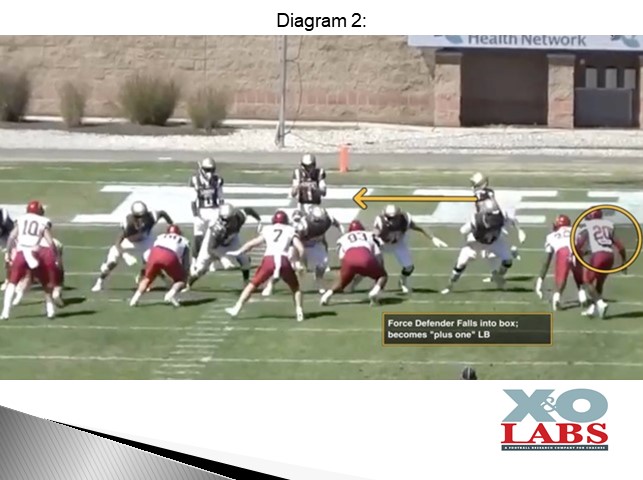
 

And when offenses build this out of 11 personnel groupings, you get the Will out of the fit and the Nickel (a more finesse defender) in the fit. It doesn’t fit his job description, and something he’s not comfortable doing or practicing.

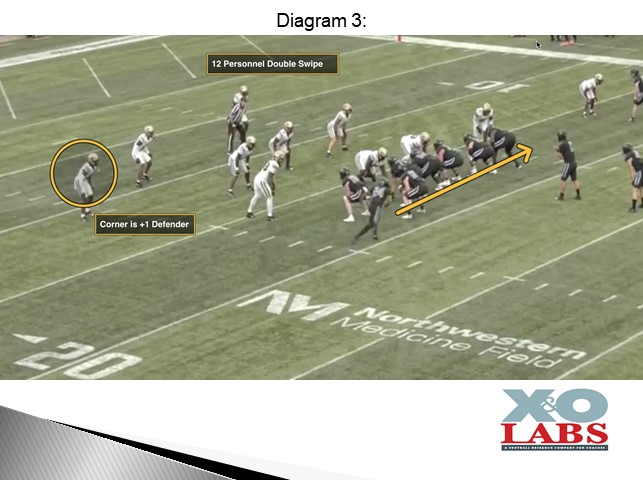
It gets even better when you build them from 12 personnel formations, where now that corner is in the run fit. It’s something that Northwestern did a great deal of.
 

Option 2: Lock the Box vs. Rock and Roll (or Rotation) Safeties

If a defense chooses to rotate safeties, this becomes an even cleaner picture for the offensive line. Now, they don’t need to “plus out” their point. They can block the box and be thicker on their double teams.
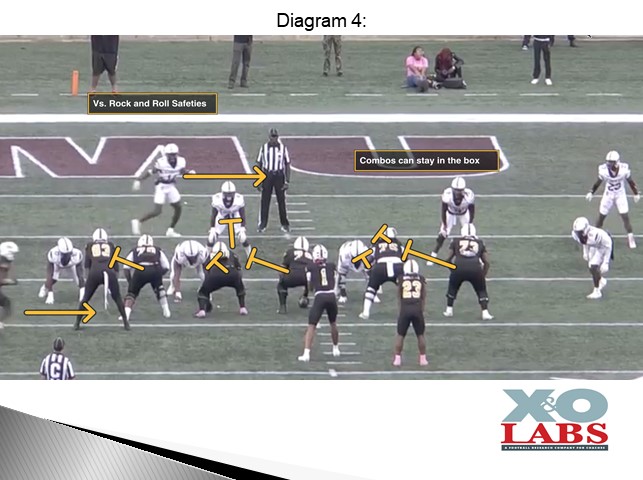
 

One coach told me, it’s the dream scenario because a defense is removing a support player and “we all love running the ball away from motion.” The safety cannot get involved in the fit.


Reason 3: The Minus One Backer (Will) Becomes Irrelevant:

Here’s where you are going to get the front-side creases that you need to make the play explosive. The combination of the swipe and jet motion forces the Will linebacker out of the fit and away from his gap responsibility in the run game. I’ve studied countless clips of this scheme, and in that Will’s gap is where the play hits.
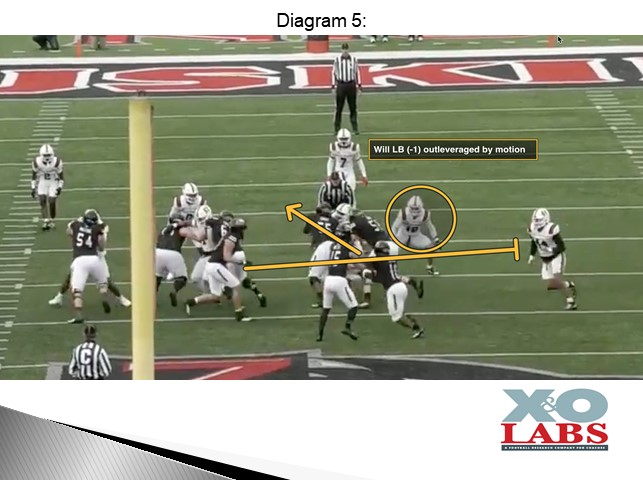
 

“The Will misfits every time, and your box is clean,” one FBS offensive line coach told me. “You got two gaps moving back at one time, and he’s usually caught defending grass. You don’t need to block him.”

But…there will be times when you can read him. That is something I will write about later in this study.


Reason 4: Greater Efficiency when Used with Formation into Boundary (FIB) Pictures:

Now, when you go formation into boundary, most defenses will travel the Nickel to the formation strength. And when you swipe the Tight End and motion the slot, it creates more distortion in a smaller area of the field. So, he has no choice but to be involved in the fit.
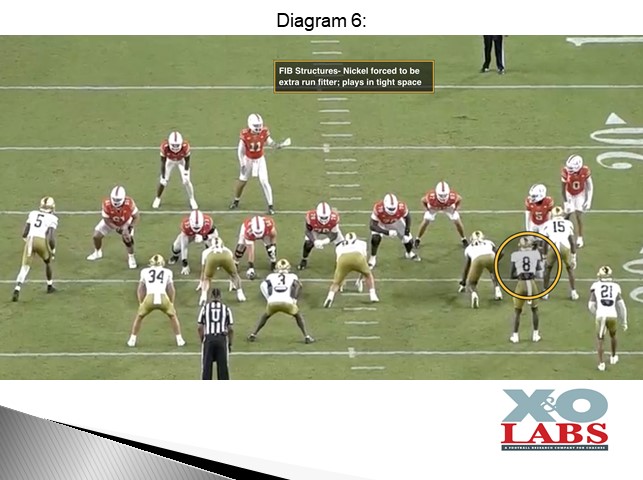
 

The research dictates that 3×1 wide zone into the boundary generated the highest explosivity rate (14.9 ypc), particularly against Over fronts.
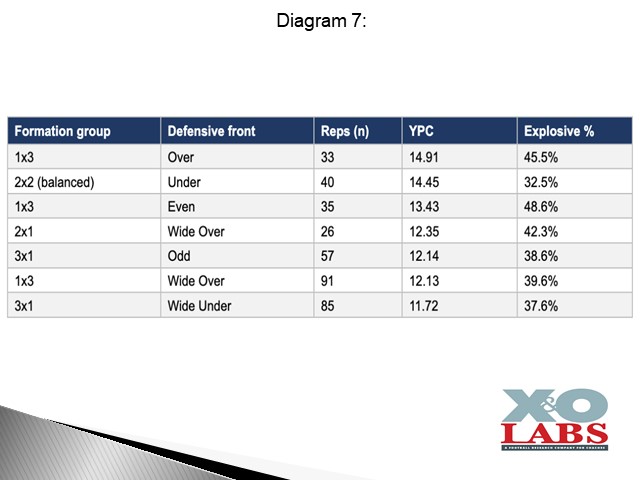
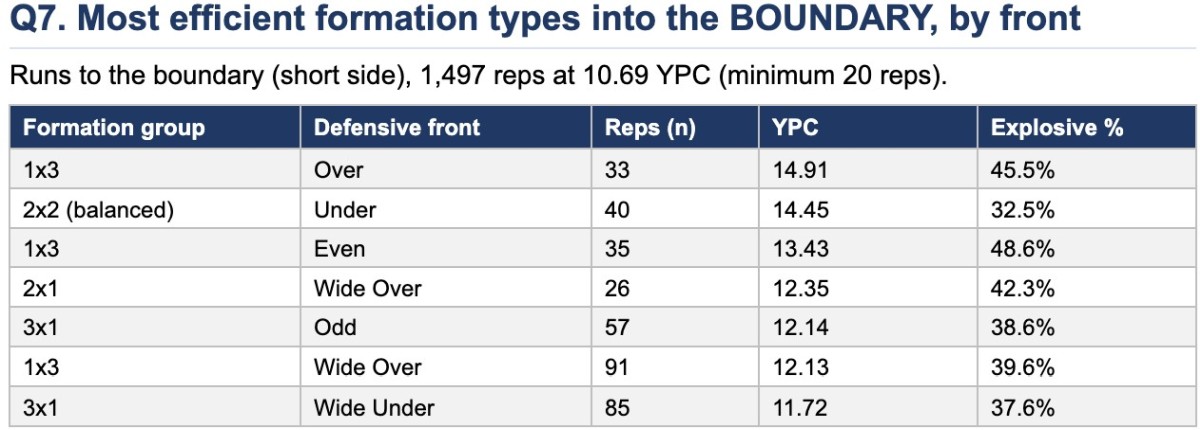


Now, I’m ready to show you exactly how these programs are building these double swipe wide zone runs into their offensive system and how they are accounting for the minus one linebacker so that he is not a factor in the run fit.


Introducing…X&O Labs Install Anthologies: Volume 1: Double Swipe Wide Zone


These Double Swipe principles- including the complementary RPOs built off of them- are included in our Wide Zone Anthology series. It’s a new series designed to prepare you with everything you need to know about installing and utilizing wide zone heading into this season, and it’s exclusive to our X&O Labs members.

You’ve seen why double swipe is the most explosive way to run wide zone. Now I’m going to show you exactly how the programs doing it are building it into their system — and how you can install it in yours without blowing up your practice schedule. Here’s what’s waiting for you in the rest of this report:

  • The blocking adjustment that lets you account for the misfitting backer without ever blocking him. I’ll give you the exact combination rules these staffs teach against both Even and Odd fronts — including the “never turn back” discipline that keeps your line playing fast when the second level rocks away from motion.
  • How to deliberately put a “softer” defender in the run fit — and keep him there. There’s a specific personnel-and-formation recipe these programs use to force a defender who doesn’t want any part of the run game into the fit on every snap. Once I show it to you, you won’t unsee it on your call sheet.
  • A 6-phase menu of RPO and QB-run build-ins, each rated 1–5 for install cost. From a no-brainer QB run off the swipe (mobile and non-mobile QBs) to first-, second-, and third-level RPOs — you decide how deep to go based on your personnel, instead of buying the whole package and hoping it fits.
  • The route progression that a Power 4 offense made its calling card — now trickling down to every level. I’ll give you the three-man pattern, who reads what, and the “family” system one coordinator uses to teach his entire RPO tree so a quarterback can run it from memory.
  • The two most “expensive” backside answers — and when they’re worth it. Quick-game controls and a full triple-option package off wide zone, broken down by the coordinators who built them, so you know exactly what you’re signing up for before you install.
  • A 7-step installation progression you can hand your staff Monday morning. Base run first, then footwork, then motion as the trigger, then the reads layered by complexity — built from the interviews I did so you’re teaching it the same way the programs that own it do.



Read More

Read Out Rules in Cross Dog Pressures

By Mike Kuchar
Co-Founder/Senior Researcher
X&O Labs
@MikekKuchar


When executed correctly, Cross Dog pressures can be an extreme nuisance to offensive protection schemes. As long as they time it correctly, both backers have the ability to disrupt protection schemes in the pass game and the natural flow of the run game. I talked to four well respected defensive coordinators at all levels to ask them how they specifically taught both backers to not only attack the Center in protection but also make the right reads to be able to fit the run game.

Their methodologies are below:


“One’s the Hug Rusher; One’s the Plug Rusher”
Source: Wallie Kuchinski, Defensive Coordinator, University of St. Thomas

“Axe” is an “A” gap interior pressure with Sam and Quick linebacker. Use against man protection teams. These are interior A gap pressures, which work very well against man-blocking teams because the running back can’t locate both interior linebackers in time in protection. Oftentimes, it presents a two-on-one against the running back.

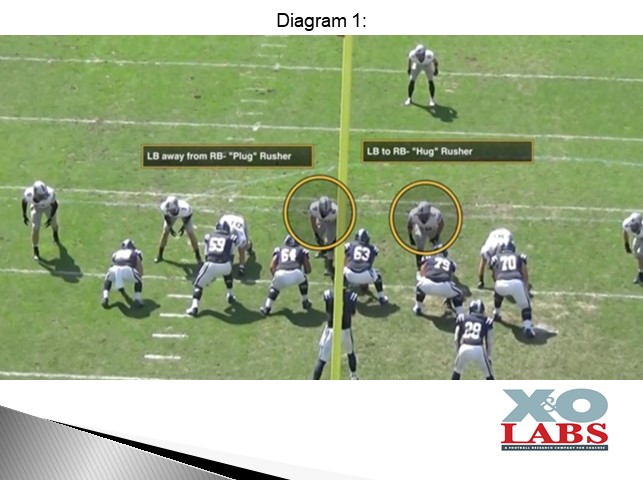
Both interior rushes work outside the Tackles for contain, while the Sam and Quick work their rush off the Center. Coach Kuchinski classifies his teaching of these two backers as a “hug” rusher and a “plug” rusher. The hug rusher is the blitzer to the running back who will fit inside him. The plug rusher fits outside the running back.

Both linebackers will be on a “Face of Center” read and cross face if Center comes at him. If the Center doesn’t come at him, he stays inside the running back.


“We Base off the Center’s Point:”
Source: Ron Roberts, Defensive Coordinator, University of Arkansas

Here is where Coach Roberts’s system gets really interesting. His “Mike” and “Will” pressures are exactly the same call. The pressure defender is based on the Center’s point. Quite simply, the player opposite the Center’s point is the defender that is triggering. 

For example:

  • If the Center identifies the Mike, the Will is automatically the pressure defender.
  • If the Center identifies the Will, the Mike is automatically the pressure defender.


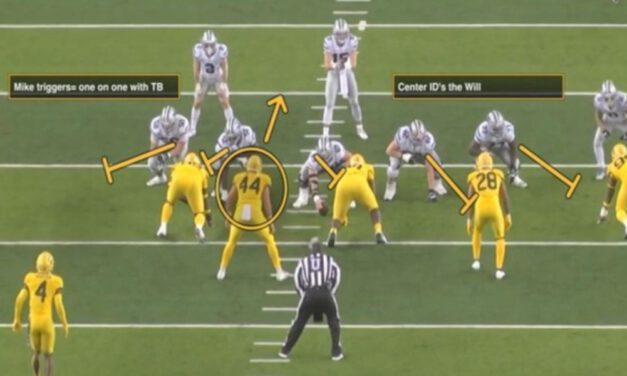
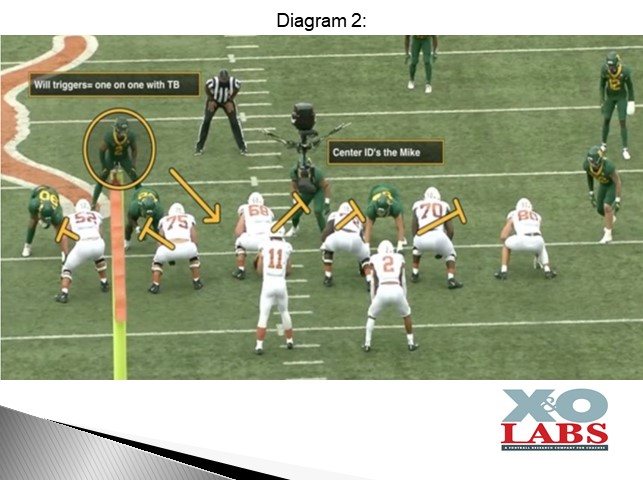
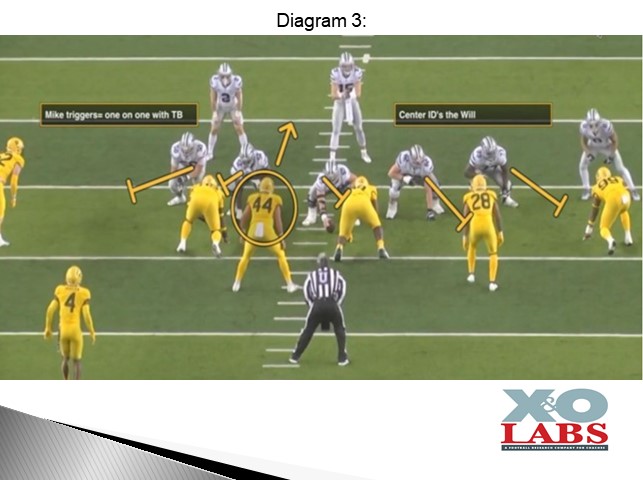
Like all simulated pressure against six-man protection, the purpose is to get a one-on-one with the back. That is usually done in the form of “Mug” or “5-0” looks where the Center has to identify the Mike or Will in protection.

In the example below, the Center identifies the Mike who is mugged up on the line of scrimmage, now the Will linebacker is one on one with the tailback, and the Mike is the middle runner.

If that Center points to the Will, the Mike goes up the gut on the tailback, and the Will is the middle runner.


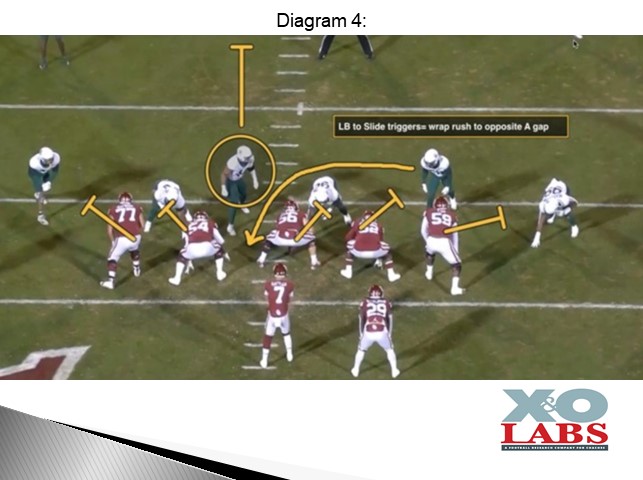
It gets better. If for whatever reason, the communication gets screwed up between the Mike and Will and the linebacker that gets identified becomes the rusher, he is taught to execute a “wrap rush,” working all the way across the slide into the opposite A gap.


“Either way you get a linebacker on a back or you get a free runner,” Coach Roberts told me. “And if you get good at reading it you get them every time. It’s a killer.”

These methods are sound against protection, but how do they hold up against the run game? We talked to two defensive coordinators- Chris Lorenti (University of Rhode Island) and Brian Bergstrom (South Dakota State University) on how they teach their defenders to read out against the run.

Below, Coach Lorenti and Coach Bergstrom break down exactly how they teach the second rusher to read out, stay sound against the run, and turn a pressure call into a weapon on every down:

  • The exact “read out” rule Coach Lorenti uses to give his run fit an extra layer — the same coaching point that let his second blitzer wreck plays in the backfield while still producing QB hurries on 41% of snaps.
  • How Coach Bergstrom decides which defender triggers first on every snap — a single, dirt-simple key that works regardless of down, distance, or formation width.
  • The down-lineman movement SDSU pairs with the pressure to funnel the ball back inside and free up the A-gap rushers (most defenses run the blitz without ever teaching this part).
  • When the second rusher should read out — and the one specific backfield action Bergstrom tells his defender to ignore completely, so he doesn’t bail on a run he’s supposed to fit.
  • The personnel wrinkle Bergstrom uses to put a defender offenses never account for in the right spot to read the ball — plus raw and narrated game film of all of it on tape.


Read More

How CCSU Generates Explosives on its Boundary Run-Action Passes

By Mike Kuchar with Caleb Gelsomino
Offensive Coordinator
Central Connecticut State University
@Coach_Gel


“When we’re trying to go to a run action pass and create a downhill explosive, this is what we go to.”
– Caleb Gelsomino, Offensive Coordinator, Central Connecticut State University


Don’t call CCSU small town football. The Blue Devils play a big boy schedule in the Northeast Conference and have claimed its top spot the last two seasons. They’ve given CAA programs like Rhode Island fits over the same time in the FCS playoffs and have posted record breaking numbers on the offensive side of the ball, leading the conference in total yards per game (381 ypg) and passing yards per game (242 ypg). At the crux of this operation is how offensive coordinator Caleb Gelsomino and his staff devise “big play” shots at the right times to exploit defenses. It’s an explosive mindset that is built on an intention. “To us, it’s always a question of how do we build one or two of these a week where it’s going to be a shot play or an explosive then we work off there,” he said.

One of the biggest challenges in connecting on these downfield shots is devising ways to protect the quarterback and give him enough time to throw. This comes with building out the types of protection schemes necessary. We will detail the route concepts further, but there are two cornerstones as far as protection goes: gap-based protections and zone-based protections.

The biggest challenge for coaches in executing these deep shots off run action is making sure the quarterback is protected and has time to throw. Coach Gelsomino relied on two separate types of protections for these shots: one for an experienced line and one for a more youthful group.  How Coach Gelsomino built these protections and devised the route counters behind them will be the basis of this report.

In this report, Coach Gelsomino opens up the full run-action pass system that fueled CCSU’s back-to-back NEC titles and a conference-leading passing offense. Here’s what you’ll see in the full report:

  • Both protection schemes side-by-side with diagrams — gap pull for the veteran line and full-slide zone for the younger group — and how each one buys the QB time on the longer mesh
  • The coaching point on the pulling guard that sells the run fake and forces the defensive end to convert to pass rush mode
  • The “one step pop” QB technique off the A-gap mesh, including which side of coverage Coach Gelsomino reads first and why
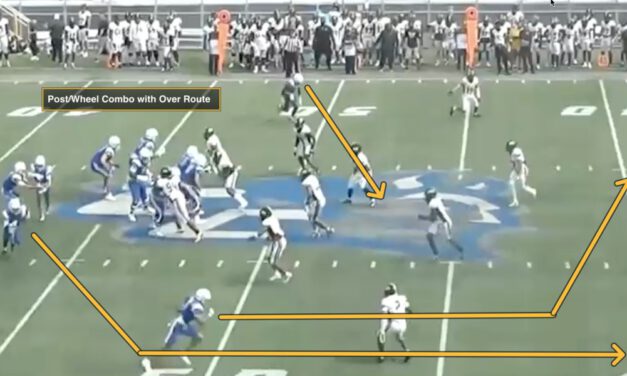
  • Seven complete route concepts with diagrams: Wave (double posts with the Dover), Boundary Post/Wheel off jet motion, Poco Switch, Four Verticals with the “slip to divide” technique, Double Post with Bender, Post/Dig with Wheel, and Boundary Slot Switch
  • The Post/Dig with Wheel concept that produced a game-winning completion this season, plus the QB’s full read progression
  • Raw and narrated game film of every concept in action


Read More

Central Arkansas Grounded TE Counter

By Mike Kuchar with Gunnar Boykin
Offensive Line Coach/Co-Offensive Coordinator
University of Central Arkansas
@CoachGBoykin


“Defenses get pretty predictable on how they set their front when you put that TE’s hand in the ground. And they certainly never account for him as a blocker away from the formation.”
– Gunnar Boykin, Offensive Line Coach/Co-Offensive Coordinator, University of Central Arkansas.


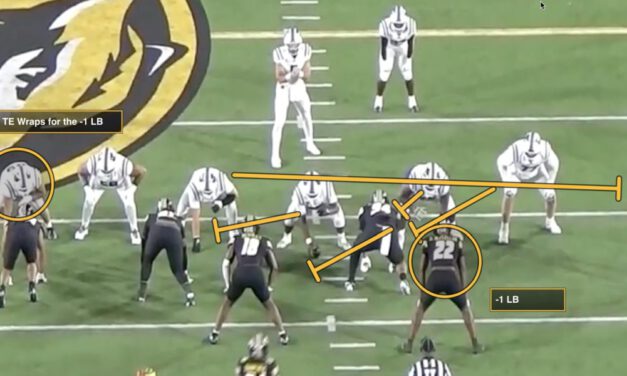
We need to give credit where credit is due. The grounded tight end concept was the brainchild of 22-year Arkansas coaching veteran Brooks Hollingsworth who now is an analyst on the UCA staff. And when Coach Hollingsworth and Coach Boykin sat in the offensive meeting room to build out the grounded tight end counter scheme, Coach Boykin had his questions. “I didn’t think the tight end would be fast enough to get to the playside,” he remembers contemplating. “But then I realized that if we figured it out it could be such a weapon. You don’t see it that much in football and defenses have to account for it.”

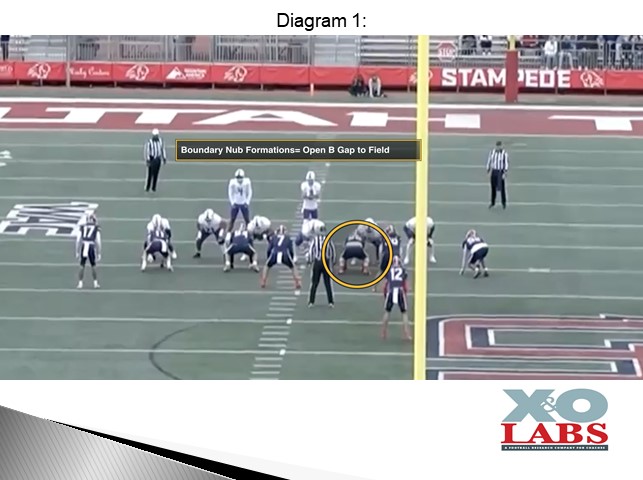
So, Coach Boykin and Coach Hollingsworth moved forward with installing the scheme. The Bears have been utilizing the grounded tight end counter since 2023- although this past season some injuries at that position made them shy away from the scheme. But as Coach Boykin will say the Bears cut its teeth on the grounded tight end counter and it has since remained a mainstay in the offensive operation at Central Arkansas. It became a formidable concept against Even fronts, particularly from Nub sets where defenses will present the bubble to the field.


While UCA runs many variations of counter, the grounded tight end version is a separate tag. It’s truly an A-gap counter scheme as opposed to the Bears G/T counter scheme which is treated like a C-gap counter where the second puller is asked to read either a kick or log block at the point of attack.

And the reason why the grounded tight end concept is taught as a true kick play is because the predictability of the surface to the open side. The B-gap bubble will almost certainly predict a kick out by the Guard and an inside entry point for the tight end, the second puller in the scheme. “Most times that B gap is going to be open,” said Coach Boykin. “So, I know the play side Tackle will be through it faster to clear space for the pulling tight end.”


“Think Speed Upfield:” Post-Snap Puller Technique:

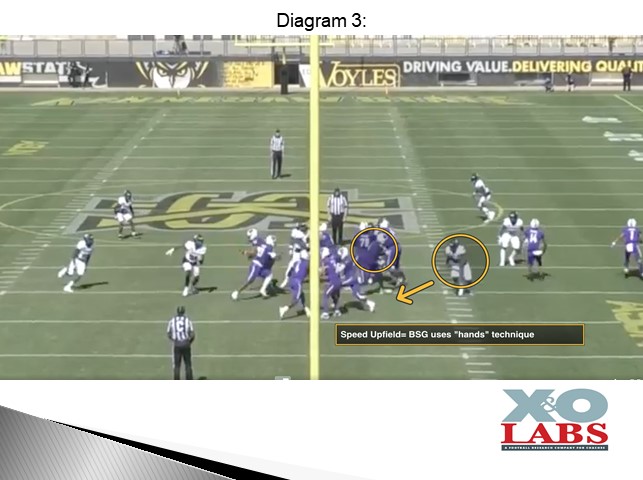
One of the challenges for the first puller in counter is having to adjust to a speed rusher who is upfield immediately. This can absolutely alter the mesh. This is why Coach Boykin emphasizes turning the near knee and hip to the sideline. If there is any speed upfield, the contact point needs to be the hands and not the shoulder on the kickout. “When I see speed upfield, I will meet the near shoulder as wide as I can,” he said. “I don’t want that to happen is lead with shoulder and he stalls and he works back up over the top of me. So, we meet him wide and trail that shoulder. We try to keep him wide and let him work upfield around us.


The biggest challenge for coaches in installing the grounded tight end counter is teaching the tight end the fundamentals needed to get the width and depth necessary as the second puller. It’s something that takes a good deal of reps and timing. How Coach Boykin teaches this fundamental and the drill work he uses to reinforce it will be the basis of this report.

In this report, Coach Boykin opens up the rest of his grounded TE counter install — the footwork, the drill work, the front adjustments, and the RB read progression that make it go. Here’s what’s waiting on the other side of the login below:

  • The “depth before width” footwork rule that keeps Coach Boykin’s tight end clean against immediate C-gap penetration — and why he has to fight to stay square all the way through the pull.
  • The inside-out read Coach Boykin teaches when the point linebacker widens on the tight end — the one adjustment that keeps this scheme alive against fast-flow defenses.
  • The “Jump Back” individual drill UCA runs every day in-season to build the timing and width their grounded tight end needs as the second puller — plus drill film of the technique.
  • The “screw to screw” coaching point for the playside Guard that declares the A-gap defender and tells the playside Tackle exactly how to attack his gallop-lead block.
  • Coach Boykin’s Mint front answer — how the playside Tackle manufactures a B-gap bubble against Odd fronts so the first puller still gets his kickout (and the one defender alignment where UCA won’t run it).
  • The RB’s entry-point progression and cutback cylinder — including the backside linebacker key Coach Boykin says triggers more cutbacks than most coaches realize (“nobody protects the backside when they see pullers”).
  • Raw and narrated game film of the grounded TE counter in live action.


Read More

Nicholls State 3-Surface Y-Lead Wide Zone Concept

By Mike Kuchar and Seth Price
Offensive Line Coach/Run Game Coordinator
Nicholls State University (LA)
@CoachSethPrice


“If the 3-Tech was tight and we felt we can get him reached quickly, then we’d have the Guard handle him. But if that was a mismatch, we had answers.”
– Seth Price, Offensive Line Coach/Run Game Coordinator, Nicholls State University (LA)


I’ve been enamored with studying these Y-Lead wide zone concepts for four reasons:

  1. You bring an extra blocker to the point of attack
  2. You do so quickly post-snap so that the defense can misfit the play
  3. You eliminate any potential lag technique by the play side defensive end
  4. You can stay thick on combinations on down defenders without being concerned about the play side linebacker (the tight end handles him)


Having said that, these Y-Lead wide zones are much cleaner to the two man surface where you have an A-gap defender. The play side Guard and Center combo the Nose so that the travelling tight end can work with the play side Tackle in combination to the defensive end and play side linebacker.


But when you get a B-gap defender to the play side, things get a little hairy. Now, you’re putting the play side Guard and Center combination with 3-Technique that can easily dent the play forcing the ball to cut up prematurely.

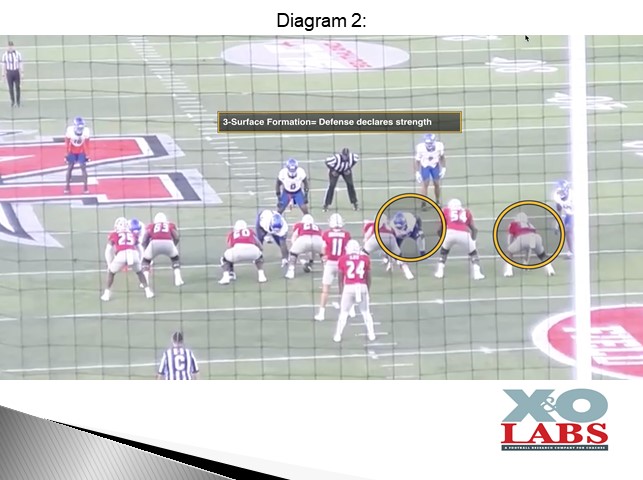
So, rather than leave it to the defense to decide where it distributes its B-gap down defender Coach Price took the guess work out by using a grounded tight end to the play side. Now, even fronts had to declare their strength.


This allows you to still run the lead play but a determination needs to be made on how you handle that down defender. “If the 3-Tech was tight and we felt we can get him reached quickly, then we’d have the Guard handle him,” said Coach Price. But if that was a mismatch, Coach Price had other answers.

What the staff at Nicholls did was build in two separate calls to keep the lead play efficient to the 3-surface side. It was an easy answer to combat the presence of dominant 3-Techniques or movement to the Tight End side of the formation.

Below, Coach Price walks through both calls in detail — the snap-point mechanics, the combination block logic, and the in-game reads that turned a 3-surface problem into one of the most explosive wide zone runs at the FCS level this season. Here’s what’s inside the full report:

  • The two distinct calls Coach Price built to handle a play-side 3-Technique — and the rule that determines which one fits the front you’re seeing
  • The motion snap-point coaching point that keeps the tight end clean post-snap — plus the under-Center wrinkle that requires its own answer
  • How the “Box” tag widens the edge and creates a natural stretch that finally lets the play-side Tackle run off the ball without fighting the defensive end one-on-one
  • The “Lead” tag adjustment that opens a vertical cut behind the play-side combination — and the assignment shift that makes it work against a tight 3-Tech
  • The Tackle’s in-game call that flips combination logic based on linebacker alignment — plus diagrams of every variation and full game film of the concept on tape


Read More

South Dakota State’s 4-1 Box Fits

By Mike Kuchar with Brian Bergstrom
Defensive Coordinator
South Dakota State University
@Coach_Bergy


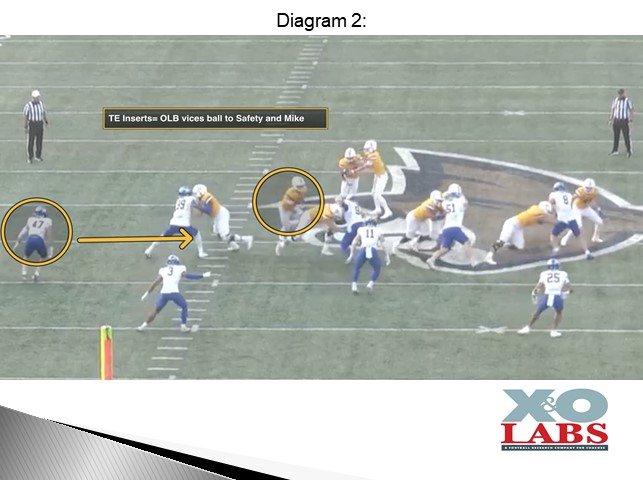
When you defend offenses in the MVC, you’d better prepare your unit for a downhill run game. When the season lags into November, and the temperature drops to sub 30 degrees, you best believe that whoever wins the fight in the run box and subsequently wins the contest on the scoreboard. And in order to equate numbers in the run game and add a hat back against quarterback run, it became necessary to play nine-man box football. But while most quarters fit defenses rely on having their safeties play inside out as force defenders, Coach Bergstrom and his staff made a conscious choice to have his outside linebackers be the edge defenders, fitting the ball back into his safeties in the run game.

According to Coach Bergstrom, the thought process behind it was to get edges set more quickly on the perimeter by defenders who were closer to the ball. It also alleviated the stress from safeties in quarters who were asked to play a receiver vertical and play the edge of the run box.

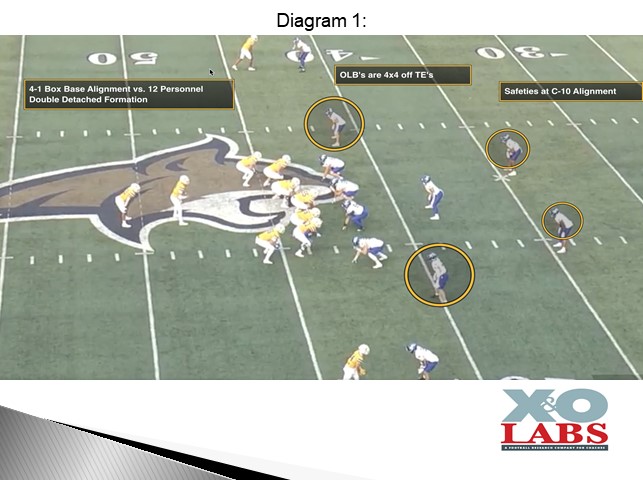
In these structures, the outside linebackers are now free to set the edge, while the safeties can play in the box. It became the core defensive structure against single-width receivers and 12 personnel, the double-detached formation that has grown in popularity in college football today. And the ultimate answer against the QB runs that were built off it.


The 4-1 Box structure held up in the pass game as well, where corners were asked to handle all of number one (unless he goes under), while safeties played number two vertical. Outside linebackers carried the flat/wheel. The Mike linebacker, related to number three, just as he would in traditional quarters looks.


How runs fits are taught and manufactured in these 4-1 box structures is the focal point of our research. Coach Bergstrom details how the safeties, outside linebackers, and Mike work off each other to defend various run schemes to make solidify an unblocked defender at the point of attack.

If you’re playing nine-man box football against heavy 12 personnel teams — and trying to add a hat back against QB run without burning your safeties as force defenders — Bergstrom’s 4-1 Box fits are the answer. Inside the full report, you’ll:

  • See the exact “hands read” Bergstrom teaches his outside linebackers to play QB-to-pitch on every option scheme — and the simple trigger that tells them when to fold back inside.
  • Get Bergstrom’s Mike linebacker spill rule against pullers — and why “wherever he goes, he always has two guys behind him” turns Counter into a losing proposition for the offense.
  • Steal the C-10 safety alignment that handles the #2 vertical AND the interior run fit — including the back-location trigger that keeps your safeties out of the fit when they need to beat your RPO, and gets them downhill faster when they don’t.
  • Walk through gap-by-gap fit diagrams against the five run schemes that stress every 4-1 box defense: Insert Zone, Split Flow, Counter, Zone Read, and Wide Zone.
  • Pick up the field/boundary thirds rotation Bergstrom mixes in to muddy up QB Glance reads against RPO offenses — plus raw and narrated game film of the entire 4-1 Box system on tape.


Read More

Western Michigan’s QB Duo Concept

By Mike Kuchar with Joe Pawlak
Offensive Line Coach
Western Michigan University
@pawlakjoe


“It was the best marriage between what our quarterback ran well and what we did well as an offensive line.”
– Joe Pawlak, Offensive Line Coach, Western Michigan University


There is a reason why most offenses rely on using pure gap schemes in its quarterback run menu. The flow of the offensive line meshes perfectly with the downhill run action of the QB. Pullers help push second-level defenders past the entry point, opening up creases in the defense for explosive plays. But when your offensive line doesn’t major in blocking gap schemes, it may not make sense to carry gap scheme quarterback runs.

Thus was the realization Coach Pawlak made mid-season last year when the offensive staff at Western Michigan decided to build its QBR around Duo run schemes and not gap schemes. “It was the best marriage between what our quarterback ran well and what we did well as an offensive line,” he told me. “We didn’t run a lot of power, so Duo was our answer.”

This past season, the Broncos ran Duo 41 times with its quarterback, and it continually got more efficient as the season rolled on. The concept debuted in week four against Toledo and helped generate a 14-13 win for the Broncos. “Our backs weren’t having a great day, and Broc was running the ball well,” said Coach Pawlak. So, we made a switch to run more Duo runs with him and started carrying it the rest of the season.”

But early on the play wasn’t hitting where it should be. Oftentimes in QB zone runs, the quarterback gets pushed behind the entry point because of the flow of the offensive line. And it wasn’t until a cornerstone adjustment in how the back identifies his blocking assignment was made for the play to take off.

The challenge in running QB Duo is that the quarterback can be pushed off course with the movement of the offensive line and miss his downhill aiming point. Coach Pawlak and the offensive staff built a simple rule for the back to handle the extra defender so the QB can have a clean read and get downhill.

Read More

Three Unique Mesh Patterns that Galvanized Mercyhurst’s Counter Scheme

By Mike Kuchar with Mike Waring
Offensive Line Coach
Mercyhurst University (PA)
@CoachWaring


 “We will do anything that buys us two false steps for linebackers and gives the offensive line a half second longer to handle combinations.”
– Michael Waring, offensive line coach, Mercyhurst University (PA) 


Editor’s Note: How explosive was your counter scheme this season? X&O Labs developed generators allowing you to import your own HUDL data to determine how explosive your counter schemes were this season. Just upload your offensive data and you get a detailed analytical report (check it out here).


For the past two seasons, Counter was the most efficient run concept in Mercyhurst’s offensive menu. “Somehow our kids just know how to run that play,” Coach Waring told me. Of course, opposing defenses in the NEC knew that as well. And with Mercyhurst making the jump from a Division 2 PSAC school to an FBS level entity, the staff had to find ways to get creative in protecting its best run concept. One of which was having its all-conference slot be the ball carrier on these counter concepts, regardless of where he lined up. And he did line up everywhere…in the slot, in the backfield and in the flank. It took the entire pre-season to get the counter communication dialed in but once it did, the play was revived. So much so that All-NEC slot Bryan Trobel finished with 983 yards and 13 rushing touchdowns. “He simply bought into what we are doing,” Coach Waring said. The good news was that Mercyhurst did have a running back that was in the ballpark of 200+ pounds as a fifth-year senior, so he became the additional puller for the slot counter concept.


Bucketing the Verbiage:

While the Counter play was termed the same, the offensive staff Mercyhurst built in both a motion tag and a formation tag into the play call in order to decipher each mesh. According to Coach Waring, the most important distinction that had to be made was whether the running back was getting the ball or the slot was getting the ball.

So, how did Mercyhurst find alternative meshes to protect Counter? The offensive staff built in three types of unique mesh patterns to “dirty the eyes” of second level defenders.

In this report, you’ll see:

  • How to make linebackers take two false steps on every Counter snap — and why that half-second advantage is all your offensive line needs to win their combinations.
  • The motion tag that turned an undersized slot into a 983-yard, 13-TD rusher — and how to install the same ball-carrier communication system without blowing up your existing Counter call.
  • Three distinct mesh patterns that “dirty the eyes” of second-level defenders — each one built off concepts your offense already runs, requiring zero new vocabulary for your players.


Read More

The Pressure Audit

A Self-Scout Report That Tells Defensive Coordinators Exactly Where Their Pressure Packages Are Working — And Where They’re Not


This is a new self-scout tool (report generator) for defensive coordinators who want to know how effective their pressure calls really are.

A small number of defensive coordinators at the FBS and FCS levels are doing something most high school and small college DCs never think to do…

They’re auditing their own pressures.

They’re running their pressure (blitz) data through a systematic comparison — pressure vs. no-pressure — to find out exactly where their blitz packages are creating advantages and where they’re vulnerable to giving up explosive plays.

We discovered this self-scout strategy by mapping the scouting and self-scout processes of over 100 high school, college, and NFL coordinators. Only a handful were doing it. When we saw what it revealed, we built it into a self-scout analytical tool (available below) — so every high school and small college DC can do the same thing in seconds.

We call it The Pressure Audit.

Here’s what one of the most aggressive pressure DCs at the FCS level said when we sent it to him to review:

“This is phenomenal. I would love this kind of report to evaluate our pressures. Initially, I thought this would be great for off-season analysis. But the more I think about it, the more I would want this each week.”

That’s the reaction of a DC who immediately understood what this report can do.
What Is the Pressure Audit?

Upload your defense’s play-by-play game data and instantly get a side-by-side comparison of how your defense performs when you pressure vs. when you don’t — across every metric that matters to a defensive coordinator:
  • Average Yards Per Play and Median Yards — pressure vs. no-pressure, run and pass
  • Explosive play percentage — where are you getting exposed?
  • Negative play percentage — where is your pressure actually winning?
  • Completion percentage and sack rate on pass plays — pressure vs. no-pressure
  • Breakdown by pressure package — this tells you which packages are working and which aren’t
  • Formations — what offensive formations beat your pressure, and which ones don’t?
  • Early downs and 3rd down analysis — situational breakdowns on base downs (1st & 2nd) and 3rd down across all distance buckets (short, medium, long, and extra long)


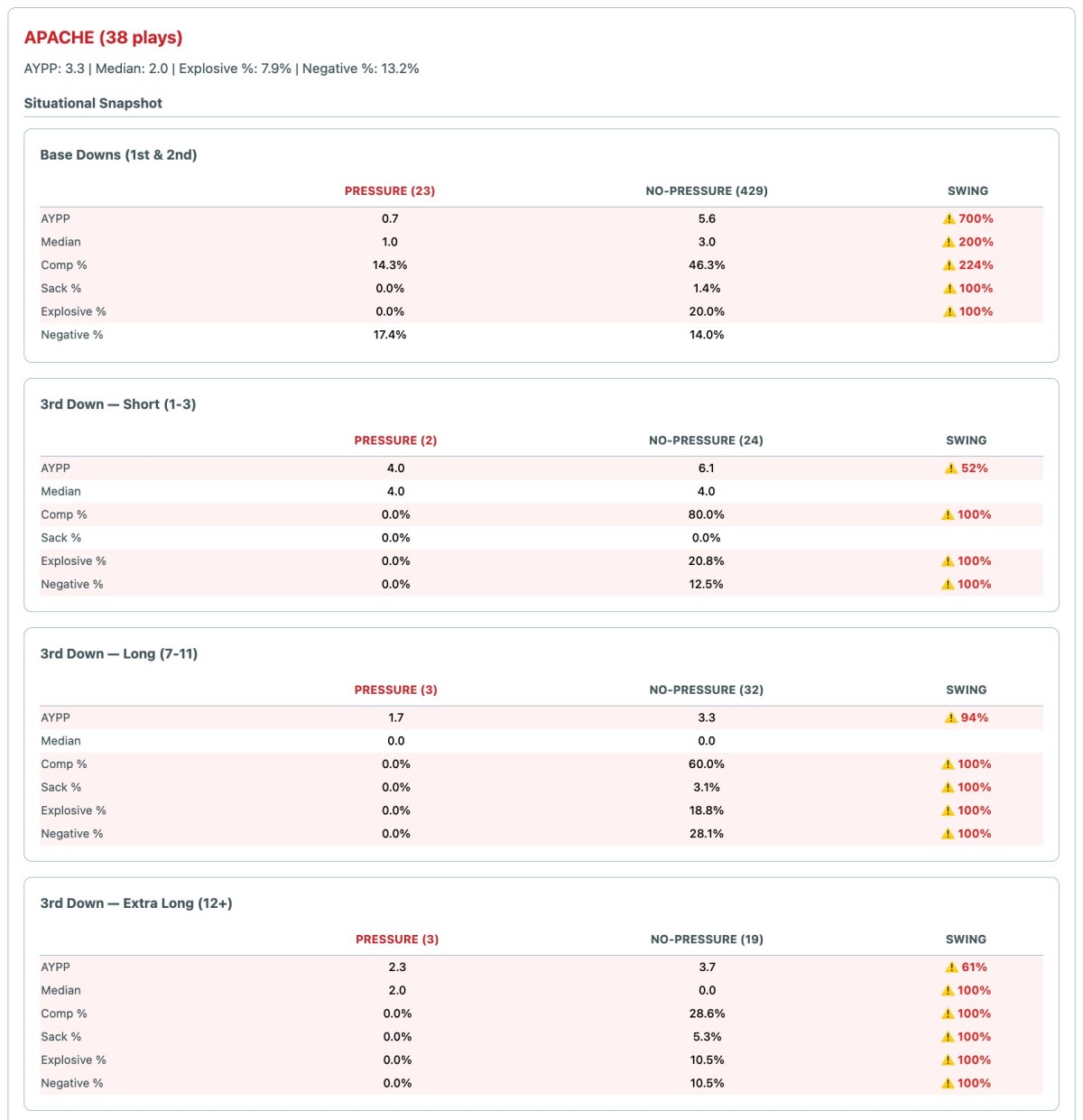
Here’s an example of one section of The Pressure Audit report. This shows the performance of ‘Apache’ pressure in base downs and all the 3rd down distance buckets.


And the metric that ties it all together: The Swing Rate.

Any time a significant variation between pressure and no-pressure performance is identified, the report flags it automatically — highlighted in red. It’s then your job to determine if that swing is good or bad. The tool finds it. You decide what to do with it.

Just Upload Your Defense’s Play-By-Play Game Data and Your Pressure Audit Is Done.


Login now and you’ll see The Pressure Audit below. Just upload your defensive play-by-play game data, and your report is ready instantly. You’ll see exactly where your pressure is effective — and exactly where it makes you vulnerability.


Read More

Using Run Fit Terminology to Improve CAGE

By Bob VanHoesen
Defensive Line Coach
Union College (NY)

In the current era of mobile quarterbacks, defensive coaches are challenged to find ways to keep opposing QBs in the pocket. Defensive coaches have to find effective methods to maintain an aggressive pass rush while controlling the QB as a running threat. Of all current methods, CAGE is widely considered the most effective approach.


TWO KEY ELEMENTS OF CAGE

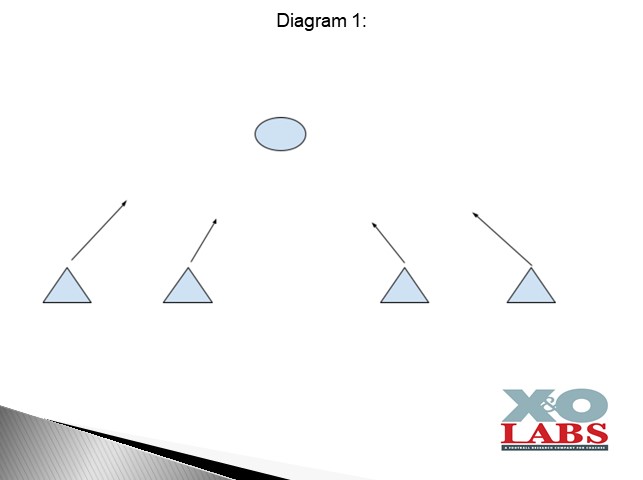
Two key elements of CAGE are rush lanes and aiming points. These elements work together to give defenders a clear understanding of their individual pass rush responsibilities. When executed correctly, pass rushers create a CAGE or net that the QB cannot escape from.


RUSH LANES

Rush lanes are the “highways” that pass rushers take to get to the QB. These “highways” are determined by a defensive player’s pre-snap alignment. For example, a defensive tackle aligned in a 3 tech pre-snap would have a lane that takes him through the B gap. In a base rush he would be expected to win through that gap. We use the phrase “win in your lane” to give our defenders an initial direction for their pass rush.


AIMING POINTS

Aiming points are spots on the QB that rushers must converge on. Rushers with interior paths (low cage) converge on the front hip of the QB. Rushers with edge paths (high cage) converge on the back shoulder of the QB. After defeating the opposing OL, rushers bend and get their eyes and toes directed to their aiming point. Our eyes lock on our aiming points like “radar” to take us to the QB like a guided missile. If the QB moves, rushers must adjust their paths in order to maintain the CAGE. For example, if a QB sprints to his right, our left edge rusher must widen his path to stay on his aiming point. Aiming points allow the CAGE to adapt to any movement by the QB.

In this report, you will see the full install — including the run-fit vocabulary VanHoesen uses to make CAGE click for his players, the drill he runs all season to reinforce it, and a film breakdown with four live game clips showing exactly how it holds up against a mobile QB:

  • Why VanHoesen borrowed “VICE” and “HAMMER” from his run-fit system — and how these two words give low-cage and high-cage rushers an instant visual reference for their QB containment role.
  • The triangle concept that locks in your interior rushers — how to teach them to keep the QB at the top of the triangle while they form the base — no more guessing on fits.
  • The edge rusher “counter rule” that prevents outside escapes — HAMMER isn’t just a direction, it’s a standard: the QB should never cross your face. VanHoesen explains exactly when and how to counter.
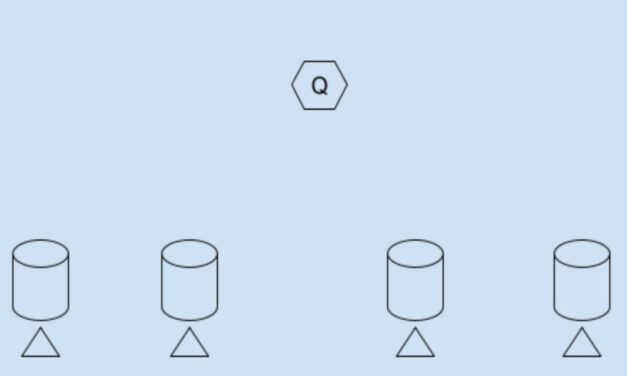
  • The full QB CAGE drill setup — field dimensions, bag placement, scout QB rules, and why the low-impact design makes it repeatable all season without beating up your guys.
  • Four film clips with VanHoesen’s own narration — see CAGE working against a live mobile QB, including a stunt concept that forces defenders to swap high and low cage assignments mid-play and still finish with a sack.
  • How to run CAGE with your linebackers, not just your D-line — Clip 3 shows a blitzing LB functioning as a low-cage rusher and helping collapse the pocket from the inside out.
  • The 3-down CAGE challenge — keeping containment with only one true low-cage rusher and what happens when a DE takes his eyes off his aiming point (Clip 4 shows both the mistake and the recovery).


Read More