




By Mike Kuchar and Seth Price
Offensive Line Coach/Run Game Coordinator
Nicholls State University (LA)
@CoachSethPrice
"If the 3-Tech was tight and we felt we can get him reached quickly, then we’d have the Guard handle him. But if that was a mismatch, we had answers."
- Seth Price, Offensive Line Coach/Run Game Coordinator, Nicholls State University (LA)
I’ve been enamored with studying these Y-Lead wide zone concepts for four reasons:
- You bring an extra blocker to the point of attack
- You do so quickly post-snap so that the defense can misfit the play
- You eliminate any potential lag technique by the play side defensive end
- You can stay thick on combinations on down defenders without being concerned about the play side linebacker (the tight end handles him)
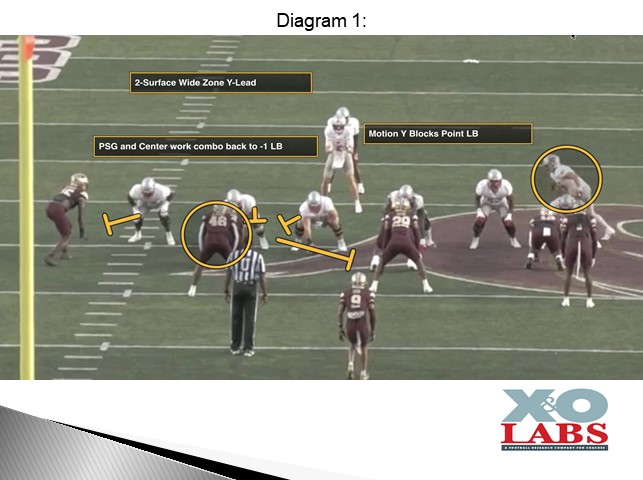
Having said that, these Y-Lead wide zones are much cleaner to the two man surface where you have an A-gap defender. The play side Guard and Center combo the Nose so that the travelling tight end can work with the play side Tackle in combination to the defensive end and play side linebacker.
But when you get a B-gap defender to the play side, things get a little hairy. Now, you’re putting the play side Guard and Center combination with 3-Technique that can easily dent the play forcing the ball to cut up prematurely.
So, rather than leave it to the defense to decide where it distributes its B-gap down defender Coach Price took the guess work out by using a grounded tight end to the play side. Now, even fronts had to declare their strength.
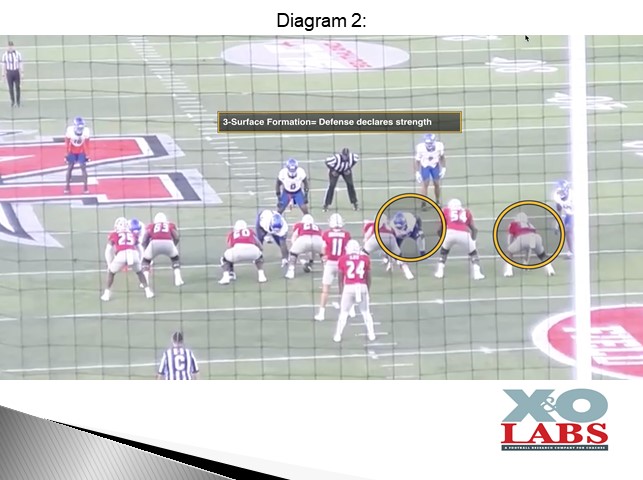
This allows you to still run the lead play but a determination needs to be made on how you handle that down defender. “If the 3-Tech was tight and we felt we can get him reached quickly, then we’d have the Guard handle him,” said Coach Price. But if that was a mismatch, Coach Price had other answers.
What the staff at Nicholls did was build in two separate calls to keep the lead play efficient to the 3-surface side. It was an easy answer to combat the presence of dominant 3-Techniques or movement to the Tight End side of the formation.
Below, Coach Price walks through both calls in detail — the snap-point mechanics, the combination block logic, and the in-game reads that turned a 3-surface problem into one of the most explosive wide zone runs at the FCS level this season. Here's what's inside the full report:
- The two distinct calls Coach Price built to handle a play-side 3-Technique — and the rule that determines which one fits the front you're seeing
- The motion snap-point coaching point that keeps the tight end clean post-snap — plus the under-Center wrinkle that requires its own answer
- How the "Box" tag widens the edge and creates a natural stretch that finally lets the play-side Tackle run off the ball without fighting the defensive end one-on-one
- The "Lead" tag adjustment that opens a vertical cut behind the play-side combination — and the assignment shift that makes it work against a tight 3-Tech
- The Tackle's in-game call that flips combination logic based on linebacker alignment — plus diagrams of every variation and full game film of the concept on tape