





By Mike Kuchar
Co-Founder/Senior Researcher
X&O Labs
@MikekKuchar
When executed correctly, Cross Dog pressures can be an extreme nuisance to offensive protection schemes. As long as they time it correctly, both backers have the ability to disrupt protection schemes in the pass game and the natural flow of the run game. I talked to four well respected defensive coordinators at all levels to ask them how they specifically taught both backers to not only attack the Center in protection but also make the right reads to be able to fit the run game.
Their methodologies are below:
“One’s the Hug Rusher; One’s the Plug Rusher”
Source: Wallie Kuchinski, Defensive Coordinator, University of St. Thomas
“Axe” is an “A” gap interior pressure with Sam and Quick linebacker. Use against man protection teams. These are interior A gap pressures, which work very well against man-blocking teams because the running back can’t locate both interior linebackers in time in protection. Oftentimes, it presents a two-on-one against the running back.
Both interior rushes work outside the Tackles for contain, while the Sam and Quick work their rush off the Center. Coach Kuchinski classifies his teaching of these two backers as a “hug” rusher and a “plug” rusher. The hug rusher is the blitzer to the running back who will fit inside him. The plug rusher fits outside the running back.
Both linebackers will be on a “Face of Center” read and cross face if Center comes at him. If the Center doesn’t come at him, he stays inside the running back.
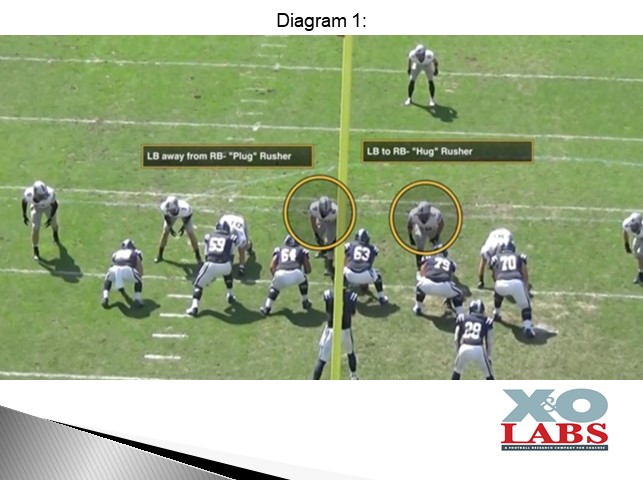
“We Base off the Center’s Point:”
Source: Ron Roberts, Defensive Coordinator, University of Arkansas
Here is where Coach Roberts’s system gets really interesting. His “Mike” and “Will” pressures are exactly the same call. The pressure defender is based on the Center’s point. Quite simply, the player opposite the Center’s point is the defender that is triggering.
For example:
- If the Center identifies the Mike, the Will is automatically the pressure defender.
- If the Center identifies the Will, the Mike is automatically the pressure defender.
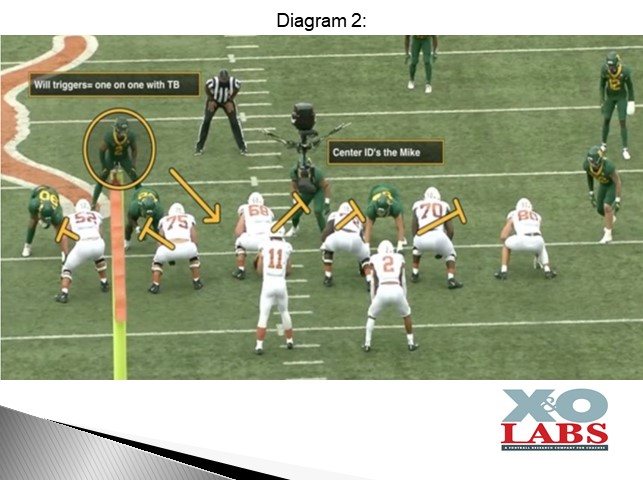
Like all simulated pressure against six-man protection, the purpose is to get a one-on-one with the back. That is usually done in the form of “Mug” or “5-0” looks where the Center has to identify the Mike or Will in protection.
In the example below, the Center identifies the Mike who is mugged up on the line of scrimmage, now the Will linebacker is one on one with the tailback, and the Mike is the middle runner.
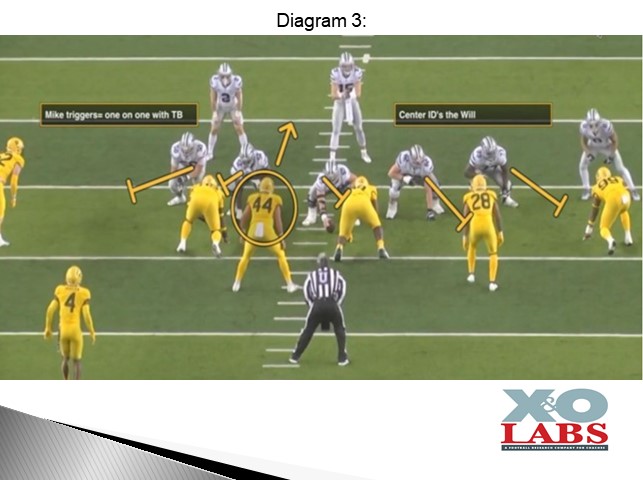
If that Center points to the Will, the Mike goes up the gut on the tailback, and the Will is the middle runner.
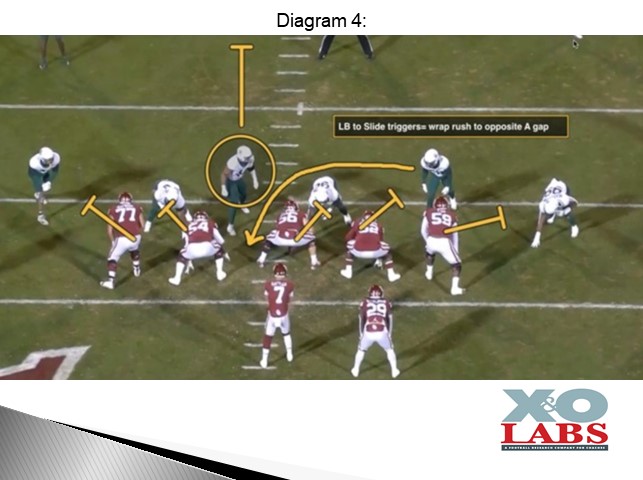
It gets better. If for whatever reason, the communication gets screwed up between the Mike and Will and the linebacker that gets identified becomes the rusher, he is taught to execute a “wrap rush,” working all the way across the slide into the opposite A gap.
“Either way you get a linebacker on a back or you get a free runner,” Coach Roberts told me. “And if you get good at reading it you get them every time. It’s a killer.”
These methods are sound against protection, but how do they hold up against the run game? We talked to two defensive coordinators- Chris Lorenti (University of Rhode Island) and Brian Bergstrom (South Dakota State University) on how they teach their defenders to read out against the run.
Below, Coach Lorenti and Coach Bergstrom break down exactly how they teach the second rusher to read out, stay sound against the run, and turn a pressure call into a weapon on every down:
- The exact "read out" rule Coach Lorenti uses to give his run fit an extra layer — the same coaching point that let his second blitzer wreck plays in the backfield while still producing QB hurries on 41% of snaps.
- How Coach Bergstrom decides which defender triggers first on every snap — a single, dirt-simple key that works regardless of down, distance, or formation width.
- The down-lineman movement SDSU pairs with the pressure to funnel the ball back inside and free up the A-gap rushers (most defenses run the blitz without ever teaching this part).
- When the second rusher should read out — and the one specific backfield action Bergstrom tells his defender to ignore completely, so he doesn't bail on a run he's supposed to fit.
- The personnel wrinkle Bergstrom uses to put a defender offenses never account for in the right spot to read the ball — plus raw and narrated game film of all of it on tape.