





By Mike Kuchar
Co-Founder & Senior Researcher
X&O Labs
@MikekKuchar
“To the offense it’s Duo, to the defense its gap scheme and to the football population it’s a complete misnomer. You’re not going to find this scheme in a category in PFF.”
- FCS Offensive Line Coach
The genesis of these Duo pulls variants are directly aligned with the advent of Mint fronts. You’d have to trace it back three seasons ago when these 4-0-4 fronts defenses were all the rage in football. The cancellation of gaps at the line of scrimmage completely stymied the efficiency of tight zone or Duo runs and the ball would get pushed out to a Nickel defender for a gain of a yard.
So, credit should start in the Art Briles coaching tree, where these staffs started to pull the play side Tackle (or Guard based on front) to gain numbers back to the offense. It was a simple solution to a complex problem. This is the story of those programs that benefitted from using it.
But First…A Clarification on Duo vs. Tight Zone:
Asking a coach if they run Duo or Inside zone is like asking a basketball junkie who is better, Lebron or Jordan. Most coaches equate Duo with inside zone and vice versa. While there are completely valid similarities to these points, I’m just giving you the definition: Duo is a run game built off a guarantee of two double teams at the line of scrimmage, thus the term “Duo.”
There were sources I worked with that called this inside zone and others that called it Duo. And when used from multi-surface alignments, there is a distinct possibility of generating up to three double teams at the point of attack- or what’s known as the backside- of the play. It is exactly what makes the play so dynamic. Bodies on bodies, vertical movement at the point of attack and a back that is able to bend the ball back by reading the backside linebacker. It’s a perfect marriage for lovers of running the football.
The play feeds on light boxes and dies against “no-double-team” fronts
Because duo is a double-team scheme, it needs a defender to double. Against a 6-man box it averages 9.35 yards and goes explosive 30.7% of the time; against an 8-plus box it drops to 6.80 and 15.8%. And the only fronts in the whole library that hold it under ~5.3 yards are exactly the ones that take the double teams away — Bear (5.30) and Double Plug (5.05) — because everyone is covered and there is no one to combo. This is the single most important defensive cross-reference in the file, and the coaches name it independently:
So, the reasoning of these Duo pulls are simple: if you’re not going to get double teams, and the opportunity presents itself to pull an additional lineman to the entry point of the play then by all means do it!
“The Explosives Live in the C and D Gap:”
Harvard offensive line coach Jim Jackson states it flatly: “that’s where the explosives are in duo, coach — the C and D gap.” Our charting and analysis agrees. Sorting all 3,260 reps by where the ball actually hit, the edge (C/D gap) is both the most common point of attack (1,372 reps) and the most productive (8.52 yards, 23.8% explosive), while the B/C gap behind the tackle is the weakest landmark (6.61, 17.3%).
We are all doing everything we can to secure the cutback (spray) in Duo because hat’s where the explosivity lies. That's not an assumption. The sweet spot in Duo seems to fall within the backside (or what coaches call the frontside) C or D gap. When Duo hits in the C gap it averages over 13.8 yards a play, and when it hits in the D gap it averages 13.5 yards a play. Fact is 63% of all Duo explosives hit in the D and E gaps.
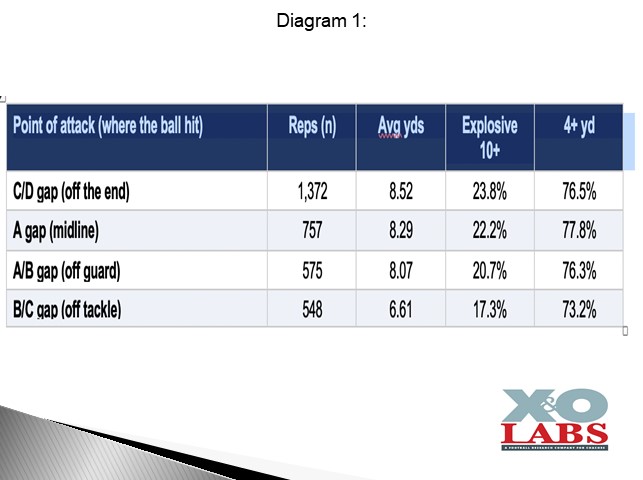
If you’re familiar with the structure of the Duo play, then you know that the common denominator in efficiency lies in allocating more hats to the concept’s backside (which becomes the front side). Duo’s beauty lies in its flexibility. Unlike traditional gap schemes, your back can press, bend, and bounce based on the reaction of the backside linebacker. Our data shows that when backs are forced to redirect, they are often finding the explosive crease.
Duo is built off the backside because that’s where the entry point of the back lies. Defenses know that too, so they do everything they can to tighten gaps and add hats to the backside, which includes dropping safeties, plussing linebackers and rotating coverage to eliminate the cutback. So, offensive coordinators had to pivot and think outside of the box by building in tools to secure the cutback. And there is a small, select group of coaches that are choosing to use these pulls to protect their beloved Duo run scheme.
Before I get into exactly what this play is- and how to install it, allow me to educate you on what it’s not. Sorry, Twitter trolls. This is not from my language. It’s from the language of those coaches that have installed the scheme.
Why It’s Not True Tight Zone or Duo:
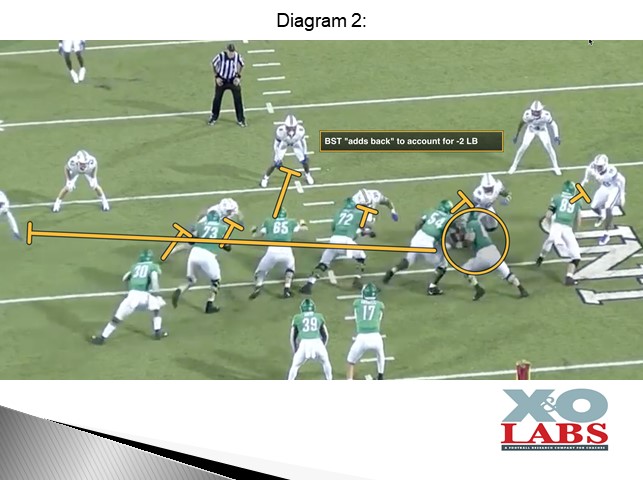
This concept looks completely different to the defense because you’re bringing an extra hat to the backside of the play. So, the defense has to find a way to account for that extra hat. Quite simply, it looks like a gap scheme but fits like a zone scheme. So, defenses can’t find a way to fit it.
Why It’s Not Power:
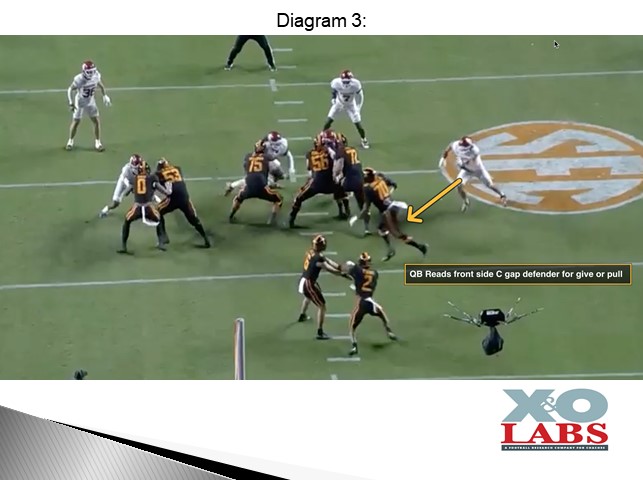
In traditional terms, the power concept is designed where a puller accounts for the play side backer and there is some type of pre-snap control- RPO, etc.- to handle the edge defender. In these Duo pull variants, the edge is handled by the read of the quarterback with the purpose being to create something where the QB can hand the ball off automatically.
Why It’s Not Tackle Trap:
This concept is not a Tackle trap for the following reasons. This concept is only run to the three or four surface formation side where combinations are taught as zone combinations and not gap combinations. This is different from a Dart concept, which is traditionally run to the two surface side. Again, the back is on a downhill A-gap track, which would contradict a typical gap scheme track.
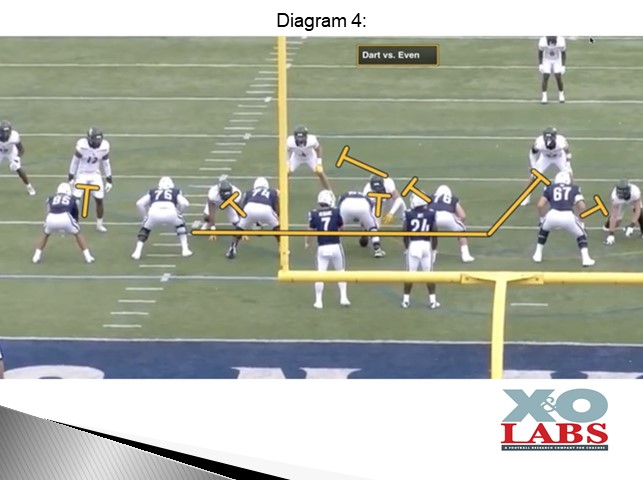
The beauty of utilizing Duo with pulls is two fold: you can keep the vertical-style combinations to the backside of Duo, and you can add a body to the play side without wasting him to the front side. Now, I’m ready to show you exactly how these programs are building these Duo pulls into their offensive system and how they are alternating who the pullers are based on the defensive front.
Now that I’ve clarified the bones of the play, these are the stories of the programs that have used it with a great deal of success the last couple of seasons.
Introducing…X&O Labs Install Anthologies: Volume 3: Duo Pull Variants
These Duo pulls are included in our Install Series. It’s a new series designed to prepare you with everything you need to know about installing and utilizing these Duo concepts heading into this season, and it’s exclusive to our X&O Labs members.
In the full report, you'll get everything you need to install these Duo pull variants in your program:
- Get the full install from three programs — William & Mary, Harvard, and Villanova — that turned Duo into a Mint and Odd front killer, including exactly which lineman they pull and how that changes based on the front.
- Add a hat to the play side without touching your Duo combinations — so you're layering onto the scheme you already run, not installing a new one.
- Get the four teaching rules our sources agree on for keeping the double team intact long enough to spring the explosive — including the cue one coach calls "smelling the breath of the linebacker."
- See how Harvard packages Power and Duo off a single read, and how the call flips between the two based on where the minus-one linebacker lines up.
- Walk the build-in layers — Arc Tags, the Guard-pull switch, QB Duo, and the full Power/Duo marriage — each rated 1 to 5 for install difficulty so you only put in what fits your menu.
- Solve the 3×1 force-defender problem that stalls most Duo teams, plus a built-in answer to weak-side pressure that doesn't cost you formationally.
- Watch it on film — cutups from William & Mary, Tennessee, and North Texas running every variant in The Film Room.