





By Mike Kuchar with Gunnar Boykin
Offensive Line Coach/Co-Offensive Coordinator
University of Central Arkansas
@CoachGBoykin
“Defenses get pretty predictable on how they set their front when you put that TE’s hand in the ground. And they certainly never account for him as a blocker away from the formation.”
- Gunnar Boykin, Offensive Line Coach/Co-Offensive Coordinator, University of Central Arkansas.
We need to give credit where credit is due. The grounded tight end concept was the brainchild of 22-year Arkansas coaching veteran Brooks Hollingsworth who now is an analyst on the UCA staff. And when Coach Hollingsworth and Coach Boykin sat in the offensive meeting room to build out the grounded tight end counter scheme, Coach Boykin had his questions. “I didn’t think the tight end would be fast enough to get to the playside,” he remembers contemplating. “But then I realized that if we figured it out it could be such a weapon. You don’t see it that much in football and defenses have to account for it.”
So, Coach Boykin and Coach Hollingsworth moved forward with installing the scheme. The Bears have been utilizing the grounded tight end counter since 2023- although this past season some injuries at that position made them shy away from the scheme. But as Coach Boykin will say the Bears cut its teeth on the grounded tight end counter and it has since remained a mainstay in the offensive operation at Central Arkansas. It became a formidable concept against Even fronts, particularly from Nub sets where defenses will present the bubble to the field.
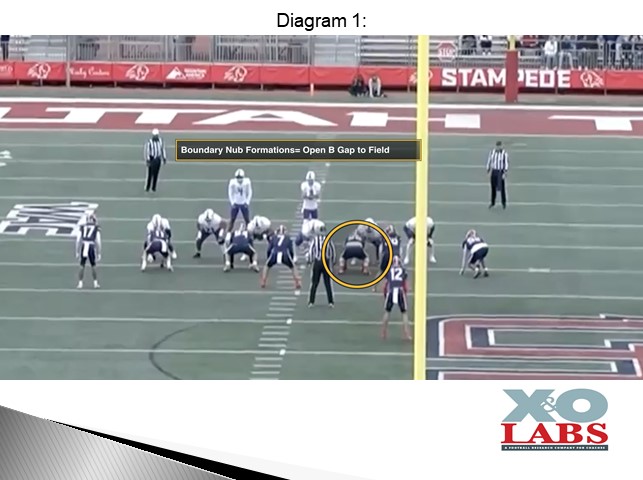
While UCA runs many variations of counter, the grounded tight end version is a separate tag. It’s truly an A-gap counter scheme as opposed to the Bears G/T counter scheme which is treated like a C-gap counter where the second puller is asked to read either a kick or log block at the point of attack.
And the reason why the grounded tight end concept is taught as a true kick play is because the predictability of the surface to the open side. The B-gap bubble will almost certainly predict a kick out by the Guard and an inside entry point for the tight end, the second puller in the scheme. “Most times that B gap is going to be open,” said Coach Boykin. “So, I know the play side Tackle will be through it faster to clear space for the pulling tight end.”
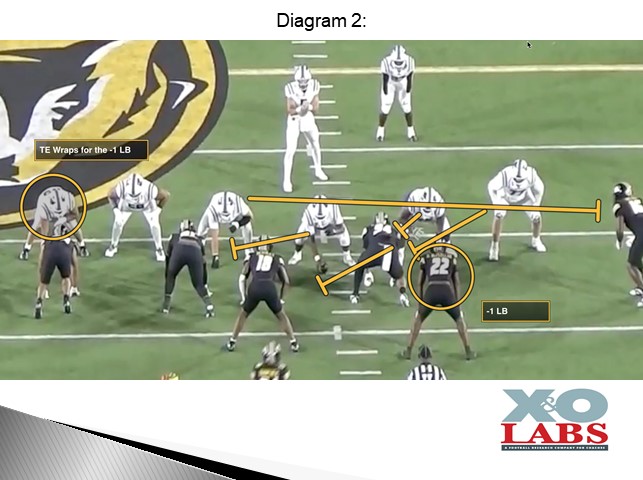
“Think Speed Upfield:” Post-Snap Puller Technique:
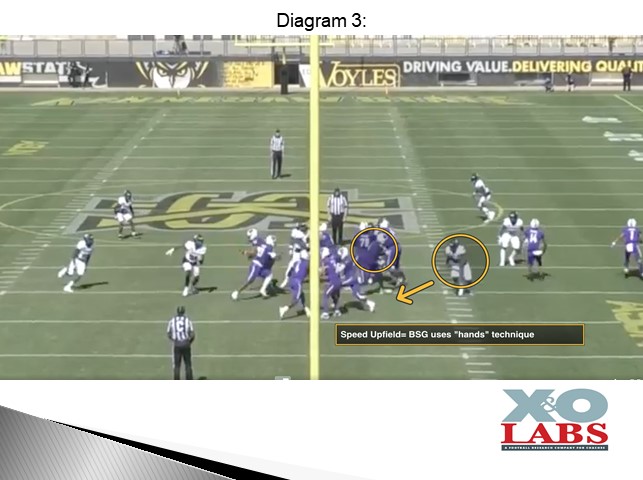
One of the challenges for the first puller in counter is having to adjust to a speed rusher who is upfield immediately. This can absolutely alter the mesh. This is why Coach Boykin emphasizes turning the near knee and hip to the sideline. If there is any speed upfield, the contact point needs to be the hands and not the shoulder on the kickout. “When I see speed upfield, I will meet the near shoulder as wide as I can,” he said. “I don’t want that to happen is lead with shoulder and he stalls and he works back up over the top of me. So, we meet him wide and trail that shoulder. We try to keep him wide and let him work upfield around us.
The biggest challenge for coaches in installing the grounded tight end counter is teaching the tight end the fundamentals needed to get the width and depth necessary as the second puller. It’s something that takes a good deal of reps and timing. How Coach Boykin teaches this fundamental and the drill work he uses to reinforce it will be the basis of this report.
In this report, Coach Boykin opens up the rest of his grounded TE counter install — the footwork, the drill work, the front adjustments, and the RB read progression that make it go. Here's what's waiting on the other side of the login below:
- The "depth before width" footwork rule that keeps Coach Boykin's tight end clean against immediate C-gap penetration — and why he has to fight to stay square all the way through the pull.
- The inside-out read Coach Boykin teaches when the point linebacker widens on the tight end — the one adjustment that keeps this scheme alive against fast-flow defenses.
- The "Jump Back" individual drill UCA runs every day in-season to build the timing and width their grounded tight end needs as the second puller — plus drill film of the technique.
- The "screw to screw" coaching point for the playside Guard that declares the A-gap defender and tells the playside Tackle exactly how to attack his gallop-lead block.
- Coach Boykin's Mint front answer — how the playside Tackle manufactures a B-gap bubble against Odd fronts so the first puller still gets his kickout (and the one defender alignment where UCA won't run it).
- The RB's entry-point progression and cutback cylinder — including the backside linebacker key Coach Boykin says triggers more cutbacks than most coaches realize ("nobody protects the backside when they see pullers").
- Raw and narrated game film of the grounded TE counter in live action.