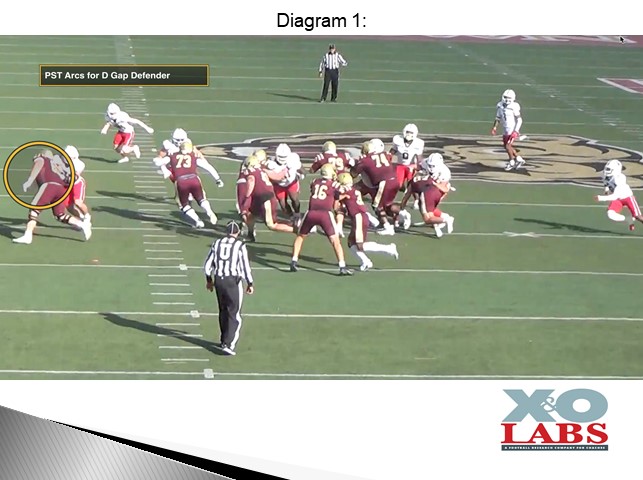

The “Kick” Concept: Harvard’s Explosive Hybrid of Duo and Power

By Mike Kuchar with Jim Jackson
Offensive Line Coach
Harvard University
@CoachJimJackson


“We wanted to be a Duo team but you don’t get explosives unless you get pullers to rip the defense in half. So, this concept came to life”
– Jim Jackson, offensive line coach, Harvard University (MA)


When you ask Harvard’s offensive line coach Jim Jackson about this play, his first answer is, “we should have run it more.” The play is a combination of both Duo and power- two mainstays in the Crimson menu- and the declaration is determined on the leverage of the minus one linebacker. At Harvard it’s called “Kick,” and according to Coach Jackson, it’s “racially” in the power family but it’s an auxiliary run to affect to minus one linebacker- who is traditionally the read in Duo.

The origin of it traces back to over a decade ago when Coach Jackson was at San Diego and had issues against Odd Front defenses. So, he started studying which concepts best exploited these looks and the four-surface Duo run kept populating in his brain. The answer was obvious: it allowed the offensive line to build a wall backside and got the second tight end matched up on a smaller outside linebacker type. Coach Jackson saw Boise State run it with Ashton Jeanty and he was already affiliated with offensive line coach Tim Keane. So, the connection was there. “You see good people do it and it makes sense why it’s successful,” he said.

So, Coach Jackson went about blending both Power and Duo to solve the issues the ball carrier was having with quick trigger backers. “We want to be a Duo team but we couldn’t get explosives until we decided to add pullers,” he said. “That is when you can rip the defense in half and use their leverage against them by trapping them inside.”
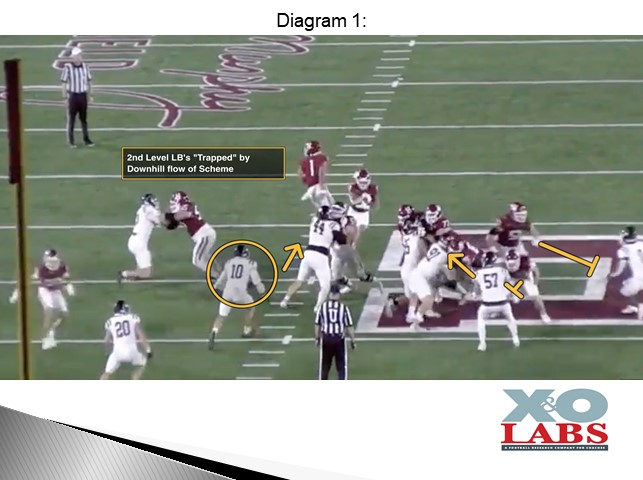
 

And at Harvard, Kick is taught on the same install day as Power. Duo is taught on a separate day.

If you’re a gap scheme team that has Power and Duo in its menu this blend of both will alleviate the responsibility of the back to read the minus one linebacker, allowing him to treat the play like a gap scheme.

When you’re done reading this report, you’ll be able to:

  • Identify the specific leverage key that tells your quarterback or playside lineman whether to run Power or “Kick” — and install the automatic built right into Harvard’s system
  • Apply Harvard’s gap scheme blocking rules for the “Kick” concept to both three-surface and four-surface fronts — including how to handle the minus one linebacker without putting that read on your back
  • Coach the pulling Guard’s open pull technique, including the “Stick Step” footwork Harvard uses to scrape the edge and kick anything he sees — even when the picture gets muddy
  • Counter backside pressure with the same technique Harvard used to hold up against Villanova in the FCS playoffs
  • Teach your running back the proper entry point and tempo off the puller — the “Piano Read” progression Coach Jackson borrowed from former Rice head coach Mike Bloomgren
  • Instantly adapt your existing Power and Duo installation to add this concept — since Harvard teaches Kick on the same install day as Power
  • Use this scheme at any level — Coach Jackson confirms he ran these same principles as a high school coach in Texas long before he was coaching at the FCS level



Read More

The ‘Warren Buffett’ Method to Self-Scouting Your Offense

By Travis Davis
X&O Labs


A 12-Month System That Tells You Which Plays in Your Playbook Are Paying a Dividend & Which Plays You Need to ‘Sell’ Immediately


The Big Idea

Being an offensive coordinator is a lot like being an investor on Wall Street.

An investor puts money into a portfolio of businesses. You put time into a playbook of plays. And just like an investor, your job is to know which of those investments are paying off — and which ones you need to cut your losses on and move to the next opportunity.

We found a college offensive coordinator who tracks his “investment” in each play in his playbook. Throughout the year, he tracks every minute he spends on each play in practice. That’s his investment.

At the end of each season, during his end-of-year self-scout, he measures the ROI — return on investment — of each play. He wants to know if every play in his playbook is worth the time he invested.

He’s the Warren Buffett of playbook investing — and this system has kept him in the black every year. He is one of the most consistent play callers in football (by production), and this system is why…

As an offensive coordinator, your time is your money. This system shows you exactly where you’re spending it and the return you’re getting back.


The ROI Self-Scout System


This is a 12-month self-scouting cycle. It’s not a film study system and it’s not a stat-tracking exercise. It’s a closed loop that connects four phases of your year — end-of-season, spring, summer, and in-season — and makes each one feed the next. Run it for a year and your offense gets sharper. Run it for three and you’ve got a playbook that pays you dividends every fall.

The core mechanism is simple: throughout the entire year, you track the time you invest in every play concept during practices — down to the exact minute of every practice. Minutes in fall practices. Minutes in spring practices. Minutes in pre-season camp. At the end of the year, you stack that investment against the success rate of each play during the season. That’s your ROI. Plays that earn their reps stay. Plays that don’t get cut or fixed. Year after year, you’re eliminating the dead weight and doubling down on what works.

Most offensive coordinators carry plays they’ve always run, spend reps on concepts that rarely get called in games, and keep things in their playbook out of habit. This system makes that impossible to ignore.

When you’re done reading this report, you’ll be able to:

  • Grade every play in your playbook using the same “success” system our college OC has relied on for 13 seasons
  • Build the exact spreadsheet he uses to calculate the ROI of every play — cross-referencing success rate against total practice minutes invested
  • Run a complete end-of-season audit that tells you which plays are blue-chip investments and which ones you need to cut
  • Use spring practice as a testing lab — driven 100% by what the audit revealed, not by habit or guesswork
  • Track your practice investment in real time during the season so the year-end audit is already done before December
  • Monitor your weekly tendencies the way a defensive coordinator watches you — and adjust before your opponent does
  • PLUS: We reveal who the “Warren Buffett of Playbooks” actually is — and why his system is worth stealing…


Read More

The Three 5-0 Pressure Patterns That Generate the Most Pressures

By Mike Kuchar with Chris Lorenti
Defensive Coordinator
University of Rhode Island
@ChrisLorenti


“We use so many twists from Bear fronts, we don’t get kick slides, we get short sets. So, the process becomes which lineman we can pick on with Up and Under movements. And that’s the fun part.”
– Chris Lorenti, defensive coordinator, University of Rhode Island


All defensive coordinators are trying to find the “fish,” or weakest link in protection, and Chris Lorenti is no different. But what makes the Rhode Island defensive coordinator unique is how he devises his movement patterns in Bear presentations to not only find but also exploit inherent weaknesses along the offensive front. The Rams were among the best at doing so this season, and they are at the top of the CAA rankings in several defensive categories this season.


The “5-0” Presentation Mindset:

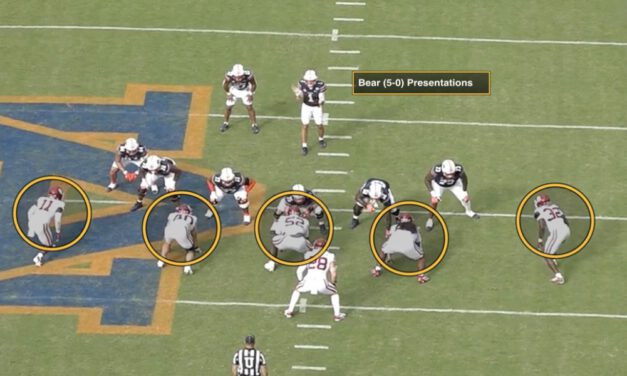
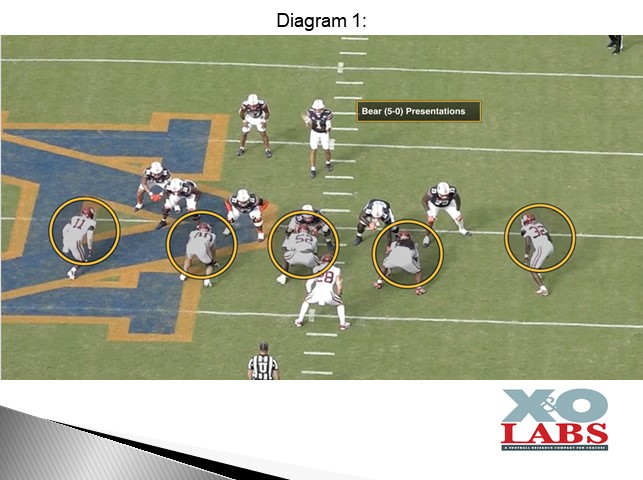
Quite simply, Bear presentations force the five offensive linemen to declare their protection rules. It basically eliminates any potential slide from the Center as he is forced to hold on the Nose, at least pre-snap. For Coach Lorenti, it’s not entirely about generating pressures or getting sacks. It’s about moving the quarterback off his spot. It’s something that the Rams did on 39% of drop-back snaps this season. “If we can move him off his spot, it’s a win,” he said. “Now it becomes the process of whether we are moving him to the non-dominant throwing hand? Or, are we moving him to the short side of the field? Or, are we moving him to the passing weakness so that he is cutting the field off? All of this goes into our game planning procedures.


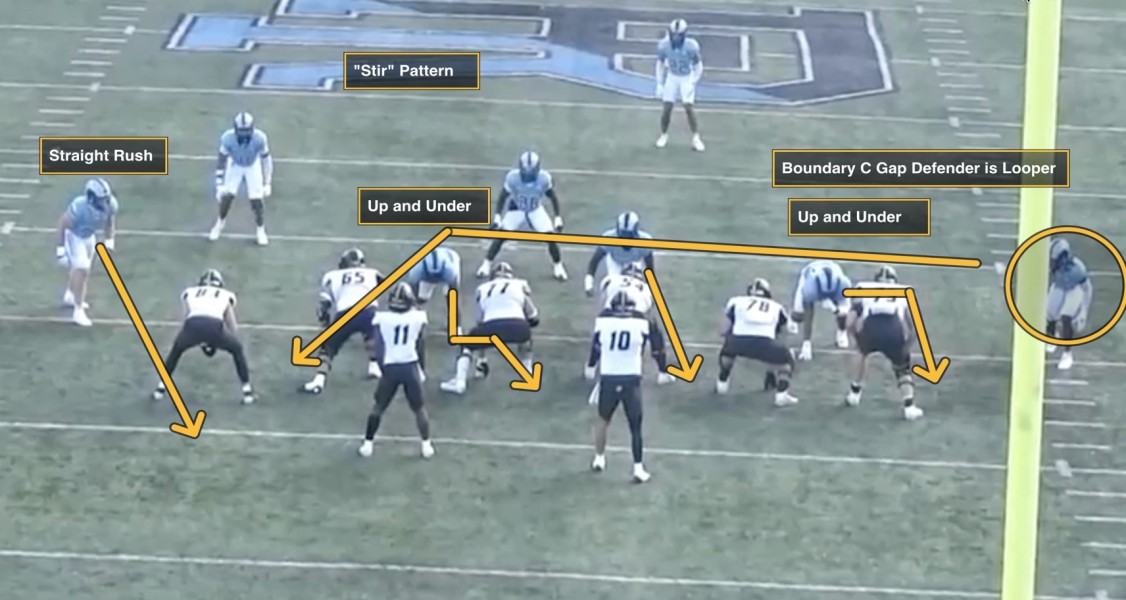
And because Rhode Island uses so many twists from Bear looks, they don’t get kick slides; they get quick sets. “When we see that, we have to make the straight rush real,” said Coach Lorenti. “They short set us, so we use up and under movements. As long as the QB is moving, we are affecting him. Then the process becomes knowing which linemen we want to go up and under on. That’s the fun part.”

In this report, Coach Lorenti details exactly how Rhode Island’s defensive staff builds and sequences their Bear front pressure patterns — and why it led to a 54% hurry rate and a top defensive ranking in the CAA two years running:

  • The 3 core rush techniques Lorenti teaches every pressure defender — and which ones he assigns to which personnel
  • The exact thought process Rhode Island uses to identify the “fish” in protection and design rush patterns around him
  • How Lorenti sequences his five 5-0 presentation pressure patterns — and why each one sets up the next
  • The field-side and boundary-side patterns that force the QB to flush exactly where Rhode Island wants him
  • The Cross Dog patterns that generated a 41% hurry rate — and the “read out” option that made them just as effective against the run
  • How Rhode Island pairs man-free coverage with these Bear looks to take away the QB’s first read and turn every play into backyard football
  • Raw and narrated game film of every pressure pattern in this report
  • Plus: The new X&O Labs self-scout tool called, The Pressure Audit, that lets you run the same pressure analysis Lorenti does on his own defense — but you can do it faster, and with nothing but your play-by-play data file


Read More

Kutztown’s Inexpensive Option to Handle Wide Zone Lag

By Mike Kuchar with Pat Taylor
Offensive Line Coach
Kutztown University (PA)
@CoachTaylor_OL


“We tried to run traditional wide zone, but we had issues with the open side Tackle giving the 5-Technique a two-way go, so we cleaned up the picture and took the indecision completely away from him”
– Pat Taylor, Offensive Line Coach, Run Game Coordinator, Kutztown University (PA)


For the last two off-seasons, we’ve been pumping our content full of these Y-lead wide zone variations. The ones that originated from the Kyle Shanahan coaching tree, that has begun to trickle down to all levels of football. Clearly Kutztown’s offensive line coach Pat Taylor wasn’t reading our research. But, like many other wide zone coaches, he did have an issue with play side lag from the C gap defender. But, rather than build in these “flying combinations” that we reported on previously, Coach Taylor built his own twist on the concept by having his play side Tackle completely ignoring the C gap defender and having the backside Tight End clean him up himself. Quite simply the Tackle has the D gap, and the Tight End has the C gap.


For Coach Taylor, it was the more inexpensive option to handle any front side lag. There was no grey area. The tight end would simply clean up any color by kicking him out, the same technique he would use in split zone.  If the DE stays in the C gap the TE handles him. If the DE stays wide, the TE inserts inside. “It allowed the Tackle to not get caught up with the defensive end staying square,” said Coach Taylor. “The ball unusually goes inside of him because he’s so worried about not getting reached. Anytime you’re making the defense change their fits on the snap where they have to all be on the same page to identify which gap they are defending, it’s always a good idea.”

Sure, this concept is an easy answer against stagnant C gap defenders. But what happens when the front moves? What happens when the defense disguises its fits and creates indecision at the point of attack? The answers — and the details that make this scheme work at every level — are in this report:

  • Most wide zone teams are still fighting the same problem — a C gap defender with a two-way go who can either dent the play inside or kill it on the perimeter. Kutztown found a way to make that defender irrelevant.
  • Coach Taylor’s fix costs you nothing schematically — no new personnel, no exotic combinations, no additional install time. If your Tight End can run split zone, he can run this.
  • The play side Tackle gets one job and one job only. No grey area, no combination, no decision tree. When a lineman stops guessing, he starts winning — and this scheme proves it.
  • This isn’t the Shanahan “flying combination” you’ve been reading about. This is a different answer to the same problem — and for many programs, it may actually be the better one.
  • The running back’s path changes, and that adjustment is critical. Miss this coaching point and the whole scheme breaks down. Coach Taylor gives you the exact aiming point cue that makes it work.
  • Movement fronts are where most coaches bail on a concept. Coach Taylor addresses exactly how Kutztown handles stunts and shifting fronts so the scheme holds up when defenses try to disguise their fits.
  • Kutztown built in a built-in answer for when the perimeter leverage is wrong pre-snap — a simple choice call that lets the QB flip the play without tipping the defense. The details of how they structure it are inside.


Read More

The Intelligence Cycle for Football Coaches

By Travis Davis
X&O Labs


How Intelligence Agencies Turn Raw Data into Actionable Decisions — And How You Can Use the Same Process to Scout Your Opponents and Yourself


The Opportunity Nobody Sees

When you finish scouting your opponent for the week, how confident are you that you’ve found everything you need to beat them?

We asked football coaches that same question. Two out of three weren’t confident they had found everything they needed to win.

The reason? Most coaches don’t have a scouting process. They have habits. Over 60% had no formal framework for scouting an opponent — or themselves. Nearly 70% admitted that parts of what they do every week have little or no impact on their game plan. They do it anyway because that’s how they were taught.

That’s not a problem. That’s an opportunity for every coach reading this right now…

Because right now, you have access to more scouting data than any coach in the history of this game. You have better technology than ever to process it. The only thing standing between you and a killer game plan is a framework for turning that data into intelligence.

When you follow the scouting process outlined in this report, you get exactly what you need to win — and you get it quickly. It’s like gaining an extra two or three days to prepare during game week.

This report gives you that process…


How We Found the Answer

For three years, X&O Labs has been researching how data and technology impact the way football coaches scout. We’ve mapped the scouting processes of over 100 coordinators from high school through the NFL — documenting how they collect data, how they analyze it, what they look at first, what questions they ask, and why.

The first thing we discovered: the coaches who consistently out-prepare their opponents share something in common. It’s not a specific tool. It’s not a secret data source. It’s a process — a way of thinking about the work that keeps every decision connected to the next one.

The second thing we discovered: the problem isn’t the data, and it isn’t the technology. It’s the absence of a scouting process for using them. Coaches have better tools than ever. They don’t have a better process. And without a process, more data just means more noise.

That discovery led us outside of football — to organizations that have been solving this exact problem, at much higher stakes, for decades.

Intelligence agencies. Military, government, civilian. Organizations whose entire purpose is turning overwhelming amounts of raw information into a small number of decisions that have to be right. They face the same core problem you face every game week: too much information, too little information, not enough time, not enough help, and no margin for error.

They solved it with a framework (a process). And through a strange course of events, this led us to a professor who lives in both worlds.

Professor Greg Kennedy teaches at King’s College London. He is a historian who has studied and taught intelligence at the university level and a former intelligence officer in the Canadian Armed Forces. He has worked and published with professional intelligence officers from Canada, Great Britain, and the United States.

He also coaches football…

He’s the rare person who understands both how intelligence agencies process information and how football coaches prepare for opponents. He’s a ‘one-of-one expert.’ Professor Kennedy’s perspective on how intelligence agencies process information anchors everything that follows.

“The Intelligence Cycle is God. It is the thing that, at the core basis, all intelligence is created from.”
— Professor Greg Kennedy

Keep reading because we’re going to show you how to adapt the Intelligence Cycle for football…


This Report Gives You 3 Things…

First, a four-stage process called the intelligence cycle — Direction, Collection, Analysis, Dissemination — that turns raw film and data into a game plan. It’s the same process intelligence agencies use to convert overwhelming information into actionable decisions. You’ll learn each stage, what it does, and how to run it during your game week.

Second, a three-layer analysis method that takes you from overall tendencies to the specific advantages that go on your call sheet. Most coaches stop at Layer 1 — the tendency report. That’s the starting point, not the finish line. You’ll learn why, and you’ll learn what the other two layers are and how to use them.

Third, a practical weekly structure that maps these stages to your actual game week — what to do on Day 1, what to focus on by Day 3, and how to compress everything into three or four rules your players can execute on game day.

This framework is an operating system for your weekly scouting process. It tells you how to think through your scouting.


Read More

Solo Coverage: Lehigh’s Quarters Run Fit to Defend 3×1 Runs/RPOs

By Mike Kuchar with Rich Nagy
Head Football Coach
Lehigh University (PA)
@CoachRichNagy


“For two years, we tried to figure out how to help number three on benders without taking our dynamic boundary safety out of the fit. This was our answer.”
– Rich Nagy, defensive coordinator, Lehigh University (PA)


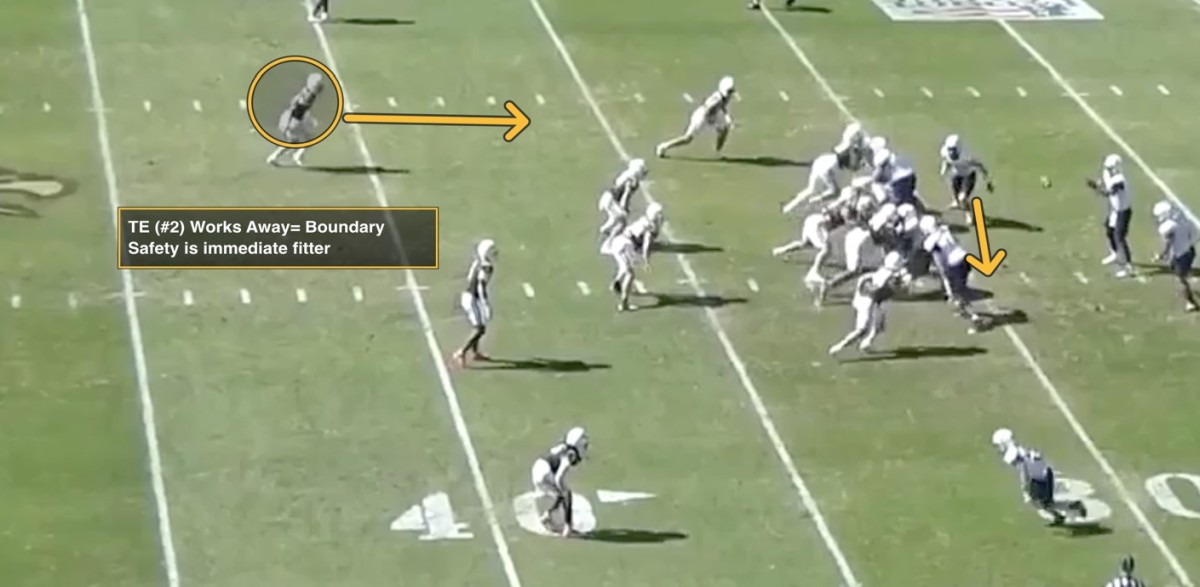
If you’re a Quarters outfit, then you know how important the boundary safety is in your defense. Against 11 personnel offenses, he’s usually the extra run fitter, which means he’s also the target of the RPO game. He’s continually placed in run/pass conflict and expected to diagnose his read quickly and be a factor in both run/pass situations. That’s why that boundary safety is often a dude, such was the case at Lehigh this season, where the Mountain Hawks were blessed with a specimen that was strong enough to play in the box and athletic enough to handle helping the boundary corner with any conflicting routes.

“Quarters coverage became very expensive for the boundary corner against the X’s we were seeing in this league year after year,” Coach Nagy told me. “So, we wanted to figure out how we can manipulate the coverage to help out the corner. In traditional quarters coverage, that boundary safety would be tied to the number three receiver. We wanted to get him off number three and into the run fit.”


So, defensive coordinator Rich Nagy and safeties coach Mike Kashurba spent the better part of a year grooming their boundary safety to be the key cog in their quarters defensive structure. The answer became what the staff termed “Solo” coverage, which alleviated the boundary safety off the number three receiver and into the weak side run fit. Sure, it was somewhat expensive, but then again so is the responsibility of the boundary safety in Quarters’ defense. And if you have a safety as Lehigh did- and chances are you do if you play quarters- then you may want to invest in it. It paid off exponentially as he tallied 56 tackles, many of which were either at or around the line of scrimmage- we have the film to validate that. It propelled Lehigh into a top 5 defense at the FCS level in several categories- including rushing defense (70 ypg), scoring defense (13.9 ppg), and total defense (278 ypg).
This report will give you a ready-to-install system — built in three distinct pieces — for getting your boundary safety into the run fit without sacrificing your coverage structure. Here’s what Coach Nagy details in this report:

  1. The “Solo” Coverage concept itself — how Lehigh removed the boundary safety from his #3 vertical read and handed that responsibility to the Mike linebacker, freeing the safety to be a fast, downhill run fitter against 3×1 formations.
  2. Why the Mike linebacker is the key unlock — the specific assignment he takes on (carrying #3 vertical to the high safety), and the one exception (the late bend) that brings the boundary safety back into the pass picture.
  3. Surface reads over lineman reads — Coach Nagy’s explanation of why Lehigh abandoned reading offensive linemen entirely in the RPO era (“they lie now”) and how they replaced it with a surface-based read system that gets the safety triggered faster.
  4. Two-surface vs. three-surface formation adjustments — exactly how the safety’s gap assignment shifts when a tight end enters the formation, and how a releasing tight end becomes an instant green light to trigger downhill.
  5. The Hang vs. Fold read for RPOs — a simple two-word framework that tells the safety whether to be “slow to go” and help on inside breaking routes, or to immediately attack his gap in the run fit based on backfield flow.
  6. Overlap backer fits — how Lehigh’s second-level defenders shift one gap away from the fold-fitting safety to maintain run integrity, and how the Will linebacker stays in the box against 2×2 open formations.
  7. Full game film — raw cut-ups of Lehigh’s Quarters run fits vs. 3×1 formations so you can see every concept above in game situations before you install it.


Read More

Villanova’s Gap Scheme Menu for Athletic Tackles

By Mike Kuchar with Sean Devine
Offensive Line Coach/Run Game Coordinator
Villanova University
@devine_sean


If you’re from the Northeast, then you already know the football rich tradition that’s built around the Valley Forge area in Pennsylvania. Villanova has long been at the top of the ladder when it comes to FCS football. Just this season, the Wildcats advanced all the way into the semifinals on the backs of a 11-game winning streak. Despite falling short to Illinois State, Villanova finished near the top of every offensive category.

And you’ll continually find the Wildcat run game at the shoulders of those top offensive categories. For the last nine seasons, offensive line coach Sean Devine has been directing a unit that continually over-achieves. That’s nothing different when it comes to Villanova football. But what was different this season more than others, was the athleticism that Coach Devine was blessed with at the bookend position. Coach Devine had two Tackles that were very athletic and can run, which is a rarity even at that level. So, when it came time to devise the run game Coach Devine started to lean on concepts where he can get his 6-6, 315-pound left tackle and his 6-6, 310-pound right tackle matched up on smaller bodied personnel.

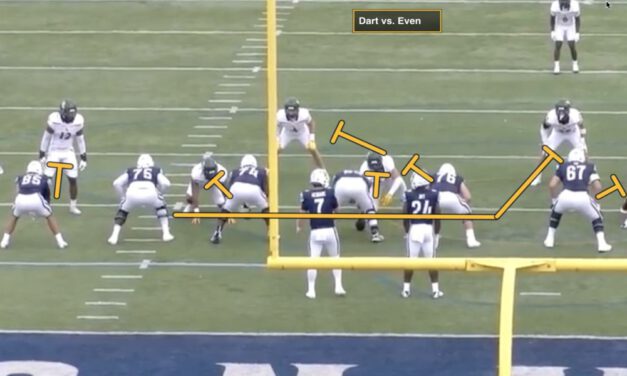
So, this season ‘Nova majored in two gap scheme runs- Duo and Dart. It became a monumental shift from the tight zone run game that Villanova hung its hat on for years. “We love the inside zone and the universal Duo plays that everyone is running but I’ve been a big believer in carrying a way to cut the defense in the B gap,” coach Devine said. “You have to create seams for the running back to cut the defense and that happened most for us with Duo and Dart.”


It Started with Duo:

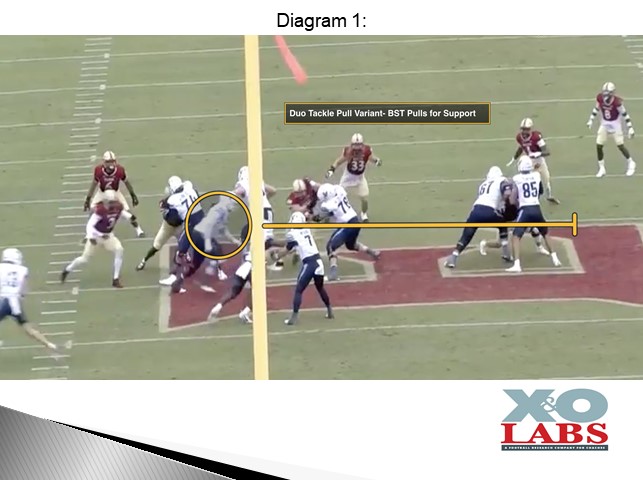
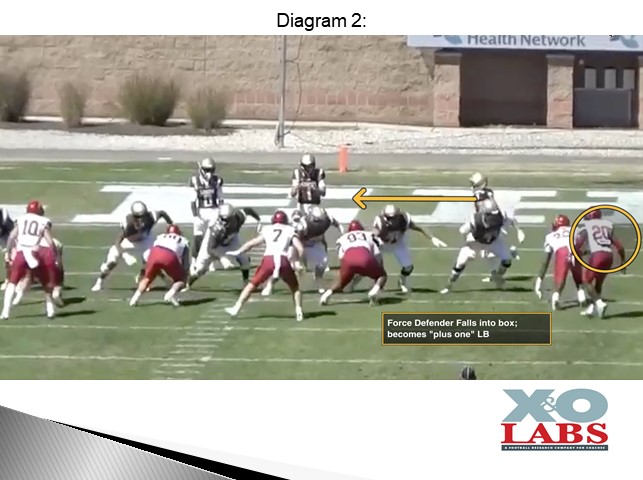
We’ve already reported on the Tackle Pull Variant of the Duo play, where the backside Tackle (or frontside depending on how you’re terming it) was responsible for kicking the support defender. It was something that William and Mary were building a season before. Coach Devine felt that skill set best fit his Tackles, so he morphed it into his own version this season for the following reasons:

  1. It became a 3×1 formation answer, where you can get the force defender blocked
  2. The Duo combinations stay the same
  3. Was good vs. 3-4 Odd teams where the play side Tackle was uncovered play side


The read is the same as in Duo- the backside LB but the Tackle is trapping the outside force defender. The ball carriers window is B gap, to C gap to inside out on the Tackle pulling.


But the Duo Tackle pull variant is only one build-in that Villanova used. Where the Wildcats got most of their mileage from was derived from its Dart concept, which had it used to manipulate both Even and Odd fronts during its national championship run. The focus of this report will be how Coach Devine and ‘Nova designed its Dart concept to manipulate the defenses in the CAA.

Here’s what Coach Devine shares in this report:

  • See exactly how ‘Nova designed Dart to attack both Even and Odd fronts, with full installation diagrams
  • “No Hips in the Hole” — the play side Tackle technique that shut down B gap penetration and why it’s the key to making Dart work
  • Kick vs. Insert Pull rules for the backside Tackle — how Devine teaches his pullers to read the defense and make the right decision without a call from the sideline
  • How to handle the 4i technique — the lateral shuffle cue that prevents your Tackle from getting washed out on Odd fronts
  • The Duo Tackle Pull variant — how Villanova used it as a 3×1 formation answer to get the force defender blocked when teams tried to outnumber them at the point
  • The mindset shift — how Devine walked away from 9 years of tight zone and rebuilt the run game identity around two gap schemes in a single offseason
  • Why a rival CAA coach said it was “the most difficult thing to prepare for all season” — and what that means for how you can use these same concepts to create preparation nightmares for your opponents


Read More

The 22nd & 10 Scouting Report

This is a scouting tool for defensive coordinators—it finds offensive play caller’s tendencies and tells in 22nd & 10 situations.

Upload your opponent’s offensive scouting data (CSV or Excel) below and instantly get a five-phase scouting report — overall tendencies, tendencies in context, and if the data reveals a pre-snap tell, you’ll know exactly what it is, how strong it is, and where in the game you can trust it. [NOTE: This tool is available below. Just login to get started.]


What is a 22nd & 10?

It’s when the offense is in 2nd & 10 AFTER throwing an incomplete pass on 1st down.

The OC has a decision to make. He just threw an incomplete on first down — now he’s behind the chains, facing pressure to either double down and pass (to pick up those lost yards) or get conservative and grind out any positive yards he can get. It’s one of the most telling decisions every OC faces, and it’s the exact decision where defensive coordinators can find actionable tendencies and tells.

This concept comes from a veteran FBS Power 4 defensive coordinator — an old-school craftsman with decades of experience leading defenses. We will not reveal his name for obvious reasons.


What Your 22nd & 10 Scouting Report Provides:

This scouting tool follows the exact thought-process of our FBS defensive coordinator, but its built for high school and small college coaches.


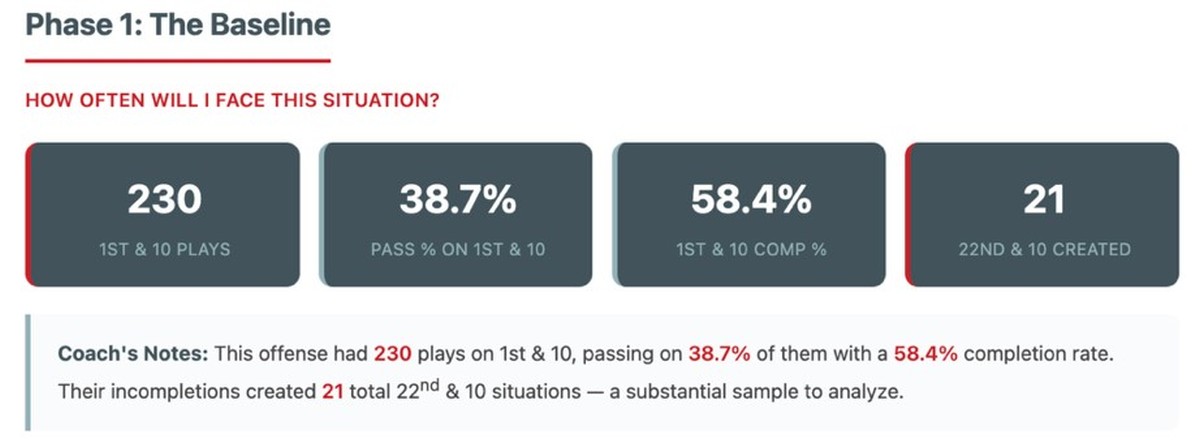
Phase 1: The Baseline — How often will you face this situation?

Establishes context: how often this offense passes on 1st & 10, their completion rate, and the total number of 22nd & 10 situations the data contains. Tells you immediately how large and trustworthy your sample is. Note: 22nd & 10 are defined as any 2nd & 10 play following an incomplete pass on 1st & 10. It does not include scrambles, sacks or penalties.


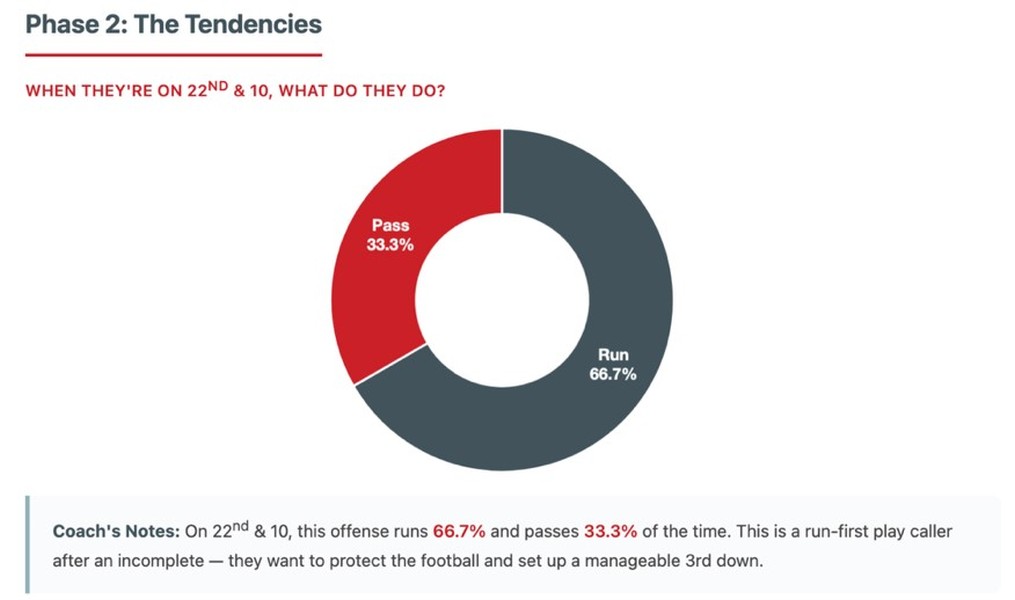
Phase 2: The Tendencies — What does this offense do on 22nd & 10?

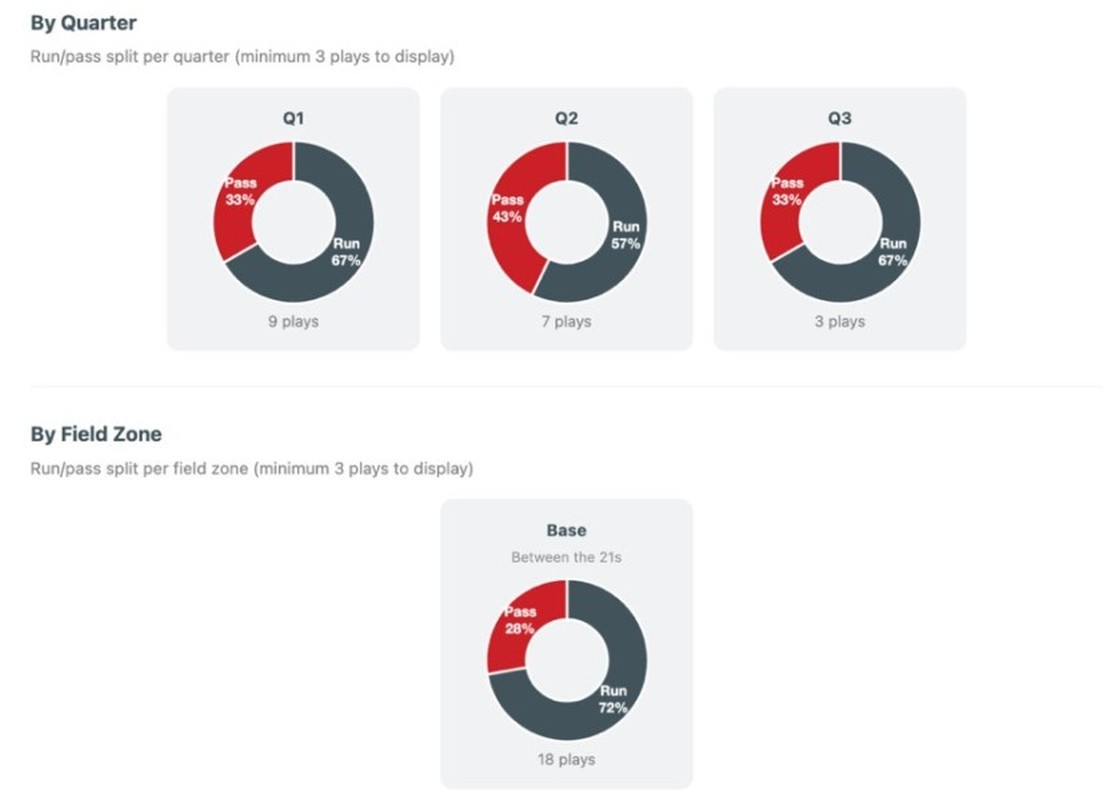
Overall run/pass split — then broken down by quarter and by field zone. A play caller who runs 65% overall may run 80% in the second half. A play caller who looks balanced between the 20s may become pass-heavy in the red zone. Putting these tendencies in context reveals what overall tendency analysis hides.


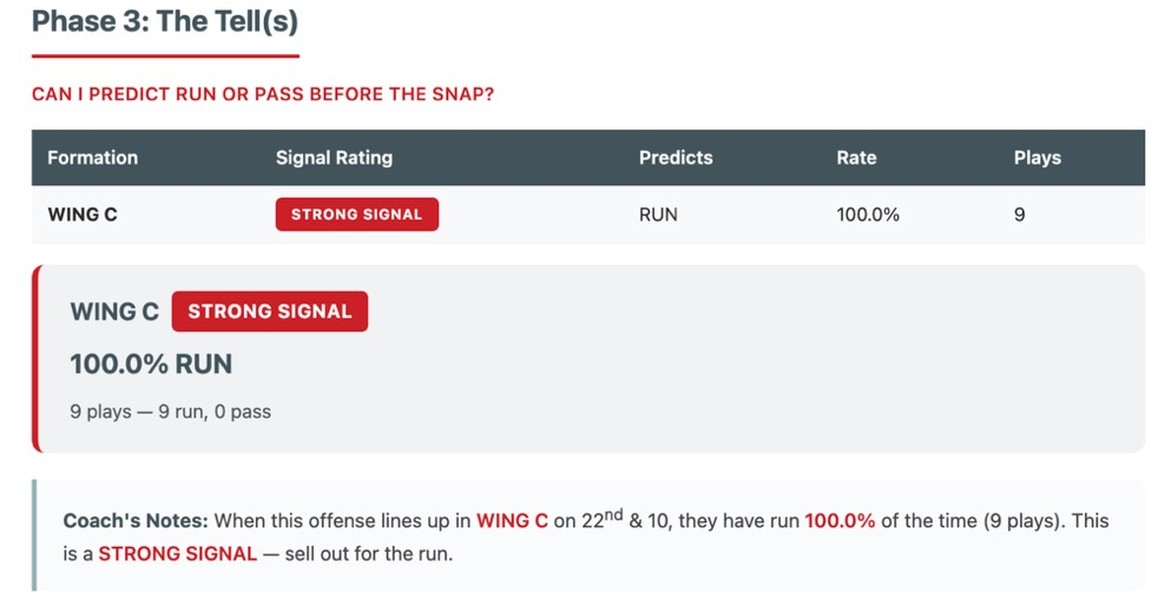
Phase 3: The Tell(s) — Can you predict run or pass before the snap?

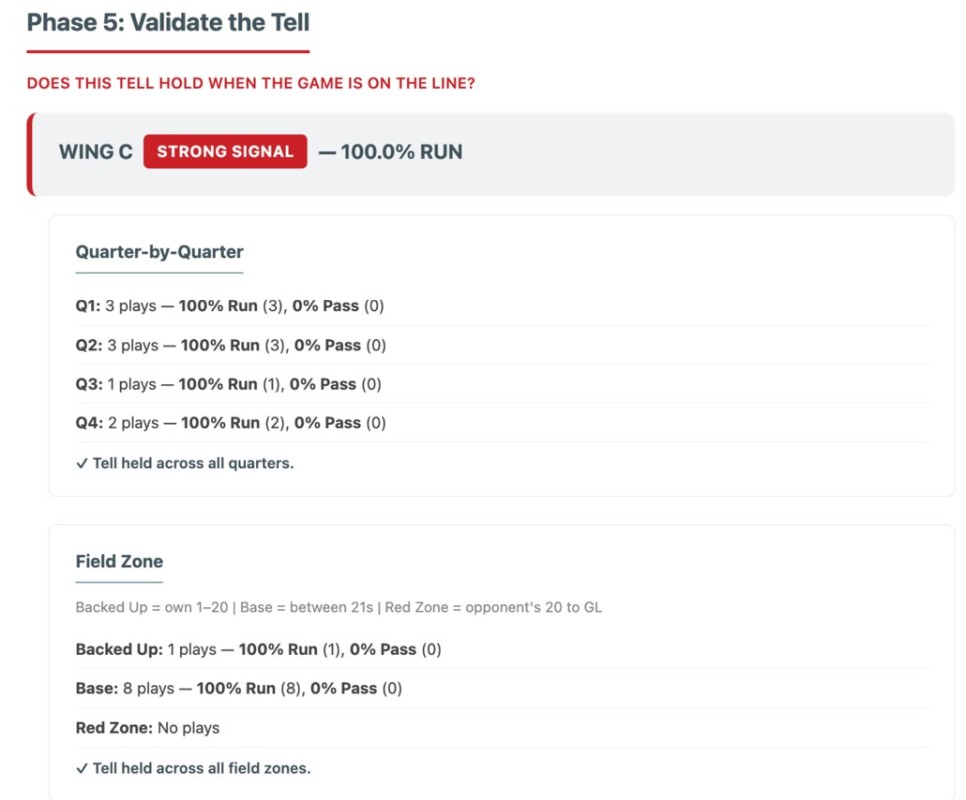
The tool scans every formation used on 22nd & 10 and identifies formations that predict run or pass at 70% or higher. When a tell is found, it is assigned a Signal Rating:

  • Strong Signal (90%+) — Sell out.
  • Solid Signal (80–89%) — Key on this formation.
  • High Tendency (70–79%) — Stay disciplined, expect it.


If no formation clears the threshold, the report tells you that too. No guessing.


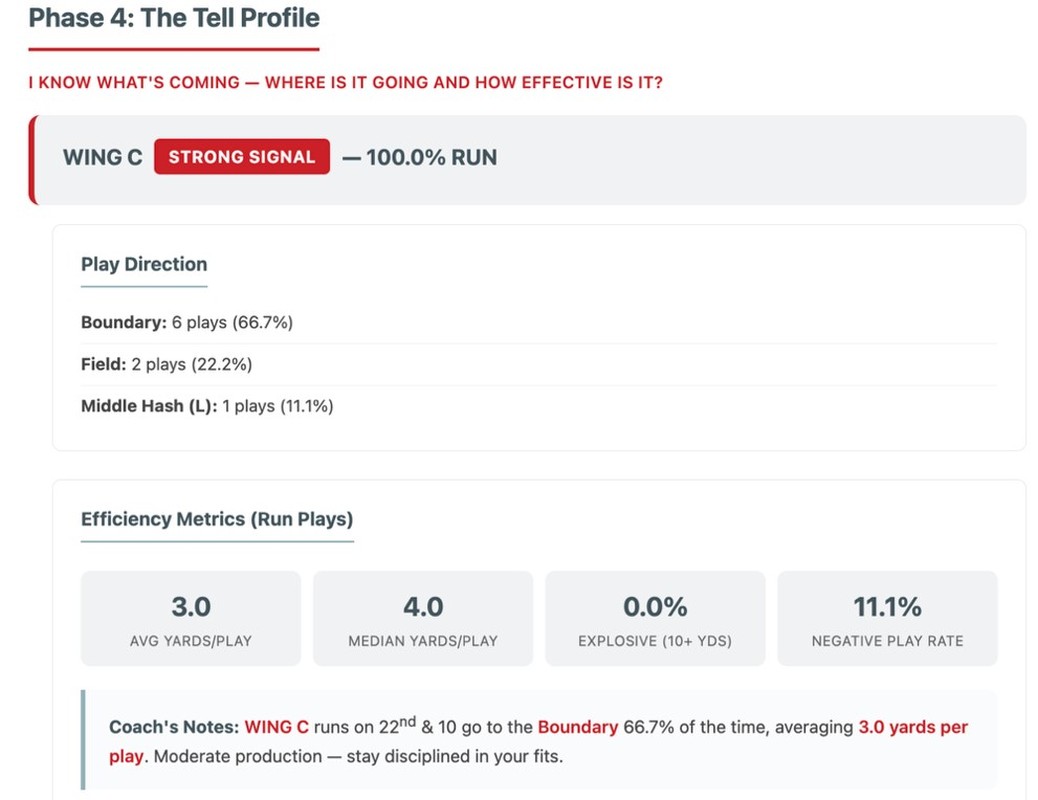
Phase 4: The Tell Profile — You know what’s coming. Now where is it going?

Every identified tell is profiled by play direction (field, boundary, middle), plus full efficiency metrics: average yards per play, median yards, explosive rate, and negative play rate. Now you can align to the most likely direction, not just the most likely play type.


Phase 5: Validate the Tell — Does it hold in predictable game situations?

The tell is stress-tested quarter by quarter and field zone by field zone. If it held consistently across all four quarters and all field positions, the report confirms it. If it broke down in specific situations, the report flags it with a warning. You’ll know exactly when to trust it and when to factor in the exceptions.


Ready to find your opponents’ offensive tendencies and tells in 22nd & 10 situations?

Login below, the page will expand and you’ll see the 22nd & 10 Scouting Report. Just upload your opponent’s offensive data, and your report is ready in seconds.


Read More

Boundary Safety Run/Pass Reads in Quarters Fits: Part 1 (The Bryant Way)

By Mike Kuchar with Anthony Barese
Defensive Coordinator
Bryant University (RI)
@CoachBarese1


“When you’re playing split safety defense your safeties can be in the run fit immediately based on their keys. You get into 9-man spacing, which is why I think split field safeties is the way to go, even against RPO’s.”
– Anthony Barese, Defensive Coordinator, Bryant University (RI)


When you talk ball with Coach Barese it becomes pretty clear that he’s a hard disciple of quarters coverage. He talks it, walks it and believes in it. So much so that after his units ‘24 season meltdown in the run game, he doubled down on sharpening up how he was going to teach quarters heading into this season. One high safety defense wasn’t even a consideration: “When you play middle of the field closed coverage, you have eight guys immediately in the fit, but your corners and safeties are pass first defenders,” he told me. “But when you’re playing split safety defense your safeties are read support defenders. They are in the run fit immediately based on their keys. You get into 9-man spacing, which is why I think split field safeties is the way to go, even against RPO’s.”

But the issue is if you’re going to teach safeties to trigger faster in the run game, you better be able to prepare them to make sure they are sound against the RPO. When your seventh fitter is traditionally the boundary safety, then he’s the one that is going to get read in the RPO game. He’s going to be the one that has to match up with tight ends and running backs in the pass game and still be able to fit the box in the run game. Bryant had the defender that was able to do those things and Coach Barese built his entire defensive scheme around him.

If you are a quarters coverage operation with safeties that can get downhill in the run game, Coach Barese will teach you how he works with his safeties to recognize and react vs. specific run concepts and have the discipline to defend RPO’s. And he has the film to validate it.

When you read Coach Barese’s full report, you’ll see…

  • How to tighten your Quarters run fits so your safeties trigger faster and your run defense improves immediately
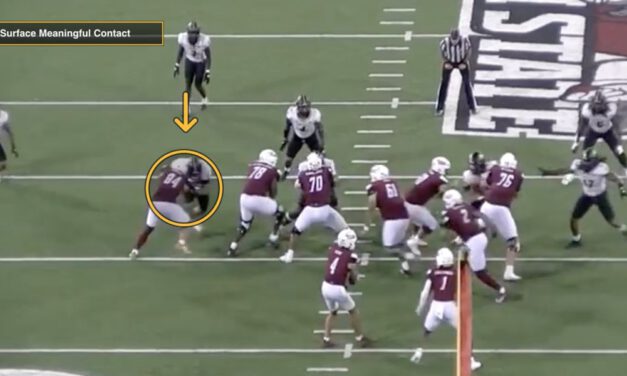
  • The “Meaningful Contact” teaching progression that removes hesitation and eliminates grey-area reads for your safeties
  • A boundary safety read system that lets you defend the run aggressively without losing integrity vs. RPOs
  • How to structure 9-man spacing from split-field coverage so you gain a numbers advantage in the box
  • Specific coaching cues that help your safeties process run vs. pass faster at the snap
  • Run-fit adjustments vs. Pin & Pull, Counter, and Insert Zone that funnel the ball exactly where you want it
  • A practical solution for handling post-snap RPO conflict without changing your coverage structure
  • Diagrammed fits and game film that show exactly how to teach it


Read More

“Control the Cutback:” The Bunch Duo RPO

By Mike Kuchar
Co-Founder/Senior Research Manager
X&O Labs
@MikeKKuchar


“We don’t want to ask our number two receiver to dig out the Nickel Sam. We just didn’t have the size to do it. Now by not blocking him we can create a soft edge and secure the cutback.”
– FCS Offensive Coordinator


Common assumption insists that Duo runs generate far fewer explosive plays than other run concepts like wide zone. Duo runs are traditionally designed for consistency over explosiveness. Most offensive line coaches will tell you it’s a “wear down” scheme, that pops later in the game. But the reality is Duo does produce explosives and it happens often. So often that we analyzed over 1,300 clips of Duo runs from this season and found that 325 total runs were explosive, generating 10 yards or more with an 8.9 yards per play average. 

The sweet spot seems to fall within the C or D gap. When Duo hits in the C gap it averages over 13.8 yards a play, and when it hits in the D gap it averages 13.5 yards a play. If you’re familiar with the structure of the Duo play, then you know that the common denominator in efficiency lies in allocating more hats to the concept’s backside (which becomes the front side). Duo’s beauty lies in its flexibility. Unlike traditional gap schemes, your back can press, bend, and bounce. The data shows that when backs are forced to redirect, they are often finding the explosive crease.

If you want to generate more explosives in Duo, then you’re going to have to get intentional about it. And that means intentionally producing a softer edge for that C-D gap backside entry point.

Essentially there are four ways to do that:

  1. Create a bigger run surface to the backside pre-snap
  2. Add an extra hat to the backside post-snap
  3. Build deception into the mesh
  4. Stretch the overhang defender


The Benefit of Bunch:

I spent the entire off-season last year reporting on the first three items on that list, so I’ll quickly rehash those points. And if you haven’t read those studies you’ll need to before you read this one. I worked with the University of New Hampshire; the University of William and Mary and Minnesota Duluth (to name a few) who all based much of their Duo runs around compressed or bunch formations because it allocated more hats to the backside entry point in Duo.

We found that Bunch Duo would be the most effective way to run the scheme, and our analysis proved us to be correct. Bunch or compressed Duo churned out a 63% explosivity rate and here is why:

  • It forces the corner to be the free hitter
  • It allows for a bigger surface to the backside (often known as the frontside) of the play.


Aligning in Bunch or compressed formations became an easier answer to get 3-4 additional blockers for Duo runs in 12 personnel groupings.

The blocking rules were simple:

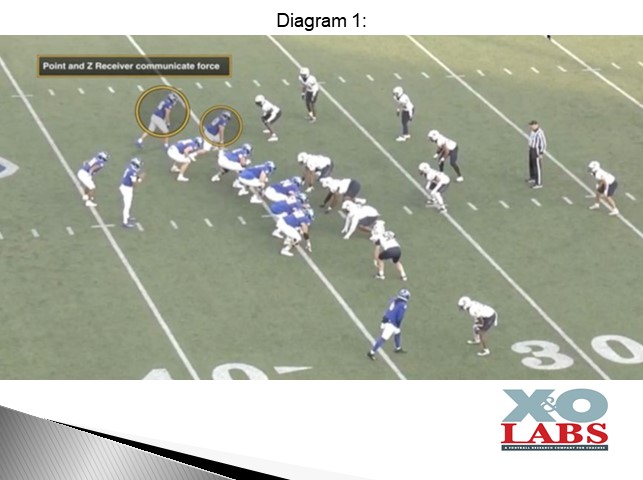
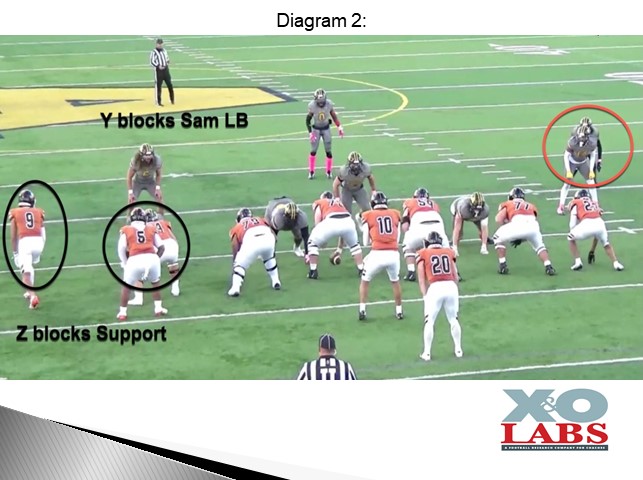
  • Attached (on the ball tight end)- block the C gap defender (possible combo with BST)
  • Point Receiver- block the Sam LB
  • Z Receiver- block support defender, typically safety, leaving the corner unblocked


I remember talking to Northwestern offensive line coach Ryan Olson about it when he was at South Dakota who told me it helps secure those explosives when the ball hits where it should- backside.

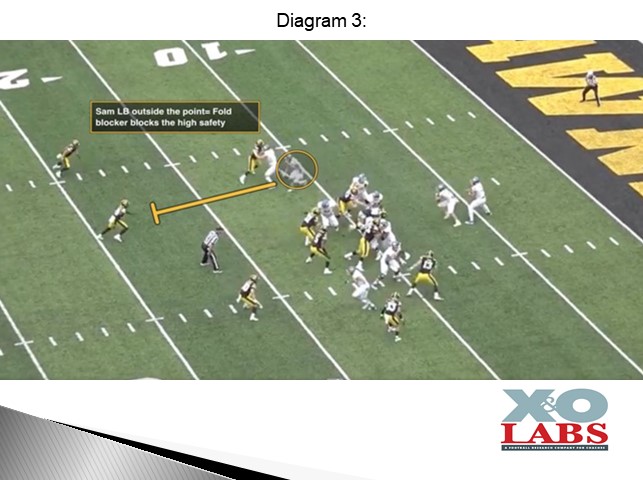
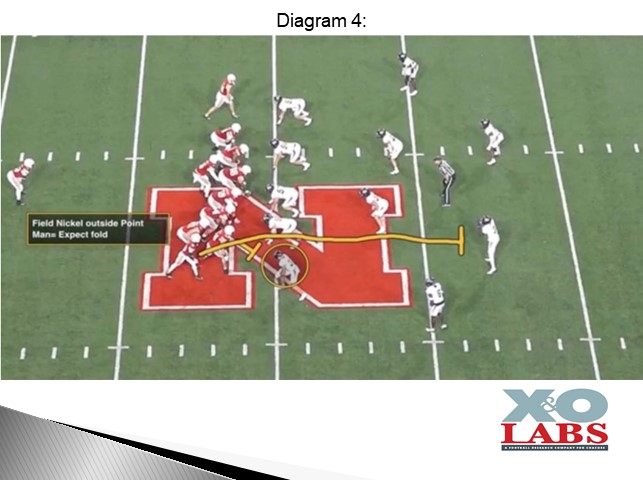
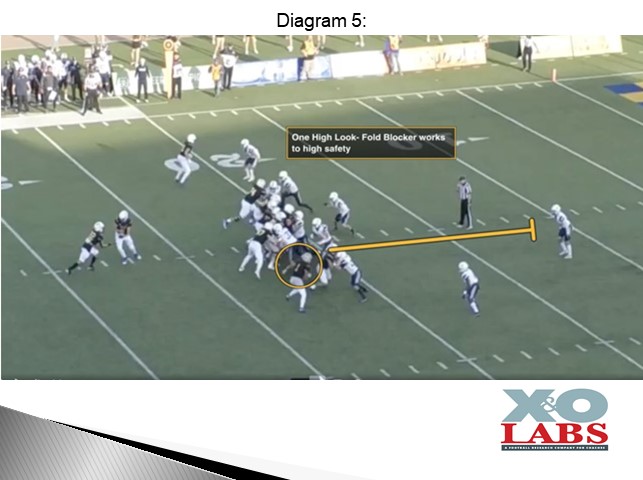
In these bunch or compressed formations, the ball carrier understands there is going to be a built-in fold block by the point receiver and the Z receiver. Both receivers talk to each other to communicate who is blocking the overhang defender and who is blocking the safety.


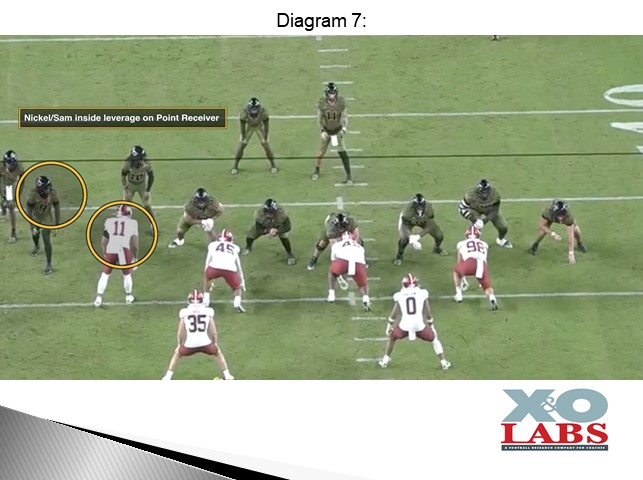
The communication is built off the leverage of the field overhang (or Nickel) defender. From a base standpoint, if the Nickel is head up to outside the point receiver in Bunch, it enacts the fold block between the Z and slot receiver.


Fold Blocker Rules:

  • Against two-high safety defenses, this receiver is taught to read support. In quarters coverage situations, it will probably be the safety unless he is way outside the half. In those circumstances, you don’t need to fold him.
  • If it’s a Cover Two look, there is no fold. The receiver blocks the corner.
  • In any man situation, the receiver will take the corner to the safety
  • Against any one-high looks, the fold blocker will work to block the high safety.


But That Was Yesterday:

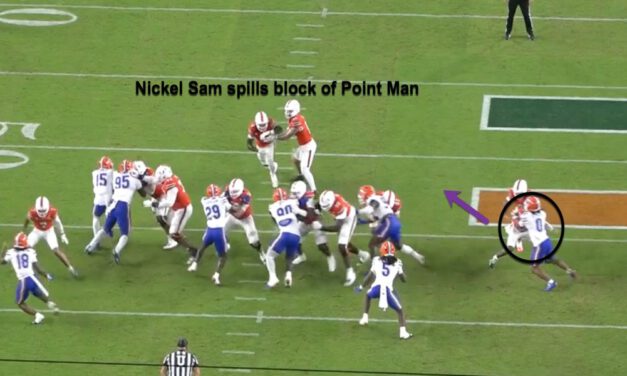
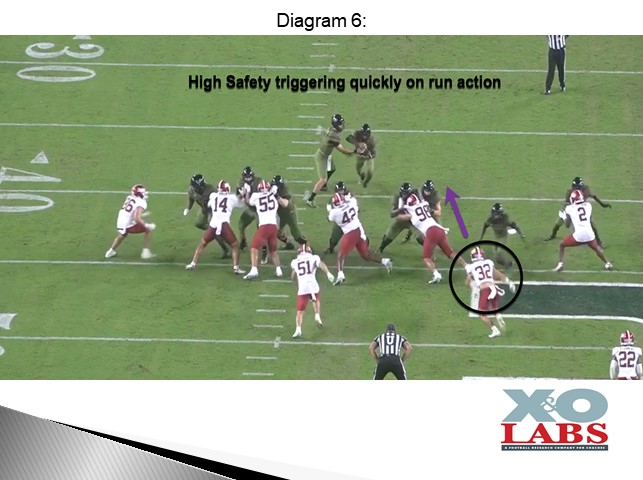
This season I found that defenses have caught up by tying in their support player to gain hats on the backside of the play affecting the cutback.

This was done in three ways:

  1. Triggering the safety downhill on the run action


  1. Aligning the Nickel Sam inside the point of the bunch to force the ball wider and “off the table.”


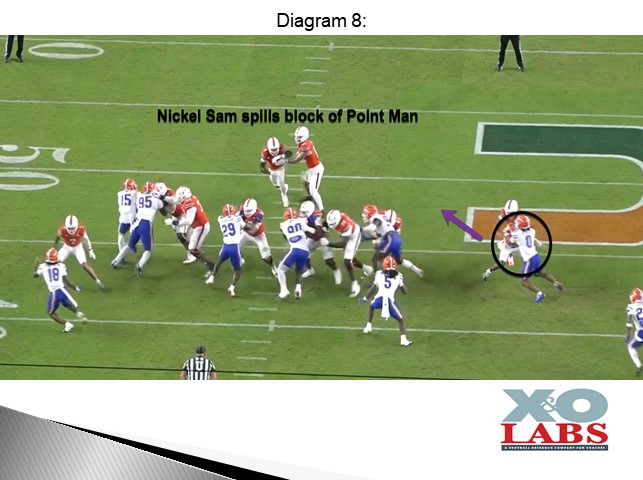
  1. Having the Nickel Sam spill the block of the point man


Typically, when this occurred, the point receiver would have to dig the Nickel out while the Z sorts out the next most dangerous defender. But that job was easier said than done for the point receiver and it often forced the play too wide.

Leave it the staff at the University of Miami to get creative and adjust accordingly. This season, offensive line coach Alex Mirabal built in a triple option element to Duo from Bunch. Sure, triple option football is not a new build-in to the run game. We’ve reported on several programs that have added triple option elements- whether it be quick game, QB reads or slides off inside and outside zone.

But when these triple option build-ins are packaged with Duo, it allows you to soften the backside entry point by adding doubt on the fit of the quarters safety and handle an inside leveraged Sam or Nickel. 

Although we couldn’t clinic with Coach Mirabal exclusively, we did connect with two coaches who did clinic with him to talk about what he did to protect the Duo cutback. And I’m  going to show you two ways in which these programs are doing that.


Here’s what you’ll be able to do after reading this report:

  • See how the University of Miami rebuilt Bunch Duo explosivity after defenses re-leveraged the cutback.
  • Understand why Duo produced 325 explosives in one season — and how to design yours to hit in the C and D gaps where the real yardage lives.
  • Protect your Duo cutback the same way Miami did — without asking undersized receivers to dig out a Nickel.
  • Attach a triple-option element to Duo that adds doubt to the quarters safety and freezes the overhang.
  • Control the backside edge using a bubble/shoot screen build-in that stretches the fit post-snap.
  • Install automatic throw rules versus Nickel fire so the QB never hesitates.
  • Force the Sam/Nickel to play slower with eye manipulation instead of trying to overpower him.
  • Add a Duo Read Double Option for QB-run systems that want the same leverage advantages without becoming an RPO offense.
  • Use compressed and detached formations the way Miami and others did to create explosive entry points.
  • Add these answers without overhauling your Duo rules or increasing your teaching load.


Login now to access this full study. And if you’re not a member, just click the ‘Join’ button. Signing up is easy—and takes a few minutes.


Read More

Delaware State’s Most Explosive Wide Zone “PRO”

By Mike Kuchar with Nyema Washington
Offensive Coordinator
Delaware State University


“We want to freeze that C gap player as much as possible. Let the defensive end free and then hit him with a pass behind him. It freezes the defense.”
– Nemo Washington, Offensive Coordinator, Delaware State University


When former NFL great Desean Jackson took over the post at Delaware State, he knew had to fix things quickly. The Hornets had won only seven games the last three seasons and were pretty stagnant on offense. So, the former All-Pro wide receiver made it his crusade to transform a once anemic offense into a scoring machine. So, another former Eagle legend Duce Staley connected him with an up-and-coming rising young coach named Nyema (Nemo) Washington. Soon enough, Jackson hired Washington away from a nameless program- Wheeling University- and into a well-recognized staff with over 60 years of NFL playing experience. Coach Washington was quickly given the reins of the offense and began immediately to preach an explosive play culture. He knew that the Hornets had athletes, but he wanted to give them something tangible, a metric that they can chase each week which would lead to success.

That metric took shape in the form of generating more explosive plays, which were runs of 10 yards or more and passes of 15 yards or more. His goal was to produce at least seven a game. It wasn’t an arbitrary number. Coach Washington did his research and knew that five explosives per game typically generated over 20 points a game. And if he can get his unit to produce seven explosive plays per game, that would typically generate over 35 points per game. He aimed high and decided ten would be the number and he made it his crusade to message it daily. He preached it to his players, hung the number in the locker room, continually reinforcing his messaging.

The players then started to embrace the culture and preach it themselves to the point where they would count each one themselves during the course of the game. “We’re getting close, Coach,” is something he would continually hear them say. Seven explosives became ten and then ten became twelve. Del State finished second in the country at the FCS level averaging 12.5 explosive plays per game and what do you know? They averaged over 32 points per game enroute to an 8-win season.
Of course, this didn’t happen organically, it happened intentionally. For Coach Washington it came with building first a scheme and then designing ways to protect it. The offense was built around wide zone run, which fit perfectly with the skill set of running back James Jones. Then, the rest of the season became about studying how defenses were defending it and building answers from there. For Coach Washington, those answers took shape in the form of what he termed “PRO’s” (Pass/Run/Options) off the wide zone play. It was a scheme that produced the highest number of explosives this season.


Inside this report, you’ll see how Delaware State’s Nemo Washington:

  • Built an offensive system designed tomanufacture explosive plays every week, not wait for them
  • Used wide zone as a tool toforce defensive overreactions — then attacked the space those reactions created
  • Created pass answers that consistently hitexplosives behind fast-flow run fits
  • Turned one explosive-play goal into aclear offensive identity players could chase and execute
  • Structured QB reads so explosives came fromdefender leverage, not perfect throws
  • Protected explosive throws off run action whilekeeping the offense clean and on schedule
  • Scaled a small menu of PRO concepts intomultiple explosive answers as defenses adjusted
  • Converted explosive-play volume directly intopoints, momentum, and wins


Login now (or join X&O Labs) to access the full report with game film.


Read More

Illinois State “Tilt” Presentation Menu

By Mike Kuchar with Travis Niekamp
Defensive Coordinator
Illinois State University
@CoachNiekamp


“We would show four down and then move to an overload to create as much confusion as we can.”
– Travis Niekamp, Defensive Coordinator, Illinois State University


“Where’s the Weak Links?”

We’re all designing these “tilt” or overload fronts for one reason- to attack protections. But It’s my belief that defensive coaches are spending too much time concerned about protection structures than protection personnel. When talking to Coach Niekamp about his tilt presentation protocols, I’ve found that the best way to go about designing these presentations is to pinpoint specific weaknesses in player personnel, not protection structure.


The Weak Link Checklist:

Here’s what I mean by this: if you’re trying to single out a particular lineman or back because of his protection vulnerabilities, then do so with your rush pattern. Coach Niekamp told me about a particular offensive tackle this season who struggled with up and under rush moves. So, what did he do? He designed his overload rushes away from that player to force him into a one-on-one with his best rusher. The result produced several hurries and a sack.

“It’s all about who can we find the weak links and how can we take advantage of that,” he told me. “There were some games we ran overloads a good deal, and some games we didn’t. It depends on how mobile the quarterback was.”

Typically, he’ll follow the following checklist in putting together his overloads:

  • Are they a mobile quarterback with the ability to escape the pocket? If so, then design rushes to flush him away from his throwing hand.
  • Are the non-mobile quarterbacks who stay in the pocket? If so, design more north and south rushes that hit downhill to get him off his platform


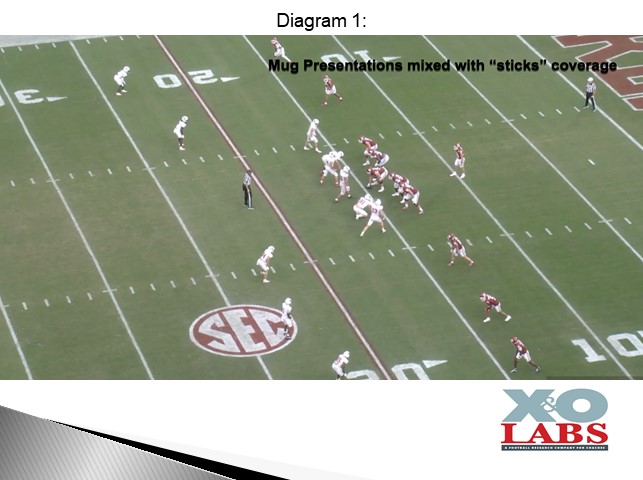
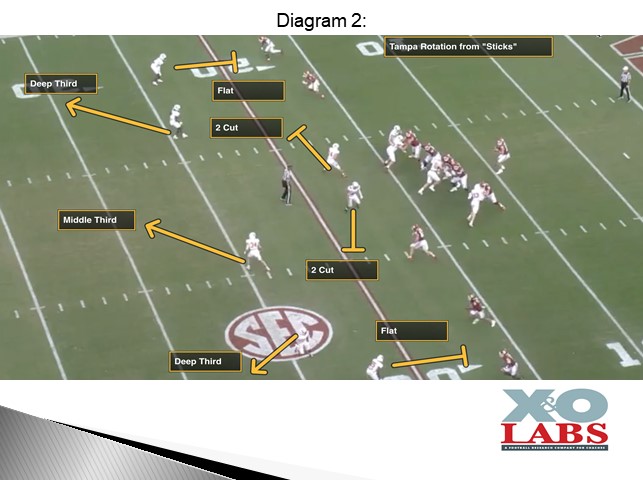
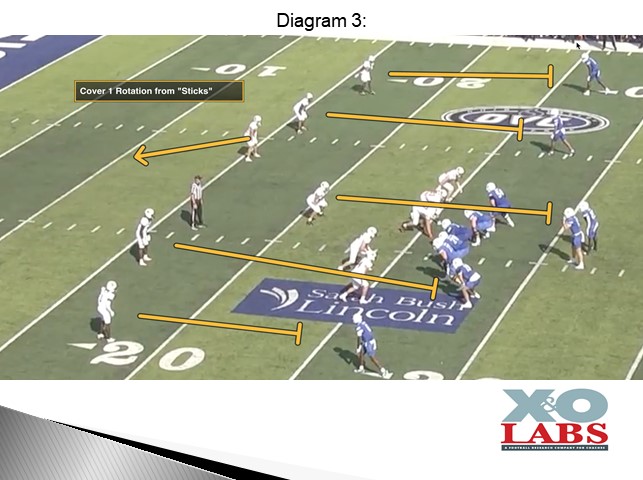
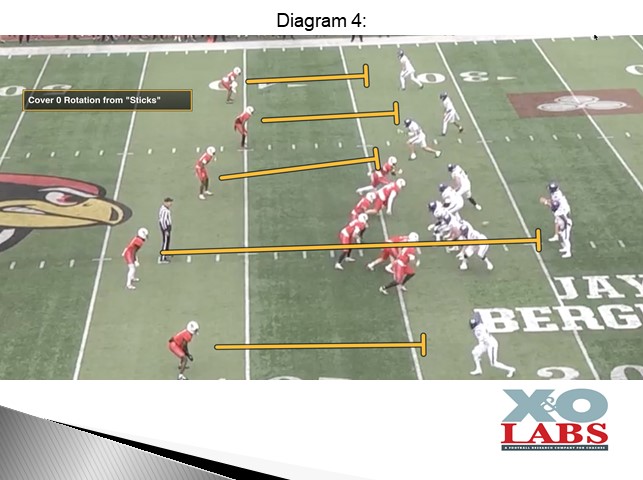
I’m going to get into exactly how these overload presentations are designed and enacted based on this checklist. But before I do so, there is something that Illinois State does on the backend with its overloads that I think is really creative. They use what they call “sticks” coverage alignments, particularly on third down. This will alert every coverage defender to align with their heels one yard before the first down so that no rotation in coverage is exposed.


This way, the quarterback cannot decipher what the coverage rotation will be on the snap. “We can disguise sticks a lot easier than other coverages,” Coach Niekamp told me. “We can play man or zone, and post-snap, the QB has to figure it out. We force him to throw the football in front of the sticks, and we tackle it and win the down.”

Essentially, these are the base coverages where “sticks” disguise is used:


Tampa Coverage


Man Free Coverage


Cover 0 Coverage


Here’s what Coach Niekamp shares with you in this report:

  • How Illinois State builds overload and tilt fronts to attack specific protection weaknesses.
  • A simple process for identifying the weakest protector and isolating him with rush design.
  • How overload fronts are paired with “sticks” alignment to disguise coverage and kill pre-snap tells.
  • Clear rules for adjusting pressure based on quarterback mobility.
  • Why Illinois State teaches face-read techniques when movement and stems are built into the front.
  • How overloads are used to consistently force 4-man and 3-man slides in protection.
  • When simulated pressure replaces 5- and 6-man rushes—and why.
  • How presentation and subtle rush path changes keep pressure aggressive without tipping tendencies.


Login now (or join X&O Labs) to access the full report with game film.


Read More

The Defensive Vulnerability Report

Every defense gives up explosive plays. The advantage goes to the staff that knows exactly where — and why — they give up big plays.

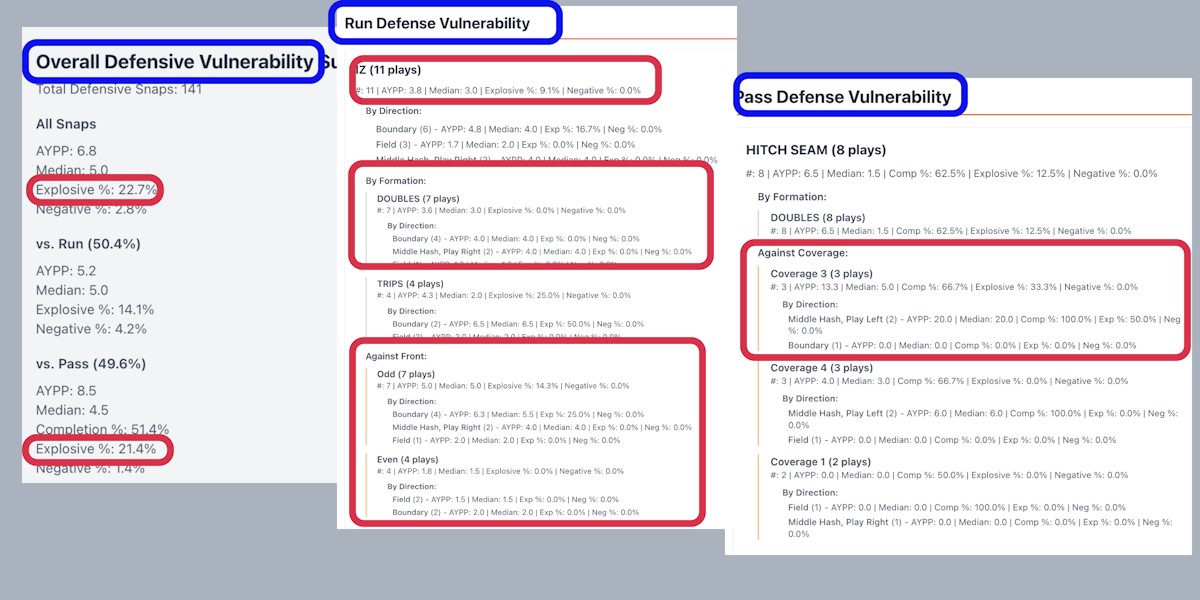
The Defensive Vulnerability Report is a scouting tool that exposes the specific runs, passes, formations, and directions (field or boundary) that are gashing a defense using nothing but real game data. Just upload your defensive data into the Defensive Vulnerability Report generator below and instantly see where the defense allows explosive plays, and where the defense is performing well.


For offensive staffs, this is the fastest way to find cheap explosives without reinventing your playbook. For defensive coordinators, it’s a clear-eyed self-scout that replaces gut feel with proof. So, problems can be addressed and fixed quickly.

This scouting report tells you exactly which plays a defense cannot consistently stop — using the same terminology you already use on your call sheet.

What the Defensive Vulnerability Report Provides YOU:

  • A complete explosive-play profile of every run and pass defended
  • Average yards, median yards, explosive rate, and negative-play rate for all plays a defense faced
  • Run defense breakdowns by concept, formation, direction, and defensive front
  • Pass defense breakdowns by formation and coverage, including completion and explosive rates
  • Clear identification of where explosives are leaking versus where the defense is structurally sound
  • Side-by-side visibility into high-volume calls that are failing and low-volume calls that are being exposed
  • Immediate insight into what offenses should attack and what defenses must correct first


The Defensive Vulnerability Report turns raw data into clear, actionable answers — play by play, formation by formation.

Ready to get started? It’s easy to use (login below and scroll down to see the Explosive Play DNA Report generator).

Just upload your opponent’s DEFENSIVE data (downloaded from Hudl). One second later — you get a clear, detailed report that shows you where their defense gives up big plays. Note: If you’re using this report generator as a self-scout tool, just upload your defense’s data (from Hudl).

Login below, this page will expand and you’ll see the Defensive Vulnerability Report below. Just upload your file, and your scouting report is instantly ready.


Read More

The Double Swipe Wide Zone Concept

By Mike Kuchar
Co-Founder/Senior Researcher
X&O Labs
@MikekKuchar


I’ve been knee-deep in studying wide zone runs over the last two months to track where explosives occur. We’ve even built a self-scout tool that analyzes your data and generates a report shows how explosive your wide zone runs were (and where they were explosive). You can check it out here.

While there were some consistencies in formation design that I noticed- all of which I reported in our previous study – there was one thoroughfare that I kept coming across. Most explosives occur when the ball is inserted from the play side B gap to the backside A gap. This was a completely different perspective than the “circle the defense” mantra that surrounded the philosophy in wide zone. While it was proven that wide zone hits best when run north to south, the question became how coaches are getting that to happen.

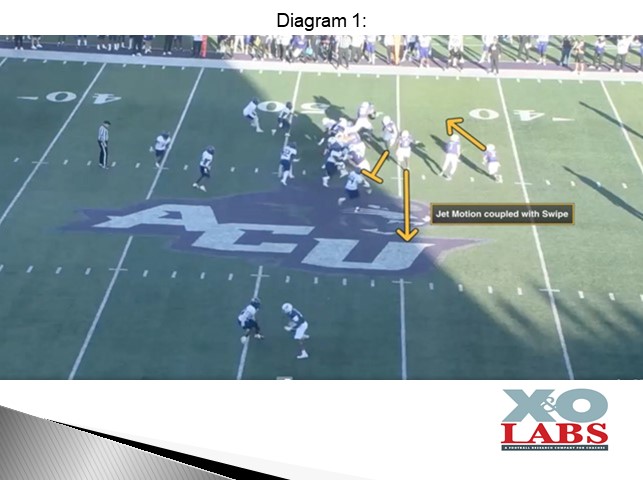
After much studying, I found the answer- it was combining wide zone principles with swipe and jet motion, thus the term “double swipe.” The movement of the slot forced second-level defenders to “rock back” away from the motion, while the cut action of the Y produced enough hesitation in backers for the ball to hit the front side. And if you already know that defenses are going to back gap your wide zone, then adding the motion element will almost assure the ball will hit front side. These two elements equated to a front-side entry point for the back, which most of the time equates to an explosive run.
 

I also found that this principle works best against single gap control, one high defense, where second-level defenders are bumping back into the box against the jet motion. This way, you’re able to target a specific second-level defender to exploit.
 

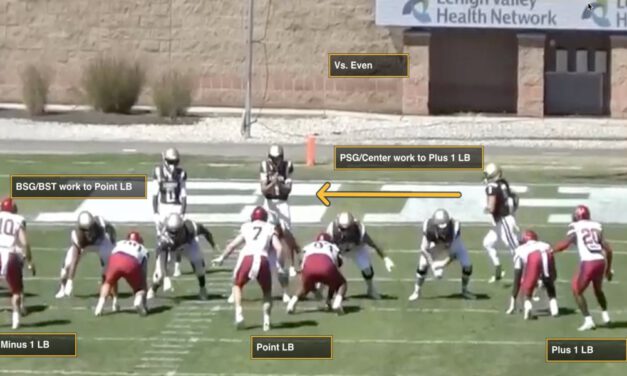
I’m going to dive into how these principles are termed, how to teach the offensive line to identify and block past the point linebacker, and how to build in backside principles to make sure you are getting the stretch you need to get the ball to hit frontside. It was an easy build-in for Lehigh, who opened against Richmond this season, knowing full well the Spiders were going to back-gap the split zone action that Lehigh showed them the year before. It worked so well that they used it the rest of the season.
Read More