





By Mike Kuchar
Co-Founder/Senior Research Manager
X&O Labs
@MikeKKuchar
“We don’t want to ask our number two receiver to dig out the Nickel Sam. We just didn’t have the size to do it. Now by not blocking him we can create a soft edge and secure the cutback.”
- FCS Offensive Coordinator
Common assumption insists that Duo runs generate far fewer explosive plays than other run concepts like wide zone. Duo runs are traditionally designed for consistency over explosiveness. Most offensive line coaches will tell you it’s a “wear down” scheme, that pops later in the game. But the reality is Duo does produce explosives and it happens often. So often that we analyzed over 1,300 clips of Duo runs from this season and found that 325 total runs were explosive, generating 10 yards or more with an 8.9 yards per play average.
The sweet spot seems to fall within the C or D gap. When Duo hits in the C gap it averages over 13.8 yards a play, and when it hits in the D gap it averages 13.5 yards a play. If you’re familiar with the structure of the Duo play, then you know that the common denominator in efficiency lies in allocating more hats to the concept’s backside (which becomes the front side). Duo’s beauty lies in its flexibility. Unlike traditional gap schemes, your back can press, bend, and bounce. The data shows that when backs are forced to redirect, they are often finding the explosive crease.
If you want to generate more explosives in Duo, then you’re going to have to get intentional about it. And that means intentionally producing a softer edge for that C-D gap backside entry point.
Essentially there are four ways to do that:
- Create a bigger run surface to the backside pre-snap
- Add an extra hat to the backside post-snap
- Build deception into the mesh
- Stretch the overhang defender
The Benefit of Bunch:
I spent the entire off-season last year reporting on the first three items on that list, so I’ll quickly rehash those points. And if you haven’t read those studies you’ll need to before you read this one. I worked with the University of New Hampshire; the University of William and Mary and Minnesota Duluth (to name a few) who all based much of their Duo runs around compressed or bunch formations because it allocated more hats to the backside entry point in Duo.
We found that Bunch Duo would be the most effective way to run the scheme, and our analysis proved us to be correct. Bunch or compressed Duo churned out a 63% explosivity rate and here is why:
- It forces the corner to be the free hitter
- It allows for a bigger surface to the backside (often known as the frontside) of the play.
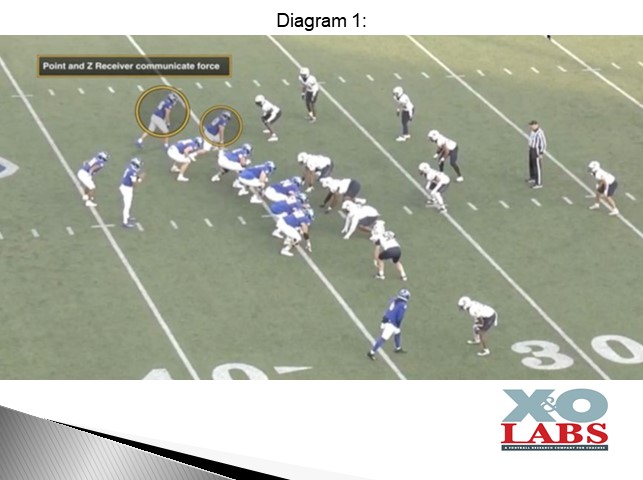
Aligning in Bunch or compressed formations became an easier answer to get 3-4 additional blockers for Duo runs in 12 personnel groupings.
The blocking rules were simple:
- Attached (on the ball tight end)- block the C gap defender (possible combo with BST)
- Point Receiver- block the Sam LB
- Z Receiver- block support defender, typically safety, leaving the corner unblocked
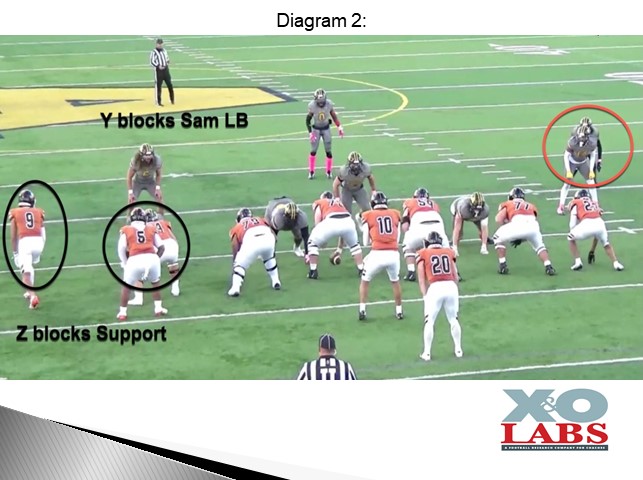
I remember talking to Northwestern offensive line coach Ryan Olson about it when he was at South Dakota who told me it helps secure those explosives when the ball hits where it should- backside.
In these bunch or compressed formations, the ball carrier understands there is going to be a built-in fold block by the point receiver and the Z receiver. Both receivers talk to each other to communicate who is blocking the overhang defender and who is blocking the safety.
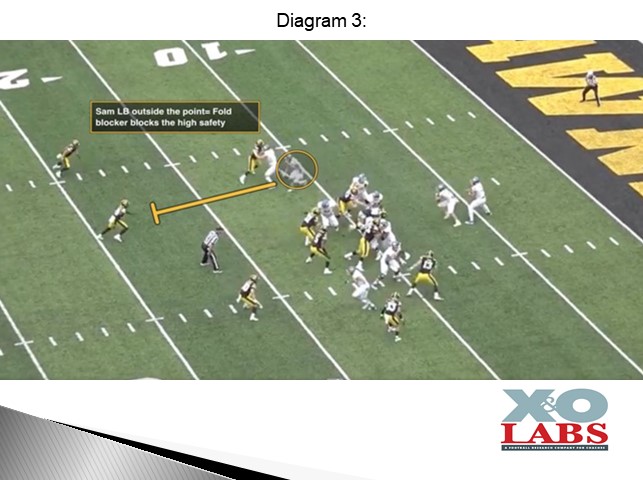
The communication is built off the leverage of the field overhang (or Nickel) defender. From a base standpoint, if the Nickel is head up to outside the point receiver in Bunch, it enacts the fold block between the Z and slot receiver.
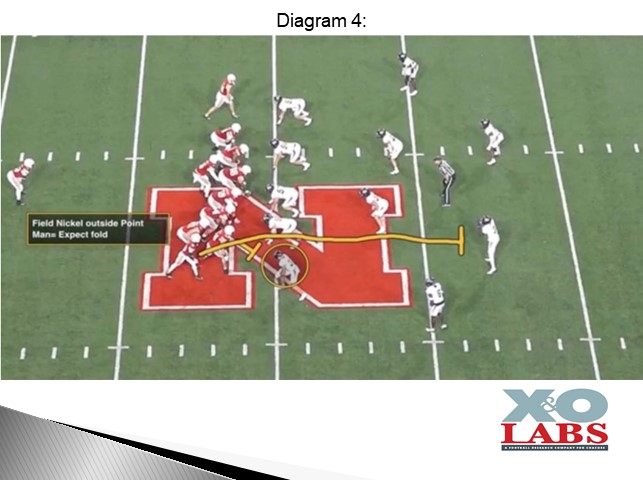
Fold Blocker Rules:
- Against two-high safety defenses, this receiver is taught to read support. In quarters coverage situations, it will probably be the safety unless he is way outside the half. In those circumstances, you don’t need to fold him.
- If it’s a Cover Two look, there is no fold. The receiver blocks the corner.
- In any man situation, the receiver will take the corner to the safety
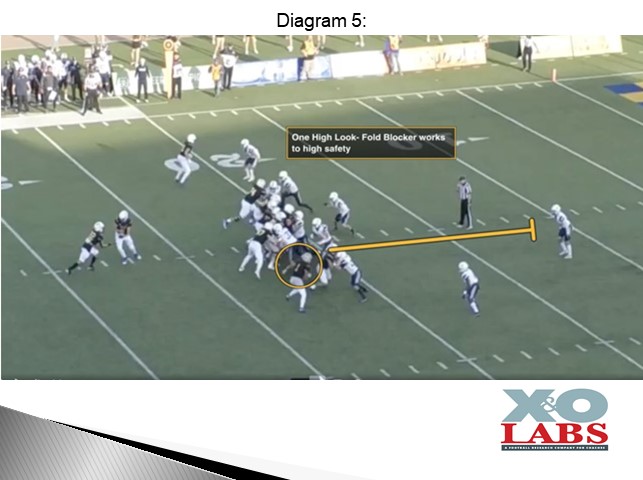
- Against any one-high looks, the fold blocker will work to block the high safety.
But That Was Yesterday:
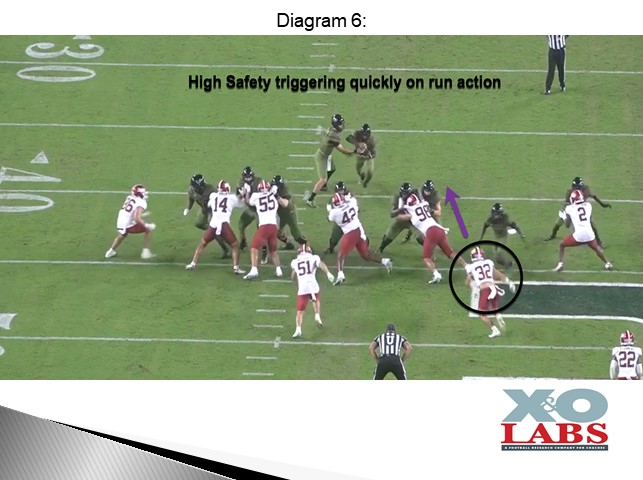
This season I found that defenses have caught up by tying in their support player to gain hats on the backside of the play affecting the cutback.
This was done in three ways:
- Triggering the safety downhill on the run action
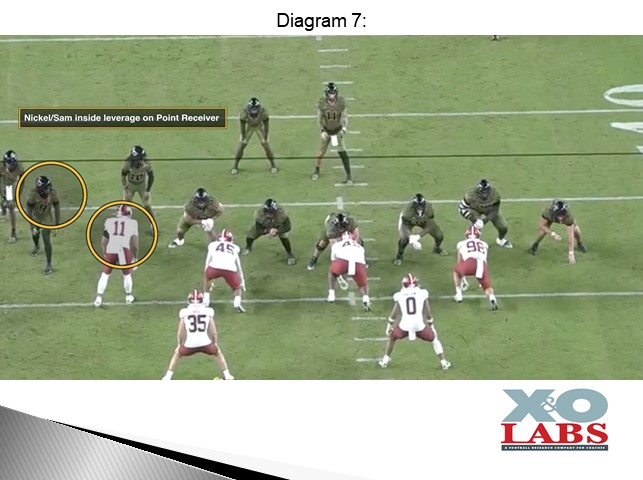
- Aligning the Nickel Sam inside the point of the bunch to force the ball wider and “off the table.”
- Having the Nickel Sam spill the block of the point man
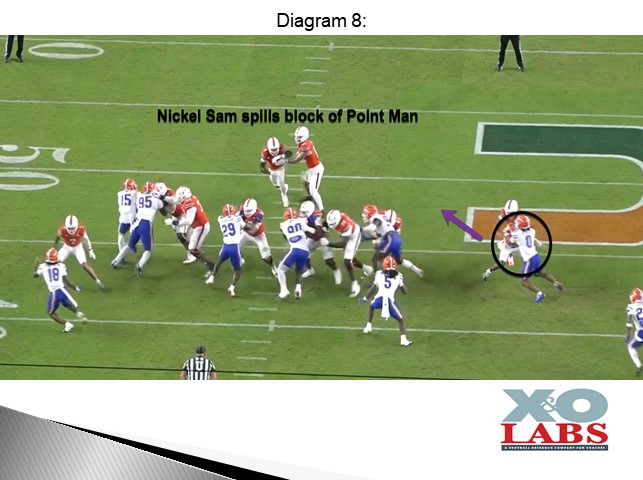
Typically, when this occurred, the point receiver would have to dig the Nickel out while the Z sorts out the next most dangerous defender. But that job was easier said than done for the point receiver and it often forced the play too wide.
Leave it the staff at the University of Miami to get creative and adjust accordingly. This season, offensive line coach Alex Mirabal built in a triple option element to Duo from Bunch. Sure, triple option football is not a new build-in to the run game. We’ve reported on several programs that have added triple option elements- whether it be quick game, QB reads or slides off inside and outside zone.
But when these triple option build-ins are packaged with Duo, it allows you to soften the backside entry point by adding doubt on the fit of the quarters safety and handle an inside leveraged Sam or Nickel.
Although we couldn’t clinic with Coach Mirabal exclusively, we did connect with two coaches who did clinic with him to talk about what he did to protect the Duo cutback. And I’m going to show you two ways in which these programs are doing that.
Here’s what you’ll be able to do after reading this report:
- See how the University of Miami rebuilt Bunch Duo explosivity after defenses re-leveraged the cutback.
- Understand why Duo produced 325 explosives in one season — and how to design yours to hit in the C and D gaps where the real yardage lives.
- Protect your Duo cutback the same way Miami did — without asking undersized receivers to dig out a Nickel.
- Attach a triple-option element to Duo that adds doubt to the quarters safety and freezes the overhang.
- Control the backside edge using a bubble/shoot screen build-in that stretches the fit post-snap.
- Install automatic throw rules versus Nickel fire so the QB never hesitates.
- Force the Sam/Nickel to play slower with eye manipulation instead of trying to overpower him.
- Add a Duo Read Double Option for QB-run systems that want the same leverage advantages without becoming an RPO offense.
- Use compressed and detached formations the way Miami and others did to create explosive entry points.
- Add these answers without overhauling your Duo rules or increasing your teaching load.
Login now to access this full study. And if you’re not a member, just click the ‘Join’ button. Signing up is easy—and takes a few minutes.