





By Mike Kuchar
Co-Founder & Senior Researcher
X&O Labs
@MikekKuchar
“Invert defenses now have trumped quarters because of the transfer portal or the way that football has evolved. We have now said screw it; we will play this on first down. If you run the ball for four, we figure you won’t do that all game.”
- Power 4 Defensive Coordinator
This isn’t your grandfather’s Tampa coverage. The late great Monte Kiffin is longer on the whiteboard and Brian Urlacher is no longer on a dead sprint to the middle of the field as Mike backer. This is the new Tampa, the non-traditional form where a third level player is tasked with being the middle runner to not only handle vertical pipes but also be an extra fitter in the run game. And it’s no longer a tool on 3rd and 10 to get an offense to throw the ball short while the defense can rally late and get off the field.
This is an all-down defense. One where some of the top programs in the country are playing it on non-consequential downs like first and ten and second and short. It holds up against the run and pass equally, and it does so for the following reasons:
- It removes the run/pass conflict from a second level defender. The middle runner (ideally a safety from depth) is a true post player with no gap. A source noted the production “disparity of the safety playing the middle run through vs. the linebacker doing it was like three to one.” It takes the Mike out of conflict entirely.
- It defends vertical seams while still pressuring with four. It leverages and reroutes verticals and forces the ball underneath, fixing the bender vulnerability of pure man / Cover-1 creepers.
- It provides disguise and unpredictability for the QB. Defenders cover down to show man-free or Cover 3, and by rotating who is force / hook / half / runner each snap, the offense cannot identify where the extra fitter is coming from — “front multiplicity with coverage consistency.”
Essentially, it’s a coverage concept that exists to solve the classic single-high pressure problem — vulnerable seams and benders — while still generating rush and remaining gap-sound against the run.
Why it’s Not Traditional Tampa:
Before getting into what makes this coverage so adaptable, let’s clarify what it is not:
- It is not a pure three-safety defense (at least pre-snap), although it will transform into one post-snap.
- An inside linebacker is not used as the middle runner
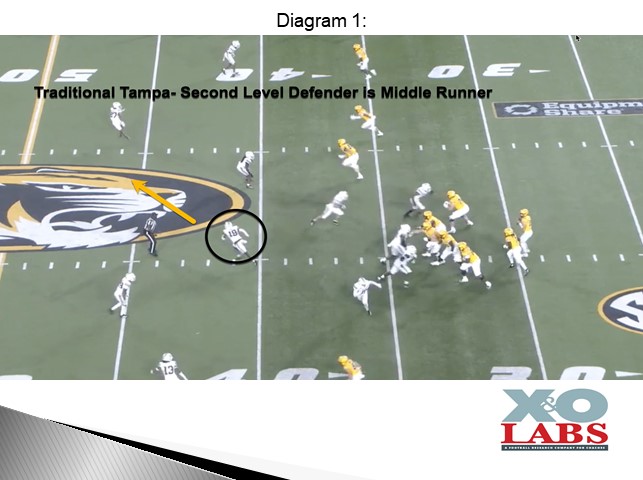
“Non-Traditional” Tampa: The Definition:
The difference in “Non-Traditional” Tampa is that the middle runner cannot be an inside linebacker, it must be a third-level defender (Boundary Safety, Free Safety or Nickel). I’ll explain why that’s important later. As you’ll notice in this study, this coverage is used in both static four-down fronts and simulated pressures with the purpose to show one-high looks as much as possible.
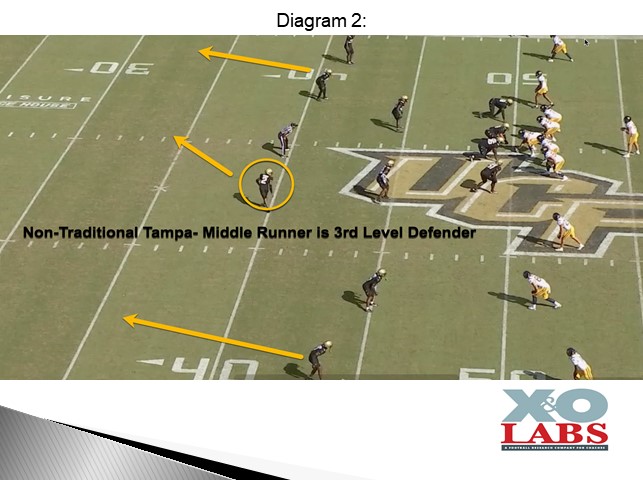
So, the typical structure of Tampa hasn’t changed, but personnel pieces around it has. “We are just changing X’s and we are changing bodies,” one Power 4 safeties coach told me. And it’s replaced quarters and cover 6 as the “go-to” coverage of choice on first and second down. “Teams are not as much quarter, quarter half on early downs anymore,” another Power 4 DC told me. “It’s hard to beat this coverage. And it’s harder than offensive guys think. It’s wonky. Offensive playbooks are drawn to beat cover three, quarters and traditional cover two. It’s the new wave- this will be 50% of our snaps will be in this coverage this season playing this coverage.”
Exhibit A: The Notre Dame Story
If you watched Notre Dame play this season, you saw this coverage live and in color in a battle against USC in week seven. Irish defensive coordinator Chris Ash knew his nickel corner (Dallas Golden) was a little too green to handle Trojan stud Makai Lemon in the slot, so Coach Ash built his non-traditional Tampa package that week to show man, only to have Golden be a middle run-through defender. It would present like man coverage and then he would take off and go to the middle of the field to be the middle run through defender. It was something Coach Ash did to keep him out of the action as a true freshman and having to defend the best player on the field.
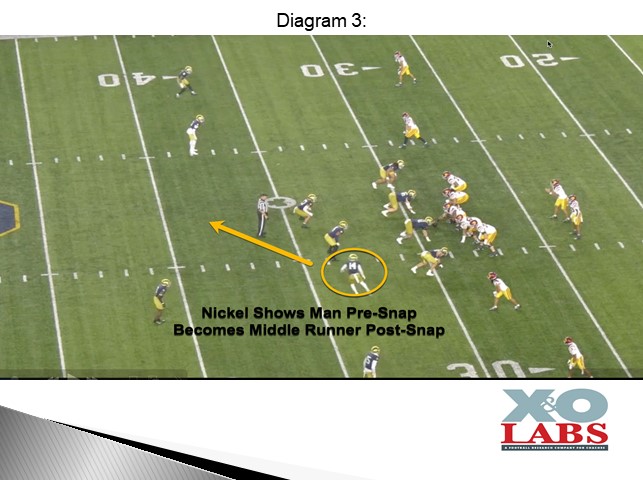
It wound up altering the picture for QB Jayden Maiava who struggled with making his reads on time. His 52.4 completion percentage that week was 13 percentage points lower than his average and among the lowest he posted last season, leading to a 34-24 Irish win.
Presenting a completely different picture for the QB is just one advantage for this coverage, hiding potential mismatches is another.
Exhibit B: The UCF Story
The University of Central Florida is more of a “portal team” than a high school team by all accounts, including those within the walls of the program. So, each January after the portal closes in mid-December, there are several new faces in the defensive back room in Orlando. In order to get them prepped for spring ball, the Golden Knight staff made a conscious effort to reduce the amount of teaching with the purpose of getting them to play collectively. The high turnover year after year, forced the defensive staff to hang its hat on one coverage- Non-Traditional Tampa- and major in teaching it. Non-Traditional Tampa consisted of over 60% of UCF’s defensive snaps last season.
“We had such a high turnover year after year, so we had to do something to keep cohesion in the back end, and do something year after year,” linebacker coach Mark D’Onofrio told me.
“We didn’t want to have all the quarters rules, and we didn’t want all the 3 match rules that people are playing so we decided to play non-traditional Tampa with four down and keep zone integrity. It was something simple that they could get good at playing. And it gave us a chance to play quarter, quarter half and not have a whole bunch of rules. You can keep the coverage checks simple by staying out of the quarter's world.”
Under the direction of defensive coordinator Alex Grinch and his defensive staff, UCF ranked 25th nationally in passing yards allowed and third in the Big 12 in that category, while finishing fourth in the conference in total defense. The Knights allowed just 185.1 passing yards per game, the third-lowest mark in program history since becoming an FBS program in 1996 and the lowest since the 2001 season.
The Analysis:
Using our X&O Labs analytics, we studied 5,226 charted plays (all drop backs) from the 2025-season against this coverage and here’s at the crux of what we found:
The Analysis: 95.9% of all completions against this family came at 8 yards or shallower, a third of them to the running back, at 2.35 net yards per catch — while the vertical menu completed 3.5% with a 15% interception rate.
The Translation: The funnel is the scheme. Defenses were able to get off the field more quickly.
The Analysis: Most Targeted Routes in This Coverage
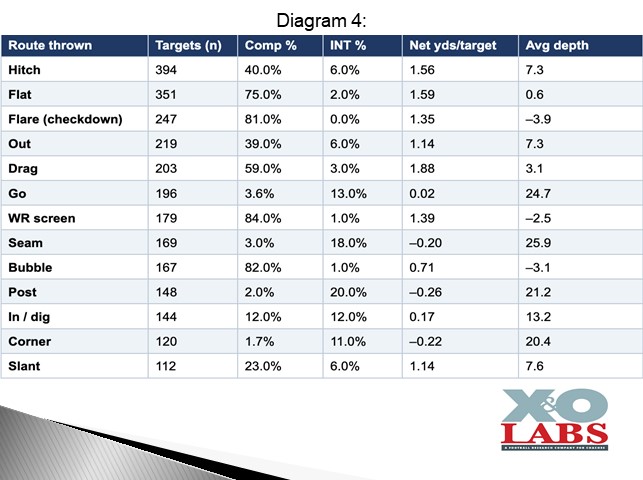
The Translation:
- The funnel works exactly as designed. Two-thirds of all throws (67.3%) came at 8 yards or less; one in four was behind the line of scrimmage. The underneath family (hitch, flat, flare, drag, screens, etc.) absorbed 2,000 targets at 66.6% completion but produced only 2.23 net yards per completion — the rally-and-vice tackle showing up in the numbers. Fully 33% of all completions went to the running back, the highest-volume completion target on the sheet.
- Most effective against, by route: four verticals / seam benders (3.0% comp, 30 INTs on the seam alone), the post (2.0%, 30 INTs), the deep corner (1.7%) and the deep over (7.8%, 13 INTs). The middle runner plus two hash droppers turn the entire middle-of-field shot menu into the most intercepted throws in the collection.
- The contested zone is the curl/hitch concept. The hitch is where offenses attacked most (394 targets) and where the directional/delivery eye discipline pays — 40.0% completion and 24 INTs in this set.
- What the coaches say still stresses it (keep these in the article even though the curated data flatters them): the boundary 7-cut / corner route high-lowing a squat corner “this is always a constant issue, the seven cut,” said one source. “Y-cross with a weak-side lateral progression, China/scissors off the cloud corner, the middle sit-down used as bait to pull the runner shallow before the bender goes over his head, and four-verts-from-empty designed “to mess with our middle runner rules.”
The Analysis: The Most Effective Pressure Pattern in this Coverage:
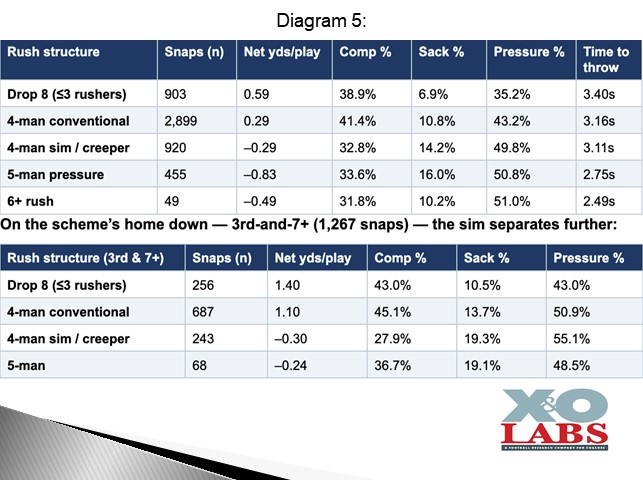
The Translation The four-man sim is five-man pressure at a four-man price — and it is at its best exactly where the coaches call it. And we will report on the specifics of these concepts later in the report.
- The most efficient pattern in the data is the simulated four-man, and adding a mug presentation sharpens it further: within the sims, single-mug snaps allowed 25.3% completions and double-mug 28.2% (vs. 36.0% with no mug), with sack rates of 15–19%. That is the Ron Roberts blueprint — Mug/5-0 looks that force the center to declare, with the pressure defender chosen off the center’s point.
- Drop 8 is the soft setting. It is the worst structure on the sheet (0.59 net yds/play; 1.40 on 3rd-and-long) — useful as a changeup, but the materials and the data agree the package’s teeth are in the simulated rush, not the extra dropper.
The beauty of this coverage is changing those coverage triangles to produce different pictures for the quarterback all while being gapped out in the run game. Now, I’m ready to show you exactly how these programs are building non-traditional Tampa into their defensive system and how they are changing the triangles around the middle runners to cause confusion for the quarterback. And, how they are mixing these coverage structures with simulated pressure.
Introducing…X&O Labs Install Anthologies: Volume 2: Non-Traditional Tampa
Non-Traditional Tampa- including the pressure sims built off of them- are included in the Summer Install Series. It’s a new series designed to prepare you with everything you need to know about installing and utilizing Non-Traditional Tampa concepts heading into this season, and it’s exclusive to our X&O Labs members.
The rest of this report is the install — the exact tools, calls, and teaching progressions the coaches I spoke with are using right now. Here's what you'll be able to do once you have it:
- Install the disguise that shows the quarterback a one-high look pre-snap and rotates into a three-high structure post-snap — so he never knows where that extra fitter is coming from.
- Build the coverage triangles and rotate the "middle runner" snap to snap, changing the picture for the quarterback without changing a single rule for your players.
- Hard-call the entire coverage so your DBs never have to make a check — including the exact "bucketing" systems three different programs use to declare who runs the middle.
- Adjust to every formation you'll see — 2×2, 3×1, empty, FIB, two-detached, and bunch — with built-in answers instead of on-field communication.
- Apply the field-side and boundary-side rotation tools (invert, cloud, sky, double invert, double cloud) and know which one fits your corners, your nickel, and your safeties.
- Layer simulated four-man pressure on top of the coverage — field activations, middle activations, cross-dogs, and Mug/5-0 presentations — to get five-man pressure at a four-man price.
- Teach the middle-runner position the way Wisconsin and Indiana teach it, including the "empty hands vs. full hands" reads that turn your safety into an extra hat in the run game.
- Follow the same 8-step installation progression these staffs used to build it from a base four-man rush all the way up to the non-traditional layer.
- Use the difficulty rating on every build-in so you install only what fits your personnel — and know which pieces are worth building your defense around.
- Watch the cutups — every rotation, pressure, and adjustment, shown on film from the programs that majored in it last season.