
Defending the Wing T with Eight Man Fronts

By Kyle Cogan
Defensive Coordinator
Lexington High School (MO)

Introduction

At the smaller classifications in Missouri, we see a wide range of offenses that we have to defend week in and week out. This includes everything from Double Tight, Double Wing to all out 5 wide spread and everything in between. Due to the different schemes we see each week, we wanted a defense that could adapt to any offense we might see. For that reason, we are very multiple in the fronts, blitzes and coverages we run.

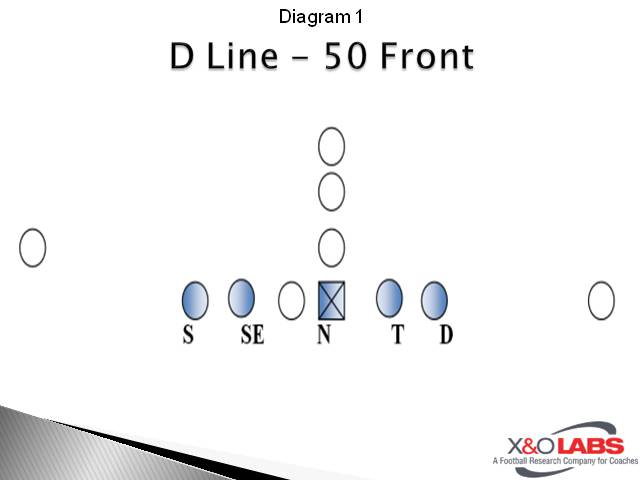
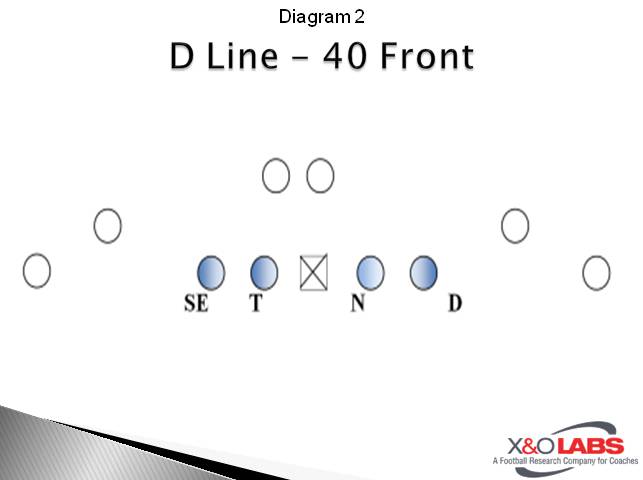
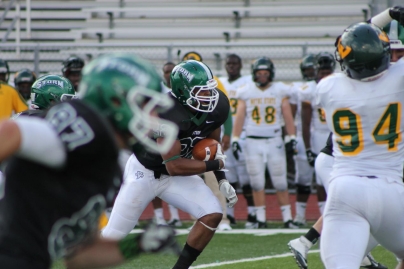
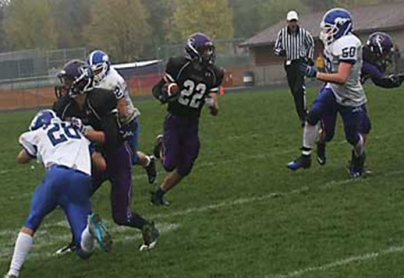
Through our 2015 season, we played a total of 6 different Wing T teams. The Wing T seems to be timeless. No matter where you are, you can all but guarantee you’ll see a good Wing T team during your season. In my experience, the Wing T forces you to go to an 8-man front. Our team philosophy is that if you cannot stop the run, you’re going to be in for a long night. We base out of a 4-2 scheme, but run a fair amount of 3-3 as well. Our approach for defending with each of these schemes will be covered in the rest of the article.

Preparation

The first thing we do when playing a Wing T team is chart their formations and tendencies. This will give you a good idea of what type of Wing T team they are. Since each Wing T coach is a little bit different, you must get inside their head and try to think how they think. When you have determined the formations, plays and personnel they play with, then you will understand the type of animal you are dealing with.

Although everyone has their own unique terminology, I will use Tubby Raymond’s verbiage because it is what I know best and the way I learned the Wing T. Most Wing T coaches will use some sort of the same verbiage but tweaked to their style.

The various types of Wing T schemes we see are:

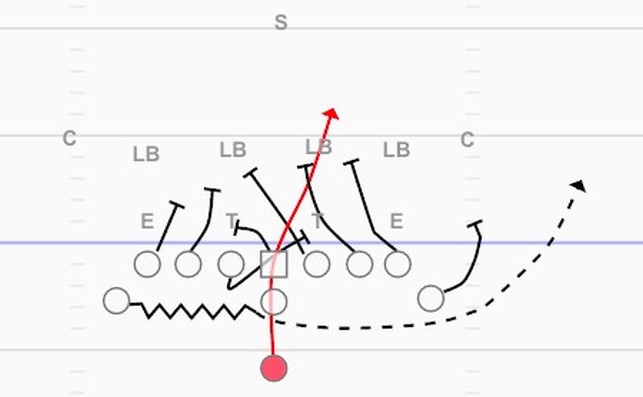
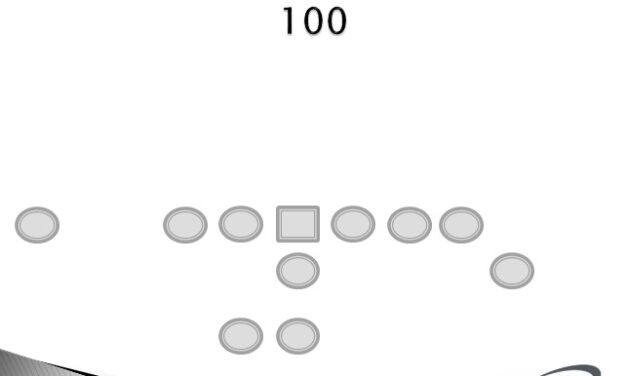
Traditional – In this version, the basic trap, buck sweep, and waggle are the staple concepts. You will see a lot of 2 back sets, primarily 100 and 900 with Red and Blue mixed in.
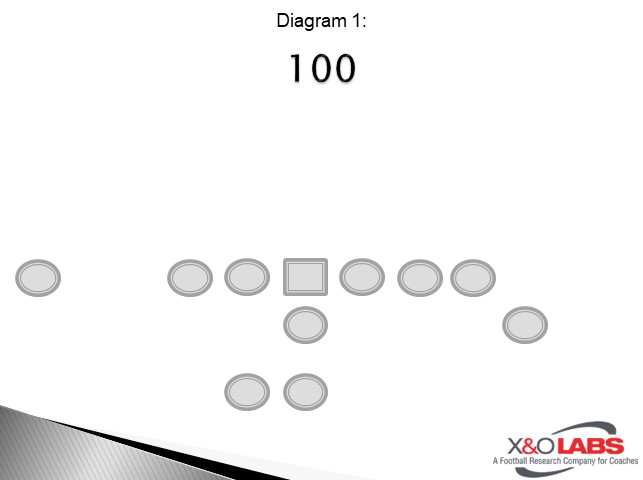
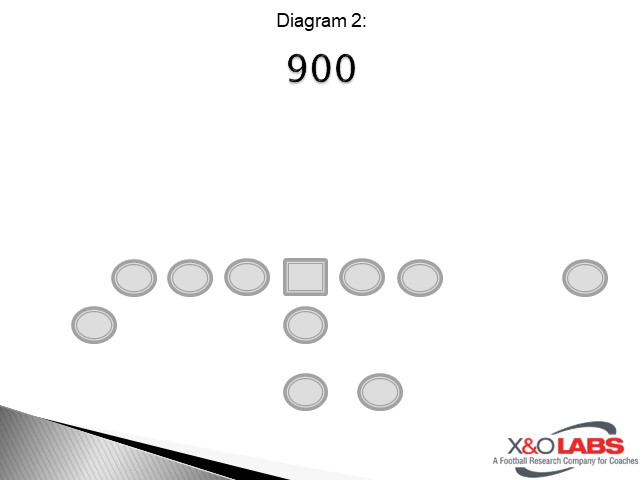
Slide1Slide1

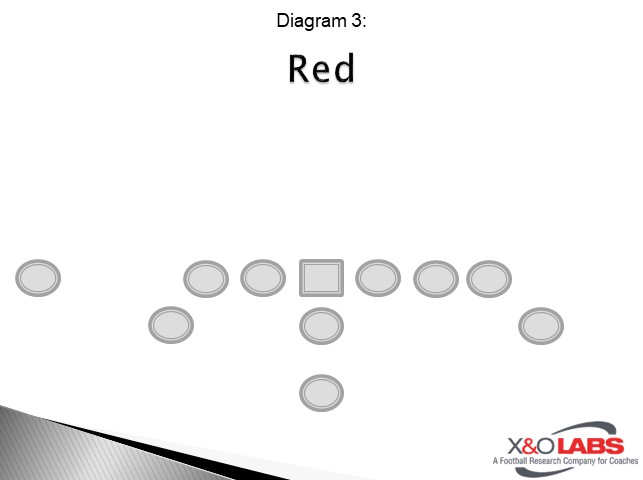
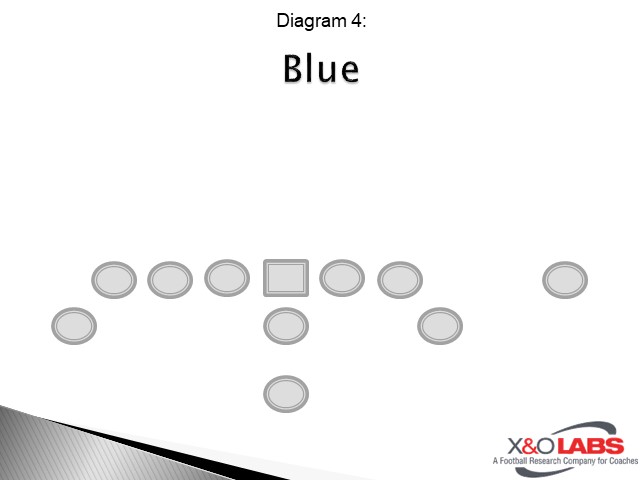
Hybrid – This version has more formations and motions with a ton of jet/rocket/buck sweep to the open side. These teams usually have a faster FB and will false key plays with their guards. It is more common to see Red and Blue than 100 and 900.
Slide3Slide3

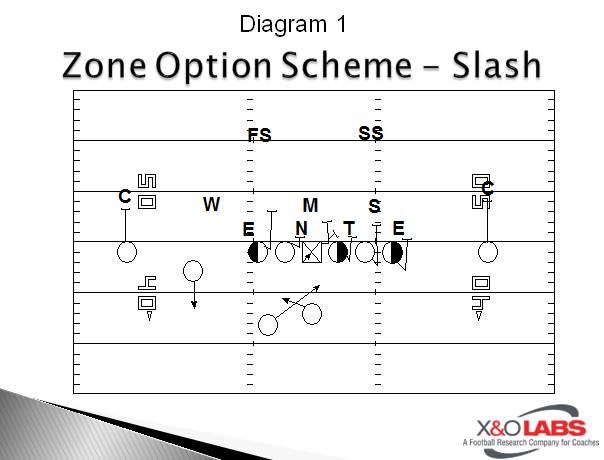
Option – We mainly see midline and veer.

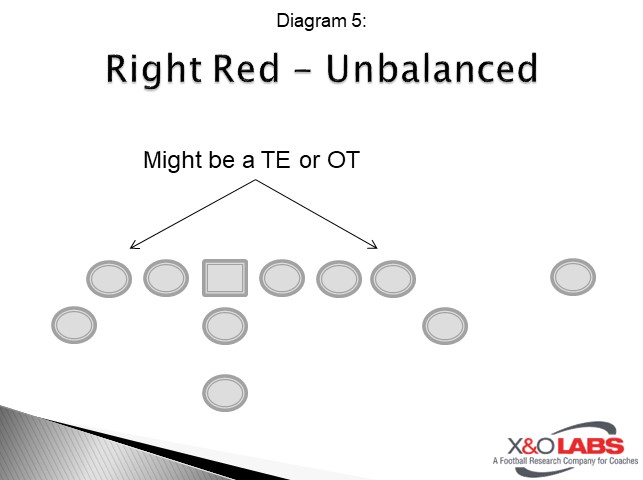
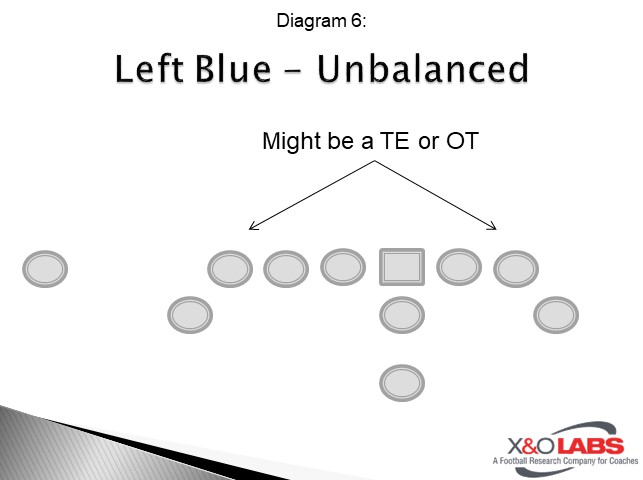
Unbalanced – This is more of a change-up for most teams than a base formation. We almost never see a true 4-man surface, but when we do we just slide everyone a man over. We do, however, see a fair amount of ‘X over.’ In my Wing T terminology, this is Right 100/Red and Left 900/Blue formations. Teams will line up differently as some will also go tackle over and others will just make the TE ineligible with the X receiver.
Slide5Slide5

Spread – This version uses the Wing T concepts and plays but primarily runs it from the gun and some pistol sets. If you have ever heard Bruce Cobleigh speak, this is his scheme.

After we have determined the type of scheme we are seeing, we go to the motions this team uses. The beauty of the Wing T is that when motion is incorporated you will always be outflanked. In my opinion, you have to get a 9th hat (FS) in the box to match the numbers (discussed later).

Everyone’s terminology might be different but to me the main types of motion in the Wing T are:

  1. Rocket – TB/WB motions flat behind the QB in gun/pistol or FB depth when they’re under center.
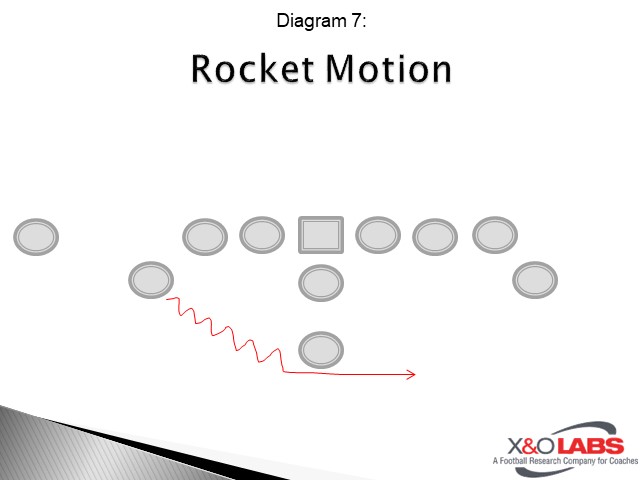
Slide7

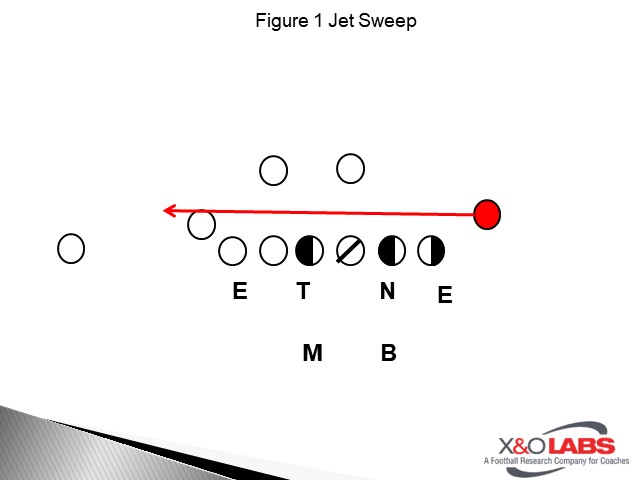
  1. Jet – TB/WB motions in front of QB in gun/pistol or behind QB when under center.
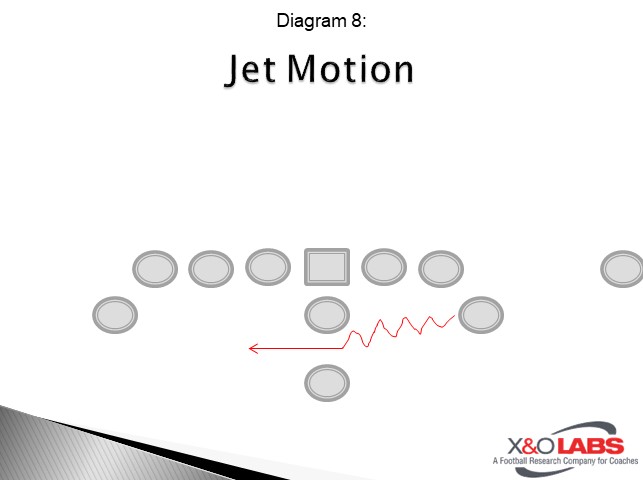
Slide7

Read More

UCONN’s Two-Man Surface Toss Concept

By Mike Kuchar
With Frank Giufre
Offensive Line Coach
University of Connecticut


Editor’s Note: This is the second report in a two-part series on UCONN’s Pin and Pull run concept. Part one focused on the three-man surface concept. Many of the block techniques associated with this report are further explained in .


For most offensive play callers, the 10 personnel four wide run game can be very limited. You have your base inside game such as inside zone or trap and your base outside run game like stretch or outside zone, but after that it gets limited. While many coaches prefer to run some toss game out of three-man surface bunch sets, the same can be done from the two-surface side without a tight end. The benefits are simple- it gets the ball on the perimeter in a hurry with bigger bodies lead blocking for the ball carrier. But in order to run the scheme with a great deal of efficiency, it’s important to educate the back on whom to read based on the defensive front presented. With many defensive structures relying on pressure tendencies in the fringe red zone area (where the play is mostly run), the offensive line must be able to protect any potential leakage that can stall the play.


Advantages of Tagging Pin and Pull Runs

  • Uses high percentage down blocks to separate the defense. Not necessary to crush defenders, just to eliminate penetration.
  • Opportunity to get two pullers in front of the ball carrier.
  • Handles bigger defenders in the box
  • Gets the ball out in the perimeter. As Coach Guifre told us, “the offensive line likes screens but this gets them running to hit a defensive back. It becomes fun. You’re not trying to knock people off the ball.”
  • Efficient red zone play because of the tight formation spacing.


Box Blocking Rules

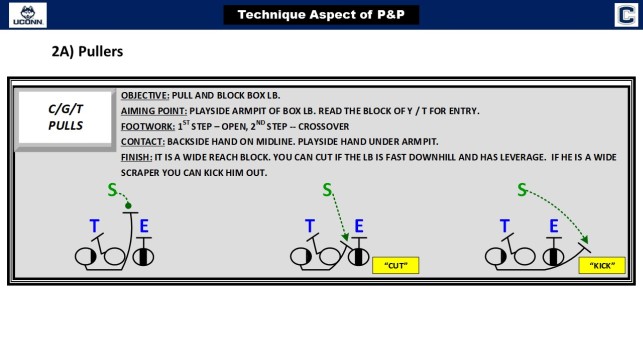
The bunch toss concept can be manipulated in several ways to attack different fronts- all of which are included in this report. In most cases, the first puller (usually the Tackle) will block the first defender past the identification.

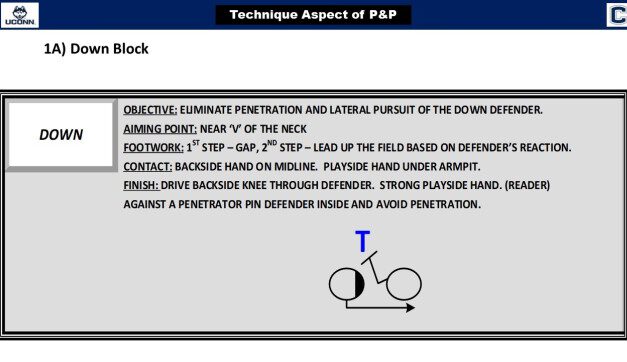
But regardless of the tags, there are three primary blocks associated with blocking the box in this run game:

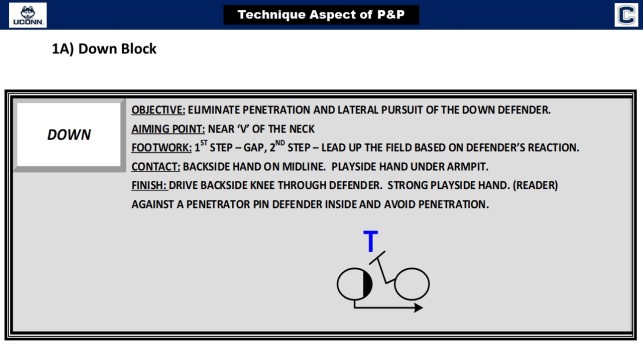
  • Down Block

Diagram 1

  • Pull Blocks

Diagram 2

Read More

Implementing Multiple Card Systems for Tempo Offenses

By Scott Girolmo
Head Football Coach
Lee High School (VA)
Twitter: @CoachSGirolmo


Seeing a play call go from abstract lettering on a play sheet to 11 players aligning in perfect spacing on the field, and executing the movements and schemes accurately is one of the most beautiful aspects of our sport. Being a play caller can make you feel like an artist. The canvas stretching before you may be green already, but your creativity and ingenuity can allow you to paint a masterpiece on any given play.

The methods in our sport are as diverse as the mediums used in an art studio. I have a tool that I believe can help all coaches simplify their artistic process. From the most complex systems, “U Zap to West Right Tight F Left Fake 99 Toss Crunch Naked Right,” and an NFL favorite “Shift to HB twin right open, swap 72 all-go, special HB shallow cross, wide open”. To the simplest, “Y-Over 121” or “Trips Left Late 93 H-Wheel.” We all want to be as efficient as was can at creating great football. If you are a west coast offensive coordinator looking to get your formations and shifts in quicker, or an Odd stack defensive coordinator hoping to speed up your front adjustments, I believe that a flip-card system can help you become more efficient. Even if you already have hand-signals, I believe flip cards cannot just complement any hand-signal system you may already have but enhance it as well. No matter how deep your staff is, this can help you top to bottom in any of the three facets of the game including special teams.


Designing Formation Cards

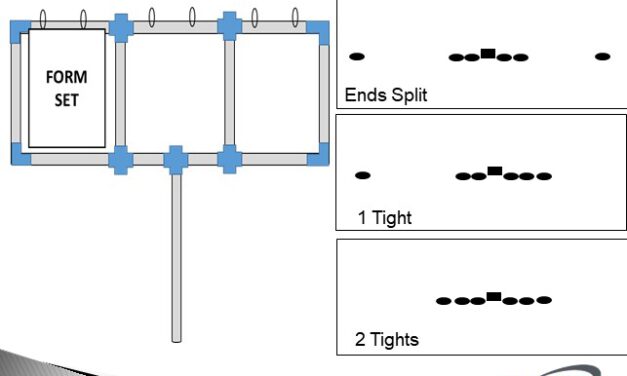
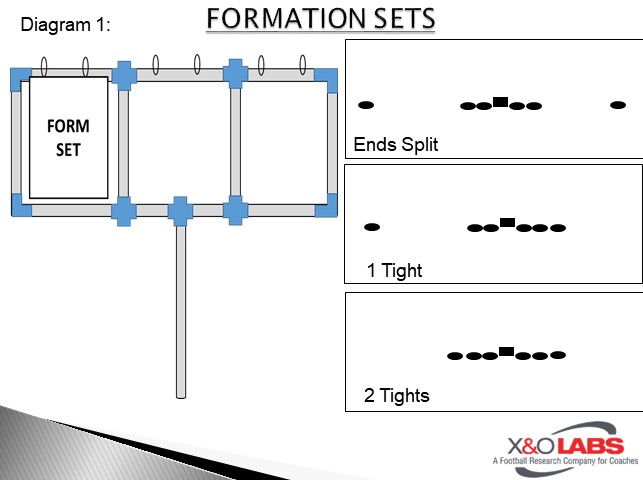
When I first started using this system the goal was to create a fast and easy method for calling formations so that I only had to hand-signal a play call. I wanted not only to be multiple, but also be quick so we could be up-tempo when we needed to be. When I stood and looked at our hand signals from the player’s standpoint, they were good, but they were limited by two hands. I knew that some would require a three signal movement, and every time one hand progressed to the third signal, I would lose the first for a moment. By creating a three panel frame, and hanging cards from it, I was able to leave the formation up on the cards through the whole play call, and it was stagnant – no waiting for the signal to start over to get set. This became particularly helpful when it came to our motions and shifts. It was painfully frustrating when looking at the signaler who was responsible for motions and formation when he would have a movement signal that wasn’t clear enough and then go straight to the formation. I needed a better way for my guys, a faster and easier way for them to see and understand the call. That is when I came up with the formation cards. I categorized all our formations by the “Set”, “Adjuster”, and “Backfield”, and broke the panels up to correspond with this. I wanted to compartmentalize the information for them, so that guys only had to remember small chunks, or “rules” about formation-creation. If they could learn the pieces, I could create any formation I wanted by mixing them up.

Formation “sets” can be described as the coordination of the 7 players who align on the line of scrimmage in the formation. In the first version of the cards, I used a three panel frame and basic formation sets to accommodate a multi-personnel offense. Three sets made up the skeleton for everything: both ends Split, One split and one Tight End and Double Tight End. The same can be true of any offense. For example, if you are a flex-bone team, you can fix your formation sets up to allow freedom for your B-Backs to align anywhere, and put your best backs where you need them.

Diagram 1

Read More

Using Robber Coverage Behind a 3-4 Front

By Nat Zunkel
Head Coach
Mercer County High School (IL)
Twitter: @CoachZunkel

Introduction:

IMG 3109Robber coverage is one way to develop a hybrid style defense to combat several of the no-huddle/multiple formation offenses that we play. After years of developing and tweaking this concept, we have found that this is the perfect high school defense for us. As a rule we use this concept about 60% of the time.

Rationale:

When we conceptualized this defense, we sat down and decided what was best for us:

1. We needed to think less on defense so we could play faster.
2. We had to decide what to do versus multiple formation teams.
3. We had to find a way to combat the no-huddle offenses.
4. We had to continue to find ways to out-athlete other teams.

After studying, we were able to determine the following responses to the points above:

1. Each player has one responsibility.
2. The outside backers will be able to play on the line of scrimmage.
3. Our rule system is simple and concise for no-huddle teams.
4. We use a base 3-man front so we can have an extra athlete on the field.

Here is a breakdown of what we are looking for with each position:

Defensive Line:

The defensive line must be completely gap aware, that is to say that from the nose to the ends each lineman must be able to “own their gap” on each play.

The Nose must be able to play a two-gap technique. We typically want a bigger body in this scheme, but we have had tremendous success with smaller wrestler types. His ultimate goal is to mess with the center’s snapping hand and disrupt the backfield.

The ends will play the B-gap against the run and the C-gap against the pass. For this reason, they must be athletic. Because of the way we play the front three, they are more active in the run game than they are in the passing game. That said, we look for a 20% QB hurry/hit /sack rate on passes.

Slide1Slide2Slide3

All defensive linemen are taught from day one on how to take up a double team. We use the terminology of “hipping” into the gap.

Linebackers:

Our inside linebackers are coached differently than the outside linebackers due to the differences in their techniques.

Inside linebackers (Mike and Will) typically align head-up over the guards who will also serve as their read on each play. In a run fit, Mike and Will have the A gap to the B Gap. Against the pass, they are responsible for the Hook Cross zones. In essence, the inside linebackers need to make every play between the tackles.
The outside linebackers (Sam and Dog) always read the end man on the line of scrimmage and will have several different alignments. The Sam should be the bigger more physically aggressive player of the two. Against a 2 x 2 set, the OLB splits the difference and sets the edge in a run fit. Against the pass, the OLBs are responsible for the Curl-Flat zone. When we get a TE formation, the OLB walks up and plays with his inside foot up splitting the difference. They must always be thinking contain and essentially make every play outside the tackle box.

Slide4Slide5Slide6

Against crossing routes, both the safeties and OLB eyes must go to the opposite field while yelling “IN” and thinking “collision.”

Against a wheel route, the OLB and Safety will yell “wheel.” This alerts the corner that they are going to switch to an inverted cover 2 and they will then chase.

Safeties:

The safeties in our defense must be very intelligent and athletic and they must always be thinking run first. The rover (strong safety) will make all of our calls so he must know the specific differences between Robber, Cover 3, and Cover 2 coverages.

The rover will align a bit tighter than a normal safety depending on the formation. We will set him between 7-9 yards if the #2 receiver is in the backfield or on the LOS. If we get 2×2 formation, he will align at normal safety 10-12 yards depth. He reads the end man on the LOS to the strength. Against the run, he is an alley player. Against the pass, he reads the #2 receiver. If #2 runs an out, flat, or bubble route, his eyes go to the #1 receiver to rob his route. The rover will play through #1 to the flat thinking “collision” #1. If #2 goes vertical, he will run with him and turn into man coverage.

The free safety will align at normal safety depth 10-12 y

Read More

Fordham University’s Double Pull Concept


By Mike Kuchar

Senior Research Manager

X&O Labs


Editor’s Note:  Mike Kuchar sat down with Joel Rodriquez to talk exclusively about the MAP concept, a double-pull concept in Fordham’s run game that has averaged 8.3 yards per carry.  Joel Rodriquez is the offensive line coach at Fordham.  He had previously served in the same capacity at Bryant College (RI).


Introduction

The crux of Fordham’s offense- one that has netted 522 yards per game this year- is a no huddle, high tempo, 10 and 11 personnel unit that takes advantage of misplace defenders by using the zone read game and play action concepts off of them.  In fact, my first interaction with what Fordham does was when I sat and listened to the Rams head coach Joe Moorhead talk at a clinic about the various pass concepts he uses of his zone read run game.  Though this may be a topic for another conversation, I couldn’t move my pen fast enough to write down all of his coaching points.    What I did catch was his admirable comments about his Offensive Line coach and run game coordinator Joel Rodriquez and the terrific job he does designing.  So I made it a point to go drop in on Coach Rodriquez to talk about how Fordham is so successful running the ball.

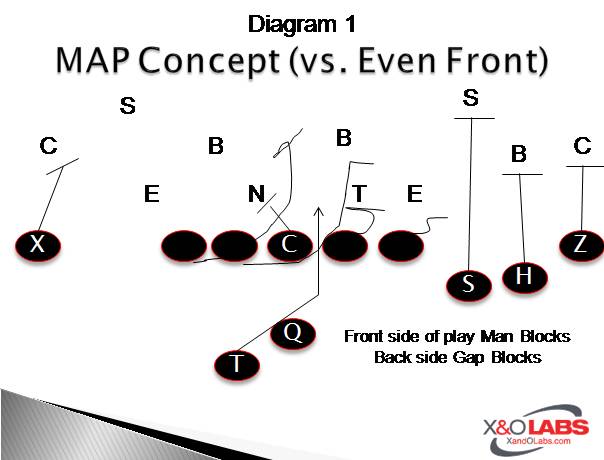
What he divulged to me is what he calls his MAP concept- a Man/Gap hybrid used to take advantage of defenses that play various games (exchanges, scrapes, etc.) to the read side of the zone read.  At its core the MAP scheme is a man concept to the front side of the play and a zone concept to the backside of the play.  The offense lineman to the play side have man assignments while the backside lineman are responsible for backside gaps, at least in theory. While it may seem like Power in structure, the front side man blocking assignments prevent any possible double teams while the backside Tackle is free to climb to the second level as a double puller.  (Diagram 1) “We didn’t want to Trey or Deuce block because we just don’t have the personnel,” said Rodriquez.  “It doesn’t take much to install it- it’s zone for the front side of the line and it’s a different read for the linebackers.”  The reason why it’s a different read is because the running back executes a “cross bow” assignment by lining up away from the call side.  His footwork will be different based on whether or not the Rams or giving it or reading it.

Slide1


Play Side Blocking Assignments:

Play Side Tackle:

For the play side Tackle, it is generally inside zone blocking.  He will block man on to outside, could be head up or outside.  Rodriquez’s coaching points for him are below:


  • PST should always have inside leverage by alignment, so drive DE & fight to keep inside leverage; widen the B-gap.

ü  Must stay square & under control so we can redirect and react to movement

ü  Don’t care which leverage he gives, by movement or alignment

ü  Strain to stretch whichever leverage the defender gives you


Play Side Guard:

The play side Guard has essentially the same assignment as the Tackle but a much bigger responsibility.  He has the man up to inside, whether it’s a 2i, 3-technique, etc.  But his biggest responsibility is to not let any player cross his face to the play side.  “If he (the defender) works a side, press him back inside and square him up. Cannot let a player cross his face.   Rodriquez’s coaching points for the play side Guard are below:


Read More

Incorporating Both Traditional and Shotgun Wing T/Double Wing Schemes

By Denny Diduch
Head Coach
Forreston High School (IL)


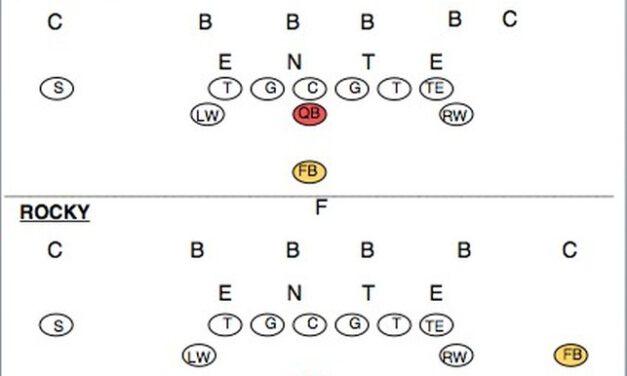
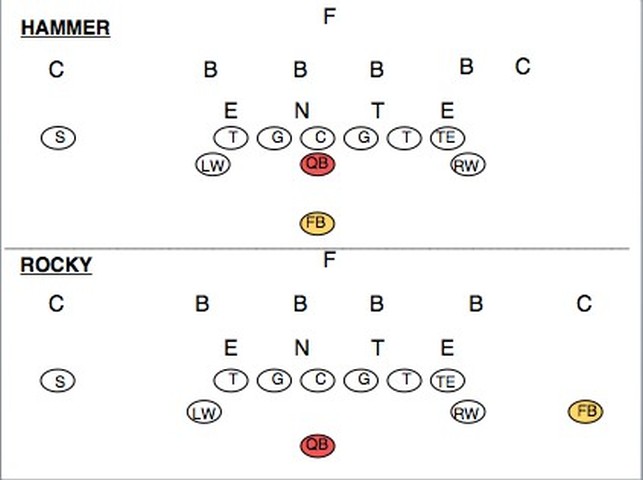
At Forreston, we have run the double wing offense for over 90 percent of our total snaps. When our program needed a switch-up, our kids’ mentality did not lend us to choosing a more traditional adjustment within wing T circles. Traditional wing T teams look to overload their lines with a tackle over or heavy backfields. We have seen other programs use these strategies effectively, but we believed those sets worked because of a hard-nosed, wrestler type team attitude. We play these types of teams in our conference, and when we tried to imitate that style it rarely worked, and at times felt like we were defeated before we even ran the play. Instead, we decided to replace our FB with a WR type player and put our QB in gun. We have been able to keep our blocking assignments simple, but still add a new dimension to our offense by making our QB become the FB and add an outside threat to our traditional Jet Sweep, Jet Trap, Off-tackle series.


Top: Hammer (with Traditional FB); Bottom: Rocky (Shotgun with the QB now the FB)

Diduch 112718 1


Troubleshooting Common Issues with Wing T/Double Wing Systems:

When the opposing front 7 is stuffing our trap and off tackle plays, and the secondary can run with our jet sweep, we (like many Wing T teams) have struggled to execute a consistent answer with the passing game. We find that the pressure good defenses use to combat our run plays also creates havoc on our slow play action game. We needed an answer that met the following criteria:

  • Keep our blocking schemes and techniques the same and our total plays low.
  • We didn’t want to move our TE. We want to know where the defense will be.
  • Keep our OL/TE tied to each other in both gun and under center.
  • Be able to attack all levels of the defense.
  • Low risk. Get the ball out quick with little chance for negative plays.
  • We wanted to give the LB’s a different “look” without sacrificing the tough nosed line play we have worked to develop.


For the purposes of this report, I will not break down our base plays but simply show how the base plays can be run from both formations.


Combating Traditional “Myths”:

  • Traditional clinic talk says to do one or the other (shotgun, under center) or risk being bad at both
  • Negative plays
  • Fumbled snaps


We addressed the shotgun and under center concern by marrying our plays in both styles. We did not create two offenses. We just created two ways for the QB to initiate the play. To avoid a change in mentality, we practiced our gun segments and under center segments interchangeably throughout the season, week, and practice. One style was not our tough style and the other our finesse style. Instead, we coached, practiced, and executed the two styles as much as possible as “2 sides of the same coin”.

To avoid negative plays, we increased the amount of total snaps between center and QB
throughout practice by using a no-huddle system. We stressed getting the ball out early on a pass and having the QB run rather than force a tight window.


Trap From Hammer vs. Rocky Formations

Hammer

Read More

Off-Season Standardized Player Evaluation Model Design to Drive Improvement

By Kyle McKenna
Assistant Head Coach, O-Line and D-Line
Mercer Island High School (WA)
Twitter: @CoachMcKenna


One of the best clinics I have ever attended was given by Bill Belichick in regard to the development of personnel that you have on your team. The example he used was Julian Edelman, who had played college quarterback before he was drafted by the New England Patriots. In their initial evaluation of Edelman, they came to the conclusion that he possessed the potential to become a slot receiver. During the clinic, Coach Belichick showed video of Edelman running routes early on in his career and then followed with others that showed a gradual improvement over a period of two years. While Wes Welker was their starter, Edelman was developed to perform a similar role. When Welker departed and signed elsewhere, Edelman was well prepared and excelled at the role once he had the opportunity to start.

In the NFL, the evaluation of talent is a key ingredient to creating a successful team. This is especially true when there have to be tough decisions about who stays and who goes on a fifty-three-man roster. On the college level, deciding who will get scholarships and how a high school football player projects on the next level takes years of practice in evaluating talent. For high school coaches, there are different factors to be considered when projecting a player’s development over a 2 to 4-year period.

On the high school level, coaches do not have the luxury of signing a better player and getting rid of another. In addition, most high school coaches are looking at the bigger picture of character development and life skills. This creates an emphasis on constant improvement or a step-by-step improvement cycle that improves the individual player, his position group and the entire team. By looking at the entire development of the player from an improvement point of view rather than production, a high school coach can fully develop the middle and bottom of the roster and therefore create a stronger team. Most squads possess a dynamic player, but great teams surround that athlete with complementary role players that can bring a team from good to great.


Application

About eight years ago, I came up with a simple method of grading players in the off-season to drive improvement and give the coaches a standardized assessment model in which to guide how they coached individuals. Once this idea was introduced to the staff, the definitions and structure began to organically take shape as we discussed the levels of improvement. Also, it helped coaches to properly match up skill levels to reduce the risk of injury and build the confidence of our players. By determining a starting point, it gave coaches the opportunity to identify strengths and weaknesses and implement strategies towards improvement. This system used colors to indicate where a player was at in his development. The four colors we used were Red, Yellow, Green, and Purple.

The colors that we used represented the level we thought the player should be placed at the time of the discussion. Personnel conversations occurred in April, at the end of May, mid-July and late August. Those discussions consisted of our staff talking about players by position and indicating whether they met the initial designation of returning starter or projected starter. Once that was determined, we could then discuss the player’s specific color designation and a plan of action for individual improvement that could elevate their status. These meetings were an opportunity for coaches to “pound on the table” for a player that they thought could contribute in the fall. It also served as an opportunity to discuss potential position changes that could benefit the team and accelerate the player’s development.

Read More

Establishing a Full-Field Zone Run Concept


By Gerald Hazzard – @CoachHazzlec

Offensive Coordinator

Lake Erie University


lake erieEditor’s Note:  Assistant Head Coach Gerald Hazzard joined the Storm coaching staff as the offensive coordinator in January 2007. Hazzard was the first assistant hired by Mark McNellie. LEU finished 2013 as the second ranked offense in Division 2 averaging 551 yards per game. Hazzard coaches the quarterbacks and has produced 18 all GLIAC performers in 4 years. A 1999 graduate of North Olmsted High School, he was a three-year varsity fullback and linebacker. The Cleveland native and his wife, Emily, married in June 2007. The couple resides in Painesville with their children Gerald IV and Lucy.


One of the first questions I always get asked is “What do you run in short yardage and goal line situations?”  I always answer quickly that we do what we do best, and that is run zone.    This past season we converted 35/46 short yardage situations when we called a zone play.  Note:  for us, a short yardage situation to us is 3rd and 4th down with 1-3 yards to go, or running a play from the 3 yard line in. 

No matter what offensive system you use, I am firm believer that in critical situations you should always call the plays that you execute the best.  The zone is “what we do best” because we make it that way.  We spend 20 minutes a day working our zone concept with our linemen so it has to be what we do best.  We believe so much in zone blocking schemes that it encompasses about 75% of our run game. In addition, we make sure that the zone play gives us a few options to get the 3 yards that we need to move the chains. 

Slide1


Here are a few of those concepts (some of which will be looked at later in the report):

  1. We are a read zone team, but we have the added dimension of incorporating a pitch guy anytime our QB pulls the football.  This can come from the slot or a second or third back.
  2. We run a “full field zone” as opposed to the inside or outside zone.  This concept allows the RB to take the ball anywhere from outside the 9 technique to the playside or outside the 5 technique to the backside all based on his two reads at the snap of the ball.
  3. We teach our linemen that we don’t need to drive the defense vertically on short yardage plays, we just need to make creases.  If we make a crease the RB just needs to hit the hole and fall forward and chances are we will move the chains.
  4. We will add an additional running back to lead the play if needed.  These aren’t traditional fullbacks, they are tailbacks that understand how to run the play as if they had the ball allowing them to read the defense and lead the back to the right hole in our full field zone.

Starts Up Front

The key to the success of our zone option game is the offensive line.  When we recruit offensive lineman we are looking for kids who have great feet, can get to the second level quickly, and have a natural ability to stick like glue and finish their man.  Our zone blocking assignments are the same as any team out there.  Where we are drastically different is in our technique.  We take what we call a 4 o’clock step with our play side foot as soon as the ball is snapped.  This technique is used regardless of where defenders lined up.  Absolutely, defenders will not always stay where they line up.  Our 4 O’clock step will allow the defense to declare itself so our second step is always correct.  We are going to line up our offensive line as far off the ball as the officials will allow us.  It creates angles and we should be able to get our second step in the ground before contact is made.(Commonly referred to as a bucket step)  This allows the defense to declare where they are going.  Our second step which we call our crotch step is designed to split the crotch of our assignment.  When these first two steps are executed properly our offensive lineman should be on a perfect course to execute their assignment. 

Read More

Concept Blocking the Pin and Pull Scheme

By Jay DeCann

Head Coach/Offensive Coordinator

Little Falls High School (MN)


Editor’s Note:  Coach DeCann is entering his 3rd year as head coach/offensive coordinator at Little Falls High School. Coach DeCann is entering his 25th year of coaching high school and college football.  DeCann has been apart of 6 conference championships and two NAIA national playoff runs. 


CaptureWe have been an inside and outside zone team for a long time and had great success with the inside zone play, but really struggled with consistency with the outside zone play with the Rip/Reach/Overtake concept.  We just had a very difficult time with displacing and getting movement on the down defenders and creating an edge for the outside zone.  In 2003 I was very fortunate to spend some time with former University of Minnesota offensive line coach Gordy Shaw, who at the time was apart of one of the best running games in the country running inside zone and pin and pull stretch play.   The piece of this concept was it gave us a great C and D gap play for our tailback that was a perfect marriage with our inside zone run game.  The backfield action was very similar to what we were doing with our outside zone play so it was just a matter of teaching the new concept to our offensive line and tight ends. 
We really liked that there was not a laundry list of rules for the offensive line, but concepts for the offensive line and tight ends working in tandems.  The main premise of the play is to make linebackers become 2 gap defenders and it allowed our tailback to read the block of the tight end and was a 2 gap play for us by pounding it into C gap or bursting off the edge into D gap. 

We try and maintain our normal splits with our offensive linemen and tight ends on our pin and pull play.  As most coaches I talk to, we have linemen who like to cheat their splits and narrow up because of fear of betting beat inside, and so our splits will tend to be any where from 18” to 24” with the offensive line and tight ends 24” to 30”.  Our vertical alignment we like to be slightly off the ball and have our linemen and tight ends line up with their helmets aligned on the rib cage of the center.  We teach a balanced stance with not much of a stagger with our feet and coach our offensive line to have approximately 40% of their weight up on their down hand.

Offensive Tackle/Tight End Tandem

The tight end is the player who will make the call.  The tight end has 3 common looks that he needs to understand the concept of this tandem:

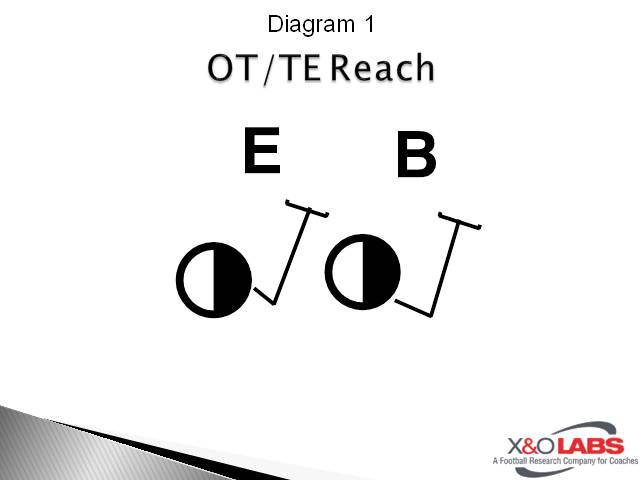
  1. OT and TE covered= Reach
  2. OT uncovered and Linebacker inside = Slug
  3. Swap: OT uncovered and linebacker outside= Swap

The 3 schemes this tandem needs to understand are reach, scoop and pin and pull. 

Reach Scheme:

We teach our guys to step at a 45-degree angle play side and their aiming point is the outside armpit.  The 2nd step we coach them to step into the crotch of the defender, as the outside hand should be thrown into the far armpit area and the backside hand into the bottom of the shoulder pads.  Head should be fit into the rib cage of the down defender and we continue to run our feet trying to work the defender for width or vertical push.  You will see as we go on that we are OK with the down defenders either getting reached or displaced outside with the read of the tailback on the tight end block.

Slide1


Slug Scheme:

The Slug scheme is used when the offensive tackle is uncovered and the linebacker is inside the box.  We teach our covered player to take a “Slide Step” which is a lateral step.  The length of the step will depend up on the alignment of the down defender.  We tell the covered player his aiming point is the play side number, so we need to slide step to get our eyes on the play side number and fit our eyebrows on the play side number.  2nd step again is to the crotch of the defender and hands inside on the down defender.  Again, we can displace the down defender for width or work a vertical push to 2nd level.  The uncovered lineman will take a 45-degree step with the aiming point the backside number.  We want this player to assume he will be overtaking the block, but do not chase the number.  If the number disappears we stay on our track for 2nd level defender. 

Read More

4-2-5: Split Field Coverage

Zach Watkins
Co-Defensive Coordinator / Special Teams Coordinator / Safeties
Washburn University
Twitter: @Zach_Watkins and @WU_Football

Introduction

 SES2173Our base scheme here at Washburn University is the 4-2-5. We believe that by playing this as our base defense we’re provided with the flexibility to defend any type of offensive scheme we will face. Up-tempo no huddle, spread, pro-style, triple option, etc. are all schemes to be soundly defended by the 4-2-5. By having 5 DBs on the field, we are able to play a variety of coverages with our base personnel. Last spring, we wanted to research and install a coverage that combined several parts of our preferred coverages. “Auto” coverage was our perfect fit as it allows us to play a Cover 3 coverage while handling certain routes with man principles. In addition, we have found Auto coverage to work very well against any combination of 4 verticals. We can eliminate this spacing problem normally felt against 4 verticals by squeezing the verticals into our help. Auto is by no means our own original idea, but we have modified certain aspects of the check system to fit our personnel (as explained below).
Alignment

Slide1

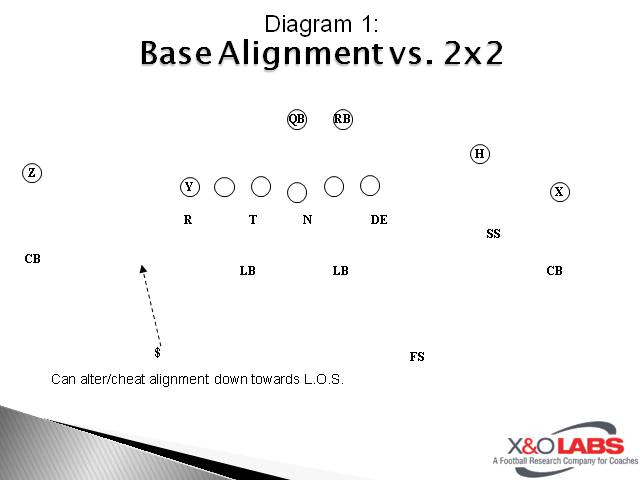
In our base alignment above, Auto is drawn against a base 2×2 set which is our favorite formation to play this against. With that said, we believe this is a sound coverage against any formation. In this case, the alignment rules are as follows:

  • LBs will align in 30s (outside shoulder of guard) at normal depth (toes at 5 yards).
  • Strong safety (SS) will align 1 yard outside #2 WR at 4 yards depth.
  • Our free safety (FS) and star (weak side passing strength, $) will align 12×2.
  • The $ will cheat his alignment down during cadence (sometimes aligning there initially).
  • Corners (C) will align 5-7 yards off if they are not pressed up. We change our corners’ alignments often to give various looks. Corners align 1 yard inside leverage.

Assignments vs. Any Non 3×1 Set

The concept of our Auto coverage is very simple. It is a combination coverage of man and Cover 3 and all positions will key their run read first. The LBs key the near guard through to the backfield, or what we call the essential “triangle”. The SS and $ will key the end man on the line of scrimmage or the uncovered offensive lineman if he playing the high safety. The FS will key the uncovered OG to the OT. Lastly, the CBs will key the #1 receiver.

Auto is best explained from the outside in. The way we teach it, corners and safeties (SS/$) have essentially the same rule; “anything up or out.” Anything “up or out” by the #2 receiver is to be played as outside leverage man to man for the safeties. Anything “up or out” by the #1 receiver is to be played as inside leverage man to man for the corners. We use the term “Man on Deep” (M.O.D.) as well as “up or out” for the CBs. “Up or out” is anything vertical past 6-7 yards. Our depth for this can change week to week based on opponent.

From the safeties perspective, a #2 receiver can be a WR, TE, or if 2 backs, a RB out of the backfield. Once he makes an “up or out” read on #2, that man is his man and he must stay with him in proper leverage. We are trying to squeeze all vertical routes by the #2 receiver into the FS by being physical on the receiver’s outside hip. The FS is essentially playing the middle 1/3 of a cover 3 look. Depth and middle of formation are his main thoughts as the play develops. We want the FS to be breaking downhill on any ball, similar to how he would play Cover 3 or Cover 1.

Read More

Off-Season Conditioning for the No-Huddle System

By Mike Kuchar

Senior Research Manager

X&O Labs

Twitter: @MikeKKuchar

1375570653Introduction:

Fact: 63.7 percent of coaches have made changes to their off-season program since going to the no-huddle system. Makes sense right? How can you expect your players to go at breakneck speeds on the field if you’re not teaching that pace in the weight room? According to our research, that teaching needs to occur now in the winter conditioning program.

Many of the no-huddle coaches we spoke with specifically credited their off-season development as the main catalyst for providing them the ability to use the tempo they needed in-season to be successful. Although this seemed like a natural progression, we felt that this was a component of football that may be neglected among tempo coaches. So we researched it. We wanted to know that these no huddle coaches were doing in the weight room this winter that helped to generate the endurance, speed and resilience needed to run the no huddle system.

So, the pocket of coaches we reached out to was small. We simply targeted those coaches that have worked with us before on our No Huddle Study special report (click here to read that study). Of these coaches, 40 percent (majority) of them have been utilizing the no huddle between 1-3 seasons. Which means they have drastically changed their weight program recently, the data below is new and cutting edge. Many coaches have cited these programs below as reasons why they’ve been able to compete and defeat larger programs.

And if you’re concerned about space issues in your weight room, chew on this:  81.9 percent of these programs share the weight room with other teams.Now keep in mind this is not strength and conditioning special report. There are no videos of players performing squats, lunges, etc.  You don’t need us to tell you what these exercises are. A quick search on youtube.com can find that. But we did provide you with something better: In addition to our research, we also provide you with the email addresses of the no huddle coaches featured in this research report, so you can contact them yourself to elaborate on the work they are doing right now to get their program better.


Biggest Change This Off-Season:

We began our research by asking one simple question: “What is the biggest change you’ve made this off-season in your weight program to accommodate no huddle tempo?” Our findings are below:

High Interval Training (H.I.T.) Reducing Rest Periods:

Coach Priebracha, Montgomery High School (NJ): “We spend our time focusing on reducing rest periods between sets and continual push to ‘sprint’ through the work out. The entire lifting should take no longer than 45 minutes. Go fast in your reps, speed up your rest, get next lift quickly.”

Coach Stichel, Archbishop Curley (MD): “We use a fast paced whistle driven program. We take 30 seconds to complete lift with 15 seconds to change weights and members for next set. It’s all done on whistle commands.”

Coach Hansen, Hinsdale HS (IL): “The conditioning aspect of the program has been researched, and we have implemented more high intensity interval training (H.I.I.T.). This gets our players used to the repetition of maximum effort for a short time followed by a short rest period. We feel that this type of training mirrors what will take place on a typical offensive drive.”

Coach Majeski, Highland Community College (KS): “The biggest thing we have done is cut down the rest between sets in the weight room. The reasoning is, yes, you can do more weight with a longer rest. The person who takes longer rest will have to lighten the load when the rest break is shortened. The person who takes shorter breaks will be able to use more weight when the rest periods are increased. We feel we will get a better overall conditioned player. A strong player that is tired loses strength rapidly. A strong player that is in condition will wear down his opponent.”

Anonymous: “We have utilized more metabolic conditioning work, especially focused on work to recovery ratios that mimic a long offensive series.”


Using Cross Fit Programs:

Cody Eyerman, William V. Fisher Catholic High School (OH), [email protected]:

“We have incorporated CrossFit type workouts for our explosive training days. We try to use a wide variety of exercises with our workouts; we really believe that CrossFit is a good way to train your body to react to all types of situations. Some of the most common CrossFit moves we use are thrusters (front squat to push press), clean and jerks, box jumps, pull-ups, pistols (single leg squat), explosive step-ups, and explosive lunges. We also incorporate supersets with some regular exercises.  Such as bench press with clap push-ups after or squats with split squat jumps after. Other things we may do are add an agility ladder as one of our stations in circuits, med ball abs (middle of sit up position catching a med ball at all different points), and all different kinds of plate raises sometimes on commands as a team for a little extra fun.” 

Read More

Multiple Fronts in the 3-4

By Jason Thier

Defensive Coordinator

University of Montana Western

71889_609636990782_36105425_34725893_5182030_n

Editor’s Note:  At 24 years old, Jason Thier became the Defensive Coordinator at The University of Montana Western in 2011. Prior to coming to UMW, Thier spent two seasons at Augustana College in Sioux Falls, S.D. In 2010, he helped coach the team to a 10-1 regular season record and the NCIS South Division Championship. In his young career he has coached five all-conference players and one all-region player, at both the linebacker and safety position. Thier played at Truman State University where he was a three-year starter at linebacker, earning All-MIAA Defensive honors his senior year. 

There is no question that the game of football is in constant motion. It is a continual machine of change. Each year it seems like there is a new offensive scheme that is gaining momentum and earning the reputation of being unstoppable. It then spreads like a wild fire across the country, traveling with coaches from team to team, conquering the game one conference at a time. Because of this, defensives are forced to adapt and adjust to combat all the latest and greatest offensive trends. This process is cyclical: offensive minds come up with new ideas and defensive minds find ways to stop them. However, there is one thing about football that will never change: it is a game of numbers and match-ups. A team’s ability to gain the numbers advantage and create favorable match-ups has a direct correlation with their ability to achieve victory.

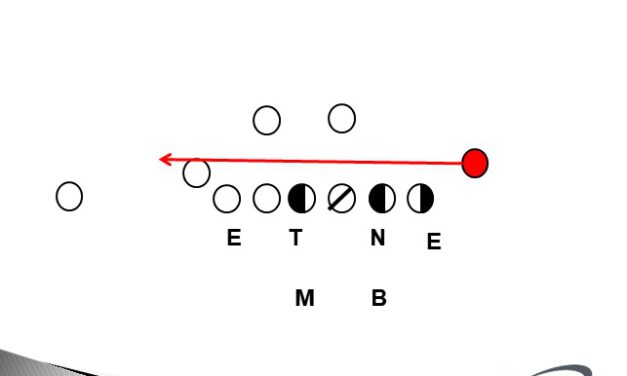
That is one of the main reasons why we have chosen to run a 3-4 defense here at Montana Western. It garners the ability to eliminate offensive mismatches and exploit match-ups of our own. It also gives us the ability to line up and adjust to all offensive schemes and formations. Being a base 3-4 team, we ran 46% of our plays last season out of reductions fronts (four fronts using a linebacker as the fourth linemen). It is the flexibility to move in and out of reduction fronts that gives the 3-4 defenses the adaptability to defend all offensive attacks. In order to be successful playing in reduction fronts we have to do a great job of teaching our linebackers to play on the line of scrimmage. This article is going to be two tiered; first I am going to focus on how we teach our linebackers to play on the line of scrimmage and secondly I am going to introduce you to the multitude of reduction fronts we use in an effort to eliminate mismatches.

Stance and Technique

When playing up on the line of scrimmage we want our linebackers to be physical and aggressive, attacking blockers and delivering contact. In order to do so, a linebacker’s stance when playing on the line of scrimmage must be low, powerful, and comfortable. Regardless of which stance you choose to use when playing a linebacker on the line of scrimmage, above

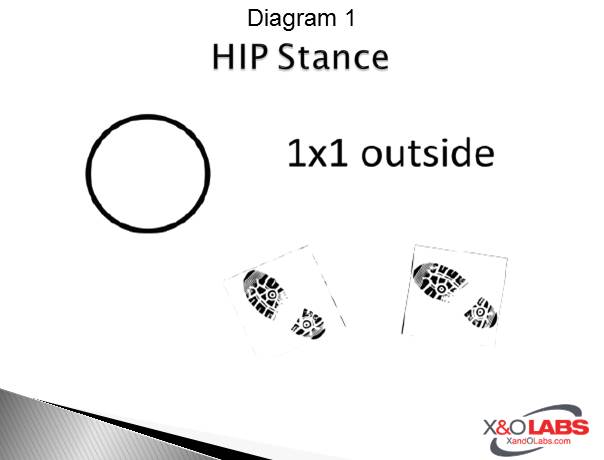
anything else it must incorporate those three things. If a player is not comfortable in his stance, his first movement will be to get comfortable, creating wasted movement. Our goal is to eliminate all wasted movements. If the player is not in a low and powerful position to engage a blocker he is at a disadvantage to give up ground immediately on the snap. Last season we started the year with our linebackers using what we call a HIP stance when they were playing on the line.

Fundamentals of the HIP Stance

  • Eyes are keying the near shoulder of the man you are shading. Read his tip to determine the block (To, Away, Back).
  • Inside foot is up, the back toe is to the heel of the front foot, and the feet are slightly inside of the shoulders.
  • The knees are bent, shoulders are back, and chest is big.
  • The hips are aligned with your aiming point (usually the outside tip of the man you are shading).
  • Hands are relaxed in front of your body ready to strike.
  • The first step is a six inch power step with the inside foot, into the crotch of the man you are shading. Be careful not to over stride. Violently fire your inside hand to the V of the neck and outside hand to the shoulder of the offensive player. Step and strike should happen at the same time.

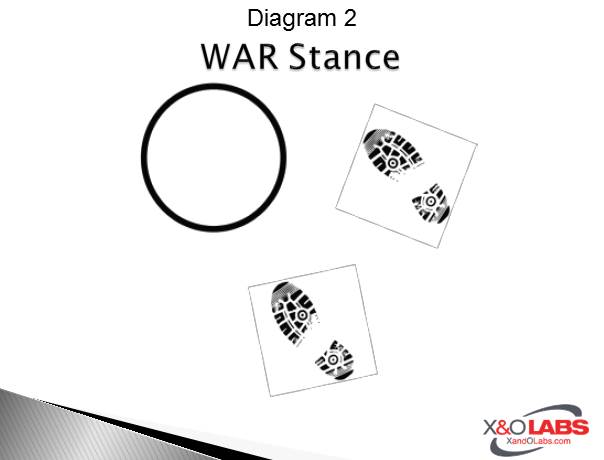
However, after our week four game we noticed that instead of stepping with the inside foot to engage blockers, our players were stepping backward with their outside foot to absorb contact. We also noticed that on the snap our guys were lowering their pads and repositioning their base. This indicated a lack of comfort and proper pad level. We then decided that we needed to make a change. We decided to put our players in a better position to be successful and to accomplish what was most important about playing on the line of scrimmage: being low, powerful, and comfortable. We then implemented what we refer to as the WAR stance.

Fundamentals of the WAR Stance

  • Eyes are keying the near shoulder of the man you are shading. Read his tip to determine the block (To, Away, Back).
  • Outside foot is up, the back toe is to the instep or heel of the front foot, and the feet are shoulder width apart.
  • The knees are bent, shoulders are back, and chest is big.
  • Body is angled inside at no more than forty-five degree angle, aligning your crotch with your aiming point (usually the outside tip of the man you are shading).
  • Hands are relaxed in front of your body ready to strike.
  • The first step is a twelve inch power step with the inside foot, into the crotch of the man you are shading. The inside foot should now be in front of or even with the outside foot. Be careful not to over stride. Violently fire your inside hand to the V of the neck and outside hand to the shoulder of the offensive player. Step and strike should happen at the same time.

The decision to make the change to the WAR paid great dividends. After changing our players from the HIP to the WAR stance we gave up 100 less yards per game in the last six games, in comparison to the first four games. We also gave up half a yard less per carry in the run game in the last six games. Finally we finished 3-3 in those last six games after going 1-3 in the first four games. Obviously there are multiple factors that go into making such improvements, but the change to the WAR stance was a big part of it. After the season was over I was able to identify why the WAR stance is superior to the HIP.

Read More

6 Non-Negotiables in Building a Program

By Dan Ellis
Head Coach
Great Valley High School (PA)
Twitter: @CoachDanEllis


Introduction

greatvalleyI have had the great fortune to be the head football coach at three separate high schools – Springfield (Delco), W.C. East, and Great Valley. In the first two cases, I took over a football program that had been down for an extended period of time. At Springfield, I took over in 2008. That program had not had a winning season since 1994. In three seasons, we changed a culture by taking the 2010 team to its first playoff run since 1994. I left to take the W.C. East job after that season, but the new head coach, Tom Kline and Chris Britton, were members of our staff and continued a run in the playoffs from 2011-2014. At W.C. East, in the four years previous to my arrival in 2011, W.C. East went 5-38. In 2013, we finished 6-5, the first winning season since 2006. At Great Valley, I was fortunate to take over a program with a history of more success and in our first season, we went 12-2 and won the District I Championship. Here is the blueprint that we implemented at three different schools that has worked successfully at each.

Step 1: Develop a Philosophy and Mission Statement

The number one thing that is needed in turning around a program is a clear, well thought out coaching philosophy or mission statement. Having a philosophy will establish the guidelines for your program. All things in the program should evolve from this one idea and should be constantly reinforced throughout the season and off-season. Our mission statement here at Great Valley is…

“To build young men of empathy, integrity, and moral courage who make the world around them a better place.”

All aspects of our program evolve from this idea. At any one point, whether it is in the weight room during the winter or a camp practice, we engage our players and talk with them about these ideas and the overall philosophy. It is not always done with the entire philosophy in mind, but different aspects of it are constantly talked about.

In order to achieve the overall vision of our team, we stress two key characteristics that will ensure that we achieve the overall goal. For our players, the two characteristics that we require of our players are Attitude and Effort. When we discuss these topics with our players, our emphasis is to discuss the importance of attacking anything with the best attitude you can and with your maximum effort. Both of these characteristics are things that any player at any age, from all talent levels is able to give. I was fortunate to play for George Welsh and Gary Tranquil (Offensive Coordinator) at the University of Virginia, and both would always say, “It takes 0% skill to give 100% effort.” There may not be a more appropriate statement when building a football team. These are non-negotiable and will not be ‘coached’. They are a requirement. Most importantly, we always bring attitude and effort back to our overall philosophy – in order to be successful with our mission statement, players must give attitude and effort, and it is not just in football, but also universally. To be a great student or a great musician or a great ________________, the prerequisite for success is having a great attitude and giving maximum effort at all times. Pick the person who is successful in any field – Steve Jobs, Bill Gates, Nick Saban, George Welsh, a players’ parents, etc. – they attacked their jobs relentlessly and with great effort. That is how Apple became Apple and Microsoft became Microsoft.

Having a great mission statement is not the only key aspect to being successful. That in fact is probably the easiest part. The hardest part, over time, is being uncompromising. X’s and O’s clearly play a crucial part, but keeping that vision untarnished and uncompromised is critically important. The discipline required to commit to our mission statement is not easy. Bringing the best attitude and effort every day is hard. It is my job as the head coach and my assistants’ job with their respective players to make sure that they are getting that attitude and effort each and every day. When players are not, we push them to be better. Clearly, every day is not always a good day and discuss that with the team. If it is a bad day, you must work to make it better the next day. However, there are situations where some players cannot make the trip.

From the first team meeting with the players and parents, we establish the vision for our program and discuss these non-negotiable ideals – Attitude and Effort. I am always brutally honest with the parents after discussing our mission statement. It is a hard ideal to live up to and I will work ceaselessly to help the players achieve their individual goals as well as our team goals. But, I demand attitude and effort and when it is not being consistently given at any point during the year, I will choose the success of the team over the individual. Unfortunately, from the moment I took each of my head coaching positions, I told the team and parents that the train had left the station… and unfortunately, not everyone can make the trip. Sometimes, some players are just unable to commit. It is crucial that when you are faced with the critical situation, when a player with immense talent reaches that point, the team must come first. It is not good enough to stand firm with underclassmen that is at best a role player. The test of real leadership comes when you are faced with the challenge of a great player who does not follow. Unfortunately, I have had to lose several players. My first year at W.C. East, two returning starters did not complete camp. My second year, our returning starter at tailback was lost. However, by being consistent through our first two years, we did not have any issues our third year.

Read More

NCAA Player Development Study

By Mike Kuchar
Senior Research Manager
X&O Labs
Twitter: @MikekKuchar

Introduction

“Coaching is about getting the most out of your players.” It is an axiom that I first heard uttered by Russ Grimm, the offensive line coach for the Tennessee Titans and original “hog” himself with the Washington Redskins. While it’s hard to argue the validity of that phrase, the difficulty in that task lies in what coaches call the “strain,” or the process in developing your players. There is a fine line that distinguishes mediocre and success in coaching and while much of it can be attributed to pure talent, how coaches extract that talent can often be a thing of beauty. It is that process of strain, that became the focal point of this study.

So, when we started research for this project, we reached out to many of the coaches in our network with one request: “Select one head football coach that gets the most from his players year in and year out.” While an abundance of names came pouring in, we went after those that kept reoccurring and while we didn’t get in touch with all of them, we were able to with 12 head football coaches, with all levels of collegiate ball represented, to ask them how they develop their players. Our research was segmented into four cases:

  • Off-season mental development
  • Off-season physical development
  • In-season mental development
  • In-season physical development

Most of our contributors have been head football coaches for over a decade. Our twelve contributors have amassed some staggering numbers collectively as head coaches, which include:

  • 734 wins
  • 711 win percentage throughout their tenure as a head coach
  • 47 division championships
  • 3 national championships (all within the last three seasons)

The list of contributors to this study is below:

Contributors (in Alphabetical Order)

Chris Ash, Head Football Coach, Rutgers University

Glenn Caruso, Head Football Coach, University of St. Thomas (MN)

Mark Farley, Head Football Coach, University of Northern Iowa

PJ Fleck, Head Football Coach, Western Michigan University

Peter Fredenburg, Head Football Coach, University of Mary Hardin-Baylor (TX)

Vince Kehres, Head Football Coach, Mount Union University (OH)

Chris Klieman, Head Football Coach, North Dakota State University

Ron Korfmacher, Head Football Coach, Taylor University (IN)

Matt Mitchell, Head Football Coach, Grand Valley State University (MI)

Tim Murphy, Head Football Coach, Harvard University

Bob Stitt, Head Football Coach, University of Montana

John Steigelmeier, Head Football Coach, South Dakota State University

Case 1: Developing the Off-Season Mentality

In this case, we studied what these coaches were doing in the off-season to develop the mental capacity of their players. We all know that it’s the cohesiveness and resilience of a football program that is developed from January to spring ball. We wanted to find out how head coaches were developing players in this area as it pertains to the following components:

  • A character development program
  • A leadership council among players
  • The infusion of a sports psychology program

While we found that the leadership council seemed to be the clear favorite of choice in developing players during the off-season, we found that coaches were using different criteria to select leaders and various activities that encourage these groups to promote the program.


Chris Ash, Rutgers University: “In the off-season, you want to accomplish some specific things. You want to get them bigger and stronger, you want to build their athletic ability, you want to build their toughness, you want to build leadership, you want to build their football skills and lastly you want to build their football IQ. You have to do that in 8 hours a week during the off-season. You can’t slack off on any of those things because rest equals rust. You can’t afford to let any of them be underdeveloped. WE built toughness at Ohio State through the artificial adversity we created in our off-season workout. You don’t rise to the level of the occasion; you rise to the level of our training. We use the phrase E+R = O which means events plus response equals outcome. We are an event-based program, we train our players to handle adversity. If you don’t train the players to deal with adversity, they will not be ready for it. We will create a special workout to push them to the limit mentally or physically or change a routine where we ask them to be here at 5 am to see how they respond. We are creating that for good events and bad events so they are ready to respond the right way. “


Glenn Caruso, University of St. Thomas (MN):“ We use a program where I will have players read several books during the course of the off-season, many of which do not have anything directly to do with football. I believe more in the psychological piece of it, using the off-season to teach not just how we feel but how we can best prepare ourselves to be at our best in stressful situations. It’s about learning who they are, how they relate to people and how people relate to them. It’s about learning ways to communicate and ways to mitigate anxiety and ways to teach their peer groups about the psychology of human nature. It’s a program that I made up. It’s a seven part mini-course that goes through the basic tenants of human psychology or human behavior.”

Read More

Multiple Variations in Getting Play Makers the Ball

By Adam Hovorka
Managing Editor, X&O Labs
Former Head Coach at Schreiber High School (NY)
Twitter: @XOLabs_Editor


You probably have that one player that is just better with the ball in his hands than the rest of the guys on the team.  When he has the ball good things happen and the more touches he can get the better your chances become.  If that special player is not your running back you have to be very creative in how you get him the ball.   We are a shotgun inside zone heavy team and our dynamic play maker (DP) just wasn’t the type of player that we could just hand him the ball in inside zone and be that effective.  We had to be very imaginative in how we got him the ball.  We moved him all over the field and used him in an assortment of ways.


Concepts for the “DP” in the Slot

The first way we got our DP the ball was to align him in the slot and run some simple jet sweep.   We would run some empty or end over formations to get the number advantage on the perimeter. This is your typical jet sweep that almost every team runs. 

Diagram 1


This formation was the most successful for us running jet sweep and enabled us to get the ball on the edge to our DP with some good blocking angles.   The first clip we are in a TE/wing formation with a wide receiver split wide to the same side.  In the 2nd clip we are in an empty formation with two receivers on the line of scrimmage.   A key coaching point f or the DP to cut down his split and snap the ball on first sound.  We do this to slow down the defense from recognizing the play and less likely to react to the motion.  We also would tag the play with a word for the outside receiver to crack and have the back on the corner.

To study game film of these concepts, click on the video below:

Read More