
Mixing Coverages Behind Zone Pressures

By Zach Watkins
Co-Defensive Coordinator/Special Teams Coordinator/Linebackers
Washburn University (KS)
Twitter: @Zach_Watkins


Introduction:
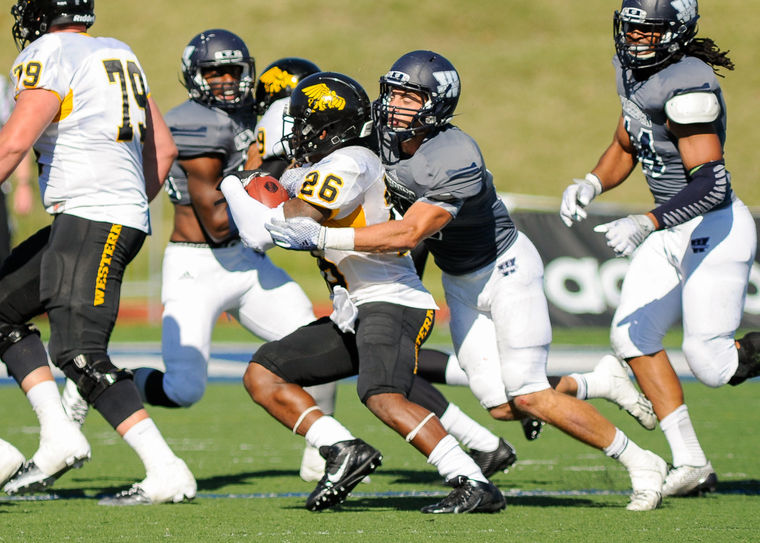
washburnIt is always important for a defense to mix up and disguise what they are doing. This is especially true when blitzing. If a blitz is given away early or executed too late, its effectiveness will most certainly be lost. We mix in all kinds of blitzes in our defensive package. We will bring anywhere from 4-7 guys, as well as changing up the coverages behind those blitzes. We feel that you must switch up the coverages to be effective.

In the past few years, we have started to use more zone blitz concepts within our scheme. We have found this to be difficult for an offense to read pre-snap, effective at pressuring the QB and provides certain advantages to us in game planning.

When To Call Zone Blitzes

All downs are possible for us to run our zone blitz packages. Passing situations are obviously more conducive to having success with the blitz, but the run fits are sound for those times we don’t call it at the perfect time. 3rd and long situations (6+) work well, especially with the 1 back sets we most often see. We always want to try to create a 2 for 1 for the RB in their protection so that we have dictated our play for the offense to adjust to.

Pre Snap Alignment

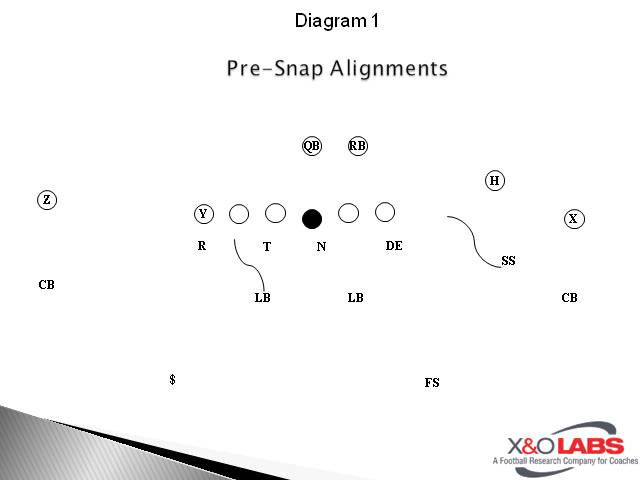
We try to confuse the offense and dictate the protection by “stemming” around pre snap. This includes sugaring our 7 underneath players (DL, LB’s and strong safety (SS)). We will give the same 10×2 high shell look every snap with our free safety (FS) and stud ($), regardless of blitz or coverage (Diagram 1). Our corners can show any leverage and depth, as long as they are in position to play the zone that is called. By maintaining this two high look with the safeties, and with the underneath LBs/SS in our 4-2-5 scheme moving around, we believe it makes it difficult for the offense to diagnose what we are doing. This alignment also gives our guys confidence in their blitzes because if they have stemmed around often enough, their blitz should be disguised.
Slide1

Blitzes

Within our blitz package, we have the ability to bring anywhere from 4-7 guys and still play zone concepts behind the blitz. All of our zone blitzes are states. This helps our players to categorize the blitzes within terminology of the rest of our defense. I will detail three base zone blitzes that we use, Florida, Texas, and Kansas with the different zone coverages we play behind them, 6 Drop, 6 Rush, and Trap 2. We can also “pop” (single blitz) any player who is not a DL and play zone coverage behind it.

Below, I will detail one blitz with all the coverages, and then expand to other blitzes. For the purpose of simplicity, I’ve drawn each diagram to show the field to the right and boundary to the left. We also play man free (Cover 1) behind these blitzes, but I’ll detail the zone concepts for this article.

FLORIDA

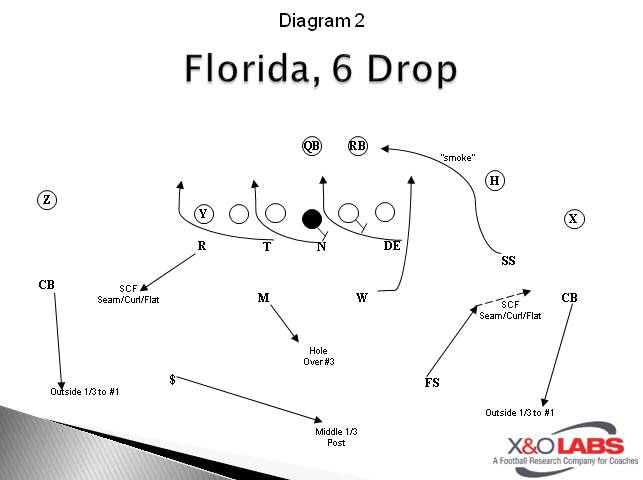
Our main zone blitz is the traditional Fire Zone. “Florida” is used with Cover 6 Drop (3 under, 3 deep, with a DE dropping into coverage) behind it (Diagram 2). Because we run a 4-2-5 and read to the multiple WRs, we typically bring this from the field. We have some flexibility in how we can roll and adjust the coverages, and that we have some more speed coming off the edge in our SS rather than an LB. As in all zones, we will get hands on and be physical with receivers and force them over the top.
Slide2

BLITZERS

Up front we call our strength to the TE, and will keep it that way no matter that blitz. This allows our front to have different looks on film within the same blitz. We will read to the multiple WR side, just like in our base scheme. We could read specifically into the boundary or towards the field if we want to bring the blitz from a certain side based on game planning. We give our DL very simple instructions. They will all “long-stick and read” (hard lateral lead into the direction they are slanting). This slant usually takes place into the boundary.

Read More

Virginia Union’s Top Quarters Beater

By Toriano J. Morgan
Pass Game Coordinator/WR Coach
Virginia Union University (Richmond, VA)
Twitter: @Toriano81


Introduction:

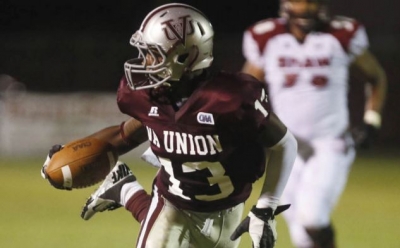
vunionA great deal of Virginia Union’s recent success and resurgence can be attributed to the emphasis they have placed on improving their passing game. That emphasis paid off this season as the Virginia Union Panthers finished 8-3 capturing an invitation to the D-2 playoffs for the first time in 24 years. The Panthers offense has also set several new school records over the past two seasons.

When installing a new offense, we looked to become more explosive and put a concentrated effort on moving the chains and being efficient in our passing game. Our Rocket concept and has allowed us to accomplish both goals and improve our overall offensive production. In just our first year, we finished the 2014 season ranked 1st nationally in yards per completion (17.6) and ranked 4th nationally in Passing Efficiency (168.4) while averaging 277ypg passing up from just 69 ypg a year prior. We also finished 1st in our conference (CIAA) in passing in both 2014(2,772) and 2015(2,618).

The Rocket concept encompassed everything we were looking for. It was simple while looking complex and it allowed us to put the ball in our athlete’s hands. Most importantly, it fit right in to all of our protection schemes.

Rocket Concept:

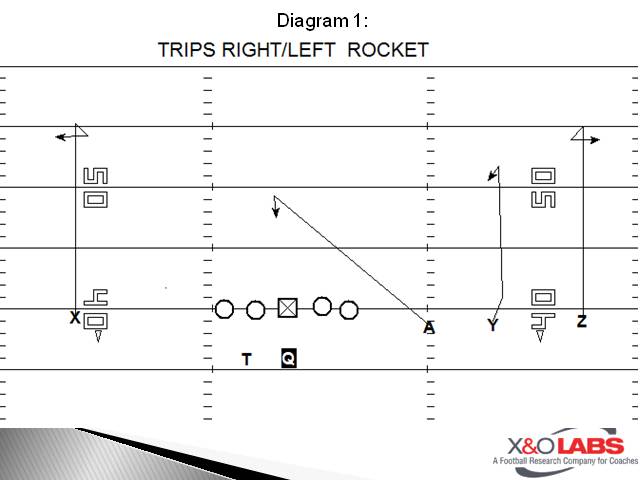
The Rocket concept is a simple concept that we use out of our 3×1 set majority of the time. This concept entails a 15 yard stop route by the #1 receiver, a 12 yard option route by the # 2 receiver, and a 12 yard sit route by #3 receiver (as shown in diagram 1). We have experienced a lot of success with this concept as it allows us to attack the defense vertically and gives us unlimited options against blitzing defenses and quarters coverage. We have found that this concept is a very compatible to our quick game and has a direct effect on defenses when it’s time to stretch the field vertically.

Slide4

Coaching the Stop Route:

We require that the receiver use a speed release off the football. We coach our guys against a soft corner to attack the defenders technique splitting the midline of his chest while quickly closing his cushion. Once he feels he has created a two way go he should step on the defenders toes, causing him to open his hips. Once he has opened the defenders hips, he is coached to continue to push the route to 15 yards. He will make his break opening his hips 45 degrees expecting the throw to be on his up field shoulder, providing him the opportunity to run after he makes the catch.

Read More

Southwest Minnesota State’s Draw/Hitch RPO

By Mike Kuchar
Senior Research Manager
X&O Labs
Twitter: @MikekKuchar


swmnfbEditor’s Note: The following research was conducted in part of XandOLabs.com special report “The Run/Pass Option” study, which can be accessed by clicking here.
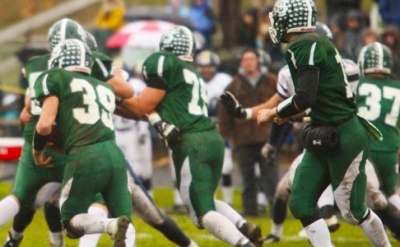
Instead of using the play side inside linebacker as a movement key in the hitch concept, Head Coach Cory Sauter chooses to put the perimeter outside linebacker in run/pass conflict. The run action is quarterback isolation, while reading the apexed player. Sauter will use hitches, outs or bubbles by the number two receiver to get the apexed player to widen. The quarterback will read number two play side. “If number two doesn’t blitz, we throw the easy hitch if he reacts off the QB draw,” said Sauter. “If he blitzes, we simply throw one of the hitches or we may convert to a fade if we see press.”

Read More

Teaching Gap Double Teams vs. Zone Double Teams

By Rich Alercio
Head Football Coach, Assistant Athletic Director
St Johnsbury Academy (VT)


Introduction:

coverThere are differences and similarities between combination blocks and double teams for offensive linemen. Regardless of your offense (Spread, Pro-style, Wing T), or your offensive line schemes (Man, Zone, Gap) you will inevitably have scenarios where two offensive linemen are engaging with one defensive lineman and working to a linebacker. Combination blocks are most often associated with zone blocking schemes, but they occur in almost every scheme you could run.
The Combination Block

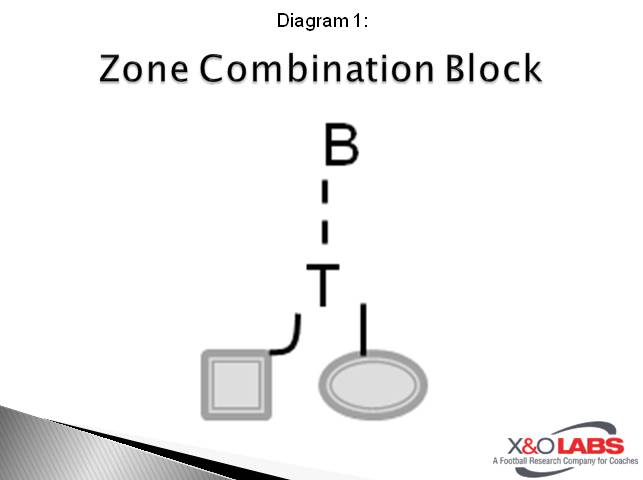
There are four scenarios in zone blocking for offensive lineman. They can be either covered or uncovered. When covered, they can be covered with a defensive lineman on their playside shoulder or backside shoulder. A head up defender is treated as covered on backside shoulder for the purposes of combination blocking. When uncovered, they could have a defensive lineman in their playside gap or their playside gap could be open.
The combination block scenario is created when one offensive lineman is covered with a DL on his backside shoulder (inside zone right with the DL on his left shoulder) and an adjacent offensive lineman to his back side is uncovered (See Diagram 1).

Slide1

In the zone blocking scheme, all offensive linemen must step with the same foot. On inside zone right, for example, every lineman steps with his right foot. In Diagram 1 (above), the covered lineman (right guard) will take a base step (vertical drive step) with his right foot. The uncovered lineman (Center) will execute a reach step (vertical step with lateral displacement) with his right foot. Both will utilize the “Heel Replaces Toe” concept in determining the vertical distance of the step. The lateral distance of the reach step of the uncovered lineman is dictated by split and alignment.
The second step for each lineman will mirror the path of the first step. The covered lineman will vertical drive while the uncovered lineman work for lateral displacement. The vertical distance of the second step is such that the heel of the second step lands at the same vertical depth of the toes of the first step (heels never pass toes).

Read More

4-2-5 LB Play: Case 1 – Bucknell’s Fits Based Off Run Concepts

By Mike Kuchar
Senior Research Manager
X&O Labs
Twitter: @MikekKuchar

Introduction:

bucknellIf you operate out of the 4-2-5 defensive structure than you know how vital it is to get those two box linebackers trained on their keys. In most cases, you’re playing with six in the box (an unloaded box), so you need to rely on the perimeter defenders to add on to the run game to get a plus one defender against quarterback runs. But how you choose to fit your defenders relies on several components, including offensive formation, coverage structure and field/boundary protocol. Here at X&O Labs, we wanted to conduct comprehensive research on how linebacker coaches were teaching their players to fit the one-back run game out of the 4-2-5 defense. And what we found were three common threads among our research:

  • Coaches either fit gaps or schemes… we present both of these philosophies
  • Coaches are finding ways to get a plus one defender on the read gap in Zone Read schemes… whether it is Inside Zone Read (C gap read), Mid Zone Read (A gap read) or Power Read (B gap read).
  • Coaches are using eight man fit principles to defend the Y-off formation and the pre and post snap motion associated with it.

So we spent time with four programs that operate out of the 4-2-5, successfully we may add, that all fit one back run concepts differently:

  • Bucknell University (PA)
  • Marshall University
  • Tennessee Chattanooga
  • California University (PA)

The run concepts we focused on were the Inside Zone, the Middle Zone, the Power and the Power Read. What we found common among all of our contributors was the ability to outnumber the offense by either putting two defenders on the running back or two defenders on the quarterback, depending on which phase you want to eliminate. How each program did this varied, and is explained thoroughly in this report.

We’ll start with Bucknell…

The Bucknell Methodology

At Bucknell University, the Bison defense vary its fits based on the run concept. They distinguish their run fits based off two types of zone schemes- the middle zone and what linebacker coach Brad Fordyce calls the cutoff zone. The middle zone has a probability of hitting front side, while the cutoff zone has a higher probability of hitting back side. Because of this, they train their play side linebacker to “fall back” to play the cut back, which is different than programs that use perimeter players to handle this responsibility. The Bison primarily utilize a quarters coverage structure on the back end and by having the play side linebacker responsible for cutback it allows the perimeter players to defend the common RPO (run/pass option) scheme spread offenses employ. In this case, Coach Fordyce details how he fits the various run concepts he sees out of one-back formations.

Contributor: Brad Fordyce, linebacker coach

Stats:

  • • Been in the top 10 in total defense at the FCS level the last four years in a row.
  • • Finished 11th in rushing defense in 2014, surrendering 3.04 yards per carry.
  • • Finished 10th in total defense in 2014, surrendering 302 yards per game.

Personnel and Base Structure of Defense:

Bucknell operates purely out of a 4-2-5 defensive structure and is mainly a Quarter, Quarter, Half coverage team (Diagram 1). Against one back offenses, Bucknell chooses to set its 3-technique to the side of the back regardless of formation. In its purest sense, the 3-technique will be set to the field or tight end side, yet both interior tackles are interchangeable because it presents the ability to line them up head up and move into a shade pre or post snap. Bucknell uses an open side defensive end and a closed side defensive end. The Sam is the field side inside linebacker while the Mike is the boundary side inside linebacker. The strong safety (N in some of the diagrams below) is the field side linebacker. The Whip is the boundary safety while the free safety is the field hash player. Bucknell also plays with a field and boundary corner, mainly because it’s field and boundary oriented.

Read More

4-2-5 LB Play: Case 2 – Marshall’s Fits Based Off Field and Boundary

By Mike Kuchar
Senior Research Manager
X&O Labs
Twitter: @MikekKuchar

The Marshall Methodology

marshall1Marshall University mixes quarters coverage and man free coverage in their secondary, which means it will vary between playing the zone read game with even numbers or with a plus one defender. Because of this, linebackers coach Adam Fuller has built in concepts, which notify the read side defensive end whether or not he has help on the quarterback. Much of what Marshall does relies on the field linebacker (or Nickel) to be the extra hitter in the one-back run game, but there are several formations that stress that defender causing adjustments to be made. Coach Fuller details those adjustments and how he handles pull plays in case two of our special report.

Source: Adam Fuller, linebacker coach

Accolades:

  • Finished 13-1 and 22nd in the AP poll after 2014 season.
  • Won Conference USA title for the first time in school history.
  • Finish 18th in scoring defense at the FBS level, surrendering 21 points per game.
  • Finished 10th in tackles for loss at the FBS level, averaging 7.5 per game.

Personnel and Base Defensive Structure:

At Marshall, holding the split safety disguise is vital, considering the various types of spread offenses that are prevalent in Conference USA. Much of what Marshall does to get the eighth defender to defend quarterback run concepts is done post-snap. In its base structure, Marshall operates out of a 4-2-5 and utilizes Man Free coverage concepts 50 percent of the time and Quarters coverage concepts 35 percent of the time. The rest is delegated to Fire Zones. Because much of what Marshall does relies on a Man Free system post-snap, they will use their free hitter to the field side, whether it is the Nickel or Sam linebacker. This is needed to get the eighth defender to defend the quarterback run in the option game. They will rarely have their boundary fitter (weak safety or corner) play an interior gap in the run game.

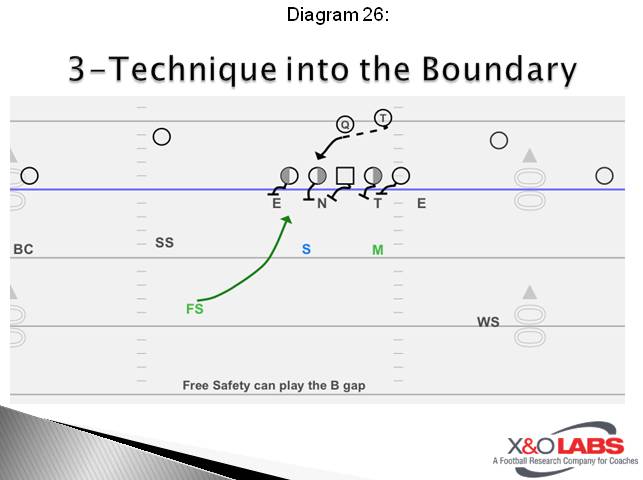
In order to do that, Marshall will set its 3-technique into the boundary so that the field hitter doesn’t need to play an interior gap such as an A gap (Diagram 26). “It’s a lot easier for him to play a B gap particularly when the Zone is moving towards him,” said Coach Fuller. “It’s less distance to travel.” It’s important to note that Coach Fuller refers to Quarters fits as any two-high safety fit, which could be Quarter, Quarter Half or Cover Zero.

Slide26

Linebacker Pre-Snap Protocol:

Coach Fuller is big on making sure his linebackers are reactionary, therefore he spends a lot of time talking to them about fit concepts and not so much coverages.

“You always have to coach the picture because that is what kids see,” Coach Fuller told us. “We key the back to unlock our movement and then key the linemen to better understand what we’re seeing. For example, if teams are running the tackle pull play we want to see the tackle. On the Power play, we want to see the double team at the point of attack. On the Zone schemes, we want to feel the tempo of the back. It’s all based on what you see most frequently.” Which is why Coach Fuller will vary his pre-snap keys for his linebackers. Any time an offense is in a shotgun set, he’ll have them key near back to flow of the offensive linemen. But when the quarterback is under center, or in Pistol formations, he’ll use an under key such as the line of scrimmage as a pre-snap read.

Linebacker Post-Snap Protocol:

There are three basic techniques that Coach Fuller uses with his linebackers as a post-snap reaction. They are all used in different circumstances and are described below.

Motor Technique: This is used when box linebackers get Zone action to them. The coaching point is to keep moving your feet and trying to keep feet connected to ground by gaining ground. “We talk about pounding our feet into the ground in a balanced position such as motoring our feet,” Coach Fuller told us. “Sometimes they move too much on those Zone schemes. You can’t move to much.”

Read More

4-2-5 LB Play: Case 3 – Tennessee Chattanooga’s Fits Based on Formation

By Mike Kuchar
Senior Research Manager
X&O Labs
Twitter: @MikekKuchar

The Tennessee Chattanooga Methodology:

tennchatAt the University of Tennessee Chattanooga, much of the one-back run scheme its defense sees comes in the form of either 2×2 or 3×1 sets which is why linebackers coach Rusty Wright has a different run fit concept for each. Coach Wright will adjust his fits based on 2×2 open/closed and 3×1 open/closed sets and will rely on his Dime defender to be the adjuster. The Mocs face a good deal of zone bluff and power read run concepts, which is why he trains his box linebackers to focus on the movement of the Y post-snap to give them their correct keys. When defending the Pistol formation, he refers to the “turn (of the quarterback) and the Yo (movement of the Y post-snap) to alert his linebackers on whether or not they play the gaps in front of them, or they fall back to play behind. This is all detailed below in case three of our special report.

Source: Rusty Wright, linebackers coach

Accolades:

  • Finished 4th in total defense in 2014, surrendering 277 yards per game.
  • Finished 11th in scoring defense in 2014, surrendering 19.4 points per game.

Personnel and Base Defensive Structure:

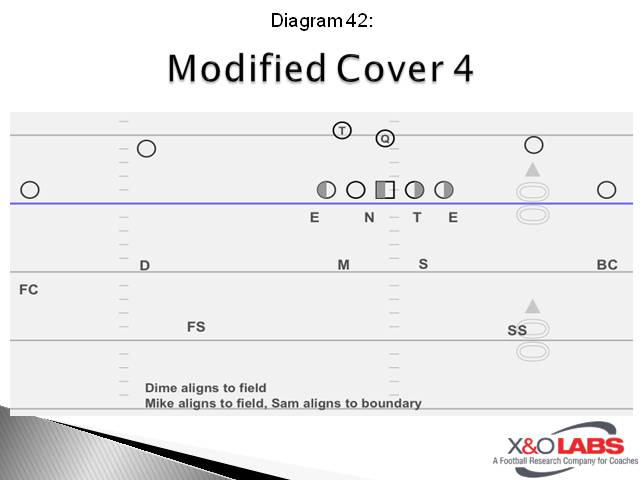
The University of Tennessee Chattanooga bases off a 4-2-5 structure with what Coach Wright calls “a bastardized version of cover four.” The Dime will go to the field with the free safety while the strong safety or boundary safety (Diagram 42) aligns to the boundary. Coach Wright preaches his simplicity of the Mocs defensive structure based on the fact they don’t move too much. Against three man surfaces, the 3-techique will be set to the field while the defensive end will play a 6-technique on the tight end. “We look like a Quarters team, but we’re getting to an eight man front pretty quickly,” said Coach Wright. “It’s get a hat in the gap and go.” According to Coach Wright, the Mocs base their fit off either 2×2 or 3×1 sets based on where the help is. The free safety is not in the fit because of the Quarters coverage structure they play behind it.

Slide42

Linebacker Pre-Snap Protocol:

The Mocs play with a field (Mike) and boundary linebacker (Sam), who line up in 30 techniques on every snap. Coach Wright tells us these two players are among the smarter players on the defensive unit because their fits can change weekly. According to Coach Wright, they could be the same player, but the boundary linebacker may be a hair faster because he has to run with number two in pass situations.

Base Zone Read Run Fits:

In order to understand how the Mocs fit the Zone Read play, it’s important to know that in shotgun formations, the extra defender in the fit will be the Dime linebacker who will align to the field. The Mocs based their support off where the off set back is in shotgun sets. If the back is away from the Dime, he lines up tighter because the Zone would work towards him. If the back is to him, he’s a little wider to play the wind back. Like Coach Fuller, Coach Wright stressed the importance of putting two people on the wind back of the Zone. In most situations, the eighth defender will be the Dime, so the help comes from the field. If the back is set to the Dime with the zone going away from him, he becomes the C gap wind back player with the defensive end. The Mike is B gap player and the Sam is A gap player (Diagram 43). If the back is set to the boundary away from the Dime (and away from the help player), the Dime has the B gap, Mike plays the A gap and the Sam is the wind back player with the defensive end (Diagram 44). “If the back is away from them, then we call it playing behind,” said Coach Wright. “The Zone comes to them so they don’t have to go run it. You step and fall back into it.”

Read More

4-2-5 LB Play: Case 4 – California University’s (PA) Fit Concept Methodology

By Mike Kuchar
Senior Research Manager
X&O Labs
Twitter: @MikekKuchar

The California University Methodology:

calpaWhile defensive coordinator and linebackers coach Mike Lopez teaches his players about gap integrity, he puts more of a premium on teaching them fit concepts. The Vulcans specialize in eight man front football out of its 4-2-5 structure, which means each second level player will have to know the following fit responsibilities- plug, cutback, force and fold. Because he will vary the placement of the 3-technique post-snap by using several different fronts, every linebacker and safety in his system are taught these fit concepts and the techniques used to associate with each. In case four, Coach Lopez details those fit concepts as well as the three different fronts he will use to set his first level B-gap player against one-back offenses.

Source: Mike Lopez, defensive coordinator/linebackers coach

Accolades:

  • 5th nationally in rushing defense at the Division 2 level, surrendering 2.67 yards per rush.

Introduction:

California University and its defensive staff (Dave Cole, Thomas Rebholz, Jr., Jessie Byrd) considers itself to be a multiple personnel, multiple front operation. Since much of what it sees is 10, 11 and 20 personnel, it spends most of its time in Nickel and Dime defense. For the most part, the Vulcans are a four under, three deep, middle of the field closed defense, which relies on boundary rotation where the free safety (who aligns to the boundary) is the extra run fitter.

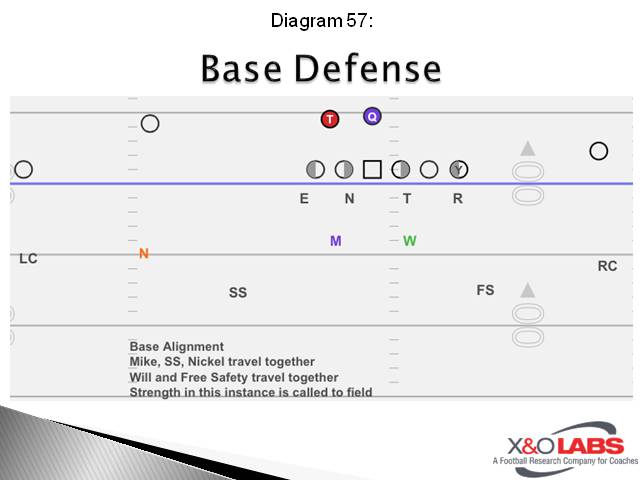
As far as personnel, California University plays with a field inside linebacker (Mike) and a boundary inside linebacker (Will) as well as with a Nickel or Sam, a strong safety and a free safety. They use travel parties- the Mike, Strong Safety and Nickel (or Sam) travel together while the Will and Free Safety travel together. Up front, the Rush and Tackle travel together while the Nose and End travel together. The strength could be called to the field if on the hash or the passing strength if in the middle of the field (Diagram 57).

Editor’s Note: In all of the diagrams below, the Nickel should be aligned head up on the number two receiver while the Strong Safety will apex the tackle and slot receiver against two-wide sets, and apex the number two and number three recevier against three-wide sets. The Free Safety will align outside the end man on the line of scrimmage.

diagram57

Coach Lopez streamlines his teaching into reinforcing concepts as well as gap responsibilities. Against the one-back run game, he teaches only two flows: fast and direct. Either the run is coming toward you or away from you. Within those two flows, the following run fit terms are enforced:

Force Player- Player resonsible for forcing the ball back inside.

Plug Player- Player responsible for taking his gap right now.

Cutback Player- Player reponsible for tracking the hip of the ball carrier to play any cutback.

Fold Player- Player who is an extra (bonus) player in run away. He will execute a shuffle, shuffle technique and fold in late on the ball carrier. 

The Mike, Will, free safety, nickel and strong safety learn all of these fit concepts, which are described below.

Linebacker Pre-Snap Protocol:

Coach Lopez teaches three different types of alignments for his two linebackers: gap, rob and pull. Gap is used in 2×1 sets where the linebacker to the two receiver side is in a 40 alignment- the inside shade of the offensive tackle- while the backer to the single width side is in a 20 alignment or inside shade of the offensive guard he is aligned on (Diagram 58). Rob is used in 2×2 sets where the Mike and Will both align in 30 techniques (Diagram 59). Pull is used in 3×1 sets where the field backer will play in a 50 alignment (outside shade of the tackle and the Will aligns in a 10 technique (stacking a shade) (Diagram 60). As far as a pre-snap key, Coach Lopez talks to his players more about the triangle to vision points. Against one-back formations, Coach Lopez, the triangle is the peripheral vision of the guard, tackle and tailback. He will have the back as a secondary key and specifies on reading the hips of the back to decipher whether it’s a tight Zone scheme like Mid Zone (which is considering direct flow) or a wide Zone scheme such as Outside Zone (which is considered fast flow). It’s more of a concept-based system than teaching a gap methodology.

Read More

Translating Read Concepts to Your QB

By Brian Casey
Quarterbacks Coach
Montini Catholic High School (IL)
Twitter: @CoachBCasey13


Introduction:

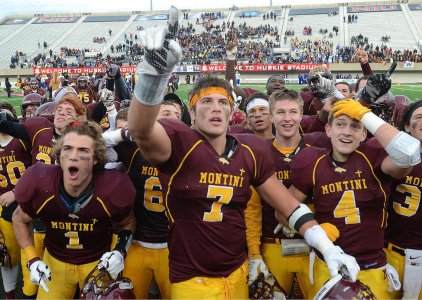
montiniThe dual threat quarterback is becoming more and more commonplace in today’s game. Whether it is Cam Newton or Russell Wilson in the NFL, or the countless quarterbacks in the college and high school game, the position is moving to individuals who can be explosive with both their arm and legs. From a coaching perspective, the idea of having a quarterback that can break a simple run 80-yards for a touchdown is at times just as much of a ‘bailout’ for an offense as an Run/Pass Option is for a bad play-call. 
In 2010, my first year as a head coach at Aurora Central Catholic (IL), I coached a young man who would be considered a pocket passer. He performed very well for us that season, and led us to the most wins the school had in 10 seasons. However, as that season progressed, we began experimenting with some “Wildcat” options with a young man who could both throw and run. The offense evolved some as the season went on. In 2011, we set a school record for rushing yards, and continued to be explosive in the passing game. From that point, it has been very difficult to even think about not having a dual threat player at the quarterback position.

This season, my first season at Montini Catholic (Lombard, IL), we had a young man that played the position as efficiently and explosively as any high school player I have ever seen. He rushed for just under 1,300 yards, threw for 1,700 yards, scoring 32 total touchdowns, while only turning the ball over twice in 14 games. Those numbers become even more impressive considering, he spent his junior season as a receiver. The attention to detail and focus in practice, especially in the running game helped prepare him for what would become the school’s first ever undefeated season.

QB Read-Run Game – Installation Progression

When deciding to go with the read-run game, it is important that the installation is done at a slow pace to allow the quarterback to understand what he is looking at, and how to execute the read at a very controlled pace. When introducing each run concept, we will do it in five phases:

1. Classroom – White Board/Film
2. Individual Breakdown
3. Small Group
4. Controlled Team
5. Team

Classroom – White Board/Film

Our progression will begin well before we ever step on the field. Each season, we will begin with all the quarterbacks in a classroom, to install our read-run game on a white board, one play at a time. We will get into the specifics of identifying the ‘read’ player, and the rules for giving or keeping the football. After talking thru the concept on the board, we will watch film on the specific play, allowing them to see the plays in action.

Individual Breakdown

Once we have installed the concept in the meeting room, we will move onto the field, working on the fundamentals during our breakdown periods. During this time, our extra quarterbacks will serve as the running backs, while I will play the read player. To start, I will be very obvious in giving the read (hard down the L.O.S., far up field, etc.), as we continue to progress, I will begin to speed up my movement, and try to deceive the quarterback.

Small Group

Once both the quarterbacks and running backs have worked their individual drills and have installed the specific read concept in breakdown periods, we will both come together and work the backfield action at full-speed. Again, just like I did in breakdown, I will serve as the read player. Again, I will start the drill moving slower and being obvious with the movement, and gradually begin to pick-up speed, forcing the quarterback to make a quicker read while executing the handoff or pull, without putting the ball on the ground. Once both position groups are ready to go, we will spend a lot of time in this phase, as we view it as a controlled period where we can get a lot of quality reps, working on the mesh technique while making a read at various speeds.

Controlled Team

Read More

SUNY Maritime 3 Three Deep, 2 Under Pressure Package

By Saj Thakkar
Defensive Backs Coach/Special Teams Coordinator
SUNY Maritime College (NY)
Twitter: @coach_saj


Introduction:

maritimeHere at SUNY Maritime we play an aggressive 3-4 slant/angle defense with a 2 high look from the secondary. We play a variety of different coverages but our favorite to pair with our 6 man pressures is over 3 over 2 “Hot” coverage. We like to bring our 6 man pressures against 10 personnel sets in order to force the quarterback to get rid of the ball quickly.
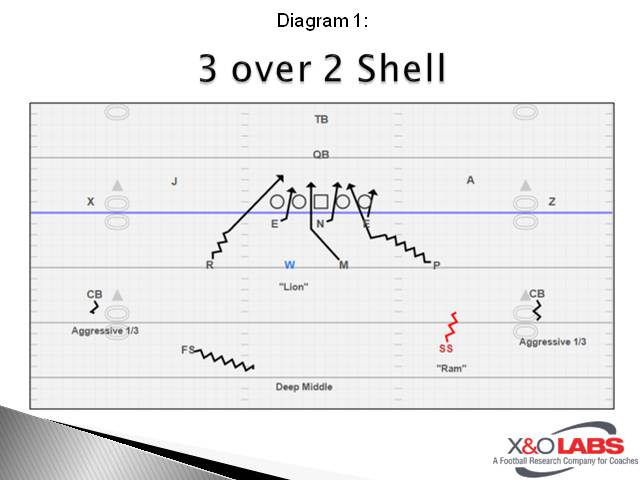
Our hot coverage allows us to play aggressive with our blitz game and gives 5 coverage men who can aggressively jump routes based off the quarterback’s keys. 3 over 2 also allow us to bring 6 without the fear of losing a matchup in 0 coverage and getting hit with a big play. The coverage involves two “hot seam” players, usually one LB and one drop safety, with the corners playing what we call an aggressive 1/3 technique, and a deep middle safety.

Here are the keys that we teach regarding the QB Drop:

• Drop
• Eyes
• Front Shoulder (Direction/Trajectory)
• Off Hand (Break Key)

Hot Seams (Ram/Lion)

Slide1

As with any successful coverage, we must communicate effectively to be successful. When we call our 6 man pressure, it is our coverage linebacker’s job to make the initial hot seam call. He will call either ram or lion depending on which seam he is responsible for. The safety opposite him will follow the call with the opposite call alerting the defense that we will have two hot seam players.

Ram/Lion Technique

We tell our drop safety to stay disguised as long as possible. Although this is an aggressive coverage, the worst thing that can happen is for him to get caught too low and are out of position to play the seam. We do not want him under 5 yards. Against a 2 receiver set, we aim to drop to the inside shoulder of the #2 receiver in order to be able to drive on the quick slant or under route.

Read More

Split End Power RPO

By Tom Grippa
Offensive Coordinator/QB Coach
Mount St. Joe University


Introduction:

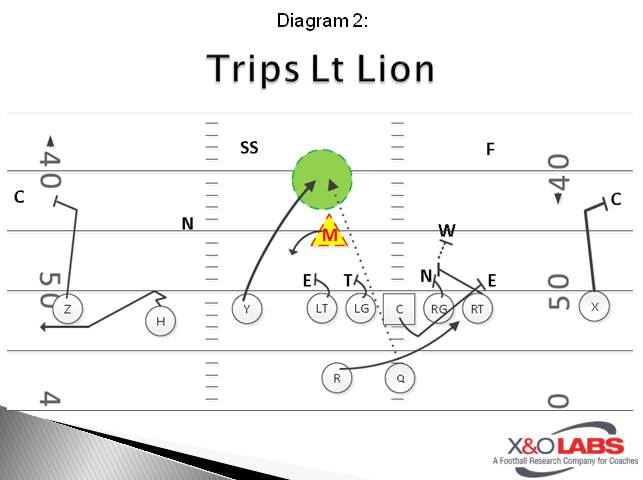
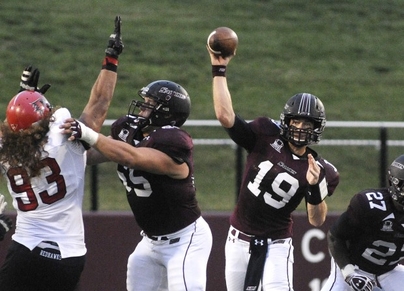
msjOne of our favorite concepts here at Mount St Joseph is the “split end power” that we run away from trips in 3×1 formations. We are attempting to control the box by adding a pass option component to our split end run play. Like any other version of option football, we are working to outnumber the defense by adding this run pass option concepts (RPO). Offensive coordinators are always looking for easy completions and using the split end power will give you easy completions on 1st and 2nd down run situations.
Blocking:

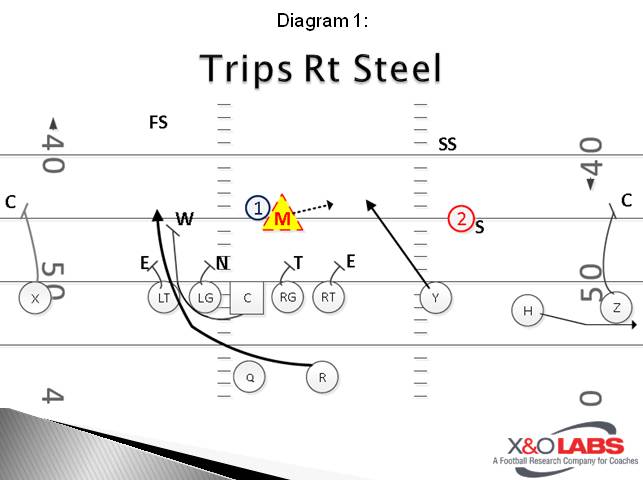
For the offensive line, the concept is simple. They will “block four down to the WLB.” Against an over front (Diagram 1), the backside guard and tackle block the 3 and 5 technique. The playside guard blocks down on the DT/NG and the center skip pulls and blocks the WLB. The center needs to read the play side tackle’s block on the DE. If the DE stays as a 5 technique, the Tackle will widen him to open up the hole and the Center wraps in the B gap and blocks the LB.

Slide1

If the DE stunts into the B gap the LB will be crashing off the edge and as the center sees this, he will execute a kick out block on the LB. If the playside tackle sees the DE slide into a 4I and the LB creeping outside, he can make a kick call to alert the Center to kick out the end man on the line of scrimmage (EMOLS).

Slide2

Against an under front, the same concept applies, but the backside guard becomes the puller. IN this case, the backside tackle blocks the 5 technique, the center blocks back on the NG, the play side guard blocks the 3 technique and the play side tackle blocks the 5 technique. The backside guard will then skip pull and blocks the WLB. This will be a tight wrap into the A gap unless the defensive line stunts, in which case the guard would wrap into the B gap or execute a kick out block.

Read More

Four Vertical Landmarks, Reads and Progressions

By Mike Kuchar

Senior Research Manager

X&O Labs


Editor’s Note:  Part 1 of X&O Labs research report on the four vertical pass concept will focus primarily on the research we found regarding receivers landmarks and route technique as well as the QB’s read progression based on coverage.  Since over 60 percent of coaches surveyed run the concept out of 2×2 formations, this week will focus primarily on that set.  


From Mouse Davis to Hal Mumme to Mike Leach, the four vertical pass concept has redefined offensive football and continued to leave its footprint on the landscape of every level.  Each coach that experiments with it, leaves their own distinct tweak on it, and in turn a football benchmark is developed.   X&O Labs first delved into the topic in an exclusive interview with Atlanta Falcons’ offensive coordinator Dirk Koetter that opened up the floodgates to an in-depth research project that culminates with what you see below.

The four vertical pass concept is a football discipline that gets researched every off-season (for various reasons which we will detail below) and for that reason, we wanted to provide what we felt were various ways to implement and more importantly devise the concept in ways that can fit your personnel. We’ve found that perhaps what started as a “run straight down the seams for the end zone” concept has morphed into a “take what the coverage gives you” opportunity to make plays in space.

So, right in time for 7-on-7 season, we present the first of a two-part series on the four vertical pass game.  What you see below will focus more on researched based information on what we’ve found were the most efficient ways to be successful running the scheme, while next week will detail some tweaks and changeups to the original concepts that coaches have used.


Case 1: Outside Vertical Landmarks and Adjustments

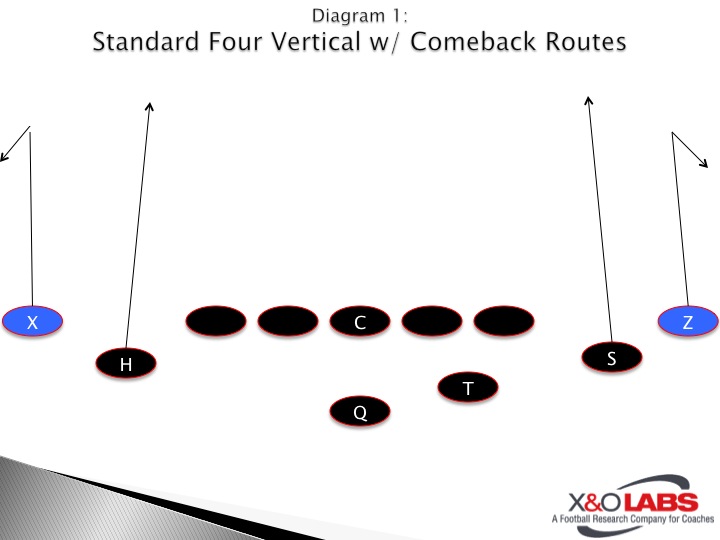
Considering all things equal, with the ball inside the hashes, 59.8 percent of coaches teach the bottom of the numbers as a post-snap landmark for their outside receivers.  In the four vertical concept, it’s the outside receiver’s (or number one as their commonly referred) job to stretch the cornerback and adjust this route off of them. While giving coaches the option of whether they teach a comeback, stop or speed out route on the outside – 67.8 percent teach comeback routes (Diagram 1) in their four vertical package.  Of these 67.8 percent of coaches that teach the comeback, 36.3 percent teach a 15-yard break point while 32.6 teach a 12-yard break point when making their decision to adjust to the corner.  We’ve found that this all depends on where the receiver can get leverage on the corner, thus making it easier throw for the quarterback. 

It seems that the drop out comeback could be an efficient “take what they give you” throw, particularly to the boundary where there is less room to work with.  Most coaches we spoke with wouldn’t dare throw the field side comeback (unless the QB had the arm strength to do so) but the productivity of the comeback could prove for an easy pitch and catch – so much so that Dublin Scioto High School (OH) offensive coordinator Doug Taracuk tagged his comeback route the “Winner Route.”  He uses it as a pre-determined throw to the best matchup he has on the outside regardless of coverage.

But what Taracuk does, that we thought was interesting, is have the QB react to the coverage and not the receiver.  Of course, this thought process is contrary to the entire principle of the four vertical passing game that relies on receivers making post-snap reads on defenders in space.  Taracuk will tell his QB’s to throw the ball deep if coverage allows it (and the receiver has gained space on the corner) but if he hasn’t, he will instruct his QB to throw at the back of the head of the WR, similar to a Mike Leach concept, which forces the receiver to adjust and react to the throw.   The receiver will look for the ball at 17-18 yards deep and react to the throw.  “The receiver will break inside or outside based on the defensive back’s leverage,” said Taracuk.  “It eliminated the QB misreading the intention of the receiver.  We used to get overthrown balls when the receiver broke and underthrown balls when he kept going vertical.  The back shoulder throw is now easy to see because the receiver reacts to the thrown ball.  Our only concern with the route is making sure the receiver is running a track which allows us to catch the thrown ball at his head.”

Below is some video of Taracuk’s “Winner Concept” in action:

Read More

How 3rd Level Defenders Impact RPO Reads

By Jake Olsen
Offensive Coordinator/Quarterbacks
Loras College (IA)
Twitter: @footballcoacho

Introduction:

blogfinalsized 00001With increased popularity of RPO plays on offense, thus too have been the improved defensive techniques from the second level to try and stop them. Here at Loras College our staff has found ways to give our offense the best chance to succeed using the third level (or safety level) as the focal ‘read’. Our RPO’s generally use the second level, or linebackers, as the ‘conflict’ defender. That said, defenses have responded by having their ‘read’ defenders faking or bluffing their intent. An example might be a ‘conflict’ defender showing inside the box alignment and bailing out into a pass lane then subsequently aligning wide and shooting an interior gap on the snap. Stationary ‘read’ keys are much easier to define for a quarterback than those always moving around. We use third level defender alignment, depth, and eyes to help our quarterbacks determine where to go with the football. In this report we will outline a few of the play examples exclusively using 20 personnel (1 RB, 1 Hybrid, & 3 WR’s) in which we read third level defenders. These examples were successful for us this past season.
Pre-Snap/Post-Snap

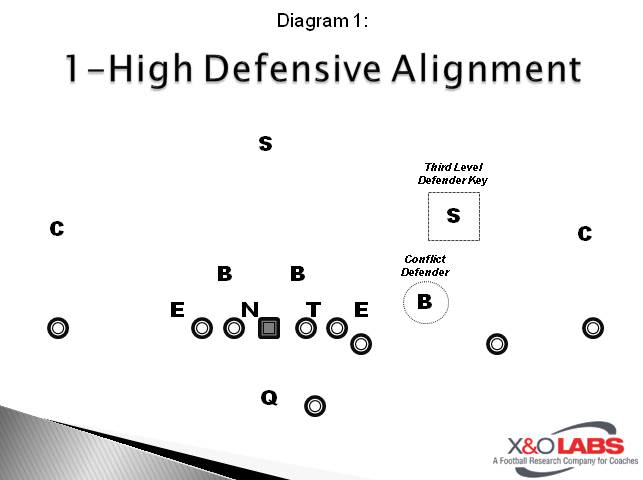
As soon as the QB can determine the location of the safeties, he will identify if they are: 2-High, 1-High, or 0-High. Our general rule we teach him is the following: 2-High Safeties – lean toward run, 0-High Safeties – lean toward pass, 1-High Safety – Your call. We expect him to make an educated decision. In any case, where we put the decision on the quarterback and it could be ‘gray’ we want to give him baseline knowledge of where to begin.
In most 2-High Safety looks, we can identify one ‘conflict’ defender at the second level to ‘read’, but in cases where this defender is moving around, we use the third level to help clean up the picture.

Slide1

Though we had a ton of success throwing the ball this past season, and statistically it appears we’re a ‘pass happy’ offense, our goal is to run the ball first if the box is in our favor. If a defense completely outnumbers us in the box, our quarterback’s job is to highlight the matchup in the pass game. However, his complete understanding of how defenses fit together can allow him to still run the ball even when it may appear we are outnumbered. Most of our RPO’s have multiple pass options for the Quarterback to choose from.

We introduced the RPO system two years ago with primarily one run and one pass option to give our quarterbacks beginner level understanding. Since then, we have evolved into providing him with two, sometimes three pass options in addition to the run. This has allowed us to feel confident knowing there should always be a winnable match-up based on personnel or leverage. Based on percentages, we typically have a 67% chance of throwing the ball and 33% running the ball on any given RPO. As mentioned before, there are even RPO’s that give us a 75% chance to throw the ball and 25% to run.
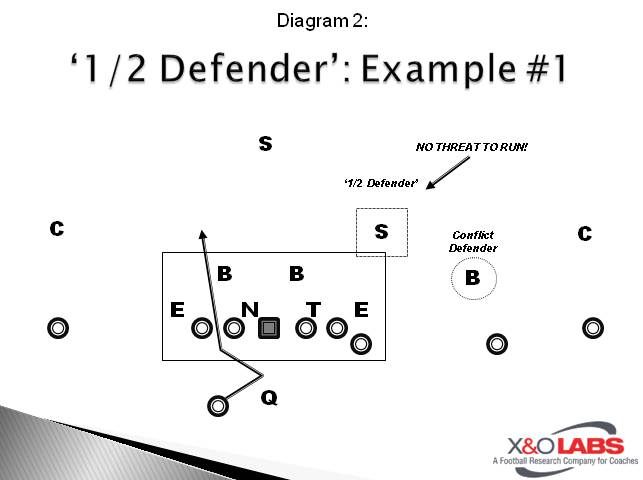
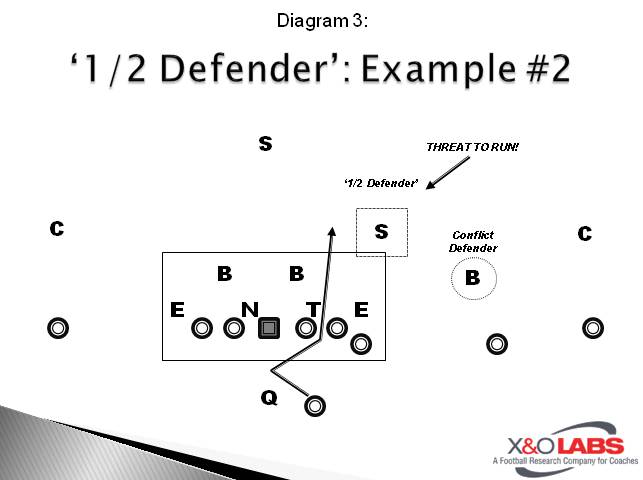
Even with the high pass probabilities, we start with the box first analysis and look to run the ball. At the snap, the decision is completely up to the Quarterback. He must have an understanding how the run play is being blocked. If we are completely outnumbered with blockers vs defenders, his decision to pass is simple. However, if we have what we call a ‘1/2 Defender’ creeping near the box, our quarterback could still hand it off. A ‘1/2 defender’ is a defensive player that we are not accounting for in the blocking scheme beginning to enter the run box (Diagrams 2 and 3). At times, he could double as the ‘conflict’ defender that we base the RPO off, but this is not always the case. Some ‘1/2 defenders’ may not have an immediate threat to our run.

Slide2Slide3

Play Example #1

The RPO used is our Power Gap scheme along with a quick game passing concept. Using the teaching we mentioned above, a 1-High Safety shell, places the decision on our quarterback. He uses his understanding and preparation to determine whether we can still run the ball or throw to matchup based route. The pre-snap defensive alignment shows the backside safety playing underneath the single side WR to take away the quick route and play wide run support. The box count is still 6 on 6 even though the Safeties are not in a 2-High look. Our quarterback knows the run play is still good because the direction of the run is away from the roll down backside Safety. He knows the free safety is playing the pass over the top of the two receiver side, thus handing the ball off is the best option for us in this play, assuming the ‘conflict’ defender does not fall back into the box on the snap of the ball.

Read More

Cultivating a Winning Culture

By Mike Kuchar
Senior Research Manager
X&O Labs
Twitter: @MikekKuchar

Introduction

mccWinning culture is built now. It’s cultivated in weight rooms across the county and emphasized in classrooms where coaches teach character development and the essentials of leadership. Successful coaches understand football is a yearlong endeavor. There is no off-season, just a perpetual process in which student-athletes learn the culture of being successful. Which is why the best coaches are hard at work now instilling what will be the “culture” of their program for years to come.

XandOLabs.com researched what winning coaches are doing now, in the off-season, to build successful teams. Our eleven contributors are head high school coaches in eleven separate states throughout the country and boast a winning percentage of .777, winning more than three-quarters of their games throughout their head coaching tenures. Their bio’s are below:

Contributors

• John Black (JB) Head football coach, Neodesha High School (KS)- 39-22 record the last six seasons, six district championships.
• Brian Blackmon (BB) Head football coach, Opelika High School (AL)- 64-26 record the last eight seasons.
• Kellan Cobbs (KC) Head football coach, Granite Hills High School (CA)- Went from 1-9 in first season to 9-3 in 2014 and 9-2 in 2015 finishing with a league championship.
• Kirk Fridrich (KF) Head football coach, Union High School (OK)- 97-13 record in eight years and four state championships.
• Josh Henninger (JH) Head football coach, Red Jacket High School (NY)- 36-5 record last four seasons. Two sectional titles and four league titles.
• Patrick Kane (PK) Head football coach, Hermitage High School (VA)- 148-26 record the last 15 seasons, 11 district championships.
• Clay Iverson (CI) Head football coach, Mukwonago High School (WI)- 81-23 record as a head coach, four conference titles.
• Corey Parker (CP) Head football coach, River Rouge High School (MI)- 56-20 record, five metro conference titles.
• Paul Patterson (PP) Head football coach, Norwalk High School (IA)- 12-2 record last season.
• Mark Raetz (MRa) Head football coach, Northview High School (IN)- 25-7 record at school, three Western Indiana Conference championships.
• Mike Rowe (MRo) Head football coach, Ricori High School (MN)- 48-22 record last four seasons, three sectional titles.

These eleven coaches were asked eight questions on how they have built successful programs. These questions were generated from our readers- on topics that spanned from off-season conditioning to fundraising. These specific questions pertained to:

• How they keep two and three-sport athletes motivated during the off-season.
• What activities they use to develop mental toughness in student-athletes.
• How they teach character education among their players.
• Which fundraisers they use to produce lucrative results.
• How they have built and developed accountability in the classroom among student-athletes.
• What characteristics they look for in hiring new coaches.
• Their philosophy in working with parents and administration.
• What they have done to develop the feeder systems (Pop Warner programs) in their towns to promote football.

The complete transcribed interview is below:

MK: How have you been able to keep you players motivated during the off-season? What things have you done during the winter, spring and summer months to keep multi-sport athletes interested in football?

JB: “We ask our players to get involved in wrestling or basketball. If they are not doing those things then we have after school speed and strength training. Most of our kids are already in a weights class so that is part of their offseason training but we want more. We try to treat them right when they are in there and make it a fun competitive place to be so they want to be there. We also reward them with shirts and other things. We still have problems getting 100% participation. Some of our kids get a job during offseason and they help support their family. We concentrate on getting the ones that are just playing around after school.”

Read More

Developing Off-Season and In-Season Communications

ByX&O Labs Staff
Twitter: @XandOLabs

Introduction:

“As the leader, part of the job is to be visible and willing to communicate with everyone”

– Bill Walsh

No matter how you measure success, a key to finding more of it is better communication. Think about the best coaches you’ve had or know. One thing they all have in common is their ability to engage and communicate. Great coaches communicate in a way that builds relationships, inspires hard work and exudes the mission of their team.

It’s no coincidence that winning often follows.

Yet a lot of really good coaches struggle with communication. There are so many ways to interact with kids, staff and even parents, and we, as coaches, don’t always know the best way to go about it.

Like all good habits, tackling proactive communication requires effort and determination—and maybe a little help in finding the right tools. We set out to find the best aid for helping football coaches to communicate and engage those within their programs.

Here’s What We Found:

A few months ago, a reader of XandOLabs.com shared the name Programax with us. Programax is a coaching app with a wide range of functionality, and promotes its ability to help coaches lead a better program.

It’s a bold claim, so we did our due diligence. As it turns out, Programax is packed with robust features that help coaches to engage, motivate, track and plan across their entire program. In short, we found it can help make your job easier.

We were so impressed, in fact, we decided to share with you a few of the things we really love about Programax.

As a side note, we reached out to the folks at Programax and asked them to provide video clips to show how the app works.

Check it out below, and follow up with Programax at www.Programax.org/football for a more in-depth view of the product.

1. Messaging

We were in search of a tool that helps football coaches with communication. We found Programax to be one of the best options out there in this arena, and really loved the app’s ability to take the legwork out of engaging stakeholders within a program. The app’s messaging functionality allows you to connect with any combination of your program’s coaches, athletes and even parents in seconds via text or email.

For those coaches who use spreadsheets for logging team contact information, take notice: the Programax app stores and organizes it all for you, making it simple to not only communicate with your program, but to access the information you need at any time. We also liked that you can set up custom groups containing those you message most (think captains, assistant coaches, etc.), saving even more time as you send information across your program.

Read More