Counter Gut RPO Concept

By Jhett Norman
Offensive Coordinator
Levelland High School (TX)
Twitter: @jhethronorm

Introduction:

12754352Since arriving at Levelland High School, running the counter concept has been our primary scheme. Regardless of being in the spread or in the “I,” counter has been the one constant of the offense. We have found that in order to combat defenses, we have had to have various ways to run the counter.

This year we adopted an RPO mentality, and found a way to mesh counter run game along with a sneak bubble concept. As the season progressed we established five RPO plays, and the counter scheme was my favorite as well as one of the most successful plays that we ran. When we run our RPO’s we are looking to throw first and run second.

Formation:

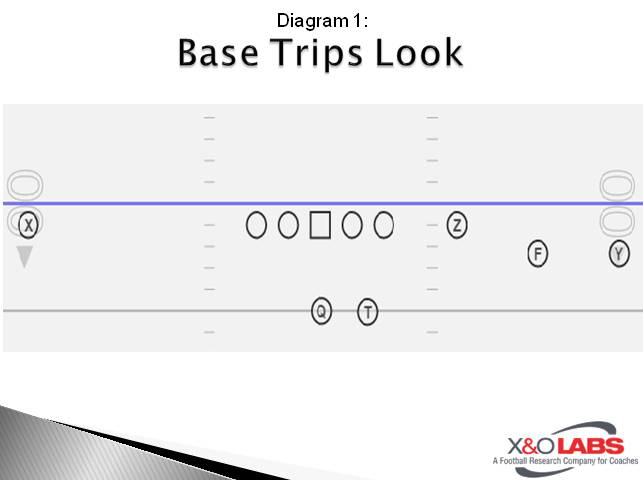
The base formation for our counter scheme is 3×1. The back is positioned beside our QB to the trips. Our landmarks are always middle of the numbers with the outside receiver – our Z (most people’s Y) flexes 5 yards from the tackle and the F splits the difference between the Z and Y.

Slide1

Counter Rules:

Slide2

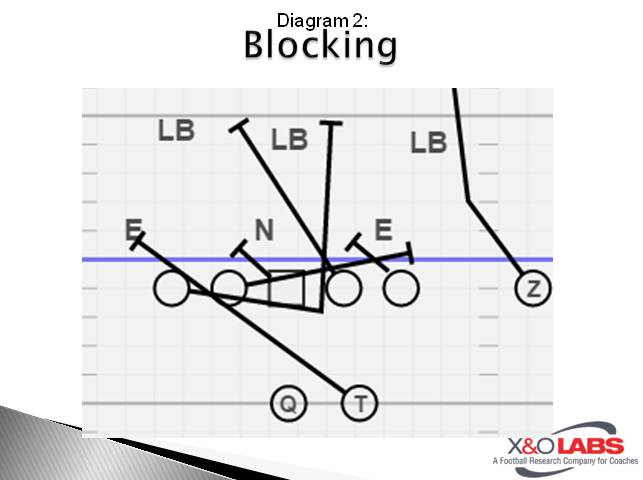
Play Sde Tackle – Down – Block first guy inside – Release inside of a head up 4 or 5-tech to backer – 4i /3 down on them

Play Side Guard – Down – Block first guy inside – Chip a 3-technique to inside backer – Double a 2-tech – to inside backer.

Center – Down – Block first guy inside – Combo a nose guard to backside backer – If you are uncovered you pull and kick out first guy outside of the PST – We only pull when we have a 3 or 4i backside.

Back Side Guard – Pull – Kick out first guy outside of the PS tackle – We call this a long pull – We say “you, you” to alert the center to pull when we have a 3 or 4i on our side.

Back Side Tackle – Pull seal up inside of the combo block. We call this a short pull. Versus a stack, we will kick out on the stacked backer over the 4-technique play side. If we are facing a team that starts blitzing the backside hard we will pull check the BS T much like he would do when running the power.

Read More

Midline & Veer in the Pistol Offense

By James Vint
Receiver Coach
Coronado High School (TX)
coronado

Introdution:

The midline and inside veer are not new concepts. They have been run by many great coaches for many, many years. We do not claim to have invented any of what I am going to talk about. What I will claim is that we figured out how to fit them into the structure of our pistol offense.

Back in 1999 we began experimenting with the spread run game from the gun. I was coaching at a large high school in the Bronx, New York. We were based out of the I formation, running what we called a multiple option offense. We were facing 8 and 9 man fronts. We had taken over a program that had lost 27 straight games and had never been to the playoffs. Our head coach at the time, David Diaz, understood that we had to keep things very simple as we tried to right the ship. In our first year we went 6-4 and made some progress. While we were very effective running ball, we needed to do something to spread the defense. We didn’t have the kids to match up against the better programs. The answer for us was incorporating some spread concepts from the gun.

Back in 2000, not many teams were running the gun. We were the only team in our area running the zone read. In the beginning, we enjoyed success because people didn’t have an answer. As we began to run more and more of our offense from the gun, we found that teams were beginning to play games to side we set our back. This caused us some issues when we played top-ranked teams. Also, we were still getting under center to run our traditional option and downhill run games. While we thought we were diverse, we were actually very easy to defend. There was very little diversity. We also weren’t able to run all of our option concepts consistently from the gun.

One night we were brainstorming, and we found the solution. If we placed the back behind our quarterback, teams could no longer game our zone read concepts. Our offensive line coach at the time, Chris Harris, also brought up that we could run all of our traditional I plays from the pistol. From our “pistol” concept, we were able to marry our traditional downhill run game, option game, and spread runs. And, our quarterback had depth in the pass game. This helped our protection schemes.

For us, the pistol is simply a formation a running back directly behind the quarterback in the gun. We kept our quarterback at 4.5 yards in the pistol, just like he is in the gun. We are not a team that moves our quarterback closer to center. We want to be able to run all of our outside zone read concepts with an offset back, and we need to be at 4.5 yards for those concepts to be effective.

Within our structure, we can run our one back sets, two back sets, and three back sets from the pistol. We can essentially go from 3 backs to empty with any personnel group. We can use a fullback or tailback type as the pistol back. Sometimes we have our pistol back in a 3 point stance, sometimes he will be in a two point. The versatility of the pistol allows us to be very diverse on offense. But, diverse does not mean complex. The beauty is that the complexity is in the simplicity.

Over the years we evolved, and now have a menu of 8 run concepts to build our offense. We adjust these from year to year based on personnel, and typically run 4 or 5 concepts. The two that set our base are the inside and outside zone concepts. These are going to be a part of our offense each year. We build out from the foundation the inside and outside zone concept sets. Our system most years will be inside and outside zone and zone read, power and power read, midline, and inside veer.

We had been running midline and inside veer from the I formation and we found they fit well in our pistol package. When we started running the pistol, we had only the inside zone concept that attacked the middle of the defense. While the inside zone is a great concept, we wanted to add an option concept that forced the defense to reduce their front. Our goal is to get our best athletes the football in open space. Because we have had success on the perimeter, defenses tend to spread out to protect our alley runs. The midline and inside veer have helped us tremendously in taking advantage of the middle of the defense.

The backfield footwork for midline is pretty straight forward. Our pistol back has 1 major rule. He owns the line. The line runs right through the middle of the center’s back. The pistol back must stay on the midpoint through the mesh. The quarterback will push shallow to lose a half yard of depth, and pivot to get off the line. We tell him push away, step at 6. We want him to reach the ball deep and shuffle as he rides the dive back. The quarterback’s eyes are on the read. If the read player attacks the dive, the quarterback will pull the ball and replace the read. If the read player does anything else, we give the ball. Figure 1 illustrates the mesh.

Read More

Varying Blocking Assignments in the Power Read

By Lance Parker
Offensive Coordinator/QBs
Bryant High School (AR)

Introduction

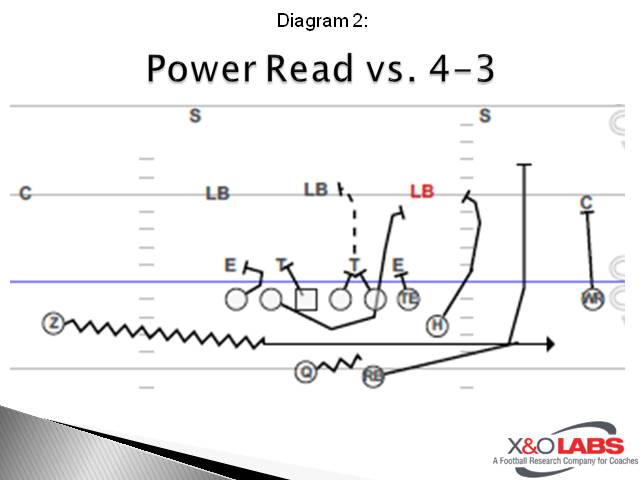
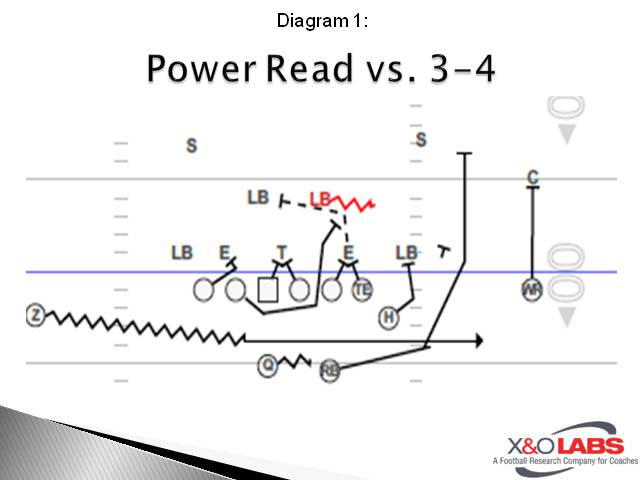
parkerIn 2014, one of our most productive plays was the Power Read. For us, the “Power Read” is a slow developing power scheme where the quarterback shuffles laterally and reads a defender. We usually read a defender at linebacker level. In our opinion, reading linebackers as opposed to defensive ends had multiple advantages. Not only did it create huge running lanes, but it removed some the pressure of quick QB decisions. It also set up play action throws and made defenders move laterally to stop the play. This in turn allowed us to gain the advantage and aggressiveness as we cut the ball up the field.
Addressing the Issues with the Power Read

While the “Power Read” was extremely productive, it had weaknesses as we schemed it from week to week. We felt it was vulnerable in the backside “B” Gap as we pulled a guard. Often times our backside tackle was not quick enough to cut off the backside “B” gap versus a 4i or 3 techniques. If we compensated by blocking the center back to aid the tackle, we lost our double team on the play side. This would, in turn effect our ability to create running lanes on the play side.

We also felt vulnerable to a “kamikaze” technique by defenders in which they try to annihilate the mesh. The “kamikaze” technique would usually give us a clear read, however it also made the QB pull the ball before we wanted and created a lateral running lane instead of a vertical running lane. We like our QB to attack downhill in the bubble instead of having to run sideways to get into it. Not to mention, a “kamikaze” technique created a lot of unnecessary punishment for our running backs.

In order to combat these problems, we simply switched up our inside complementary schemes to adjust to weakness in our base “Power Read” play. Examples of these changes include having off tackle “down-kick or X” scheme such as “buck sweep” or “G” to our Power Read mesh. It is important to note that these concepts were already in our playbook in other forms. For that reason, adding them to the Power Read didn’t require any new teaching.

In addition, we researched teams that use a traditional “counter” scheme where the backside guard “kicks” the read key for the under (QB Pull). We decided to add that into our package to specifically to attack away from the tight end against an odd front.

Base Power Read

I also should mention that our favorite way to run “Power Read” was to overloaded sets. We always would strive to block the play in which the QB could be right no matter his decision. We usually blocked the read key “over (for sweep)” and “under (for QB run)”. This can only really be accomplished in overload sets (shown below).

Slide1Slide2

Coaching the Offensive Line in Power Read

“Leave One, Block One” Philosophy

“Leave One, Block One” is the rule we beat into the heads of our linemen. “Leave One” determines who the backside guard is pulling to block. The backside guard is thinking he is the “Under” block for QB pull. Because this is a slow developing play sometimes the linebacker flies out and it is an easy block out for him. Other times we engage the backer in the box and he “washes” by the mesh as our QB cuts vertical. One of the keys is getting our guys to understand we are not trying to take the guys helmet off. Instead, we desire to be to merely engage and occupy the defender. If the guard is out of control, he will make miss too often and in this situation there isn’t a need to take that chance. There is no need to move a defender to create a hole on this scheme.

“Block One” is talking to the combo that has a double team on the play side. Most of the time, we set the combo on the B gap defender between the tackle and guard. Personnel or game plan might make us change the combo to the tight end and tackle. Either way the “Block One” ID determines the linebacker toward which the double team is working. The more that “Block One” player moves over the top of the combo the less help the inside gets from his combo partner.

Read More

Linebacker Pattern Reads in Quarters Coverage

By Joe Ginn
Defensive Front Coordinator/LBs
Choctaw High School (Choctaw, OK)
Twitter: @CoachGinn

Introduction

choctaw“If he’s good at pass drops, he’s probably not a good Linebacker.” I heard an older coach state this a few weeks back at a clinic and it made me think quite a bit about linebacker pass drops and how much time I spend on it.
Upon reflection, I decided that I am not asking too much out of my linebackers to be able to defend the run and still be able to get to the correct spot on a pass. I expect our defense to be good against both the run and the pass, so shouldn’t I expect my players to be good at defending both?

We are a 4-3 defense as a base, however, I believe the way I coach LB drops will carry over to any scheme of defense. We play multiple fronts (3-3 Nickel, and 3-4 Dime) and multiple coverages and we speak the same verbiage to our LBs regardless.

Basics of LB Drops

First off, it is important to note that we do not have our linebackers read the QB. I believe with modern offensive coordinators want linebackers to read the QB’s eyes. This allows the QB to manipulate the defender with his eyes while his receivers get to where the defender has vacated and “sits down” in that area. I teach our players that they must train their eyes and read routes, not read the QB.

When I was an offensive coordinator, I loved it when LBs would “spot drop.” I’d tell my QB “he’s wrong either way”, because we could make him pay regardless of where he was dropping. For that reason, we do not speak in ambiguous terms of zones (ie. hook, curl, flat). Instead, we coach our kids’ eyes and read offensive receivers and routes at the LB position. I want my kids to cause a disruption on those receivers’ routes, I want to take away the receiver’s ability to “sit down” between two of my defenders.

OLB Technique Reroute #2 to #1

In the following examples, I will be talking about our drops and reads out of our cover 5, which is essentially a quarters coverage. As I mentioned before, the concepts can be applied to any system.

In our cover 5, the secondary depends on a formation to determine how we’re going to play to each side. For you Zone Drop guys, our OLB’s are the guys you would consider your Curl/Flat guys. This guy will read the uncovered linemen on his side or the OT.

Note: For more depth on how me make those reads, be sure to check Coach Ginn’s other article on LB Reads/Run Fits.

As soon as the linebacker gets a pass key he will flip his hips and get his eyes to the #2 receiver. He is taught to get his belly button towards the #2 receiver to get his initial drop read. The #2 receiver will be doing one of three things if it’s a pass; Out, Vertical, or In. Here is how we teach him to respond to each of these triggers:

Read More

Adjustable Five-Man Protection Scheme

By Jim Hofher

Associate Head Coach

University of Nevada


Editor’s Note:  The following clinic report was put together by X&O Labs Senior Research Manager Mike Kuchar early this off-season.  Coach Hofher, previously the offensive coordinator at the University of Delaware, has since moved on to become the Associate Head Coach the University of Nevada in Reno.     

nevadaWith the infusion of no-back offenses that has infiltrated the college landscape nowadays, it’s become necessary to fine tune protection to make sure that your QB is protected at all times.  In order to do this, it’s necessary to make sure all five offensive linemen are accounting for five potential rushers.  Now while this concept may be simple in nature, defenses present a variety of threats from a pressure standpoint that will force and offense to make an offensive line adjust.  Jim Hofher, explains how he adjusts to those threats and more importantly how he avoids them altogether.
Benefits of Five-Man Protection:

  • Gets the back involved in the route– Too many of these running backs don’t know how to correctly block (and most don’t want to ) so why not get them out and let them do what they are supposed to do- handle the ball?
  • Good against pressures- The defense can dial up any pressure it wants, as long as the offensive line uses its indicators (which Hofher discusses) it can handle any pressure.
  • Eliminates confusion with man blocking- No simpler way to protect than to identify defenders and block them- this protection concept gives you the opportunity to do so.
  • Marry it with quick game routes- This gets the ball out in a hurry, leaving defenders scrambling to chase the ball.   But for Hofher, this was his main protection, both in the quick and drop back game.

Philosophy of Protection

“You must be willing to leave your Center on an island,” is the first thing that Hofher told us about this protection- which is the case in most five-man protection schemes, particularly against three-down fronts.  Now, there are ways to get him help- which he will explain later- but it helps to have a strong protector anyway at that spot.   The key in the protection lies in the play side tackle who will work with his adjacent guard to handle their assignments.   It is his responsibility to involve the guard to his side, based on what he sees.  “It’s different, but it works,” says Hofher.  “The lineman come to understand one code is the name of the protection for quick game routes.  It tells them they don’t have to battle forever.  That’s when they know at their will they can use some cuts (cut blocking).  We’ve figured out 99 percent of the problems in five-man protection and we know how to address them.

Tackle Responsibility

In Hofher’s five-man protection scheme, the Tackles make a call signifying if he has an outside rusher (not including a player who is covering him up).  If there isn’t a potential rusher to his side he makes an “Open” call to his Guard, which means there is no threat outside so his triangle only encompasses the DE and linebacker (Diagram 1).  There is no threatening alignment by his triangle.  Once this is confirmed post-snap that they drop, then the Guard can help in the other direction across from the center (Diagram 2).  If there is a threat of a potential rusher, the Tackle will make a “danger” call, meaning the defender isn’t on the line, but he may not come at all.  This is typically called when an outside linebacker is in the “hip” position of the Tackle (Diagram 3).   “My guard now knows that I can’t get out of here real quick,” says Hofher.  “I’m going to pop and set and see what happens.”

Read More

Using Orbit Motion to Ignite Your Offense

Scott Girolmo
Offensive Coordinator
Liberty High School (VA)
Twitter: @CoachGirolmo

At Liberty High School, we are a multiple offense that utilizes a number of personnel groupings, and a very wide array of formational sets. From these formations we utilize multiple man, zone and gap run schemes and 6 and 7 man pass protections. Finally, we have combined these schemes with both traditional I back / single back backfield movements, and contemporary shotgun multi-read backfield movements.

This is a lot of offense.  We understand that, but we do it for one simple purpose:  to attack the defense. We are constantly drawing, debating, and adapting our scheme to better fit our personnel. One of these adaptations, the “Orbit” motion, has been an integral component to our attack.

The Evolution

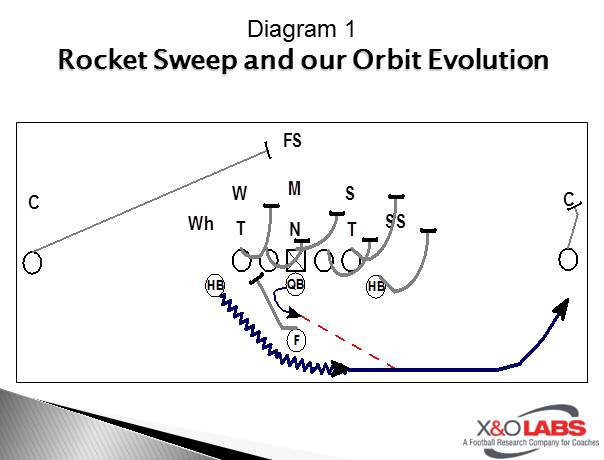
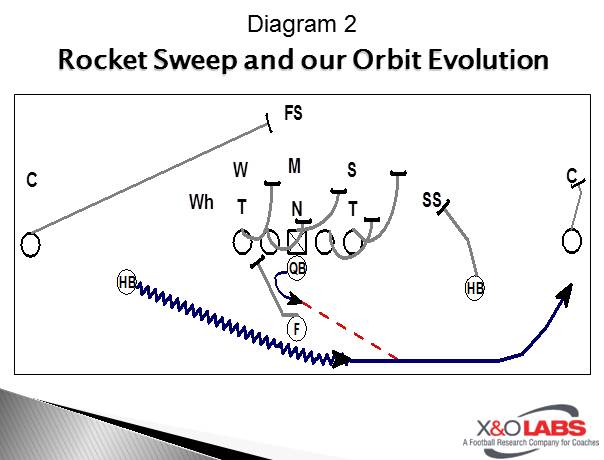
Our prior offense here at Liberty was orchestrated by then Head Coach Tommy Buzzo, and our current Head Coach Sean Finnerty. Their offensive package was tremendously dynamic, with a myriad of shifts, motions and swiftly attacking run schemes that worked like focused jabs to weaken the defense for a knockout haymaker. One of the signature plays within the offense was the classic “rocket sweep” utilized by flexbone-heavy offenses [Diagrams 1&2]. In our attempt to adapt the best concepts of the former offense to the completely new package we installed this past spring, the idea of utilizing a pre-snap movement that was abrupt and lateral to “outflank” the defense was a major priority. From my previous experience I had developed a particular affinity for both flexbone option football, and a variation of the spread I – multiple offense developed in the early 2000’s by Wake Forest O.C. Steed Lobotzke which was heavy in Orbit motion (He credits University of Minnesota coach Glenn Mason for running it first in 1999 in a game they coached against one another). Therefore, a perfect marriage was conceived.


Orbit Defined

Football is the greatest sport for so many reasons, but one of my favorites is that the simplest of concepts or fundamental skills can have innumerable names, appearances, or philosophies behind it depending on who is teaching.  For us, Orbit motion is a perimeter player (tight slot or wing) motioning across and behind the deepest back in the backfield. The two variations of Orbit are taught simultaneously.

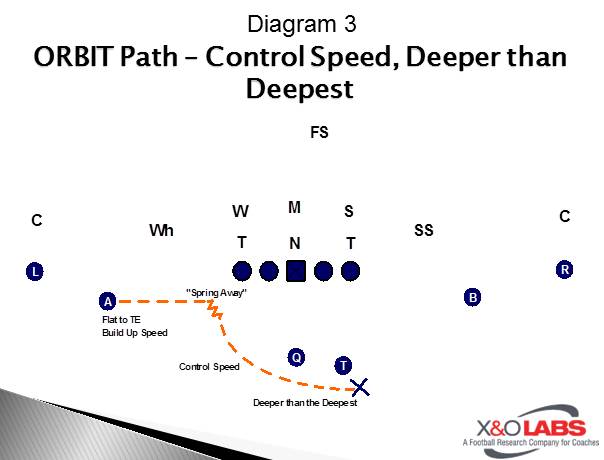
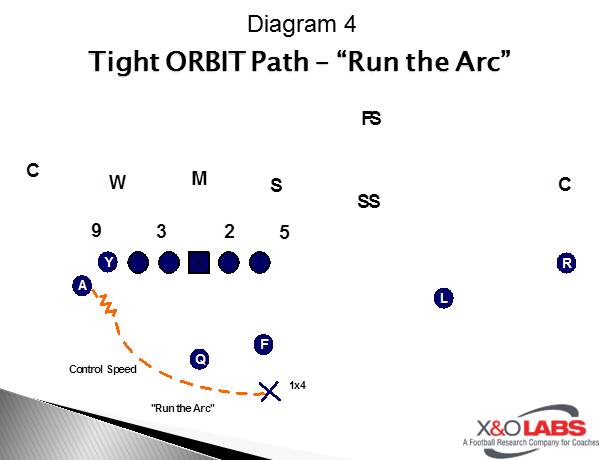
On the first day of its installation, our players are taught to motion flat towards the interior of the formation from their alignment building speed as they go. As they enter the tackle box, they are to “spring” off of their foot closest to the LOS and attack behind the deepest back, controlling their speed to achieve the position desirable for the particular play called at the moment of the snap [Diagram 3]. We condense that rhetoric for our players by teaching them to “run the arc.” If they are aligned in a tight slot, or wing position, we teach them to run the arc from that spot [Diagram 4].

Teaching Progression:

  1. End Result
  2. Why
  3. Communication
  4. Execution

End Result

Experience has taught us that our teaching is more effective when explain our concepts from the ref’s whistle backward.  In each scenario we explain to the player that their motion should put them in position to accomplish one of three outcomes:

  • Motion player is the Pitch Man
  • Motion player is the Swing Route
  • Motion player is a decoy.

Why

With the end result established, we can then move on to explain why they are in the position for each of the three outcomes above.  Here is a more detailed look at how we teach each outcome:

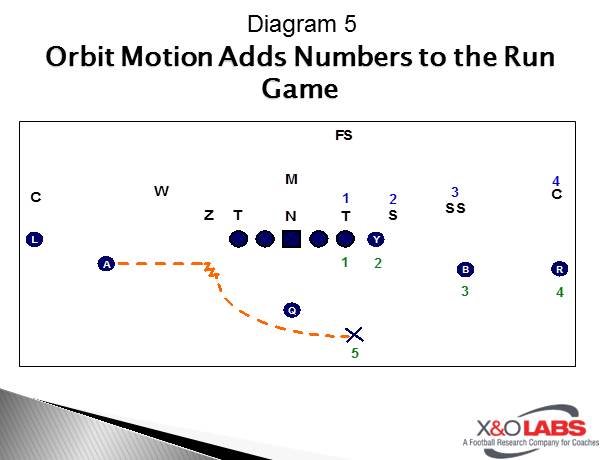
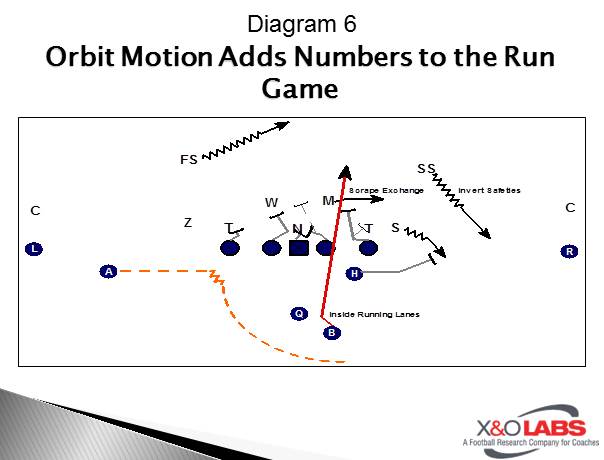
Pitch:  In the instance that they are motioning to become the pitch man, we are attempting to attack a numbers advantage in the defense’s run-support scheme. By motioning across the formation, we can both attack the defenses flank by pitching the ball, and force a distortion in their run-fits which will create a favorable match-up or running lane [Diagram 5&6].

Swing Route:  When a pass is called, we utilize the orbit motion for several reasons. The first is to gain a swiftly expanding flat-route to provide a check-down, or what we call “rush” route for our QB. The next reason the player runs a swing route is to win the numbers advantage against the defenses coverage scheme. By adding one more receiver to their defenders in coverage, we may be able to free someone up [Diagram 7]. In addition, the Orbit Swing is to create conflict in the defensive secondary’s eye/read progression, and create space for a front-side or back-side deep route (what we call ‘rhythm’ throws).

Read More

Veer/Midline Case 1: QB Footwork and Mesh

By Mike Kuchar – @MikeKKuchar

Senior Research Manager

X&O Labs


Rouse-Bio

Introduction

In this case, we wanted to present our data on the varying methods coaches are using to teach the mesh game in both midline and veer option concepts.  Decades ago this never would have been a topic of conversation or an interest of research because all option coaches were operating under Center.  But with the advent of the Pistol formation, which XandOLabs.com presented an entire special report on its dynamics- we’ve found many coaches are either committing fully to running option exclusively out of the Pistol formation or finding a way to integrate both.

But before we submit our research, it’s important to decipher the difference between midline and veer option.  To most option coaches, the difference is as follows: 


  • Midline Option is, for the most part, a double option concept in which the first level B gap defender is the HOK (hand off key).
  • (Inside) Veer Option is a triple option concept in which the first level C gap defender is the HOK (hand off key).
  • (Outside) Veer Option is a triple option concept in which the first level D gap defender is the HOK (hand off key). 


Editor’s Note:  Coaches will utilize all three of these schemes based on what defenes present.  Now, as you will find out in Case 2, there are some coaches who will run midline against an A-gap down defender and run veer to a B-gap down defender.  This will all be covered in Case 2 of our special report. 

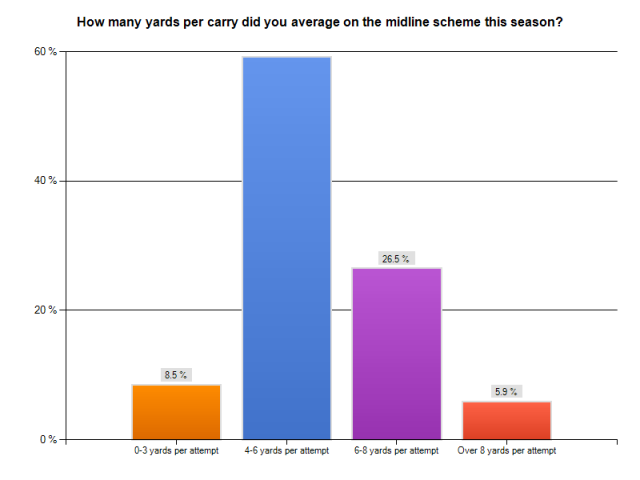
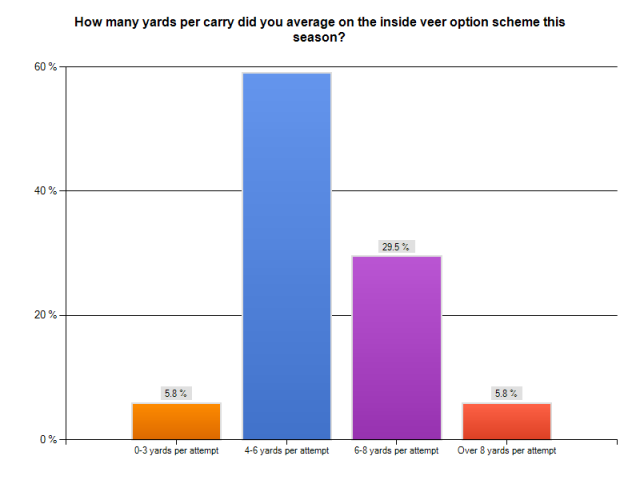
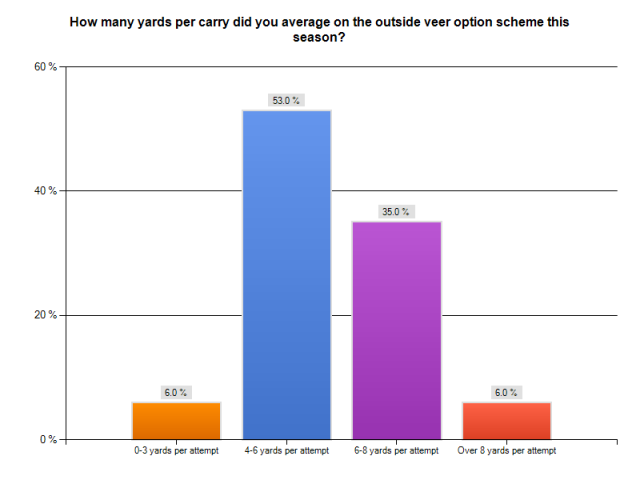
Below are just a couple notes on our research about both the veer and midline option concepts.  We wanted to ask our readers how productive their option concepts were.  Here’s what we found:


  • 59.4 percent of coaches say their midline concept averaged 4-6 yards per attempt last season.  Only 8.5 percent said that it netted 0-3 yards per attempt.


ChartExport8


  • 58.7 percent of coaches say their inside veer option concept averaged 4-6 yards per attempt last season.  Only 5.8 percent said that it netted 0-3 yards per attempt.

ChartExport22


  • 53.4 percent of coaches say their inside outside veer option concept averaged 4-6 yards per attempt last season.  Only 6.0 percent said it netted 0-3 yards per attempt.


ChartExport39


It should be noted that our survey on the option game was one of the more responsive surveys we conducted, with over 500 coaches (at all levels of football) chiming in with their feedback.  When it came to whether or not coaches preferred to be under Center or in Gun- our results were basically split down the middle.  They are as follows:


  • 46.5 percent of coaches prefer to utilize the option game purely in under Center alignments.
  • 23.7 percent of coaches will mix both Under Center and off-ball alignments but mainly operate Under Center. 
  • 22.9 percent of coaches prefer to utilize the option game exclusively in off the ball (Shotgun or Pistol) alignments.
  • 7.1 percent of coaches will mix both Under Center and off-ball alignments, but mainly operate in shotgun or Pistol.  


The Case for Being Under Center

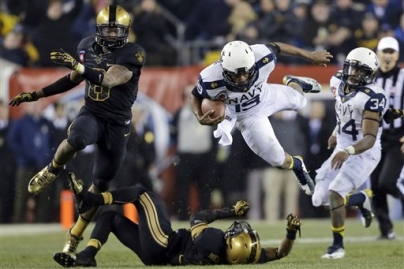
Old habits die-hard.  This is particularly true of football coaches and perhaps none more evident than the responses we got as to why coaches choose to run the midline and option game purely from under Center alignments.  We’ve found that there have been many arguments in support of using under Center alignments in the option game.  One of the stronger explanations came from Lou Cella, a 19-year football coach and option consultant who heads the website Triple Option Football Academy and runs numerous option camps around the country prepping both coaches and players on the triple option system.  Cella, who is also studying to receive a doctorate in mental conditioning, recently conducted a study on the Naval Academies production per play both under Center and in the Pistol.  “If you study Navy’s average yards per play from Pistol and under Center it’s astonishing,” he told us.  “They are averaging less than three yards per carry in Pistol sets.  When they run the triple option under Center, their yards per play is close to 8 yards.” 

Read More

Veer/Midline Case 2: Interior / Exterior Blocking

By Mike Kuchar – @MikeKKuchar

Senior Research Manager

X&O Labs


navy1Introduction

In this case, we will present our research on some of the varying blocking techniques coaches are using to block the midline and veer concepts.  Like many other option principles, the core roots of the blocking system are sacred and we’ve found the majority of coaches still abide by those rules.  But as the system continues to develop, there is a faction of coaches still finding ways to tweak some blocking assignments to get the most production out of the offense.  It was our intent to find those coaches through our research and present what they are doing differently.

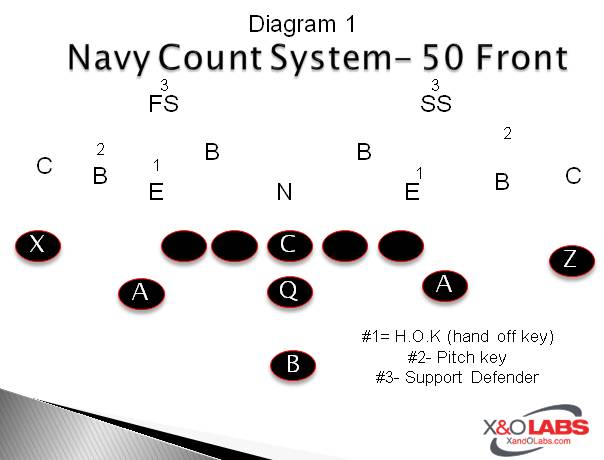
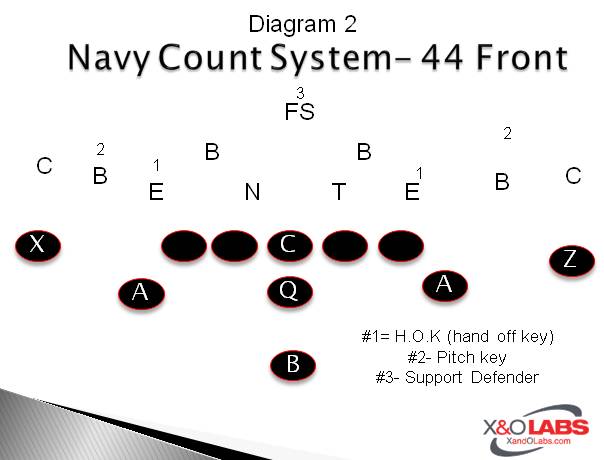
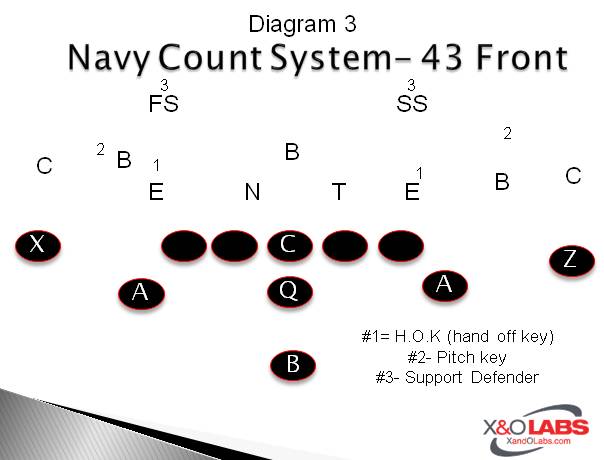
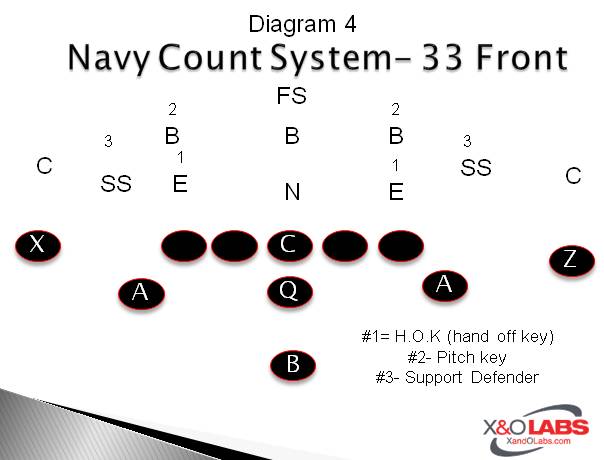
But before we do that, we felt it was important to convey the grass roots of the system and there is no better way to do that than to give attribution to the Naval Academy, one of the forefathers of the option offense.  The Naval Academy started its option premise on a count system, one that basically entails reading number one and pitching off number two.  For all intents and purposes, those numbers can change based on the scheme- midline or veer. 

In the midline option, those numbers are as follows:

Number 1- The first level defender in the play side B gap.  Or as some coaches referenced it, the down lineman touching the Guard.

Number 2- The first or second level defensive player outside of number one. 

Now, truth be told, the midline scheme is usually a double option concept.  The facts is 55.8 percent of coaches rarely or never use the pitch phase in midline option.  Only 35.2 percent of coaches will use it sparingly.  But we have found coaches that do utilize a midline triple concept and we will present their ideas later on in this case. 

In the veer or triple option concept, the numbering system is as follows:

Number 1- The first level defender in the play side C gap or as some coaches referenced it, the down lineman touching the Tackle.  

Number 2- The first or second level defender outside of number one.

Of course, those numbers can change based on defensive structure.  But if we’re talking about grass roots here, the following is the count system Navy used (and still uses today) in its option system.  Below is an example of the count system, straight from Paul Johnson’s playbook, on how Georgia Tech identifies several different defensive structures.

50 DEFENSE

Slide1


44 DEFENSE (8-MAN FRONT)

Slide2


43 DEFENSE

Slide3


33 DEFENSE

Slide4


As mentioned previously, this can be altered based on game plan and personnel.  We will present how some coaches are manipulating the system to their advantage later on in the report.  For example, some coaches prefer to run midline to a 2i or 2 technique (which would be an A gap defender, not a B gap defender) and some coaches prefer to run inside veer to a 3-technique (which would be a B gap defender, not a C gap defender). 


Offensive Line Splits

Option football is synonymous with large line spits and reason is simple- they want to gap you out as far as you will allow them to.  This opens up run lanes inside for the dive back.  In fact, our research has shown that the majority of coaches- 54.5 percent- choose to use three-foot splits along its front in the option game.  Only 18.7 percent of coaches use the traditional two-foot split layout most common among offensive lines in other systems.    Rob Harris, the head coach at Broadneck High School (MD) actually will expand his offensive line splits up to 3.5 feet depending on the concept.  “ We run 56 percent of the time and throw 44 percent and only gave up 14 sacks this year with these splits in 11 games,” Harris told us.   So the benefits of wider splits not only help in the run game but in the pass game as well. 

Read More

Veer/Midline Case 3: Formationing the Defense in the Option Game

By Mike Kuchar – @MikeKKuchar

Senior Research Manager

X&O Labs

Introduction


This particular case will focus on the most advantageous formation structures offenses can present when utilizing the veer and midline concepts.  While we understand that coaches will predominantly use what they are accustomed to, we did find that certain formations would place more stress on defenses than others.  So, after distributing our surveys and conducting our research, we found coaches will use the following 18 formations most frequently in the option game

General Philosophies

Before we detail the specific formations there are some general principles that option coaches adhere to when deciphering which of their option schemes are most beneficial.  Some of the more general responses we received are centered on the following:

  1. “Run the midline concept to a B-gap down defender, or 3-technique.”
  2. “Run the inside veer concept to a C-gap down defender, or shade/5-technique.”
  3. “Run the outside veer concept to a D-gap down defender, or 3/9-technique.”

Of course, there were some responses that centered around personnel matchups as well and we discussed most of them in Case Two last week.  Paul Murphy is one of those coaches who feel that his ball carrier is the impetus behind which play to run.  “Whether we use the veer or midline scheme for us has more to do with the personnel match-ups,” said Murphy.  “We like running the midline if we have a fullback type that can find the seam since we will triple team the NG vs. a 3 man front and we will trap an even man front that plays a 3 and 1 tech.”

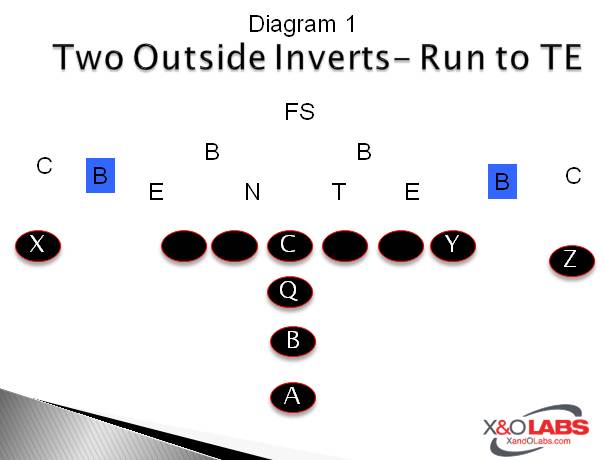
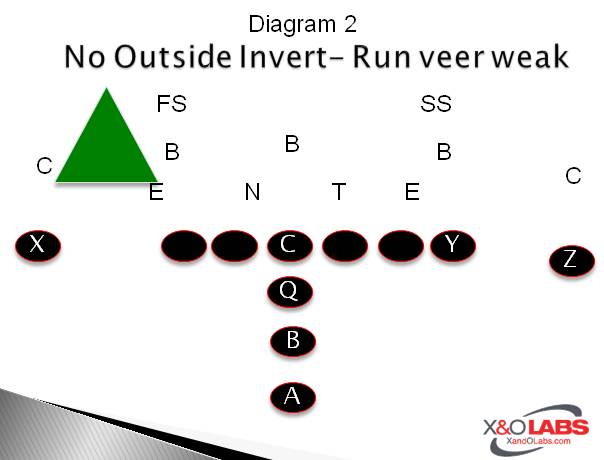
One of the more common methods of deciphering to run the veer or midline scheme is identifying the outside inverts; it’s a method we learned while talking to Jerry Campbell (http://stores.jerrycampbellfootball.com).  In it’s simplest sense, if there are two inverts (or eight man front) it makes sense to run towards the Tight End because of a numbers advantage (Diagram 1).  According to Campbell, “any offense is most flexible and at its toughest point when it has two running backs, two wide receivers and a tight end.”  According to Campbell, he would have his quarterbacks make his choices based on the following:

  • Inside Veer (Open side)- when there is no invert (a second level player- either linebacker or safety) outside the open side Tackle (Diagram 2).  If there is an outside invert, run it the other way.
  • Midline- only versus a two or three technique

Slide1Slide2

Mike Judge, the fullbacks coach at the Naval Academy, told us he will go into each game with an average of nine formations, but most times he’ll only use two or three.  “We may run three formations all game if we’re successful,” said Judge.  “If we are getting what we want out of 2×2, then we don’t start tinkering with it.  “We get into different sets because of what the defense is doing.  If they are going to match personnel, like an 8-man front team taking Corners over, that’s why we get into different sets.”

Judge expounded upon his no-huddle system which allows the QB to put them in the best play call possible.  “Our QB knows that when we get certain looks, these are the three plays I want to check to,” said Judge.  “We may only have one check to each look.  We don’t give him a ton of things.  We’ll say if you get a three-technique with a two backer set we want to run midline.  If we get a shade five nine to the three-man surface then we want to run inside veer.   Ninety-nine percent of the time we know what we’re going to get.  Teams are not going to play seven different defenses against us.  Once we have an idea of how they are going to line up, we’ll say ‘when we go Over (unbalanced), these are the two plays we want.  Here’s one strong and here’s one weak depending on how they put the front.’”

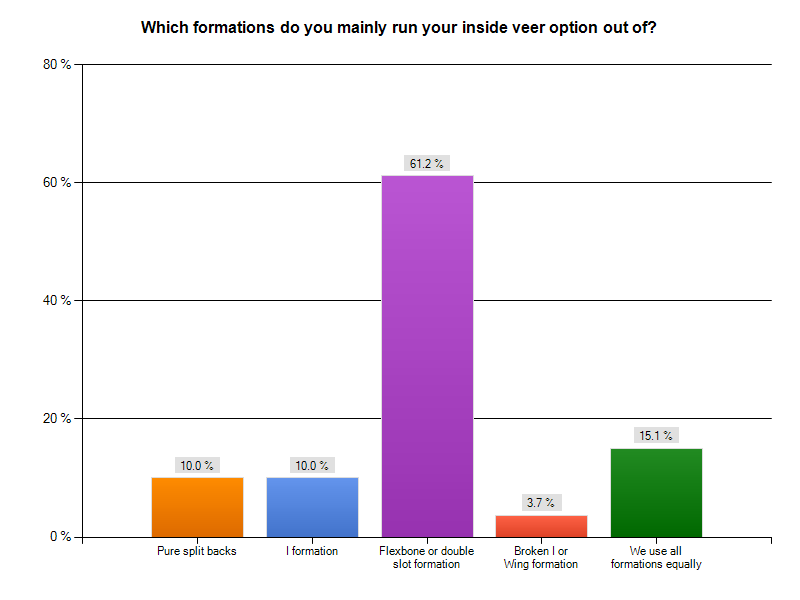
So, we asked our readers which of the following formations do they feel are most beneficial when running the option game, most specifically, the inside veer.  We’ve found that 61.2 percent of coaches prefer to use the traditional flexbone formation more than any other formation.  Split backs and “I” formations were second with 10 percent. Since it is the most popular formation in the option game, we will start there. 

ChartExport 3

Read More

Morphing a 4-2-5 into a Five Down Front

By Dan Devine
Defensive Coordinator/LB Coach
Alpharetta High School (GA)
Twitter: @coachd73

Introduction:

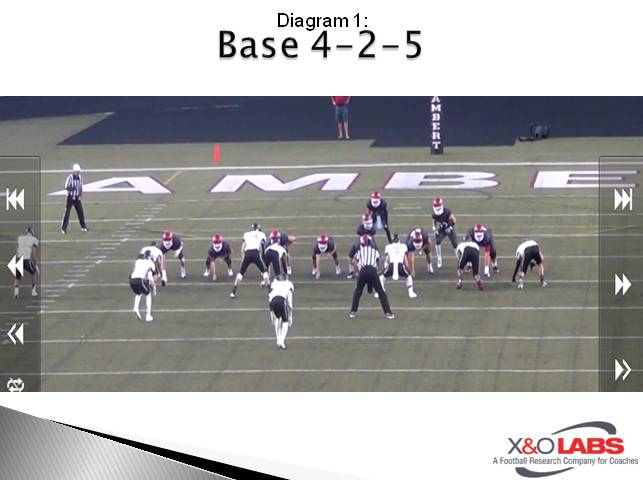
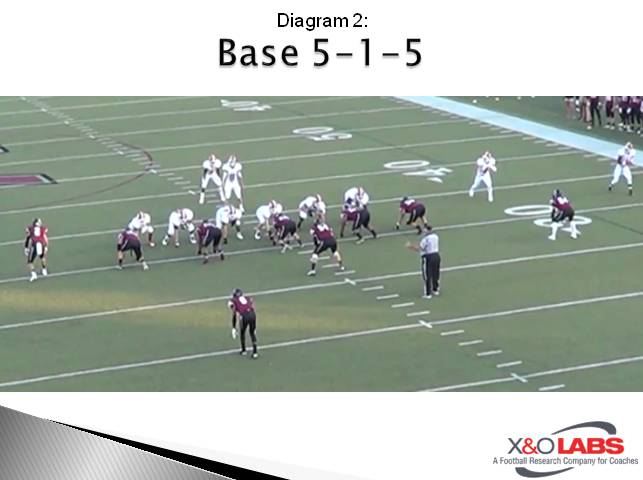
captureThe concept of the 5-1-5 defense is a run stopping package that we used off of our base 4-2-5 defense. This concept was born out of the necessity to stop the run heavy oriented teams while staying true to our 4-2 principles. What we found was substituting a DL for a LB or safety type body allowed us to stay solid in the run while still being flexible in the passing game. The result was a system where we could run all of our 4-2-5 coverages and get pressure with our most athletic players all out of a 5-1 front.
Reasoning/Methodology

At first, we were reluctant to leave one sole linebacker behind the line, but the more we practiced it and broke down the film the more comfortable we felt. We had a lot of inexperience and injuries at the linebacker position and our depth in the backend was also thin. For that reason, we decided to lean on our strength and depth up front to make the changes we needed against heavy run teams.

That said, the one backer in this system must be very good. He has to be smart enough to make the adjustments, tough enough to go tackle-to-tackle and elusive enough to shed defenders. In all, he must be the best defender on the team. We also knew, as a coaching staff, that we had to be sound with teaching technique and also make our kids fully grasp the idea and concept of what we were trying to do.

Concepts/Rules

The basic concept of the 5-1 is to cover up and shift along the defensive front while allowing your one true LB to roam free. In order to allow him to do this without fearing plays down the sidelines, all outside edge principles (backside counters, reverses, toss, etc.) are handled by the two safeties outside.

Slide1Slide2

At first glance, this concept will appear to be very similar to the old 5-3. This is especially true against heavy wing-t or option teams. However, when you actually look at personnel and depending on formations it does stay true to a six man box.

We play with a strong safety, weak safety (Raider) and a free safety. In our system, they are called the triangle. Against run heavy teams and statistically heavy run situations, we will most likely be in some version of cover 3 with a single high safety. In that case, the strong safety will align the strength and weak safety opposite the call. Their alignments are 3×3 off the last man on the LOS (if given a TE or tackle) or head up to inside eye if given 2×2, trips or empty.

Whether we roll to the coverage or just line up in the base formation, both outside safeties know that their jobs is contain, backside counter/reverse, and anything that bounces out to their side. They cannot be sucked in by play action or get caught peeking in the backfield. They play a vital role in being able to run this defense effectively and consistently.

Clink on the link below to see the base concept in action.

Read More

Meshing the Jet Sweep with Triple Option

By Matt Mishler
Head Coach
Rolling Meadows High School (IL)


Introduction

09-19-14 RM Varsity Football-0094The jet sweep has been a big part of our offensive package for years. As teams become more accustomed to how we ran the play, they began to use running back alignment and the paths of the offensive linemen to get a jump on our jet sweep. Since the jet sweep is a fast flow play, they were now more quickly getting to the outside on us with fast flow from their linebackers and decreasing the effectiveness of the play.
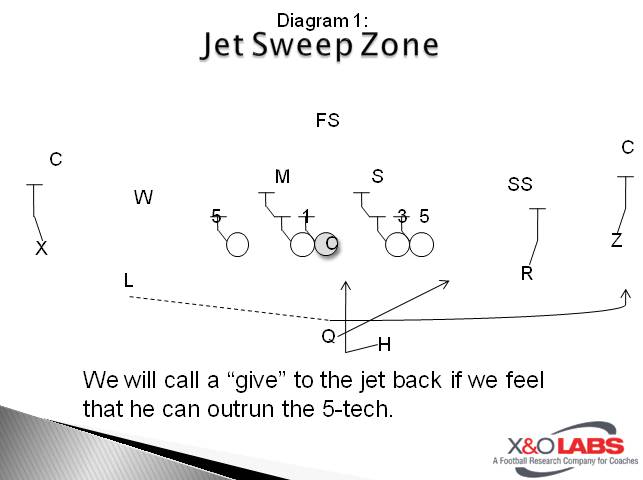
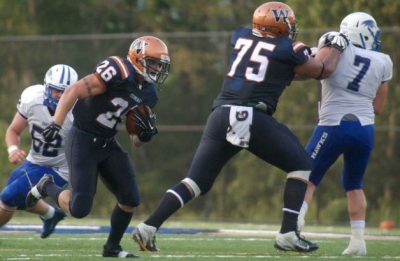

As a tendency breaker, we began running jet motion and then running zone read back away from the motion. This allowed us to offset the running back and give the defense all the keys they would get on jet sweep, but then run inside zone instead. We are able to run jet sweep with inside zone blocking up front as well. This became an extremely effective way for us to run the jet sweep as there were no fast flow keys for the defense. As a result, the linebackers stayed home which allowed our jet back to get the edge. The third phase of the play is making the jet back our “pitch” man in our triple option scheme. We can either throw bubble to him, or throttle him down and pitch it to him.

Jet Sweep Give

In this base concept, when we call give we are saying that we believe based on alignment or personnel that the jet back can out run the 5 technique (Diagram 1) for at least 5 yards. The offensive line will block inside zone away from the jet sweep.

Slide1

To watch this concept in action, click on the link below:

Read More

Motions, Shifts, & Trades That Defenses Hate

By Drew Owens
Offensive Coordinator/Offensive Line
Western Connecticut State University
Twitter: @ballcoachDRO


Introduction

westconn1Fellow coaches always ask, “What type of offense do you run at Western Connecticut?”
For some reason, I always struggle to answer this question. I hate saying we are a spread team because I associate that word with finesse and pass first. We are by no-means a finesse football team, we stress running the football using zone and gaps schemes with option and we are not an exclusive 10 personnel team.

When I really break it down, the main thrust of our offense at WCSU is to cause defensive coaches headaches. We are always thinking, “what can we do to make defensive coordinators feel uncomfortable?”

This perspective is undoubtedly rooted in the coaching experience of our Head Coach Joe Loth who coaches the quarterbacks in our offense. As a previous defensive coordinator and secondary coach, he provides us with a unique perspective and helps us focus on doing the things that defensive coaches hate to coach against.

It should be noted that we don’t do this to be a nuisance; instead we focus on making defenses uncomfortable because we know that it will help us do what we want to do. In other words, we do it to ensure that we can run the football and get the defense to stick to its base. Those two goals are the focus of our game planning every week.

What Do Defenses Hate?

  • When we ask defensive coordinators what they hate to see, we usually get the following responses…
  • Multiple formations out of multiple personnel groupings
  • Motions, shifts, and trades
  • Unbalanced formations including FSL 4×1 and 5×0 formations
  • Option

Every week at WCSU, we want DCs to have to prepare for all of those things. Some of the plays are repeated week to week, others are used for only one game. We philosophically “wipe the board clean” from week to week. Weekly, we always want to take what is given, not force plays that worked the week before. Hopefully, while game planning to play WCSU, the opposing defensive coordinator will get frustrated, erase the board, and say, “we just need to play base.”

Of the list of things that defenses hate above, we have found motions, shifts, and trades to be essential to getting a defense into base. Each of these pre-snap movements has their own advantages and when they are combined they have real potential to create havoc.

We rely heavily of motions, shifts and trades because the force the defense to:

  • To be sound versus movement pre-snap
  • To play more Base
  • To be sound in man coverage responsibilities
  • Change formation and strength calls quickly
  • Roll the dice when calling a pressure
  • To simulate motions/trades/shifts w/ scout team players

Ultimately, we feel it creates “one more thing” defenses have to work on during the week. They must have a plan. We can also move players to create matchup scenarios, preferential to the offense.

Read More

Stealing Yardage with Fast Screens

By D.J. Mann
Offensive Coordinator
Crosby High School (TX) 
Twitter: @Thamannjr

sulphur


Just like everyone else in the nation we want our offense to fit the personnel we have. That said, we are going to make that happen within our overarching offensive philosophy.  For us as an airraid team, that meant helping the lineman with a fast pace, winning the line of scrimmage with the inside and outside zone play, and getting our players in space.  We feel that if we force defenses to play sideline to sideline, we are going to gain a conditioning and schematic advantage as the game goes on and the best way we were able to do that this past year was through implementing a comprehensive fast screen system.  The result were more than we could have expected.  In the end, we averaged 460 yards a game in district play and broke or tied 3 school offensive records.

The fast screens were essential to our success for multiple reasons, most important among them being their simplicity and their ability to get everyone on the offense involved. They are confidence throws for our QB.  Each play is an easy throw that can get your QB on rhythm. It is not a long distance throw so it is a simple catch and run for the receivers.  The plays don’t require the offensive line to over think, as they are taking an outside zone path to the left or right.  These factors all were magnified for us as a first year staff that needed to bring early success to the program.

Our Screens

Of course, the entire idea is the get the ball to our playmakers in space. We want to be in the 95% completion range running these screens.  Here is a look at each of the screens we employed this past year and the coaching points for each individual screen.

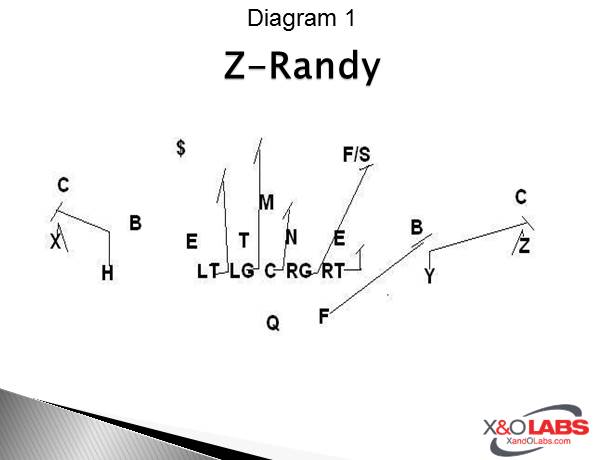
Z-Randy

Position Coaching Points:

  • QB -Grip and Rip to the Z receiver.
  • Z- Quick foot fire up field stick and Get outside. Goal is 6 yards.
  • Y- Push up field one step and go cut the corner.
  • F- Cheat up and out and cut the force player normally the OLB/SS.
  • H- Mirror the screen or block man over you.
  • X- Mirror the screen or block man over you.
  • OL –(3 steps flat) PT – End, PG – P/S Safety, C – Farthest P/S backer in the box, B/S G – B/S backer to B/S Safety, B/S T – B/S Safety.

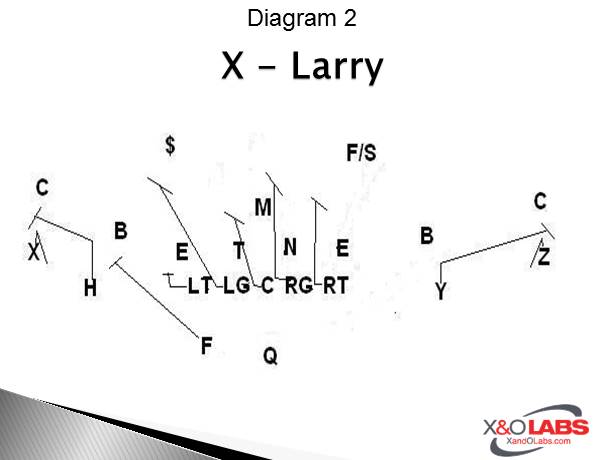
X – Larry

Position Coaching Points:

  • QB- Grip and Rip to the X receiver.
  • X- Quick foot fire up field stick and Get outside. Goal is 6 yards. LOS.
  • H- Push up field one step and go cut the corner.
  • F- Cheat up and out and cut the force player normally the OLB/SS.
  • Y- Mirror the screen or block man over you.
  • Z- Mirror the screen or block man over you.
  • OL –(3 steps flat) PT – End, PG – P/S Safety, C – Farthest P/S backer in the box, B/S G – B/S backer to B/S Safety, B/S T – B/S Safety.

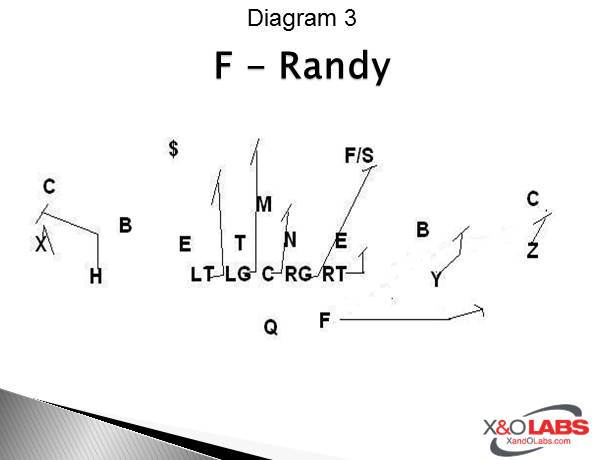
F – Randy

Read More

Giving the QB the Keys to Your Offense

 By Jeremiah Behrendsen
Offensive Coordinator
Dakota Ridge High School (CO)

Introduction

photo 2While the idea of giving your quarterback the freedom to run your offense might scare most coaches, especially if they have a young quarterback, it is something I believe they can handle. I’m not talking about giving them the ability to audible when they want or to change our play call to any play that they think might work. I’m talking about giving them the tools to manage the plays called to optimize our success and to allow them a few basic play call changes when we see specific looks. It is crazy to think that we are always going to call the correct play, to the correct side, and against the correct front or coverage. No matter how much we scout and how many tendency reports we work through, we still have to understand that when the game starts, we are on the sideline and the quarterback has the best view of what the defense is doing.
I just completed my 5th season as the offensive coordinator at Dakota Ridge High School and each year I have found myself giving the quarterback more responsibility, freedom, and flexibility on game day. That is not because my quarterbacks are better players now than they were when I first began. Instead, I believe it is because I am doing a better job of coaching my quarterback during the week. This leads to more confidence in his preparation and helps me trust him to make the right decision.

Starting with the Game Plan

Probably the first key component to giving your quarterback the kind of freedom I am talking about is developing a clean and detailed way passing along your weekly game plan to your players. As an offensive staff, we put a significant amount of time each weekend into developing a scouting report that covers a variety of topics that are not just important to the quarterback, but the entire offense. If all of the players are accountable for this information it will help the quarterback and serve as a sort of checks and balances on game day. Examples of the checks and balances include:

  • The offensive line should know if we are running a play at a certain defensive technique or maybe towards an overhang LB.
  • The wide receivers should know if we are using a certain type of motion on a given play during the week, etc.

If they know these types of details, we can help identify if any mistakes are made early in the game to avoid making them as the game continues. The scouting report, continued repetition, and specific coaching throughout the week will guide the decisions that quarterback is supposed to make when controlling the offense on the field.

The scouting report we use contains the following information:

  • We start by listing overall observations and tendencies for the defense.
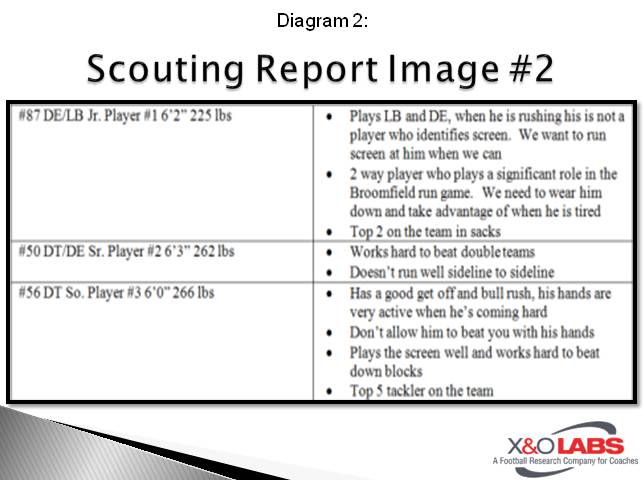
  • We give an evaluation of the top 12-15 players on the opposing defense and including their perceived strengths and weaknesses. We also detail what skills and techniques we hope to use against each individual.
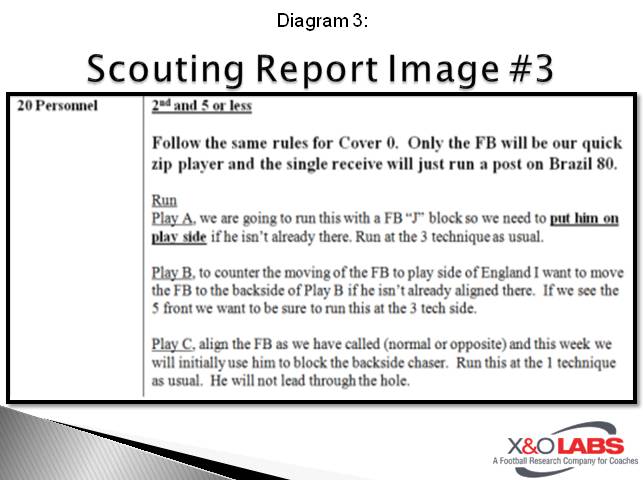
  • We list each personnel group and what plays that group will be responsible for.
  • We list any specific rules we want the offense to follow during the week for the plays mentioned under each personnel group.

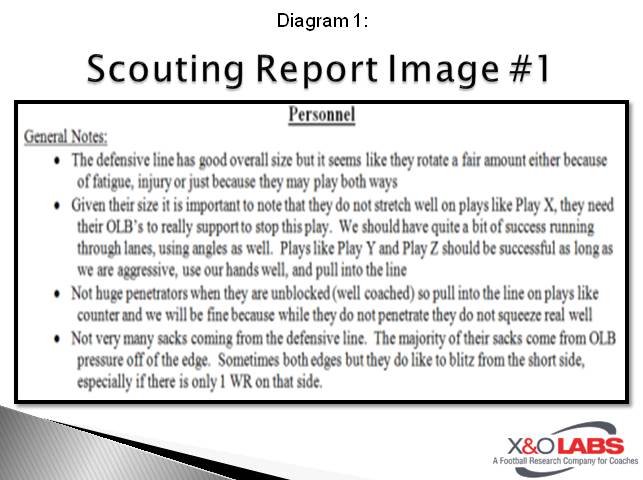
Here are some cut outs from parts of a sample scouting report:

Slide1Slide2Slide3

This document sets the learning expectation for the week by:

  • Passing information about the entire offense along to our base personnel starters.
  • Passing the information along to starters in our other personnel groups ONLY the information that is pertinent to the plays they will be running. This is crucial for us as many of our FB’s, TE’s, and extra WR’s actually start on our defense and we don’t want to overwhelm them or force them to waste time practicing things that don’t apply to them.
  • It lays out for the quarterback not only what plays we will be running but it indicates where we want to run certain plays and what progression we should use in certain passing situations. It also spells out any play changes he’s allowed to make based on a specific defensive look or adjustment.

Note: Without this type of document, or alternative pre-teaching strategy, I do not believe you will be able to ask your quarterback to do the types of things that will be discussed in the rest of the article. The initial instruction and format makes all of the difference.

Read More

Stemming In and Out of Odd Pressures

By Reid Stapp
Defensive Coordinator
Nutley High School (NJ)

Introduction:

xando pictureIn this day in age, offenses try to get as many talented and fast athletes on the field as possible. It is my belief that in order to keep pace with these offenses, the defenses must have just as many fast athletes on the field. Our 3-4 defense allows us to do just that while we rely heavily on disguising blitzes to attack protections and complicate the QB’s pre-snap read.
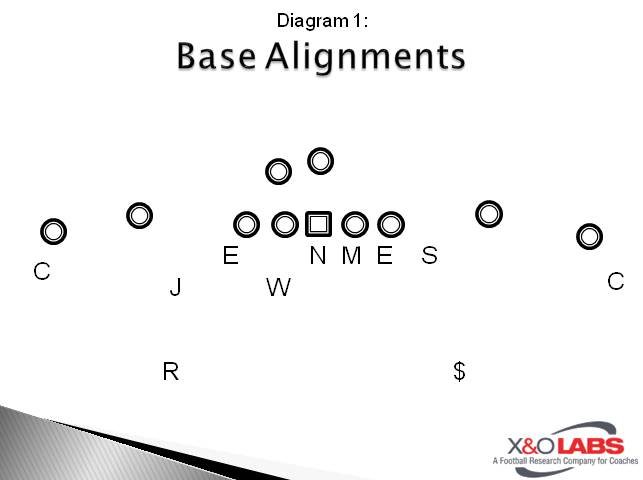
Base 3-4 Alignment & Scheme

In our base alignment, we play with the strong side DE in a 4i technique, the weak side DE is in a 5 technique, and our nose is in a 0 technique. We like putting the weak side DE is in a 5 technique because he is more of a pure pass rusher in our system. He is a kid that can get up the field and speed rush the tackle.

The inside linebackers, Mike and Will, are both in 20 techniques while the outside linebackers are both splitting the difference between the tackle and the #2 receiver to their side (in 2×2; 10 personnel). The corners are aligned on the outside shoulder of the #1 receiver on a 45 degree angle. Lastly, the Raider and Safety are both aligned at 10 yards from the ball, but 2 yards outside the tackles.

Slide1

3-4 Advantages

The real advantage of this system / alignment is that this past year we were able to get 10 true athletes on the field all at once. The speed and quickness that they were able to play with was a major advantage. We come from every angle and are very aggressive. From that base, we were able to blitz at least one second level player on every play if not more and they were able to use their athleticism to make plays.

The results speak for themselves. In 2014, we had 28 sacks in 10 games, but more importantly, 11 different players register at least a ½ a sack over that time period. Our biggest ally was disguising where our blitzes and coverage to keep the offense guessing. We can run eight different blitzes from the same pre-snap look. This, in turn, allowed us to game plan for a variety of 2 on 1 matchups with offensive linemen and forced the running backs to get involved in pass protection.

Defensive Philosophy

Before I get into the x’s and o’s of how we disguised our blitzes, here are a few more parameters of our defense that can provide some more background into how things operate.

  • Everything we do is out of a Cover 2 shell. We preach to our kids to hold that shell as long as possible before the safeties rotate.
  • The corners must be in our Cover 2 press technique. If the corners are off in Cover 3 technique then the 2 shell by the safeties doesn’t really matter. Our corners will creep back as safeties begin to rotate.
  • The linebackers must be active pre-snap. Our linebackers are moving constantly, creeping up or lining up on the line and bailing at the snap. This constant movement happens while they are reading their keys.
  • Communication is essential. We have calls that the linebackers must make to their partner on the defensive line. These calls must be understood in order to maintain gap responsibility and to keep the offense guessing. We make the call so that the defensive lineman or linebacker could go either way on any given play. A simple “in or out” goes a long way.
  • There is no substitute for speed. There is also a limit on how fast an offensive lineman, quarterback or running back can react. For that reason, we stress to our linebackers that anytime they are blitzing it must be at full speed and to the depth of the football. We blitz with our eyes!
  • In order to help the blitz, we must take away throwing lanes. The biggest part of our pass defense is reading receivers. Anyone that is not blitzing is getting eyes to their receiver first. We read the path of the receiver in order to get in the throwing lanes and force the quarterback to hold the ball, throw an INT or alter his release.

“SLAM” Blitzes

Read More