



Mixing Coverages Behind Zone Pressures
By Zach Watkins
Co-Defensive Coordinator/Special Teams Coordinator/Linebackers
Washburn University (KS)
Twitter: @Zach_Watkins
Introduction:
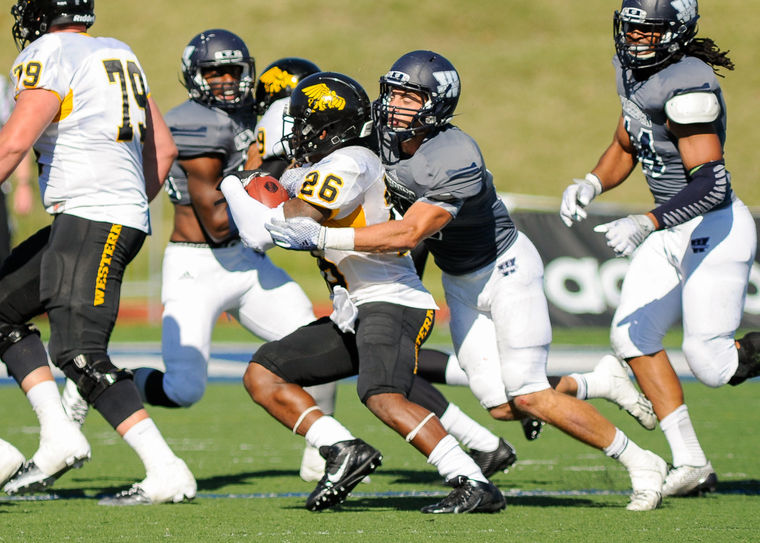 It is always important for a defense to mix up and disguise what they are doing. This is especially true when blitzing. If a blitz is given away early or executed too late, its effectiveness will most certainly be lost. We mix in all kinds of blitzes in our defensive package. We will bring anywhere from 4-7 guys, as well as changing up the coverages behind those blitzes. We feel that you must switch up the coverages to be effective.
In the past few years, we have started to use more zone blitz concepts within our scheme. We have found this to be difficult for an offense to read pre-snap, effective at pressuring the QB and provides certain advantages to us in game planning.
When To Call Zone Blitzes
All downs are possible for us to run our zone blitz packages. Passing situations are obviously more conducive to having success with the blitz, but the run fits are sound for those times we don’t call it at the perfect time. 3rd and long situations (6+) work well, especially with the 1 back sets we most often see. We always want to try to create a 2 for 1 for the RB in their protection so that we have dictated our play for the offense to adjust to.
Pre Snap Alignment
We try to confuse the offense and dictate the protection by “stemming” around pre snap. This includes sugaring our 7 underneath players (DL, LB’s and strong safety (SS)). We will give the same 10×2 high shell look every snap with our free safety (FS) and stud ($), regardless of blitz or coverage (Diagram 1). Our corners can show any leverage and depth, as long as they are in position to play the zone that is called. By maintaining this two high look with the safeties, and with the underneath LBs/SS in our 4-2-5 scheme moving around, we believe it makes it difficult for the offense to diagnose what we are doing. This alignment also gives our guys confidence in their blitzes because if they have stemmed around often enough, their blitz should be disguised. 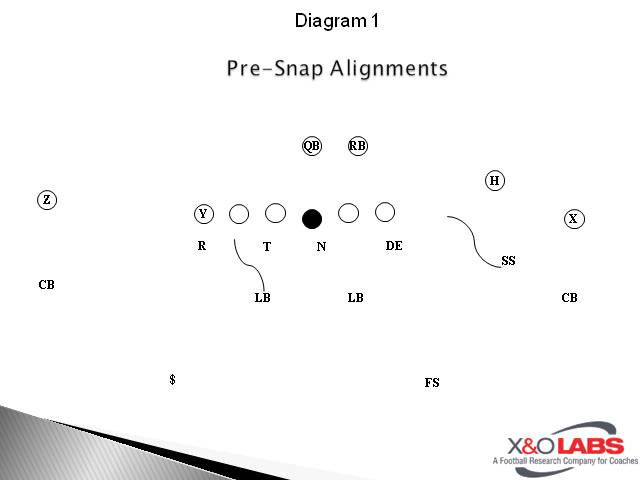
Blitzes
Within our blitz package, we have the ability to bring anywhere from 4-7 guys and still play zone concepts behind the blitz. All of our zone blitzes are states. This helps our players to categorize the blitzes within terminology of the rest of our defense. I will detail three base zone blitzes that we use, Florida, Texas, and Kansas with the different zone coverages we play behind them, 6 Drop, 6 Rush, and Trap 2. We can also “pop” (single blitz) any player who is not a DL and play zone coverage behind it.
Below, I will detail one blitz with all the coverages, and then expand to other blitzes. For the purpose of simplicity, I’ve drawn each diagram to show the field to the right and boundary to the left. We also play man free (Cover 1) behind these blitzes, but I’ll detail the zone concepts for this article.
FLORIDA
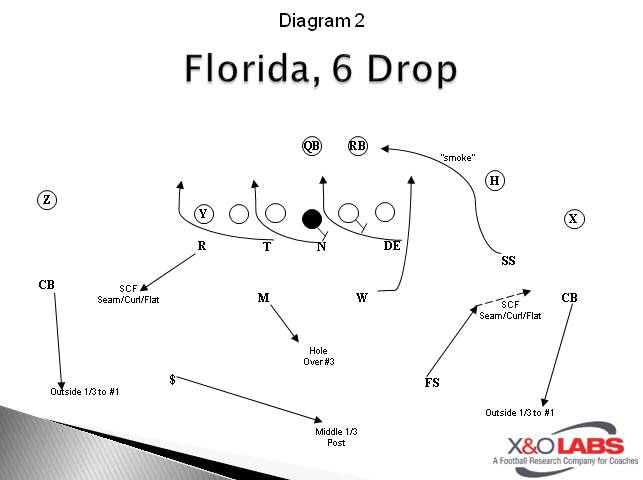
Our main zone blitz is the traditional Fire Zone. “Florida” is used with Cover 6 Drop (3 under, 3 deep, with a DE dropping into coverage) behind it (Diagram 2). Because we run a 4-2-5 and read to the multiple WRs, we typically bring this from the field. We have some flexibility in how we can roll and adjust the coverages, and that we have some more speed coming off the edge in our SS rather than an LB. As in all zones, we will get hands on and be physical with receivers and force them over the top.
BLITZERS
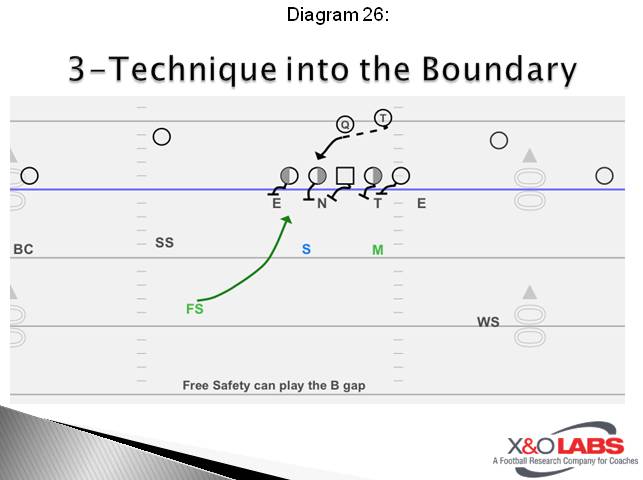
Up front we call our strength to the TE, and will keep it that way no matter that blitz. This allows our front to have different looks on film within the same blitz. We will read to the multiple WR side, just like in our base scheme. We could read specifically into the boundary or towards the field if we want to bring the blitz from a certain side based on game planning. We give our DL very simple instructions. They will all “long-stick and read” (hard lateral lead into the direction they are slanting). This slant usually takes place into the boundary.

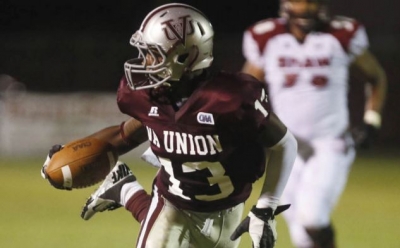
 A great deal of Virginia Union’s recent success and resurgence can be attributed to the emphasis they have placed on improving their passing game. That emphasis paid off this season as the Virginia Union Panthers finished 8-3 capturing an invitation to the D-2 playoffs for the first time in 24 years. The Panthers offense has also set several new school records over the past two seasons.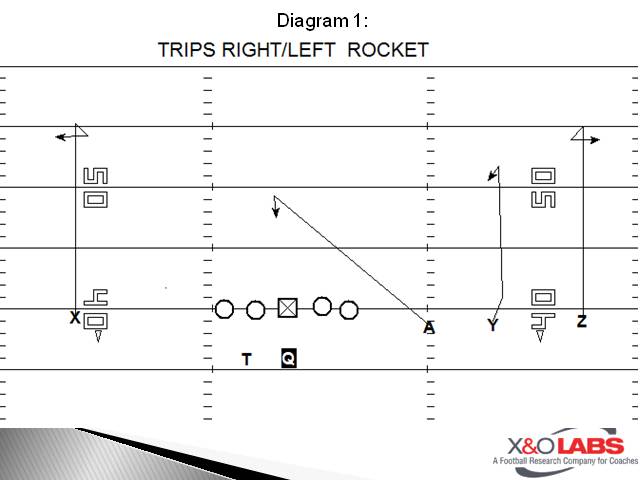
 Editor’s Note: The following research was conducted in part of XandOLabs.com special report “The Run/Pass Option” study, which can be accessed by
 There are differences and similarities between combination blocks and double teams for offensive linemen. Regardless of your offense (Spread, Pro-style, Wing T), or your offensive line schemes (Man, Zone, Gap) you will inevitably have scenarios where two offensive linemen are engaging with one defensive lineman and working to a linebacker. Combination blocks are most often associated with zone blocking schemes, but they occur in almost every scheme you could run.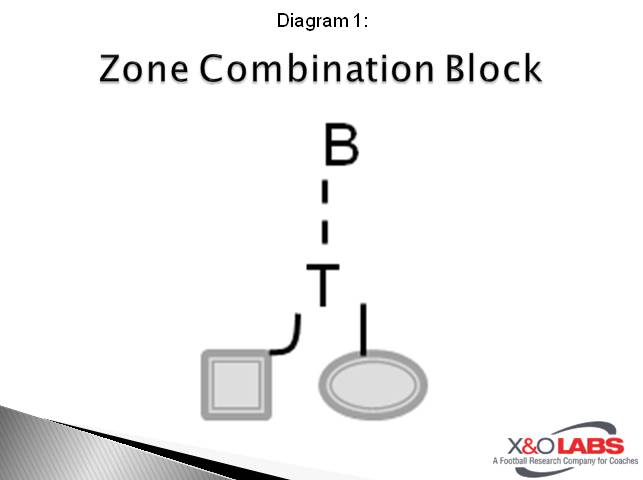
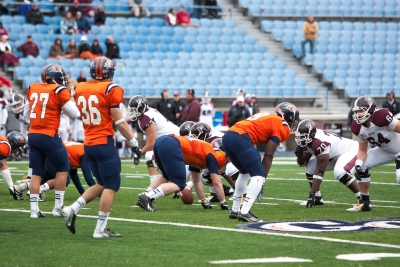
 If you operate out of the 4-2-5 defensive structure than you know how vital it is to get those two box linebackers trained on their keys. In most cases, you’re playing with six in the box (an unloaded box), so you need to rely on the perimeter defenders to add on to the run game to get a plus one defender against quarterback runs. But how you choose to fit your defenders relies on several components, including offensive formation, coverage structure and field/boundary protocol. Here at X&O Labs, we wanted to conduct comprehensive research on how linebacker coaches were teaching their players to fit the one-back run game out of the 4-2-5 defense. And what we found were three common threads among our research: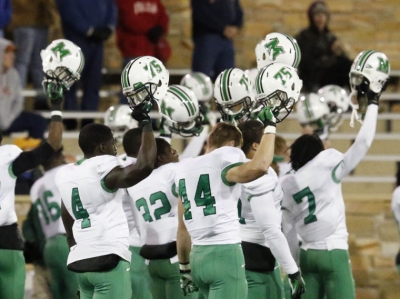



 The dual threat quarterback is becoming more and more commonplace in today’s game. Whether it is Cam Newton or Russell Wilson in the NFL, or the countless quarterbacks in the college and high school game, the position is moving to individuals who can be explosive with both their arm and legs. From a coaching perspective, the idea of having a quarterback that can break a simple run 80-yards for a touchdown is at times just as much of a ‘bailout’ for an offense as an Run/Pass Option is for a bad play-call.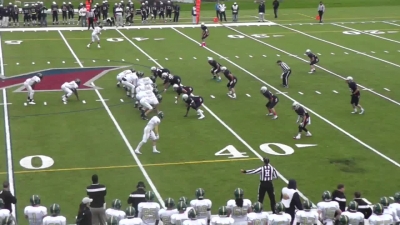
 Here at SUNY Maritime we play an aggressive 3-4 slant/angle defense with a 2 high look from the secondary. We play a variety of different coverages but our favorite to pair with our 6 man pressures is over 3 over 2 “Hot” coverage. We like to bring our 6 man pressures against 10 personnel sets in order to force the quarterback to get rid of the ball quickly.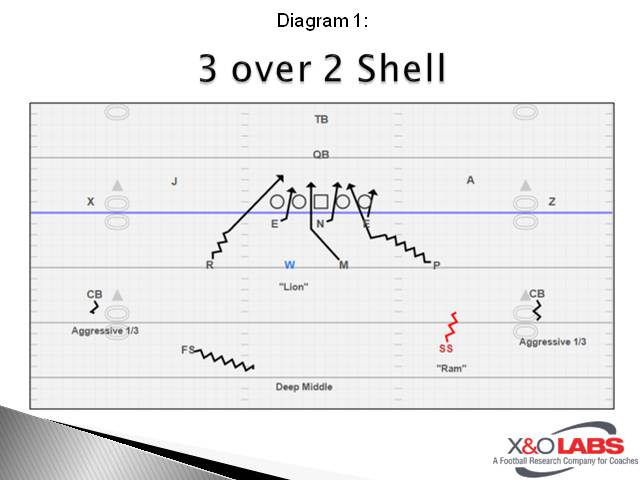
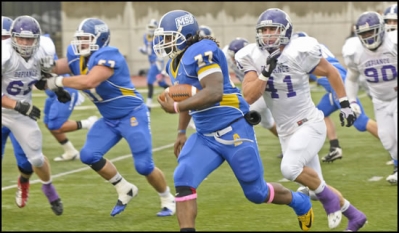
 One of our favorite concepts here at Mount St Joseph is the “split end power” that we run away from trips in 3×1 formations. We are attempting to control the box by adding a pass option component to our split end run play. Like any other version of option football, we are working to outnumber the defense by adding this run pass option concepts (RPO). Offensive coordinators are always looking for easy completions and using the split end power will give you easy completions on 1st and 2nd down run situations.
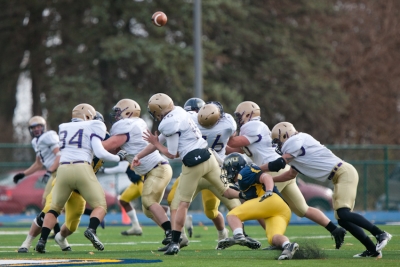
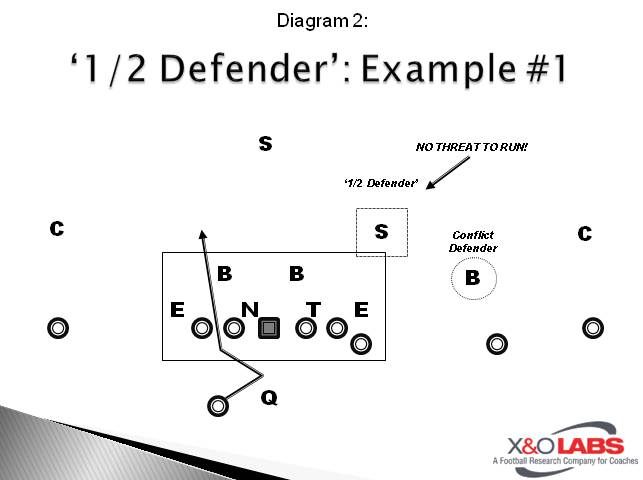
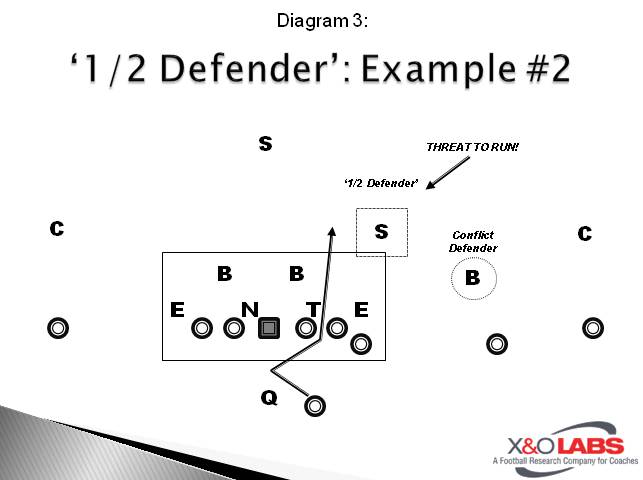
 With increased popularity of RPO plays on offense, thus too have been the improved defensive techniques from the second level to try and stop them. Here at Loras College our staff has found ways to give our offense the best chance to succeed using the third level (or safety level) as the focal ‘read’. Our RPO’s generally use the second level, or linebackers, as the ‘conflict’ defender. That said, defenses have responded by having their ‘read’ defenders faking or bluffing their intent. An example might be a ‘conflict’ defender showing inside the box alignment and bailing out into a pass lane then subsequently aligning wide and shooting an interior gap on the snap. Stationary ‘read’ keys are much easier to define for a quarterback than those always moving around. We use third level defender alignment, depth, and eyes to help our quarterbacks determine where to go with the football. In this report we will outline a few of the play examples exclusively using 20 personnel (1 RB, 1 Hybrid, & 3 WR’s) in which we read third level defenders. These examples were successful for us this past season.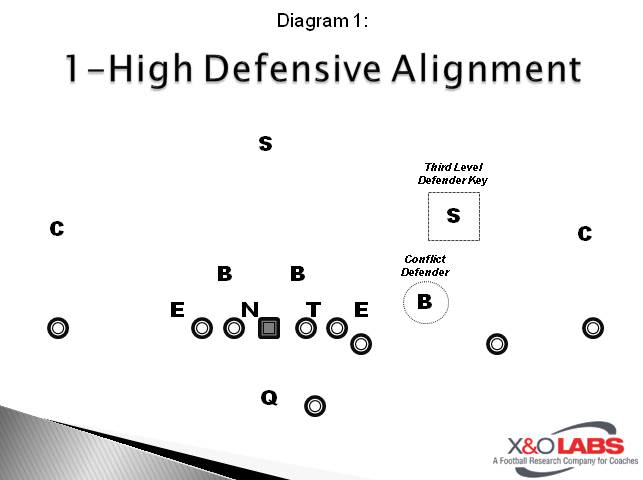
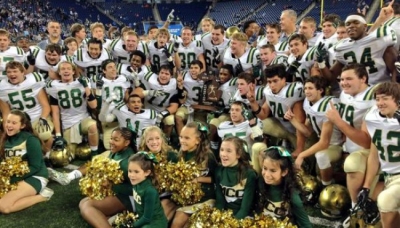
 Winning culture is built now. It’s cultivated in weight rooms across the county and emphasized in classrooms where coaches teach character development and the essentials of leadership. Successful coaches understand football is a yearlong endeavor. There is no off-season, just a perpetual process in which student-athletes learn the culture of being successful. Which is why the best coaches are hard at work now instilling what will be the “culture” of their program for years to come.