Research: Defending the Problem Areas in Quarters Coverage

By Mike Kuchar
Senior Research Manager
X&O Labs
Twitter: @MikeKKuchar

Introduction:

In an effort to make sure we were as thorough as possible in our research, we wanted to devote this last case to defending the various “problem areas” in Quarters coverage.  We all know that every coverage has its weaknesses, and Cover four is no different.  So we asked some of our sources directly, how they best defend the following “Quarters beaters” that offenses will use against it:

  • Double Post Routes
  • Three-level Flood Concepts
  • Post/Flag “Scissors” Concept
  • Mesh or Shallow Cross Routes
  • Boot and Naked Pass Game

Problem: The Double Post Route (Diagram 1)

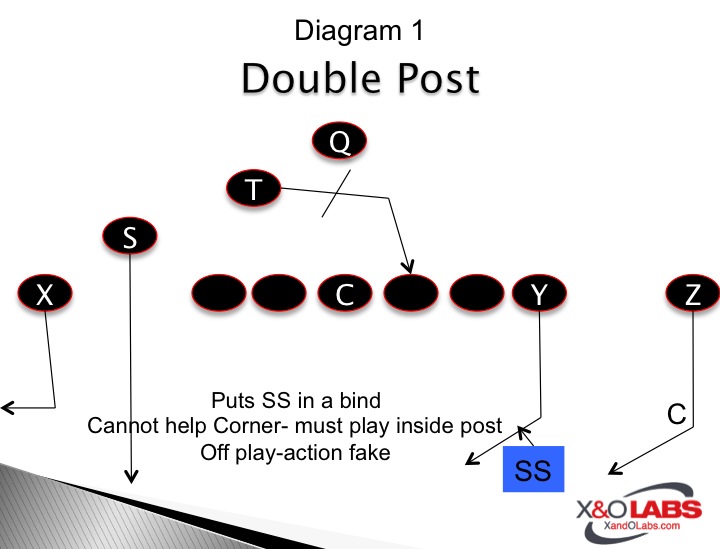
Perhaps the most popular Quarters coverage beater is the double post concept.  As shown above, the purpose of the double post is for the number-two receiver to occupy the deep safety, opening up the middle of the field for the number-one receiver.  It’s a concept most successfully used with a run-action fake, just to get the Quarters safety downhill to open up the middle of the field.  Take a look at a clip from last season’s Outback Bowl to see how the University of Michigan was able to scorch South Carolina on the double post concept out of an unbalanced formation.

Read More

Adapting the Hitch/Seam to Attack any Coverage

By Matthew Burleson
Head Football Coach
Telfair County High School (GA)
Twitter: @CoachMBurleson

Introduction

CaptureThe four vertical scheme has always been one of our favorite route combinations, but we have always wanted to find ways to make it more flexible. We like the ability to attacking the deep hashes and the middle of the field, but at the same time we wanted the comfort of the short game when the defense is playing soft. Our answer was a modified hitch seam concept.

The best part about the hitch seam route combo is that it is a great play for any down, distance, or coverage.  It also is very flexible in the way that it fits with various formations (2×2, 3×1, 3×2), play types (drop back, play action), and motions without disrupting the concept, timing or read.

Here is a look at how we teach this common concept and hopefully you will be able to find a few wrinkles in here that can help you with your hitch seam concept.

Outside Receiver Assignment: Run a 6 yard Hitch Route

How the hitch route is run is determined by how the corner is playing our wide receiver. If the corner gives us a loose alignment or bails on the snap, the receiver will push hard with a vertical stem to 6 yards and sit down ready to receive the ball. If we are getting a tight man coverage, we will outside release vertical to 6 yards and bring the receiver back underneath running away from the corner. If it is a hard cover 2 corner, we will have him take an inside stem leaning hard on corner’s inside shoulder to 6 yards and then bring the route underneath to the hole in between the corner and the OLB.

Inside Receiver Assignment: Run a Vertical Route ready for the ball between 12-15 yards depth.

His landmark is down the hash marks. As he gets off the line, it is important to avoid collision by the OLB/SS who is attempting to disrupt the vertical route on his way to the flat in Cover 3. It is imperative that the receiver does not to fade his route out or he will allow the cover 3 Corner to make a play on the football or bend his route in toward the single high safety.  Against a 2 high safety look out of 2×2, we will have a designated “bender” to attack the MOF. He should be ready to receive the pass after clearing the LBs in the middle of the field.

Slot Receiver Assignment: Vertical Bender Route 12-15yds (read for ball).

Anytime we run this combination out of a 3×1 or 3×2 set our slot receiver or the inner most receiver will run a vertical bender route. Unlike the bender by the #2 receiver, his landmark will always be the middle of the field regardless of coverage. His job is to avoid any LBs/SS and get to the MOF as quickly as possible at the free safety.

Read More

Odd Stack: Varying Run Support

By Jonathan Jones
Defensive Coordinator
West Sabine High School (TX)


Introduction:

jonesWe are a 3-5-3 defense in our base alignment. The reason for this is that it’s easy to teach from junior high and add in the elements and aspects that we need before high school. It allows us to have success in all levels without sacrificing losing for trying to teach kids how to understand the elements of football. It’s much easier to go ahead and have 8 men in the box at a junior high level than it is to try to teach a free safety or strong safety to play downhill and also cover the pass.

We play a 3-5-3 defense, but the qualities for positions we look for is more like a 4-3. We play a strong outside linebacker and a weak outside linebacker. Our weak outside linebacker is going to be a strong safety type kid. He’s strong enough to play inside, but fast enough to cover the number 3 on a vertical in a trips set if they run 4 verticals. It’s pretty easy to find our weak side outside linebacker, he’s normally the best all-around athlete we have. We put him there because this position requires a lot of versatility. This benefits us because we never have to do a lot of substitutions to match up against an offense.

Our strong side outside linebacker is going to be a bigger stronger kid that can play with his hand up or down and can spot drop to the flats. Those are the basics of what it takes to play that position. Inside, we play a Mike, Sam, and Will linebacker. Our Mike will be our best tackler and has to be able to run. Our Will and Sam need to be able to run and also need to be smart kids. Our read force is based primarily on them recognizing the formation and reading blocks and flow to get where they need to be. We run a few different coverages. I know a lot of people will tell you to find one thing and get really good at that. I truly believe in that statement. We mix up our coverages quite often, but keep it as simple as possible. Coverages are important when talking about force reads. You have to make sure you keep everything working together. We have five different force calls we can make. A force call will be made once the defense recognizes the offensive formation. A defense should be a well-oiled machine. Everyone has to do their part on every play, it doesn’t matter if you execute up front if you can’t keep it locked down in the back end with the secondary.

Varying Force

Out of our 3-5 base, we will play five force concepts with each being dictated by the coverage that we are playing. Each of these concepts is based off of our Read Force concept, which will be addressed first.

Read Force

Slide1

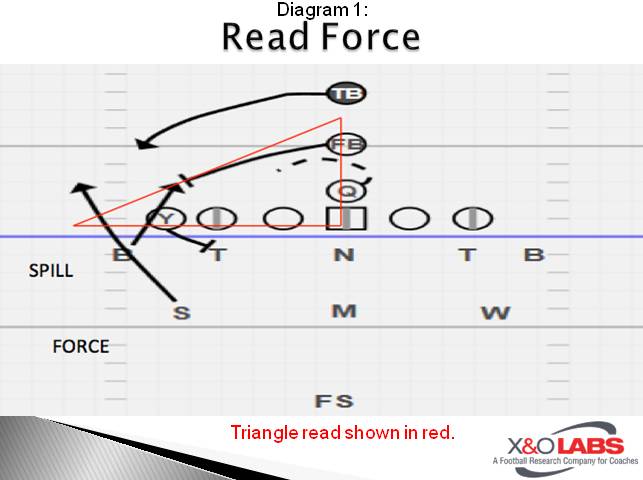
Diagram 1 below shows our read force call in cover one against a basic pro set. The read is taking place between the strong outside linebacker and the Sam. The strong outside linebacker reads the down block by the tight end and knows to look inside for something to spill. We teach what we call T.B.I triangle reads, which stands for tight end (or tackle), back, inside. When he sees the tight end block down, his eyes will go straight to the FB. If the FB goes away, he looks inside for counter. If the FB comes toward him, he knows he needs to wrong shoulder the FB and keep the running back moving toward the sideline. If the tight end blocks out on the outside linebacker, he must shoot his hands violently with his inside hand aiming for the sternum of the tight end. At that point, the strong side outside linebacker will run his feet to maintain leverage outside the ball carrier and become the force player.

The Sam reads flow and knows what direction the ball is going, but he must wait and see the strong side outside linebacker’s choice before he knows his role. To ensure his read is clear, we tell our Sam and Will that our OLB’s are always right, but sometime our Sam and Will have to make them right. If the strong side outside linebacker collisions a widening tight end, the Sam will play underneath the outside linebacker and does not have force responsibility. Additionally, our corner would be coming up as secondary force, our Mike is overlapping to the ball and our free safety is running the alley. Conversely, if the strong side outside linebacker tightens based on his read, the Sam will fill to the outside as the force player.

Read Force vs. Power

Slide2

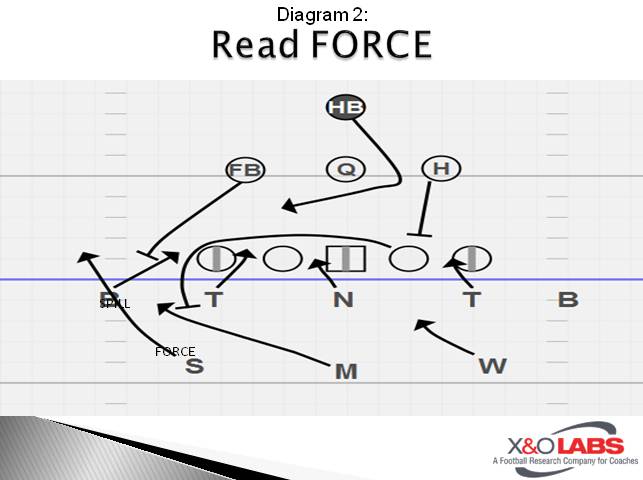
Nothing changes when we see a Power scheme. In that situation, the SOLB reads his triangle and sees the FB heading out at him. He knows his responsibility is to attack his inside shoulder and blow up the FB to keep the running back going horizontal. If the running back tucks the ball back inside the fullback’s block, the OLB makes the tackle. If he spills outside, the Sam is now our force player with our Mike and free safety play clean up on the back.

Read More

Adapting Chip Kelly’s System at the HS Level

By Sam Nichols

Managing Editor

X&O Labs

Editor’s Note:  Last year when we published our No Huddle Special Report, we had the opportunity to interview many coaches.  One of those interviews that sticks out was with former Chip Kelly Assistant at New Hampshire Jason Thomas.  Coach Thomas just finished his fifth season as head football coach at Burr and Burton Academy.  He has built a start-up program into a consistent playoff contender.  In his five years at BBA the football program has been to the state semi-finals twice and was the runner-up in 2011.  His offense has average 35.5 and 41 points over the past two seasons and his Quarterback won the Gatorade Player of the year in 2011.  Jason played collegiate football at UMass.  His coaching career began at Randolph-Macon College, then made stops at the University of New Hampshire (where he worked under Chip Kelly), The University at Buffalo and Middlebury College. X&O Labs 


SN: OK coach.  Thanks for taking the time to interview with us.  Tell us what brought you to install the no huddle?  What were you hoping to accomplish by adding this to your offense?

JT: I first learned about the no-huddle at the University of New Hampshire with then coach Chip Kelly.  I really loved the speed of the offense, the amount of reps we were able to get during a single practice and I saw how it affected the defenses we played.

Really there are so many benefits of the no-huddle.  Here is a list of the ones I hoped to bring to my program:

  • Adaptability for any offense
  • Dictate the tempo of the game
  • 2 minute concept built in
  • Have time and capability to call the right play versus the right defense
  • Mentally & Physically wear down your opponent
  • Forces QB to be a leader
  • Lengthen the game, more plays = more scoring opportunities
  • It is fun for players and fans
  • You’ll get more kids out to play
  • More reps during practice
  • Keeps players attention (they have to pay attention to keep pace)
  • Great conditioning tool
  • It is fun for the players
  • Dictates the pace, which forces the defense out of their comfort zone
  • Forces the defense to play base, or allows you to see their adjustments
  • May force the defense into a bad situation (out of position, bad match-up, burn a timeout) if they can’t adjust to the set pace
  • Prevents defenses from regrouping after a big offensive play
  • Limits defensive substitutions
  • Defensive coaches may have to find a way to communicate to their defense
  • Other teams cannot simulate our tempo in practice

SN: Did switching to the no huddle have the effect on your team that you had expected?  Any surprises either positively or negatively?

JT: Yes I think it was instrumental in our success.  My school was 3-6 the year before I arrived and we went 8-2 my first year largely because we were the only team running the no-huddle.  The offense improved by more than 15 points per game and we wore down our opponents as the game went on.

SN: That is quite a drastic change coach.  Since you have been running the no huddle for a few years now, I am curious to hear about how much your system has changed over time. 

JT: The system itself changed very little from year to year.  If you have a sound system adjustments can be easily built in.  However, I will say we are constantly looking for ways to play faster and disguise our signals better.  We have progressed from one person signaling to now having two signalers and a person holding a play board.  I also spend a great deal of time trying to refine how we practice our no-huddle to maximize our reps. 

Read More

Bracket Coverage Concepts and Techniques

By Jason Brown 
Defensive Coordinator 
Dutchtown High School (LA)

Introduction:

dutchtownThe importance of a workable 3rd down defensive package cannot be overstated. If you play good defense on first and second down and you can get an offense in a third and medium to long situation, you must be able to get off the field a majority of the time. We have found that our 3rd down package gives us a good chance to get our defense off the field and to give our offense a chance to score points.

Our 3rd down package has been developed over twenty-plus years and we are constantly tweaking it to make it simpler and more effective. The result is a nice clean package that we install in the summer months, work on during Pass Skeleton / 7 on 7 leagues, and then carry it through the season. During the season, this package is focused on every Tuesday. This time and commitment gives us the utmost confidence that we need to win on 3rd down when the games arrive.

On the early downs, our philosophy with the back of our defense is to maintain zone eyes. This allows us to better swarm the ball. When it gets to third down, especially in the third and medium area, we adjust into more of a man concept to deny the ball. Nothing is more frustrating for a coordinator than to get an offense to third and 4-7 yards and the offense runs a flood concept or horizontal stretches a zone defender and first down! If you work that hard to get to the down, you should have the necessary tools to win the down.

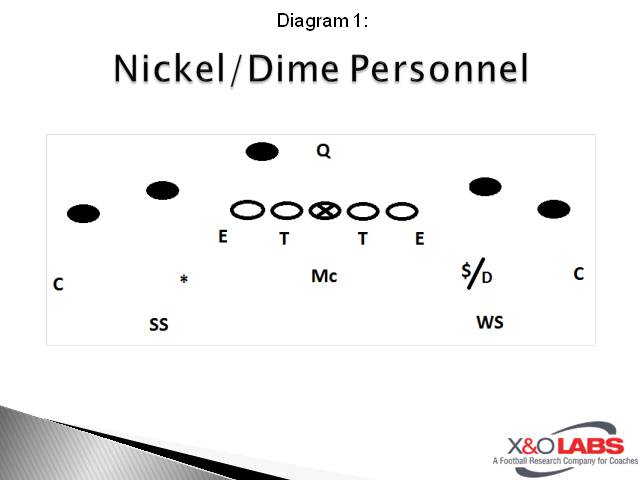
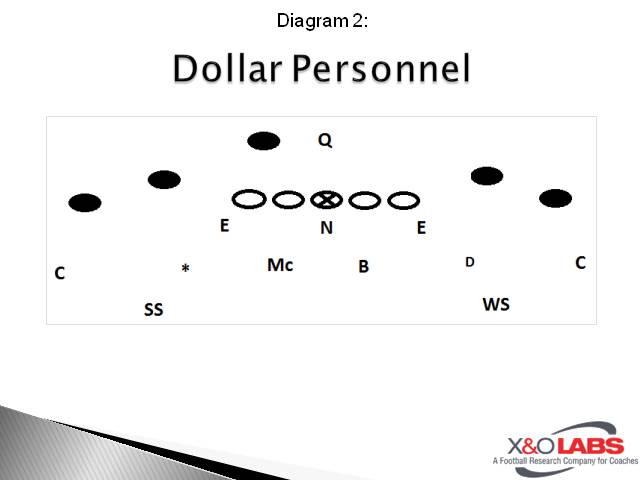
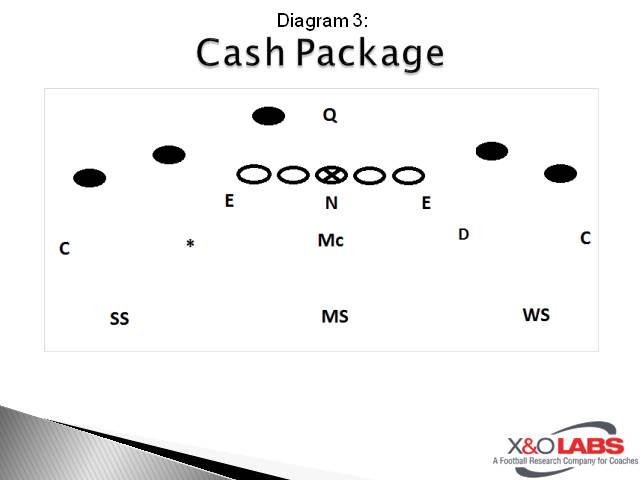
Defensively we are multiple in our personnel packages and in our mode of attack. For this report, we will mostly be dealing with our sub packages, which are listed and shown below:

Nickel: 4 lineman, 2 linebackers, 5 Defensive backs (Diagram 1)
Dime: 4 lineman, 1 linebacker, 6 defensive backs (Diagram 1)
Dollar: 3 lineman, 2 linebackers, 6 defensive backs (Diagram 2)
Cash: 3 lineman, 1 linebacker, 7 defensive backs (Diagram 3)

Slide1Slide2Slide3

Basic Cover-Down Rules for Sub Personnel:

Star: Cover down on number 2 to the passing strength. If we are in man to man, he must bring the Money over if three receivers. This is an automatic “Coin” alignment. He must establish the strong side with a “Lucky” or “Ringo” call.

Money/Don: Cover down on number 2 away from the passing strength, unless “coin” is called aligning him to the three receiver side.

Mac: Cover down on number 3 receiver to the passing strength. If the Money “Coins,” he will then cover the # 2 receiver away.

Buck in Dollar Package: If in the package, he will align away from the Mac.
Strong Safety: He aligns to the strong side.

Weak Safety: He aligns to the weak side.

Middle Safety in Cash Package: If in the package, he will align in the middle third as a starting point.

Corners: They will be designated as left and right. Sometimes we will assign a corner to a certain side of the formation depending on receiver distribution, field-boundary, etc.

Read More

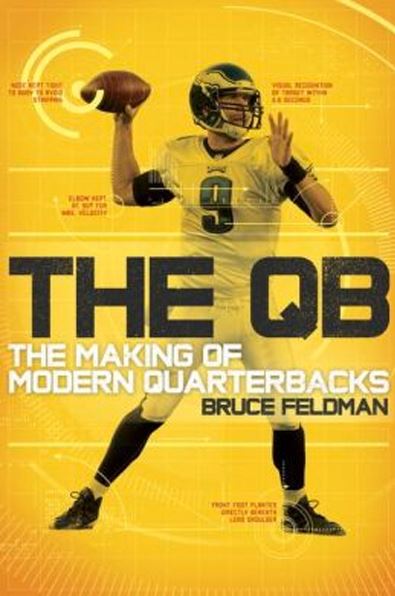
The Making of the Modern Quarterback

By Bruce Feldman

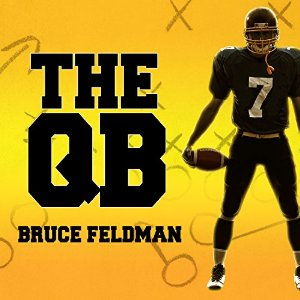
Editor’s Note: The following is a transcribed interview between XandOLabs.com Senior Research Manager Mike Kuchar and Fox Sports college football analyst Bruce Feldman. Feldman just completed his fourth book The QB: The Making of Modern Quarterbacks which can be found by clicking here.


Introduction:

bookcover

After reading Bruce’s fourth book (after previously reading the first three), I found this one to be a telling narrative on the process the more prominent quarterback trainers use to develop their clients to get them NFL ready. Bruce is known for getting all-access availability to tell his stories, so I wasn’t surprised that he was given cart blanche into Trent Dilfer’s Elite 11 Organization and how the most well known quarterback gurus develop their clients and prepare them for the scouting combine and the NFL draft. Bruce’s piece was centered around five specific personalities that work with these quarterbacks:

The Gurus:


Trent Dilfer– Head Coach of the Elite 11 quarterback camp and ESPN analyst. Former Super Bowl champion quarterback with the Baltimore Ravens.

George Whitfield Jr– Founder and owner of Whitfield Athletix who has worked with Johnny Manziel and Cam Newton and who is currently working with Jameis Winston and Bryce Petty for this spring’s NFL Draft.

Yogi Roth– Host and analyst for the ‘Elite 11’ quarterback show on ESPN, college football analyst for the Pac-12 Network who also co-authored his first book with Seattle Seahawks Coach Pete Carroll titled Win Forever.

Tom House– Former pitching coach at the University of Southern California who also played–and coached in the Majors, later helping Nolan Ryan and Randy Johnson, among others. He also trains NFL quarterbacks such as Tom Brady and Drew Brees. He was also portrayed in the movie “Million Dollar Arm” which released in 2014.

Steve Clarkson– Ex CFL QB who is the founder and owner of Dreammaker Academy and has tutored the likes of Ben Roethlisberger, Matt Leinart, Matt Barkley and Jimmy Clausen.


The Interview:

Mike Kuchar (MK): Dilfer makes a lot of references to “dude qualities” citing the intangibles that makes quarterbacks special. He refers to his four intangibles: competitive temperament, functional football intelligence, passing proficiency and trainability. He talks about thermostat vs. thermometer, being able to feel pressure and respond to it. He mentions specifically that this is not and inherent trait, but can be developed over time. How does Dilfer develop it? What can coaches at lower levels do to facilitate this trait?

Bruce Feldman (BF): What I found so interesting about Dilfer is not only is he consumed by the world of the QB, but he’s savvy enough and connected enough to have taken his passion and devised a 3-dimensional game plan that he’s put in effect to leverage his big ESPN platform and seed it down to the grass roots level. In regard to something like the thermostat vs. thermometer leader and how Dilfer believes that can be developed, I think back to something David Blough, now the QB at Purdue told me about how he had studied previous Elite 11 shows on ESPN. This is what Blough said:

“I learned it’s about a lot more ‘mental,’ the leadership and being able to adapt and make plays work,” Blough later told me. “It’s a lot more than just being able to throw the ball. It’s all about how you’re wired, how you work. A thousand kids can throw the ball, but it’s the intangibles that separate you. They (the good ones) really stress it. That was something I had to focus on if I wanted to be noticed. I was slapping people’s hands when they caught a pass for me; I tried to bring high energy, and it seemed to work. So it’s stuck with me.”

Read More

Defending Unconventional Offenses Case 1: Front Structures and Line Play

By Mike Kuchar
Senior Research Manager
X&O Labs
Twitter: @MikeKKuchar

Introduction:

We’ll start by sharing something you may not know… 61 percent of you will face either a Single Wing, Double Wing or Wing T offense this fall. It’s a fact that has been confirmed by our research. Sure, these schemes may have the perception of being gone by the dawn of the forward pass, but the reality is these offenses are not going away and you’ll need to be ready to defend them. And if you’re in the majority of coaches (37 percent) that wait until game week to prepare for them, your chances of success are limited. In order to shut them down, you’re going to have to start now. But don’t take our word for it. Much of the research we present in this special report was targeted on coaches who specifically have had success against these schemes, those who have won more than 50 percent of their games against these offenses.

When we talked to these coaches specifically on how they were successful, all of them credited the success of their defensive line. So in this case, we are going to provide our research on how coaches prepare their defensive lineman on recognizing the blocking schemes of these offenses. More importantly, it details how hand placement and block recognition contribute to success along the front. These offenses are based on deception and one false step could mean one big play. This section will present what we found as the most effective fronts you need to be in and the types of techniques necessary to better defend the run concepts presented in these offensive schemes.

Before we report our findings, we thought it was necessary to detail the layout of this report. But first, let me explain what this report is not:

  • This is not a report that includes option schemes. Sure, some Wing T, Double Wing and Single Wing teams do incorporate option football, but this is a topic that is in and of itself and something that will be covered in depth in a future report.
  • This special report is focuses solely on the run game of these offenses. Now, we can hear the coordinators of these schemes screaming “but the play-action is lethal and a big component of our offenses.” We understand that, but it was our belief (backed by other defensive coaches’ assertions) that the Wing T, Double Wing and Single Wing offense is based on the run game. So that’s the priority in which we placed this report.

What we are presenting is our research on defending the Wing T and Single Wing offense as it pertains to the following components:

Case 1: Defensive Line Play
Case 2: Second Level Keys and Reads and Primary Coverages
Case 3: First and Second level Movements to defend particular Wing T, Double Wing and Single Wing run concepts

We also felt that in order to present the defensive viewpoint on defending these schemes, we needed to completely understand these schemes. So, we reached out to a select group of coaches who run the Wing T, Double Wing or Single Wing offenses, coaches who have won a total of 19 state championships, to simply ask them how they would defend their own offense. Now although they spoke candidly, they did speak anonymously (we don’t want to expose this secret society) about which kinds of defenses hurt them. We labeled these sections the “What Would (Wing T/Single Wing) Coaches Do?”

Glossary: 

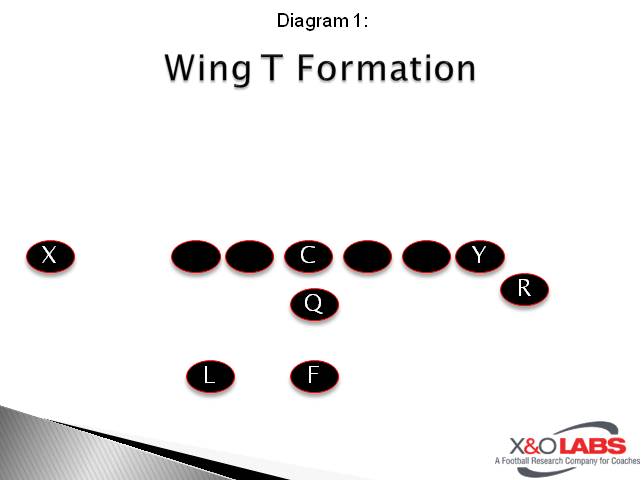
Wing T offense: Now the Wing T is divided between traditional forms of the Wing T and hybrid forms. But for the most part, the Wing T offense is centered around traditional “1 and 9 formations” (Slide 1) and package run concepts like buck sweep, down, belly, counter and trap.

Slide1

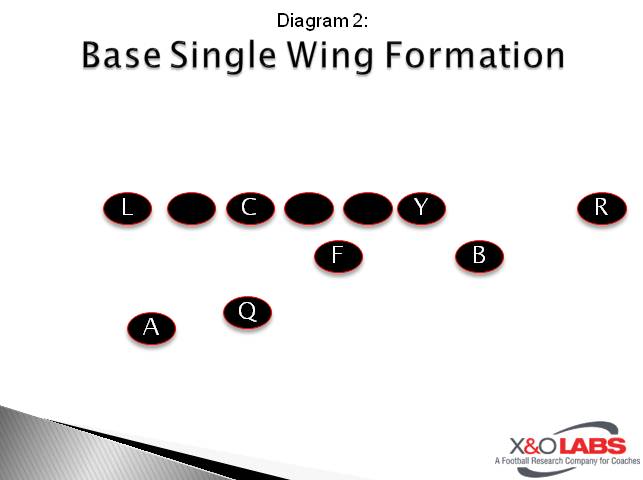
Single Wing offense: The Single Wing offense is centered around an unbalanced line of scrimmage that consists of a long side (center, guard, tackle, tackle, wing back) and a short side (guard, tight end). The backfield consists of a sniffer back, quarterback and running back. There may also be a single receiver on the flank (Slide 2). This offensive run game will consist of perimeter plays like Sweep and off-tackle plays like Counter and Power.

Slide2

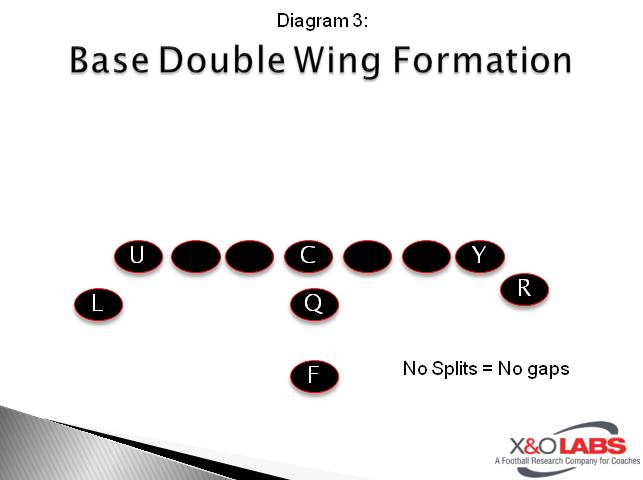
Double Wing offense: The Double Wing offense is similar to the Wing T, but presents a total of ten gaps on the line of scrimmage by consisting of two tight ends, two wing backs a quarterback and a fullback (Slide 3). This offensive run game will mix a good dose of off-tackle schemes like Power and Sweep with misdirection like Counter.

Slide3

Read More

Defending Unconventional Offenses Case 2: 2nd & 3rd Level Player Reads / Coverages

By Mike Kuchar
Senior Research Manager
X&O Labs
Twitter: @MikeKKuchar

Linebacker Reads in Defending the Wing T:

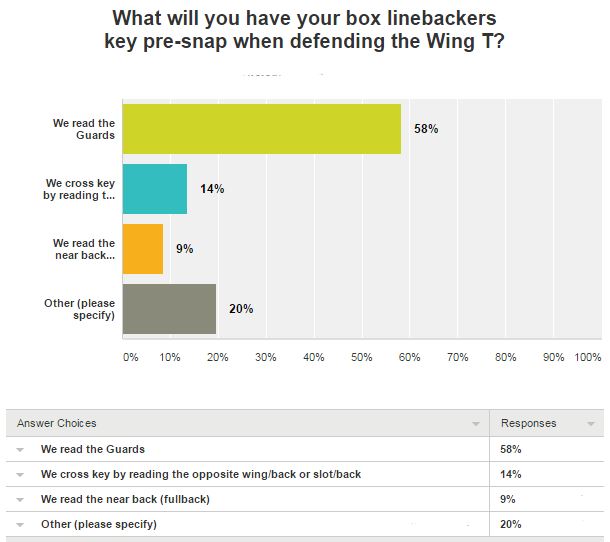
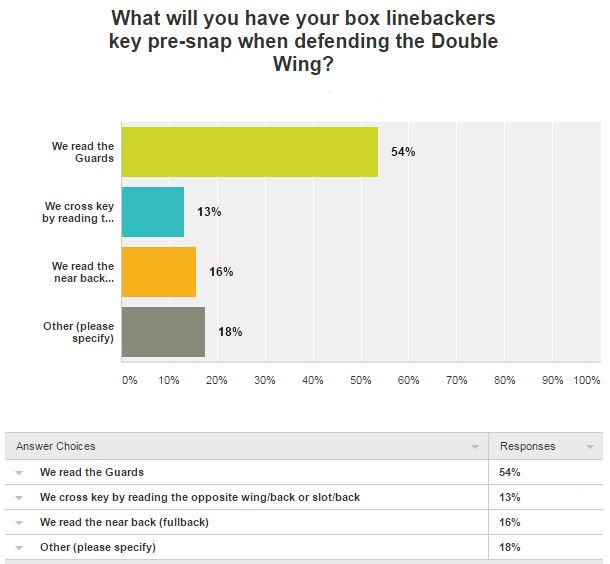
It is without question that second and third level post-snap reads need to be sharp when defending these offenses. One false step can equal one big play, which is why we wanted to devote an entire case study on how coaches are teaching their defenders to react to defend the run game of these teams. Regardless of the defensive scheme, we wanted to ask coaches what they were telling their box defenders to read post-snap. This could mean the three linebacker set in a 4-3, the two box linebackers in a 4-2-5 or the two box linebackers in an odd front. The perimeter players are not included in this section. For years, defensive coaches have been preaching to “read the guards” when defending these misdirection offenses and it seems that advice still holds validity today considering it was our number one response. Consider the percentages:

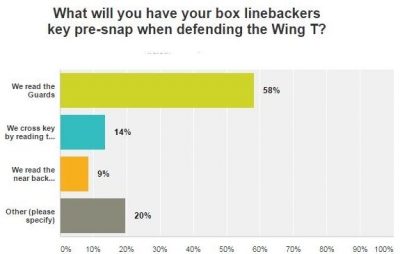
58 percent of coaches that defend the Wing T will tell their box linebackers to read the guard.

graph13

54 percent of coaches that defend Double Wing offenses will tell their box linebackers to read the guard.

graph24

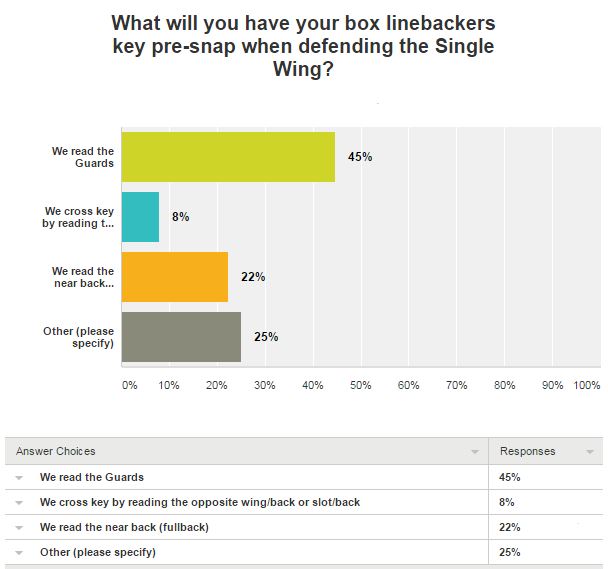
45 percent of coaches that defend the Single Wing will tell their box linebackers to read the guard.

graph35

This is mainly due to coaches who will have box players read the sniffer back (fullback) which we will detail later.

Guard Read Protocols:

Jerry Gordon, one of the more experienced coaches we spoke with, and the0 Defensive Coordinator at Broad Run High School (VA) who wrote a book on his Under front which can be found here. Against Wing T offenses, he’ll have his Mac (Mike linebacker) and Will read the guards out of his Under front. The Mike is playing the bubble, so he’s got a clean vision. “We want them on the guards,” said Gordon. “Those guards will pull if it’s true Wing T. Many coaches talk it being difficult to get reads nowadays, but if it’s a good true Wing T teams those players are going to move. If they don’t move they are not a true good Wing T team. It’s a better read than cross-keying.”

To see cutups of Coach Gordon’s box linebackers defending the Wing T run scheme, click on the video below:

Read More

Defending Unconventional Offenses Case 3: Movements & Pressures to Attack Run Concepts

By Mike Kuchar
Senior Research Manager
X&O Labs
Twitter: @MikeKKuchar


Movements to Defend Wing T Run Concepts:

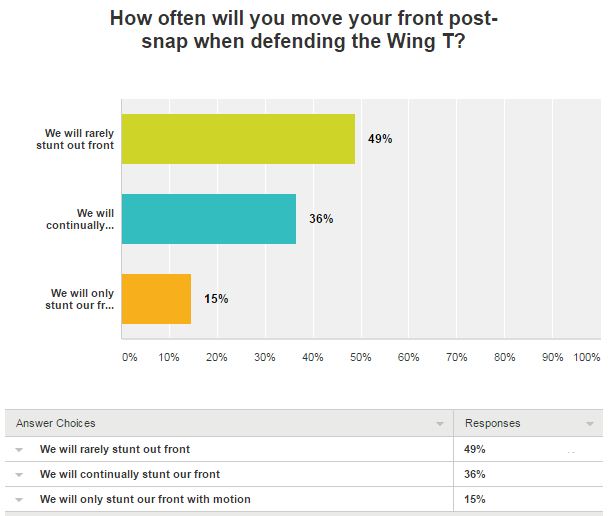
There seems to be conflicting opinions on whether or not to move the defensive front post-snap when defending the Wing T. According to our research, 49 percent of coaches choose not to move their front post-snap when defending the Wing T run game. While 35 percent will continually move their front and 16 percent will only stunt with motion.

graph11

Movements in Four Down Fronts:

Sparta High School, a perennial public school powerhouse in New Jersey has had success defending Wing T run game from its 4-2-5 front by mixing in several post-snap run movements by its first level defenders. On almost every play, Defensive Coordinator Christopher Kappelmeier will make sure one or more of his defensive linemen will be stunting into the adjacent gap or across the face of the offensive man and he’ll teach the proper stunt technique early in the preseason and practiced regularly. Many of them are gap exchanges which include second level linebackers as well.

“The linebackers need to know which gaps the defensive linemen are stunting into at all times because they will need to fit those gaps that are opened by stunting linemen should the flow head in that direction,” said Kappelmeier. “By moving our defensive linemen and linebackers on most plays, we make it very difficult for offensive linemen to execute their blocking schemes, particularly man or gap blocking schemes like the Wing-T.

“At Sparta when we practice our gap exchanges we do it during the inside run period. It is vital that the stunting linemen and linebackers be able to read and react while moving. Defensive linemen learn by repetition to read the offensive linemen toward whom they are stunting. Linebackers learn by repetition how to fit open gaps and not get caught between stunting defensive linemen. We have found that the movement of the defensive front, even if it doesn’t seem to be fundamentally sound on paper, very often creates situations in which defenders are totally unblocked and in position to make big plays. Pre-snap we try to look the same every play. The only player who may need to change his alignment is the nose. If he is stunting into the B gap, he aligns in a 2i-technique. This does not telegraph his intention to stunt because that is his alignment in the tight G front which is used often.”

Movements defending Strong Side Run Game:

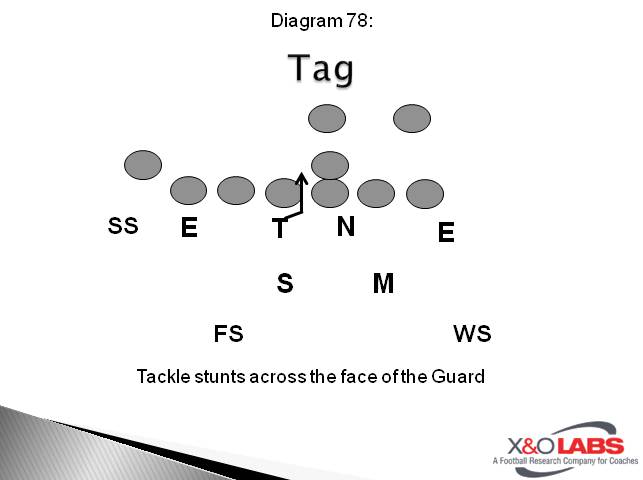
One of the more frequent movements Kappelmeier will use against the Wing T is his “Tag” stunt (Slide 78). It is a single tackle stunt highly effective against the fullback trap. It is also very useful against many other Wing T plays because it gets the defensive tackle moving toward the halfback, which is the direction of a many wing T running plays. “The movement of the tackle, across the guard’s face, makes it almost impossible for the guard to cut him off. If the guard is pulling away, the tackle can jump in his pocket and follow him right to the ball carrier. This technique makes it very tough for the offensive center assigned to block back on the defensive tackle.”

Slide78

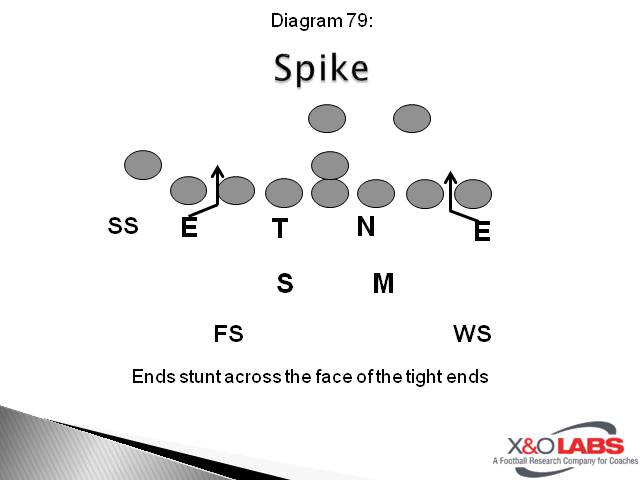
Kappelmeier will use his “Spike” movement (Slide 79) against the strong side Wing T run game. “The normal technique of the defensive end is to read the movement of the offensive tackle. Because so many of the Wing T plays involve the offensive tackle down blocking on the 3-technique, the defensive end will be bending inside often. However, stunting the defensive end inside the tight end on the snap eliminates any possibility of getting washed down inside. The proper technique will put the defensive end into the path of the pulling guards on the buck sweep, belly down, power, and strong side waggle. Keep in mind that the base defense uses linebacker type athletes at the defensive end positions. They are expected to be quick enough to avoid the down block of the tight end when they stunt inside.”

Slide79

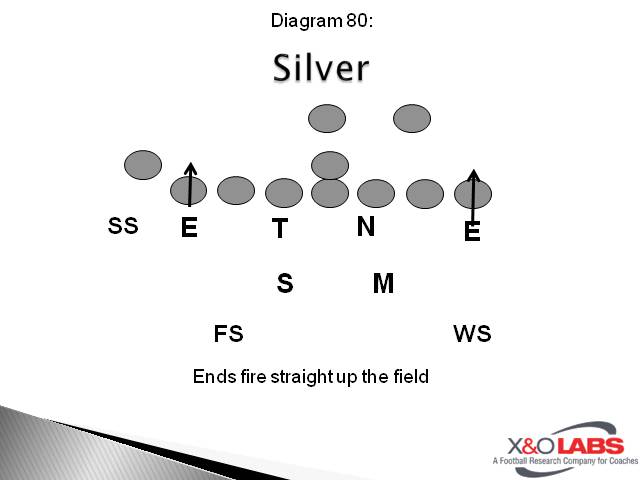
To defend buck sweep, Kappelmeier will use his “Silver” movement (Slide 80). “After several stunting inside or bending with the movement of the offensive tackles, the aggressive up the field movement of the defensive ends provides a change up in technique and discourages the tight end from anticipating the inside movement of the defensive ends.”

Slide80

“Aim” (Slide 81) is a movement that is highly effective against the fullback trap. “The tackle stunts across the face of the guard into the A-gap allowing him to blow up the trapping guard and force the fullback to bounce outside. The Sam linebacker will quickly fit the B gap when reads flow because he is aware that his tackle has closed the A gap.”

Read More

Offensive Line Drills for Up Tempo Offenses

By Brian White
Offensive Coordinator
Rose Hulman Institute of Technology
Twitter: @CoachWhite_RHIT

Introdution: 

Everything we do in our offense is about operating with great tempo.  In order to play with tempo, you must practice with tempo.  This is especially true for the offensive line.  We want our individual period to move quickly by eliminating lines and wait times.  Our reps are maximized by having as many players as possible work at the same time.

Pre-Practice

At Rose-Hulman, our practice field is separated form our campus by a bridge.  This is a great device to let our players know that as soon as they cross the bridge they are locked in and ready to go to work.  Each position group has a certain set of drills they do as soon as they cross the bridge.  This puts them in a working mindset even if they are out to practice early.  

The offensive line will work a circuit of drills that highlights almost all of the skills they require to be successful during a game.  One of the reasons we choose to run an up-tempo offense is because of the limited practice time we have.  We believe it is critical that the offensive line is working the entire time they are on the practice field.  Our pre-practice circuit is one of the methods we developed to have our offensive line constantly working.  This helps both improve their conditioning and gets them used to the constant activity of an up-tempo offense.

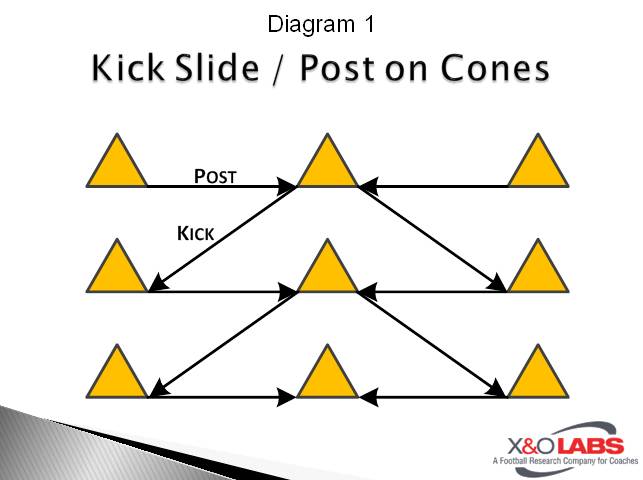
Pre-Practice Drill #1 – Kick-Slide/Post on Cones 

Slide1

In the first portion of the drill circuit, the OL will perform the Kick-Slide/Post on Cones Drill.  Three lines of cones are set up with each cone about 3 yards from each other.  The lineman will start on the top left cone and assume a great pass pro demeanor for an offensive lineman on the left side of the line of scrimmage.  He will post to the center cone, then kick to the next cone on the left.  Once he gets to the third center cone, he will hustle to the top right cone and repeat the drill as an offensive lineman on the right side of the LOS.

In this drill, we want to ensure that the offensive lineman is using a proper tilt to keep the weight down the center of his body.  The shoulder in the direction that the lineman is moving should be slightly raised.  This will prevent too much weight being placed on the outside foot on the kick-slide, and the opposite on the post.  Keeping weight down the center of the body is critical to staying balanced throughout the entire rep of pass protection.

We are also looking for the offensive lineman to understand the importance of keeping his post foot up through the entire drill.  The feet of the offensive lineman should stay tight to the ground throughout the entire rep.  Keeping the feet close to the ground allow for redirection on any rush move by a defensive lineman.  We coach the feet of the offensive lineman to move independent and equidistant from one another.  Feet move in sequence, as opposed to hoping, and each step covers the same amount of ground.  This keep a power position and great demeanor through the entire course of the block.

To see video of Coach White’s Kick Slide/Post Drill, click on the link below:

Read More

Program Development Case 1: Coaching Philosophy

By Mike Kuchar – @MikeKKuchar

Senior Research Manager

X&O Labs


Introduction

This report is a first for XandOLabs.com.  We’re accustomed to spending hours upon hours researching football’s latest trends as it pertains to scheme and fundamentals.  This special report is focused around something totally separate (and often more important) than the schemes of the game- the core of building a successful program.  We started our research months ago by developing questions to target successful head coaches in the sport.  We wanted to know the “why” behind their success.  Why they won championships. Why they won titles?  What specifically made them successful?  So we developed a 30-question survey that we distributed to our entire reader base- over 26,000 coaches at all levels.  Since 95.7 of coaches that responded to our survey were head high school coaches (reasonably so due to conflicting NCAA spring ball periods) we tallied their responses and detailed them in the report below.

But before we present our finding, it’s important to note we did something else that was totally different than previous reports- we segmented our research into separate areas.   We wanted to target successful head coaches in this research and while we’re quick to point out that success is not all about wins (there are certainly too many other variables that add into that equation) winning is truly the main benchmark that we used to separate our readership.  We decided to segment our research into the following groups:

All Groups- All Head Coaches that took our survey.  Naturally, this equates to 100 percent of those surveyed.

Group 1- Head Coaches that have won at least 75 percent of their games over the last three seasons.  This equated to roughly 33 percent of those surveyed.  These coaches have won at least three-quarters of their games as a head coach since 2011.

Group 2- Head Coaches that have won less than 25 percent of their games over the last three seasons.  This equated to roughly 13 percent of those surveyed.  These coaches have won less than three-quarters of their games as a head coach since 2011.

Group 3- Head Coaches that have won between 2-5 championships (at the league, county or state level) in their careers.  This equated to roughly 31 percent of those surveyed. 

Group 4- Head Coaches that have won between 6-10 championships (at the league, county or state level) in their careers.  This equated to roughly 11 percent of those surveyed.    

Group 5- Head Coaches that have never won a championship at any level.  This equated to roughly 29 percent of those surveyed.

This format is different than what we usually produce and for good reason.   We really wanted to examine the difference between successful coaches and non-successful coaches, as it pertains to wins.  Of course, when first designing this research we weren’t sure that there would be a distinction but we were quickly assured there was- in fact quite a substantial difference- between what successful programs do and what unsuccessful programs do (or do not do for that matter).  What is traditional as it pertains to our format, is we separated our findings based on three categories: 

Case 1- Coaching Philosophy and General Methodology

Case 2- Off-Season and In-Season Preparation

Case 3- Offense, Defense and Special Teams Structures

Case 1 – Coaching Philosophy

Introduction

This case is centered around coaching philosophy and style- from creating mission statements to developing a mental training regiment.  We take something from all of our categories of coaches.  What worked?  What didn’t work?  What common mistakes do unsuccessful programs make?  How do great programs win?  Why take a job? Why resign from a job?  How old is the right age to become a head coach?  Thousands of coaches chime in with lessons learned from their greatest teacher- experience.

Read More

Program Development Case 2: Off-season and In-season Preparation

By Mike Kuchar – @MikeKKuchar

Senior Research Manager

X&O Labs


“Failing to prepare is preparing to fail.”  We’ve read this mantra in too many weight rooms, meeting rooms and practice facilities.  While it may be trite, it is profoundly true.  Successful head coaches master the art of preparation and this case is devoted to preparation.  It’s focused around off-season development of a football program, from strength and conditioning to developing team building to conducting practice.  We knew that many coaches were interested in this facet of the game, because it relationship to success is evident.  Here, we present our research on what makes those coaches “win” in the off-season and how they prepare themselves to win during the season. 

But before we present our finding, it’s important to note we did something else that was totally different than previous reports – we segmented our research into separate areas.   We wanted to target successful head coaches in this research and while we’re quick to point out that success is not all about wins (there are certainly too many other variables that add into that equation) winning is truly the main benchmark that we used to separate our readership.  We decided to segment our research into the following groups:

  • All Groups- All Head Coaches that took our survey.  Naturally, this equates to 100 percent of those surveyed.
  • Group 1- Head Coaches that have won at least 75 percent of their games over the last three seasons.  This equated to roughly 33 percent of those surveyed.  These coaches have won at least three-quarters of their games as a head coach since 2011.
  • Group 2- Head Coaches that have won less than 25 percent of their games over the last three seasons.  This equated to roughly 13 percent of those surveyed.  These coaches have won less than three-quarters of their games as a head coach since 2011.
  • Group 3- Head Coaches that have won between 2-5 championships (at the league, county or state level) in their careers.  This equated to roughly 31 percent of those surveyed. 
  • Group 4- Head Coaches that have won between 6-10 championships (at the league, county or state level) in their careers.  This equated to roughly 11 percent of those surveyed.    
  • Group 5- Head Coaches that have never won a championship at any level.  This equated to roughly 29 percent of those surveyed.


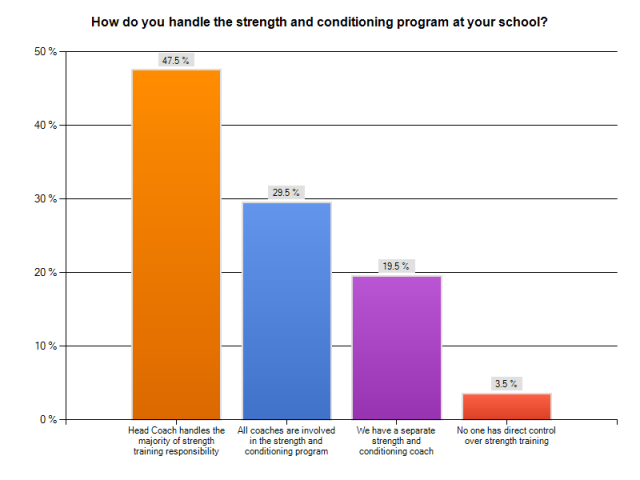
Question:  How do you handle the strength and conditioning program at your school?

When surveying all groups, 47.5 percent of coaches say the head coach (themselves) handles the majority of strength training responsibility.   This was pretty consistent among all our groups- both successful and unsuccessful.  Many programs did not have a separate strength and conditioning coach, the largest group that did was a 20.9 percent response rate from those in Group 1- coaches that have won at least 75 percent of their games over the last three seasons. 

ChartExport 3

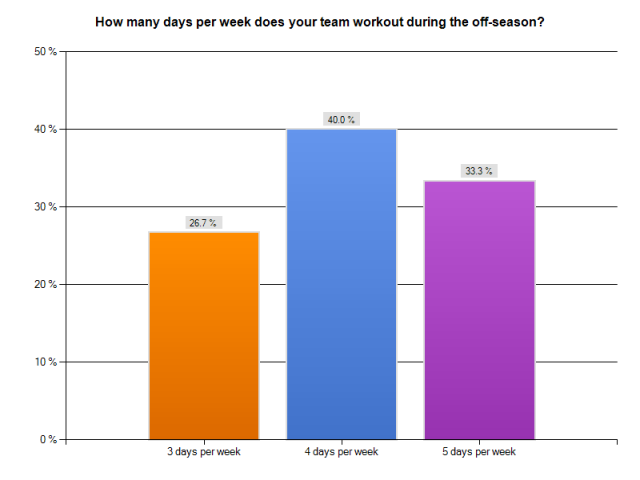
Question:  How many days per week does your team work out during the off-season?

It seems that four days per week seemed to be the majority response-with over 52 percent of coaches from all groups selecting this response.  We did find that 40.7 percent of those coaches that won 25 percent of their games or less over the last three seasons lift three days per week during the off-season (below). 

ChartExport 4 2

Question:  Do you conduct off-season mat drills in your program?

We defined mat drills as agility or plyometric drills done usually early in the morning to train discipline, speed and agility.  We found that 59.8 percent of all coaches are using a mat drill program while 40.2 are not.  A couple of interesting tidbits here.  Only 60.9 percent of coaches that have won at least six titles conduct mat drills during the off-season.  What was interesting here was that 67 percent of coaches from Groups 2 and 5 (those that have never won a title or won less than 25 percent of its games the last three seasons) do conduct mat drills.  Perhaps, the answer lies in the way in which these mat drills are conducted that equates to success. 

Read More

Program Development Case 3: Offensive, Defensive, and Special Teams Structures

By Mike Kuchar – @MikeKKuchar

Senior Research Manager

X&O Labs


In this final case, we are going to present our research on the most commonly used offensive, defensive and special teams structures by successful head coaches.  Now, we realize that this facet of our research could be completely arbitrary. After all, coaches all across the country have found ways to win with various schemes, often changing them to fit their personnel.  Still, we were curious to find if there was a common thread with certain schemes in championship level coaches.  After all, complete thoroughness is always the mantra of devoted research. 


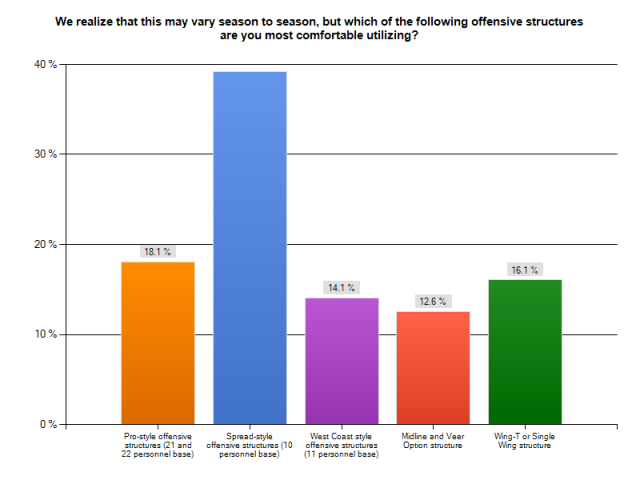
Question:  Which of the following offensive structures are you most comfortable using?

Among all group categories, 39.2 percent of coaches are using spread style offensive structures (10 personnel) as the base of their offensive system.  We didn’t find this to be surprising, but what we did find interesting was that the next most popular structure was pro-style personnel systems with 18.1 percent of all coaches selecting that option.

ChartExport 9

So, when we separated our research down into those specific groups and here’s what I found:

  • The majority (30.4%) of head coaches that have won between 6-10 championships choose to use pro-style offensive structures.
  • The majority (44.1%) of head coaches that have never won a championship choose to use a spread-style offensive structure.
  • The majority (41.0%) of head coaches that have won between 2-5 championships choose to use spread-style offensive structures.
  • The majority (48.1%) of head coaches that have won less than 25 percent of their games the last three seasons choose to use a spread-style offensive structure.
  • The majority (41.8%) of head coaches that have won more than 75 percent of their games the last three seasons choose to use a spread-style offensive structure.


Question:  What is something you’ve done recently on the offensive side of the ball that has benefitted your program tremendously?

Naturally, we targeted this question to those coaches who have won more than 75 percent of their games the last three seasons.  Their responses are below:

Group 1 Responses:

“Adding quick screens and short pass reads to our run game.”- David Buchanan, Head Coach, Mason County HS, KY [email protected]

“We have committed to running an up tempo option attack which has allowed our program to utilize players that may otherwise not have played.” – Matt McLeod, Head Coach, GraftonHS, [email protected]

“We had been an under center flex bone option team and recently switched to running it out of the shotgun. Our offense improved Rushing yards UC: 282 ypg Gun: 324 ypg Passing yards UC: 95 ypg Gun: 140 ypg Wins: UC: 8-2 Gun: 11-1.” – Rod Stallbaumer, Head Coach, Basehor-Linwood, [email protected]

“Implemented parts of the Nzone system especially the tempo. We scored the most points we have ever scored and we set a record for most points in a half in the NYS quarter final with 54 and scored 60 in the first half in the NYS semifinal against the #2 team in the state.” – Joe Whipple, Head Coach, Schalmont High School NY, [email protected]

“Working Wing T principles out of gun set.” – Sid Otton, Head Coach, Tumwater High School, msotton@comcast.com


We changed how we call our formations so that we can get the personnel we want in the right position. We also eliminated a lot of our playbook to concentrate on the base concepts we utilize.” – Steve Pyne, Head Coach, Central Catholic High School – Portland, OR., [email protected]

Read More

Adjusting Your Nakeds to Attack Coverages

By Derek Bedell

Offensive Coordinator

Wilson High School Long Beach (CA)

Twitter: @derekbedell17


Introduction:
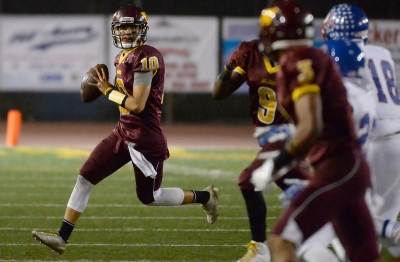
wilsonFor over 20 years, the inside zone and outside zone have been the primary run plays used in our offenses. One problem with zone based offensive teams is that they often have significant run tendencies based on specific formations, strength, or direction. Over the course of my career, I have found that one of the great ways to break tendencies is to use misdirection pass to keep defenses off balance. One of our favorites is the naked bootleg concept. Over the past four years, our naked bootleg package has accounted for 50% of our play action passes and nearly 30% of our total passing yards. The beauty of this concept is that it works against any coverage at anytime from anywhere on the field. Here is a look into what makes this play work so well.

Coaching Linemen and Backs:

The offensive line and tailback are where the zone boot concept begins. If those six players do not sell the run, we will not be able to make the bootleg concept work. For that reason, they are told that their sole purpose on this play is to sell the run. Since this is a naked bootleg we are not relying on the offensive line to provide any stout physical pass protection for our quarterback. This allows our OL and TB to carry out their individual run blocking assignments with full conviction.

Since it is a pass, it is critical that the OL does not extend their blocks up to the second level. We teach them that they should work to extend the play laterally instead of vertically in order to really sell the concept. As part of this technique, they are taught to run through the outside shoulder of the defender on the play side of them. We also teach the TB to sprint to the sideline and bury himself in the offensive line. This exaggerates the flow of the play to the sideline and forces the defense to react.

QB Footwork and Fundamentals within the Zone Bootleg:

Like the offensive line and running back, the quarterback must do his part to sell the zone. Here are a few key areas the quarterback needs to focus on to make this an effective concept:

Selling the fake to the running back: If the quarterback is under center, we teach him to follow the TB with his eyes for a split second. This will attract linebackers and safeties who key on the eyes of the QB. If the QB is in the shotgun, he should slide with the running back keeping the ball seated in the TB’s belly for as long as possible.

Depth & Snap: The QB must get depth away from the line of scrimmage (LOS) and snap his head around to find the unblocked DE. The depth will allow for some extra time to snap his hips around and get the ball off if necessary. It also creates separation from the DE allowing him to get around him to the outside.

Attack the LOS: The QB must make himself a run threat. This puts a strain on the defensive coverage and also creates indecision for linebackers.

Read and Progression Philosophy:

Our philosophy for the quarterbacks read can be paraphrased as “dump and run.” Our number one goal is to get the ball in the hands of the player in the flat as quickly as possible. That said, it is not always possible, so we will have a deeper throw option for the QB to execute a high/low read on a specific defender.

We limit our QB to two throw options before he uses his feet as a weapon. This is done to encourage him to make a quick decision. He cannot hold onto the ball and take a negative play. The throw options are coverage and call based. The QB will understand that if we have tagged the X receiver to run a go route his two throwing options are the flat and the TE across route.

Base Naked Bootleg:

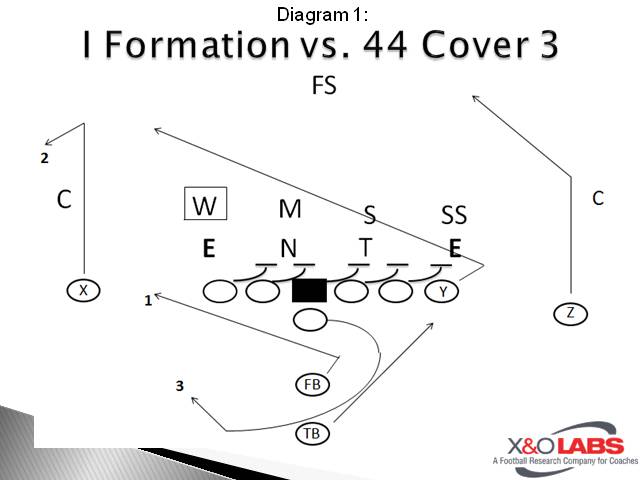
Our base bootleg package is initially installed out of the I formation and 21 personnel. I have found that installing it from this group makes it significantly easier for us to adjust the responsibilities of specific players for later options. When we are in 21 personnel, we see a lot of 8 man front defenses designed to stop the run. This is why we like to utilize this misdirection pass when we see over pursuing 8 man front defenses.
Slide1

Here are the players’ assignments out of this look:

Fullback: His first step is towards the run to sell the play action. This is vital to getting LBs to pursue the play. Next, he will change direction hiding behind the offensive line emerging in the flat away from the run call. He is the primary target.

Y Tight End:             His first step will be towards the run. He will then attack the opposite side of the field climbing to a depth of 15 yards on the opposite sideline. He is instructed to get in the vision of the quarterback, but he cannot stretch to far as to conflict with the play side wide receiver’s deep comeback.

X Receiver: The play side wide receiver will run a deep comeback. We like to drive the route to 18 yards and comeback to 15 yards. The depth of this route can vary the depth depending on quarterback’s arm strength or receiver speed. We also adjust the route to a streak or post if when we want to clear the picture up for the quarterback.

Read More

Beating 2 High with Inside Scissors

DeAndre Green 

Wide Receivers Coach

New Mexico Highlands University

Twitter: @CoachDreGreen

Introduction:

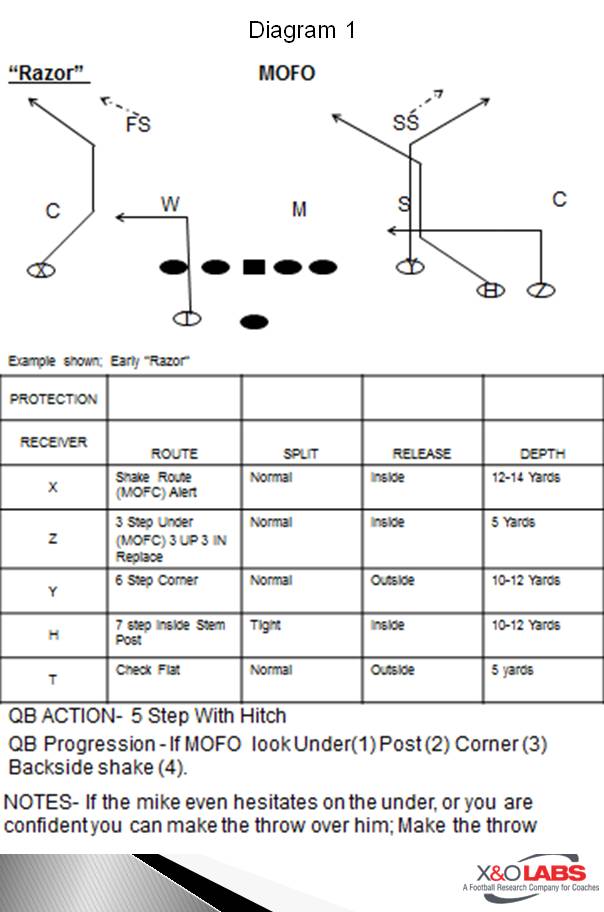
Here at New Mexico highlands we are a true Air Raid spread no-huddle team, very similar to Oklahoma state and West Virginia. Our pass game philosophy is to make the defense defend the whole entire field by occupying as many zones as possible. The following pass concept I would like to discuss is an inside variation of the Air Raid scissors concept. Traditional scissors puts stress on the CB and the SS by putting them in a bind with a post breaking away from the CB by the outside receiver and a corner route breaking away from the SS by the inside receiver. However, defense has made adjustments regarding the scissors concept. Usually you would get a “switch” call between the SS and the CB. What this does is allow for both players to pass off routes to one another. The SS would hold, turn his hips and run underneath the post, while the CB would fall off and wait for the corner route to come into his zone. Our inside scissors play which we call “Razor” is almost the same concept but, takes advantage of 2 hi safety teams by putting stress on the SS and middle linebacker instead of the CB.

Quarterback:

The first thing we would like for our QB to do is take a look at the defense and determine whether the middle of the field is open or closed (2 hi, 1hi). The reason being is because there are two different progression reads based off of the defensive coverage. We are primarily a progression read team; this means we tell our quarterbacks to look at his receivers in a particular progression to determine where to throw the ball. Once the QB determines if the middle of the field is open or close he now knows what progression he is going to make.

Concept:        

The “Razor” concept is a great 2hi beater. This concept is very flexible and can be taught as a key read, progression read or key progression read and can beat almost any coverage a defense may throw at us. We can run this play out of multiple formations; however we were more successful out of our 3×1 and empty sets. The “Razor” concept is a corner route by #3 receiver, an inside stem post route by #2 receiver followed by a under route by #1 receiver. This automatically puts stress on the SS because he has 2 verticals coming at him from the slot position and he has to choose one. The MLB is also in a bind because he has a under route underneath him and a post route in the hole behind him.     In addition, we want the inside stem because we want the SS to be in a bind with 2 verticals coming right at him. Also the inside stem gets the receiver a good angle to the middle post and gets him there faster. 

Assignments

“Razor” – (Middle of the Field Open)

(Z / #1 Receiver) = 3 step under. Outside foot back, burst out and on third step plant foot in the ground and stay flat at 5 yards across Mike’s face.

(H / #2 Receiver) = 7 step inside stem post. We tell this player it is very important to get a very good inside stem behind the Y. This player needs to be right behind the Y before he makes his break to the post. 

(Y / #3 Receiver) = 6 step Corner route. Y needs to always be lined up on the ball. It is very important that we get a good release from this position and get vertical to get the attention of the play side safety. WE CAN NOT GET JAMMED. It will throw the timing of the play off.

(X / Single Receiver) = Inside stem Shake route. The land mark for the inside stem is 7 yards up field and 2 yards away from hash. We tell this player to really get vertical to get that backside safety attention.

(T) = Check Flat. Always line up away from the trips side and block inside out if there is pressure. If there is no pressure we tell this player to release to the flat. We also motion this player out of the backfield and run smash concept backside.

(QB) = QB comes to the line and see MOFO and knows automatically that his pre progression read is Under (1) Post(2) Corner(3) Backside shake(4). We tell our QB we want to hit the post so if the mike even hesitates on the under throw the post behind him.   

Slide1


“Razor” – Middle of Field Closed

(Z / #1 Receiver) = 3 steps up 3 steps in Replace route. Outside foot back, burst out and on third step plant your foot in the ground and stay flat for 3 more steps and stop. We tell this player we want him to get the attention of the SS and the corner. Try to sit in the hole between the two.

(H / #2 Receiver) = 7 step inside stem post. We tell this player it is very important to get a very good inside stem behind the Y. This player needs to be right behind the Y before he makes his break to the post. 

(Y

Read More