



5 Ways to Maximize the Power Concept
By Justin Gumm
Head Football Coach/Offensive Coordinator
South Beloit High School (IL)
Twitter: @CoachGumm87
Introduction:
At South Beloit High School, we are a spread, no-huddle team that tries to get plays off at an average of 12 seconds between the ball being spot and snapped. Like many no-huddle teams, we signal in our plays and have up to 15 one-word play calls. In our offense, we have two base run plays; inside zone and power. Power, a play that we averaged 6.1 yards per carry for us last season, is the play we will be covering in this clinic report.
For our offensive line, simplicity is extremely important to me. The less they have to know, the faster they can play. We teach “fast minds equal fast feet.” Because we have only two run-blocking schemes, we must be multiple with what we do with our QB’s, WR’s, and RB’s in order to stretch the field horizontally and vertically. Below we will dive into the intricacies of how we get multiple with our “new age” ways to run power.
For a little perspective on the concepts we are going to cover below here is some data on how much we run these plays:
- Our Power blocking scheme accounts for 45% of our run plays.
- 32% of Power blocking scheme is Power Read.
- QB Bubble is the second most common at 19%.
- Power Give was the least last year at 10% of our Power blocking scheme calls.
Why Run Power?
Here is a shortlist of why we have chosen to make Power one of our two core running concepts:
- It is a play that allows us to have multiple double teams up front.
- It is a downhill, violent run play that allows you to get North and South with a high percentage of plays getting you positive yards.
- It is a scheme that forces defenses to prove their gap integrity and discipline by creating extra gaps at the point of attack.
- It is a simple scheme that provides great blocking angles for your offensive linemen.
- It is a scheme that can be run many different ways and has many answers to the various techniques teams will use to defend you.
Our Power Scheme
Here is a look at our scheme against 3 common fronts:
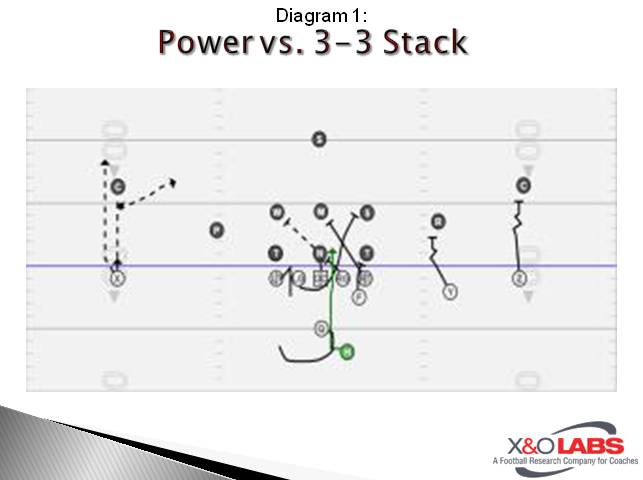
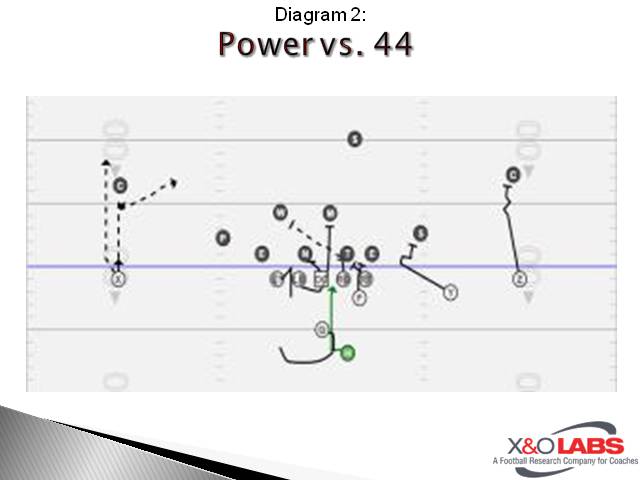
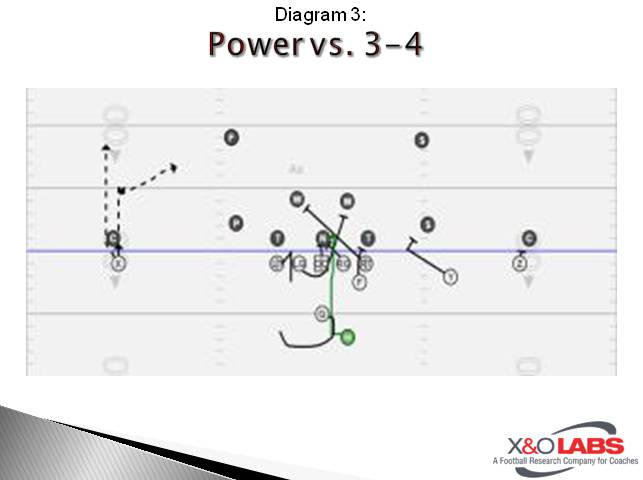
Responsibilities and coaching points include:
- Q – Pivot on the foot closest to the back. Bring the back side foot forward so you are perpendicular to the line of scrimmage. Extend the ball and make sure you get it into the belly of the back then boot away.
- H – Side shuffle toward the QB and scissor your feet (front foot should be to the QB). Get the football and attack play side ‘A’ gap. Stay tight off double team and follow back side pocket of pulling guard. Find seam and hit it! DO NOT BOUNCE IT!
- F – Kick out the play side end man on line of scrimmage (EMLOS). Take a downhill path and work inside out on that defender, stepping with the outside foot first. Your head must be on the inside number of the defender and use your hands and run your feet. If the EMLOS crosses the offensive tackle’s face, work up field and block the outside linebacker.
- X – Work inside run rules. Drive off ball to sell the fade, come to balance and stalk block defender over you. Be ready to drive the defender in the direction he wants to go. If you are a single receiver run the “Now” or a hand signal route.
- Y – Drive off ball aiming for the heels of the defensive linemen. Come to balance and cut off the alley player (OLB/SS).
- Z – Work inside run rules. Drive off ball to sell the fade, come to balance and stalk block defender over you. Be ready to drive the defender in the direction he wants to go. If you are a single receiver run the “Now” or a hand signal route.
- Play Side Tackle and Play Side Guard – Inside gap, Head up, play side gap or “inside gap to play side combo” (Covered/Uncovered rules). If an immediate threat is to the inside gap, you will down block on that player. If no immediate threat but there is a player head up or immediately in your play side gap, combo block with play side teammate. If no threat, work to the backside linebacker.
- Center – Similar to play side lineman above with the exception of having a defensive lineman anywhere from the backside A gap (1 technique) to the backside B gap (3 technique) as top priority. Note that we typically do not want to run towards a 1 technique, with a backside 3 technique, but it may happen.
- Back Side Guard – Skip pull for play side inside linebacker. We use skip pull to keep our shoulders square and get downhil

 With so many programs running the spread offense with a no-huddle tempo, it is critical to be prepared for any formation or personnel grouping, especially empty sets. Even teams that aren’t “Air Raid” style offenses are spreading the field more and almost every team that does spread the field has some sort of any empty package.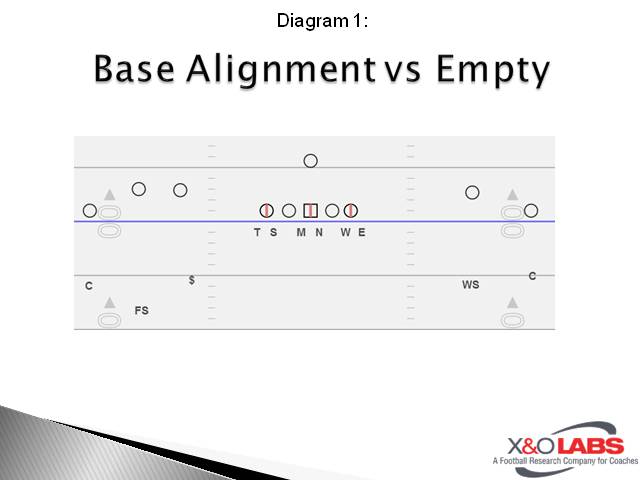


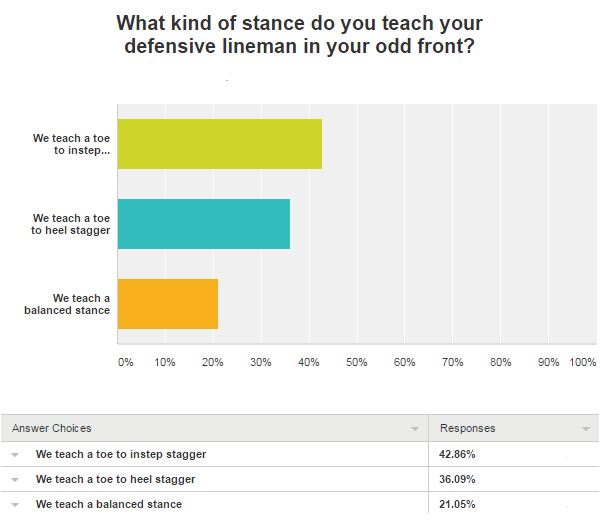
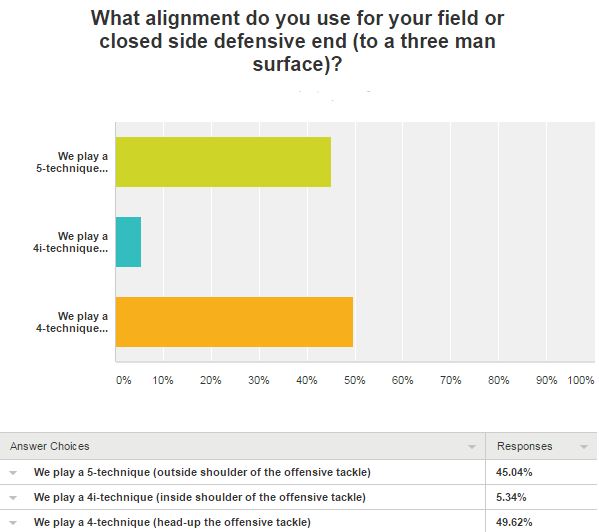
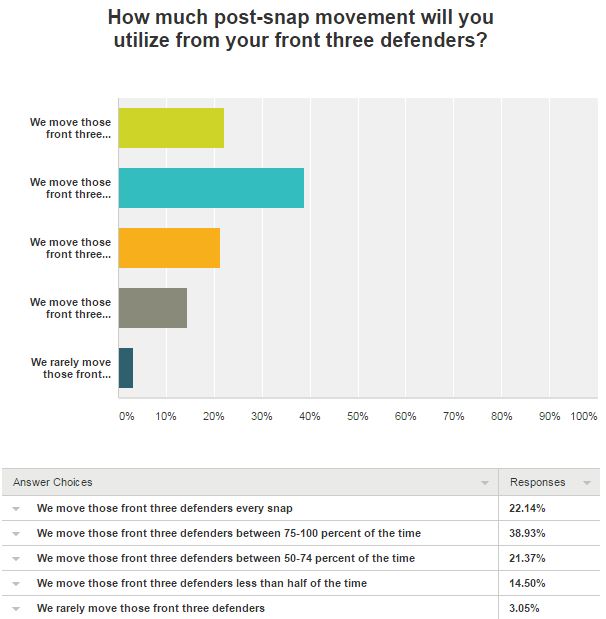
 For clarification purposes, the open side run game consists of concepts attacking the two-man surface side, away from the tight end or strength. The runs we focused on researching were specifically the spread option game, which encompasses the zone read and power read run game. Because there are different runs designed to both sides of the offensive formation (closed and open), most odd front coaches use different types of personnel to play these two positions.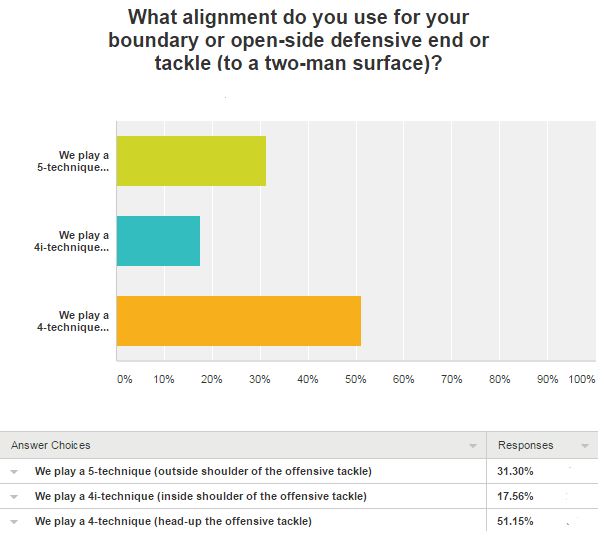
 At Rose-Hulman, our offense is predicated on running simple play concepts and executing them as fast as we possibly can. As with most Spread offenses, we also want to make the defense defend the entire width of the field at all times. This is one of the reasons why Outside Zone has become a staple of our offense. We can run this concept in one direction with a Run Adjustment, such as a Bubble or Smoke screen, in the opposite direction. While I will detail our “one word play packages” in another report, I wanted to give as much detail as possible in how we block the outside zone, one of our most productive play concepts.
 Whether it is 10, 11, or 12-personnel, the Trips formation can present some unique challenges to any defensive scheme and, depending on your comfort level of what you do, may require multiple answers.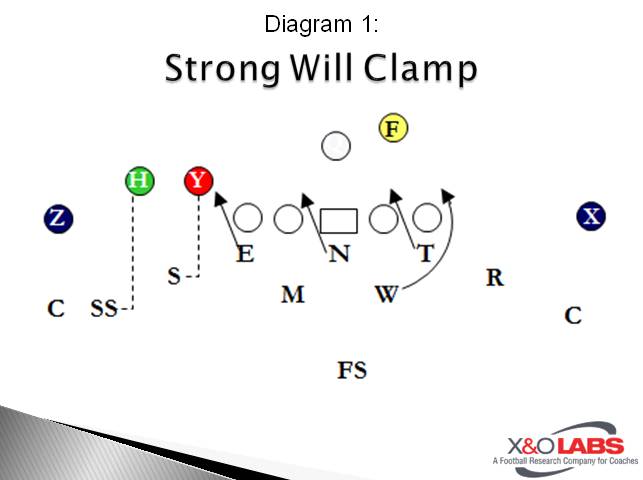
 Why is mixing science with quarterbacks so advantageous? You cannot argue with the scientific facts regarding the body and its functional ability. When we truly understand how the body works as a whole, we can then begin to figure out how to make our body perform to that optimal level as often and as possible. Playing the quarterback position may seem as simple as throwing a ball to a target, yet the complexity and kinematic sequencing that goes along with it is far from simple.
 Stopping the run. It has been and continues to be the most important job of any defense. That said, the task is getting harder to coach to this philosophy when teams are willing to pass the ball 80% of the time. And with that the days of having seven or eight players in the box are all but over.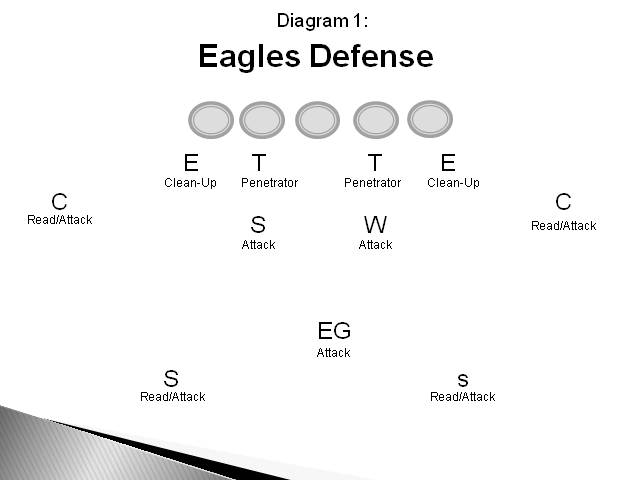
 Our offensive philosophy at Archbishop Spalding High School is to be a no huddle, multiple, downhill running team. The core of the offense focuses on the zone, power and counter run game from the pistol. That focus is complimented by quarterback runs, packaged plays and the focus of this article, play action shot passes.