OLB “Bite” and “Blood” Technique vs. Three Man Surface Runs

By Mike Kuchar
Senior Research Manager
X&O Labs
Twitter: @MikeKKuchar


Editor’s Note: The following research was conducted as part of XandOLabs.com special report on “Defending the Run with the Odd Front,” which can be accessed in full below.


Bite Technique, Tim Baechler, Canton High School (MI):

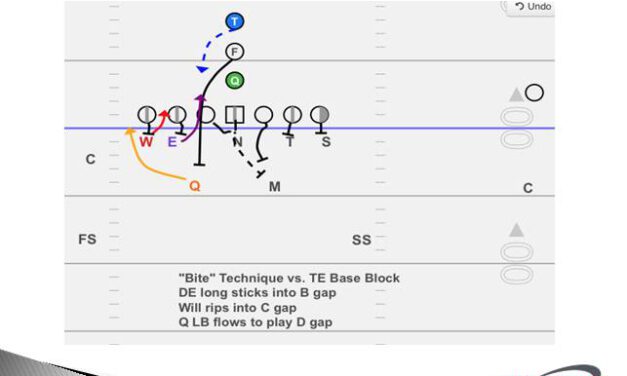
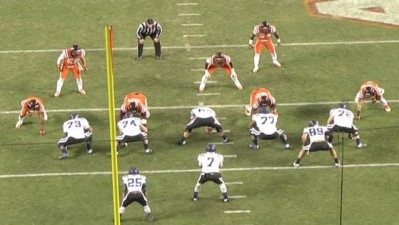
Coach Baechler will teach what he calls a “Bite Technique” to his outside linebacker against three-man surfaces, particularly if he is slanting to the field and the tight end is to the boundary or against two tight end sets. The purpose is to bounce the ball outside to the middle linebacker and primary support player. The Sam or Will linebacker is going to move to a head up situation. If the tight end bases him and he gets run action to him, the Sam will rip inside and be the C gap player while the Quick linebacker scrapes to be a D gap player (Diagram 34). The Will jams and closes to try to bounce and spill everything outside to the Quick who becomes the D gap player. If the tight end reaches the Sam, the Sam becomes the D gap player (Diagram 35).

Read More

Mix These 5 Coverages Behind Zone Pressures to Defend the Run and Pass

By Clay Iverson
Head Football Coach
Mukwonago High School (WI)
Twitter: @CoachIverson

Introduction:

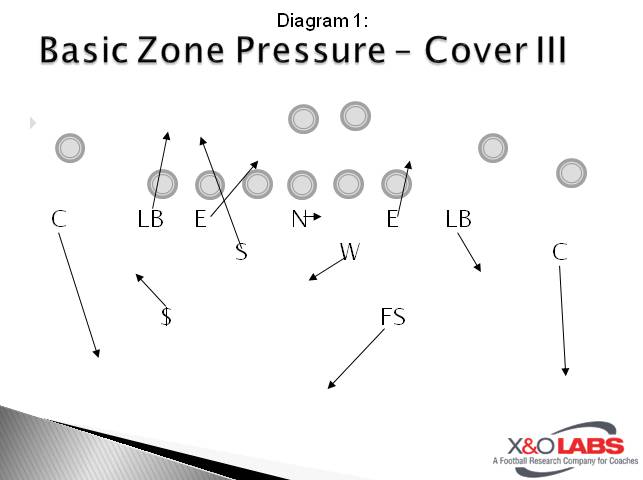
As we have developed our zone pressures, we have started to add different coverage concepts on the backend. We used to use Cover 3 exclusively and we did it the same way. This was a very effective way to cover down on your pressures and we will discuss. We found that as opposition coaches found ways to attack our one coverage, and quarterbacks were able to execute, we had to add a few more concepts; both to defend the run and pass from the back end of zone pressure. The concepts we will get into here are the base Cover III, Cover III Cheat, Cover II, Gator Coverage and Split Coverages.   

Why Zone Pressures

We live in a “why” society (which isn’t bad). Your players and assistant coaches want to know the why.  This forces the coordinator to make sure that he has good reasoning for what he is doing. We use to be a man blitz team or a zone pressure team that voided zones.  We believed that high school teams would be unable to pick up the pressures and even if they could, they would not be able to find the voided areas in their run and pass game.  We were right, for a long time, then we became less right as offensives started to evolve.  Finally, we knew we had to make a change because our “why” became “because we have always done it that way” – a very dangerous answer.

Varying Coverages within Zone Pressure

As we searched for a better way to call, execute and cover in our pressure packages we met with multiple college and high school staffs. Coach Steger, the incredibly well respect defensive coordinator at UM-Duluth, really has guided us through the process of making zone pressures a main stay in our defense. I have written before on the different pressures you can bring, and really they are as endless as your imagination, so instead of the pressures let’s look at the variations in coverage you can use in a very basic pressure. 

Cover III

Slide1

Coaching Points:

Very important to keep safeties on the hash until snap of the ball or they will tip the pressure. This might sound like coach speak but it has hurt us. Your back end kids will have plenty of time to get there. Here are some coaching points for the roll down safety ($ in Diagram 1).

  1. He should get no deeper than 7 yards of LOS when dropping into the flat. We use cones to teach this.
  2. Once the ball is snapped, the players don’t take their eyes off QB. They must remember they are in zone coverage and play the ball.
  3. Any receiver that tries to get down the seam must be rerouted. He should use his body position to force them outside to the Cover 3 corner.
  4. Keep the FS free and protect him.
  5. Make sure he keeps his shoulders square to LOS.  He can rally to flat, but if he turns his shoulders with a vertical route he is lost in run support and we have lost our flat player.

It is important that the safety that is rolling to the middle doesn’t over rotate and give up hips. He can be slow to go because he won’t be threatened until a deep route shows up.  The FS is needed in the run game on his side so if he bails to the middle to early, not only has he tipped your hand, but your run fits and spacing are a mess. 

Your corners have to understand they are cover 3 corners and if they have any #2 vertical threat they have to honor it and we will be light in the flat. We will teach our corner away from the pressure to be a little more aggressive as a lot of times the ball comes out fast his way.

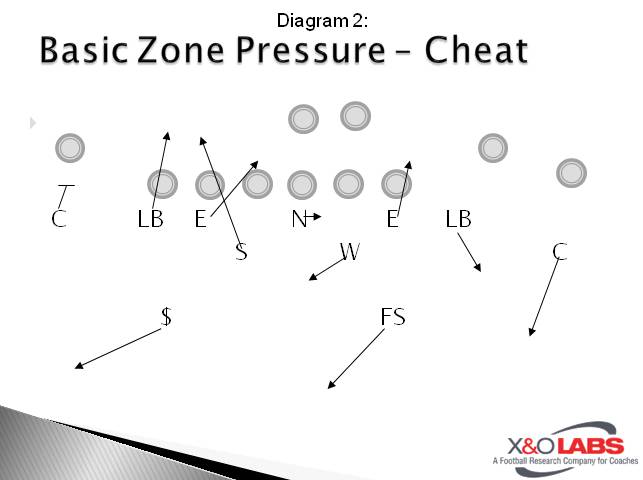
Cheat Coverage

Slide1

One of the important parts of any defense is knowing it’s weaknesses. If we are zone pressuring out of Cover 3, we understand the flats are weak in both quick game and in the jet and rocket series.  We can bring the same pressure but by cheating the corner we can be solidify the flat.

Read More

Attack Multiple Coverages Using Dig-Pivot Concept and Simplify Your QB’s Read

By Kyle Buresh
Quarterbacks & Wide Receivers Coach
Dakota Wesleyan University (SD)
Twitter: @KyleBuresh2

Introduction:

bureshThe Dig-Pivot Concept is a simple read for the quarterback and allows an offense to attack the defense in multiple coverages. The dig-pivot concept is an efficient concept that requires great timing from our quarterback and wide receivers. The quarterback reads the wall 2 defender, usually an outside linebacker, and makes him wrong based on the drop he takes in coverage.  The dig route is also very difficult for a cornerback to cover and run with if the receiver makes a great break.  Another great aspect with this concept is that the dig route stays on the move and the quarterback can throw the ball into the first window right out of the receiver’s break or the second window after he clears a dropping linebacker or safety.  The pivot route forces a wall 2 defender, usually an outside linebacker, to hold his ground or work to the receiver because the route is attacking the defender before breaking out toward the sideline which creates great timing to throw the ball into a great window.  The concept is simplified based on the quarterback’s pre and post snap reads.

In this report, we will discuss this concept against an open (2 High Safety) defense. We will discuss the following aspects of this concept:

  • Install of the routes
  • The concept out of a 2×2 formation with the Quarterback’s pre and post-snap reads
  • The concept out of a 3×1 formation with the Quarterback’s pre and post-snap reads
  • Quarterback progression

Routes

Dig: The outside or #1 receiver runs the dig route working to flatten out at 12 yards.  The receiver pushes vertical to ten yards before planting on his outside foot to make a speed cut which allows him to climb to 12 yards depth and then stay lateral aiming at the opposite sideline.  The receiver uses his inside arm to hammer back, helping him to maintain balance and accelerate out of his break.  It is imperative that the receiver violently sinks his hips to help create force from the ground to accelerate out of the break.

Pivot: The slot or #2 receiver runs the pivot route at 5 yards.  The pivot route attacks the outside shoulder of the closest underneath defender, which is usually an outside linebacker.  Attacking the linebacker’s outside shoulder forces him to freeze or work to the receiver, which helps with the timing of the route.  When the receiver gets close to the linebacker’s outside shoulder he sinks his hips and plants off his outside foot and whips out of the route toward the sideline at 5 yards.

MOF Clear: The MOF clear route is run by the #3 receiver. The #3 receiver is taught to run up the middle of the field.  The quarterback can blink (pre-snap read) the MOF clear route against a Cover 0 (Man Coverage) look or if the two high safeties are aligned outside of the hashes or working off the hashes to the outside on the snap.  Those are the few times this route is thrown as it is primarily a clear route to get safeties away from robbing the dig route.

Spot: The spot route is run by our running back in a 2×2 concept where he sits at 5 yards over top of where the ball was snapped from.  The running back is in check protection where he sees if linebackers are blitzing and if they aren’t, he runs the route.  This route is simple as the running back escapes the backfield and turns around at 5 yards over the ball as a check down for the quarterback.

Flat: The flat route is run by our running back in a 3×1 concept to the single receiver side or boundary.  The running back is in check protection where he sees if the inside or outside linebacker to our man protection side are blitzing and if they aren’t, he runs the route. The running back escapes into the flat aiming at 3 yards on the sideline.  The running back throttles his route down once he reaches the numbers on the field.

Read More

West Conn’s Post Season Self-Scout Protocols


By Drew Owens
Offensive Coordinator
Western Connecticut State University
Twitter: @ballcoachDRO

Introduction:

With Clemson narrowly defeating Alabama in the NCAA National Championship, the 2016 college football season is officially over. I am sure your season had some highs and lows, along with some good and some bad, but with your season complete…now what? 

Like most college football programs, our focus here at Western Connecticut is on recruiting our next class, but I will also set time aside to work on our self scout. While recruiting, every program begins to explore ideas for their next year, but most of these thoughts, both X’s and O’s and philosophy are created before fully analyzing the just completed season. We have a process here at WCSU that will allow the coach/coordinator not only a better snapshot of their season but will also help a coach better understand how a football game flows. We do not want to have any innovation before fully analyzing our season.

Create Your Cutups

Create your cutups, using HUDL, DV or XO’s create files with your plays. At WCSU we break them down in the following categories and subcategories.

  • Run Game

    • Inside Zone

      • All Inside Zone

        • IZ (No Option)
        • IZ (1st Level 2 Options)
        • IZ (1st Level Triple Options)
        • IZ (2nd Level Options or RPO’s)

    • Outside Zone

      • All Outside Zone

        • OZ (No Option)
        • OZ (1st Level 2 Options)
        • OZ (1st Level Triple Options)
        • OZ (2nd Level Options or RPO’s)

    • Power

      • All Power Runs

        • 1 Back Power
        • 2 Back Power
        • Power RPO’s
        • Power (Inverted Option)

    • Counter

      • All Counter Runs

        • G/Y Counter
        • G/Y Counter RPO’s
        • G/T Counter (No Option)
        • G/T Counter Read (2&3 Options such as zone read- QB pull or Zone read with pull pitch/throw options.

    • Aux

      • Dart
      • Draw
      • Speed Option

    • All RPO’s
    • Aaa Options
    • All Inverted Reads

  • Pass Game

    • Drop Back

      • All your Drop Back Concepts

    • Quick Game              

      • All your Quick Game Concepts

    • Sprint

      • All your Sprint Concepts

    • Naked/Boot

      • All your Boot/Naked Concepts

    • Pocket Play Action

Read More

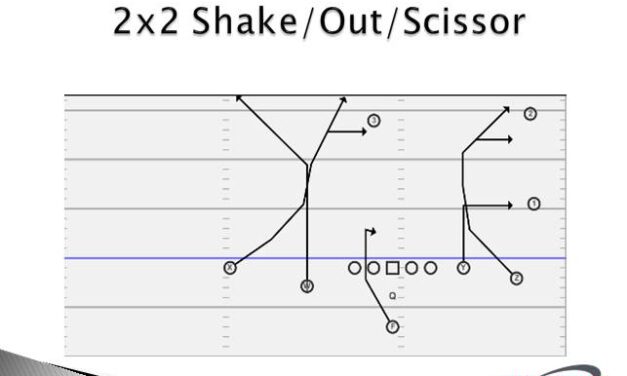
Air Raid: Shake/Out/Scissor Concept

By David Robinson
Offensive Coordinator
Skyview High School (ID)
Twitter: @coachrobi

Introduction:

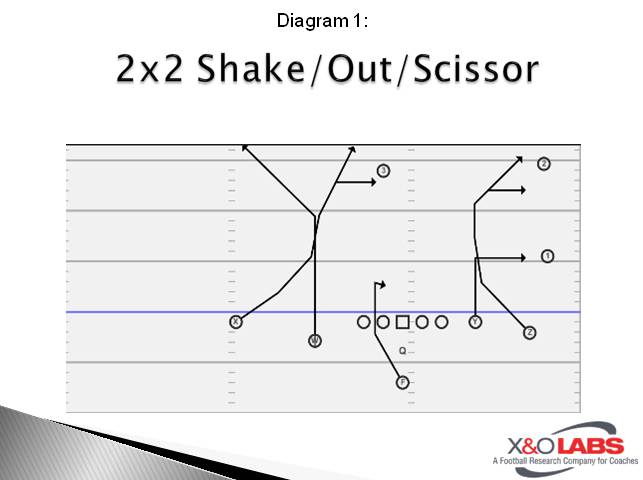
Shake/Out/Scissor has been a breakthrough concept for us this year. After years of struggling to find a reliable vertical concept (we’ve run different variations of 3 and 4 verticals with marginal success), we feel like we have found a vertical concept with staying power. It was our most called concept in 2016 including run plays (66 calls, 61% completion percentage (38/62), 652 yards, 5 TD, 0 INT). The concept is rooted in the air raid 3 verticals concept, a traditional two high beater, but has become very multiple and reliable for us.

Slide1

Protection

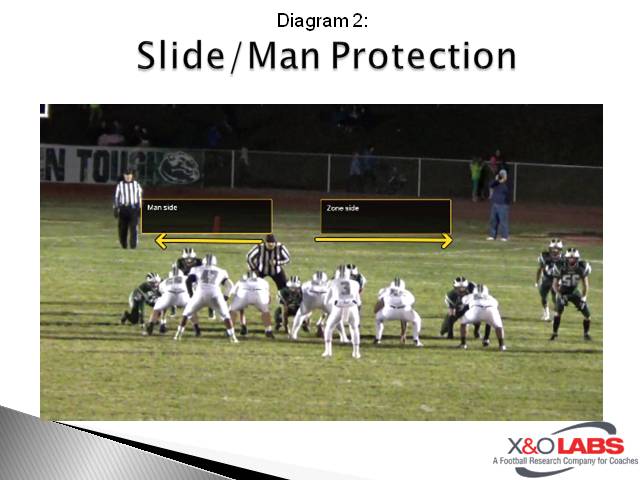
We are a half slide/man protection on this play with the running back taking the most dangerous man on the man side.

Slide1

Receiver Assignments

We are a concept based passing team. We move our receivers around to get optimal matchups for our best players. Receivers must know the concept from call side to backside; for example, the call side receivers run shake/out, while the backside knows to run scissors.

2×2 call side (Shake/Out):

Slide3

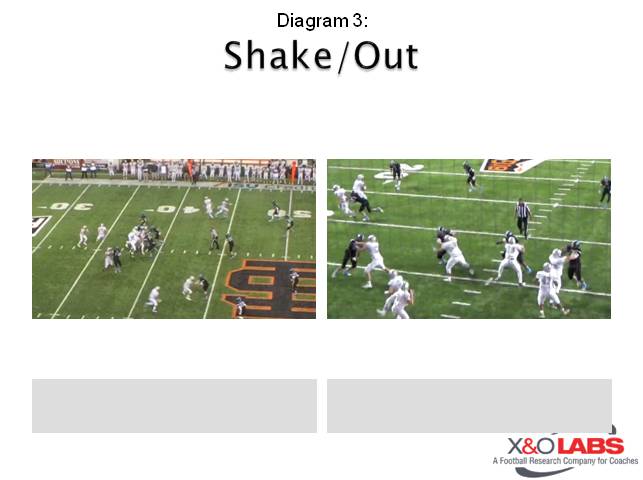
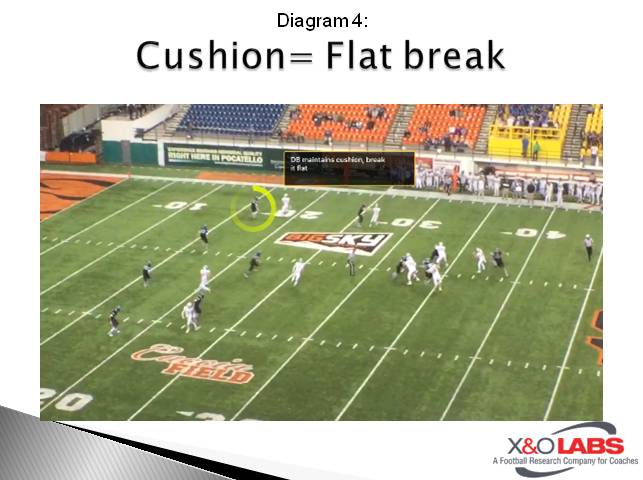
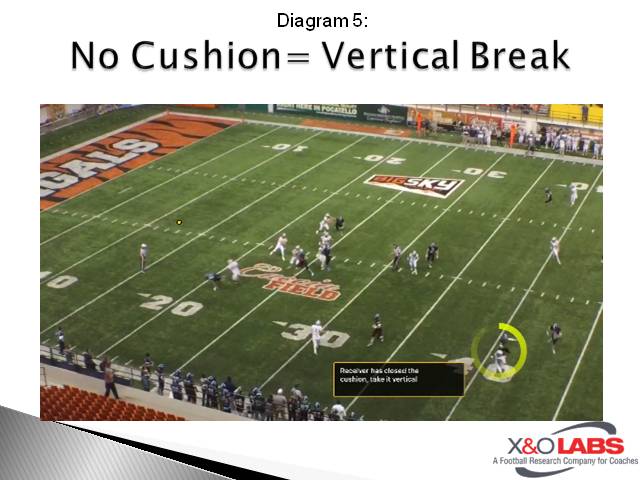
Shake: The number 1 receiver from the sideline will align approximately six yards from the tackle and run an inside release shake route, by pushing vertical to a depth of eight yards attacking the leverage of the deep defender (corner or safety). We teach our players early on in the spring to attack the defenders leverage, which is particularly important on the shake route. By attacking the defenders leverage we leave the quarterback room for the throw. The shake turns into a post/corner vs any sort of locked corner. We want the depth of the second break to be at 12 yards. On the break the receiver will push his angle vertical if he has closed cushion or flatten out the route if the defender maintains cushion.

Slide3Slide3

Out: The number 2 receiver from the sideline will align splitting the difference between the outside receiver and tackle. We have the out runner walk off the line on his release to allow the shake to get out first. The out runner and shake should be stacked (running the same stem) after the initial release, with the shake runner ahead of the out. The out runner will break flat at about 6 yards.

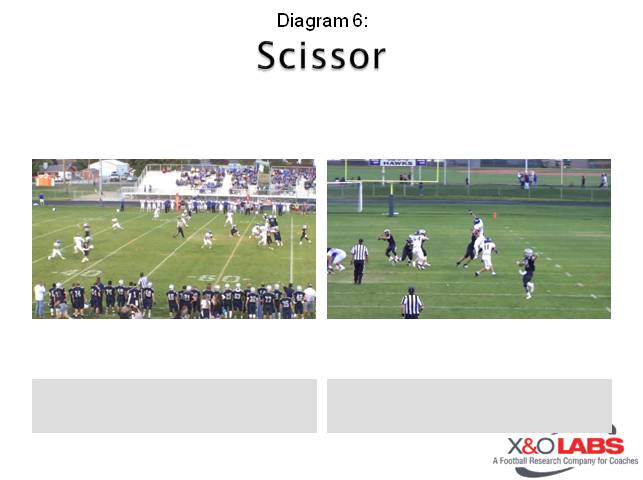
2×2 backside (scissor)

Slide6

Scissor runners should be aligned in an approximately 3-yard relationship to each other.  The split of the number 1 receiver will be wider to the field than the boundary. Number 1 receiver will align about 9 yards from the tackle to the field and 6 yards from the tackle in the boundary. Number 2 receiver will align about 3 yards from the number 1 receiver.

Read More

Deciphering Level Reads in Offset Formations

By Mike Kuchar
Senior Research Manager
X&O Labs
Twitter: @MikeKKuchar

Editor’s Note: The following research was conducted as part of XandOLabs.com special report on Virginia Tech’s Bear Defense, which can be accessed in full below.


Introduction:

Let’s get one inalienable truth straight: the entire Bear package is designed to stop the run. We know that shouldn’t come as a surprise, but remember the roots of the Bear system is centered around two main objective: get plus one in the run game and eliminate combination blocks at the point of attack. If teams are running the ball on Bear, there is a technical problem, not a structural one. In fact, when Virginia Tech used the Bear package they surrendered 2.9 yards per carry. That is nearly one yard less than what the Hokies gave up per run play using any other defensive structure.

Level Reads on Single Back:

Foster and his defensive staff place a premium on the horizontal and vertical level of the offset back in one-back offenses. In fact, the Mike will call out the level of the back on every snap because it affects how the defensive line, Mike linebacker and secondary defend the run game. Foster was hell-bent on this being a big key to decipher which run or pass concepts can be used. He told us that a lot of what he does with his front is based on the anticipation of the play concept he is getting with the offset in that position. He did tell us that the level could be disguised if the team has a dynamic center and the ball gets back quickly, but in most occasions this is not the case and the back cannot lie in order to get to the mesh point. Since the Bear package puts a nose on a zero technique on that center, it’s much harder to both snap the ball and block efficiently. In any case, we detail each of these levels below.

Read More

Small Programs Research Report

By Mike Kuchar
Senior Research Manager
X&O Labs
Twitter: @MikekKuchar
With Special Reporting from Adam Hovorka and Benjamin Fusco


Introduction

IthacaSeniorsWhen I first got into coaching nearly two decades ago, I heard the current Don Bosco Prep (NJ) head coach Greg Toal say, “If you want to learn how to coach and how hard it can be, coach at a small school.” Coach Toal was, of course referring to his early coaching days at smaller classifications, and I had no clue what he was talking about. Having mentored at schools with enrollments of at least 500 boys, I wasn’t used to those “small school problems” that many coaches across the country were having. That was, until this past season went I spent the fall at a small public school in Union County, New Jersey. It was there where I had to learn about several challenges: stimulating competition among a smaller talent pool, fighting complacency with the “star” players and working through a functional depth chart with diminishing numbers in season just to name just a few. And I was just an assistant coach. This became the impetus that drove me to conduct this research project. I wanted to find out how some of the most successful small school high school coaches were running their programs despite being confronted daily with these issues.

After conducting my research, I’ve found that it seems success at coaching in the small school level is directly proportioned to how well you manage issues such as handling limited numbers, smaller coaching staffs all while sharing athletes and facilities. It was the goal of this study to uncover the solutions that some of the top small school coaches in the country were using to combat these issues.

The structure of our research was to find the problems that these small school coaches were having and how they were addressing these issues. We provided each contributing coach with a series of potential issues and they were asked to pick one and address specifically how they were solving it. They are separated into the following four domains:

  • Off-Season Program Development
  • Working with Limited Numbers and Less Talent
  • Delegating Responsibilities to a Smaller Assistant Coaching Staff
  • Implementing a Scheme to Maximize your Talent Base

Once we put together the four domains we wanted to address, we needed to establish criteria for potential contributors. The criteria was as follows:

  • A minimum of 40 or less varsity players on average per year.
  • A winning percentage of at least .750 percent (career record).
  • A minimum amount of FBS/FCS full scholarship players coached during tenure.

After developing those criteria, we engaged in the pursuit of finding our contributors.

Now it’s important to note our contributors came directly from our reader base, they were not picked directly by the XandOLabs.com staff. Although a hard deadline prevented us from connecting with all of them, we tried to be equitable in representing several states across the country. Our contributors are listed below 

Contributor List (in alphabetical order):

  • Tony Becerra, Pleasantville High School (NY): 82-40 in 12 years, 0 FBS/FCS scholarship players during tenure.
  • Tom Crawford, Bishop Diego High School (CA): 62-13 last 6 years, 4 FBS/FCS scholarship players during tenure.
  • Kurt Forrest, Mechanicsburg High School (OH): 43-8 last 4 years, average 35 varsity players yearly, 0 FBS/FCS scholarship players during tenure.
  • Jeff Giger, Strasburg High School (CO)-: 65-49 in 11 years, 0 FBS/FCS scholarship players during tenure.
  • Greg Grant, Heppner High School (OR): 283-65 in 35 years, average 34 total varsity players yearly, 0 FBS/FCS scholarship players during tenure.
  • Terry Hessbrook, Ithaca High School (MI): 139-19 in 13 years, average 32 total varsity players years, 5 FBS/FCS scholarship players during tenure.
  • James Hubert, Maplesville High School (AL): 160-38 in 16 years, average 40 varsity players yearly, 4 FBS/FCS scholarship players during tenure.
  • Tommy Lewis, Victory Christian School (FL): 40-8 in 4 years, average 38 varsity players yearly, 3 FBS/FCS scholarship players during tenure.
  • Mark Lippe, Adair High School (OK): 86-15 in 8 years, average 35 varsity players yearly, 1 FBS/FCS scholarship player during tenure.
  • Judd Naegar, Valle Catholic High School (MO): 148- 29 in 13 years, average 30 varsity players yearly, 0 FBS/FCS scholarship players during tenure.
  • Ed Sadloch, (formerly) Cedar Grove High School (NJ): 203-65 in 27 years, average 35 varsity players yearly, 9 FBS/FCS scholarship players during tenure.
  • Lynn Shackelford, Cashion High School (OK): 117-26 in 11 years, average 36 total varsity players yearly, 1 FBS/FCS scholarship player during tenure.
  • Kevin Swift, (former) Gold Beach High School (OR): 127-67 in 17 years, average 35 varsity players yearly, 1 FBS/FCS scholarship player during tenure.

    Read More

Chattanooga’s 4-2-5 Fits vs. Y-Off Run Game

By Mike Kuchar
Senior Research Manager
X&O Labs
Twitter: @MikekKuchar

Introduction

The following research was conducted as part of XandOLabs.com special report on “4-2-5 Linebacker Play.” Continue reading for more information on this special report.

Y-Off Formation:

When defending the Y-off formation, the Mocs will set the 3-technique to the Y. Coach Wright tells his linebackers to eye the near back once the get that Y motion. “He will tell us everything we need to know,” Coach Wright says. Anytime we get any motion across if he widens (like stretch), we will be wider. If he’s downhill (like Power Read), our guys fit it tight. The Mocs get a steady dose of Power Read from this set so once that play side defensive end knows he’s getting a lot of arc release from that Y, he will key the knee to inside hip of the tackle. “Our defensive end is taught to hard joint it and knock the heck out of that trapper, whether it is the Y or he will get inside the pulling guard. He won’t make tackles on the perimeter anyway. The defensive end fits outside the guard, the Sam fits inside the guard and the Mike is over the top (Diagram 51). The Sam is clued in on the scheme because the back is wide and not tight. He knows that the guard is trying to come off and pin him. We tell him to try and win up and under instead of over the top because of the space. The double teams shoulders are tight so we tell him to stick his foot in the ground that way and come up underneath it. If he starts running over the top, then you have a cavity. That defensive end doesn’t always get it tightened down and it causes a crease. Our DE will run to him with his inside shoulder and try to knock him down to go meet it quick knowing the Mike is over it. Those two must see that its Power. We tell our players, ‘if it looks like Power and it smells like Power, it’s Power to us. That is all that matters to use, because that’s what they will go back to.”

Read More

Spread Passing Study: Snag Concept

By Mike Kuchar
Senior Research Manager
X&O Labs
Twitter: @MikeKKuchar

Introduction

When we collected our data on the Snag concept, the feedback was strong. The snag concept was the second most utilized pass concept among spread coaches (the first being 4 verticals), with 29 percent saying it is their most used pass concept.

Of the coaches that utilize the snag concept, 55 percent operate out of a spread, no tight end structure.

graph1

We did find some two-back variety of the Snag, which we will present in the red zone section, but for the most part the favorites of the snag were spread disciples.

We didn’t want to focus our research on protections, but we did ask which kind of protection coaches are using the snag with. We wanted to see whether it was used more as an intermediate concept in the five-step game or as a quick game concept. Our research shows that 56 percent of coaches are using it as a three-step drop, compared to the 36 percent who use it with five-step footwork.

Base Snag Concept 

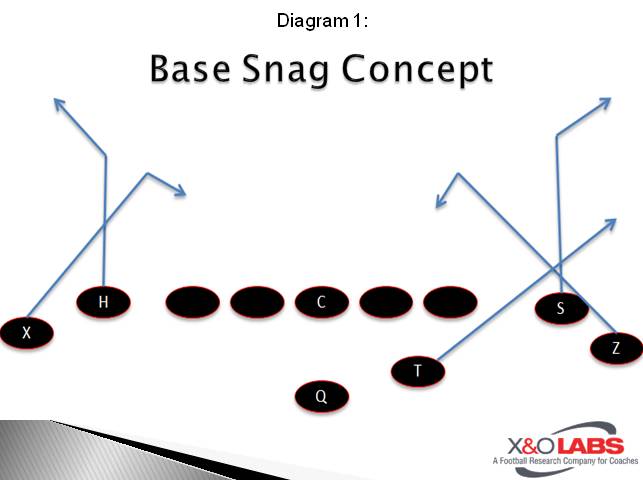
Slide1

The snag concept is meant to produce a high/low stretch on either second or third level defenders, depending on the coverage. The majority of coaches, 63 percent, choose to run the snag out of 3×1 opens sets. We should mention that there are two-man snag variants, which we will present, but for the most part the route structure to the play side consists of the following:

  • Vertical component – such as a corner or post route.
  • Flat component – such as an arrow or wheel route.
  • Snag component – such as an over the ball or spot route.

We asked coaches which particular route has been the most efficient using the snag and here is what they told us:

  • 52 percent said the over the ball component was their most efficient route.
  • 24 percent say the flat component was their most effective route.
  • 13 percent say the vertical component was their most effective route.

Now, this is purely the base route structure of the concept. In case one, we are going to present our data on the various route adjustments and tags coaches are using to attain productivity on the concept. The way this case is broken down is to first present on the quarterback’s pre-snap and post-snap progression including the drill work coaches are using to teach it. We will then follow that with why the snag can be both a zone and man beater, and more importantly how coaches are averaging nearly a first down every time they throw the ball on it.

Base Quarterback Pre-Snap Read

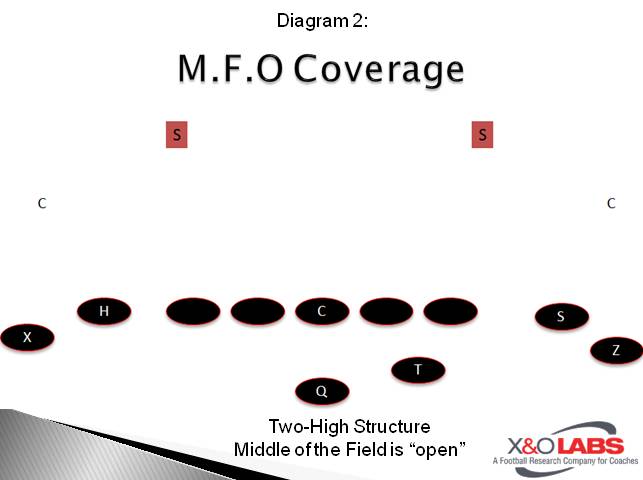
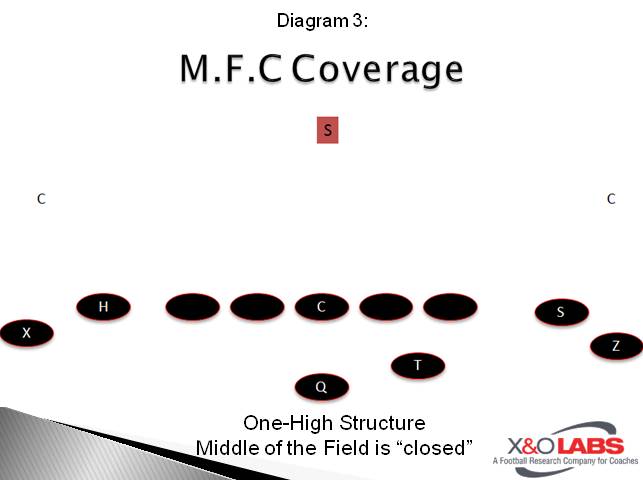
Like many other spread pass concepts, an initial progression must be made on the snag based on the pre-snap alignment of the defense. It’s not uncommon for most coaches to teach their quarterback in the pre-snap vernacular of M.F.O. (Middle of the Field Open) vs. M.F.C. (Middle of the Field Closed):

  • Middle of the Field Open: Denotes some sort of spilt safety coverage such as halves coverage, quarters coverage or a combination of both (Diagram 2).

Slide2

  • Middle of the Field Closed: Denotes some sort of single safety coverage such as thirds coverage or man free coverage (Diagram 3).

Slide3

Generally speaking, we found the following general pre-snap reads:

  • If the middle of the field is open, coaches are looking to high-low the flat player on a snag vs. flat combination.
  • If the middle of the field is closed, coaches are trying to throw high-low the corner on the vertical vs. flat combination.
  • In man coverages, coaches are picking their best match-up pre-snap.

There were some variants of these reads below:

Read More

Spread Passing Study: Shallow Concept

By Mike Kuchar
Senior Research Manager
X&O Labs
Twitter: @MikeKKuchar

Introduction

The Shallow/Drive concept was our second most heavily utilized Spread pass concept, with over 75 percent of coaches using in in their offense. Twenty percent of those coaches said it is their most used pass concept. It was significantly efficient for these coaches this season as 45 percent of coaches said it netted between 7 to 10 yards per snap.

Base Shallow/Drive Concept (Diagram 87)
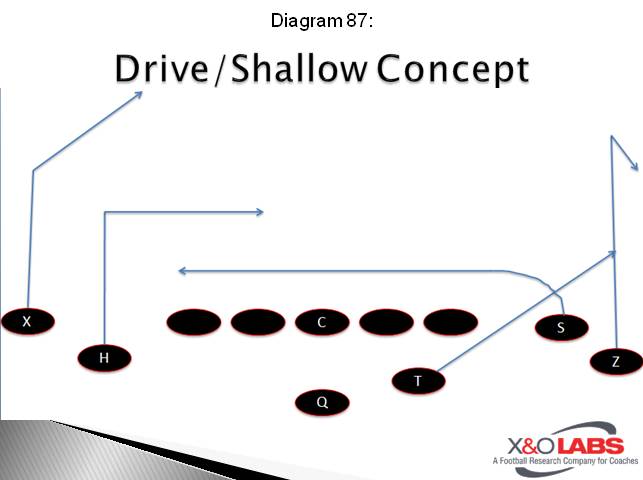
diagram 87 2

The Shallow Drive concept, which is firmly entrenched in the Bill Walsh West Coast offense vernacular, is meant to produce a high-low stretch on the play side inside linebacker by presenting him with an under route (shallow) and an over route (dig). It’s what most coaches refer to as the “triangle read”, which will be detailed below.

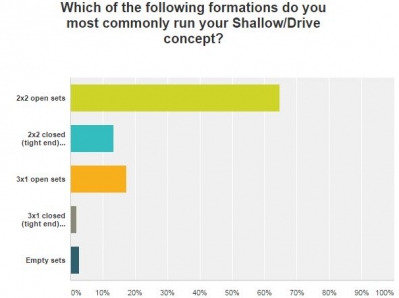
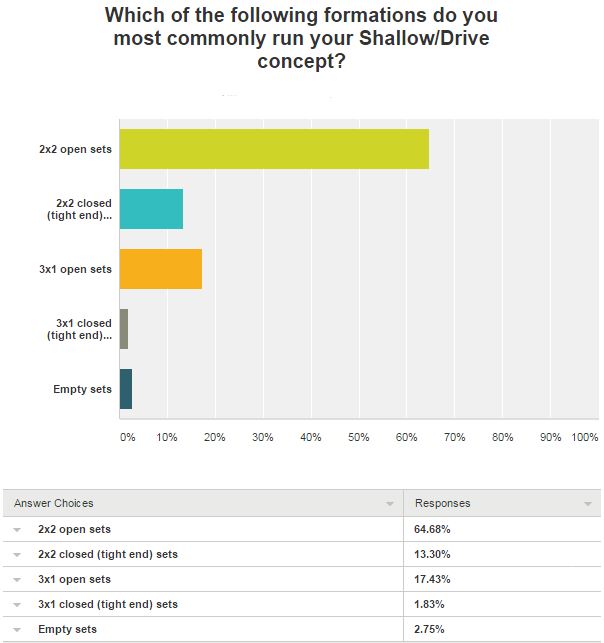
We found that many coaches were adamant about utilizing the Shallow/Dig out of balanced sets, rather than the trips sets as the Snag is most frequented out of. The majority of coaches, 64 percent, choose to run the Shallow/Drive out of 2×2 opens sets. 
graph18

In its base, the route structure to the play side of the Shallow/Drive consists of the following:

  • Vertical component – such as a post or curl route.
  • First under route – such as a drag at the heels of defensive lineman, although that depth can change depending on the coach.
  • Second under route – usually coming from the other side of the formations, such as dig route

Editor’s Note: We do understand that some coaches refer to a Shallow concept when the Shallow and Dig come from different sides of the formation where a Drive concept refers to when the Shallow and Dig come from the same side of the formation. We are providing both concepts for the purpose of this study.

We asked coaches which particular route has been the most efficient using the snag and here is what they told us:

• 51 percent said the drag was their most efficient route.
• 34 percent say the dig was their most effective route.
• 13 percent say the vertical component was their most effective route.

Now, this is purely the base route structure of the concept. In case two, we are going to present our data on the various route progressions and adjustments:

• Technique of drag runner
• Technique of dig runner
• QB pre-snap and post-snap read progressions
• Route adjustments to certain coverages

QB Pre-Snap Read

The beauty of the Shallow concept is that it has a built-in man beater (drag), zone beater (dig) and an over-rotated coverage beater (post). So the pre-snap read is usually just identifying which of the aforementioned structures you’re getting, which triggers the quarterback where to throw the ball. We did find that many coaches were still teaching the “M.F.O. vs. M.F.C. principle” to take a deep shot of the post against structures that allowed it. We included some samplings of coaches responses on what they tell their quarterback pre-snap:

Nate Knight, Faith Lutheran High School (NV): “Our quarterback identifies the number of safeties then the depth of the corners. If it’s cover two, he knows the Dig will be his primary. If it’s single-high he will look to the leverage of the safety against the Post.”

Matt Puffenberger, Berkeley Springs High School (WV): “We identify middle of field open or closed. Closed will likely eliminate the post, so we expect to throw the drive. If we see middle of the field open, we’re looking for the post first. Then we identify the MLB, which is our movement key.”

Jason Farias, Cottbus Crayfirsh (MA): “We look for availability of the post route in 3×1 sets.”

Preston Troyer, Tonganoxie High School (KS): “All we care about pre-snap is the post route. We are looking for the corners alignment and if there is a safety capping (over the top of it).”

Bruce Miller, Gainesville High School (GA): “We look for the depth of linebackers and if there is one safety or two safeties.”

Kevin Ross, Van Buren High School (AR): “We will pre-snap glance at the Post route. One thing the defense does is to jump the Dig with the safety. If we see this and or we see the safeties aligned at 8 to 10 yards we will throw post.”

Shawn Liotta, Clairton High School (PA): “The quarterback will look pre-snap at vertical (peek post). Against edge pressure he knows he has the running back out of the backfield and the shallow which is hot.”

QB Post-Snap Progression

Read More

Frostburg State’s Gap Schemes from Multiple Personnel Groupings

By Tye Hiatt
Offensive Coordinator/Quarterbacks Coach
Frostburg State University (MD)
Twitter: @HiattFSU

Introduction:

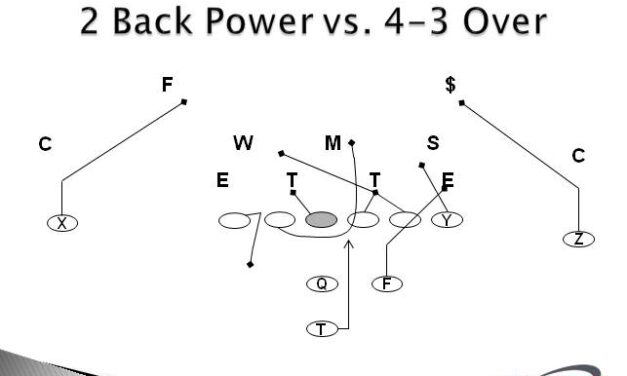
One of the 1st things we do as a coaching staff every week in our game planning sessions is find ways to effectively run the ball with a downhill attitude. We believe that we must establish the LOS every snap in order for us to have a chance at being successful. One of the scheme’s that has been very good for us has been the “Power” concept. We will find ways to run “Power” from multiple sets and personnel groupings, as well as getting our QB involved and by using our RB in the scheme to get the numbers we want in the box. Throughout the article we will show a few different ways in which we run the “Power” concept.

Base Power Concept

Here are our base rules when laying the foundation for our power scheme. Every other adjustment is made from this base foundation.

Center: Back block on the back side defensive lineman.

Play Side Guard (PSG): Double team the play side defensive lineman to the back side linebacker.

Play Side Tackle (PST): Double team the play side defensive lineman to the back side linebacker.

Back Side Guard (BSG): Pull for MLB – Must demeanor thru 2nd level

Back Side Tackle (BST): Stab & Hinge – Must control B Gap run thru!

Y: If we see a 7 technique, he will drive thru C Gap up to the 2nd level. When we get a 6 technique we will either base out the DE and use the F to double up to the play side linebacker or we will arc release the Y to the play side linebacker and the F will kick out the DE.

Q: Drive step straight back to the T and put it on his belly button. Set up at 7 YD’s depth for PA.

F: Will receive a call from the Y. Either he will kick out the DE or will double the DE to the play side linebacker.

T: 6 inch lateral step. His aiming point (AMP) is play side leg of center. We want him getting downhill as soon as possible. He gets one cut and then must get vertical!

X and Z: Read for middle of the field open (MOFO) or middle of the field closed (MOFC). Push-crack working the most dangerous man.

Blocking Coaching Points

  1. Communication on double team
  2. When we come off the double team, the man that stays on the DL drives his man back, focusing on vertical push. The man that comes off one the LB stays on his track. He will begin his demeanor when he is 1 yard away from his man.
  3. If the LB never comes, we will stay on the double team and drive him 5 yards deep.
  4. On all double teams we want to keep our off-hand free. We want to ensure that we can drive the DL off the ball but be able to get off the double team to pick up our assignment.

In these diagrams we show how we would run it against a 40 and 30 front.

Read More

Varying QB/RB Alignments in One-Back Gap Schemes

By Mike Kuchar
Senior Research Manager
X&O Labs
Twitter: @MikekKuchar


Introduction

This research was conducted as part of XandOLabs.com special report on “Spread Gap Schemes,” which can be accessed in full by clicking below.

Preferable A Back Alignments:

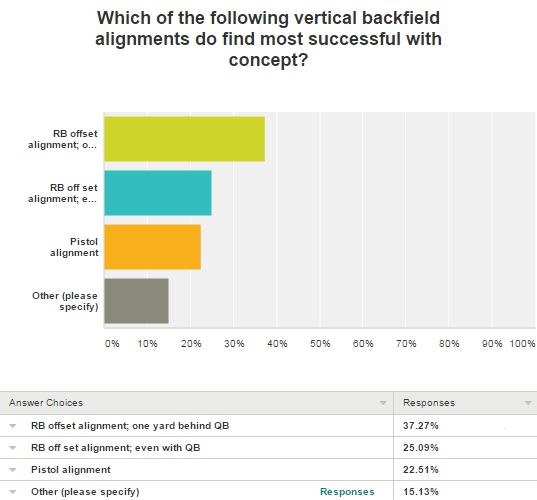
We found these responses were similar to the alignments that coaches use in the Power concept. The majority of coaches that use the Counter concept choose to use a vertical alignment of one yard behind the quarterback (See Graph Below).

graph17

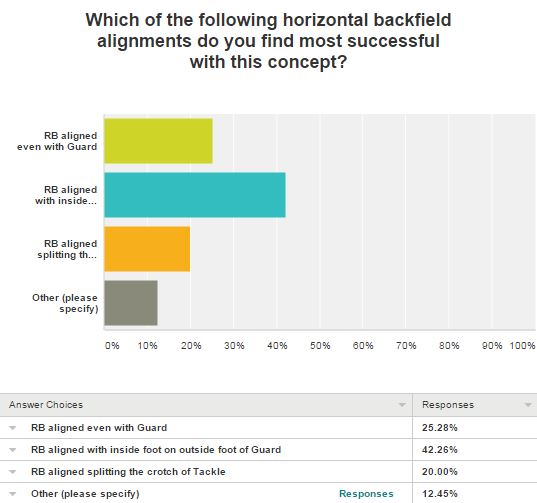
The horizontal alignment of choice has the ball carrier aligned with his inside foot on the outside foot of the back side guard (See Graph Below). We did find evidence of some coaches who will run the same side Counter concept, Mark Holcomb is one of them, but the majority of coaches will set that back (if he is offset) away from the play side.

graph18

QB/RB Mesh Points; Offset Alignments; Three-Step Footwork:

Jeff Conaway, Shiloh Christian High School (AR): “We use alignment options 1, 2, 3, or 1.5 (this was explained in case one). He slides, meshes, and press front side A gap, downhill, with attitude. This is done with a three-step footwork, pushing off the third step. His key is the play side defensive end and reads the H-Back pull on play side linebacker.”

Inside Zone Footwork:

LJ Spinnato, Choate Rosemary Hall (CT): “To us, it’s the same as Power if the A back is aligned play side. If he is aligned backside, it’s Inside Zone footwork if aligned QB Jumps to 45-degree angle and presents the ball. Tailback tempos his zone step from 2×1 alignment, can Counter step, but we usually don’t. We have done it both ways in the past. QB, 6-inch lateral steps play side, then clear backside leg to 45-degree angle.”

Read More

Scaffolding a Pre-Snap RPO System – Case 1: Design and Installation

By Mike Kuchar
Senior Research Manager
X&O Labs
Twitter: @MikekKuchar

Introduction

It’s important to note that much of the design component of these pre-snap RPO tags lies in understanding offensive formation structure and defensive coverage structure. We all know that the beauty of the RPO system is taking all the top route concepts in your offense and marrying them with the most productive run concepts you have. While it may be difficult not to get carried away with all the possibilities, we’ve found that at the crux of this design is getting the quarterback to understand what a pre-snap read is and what a post-snap read is. So, we’ve gone ahead and defined it for you:

Pre-Snap Read: These are decisions made by the quarterback pre-snap to either run or pass the ball depending on the pre-snap leverage of a particular defender.

Post-Snap Read: These are decisions made by the quarterback post-snap to either run or pass the ball depending on the pre-snap movement of a particular defender.

While we’ve found that many offensive coordinators will use both of these models to get into the most advantageous situation, this particular study is devoted to how coaches are teaching their quarterbacks to make the right adjustments pre-snap to take advantage of either numbers, leverage or grass of the defense.

Numbers

The concept of numbers is specifically tied to a numerical advantage by the offense at the point of attack. It’s a universal concept; defenses will try to do the same thing by the time the ball is snapped to get a plus one defender around the ball. While this is not a novel idea, we felt that it’s important to educate coaches on how our sources were treating box count on the interior and numbers count on the perimeter to effectively get in the best play scenario.

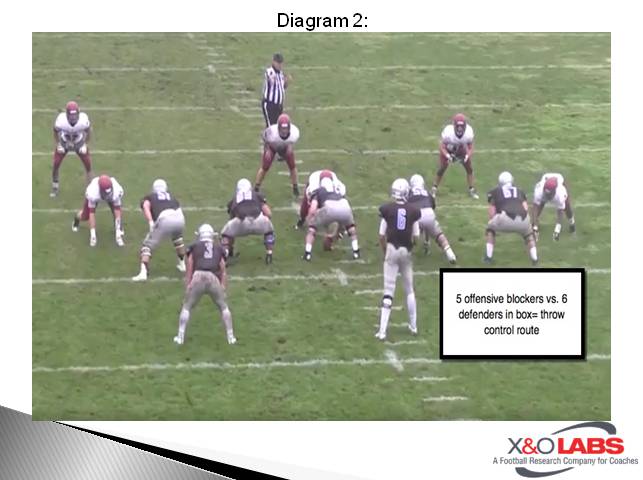
Important: Keep in mind the pre-snap RPO system is commonly used to supplant a non-mobile quarterback, who is not included as a potential runner. For example, a 10 personnel offensive structure will only have five blockers. So six in the box will trigger a throw.

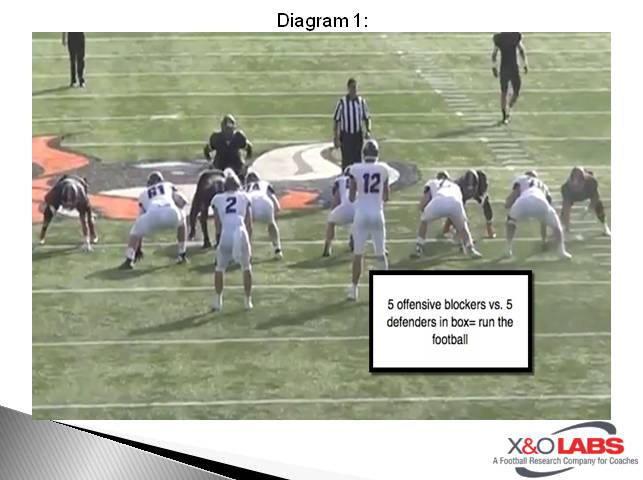
Box Count:

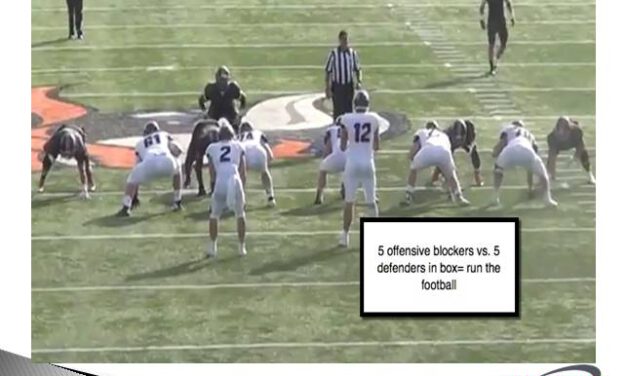
Quarterbacks, even at the lower levels, are now asked to count the box. Most coaches refer to the box as the areas two feet outside the offensive tackle. Quite simply, if a defense has even numbers or less numbers, run the ball.

Slide1

If a defense has more numbers, throw the ball.

Slide1

Since the majority of pre-snap RPO concepts are used to manipulate two-high safety structures that will try to find a way to sneak an extra player into a fit, in most cases odd fronts and even front will have a possibility of seven defenders in the box.

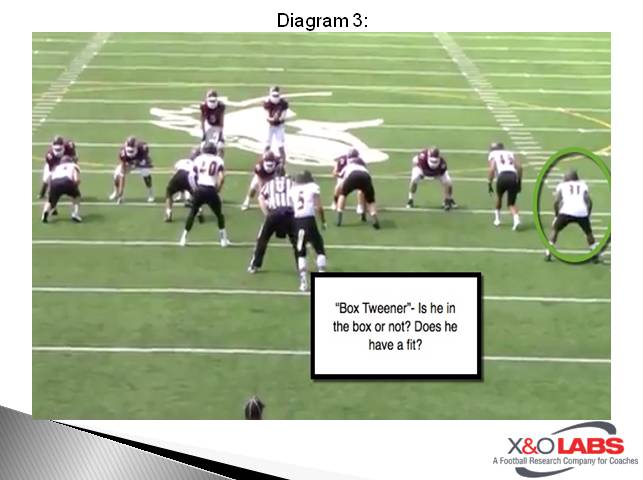
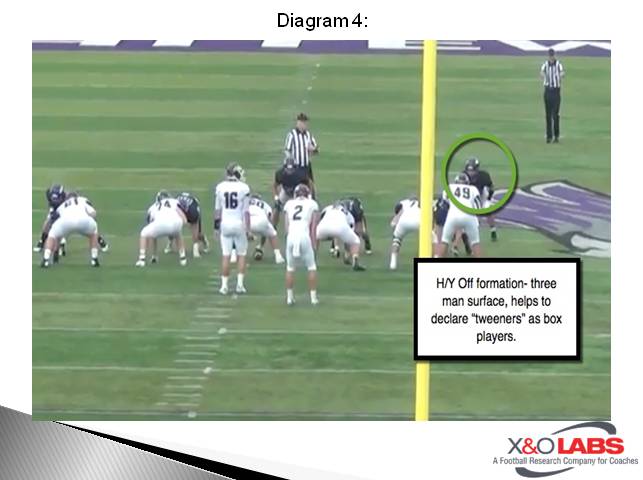
Now, where it gets tricky, is when defenses start to “mess” with those overhang defenders, particularly on odd structures to either be run or pass players. Conflict defenders are those tweeners, who may be in a position to play run or pass. But how effective they can be in playing run or pass is in direct relation to how far they are from the tackle box.

Slide3

And that is where creative coaching comes in. At this point, offensive coordinators have three options:

  1. Change the formation to make it clear whether or not that defender is a run first or pass first player. Structures such as three-man surfaces suffice for this solution (Diagram 4).
  2. Continue to monitor the reaction of that player when run develops to determine if he’s accounted for a gap.
  3. Tag a post-snap RPO concept to affect that player when all else fails.

 Slide3

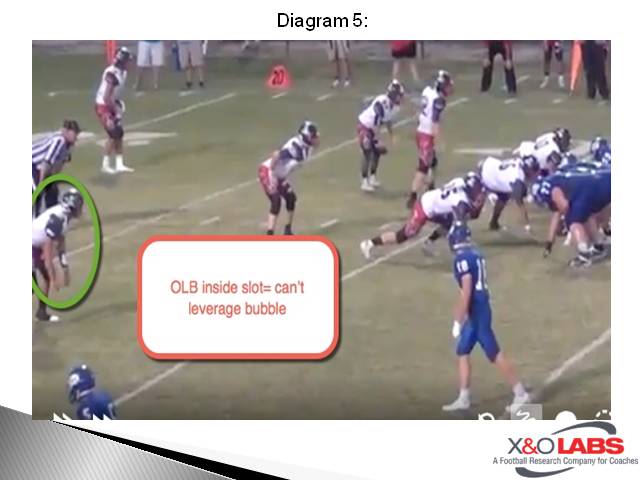
Scott Chisholm, the offensive coordinator at Berryhill High School (OK) will teach his quarterback to run the ball to a 5 man or less box, so he teaches his signal caller to ask them to declare whether or not that apex player is inside the wide receiver (usually the slot) or is he outside? “If he’s inside that wide receiver, we will usually throw the bubble, because we’ll outrun that outside linebacker and gain five yards before that safety comes up (Diagram 5),” coach Chisholm told us. “This also puts that OLB in a bind, he’s starts thinking, ‘are they reading me? Are they counting numbers?’ For us it’s just easier to teach a 17 year-old kid this concept, rather than reading him.

Slide5 

Read More

Scaffolding a Pre-Snap RPO System – Case 2: Pre-Snap RPO Concepts That Attack Numbers, Leverage and Grass

By Mike Kuchar
Senior Research Manager
X&O Labs
Twitter: @MikekKuchar

Introduction

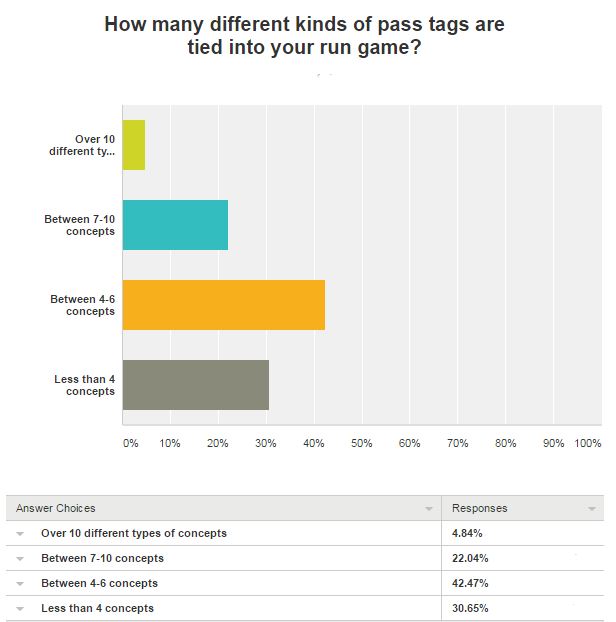
When a run is not necessarily the best play call for a certain situation, the pre-snap RPO pass tag provides options. Scenarios such as the leverage of a force defender and the depth of corners and safeties all attribute to the quarterback making a decision at the line of scrimmage. According to our research, we’ve found the majority of coaches, 42 percent, use between 4-6 pass tags in their run game (See Graph Below). In this case, we study the most productive RPO concepts used by our sources based on all those situations that unravel pre-snap. We segmented our research into detailing which concepts coaches are using to exploit a perimeter numbers advantage as well as an interior numbers advantage.

chart7

Exploiting Perimeter Numbers

Backside Gifts

Backside “gift” concepts are most associated with the single, or X receiver in trips formations. Much has been written on this already, but we would be remiss if we didn’t include this in our research because so many offensive coordinators have gained a great deal of traction using them. 

At Tufts University, slot receiver coach Pat Murphy used the same “open side matrix” he used while a head coach at St. Anselm College. It’s the only decision he had the quarterback make pre-snap based on the alignment of the corner on the backside X in trips. An example of the menu is below.

Versus Press Coverage:

  • Fade
  • Slant
  • Hitch

Versus Off Coverage:

  • Pivot
  • Speed Out
  • Skinny

To study game film of some of these access throws, click on the video below:

Read More

Scaffolding a Pre-Snap RPO System – Case 3: QB Pre-Snap Protocols and Post-Snap Mesh Game

By Mike Kuchar
Senior Research Manager
X&O Labs
Twitter: @MikekKuchar

Introduction

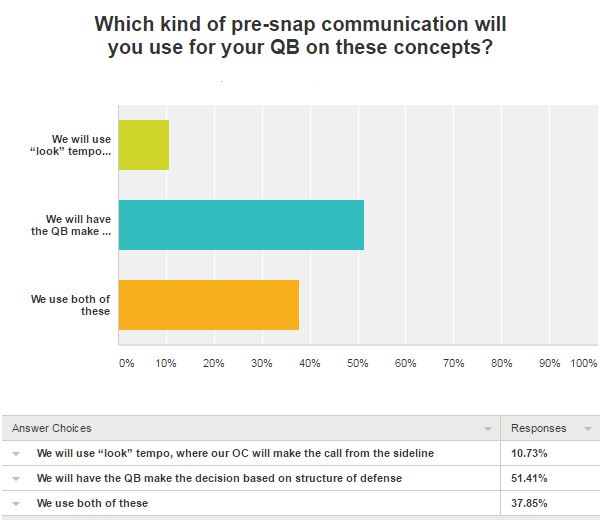
Training the quarterback pre-snap eyes seems to be the crux of using this system and since 51 percent of coaches will have their quarterbacks make the decision, rather than themselves from the sideline, (See Graph Below) it’s imperative to study how he is making the right read. We wanted to target our research specifically to sources who have a continual transition at the quarterback level, particularly those at the high school and small college ranks where time can be a factor in educating these players about the nuances of this system.

chart12

At the high school level, factors such as academics and extra-curriculars can put a stretch on the time these players need to understand this type of system. Per our research, leverage can be determined by the following factors:

  1. Numbers Advantage in the Box
  2. Numbers Advantage on the Perimeter
  3. Leverage Advantage in the Box
  4. Leverage Advantage on the Perimeter

Once the quarterback identifies his advantage, he must be taught the means in which to attack them. In this study, we are going to examine how each of the following factors tie into the quarterback’s decision to make the best play call at the line of scrimmage, and not after the ball is snapped. After all, the premise of this system is to be in the “best play scenario” every snap. This can only be done through repletion and a constant education of your quarterback. But whatever decision he makes, it’s essential to live with it. As many of the coaches that worked with us told us if you’re going to commit to this type of system, you must live by your quarterback’s decision. In the words of the great Bill Parcells, you can’t allow him to cook the meal if he’s not allowed to buy the groceries.

H.A.L.O. Methodology

Jason Eckert at New Richmond High School (WI) subscribes to the R4 methodology devised by the National Football Academies when training the quarterback’s pre-snap eyes. It’s commonly referred to as the acronym H.A.L.O., which is described below.

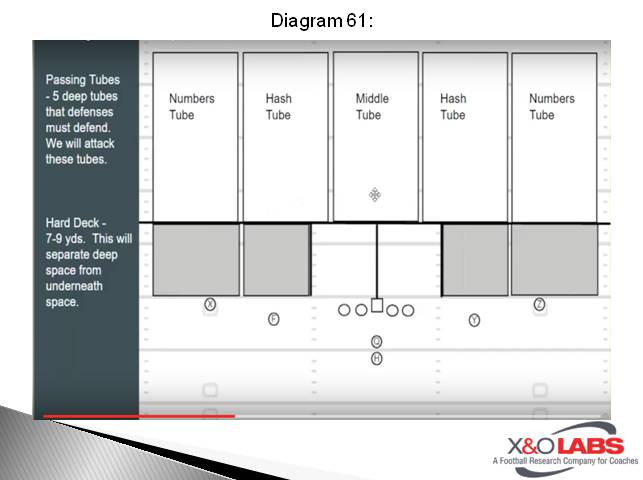
Hard Deck: Identifies deep space from underneath space, which is 7-8 yards of space above line of scrimmage. The quarterback is asked to find him and then draw a line out from him. There are five passing tubes. Tubes on the numbers, tubes on the hash and a middle tube. They are separated by underneath coverage (Diagram 61).

Slide61

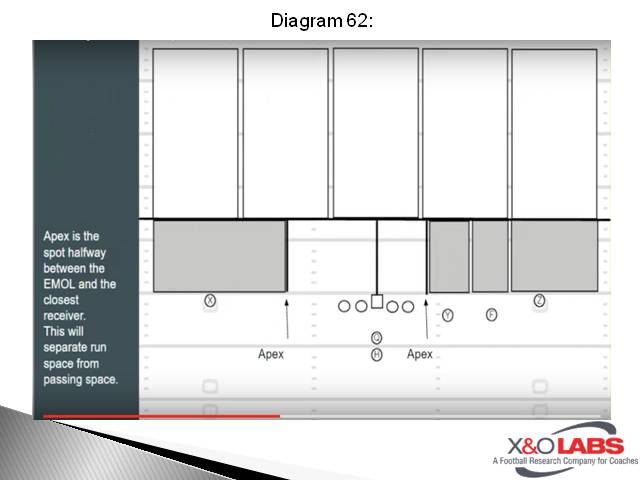
Apex: Apex is the spot halfway between the EMOL and the closest receiver. This will separate run space from passing space (Diagram 62).

Slide61

Center Line: Middle of the field concept

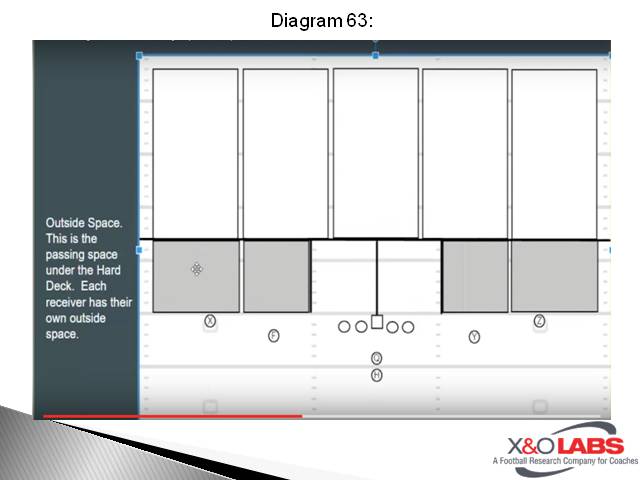
Outside Space: This is the passing space under the hard deck. Each receiver has their own outside space (Diagram 63).

Slide63

“I don’t talk in terms of coverage very often,” Coach Eckert told us. “One reason is I sometimes have a difficult time figuring out what coverage some of our opponents are supposed to be in.  Part of that is some teams are just bad and sometimes high school kids don’t do what their supposed to do. If I’m confused, our quarterback will be more confused. We talk more in terms of space. He needs to know how many defenders are taking away or capping space above our hard deck. This will tell him routes that are being taken away pre-snap or deep space we will be able to attack.  He needs to understand what space the defense is giving up underneath the hard deck. Our quarterback will look concept side first and then work backside. If I want his progression to change, I’ll add a tag for that. So, I control his progression. This limits confusion.”

In Coach Eckert’s system, each route is designed to attack the open space as it pertains to these categories. The quarterback and wide receivers will only choose the specific screen they want tied to the run game. “They are taught what works best, but they make the call on the field,” said Coach Eckert. “Our keys screens were decided by our players, unless I wanted a particular screen. So, I would just call a run play with ‘key’ added to it. They decided, based on how the defense aligned, whether the screen would be to the inside or outside receiver. Other than that, we don’t change routes at the line of scrimmage.”

Read More