
Implementing a Pre-Season O-Line Drill Catalog

By Justin Iske
Offensive Line Coach / Co-Offensive Coordinator
Southwest Oklahoma State University
Twitter: @justiniske

Introduction:

Working with your players during the off-season is critical to having success during the season. Regulations on time, equipment and number of players you are allowed to work with have forced coaches at all levels to be more creative when it comes to getting work done while staying within the rules and keeping your players healthy throughout the off-season.

One tool that is underused during the off-season is watching film. With programs like Hudl, it is easy to make teach tapes of individual plays or techniques to help your players continue to get better. It is also a good idea to film your off-season drills to review with your players.

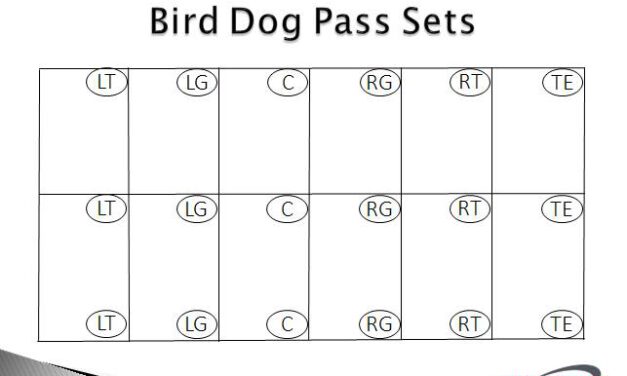
Bird Dog Pass Sets

This is a great way to work all of your offensive linemen (and tight ends) at one time to maximize reps. If you have a grass area that you can form a grid with 5×5 squares that is great. If not, you can use yard lines and towels to get the same results. If you can’t do a grid and don’t have access to lines, simply use the towels as landmarks.

  • Line up all of your OL’s and TE’s on a grid (or you can use yard lines and towels) by position.
  • Call out a play and snap count.
  • Drill can be done for one step, two steps, or through a whistle.
Slide1


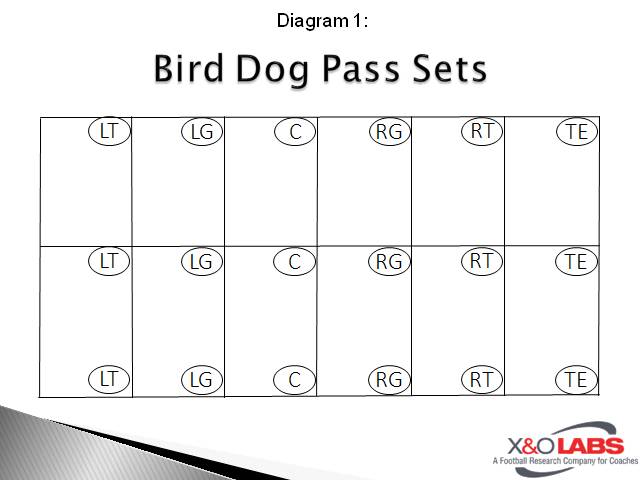
Wave Drill

Another drill that can be done with everyone at one time. This drill is a great warm-up drill and it allows the players to feel proper body position for both pass protection and run blocking. It can also be used as a conditioning drill to develop core strength and overall stamina.

  • Line up all of your OL’s and TE’s on a grid (or you can use yard lines and towels) by position.
  • Point in a direction and then call out snap count. Change direction every 2 to three steps or as desired.
  • Drill can be used as a warm-up and/or as a conditioning drill.
  • Side to side = pass pro demeanor.
  • Forward or backward = duck walk / run.
Slide1

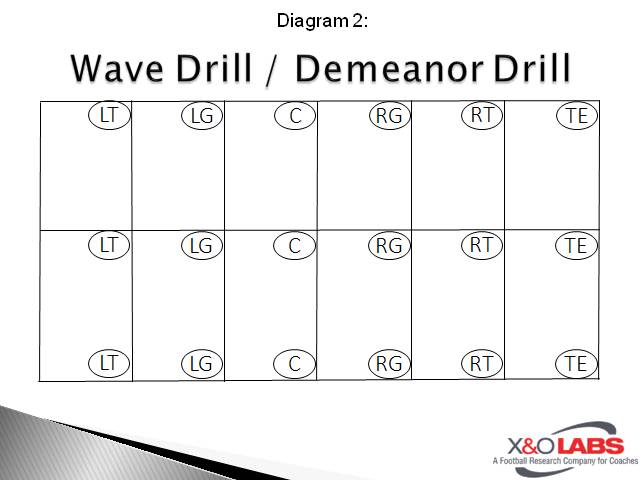
Pass Pro Shuffle

This drill incorporates a kick or post set and change of direction. It can also be used as a conditioner. The key coaching points in this drill are carrying the hands correctly, proper weight distribution and keeping the feet as close to the ground as possible as you slide.

  • Divide OL’s into three groups (right-side, left-side and centers).
  • Align 1st player at the sideline of the field on a yard line. Have them kick or post (based on position) five yards and back as many times as desired.
  • Once all three groups have gone, start over with all going the opposite way first.
  • In the diagrams on the right, the left side would kick to the left first, then post back to the right. Right side OL’s would post to the left first, then kick back to the right. Center’s would kick in both directions.
Slide3

Pass Sets (Kick – Post)

Drill can be done with everyone going at once on air or can partner them up to give players a defender/landmark. Align defender head-up, inside, outside, on the body or off the body to force them to adjust their footwork accordingly. Use the drill as a progression by having the players take one step, then two. Can progress to timing up the punch and then redirecting and/or reacting to a pass rush move.

Kicks:

  • OL starts in two or three-point stance with outside foot in the corner of two perpendicular lines (or rolled up towels).
  • On command, he will take his first step over the line for width and depth.
  • Drill can be done for one step, two steps, or through a whistle.
  • Drill can be done on air or versus a defender.
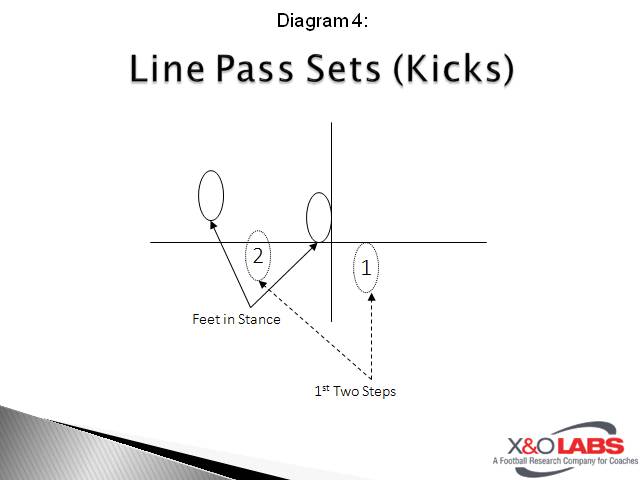
Slide3

Read More

Slide Footwork in Press/Catch Technique to Alleviate False Feet

By Mike Kuchar
Senior Research Manager
X&O Labs
Twitter: @MikeKKuchar


Addressing False Feet

Most coaches will argue that in press coverage, the feet must move before the hands. But where they move is just as important as how they move. Too many times, a corner will put himself out of position by stepping back or stepping away from the receiver. So, to combat this issue Coach Sewell at Bowie State University will use agile bags for his corners to work on their feet before making contact in press technique.

Coach Sewell calls this the No Retreat Press Drill, which works on press technique without retreating. “We’re focusing solely on sliding in the direction where your leverage advantage is without giving ground,” said Coach Sewell, who will use this from press alignment and catch alignment at 5 yards.

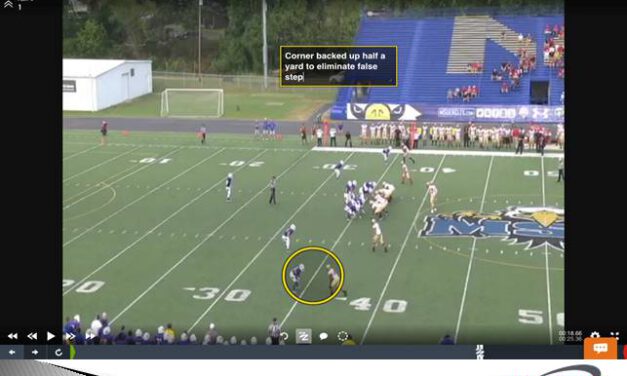
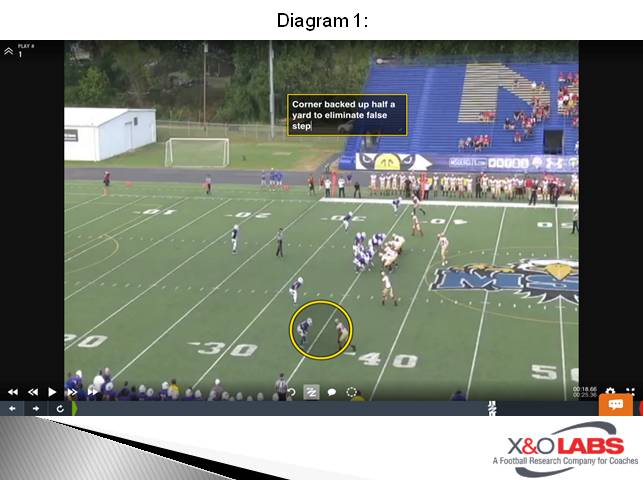
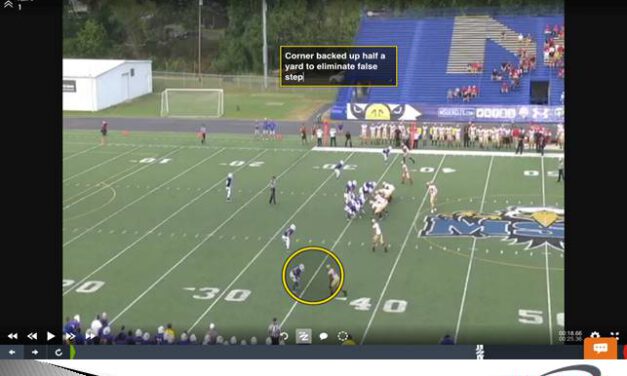
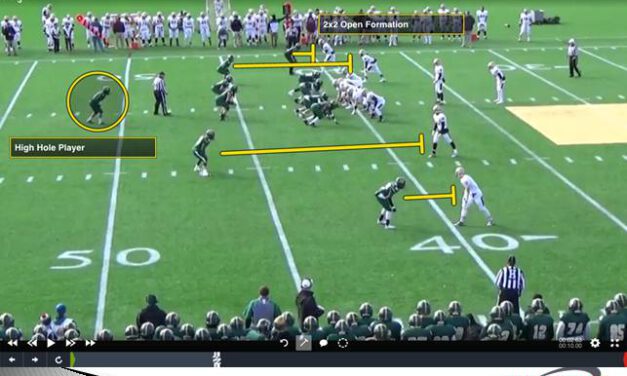
Conversely, some corners will develop the bad habit of a forward jab step in playing press technique. According to Coach Moore, if it can’t be fixed with extra study and individual work, he will back the player up a half of a yard and let them play using the false step, like a golfer playing for his/her slice. For example, in the clip below, the corner at the bottom is playing further off than the defender up top because he would always take the false step (Diagram 1). “So instead of playing at the normal depth, we backed him up a half a yard or so he can still take the false step,” said Coach Moore. “We had trouble getting it out of him.”

Slide1

At Southern Arkansas University, former defensive coordinator Josh Lawson, taught a slide technique to play press coverage. But to alleviate players using their hands before their feet, he would make his corners wrap their hands behind their backs. “We would have a receiver holding a dummy and we would cover the receiver without using hands so they had to use their hips and body all the way through the receiver,” Coach Lawson told us. “We don’t backpedal. We don’t think it helps us. So, we over exaggerated how many times we had to slide. So, if I felt like we needed two good slides in our press coverage before we can get our hands on them and open up with them, we would have exaggerated that to four slides. We would slide laterally four times and then punch a bag to open our hips. We over exaggerated their feet a lot.

Addressing Dead Feet

Aside from taking false steps, some corners have issues with stopping their feet in press coverage as well. How Mac Alexander, the defensive backs coach at Colorado Mesa University alleviates this issue is by using what he calls his “motor technique.” He will start his drill work every day for 10 minutes working his motor drill then progress to one-on-one’s. In his motor back technique; the emphasis is keeping the feet shoulder width apart with weight on the balls of their feet. The hands are up ready to punch and in athletic stance with flat back. When wide receiver releases the defensive back moves his feet back quickly gaining six inches with each step, while staying square.

Like many coaches, Coach Alexander will film his individual time of all the man technique. “We show them that ‘yes, you can do this,’ but you just have to focus on what you are doing,” he told us. “Because many times what gets a defensive back in trouble is that when they come press, they don’t have a plan on what they are going to do. So, getting them to think and focus every time they press will really benefit them.”

Once the motor technique is understood from a stagnant position, Coach Alexander now implements the fundamental to simulate when a receiver moves back and forth. It comes in the shape of his Zig Zag Drill.  “As the wide receiver goes back and forth, the defensive back is working his motor literally staying square and inside of the wide receiver,” said Coach Alexander. “The hips do not open and there is no punch.”

Addressing The Eyes and Hands in Catch Technique

As opposed to on the ball corners which use a press technique in man coverage, off the ball safeties or outside linebackers use what is called a “catch” technique with the visual of “catching” receivers and not giving ground, as they get into their routes. So, we asked each contributor to talk about how he is training the eyes and hands of defenders when in catch technique on a number two receiver.

Zack Moore, defensive coordinator, Morehead State University (KY): “At safety, most footwork issues center around two things: giving ground before utilizing ‘catch’ technique and giving up leverage due to breakdowns in their footwork.  We combat these issues by teaching our safeties to play on a cliff, understanding they cannot give vertical ground prior to making contact with the receiver. We also teach them to understanding how teams may attack our coverage helps the player understand not only what routes they’ll see, but why. Therefore, understanding why they must keep leverage. The technique correction is usually their failure to stay square and mirror lateral movement by the receiver. Correction may be as simple as re-teaching or may call for intervention by means of an alternative drill or approach.

If a player is in man coverage, we do not teach them to read the QB. They can be taught, dependent on the opponent, what routes to expect from various splits, field positions, different players and situations. Also, knowledge of what the weaknesses of the coverage may be and how offenses tend to attack the coverage should give them a good idea of how they’ll be challenged. For example, if we are outside leverage on a slot receiver, we know that slants and inside fades will be on the menu for whatever offense we are playing that particular week. RPO always adds to the challenge of defending, but this is also a big reason why we choose to utilize cover 1.  The back set is often a good indicator of whether you will be on the passing side of RPO. As mentioned above, this, as well as other pre-snap indicators, can help the player anticipate or be prepared for certain routes.    

Read More

Alabama, Michigan OL Coaches Headline C.O.O.L. Clinic in May

wylieThe Annual Offensive Line Clinic will be held on May 19 & 20, 2017 at the Millennium Hotel in Cincinnati, Ohio. It’s two days of non-stop football with presentations from some prominent offensive line minds in college and professional football including speakers from Michigan, Alabama as well as the Redskins, Cowboys and Steelers. X&O Labs will be represented and we would love to see you there.  While you can register for the clinic at the C.O.O.L. clinic website, Insiders members can access a report from Cleveland Browns offensive line coach and clinic director Bob Wylie on his Twin and Duo run concepts by clicking here.

Read More

Punt Coverage Drills – Washburn University

Read More

Man Coverage v. RPOs: Case 1 – Teaching Press Man and Off Man Techniques

By Mike Kuchar
Senior Research Manager
X&O Labs
Twitter: @MikeKKuchar


Introduction:

Playing man coverage is a mindset. We must not underestimate that. There is a common myth among coaches that believe you must have the “dudes” to play man coverage. You need that 4.45 shutdown corner that can eliminate at least a third of the football field. Or you need that 6ft. 3in. safety with the length and ability to both close quickly in the short game and cover enough ground in the vertical game to prevent deep throws. 

Well, we’re here to tell you that is not true, at least according to our contributors of this study. Regardless of your personnel, you can play man coverage and you can do so effectively without putting your players at a significant disadvantage. One of benefits of man coverage is the possibility of creating personnel match-ups and getting players who may be deficient in coverage the help they need if they know how to protect leverage. While man coverage can be the simplest coverage to teach structurally, the challenge lies in teaching your player the fundamentals and techniques necessary to defend routes.

In this case, we present our research on the daily drill work our contributors are using to teach both press and off technique to their back end. But before we do so, we wanted to start with how these coaches get their defensive backs to understand how important it is to play with confidence.

Developing the Man Coverage Mindset:

Let’s face it: getting players to play man coverage starts with the belief that they can. In doing this, defense can shift the paradigm to where they are dictating which routes they want the offense to run and which part of the field they want them to be run. And while much of this is tied to pre-snap and post-snap leverage, which we will detail in this case, we will start with how coaches are teaching their defenders to understand how the following five components tie into success in playing man coverage: 

  1. Competition
  2. Playing with confidence
  3. Knowing your Opponent
  4. Knowing the Situation
  5. Maintaining Focus

We asked our contributors how they use these components to prepare their defensive backs for success in playing man coverage. Consider their responses below: 

Mac Alexander, defensive backs coach, Colorado Mesa University: “As a defensive back coach I believe it is my job to instill confidence into my players. Part of being a defensive back is all about having belief in yourself. As a coach, I understand that they are going to get beat, but the way they respond is what I am really looking at. If a big play happens, I never want their body language to change, because if they do drop their heads or slump their shoulders, then I guarantee an offense is coming right back at them. I want them to believe in themselves and the techniques we are using.

“The first way I instill this confidence is by coaching them hard, but always being positive with them. The second way is by the way we do our individual drills. Each day we have a 10-minute segment dedicated to man-to-man technique. These drills are always the same and they pertain directly to what we are going to see from a wide receiver. Now these drills are not easy and they are made to make the DBs get tired, so now they must focus even more on their technique and what they are doing. This is my way of getting them to have confidence. As a group, we have the hardest individual periods on the team and that is something that we take pride in and will develop confidence through these drills. They work this stuff every day and come to a point where it feels very comfortable to them giving them confidence in themselves. Then when they see the drill work carry over to teamwork, they really start to work even harder during these individual drills.”

Will Pluff, defensive coordinator, Utica College (NY): “If you do your first three tasks right you will always have the opportunity to win the play. No matter whether you are ‘in phase’ or ‘out of phase’ you always have a chance to compete to win the play. But players need to be drilled what to do when the ball goes in the air. This cannot be an intricate thought process, it happens fast. We also spend a lot of time in wide receiver study of not only what routes you will see but also how the receivers get in and out of their breaks. Do they give the route away in their release? As far as down and distance goes, we must know what routes would an offense use and how does our alignment impact the wide receiver’s route such as an offense coaching choice routes based off our pre-snap alignment.”

Zack Moore, defensive coordinator, Morehead State University (KY): “Any form of man coverage requires confidence, thick skin and a short memory. The opponent is going to catch a ball, we’re going to get a pass interference call; they will make plays. If it happens, we don’t lose our minds, we correct the performance and put them right back in the same situation. Our expectation is that they learn from their mistake, correct it, and make the play when the opportunity arises. Confidence comes from feeling comfortable in what you are doing. We habituate our players to different looks as much as possible. In studying our opponents over the past couple of seasons, and by competing against our own offense, our guys will be exposed to all the stacks, bunches and motions we can imagine during meetings, film study, walk-through’s and practice. We believe that when they have been put in these situations, we’ll reduce the emotional response (panic) during competition, therefore increasing their ability to produce.”

Read More

Man Coverage v. RPOs: Case 2 – Formation Adjustments and Defending Compressed Formations

By Mike Kuchar
Senior Research Manager
X&O Labs
Twitter: @MikeKKuchar


Introduction:

The advantage of utilizing a 4-2-5 front structure is that it keeps both six in the box and is malleable against basically any offensive formation. When it’s coupled with man free coverage it provides for advantageous personnel matchups all over the field. While split field coverages are tied to 4-2-5 fronts, we’re finding that many 4-2-5 defensive coordinators are mixing in a good amount of cover one structures to account for every possible receiver on the field while keeping six in the box to defend the run game. The best part is there is no conflict defender sitting in an apexed alignment forced to make a decision on run or pass. Quite simply, there are separations of run defenders and pass defenders pre-snap.

We will detail how our contributors are coaching these interior and exterior defenders to play both the run and pass in case three. But in this case, we will focus more on how the 4-2-5 front structure adapts to each of the more popular one-back formations and how coaches are able to create personnel matchups on the perimeter.

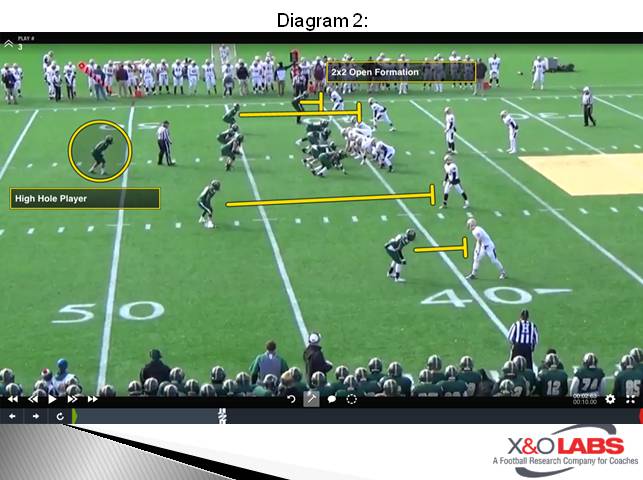
10 Personnel 2×2 Formations: (Diagram 2)

Slide2

Against 2×2 formations, the six-box will not change. The adjustment comes on the perimeter, where each receiver is covered down by the two corners and a strong safety and weak safety. The free safety is traditionally the high hole defender.

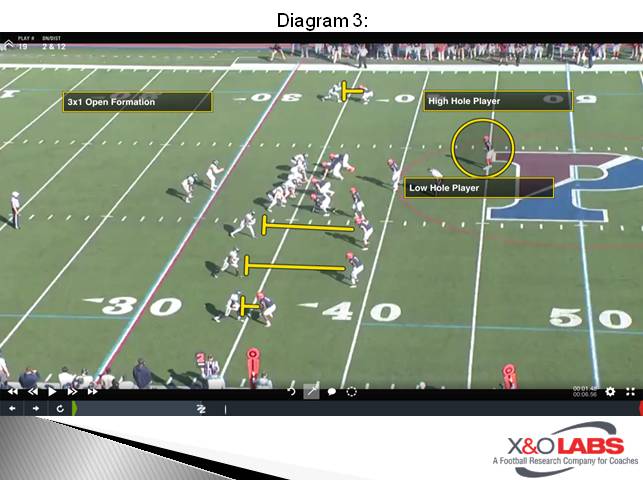
10 Personnel 3×1 Formations: (Diagram 3)

Slide2

Again, the box doesn’t change with trips formations. One interior linebacker will typically play the back and the other will play the quarterback. We will address how this will vary in case three. In the back end, the weak safety will traditionally be the high hole player, while the strong safety, free safety and corners scramble to align on the other receivers.

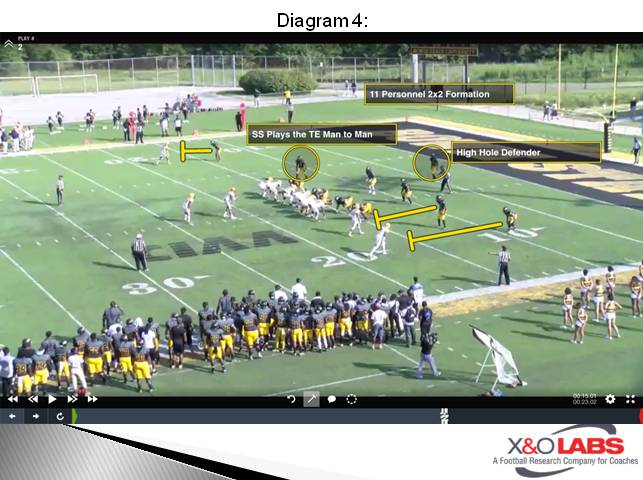
11 Personnel 2×2 Formations: (Diagram 4)

Slide4

The advantage of a closed tight end is that the defender responsible for him in coverage is able to play both the run and pass based off the tight end’s movement. As Will Pluff, the defensive coordinator at Utica College told us, “he has the best key in football. It’s hard for him to lie.” In these situations, the corners and safeties decide who will be the high hole player.

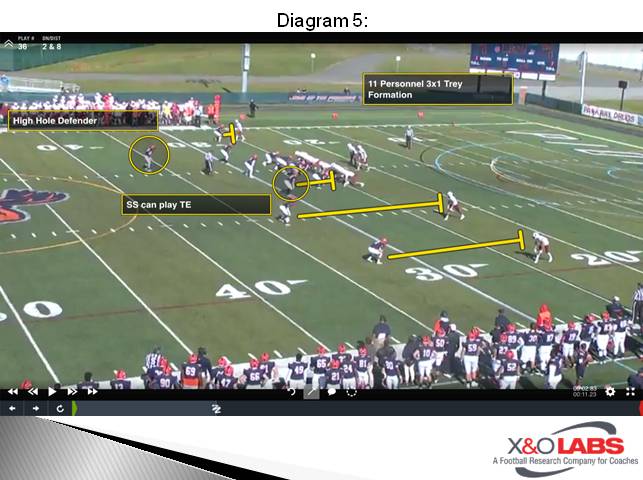
11 Personnel Trey Formations: (Diagram 5)

Slide4

In Trey formations, the strong safety will typically align to the tight end and play him man-to-man just as he did in 2×2 closed formations. However, if the offense aligns in a formation to boundary situation, a matchup advantage could be employed by “banjoing” the number two receiver and tight end. This is something Coach Sewell will use. When the number two receiver goes in, the safety drives down right now. He normally expands to play tight end but tight end blocks so he gets underneath number one. Here, the Mike is able to open up and be the low hole player when back goes away. It becomes a bracket on the number two receiver.

The clip below best illustrates this coaching point:

Read More

Man Coverage v. RPOs: Case 3 – Concept Teaching Man Free Coverage to Defend RPOs

By Mike Kuchar
Senior Research Manager
X&O Labs
Twitter: @MikeKKuchar


Introduction:

Now we segway into how using the fundamentals and techniques in the earlier cases transitions into defending RPO (run/pass option) concepts. In this case, we present our research on the run responsibilities of each defender. Remember there is one clear definitive in the reasoning why coaches are preferring to use man free coverage structures to defend RPO schemes: there is no conflict defender. The entire premise of the RPO system is to manipulate a defender in zone coverage who may have a dual responsibility by playing both run and pass. That is certainly not the case in man free coverage. Defenders are given either a run or pass responsibility pre-snap and it is their singleness of purpose to carry out that assignment.

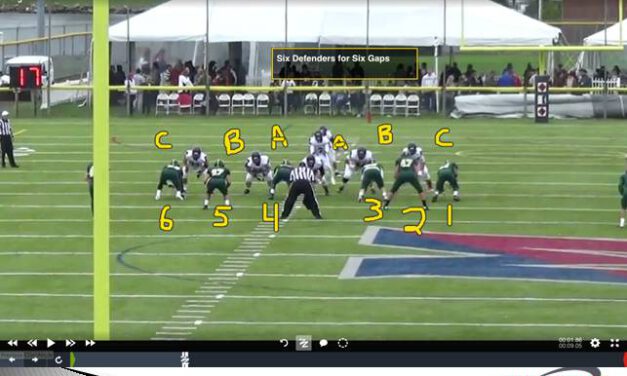
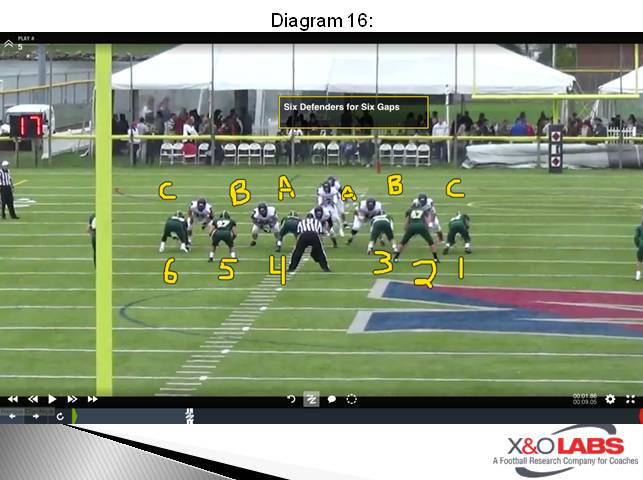
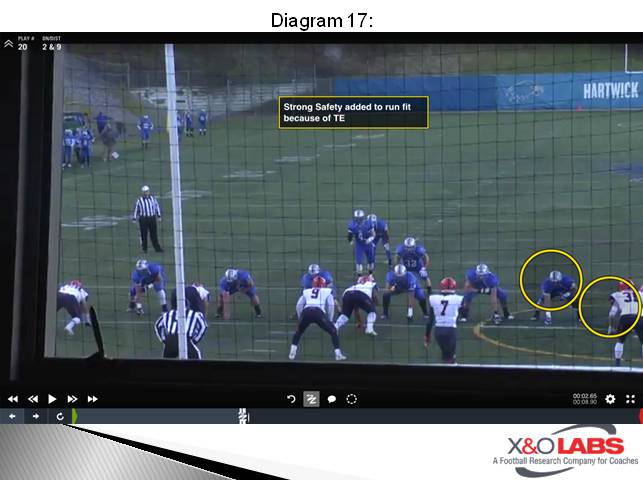
Now, the down side of man free coverage structure is there is no traditional numbers advantage in the run game. In 4-2-5 defenses, it is six-for-six in the box against open formation offenses (Diagram 16). It’s a single gap control situation, “a get a hat in a gap and go mentality” with a defender asked to make a tackle on the player he’s responsible for. Now, later on in this case, we will detail how some coaches are getting a numbers advantage by cheating the extra, low hole or high hole defenders, to get another hat in the run game. When offenses add an extra hat, thus adding an extra gap in the run game, another defender must be accountable. This defender is usually the strong safety against three man surfaces (Diagram 17).

Slide16

Slide17

Now, the benefit of having a closed tight end is that it may be a clean read for the strong safety to trigger on a run or pass. “The tight end is the best key in football because it’s very hard for him to lie,” said Will Pluff, the defensive coordinator at Utica College (NY). In order to make it a cleaner read for him, Coach Pluff will align his defensive end in a C gap so the tight end must have to make contact on that defender either way. And as we expounded upon in case two, the H/Y off key is often just as true in determining run or pass reads. The defender responsible for that player will simply add on to the run fit whichever way he moves pre or post-snap.  But either way it doesn’t change the box count. “We have to study the formation,” said Coach Pluff. “It’s really about what they are doing with the tight end off the ball. If they take the tight end and put him off the ball and involve him in the RPO, well then they have five blockers up front. They could block you with the quarterback as well. You have to make sure you need to have six in the box for the run and you get that in the 4-2-5 look. Our two inside linebacker will fit to the box. Schematically, we need to make sure we have eyes on number one, number two and number three in the pass game. If we have eyes on those guys and not involving the inside linebackers, I think we have a shot.”

Training Box Defenders to the Run Element of RPOs:

So now once the ball is snapped, the formation detail is off the table and defenders must execute their run or pass responsibility. Here we focused on how our contributors were training their box defenders to fit the run game. We wanted to study what they were teaching them to read pre-snap and how they were teaching them to react post snap.

Basically we found four areas of study in training the box defenders to play the run element of RPOs. They fit into the following areas:

  • Gap Based System
  • High to Low Read System
  • Low to High Read System
  • QB Read System

Gap Based Systems

Grant Caserta at Husson University teaches his box defenders a gap based system with the understanding that this may change based on any pullers. Against the zone read run game, the crux of our entire defense is having all interior run gaps accounted for. As Coach Caserta asserts, “If we leave open gaps inside from tackle to tackle, there is no way we will stop the run consistently. Fitting gaps properly on the interior is crucial. We feel like the strength of our defense is stopping interior runs, so that is where we prefer the ball to go on option plays.” As a general rule, anybody who is blocked has the dive. The unblocked defender will play the quarterback, which would apply against other types of RPOs as well, such as when defensive tackles or linebackers are read. The purpose is to get the ball handed off on any kind of zone read, RPO or any other kind of option. “All inside run defenders need to fill their gap based on the run scheme. We stress to these players that they need to stay in their gap and take care of the running back,” said Coach Caserta. “They must trust that the perimeter players will do their job and take care of their respective responsibilities. For these inside run defenders, it does not matter if there is a ‘read’ element to the play or not they should fit the run the same way regardless.”

The clip below best illustrates this coaching point:

Read More

Using the Mike LB to Adjust to 20 Personnel Fast Motion

By Michael Bellacosa
Defensive Coordinator
St. John the Baptist High School (NY)

Introduction:

The approach we take defensively at St. John’s will always remain the same no matter what offensive scheme we face: we will overwhelm the point of attack. We focus on putting pressure on our opponent using multiple fronts stemming from a 4-3 defense in order to make the offense very reactive.

Our primary call in attacking a spread offense that use jet motion from the backfield is what we call “Stack”. This is a simple over front moving one of our linebackers to the line of scrimmage and stacking our remaining linebackers slightly outside of our defensive tackles giving them protection.  It has been very effective for us over the past few years and I believe it can be a nice weapon for coaches to add against these types of teams.

Defensive Approach:

Before I get into the “stack” call itself, I feel it is important that you understand why we take this approach. Our goal is to never break our 7 man box and to bring in up to 9 whenever we can. With that, we are comfortable and confident in sending anywhere from 4 to 7 players after the QB with as much movement up front as possible. Our middle linebacker and safeties are the key to making this style of defense succeed. 

I have always believed the best way to play defense at the high school level is to take the reactive nature of defense out of the equation and take an offensive play calling approach to the other side of the ball. The objective is simple, to overwhelm the point of attack and overload the line of scrimmage with movement and different angles created by various fronts. With this approach in mind, I draw up a simple game plan with as many different fronts as possible to stop the offense’s top plays. 

Our opponents have tried to spread us out and get players into space using traditional spread rules and a hurry up style. Our style never changes and I feel that by keeping the receivers in front of our defensive backs and tackling well, teams are not able to short pass us down the field. By committing so many players to the box and playing so close to the line of scrimmage, we are dictating to the offense to throw the ball, and throw it quickly since the rush is coming.

The most important thing that I think of when putting together a defensive game plan is to maintain my aggressive approach and line up in a way so that my players can always play my call. We never check out of a call no matter what the offense does. 

Defending Jet:

To counter our defensive approach, many teams have been running full speed jet motion as a way to make us react quickly with hopes of creating a mismatch.

The middle linebacker becomes the key to defending this style of offense. Most of the jet motion comes from the backfield in a 32 personal type grouping (3 receivers and 2 backs). Instead of playing with a single high safety, we will use our middle linebacker to drop coverage in the middle of the field while sending pressure off the edge with our outside linebacker and weak side safety. 

Diagram 1 (below) shows our base 4-3 defense numbering our safeties and linebackers 1-5 front left to right for our blitz purposes in other packages. Our defensive line have specific landmarks to hit across the offensive line to help keep their pad level down and stop them from peaking in the backfield. Our base coverage is Combo 2-1 man coverage with linebackers picking up the back out of the backfield. This coverage is simple implementing switch principles to defend any pick plays and combination routes.

Slide1

We commit our 2 and 4 linebackers to the line of scrimmage on more than half of our defensive snaps. They are our bigger linebackers, similar in stature to our defensive ends. Our 3 linebacker is the key to the defense. We look for a player with the build and skill set of a large safety. He must be able to run sideline to sideline and cover backs out of the backfield on swing and seams when we are in Red coverage. In the case of defending this full speed, last second jet motion, he must be able to drop and play a middle zone. 

Read More

Zone Inserts Special Report – Case 1: Adjustments in Zone Identification, RB Entry Points and Training the Inserter

By Mike Kuchar
Senior Research Manager
X&O Labs
Twitter: @MikeKKuchar


Introduction

This report may be a zone study, but it’s essentially an advancement on running the inside zone concept. We specifically researched programs who were “hanging its hat,” as coaches say, on the inside zone concept. Specifically, we wanted to contact coaches who were finding ways to run the inside zone when they had to run the ball, which often came at the expense of seeing loaded defensive boxes.  Of course, one of their answers was to use an insert a blocker such as a fullback or H/Y off the ball. But before we address the three run concepts in this study (Divide Zone, Cut Iso and Wham Zone), we wanted to provide the framework of how coaches teach their offensive linemen who to block. We didn’t want this to be a technical report on how to block the inside zone play. Much of that has been studied and reported in the past. 

In this case, we present our research on how coaches have tweaked their zone identification to account for loaded boxes pre-snap and defensive “back gapping” post-snap. We also researched how these new box counts were correlating to the path and reads of the ball carrier. Finally, we wanted to provide a skeleton outline of how coaches were training their H back in practice to prepare him to make the necessary blocks to make these schemes productive.

Identification Systems

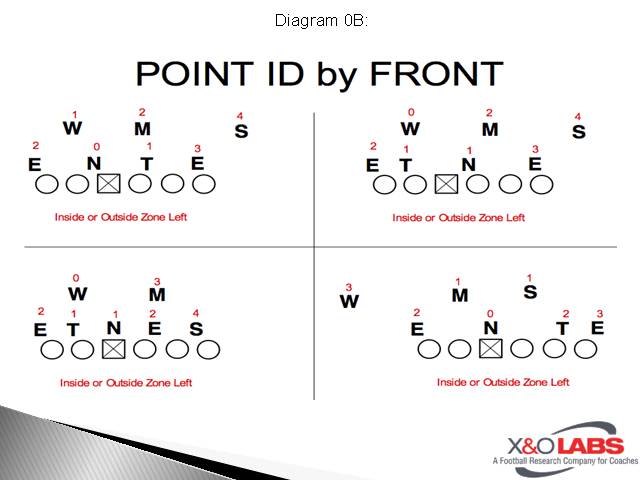
In most programs’ zone schemes, the quarterback or center is expected to make the front identification by identifying the play side inside linebacker (Mike) and the line will work their zone combinations to that defender. The “point” is where the center is working his combination block. In most cases, that player will be the play side (or center side) A gap defender. The count (front side and back side) occurs from there. The guard is responsible for number one (on or off the line of scrimmage), while the tackle is responsible for number two (on or off the line of scrimmage). Consider the following diagram where all defenders are accounted for on the line of scrimmage.

Slide2

When second level defenders are tied into the count, they can still be given numbers. Consider the following diagram:

Slide2

This common point system can be implemented against most base defensive fronts.

Slide3


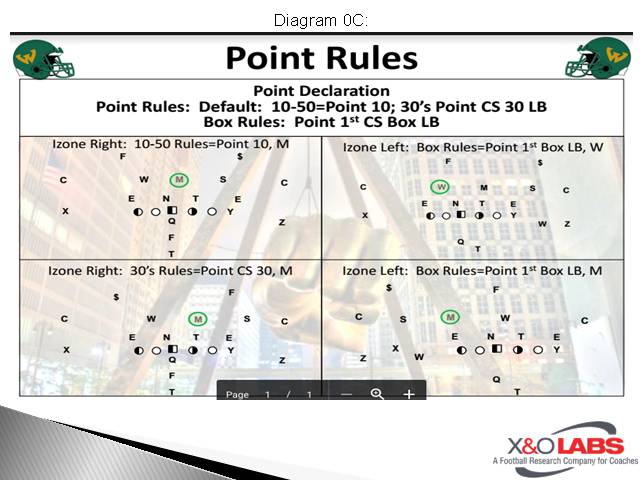
Consider the following point rules for one of our two-back contributors that will use a default for the center to identify second level defenders and will identify the 30-technique backers (split look) or 10-technique backers (stack look) to start his combination.

Slide3


Three Down Stagnant Front Identification

There are some coaches, like Brad Davis at the University of Florida, who chooses not to run inside zone against three-down, movement based structures. “The angles are bad, particularly against two-gap defenders,” he told us. “It’s easier against four down because you can control who the quarterback reads. There is not as much fold action with the defensive end and outside linebacker.”

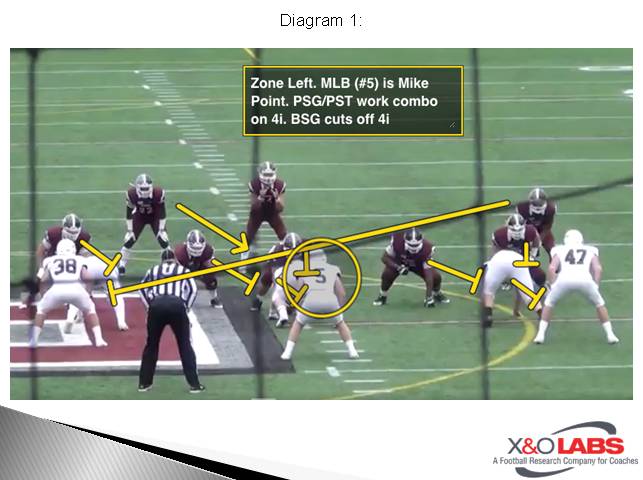
So when we first started conducting our research, we were curious to see how many coaches were confident in running inside zone schemes against odd fronts. We had to believe that for coaches that hang their hat on the inside zone scheme, they will make adjustments to “do what they do.” Turns out there were some concern about zoning the odd front: particularly the presence of two 4i techniques (otherwise known as the Tuff front) and the potential of movement post-snap. With movement gaps change so it’s vital to get the number count right pre-snap.

We will present our research on how coaches are addressing both 4i alignments and movement, but before we do, we’ll address how they are identifying stagnant box structures.

Base 3-3 Box (Diagram 1)

The consensus is to “own the stacks” with the Mike LB being the Mike point.

 Slide1

Base 3-4 Box (Diagram 2)

Here, the thought process is to push the count to the overhang rush (or Jack linebacker). Tyler Bowen, the offensive line coach at Fordham said, “we will never account for a defender outside the framework of the original six that we declare pre-snap. We will handle all other defenders with a RPO tag or feel comfortable about our matchup with the RB on their unblocked player.”

Read More

Zone Inserts Special Report – Case 2: The Divide (Split) Zone Concept

By Mike Kuchar
Senior Research Manager
X&O Labs
Twitter: @MikeKKuchar


Introduction

What separates using open formation zone concepts from H/Y off zone concepts is the addition of another gap offensively which converts to the ability to block at least six defenders. And when you add the quarterback run into the equation (which we won’t for the intent of this study), it has the ability to block seven. For all intents and purposes, the zone read component of the H/Y off run game, or commonly referred to as slip, will be left out of this report…but it’s a nasty complement to these schemes. That concept was focused on in our special report on the Pistol Formation.

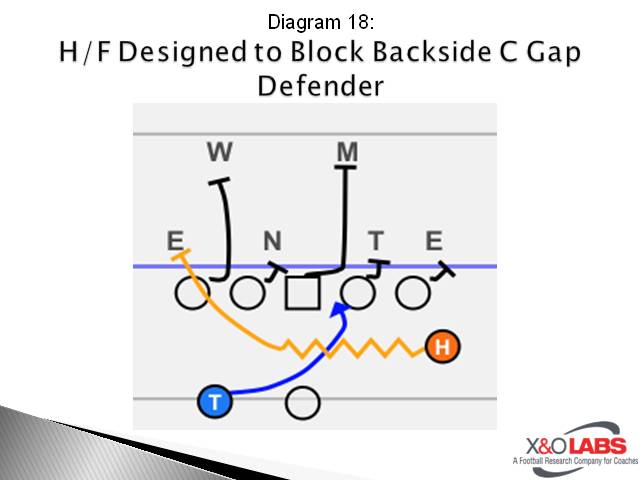
This case is going to strictly focus on the divide zone (Diagram 18), which many coaches are calling the best-run concept in football for a variety of reasons. Most of which are included directly from our contributor’s testimonials on it below:

Slide18

Tyler Bowen, offensive coordinator, Fordham University (NY): “You can take advantage of teams that back gap, but are late to fill the front side B/C gap area. Also against teams that back gap and fill with a 3rd level player, it can allow you to take advantage of that player with RPO tags. From a basic standpoint, split zone gives you the ability to run a split end surface run, to your tight end strength (H Back) by creating a three-man surface.”

Tom Clark, North Cobb High School (GA): “We love it out of two back formations. I like it because we run so much gap scheme out of two back, teams start over playing one side and it helps with misdirection. It gives defenses the wrong read and keeps them honest. Also helps against odd fronts that don’t know where to slant. We can cover up all the gaps and be gap sound with this scheme.”

Justin Iske, offensive line coach, Southwest Oklahoma State University: “The more a team slants/twists, the more we will work our base zone and split zone.”

Mike Rowe, Rocori High School (MN): “We want to be able to run the ball because living in the Midwest the weather will not always be perfect. Even with all the RPO adjustments, we still find defenses will load the box on crucial run downs. By using split, iso, and wham, we are able to still gain positive yards versus these run boxes.”

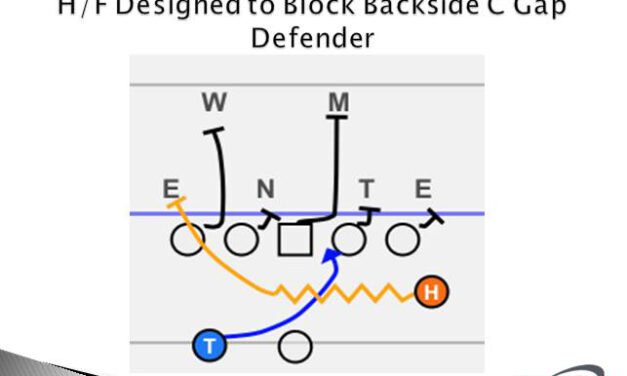
Chris Fisk, offensive line coach, Central Washington University: “The entire zone game is how you control the back side C gap or D gap. You don’t want defensive linemen crashing down line of scrimmage making plays for a one or two-yard gain. Split zone controls the backside C gap effectively.”

Tagging The Divide Zone

Before we get into how teams are running these concepts against box counts, we wanted to present our research on how offensive coordinators are tagging these concepts to alert the skill players. One of the more prominent advantages to tagging these insert zone schemes is the ability to not change anything up front for the linemen. We’ve found that the path of the back doesn’t change as well. So, the onus is on the H/Y to know who he blocks based on the insert being used.

Below are anonymous responses coaches have submitted from our survey on how they “tag” the divide zone concept.

“We used two calls for this a year ago. ‘Scrape’ would indicate that the fullback or tight end/wing would insert himself to the backside of the run, kicking out the end man on the line of scrimmage (EMLOS).”

“We would call this ‘10 Kick’ (Mule for no huddle ID). The 10 tells the linemen to block inside zone to the right and the kick tells the H he is to kick out/cut off the first man outside of the midline of the back side tackle. In situations where a head up defensive end spikes inside, the back side tackle would pick him up and attempt to cut him off or ride him down the line of scrimmage leaving a bigger cutback lane and the H would lead up to the Will or first back side inside linebacker.”

“We actually make this a different scheme / code word in our system to communicate to our offensive line when we run at an A gap defender that we want the backside to cut-off.”

“It’s built into the play. That is how we teach it. The H block is called ‘Hack’.

“We simply add the word ‘kick’ to our play call. The offensive line rules do not change. We run inside zone to the right, leaving the C gap defender untouched (zone read). When we want to run cutoff/divide concept, we just call ‘zone right–kick’ and the H back or Sniffer knows he is kicking the C gap defender.”

“We tag this as a ‘BAMA’ call. This tells our back to go to the A gap and our H-Back to kick-out the defensive end. For our linemen, we keep it simple and stick to our ‘zone read’ rules. This allows multiple plays and looks out of different formations.”

“The (zone) read and cut-off is same call. Only the player responsible for that block knows from a signal.”

Read More

Zone Inserts Special Report – Case 3: The Cut (Zone) Iso Concept

By Mike Kuchar
Senior Research Manager
X&O Labs
Twitter: @MikeKKuchar


Introduction

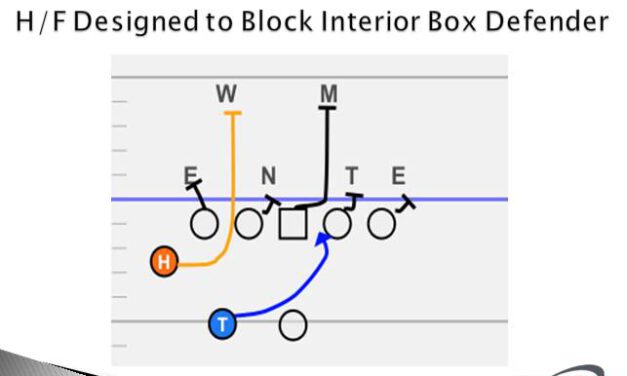
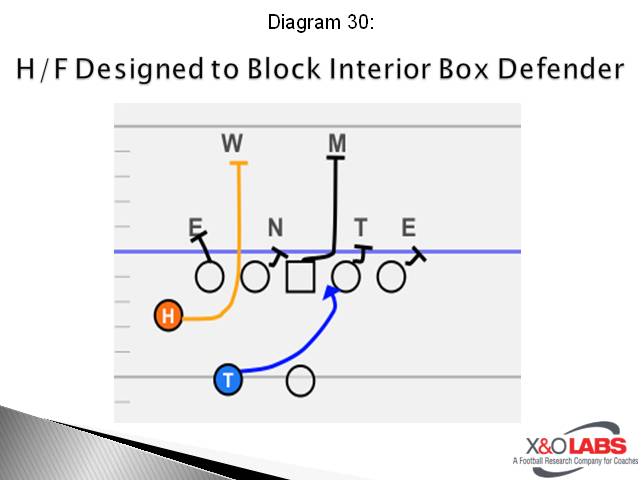
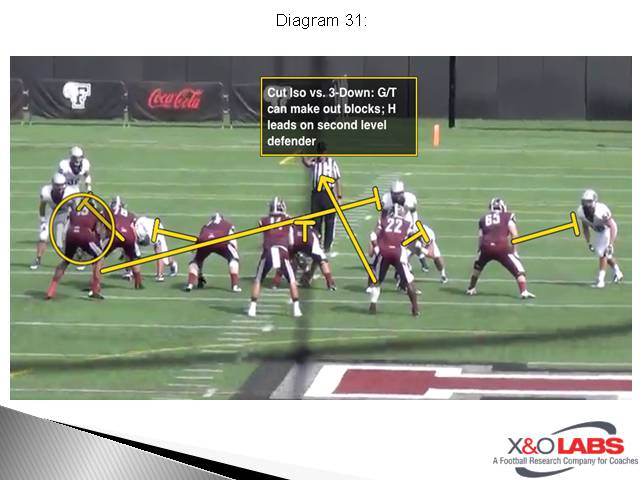
The cut iso or zone iso, as it may be called, is an insert concept that will influence the backside inside linebacker or -2 the point in zone schemes (Diagram 30). It can be run to the side of the H or away from the H who will lead block on a second level defender. It mirrors the old school isolation scheme save for one main reason: it entails zone blocking to the play side and man blocking to the backside of the concept. This means that it still relies on the displacement of defenders who are working to the zone concept and because of this it provides for a “softer” blow by the H/Y on the second level defender. We are calling it “cut” iso because the H is usually “cutting” across the formation to block the second level defender.

Slide30

In this case, we will conduct our finding on how coaches are identifying the defensive front, how they are blocking the concept and how the H is taught to execute his assignment. It’s a zone concept play, so the aiming points of the back will be of the same emphasis we detailed in case one. When we asked our contributors why they packaged the cut iso, here is what they told us:

Justin Iske, offensive line coach, Southwestern Oklahoma State University: “The more static the front is, the more we will run cut iso.”

Chris Fisk, offensive line coach, Central Washington University: “Whenever that back side tackle has free access into the B gap that DE can close the hip so bad, we lose H backs to concussions. The collision is so much more doable for him (an H) to insert into a second level.”

Tyler Bowen, offensive coordinator, Fordham University (NY): “If a team is doing a great job of bend scraping on the backside of the zone, this can give you the ability to set a point on the bend defensive end and put the TE/H back on a soft scrape defender.”

Larry Hill, Smithson Valley High School (TX): “We think it marries up with the three down fronts and four down fronts equally.”


“Tagging” Cut Iso

Since many coaches package the cut iso with other insert concepts such as divide zone or zone wham, we wanted to research how they were coding the play, or labeling the play. Responses are posted anonymously below:

“We use the tag, ‘BOB’ to let the H/Y/F know that they are responsible for inserting on the backside LB.”

“We tag the backside tackle with a ‘Seal’ tag when he has a FB/wing play next to him. In conjunction with labeling a Mike (whom the center will climb to all things equal/proceeding normally), the Seal tag tells the backside tackle he is hinging back. If we want to have both the tackle and guard hinge back, a Bob call is made which directs the FB/wing to insert through them to go second level, again, keeping in mind who our designated Mike will be.”

“The back side tackle has man on. Rest of the offensive line follow inside zone rules. If the back side guard has a 3-tech, H leads up through backside A gap for the Will (linebacker).”

“We tag our zone call with ‘BOB’ (Big on Big). When the linemen hear the ‘BOB’ tag, they know they are responsible for the 4 down linemen plus the “Mike” (3 down linemen and OLB if an ODD look). The QB sets the ‘Mike’ call at the LOS and we base our combos on that call.”

“We tag our blocking call with a ‘T’ to tell the BST (and sometimes the BSG) they are base blocking, not zone blocking.”

“For us, we call this ‘wham’ which is nothing more that inside zone on the play side and iso rules on back side. Our play side offensive tackle just knows he has to drive block the defensive end.”

“To our linemen, this is ‘Boston’ which to them is our code word for locking on the defensive end. This also tells our H-back to block B-gap backer whether play side or backside.”

“We would call this ‘zipper’ insert. We signal the concept to the offensive line, so we would signal in zipper lock, telling the left tackle that he’s locked on the end.”

“We use a ‘B’ word to tell the line that the Y has linebacker level (first linebacker outside center away from the call). Basically becomes an iso.”

Three Down Front Play Design

Slide30

The cut iso is a six-box run concept, particularly out of 11 personnel Y off groupings, which 65 percent of coaches say is their most productive Y off personnel grouping. The advantage of running the cut iso against three man front six boxes is the ability to out block on both the 3 or 4i-technique defensive tackle and Jack linebacker, while inserting into a second level player. Which means that there is one underlying question to using this concept against odd fronts, can your center handle the nose? If he can, great. If not, this may not be a good concept against odd.

Read More

Zone Inserts Special Report – Case 4: The Zone Wham Concept

By Mike Kuchar
Senior Research Manager
X&O Labs
Twitter: @MikeKKuchar


Introduction

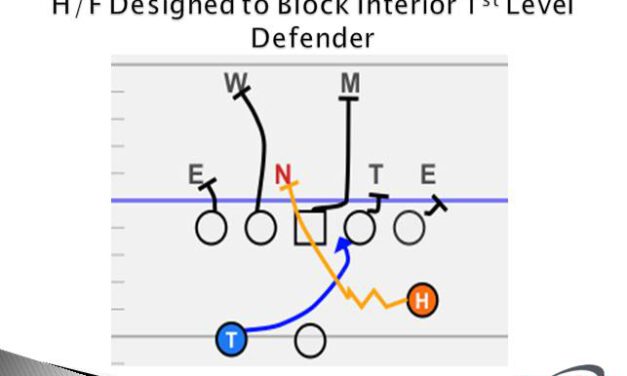
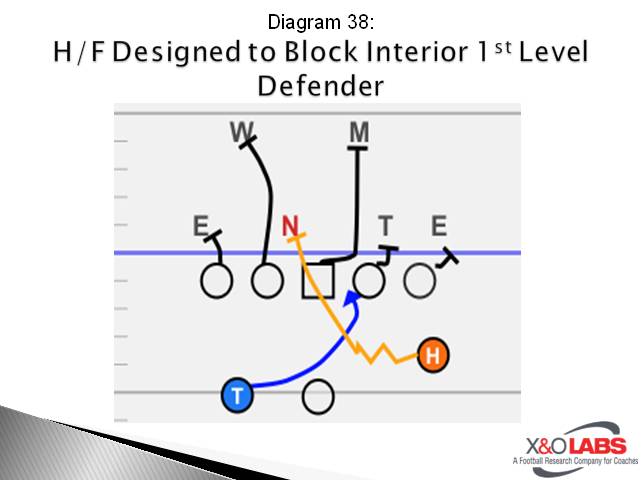
The final insert concept of this special report is the wham concept, which is essentially a trap block on the -1 defender on the backside of the zone (Diagram 38). Although 46 percent of the coaches surveyed say they run this concept, we found it to be the most under utilized concept among this focus group. In fact, while conducting our research, it was a common declaration for many of our contributors to say, “we wish we ran it more.” Because when run correctly, the play can be dynamic.

Slide38

While it can be dynamic, there is that ever-present concern that an H back cannot effectively block a first level interior defensive lineman, which is what the job description entails. Sure, a tight end on a defensive end on split zone can be managed, but a face first block on a 3-technique or what’s worse, nose? You can’t be serious. Well, our contributors are not only serious but they’re adamant about running the wham to both an odd and even front.

In this case, we’ll share our finding on how coaches are identifying whom their target is, because the beauty of the scheme is manipulating whom you want to trap. We also present our research on how they are blocking the concept and how the H is taught to execute his assignment. It’s a zone concept play, so the aiming points of the back will be of the same emphasis we detailed in case one. When we asked our contributors why they packaged the wham with their inside zone concepts, here is what they told us:

Tyler Bowen, offensive coordinator, Fordham University (NY): If you’re running zone, the toughest block on the field is the backside tackle on that 4i defender so the zone wham is an answer. We have a better angle to wham him than cut him off.”

Tom Clark, offensive coordinator, North Cobb High School (GA): “The best part is it doesn’t change anything for our offensive line zone principles and it allows me to block six or seven in the box. We don’t have to worry about brining an extra lineman in to block seven in the box.”

Justin Iske, offensive line coach, Southwestern Oklahoma State University: “It’s a way to run trap without teaching trap.”

Tagging Wham Concepts

Since many coaches package the zone wham with other insert concepts such as divide zone or cut iso, we wanted to research how they were coding the play, or labeling the play. Responses are posted anonymously below:

“This is a ‘wham’ tag for us. The H/F/Y is responsible for the first down defender past the center.”

“By how we align our back, or the formation, and where that sets everyone, the wham call will always apply to an A gap threat on the backside of the call.”

“The first man past the nose of the center is not blocked. Backside tackle has defender on line of scrimmage. Backside guard has best path to linebacker.”

“We tag ‘wham’ or ‘nose wham’ to our zone call. Wham is a front side wham and Nose Wham is a backside wham. These are interior defensive line tags. Linemen know to fan/rip-under the side of the wham. Combos remain the same as zone unless your combo defensive lineman is getting the wham block.”

“We actually have a play call for this play. This is 40/41 for us. Which is inside zone front side, fan backside and the H lines up base on the call. Against an even front will always wham the nose or shade technique. Against an odd front, we have whammed the nose, or a defensive end.”

“We will only wham a 3-technique. We’ll give a Tom, Tommy, or Thomas call along with our zone call to indicate to the OL that front side is blocking inside zone and backside guard and backside tackle have linebacker and defensive end. The ‘Tom’ call tells backside not to block the DT backside.”

Play Design vs. Four-Down Fronts

We found the majority of coaches will prefer to run the wham concept against a 3-techinque mainly because of the aggressive nature of that player and a higher tendency of an up field charge, both of which complements the purpose of utilizing the wham scheme.

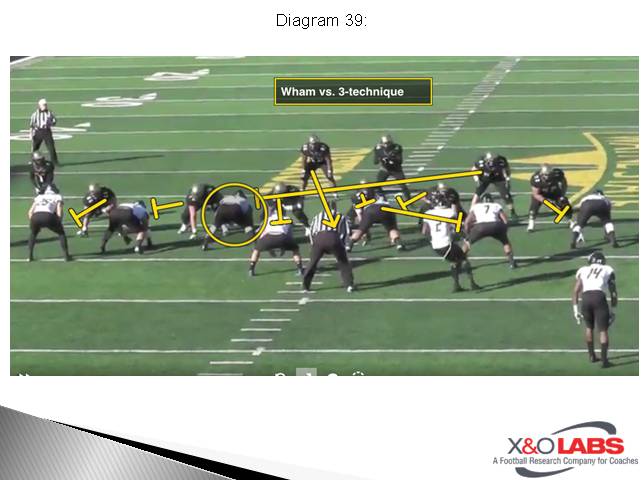
Scott Wooster, the offensive line coach at Wayne State University prefers to run the wham concept at the 3-technique in four down fronts mainly because of those aforementioned reasons. Often times he will do it with H motion in order to get him on the outside leg of the guard to get the right leverage on the block (Diagram 39).

Slide38

Read More

SEC OL Coach on The Insert (Split) Zone Study

By Mike Kuchar
Senior Research Manager
X&O Labs
Twitter: @MikeKKuchar


Introduction

When defenses add safeties into the box it leaves an offense with two options: read him with an RPO or go right after him in the run game. One prominent SEC OL coach told X&O Labs he’ll choose the latter:  “If he wants to come fit let our back go one on one with that dude.” In an X&O Labs exclusive interview, this coach talks about why a numbering system slows down tempo offenses, how he implements key breakers in the H/Y off formations and what he does to handle back side 4i defenders in the odd front, all focal points of the insert zone study X&O Labs released in February. We wanted this perspective on how coaches were teaching the insert zone as it pertains to the following four contentious issues in blocking the inside zone:

  • The issue of using covered/uncovered principles vs. a numbering system in tempo offenses
  • Why changing the back’s landmark to combat defensive back gapping is flattening out the zone scheme
  • Implementing key breakers in the H/Y Off formation
  • What to do to handle the read side 4i defender in Odd front 

His thoughts on these topics are below:

On Using Covered/Uncovered Principles vs. a Numbering System…

“We’re more along the lines of what Joe Freitag (the offensive line coach at Monmouth College IL) is doing with just blocking fronts and not going to a numbering system. We don’t use covered and uncovered rules. We block what is in front of us, rather than saying ‘this guy is a minus one or this guy is a zero.’ Then when the ball snaps they move and it changes everything. You better be ready to play when the ball is snapped. You can’t overload your offensive line with too much information. You don’t want to over coach it.”

On Defensive Back Gapping…

“This is what people are going to see more and more of. Defenses are trying to fit everything like a 4-3 team with the safety being the front side fitter. You can either control that safety with an RPO or you can block the hats we are responsible for. My mindset is screw that guy. If that guy is going to come fit, we will let our back go one on one with that dude and see if he wants to be the leading tackler of the team. If he wants to be, then we will have our moments as well.

The other thing you can do is push to him with our coding like a gang call.  We did this against one program this season who was blitzing as soon as they got off the bus. We gang called everything and gap tracked it. The whole key with that is getting in vertical tracks after the first step. We would go lateral for six inches than press vertical. If you don’t everything starts to wash sideways. Now the track of your line doesn’t match the track of your back. For us, we only have one landmark on our inside zone concept, which is the crack of the Center’s butt. In your study, North Cobb High School (GA) talked about not changing landmarks and that is like us. We don’t want it to change. We want to be consistent regardless of the front. You change the track and it becomes like a mid zone and not an inside zone. If you’re going to be a B gap zone team, that’s a mid zone.  It’s a totally different concept. It’s not a vertical departure angle. We want to get vertical. I don’t want the line moving laterally on inside zone. When you start pushing the line to that fitter from the top shelf that is the danger of it. It flattens out and it moves laterally on what should be a vertical push.”

On the Benefits of Using Same Side Zone Schemes…

“What I find most interesting from the study is what coaches like Tyler Bowen (now the offensive line coach at Maryland) are using to break keys in the Y/H off inside zone scheme. If you don’t want to use pistol formations, this gives you another option.”

On Handling the Backside B Gap Defender…

“Against odd front, if I have two 4i technique’s with no overhangs, I will double team both 4i’s and solo block the Nose with my Center. We’ve also tight arced the tackle and read him or whammed that defender. To wham him or to run the cut iso, which was also detailed in your study. It is a really inexpensive add to the zone scheme. This past season one team wound up blowing up the mesh point in our zone schemes so instead of running split zone we would run split zone but lock the backside and insert for the backside linebacker. You’re getting a hat for the defensive end right now without giving him an opportunity for him to blow it up. We have tags that will get us to that stuff.  You’re still running an inside zone concept you’re just adjusting. It’s simple. You can get it taught and understood quickly.”

To read the entire study devoted to all of these components, click on the link below:


BREAKING: X&O Labs’ Brand-New Special Report…

Read More

Hot Route System for the High School QB


By Dan Ellis 
Head Coach
Great Valley High School (PA)
Twitter: @CoachDanEllis


Introduction

My goal as a high school coach is to limit the amount of thinking our players need to do on a play-by-play basis so we can maximize our talent and athleticism. I like to throw the football and I like to keep our QB safe, so our protection schemes are critical. However, I do not have enough practice time to invest in too many protections and still get everything repped that we need during a practice week. We do not feel we can afford to teach another 5 man protection on top of the other protections we use (slide, half-slide, roll, naked/boot). Therefore, we have made sure that we protect ourselves by building hot or sight adjustments into our play calls and use a version of our 6 man protection.

Protection

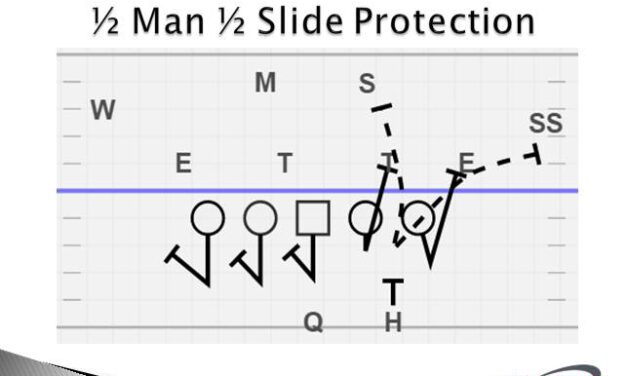
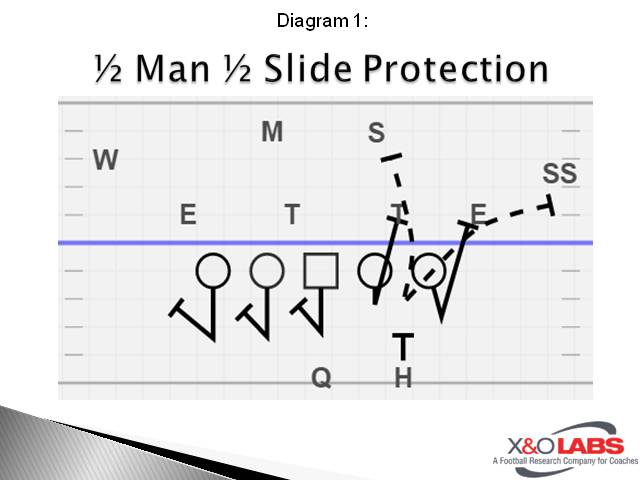
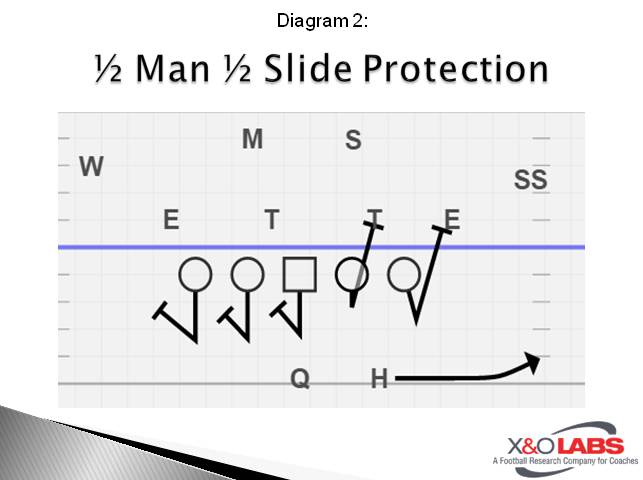
Our basic protection is half man/half slide protection, which has been talked about numerous times on XandOLabs.com by others. Below is our basic protection with the H reading inside out. Play side, the PSG has #1 down, the PST has #2 down. C has backside A and his general rule is that he cannot allow a slide side player to cross his face to the man side of the protection. The BSG has backside B, and BST has backside C. Even in this 6 man protection, the weakness is always 4 to a side. If both the SS and S blitz (or the M and W), we cannot protect and have to throw it hot. 

Before I touch on the built in hot, we also use the same protection for our 5 man protection. The only difference is that we have a signal for the H to be a free release player from the back field. The H always has a route to run in regular 6 man protection if no blitzer shows, but with this tag he is automatically releasing. If we are in empty, it is assumed that he is free released by his alignment in an empty formation. Again, the coaching point here is that no receiver will have to adjust their routes and linemen will not have to learn or practice a new protection call. The center still has the same rule about a slide side defender crossing his face to the man side, he has to block him.  

In each of our pass concepts (shown below), we always have a player that is running a short/quick route.  When we teach them our route concepts, the only thing we say is if they see a blitzer as they run their route, be prepared for the ball. The offensive line will always block the protection called and do not need to make any calls to adjust. The QB is the thinker. He needs to know what is happening, be surprised if the blitz doesn’t come, and if it does, deliver the ball to the appropriate receiver.  

Teaching the QB

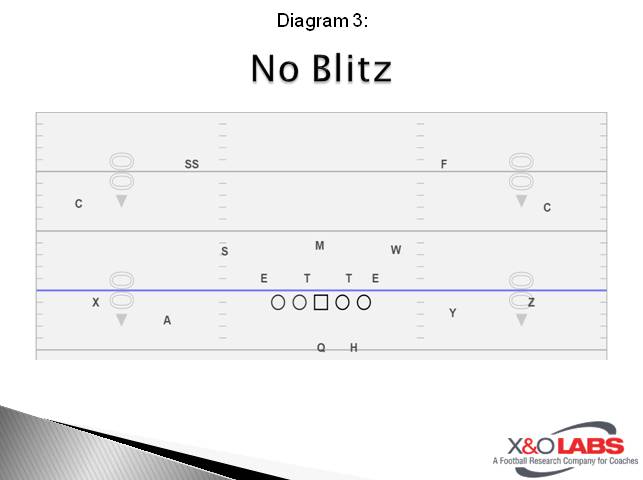
The first thing the QB must know is what the secondary is doing. Alignment and eyes for the corners and safeties are great keys for him to read. If there are two high safeties at 10-12 yards and corners are off and looking at the QB, the QB knows there is little chance there will be a pressure bringing 4 to a side (Diagram 3).  

If the corners are aligned in a man technique and the safeties are tight, he knows to be ready (Diagram 4). He may not know where the blitz is coming, but he knows to expect it. No safety is beyond 8 yards so a blitz is coming. We always stress that they need to cover the back with one of those LBs.  

Read More

Case Study: Communication Drives a Winning Culture

By Research Team
X&O Labs
Twitter: @XandOLabs


Games are often lost in four or five plays, communication and pride in
preparation makes all the difference in those few moments.

Over the last six years, X&O Labs has discovered that great programs work hard at avoiding one of life’s biggest pitfalls: poor communication. Communication is key to building culture. A football coach’s goal is to have a culture of success and accomplishment, with players expecting more of themselves and ultimately winning more games.

To sum it up: Better Communication = Better Culture = Better Program.

Through extensive research and a handful of coaching interviews we believe we have found the best communication tool for coaches on the market: MaxOne.  

We’ve talked about MaxOne before and continue to hear about it from our readers. We want to share how this tool is changing the way coaches communicate, train, and ultimately turn their programs into cultures of success. MaxOne is a multi-faceted tool that solves many problems for coaches.

A couple months ago we outlined how Coach Keith Badger is utilizing the MaxOne strength training features , now we are digging in to hear about best practices from another coach who utilizes MaxOne to “communicate and drive the culture of his program.”

Meet Coach David Brozeski, an X&O Labs’ Insiders member who recently made the switch to  MaxOne. Here’s a quick intro to his program:


diagram1

Name: Coach David Brozeski

School: Norwin High School (Class 6A)

Location: Pittsburgh, PA

Conference:  PIAA District 7 (Joe Namath, Dan Marino, Joe Montana, Terrelle Pryor, to name a few)

School Size: 9-12th Grade – 1,650 students

Demographic: Middle Class

Time Coaching: 22 years

Head Coach: 4th Year

Notable Success: 3 straight playoff appearances

Read More