
Building in Variations of the Bash (Counter Read) Concept

By Lou Chiccehitto
Offensive Coordinator/QBs
Liberty High School (VA)
Twitter: @Coach_Lou12


As the evolution of the Spread Offense continues, our staff has noticed teams stray away from the use of gap scheme in the run game. We’ve found, especially at the high school level, that you can create huge advantages with numbers, angles, and leverage utilizing gap scheme. Our staple run is Counter Trey, and we use Bash (back away sweep) and Triple Option as ways to stress a defense horizontally. We also get the Tight End involved running Counter, using RPO’s and play action with this to stress the 2nd and 3rd levels of defenses. These two runs get our more athletic Tight Ends and Tackles to the 2nd level, instead of a guard in Power.

We’ve found that whether teams read guards, backs, cross key the backfield, gap exchange, or simply double fill, we can have answers in the run game with these two Gap Scheme runs. It’s easy to create rules against blitz (we call “Down” vs. interior pressure, which eliminates combos), against Bear fronts (call “Down”), for who to ID (always first LB past the midline), against Bear 4i’s or Tite Fronts (cut the backside 4i and read the EMOL/Overhang), and helps hide a smaller or immobile Center. And most importantly, we have tags that can beat aggressive Safeties or LBs without changing anything up front.


Gap Scheme Overview

For all Gap Scheme runs, we start with basic rules for our OL. We teach the frontside “On-Gap Down-Backer” and always ID the first LB past the midline for the puller. We stress eyes up, not to chase movement, block your gap instead of a guy, and never block a blocked man. This helps tremendously with teams who blitz, reduce gaps or gap exchange. Against Bear Fronts or interior pressure, we call “Down” which eliminates combos and sends OL a gap down to LB.


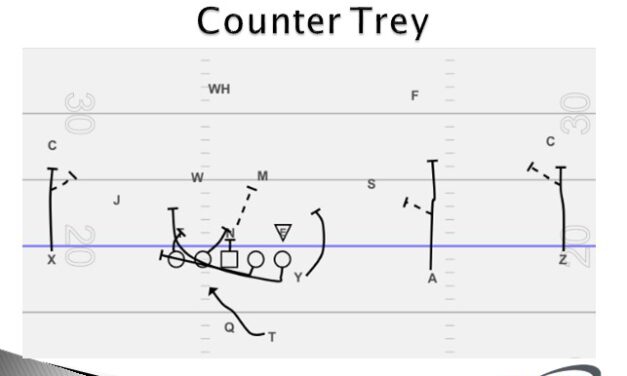
Counter Trey

Playside Tackle (PST): Vs. Over, combo with PSG to first LB on or past the midline. Vs. Under, gap-down-backer. Vs. Odd Fronts, Rip/Rake rules (rip C-gap defender, rake B-gap defender). Against bear, “Down” to 3-tech or 4i.

Playside Guard (PSG): Vs. Over, combo with PST to first LB on or past the midline. Vs. Under, block back on A-gap defender. Vs. Odd Fronts, combo with C to first LB past midline. Against Bear, “Down” to the nose.

Center (C): Vs. Even Front, block back to first down lineman. Vs. Odd, combo with PSG to first LB past midline. Against Bear, “Down” to BS 3-Tech. Call “Down” vs. interior pressure or when in doubt

Backside Guard (BSG): Trap pull tight to OL for C-Gap Defender. Log spillers kick out squatters (easy terminology for our guys).

Backside Tackle (BST): Skip pull inside BSG for first LB past the midline. If BSG logs, insert outside.

Y: Tag will tell him. Can arc to secure box if backside, or down block /base block playside.

QB: Open with feet aimed at playside B gap. “Trim the hedges” with your mesh. Read BS EMOL.

Read More

Whole Part Whole Method to Teaching Pressure Patterns

By Zach Cunningham
Defensive Coordinator
Del Sol High School (NV)
Twitter: @CoachCunny


I want to thank X&O Labs for the opportunity to contribute to this amazing football coaching community. It truly is an honor to be a part of something so special for such a long time. Coaching defense is fun, exciting, and tough. One of the more interesting aspects of coaching defense is the blitz game. Just like how offensive guys get “giddy” about new pass concepts and blocking schemes, us defensive guys get just as excited for blitz packages. No matter how exotic the blitz packages you come up with are, you will get burned unless you have an effective system in place. Within this system, you need to have adjustments and have a validated reason for calling the blitz.

When installing blitz packages, or even a defense for that matter, you need to have a system. A sound system is one that can adjust to multiple formations, motions, etc. A sound system also must be simple enough for your players to be able to make the adjustment quickly.

Our teaching progression begins on the board. Note: by the time we start installing blitz packages, we have already taught the basics of our defense to the players: positions, gaps, techniques, etc. We will teach the run/pass rules of the blitz on the board. Then on the field, we will walk through the blitzes on trash cans to get a lot of stationary reps.

Read More

12/21 Personnel OZ/Boot Package

By Brandon Maguire & Trevor Wikre
Running Backs Coach & Offensive Line Coach
University of Northern Colorado
Twitter: @Maguirebrandon & @Coach_Wikre


Introduction:

Illusionists are experts at leading an audience’s eyes to see and believe something that is not actually happening. That is exactly what we are trying to accomplish when we marry our 12/21P outside zone runs with our movement passes (Bootlegs). We want defenses set on stopping the run, causing them to vacate zones in coverage for explosives when they are too aggressive downhill. At UNC, we spend an incredible amount of time making sure our movements look identical to our outside zone schemes. In practice, this means scripting an outside zone immediately followed by a movement to compare pad level, sense of urgency, and body language.

When we decided that we were going to major in outside zone, we made the investment in our professional development, film study, and practice time to be great at it. We felt we must do three things:

  1. The offensive line will attack vertically, moving the defense against their will.
  2. The backs must be decisive and press the line of scrimmage.
  3. Wide receivers must be proactive within the blocking scheme.


We communicate to our player’s through two main points in our outside zone schemes:

  1. Physicality/Aggression
  2. Speed off the ball to aim points


This forces defenses to run sideline to sideline while trying to maintain gap integrity. Offensively, it helps us collect stunts and allows the offensive line to be aggressive. This aggressiveness comes from the comfort knowing the offensive linemen are in combination.

Abbreviations Used

PS = Playside

RT / LT= Right/Left Tackle

BS = Backside

RG / LG = Right/Left Guard

SL = Sideline

C = Center

OZ = Outside zone

QB = Quarterback

LOS = Line of Scrimmage

A = Running back

TE = Tight End

FB = Fullback

OC = Offensive Coordinator

WR = Wide Receiver (Also X & Z)

DE = Defensive End

NG = Nose Guard

DB = Defensive Back

LB = Linebacker


Outside Zone Concepts

Deuce Oregon (16-17): 1-Back. 12 personnel runs designed to attack the perimeter. Our balanced formation gives the offense a two way go, based on block leverage or support players. (Shown in Diagrams below)

I Duck (17-16 Wk): 2-Back. 21 personnel runs designed to attack the perimeter to the weak side. Full flow from the backs.  (Shown in diagrams below Deuce cut-ups)

QB: Open playside @ 45°. After handoff drive for 5 hard steps and snap head around selling keeper fake.**Check Oscar: away from support in normal splits. To support with reduced splits and 6i**

Read More

Mixing Quarters Technique for Rip/Liz Match Pressure Coverage

By Steve Erxleben
Head Coach/Defensive Coordinator
Southern High School (MD)
Twitter: @CoachErxleben


The ability to utilize Fire Zone Blitz concepts on any down and distance allows a defense to be multiple and defend numerous Formations and blocking schemes without checking out of most calls. In our league, here in Anne Arundel County, Maryland, each of our opponents present diverse formations, motions, run schemes, pass protections, and pass combinations out of a variety of personnel packages and tempos. As a defensive staff, we feel being a heavy zone pressure team gives us an opportunity to dictate the game and concern ourselves more with what we are running versus having to have a litany of checks per formation, motion, personnel, etc.

As a 76% blitz team here at Southern High School, we primarily use a 3 under 3 deep coverage scheme behind our zone blitzes. We feel it is the most important part of our blitz scheme in that it allows us to blitz while focusing on eliminating big plays and dictating how the ball will be leveraged from the outside-in as well as creating turnovers to get the ball back to the offense.

Unfortunately, a 3 under/3 deep scheme is sometimes referred to as a “cheat” coverage because it is relatively unsound in the immediate flat areas, the deep seam, and in the middle of the field between 15 and 20 yards. Every year we do an efficiency report on our Defense looking at all passes over 10 and runs over 15 to determine why these plays happened. In over half of our completions over 10, Hitches and bubbles were the routes completed and either created a first down or a long gain.

To challenge these short throws without giving up our blitz identity, we have gone to incorporating some of our quarters techniques into a Rip/Liz match cover 1 scheme against 10/11 personnel and formations where #2 and/or #3 is removed.

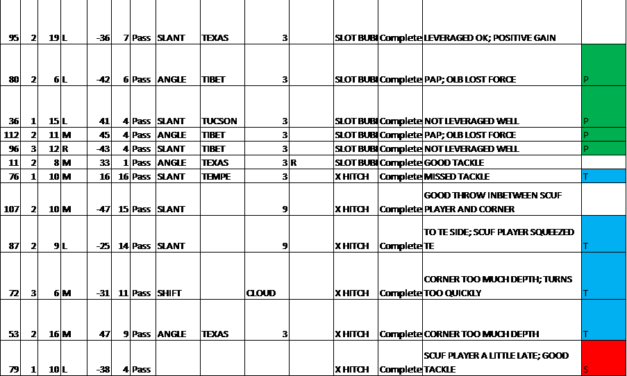
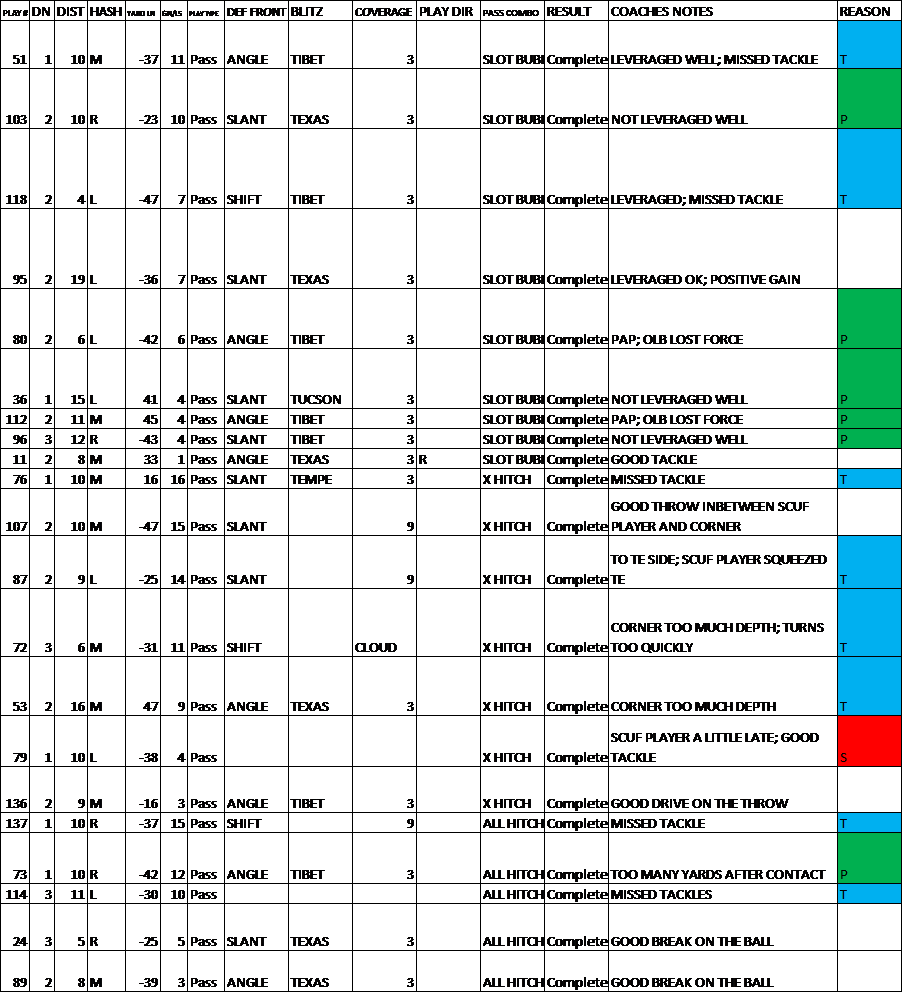
Every year our defensive staff creates a report and cut-ups within HUDL of all our completions given up over 10 yards to determine why the Blitz didn’t get home, why the throw was a completion and was the completion caused by either a lack of technique, a lack of execution, or a lack of effort. Below is an example of the excel sheet we tabulate.


This report is the 21 passes over 10 yards we gave up as a Defense from 2015. In the 12th Column we tabulate what route or route combination each of these completions was and from the data collected, Hitch and Bubble were almost 1/3rd of all passes completed over 10 yards. Before this year we were primarily a 3 under 3 deep team using some match principles but giving up or “China” calling any non-threatening route by #1 (basically hitch) and coming off late and rallying to the bubble. Our goal was that the Blitz would get home and the QB would either get sacked, flushed, or that the pressure would cause an error in footwork or decision making that would lead to an incompletion or turnover.

We think in a “worst case scenario” frame of mind quite a bit as a staff and try to rep those situations as a defensive backfield when the blitz is either picked up or the pass is off, so we must play coverage. To alleviate the quick throws, our goal was to play more pressed coverage out of quarters/Read 2 principles. However, with no post safety vs 2×2, we were way more subject to the RPO game and 4 verticals, which becomes a match-up issue 4 on 4.

This past year, we experimented and successfully ran a match-up cover 1 (Rip and Liz verbiage) from a pressed alignment while keeping our blitz on and adjusting to 3×1. From a technical aspect, we relied on our pressed quarters’ technique and pressed quarters rules specifically for our Corners and coached our MOF safety in more of a “robber” technique to add him to the run fit.


BASE FRONT/SECONDARY CALLS

Even though this article is about Cover 1 and Fire Zone, it is warranted to first touch on our base verbiage and what the Blitz and non-pressure sides are doing. In our base defense, we will set our front either to the field or the boundary, to or away from the multiple receiver side, to or away from the TE, or to or away from the Back in the shotgun. Where we are setting the front is a weekly game plan decision. Every snap we make either a “Roger” or “Louie” call which dictates where the 4th rusher is coming from and if we are in a 3-deep situation, where safety support is spinning. Our Interior linemen always slant away from the front call (Roger/Louie) as the 4th rusher (our call side OLB) becomes the C gap player/5 technique call side. The reduction side call correlates with a coverage call to establish who the force player is to the reduction side as well as who the seam player will be. All our same-side ILB/OLB or “edge” blitzes correlate with a Roger or Louie call, which we feel makes it easier for our players to identify and gives them a chance to focus more on the disguise and triggering the blitz from a proper depth and angle. 

Read More

Empty Run/Screen Package from Wing Alignments

By Nick Gehrts
Head Coach
Westview High School (AZ)
Twitter: @Coach_Gehrts


At Westview High School, the Delaware Wing T has been a staple for over a decade. Since 2011, we have won 8 consecutive region championships and are 46-0 in region play. We have also made the state playoffs the last 13 years. Although our success can be attributed to a multiple of factors, running the wing t has no doubt been a big part of that.

After taking over the program in 2016, I wanted to continue to run the wing t, but I also wanted to evolve the offense to be able to give us more options when teams stopped our run game or stacked 8-9 guys in the box. In 2017, we began running more shotgun formations, and this past season in 2018, we were in shotgun running our wing t concepts 98% of the time. By making the transition to shotgun this gave us the ability to run our QB much more and essentially put a 4th RB on the field. Being in shotgun still allowed us to run our base plays (Buck Sweep, Jet Sweep, Trap and Belly), but we could also do a lot more off of them.

Implementing a few wing t concepts to any offense can certainly help your offensive output and give defenses an added dimension to game plan for especially when preparing for a running QB. In this report, I am going to break down a couple of the plays that we had a lot of success with this past season with our QB


Buck Sweep

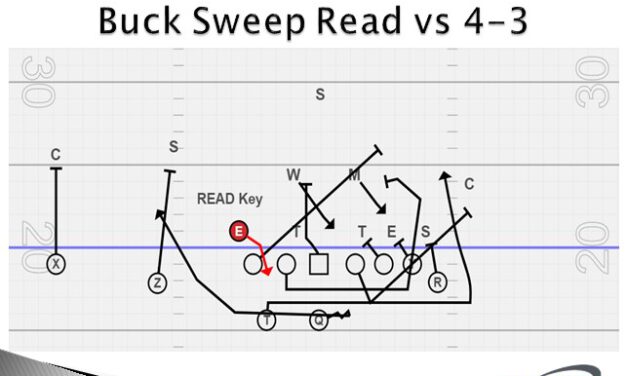
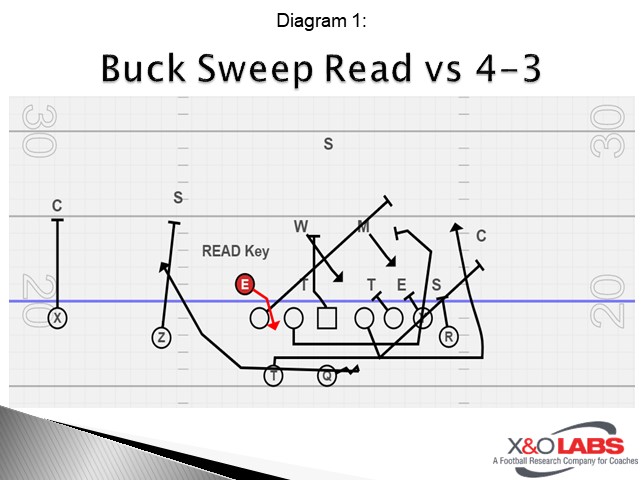
Diagram 1


Rules

TE – Gap/Down Backer

PST – Gap/Down Backer

PSG – Pull Kick #4

C – Gap/Down Backer

BSG – Pull Seal

BST- Base/Cutoff

Wing – Gap/Down Backer


Buck Sweep is the bread and butter of our offense. The key to a successful buck sweep is to prevent the linebackers from scrapping and coming under the blockers that could potentially prevent us from having a big gain. Since deciding to go exclusively shotgun wing-t we feel that the biggest advantage is being able to make those LBs play more honestly by having adjustments when they do start getting underneath our blockers.

Once the middle linebackers begin to fly down and scrape underneath our blockers we will tag our buck sweep call to tell our QB to read a defender. In the example above, we would tell our QB to read the BS end. If the end is squeezing down the QB will pull it and if he is getting upfield the QB will give it. If the BS end continues to get upfield and give our QB a give read we will tell the BST to arch block him and tell the QB to keep it no matter what. The great thing about the call is that only 2 people are changing what they are doing, the QB and the TB.

To study game film of this concept, click on the video below:

Read More

Press Quarters Coverage


By Andrew Strobel

Defensive Coordinator

Culver-Stockton College


This year we implemented press quarters and had huge success improving our pass defense. Here are a few statistics that we improved on.

Playing press quarters this past season help us have the most successful pass defense Culver has had in over 10 years

IMG 80992012 – 143.8 Yards passing per game 2011= 203 ypg
2012 – 12 INT’s   2011= 9 INT’s

2012 – 1,582 yards total passing/ 2011= 2,233yds

Improved Pass Defense Efficiency by 22 points

Why Press Quarters?

  1. Disguise Coverage
  2. Give Safeties more time to read run/pass and help in the run game
  3. Press makes the WR’s uncomfortable
  4. Takes away 3-step timing

In our press quarters our alignments are dictated off of formation and the number of receiving threats. We don’t count TE’s as a receiving threat unless he is their best player. Most of the TE’s we see are big slow blocking tight ends. So, if there is one threat the corners will play inside aligned and funnel the WR to the side line. This allows the safeties to get a better run/pass read. The safeties technique is called walk-out and they literally walk back slowly reading the EMLOS. If the safety gets run his way he will fit outside. Huge coaching point is not going passed the LOS, because it will widen the running lanes. If the run is away, safety will give ground to gain ground. He will open up at a 45 degree angle and track the backside hip of the ball carrier then run the alley. This helps eliminate bad angles.

Read More

QB Generated Run/QB RPO Package – Case 1: Double Option Concepts and The Evolution of the Inverted Run Series

By Mike Kuchar
Senior Research Manager
X&O Labs
Twitter: @MikekKuchar


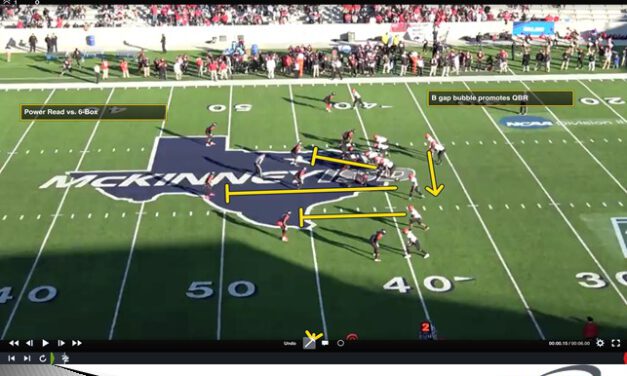
The initial inverted run concept was credited to Auburn University head coach Gus Malzahn and the success he accrued with former quarterback Cam Newton with his power read scheme. The concept took the SEC, and the nation, by storm as the Tigers rode the concept both literally and figurately to a 14-0 record and national championship in 2010—a season that saw Newton rush for over 1,400 yards. This concept was the catalysts for many coaches to start researching other ways to get quarterbacks designed runs. Flash forward eight football seasons later, coaches are still researching ways to get one of their top athletes, the quarterback, a significant amount of touches in the run game.

By definition an inverted run concept is a dual option read for the quarterback that combines an outside run element on a horizontal plain (such as a slot on jet sweep or in Auburn’s case an A back across the quarterback’s face) and an inside run element on a vertical plain (mainly a gap scheme) with the quarterback. In this case, we present our research on how coaches are designing these schemes with quarterback touches in mind.

It’s a process that is progressing each off-season in football meeting rooms across the country, where college coaches are tailoring their offense around the new model of quarterbacks they are recruiting. It’s the process that former Campbell University (NC) offensive coordinator Dave Marsh researched with his young athletic quarterback. He’s now doing the same thing at his new post at Texas Southern University. They may be slightly behind the curve compared to high school coaches who have already been using that blueprint of getting the ball in their quarterbacks’ hands for decades to win games.

Any of our runs we can invert,” he told us. “We just change different mesh points for the backfield but have similar blocks for the line. Our wrap read and fold read are examples. You can invert it and read an end or second level defender. Or, you can have a quicker read like toss from the same side so it’s not coming from across the quarterback. If you have a true downhill running back, you may not want the inverted runs from across the quarterback. You want to get him perimeter touches on the same side of the quarterback. You want him wider and to be in the toss phase to take one step in direction of toss and he goes. If you have a true downhill A back that can make vertical cuts, then he could come from the same side of the quarterback. In our offense, we have three main inverted runs: base runs with the running back as the primary ball carrier, invert runs from a flat mesh and toss runs with the quarterback either throwing it to him outside or tossing it to him. We will do all three of these things from our QB run menu.”

With this inventory in mind, the process revolves around designing these concepts to fit the skill set of your quarterback. All of our sources for this study have a wide variety of quarterback run concepts but they can’t use them all during the course of the game, that would be too many touches and risk potential injury to the most important player in the offense. So, in this study we do the research for coaches by providing them with rationale as to why our sources use selective concepts for the quarterback run game. In this particular case, we present our research on dual option reads for the quarterback. Regardless of the particular scheme, these dual read concepts are effective in the following ways:

  • They are simple in design—coaches already have these blocking concepts in their offensive menu.
  • They cultivate quick decisions by the quarterback. It’s a “if the read defender does this, I do that,” mentality.
  • They combat loaded boxes—with the quarterback as a viable run threat, an offense may never be outnumbered. He has to make one defender miss for a big play.


The Significance of Flash Motion

What hasn’t changed in eight years is the defensive movement triggered by offenses showing flash motion in front of the quarterback. Regardless of whether the quarterback is reading anyone the manipulation of second level defenders is quite astounding, and coaches don’t need SEC level talent to attain this. Each of our contributors to this study detailed examples where using flash motion on run actions in front of box defenders open up seams in the tackle box leading to big gains for quarterback runs. This comes at a price, however. In order to keep defenses honest (at least at the collegiate level) the quarterback will need to get the ball to that motion man at certain times.

At the high school level, sometimes it’s not even necessary to give the outside element of the dual read to get sixteen year-olds to trigger. The pre-snap movement may be all that is needed. “Linebackers at our level are so heavily influenced by the running back all the time, they are like ball hawks to where he goes,” said Catholic High School (LA) run game coordinator Sanders Davis. “There are times we fake mesh with running back and run the QB and there aren’t even linebackers in the box. If we run quarterback power, we may have the pulling guard getting up to a near safety.”

So, when you have “dudes” running those perimeter elements as Ferris State University (MI) does those linebackers really flow out of there, leaving opening the quarterback on pulls. The Bulldogs relied on these dual read schemes to produce the Division 2 player of the year Harlon Hill winner Jayru Campbell who rushed for over 1,400 yards in 2018. As Ferris State University offensive line coach Sam Parker told us, “There is no better mesh than a jet sweep in football. It’s consistent, you can block a lot of different fronts up and they play action because it opens up in the pass game is insane.”

At Campbell University (NC) this past season, offensive coordinator Dave Marsh always used motion as a weapon. “We will use all of our invert series from our 11 personnel Empty formation,” he said. “If a defense is a heavy rotation or bump teams, we will have called quarterback power, quarterback iso or quarterback counter. In the example below from Ferris State, watch how both linebackers flow with jet motion, opening up a major cavity inside the box for the quarterback run. 

Read More

QB Generated Run/QB RPO Package – Case 2: Designed QB Runs from Advantageous Formations

By Mike Kuchar
Senior Research Manager
X&O Labs
Twitter: @MikekKuchar


There is a contingent of coaches that prefer to take the guesswork completely out of their quarterback’s hands by alleviating him from making any post-snap reads. These are the coaches that just want their best runner, who happens to be the quarterback, running the football with no hesitation. In this case, we report on the various ways in which coaches are designing formations and blocking variations to make sure their quarterback carries the football. And despite what the film may look like with flash fakes, there are no reads on this scheme, which means the offense has to block ten defenders. The beauty in this presentation is we report how offenses are able to gain numbers on defenses by blocking with ten. Our research is segmented on how these formations and blocking adjustments alleviate the potential of extra run fitters without using option or RPO’s as an alternative. This is a no RPO zone.

The designed quarterback run concepts researched in this case include:

  • QB Power Concept
  • QB Counter Concept
  • QB Draw Concept
  • QB Sweep/Stretch Concept
  • QB Buck Sweep Concept


For each of these concepts, we provide the following reasoning:

  • Why our sources use the concept
  • How our sources gain an advantage (either by formation or by blocking adjustment) to attain numbers for the QB run element.


QB Power Concepts

The quarterback power concept continues to be a mainstay in offensive systems throughout the country. It’s hard to ignore the success FBS programs like the University of Texas have had with Sam Ehlinger running power schemes. It’s a simple play that can account for six box defenders with the running back as the lead blocker. While some coaches have expressed their hesitation in having an A back type be forced to block a C gap defender, as he would have to in traditional power, others have found ways to alleviate this player from having to handle that job responsibility.


Blocking Adjustment:


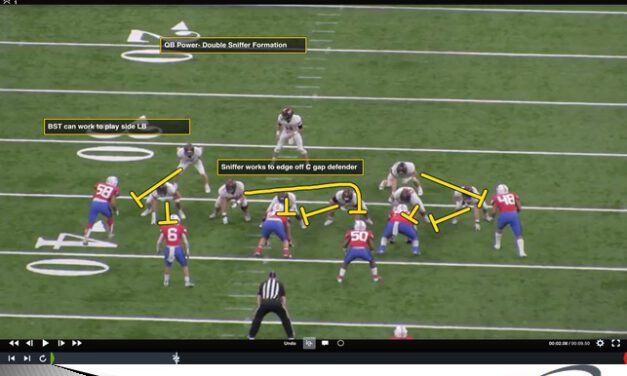
Double Sniffer Concept: Catholic High School (LA)

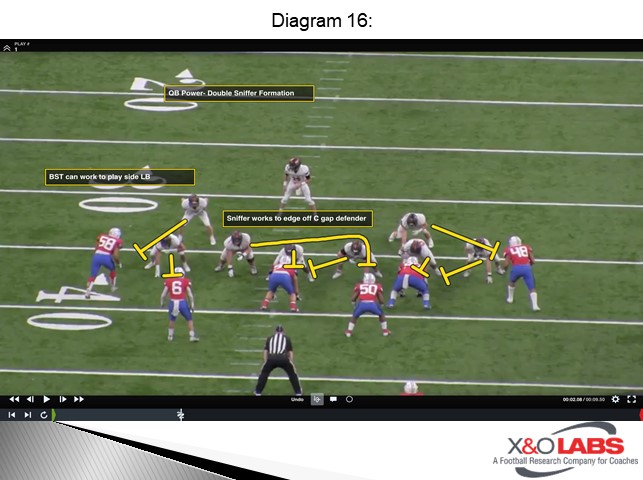
At Catholic High School, a prep powerhouse in Baton Rouge, run game coordinator Sanders Davis will sub in heavier personnel such as a fullback, tight end (or A back that can block) to run quarterback power. We were extremely impressed with the quarterback run catalog at Catholic, who will virtually run any one back concept in the offensive menu. So, Coach Davis wanted to keep the downhill element of power but wanted to be able to block seven box defenders in 4-3 schemes. So, his answer was to use a double sniffer concept, where one sniffer would block the play side C gap. The other sniffer would cut off the backside C gap defender. This allowed the backside Tackle to chase the backside linebacker in the box. This can be accomplished by just making a simple tag to the concept.

Diagram 16


According to Coach Sanders, this concept gave him a lot of variety against Bear and heavy fronts and also provided some manipulation on how to block linebackers. “We were able handle the defensive end with the sniffer and we can have double teams with linemen,” said Coach Sanders. “It was originally an adjustment against 4-3 teams where we can’t get to backside linebacker. So, the sniffer came in to block the defensive end to get a seven on seven matchup. The tackle can get to the backside linebacker and we get a hat on a hat. Blocking the backside defensive end is not a huge block, we just need to slow him down. The Tackle needs to work to linebacker who can flow over the top and make the tackle on gap schemes.”

To study game film of this concept, click on the video below:

Read More

QB Generated Run/QB RPO Package – Case 3: QB Generated RPOs

By Mike Kuchar
Senior Research Manager
X&O Labs
Twitter: @MikekKuchar


As the quarterback continues to be a focal point of an offenses’ run menus, it only becomes natural for defenses to find ways to reclaim the numbers game by committing more defenders to defend the run. This leaves offensive coordinators with two options: have the belief, and faith, that the quarterback can beat that one defender at the point of attack OR devise a run/pass option to manipulate that defender. Choosing the latter could elongate the possessions, and consequently, the health of the signal caller. Whatever option an offensive coordinator chooses… one thing is certain, a running quarterback has more direct impact on the passing game than any other player on the field. In this case, we are going to present our research on the run/pass options that coaches are devising off the quarterback runs in their offensive menu.


Editor’s Note: Quarterback driven RPOs are run/pass options where the run action is based off a designed quarterback run scheme. While these can be combined with jet motion or a flash fake, there is no option of any other player carrying the ball.


Advantages of QB Driven RPOs

The benefit of quarterback driven run/pass options is that the quarterback has more time to decide on his read than he would if he were forced to make mesh fake with a back than have to progress to his read. “You lose a blocker in tailback driven RPO’s which delays the decision making process,” said South Dakota State University offensive coordinator Jason Eck. “You get more forgiveness with these quarterback RPO’s. You can make decisions later. You can ride the fake a little more. It often gives you air behind throws. So, when the quarterback run game happens, you’re thinking run any way. It’s more naturally to run it off of. You’re not flatfooted on throws.”  

Again, the RPO’s detailed in this study are pure dual reads on defenders. They are simple reads made by the quarterback on the conflict defender. As detailed in these cutups, some are the right reads and some are the wrong reads. In either case, we are going to profile two programs that use quarterback driven RPO’s and two that use play action pass concepts off their quarterback run game.


RB Swing RPO Concept: Slippery Rock University (PA)

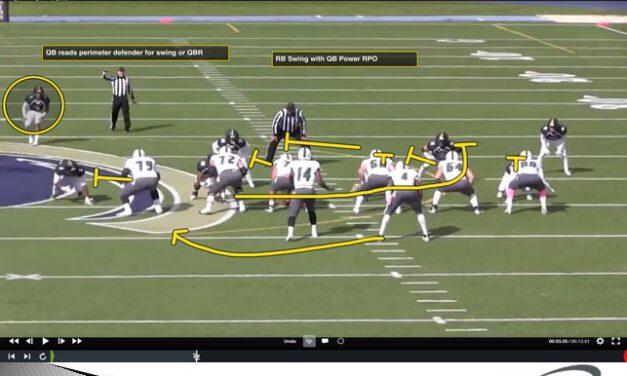
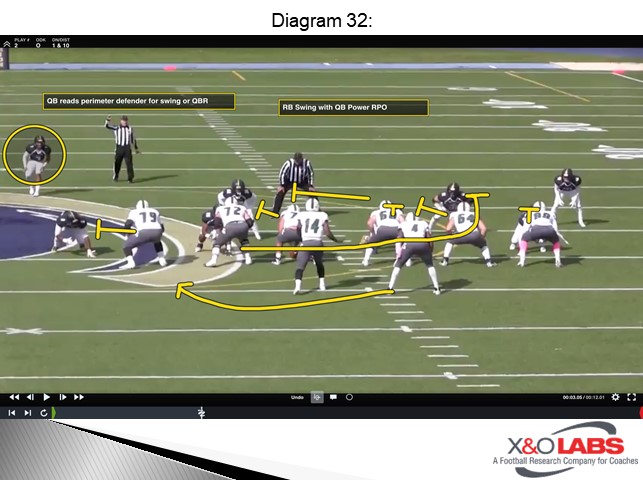
At Slippery Rock University this past season offensive coordinator Justin Roper made good mileage out of his running back swing RPO concept, which is coupled with some form of quarterback gap run. The offensive outfit at “The Rock” is a base 11 personnel outfit, with an attached tight end at the line of scrimmage on most snaps. Defenses continually played with seven in the box and this basically became his version of power read, except he was reading a defender at linebacker level. Instead of doing actual power read, where the mesh point is all in one spot, they basically just extended the mesh point by ten yards where there is no possible way for that conflict defender to be right. The run action is going to replace whatever defender is the extra defender to the play side.

Diagram 32


For Coach Roper, running the scheme out of eleven personnel can usually dictate where the front is based on the tight end. “He sets strength usually more so than the running back,” said Coach Roper. “If you are running it out of 10 personnel, you can use the running back to determine where you want the front. For me, a lot of times, if you a facing certain man teams, you can put the running back opposite of the swing side and you may get a specific defender running with the motion versus if you motioned him from the same side. So, it is more of who runs with the motion that dictates running back offset or if the defense bumps. Typically, we like to put the running back away from where he is going to end up, and have him cross formation.”


Affecting the Read Defender

The read defender in this scheme will be the seventh defender in the box. During the week Coach Roper and his offensive staff will decide if the opponent is a two high safety or one high safety defense. “If it’s a two high team, the box is blocked regardless,” he told us. “The extra roll down defender, or the extra field side linebacker, are the only guys that can really effect the run play.  If the extra defender to the field takes the running back on the motion, we are using the run to replace him. It’s going to the same side but the stretch on that defender is a lot more than traditional power read mesh.”  

“I think it is an easy read for your quarterback,” said Coach Roper. “So, if you have a quarterback that is a really good runner, but maybe isn’t good at making certain decisions, you can put a huge stress on the defender without putting huge stress on your quarterback. The other reason we went to it was, it gives you the ability to account for a seven-man box. Even in ten personnel we did it sometimes, especially in trips. In trips you can run it to the trips, even if they are in single high they are giving you a six man box, you take one of the linebackers out of the equation and run against a five man box.”  

“If it’s a two-high team then the quarterback really only has to see if the safety is rolling with the running back motion. If the safety comes down, then we run the ball. If there is no movement, we throw it to the back. We used it predominantly for single-high teams because they get an extra defender in the box.” In that case, you can do it two ways. With your tight end to the field in a trips set, if that safety wants to roll down over the tight end, your quarterback is going to read the safety.

Read More

QB Generated Run/QB RPO Package – Case 4: Checked QB Runs from Overload Formations

By Mike Kuchar
Senior Research Manager
X&O Labs
Twitter: @MikekKuchar


Many of the sources that contributed to this special report have flexbone triple option roots somewhere in their background. So, it only makes sense that their philosophy has been grounded in the quarterback run game. Like any option coach, the all-encompassing thought process in their quarterback run catalog is to find numbers and exploit them. This process revolves around building formations to access numbers in the run game. River Dell High School (NJ) head football coach DJ Nimphius is one of those former triple option purists who seek to exploit numerical advantages formationally, but he does so by using overload, or unbalanced formation structures.

The benefit of overload formations is that it forces defenses to react in real time to formation structures they are not used to seeing. And when offensive coordinators couple these formations with motions and shifts it increases the potential of defenders being out-gapped at the snap and losing leverage on ball carriers. This all can result in big plays for the offense.


The Overload Formation Menu for QBR

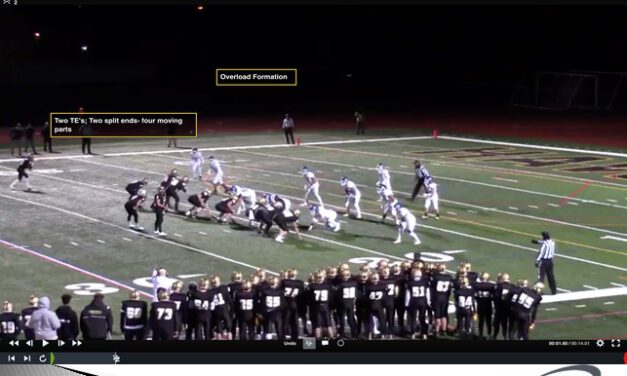
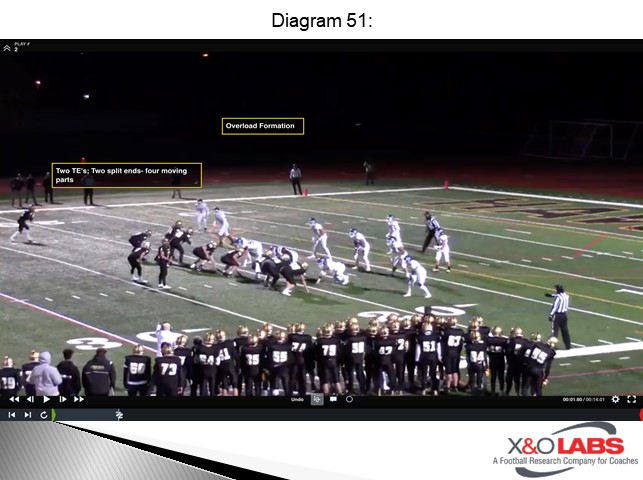
At River Dell High School Coach Nimphius and his offensive staff begin their formation building around twelve personnel (two tight ends, one back) formations. Coach Nimphius uses that as his jumping off point because it makes the quarterback run game easy to teach. “Now we have four guys (quarterback, running back, two receivers) that can potentially get the ball,” he told us. “We can pull across the formation, set edges, run isolation and pull players. We can block down and kick out. We have three moving parts other than the guy carrying the ball. Then we figure out what is going to cause them problems. For example, if they are an Odd stack team that doesn’t want to come out of it that means we can go into any formation we want and get what we need. I don’t know any defensive coordinator that likes to see two tight ends. If you can start extending the field, that is a good thing.”

Diagram 51


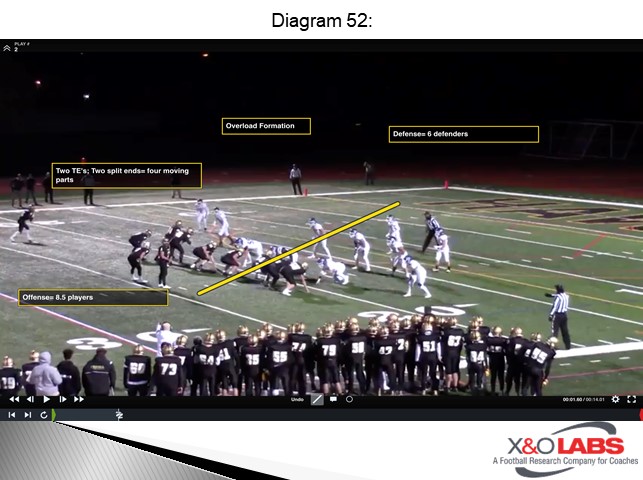
The quarterback run menu at River Dell consist of: inside zone, inside zone read, trap, trap iso (RB leads through), stretch, stretch read, first and second level power read. All of these runs can be checked to the numbers advantage either by the quarterback or the offensive coordinator. It’s something that is repped during the course of the practice week and honed on game day. “If we have numbers the quarterback will run the play,” said Coach Nimphius. The diagram below shows an example of a numerical advantage by the offense. The overload formation produces 8.5 players. The defensive side shows only 6.

Diagram 52


The clip below shows the result of this mismatch. The quarterback checks to a loaded sweep and picks up solid yardage.

The clip below best illustrates this coaching point:

Read More

QB Generated Run/QB RPO Package – Bonus Case: Game Planning and Practice Organization to Prepare for QBR

By Mike Kuchar
Senior Research Manager
X&O Labs
Twitter: @MikekKuchar


While there are an exorbitant amount of schemes and concepts coaches can devise around running quarterbacks, we wanted to research how these coaches were preparing these players, both in practice and in game planning, to carry the load each week. There are two realms in this process: conditioning the mind and well as the body. We took some of the best methodologies from our sources on how they develop their quarterback in practice and how they game plan. We segmented our research into base methodologies coaches were using for each.


Six Mandatory QB’s in Program: DJ Nimphius, River Dell High School (NJ)

It’s a belief at River Dell High School (NJ) that anyone can line up at quarterback and carry the ball. And we don’t mean anyone in terms of ability. Head football coach DJ Nimphius will cycle through a pool of candidates to determine who will be “the guy.” In his system, running backs and wide receivers can take snaps and learn how to read his two man games, which are option concepts detailed in case one.

In order to begin the selection process each year, Coach Nimphius mandates having two quarterbacks in each grade (10-12) to compete for the job. “We want two from every class because then we can figure out what we want to be and what we may be,” said Coach Nimphius. “If every kid learns quarterback, he can play anywhere on the field because you see the whole picture. As long as you’re physical enough and you can run you can play quarterback here.” In fact, it seems like the entire personnel process at River Dell seems like a funnel, channeling the top players into the quarterback position. “Sophomores who are quarterbacks will start on the perimeter at wide receiver right away if there are not the guy,” he said. “They will slowly move towards the ball. Then they will line up all over the place. I have six coming back and all six have to be on the field some way next year. We even have had offensive Tackles who came in and played at quarterback.”


Game Planning:


Pitch Counts

We wanted to find out if coaches limit carries for their quarterback each week. We found that pitch counts relied on two main factors: ability of opponent, backup quarterback situation. Some coaches, like Derek Pennington at Zeeland East High School (MI) would often tone things down for his quarterback run package when the game was well at hand. And other coaches like South Dakota State University offensive coordinator Jason Eck preferred to try to limit quarterback carries this season because of a fluid backup situation. In either case, we were curious to see if there was a limit to how many carries quarterbacks should have.


Maximum of 15 Carries Per Game: Dave Marsh, offensive coordinator, Texas Southern University.

Coach Marsh believes in having six quarterback runs each week. This is basically the entire quarterback run menu. This doesn’t mean he’ll call all of them, but they are on the offensive menu. “We don’t want to carry more than six QB runs into a game,” he said. “That’s on the call sheet. Our game plan only has thirty something plays on it. We need to keep in mind that the quarterback is also getting hit in the pass game. When it comes to direct runs we limit him. Within the game, we don’t want him being the primary ball carrier. We let it happen organically based on what they are doing defensively. I don’t like him ever getting over 15 plays a game. We ran around 70 plays a game this season, and in some games, he had two or three carries.”


Building Around Skill Set of Quarterback: Sanders Davis, run game coordinator, Catholic High School (LA)

While it sounds simple enough, it’s imperative to select run concepts that suit your quarterback. And since at the high school level where there is no recruiting involved, these quarterbacks can be different year after year. Some years it may make sense to rely on more downhill quarterback runs while in other years it may be appropriate to use him more on the perimeter. It’s a process that Coach Davis undergoes on a yearly basis. 

“We always want to consider what our quarterback is capable of handling and where he excels when designing the quarterback run game,” he said. “For example, if he is a heavier quarterback with a lot of body armor (muscle) who can run, we would want to use him in our interior run game as well as our perimeter run game. Conversely, if we have a quarterback who runs well, but we are afraid of him getting hit by a defensive lineman or linebacker, we may only use him to run on the perimeter. Remember, every time you are running a quarterback run play, that is one play that your running back is not touching the ball. The quarterback needs to be a guy worth taking that carry if you want to consider quarterback runs.” 

Read More

OLBs in Cloud Coverage from Three High Alignments

By Keith Snyder
Defensive Coordinator
Dekalb High School (IL)
Twitter: @KTS7799


In 2010, I was the offensive line and defensive line coach at Kaneland. That season we made it to the 5A Semifinals and lost to Montini High School. At that time, we were a traditional 3-3 1-high team that would go to a traditional 2-high (2 safeties deep and an overhang player to field or passing strength) versus spread teams or in passing situations. During this game, we had no answers for when they would shift or jet motion away from our over-hang and hit us with bubbles and jet sweeps. I knew when I became a defensive coordinator that I wanted the balance of 1-high look but be able to play with a hard corner. So, in 2011, we started running what is the cloud look that many teams run now. It worked well for us getting back to the semi’s and having a pass defense that picked off 16 passes in 13 games. It allowed us to roll coverages very seamlessly and have the balance I was looking for so that we were never out-leveraged.  The following year, we introduced our OLB’s lining up as CBs to give us a new variation to the cloud concept. We had success with it because it put our players in positions that they could be successful and were used to playing. Our OLBs were able to get hands-on and re-route wideouts while our CBs were still the deep zone. 

Over the next few years, we went back to a traditional 3-3, 2-high look for various reasons, but we became much more predictable and asked more of our athletes than we needed. In 2016, I had the opportunity to take over as defensive coordinator at Dekalb High School and I knew this time I wasn’t going to make the same mistake. We were going to be a cover 3 team no matter what from both a traditional -high look as well as non-traditional 2-high schemes. Over the past two seasons, we have continued to grow and develop this combining a true cloud concept with an OLB emphasis and incorporating Robber techniques to best use our personnel in what we call our Monster Cover 3.


Our Reasons for Running Monster Cover 3:

  • It allows us to teach similar concepts to positions but give us two different coverage looks: OLBs: Flat & Force; CBs: Deep 1/3; FS: Robber Tech; ILBs: collision/reroute wall #2
  • Played into our strengths OLBs can be physical with wideouts, corners are our deep space players and made use of the fact we put our most athletic, aggressive downhill player at Free safety leaving him unaccounted for in the run game.
  • We can still roll to coverages.
  • We would morph into different looks depending on the offensive formation giving the defense an awkward look for offenses to game plan and attack.


Two Scenarios to Use Cloud:

  1. We can purely plug up A&B Gap with defensive linemen allowing us to play with a light box, depending on the formation. In this concept, we have two base fronts 4-0-4 (Bull) & 3-0-3 (Tight)
  2. 3rd Down Coverage: Here we are now bringing four, we are not as concerned with covering just B Gaps with the Defensive Line. We will play 5-0-5 & 3-0-3 fronts slanting, stunting and blitzing to bring pressure while dropping 7


Defensive Position Break Down:

  • DL: T (Tackle, strong side DL) N-Nose Guard, E (End, weak wide DL)
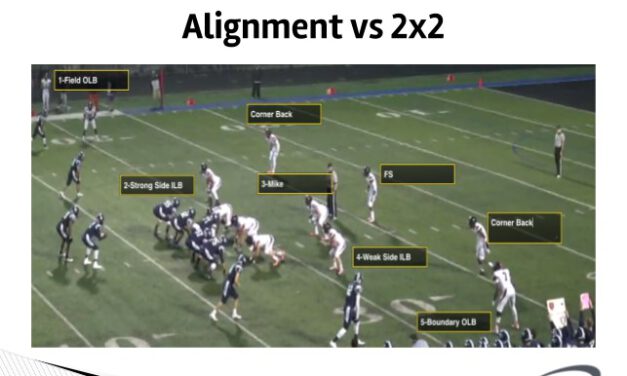
  • ILB/Stacks: We use a numbering system don’t really use names outside of Middle is Mike. 2 (Strong Side ILB) 3 (Mike) 4 (Weak Side ILB)
  • OLBs: We leave them field and boundary, so they don’t have to spend as much time running across the field for formations. 1 (Field/Strong Side OLB) 5 (Boundary/Weak Side OLB
  • F-Free Safety
  • CBs-CBs


Position’s Run/Pass Responsibility

Position:

Run:

Pass:

DL

T/E: B Gap

NG: A Gaps

Vertical Penetration in their Gap

ILB

2/4: C Gaps

3: Gap Free

2/4: Collision #2 to Hook/Curl

3: QB Spy/ Replace Blitzer

Read More

The Spread Wing T Run Game Series

By Chip Sorber
Head Football Coach
Geneva High School (OH)
Twitter: @chippers5


Our base run game out of the shotgun consists of more than the following three plays, but we start with them. Each play is a complimentary play to the others. They look the same, have jet motion with them and attack multiple areas of the defense on each play. We can run all our shotgun plays from under center also. We have some subtle variations included in this report to either help break defensive keys, slow down the defensive flow, or provide better blocking angles for our offensive linemen. In 2018, we rushed for over 3,000 yards. We run the ball 85% to 90% of the time. Therefore, we are faced with 8 and 9 and sometimes 10-man boxes each week and we still find a way to run the rock.


Jet Sweep

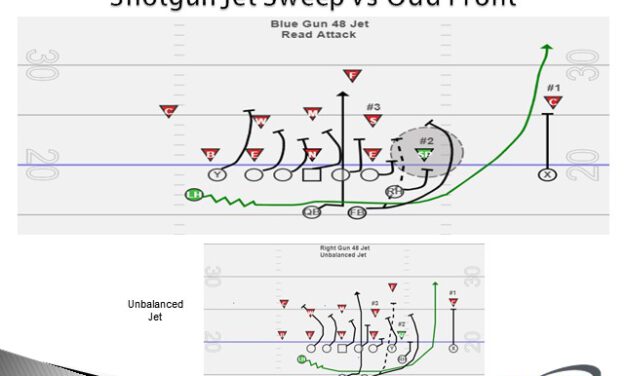
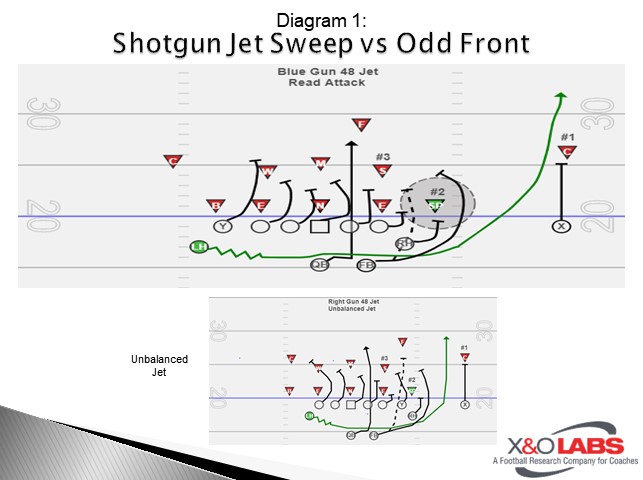
The jet sweep is the first play that we install every year. Nearly everything we do offensively is predicated on jet motion. The jet is our best perimeter play and running it out of the shotgun has allowed us to evolve our traditional Wing T into our Spread Gun Wing T. We ask our offensive linemen to make a realistic block by enabling him to drive his defender outside if that’s the way he wants to go. This is a read attack jet sweep reacting to the blocks as they occur.

Over time, we have observed defenses that react to our jet motion in a variety of ways. They will slant to the jet motion, blitz to the jet motion, roll the secondary to the jet motion or any combination thereof. Sometimes defenses overreact and sometimes they under-react but our goal is to keep them guessing and make them pay for whatever defense they deploy. The strength and success of our jet sweep is because it exists in a series of other plays that help each other succeed. The Jet series plays look very similar to one another while being quite different. When we add some variations to the blocking and backfield schemes our offense becomes a nightmare to prepare for.


Coaching Points

QB will snap the ball when the JET back is in the backside B gap. The QB will mesh with the jet back and carry out his QB Isolation fake. The ball carrier (Jet Back) will follow the block of his FB. The offensive line and play side wingback all take a 45-degree fire/reach step and try to gain outside leverage. If they cannot get outside leverage, then block your man outside as fast and hard as possible. The FB and Jet Back will read the blocks and cut up inside or stay wide and outside. We read attack the #2 defender. The fullback (gun back) is our lead blocker and he must make the correct read on the block our TE or OT make on the #2 defender for his route to block the #3 defender. We do not block anyone from the play side A gap back. The Center, BSG and BST simply cut off backside flow at the 2nd and 3rd level.


X: Stalk block the #1 defender or run off if tagged.

Y: Cut off backside flow at the second or third level.

RH: Block the #2 defender. Try to gain outside leverage but if you cannot then block him outside and we will cut up inside of your block.

LH: Fast jet motion receiving the handoff in the play side A gap. Get to the edge as fast as possible reading the block on the #2 defender and following your FB.

FB: If offset alignments you are the lead blocker on the jet sweep. FB will read our block on the #2 defender to determine if he leads the play inside or outside that block.

QB: Snap the ball when the jet back is in the backside B gap. Meshing with the jet back you will make the hand off in the play side, A gap then continues with a great QB Wham/Isolation fake.

PST: 45-degree Fire/Reach step attempting to win outside leverage. If you cannot get outside leverage drive your man outside and back off the LOS.

PSG: 45-degree Fire/Reach step attempting to win outside leverage. If you cannot get outside leverage drive your man outside and back off the LOS.

C: 45-degree Fire/Reach step attempting to win outside leverage. If you cannot get outside leverage drive your man outside and off the LOS.

BSG: Cut off backside flow at the second or third level cut off backside flow at the second or third level.

BST: Cut off backside flow at the second or third level.

Diagram 1


To study game film of this concept, click on the video below:


Editor’s Note: Coach Sorber has provided a clip by clip narration of this concept below: 


Clip1: Unbalanced jet into the boundary. We outnumber the defense on both flanks. Great reach block on the #2 defender. We have such good numbers our FB just has to clean up as he leads the play.

Clip 2: Unbalanced empty backfield jet. Defense keeps a 7 man box to defend internal QB run which means they cannot properly defend both flanks giving us huge number advantages.

Read More

The 32 Personnel Unbalanced Run/PAP Package

By Shea Monroe
Offensive Coordinator
Ashville High School (AL)
Twitter: @Coach_Monroe3


We primarily work out of 32 personnel the whole game. In some instances, when we do use “receivers” they are just flexed tight ends. We use these flexed tight ends to create extra gaps and to crack the 2nd level.

The reason: In 2018, I recently took a new position at Ashville High School in Ashville, AL. We are grossly undersized and not very big. My head coach decided that we should adopt a “ground & pound” philosophy, where we could control the clock and keep our defense off the field.

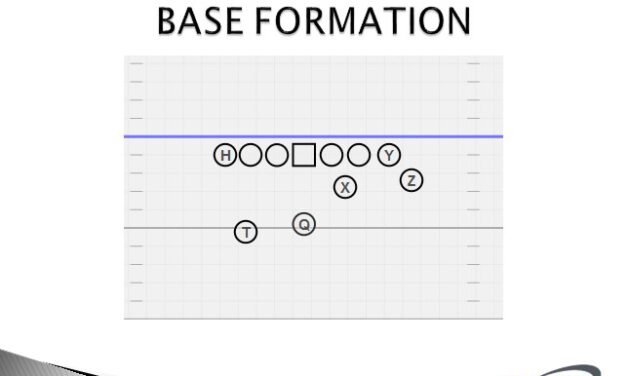
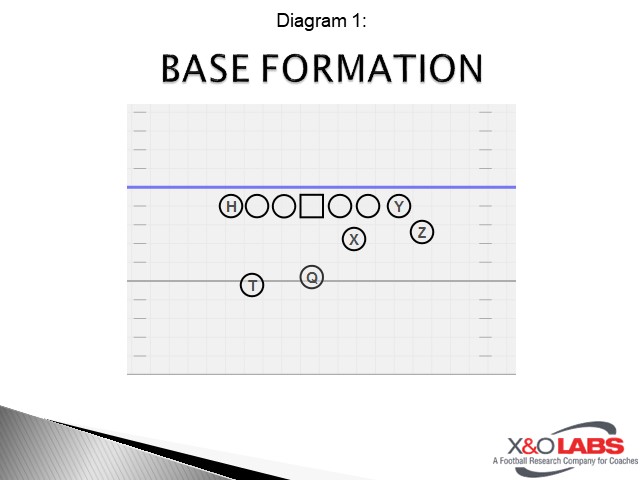
The style of offense we run was made popular of Coach Tim Murphy of Clayton Valley Charter School in California. Basically, the offense featured an exclusive two tight end set with the QB in the shotgun, the TB offset to his right or left, and a fullback and wingback off-set to the right or left. Below is an example:

Diagram 1


One of the best benefits of going two tight ends is the ability to go unbalanced. We run unbalanced 3 different ways:

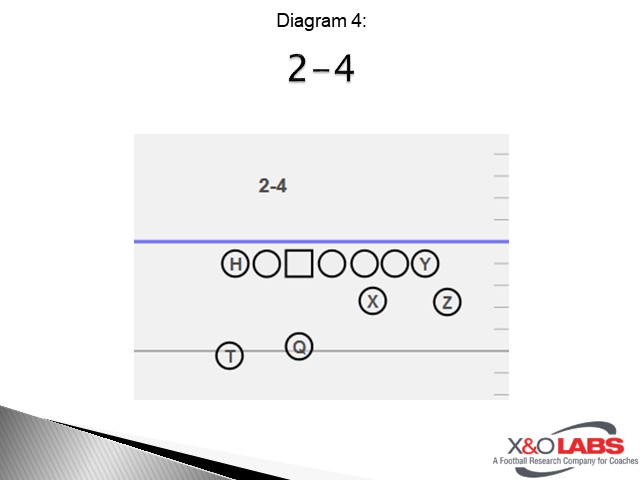
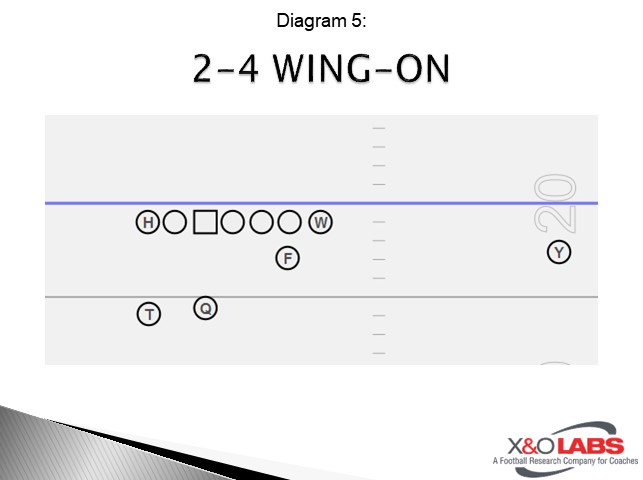
  • 2-4 (two linemen on one side of the center, and four on the other)
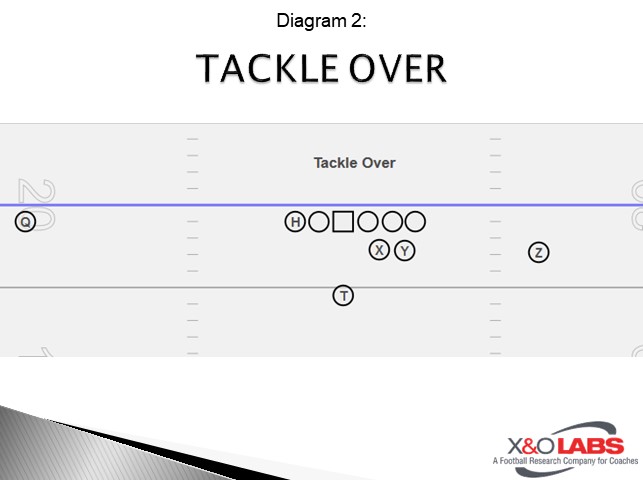
  • Tackle Over (TE on the backside)
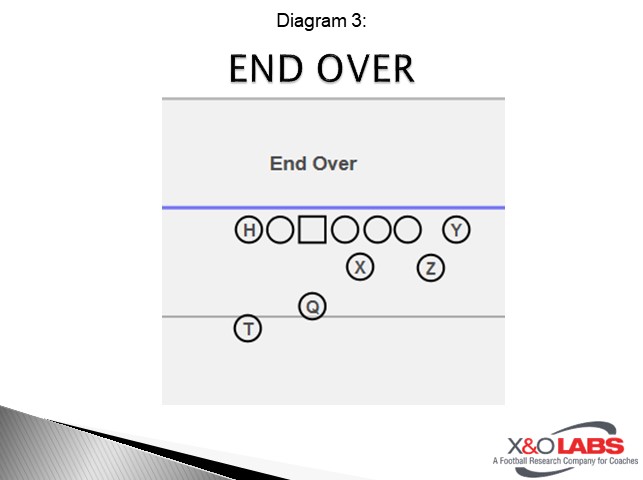
  • End over (Crack alignment covering up a tackle)


As an offensive play caller, I know there are only a few options the defense can do to unbalanced formations:

  • They do not do anything.
  • They slide down a full man toward the most lineman/WR side
  • They roll their secondary
  • They walk a linebacker over


Below are some diagrams of our unbalanced sets:

Diagram 2

Diagram 3

Diagram 4

Diagram 5


Coaching Points:

From these formations, we really like our QB run game. Running the QB is great because it allows you to be +1 running the football. For example, if the defense has 10 in the box, you will have 11 with the QB becoming a runner. When teaching the quarterback to run the ball in these condensed looks you must tell him a couple different things:

  • Be patient (it’s a fistfight in a phone booth)
  • Let your blockers get in front (point #1)
  • Make 1 cut and get vertical (this is a marathon, not a sprint, at least for us)


Read More

Add Offensive Versatility with the Middle Zone

By Mark Melnitsky
Offensive Line Coach
Trinity College (CT)

Introduction

The Middle Zone is an excellent complimentary play to the staple run play in our offense, Inside Zone.  With a wider landmark, the Middle Zone play provides us with an effective way to potentially run the ball outside the tackles.  It is a play we run from a wide range of personnel groups and formations.  We are also equally comfortable running the play from under center or in the shotgun.  This past season, the play was very productive for us as evidenced over our eight games where we ran the play 77 times and netted 512 yards for a 6.6 yards/play average.  In addition to being an efficient play, Middle Zone provided our offense with the ability to generate a good number of explosive plays (plays that gain at least 20 yards) on the ground.

The genesis of the play in our offense took shape several years ago when we were primarily a one-back, three-receiver offense.  From that personnel group, our two primary run plays were inside zone to the two-man surface and one-back power to the three-man side.  Occasionally we ran an Outside Zone concept to the three-man surface.  However, the Outside Zone scheme required one of our receivers make a crucial, point-of-attack block on the alley defender. 

More often than not, that block was a mismatch for us, with a receiver being asked to hold up for several seconds against an outside linebacker.  With the tight landmark of our inside zone play (outside leg of the guard), the only way we could consistently run the play at the three-man surface and control the end man on the line of scrimmage (E.M.O.L.S.) on the backside would be to motion a receiver over to cut him off or to have the QB read him.  Having the receiver motion over to cut off the E.M.O.L.S. made us relatively predictable.  Additionally, our quarterback was not very athletic, therefore we were not inclined to invest in a read scheme. 

This being the case, we decided to merge concepts of two plays in our offense, Inside and Outside Zone, to create a new play – Middle Zone. In a nutshell, we widened the Inside Zone landmark for the running back to the outside leg of the tackle.  We kept the blocking scheme for Middle Zone the same as our Inside Zone play.  However, we employed the techniques of our Outside Zone for our offensive linemen and tight ends.  We kept the read for our running back the same as it is on Inside Zone.  We just bumped it one defender wider.  For instance, in the case of an even front, instead of reading the front-side 3 Tech to the backside Nose, we had him read the DE to the 3 Tech.  In doing so, we made the backside E.M.O.L.S. much less of a factor, eliminated the match-up issues for our receivers, and added a “new” play to our offense using concepts and techniques our players were familiar and comfortable with.

MIDDLE ZONE RULES

QB:  If under center, step with play-side foot at 10/2 o’clock.  Race ball to mesh point at depth of approximately 5 yards.  After handoff, execute boot fake opposite the run play.  From the shotgun, extend ball in front, secure exchange, and execute boot fake opposite the run play.  From the shotgun, we can also ‘tag’ the play and have the QB read a backside defender to determine whether to hand the ball off or keep it.

RB:  Lead step, crossover, and chase the outside leg of the tackle.  Stretch the ball wide, aggressively chase the landmark, and “crease” or “bounce.”  The read is the E.M.L.O.S. to the first front-side down lineman inside.  If the first read is reached, bounce the ball outside.  If the first read (E.M.L.O.S.) does a good job containing the play, look to crease the ball underneath the first read.  You now must make a quick determination where your second read (down lineman) is and hit the underneath crease accordingly.

FB:  If “Boss” (Back on Support), arc release for alley defender.  If “Lead” read the PST’s block to determine best path to block playside ILB.

PST:  Zone playside C gap.  If covered, either combo scoop with PSG to playside ILB or reach defender solo.  If uncovered, combo scoop with TE to alley defender.

PSG:  Zone playside B gap.  If covered, combo scoop with C to playside ILB or reach defender solo.  If uncovered, combo scoop with PST. C:  Zone playside A gap.  If “Odd” front, combo scoop with BSG.  If “Even” front, combo scoop with PSG to playside ILB or MLB (If ‘43’ front).

BSG: Zone cutoff backside A gap.  If “Odd” front, combo with C.  If “Even” front, backside combo with BST to backside ILB.  Look to cut on the 2nd level.

Read More