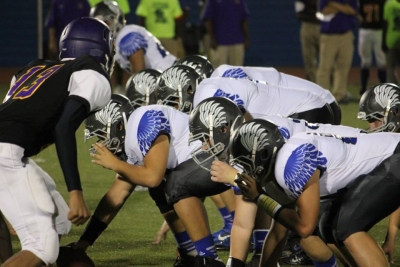

Compliment the Veer with Power


By Rob “Tog” Paschall

Offensive Coordinator

Carrolton Creekview High School (TX)


The Veer and the Power are not often seen as complimentary.  The Veer has its loyalist within the option football community while the Power is seen as the basis of “big boy football” that doesn’t rely on deception to trick the defense.  Dig a little deeper and you will find that there are quite a few similarities between these two schemes.  In fact, we have found that the similarities in technique and look to the defense actually make them the perfect compliments within our scheme. 

Why Veer AND Power?

Our staff has all come from various styles of offense, with varied ways to attack a defense.  When I came here and was made the offensive coordinator we started to have meetings to figure out where we wanted to take things.  I had the basic system in place having been a coordinator in Texas High school football for years, but have always wanted the staff to have some buy in with the thinking that more input=more output.  When I met with our head coach, Jay Cline, and the rest our offensive staff, my goal was to have a truly collaborative effort that we could put in to develop our offensive system.  Here are the basic tenets of our offense that we landed on.

  1. We needed to be adaptable to the talent on hand.  Our offense had to be modular to allow us to keep and teach a system over the years, yet adapt it to the wildly varying talent levels on the team or in specific position groups we see at the high school level from year to year.
  2. We were going to be physical.  This is not dictated by the formation.  It is more of an attitude and “what you will accept as a coach” thing.  We wanted to run power.
  3. We were going to be balanced, or at least have a semblance of balance.
  4. We wanted to be able to do all of the above and keep things simple for the offensive line while being able to pyramid teach our system.  In other words, we wanted to be able to make it look complicated for a defense, be easy, cheap, and effective for our kids, and allow us enough answers in our x and o’s toolbox to be able to attack whatever fronts or personnel issues we see.


We were going to be a vertical push zone team with our offensive line as that was my background and what I believe in as a sturdy system to allow any offensive line, regardless of talent to have some success.  With this, we were going to have the ability to rotate our combos with a simple tag.  When we rotate our combos to the backside linebacker we can insert someone, either an H back, wr, fullback, or an offensive tackle on that linebacker.  We can also read that same guy in the gun.

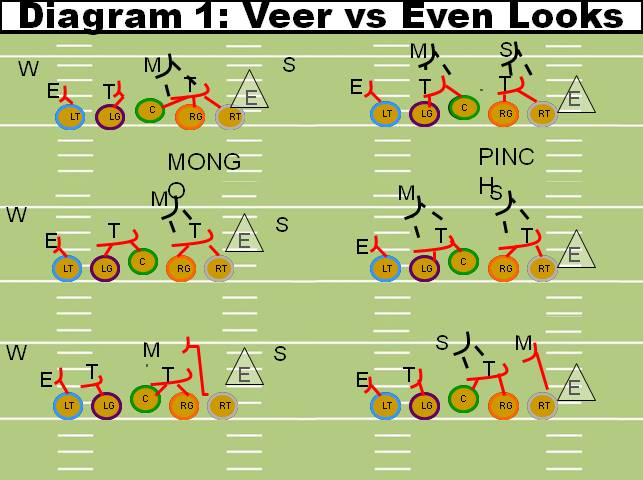
With this basic vertical zone combo style in place.  We can then adapt in a modular way from inside zone to read, insert, counter insert, filled read, dashed read, and veer where we read the unblocked de on the frontside of the combo rotation.  We can add all sorts of window dressing on top of the zone to make it look more complicated than it really is. When we block veer, we treat it as a backside rotate zone, with the psot as the “insert” guy.  We can run veer as a triple, but usually run it as a double option.
Slide1Slide2

Read More

Balancing Consistency and Culture as a Newly Hired Coordinator

By Justin Roper with Mike Kuchar
Quarterbacks Coach
University of Northern Iowa
Twitter: @Justin_Roper


Editor’s Note: At the time of this interview, Coach Roper was in his third year as the offensive coordinator at Slippery Rock University (PA). After a 2018 season that has produced an 11-3 record and a trip to the Division 2 quarterfinals, Coach Roper has now been appointed as the quarterback’s coach at Northern Iowa University


Justin Roper had big shoes to fill when he first arrived at Slippery Rock University in 2016, the “Rock” was coming off a year where it averaged 45 points and over 600 yards per game under the direction of then offensive coordinator Phil Longo. Coach Longo, now the offensive coordinator at the University of North Carolina, set up an Air Raid system and when Coach Roper took over, he was the only new face on the staff. Coach Roper’s dad Brad coached at Georgia Tech in the 90’s and Justin had only been a position coach for two years at Valdosta State University before being named an offensive coordinator. This was a challenge in itself and Coach Roper put the onus on himself to learn the already established terminology rather than create his own.

“We were going from an Air Raid based offense to a spread based system,” he told us. “You organize your priorities in what is important. What we called things is not important. That doesn’t matter. What is important is how routes are run and what are we trying to accomplish. That stuff I can tweak to my liking while keeping the base structure the same. The teaching and the purpose of teaching is the same thing.”

MK: Describe the process you use when evaluating the incoming talent when taking over a program.

JR: “I watched the entire previous season straight through with no cutups without the other staff because what I wanted to find the pure identity of what that offense was. I researched what they did really well? What were the weaknesses? What that allows you to do is I can sense what they were really good or bad at rather than think what they were good or bad at. I noticed our wide receivers were the best blockers I’ve ever seen. That’s an unbelievable strength. Then when you talk to your staff about how they use their positions and the talent that is returning. Then your morph that into how you want to use them. You understand the positives and negatives of what you have. The next step is to talk to the staff about the positives and negatives of what they think they have and then you see what matches up.

I think it’s important to let your staff teach you what they did well the season before. I’ll first stress our identity, which is to play fast and execute. From there, I asked position coaches to teach me how they taught the run game. This does two things: one, it gives you the ability to assess their talent to convey information as coaches and two it lets you understand how things were communicated to the players and what needs to be kept the same or what you can adjust. It also provides ownership to the coaches. You might have the inclination to say ‘I want to do things this way and the success is warranted, but I can’t beat people over the head telling them what I want to do. Listen to what they did so they feel that they have been heard. But make it known that l has the overriding say on things.”

MK: After assessing the personnel, how do you go about fitting your scheme around that personnel? Is this a selection process of which concepts should be utilized with that personnel?

JR: “I was going from an Air Raid to a spread system. The basis of the system that I was taking over was one that valued quickness and making people miss in open space over anything else. All the running backs were smaller- 5’7 and the slots were 5-8 or 5-9 that were really good at making people miss in space. The Air Raid system was all set up to be receiver friendly. Not sure how many of them played QB. What I do in a spread system, everything is based on the QB read. Because that is the hardest thing. I base everything on spots on the field and we read defenders, not necessarily a progression. We read defender to defender. The receivers just get to a spot on time. We tell those receivers to get to the spot any way they can. It gives receivers more freedom and lets the quarterback understand what the defense is doing. We read defenders eyes, intent and body language.

Read More

A Systematic Approach to the Psycho/Amoeba Defense

By Micah Adams
Defensive Coordinator
Waukesha South High School
Twitter: @GridironAdams2

Introduction

PsychoAt Waukesha South, our team has seen a great deal of improvement in the past two years. Led by Head Coach Dave Rusch, our defense promotes an aggressive, attacking style of defense that causes turnovers and creates confusion in opponents.
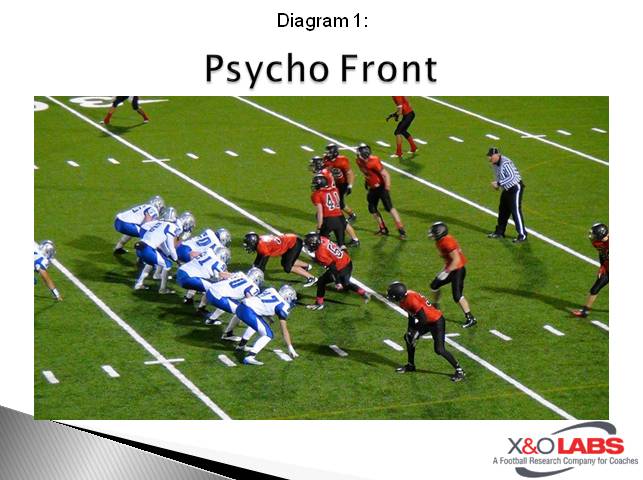
The way we look at it, a confused player is a slow player. So the more we can make the offense think, the slower they operate and the more chances we will have to make big plays and create turnovers. One of the key elements of the disruption we cause on defense has been the implementation of a Psycho package.

Defining the Psycho Package

For us, the Psycho package is a scheme that utilizes a front that does not give players specific places to line up. Instead, the defensive front players are encouraged to continually move during the quarterback’s cadence in an effort to disguise their assignment on any given play. The idea of the Psycho packaged was derived from similar ideas used by Dom Capers of the Green Bay Packers and Nick Aliotti of the Oregon Ducks.

Slide1

Using a front based on movement requires finding players that are mobile and aggressive. Larger, slower players would not be able to quickly change directions in order to be in the right position at the snap of the ball while moving during the cadence. By having the right type of players on the field that can make the athletic moves required, our kids are better able to truly disguise whether they are blitzing, dropping into coverage responsible for a gap in the run game or contain on any given play.

In many ways, the use of quicker players in this system plays into our strengths as a program. South is blessed with many exceptionally gifted athletes and lots of tough kids who are passionate about football. However, we struggle at times to find the requisite size on our lines to compete in the highly competitive Classic 8 Conference, which many call the best conference in the state of Wisconsin. The Psycho package is part of our answer to this lack of size.

The key to implementing an entirely different scheme was to keep players involved in situations that they most often experienced in their roles in our base 4-3 defense as well. For example, if our Whip linebacker often was dropping into the weak side flat, his Psycho position would ask him to do that at times as well. This made the install of the Psycho package “inexpensive” in terms of practice time as the kids were often already practicing the things that they would need to do in their Psycho role.

Read More

Attaining the 21% Roster Increase: 14 Methods in Recruiting and Retaining Players

By Jeremy Plaa
Head Football Coach
Thomas Downey High School (CA)
Twitter: @JeremyPlaa


After taking over the program twelve years ago, it took me a couple of seasons before realizing we needed to fix the issue of retaining players.  We had to reinforce the mentality with our lower-level coaches that we wanted them to enjoy their football experience and wanted to play again the following year.  Every head coach knows this but having solid lower level coaches is really the foundation of any good program.  The kids retained and the kids recruited slowly started to improve, but it was a process that took time.  It is one of the main reasons I believe continuity is so valuable with a coaching staff- so that we can learn from mistakes made and finding more efficient ways to get things done.  We learn better practices every year and attempt to improve every year. 

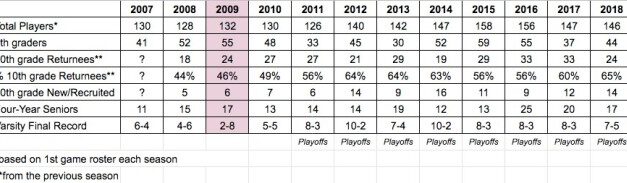
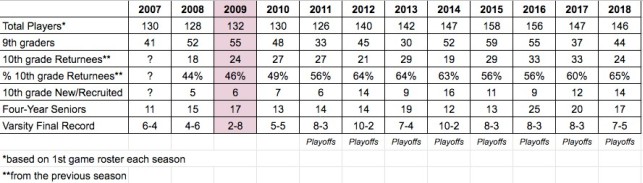
Our participation study showed two things:  1) improvement doesn’t happen overnight  and 2) at some point your program will likely hit a participation plateau.  The key to growing your program is you cannot rest when you hit that plateau.  We work as hard as ever with looking for athletes at our school, and retaining them when we find them.  While our numbers have stayed pretty constant the last few years, our program accrues playoff experience and the expectation of success with each winning season.  Below, you will see the quantifiable increase in numbers in our program over the last twelve seasons.


As football is more popular than ever at the college and professional ranks, concussions have scared away not only parents of high school kids, but also kids at the youth level.  Kids themselves even seem to be constantly reminded of the dangers of football.  As coaches already know, all the benefits of football far outweigh the risks.  As coaches, it is our job to not only promote our sport but to do our best to entice as many kids as possible into our school’s program.  We are constantly looking for ways to increase our signups and retain the kids we have in our football program.  This article will list all of the ways we have “got them out for football, and kept them in the program.”

Recruiting your hallways is not a once-a-year thing.  It is an all-the-time thing.  Recruiting your hallways could be between classes, in your class, or before and after school.  Obviously, the more coaches you have on-campus, the easier your job.  But even if you are not lucky to have that situation, you can still reach out to teachers on campus to help promote your program.  Build bridges there and you will surely see the benefit. 

Our staff is always on the lookout to identify students we should approach about playing football.  We are a 9-12 high school and we spend most of our on-site recruiting effort on our freshman class.  We feel like they will give us the biggest return for our effort, and have the chance to be in our program for three years.  We feel like we can have as big of an impact on them as they will on the program.  We are not against recruiting any grade level, but in terms of time management, we like to spend most of our time on each year’s freshman class.

We also get a monthly report from our attendance office of students who have transferred into and out of our school.  Occasionally we will find a young man whom we can get tied into our program, and that, of course, would help him get acclimated to the school more quickly as well.  If you don’t get this type of report, make friends with someone in the attendance office and ask if you can check in occasionally to get a report like this.  With the data systems our schools have, it probably isn’t difficult to get this done.


Step 1: Recruiting the Physical Education Teachers:

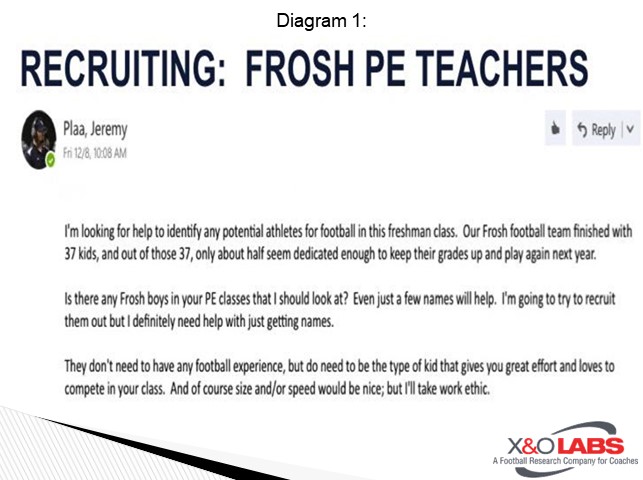
We will start our cycle for next season as soon as the off-season begins.  The first stop for us is our PE teachers.  In December of each year, we will send them an e-mail that will ask them to identify any or all kids that they think would be good for football.  We ask for work ethic first, and talent is secondary.  They will always identify at least a few kids that will make a difference in our program, but of course, make a bigger difference in their own lives for joining a team environment that football provides.  December is a good time to ask the PE teachers because this has given them a few months to identify the kinesthetic kids that excel in class.  I will usually follow up with in-person conversations with those teachers, and giving them a t-shirt as a thank you for helping our program out is always good practice.   

Diagram 1


Depending on how helpful your school’s PE teachers are, you can also use your school’s attendance/grading system to look for potential players.  We have a data system that I can filter all of the male ninth-grade students, and I can look at their first quarter grades as well as a school picture of each student.  The student’s picture could give you a small clue, but the bigger reveal is the student’s grades.  In the past, I’ve looked for students that get good grades in PE, and struggle in their academic classes.  These kids are surely kinesthetic learners and would probably enjoy afterschool sports.  These students probably NEED afterschool sports.   The extra guidance of a football coach could be just what that young man needs to improve as a student to be a part of the football program.  They are easy recruiting targets and should be discussed with their PE teacher if the PE teacher didn’t already alert you about the student.  Another reveal is a student that gets all good grades but doesn’t seem involved with many other programs at the school.  Our school is typical of most, and offers music, drama, agriculture, and of course other sports; but sometimes you will find a student that does very well academically but has not otherwise tied into the school’s afterschool activities.  Students that get good grades are going to be more reliable and will likely reflect well on your program’s reputation and emphasis on the academic part of the “student-athlete.”

Read More

Adding a Run Defender in the 4-3 and 3-4


CaptureBy Will Pluff

Defensive Coordinator

Utica College

At Utica College we are a base 4-3 defense and run Cover 3.  Our philosophy is to have a base defense that is strong from the inside out keeping terminology consistent to allow our players to play as fast as possible  We align to the field or the formation strength if the ball is in the middle of the field.  We do not use the traditional “Strong Safety” but instead align two linebackers primarily in the box and one out in space rotating our weak side safety down to get us to Cover 3.  This is the first way we teach our players to get to an 8 man front.  

Slide1

BASE COVER 3 RUN FITS USING THE 4-3

Before I get to the run fits for the linebackers and secondary I think it is important to cover a few basics of how our defensive line plays in the 8 man front.   Our defensive linemen are coached to read the offensive linemen for block recognition and strike their shade low to high as quickly as they can.  They should be working to take two quick steps to create a new line of scrimmage.   We ask that our defensive line makes plays that come to their gaps by using an escape move.  We will also slant our defensive line, they will use a 45 degree slant step working penetration of their gap.  Longsticking is a common term which we call “slicing,” this is a two gap movement.  Our last defensive line adjustment has them hit their gaps getting to the heels of the offensive line.  

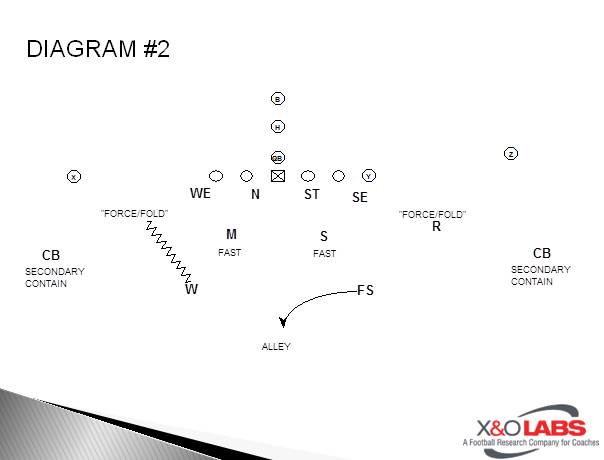
When installing Cover 3 with the linebackers and secondary we stress their run fit and knowing how Cover 3 works against the run.  We have words that tell the players what their run fit is and this run fit tells them their pass responsibility.  When we say 8 man front we want our players to picture two “Force” players, two “Fast” players, two “Secondary Contain” players, and one “Alley” player.  The outside players are working the ball back inside and the inside players are working the ball outside.  

Slide2

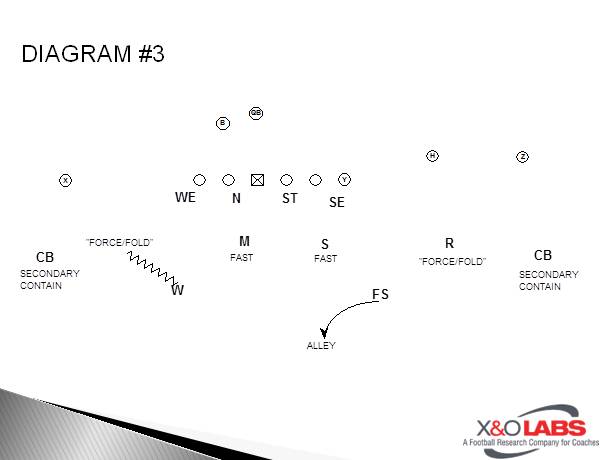
In our base defense we adjust our linebackers alignments to 3×1.  This is common to do while running Cover 3 to help since the alley for the runner to hit inside of the force player can be displaced by the receiver’s splits.  

Slide3


It is very important for the players not only to know their run fit but know what it means.  The run fits stay the same but the players performing them can change as we start to roll to Cover 3 different ways.  The run fits also stay the same when we are running our 3 Under 3 Deep.  Since we keep the run fits consistent in the majority of what we do this gives our players less to think.  We, as many other teams, want our defense to play as fast as possible and teaching run fits this way in the 8 man front has allowed us to do that.  The following list of words and definitions is what we show the players at the very beginning of camp.

“FORCE/FOLD”

-RUN TO- Make the tackle or turn the ball inside

Fast  Flow to: Attack the ball and make the tackle, attack any lead blocker with inside shoulder keeping outside arm and leg free (outside leverage)  “Forcing “ the ball back inside.

Slow Flow to: Stack on DE keeping shoulders square having the ability to play from the outside in, waiting for the ball to commit to the line of scrimmage.  Play the ball if it bounces outside or fold downhill into the formation if the ball hits inside.

Read More

Simulated Pressure System – Case 2: Back End Coverage Structure and Responsibilities

By Mike Kuchar
Senior Research Manager
X&O Labs
Twitter: @MikekKuchar


In this case, we will expound upon the coverage responsibilities of defenders in these replace pressures. Remember, the base coverages will only be one of two concepts, Cover 3 or Cover 2, but the difference in these pressures is that it’s unknown, particularly to the opposing quarterback, which defenders are responsible for which zones because they can change from play-to-play.

According to Coach Toney, this the safest way to pressure the quarterback, because a defense can get seven defenders in coverage. And the beauty is those defenders will change from snap-to-snap. “When running a replace pressure, you are still playing traditional coverage,” he said. “We are playing either four under three deep zone (Cover 3) or five under two deep zone (Quarter, Quarter, Half). Being able to play traditional coverage while still being able to bring pressure maximizes your time coaching. Since you are running the same coverage you play on base downs, there is minimal new learning for your players, which allows them to rep and become proficient at the techniques, pattern reads and matches of the coverage. The other added benefit is that the presentation of the coverage looks drastically different to the opposing quarterback, because different defenders are dropping into the underneath zones and different rushers are coming. So, while it may be simple for us, it’s still difficult for the opposition.”

According to Coach Toney, utilizing replace pressures gives you the ability to call them in all down-and-distance situations. “For example, in third-and- medium situations, most offensive coordinators are trying to get the ball to the sticks,” he said. “So, defenses are mainly seeing quick-rhythm short routes in which three deep replace pressures wouldn’t be the answer. Yet if we want to run those pressures, we have other coverages to pair them with, so they can be used in those situations. Conversely in long yardage situations, we like using our two deep and three deep zone replace pressures to protect the seams and verticals, which forces the offense to check the ball down short and outside and we can rally to and tackle in front of the sticks. This versatility has allowed us to go into games running the same pressure patterns from four or more different versions of coverage as well as allows us to keep our game plan simple for the front and allow the secondary to adjust to the down-and-distance situations by coverage.”


Communication System for Pressures

Part of the challenge in devising pressure packages is making sure the language is aligned. One flaw in communication can produce big plays for the offense. This is why Coach Roberts and the defensive staff will marry each of these pressure concepts with words that denote the corresponding coverage. The four replace pressure concepts are classified below:


Editor’s Note: All of the following pressure concepts are detailed further in this report.


“Smoke” Pressures: These are boundary (short side) pressures. The coverage is a single safety coverage (cover three) with weak side rotation.

“Fire” Pressures: These are field pressures. The coverage is a single safety coverage (cover three) with strong side rotation.

“Weak” Pressures: These are middle pressures. The coverage is a single safety coverage with middle rotation. Strength is called to the field.

Two-High Pressures: These are middle of the field open pressures, where mostly an interior linebacker will add onto the pressure pattern. Coverages can vary between two-read or cloud principles.


Base Three Deep, Four Under Coverage Responsibilities

In order to teach the zone coverage unilaterally, defenders must know the base rules of each underneath and deep defender. Regardless of the zone they are responsible for, each coverage defender is asked to look at the QB with “zone eyes,” which is different than pure pattern match principles. It’s all centered around the intent of different defenders dropping into unknown locations to get tip balls or interceptions. Since the Cajuns teach a spot drop, not pattern match principle, all coverage defenders must abide by the golden rule: Anything the quarterback tells you as he’s dropping is bulls**t, once the backfoot hits the ground it’s a reality. And with four unidentified flying objects come directly in his face, the QB will usually need to shorten his drop. So, when the quarterback shortens his drop, so do drop defenders. They often don’t need drop that far before the ball is released, or the whistle is blown on a sack. 

In any of the above three deep, four under coverages, the following zones must be accounted for:

  • Outside Third (2 defenders)
  • Deep Third (1 defender)
  • Curl/Flat (2 defenders)
  • Hook (2 defenders)


Outside Third Defenders: While outside third defenders will usually be the corner, or Weak safety in boundary pressures, they will play off 1×8 off the number one receiver or will press bail to look like man coverage. Their primary key is through the number two receiver to the QB. “He will start in a walkout technique,” said Coach Toney. “His is secondary key is the release of number two. If number two is in the seam, he will get depth on his divider, which is one yard on top of the numbers if he’s a field corner. If he’s the boundary corner the divider is apexing the numbers.” Once the ball is snapped, these defenders are asked to play with complete vision on the quarterback. “If number two is anything non-vertical (which means in our out) he will nail down and play loose man on number one,” said Coach Toney. This is essentially “MOD (man over the depth of LBs)” in Coach Nick Saban’s terms. “He will play loose man over the depth of linebackers on number one. Anything underneath he will zone the third and look for work coming back to him.”  

Read More

Simulated Pressure System – Case 3: Drilling the Rush and Cover Concepts in Simulated Pressures

By Mike Kuchar
Senior Research Manager
X&O Labs
Twitter: @MikekKuchar


As potentially elaborate as the simulated pressure scheme may be, its efficiency lies in drilling the fundamentals of both the cover defenders and rush defenders. Teaching simulated pressures require teaching defenders to perform skills that they are not accustomed to performing. In order to get this done, coaches must spend time working various defenders through each of these responsibilities. Louisiana State University defensive coordinator Dave Aranda, who is credited for bringing the scheme to the NCAA level, credits the Baltimore Ravens as the model in the NFL for being efficient in switching jobs through the season and modeled his three-day installation after that blueprint. “On day one linebackers will do linebacker things, defensive backs will do defensive back things and bigs will do the defensive line things,” Coach Aranda told us. “Then in day two, the linebackers will switch with the defensive backs and in day three the linebackers will switch with the bigs. This way, everyone’s role is switched. Simulated pressures give you that ability. The coverage will always be the coverage, it’s the specific defenders that are executing that coverage that will constantly change.”

While we may not be able to document all of the drill work that the Ravens work through on daily, we are able to provide practice film of how both Coach Aranda and University of Louisiana safeties coach Patrick Toney teach their players the rush and cover concepts infused in these pressures. We segmented our research into both rush and coverage drills.


Coverage Drills


Curl/Flat Drill Progression (University of Louisiana):

In three-deep simulated pressures, there will be two curl flat defenders who will be asked to reroute the number two receiver if he’s vertical or look to get underneath the number one receiver if there is no other vertical threat. And because these curl/flat defenders can either be interior linebackers, outside linebackers or safeties in this system, Coach Toney will rep all potential curl flat defenders through the following circuit.


Curl/Flat Drop on Air for Second Level Defenders:

This drill teaches the drop of the curl flat defender if he’s positioned as a second level defender such as a linebacker. If on the hash, his drop needs to be eight yards deep and on the top of the numbers. If he’s in the middle of the field his drop should be between the numbers and the hash. All eyes should be on the quarterback, who will simulate throwing an interception.

To study film of this drill, click on the video below:

Read More

Simulated Pressure System – Bonus Case: Installation Methods for the High School Level

Question and Answer with Kyle Cogan
Defensive Coordinator/Assistant Head Coach
Lexington High School (MO)
Twitter: @CoachCogan


While simulated pressures have been populating the NCAA domain for the last few years, we realize many high school programs will be implementing these concepts for the first time. As a result, we wanted perspective from a high school program with experience using these schemes, particularly a smaller program with lower numbers that needs to maximize time to get these established. Our source came from Lexington High School in Missouri, where defensive coordinator Kyle Cogan has been using them for the last couple of seasons. We conducted a Q and A with Coach Cogan below.


Question: What percentage of your pressure system is based on simulated pressure?

Kyle Cogan: Conceptually, it’s one third of our pressure system. I separate everything into three categories: 

  • Simulated pressures 
  • 5 man pressures
  • 6+ man blitzes. 


When we ran one of those three concepts we used simulated pressures about 30% of the time, 5 man pressures around 60%, and 6+ man blitzes roughly 10%.

Of total snaps on the season we used simulated pressures 7% of the time, 5 man pressures 24%, and 6+ man blitzes 2% of the time.

Depending on the offenses you see week in and week out the percentages could be completely different for another team. About half our schedule we are playing teams running split back veer, wing T, or single wing. Some of these teams will use 9 man protections or run trap on 3rd and long. We could go back-to-back weeks where we don’t run a single simulated pressure and then the following week use them 30% of the entire game. 


Question: What summer installation model do you use for this concept? Do you spend one day teaching pressure patterns and another day teaching coverage? Do you tie them both together?

Kyle Cogan: In the summer I teach the two main pressure patterns we will use for the season on the same day. One is attacking the A gap, the other is attacking the B gap. This is after we have all our base fronts installed. By the time we get to our simulated pressure install we have most of our base coverage concepts in which for us is cover 3, man free, and 2 man variations. From there it’s plug and play. Because we are only bringing four rushers I can pick and choose the coverage concept we want based on what coverage matches up well with what the offense likes to do. Or I can select what simulated pressure matches up well for the blocking protection the offense likes to use. 

Read More

Heavy Personnel C/D Gap RPO Concepts

By Brent Dearmon (with Adam Hovorka)
Head Football Coach
Bethel College (TN)
Twitter: @BrentDearmon


Editor’s Note: We would like to congratulate Coach Brent Dearmon on his recent (January 2019) appointment as Senior Offensive Consultant at the University of Kansas under Head Coach Les Miles.


At Bethel College in 2018, we called 320 RPOs out of 798 plays. 40% of our offense was RPOs. We scored 55 points per game this season and averaged 7.4 yards per play on called RPOs. Twenty of our 85 touchdowns this season came from RPOs. We also have found safer ways to call RPOs. Early on in this “RPO” journey, our QB took some late hits because of a short edge or a missing gap in the gap scheme. Because of this, we have started running more RPOs from 12/21 personnel groupings to protect the backside of our QB more. This also eliminates two-sided reads for QBs. If you are trying to simplify RPOs for your young QB, this system is a great way to get started. Give your QB one post-snap read and allow him to play faster and smarter. Plus, having two good tight ends makes it easy to get wide receivers to block because they know that we can live in 12 personnel.

Dearmon 012919 1


12/21 Personnel Advantage

The advent of odd structures have basically forced offenses into using heavier personnel. I like double tight sets against odd fronts for a variety of reasons. We have more gaps accounted for, and we keep the quarterback upright. In some of our schemes, you can often see the QB standing up with no one within five yards of him. Now what we’re starting to do is account for the D gap into the boundary with the tight end blocking rather than using a “gift” concept such as a fade or hitch route.  With our hand-down tight-end blocking, we often get our tailback one-on-one with the non-run fitting boundary safety. 

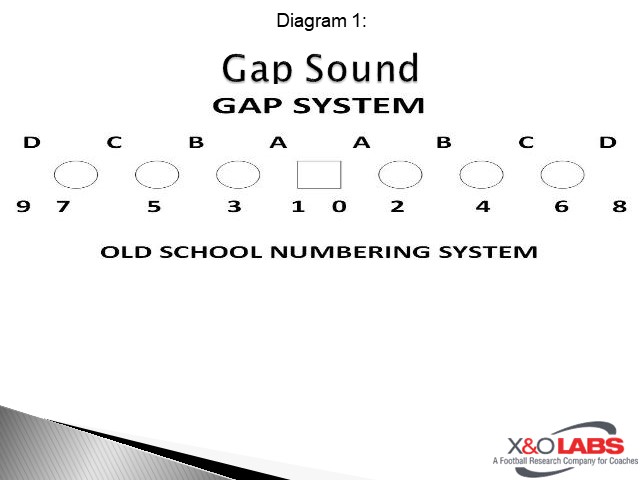
Before we get into plays, I want everyone to understand how we teach our QBs. The chart below discusses every RPO we install. Our QBs understand in which gaps they are protected, in which gaps they are reading, and in which gaps the protection is weak. Our QBs must understand when a gap is empty.

Diagram 1


So, now we are taking the same RPO catalog we used with 10 and 11 personnel and have adjusted it to fit with 12/21 personnel groupings. Below I detail the more common RPOs we are using with this grouping and why it’s effective with heavier personnel groupings.


Inside Zone with Bubble Contour

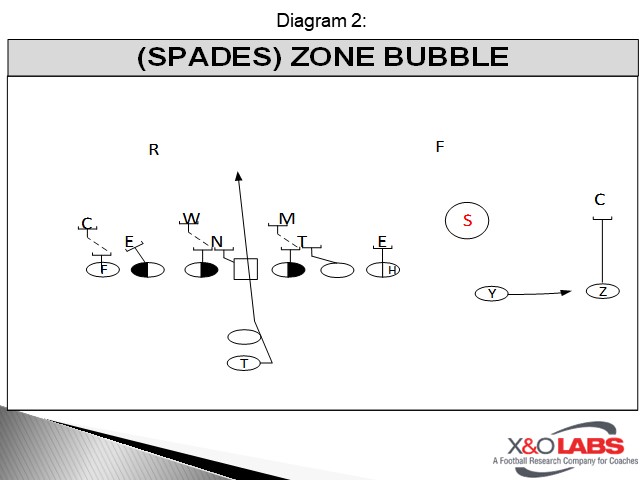
The first RPO we put in is the Inside Zone combination with field Bubble.

Diagram 2


In this concept the QB will learn the following:

  1. The offensive line and HBs will protect you from front side D gap to backside C gap.
  2. QB is responsible for the field D gap run fitter both pre and post-snap now. The QB will ride read the field D gap player. If the D gap player attaches hard to the run fit, he will pull and throw the field bubble. If D gap player blitzes and squeezes the back, abort the ride read and get depth to deal the bubble now.


The Advantage that 21/12 Personnel Grouping Gives

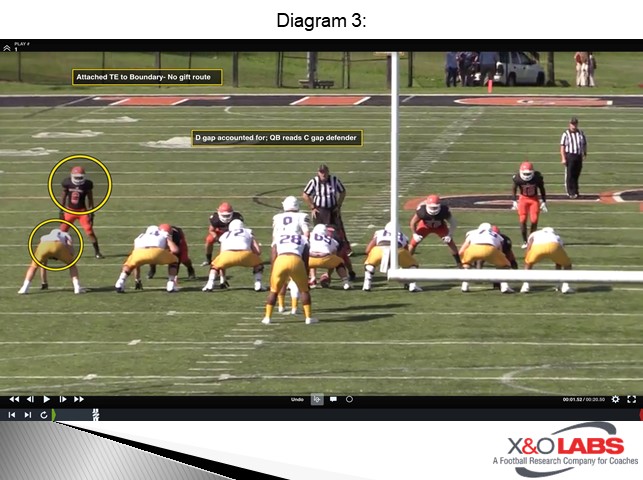
By using the double tight end formation, we have the D gap to the boundary to the C Gap to the field side accounted for. The QB knows we have everything blocked and he is responsible for D gap to the field. The QB is reading the Sam linebacker in the C gap who is just hopping around post-snap. It tells the QB to just run the ball. 

Diagram 3


The same effect can be accomplished with using an H back from across the formation. The boundary tight end takes care of the D gap fitter, which is the Cover 2 corner and the offensive line handles the rest of gaps to the backside linebacker. The QB will read the Sam linebacker to the field. You can see that backer is expanding, so the QB gives the ball and fakes throw. 

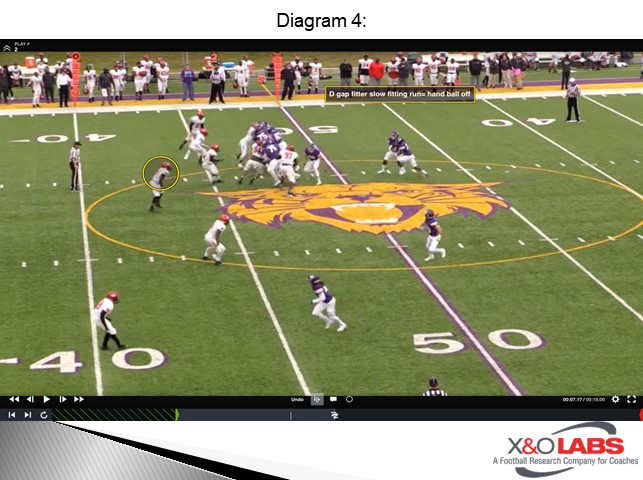
Diagram 4


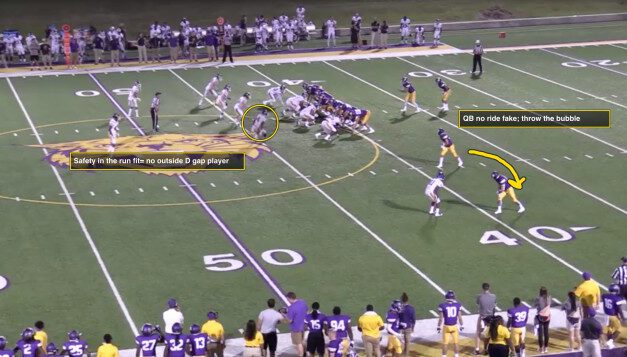
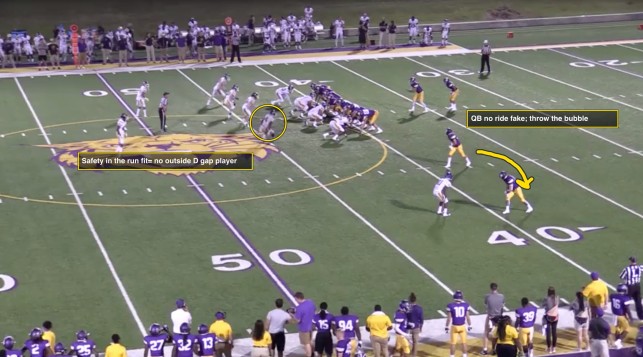
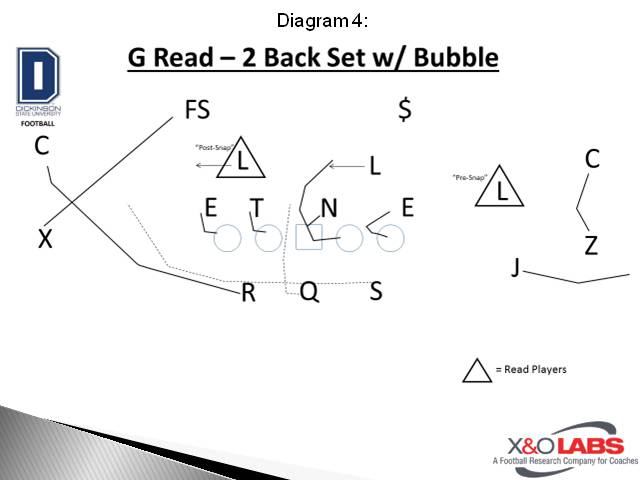
We can run the same play with the boundary tight end handling the D gap player. In this case, the safety is in the run fit. The defense has no field D gap player, so that tells the QB he doesn’t have to ride anything, and he can go ahead and throw the bubble now.  

Read More

Transitioning Between Multiple Even and Odd Fronts without Sacrificing Coverage

By Joey Ginn
Head Coach/Defensive Coordinator
Bethel High School (OK)


First off, I would like to begin by thanking Mike Kuchar and Adam Hovorka for what they do with X&O Labs to further the learning opportunities for coaches to develop. I would also like to take this time to mention/credit my staff, these guys have gone above and beyond in trying to change the shape of a program that isn’t exactly known for success on the gridiron. James Mangram (OC/OL), Lincoln Dearing (WR/DB/Special Teams Coordinator), Stony Burt (DL/RBs), Jason McPhail (OLBs). I spent this last year coaching our LBs, and QBs and calling the defense as a head coach. 

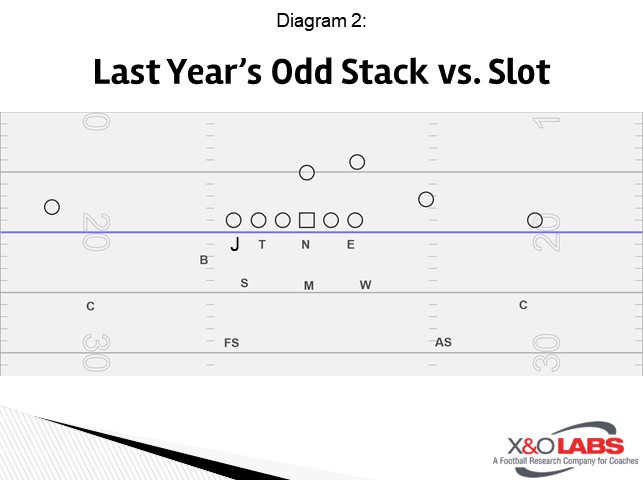
We are a small 3A program in Oklahoma and had just 37 players this year. We were very young the last 2 seasons, my first two years as head coach. My first year here coming from a 6A program where we had 100 + players in 10-12th grades and coming here where we had 42 players 9-12 in my 1st season and 37 players 9-12 this past year was an adjustment. At the 6A program, we had a split staff of 10 coaches, we practiced our varsity and JVs separately, we had a separate 9th grade staff and they held their own practices. Another advantage we had at the larger program was we had several one-way players, for instance, all but one of my linebackers at the 6A school practiced and played defense only. I was two deep at every position also. When faced with 37 kids 9-12 as opposed to 100 players in grades 10-12 and another 40 freshmen, there are some adaptations that had to be made. My first year we were an Odd Stack team with split field coverages in the back end, because that’s what I believed in. However, as the first season moved on, I made the decision we had to do what was best for our personnel and what I believed in better fit the kids I had in my program.


The Transition

Entering the off-season, we returned our Mike linebacker, and a to-be-sophomore who had played a little bit of inside linebacker for us as a Freshmen. We also returned our strong safety/linebacker hybrid who we called Bandit in our 3-3-5 Scheme. We had a to-be-freshmen kid who I felt like could play a linebacker for us, but I really wasn’t sure. We had a wrestler coming out who I felt like could be pretty good, but I had never seen him play football before. Therefore, we had to go to the drawing board to figure out what we needed to do to fit our personnel best. I knew two things were going to remain no matter what: split field coverages in the back end, and an attacking Odd Front. We looked at several things believing we were an inside linebacker short to allow us to play our Odd Stack. We felt like the to-be-Sophomore just wasn’t yet aggressive enough to be a Stack LB in our true 3-3-5 scheme. We had used him, however, as a DL as a 9th grader, so we knew he gave us the ability to be multiple in our looks by putting his hand down on occasion. With this we began putting together a plan. How could we maintain our structure and aggressiveness defensively with 3-3-5 personnel, maintain Split Field Coverages in the back end, yet not have that 3rd Stack linebacker? 

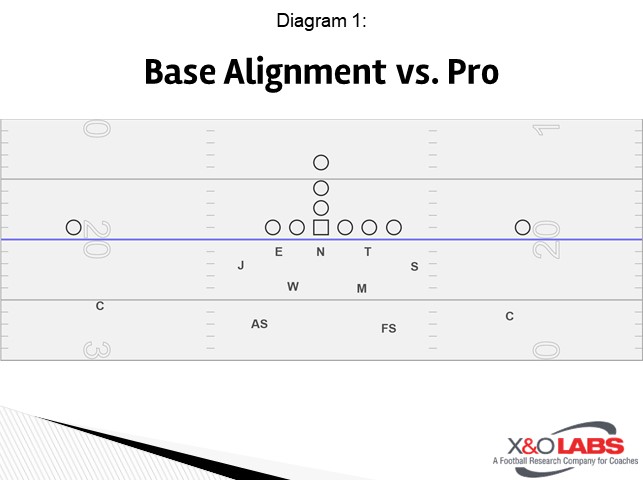
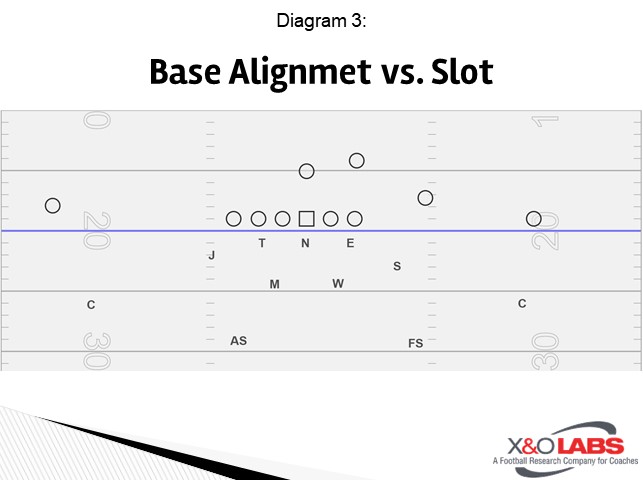
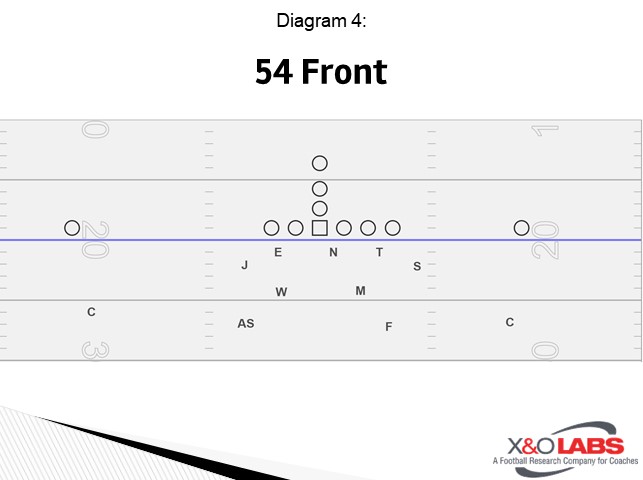
Upon research/study, we thought we found our answer. We looked high and low, and drew several different things along the way, but mostly what helped us the most was putting pen to paper comparing our 3-3 stuff side by side to 3-4 stuff, maintaining our Split field coverages.  What we would do was line up in a 3-4, we would use our Bandit as a Sam on the passing strength side, he would always travel with the free safety and play OLB to the passing strength.  Our Mike LB would simply be a 30 LB on the strong side, our Will would move to a 30 LB on the weak side and we would create a “Jack” LB position that would travel opposite the passing strength (Diagram 1). This we felt would make lining up even simpler as a defense as it balanced us up, and formations could no longer give us alignment issues such as double tight did in our 3-3-5. Our free safety could make the passing strength vs. what we call a slot set to the true passing strength rather than to the TE in our 3-3-5, this made us more-sound as we had more of a LB on the weak side of the passing strength to be able to tighten down to a 9-tech. vs. a TE and still had 3-on-2 to the two quick receiver side (Diagram 2 & 3). We would still call the front the same way we had the year before by calling the tackle (strong end) and end (weak end) using a double-digit call and telling the nose he played the high number side (Diagram 4).

Diagram 1

Diagram 2

Diagram 3

Diagram 4


Another advantage with this transition we felt was the ability to install some Even front looks and even an Under look that I grew up in coaching defense with. This was very simple out of our 3-4 Front the way we had installed it. We made two calls that talked to only the Jack: “Tight” told him to travel with the strength of the front he had 2 simple rules. 1.) If the tackle is in a 4-tech., you’re in a 7-tech. with your hand in the ground. 2.) If the tackle is in a 5-tech. you’re now a stand up 9-tech. This gave us the ability to vary our look giving us a 4-2 look with the very same 3-4 personnel on the field. We changed nothing for the secondary here (Diagram 5 & 6). The other Even look we created was a “Walk” call. “Walk” told the Jack again he was on the Weak side lined up in a stand up 5-technique. The call we used to go with a “Walk” call front-wise was 53 Walk (Diagram 7), we told the free safety in Walk he had to call the passing strength to the front strength when we were in Walk vs. any 2×2 set this put us where we needed to be vs. a Slot set as mentioned earlier (Diagram 8). 

Diagram 5

Read More

The Double Wing Power: The Culprit Behind Two Program Resurgences

By Derek Katris
Head Football Coach
Elgin High School (OH)
Twitter: @CoachKatris


Editor’s Note: In this report, Coach Katris describes how the Double Wing offense helped him re-build two programs. As he tells it, he and his staff were able to generate on-field success, increase player participation numbers and win more games. At the end of this report, we asked Coach Katris to discuss in more detail the impact the Double Wing had on the overall health of these two football programs.


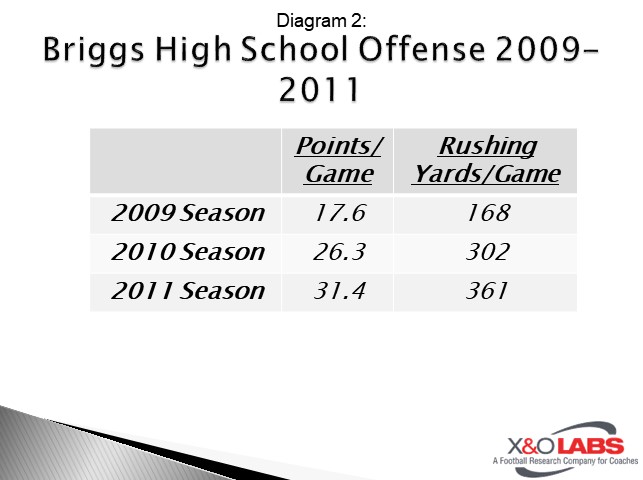
I accepted the head football coach position at Briggs High School (Columbus, OH) in April of 2009 with only two years of experience as an assistant coach. The school only had one winning season since 1996 and a great deal of player and coach turnover. I attempted to install a spread offense my first season. We couldn’t do much right and struggled to a 0-3 start. We couldn’t score, could only inconsistently move the ball, and lacked offensive explosion. We finished the last seven games running a vanilla under center dive, trap, and off tackle series to try to come up with some sort of offensive identity.  We finished 3-7 and averaged only 17.6 points per game. We had no offensive identity and lacked team toughness.

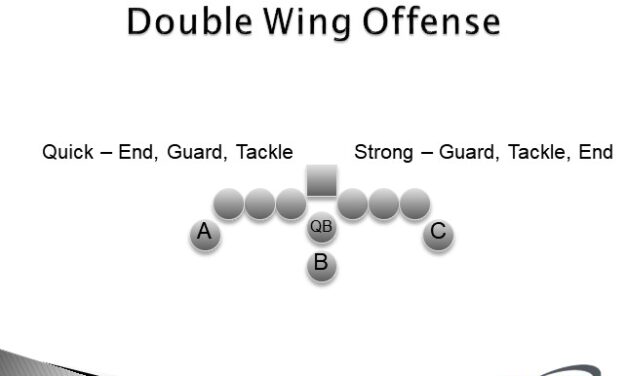
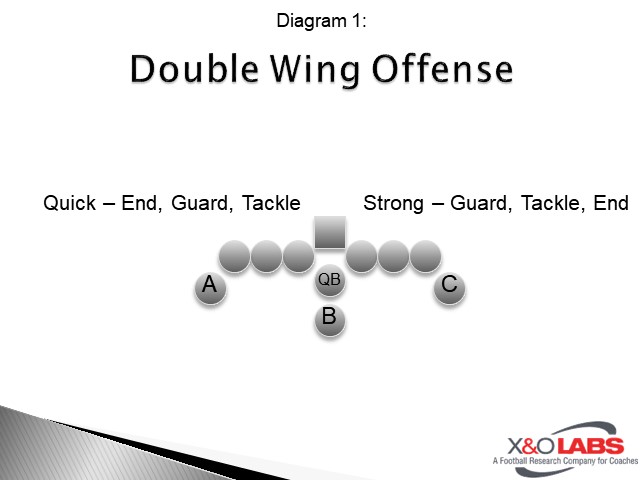
Along with the help of my offensive coordinator, my brother, Luke Katris, we found the double wing offense. It had everything we were searching for, however, most of all it gave us an identity. We introduced an offensive system built around the power play. We didn’t need to be bigger, faster, or stronger to be competitive with this system. We believed that with the core philosophy of running power, blocking hard, and running hard for 5 yards every play we had a chance. We finished 6-4 and beat our rival in game #10. The double wing and its power play had helped us turn the program around.

Diagram 1


It all started with a concrete philosophy, running base double wing power, and building everything up from there. The philosophy formed an identity that everyone could believe in – always do one thing better than the other team (run power). We improved drastically as an offense and averaged 26.3 points per game in 2010. The offense produced even more the next season (2011), averaging over 31.4 points per game.

Diagram 2


After the 2011 season I moved on and spent three seasons as an assistant at two different schools, guiding each as the offensive coordinator in the double wing offense. In the spring of 2015 I was blessed enough to get the opportunity to be the head football coach at Elgin High School (Marion, OH). Elgin was a school with great football tradition; however, it had fallen upon tough times. Low participation in football, no winning season since 2005, and continual turnover at head coach had taken its toll on the program.

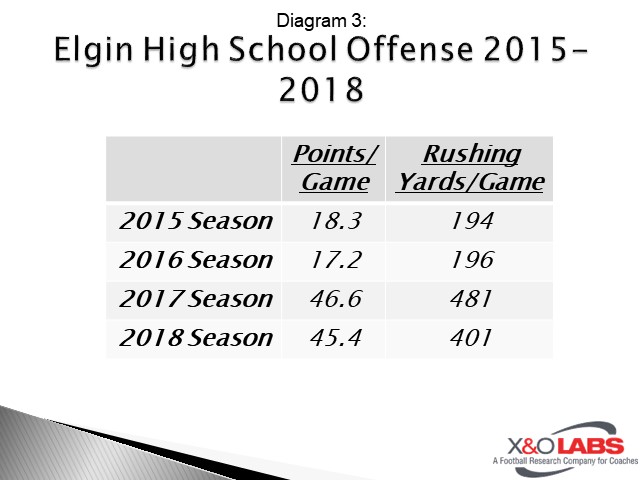
The first two seasons we struggled mightily going 3-7 and 0-10, suffering through some very tough losses. We averaged only 18.3 points per game in 2015 and 17.2 points per game in 2016. Year three was the turnaround we had all hoped would come once our younger players grew up. We started 3-0, rushed for over 1,700 yards in those three games alone and set multiple state of Ohio rushing records. Game #1 (553 team rushing yards, #27 state of Ohio team single game rushing history) and Game #3 (688 team rushing yards, #6 state of Ohio team single game rushing history) were now in the record books for most rushing yards by a team in a single game. While later on adding #19 in the state record book with 584 yards rushing in game #9. No other team in state history is on the list more than one time. The season culminated with the school’s first winning season since 2005. We averaged 46.6 points per game, 481 rushing yards per game, and converted 46/60 two-point conversions on the season. In addition, this past season we followed up last season’s success with a more diverse attack. In the process of attaining the first back-to-back winning seasons since 1999/2000 at Elgin High School, we averaged 401 rushing yards per game. We also implemented more of a passing attack adding in 56 passing yards per game. Our scoring average was 45.4 points per game and we converted 41/62 two-point conversions.

Diagram 3


What is it about the double wing that allowed for this type of turnaround ability? Everything we do draws from the offense, whether it is in the weight room, film room, or practice field. The offense has literally steered our program from the depths of being one of the worst teams in the state to one of the best rushing offenses last football season in the state of Ohio. The kids own it, love it, and identify with it. When we line up every first play, tough play, and needed play we run power. We pride ourselves on execution, aggression, strength, and breaking tackles.

Very simply the Double Wing has allowed us to do three things very well: develop an identity as a football team, play fast with confidence, and give our players an advantage because they know how to execute against every imaginable front that we could face with very simple adjustments. Our players know from day one our identity of the football program is power. They understand how we win and what it takes to be successful because of our identity. We discuss our identity regularly and hold everyone accountable to it. Our players have very simple alignments, assignments, and techniques that are drilled daily. Through the simplicity and daily repetition our players are very confident and do not experience situations they have not practiced extensively before. I believe this is a very important facet of high school football; the more confident team that plays faster is usually the more successful team. Finally, we develop an advantage because there are only so many combinations of fronts that can be played against our base double wing alignment. By the end of August camp our offensive line and tight ends have seen it all.

Read More

QB Gap Read Concepts

By Jace Schillinger
Offensive Coordinator
Dickinson State University (ND)
Twitter: @jaceschillinger

Introduction:

schillingerThe past couple of seasons, we have been trying to play “11 on 10” football. We had a quarterback that was a nice runner and could do a great job in the read game. This approach also helped our young offensive line that was not ready physically to handle some of the defensive players on our schedule. 
During this time, we ran a steady diet of zone read and power read concepts. It worked well for us, but our opponents soon began playing different games against us up front to muddy up the read for the QB. Against the zone read, the defense would crash the end on running back and loop linebacker for quarterback. Against the power read, we saw defenses collisioning the mesh point and looping the linebacker.

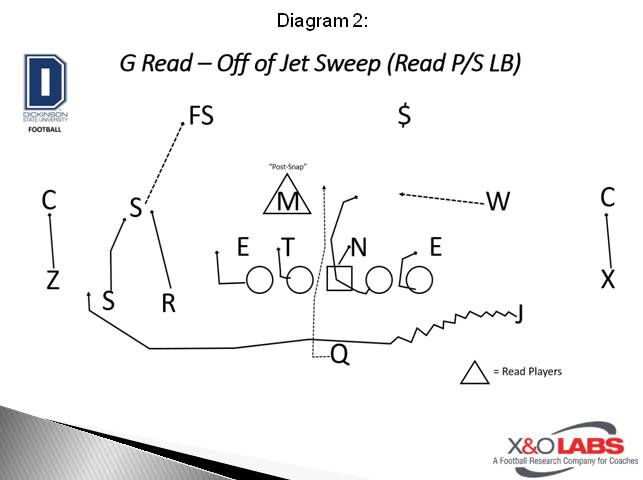
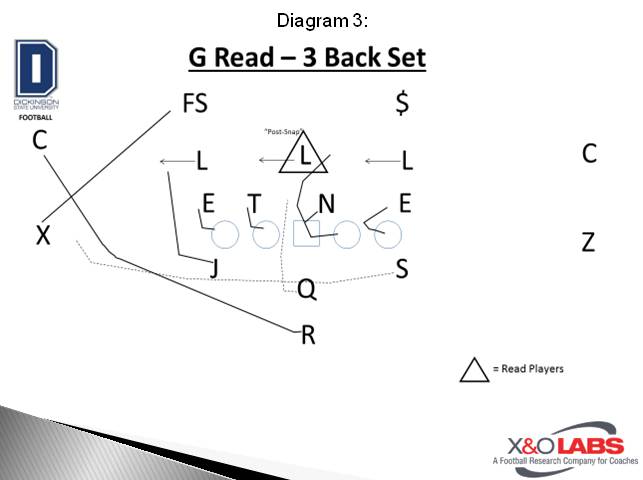
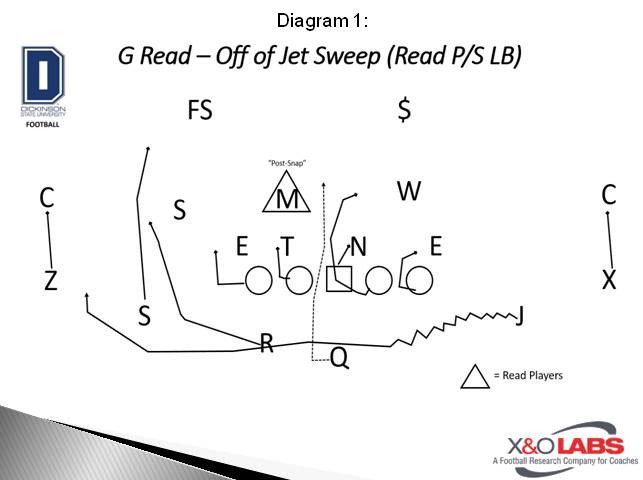
To counter these tactics, we needed something different to slow down both the end and linebacker while getting the ball on perimeter and giving the QB a lead blocker.  The result was our G Read concept . Since installing this play about halfway through the 2014 season, we have averaged almost 7.5 yards/play on G Read. 

Base G Concept:

At its core, this concept is quite similar to everyone’s “G” play. The difference is that we pull for the backside LB and leave the front side LB. The quarterback is taught to read the LB head up of the center to the playside tackle. If the read key flows with the jet motion, our QB keep will keep the ball running the QB “G” scheme. If the linebacker doesn’t flow, the QB will give to jet motion back and we feel we can get the edge.

The QB read is rather simple for this play. We tell our QB that if he thinks the Jet can out run the Mike at exchange time to give it. If he doesn’t think we can out run him or we get flow, the QB will keep ball and get to A gap. Whenever they are in doubt, they are told to give ball to the jet player and save the QB from taking another hit.

Slide1Slide1

We can also run this play straight out of the backfield with no motion with our tailback. It is a little tougher read for the quarterback, because the linebacker is not flowing so hard with jet motion. In our league, we see a lot of 6-man boxes in 10 personnel formations.

Slide3Slide3

We run this play mostly from 2×2, 3×1, or empty sets. Most of the time we get 2-high safety looks with these formations. To the front side of the play, we are running outside zone. Our play side tackle is taught to bucket step and to try and reach the outside wing of the defensive end. To the backside, we can tag a bubble or quick screen.

Read More

Defending Formations into the Boundary (FIB) from Two-High Structures

By Cody Alexander
Secondary Coach
Midlothian High School (TX)
Twitter: @The_Coach_A


Though it may seem counter intuitive, utilizing reduced space can get a defense to over react to WRs into the boundary. As I wrote in my first book, Cautious Aggression: Defending Modern Football, offensive coordinators align formations into the boundary to get the defense to over rotate to the short side of the field, baiting the defense to leave the wide side without an overhang. Offensive coordinators also use FIB to take advantage of how a defense sets its strength, and finally, to isolate a single WR on a CB. Add the use of quick motions back to the field and the defense can look as though it is ill prepared for what seems like an easy transition. The goal of this report is to demonstrate how Quarters, and primarily a two-high scheme gives the defense the best chance at combating FIB formations.

Most Quarters schemes can function as a split-field defense. This means that each side of the secondary can react to the set, or number of WRs it is given, and can be manipulated by the coach to fit any need by the defense. By running a split-field look, the defense has a better chance of reacting to an offense that puts a formation into the boundary (FIB). The diagram below illustrates this flexibility.


Defending 20 Personnel Y Off FIB:

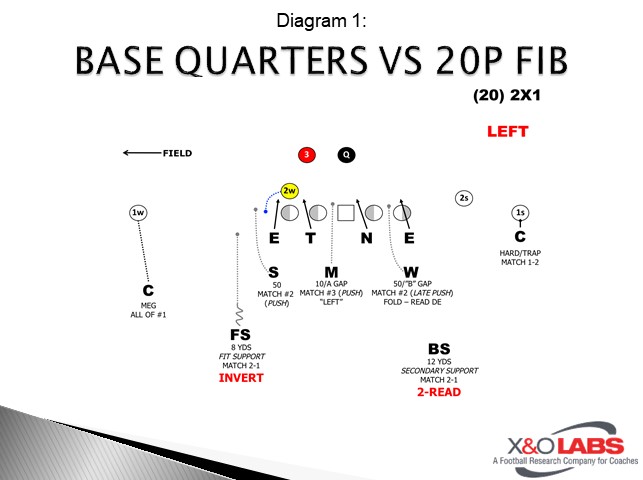
To the two WR side, the secondary is in a 2-Read, or match Cover 2 concept. This allows the CB to be “hard” (aggressive) near the line to combat a vertical by #1, an RPO screen into the boundary, or as a plus-one if the ball comes back to the short side. This added value by the CB forces the offense to go back to the field, making them predictable. Playing 2-Read over the two WRs also allows the Will LB to work back into the box since he knows the CB will take any out cut by #2. In the diagram, the Will is labeled as “late push.” The coaching point for the Will is to step to his gap with his 6” steps (lead leg first) and read the mesh. If the RB comes his way, fold or fit off the DE, if the QB pops up to pass, the Will holds the curl, working through #2 to get to #1. If #2 goes out, the Will’s eyes dart to #1 to see if he is coming back inside, holding the curl and bracketing the WR with the safety.

Diagram 1


The field side is just as crucial to the boundary. In a Quarters scheme, especially to the single WR side. The advantage of staying two-high and running split-field scheme is that a defensive coach can manipulate either side to fit what is needed. In an obvious passing situation, the field safety (FS) would not invert down on the open side (shown above), instead opting to stay high and assist the field CB in the pass, primarily in what I refer to as the “post-hole” (the area near/on the hash where most Posts are thrown). The safety’s alignment to the field should be near or on the hash depending on tendency of the offense.

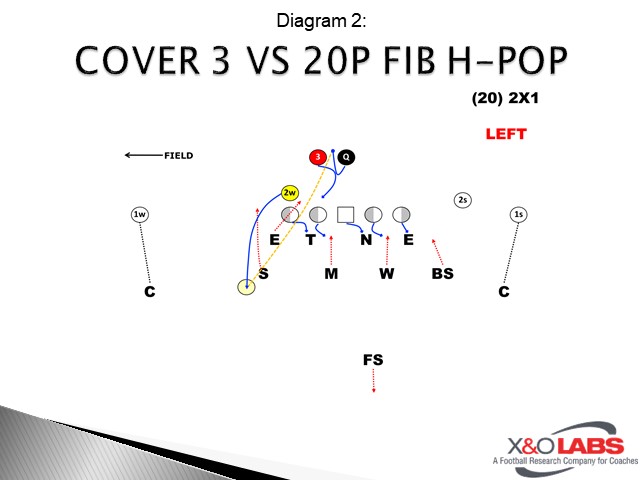
Many coaches will spin a safety down prior to the snap to gain leverage on the sniffer or H-back. By putting the safety to the boundary down prior to the snap, a defensive coach is opening the door for the offense to use play-action against his defense. Below is a diagram of a typical “H-Pop” spread offenses use to counter aggressive Cover 3 or single-high schemes. Staying in a two-high shell inhibits the ability of the offense to gain free access to the field and keeps them cornered into the boundary. The eyes of the safety to the open side should read through the sniffer to the QB to see the play develop. Versus a pass the safety either takes the vertical stem of the H-back or works to the “post-hole” with eyes back to #1.

Diagram 2


One of the most basic ways that an offense can attack a defense by using formation into the boundary is from a 20 personnel or Y-Off formation. In the clip, below, the offense puts both WRs into the boundary while setting both backs to the field. If the defense were to roll to the boundary, the defense would lose the field overhang. The play shown is the infamous Power Toss, made famous by Chad Morris at Clemson. The fits for the defense are simple, the DE to the play side will work to his first threat or QB because he has that in option responsibility. The Sam should fit outside the arcing sniffer to force a cutback but makes the mistake of going inside the arc. Not all is lost, because the inverting safety is there to correct him and make a tackle for a loss.

Read More

Leveraging Weight Room Achievements to Grow Participation

By Brian Odland
Head Football Coach
Saint Peter High School (MN)
Twitter: @coachodland


We are a mid-sized public high school. Our district offers two other fall sports, soccer and cross country running. We are also not immune to the concerns regarding player safety. Despite these challenges, we have seen our football numbers in grades 10-12 increase by over 55% over the past ten seasons.  I am privileged to be invited by X&O Labs to share what we are doing to have this success. 

We have a couple tenets that form the foundation of what we do:

  1. We must connect and make relationships with the players. This is key.  I truly believe building the relationships keeps kids out and makes it more rewarding for players and coaches.
  2. We are inclusive. We welcome anyone whether a first-time player or a kid returning to play.
  3. We mention these multiple times, “If you are here, you matter!”


What follows is a breakdown of what we do based on the time of the year:


SCHOOL YEAR OUTSIDE OF THE FOOTBALL SEASON

With the conclusion of the football season, we encourage all our players to participate in our off-season program. We offer lifting times in the mornings as well as after school to reach all our players, even those in winter seasons. Our emphasis to each athlete is to strive for individual improvements. We do not stress competition between the players (kids will do that on their own). Rather we focus on achieving personal records (PRs). This fosters success and helps them develop confidence.

We have found that spring has led to a drop in weight room attendance for a variety of reasons. This past season, we selected eight seniors and they held a draft of all football players in grades 9-11 to be placed on lifting teams. They selected team mascots and had to track down their draftees to inform them, and in some cases invite them, to join the team in the weight room. The competition was based on weight room attendance and completion of their daily lift sheets during the spring and into summer. The winning team was offered the choice of an ice cream treat or to sit out one conditioning period during the first week of practice. 

We observed a couple of reserved seniors really step up and take a leadership role with this activity and it forced the older kids to communicate and work with the younger ones.

Beyond the lifting, I email a letter in March to every returning player and possible new players in grades 7-11 grade specific letters regarding summer opportunities, camps and fall start dates. I have found this to be a time saver for myself as families try to schedule summer vacations, work schedules, etc.

Read More

Adapting Single Wing Principles to Ignite Your Run Game

By Dan Woolley 
Head Coach 
Scott High School (KY)

Introduction:

There is a lot of talk now of how people are using Single Wing principles to enliven their run game. Whether it is the overloaded formations, wildcat groupings, or misdirection backfields, these age-old systems keep finding their way back to all levels of football.

When I became the Head Coach of Scott High School (KY), their football program had accumulated 76 total wins over a 34 year span. It was apparent that if we were going to be successful we needed to do something unique, simple, and fundamentally sound. The Single Wing concept provided all of those attributes and more.

Since implementing our modified Single Wing offense, we have gone 18-14 and have rushed for an average of 6.94 yard/carry, rushed for 301.64 yards/ game. More importantly, we have outscored opponents by an average of 10 points a game over that time period. Here are a few of the reasons that the Single Wing has helped create such a large turn around.

Unique: We are the only one in our state (that I know of) that runs the offense. This means that opposing teams are unfamiliar with the offense and don’t have a ‘standard’ answer for playing us. Most teams will not run their base defense against us. Instead, they have players have to change positions and/or responsibilities, which causes them to play slower. Since opposing team’s only has 3 days to prepare, this can become a huge advantage.

Proven: The single wing has been around for over 100 years and has been run at all levels. Teams nationwide run this on the high school level and have recently won state titles running the Single Wing including nationally ranked Apopka High School in Florida.

Identity: Our kids have bought in to this system and its physicality. They enjoy this style of play, but more so, the success that has come since its implementation. In today’s world of 7 on 7’s and spread happy offenses, many players are not used to this physical brand of football and are not used to getting the ball run at them for four straight quarters. This can physically and mentally wear down a team.

Numbers: Many times spread coaches talk about counting numbers in the box to create an advantage. We think of our single wing the same way. In our base formation, we line up with 10 players in the box. If we have a numbers advantage in the box, we are content to run the ball. If we don’t have a numbers advantage in the box, then that means that there is no safety and we will try to throw the ball over their heads.

Unbalanced: With our unbalanced set, we look for the side where we have a numbers advantage to and attack that side of the formation. It is important to remember that we use a lot of pullers in our offense. This allows us to get another man or two to the point of attack even if we have a pre-snap disadvantage at the side of attack.

No QB, No Problem: Since we have started running this offense we have had traditional QBs at the varsity level, but we know from experience that this will not always be the case. When that prototype QB isn’t available, we can plug in a running back without changing schemes. In the true single wing, there is no true QB, but instead a running back who receives the direct snap from center. Having a true QB does help as throwing the ball loosens the defense up, but replacing the QB with another running back can end up getting you an extra blocker at the point of attack.

Simple: The simplicity of this offense and the power it provides in the run game allows teams to not change much when they are in short yardage or goal line situations. This offense is built to drive the ball out from under the shadow of the goal line and punch it in when we get close.

Blitz Killer: Because our standard splits are less than one foot, there are no natural gaps for defenses to exploit. For that reason, most teams do not blitz or stunt against us.

Base Formation/Advantages

Our base formation is an overbalanced line with a guard and two tackles to the strong side and a guard and TE on backside (Diagram 1). The offensive line is off the ball as much as is legally possible to aid in pulling and avoid cutting techniques by the defense. The wide receiver (R) aligns to the strong side along with a wing (B) who is lined up one yard by one yard off of the outside tackle. The QB is aligned directly behind the center with heels at 5 yards. The tailback’s (A) base alignment is 1 yard to the side of the QB and 2 feet behind the QB. The most unique position in this offense is our fullback (also known as a sniffer). He is lined up anywhere from the middle of the A gap to the middle of the B gap, depending on the play, and about 1 yard behind the linemen.

Read More