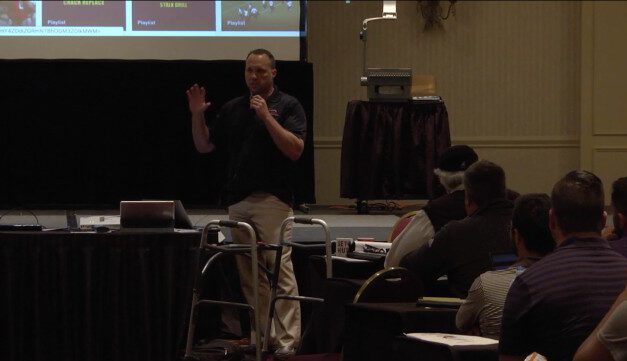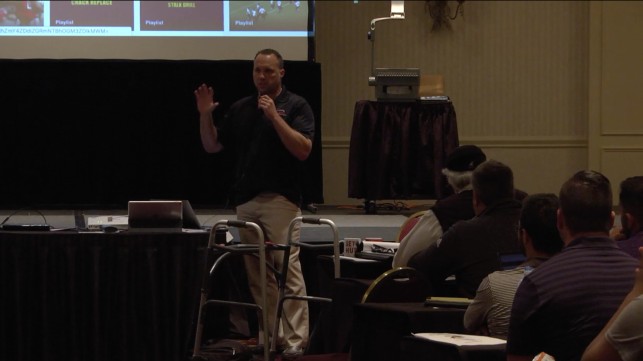

Double Teaming Punt Team Gunners

By Chris Fore
Special Teams Coordinator
Sultana High School (CA)
Twitter: @coachfore


Introduction:

Punt return is a critical play when it comes to stealing yards in a football game. In 2014, we improved our average start from the 34.48 yard line to the 45.05 yard line, an increase of 31%! We returned three punts for touchdowns, up from just one in the previous season. We increased our average return per punt from just 5.5 yards to 19.38 yards, the best punt return average in the state of California, and in the top 10 in the nation. The following year we found similar games at a different school Sultana High School (a new school), where we increased punt return yards per attempt from 7.25 to 14.66. 

Think about that difference.  We DOUBLED our punt return yards every time we touched the ball.  (Meanwhile we cut our opponent’s punt return average from 15.8 to 2.3!)  Our average start after punts was the 35.03 yard line, 6 yards better than 2014.  We cut our opponent’s average start after punts from the 37 to the 26.09 yard line, a difference of an entire first down!  So, add our improvement of 7.41 yards per punt plus taking away 10.91 yards per punt from our opponent, and we improved our field position by 18.32 yards during the punting game. 

Doubling Gunners:

The traditional pro style punt, two gunners who are out wide, 2 wings, 5 linemen, personal protector, punt is my absolute favorite scheme to see on film before we play a team.  Why?  Because I’ve got what I think is a great Punt Return to gain some dynamite yards. 

There are strengths and weaknesses with every single football play. I think that the Pro Style punt is the absolute worst way to punt the football. Usually, there are only three players (the gunners and the long snapper) heading down the field at the snap of the ball to tackle the returner. The other eight players are a part of the kicking process, with seven of them blocking for the kicker. So, you have two pretty fast players running down to tackle the ball carrier, and usually a lumbering long snapper. That is the strength of this punt: the gunners. It’s very difficult to keep these gunners from getting to your ball carrier.  It is hard to ask one player to go backwards while also blocking somebody who is going full speed forwards. 

So, we don’t!  We double team the gunners.  Let me show you how I like to attack the pro style punt scheme.

In the second week of our 2015 season, we faced one of the absolute best punters I’ve ever seen in 15 years of coaching this great game. Better yet was how fast his gunners got down field. The week before we played them, they had just HUGE change of field position plays every time they punted. In fact, through 4 punts in week 1, he averaged 46 yards per punt.

My favorite thing to do as a Special Teams Coordinator, outside of game night, is to analyze film in order to put together a game plan.  I always ask: how can we line up against this play, and have success?  Against this specific team, with their gunners, I knew that we had to double team them to have a chance.

The results were drastic. We cut their Net Punt Yard Average from 46 yards per punt t0 20.66 yard per punt!  We cut their punt average in half, and then some and, more importantly, we won 26-17.

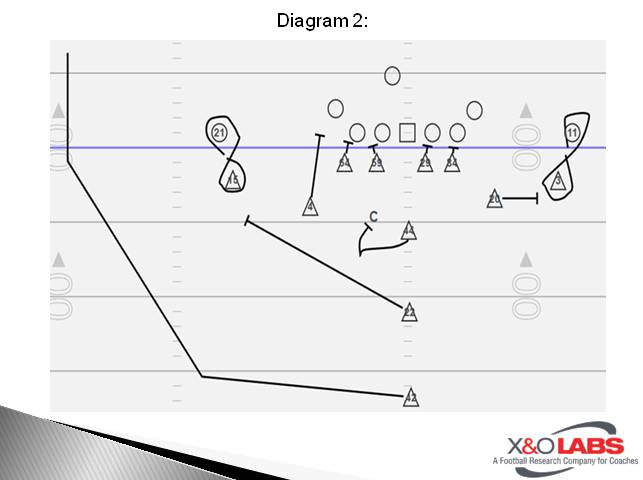
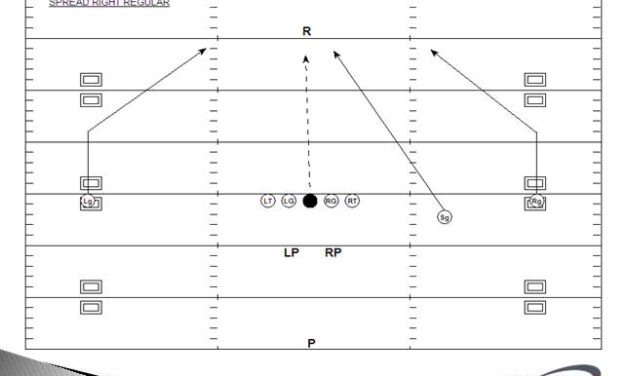
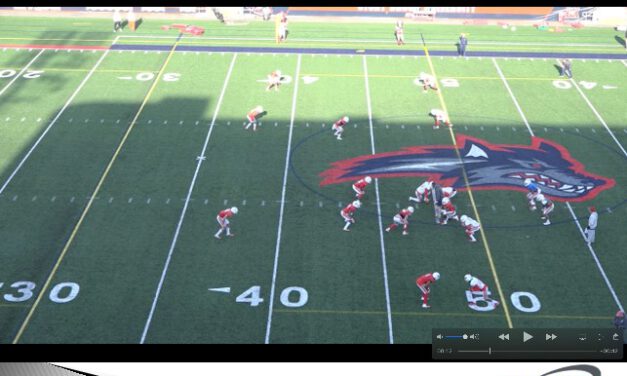
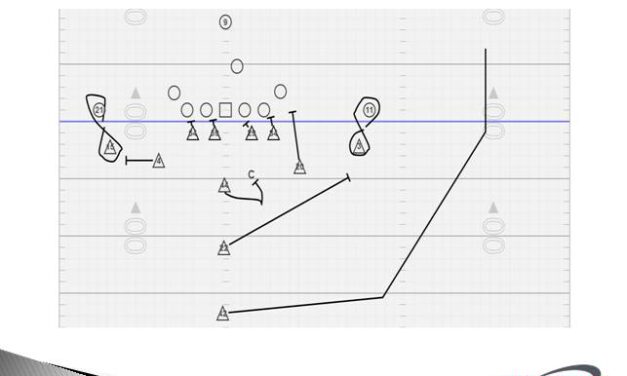
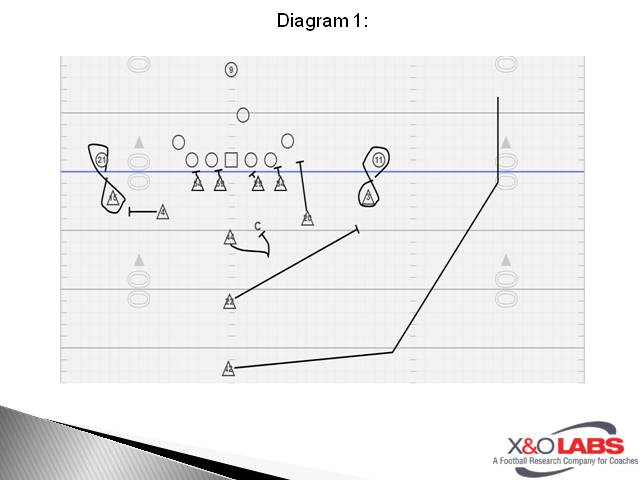
Here is what we drew up for our opponent, in order to double the gunners.  We drew it up both left (Louie) and right (Ralph)
Slide1Slide2

Let’s talk thru Ralph, our right return.

Corner’s Responsibilities:

  1. Corner takes away the inside release by his alignment first.  The corners will line up on the inside shade of the gunner.  They will not turn their body too much one way or the other, but the goal here is to take away the inside release.  The corner has got to maintain inside leverage on the gunner
  2. This forces the gunner to take an outside release.
  3. This gives the corner inside leverage on the gunner.
  4. Teach the corner to ride that man to the sidelines.
  5. Usually the gunner will beat the corner to the outside.
  6. This is where the Outside Linebacker comes in to play

Left Outside Linebacker Responsibilities:

Read More

Special Teams Unit Development (STUD) Training


By Ryan Turnbull
Special Teams Coordinator/DFO/Defensive Backs Coach
Rensselaer Polytechnic Institute (RPI)
Twitter: @CoachBullRPI

Introduction:

rpifbThrough very detailed drill work, STUD/STUD 2.0 allows the special teams unit to work on multiple facets of pursuit/return based special teams drills simultaneously. Players must hone in mentally on the specific coaching points that are being relayed. In addition, coaches must provide detailed and thorough direction towards the specific coaching points that will be practiced. Both players and coaches must respect spacing on the field of other drills to ensure full efficiency of STUD/STUD 2.0.
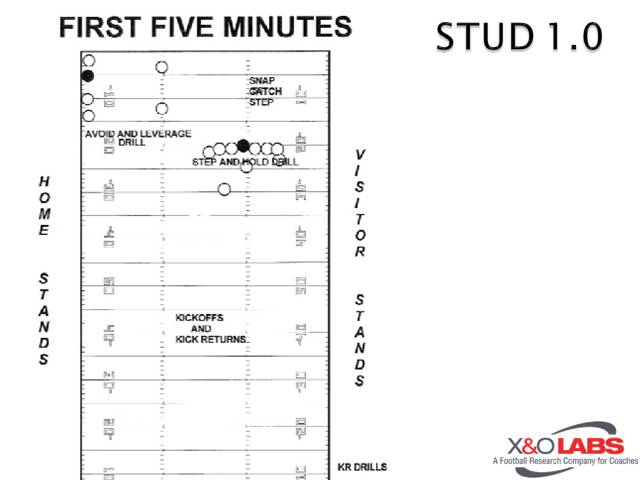
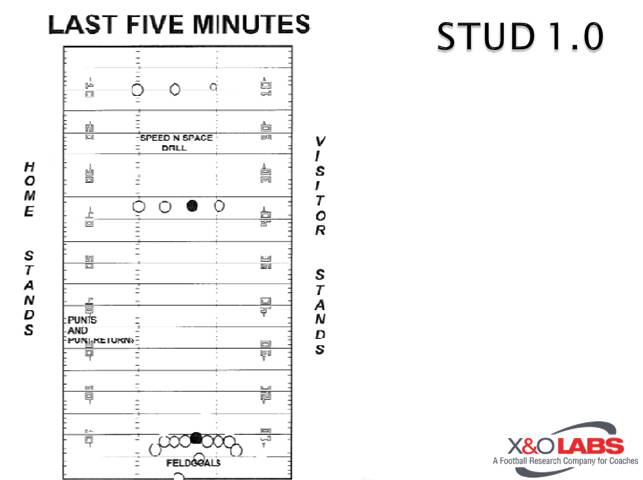
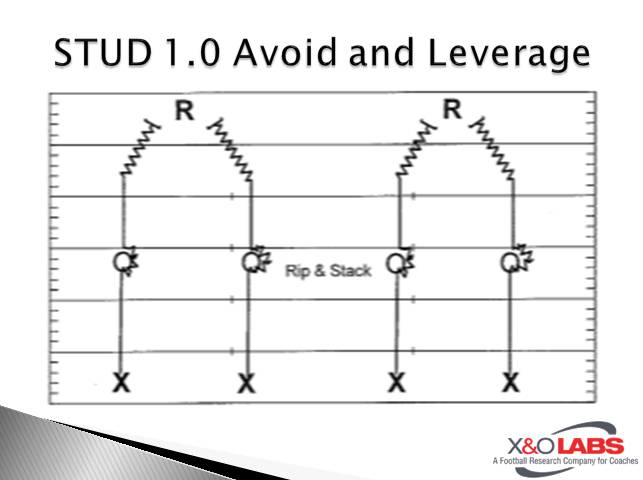
The drills contained are meant to be detailed, specific, and work on three concepts at most at a time.  These drills are open to variation and discussion within a staff.  Other drills practicing the same or equally important concepts are encouraged to be considered through discussion.

Concept Details

The first 7 minutes of STUD will consist of the avoid and leverage drill, step and hold drill, snap catch and step drill, and kickoffs/kickoff returns (Diagram 1). The last 7 minutes will consist of speed in space, field goals and punt/punt returns (Diagram 2). At least one coach, if not two, will be assigned to work with each group and coaches are specific to the drill (i.e. o-line coach works with PAT/FG).

Slide1Slide2

Avoid and Leverage Drill: The areas this drill will target are acceleration, athleticism in a short window, and leveraging the football during pursuit. Players must accelerate to the first obstacle then “rip and stack” through that obstacle. Next, they will accelerate to the second obstacle followed by a break down and leverage. The coach will break down the drill in parts as he sees fit (Diagram 3).

Slide3

Read More

Perimeter Blocking in the Jet Sweep/Power Read Game

By Jeffrey Russell

Offensive Coordinator and Quarterbacks Coach

Wethersfield High School (CT)

Twitter: @coach_jrussell


Introduction: 

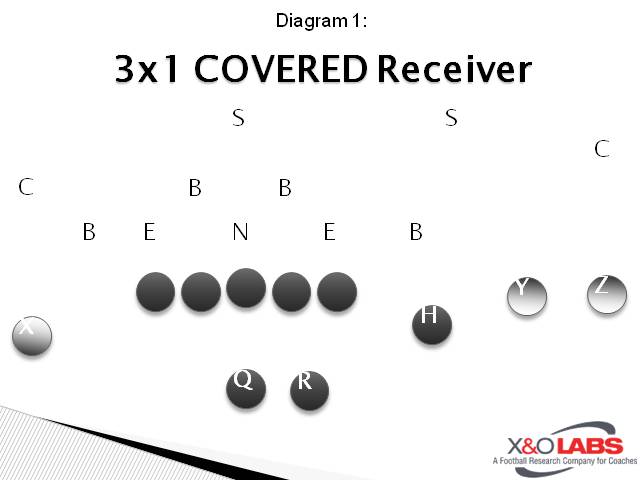
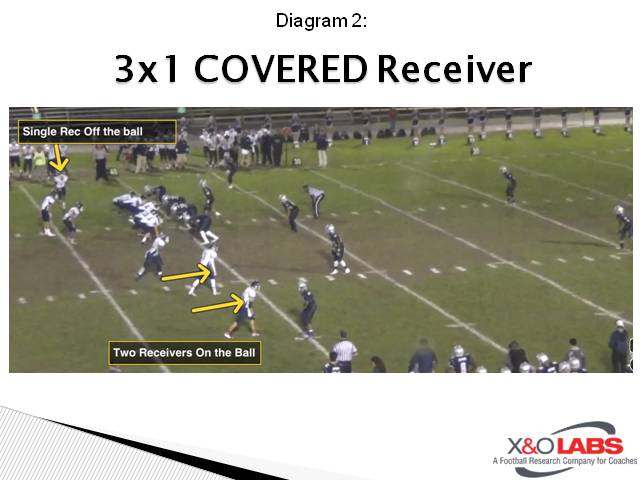
Jet Sweep 1At Wethersfield, we’ve become a three headed monster that attacks our opponents with quick passes, perimeter runs, and run/pass concepts. To counter these strengths, defenses often will try to create a numbers advantage by having defenders be responsible for a part of the run game and a part of the pass game simultaneously. It is our goal to diagnose their strategy early in the game and then use those responsibilities against them with each of the three offenses phases I mentioned above. We assess things like:
  1. How much of the wide side of the field or boundary a defense is willing to give up?
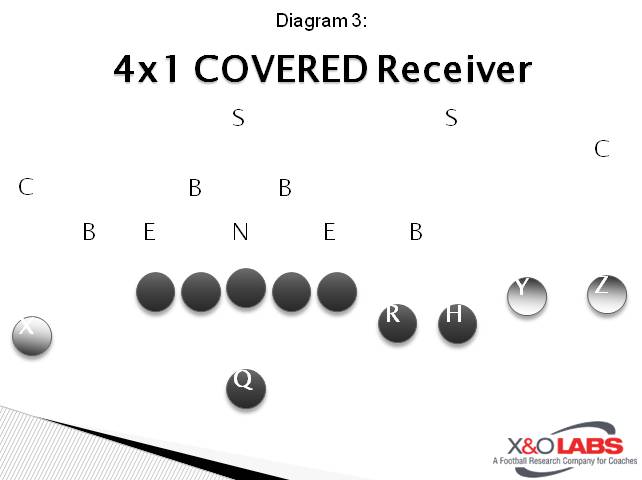
  2. How many players are they willing to sacrifice vs. 3 and 4 receivers? 
  3. Which formations, be it Trips, Quads or an unbalanced variation that allows our back side receiver to motion, will best expose the defenses weak point?

Outnumbering Defenses by Alignment

Our offense moves very quickly, but we don’t want to sacrifice options to get into advantageous formations. For that reason, our skill position players have a couple of simple rules they follow in regards to know where to align. They are as follows:

1.  Our receivers are labeled from X, H, Y & Z, from left to right, and they never overlap or change order. The players must be able to operate out of the different positions.

2.  Our running back (R) will become the inside most receiver closest to the backfield in any of our Empty formations (3×2 or 4×1).

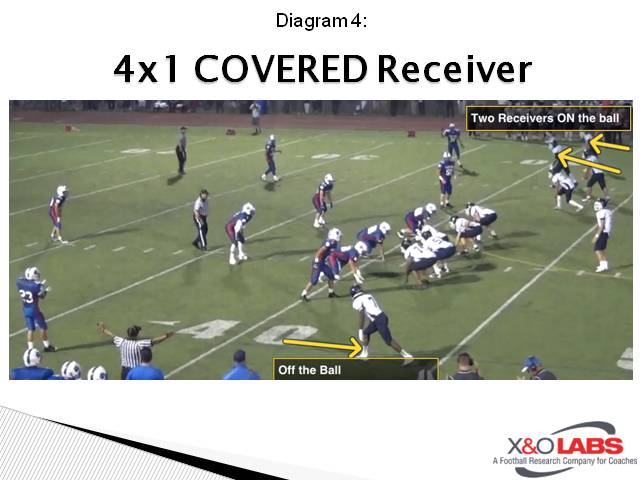
3.  A simple hand signal will tell the widest player who’s NOT already on the line of scrimmage to move up onto the line of scrimmage. This same hand signal, will tell the single receiver on the opposite side of the formation to move OFF of the line of scrimmage, allowing him to motion. 

These formation variations create issues for defensive coordinators in real time, and put the responsibility on the players on the field to make the correct adjustment. 

Slide1Slide2Slide3Slide4Slide5

Outnumbering Defenses with the Jet Sweep:

With all the extra blockers we get on the edge, our Jet Sweep has become a great play for us. Our Jet Sweep concept is actually a passing play for the receivers and a running play for the running back. This concept keeps the players “statistically”happy (receivers get receiving yards and running backs get rushing yards), and also puts them in the best position to be successful. When a receiver is tagged to run a jet sweep, they will run full speed jet motion and the QB will actually flip/pass the ball in front to them. This allows the receivers to do what they do best, and doesn’t force us to spend a lot of practice time on repping handoffs. This also assures us that any dropped exchange is an incomplete pass and not a fumble. This rule applies in conversely for running back. They will receive a handoff when tagged to run the Jet Sweep from the back field.

Read More

St. Thomas Pressure Package – Case 2: Full Field and Split Field Pressure Coverage Concepts

By Mike Kuchar
Senior Research Manager
X&O Labs
Twitter: @MikekKuchar


In addition to the pressure patterns used by the front seven, the responsibility of the backend to handle the coverage component of zone pressures is placed at a premium. Depending on offensive personnel and formation, many of these coverage defenders will be tied into the run fit of the pressure. While the defensive staff at the University of St. Thomas mixes and matches coverages, there is one constant pre-snap allusion: The allusion of a two high safety defense. But after the snap, all bets are off.  “We are going to bring five defenders on mostly every snap, but you don’t know where it’s coming from and what coverage is tagged with it,” said defensive coordinator Wallie Kuchinski. “That’s when they [offenses] start grabbing for things that are not there.”
It’s important to note the Tommie defense at its base is rooted in a man coverage philosophy and plays with man eyes. “We were always a man concept team,” he told us. “In 2014, we were more of a zone check team in base defense and we struggled because the first thing offenses do in game planning is watching a formation tape to see what coverage structure you will be in on non-consequential [early] downs. They watch how you line up against their formations.” It was because of this that Coach Kuchinski and the defensive staff went back to playing with more “man eyes” on the back end. According to Coach Kuchinski, it helps in getting the ball out more quickly and produces a lot of hits on the quarterback. St. Thomas produced 36 sacks last season. “There are a lot of holes in zone coverage and the quarterback can complete the football,” he said. 

So in case two, we present our research on the coverages that the University of St. Thomas will utilize on the backend of its zone pressure patterns.


Editor’s Note: Any of the following coverages could be used with the pressure patterns detailed in case one. The decision process on which to use is elaborated on in case three.


Coverage Defender Personnel

Quick LB: Weak side or field side linebacker (Nickel) who will be asked to make tackles in space and be able to cover slot receivers. He’s the most versatile position in the system.

Sam LB: Strong side inside linebacker that Coach Kuchinski refers to as the “mini-me” in this system. He is more of a run defender than the Will or weakside inside linebacker. Most run fits are geared to him being the free hitter.

Stud LB: Strong side outside linebacker who will be asked to align against three-man surface structures. He will also be reduced down to play 5-technique alignments on offensive tackles. He will usually possess a stronger body than the Quick LB.

Will LB: Weakside inside linebacker. Very similar in style to the Sam, but may have a different skill set in the open field.

CBs: More of the rangier, lengthier defenders in this system, although Coach Kuchinski has played with smaller defenders here. Were asked to press on 81% of snaps last season.

Free Safety: Weak side safety

Rover: Strong side safety


Press Corner Technique

Regardless of the coverage played behind them, the corners in the Tommie system will be asked to press the number one receivers on 80% of snaps. These press techniques can take the shape of a punch or press bail fundamental. Since the press technique is not over-coached at St. Thomas, we didn’t feel it necessary to spend too much time addressing it in this report. Quite simply, Coach Kuchinski and corners coach Marcus Jones will have them line up with 2.5 yards width and five yards deep. They call it “the box” with the purpose being to not let receivers run in that box by disrupting the route long enough for the pressure to get there. According to Coach Kuchinski, in most cases that pressure arrives between 2.2 and 2.3 seconds on the quarterback.

Read More

St. Thomas Pressure Package – Case 3: Best Practices In Matching Patterns/Coverages to Affect Run Game

By Mike Kuchar
Senior Research Manager
X&O Labs
Twitter: @MikekKuchar


In the first two cases of this study, we addressed the fun part of creating zone pressures, designing pressure patterns and mixing them with the proper corresponding coverages. Once that information is assimilated, the task for any defensive coordinator shifts to designing these pressures to attack an opponent’s offensive structure and scheme. Remember that any of these pressures can be run with a myriad of coverages. The challenge is selecting the coverages that work for that particular week while still keeping it streamlined for defenders to play fast on game day. 

In case three, we present our research on which particular pressure patterns and coverages work best against certain offensive personnel groupings and play concepts.


Editor’s Note: The following information is our editorial opinion based on film study. It is NOT the perspective of Coach Kuchinski or the defensive staff at the University of St. Thomas.


General Design Factors

The University of St. Thomas defensive coordinator Wallie Kuchinski told us that in order to stop the run he will do two things: Either run zone pressures or play double eagle defense. That’s the extent of it. Since this study is focused entirely on the former option, we wanted to research exactly how he and the defensive staff design their pressures to attack the offenses he sees in his conference. But before we present our assertions on this, Coach Kuchinski provided us with some general guidelines on how he plans his pressure package. There are certain “umbrellas” that his pressure system falls under. They are as follows:

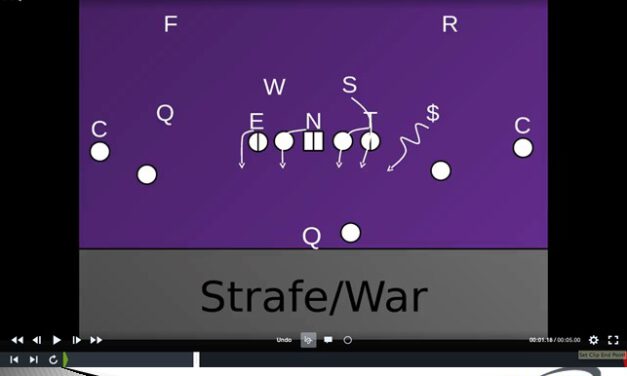
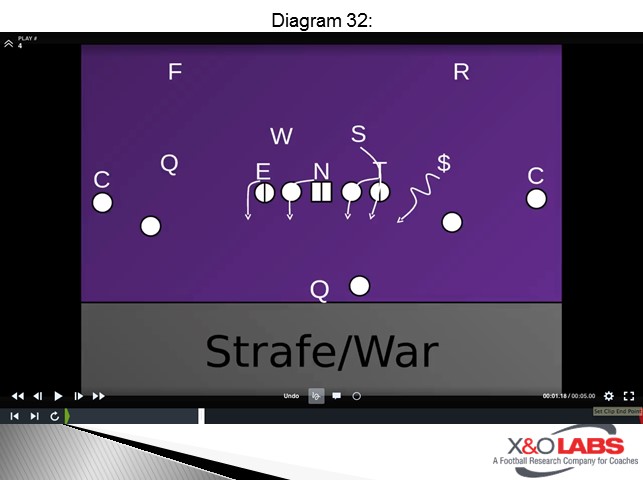
  • Pressures are Multiple: This means that they can be called either strong or weak and the strength call can be manipulated to run pressures. For example, the strong side “Strafe” pressure pattern documented in case one doesn’t always need to be run to the tight end (or boundary), which is where he calls his strength. He can mix it with a boundary strength call and get the pressure coming from the field, etc.
  • No Checking Out of Pressures: Because of the various run fits arranged and communicated by the safeties in these pressures, all of which are detailed in case two, there is no checking the pressure side or checking out of pressure here. It’s a call it, run it scenario.
  • 70 Percent Rule: When compiling tendencies, Coach Kuchinski follows the 70 percent constant, meaning it’s only an offensive tendency (based on formation or down/distance) if it’s higher than that number. “68 percent is still 50/50 to me,” he said. “We find the breakpoint to get the 70 percent. It may not be 3rd and 7. It might be 3rd and 8 that we get that tendency.”
  • Rule of 3: This is a rule in regards to selecting the proper pressure coverage relating to offensive personnel groupings. In doing so, Coach Kuchinski adheres to the rule of 3. “If they have a personnel grouping that adds up to three or more than we need the safeties in the fit,” he said. This kind of grouping includes 21, 12 and 22 personnel. “If they have a personnel grouping like 11 or 10, we don’t need the safeties in the fit because we have seven defenders. But when they have a grouping that adds up to three or more, we need to spill the ball to somebody, so we need to play Black coverage to get the safety in the fit.”

Using those guidelines, Coach Kuchinski and the defensive staff now begin the process of plugging which players they want into the following responsibilities, all of which are detailed in case one:

  • Pressure Side Arrow Defender
  • Non-Pressure Side Arrow Defender
  • Chase/Spill Defender
  • Contain/Splatter Defender
  • Power Player

This is where a coach can get really creative based on the scheme the offense is presenting. Each pressure pattern is structured differently. For a frame of reference, the five most common pressure patterns we researched are below. Again, they are all presented to the strong side, but the pressure can easily be flipped to the weak side as well.


Strafe/War
Strafe/War


Read More

St. Thomas Pressure Package – Case 1: 5-Man Pressure Patterns and Zone Blitz Technique

By Mike Kuchar
Senior Research Manager
X&O Labs
Twitter: @MikekKuchar


The University of St. Thomas defense is a pressure outfit. It’s been that way throughout defensive coordinator Wallie Kuchinski’s ten-year tenure. The Tommie D prides itself on getting off the ball and getting after the quarterback on third downs. But it was only recently that Coach Kuchinski and his staff decided to sell out completely by bringing pressure on run downs. In 2017, the Tommie’s brought pressure on 85 percent of these downs. Yes, that’s 85 percent. It’s completely unchartered waters for most defenses. But, for the Tommie’s, it’s home.

 According to Coach Kuchinski, the reasoning is simple. It’s a methodology wrapped around the importance of what he calls “non-circumstantial downs,” which are first and second downs for offenses. “If it’s a down where you don’t know if they are going to run or throw, why not bring pressure?” he asked. “You need to dominate them in the run game. The only thing I need to know is down and distance and personnel. If I can get a call that is good against the run and pass, why not do it all the time? If we’re sitting back in an over front quarters defense and have to fit everything tight in the run game to make it work why do it? And in the passing game we’re only bringing four then we have to find a way to get to the quarterback with using twists. Here at St. Thomas, we get to bring our run and our pass stuff all on the same down.”

The premise is to get the offense behind the chains on first down. “Our entire emphasis is to try and get negative plays on first and second down,” he told us. “And not just negative yardage plays. We’re talking about false start penalties, holding calls, poor exchanges. That all happened this year because of how fast and aggressive we were.” Apparently so aggressive it got offenses off the field in a hurry. Using this mindset, the Tommies only had to defend 55 plays a game this season, down from 65 per game on average the last few seasons, and were getting off the field on 80 percent of third downs.

In case one, we present our research on the Odd system structure being used at St. Thomas. We also detail the five most common pressure patterns the Tommies use in its five-man zone pressure menu. We also break down the technical concepts that pressure and non-pressure defenders are taught to execute in these schemes and the drill work that corresponds with them.


Defensive Personnel

Contrary to most odd front structures, the Tommies are not a mirrored front defense. Coach Kuchinski plays with what he calls a strong side and a quick side. The quick side is trained more to handle perimeter space while the strong side is accustomed to working against heavier run surfaces. Below are quick job descriptions of these defenders:


Tackles: The two defensive tackles are 4 technique alignment defenders that will need to be able to move post-snap into the interior as well as exterior gaps. They are put in 4-techniques to present the allusion of movement.

Nose: The zero technique defender who may be a little more stout than the tackles. Again, he’s not a two-gap player here. He will move post-snap.

Quick LB: Weak side or field side linebacker (Nickel) who will be asked to make tackles in space and be able to cover slot receivers. He’s the most versatile position in the system.

Sam LB: Strong side inside linebacker that Coach Kuchinski refers to as the “mini me” in this system. He is more of a run defender than the Will or weakside inside linebacker. Most run fits are geared to him being the free hitter.

Stud LB: Strong side outside linebacker who will be asked to align against three-man surface structures. He will also be reduced down to play 5-technique alignments on offensive tackles. He will usually possess a stronger body than the Quick LB.

Will LB: Weakside inside linebacker. Very similar in style to the Sam but may have a different skill set in the open field.

CBs: More of the rangier, lengthier defenders in this system, although Coach Kuchinski has played with smaller defenders here. Were asked to press on 81% of snaps last season.

Free Safety: Weak side safety

Rover: Strong side safety

Read More

X&O Labs Presents: Hot Takes from the COOL Clinic: 2019 Version

By Mike Kuchar
Co-Founder/Senior Research Manager
X&O Labs
Twitter: @MikeKKuchar


Once again, Cincinnati played host to some of the top coaches across the country when over 350 offensive line coaches poured into the Millennium Hotel Downtown to expound upon the finer components of football—leverage, footwork and hand placement. While many times our off-season editorial schedule prevents me from attending most clinics, this one is always a must attend annually. And as this was my eighth COOL clinic, it may have been the best. Normally, the speaker lineup features a packed run down from both the collegiate and professional ranks, this time around there were some nuances.  An entire crew from NFL Films was following the clinic’s host (and former Cleveland Brown offensive line coach) Bob Wylie as he continues his reality television show career stemming from the success of HBO’s Hard Knocks.


It also featured a first-time player presentation as Browns offensive line members Joel Bitonio, JC Tretter and Austin Corbett converged on educating the clinic base on the nuances of the inside and outside zone schemes. I was able to stay through the entire presentation list (save for Coach Butch Barry of the University of Miami), so I wanted to provide what I felt were the most important nuggets of these presentations. We segmented our research into one key trend coaches should expect to see this fall in the common areas of offensive line play.


Redefining Leverage

This is usually my favorite part of the clinic, where coaches like longtime NFL offensive line coach Paul Alexander tell us that he truly grasped the meaning of leverage while studying a glass bird antique in his mother-in-law’s home. (Don’t ask, long story).

coolclinic 1

Read More

Using Multiple Formations for the Rugby Punt

By Dan McKenna
Special Teams Coordinator
Anna Maria College (MA)
Twitter: @CoachMack36


Introduction:

Punt is the most important play in football. The number of players guaranteed to handle the ball and the exchange of possession and field position is what makes punt the most important play. The rugby punt is a great way to add simple variety to any punt formation. At AMC this past season, we had a lot of success working in the rugby technique with our existing scheme. We used the rugby through the combination of existing and new formations, making our punt scheme unique and multiple.

Before completely adopting this concept, we wanted to know exactly what we would be gaining and losing by going to the Rugby punt. Here is a list of pros and cons:

Pros

  • Block point changes
    • Rushers must alter their path to the block point.
    • The distance between the block point and the backside to A-gap rushers increases.
  • Reduces stress on protection
    • Frontline can take a more aggressive approach and attack rushers moving laterally/forward, instead of having to protect moving backward in their steps. (Bucket step VS. Kick slide)
  • Allows coverage to release/get downfield easier
    • Keeps attention on punter/in backfield.
    • The longer the punter can cradle the ball, the more the coverage can close to the returner.
  • Limits block and return schemes
    • Being able to punt from the pocket and rugby in any situation creates difficulty to match block and return schemes with each punt.
  • Creates problems for returner
    • Difficult to read and field a rugby kick because of the limited hang time and roll. This can create turnovers due to an unpredictable bounce of the ball.
    • Returner is often forced to let ball roll or fair catch.

Cons

  • Can increase ball security issues
    • The punter has a greater chance of mishandling the ball on a rugby punt because of the movement involved in his steps, not looking the ball in (catch and mold) and executing a clean drop while on the move.
  • Punter’s mechanics
    • Drop and point of contact need to be emphasized more in practice to stay consistent with the rugby movement. Punter mechanics can get sloppy when punter is focused on moving.
  • Protection
    • Can create seams and an open front-side edge rush if the protection’s steps are not executed correctly and in good relation with the punter’s rugby steps.

Personnel:

As with almost any aspect of football, it is critical to know your personnel! When considering adding the rugby technique, the focus should be solely on the punter. Some punters are strictly “pocket punters” that are most productive punting the traditional way. Fit the scheme to the punter to maximize his strengths.

Here are a few things we evaluate when determining if the rugby technique fits the punter:

Ball security – Does the punter consistently catch and mold the football to his body, especially as he takes his lateral steps. Ball security can be a bigger issue in a rugby punt if the punter is too focused on getting out of the pocket and reading the rush instead of looking the ball in and focusing on hand placement and drop.

Read More

Using Press Technique to Disrupt the Fade-Stop

By Trey Henderson
Safeties Coach
College of William and Mary 

Introduction 

wandmI would like to take this opportunity to thank Mike Kuchar, Research Manager for X&O Labs for allowing me to write this article on Press Coverage.  Most of what I know about the game of football has been given to me by someone.  I would like to thank them all, but there are just too many to mention.
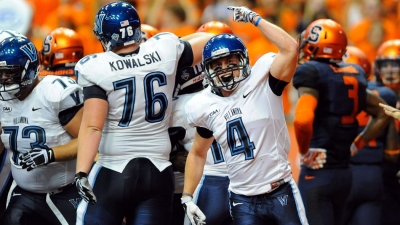
In 2010, William and Mary finished the year as the CAA Champions with the #2 Overall seed in the Division I playoffs.  Defensively, we were sixth in points allowed per game (16.6 ppg) and tenth in Pass Efficiency Defense (103.6)  in all of FCS.  We also allowed only six passing touchdowns.  The reason for our success is because of our ability to play Press Coverage no matter where we are on the field.  In this article, I will explain our basic press man to man technique and how to better defend the fade stop route.

The teaching progression we us in our Press Technique, at William and Mary, can be illustrated by the acronym (AKRE) :

Alignment, Key, Responsibility and Execution.  We use this acronym for every coverage we install, regardless of zone or man.  So let’s get to work.

Alignment – If we are lining up on a #1 WR that is on the LOS (Line of Scrimmage) then we align one yard off the ball with inside leverage on the WR. If the WR is off the LOS then we align as tight to the LOS without being off sides while still having inside leverage.  We define Inside leverage as having our outside foot splitting the WR in half.  Our stance is square with our feet slightly wider than shoulder width.  This give us a good base and allows us to not get run over if a WR decides to bull rush us.  Also, we are in a good knee bent position with our hand relaxed ready to strike.

Key – Our eyes are locked on the bottom of the WR numbers.

Responsibility – The WR Man to Man.

Execution – We want to be as physical as possible in our three-yard area surrounding us and the WR.  Our feet need to move before our hands, so that our punch is more violent.  Moving your feet provides a better balance for the punch.   If we dominate this area, then we should disrupt the timing of any route.  As the WR moves we move our feet,   I begin by telling our guys to slide back slightly(slide technique is defined below) when the WR moves to prevent them from lunging.  As we slide back grudgingly from the WR, we remain as square as possible.  We use an off handed punch technique on the WR.  This means if the WR releases to our right then we slide our feet to stay square and maintain our leverage and punch with our left hand.  Our aiming point is the breastplate of the WR with our thumb up.  This gives us the most power to punch the WR and impede his release.

Get X&O Labs’ Research Reports Sent Directly to Your Email Every Tuesday Morning.  Just Enter Your

Principles of Slide Technique:

  • Balance stance, no stagger.
  • Weight on balls of feet (similar to a boxer), no forward lean, no heels.
  • Six inch to one foot slide backwards depending on ability of receiver.  For most dynamic receivers, a longer slide is necessary.

Read More

Creating Your RPO Menu to Combat Common Defensive Adjustments

By Mike Kuchar
Senior Research Manager
X&O Labs
Twitter: @MikekKuchar


Introduction

Now that your RPO concepts have been installed and implemented, it’s time to fine tune your RPO package to attack the certain coverages and adjustments presented throughout the course of the season. We’re not referring to changing your base RPO concepts, just tailoring them to attack what defenses are doing to defend them. In this research report, we present the most efficient RPO’s concepts being used for the backside X receiver, how best to get a dominant tight end involved and what answers can be provided against man coverage.

RPOs vs. Defenses That Leverage the Stick Route

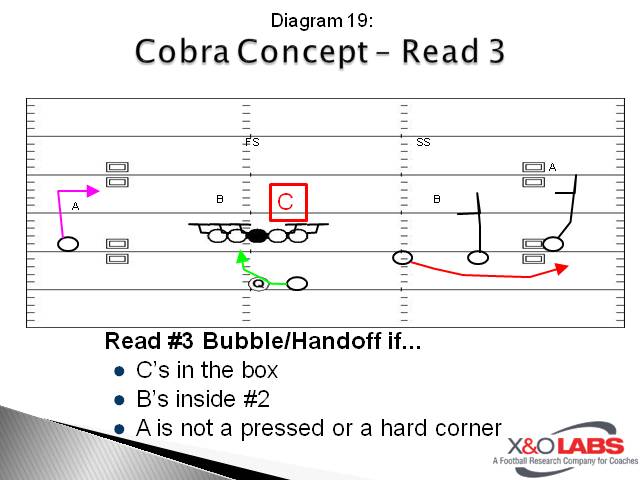
Since the stick/draw RPO may be the most popular of its kind, defenses are finding ways to get the Mike backer (or hook defender) to play with inside leverage on number three. Below are some options that help alleviate that issues.

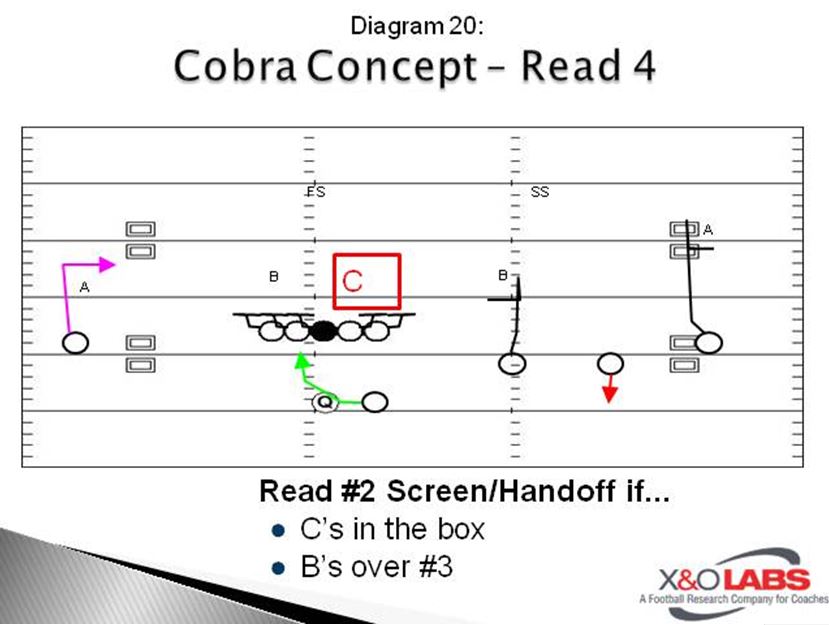
Establishing a Pass/Pass Read: Drew Owens, Offensive Coordinator, Western Connecticut State University

“For example, defenses will sometimes insert C and set B on the inside leverage on number three (Diagrams 19 and 20). We will just say, ‘Bravo’ and take the C read off and it becomes pass/pass read based off stick or bubble,” continued Owens. “We have no blockers for the defenders in the box. The QB will still will show ball, but eyes to right to B based on that defender.”

Slide19

diagram22

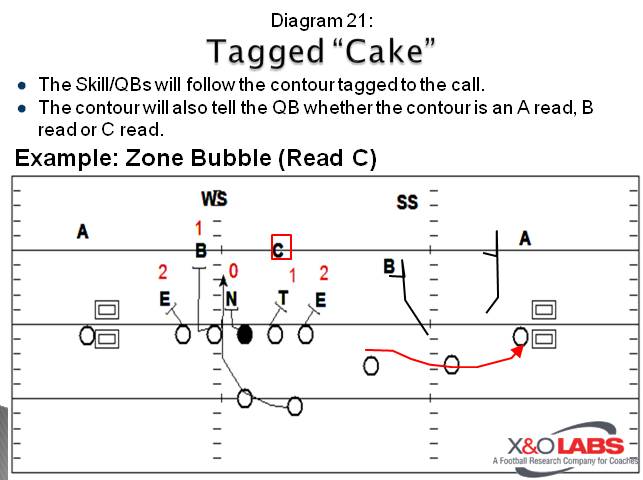
Owens will also use a “Cake” variation where the Stick read is off. It becomes a bubble by number three (Diagram 21), which is used on weeks when he’s having a hard time blocking that box defender.

Slide21

To see a video tutorial of Western Connecticut’s Cobra Concept, click on the video below:

Read More

Phase Two: 4-2-5 – Case 1: A Communication System to Support Multiple Front Structures

By Adam Hovorka
Managing Editor, X&O Labs
Twitter: @XOLabs_Editor


Over the last two decades, Stony Brook University (NY) has evolved itself from a Division II football institution to a non-scholarship FCS level program and now is among the top teams in the highly competitive scholarship level Colonial Athletic Association. Just this past season saw the Seawolves crack the top 25 nationally at the FCS level nine weeks in a row.

At the heart of this progression is a defense that under head coach Chuck Priore have not allowed opponents to score over 21 points per game in five of the last six seasons. The 2018 season saw the Seawolves produced the following numbers in the CAA:

  • Finished 1st in opponents 3rd down conversion (28.2%)
  • Finished 2nd in scoring defense (20.3 ppg.)
  • Finished 3rd in rushing defense (122 ypg.)
  • Finished 5th in total defense (315 ypg.)


System and Personnel:

The Seawolves are a 4-2-5 defense at heart and have been for years. But the influx of RPO offenses and the speed of the skill players in the CAA have forced them to transition into using both Odd and Even front structures. And they have done so by keeping the same personnel on the field. Much of that responsibility falls on the boundary defensive end- or what Stony Brook calls the Anchor. The following positions round out the personnel in Stony Brooks’ defense.

  • Nose
  • Tackle
  • Field End
  • Boundary End (Anchor)
  • Strong Inside LB (Mike)
  • Weak Inside LB (Will)
  • Field Down Safety (Rover)
  • Field High Safety (Free)
  • Boundary Safety (Whip)
  • Boundary Corner
  • Field Corner


The “Anchor” is the hybrid defensive end/outside linebacker type that has continued to be the pulse of the Seawolves unit and the position that we profile in this report. It’s a position that has continued to be extremely productive in this outfit, registering the following numbers this past fall:

  • Finished 4th in tackles
  • Finished 5th in TFL’s
  • Finished 3rd in Sacks


Anchor Job Description:

At Stony Brook University, the “Anchor” or boundary defensive end is one of the most important positions on the field. According to defensive line coach Rob Noel, he’s a player that started out at as a linebacker but either got too big or wasn’t quite explosive enough to make tackles in space. Or, he struggled to make the reads as consistently as a linebacker would. It’s a player that is usually at the 240-250 pound range at the FCS level, which is significantly smaller than the 290-pound field defensive end playing on the other side of the ball.

Ideally, Coach Noel wants this player to be around the range of 6’1, 250 lbs. “I’d like him to have as long arms as possible,” said Coach Noel. “Height is not as important as wingspan. The bigger you can get the better, but I am willing to sacrifice height at that position to get a very fluid athlete because we’re going to ask him to do a lot of different things on the football field.  I think for us that position must be an extremely high motor type of kid.”

Read More

Phase Two: 4-2-5 – Case 2: Responsibilities and Techniques for Anchor vs. Run

By Adam Hovorka
Managing Editor, X&O Labs
Twitter: @XOLabs_Editor


Like most defensive outfits, Stony Brook prides itself on stopping the run and everything they do so is based off the four-down front. So, when the Seawolves transition into either their Double Eagle or the 3-man fronts, it’s almost the exact same defense.  “We just tell the Anchor that either you are already aligned in the gap you are assigned, or you are moving back to the gap we want you in,” said Coach Noel. “if we have a blitz called in a four-down front, we can very easily run it from the 3- down front and Eagle package by using a different word that they already know. If the blitz is called something in 4 man package (say Bronco) then in 3-man fronts it might be called Orange.”

Regardless of the front, the Anchor will be asked to execute the following three techniques based on run to or run away from him. These are all techniques that we will cover in this case.  

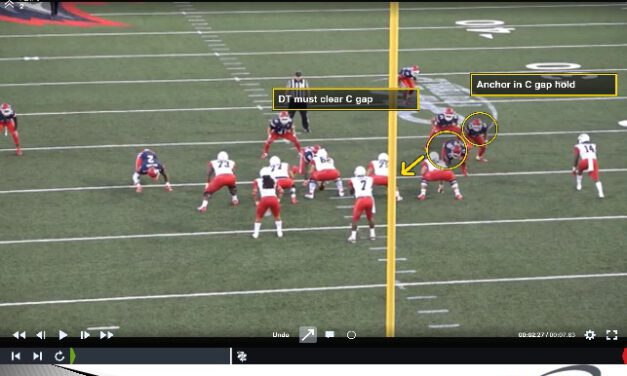
  1. Hold the gap Technique: In most times this defender will be asked to hold the C gap, but may be the B gap in certain pressures. Whatever the situation, he is responsible for his gap. He can either align in it or blitz to it. Here, the Anchor is in single gap control and must get upfield right away on the snap.
  2. Lag Technique: Lag means that if the offensive lineman tries to reach the Anchor, he will play to his butt side and play the inside gap. He will allow himself to get reached and not worry about holding the outside gap. These are used in zone schemes to prevent any wind backs. It allows for big plays in the A and B gap.  
  3. Fold Technique: Here the Anchor who is aligned as a stand-up C gap or even D Gap player will take the B gap or A gap. This is mainly used against gap teams when the Anchor gets pull schemes away from him. In these circumstances, he’s not responsible for CBR (counter, boot, reverse).


According to Coach Noel, the purpose of using multiple fit patterns is to alter blocking schemes at the line of scrimmage. These fit patterns are tied into two factors: coverage structure and block recognition. But regardless of the fit pattern called, it can be changed based on the offensive blocking scheme. For example, “lag” fitting doesn’t happen when it’s a gap scheme because most gap schemes will entail some sort of pull. Therefore, the lag fit becomes a “fold” fit. Even though these fits are executed at the first level, second level defenders are expected to know where they fit based on the blocking scheme. “In most cases, the linebackers will work to play behind on zone schemes and fit their gap on gap schemes,” he said. “If the Anchor is folding fitting the gap, the linebackers push a gap further away from the run action. It’s all based off the flow. We tell them they have this gap in base flow and this gap in pull.  No communication has to happen.”

According to Coach Noel, these are all built in calls and will change the fit of the other defenders. For example, “Pirates,” could mean four down front (Pittsburgh) with a lag fit. It’s a premise that the defensive staff at Stony Brook implemented recently to break tendencies for opponents. “At this level, if defenses know what your fit is it doesn’t matter how good for football players you have,” he said. “Some of the biggest plays we gave up this year was when the defense figured out what we were going to be in and dictated to us.  So, we decided to not check our fits anymore based on an offenses formation. There were teams that knew in certain formations they’re going to get Quarters coverage out of us and they were going to get the match-up they wanted and exploited us for some big plays.”  

In order to get it communicated, Coach Noel will use one-word calls that tells the defense the front, the coverage, and the fit. “For example, Bronco may tell them it’s a four-down front with a lag fit,” he said. “Where Texans could mean it’s a three-down front with a lag fit. Or maybe Steeler tells us it’s a lag fit from a quarter, quarter, half coverage structure. All NFL teams could be four down fronts with lag fits.”


Hold Gap Technique:

The first thing the Anchor is taught to do in the run game is to hold his gap. The hold gap technique is a single gap control technique where he is asked to either align in the gap he’s responsible for or blitz to it. He must be able to align in his gap and hold it in either 3 or 4-man fronts.  This includes blitzing or moving into his gap as well.  Therefore, this player has to be able to easily move in and out of the 3- and 4-man fronts because he’s making a lot of the same reads.  

“He’s going to fit a lot of the same gaps and in a two-point stance he’ll be a bit further from the line of scrimmage,” said Coach Noel. “So that’s what helps us be able to move in and out of this very easily. We are not asking the guy to suddenly do something in the 3-down package that he doesn’t already isn’t doing in the 4-man front. There’s not a single thing that is different.”  So, if the Anchor is responsible for C gap control he can do so at the line of scrimmage or back off the line of scrimmage to play it.

The reads in the hold gap technique may change based on opponent, according to Coach Noel. There are times when he must have “bigger vision” like a linebacker or he might key the guard and tackle to his side. “He’s got to look at both of those (Guard and Tackle) in a 3 or 4 down front,” said Coach Noel. “Since he needs to see the whole picture, he can’t just get what he needs to do from one guy.  We will drill that when we are not in pads. We will go on barrels, we will do walk-throughs, and will do this as a group. He will just get his block reads a little bit different. They’re just kind of walking through plays and we’re getting our block recognition.”  

Read More

Phase Two: 4-2-5 – Case 3: Responsibilities and Techniques for Anchor vs. Pass

By Adam Hovorka
Managing Editor, X&O Labs
Twitter: @XOLabs_Editor


From a coverage perspective, the Anchor will be asked to handle several responsibilities. In the majority of situations, he’ll be assigned to play the weak flats or match the number one receiver into the boundary. But he will also be asked to carry some sort of spot drop on a field area such as a hash dropper or middle of the field dropper. These techniques are often utilized in Stony Brook’s drop eight (five under, three deep) coverages and zone pressure (three under three deep) concepts. “We give him landmarks of where he’s going to drop depending on what the coverage is,” said Coach Noel. “And we will vary between teaching him zone eyes and man eyes.”

Coach Noel mentioned that he doesn’t spend a lot of time drilling coverage techniques. Many of the teachings are done off of the film. “In zone coverages, we emphasize our eyes either looking more at the quarterback or getting more depth. We will talk through routes a little bit at that time. It is just teaching them offensive football, that’s what we try to do more than anything with the coverage part of it.”

In this case, we segment our research based on the following:

  • Man-coverage responsibilities
  • Zone coverage responsibilities


Man-Coverage Responsibilities:

Stony Brook will ask the Anchor to play some man coverage but will only be asked to do so against a tight end or running back. “We will try to never have him matched man on a slot receiver,” Coach Noel said. “We do this if we think he can match up and run with the tight ends and or the back. We work to keep our eyes are on him and run with him wherever he goes. The important fact is if we have a matchup that we can live with athletically?” In instances when the Anchor has to play the number two receiver, he may make a switch assignments with the safety. The safety would handle the slot and the Anchor would play the back.


Blitz Engage on RB:

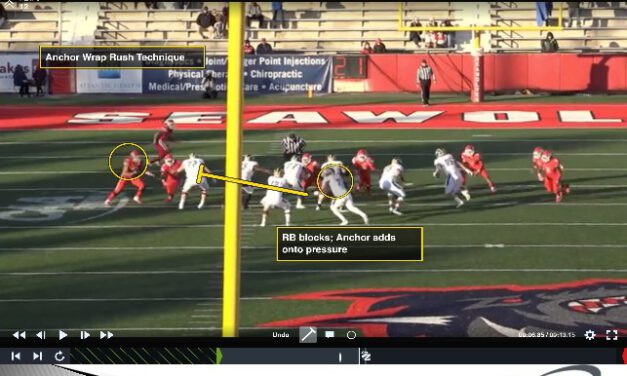
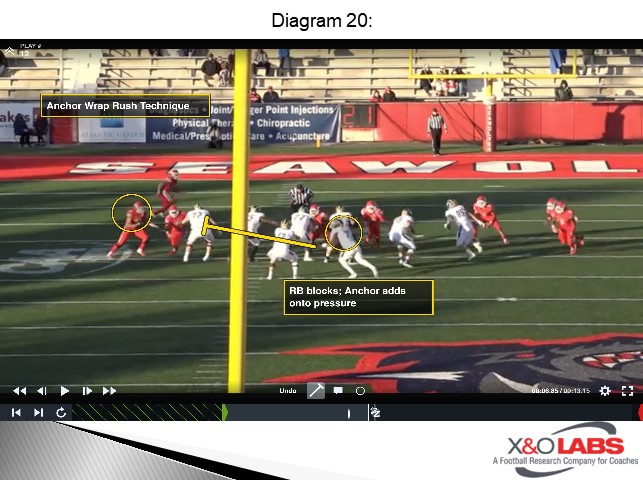
When the Anchor is responsible for the back in coverage, he will execute a wrap rush technique if the back blocks. “When the running back steps up to block, he’s no longer a threat so our blitzers will add onto the pressure.”  

The clip below is a good example of how the Anchor wraps into pressure. Here he’s responsible for the back man to man. The back stays in and blocks, so he adds onto the pressure and gets a stack.

Diagram 20


“We don’t waste a guy on him, he adds in once he sees the block is taking place,” said Coach Noel.

Read More

Phase Two: 4-2-5 – Case 4: Developing a Practice Plan and Drill Work for the Anchor

By Adam Hovorka
Managing Editor, X&O Labs
Twitter: @XOLabs_Editor


As detailed in the first three cases of this report, there are several techniques the Anchor has to master. The challenge is being able to teach and rep all of these techniques in a streamlined practice plan. At Stony Brook University, Coach Noel is the only defensive line coach. Which means he cannot solely work with the Anchors. His time is split between working with the entire front. And it is this collective mindset that Coach Noel uses when developing this player. “We think of this position as defensive lineman first and foremost,” he told us. “He will do all defensive drills with this group and build from there.  He does not have his own position coach; he is part of the defensive line unit.”


Delegating Practice Time:

Having said that, Coach Noel will get him extra reps at times when he builds them into his practice plan. It is usually during special teams segments where Coach Noel will steal time with the Anchors to work all of those run fit techniques (fold, lag and hold) detailed in case two. “There will also be times when we break up the tackles and ends,” said Coach Noel. “I will take the ends and Anchors and work with them and do some drills because they do a little bit different things in regard to pass rush, but I don’t think you need a different coach completely.”

“We do almost the exact same technique, execution, and everything across the board at all four spots.  We teach the same pass rush drills and the same block destruction drills.  We do the exact same footwork on get-offs and all the stuff that we already must do.  Now there are some specialized things that he must do. He’s the only guy that’s going to be in covers for us 95% of the time so I don’t take individual time to work pass drops.”

One of the more essential periods the Anchor will get is dividing his time between getting one on one pass-rush with the offensive line and working pass skelly with the back end. He will often be involved in the 7 on 7 for the first five minutes- where the coverages he usually involved in are scripted- than he rotates with the backup Anchor so he can work pass rush with the rest of the defensive line. “He’ll come down to do pass rush and the other guy will go get a few reps in pass skelly,” said Coach Noel. “Then we’ll send them down there for seven on seven and they’ll get reps pretty much every single day.  We also don’t try to over-coach that guy too much when it comes to that kind of stuff. We give them landmarks, and give them easy things to remember.”

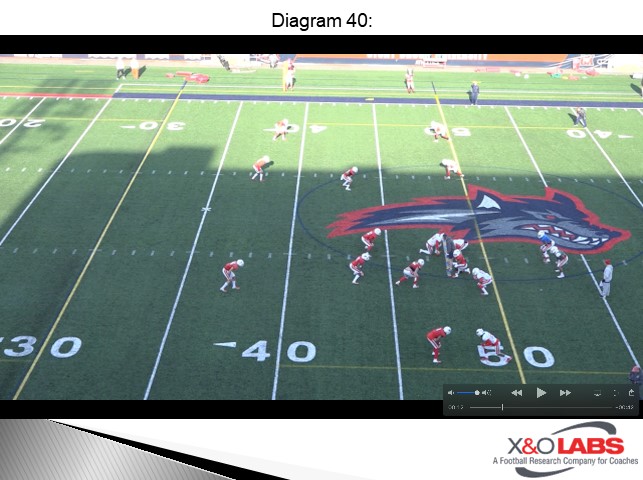
Diagram 40


There will be game specific concepts that Anchor will be taught based on the opponent and Coach Noel and linebacker coach Matt Hachmann work to carve out time to get that accomplished.  “We may do some circuit training with him (detailed below) to change things up,” said Coach Noel. “We may have something in that week from the 3-down front where the Mike and Anchor have the same responsibilities dependent on flow call, and Coach Hachmann will take the Anchor for the period. There will be other times when we are teaching all the other guys to pass rush technique.  We will occasionally want to know if we got a linebacker that we want to rush on third down sometimes so they will come with the defensive line and we’ll teach pass rush to him.   We really just teach speed and speed to power and then little intricacies off of that, some counter-moves, and the long arm.”


Seawolves Agility Circuit:

Because this Anchor gets cross trained in Stony Brook University’s system, it’s important that he continue to develop the agility needed to play both run and pass. On any given snap, he’ll be asked to play a zone in coverage, play a man technique in coverage, rush the passer or play a run fit. So, a good deal of time is spend working on the dexterity needed to change directions mechanically. One of the first drills Coach Noel will do with these Anchors is work on their lateral movement skills.


Lateral Shuffle Drill:

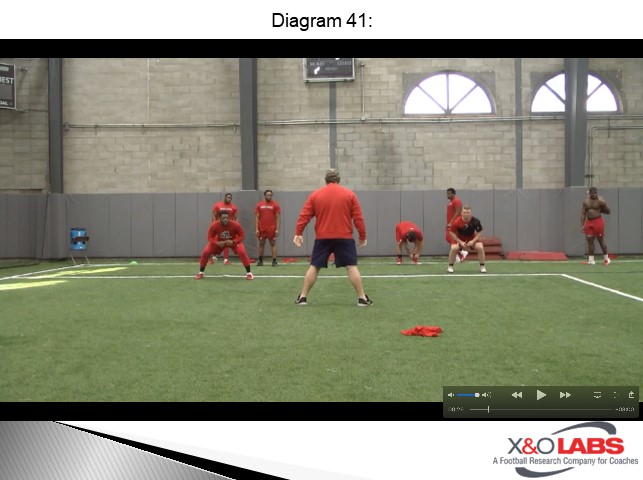
Diagram 41


This drill emphasizes the lateral movement needed to play this position. After the shuffles are executed, defenders will burst downhill to simulate getting home in the pass game or the approach on a ball carrier.

To study film of this drill, click on the video below:

Read More

Assigning Gap, Bonus or Conflict Responsibilities for Overhangs to Defend RPO’s

By Jason Thier
Defensive Coordinator & Linebackers Coach
Dickinson State University (ND)
Twitter: @Jasonthier


Due to the control that the offense has before the ball is snapped, the game of football is offensively driven. With the ability to determine the personnel, formation, shifts, motions and snap count they dictate the terms to the defense on every play. Due to this pre-snap control, defenses must be able to adjust to what the offense presents. In a Two-High safety scheme, it becomes the responsibility of the linebackers to be the adjusters. In the modern spread game, this means linebackers spend more time aligned in space as APEX players. Additionally, with the introduction of the run-pass-option (RPO), APEX players in a Two-High safety scheme are being put in conflicts on what to defend. The combination of these things has made the APEX player a difficult position to play and coach. This report aims to address how to get the most out of the APEX player with proper alignment, reads, and pre-snap indicators.

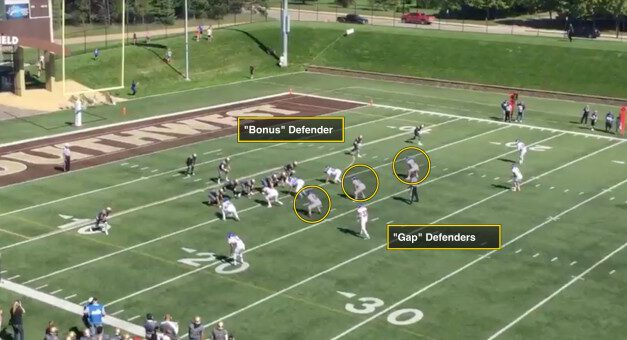
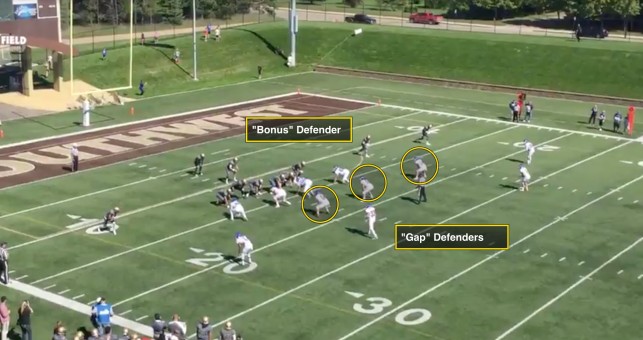
We will begin by identifying the three different types of defender the linebackers could be when facing an RPO style offense; gap, bonus, or conflict. It is important that each linebacker knows what type of defender they are before the ball is snapped. In most situations we are able to control the type of defender they will be by defensive play call, and pre-snap indicators.


Gap Defender Responsibility:

If a linebacker is aligned in the box he is referred to as a “gap defender”. As a gap defender, they can be aggressive against the run because they have no responsibility to the throw option of the RPO. We teach our gap defenders to play RPO’s as base run plays. Even though this report is about APEX defenders, it is important to understand what the linebackers in the box do to see the whole picture.


Bonus Defender Responsibility:  

If the linebacker is aligned in the APEX position he is either a “bonus defender” or a “conflict defender”. A bonus defender is an APEX player who doesn’t have a primary gap attached to the box, and can play the throw option in the RPO first. We teach our bonus defenders to guarantee the throw won’t happen before helping on the run.  The throw could be a screen or three step routes. After guaranteeing the throw, the bonus defender plays the run option from outside in. The beauty of the bonus defender is the ability to create help where it is most needed. For instance when facing a talented runner at QB, they can be used as a secondary QB player and take stress off the defensive end.


Conflict Defender Responsibility:

A conflict defender is an APEX player who has the duel responsibility of a primary gap attached to the box and has to hold off the throw element of the RPO. The conflict defender has the most difficult job verse an RPO offense. We teach our conflict defender to be “slow to go and fast once they know”. They will pop their feet in place while making the read, giving up no ground to either the run or the throw. By game plan we will determine which one of the options we want to give the offense and have the defender be more aggressive towards the option we want to take away. Our base rule is to guarantee the run first. It is our responsibility as defensive coaches to dictate who we want the conflict defender to be as often as possible.


Alignment and Stance

When it comes to the stance of the APEX player, we teach the same stance as a linebacker in the box with one small exception. Instead of the APEX player having their toes at the same level, we have them stagger their stance with the inside foot forward. The stagger should be no more than the outside foot’s toe on the inside foot’s heel. We feel this allows our APEX player to open their hips quicker in passing situations and still be able to play downhill against the run. With that being said, stance is all about comfort and efficient mobility. If a player is more comfortable in a squared up stance, we encourage him to use the one he feels the most confident in.

The alignment of the APEX player is determined by whether or not they are a conflict or bonus defender. If the APEX player is the conflict defender, they will align five yards off the ball, splitting the difference between the end man of the line of scrimmage (EMLOS) and the extended wide receiver. If the APEX player is the bonus defender, they still align five yards off the ball while cheating their alignment closer to the wide receiver.

Read More