
Cover 2 Press Corner Techniques

By Richan Gaskins
Defensive Backs Coach
Gallaudet University (DC)


Introduction

galludetOur secondary and linebackers are taught to play physically in pass defense. Physical play does not begin when the ball is in the hands of the receiver, it begins at the line of scrimmage. Our version of the Cover 2, our most successful coverage this season in terms of interceptions this season, has placed a premium on putting hands on receivers and tight ends. “Hands-on” has become a common phase in the secondary in our Cover 2 look, particularly with the cornerbacks. Our philosophy centers on the idea that a quarterback has approximately 2-3 seconds to make a decision in the pocket before reverting to either a “scramble drill”, sack, or hurried throw. By having our cornerbacks and outside linebackers re-routing receivers, it will disrupt the timing of the quarterback and receiver. Our ultimate goal is to cause turnovers by forcing the quarterback to make the most difficult throw or settling for the last read in his progression.

Placing a premium on physical play in the secondary will also cut branches off of the passing tree. What I mean by that is that receivers will often be forced to break off routes early, or resort to a limited number of routes. Physical play makes it difficult for many pass route combinations to fully develop before the rush gets to the quarterback, as we saw with many offenses who gave us a high percentage of 3-step routes. This plays into our defensive concept of stopping the big play.

Hard Corner Techniques

We have different alignments in our Cover 2, but our philosophy in every look remains the same. In our “Hard” Cover 2, our corners are lined up one to three yards from the line of scrimmage, giving him the least amount of room to work a release. We set up in an outside shade of the wide receiver, with the inside foot parallel to the groin of the receiver. Our feet are even and set underneath the hips, providing a solid base. The body is in a comfortable, hands are above waist level with the tips of the fingers facing forward. We coach the hands to be relaxed and ready to strike. Like any track coach will tell you, a loose, relaxed muscle travels faster than a tense one. The objective of our cornerbacks in Cover 2 is to force all threats inside towards our safeties and Sam and Will backers. While being physical may lure some corners into being overly aggressive, we coach our defensive backs to jam with their feet first. By keeping the initial outside leverage using short, quick steps to stay in front of the receiver, we can disrupt the timing of a pass route. We have two drills that we use to emphasis our footwork in Cover 2, the importance of forcing your opponent to the inside, and to not unnecessarily give up ground, respectively.

Read More

Four Fit Patterns in Defending Split Zone from Two-High Spacing

By Mike Giancola
Defensive Coordinator
Bridgewater College (VA)
Twitter: @CoachGiancola


Zone schemes have been a regular staple of offenses across the country for close to two decades now.  Athletes on the football field year in and year out continue to get faster and more athletic, allowing offenses to be more dynamic.  The fluidity of zone schemes let coordinators be more “simplistic” in concept while also taking advantage of potential mismatches in the run game, allowing for a play to hit in several different gaps based on the blocks up front and the reads by the tailback.  Just like any other base scheme, zone runs evolved over time.  With the heavier use of 20 personnel and Y-Off 11 personnel sets in today’s game, many offenses utilize the split-back inside zone play.

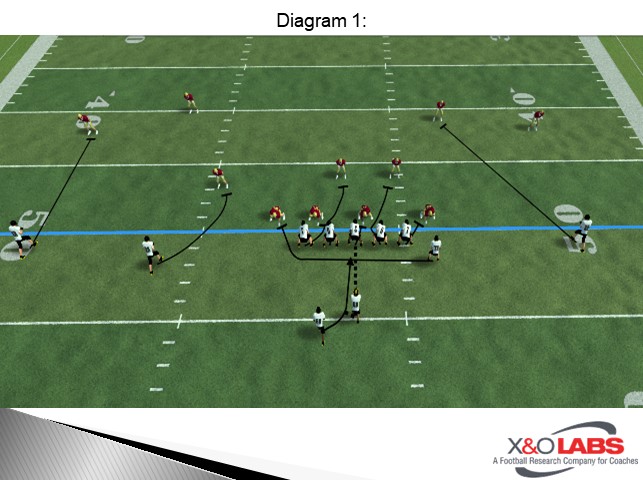
Diagram 1


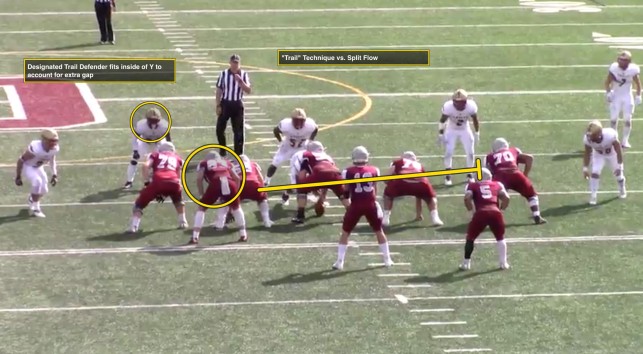
The difficulty in defending the split-back zone comes from the extra gap created on the backside of the play with the slicing sniffer.  The question defensive coordinators need to answer is: how do account for the extra gap?  Here we will discuss various ways to remain gap sound in defending the split-back zone.


Defending Split-Back Zone

Depending on our defensive call, we have four ways we will defend the split-back zone.  The idea behind each is to keep gap integrity while providing adequate numbers in the box to allow for one of our defenders to be unblocked to make the tackle:

  • Screw Down a Safety
  • Treat the Sniffer as a Pull
  • Trail the Sniffer
  • Rat the Sniffer


Situational Implementation

As a staff, much of the teaching we do in terms of our scheme is done conceptually.  We found (through copious amounts of trial and error) that teaching this way allows players to take ownership of the scheme, think less, and play faster.  As such, we will pair the different approaches to defending split back zone with our front calls.

As we install fronts and teach our run fits, each front has a base fit and corresponding rules.  Simple call tags (discussed below) can slightly adjust these rules to better defend certain offensive schemes.  A simple guide for when we use these concepts is:

  • Screw = Base Even Front Call
  • Sniffer Pull = Adjusted Even Front Call (keep 4 shell)
  • Trail = Base Odd Front Call, Adjusted Tight Front Call
  • Rat = Base Tight Front Call


Screwing Down a Safety

The easiest way to account for the extra gap created in a split-back zone is to screw down the weak safety.  A “Screw” call for us creates an 8-man box that protects the defense not only against the split-back scheme, and it also accounts for offenses whose QB is a running threat.  We will most often make a Screw call when we determine there is more than one back in the backfield.  Based on aligned of an off Y, especially if he is in the core (between the tackles), we will treat him as a back.  Matching numbers for numbers in the box is the simplest way to account for all gaps while also having an unblocked hat (possibly 2) to make the tackle.

Read More

Rub Route RPOs to Combat Man Coverage

By Steve Rapp
Offensive Coordinator/QB Coach
Dr. Henry A. Wise Jr High School (MD)
Twitter: @CoachRapp_O


At Wise High School attacking man, coverage has become a regular occurrence for us. We are a heavy Run/RPO team, which defenses answer as of late is to play a lot of Cover 1 and Cover 0 to get extra players into the box and take bender/stick throws away. This has led our offense to evolve to man-beater concepts with the sprint out and RPO attached. I will discuss 3 man-beaters, a sprint-out rub combination, an RPO man beater with Gap scheme, and one with the outside zone with an off/bail CB.


Move Concept

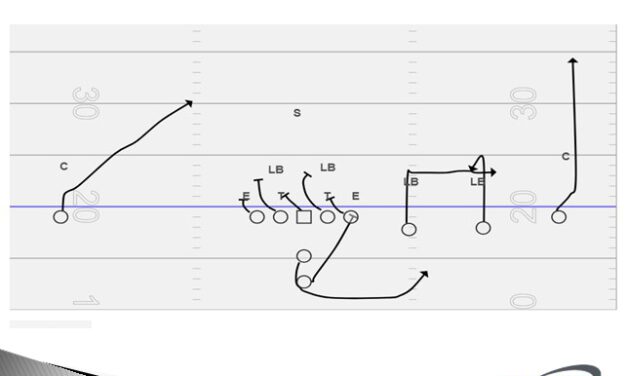
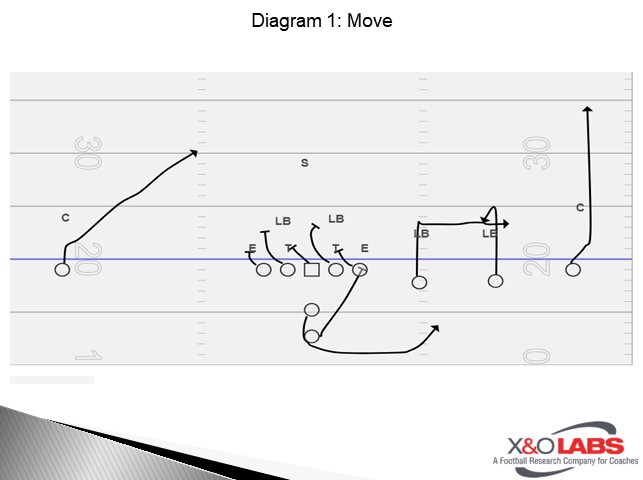
Our sprint out move combination is a go-to versus Blitz and Man coverage. It is a 3×1 combination (See Diagram #1). You can dress this up any way you like using bunch/loose trips/TE attached or detached Trips. The premise of this whole combination is #2 and #3 working together to get a rub. #1 strong is 50/50 Fade ball, #2 a 5-yard hitch and expanded inside (like a basketball pivot), #3 a 4 yard out staying straight after coming underneath the hitch. We add full sprint protection opposite of the call for a false triangle read for inside the box backers, which leaves our tailback 1v1 versus the play side DE.

Diagram 1


Major coaching point: This 5-yard hitch and 4 out must be worked every day, they are a team and must work together to get each other open. We work it vs press on 2/3 so they can work their releases but still get the timing down. 

To study game film of this concept, click on the video below:


Editor’s Note: Coach Rapp has provided coaching points for each clip below:


Clip 1: Pre-snap read is man and we are working the out to the hitch. Great job on the rub, easy throw and catch. 

Clip 2: We catch them in a full spin and an edge pressure works the out right to the blitzer! Perfect.

Read More

Long Stick Techniques to Optimize Zone Pressures

By Clay Iverson
Head Football Coach
Mukwonago High School (WI)
Twitter: @CoachIverson


Introduction

banner 4From the flex bone to four wide, double tight to empty, or up-tempo to shifts and trades; developing a pressure package that is both effective and sound week-to-week is becoming more and more difficult. All challenges aside, there is an answer. For us, it starts with solid zone coverage and the ability to bring 5 or even 6 man attacks that you can use week in and week out is one way to keep improving daily. This prevents the “defense of the week” approach that will inevitably be a recipe for disaster.
At Mukwonago High School (WI), we have hung our hat on multiple zone pressures. Pressures that are installed in mini-camps and pre-season that we feel comfortable with against any offense we see throughout the course of the season. 

Long Stick Technique:   

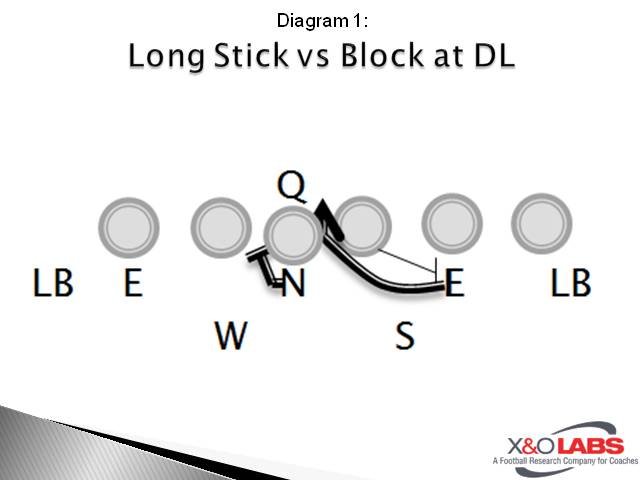
While we have a variety of zone pressures, from double inside backer, inside/outside backer, safety and corner zone pressures, it all starts with our ability to use one or more of our defensive linemen in a long stick technique. Like many of you, we define a long stick as a stunt where a defensive lineman must cross multiple gaps.  We practice this technique daily in multiple periods with our defensive linemen. Here are our long stick rules and coaching points:

Performance Alignment: Because the defensive linemen have to travel longer than a traditional slant, they may need to adjust their stance. These adjustments include backing off the ball, narrowing their stance, or moving to a head up to inside eye alignment. These changes vary based on the player as they all need to use their own abilities to get to where they need to be. We have found some of our quicker or longer leg players prefer to line up wider. This adjustment makes them travel further; however this gives them more of a chance to read their keys and adjust on the run.

Eyes: Once aligned, the long stick defensive lineman must have his eyes focused on the near hip of the adjacent offensive linemen.

First Step: On the snap, the defensive lineman will take a flat step rotating their foot, knee and hips so they are all facing the sideline. Next, he will throw his movement side arm backwards to get his lower body and hips rotated. This skill is very similar to the first step of a pulling offensive lineman. He must be sure to keep his eyes on his key, which is the adjacent lineman.

Second Step To: The second step is the most crucial step in the movement and it is all determined by what his key does. As the player takes his first step and gains ground down the line of scrimmage, he is reading the offensive lineman and the direction he is headed. If the key comes to block him, which could be a zone to him, out block at him, or slide protection to him, then the defensive lineman must continue to gain ground and possibly lose a little depth in order to get to the next gap. He cannot get cutoff.

Third Step: The third step must get on the ground quickly and redirect the defensive linemen up field in his gap. On his third step he must have his feet, hips, and shoulders facing and moving in the direction of the line of scrimmage (Diagram 1).

Slide1

Read More

Developing a Defensive Identification System

By Sam Gooding
Former Offensive Line Coach/Special Teams Coordinator
Dakota State University (SD)
Twitter: @CoachSamGooding

Introduction:

When analyzing the defenses that we saw in the 2015 season, we were astounded to see so many different looks. Teams tended to have similar strategies to stop our base plays, but the alignments that they operated from were wildly different. Not only that, but each basic front had so many subtle variations that the blocking schemes could look completely different against similar fronts with slight adjustments. This placed quite a bit of stress on our offense, specifically the offensive line. The emphasis of this article is not specific techniques or schemes, simply how we sought to solve this problem through defensive identification.

Front Description

The first step in alleviating the problem was developing a more detailed, yet intuitive way of analyzing fronts on film. An Over front with two LBs in the box is not the same (and is not blocked the same) as an Over front with two LB’s in the box, a DE reduced to a 5-tech to the TE side and a LB walked up into a 9-tech. The front ID system that we began to use was divided into the three most descriptive categories for us: the base “Front” (Under, Okie, etc.), the “Box” (# of players at LB depth in the box), and “Tags” (we had different descriptors for small adjustments, like LBs walked up at different points on the line, etc.). Together, this naming system allowed us to quickly analyze a defense with breakdown data and see how a defense liked to align before we even began to watch film in-depth. We also saw quite a few benefits with the offensive line being able to come to the sideline and accurately describe to us what they were seeing on the field.

Front ID Pre-Snap

On the field, pre-snap identification needed to be simplified much more in order to identify combo blocks and ensure that all players were accounted for in the box. Our up-tempo offense placed a premium on our players’ abilities to quickly ID a front, make their calls and play fast. To do this, we installed a “Point” system, similar to what many schools across the country use to establish a standardized method of identifying blocks that can be used in all run plays as well as pass protection. To illustrate the way we used this system, we will focus on our inside zone for the run game and our 6-man half-slide pass protection. We will also briefly look at how we apply it to other runs/protections.

As with most schemes, we borrowed quite a few ideas from multiple coaching staffs to establish the system that would work best for us, much of which came from the staff under offensive coordinator Bill Cubit at the University of Illinois. I would be amiss if I didn’t credit this staff for what they did so well.

Application to Inside Zone

With the multiple looks that we received from defenses, it was clear that the classic “covered/uncovered” principles could not always account for every player in the box against unconventional alignments in our inside zone. Simply running tracks would result in unblocked players against certain looks, especially when defenses tried to protect LBs by nesting them behind certain techniques of defensive linemen. Our application of the point system to our inside zone combined elements of zone and man schemes: the flexibility and capability to pick up movement of a zone scheme with the certainty that every defender was accounted for  in a man scheme.

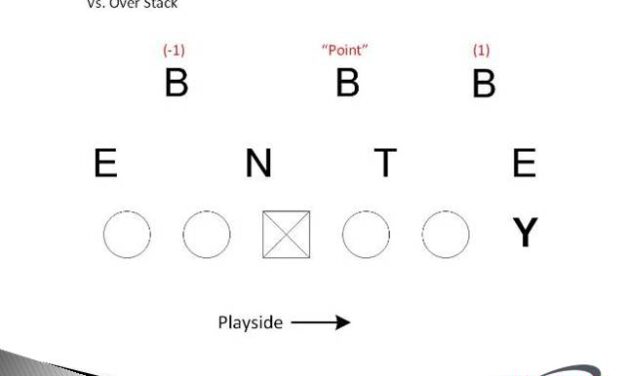
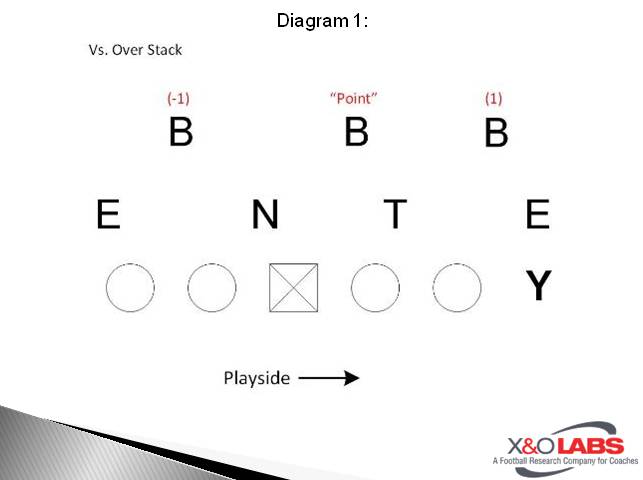
The process at the line begins with the Center’s “Point” call. His call will identify a LB by number (ex. “Mike 52!”). This establishes the “0” in our numbering system. It is important to remember that the “Mike” is not necessarily the true Mike linebacker. For our inside zone play, the 0 is simply who the Center (or the Guard in his combo) is working toward. This varies depending on the play, but that is our rule for inside zone. The Center has some flexibility in his Point call and can adjust it as he sees fit. His only rules in zone are that against an even front (4 down linemen) he establishes a playside Mike point and against an odd front (3 down linemen) he makes a backside Mike point. There is an inherent amount of trust in giving this responsibility to one player, but our current Center just finished his third year as a starter and has quite a bit of awareness on the field. If needed, who establishes the Point could be adjusted, but we did not want to put more on the QB’s shoulders and the Center has the best vantage point on the OL.

Slide1

Once the point call has been made, the Center has declared who he is working toward (the “0”). He then makes his combo call, declaring who he is bringing with him to block the first down lineman playside in combination to the 0 or Mike. From there, the combo calls can be made outward from the Center. The combo playside of the Center will be responsible for the next adjacent down lineman and the “1.” The combo backside of the Center will be responsible for the first backside down lineman and the “-1.” We have a set of combo calls for each possible combination on the line, as well as “solo” calls for one-on-one blocks. We allow our players some freedom in deciding who combos and who can be left with a solo block, allowing us to adjust the combinations to ensure that we combo more dangerous defensive linemen. The numbering system ensures that we have everyone in the box accounted for, no matter the alignments. Typically, we will cut the backside DE loose and read him in our inside zone. If there is no “1” in the box (the 0 is the furthest playside LB in the box) then the next combo playside from the Center’s is working toward the run support player to that side, or a LB who leaks out over the top. We refer to this as an “MDM” combo, or “most dangerous man” combo.

Read More

UNC’s Evolution of the Air Raid: Why the System Being Implemented at Chapel Hill is Breaking the Mold

By Mike Kuchar
Co-Founder/Senior Research Manager
X&O Labs
Twitter: @MikeKKuchar


To most college football fans, the name Longo may not resonate with other Air Raid associations like Leach, Holgorsen or Riley. But the truth is he not only belongs in that same category but also may be carving out a niche for himself in today’s era of the Air Raid disciples. For those that don’t know the new offensive coordinator at the University of North Carolina, for nearly 30 years his version of the Air Raid has produced astronomical numbers at every level of football. He’s orchestrated a top-ten offense nationally from Division 3 William Patterson University (NJ) to Division 2 Slippery Rock University (PA) to FCS level Sam Houston State University (TX) where his Bearcats averaged 531 yards per game and 41 points per game producing two-time Walton Peyton Award winner in quarterback Jeremiah Briscoe.

And as recently as last season while as the offensive coordinator at Ole Miss, his unit finished in the top seven nationally in three separate categories- total offense (510 ypg) passing offense (346 ypg) and yards per play (7.1)

So, when someone with the digital Rolodex the size of Mack Brown came calling, many pundits were surprised he made Longo his selection. Even Brown himself admittedly thought outside of the box when making the hire. “I wanted to find someone who has done more with less and that was Phil,” Brown told us. “He’s taken lesser players and beaten better teams.” While the hire may have been unpredictable, the root of Brown’s selection process was not: he wanted a coordinator who had a complete grasp of the system that his counterpart at Texas Tech Mike Leach used against him for 15 years in the Big 12.

Brown couldn’t have gotten any closer to hiring a Leach protégé than Longo. He and Leach have a relationship dating back to Leach’s days as the offensive coordinator at Kentucky. Longo gloats when he talks about packing up his 4-Runner and making the nine-hour drive from north Jersey to Lexington. Fueled on Taco Bell and taking periodic stops at gas stations to shower was well worth the sacrifice to hear Leach talk about his offense at his coaching clinic, where Longo’s persistence in asking questions eventually picked up on Leach’s radar. “I outlasted everyone in the room,” he said. “It was a complete grind, but making that trip was the best decision I’ve ever made.” The two have remained close friends since, even while butting heads on the recruiting trail- Briscoe was a Leach decommit before ending up at Sam Houston.

But the linear lines that connect these two coaches systems veer off when it comes to one distinct difference in philosophy: the onus of responsibility in Longo’s Air Raid is alleviated from the quarterback and placed on the receivers.

The Foundation: Chasing Space

Read More

Eight Man Fits Patterns in 3-4 Spacing

By Phil Kleckler
Defensive Coordinator
Lindsey Wilson College (KY)
Twitter: @CoachKleckler


The game of football is constantly changing, and I think it’s important for coaches to always be committed to learning and growing. In today’s game, teams must defend a wide variety of offensive schemes, formations, and tempos. At Lindsey Wilson College, we are an aggressive, odd multiple fronts and coverage defense.

No matter how much the game is changing in terms of schematics, it still comes down to execution! As we look at offenses when we break down opponents, we usually find the most successful ones have very few plays and concepts that their players can fully execute and understand. They window dress their plays with formations and motions to make themselves look more versatile and different from their opponents. We take the same approach with our defense whether it’s our base fronts and coverages or within our blitz packages.  We make our scheme as simple as possible for our players to learn, so they can play fast and attack! We want our scheme to be annoying for an offense to prepare for by building in pre-snap movements and alignments. We work rigorously to prevent the offense from having a pre-snap advantage.

To put this idea into perspective, I will show you how we implement “Window Dressing” within our coverage packages.  Our number one goal each week is to stop the run and make the team we are playing one dimensional. In order to do this, all eleven of our defenders must be committed to stopping the run. We will use our secondary to gain a numbers advantage in the run game. The backend of our defense learns three coverages, but we play many variations within those coverages that make us appear different to our opponents. I will describe how we implement our cover three package in our defense while keeping the teaching the same.

To keep things simple within this article I’ll explain all our cover three coverages from our base 3-4 front.  We send in a menu of coverages with every call and it is up to our safeties to get us in the right coverage based on the formation we get.   Based on that call the players know how to fit the run game including pullers, kickouts.  Backers also know where to insert based on that call as well. 


Nickel LB as Extra Fitter

Diagram 1


We always begin on our install calendar by starting with our field cover three coverage using our field outside linebacker as the insert. The defensive line can be in the variety of shades we incorporate in our defense while our outside linebackers will “Yo-Yo” from the heels of the DL to the apex of the nearest WR.  At the snap of the ball, our DL will take a 45-degree slant step to the boundary of their nearest gap. Our field OLB will aim for the end man of the line of scrimmage. We also can/will change responsibilities with the field DE and OLB to create gap exchanges for the OL to have to block. All of the slanting defensive linemen are aiming for the near hip of the OL they are slanting to and don’t look to get vertical until they have canceled their assigned gap. Our secondary will roll to the field strength with our strong safety being our field Seam / Curl / Under / Flat (SCUF) defender. Our SS is our primary force player to the field and all our box defenders are trying to make the ball bounce to him. Our field outside linebacker insert paired with our field version of cover three is good against perimeter run teams that run power read, outside zone and split zone.

To study game film of this concept, click on the video below:


Editor’s note: Coach Klecker has provided a clip by clip analysis of this playlist below.


Read More

Kickoff Advantages in Defeating Man, Single Wedge and Double Wedge Returns

By Wes Anderson
Specials Teams Coordinator
New Palestine High School (IN)


At New Palestine, we are an aggressive, up-tempo, no huddle, power spread offense, and a blitz-heavy 3-3 stack defense. When I became the Special Teams Coordinator, I wanted to bring that same aggressiveness to our special teams. We tell our kids we play fast and hard and to put a strain on our opponents on downs 1, 2, and 3, but we weren’t really doing that in the kicking game. In the other two phases, our expectation is to punish our opponents relentlessly, but then we gave opponents a bunch of hidden yards on 4th down. Why? Our defense works so hard to get off the field, why don’t we take advantage of that in the kicking game?

New Palestine is in the second-largest class in Indiana, so we play against some incredibly talented specialists, particularly kick and punt returners. We only have around 45 players on our varsity roster in a given year. With those two factors considered, the decision about who plays on specials is an easy one for us. Our best players play. We approach it with an attitude of required effort. If you won’t play hard on special teams, you won’t play at all on offense or defense. It’s what we need to do to win. Here’s a look at how we implemented this on our kickoff team.


KICKOFF

The last two seasons, we have not had a kicker with a monster leg. We have to go cover kicks. In past years, lining up five players on one side and five on the other didn’t work for us. Our best players were getting double-teamed. Wedge returns were killing us because we preached lane integrity. This past off-season we felt like we needed to make a change to get our best players a better chance of getting to the ball, not depending on the return taking the ball to them. So, we elected to let them go straight to the ball.

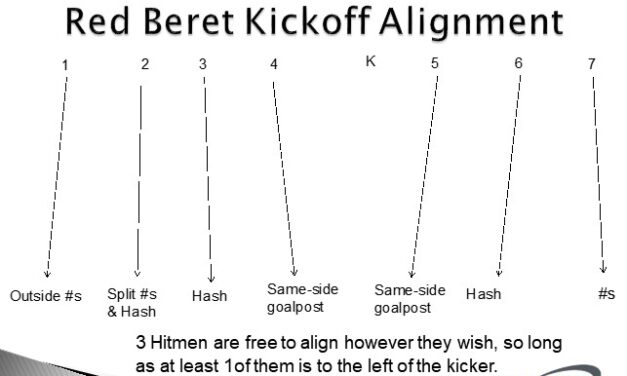
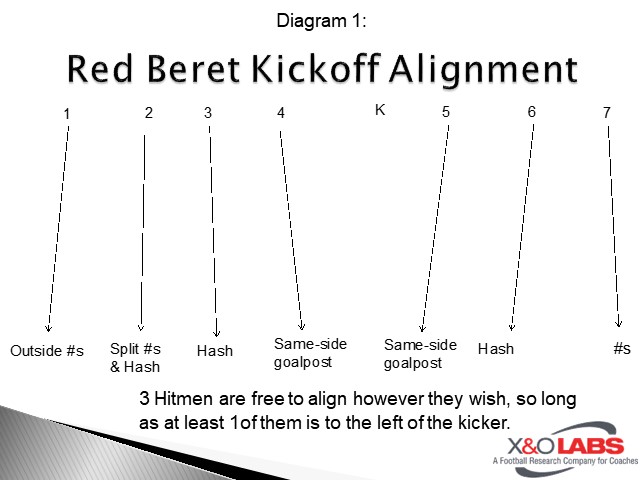
We now give our best three tacklers the opportunity to line up wherever they want, run directly to the ball, and make tackles. We call them “Hitmen.” They have no set alignment or assignment. They are encouraged to align differently on every kick so our opponents can’t account for them with the same player each time. The other 7 players on the coverage team still have a lane they are responsible for, but the other 3 are free to take whatever attack angle they deem appropriate.

Diagram 1


Our 7 “regular” players line up 4 yards deep instead of the traditional 5 to allow our Hitmen to move freely around the formation during the approach.  Our kicker always kicks from the dead middle of the field.

We do NOT believe in safeties. Our edge players are full speed on the rundown, but smart about making sure nothing ever gets outside them.

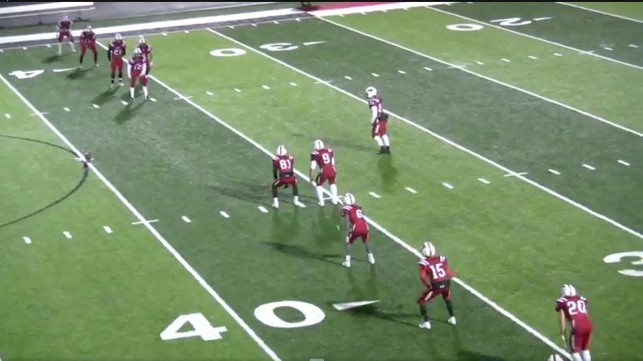
Here are some alignment examples that I’ll talk more in-depth about throughout the course of the article:


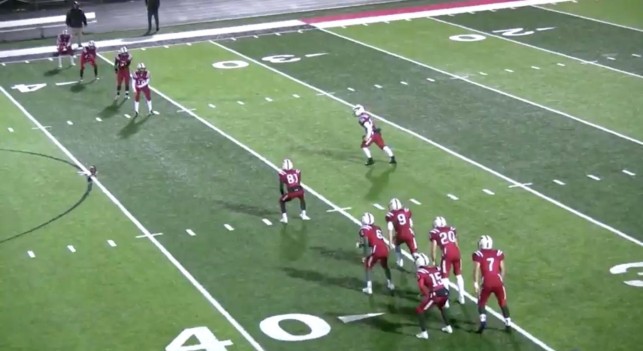
Notice how in the kickoff above, Hitmen technically represent players 4, 6, and 10 as you count from left to right. The photo below is the very next kickoff in the same game.


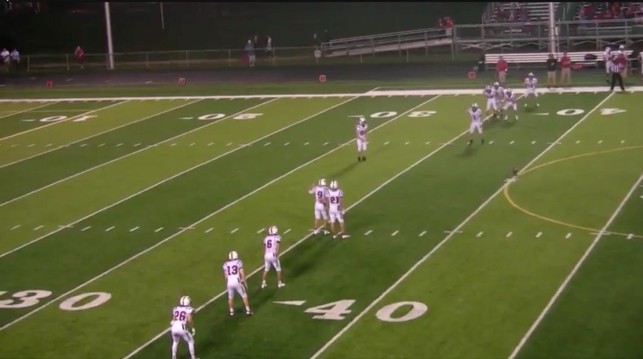
They now represent players 6, 8, and 10, which can completely change how our opponent would block them.


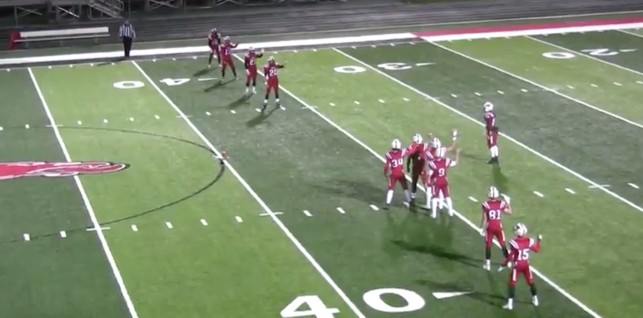
In the instance above, we have created a bunch at the top of the screen. By grouping 2 Hitmen together with one of our regular players, it becomes more difficult for a man return to sort out exactly which of the 3 players belongs to them. Against a traditional single wedge return, it forces the front line players to make difficult decisions about who gets blocked and who gets released to the wedge.


This quads-type look was particularly effective, and one that I encouraged our players to use as frequently as possible against any type of return.

In these 4 photos, you see four totally different alignments, in some cases moving freely between a 5 & 5 alignment and a 6 & 4 alignment, with little to no actual adjustment made by our coaches within the game itself.

We employ a small set of guidelines for our players to think about when we face a certain type of return. In this article, I’ll talk about the three main types of returns – full man-blocked returns, a single-wedge return with man blocking in front of it, and a traditional double-wedge with no man-blocking elements. Almost all returns will, in one way or another, fall into one of those 3 basic categories.


Man-blocked Returns

Man-blocked returns are inherently based on the return team’s ability to identify their assignment before the kick. We coach our hitmen to think about three things when they line up against a man-blocked return:

  • Align in such a way that a front-line player isn’t responsible for you. If you do align as that number, align in such a way that you are too far away to be blocked by him.
  • Twist or change your “pre-snap number” before the kick in order to cause confusion.
  • In some cases, our opponents would assign one player on the return team to each of our hitmen and chase them regardless of their alignment. As we identify those situations in the game, our Hitmen intentionally line up as far away from that player as they can.


Read More

Planning for Red Zone Efficiency

By Mike Kuchar
Senior Research Manager
X&O Labs
Twitter: @MikekKuchar


Introduction:

ccfbIt’s without question, the most important area of the field for offenses. Whether it’s referred to as the red zone, green zone or the fringe, one thing is certain, wins are determined by how successful your offense is in this part of the field. We researched several programs that are successful in the red zone to find out how they prepare for this area of the field. 
Contributors (in alphabetical order)

Steve Dearmon (SD), Offensive Coordinator, Arkansas Tech University: Finished 9th in Division 2 in red zone efficiency with a .898 scoring percentage.

Jim Good (JG), Offensive Coordinator, University of the Redlands (CA): Finished 1st in Division 3 in red zone efficiency with a .943 scoring percentage.

Eric Long (EL), Offensive Coordinator, St. Francis University: Finished 2nd in FCS in red zone efficiency with a .925 scoring percentage.

David Patenaude (DP), Offensive Coordinator, Coastal Carolina University: Finished 10th in FCS with a .889 scoring percentage.

Gordon Shaw (GS), Offensive Coordinator, Colorado State Pueblo: Finished with a .863 scoring percentage in the red zone.

Trevor Stillman (TS), Offensive Coordinator, Thomas More College (KY): Finished 4th in Division 3 with a .905 scoring percentage.

Christian Taylor (CT), (former) Offensive Coordinator, Illinois Wesleyan University: Finished 8th in Division 3 with a .884 scoring percentage.

What area of the field do you consider the red zone?

JG: “It starts at the +20 then evolves as we get closer.”

EL: “We talk about +25 and in because that’s where we are in real-easy field goal range. It determined based on the kicker.”

DP: “We call it the +25 and in, but I don’t see teams changing what they do until the +10 yard line going to more bracket coverage or man pressures. That’s where it changes.”

GS: “We start on the +25 yard line because the field is shrunken at that point. That’s where the defenses will start to change coverages. Many will play cover zero and run with underneath receivers.”

TS: “Red zone is the +20 and the green zone is the +10.”

CT: “We break up our red zone into five different areas and have run and pass play calls specific to each area. The red zone fringe: +30-+21 yard line, the high red zone is the +20 to +15 yard line, the mid red zone is the +14 to +10 yard line, the low red zone is the +9 to +5 yard line and the goal line is the +4 and in.


What is your overarching plan of attack in the red zone? How is your philosophy in this part of the field different than in the big field?

JG: “Number one is attitude. We have to have an attitude of success. Open your focus and open your concentration a little bit more. We evolve depending on where we are on the field. As we get closer to the goal line, our offense evolves.

EL: “We take the deeper opportunities out of the menu. We need to be efficient in the run game. We need to be on schedule. Because it’s so tight down there, we do a lot more QB run game and wildcat runs. We don’t do a lot of straight five-step drop in the red zone where we are reading horizontally or vertically. It’s a lot more play action down there based off our run game. If they are a zone blitz team we feel good about protections because we are simple in our schemes. If they are a man blitz team, we just look for matchups.”

DP: “It’s all predicated on whether or not the defense is going to change. If the defensive philosophy is that they will be a four front and play cover four all the way to the two-yard line (which we will see) then we will stay with what we run. Because we are no huddle and we move so fast we don’t see a lot of teams changing.  When you look at it statistically, the plays that you call on second down are going to predicate whether or not you can get to fourth and short. We want to always try to get to fourth and makeable. Even if it’s up the field we don’t’ want it to be fourth and four, not fourth and one. So what you call on third down will make a difference as to whether or not you can get it to a makeable fourth down. We’re always trying to statistically get us to the best advantage. If we know we are in four down territory inside the ten-yard line you’re thought process is going to change because you have four plays. Sometimes we will say we need three downs to get in and then get a kick, which we will do in situations where we are way ahead. But if you go in with four downs to score a touchdown, you have to get it to fourth and short. You want to get it to fourth and less than two. First down you can call anything you want. You can use a play action or you can run it. But on second down, you have to get yourself to a makeable third to get a makeable fourth. We want to stay away from being fourth and four or more.” 

Read More

Projected 95% Model in Game Planning – Course 1: Exploiting Defensive Structures in Game Planning

By Mike Kuchar
Senior Research Manager/Co-Founder
X&O Labs
Twitter: @MikekKuchar


In order to meet the projected 95% rule in game planning, it’s important to define what efficiency is. According to Coach Longo, it’s something that should be pertinent to both the situation and play concept. This may not follow the conventional wisdom of taking the number of times a play is called and base it off the average number of yards it gained. That former belief is one that Coach Longo subscribed to back when he started coaching. But now he bases offensive efficiency off the two elements he game plans against defensive structure and defensive personnel.  “Basically, it’s the minimum amount of yardage we would accept on that route and still feel it’s efficient,” he said. “But if we were throwing a hitch on a corner that we feel we cannot gain four-plus yards on or against a coverage we should not be throwing it against than it’s not going to be efficient.”


What is Efficiency?

So, what is efficient? Coach Longo separates efficiency numbers in the run game and pass game. In the run game, four yards or less is efficient to him providing it’s a base down. If the offense in the four-minute mode, 3.5 yards can be quantified as efficient. “Of course, getting first downs take precedent,” he told us. “If there are three yards to get and we get a first down against a loaded box but still move the changes, that is efficient. The goal of the call is to get a first down. Or, if we are in goal-line situations a touchdown is efficient.” 


Pass Game Efficiency:

Since Coach Longo’s system is grounded in the Air Raid, his pass game is measured differently. It’s quantified more on the specific route that is built into the play concept. Each route has an efficiency number that doesn’t change from week to week. For example, drop back verticals have an 18-yard efficiency goal, whereas now verticals off press have a 12-yard efficiency goal. Digs have an efficiency goal of 8 yards while hitches have a goal of 5 yards. These are not general numbers that are arbitrary in nature. They are based on the route structure. “Let’s say the hitch by the wideout is open five out of five times and we throw the ball out there and complete it for five yards and he gets tackled,” said Coach Longo. “So why have a random efficiency number of 8 yards per play if the hitch is what the defense is giving up? That doesn’t tell you the play is efficient.”

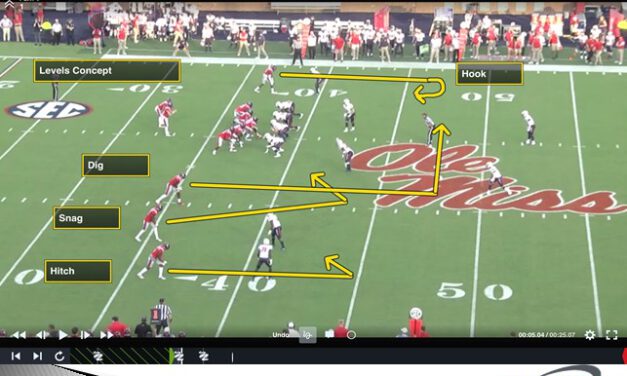
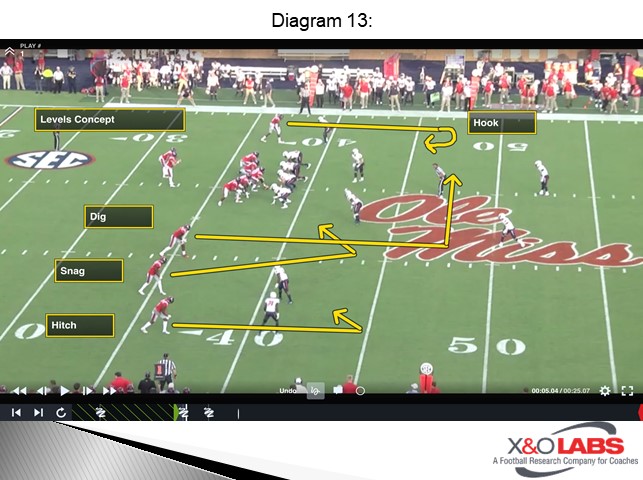
These numbers are all tied into the concept being run. Take a generic levels concept as reference.

Diagram 13


“The first look on the concept is the hitch,” said Coach Longo. “If it’s open and gets completed for five yards it’s considered efficient. The second read is the dig. If the dig is completed, at eight yards it’s efficient. All we want to do is complete it to the route for the yardage the defense would give us.”


Post-Season Efficiency Study:

The point of this method is for coaches to take each concept in their offense and design their own efficiency goal based on each individual concept. At the end of each season, Coach Longo will conduct an efficiency study based on each play concept. This information can be used to change or adjust efficiency models moving forward. “We will go back and look at the 11 Levels concepts that we ran and decide if the ball went to the proper place,” he said. “If the ball didn’t go to the proper place, it was an inefficient play. If we got lucky and threw into coverage and the ball got tipped but we caught it, we are not calling that an efficient play. If we throw a swing into coverage and the running back breaks a tackle and gets yardage, that is not efficient for us. We have to throw the ball to the right guy in the right progression. When we do, we should get the yardage prescribed. If we run 10 Levels concepts and the ball goes to the snag five times and he gets the yardage prescribed, that is five efficient plays. If the quarterback goes to the dig and overthrows it or we drop it and it’s incomplete it’s inefficient.”

His game plan is more about his players and not their players. This is why he builds in play concepts that can answer multiple defensive presentations. “A play has to be able to answer everything,” he said. “And 95% is everything to me. You need something you can answer most everything. When it’s not everything that means a defense needs to be extreme to beat us. So, we spend our time looking for the answer for the extreme. They have to do something extreme where we don’t have an answer. Our responsibility is to have that answer.”

In this course, we present our research on how Coach Longo applies the projected 95% method to game plan against defensive structures. We will also take readers in-depth into a work week of how Coach Longo and his offensive staff prepared against a particular opponent’s tendencies this past season in the SEC. But before we do, we wanted to make an important clarification: Coach Longo doesn’t spend a lot of time studying call patterns of opposing defensive coordinators. He’s more interested in studying the “defensive approach” structurally that these coordinators engage in. “To us, it’s all about the system,” he told us. “Like are they four-match teams or cover one man free teams? Or are they a big cloud team?”


Delegating Work Flow:

The process of preparing against potential opponents starts in the spring for Coach Longo. When spring ball ends, he’ll start organizing his thoughts to prepare against next fall’s opponents. The process gets culminated after the summer when he’ll have the base of his game plan thoughts together. By the time fall camp rolls around, he’ll have a “good feel” of how they may attack each opponent. We will elaborate upon the process he uses, the same one he used while as a high school coach in New Jersey. Sure, the process has changed somewhat as an FBS level offensive coordinator. “The biggest difference from each level is resources,” he said. “As you move up they spend more money on those staffs. I can focus on watching the film and getting to know the opponent which in my opinion is the most important thing I can do. I’m not distracted by the other things because my (former) graduate assistant (now offensive analyst) Josh Snow does a great job handling those duties.” Now he doesn’t make the cutups he uses during meetings. He leaves that to Coach Snow. “He emails me a script template. I write it and send it back to him. The majority of the time now I spend recruiting and coordinating the offense.”

Read More

Projected 95% Model in Game Planning – Course 2: Exploiting the Human Behavioral Patterns of Defenders

By Mike Kuchar
Senior Research Manager/Co-Founder
X&O Labs
Twitter: @MikekKuchar


Coach Longo is a constant observer of people. He’s quick to notice one’s posture, one’s gait, vocabulary, and even habits. He’ll remember things you brought up in conversation several years prior. He’s done so with me. It’s something you rarely realize he’s doing. These same traits make him a successful offensive coordinator because he takes these habits with him on the sideline. While some coaches prefer watching the ball after they make their call, Coach Longo spends his time watching you, the defense react to it. To him, it is how defenders react that’s what important. He self-admittedly will continue to stretch corners on vertical routes just to set up throws underneath them. And that is just one particular example. He’ll do the same for almost every other position on the field.

In this course, we are going to present our research on how Coach Longo and his staff spend time dissecting the behavior patterns of defensive personnel to design game plans to exploit them. As noted in the previous course, attacking the scheme is already built into the offense. His players already know how to beat certain coverages. It’s how to beat human nature that Coach Longo spends the majority of his game plan. 


A Seasonal Plan to Manipulate the Human Element:

Just as in the previous course of this report, Coach Longo begins this process directly after spring ball which has just concluded in Durham. The staff will work through the entire personnel of upcoming opponents. Once coach will study the secondary structure and diagram the defense while another coach will be asked to break down the returning personnel. He’ll watch every game from the previous season in doing so, particularly studying the returners. “We will study these defenders all summer to see what they cover well and what they don’t,” he said. “That’s why we like to go through the entire season because we can pick up on the human tendency. It’s hard to hide these habits during the full length of a season.”

This is something that Coach Longo prides himself on. It’s a cathartic task he gets completely wrapped up in. Similar to a scientist dissecting elements in a Petri dish, Coach Longo combs through each game to examine cracks in behavior patterns of defenders. “You can coach against four teams in a row that all play cover two but all four corners may play it differently,” he said. “The playbook says you should be able to beat cover two with a corner route but you may not be able to complete a corner route against a corner that plays it a certain way. The right corner may be coached by the same defensive back coach but because one of them is longer, rangier and faster he is going to play it differently than this guy. We’re going to look at him and say he can’t cover the corner route. We know what their strengths and weaknesses are. We are going to attack the people, not the scheme every week.”

We felt it important to reference the fact that this process has been expedited with the use of Pro Football Focus which is a tool that analyzes every player and every play of every game to deliver player grades, stats, and rankings for the NFL, fantasy football, and NFL Draft. Using this service, Coach Longo is able to simply pull up an individual defender and watch every clip he was involved in the previous season. “I used to tell my GA’s to make cutups of the two corners and the two safeties so every play we can watch them,” he said. “Now we have plays broken down into targets. All I’m doing is studying one particular player. When you watch just one player, you can find a particular mismatch against one of our players.”


Common Principles When Exploiting Personnel:

This information gets translated into some general thought processes on how to manipulate specific defensive personnel. While we detail how this correlates to specific game planning, we wanted to provide a brief overview of how Coach Longo conceptualizes position groups in his game planning. There are some common mantra’s he will use below in his early preparation.


“Run at the Speeds; Not at the Bigs”

Among all position groupings, Coach Longo will spend the least amount of time watching the defensive line. But it’s not because they aren’t important. The offensive line coach will do that during game week. He will direct his attention specifically to defensive ends because, in his opinion, they can more quickly affect games. He will work to find out if there is a discrepancy between the two either in size or ability and design his run game around that facet. “We want to run at speed defensive ends,” he said. “We want to generate force at him so he can generate force back at me. We want him to continually take on a tight end on a drive block to wear him down. We’ll take the big heavy defensive end who doesn’t run as well and cut him off on the backside.  We don’t want to run power against a big physical kid. If teams play left and right, I’m going at the speed kid and not the size. If it’s a team that puts the speed to the weak side, we will run to the weak side.  If it’s a formation defense, we figure out when they are going to put the speed to the trips and we’re going to run it there. You find out what they do because they can’t do everything.”

The same principles apply to interior defenders who can be issues in gap schemes, Coach Longo will make decisions on which kinds of blocks to use against them. “If we have a big heavy 3-technique we will block back on him because even a stalemate is a win,” he said. “We’ll try to get a double team on that little fast kid and move him out of there.”

Read More

Projected 95% Model in Game Planning – Course 3: In-Game Call Patterns

By Mike Kuchar
Senior Research Manager/Co-Founder
X&O Labs
Twitter: @MikekKuchar


Once the game planning design is in or the “hay is in the barn” the next phase of the 95% method is executing the game plan. Here, all of Coach Longo’s previous planning comes to fruition. He’s asked to make real-time decisions on which concepts to call and adjust to any changes in defensive structure or personnel. We were given full access this past season into Coach Longo’s game day operations procedure. We shadowed him as he prepared for an SEC opponent while at the University of Mississippi.

In this course, we present our research on the pre-game and game day activities he takes part in during the game week.


Pre-Game Operations


“Calling the Game” Simulation:

We found this activity to be instrumental for the in-game call procedure Coach Longo uses with his staff. It’s a 30-minute session once a week where he and his graduate assistant (now offensive analyst) Josh Snow will sit down and simulate calling the game in real time. Coach Longo will present cutups of how the next opponent defended particular formations during the course of the season. He’ll use his playlist and call a play concept while Coach Snow follows the protocol he uses during game day such as verbalizing the coverage and where the quarterback should go with the ball. It’s real-time dialogue, without a pause button, that gets fined tuned so there is no wasted verbiage on game day.

“I like to have my graduate assistant in here with me so he gets a feel of how I will call a game,” said Coach Longo. “The more we do that the more he sees things the way I do. I need him to do that so he can give feedback to me thinking about the game, the plan or the play calls the way in which I think about it. You have to know why I’m calling the game. You have to have a complete understanding of the offense to be a great spotter.”

According to Coach Snow, the process is immeasurable in helping him harmonize with Coach Longo on game day. “I get the reps just like the quarterback is getting the reps during the course of the week,” he said. “That’s really important to me. I hear all of Coach Longo’s coaching points. And the more times I can see the game at game speed the more it helps me in the booth.”


Applying the Read Sheet:

What Coach Snow is specifically looking at during these sessions is what Coach Longo calls the “read sheet.” It’s a play sheet that lists each play concept Coach Longo plans on using that week and next that concept is the most influential defender that can affect that play. It is Coach Snow’s responsibility in the booth to monitor that defender as the play unfolds.

While we can’t produce the actual read sheet for this report, we did notice the following:

  • In zone schemes, the read defender will be the C gap defender
  • In gap schemes, the read defender will be the backside linebacker.
  • In bubble screens, the read defender might be the play side alley defender.
  • In most dropbacks, the read defender might be the backside safety.


Once these defenders are identified, Coach Snow will monitor their post-snap actions. One example on the levels concept would be which route the Mike linebacker took. Or in the Shallow route, the defender that squeezed the dig would be the read defender.

Although Coach Snow has graduated from the read sheet- he’s been with Coach Longo for over five years- he says it’s helped train his eyes to interpret and discern information quickly. “It was awesome for me because it helped me learn the offense,” he said. “That is the easy way to understand how to help him.” While every concept has a read defender, sometimes those defenders will change on a weekly basis based on how a defense is deciding to take away particular schemes.

Coach Longo did make a point to say that those determinations are not always made after one rep of him doing it. It’s a pattern of behavior. “The defensive coordinator might be in a coverage where that safety needs to come downhill right now on one play,” said Coach Longo. “He may track harder in cover four than he would in cover two. We have answers for that.”

Coach Snow is also responsible for running the scout team defense where he will make the defensive scout sheet to fully immerse himself with the opponent’s defensive structure and personnel. “Many times, when we are devising personnel match-ups, I will put our match-up advantages in different color jerseys in practice so that we know who to exploit,” said Coach Snow.


Game Day Operations


The Walk-Through:

Even for home games, the University of Mississippi football team travels to stay in a hotel more than 45 minutes away from Oxford. It is at this location where the club will have its pre-game walk-through nearly three hours before game time. In the parking lot of the hotel, Coach Longo and his offensive staff recount every possible scenario that may present itself during the game. It’s a thorough, 30-minute session where Coach Longo will rattle off his entire play menu and signal in the tempo and formation in which these concepts planned to be used. The offense walks through their responsibilities in regimented fashion against a makeshift defense.

Read More

Projected 95% Model in Game Planning – Course 4: Streamlining the System

By Mike Kuchar
Senior Research Manager/Co-Founder
X&O Labs
Twitter: @MikekKuchar


Editor’s Note: In order to provide background context on how Coach Longo implements his projected 95% efficiency method in game planning, we felt it necessary to give a brief overview of his offensive system in this course.

If you’re looking for a more in-depth look at Coach Longo’s system, more research can be found here.


Efficiency: it’s the basis of Coach Longo’s offensive system. We will not use “simple,” even though simple does come with a positive connotation among football coaches. It’s efficient. We all want our systems to be simple for our players to absorb but the challenge becomes making the presentation complex to the defense. Over the last thirty plus years as an offensive coordinator at all levels of football, Coach Longo has found a way to balance those two priorities in producing a top ten offense nationally six times in his coaching career. This includes being in the top five the last four consecutive seasons at Sam Houston State (TX) and University of Mississippi respectively. Now as he prepares for his first season calling the shots at the University of North Carolina, he continues to hone his system around new personnel and new opponents.

It was this past season while he was in Oxford (MS) when we had an opportunity to mirror how this system is translated into his game week preparation and game day protocols. We started with the premise of shadowing an FBS offensive coordinator to explore the procedures he and his staff use during game week. What we initially found was that the process isn’t that much different than at your high school or mine. Sure, the resources are greater, but his process hasn’t changed much. And as we continued to dig deeper into his process, we found one common threat in our research: he is exceptional at trimming the fat in his game planning. He doesn’t carry a lot of formations or concepts. He only carries the great ones, or as he calls the 95 percenters into game day. This is the process behind how he crafts, selects and calls those plays on game day. It’s a procedure that has yielded one of the country’s most efficient offenses- finishing in the top 10 nationally in yards per play the last two seasons.


Model of Efficiency:

After studying Coach Longo’s system twice, it’s clear that his success has a good deal in part with the “simplicity” of his system. Coaches all talk about cutting things down, but Coach Longo and his staff strive to abide by it. A streamlined system makes things easier to operate on game day. The fewer things you do on offense, the quicker it is to make corrections. “A defense can only do a certain number of things and we would like to think we have a good feel for anticipating what those things are,” he told us.  The top game day coaches know how to adjust in real time and what smoother way to make these adjustments than to have the answers before they are presented on the field?

Coach Longo’s system has some of these answers. They are developed through a process that is repeated over and over again each game week. As he told us, the offense stays 80% the same regardless of the week it’s just the opponent that changes. Sure, he may add a couple of weekly tweaks but the philosophy remains steadfast: take space where you can get it. This means there are really no “call it and run it” scenarios in this offense. The quarterback is given choices and is expected to make those choices based on where space presents itself.

This space is generated in two distinct ways: defensive structure and defensive personnel. Coach Longo spends more time understanding common principles of defenses than focusing on who the defensive coordinator is. Coach Longo attacks defenses by classifications, such as cover four match teams, cover one team or pressure teams, etc. which is revealed more in Course 2.  How the defender’s individual personality reacts to the concepts he presents is even of greater interest to him.  As he told us, “a cover two corner may play cover two an entirely separate way than the corner on the other side of the field. How he reacts to things dictate my play calls.” 


50/50 Balance is Not a Priority:

His approach differs from other coordinators who try to stress having run/pass balance. Yes, he is an Air Raid coach by nature, but it’s more important to take what defenses give him. He’d rather throw an eight-yard bubble route than pound the ball into loaded boxes. On game day, he doesn’t calculate touches for his top players- even though he’s had a receiver in the top ten nationally in receptions the last two seasons. The system is about building in options within the play call that are best for that particular situation. “We want to give the ball wherever you’re going to give up space,” he told us. And that alone produces ball distribution. “Even if the number four receiver is not as good as the number three receiver, he can still catch the ball and hurt the defense. When you distribute the ball to all the players, the defense needs to defend all the players. And when a defense overplays one from a human nature standpoint or scheme, you are giving up grass somewhere else and all those guys are taught to attack the open grass.”

In this course, we wanted to present a general overview of Coach Longo’s offense. We thought it was important to understand how the system is built in order to understand how he game plans or makes his adjustments on game day. His offense can be categorized into the following:

  • 3 base formations
  • 3 motions
  • 5 formation tags
  • 5 backfield sets


Read More

Projected 95% Model in Game Planning – Bonus Course: Adapting to the High School Level

By Mike Kuchar
Senior Research Manager/Co-Founder
X&O Labs
Twitter: @MikekKuchar


After working with Coach Longo on this project, I felt compelled to provide a translation for high school coaches on how to take some of these same principles and gear them to their own game planning method. As an offensive coordinator myself, it opened up my eyes to new ways of game planning. I thought back to this season, how many times I called might have called a bad play, particularly in big spots. It still haunts me six months later.

So, my plan was to take the same model that Coach Longo used and apply it to the high school coach. Many of us don’t have the same resources he does, like the use of two graduate assistants and Pro Football Focus, but I found there are ways to adapt some of these principles for game planning around our systems. There is an extensive amount of information in the previous courses of this study so I segmented our research into seven key tenets that can be adapted into any game planning process.

In order to gauge how coaches were conducting game planning, we conducted some pre-research by sending out a survey to all of the offensive coordinators in our network. Over 500 coaches responded and the results were what we figured – coaches are spending too much time changing their systems from one week to the next in preparing for their opponents.


Tenet 1—Less is Always More: Streamline Your Play Menu

We found that 60% of coaches still choose to carry over 20 or more concepts into their offensive game week preparations. Consider this: according to HUDL, the average number of high school offensive plays per game is 72. This means that each play can barely be run four times during the course of a game if you’re going to use all of the concepts on your play menu that week. If the argument is in most cases offensive coordinators will not use all of the plays in the menu, our simple rebuttal would be: then why include them in the menu?

Sounds simple enough, right? But this may be a struggle for some offensive coordinators like myself. We love everything. We see it, we take it, we implement it and off we go. I get it and so does Coach Longo. But Coach Longo is hell-bent on having no more than twenty concepts in his playlist that week and self-admits using “repeaters” between 8-10 times a game. As coaches we all know that the less you do, the better you get at it. Yet, it’s a constant struggle to keep your play menu limited.

How many times have you seen the quarterback get to the line of scrimmage only to realize that you’re in the wrong play call? While I realize that many coaches are giving their QB’s “outs” by building relief throws into concepts, the difference with Coach Longo’s system is that he builds universal concepts into his play call. He has concepts that can be effective against any coverage. We all can do this by breaking down our game planning by packaging concepts based in thirds: the right perimeter, run box and left the perimeter.


Tenet 2—What Is Your 95%? Defining Efficiency

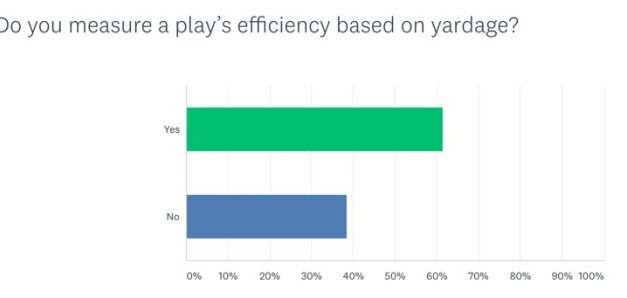
61% of coaches still use yardage to define a play’s efficiency. But there are so many factors… down and distance, field position, etc. that go into why a play was efficient and why it may not be efficient. As Coach Longo told us, to tag an arbitrary number (based on an average of total plays and yards gained) doesn’t correctly measure whether a play was efficient for those particular circumstances. Yet why are so many coaches still relying on yards gained to determine if a play was effective or not?

Do you measure a play's efficiency based on yardage?


Coach Longo talked in great length about designing his game plan around concepts that have a projected 95% efficiency rating. But how do you measure efficiency? For years, I’ve heard coaches use four yards per play as the gold standard for a play’s efficiency. Do the math and it’s a simple solution to gain first downs. Yet, according to HUDL’s 2019 performance report, the average yards per play gains 6.01 yards nationally. So, what measures efficiency in your program? While Coach Longo adheres to the four yards per play declaration in the run game, pass game efficiency is completely reliant on the individual pass routes in the concept. A dig is 8 yards, a drop back vertical is 12 yards, etc. It’s all based on where the ball is being thrown.

While there are numerous factors that tie into efficiency- all of which we explain in the report- I think it’s important for coaches to generate an efficiency plan before the season for each of their play concepts. Not only does it provide for realistic expectations for players and coaches but can also serve as the basis for eliminating or keeping plays during the offseason review.

Read More

Simplifying Offensive Communication

By Mike Kuchar
Senior Research Manager
X&O Labs
Twitter: @MikeKKuchar


Case 1: Communicating Personnel Groupings and Formations

Introduction

628x471In this case, we focused our research on how coaches were grouping formations and personnel to make them more relatable to players. We’ve found coaches can have upwards of 8 personnel groupings and over two dozen formations. We wanted to find ways in which coaches are simplifying their offensive packages to utilize as many groupings/formations as possible without jeopardizing the learning curve of their athletes.

Number of Personnel Groupings

Our research below indicates the amount of personnel groupings coaches are using per game. The majority of coaches, 38 percent, use four personnel groupings per game.

Reader Responses:

We surveyed coaches and asked the following question:

Q: What has been the most efficient way to group or relate the names you use in your personnel groupings to make it more understandable for your players?

The responses are below. We kept them anonymous in order to protect identity.

Color System:

“We use colors, with the darker the color the more run-focused the grouping can be. For example, Black is our Maryland-I formation, which almost 90% run. White and Grey colors are two back pistol formations, which are closer to 50/50 run/pass.”

Default Formations:

“All our formation calls come off our base formation, which is double twins. The X and H are on left side and Y and Z are on right. We use one word for the formation such as ‘Ace.’ Then we have specific words that tell our wide receivers and tight ends where to be. Such as ‘Ace Hit,’ this tells the H to come across formation. This has worked better for us than when we just said ‘Pro Right or Left’ because it tells each kid where to be. Bronco and Buffalo tells our B back (H back) where to align. An example would be Bronco ‘Yo.’ B would be to right and Y would go over to left to create a Pro twins look.”

Weather Names:

“We use weather names; 10 means lightning; 11 means thunder and 20 means tornado.”

Vocalizing Formations:

“We simply yell out ‘two-back’ if we want the H-back into the game and we’ll call out a receiver (usually a slot) for him to replace.”

Picture Boards:

“We use boards with pictures to move players from the same personnel groupings and formations to different places within the called formation.”

Hand Signals:

“We use hand signals and fingers to represent formations. After we put up the different fingers we make a fist to add a tight end to the formation. An example is four fingers represent a 2×2 formation. Now if we make a fist right after putting up the two fingers we know one side will have a tight end.”

Word Associations Based on Positions

“We use names that relate to the primary focus of the personnel group. For instance, ‘hammer’ could equal a big fullback and our best tailback. ‘Jumbo’ could equal our biggest skill guys. ‘Falcon’ could equal three wide receivers and ‘Trojan’ could equal our three best running backs.”

“The best way is to associate by position or by physical attributes of your different players. Examples include ‘big’ personnel for your taller receivers or extra tight ends. ‘Extra’ personnel for your entire X are to be in the game at certain positions. ‘Zebra’ personnel for all of your Z’s to be in the game at certain positions. ‘Speed’ personnel is used for your fastest guys at certain positions, and so-on and so-forth.”

“We use names to identify personnel groups that are used for multiple formations. ‘Sam’ equals no tight end. ‘Ted’ equals one tight end. ‘Henry’ equals one H-back. ‘Hannah’ equals one tight end and one H-back.”

“Like most teams, we designate positions with letters. We name the personnel groups with words containing the letter or letters of the position or positions within the group who is/are the ‘adjuster(s).’ Let’s say that the personnel group is Horns. This group includes Z & J (outside receivers) S & H (slots) and R (RB). The H is the ‘adjuster’ In Horns personnel Tiger, the H aligns in the slot to the right side of the formation regardless of hash. In Horns personnel Lion, the H aligns in the slot to the left side of the formation regardless of hash. In Frogs personnel, the Z & J are still on the field and S is still on the field, but H Back is replaced by the F and the F is the ‘adjuster.’ In Frogs personnel Tiger, the F aligns in the slot to the right side of the formation regardless of hash. In Frogs personnel Lion, the F aligns in the slot to the left of the formation regardless of hash. Tiger and Lion are 2 x 2 formations. In 3 x 1 sets, all positions have a ‘home base’ and we have tags to move them around within the formation. In Thunder personnel, the Z remains on the field, but now the tight end (T) and the H Back (H) are part of the group along with S and R (RB). Both T and H are ‘adjusters’ in Thunder personnel formations.”

Read More