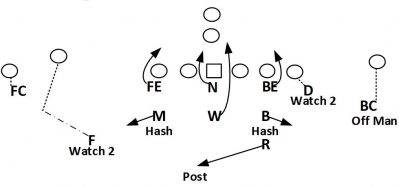

Quarters Coverage: Case 2 – Alignments & Adjustments vs. Closed Sets

By Mike Kuchar

Senior Research Manager

X&O Labs


Because so much of playing Quarters coverage is adjusting to various offensive formations, we tried to find a way to compartmentalize offensive structures in ways in which makes it easier for defenses to recognize.  While we realize that all coaches may have their own methodology in doing this, we searched for a common denominator in which most coaches would agree.  So, if Quarters coverage is truly a split-field coverage, there can really only be a few variables for each side of the formation:

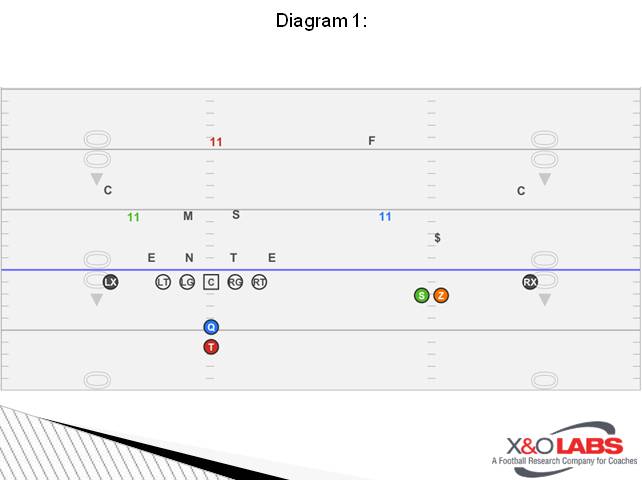
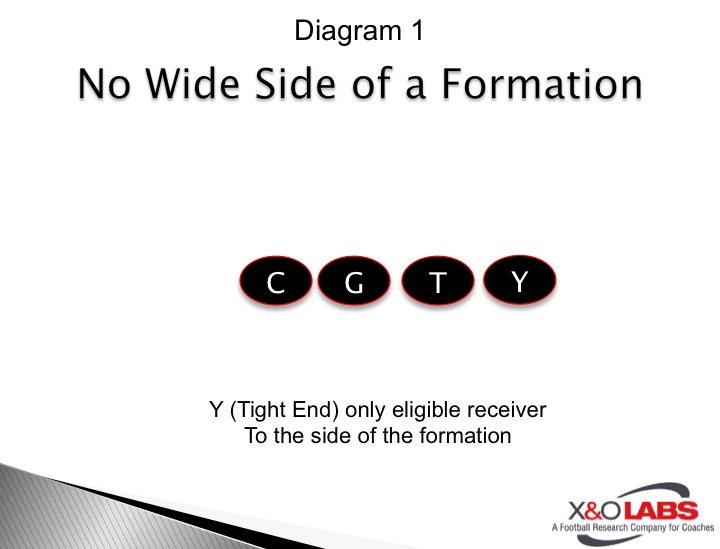
No Wide Variant (Diagram 1): No wide receiver to the side of the formation.  This can also be referenced as a “nub” side. 
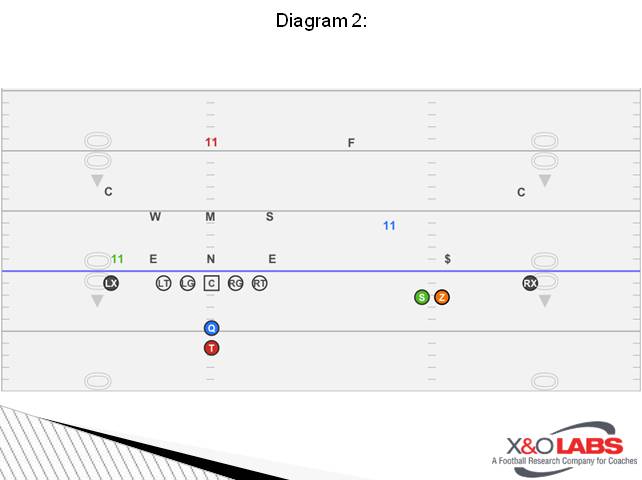
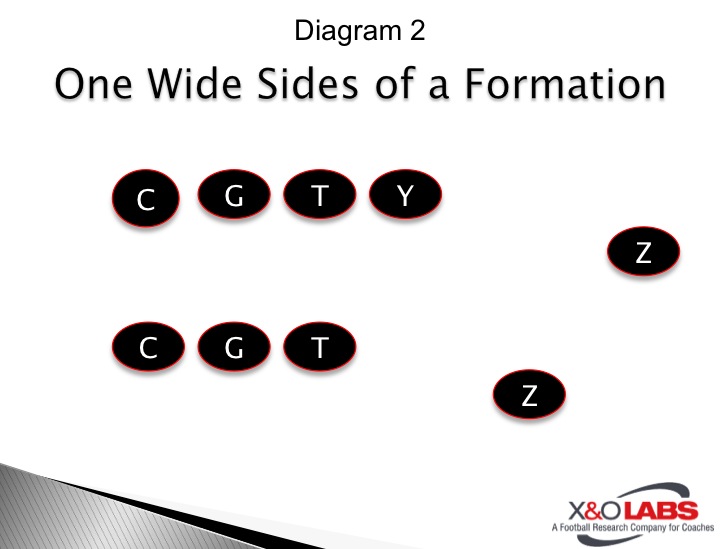
Single Wide Variant (Diagram 2): One wide receiver to the side of the formation.
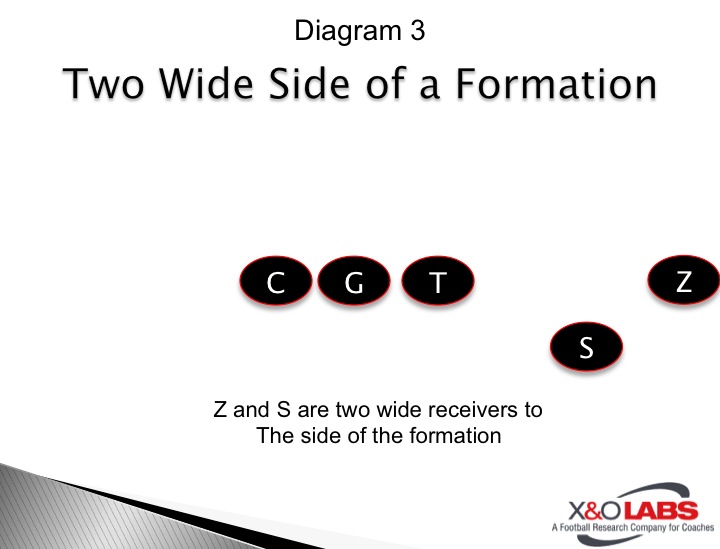
Double Wide Variant (Diagram 3): Two wide receivers to the side of the formation.
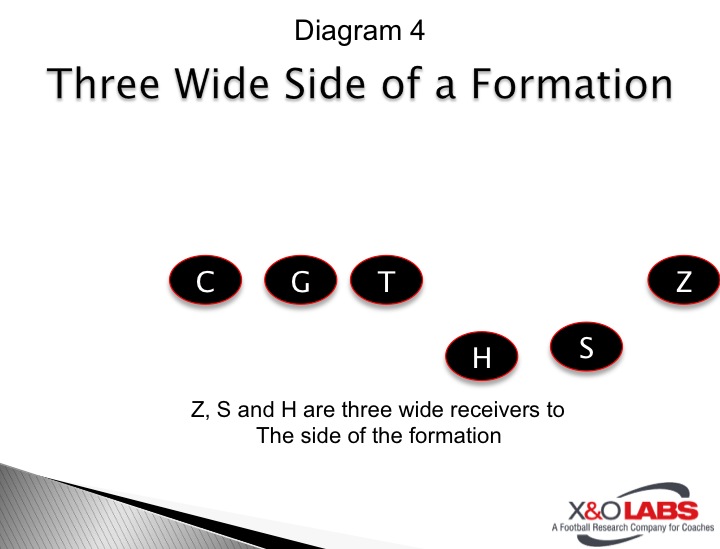
Triple Wide Variant (Diagram 4): Three wide receivers to the side of the formation.
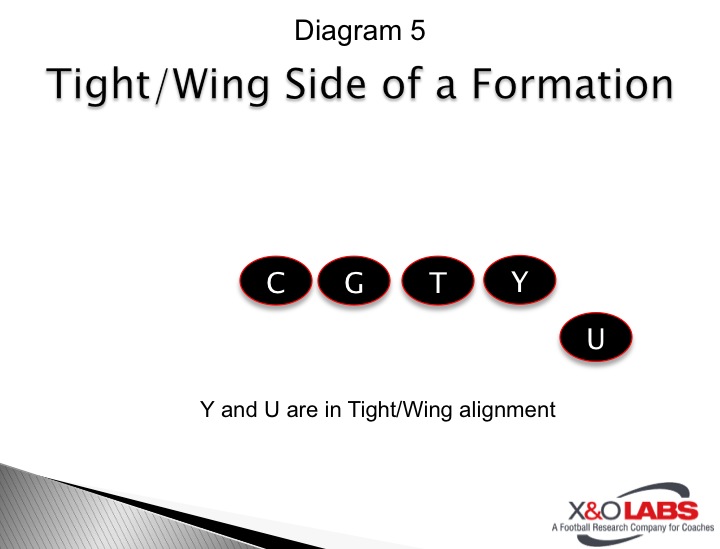
There are two other variants that should be discussed, because they could present adjustment issues to the defense:

Wing Variant (Diagram 5): Tight End/Wing to the side of the formation.
Slot Variant (Diagram 6): One wide and slot to the side of the formation.
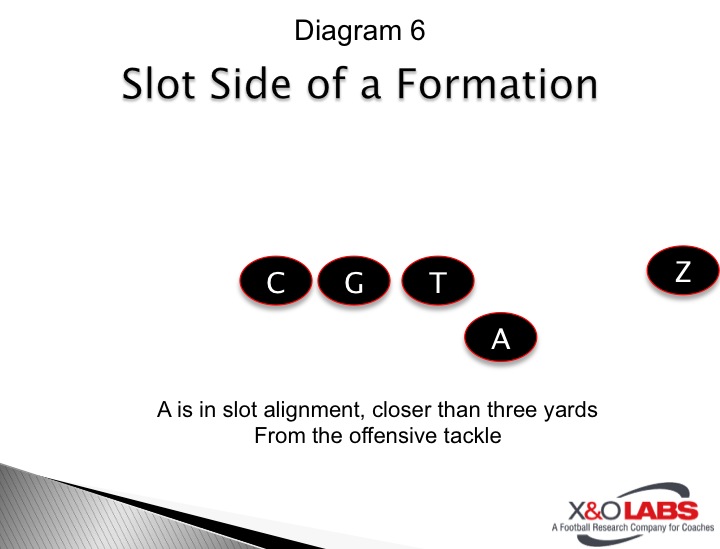
Now, how you structure your coverage to adjust to these formations can be completely up to you, we will only present what we’ve found to be the most common adjustments to those various offensive variants presented above.  We’ve found that introducing all of these concepts early in fall camp or in the spring would be entirely beneficial.  Of course, these adjustments can change during the course of the season, based on your schedule, but at least it serves as groundwork for installing the defense.

It’s the same process that Nick Rapone, now the secondary coach with the Arizona Cardinals, undergoes each season.  “The whole key is to use all of your different force calls and adjustments to your advantage,” says Rapone.  “They affect the corner, safety and linebacker to that side.  Then you just pick and choose each game which one you’d like to use.   That’s the key to running the whole Quarters system.  Before you know it, you have multiple coverage’s but you’re just playing quarters.”

Once spring practice starts, Rapone gets 15 minutes of group work with his corners and safeties.  The first 10 minutes are on one-on-one’s and the last five minutes are just working cloud, club and combo – three of his Quarters adjustments that are detailed later in this report.   “Once they know those four changes, they can get themselves in and out of any formation they face – minus split, plus split, etc.,” says Rapone.

Pat Narduzzi, the defensive coordinator at Michigan State, starts the entire process every week, as he “self scouts” his defense every Sunday.  He used a Quarters scheme 65 percent of his snaps this season – which is quite remarkable considering the various offenses he sees in the Big 10 each week.  But, says Narduzzi, that’s the beauty of the coverage.  It can adjust to all different formations and defends everything. Narduzzi calls it “a players defense” because it lets them make plays.  “Our Cover Four is good for run and good for pass – whether you have five wide outs or one wide outs,” he told us.  “So many offenses now will shift and motion from different formations, so I’m not going to get stuck being in a coverage that I don’t want to be in. Quarters gives you the flexibility to adjust.”

Narduzzi has over 20 variations of Quarters coverage – we didn’t have the time or resources to divulge all of them – but he did recommend using 4-5 could get the job done.  “We don’t use all of them in the game plan,” he told us.  “Maybe we’ll come in with 10 and use four during the course of the game.  I go into the game plan with enough tools to adjust to problems. I don’t spend the majority of time using one or two adjustments, because then I’m guessing anyway of what they’re doing.”

Narduzzi will make adjustments based on each series, and not wait until halftime to do so.  “Really we don’t put in new coverage’s, we are just remembering how we played a certain scheme and changing things around,” he says.  “We introduce them all during camp.  We want to have as many tools as we can.  Once an offense exposes a deficiency in a coverage that we’re using, we simply just tweak it to a different adjustment.  Amazingly, they don’t run it again anyway.”

Single Wide Receiver Adjustments:

Two-Back Pro Formation (Diagram 7)
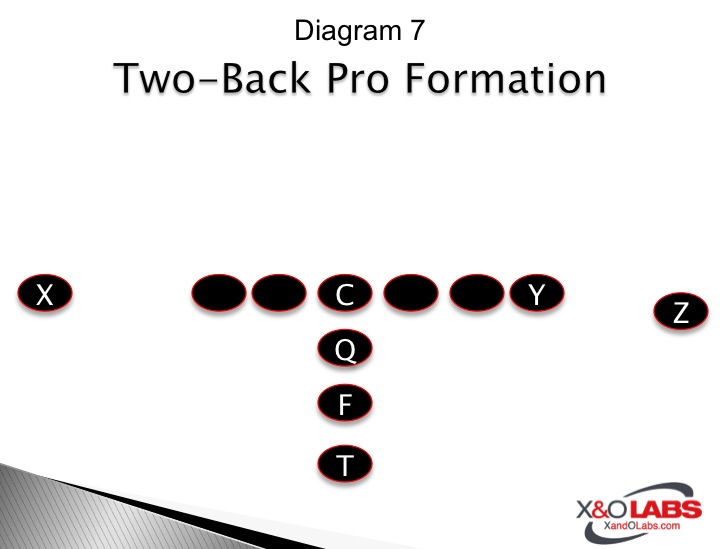
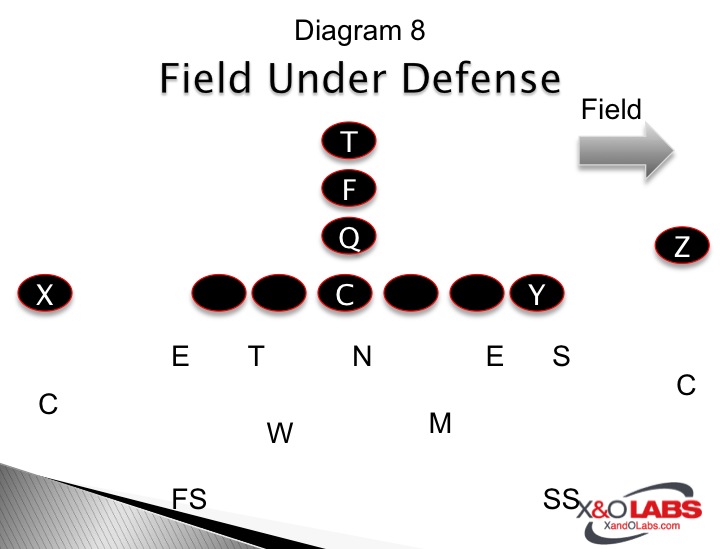
Since this is usually the starting point for most offenses, we will start here on defense as well.  When conducting our research, this is an area we wanted to explore.  There are various schools of thought on this formation.   Some coaches feel as if an eight-man front is needed to play against two-back offenses, thus opt for using man-free or Cover Three principles against these structures.  Chris Ash, the defensive coordinator at the University of Arkansas is one of those coaches.  Ash prefers to play more of a “Field Under” defense (Diagram 8) against two-back pro-style offenses because of both a numbers disadvantage and a depth disadvantage for the safety.

Read More

Quarters Coverage: Case 3 – Alignments vs. Open Sets


By Mike Kuchar

Senior Research Manager

X&O Labs


Ok, so most coaches know that playing Quarters coverage against closed sets give them an opportunity to put nine in the box and defend the run game while still having four defensive backs to handle any play-action responsibilities.  You’ve got nine run defenders against seven potential blockers, a tremendous defensive advantage. A “fight in a phone booth,” one coach told us.  But, offenses are getting coached too, and are now opening up their offensive structures just to force you out of your Safety run support.  Adjustment have to be made, the question is how do you make them?

In this Case, we are going to present our research on how to defend open sets, which many coaches call “two wide” or “two detached” formations.  Of course, this can also mean “three detached” or “three wide” in a typical trips formation.  Some general notes we found when conducting our study:

  • 60.4 percent of coaches teach a 10-yard depth for their Safeties vs. two or three wide receiver sets.
  • 64.6 percent of coaches will use a horizontal alignment of the inside shade of #2 receiver against two or three wide sets.
  • 48.5 percent of coaches play bronco support (which is Outside Linebacker Force) against two or three wide formations.
  • 42 percent of coaches play sky support (which is Safety force) vs. two wide or three wide formations.

Of course, these are general benchmarks, things get more specific based on what offenses are presenting.  Since the most common open offensive formation is an open 2×2 set, most common in spread teams, we will start our research there.

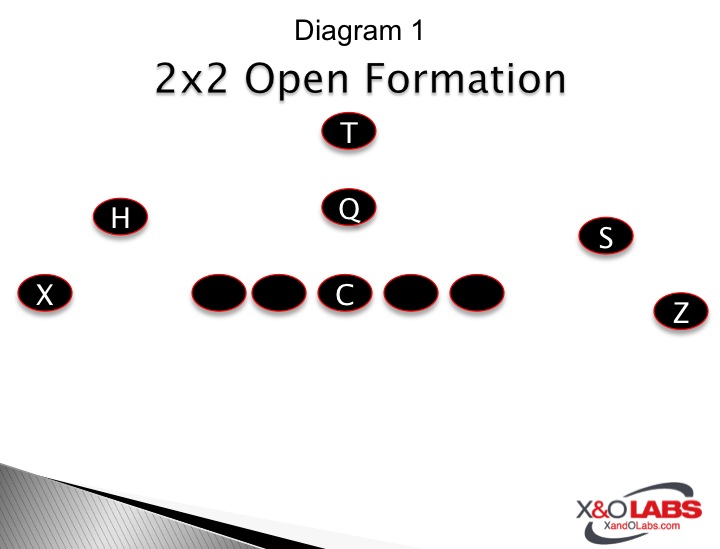
2×2 Open Formations (Diagram 1)

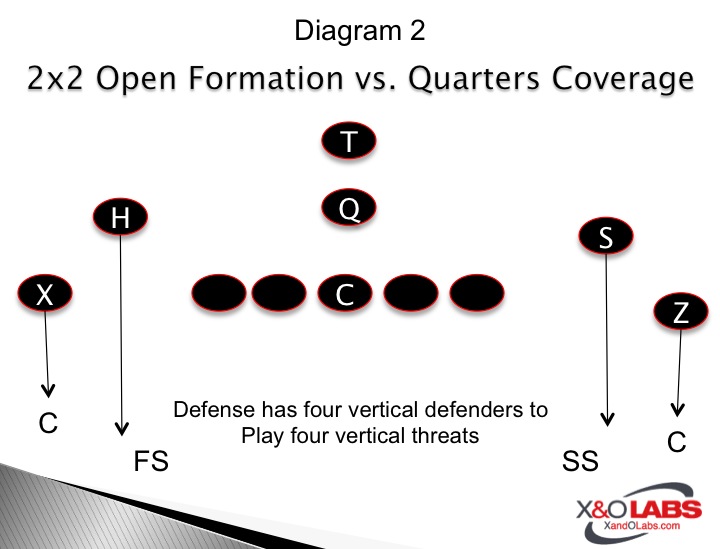
Always a topic of conversation among coaches that use Quarters Coverage is how best to handle 2×2 formations.  It seems that the structure of Quarters coverage itself is ideal for 2×2 formations because you have the ability to handle four vertical threats with four secondary defenders without risking any underneath defenders in coverage (Diagram 2).   Once the slot receivers are able to cross linebacker depth, a safety is able to jump them right away.  Playing Quarters coverage against four vertical threats often gives offensive coordinators problems because a defense forces a tight window (between the second level and third level defenders) to place the ball.

But while a defense could be protected vertically by using Quarters coverage, horizontally it could be an entirely different issue.  Offenses can use Post/Wheel or slant/arrow combinations to attack defenses in the flat, which is an area of constant vulnerability of Quarters defenses.

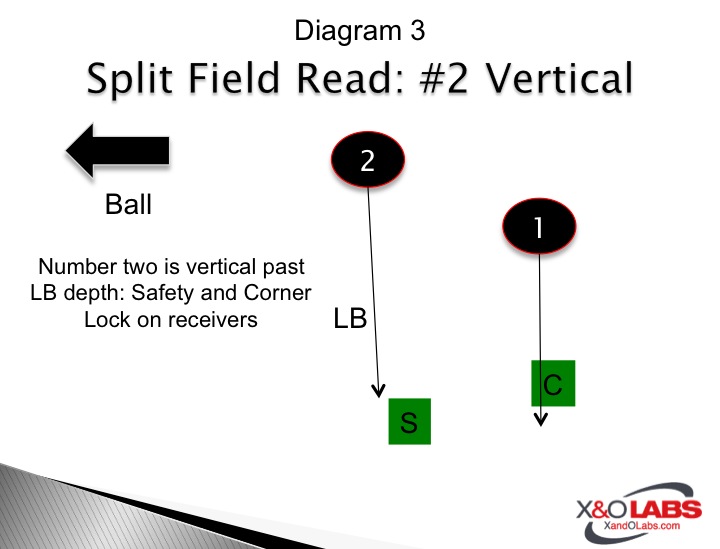
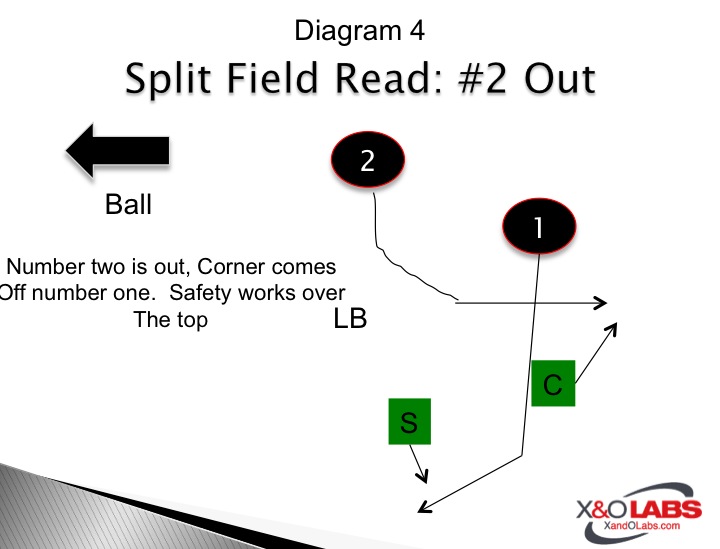
One answer to this formation is to play what amounts to a Soft Cover Two check against two receivers to one side of the formation.   This essentially protects defenses against the threat of number two on a wheel or flat breaking route because the Corner will play any number two receiver on an out-breaking route.  It’s called “two read” because both the Safety and Corner are reading number two based on his release.  His release can be all of the following variants.

Two-Read Coverage Rules:

In this type of coverage, the Corner’s rules are simple:

  • If number two is vertical (past linebacker depth) stay on number one (Diagram 3).

  • If number two is out, get off number one and play number-two (which is essentially becomes the new number one) (Diagram 4).
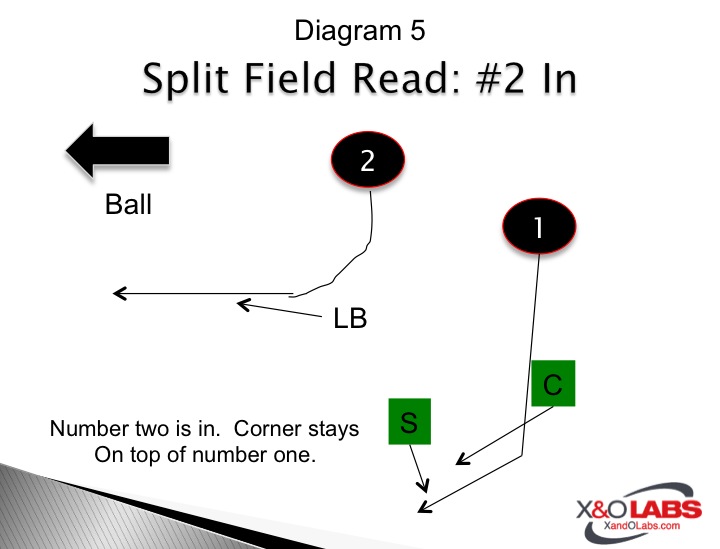
  • If number two is in, stay on top of number one (Diagram 5).

Alert Call

Since it is the defensive backs making these adjustments on field, anytime the offense comes out with a detached number two receiver and could be a vertical threat, Shap Boyd, the defensive coordinator at Muskingum College, uses an “Alert Call” made by his Safeties.  His rules are below:

Alert Call Rules:

CB Rules:

  • Squeeze #1 until #2 crosses your vertical
  • Do not chase, zone your quarter
  • If both WR disappears, then you can squeeze if #2 is running to the post or seam.
  • Watch the QB thru 3 steps before snapping eyes back to #1.
  • Flip your hips and skate

Safety Rules:

  • 12-15 yards off ball, on top of #2
  • If #2 is vertical- lock on #2
  • If #2 is out- get eyes to #1
  • If #2 drags- eyes go to QB and find work
  • “Don’t got until you know.  Find out what #1 is doing.”
  • Will LB must wall #2, look to #1 and expand for #3 pickup

The benefit of the Alert call is keeping the outside linebackers close to the core in run-downs.   Since both outside linebackers don’t have flat responsibilities, it allows them to stay what Boyd calls “the hip position” on the defensive end to their side.  Boyd uses it more on run downs or what he calls “tweener” downs when he’s not given a tendency on a run or pass.

Read More

Quarters Coverage: Case 4 – Defending the Problem Areas

By Mike Kuchar

Senior Research Manager

X&O Labs


In an effort to make sure we were as thorough as possible in our research, we wanted to devote this last case to defending the various “problem areas” in Quarters coverage.  We all know that every coverage has its weaknesses, and Cover four is no different.  So we asked some of our sources directly, how they best defend the following “Quarters beaters” that offenses will use against it:

  • Double Post Routes
  • Three-level Flood Concepts
  • Post/Flag “Scissors” Concept
  • Mesh or Shallow Cross Routes
  • Boot and Naked Pass Game

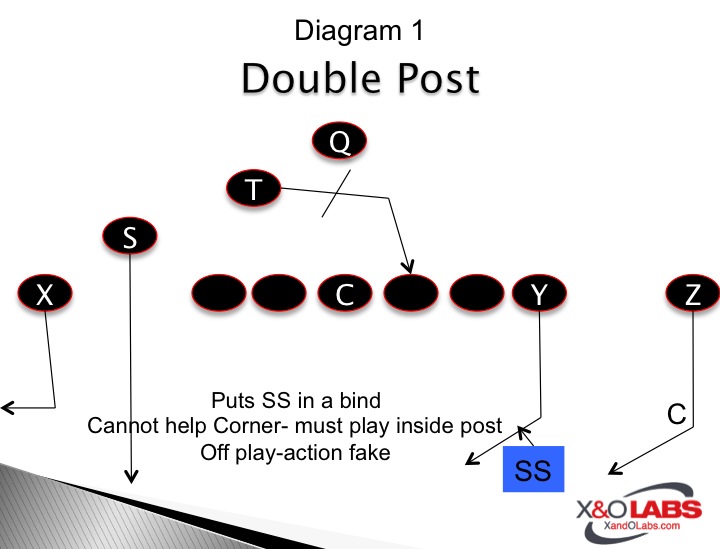
Problem: The Double Post Route (Diagram 1)

Perhaps the most popular Quarters coverage beater is the double post concept.  As shown above, the purpose of the double post is for the number-two receiver to occupy the deep safety, opening up the middle of the field for the number-one receiver.  It’s a concept most successfully used with a run-action fake, just to get the Quarters safety downhill to open up the middle of the field.  Take a look at a clip from last season’s Outback Bowl to see how the University of Michigan was able to scorch South Carolina on the double post concept out of an unbalanced formation.

Read More

Counter Gap Concepts from Auburn’s Slant Formation

By Mike Kuchar
Senior Research Manager
X&O Labs
Twitter: @MikekKuchar


Editor’s Note: The following research was conducted as part of XandOLabs.com special report on “Spread Gap Schemes Study,” continue reading for more details on this exclusive special report…


Slant Formation:

shilohShiloh Christian High School (AR): Coach Conaway at Shiloh Christian High School, a Gus Malzhan disciple, prefers to use his Slant formation to run the Counter scheme. Similar to the Stack formation that was detailed in case two, “Slant” tells the A-back, or ball carrier, to align away from the sniffer. Coach Conaway pairs this formation with Buck Sweep, so once defenders start to overload to the twins side, counter becomes a viable solution. Coach Conaway details the blocking rules in his Counter scheme below.

Read More

Inside Zone: Introduction


By Mike Kuchar

Senior Research Manager

X&O Labs


slipperyrock zoneIntroduction

“It all starts with the inside zone,” is a reoccurring coaching maxim that we’ve heard over the last decade.  The inside zone is often the first concept installed on the first day of spring and summer camp every season.  It’s a physical, downhill run scheme that relies on the vertical displacement of defensive lineman and linebackers at the point of attack, giving the running back an opportunity to find an exploit open gaps for yardage.  Yes, we got all that.  We know the scheme, but do we know the best way of teaching it?

Ask most offensive line coach and they will tell you that the zone run game may be the most sought after topic of conversations at clinics.  Questions like:  Where do you like to run the scheme? How do block combinations?  When should you come off linebacker depth?  What does the back read? bombard these coaches on the clinic circuit.  So, these were the same questions we sought answers to in this special report.   The fact is 40.9 percent of coaches use the inside zone scheme for nearly 26-50 percent of their offensive run game.  That means one out of every four runs is the inside zone.  Not surprised?  Well, neither were we.  Naturally, a scheme that is utilized by over 75 percent of the programs in the country should have plenty of resources to tap into and that’s exactly what we did.  We found that 42.7 percent of coaches say they averaged between 5-6 yards per carry on the inside zone and that was the majority.  We were curious to find how different these were running the scheme and what they were doing to give them that rate of efficiency.  So we went right to the source, probing the coaches that told us why they were successful.

Before we present our research it should be pointed out that this special report is more centered on the techniques, not the schematics of the inside zone run game.  Again, we all know about the schematics inside zone- we’ve been hearing about it for decades- this is more about how to block it.  


Ball Carrier on Points of Attack and Reads

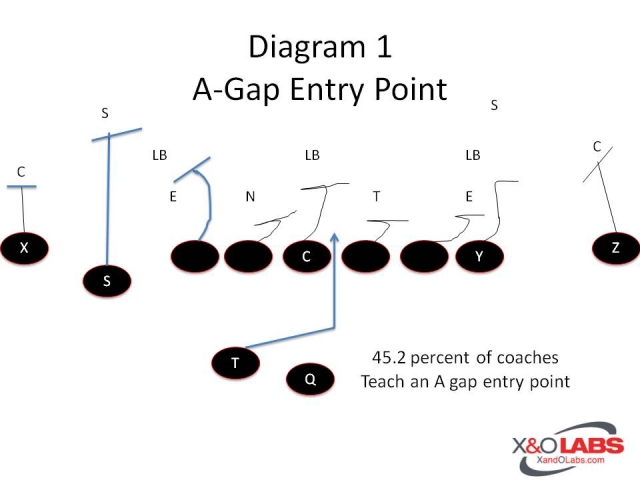
Because so much of the success of the inside zone is predicated on the displacement of linebackers, we thought it necessary to present information on the play of the running back.  After talking with so many offensive line coaches when researching this project, there were plenty who talked about how the running back can often make or break the play.   While it should be noted that many coaches teach the inside zone as a cutback play, according to our research 45.2 percent of coaches say the front side A gap is the most used point of attack in the inside zone scheme (Diagram 1).   Longtime NFL coaching veteran Jim McNally is one of those coaches who prefers to run the tight or inside zone right up the butt of the Center to the play side and believes it’s the back’s job to “cram it up in there” without hesitating. 

Slide1

Read More

Inside Zone: Case 1 – Offensive Line Communication/Pre-Snap Protocol


By Mike Kuchar

Senior Research Manager

X&O Labs


galludet zoneIntroduction

You have to know who to block before you block them.  Although the inside zone has a concept may be elementary in nature- just block your gap- but because of the constant pre-snap movement of defenses it’s important your players understand how this affects their blocking responsibilities.  In this case, we will report the various ways in which coaches teach their lineman to block the inside zone. 


Offensive Line Splits

According to our research, 63.6 percent of coaches say a two-foot split along their offensive front is most suitable when running the inside zone scheme.  While most coaches preferred a horizontal split of two-feet along the offensive line, some coaches like 23-year NFL veteran Tom Lovat stressed the importance of the vertical alignment off the line of scrimmage.  Lovat talked to his players about creating the neutral zone so that his offensive lineman had almost a yard before they made contact with the defenders.  “Our earhole would be on the belt buckle of the Center,” said Lovat.  “The defensive linemen have to align on the ball.  So this creates an area where you can be moving forward all the time.  You shouldn’t have to move laterally.  Even if you’re covered, that player is a half of a yard off you anyway. If you crowd the ball he’s up in your face.  By the time you’re foot is off the ground he would stuff you.” 

There are still a faction of coaches- 26.1 percent- that do prefer a split of three feet along their offensive front.  These splits have been made more common with the Mike Leach school of thought of extending the front to open larger run lanes for the back.  Leach keeps his splits at three feet for a variety of reasons that he explained to us on the record back in 2011.  “To me, the ultimate offenses in terms of distribution are what we do and the old school wishbone offense and both of them have wide splits with their lineman.  We would do it for zone run lanes and pass blocking assignments because the edge guys are now wider from the QB than they would be.  We start out at three feet.  If we had no trouble in blocking them than we would widen, if we had trouble then we’d tighten them.  Defenses would try to keep a guy in the middle of a gap and shoot that gap, if they did that we would keep it at three feet.  We would just take deeper drop steps to get angles in our run game. No defenses ever had success in doing that [shooting gaps] against us because, again, it wasn’t something they would consistently do so they weren’t comfortable in doing it.  They’re not good at just shooting gaps because they haven’t done it except for three practices in preparing to defend us.”


Identifying Fronts:  Numbers or Concepts?

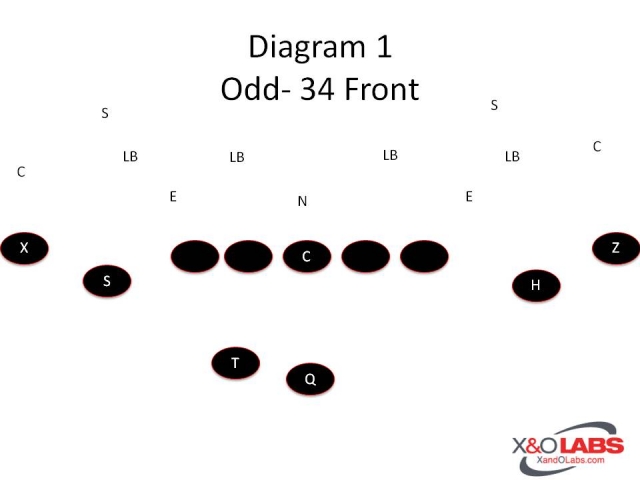
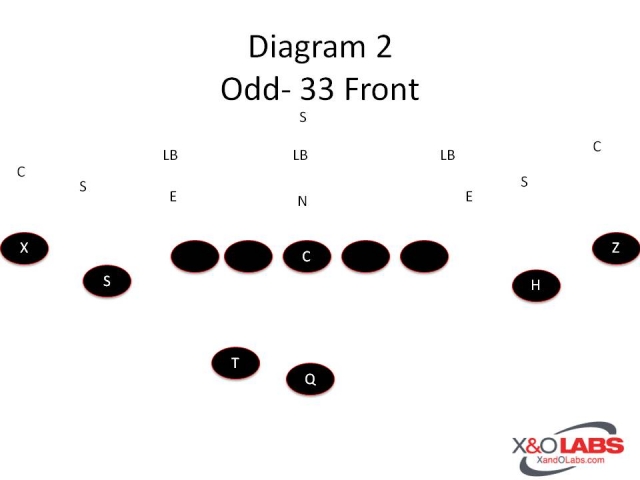
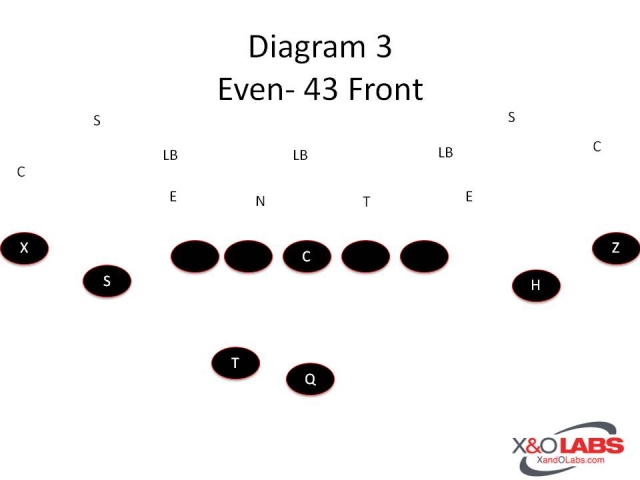
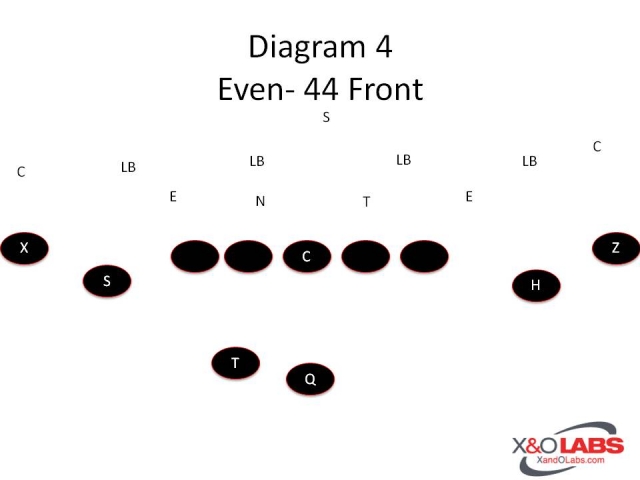
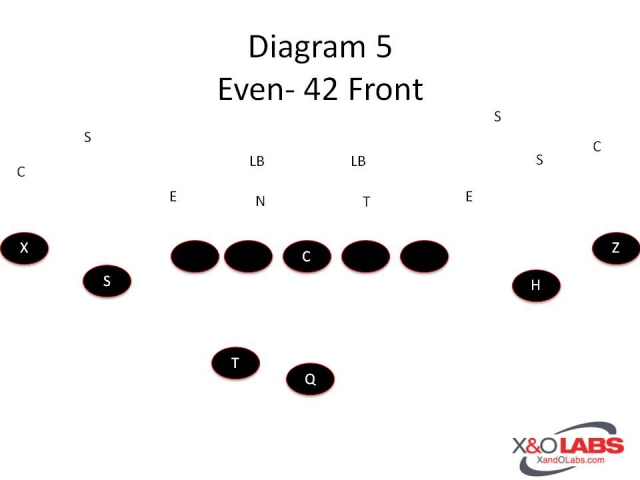
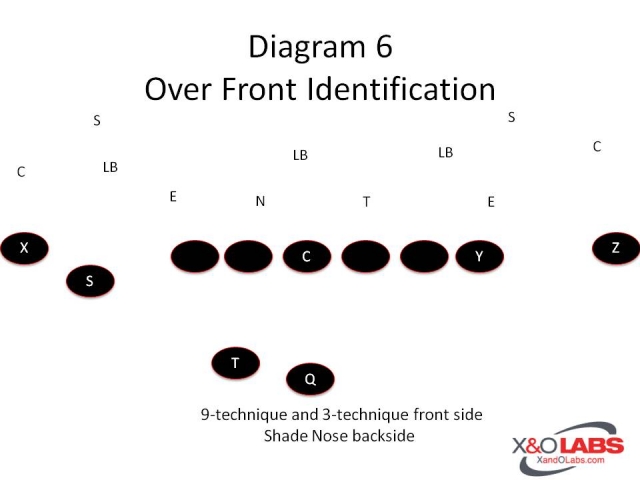
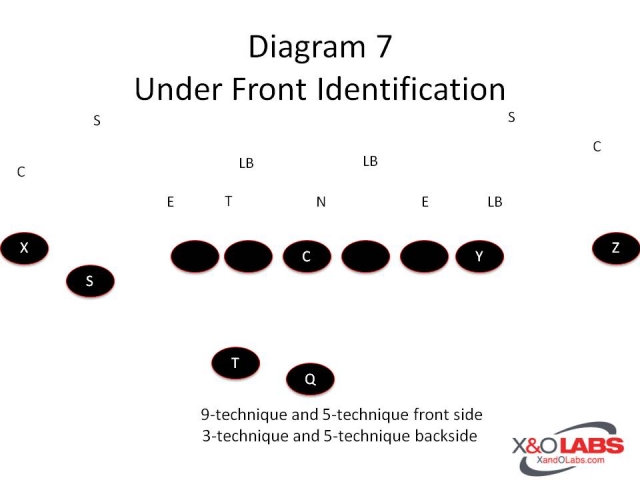
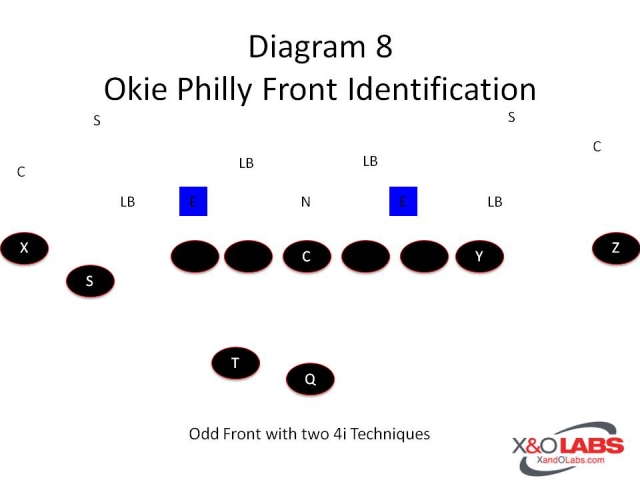
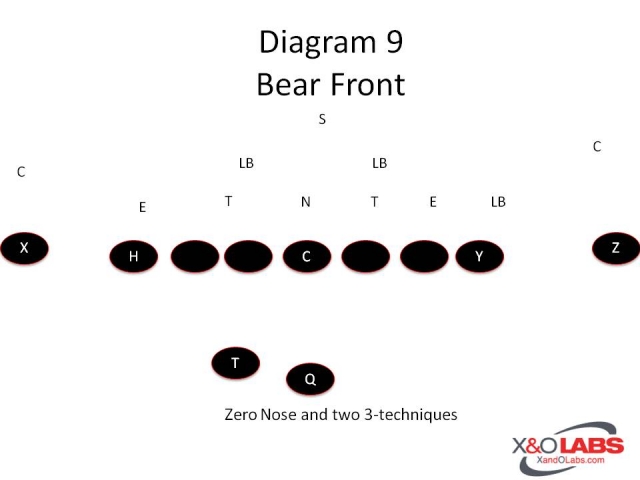
Once the splits have been determined, a decision needs to be made on how to identify various defensive fronts to run the zone scheme.  While there may be differences in opinion on this, the majority of coaches- 37 percent- use a concept identification system such as even or odd front.  In its simplest form an Odd front is any front where the offensive guards are uncovered such as a 3-4 (Diagram 1) or 3-3-5 (Diagram 2) while an Even front is typically a four down front such as a 4-3 (Diagram 3) 4-4 (Diagram 4) or 4-2 (Diagram 5).   This is similar to what Clayton Hall, an assistant coach at Gallaudet University tells his offensive linemen.   Hall is more specific with concept names.  He will tag an “Over front” as a 3-technique and 6 or 9 technique front side with 1-technique backside (Diagram 6).  He’ll term an Under front with a shade, 5- technique, 9-technique front side and a 3-technique and 5-technique backside (Diagram 7).  He’ll term “Even Stack” for any  4-4 or 4-2 front and he’ll term “Okie” to any base 3-4 defense with two 5-techniques with the exception of “Okie Philly” for any Odd Front with two 4i techniques (Diagram 8).    Finally, “Bear” would denote the 4-6 front with two 3-techniques (Diagram 9).

Slide1Slide2Slide3Slide4Slide5Slide6Slide7Slide8Slide9

Read More

Inside Zone: Case 2 – 1 on 1 Block Fundamentals and Techniques

 By Mike Kuchar

Senior Research Manager

X&O Labs


su zoneCOVERED LINEMAN TECHNIQUE

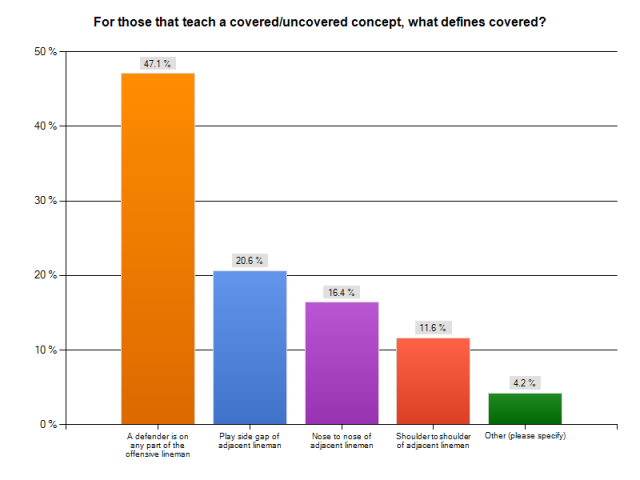
Since there can be several examples of what a “covered” lineman is, we will detail the following examples of what a covered lineman can be.   We’ve found that the technique of these covered offensive lineman can change based on the alignment of the defender. Although the pre-snap leverage of the defender may change, as it relates to footwork, we’ve found that 36.1 percent of coaches teach the far number (or widest number) of the defender as a visual landmark in inside zone schemes.    

q11


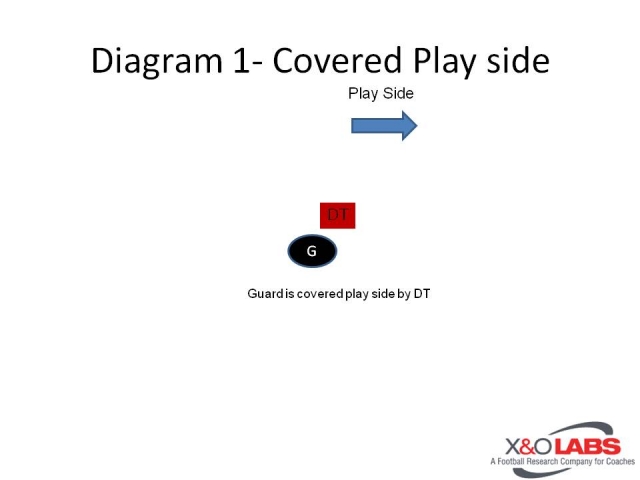
Covered Play Side (Diagram 1)

Slide1

Double Under Technique

The Double Under Technique is a relatively new technique- we’ve found it to be around four years old- that many higher level coaches are starting to teach to their players.  We first heard the technique discussed by well-reputed Penn State offensive line coach John Strollo.  By definition, the double under technique is a tight elbows, double under lifting motion (with palms up, not thumbs out) strike.   Jim McNally calls it a “fish bowl” strike, to simulate picking up a fish bowl with both hands under the bowl.   Although the visual aiming point may change, former NFL coach Bob Wylie tells his players to put their helmet one inch outside the sternum of the defender when executing this block.  “ We tell them they will never usually get one inch outside the sternum so they wind up getting their helmet on the play side number,” he told us.  “If I tell them to put the helmet on the inside number, it may wind up on the outside number.” “The shorter the steps the better,” said Wylie.  “It becomes a tight elbows, double under lifting motion.  We’re trying to get underneath him, but we want both feet on the ground on contact.  “When you strike, your feet keep going and it’s a lifting action.  You want to keep your momentum going further.  The farther you turn your thumbs out, the stronger you feel.  You’re trying to hit him with the bottom part of your hand.  You may not get that but if you may get it. You can tell where you’re elbows are.  If you don’t see any light between the elbows and body, it’s a pretty good chance the hands are where they need to be.”

Jim McNally is a huge proponent of the double under technique.  In the video below, he describes the technique and the drills that correspond with it. 

Note: This video was granted with permission from of the School of the Legends. You can find other technique related videos by visiting their website http://www.sotl.com.

Read More

Inside Zone: Case 3 – Combination Block Fundamentals and Techniques


By Mike Kuchar

Senior Research Manager

X&O Labs

Introduction

This case is focused on the techniques that are taught when combination blocking the inside zone scheme.  These are used when two offensive players are responsible for blocking two defenders.  Before we start to address the “how” used by coaches to teach this technique, we’ll start with how lineman are taught to identify the “who” to block.  

IDENTIFYING SECOND LEVEL TRIGGER POINTS

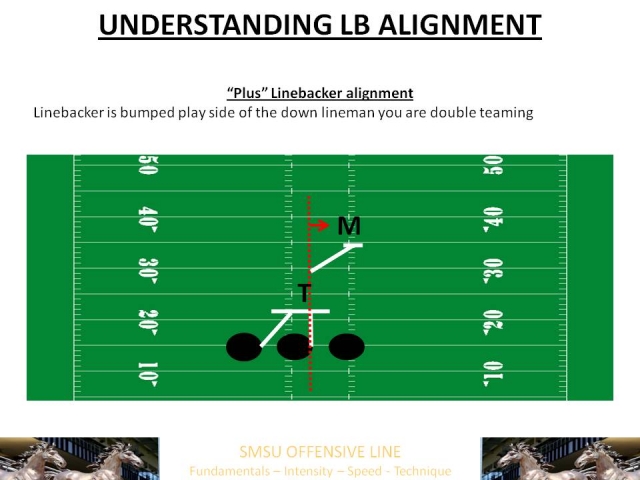
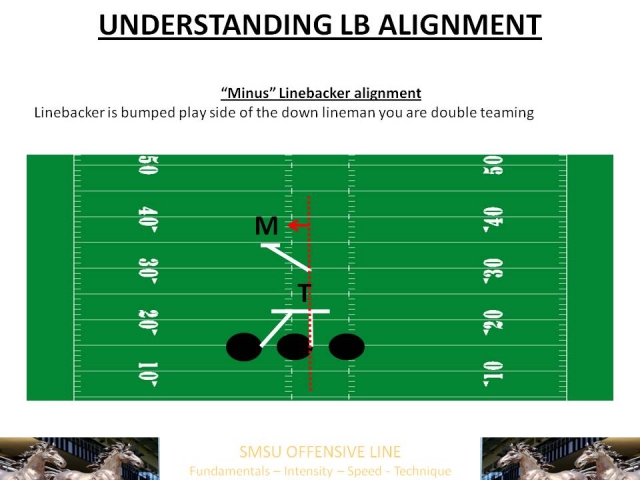
Many coaches put a premium on identifying the leverage of the second level player that the combination will be working up to.   Lineman need to not only identify the linebacker they are working to, but also understand where that player is situated the footwork needed to get there.  Jeremy Darveau, the offensive line coach and offensive coordinator at Southwest Minnesota State University, is one of those coaches that educate his players frequently on the location of linebackers.  Darveau talks about a “Plus” and “Minus” leverage point for linebackers.  A plus alignment refers to the play side linebacker being “plussed” over, which means wider from the box (Diagram 1).  In this situation, Darveau schools his play side offensive lineman to expect to climb to linebacker level while he tells his backside offensive lineman to sell out to reach the down lineman because of the little chance of him climbing to linebacker depth.  In order to teach the reach, Darveau uses a bucket step, which he calls six inches off the line of scrimmage and eight inches width.  “We want to cover the width of the defensive lineman with the depth of the first step,” was Darveau’s coaching point.    “We are going to expect more of a stretch here,” Darveau told us.  “They really don’t need to get off the double team because there is a good chance that 3-tehnique will spike into the A gap and the Center will wind up taking him over.   In a minus alignment (Diagram 2) the linebacker is tighter to the box.  This would essentially, switch the roles of the lineman.  The backside offensive lineman should now be prepared to climb to linebacker depth while the play side offensive lineman should be aggressive with his second step to get vertical displacement.   In this situation, Darveau teaches more of a flat step to his uncovered offensive lineman because of the probability of getting more of a vertical, not horizontal push.  Darveau’s flat step is what he calls enough of a first step to get to outside framework of covered defender.  It’s an aiming point of the play side number in 7-9 inch area.  “He must stay square in that situation,” said Darveau. 

Slide1Slide2

Damian Wrobleski, the former offensive line coach at Rutgers University this season, also uses an indicator system to identify linebackers in the zone run game but he uses a “thick” vs. “thin” scenario.  Thick is the terminology that refers to a situation where a second level linebacker is tight to the Center, which requires the offensive lineman to get more of a piece of him.  The linebacker could be either head up on the offensive lineman.  “In this case, he will use more of a shoulder point and lift technique on first level defender,” said Wrobleski.  A “thin” situation means the second level player is wider, requiring the offensive lineman to not get as much a piece of him.  “In this case, we’ll teach the lineman to use more of a side flipper or hand just to deter him and work to linebacker depth,” said Wrobleski. 


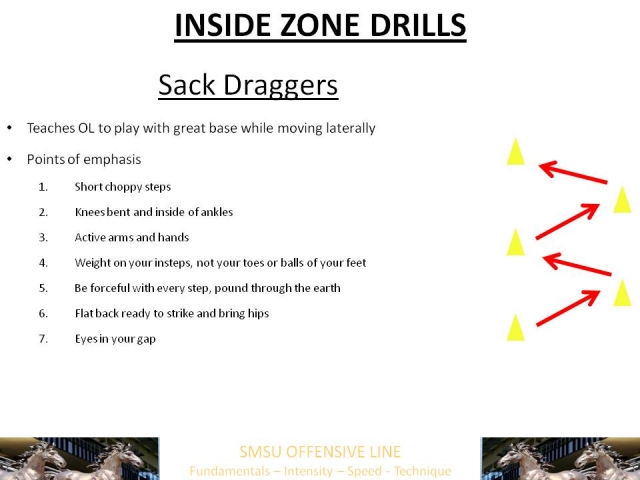
There are two main drills that Darveau uses to teach his offensive lineman block linebackers in space.  One of these drills that Darveau organizes is what he calls Sack Draggers.  It teaches lineman to be able to play with a great base while moving laterally.   The points of emphasis of the drill are below (Diagram 3).

1Slide1


To see video of the Sack Draggers Drill, click on the link below:

Read More

Horizontal Read Options (HROs) Off Jet Sweep

By Jeffrey Russell
Offensive Coordinator
Wethersfield High School, Connecticut
Twitter: @coach_jrussell


Introduction:

russellRPOs have been a major part of our offense for the past couple of seasons in part because of the type of QB we’ve had. This season we replaced our all-state QB with an athlete who was one of our leading receivers the previous season. A lot of time was spent in the offseason as well as the pre-season developing a game plan/offensive identity that fit our new personnel, especially in the backfield. We needed more than just the Zone Read and the Power Read to stretch the defense with our speed at the skill positions as well as our running ability with the QB.
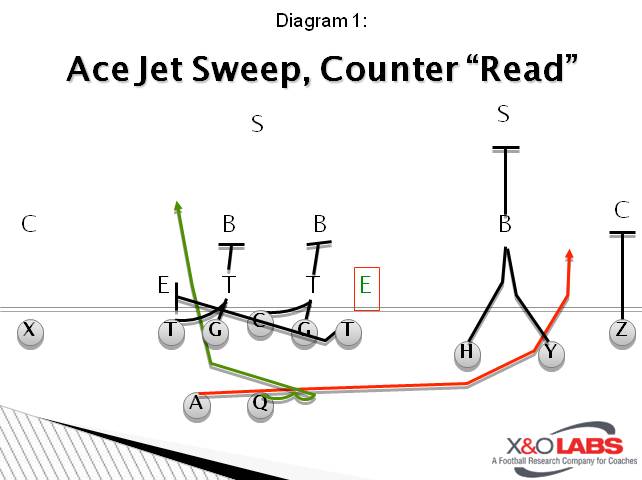
Our horizontal run read or “HROs” are designed to stretch the defense and force them to stop the run from sideline to sideline, hopefully slowing down our opponents ILBs and keeping them honest (Diagram 1). These packages aren’t entirely new, but just a combination of traditional Zone Read and Power Read. This season, HRO’s were a small part of offense but we still managed to average 8.5 yards per play (including plays where the QB predetermined and/or made the incorrect read).

Slide1

Zone Read Elements

Much like the Zone read, the play is designed to stress the front side and the backside of the defense. Since the read comes from the play side DE and not the back side DE, it helps to eliminate some of the strategies that a defense will use to stop zone read (i.e. scrape exchange).

Power Read Elements

Much like the Power read, the play is designed to stress the assignment of the “end man on the line” (EMOL). In a 4 man front, the edge player or EMOL is usually a pretty easy read just based off of alignment. Against a 3 man front, the read gets a little more challenging as it’s usually unknown pre-snap whether or not that EMOL is going to be a “C” Gap/Contain or a “B” Gap player.

Play Call and Concept

We are a no-huddle varying tempo offense that uses hand signals to send plays into the QB and the rest of the skill players. The QB then provides the offensive line with a “code word” and a “call side” to let them know what run concept they’ll be blocking. Because of this, the offensive line is sort of “in the dark” when it comes to knowing who the ball carrier is and where they’re going. This is fine because it’s all apart of the true “sell” of both concepts by the offensive line and the skill players.

If you broke the hand signals from the sideline down into a sentence it would read (after the formation) “Running Back Jet Sweep Left, Counter Right, Read,” as an example. The skill players are looking for the initial information of which player is tagged and what concept they’re running. They are taught (in our offense) that the “Jet Sweep” is always blocked by the skill players when a “run play” follows in the signals. When a pass concept is signaled following the jet sweep, the receivers will run the pass concept instead of blocking the Jet Sweep (this would be in our RPO concept).

The QB is taught to look for the “READ” hand signal, which tells him what information he’ll be providing to the Offensive Line. If the signal came in as “Running Back Jet Sweep Left” then the QB would be providing the offensive line with whichever code word represents “Jet Sweep” in our offense, but once you add in the “READ” hand signal at the end of the play call, the new preceding run blocking concept would be relayed to the offensive line.

The Decision

I don’t always like to refer to the EMOL as the read player, because a lot more goes into deciding whether or not we hand the ball off to the running back or keep it. For example, our QB will make an RPO count on every play. He does this on both sides of the formations allowing him to always know “who the read” player is on RPO concepts. This simple math also lets us know whether or not we have a blocking advantage in the Jet Sweep or not. While this count might slow players down initially, but in the end it’s no different than having a player count the box to determine run/pass.

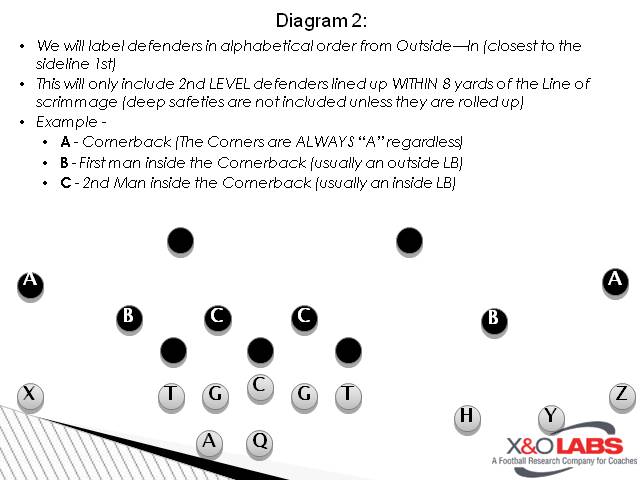
If we are running an RPO, we label defenders in alphabetical order starting from the CB or the defender closest to the sideline (Diagram 2).

Slide2

Note: for more on this approach to labeling players, read the report by Western Connecticut’s Drew Owens.

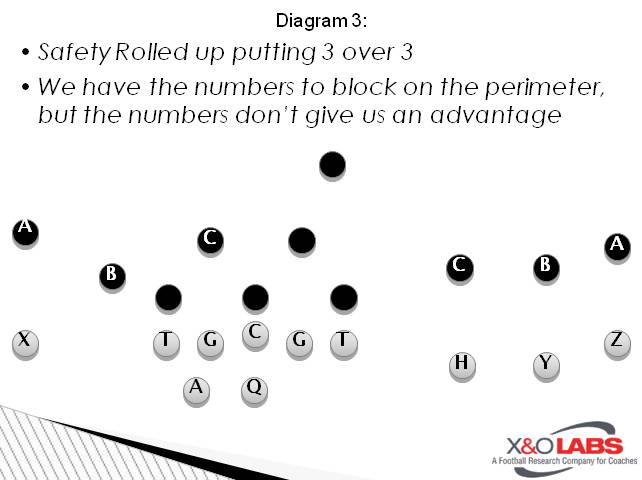
We only count players who lineup within 8 yards of the LOS before the snap. Often times, if a safety’s pre-snap alignment puts 3 defenders over our 3 receivers, then it will make the “pre-snap” decision for us (Diagram 3). Slide3

Read More

Using Trips to the Field Exclusively

By Kurt Earl
Head Coach
Lincoln Christian School (Lincoln, NE)
Twitter: @KurtEarl14

Introduction:

lcSeveral years ago as we transitioned into a 100% no huddle offense, we realized we weren’t operating at a pace that was actually giving us a competitive advantage. As we began searching for ways to shave off extra seconds in between plays, we soon realized one of the things that was slowing us down the most was changing formations nearly every play. Changing formations took up time while signaling the play in and while players moved into the formations. Thus, we began to tinker with the idea of running one formation exclusively throughout a game.

Over the past five seasons, we have used one formation almost exclusively on offense. While we have used other formations at times we have never entered a game with more than three formations in the game plan. There are three important factors that you have to understand if you are going to run 95% of your offense from one formation. First, you have a to pick a formation for your offense and your understanding of how to attack a defense. Second, you have to embrace a “take what they give us” mentality and drop a “this is our bread and butter” mentality. Finally, you have to have answers to the defense’s potential adjustments to your play-calling.

Why Trips to the Field

Over the years, I have evolved into a true spread option, RPO, zone-based blocking scheme coordinator. When I see a defense line up against 10 personnel I immediately start to see zone reads tagged with bubble screens, inverted veer, four verticals off of play-action, etc. Therefore, as we’ve traveled this journey towards becoming a one formation offense I’ve settled on a formation that fits my thinking as a play-caller.

If you don’t think about offense the way I do, it would be a mistake for you to copy what you see me doing in this article. If you’ve been a Wing-T guy for years than you need to pick a Wing-T friendly formation. If you’ve traditionally used more of a pro style approach than pick a formation that is conducive to calling pro style types of plays.

The point I am making here is that we settled into what we call an Open formation because it fit the way I have learned to attack a defense. Our open formation is a 3×1 formation, with the trips to the field, using 10 personnel. From that formation, I have all of my favorite options available to me. I can run my base RPO, speed option, inverted veer, etc. I can isolate my best receiver on the boundary side and attack with verticals or spacing concepts on the field side. The point is, I suggest that you take what I share here and find ways to apply the principles and ideas to your way of thinking about offense.

“Take What They Give Us” Mentality

You don’t have to be a football genius to know that there are too many defenders in both of the diagrams below. The point I am making with those diagrams is that most defenses line up in either a 4-2 or 3-3 front and the only real difference between defenses is the location of the 11th man. Yes, there are dozens of possible variations to the defenses in the diagrams, but you can begin to anticipate most of those as you study film. Each DC only has a handful (or fewer) variations he’s comfortable running against our tempo and the diversity of concepts we bring from our one formation.

Slide1Slide2

Read More

Army’s Two-Gap Technique to Defend Zone Runs

By Mike Kuchar
Senior Research Manager
X&O Labs
Twitter: @MikekKuchar


Editor’s Note: This research was conducted as part of XandOLabs.com special report on “Odd Front vs. the Run Game,” see below for details…


This is a technique used by Army defensive coordinator Jay Bateman 50 percent of the time in base situations, mainly when the back is set away to the side of the open side end. It’s a technique used when the defensive end is working with a linebacker to defend two gaps. It eliminates the ball hitting on a linebacker or safety. “If we play Robber defense, where we get speed receivers to the field, we will have the defensive end play both B gap and C gap because we don’t want that safety being the only player to play the C gap,” said Coach Bateman. “The Mike and Will can play a backside gap (Diagram 4). If the offense is in a gun formation with the back away from me, I’m a kill player. I will go up and under on that offensive tackle. It’s a jab step and come underneath. It’s a two-inch step. I just want the line to come with me. When they can’t use another blocker on you in a two-man surface, we know where the back is coming from based on everything else we know. If the zone is coming to me, I may take an up field step and then come underneath.”

Read More

Defending RPO and Triple Option – Case 4: Man Coverage Structures to Defend Run/Pass Option Concepts

By Mike Kuchar
Senior Research Manager
X&O Labs
Twitter: @MikekKuchar

Introduction

When we first conducted our research on defending RPO concepts, we were under the assumption that many defensive coordinators will use man coverage structures against them. But as noted in case three, the majority of coaches decide to use split field coverage principles against these types of concepts. This is done in order to negate certain types of route structures based on field/boundary, formation or personnel tendencies. However, there are pockets of programs- such as the ones studied below- that believe whole heartedly in utilizing pure man coverage structures (either cover zero or cover one) to defend RPO concepts. We found that while man coverage concepts may be easier to teach, the success of using these principles are tied to the fundamentals in which they are taught. We examine the different man coverage fundamentals coaches are using in this case.

We decided to segment our research in this case to certain coverages that coaches are using to defend RPO concepts. We also detail which types of RPO concepts or constraints (stick draw, zone bubble, zone pop, etc.) that these coverages are efficient in defending. This case will focus on zone-based configurations, whether it be split field variations or whole field variations. Our research shows that 14 percent will use man coverage principles to defend the RPO game.

We selected four sources that have had a win percentage of .750 or higher in defending these offenses to explain how they were successful. Their system analysis is below.

Source 1: Westfield High School (VA) 
Defensive Line Coach Mike Giancola

Run First/Pass First Methodology:
According to Coach Giancola, where it all got challenging in defending RPO concepts is with teams that started recognizing players that were responsible for the run and the pass. “We had to struggle with the number of adequate guys in the box and an adequate number of guys in the secondary playing pass,” said Coach Giancola. “So teams started running RPOs like fade out and not only picking on an overhang, but seeing what our second level flat defenders were doing. We’ve also seen teams letting the window open up more off the read player and taking a shot on us 15 yards down the field.”

Because of this, Coach Giancola and the rest of the staff started to designate at least one player, mainly a linebacker, to play the pass regardless of his run read. There was a different pass first defender based off the coverage calls. “We have to tell that kid if you get a run read and you are the pass player you have to slow yourself down and alert yourself to the near receiver on the tailback side,” said Coach Giancola. Since many RPO concepts are tagged to the side of the back, it’s that receiver closest to the back that needs to be accounted for in the RPO game. “We tag these with coverage calls,” he said. “In all of our coverages and fronts we know who is pass first or run first. Linebackers need to be run first players or otherwise dictated. We found that tagging the coverage with something like a ‘Tampa’ or ‘Trace’ that you can slow down on the run and favor pass.” Coach Giancola was clear that when that player does see the ball handed off they come up and make the play. “The linebacker reads line through the tailback,” said Coach Giancola. “You see run read and see the mesh point, the next place your eyes have to go is the near receiver to the tailback side for the pass.”

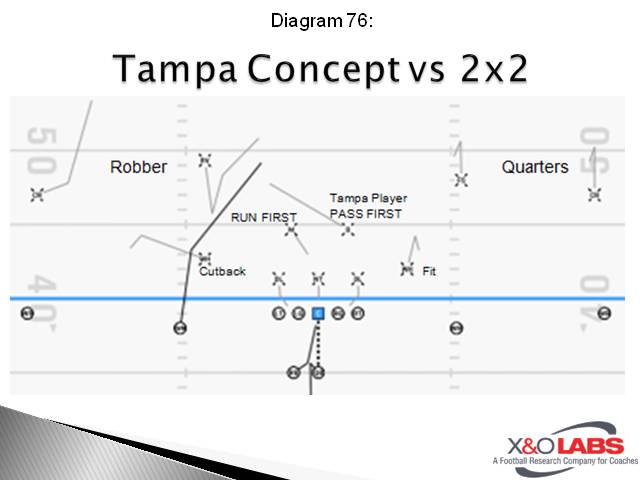
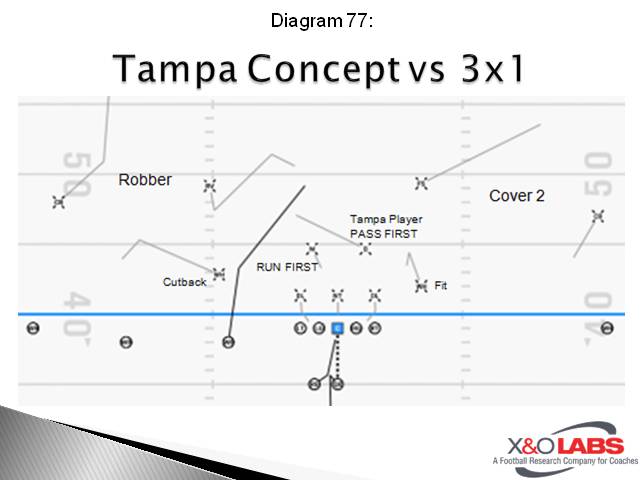
Coverage: Tampa
Constraints Defended: 2×2 and 3×1 Backside Pop or Skinny
Tampa tells the secondary Mike linebacker, or linebacker away from the back, that he needs to key the receiver closest to the tailback side. “We do this with teams that run the number two receiver down the seam with the back to the same side,” said Coach Giancola. “We needed to give our guys help underneath in the secondary because when linebackers were forced to play the run it opened up a hole in the play action game.” Coach Giancola will not give that player a run gap responsibility. The overhang away from the back will be tied into the fit as the C gap player; the defensive end will play the B gap and the nose can two-gap technique. The apexed linebacker away from the pass first player plays cutback, while the first linebacker play side is clued in on the run. “We protect him inside with 4i-techniques he can be late to the football,” said Coach Giancola. He will play a robber concept to the field and a quarters concept away.

Slide76Slide77

To study game cutups of Tampa coverage against RPO concepts, click on the video below:

Read More

Seams and Verticals to Stress Third Level Defenders

By Lee K. I. Boyd
Wide Receivers Coach
Saint Louis School (HI)


Introduction:

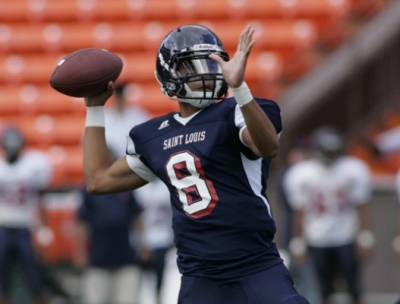
MariotaHere at Saint Louis School, we’re a no huddle Run and Shoot offense. As part of that scheme, the majority of routes will adjust post snap. We do this to get the best routes against the coverage we face each down.
Orchestrating the offense to the degree in which it appears organic and fluid in nature along with our receivers attacking coverages with controlled natural instinct is critical in this offense. It requires us to invest much of our time teaching players how discipline their thought process. This increases the accuracy of their decisions by making them recognize when and where to put their eyes as they root themselves in the moment of the play.

Our philosophy is simple. We’re going to get good at what we do. We line up in 3×1 and 2×2 and play fast. The simplicity of our formations plus tempo allows us to always see the defenses alignment pre-snap, regardless of coverage scheme. When the play starts we’re going to execute what we do, better than you execute what you do.

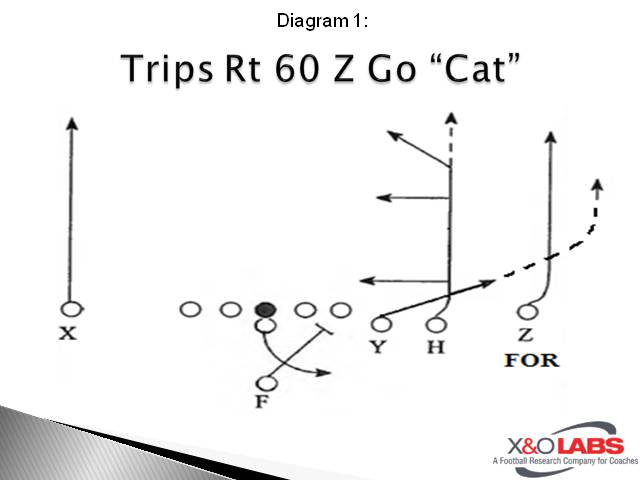
“60 Z Go”

Our base concept is what we call the “60 Z Go.” The go route sets up everything else in the offense, so we start teaching it on day 1. The transferability and versatility are some of the best aspects of this play.

Slide1Slide2

The whole process for us starts in the spring. At that time, we teach our players the strengths and weaknesses of coverages. This facilitates their understanding as to why our routes change so we can inflict the most damage to that coverage. Although there are multiple variations of coverage we put them into 5 basic categories. We want to keep it simple so that we can play fast and get the receivers and quarterbacks on the same page.

The coverage concepts that we teach are as follows:

  1. 3 deep zone “Cover 3”
    1. Cover 3 Sky –Safety is the flat defender
    2. Cover 3 Cloud- Cornerback is the flat defender
  2. 2 deep zone “Cover 2”
    1. 2 deep man under
  3. 4 deep zone “Cover 8”
  4. Man free
  5. 4 across man (blitz)

Back Side #1 Receiver “Up Route”

The back side receiver will align at the bottom of the numbers and execute an up route. He is responsible for creating a vertical stretch on the defensive coverage and preventing the backside cornerback from becoming a factor to the playside.

The up route receiver has two key jobs on this play. First, he must tie up the coverage on the backs side of the concept. Secondly, he must also test his cornerback’s use of cushion both pre-snap and post-snap (backpedal) regarding his ability to sustain his coverage responsibility. Determining his potential advantage to get vertical on the defender, gives the receiver confidence and lets our play caller know we can attack the weak side cornerback with our “Choice” concept when he’s put into a one-on-one situation.

Read More

Teaching Contain, Chase, Inside and Outside Blitz Angles

By Jeff Rogers
Defensive Coordinator
Armstrong High School (MN)
Twitter: @J_E_Rogers


Introduction:

rogersExecuting a pressure can be difficult. With all of the different pressures that we run it could become difficult for the players to know their blitz responsibilities. So, we came up with four different type of blitzers: Contain, Chase, Inside & Outside.
This system allows the players to know what type of responsibility they have in each pressure based on what type of blitzer they are in the pressure. This allows our players to play faster because they clearly know their responsibility. Naming the type of blitzers allows for coaches to use the same language with all players.

CONTAIN BLITZER

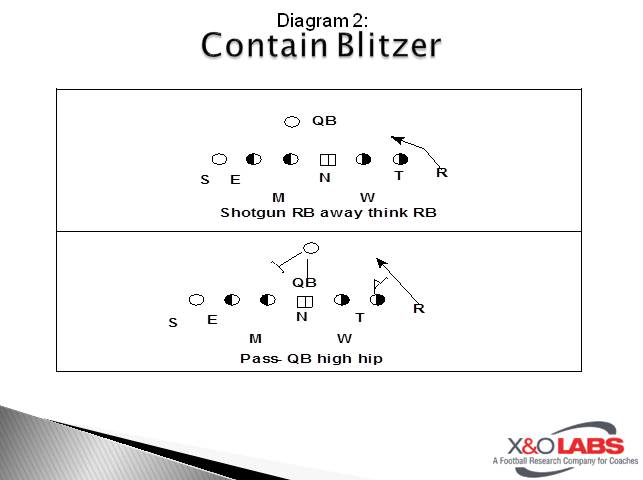
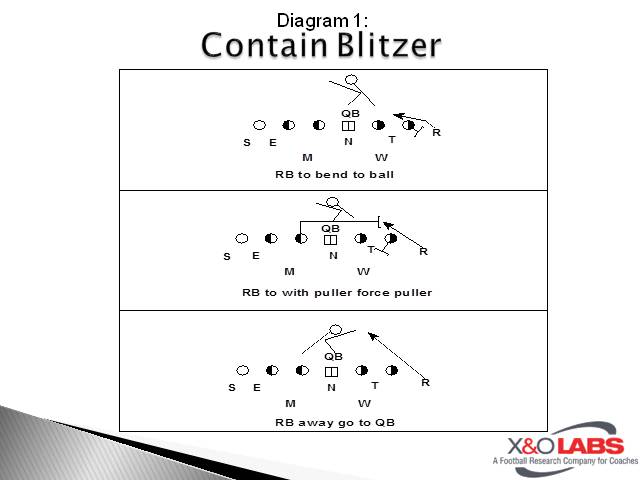
A contain blitzer is a blitzer off the edge. This type of blitzer will force the ball to the inside. The blitzer should have his eyes on the EMLOS to the deepest back. His aiming point should be the deepest back in the backfield. This angle will help set the edge behind the offensive line and condense the play. The blitzer should attack the edge of a blocker and keep his outside arm free.

A contain blitzer has a few rules of how they attack a play. Quarterback opens to you go to the ball carrier. The blitzer should go to the quarterback’s up field hip if the quarterback opens away thinking boot. If the quarterback is in the shotgun and running back is to the contain blitzer. The blitzer should think they have quarterback. In shotgun running back is away from the blitzer think running back. When the quarterback drops back to pass the blitzer attacks up field hip of quarterback. The rule for a contain blitzer versus option teams is you have quarterback.

Slide1Slide2

CHASE BLITZER

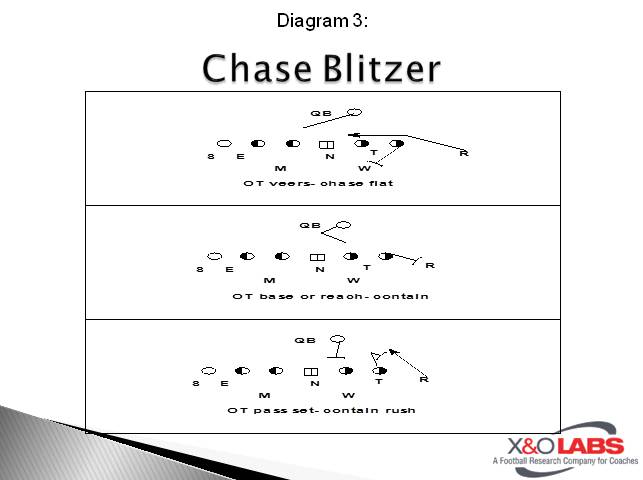
A chase blitzer is blitzing off the edge. This type of blitzer was created for pressures versus zone read teams to change up who has quarterback and running back. The chase blitzer should have his eyes on the EMLOS to the deepest back. The chase blitzer could become a contain blitzer based on what block he gets from the EMLOS.

Chase blitzer gets a base, reach or pass set then becomes a contain blitzer. This blitzer gets a veer block then close flat and play running back. When closing flat, spill all flat pullers and all deep pullers redirect for late contain. The nice thing about the chase blitzer you are never wrong as long as the player reacts to the block properly.

Slide3

CONTAIN & CHASE TECHNIQUE/DRILLS

The contain blitzer must understand his rules in order to execute the technique properly. Type of technique the blitzer uses is based on the block he gets from the EMLOS and ball carrier. The blitzer gets a reach or base block with run to, should attack the outside edge of the blocker while getting knock back on the blocker. Blitzer gets a veer block by EMLOS he should start to squeeze toward the veer block eliminating the space and make sure the blitzer doesn’t get to far up field and create vertical seam. Veer block with run to the contain blitzer should look down the LOS for pullers if a puller comes be ready to force the puller by giving the tip of inside shoulder to puller. Blitzer should keep his inside foot up just in case the ball bounces outside it is easy to rip off the block and redirect outside to make the tackle. Veer block with run-away the contain blitzer should attack the QB’s up field hip to check for boot or even a reverse. Contain blitzer gets pass block work the edge of the man don’t counter unless pass QB depth. With pass rush like the contain blitzer to beat with speed and use different rip moves and bull rush as a changeup.

Read More

Abilene Christian Vertical Settle RPO

By X&O Labs
Twitter: @XandOLabs

Editor’s Note: The following report is an excerpt from X&O Labs’ brand-new, 250-page book, The Complete RPO Manual. To request your copy of this book, please go here.

Vertical Settle RPO Concept:

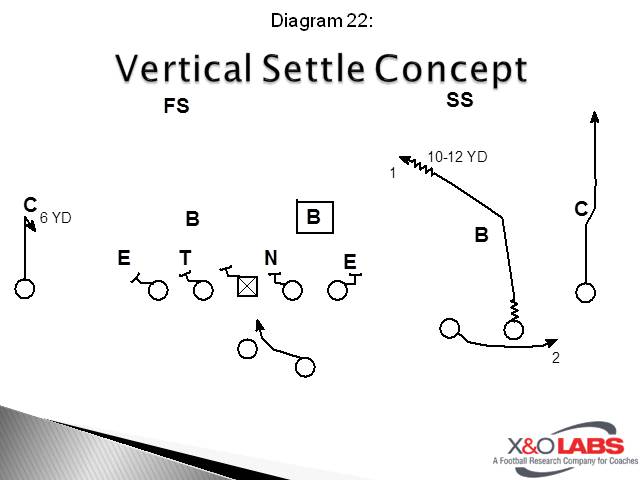
Instead of running a Stick/Draw concept, Abilene Christian uses what offensive coordinator Nathan Young calls a ‘vertical settle’ concept (Diagram 22), which is paired with, Inside Zone run action. The quarterback will read the back side inside linebacker on the play. “If he runs with number three or bails to zone, we give the run,” said Young. “If he sits at all, we are working the vertical settle to the bubble. If he likes the hitch pre-snap, he can take it now,” said Young. According to Young, the settle can’t be run at top speed. “The ball should be caught around ten to 12 yards,” said Young. “Find the dead spot in the zone behind the linebacker and in front of the near safety and shuffle. We do not come to a stop as we want to hit him on the move. Do not bend it so sharp that you get into the back side safety’s business.”

Slide22

To see cutups of Abilene Christian’s Vertical Settle Concept, click on the video below:

Read More