
3 Step Plan for Adapting RPOs for High School Varsity Programs Down to 9th Graders

By Paul Hefty
Assistant Coach
State College High School (PA)
Instructor of Kinesiology, Penn State University


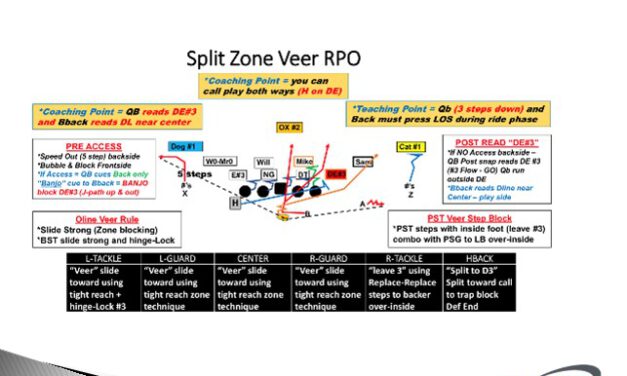
One of the challenges for all coaches is to take today’s new-exciting, but complex RPO concepts and find ways to simplify teaching, learning and processing for high school level players (and Coaches).  The dilemma is to take a major D1 offense or complex system and make it simple enough to use at not only the high school varsity level – but, with the 9th grade program – while still reaping the benefits of explosive plays and being turnover free.

First, research a system that is sophisticated, but simple in design, “Evolved Simplicity” = use only 1 blocking scheme for OLine (Zone-Veer) – Run or Pass.

Second, design a system to be flexible in that it can adjust and fit to the strength’s (talents) of personnel from year to year, week to week and game to game.

Third, use a scaffolding or chunking teaching progression. Scaffolding or chunking of teaching is a process of introducing information in a way where each future concept builds upon or simply expands the previous concept.


Step 1 – Simple

  1. Teach using 2×2 alignments
  2. Learn details of a quality RPO system without making changes to the core, so as to not lose the integrity of system as it evolves
  3. OLine uses a minimum number of blocking schemes


Step 2 – Flexible

  1. Use simple personnel terminology while each position has a natural twin
  2. Split-Zone RPO attacks all fronts and coverages (1 scheme for multiple plays)
  3. Split-Zone RPO has ability to make QB a runner, thrower or dual threat (play to strengths)


Step 3 – Scaffolding

  1. OLine uses only Split-Zone (Veer) blocking rule for every type of play
  2. Pre and Post-snap defensive recognition process that is used with all no huddle plays. This TRI-O process is used with both the OC (coaches) and QB (players) = all on the same page
  3. Limited communication to simplify processing for players (think and play FAST)


3 STEPS – MAKING COMPLEX SIMPLE


Step 1. SIMPLE:

We start by installing and teaching everything from a balanced 2×2 H-back set. This helps with learning our offensive principle #1 = NUMBERS. Both the OC (from the sideline) and QB can easily see if the defense is balanced or overloaded by using a three step, defensive recognition process of pointing @ 1 or 2 high safeties plus hanging backers (Mr 0’s) and last, the mike backer.

The other key point is that you can adjust the H-backs alignment pre-snap (using similar formation calls that again, only the H-back adjusts to). This is done with an offensive concept (blocking scheme) in mind, which allows the H-back to have the best leverage for each play. Applying offensive principle #2 = BLOCKING ANGLES. Both the OC and the QB want to call plays to put the OLine and H-back in the best possible blocking scheme based on blocking angles.

To keep communication with the no huddle – high tempo offense simple, 95% of the time we have the Slot align to the field (formation directional call) and the H-back into the boundary. This achieves a maximum horizontal stretch of the defense while helping the OC and QB to identify defenders easily. Applying offensive principle #3 = SPEED IN SPACE or FIELD. The players can anticipate this tendency, helping to simplify and create consistency for everyone. When, and if, you want to be a heavy 3×1 team when the football is on the hashes, you simply move 1 player (H-back) to the field. All other players align the same as they would in a 2×2 set. By minimizing the number of players who have to change – you have limited new learning. The key to keeping your system simple is to have the ability to use the same rules for both 2×2 and 3×1 sets. Only the nature of the defense should change. The goal for changing alignments should be to manipulate the defense, not changing things up just to do something different (method to the madness). Remember, less variables for the players means less to process (Less is More concept = SIMPLE).

Read More

Creating Pin and Pull Tags to Block Problematic Fronts

By Mike Kuchar
With Frank Giufre
Offensive Line Coach
University of Connecticut


The pin and pull concept have mainly been considered to be used as a change-up. It has been used to supplement the wide zone, tight zone and gap runs already in your arsenal. But that philosophy is changing. Before we present our research on the specifics of the block scenarios involved with the scheme, there are certain tangibles that need to be taken into consideration before implementing the pin and pull as a fixture in your offensive play menu.


Advantages of Tagging Pin and Pull Runs

  • Uses high percentage down blocks to separate the defense. Not necessary to crush defenders, just to eliminate penetration.
  • Opportunity to get two pullers in front of the ball carrier.
  • Handles bigger defenders in the box
  • Gets the ball out in the perimeter. As Coach Giuffre told us, “the offensive line likes screens but this gets them running to hit a defensive back. It becomes fun. You’re not trying to knock people off the ball.”
  • Efficient red zone play because of the tight formation spacing.


Skill Set Requirement and Personnel Preference Needed for Efficiency

While with the Indianapolis Colts as an assistant offensive line coach, Coach Giufre used the concept mainly as a change-up for the Colts inside and outside run schemes. “It wasn’t part of our identity because we were such an outside zone heavy team,” he told us. “But if you have a running back that can navigate through space it can really put stress on a defense. You look at what Philadelphia Eagles have done (with LeGarrette Blount) and it’s been astonishing.” According to Coach Giufre, it may even make sense for high school coaches, to scrap the pure outside zone run and utilize inside zone and pin and pull because they may not have a back that can read the outside zone. “It may be easier to run the tight aiming points of inside zone with the pin and pull addition,” said Coach Giufre. “Cut the defense with down, down pull. You may get your outside zone off pin and pull without using the NFL or college model.”

With the prevalence of 4i techniques in Odd fronts, the pin and pull scheme can be reliant on down blocks at the point of attack while uncovered Guards can get out on the perimeter and make blocks in space. It seems to be extremely effective against teams playing heavy, inside techniques with a back that can navigate in the open field. “We like backs that can catch a toss then get his eyes up to his read,” he said. “It can also be an excellent run with jet sweep motion to act as an eye distraction to the defense.”

In most cases, Coach Giufre will utilize the pin and pull concept with both 12 & 11 Personnel groupings, but prefers it out of 3×1, 2×2, and 1×3 (Nub) formations.


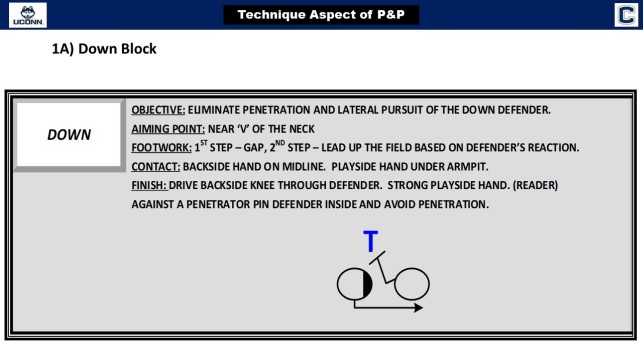
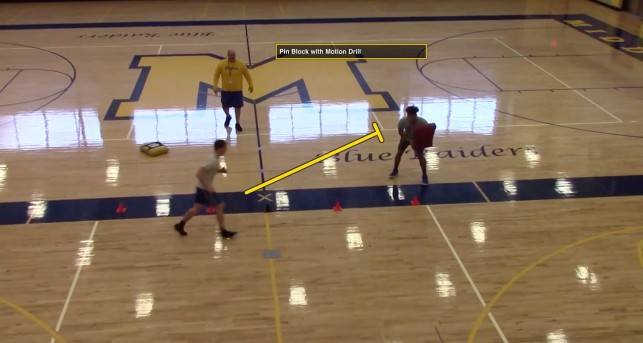
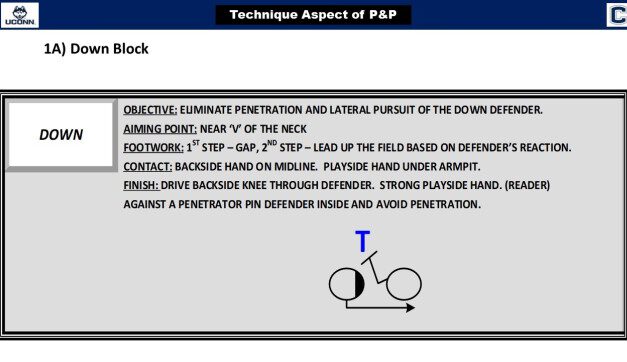
Down (Pin) Block Technique

Diagram 1


The concept of the down block is to negate penetration by working your hips around to block the defender. While some coaches teach a play side vertical step to account for any possible crossing of the face, Coach Giufre teaches a gap step with the first step. The second step is the lead step with the third step being the follow step. “On the gap step, we step with the foot closest to defender, while the lead step works slightly up the field,” said Coach Giufre. “In our position step, we set our eyes to the aiming point (which is the near V of the neck of the defender).  Eyes should be in near V of neck. Like baseball, we try to keep our eyes on the ball. If we get eyes to aiming point and our body will follow.
Coach Giufre teaches a strong play side hand to flip leverage if the defender tries to get around him. “If we try to pin him and he runs outside, I step and take my inside hand and throw a shot put and accelerate him to sideline to open up the hole,” he said. “You need to know your personnel. If he is a penetrator, bring heavy hands and get your eyes on that near knee and bring your feet to displace him. These defenders can’t knock off a puller. If he’s a reader, be cautious on the first step and get second step on the ground to be prepared to flip hips.”


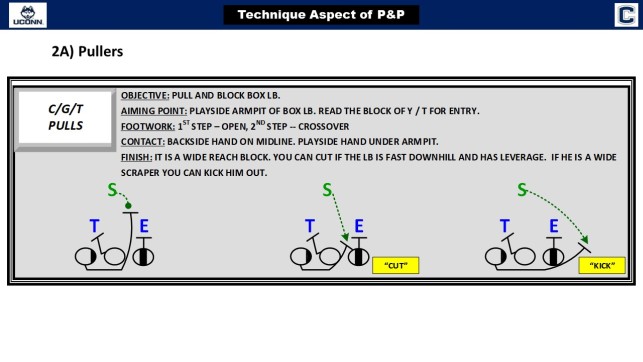
Pull Block Technique

Diagram 2


The footwork for pull blockers is taught as an open, crossover progression. Pull blockers will open their play side foot (Coach Giufre calls it a ‘wedge step’) and crossover with the backside foot. “It doesn’t matter if their shoulders are turned,” he said. “If they open up a little bit it helps them sift things out. The ball is out of the box anyway. It’s not like counter or power scheme.” As far as the strike point goes, Coach Giufre teaches a double under technique (made famous from John Strollo and Jim McNally lectures) on contact. “Rather than pushing a guy, you’re lifting him,” If you can get hands underneath and lift shoulder pads it chokes defensive linemen. They will naturally stand up to find air.” Once the target is identified (which is usually the first defender past the identification) there is no shimmy, or no entry point through the line. It’s a complete run. There are two types of blocks synonymous with these assignments:

Cut block- offensive lineman’s backside shoulder through defender’s legs.

Read More

Complete Installation: Shotgun Buck Sweep Concept

By Brett Myers
Head Coach
Middletown Area High School (PA)
Twitter: @mtownfbinfo


Over the past three years at Middletown Area High School we have reached new heights as a program. We have won 3 Division titles, 3 District titles and made 3 straight appearances in the PA state finals. Our record is 53-6 over the past 4 years. There are many reasons for this success but one of the major pieces that have led to this success is our run game out of the spread and our top play over this period has been the BUCK SWEEP. The reason the buck sweep has been such a large part of our success is that it matches our core beliefs.

By adding the Buck Sweep to our spread offense, it has given us a chance to be physical against teams that we cannot move off the ball vertically. The buck sweep is the most fundamental play in football. It takes a total team effort to run this play. With that type of scheme and with proper technique you can have success with less talent. With, another benefit to the Buck sweep in our spread 2 back offense is that we can spread the field to give our players better blocking angles and get people in space. The more formations we can come up with the better. These formations will give us the angles we want and put different defensive players in conflict.


Coaching Points

We will start with our rules for the Buck Sweep

PS-TE-gap, down, backer – if flexed inside backer

PS-TAC- gap, down, backer

PS-G- pull kick out force player (open 5 o’clock crossover get inside out)

Cen- A gap to A gap-(most dangerous threat from play-side A gap to Backside A Gap)

BS-G- quick pull and wrap looking for backside lber

BS-TAC-Pull check & hinge

PS-HB – wing gap down backer/spread stalk unless in motion, chip end work to the the backer

FB- if QB under center carry out trap route if in H back reach 1st guy outside tac block

BS-HB- jump snap aiming for FB heel taking the handoff reading the flank, must make 90-degree cut, if TB spot run through QB hands reading flank looking to make a 90-degree cut.


To study game film of this concept, click on the video below:

Read More

Weekly Model to Teach Competition in the Off-Season

By Jeremy Plaa
Head Coach
Thomas Downey High School
Twitter: @JeremyPlaa


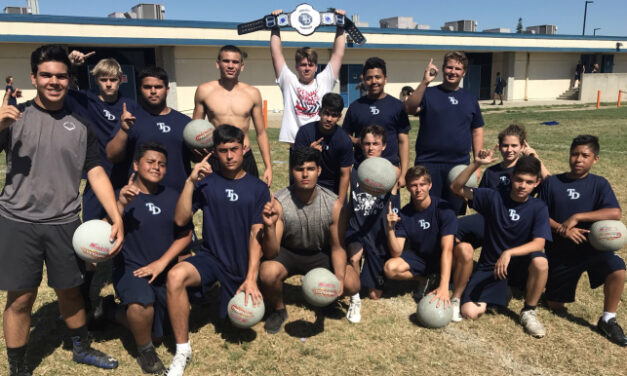
In our program, teaching the concept of HOW TO COMPETE is just as important as teaching technique and scheme. While some coaches may not believe that, the Competitive Games model has been great for us to celebrate success and use the lesson of losing to teach consequence and talk sportsmanship. And best of all, it’s fun and our kids love it.

Competitive Games have multiple benefits for our program:

  1. Each team has a captain and a co-captain, so it provides the opportunity to teach and build leadership
  2. Reinforces the idea that LEARNING TO COMPETE is everything in life
  3. Celebrates winning & uses losing as a motivator
  4. Serves to organize attendance in our program- each team’s captain takes roll
  5. Improves attendance in the summer- captains apply pressure to make sure all their team attends
  6. Serves to organize setup/cleanup of practice equipment (bags, water cart, cones, etc.)
  7. Reinforces the idea of family- helps freshmen to connect with older kids in the program
  8. Helps to prevent the hazing atmosphere that some programs have- where Seniors look down on younger classes
  9. Organizes jobs/duties in the off-season program- each team is responsible for something
  10. The FUN factor- don’t overlook this- we have FUN with our summer games


What is a Competitive Game? At the end of every off-season workout, we spend 15 minutes competing. Our entire program160 kids- is split into 8 families. Having 8 makes it easy to make every competitive game a bracket-style event. To get everyone involved, we come up with guidelines that will make sure all kids on each team compete at least once a day. For example, we keep Handball on Tuesdays a game of 5 on 5. To make sure everyone plays, we say that no athlete can sit out two games in a row. So, if they sit out round one, they must play in round two; or their team is automatically disqualified. Also, if a team is eliminated in round one; on the next day athletes who did not participate MUST be the first to be included.


Organization of Teams

How do we set this up? We start with coaches selecting potential captains. Anyone and everyone that we think is a potential captain is up for discussion. Our coaches settle on anywhere between 8-16 captains for the summer teams. This year we identified ten kids that have captain-potential. So, we picked our top 8 and allowed those 8 kids to select their co-captain. The remaining two kids that didn’t quite make captain in the coaches’ view, were some of the first “co-captain” picks. You can steer this as needed. Once we have a captain/co-captain for eight teams, we set a draft date following our first final exam date in May. Before the draft begins, captains select a team name with a “character trait” theme, and they also select what summer setup/cleanup jobs they want for the entire summer.

Read More

Three Play Package for Single Wing Systems

By Bruce Eien
QB Coach
Eugene High School (OR)
Twitter: @bruceeien


The spread offense is all the rage in football today.  Modern defenses have come up with sophisticated ways to stop the spread offense. Many teams have combated these defenses with more traditional type formations and sets.  Teams use double TE’s, TE/Wing and a fullback look to take advantage of these new modern defenses.  What if you could combine both sets into a single offensive system allowing you to gain an advantage over anything the defense presents?


The Merge

The way we merge the Single Wing and Spread is to run the same series between formations.  Optimally we would like to use the same personnel so we can shift between formations not allowing the defense to sub in bigger defenders.  Most of the time the defense opts to play their pass defense and not a short yardage front.  This gives us an advantage as we can get more people to the point of attack then they can defend.  It also gives us options to see what system gives us a better advantage! We use the same rules and schemes in both formations systems to streamline learning time.  Another advantage is multiple players can be the QB in the Single Wing giving you many game time options and optimizing practice time.  


Formations

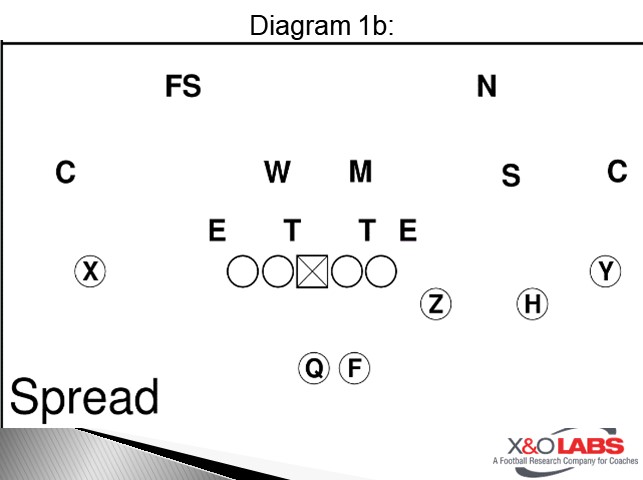
We use a four WR set with base formations of Spread, Trips and Empty.

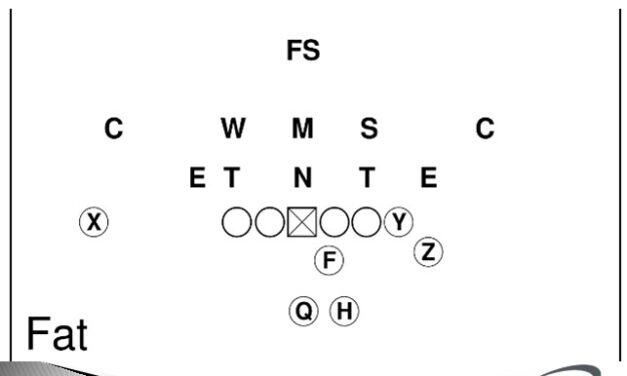
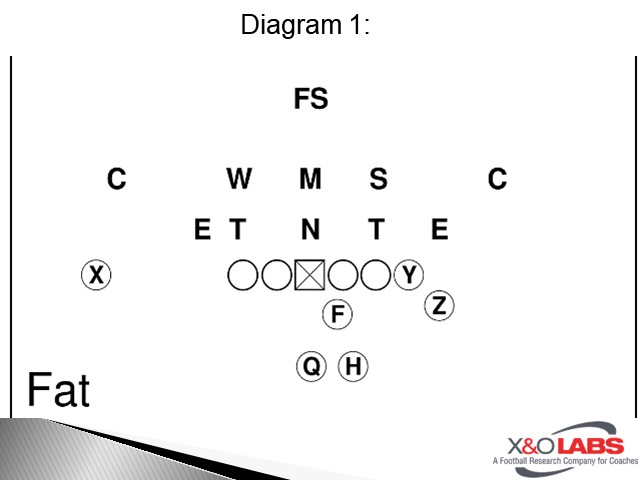
We use a Single Wing set with formations called Single and Double Fat

Diagram 1

Diagram 1B


History

We have been an under center four WR offense since 1990 and went full-time shotgun in 2000.  We had run the Power I as our goal line offense for many years.  In 2001 we had a great running QB and we were figuring out ways to get him the ball.  So, we brought in a true FB in the backfield and started running I back type plays to the QB.  We then tried to figure a way to get the Power I into the offense and moved 2 FB next to each other.  During this time a team in our league played a Single Wing Team and I noticed we could run our double FB offense from a balanced set.  We introduced it in the 2001 season and called it Jumbo.  One of our player’s mothers asked me when we were going to run those plays were, we bring in all the “fat guys” and hence the name was born.  

Searching the Internet, I found the Single Wing Forum on Delphi and discovered Steve Calande was running something similar called the BEAST.  The only difference was he was running 3 FB’s where I had 2 and a Wing.  Later on, I found out we were both running versions of the Yale Formation from the early 1900s.  It’s amazing how 2 different coaches from opposite ends of the country came up with a similar formation and plays, never knowing about each other’s work until they were finished?


Three play series

We use a three-play series of a QB Sweep, Roll Out Pass, and a Wing Counter.

In this series, we use the QB Sweep off the rollout pass. In the trips Formation, we use the rollout pass to set up the QB Sweep while in the Fat Formation we use the QB Sweep to set up the rollout pass.  The Counter Play is used to take advantage of the defense overplaying the Sweep or Roll Out Pass.  We have other plays in this series but are concentrating only on these three for this article.


Roll Out Pass Concept:

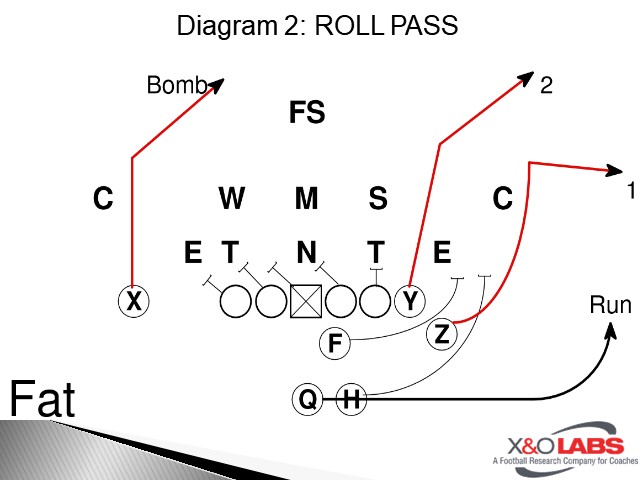
Diagram 2

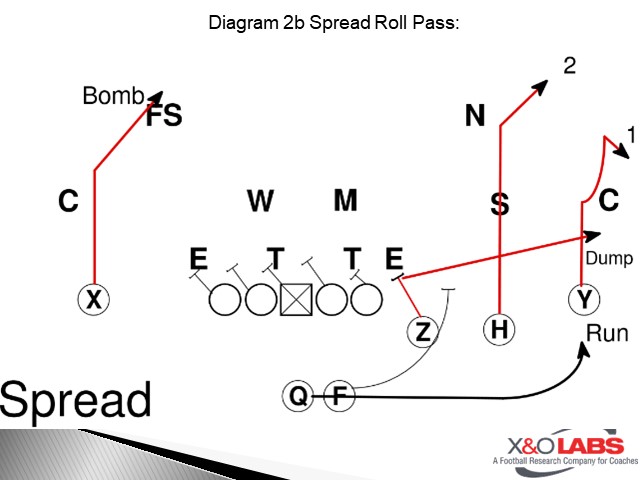
Diagram 2B


The Roll Out Pass is a moving pocket where the QB will break contain and read the CB on a Hi-Low Concept. We can also tag other concepts like Flood, Smash and Curl to this play.  The Line is in turn back protection blocking to the gap opposite the play.  For example, Roll Right, the linemen block left and vice versa.  The RB sets the edge by running at the DE and takes over the block from the chipping #3 WR.  In Fat, the TE will chip as the Wing is the primary WR.

WR routes are:

#1 15 Yard Fade Out (Fade at 7 comebacks to sideline at 15) in Fat the Wing runs a Wheel Out as he is tighter in the Formation. 

#2 Deep Corner (corner at 15 getting deep)

#3 Chip on DE run 5-yard Flat route


QB breaks contain like Sweep and his first read is Fade-Out all the way.  If the CB jumps the out the QB hits the deep corner route.  If the QB is not open or he gets pressure he can dump to Flat Route or run the ball.  If QB breaks contain and sees open grass for more than 10 yards run every time!

Read More

Matching 3 Deep, 3 Under Coverage For 5-Man Pressures

By Mike Kuchar with Todd Argesta
Defensive Coordinator
Montclair State University (NJ)
Twitter: @ToddAgresta


Montclair State University is a program rooted in successful tradition. One of the top Division III programs in the Northeast, the Red Hawks have been playing football for 87 years and head coach Rich Giancola has been coaching for 37 of them. He’s the active NCAA Division III leader in wins, compiling a 239-121-2 mark since taking over in 1983. Defensive coordinator Todd Agresta has been with Coach Giancola for 20 of those 36 years and it’s no coincidence that for 10 of those years the Red Hawks have been in the top three in the conference in every major defensive statistical category.

Like most successful program, they believe in what they do defensively and what they do is play with a middle of the field safety on over 85 percent of snaps. It’s a philosophy that Coach Agresta has developed and refined to defend the modern RPO offense. “I just believe in having a post defender,” he asserts. “I don’t feel comfortable with the teams we play playing with two safeties. You still need to stop the run. Our run fits are easier and it’s easier to teach.”

While the coverage can routinely change, one thing will not: there will be a safety in the middle of the field. And at the hierarchy of the Red Hawks defense sits its bread-and-butter coverage- Rip/Liz Match, or what Coach Agresta calls “Cover 9.” It’s the latest off shoot of man vs. zone, it looks like Cover 3 when it needs to and it looks like man coverage when it needs to look like man. It’s a coverage commonly associated with five-man pressure defenses and Montclair State runs it just as good as anyone.


Editor’s Note: Due to space issues, this report is designed exclusively around the coverage aspects of Rip/Liz match.  X&O Labs already devoted an entire report on how to fit the run with this coverage with the University of St. Thomas (MN).


Personnel and Defensive Structure

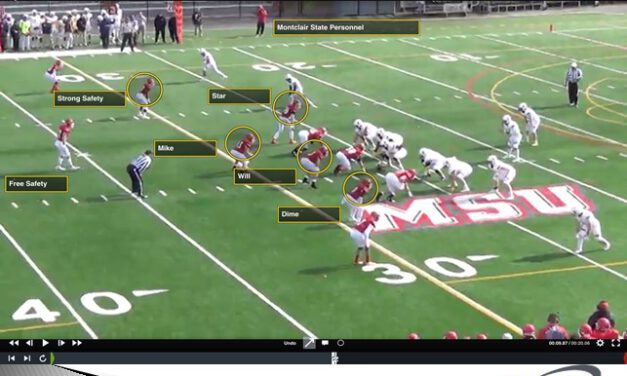
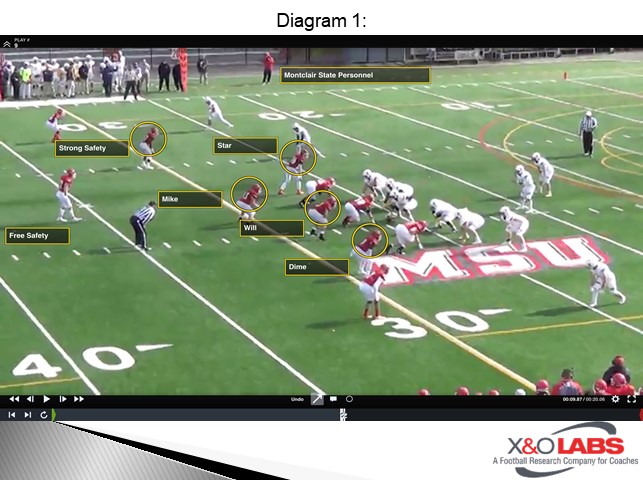
The genesis of the Red Hawks scheme is based on an Odd front with the following denominations:

Diagram 1


  • Two-Gap Nose
  • Base 4i Techniques at Defensive End (may be 5-techniques in Dime)
  • Inside LBs: Mike and Will
  • Outside LBs: Star (left) and Dime (right)
  • Money: Strong Safety
  • Jack: Free Safety


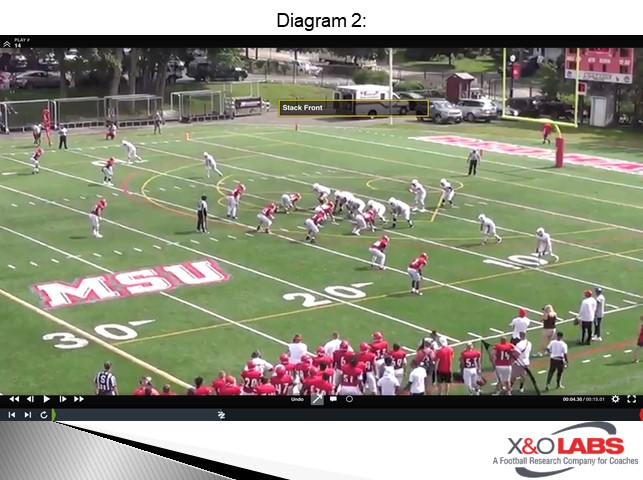
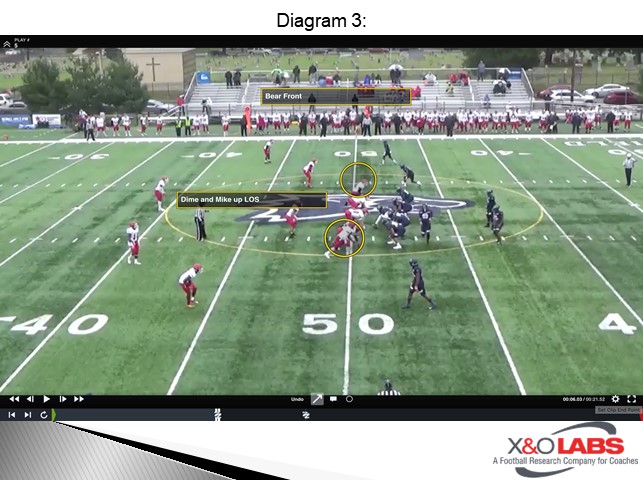
While Coach Agresta modeled his defensive scheme around the New England Patriots, he calls his outfit a “junk front,” which can align in various positions along the line of scrimmage. These fronts can transition into the following:


Odd Stack

Diagram 2


Bear Front

Diagram 3


Base Coverage Principles

There is a myriad amount of pressure patterns that can be devised with this coverage, so we wanted to first spend time detailing the technique associated with each of the coverage defenders in Rip/Liz Match. The defenders in this coverage consist of the following:

  • Two Outside Third Defenders
  • One Deep Third Defender
  • Two Seam 2 Droppers
  • One 3 Hook Defender


According to most coaches, including Coach Agresta, the key to making the coverage efficient is a cross-training approach so that each back-end defender (LBs and DBs) understand how to play each of the above coverage concepts. It’s why the defensive staff at Montclair State spends the majority of spring practice (D-III is non-padded) working how defenders relate off each other. “Communication is the key to this coverage,” he told us. “Which is why we have buzz words for each scenario.”

While, we will provide the vocabulary behind the communication when we present the pass concepts that affect this scheme, we wanted to provide an overview of the responsibilities of these defenders.


Outside Third Defenders

In most situations, these will be the corners, the “Hawk” or left corner in the Red Hawks scheme and the right corner. In this system, the divider rules are the numbers. “If the wide receiver is outside the numbers, we’re 1×6 (one yard inside, six yards deep),” said Coach Agresta. “If the wide receiver is anywhere on the numbers, we will be head up the wide receiver at 6 yards. If he’s inside the numbers, we’ll be one yard outside and six yards deep.” Coach Agresta breaks down the post-snap read of the corner based upon the drop of the quarterback. “We will read the drop of the quarterback, mainly from shotgun alignments because that is what we see,” he told us. “If the QB catches and sets it’s a three step drop. In three step our eyes go to number one because we don’t get any shallow routes from that action. If the QB is taking three steps, it’s a five step drop for us. When I see five step, my eyes go to one and we pattern read off of that.”

Read More

The Complete Middle Zone Concept Installation

By Adam Hovorka
X&O Labs Managing Editor
Twitter: @X&OLabs_Editor

Featuring Mark Melnitsky
Offensive Coordinator/Offensive Line Coach
Trinity College (CT)
Twitter: @coachmelnitsky


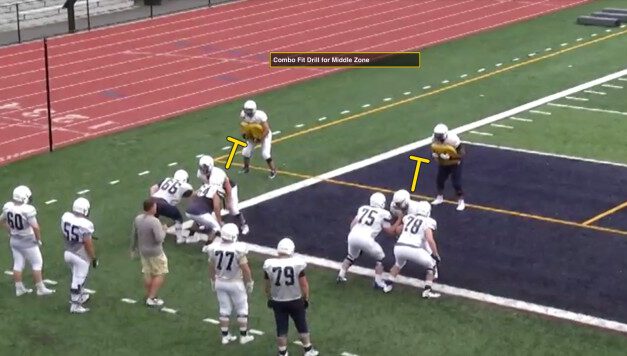
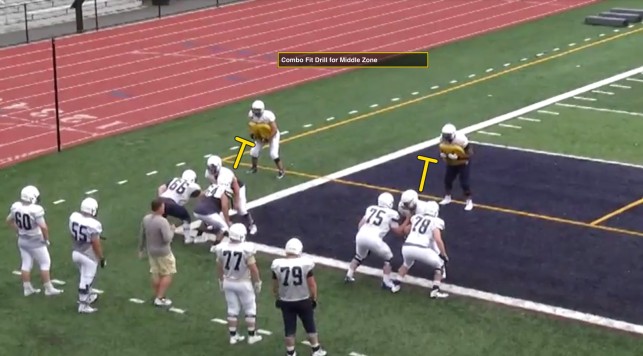
Football is an ever-evolving game, however, the one constant that has remained is the fact that you need to be able to run the ball to win games. At Trinity College, the Middle Zone is the staple of the run game.  In 2018, Trinity ran it over 15x per game, for an average of 5.6 yards per carry and 9 touchdowns. One of the reasons they like the mid-zone so much is the flexibility it provides against different defensive fronts, schemes, and structures. Offensive coordinator, and offensive line coach, Mark Melnitsky says the reason they run it so much is that “We like it against, 4-3, 4-2-5, 3-man fronts, cover 2/4 structures, one high, man, for us it doesn’t matter the defense because we will be able to run mid-zone against any defensive look. It can also be run from under center or shotgun and offset or pistol when we do go shotgun. We can also tag our midzone to get many RPOs, play-action and bootleg pass to make the play that much harder to defend.”


Why Run the Mid Zone?

  • Provides flexibility vs. various fronts
  • Can be run from Under and Gun alignments
  • Multiple first and second level built in reads
  • Versatile package of RPOs and PAPs


What is Mid Zone?

Football is a game where coaches often borrow ideas from one another and blend ideas into one concept. The Trinity Mid-Zone is one such Concept. Coach Melnitsky describes their midzone as a combination of the inside zone scheme and the outside zone, hence the midzone name. Coach explains his midzone by saying: “on the inside zone, the landmark is the inside foot of the play side guard and, when we used to run outside zone, the ball carrier’s landmark was 1 yard outside the TE or imaginary TE if run to a non-TE surface. The read on Inside Zone was the 1st play side interior DL to the 1st backside interior DL. The RB would sink the ball to his landmark and either drive it frontside downhill or hit the cutback in front of or behind the backside DL. In Mid-zone, we want the ball carrier to chase and press his play side landmark (outside heel of OT) and either bounce or crease the ball based upon how the tackle handles the DE. If the tackle reaches the DE, the ball carrier bounces the ball outside. If the tackle stretches the DE, the ball carrier must stick his outside foot in the ground and crease under the DE. We’ve essentially moved the landmark a player wider on MZ than IZ.”


Blocking the Mid-Zone

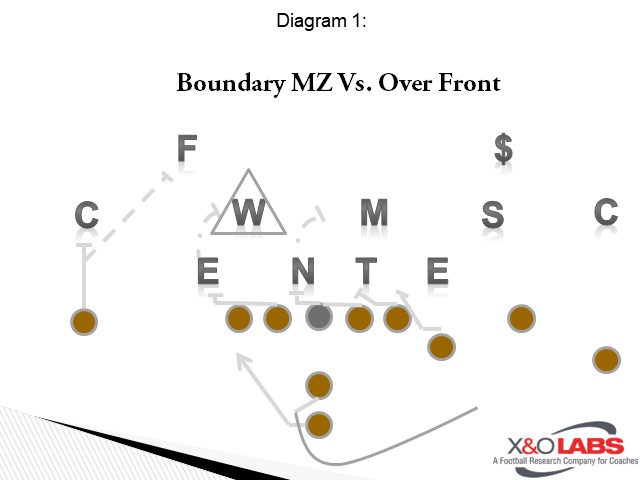
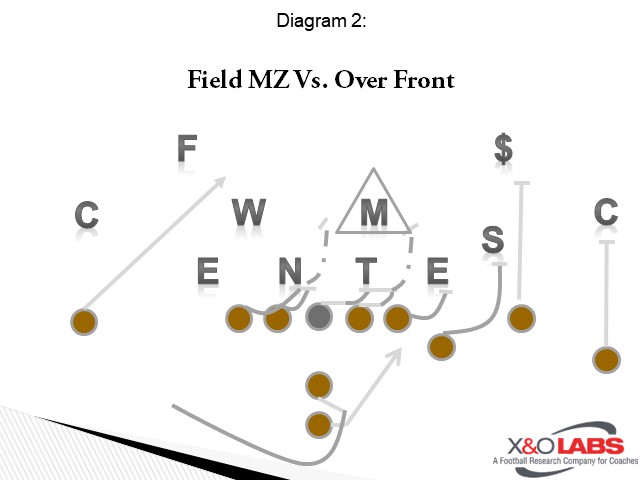
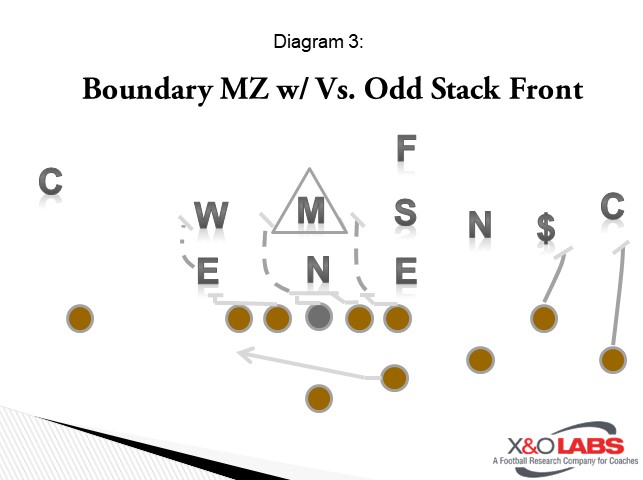
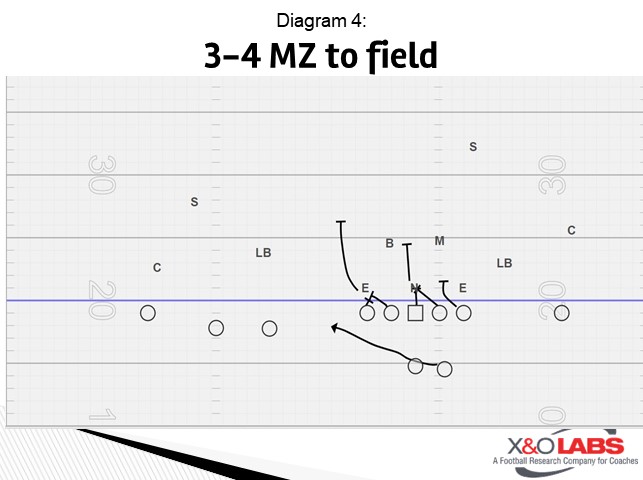
To truly understand any running play, it all starts with the offensive line and their identification of the front and the blocking techniques that they are going to use to block the myriad of fronts they will see. The first thing that the Trinity OL will do is identify the front as either odd or even according to their rules. Next, they determine who the Mike backer is and that will determine the combination blocks or man blocks being made on the MZ play. On any even front, the front-side tackle is by himself on the end man on the line of scrimmage. The play-side guard and center are working together for the Mike backer and first down lineman past the center. The backside guard and tackle are working for the first adjacent backer away from the Mike and the next interior down lineman. 

On odd fronts, the scheme is a little different, but Coach Melnitsky has simple rules to help his players know their assignments. For odd fronts, the blocking scheme is determined by if the play is being run into the boundary or the field. “We will run this from 3×1 with the solo side being into the boundary,” explained Melnitsky. “Into the boundary, if there is an overhang there, which most teams have, we will make the boundary inside backer or the playside backer the Mike. This pulls the front side guard into the scheme. The Backside Guard and center will work from the nose to that Mike and then the frontside tackle and frontside guard work from the playside down lineman to the overhang. 

“If you run this to the field or the strength, we will make the backside backer the Mike. Here versus an odd front, the backside guard is working with the center to the Mike.  We can do this because we have no overhang defender. He is being blocked by the TE or is responsible for a receiver in the trips and can be taken up by the route.”  

The Playside tackle and guard have the first backer playside away from the Mike and the first DL. The Center and Backside Guard have the nose to the Mike and the backside tackle is ripping through the B gap and blocking whoever shows.

The diagrams below detail how Trinity runs its Middle Zone concept against various fronts:

Diagram 1

Diagram 2

Diagram 3

Diagram 4

Read More

Integrating the Rocket Sweep Into Double Wing Offenses

By Derek Katris
Head Football Coach
Elgin High School (OH)
Twitter: @CoachKatris


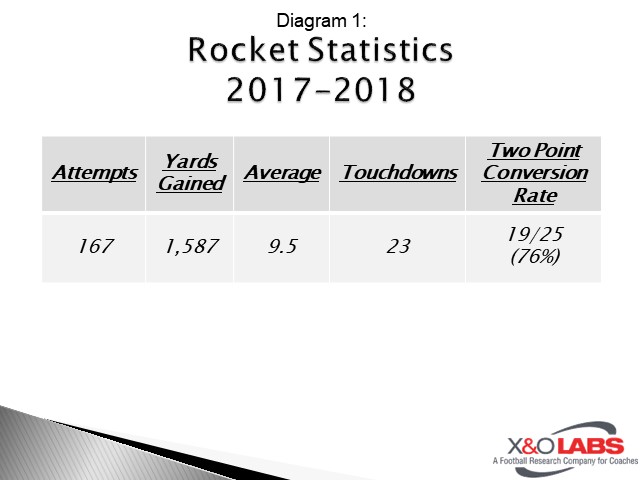
A potential issue with the double wing is it can be difficult to stretch outside effectively. Different double wing coaches believe different things on this subject; however, I believe it is necessary to stretch horizontally to the sideline from time to time or a defense can make it very difficult to consistently run off tackle throughout a game. Defenses love to compact the double wing, routinely putting many defenders in proximity and sometimes only leaving a defensive back outside of a 9 technique. In these situations, it is absolutely imperative that we take advantage of the situation and make a defensive back play run defense. During the 2017 season we began to stretch the defense and force defensive backs to play consistent run defense by running the rocket. We built on it by implementing formations to confuse the defense by moving players to new alignments (with simple rules) and shifting to unbalance formations to keep our rocket fast and effective.

Diagram 1


Rocket, with the rules described below, can be very adaptable to almost any formation. The defense now must defend the double wing power and potentially being outflanked by the rocket at any time. Rocket is the play every double wing team needs, in my opinion, to take their offense to the next level.

Diagram 2


Motions

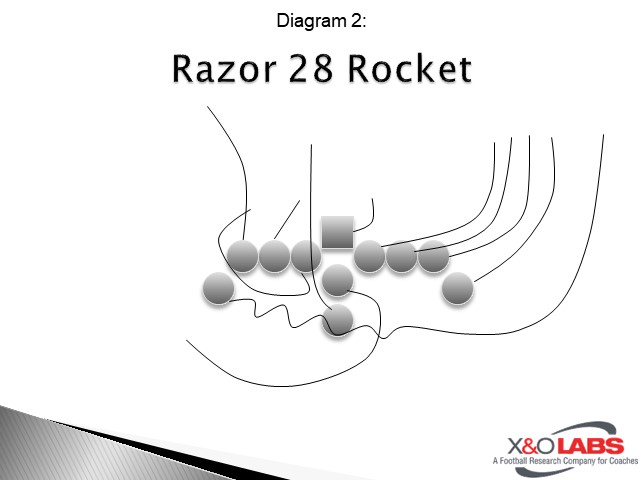
Within our double wing system, we use two primary motions. Motion #1 is called rip/liz and is our power shuffle motion. Motion #2 is razor/laser and is our sprinting rocket motion. Each motion paired with its core play creates a system of plays for us. For example, in our rocket series we run rocket, trap, G, counter, and a play action series all with the razor/laser motion and similar actions to some degree. This simple step of creating a rocket series has allowed us to effectively double our playbook without any extra offensive line learning. The rocket will be outlined below with rules and additional film cut-ups.

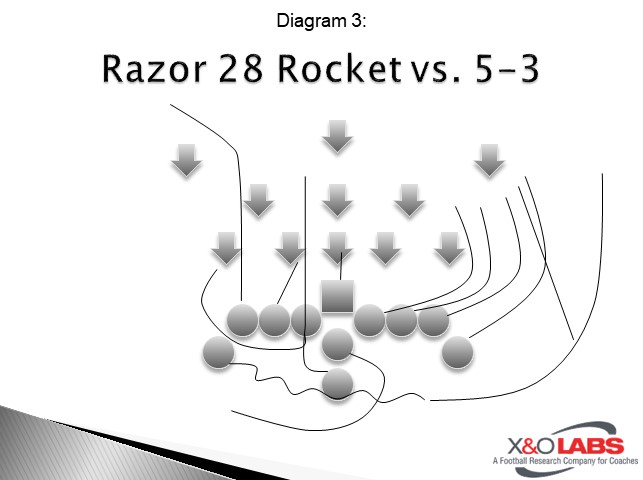
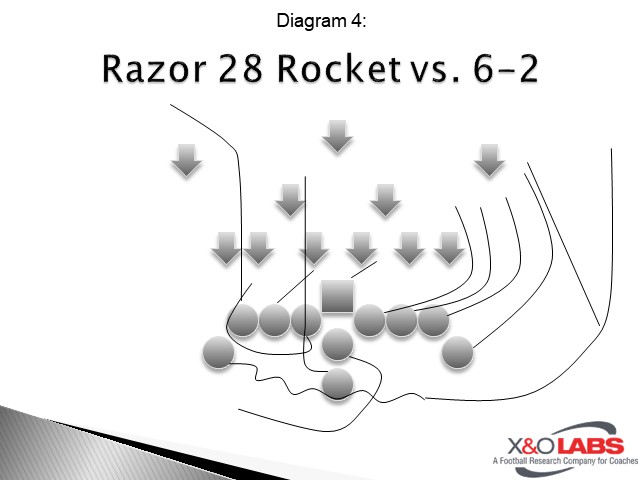
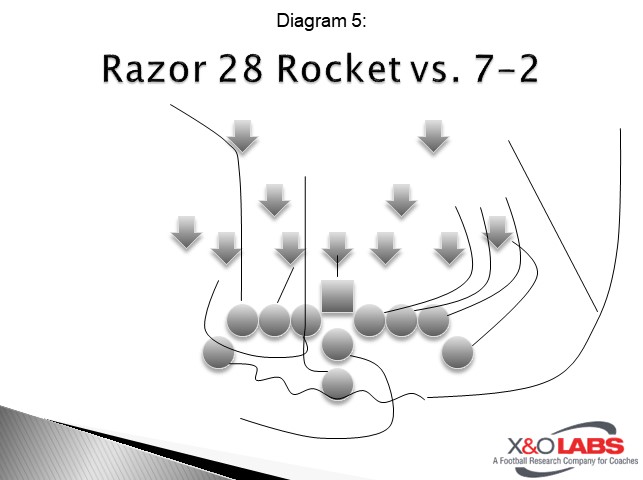
The rocket play itself is our easiest play to install because of the simplicity of the way it is run. It all starts with the motion. The wing in motion must always sprint to sell the fake or to run the play effectively. His path is directly through the butt of the fullback/B back (who is lined up in the sniffer behind the QB).  This motion has developed a very distinct influence on the defense. We usually either receive a hard-defensive backfield roll to the motion or a very definite attack from the outside (force) defender to the rocket motion to turn the play inside immediately. If neither occurs, it is very difficult for the defense to slow down the play. Once the motion disappears the QB will call for the snap and the wing should be behind the play side tight end when receiving the toss. The QB should open to the wing receiving the toss, step to him, and basketball pass from his chest to the wing. This toss will travel sometimes 7-8 yards in a fast and tight toss. Once he tosses, he carries out a boot fake to the backside.

Diagram 3

Diagram 4

Diagram 5


Razor 28 Rocket Rules

  • Wing to the call (C Back): Block the first defender from the sidelines, usually a corner or outside linebacker. Almost always a sprinting reach block. If executed correctly it is the single determinate of the play’s success. Sprint for the outside shoulder of the defender and only settle for a kick out to the sidelines if the defender forces you to turn perpendicular to the line of scrimmage. If the defender attacks immediately then kick him out immediately and try to open the alley as much as you possibly can for the ball carrier.
  • Strong End: Reach step and sprint as fast as possible to get to the alley outside the line of scrimmage defender (usually a 9 technique) and get in a reach relationship to the next second/third level defender on the field. Take a path around the 9 technique or where he would be aligned. Only engage the 9 technique if he engages you while reaching hard to the alley. If you can turn and run by him that is just as effective as blocking him in this play. A popular adjustment is to immediately reach the defensive end and have the strong tackle and strong guard take a predetermined pull path for the second to third level defenders.
  • Strong Tackle: Same as the strong end. May have to settle for a reach block on the 9 technique.
  • Strong Guard: Attempt the same technique as the strong end and strong tackle; however, normally his path takes him more vertical to the second/third level because of the speed of the play. Do not block any defensive lineman inside of the 9 technique; take a path for the near linebacker.
  • Center: Protect the QB’s pitch by reaching the first defensive lineman on to play side. Can cut if necessary.
  • Quick Guard-Quick End: Complete one of two courses. Usually a game plan decision based on the defense’s keys.
    • Run a boot fake.
    • Run a full touchdown blocking course to try to get out in front of the play and help downfield.


Read More

Preparing to Be a Coordinator Next Season? What You Need to Know…

By Nick Davis
Defensive Coordinator/Defensive Back Coach
Rose-Hulman Institute (IN)
Twitter: @Spread_Defense


I started off as a defensive graduate assistant at Ottawa University (NAIA). The DC there Josh Homolka did not let me coach defensive line because that is where I had played in college. He wanted me to experience defensive backs and linebackers over my two years. That made me grow a great deal as a defensive coach. I was able to have a background in every aspect of defensive play, leaving as a graduate assistant. In 2012, I applied for a defensive line job at Rose-Hulman and their running back coach left around the same time. They liked me enough in the process that they offered me the running back job. I went from coaching running backs and coordinating the special teams at Rose-Hulman over the next three seasons to the defensive coordinator in 2015. When I became the defensive coordinator, I had no assistant coaches on my side of the ball and had not coached defense in three years. Here are a few tips and tricks that made the transition easy for me.

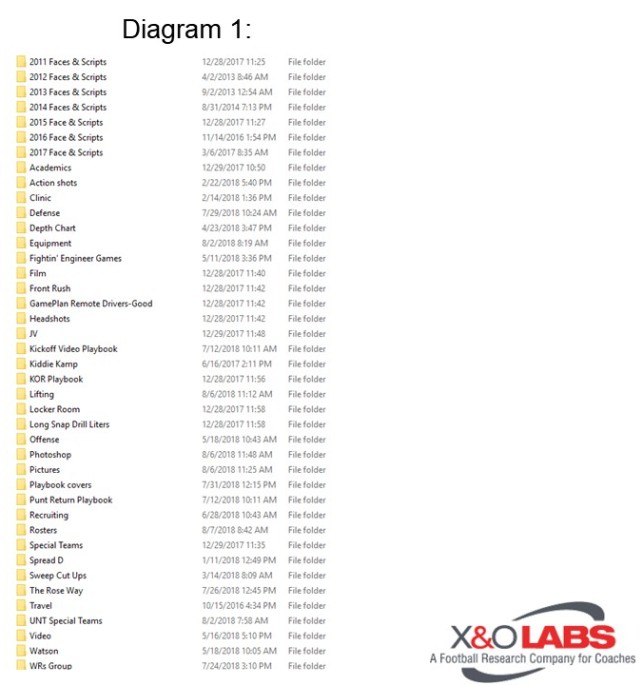
I knew the first thing I need to do was be organized. Our Offensive Coordinator Brian White was super organized. We had a shared network drive that everything we did on offense was kept on. Our playbook and scouting reports were saved on the shared drive for everyone on staff to access. That has since been taken to the next level with Google Drive, or One Drive over the last few years. I could go back to 2011 when I did not coach at Rose-Hulman and be able to pull any information I needed to pull from the shared drive. One tip is to create folders to keep things together.

Diagram 1


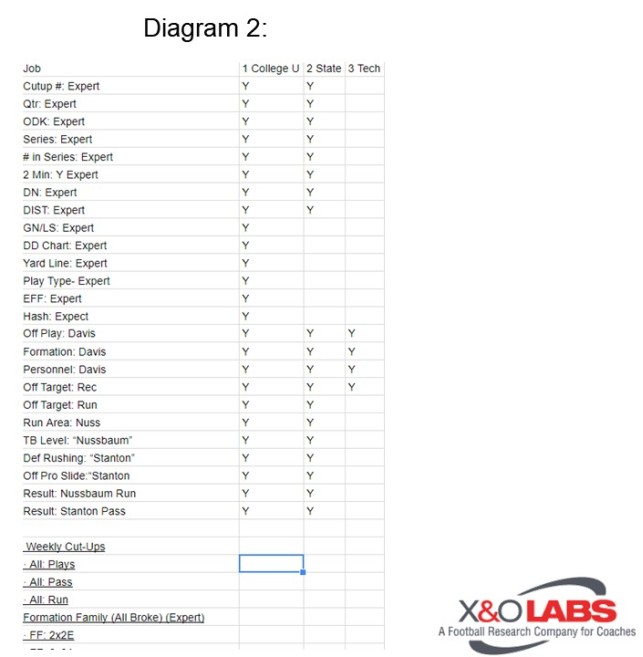
I created manuals for the new coaches for the breakdown and cutups I wanted each week. I have since put that information on google drive and the coaches have to update where they are in the breakdown process each day.

Slide2


I make my coaches learn what our offense calls the plays and formation. I do this so the staff and scout players can be on the same page. It also made more sense to me why we called certain things. I created a composite schedule to have our coaches know what games they need to break down.

Read More

Coach the Player, Not the Product

By Malik Hall
Head Football Coach
Bates College
Twitter: @coachmalikhall


In football, as in many other professions, coaches are hired to solve problems. Some problems can be cultural, schematic, and or developmental. It’s the responsibility of the coach to generate answers for any problems that exist during games, practice, the off-season. Contrary to the belief of some, the coach’s responsibilities do not end with on the field solutions. He is also responsible for finding solutions for off the field questions as well.

Clinics can be a great source of information for coaches in regard to how they teach football schemes and techniques that are critical to the success of your program. That said, these professional development opportunities too often avoid talking about how we, as coaches, can grow in how we coach the person (athlete). The product can only be as strong as the person executing.

Here at Penn, we believe strongly in coaching the person, not the product. The person should always be valued higher than the product (i.e. wins and losses). 

“Winning isn’t everything it’s the only thing.” by Vince Lombardi is one of the most famous quotes in athletics.  A strong and definite quote from a men who revolutionized the game of football. It declares a view of, and what it means to, win. Not many coaches will ever argue against one of the greatest football coaches ever. 

Consider this, if you can win over people how can you not win games

I ask my children every day after school, “Did You Win Today”? I realize that it’s a human condition to want to win. It’s something that you don’t have to teach. Winning validates your work ethic and your ability to overcome obstacles. Who doesn’t want to be victorious in the heat of competition? 

Winning is the only thing, because losing isn’t fun, in fact losing most often creates a desire and yearning to win. Victory can also confirm that you’ve helped your players/team reach their full potential.  John Wooden, another great coach (basketball), evaluated players based on the skill sets they brought to the game. Wooden evaluations were based on a player maximizing their innate skill set. That ultimately won him several NCAA national championships. Lombardi infuses winning as discipline, and Wooden coached his players to be true to their skills and attributes. Both philosophies resulted in wins; however, those wins were the result of winning over the players, community and fan base. 

Read More

Effective Off-Season Player Meetings

 By X&O Labs Staff

Twitter: @XandOLabs


Why do a small group of high school football programs win multiple championships year after year? 

Our research staff at X&O Labs found the answer. They’ve discovered programs that win more local and state championships do things differently than those programs that have not found success.

To clarify… you’re probably doing the same things as those championship programs, but they’re just doing them differently.

Over the next few weeks, we will be releasing some very important discoveries found in our High School Football Program Development Study. What we found suggests that just making a few changes to what you’re already doing could be the one thing you need to spark your program.

This week, we’re going to start at square one: Student-Athletes. The following report was written by Mike Kirschner, the Head Coach at Ben Davis High School (IN), and is featured in the High School Football Program Development Study.

There are few programs better to lead off this series on developing a high school football program than Ben Davis High School. They’ve won 1 national championship, 8 state championships, 10 semi-state titles, 15 regional titles, 20 sectional titles and 9 MIC titles.

In the following report, Coach Kirschner tells a very personal story detailing how he changed the structure – and the effectiveness – of his off-season meetings with his players. As you’re about to learn, what Coach Kirschner did built a deep bond between himself and his players, leading him to become a more effective coach and mentor.


“I began right there… to ask myself

some serious questions.”


By Mike Kirschner, Head Coach, Ben Davis High School (IN)

bendavis

Every January I have the pleasure of attending the American Football Coaches Association national convention. I attend these conventions not so much for the X’s and O’s, but for ideas on motivation, leadership, organization, etc. Towards the end of one of the days, I decided to stay for a topic titled ‘Social Issues’ hosted by legendary coaches Bobby Bowden of Florida State and Dick Tomey of Arizona.

During their lecture they discussed issues like drugs, alcohol, suicide and single parent homes. At one point during the lecture, Coach Tomey spoke about how he used to invite his seniors over to his house and they would take turns talking about their personal lives.

As I sat listening, my mind kept going back to Coach Tomey’s idea of the players sharing their life stories. I began right there, to ask myself some serious questions. I started with the most important; do I really know my players? Do my players really know each other? Do my players really know me?

Read More

How 3 Dimensional Coaching Turns Burnout into Purpose

By Lucas Smith 
Head Football Coach 
Hicksville High School (OH) 
Twitter: @acesfbcoach 

Introduction 

We are part of one of the best and most influential professions in America. We ask ourselves so many important questions every day. Questions like:  

  • How can I motivate this group?  
  • How can I get them to care?  
  • How do I get my team to play as one and get them to put selfish desires aside?  
  • How do I make sure I don’t trade my wedding ring for a championship ring?  
  • How do I give my own children the time and attention they deserve?  
  • How do I communicate with and gain support from administration?  
  • How do I communicate with and gain support from the parents and the community?  
  • How do I maintain my health? 

In a society filled with a “win at all cost” mentality, how can we be the thermostat and not just another thermometer? The key is stepping back and taking perspective. Webster defines perspective as “the interrelation in which a subject or its parts are mentally viewed” or “the capacity to view things in their true relations or relative importance.” We lose our way or focus because we fail to maintain the proper perspective or relative importance of all that the pressure of life demands of us. I know it’s a constant struggle for me. My goal for this article is to help coaches identify that our “perspective” is a major area for improvement and offer some practical solutions to help us fight the good fight and finish the race. 

Success and Burnout 

After the 2013 football season, my tank was on “empty.” I had spent the last twelve years coaching HS football, six as an assistant and six as a head coach. I was having success as a head coach. We had taken over a program that only won nine games in three years and turned them into a contender. We started 17-4 in the first two seasons (2008, 2009), had a down year in 2010, but came back in 2011 and went 11-3 and made it to the state semi-finals. We barely missed the playoffs in 2012 but made it back in 2013 and upset the #2 seed in our region. With all that success as a coach, I wasn’t feeling fulfilled at all. Instead of prepping for the next season, I was exhausted and ready to hang up my whistle.  

My perspective began to change after I attended an FCA (Fellowship of Christian Athletes) coaches training that following March. The speaker was Jeff Duke spoke on the topic of 3Dimensional Coaching. Coach Duke’s presentation pierced my heart and sent me on a new pursuit to coach in all three dimensions (body, mind, and heart). The concept inspired me to retool our team motto “Become Uncommon” based on the book by Tony Dungy. The 3Dimensional Coaching program was exactly what I needed. I spent more time studying the 3Dimensional model and began formulating ideas on how to build strategies into our program. You can access the website at https://3dinstitute.com

Read More

Developing a Mental Training Program

By Ryan Lucchesi and Tyler Kunick
Defensive Coordinator/Defensive Line and Outside Linebackers
Muskego High School (WI)
Twitter: @CoachLucch


The “Why”:

At Muskego High School we compete in the state of Wisconsin’s highest classification, Division 1, and in what many consider the most highly competitive league, the Classic 8 Conference. For many years our program was “knocking on the door” but left searching for that breakthrough. In 2017, we took a major step forward and went to the State Semifinals before losing a close contest. In preparation for the 2018 season, we discussed ideas as a staff that can continue to help push us over the edge. We searched every angle of our program, leaving no stone unturned. One significant area we wanted to develop was the area of our mindset. We knew we could continue to push our young men to grow in the areas of leadership and character development through what we called “mental training.”


Implementation = The “How”

As a staff, we decided it would be best to achieve this through what essentially became a book study. We decided on reading Chop Wood, Carry Water by Joshua Medcalf. In Wisconsin, we are given five contact days throughout the summer for Football activities. Three of these days are spent away at a local university. It was during those contact days in the summer where we laid the foundation for our mental training and the conversations we would have around this book.

At Muskego, we are fortunate to have the numbers to be a full two-platoon. During the regular season, we would meet on Thursday evenings as a defensive unit. Our Thursday nights during the season grew to become very special days for us as a program. We practice under the lights on Thursday nights which allows our young men to attend the home Junior Varsity or Freshman game that week. After those games, our Gridiron Club hosts a team dinner at 5 pm. We will schedule mental training 45 minutes to an hour after dinner begins.

Below are methods we used to design our mental training sessions:

Set a high standard and enforce it

  1. A locked door that doesn’t open after we start
  2. No phones
  3. Silence means silence


Questions were given to guide players’ thinking about a chapter, and some direct instruction happened from time to time, but it was purposely built for players to take the lead in the meetings.  We focused on teaching the value of the process – both practice habits and school habits.  “Dominate Everything” mindset created.  This became an integral focus of our defense the remainder of the season. We talked in terms of dominating every aspect of our days. It was our goal to dominate breakfast, school, practice, weight room, and lastly our games.


Mindfulness:

Read More

21-Hour Football: Using “Pride Points” in the Off-Season Program

By Jeremy Plaa
Thomas Downey High School
Modesto (CA)


Editor’s Note: X&O Labs is continuing its study into how coaches are advancing their programs to achieve higher levels of success in an ever-changing culture, society and world. We’re calling our study The 21-Hour Football Program because these concepts focus on the 21 hours before and after practice that build a winning culture. In this report, Coach Plaa outlines his Pride Points system. To access our brand-new study, The 21-Hour Football Program, please go here.

Introduction

As I finalize the previous season and start to look ahead to next year’s team, one of the first thing I look at is our Pride Point system. Our Pride Point system is an important part of our program for the following reasons:

  • Rewards the kids that deserve to be rewarded
  • Creates a system of merit to receive first pick of football equipment & jersey numbers
  • Encourages kids to be active in other sports
  • Helps to motivate kids towards perfect attendance in the spring & summer
  • Creates kids that value giving back to their teammates and others
  • Allows coaches to identify kids struggling with staying motivated

On top of all the positives, it also lets me identify which kids aren’t as committed to our team. It never fails, the kids that are the lowest Pride Point achievers are the first ones to quit when things go bad, and often are the same kids that miss practice and/or games because they aren’t completely invested in our team.

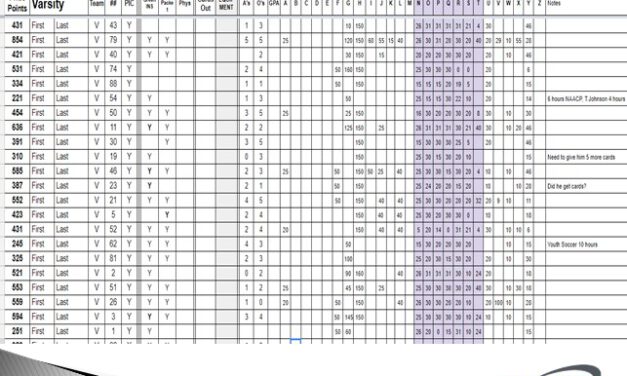
The first step to implement this program is to come up with your system. I always recommend to start simple. Find the things you find are really important to you, and emphasize it with pride points. You can always add to it or take away from it during the off-season, or between seasons. It is a better approach to start simple and add a little at a time, than to try to have too much and not be able to keep track of everything. Our pride point sheet is the result of 15 years of tinkering and I still tune it up every year to emphasize what’s important. This year, I increased our points for being on the wrestling team because football-wrestling participation numbers at our school have been dwindling. I also added in a bonus for each individual’s pride point max lift because I am trying to emphasize weight training more than ever. I will still possibly adjust it again because I’m researching leadership curriculum that I want to integrate into our program.

Point Opportunities

Here is a look at what we award points for in our system. This is what goes out to the players in the player letter. I will talk about many of these items more specifically below.

Winter & Spring

75 points – Bonus points for starting and finishing Basketball or Soccer (1 pt. per off-season workout, must be pre-approved)

125 points – Bonus points for starting and finishing Wrestling

150 points – Starting & finishing a Spring Sport.  (60 points if starting late/ending early, due to ineligibility)

25 points – Turn in COMPLETED AAU Form & AAU Money ($40) by Tuesday, February 20th

25 points – Bonus points for turning in ALL fundraising, by the Root Beer Social in May

15 points – Parent/Guardian joining the Booster Club at the Root Beer Social

5 points – For every “A” grade and every “O” citizenship, at the end of the 2nd semester.

1 point – For every canned food item turned in during our NEW Canned Food Drive.  Date TBA

1 point – Bonus point for every $5 raised above $200 (Varsity); or $150 (JV/Frosh) 

Varies  – Off-Season Workouts

Summer

5-25 points – Points given weekly based on weekly effort grade (1-5 rubric), multiplied by days present. 5 grade x 5 days attendance= 25 points  (See weight room for rubric)

Read More

Developing the Servant Leader In Your Football Family

By Clay Iverson
Head Coach
Mukwonago High School (Mukwonago, WI)


iversonAs always it is a pleasure to contribute a report for X and O Labs, it is a great place to go to learn, add to, and gain research on a number of items related to a game that has meant so much to me and to many others. 

I have not only thought it to be an honor to contribute a piece to X and O but also it is fun, I like sharing what we do from an on the field perspective.  I have never had an issue with sharing any of the schemes, plays or series we run at Mukwonago or where I have been.  I do not get paranoid about who has our film, and in general if one of our opponents had our play book I would be just fine with that.  There is no magic in there, and as many of you know there is no magic in any playbook.  The X’s and O’s of football are easy to learn and if you have the internet and the ability to read, well, you can get whatever you are looking for and then some.  So sharing in these areas has been a great experience.

This report’s topic however, is something we rarely share outside our program.  One reason is people don’t ask, which I think is too bad.  The second reason is we don’t bring in up because it has let us have success at multiple places in multiple leagues.  I suppose selfishly we like to keep it in house.  I do feel though more and more coaches are starting to understand the importance of leadership training and teaching family (not just preaching family) within a program.

We Want to Win

I think sometimes when coaches hear leadership or developing the complete person or family they feel that means putting winning on the back burner.  I know that is what I thought, until I started to listen to what the great programs were doing.  When it came to scheme they were simple, when it came to program and player development they were very intricate.  Make no mistake I have never coached a game I didn’t want to, think, or prepared as hard as I could to win.

When I was younger I didn’t go to many of the leadership or team building clinic talks (I thought that was a waste of my time, especially when the guy down the hall was going to teach me a can’t fail way to protect my 5 step game vs. man pressure schemes).  Yikes, that seems absurd to me now. It is amazing the great players I got to coach when I first started who won enough games so I could stay in this great profession.

What sets programs apart is not the X’s and O’s and I would argue it is not so much the Jimmies and Joes either, but the development of the servant leader and the investment of a true football family.

Who is the Servant Leader

As a coach think about the things that you get upset about, I mean the things that really keep you up at night, that get under your skin.  If those things are how to run the smash route perfectly or what depth your safety should be at in cover 1 I would argue, humbly, you are a football enthusiast, not a football coach. 

While technique and scheme are important they are meaningless without a group of young men that are dedicated to improving daily, love one another, and have the courage to serve others before themselves.

My main concern as a coach now, the things that keep me up at night, are reaching the level of complete servant leadership within our program.  This includes the following:

Having players who:

  1. Sacrifice anything that would take away from the team’s success (parties, soda, junk fund, too many video games, drugs and alcohol, etc.)
  2. Put (family) team success over their own individual stats or honors
  3. Play and practice hard all the time
  4. Never miss a 6:00 AM lift
  5. Are great young men in school and in the community

A football coach likes to win, if you had a team full of guys that are all in on the 5 above points, I think winning takes care of itself and not to mention you will get rid of those restless nights (well at least most of them).

Developing the Servant Leader and the Family

As with most things in football the devil is in the details.  We have all given our leadership talks, preached the importance of being a family, and maybe even threw in a leadership counsel or retreat.  I think all of that is great and they are all great items to use when developing a team of leaders and servers.  However, you need a game plan or else just like on Friday night everything kind of runs together into “what should we do next” situations.

Here is our servant leadership/family development game plan; we use it for all 10-12th graders, and pick parts of it to use with freshmen and even throughout our youth programs.

Read More