Leadership Council Implementation and Organization

By Chad Stadem
Head Coach/OC/Qs
Sioux Falls Washington High School (SD)
Twitter: @Mr_Stadem & @SFW_Football


“Build your team a feeling of oneness, of dependence on one another, and of strength to be derived by unity.”
– Vince Lombardi


In 2013, I went from a small, rural school in South Dakota to one of the largest schools in our state.  Having a team focused on unity and on the same standards was easier in a small school because we had every one of our students in class.  We could speak every day, and I had a good feel on the vibe of the athletes.  At Washington High School, I did not have that luxury, and it was hard to see and talk with my athletes daily.  I whole-heartedly believe that leadership is a contact sport and that teams and leaders need to see and interact daily.  The problem we faced in this new community was getting to know our players and the players getting to know us.  We needed to come up with a method so we could work on developing our core standards and unify our Warriors as a cohesive unit.


Starting the Leadership Council

Starting the leadership council was a big task.  It had to be real.  It had to reflect both the athletes and me authentically.  It had to be about giving our athletes a voice, and for them to build the team they wanted it to be.  I wanted to give ownership to them, and I wanted to get to know them on a personal level.  I began by speaking to one of my mentors, Lew Johnston.  Lew gave me ideas on how he was running his senior leadership council.  Then I researched Tom Osborne’s Unity Council during his time as head coach at Nebraska.  I began reading leadership books from John Wooden, Jeff Janssen, John Gordon, Tim and Brian Knight, and many more.  From this research, I trusted my heart and built the council with the sole purpose to help build a more accountable and focused team, just like the Lombardi quote.


The Makeup of the Leadership Council

Our Leadership Council meets every two weeks in the off-season.  It originally started off with just seniors from the team but has since evolved to include elected members from each class.  We meet before school for about 45 minutes.  This past year, it included coaches from our basketball and volleyball teams because they wanted to learn how we were building our team.  The purpose of this council is to help build the culture of the team.   My job is to start and direct conversations.  I spend most of my time taking notes and listening to their needs, wants, and concerns.  We see true leaders step up and voice their thoughts.  This creates an open dialogue, and it is fun to listen to the guys.  This council makes a lot of decisions regarding the direction of the team, including which summer camps we will be attending to handling behavior issues.  Before each meeting, I send out an agenda with a thought or idea to discuss, but we want it to be fluid.  After each meeting, I send out notes of our discussions.

Read More

21 Personnel RPO Package

By Brent Dearmon
Head Football Coach
Bethel University (TN)
Twitter: @BrentDearmon


Introduction

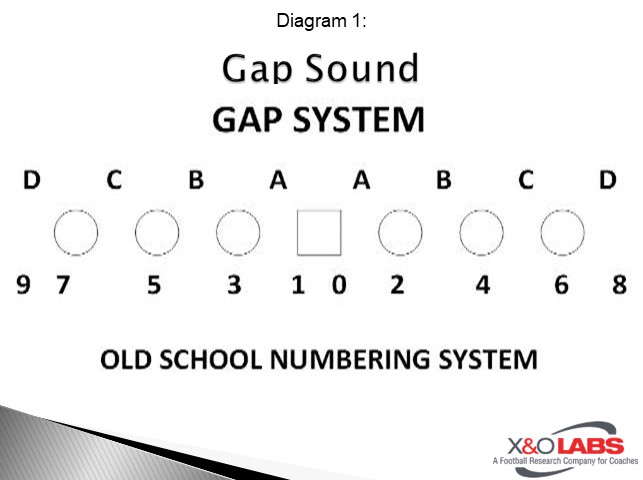
In 2017, we called 313 RPOs out of 885 plays. That means that 35% of our offense was RPOs. The results were overwhelmingly positive on those plays, but perhaps the best stat is that we had zero sacks and zero interceptions on RPO plays. The main reason we were able to do that was because we found ways to be gap sound and protect our QB.

As the season went on, we found ourselves in 21 personnel more than we had anticipated to help create an extra gap to protect our QB. In this report, we will show a few of those plays, but more than that we will explain the protection and the read for the QB.

Coaching QBs

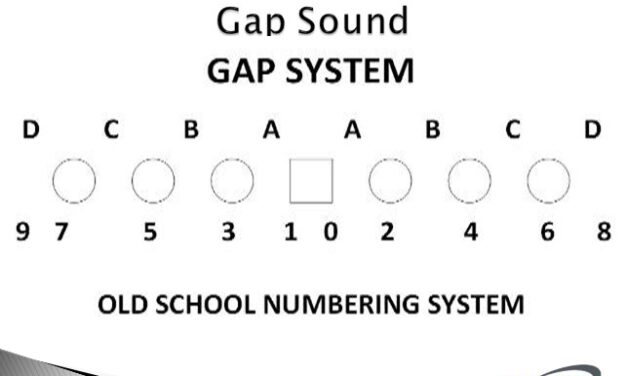
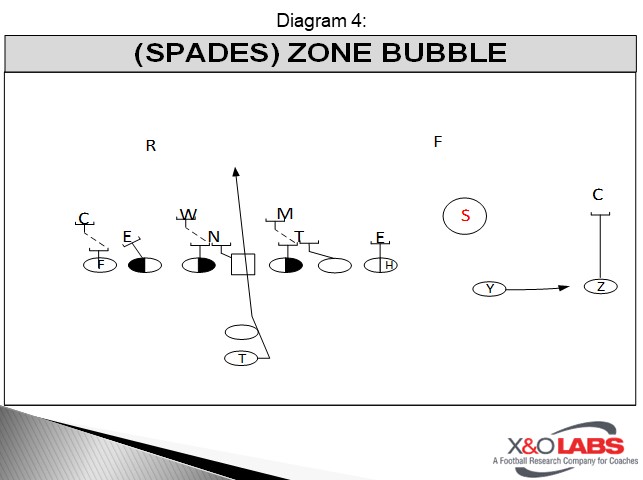
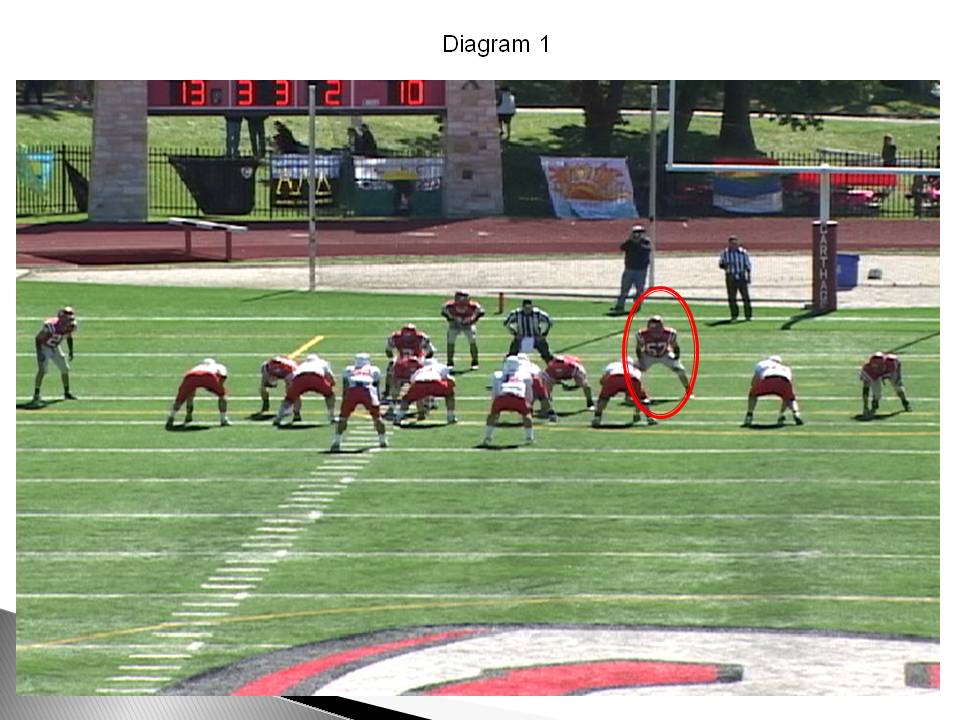
Before we get into plays, I want everyone to understand how we teach our QBs. This chart is discussed in depth with every RPO we install. Our QBs understand which gaps they are protected, in which gaps they are reading, and in which gaps the protection is weak. (Diagram 1)

Slide1Slide1Slide1

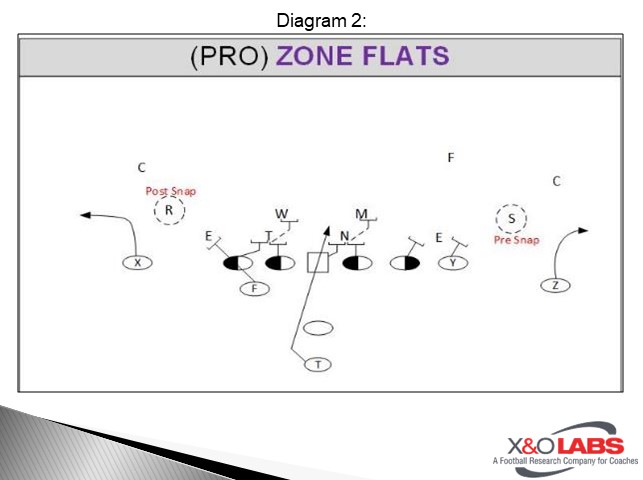
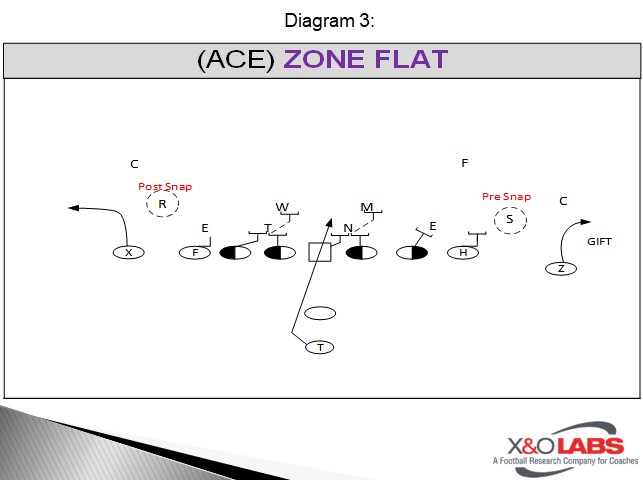
Zone Flat

In this concept the QB will learn the following:

  1. The OL and HBs will protect him from front side D gap to back side C gap.
  2. His pre-snap “quick game” throw will always be opposite the side. He will turn his eyes to this during the RB mesh. If the pre-snap “gift” flat route is there, we want him to throw it now.
  3. If the pre-snap throw is not there, he will then ride read the boundary D gap player. If the D gap player attaches hard to the run fit, he will then pull and throw the boundary flat route.

Slide4

To study game film of this concept, click on the video below:

Read More

Using “Flush” Principles to Add on to Pressures

By Ty Gower
Defensive Coordinator
Princeton High School (TX)
Twitter: @coachgower


As a 3-4, we base in the popular mint/tite front (4i-0-4i), or what we call “Okie” front, that has become more common as the clinic tapes, coaches’ lectures, and other teaching material becomes available. There are many reasons as to why we love the Okie front, but like every defense, this defense has its strengths and weaknesses. I learned long ago that, “Whatever your defensive philosophy is, you must identify the weaknesses of your favorite defense as much as the strengths.” As we have found out, and as you will read, this is one of these schematic ideas that is understood through reading and chalk talks but also needs video representation to explain the point further.

Benefits of Okie Front:

Let’s start with some of the strengths of the Okie front

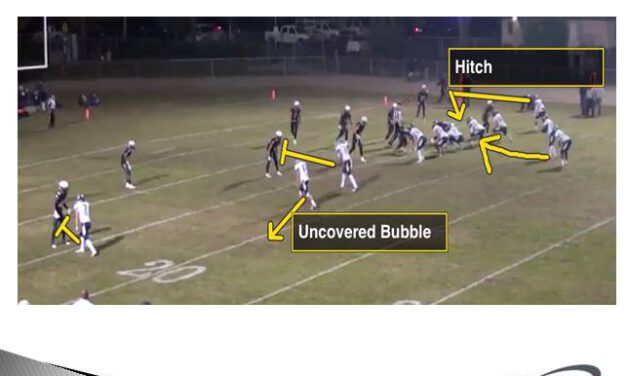
  1. The “unknown” to the offense of where the bubble is in the 4i-0-4i front, as opposed to playing a shade/3 front.
  2. The ability to slant & move to any front we want from an odd front structure.
  3. The ability to “walk” the boundary OLB to help bracket the “X” WR in 3×1.
  4. The ability to drop 8 and play multiple coverages.
  5. The ability to rush any 4 of the ILB or OLB anywhere we want and at any time.


Troubleshooting 4-Man Pressures:

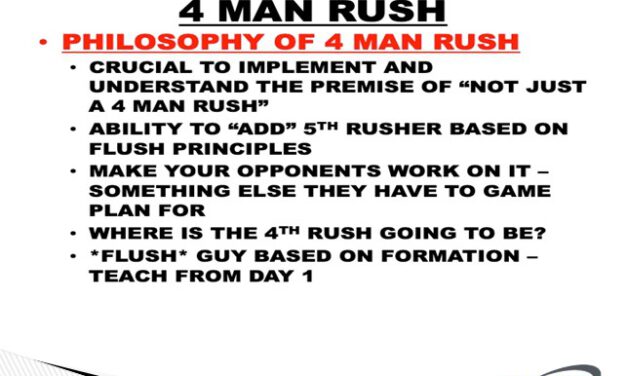
The ability to rush any 4 of the ILB or OLB anywhere we want and at any time is vital to incorporate into your 3-4 defense. When we first were learning about the 3-4, we were implementing a 4-man rush, just to install a 4-man rush. We would go through spring ball and run a 4-man OLB rush, but not getting the results we wanted. We later realized that the away side of the rush was just as vital to coach as the front side OLB rush. So we came to find out, #5 had a dilemma, and we had to coach up the 4-man rush, more than just “install the 4-man rush.”

As much as we like strength #5, this strength does come with a weakness. We found that we had two glaring weaknesses within bringing a 4-man rush out of 4i-0-4i. ***Disclaimer – We can and do slant the front when we are bringing our OLB, but as a base, we want to stay within the 4i-0-4i front, as will be described in this article.***
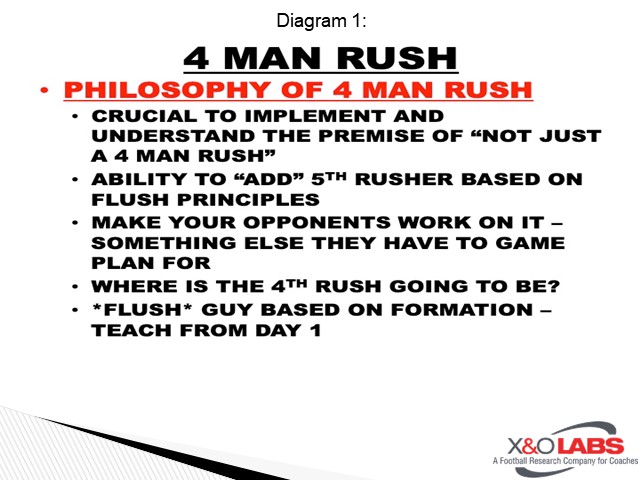
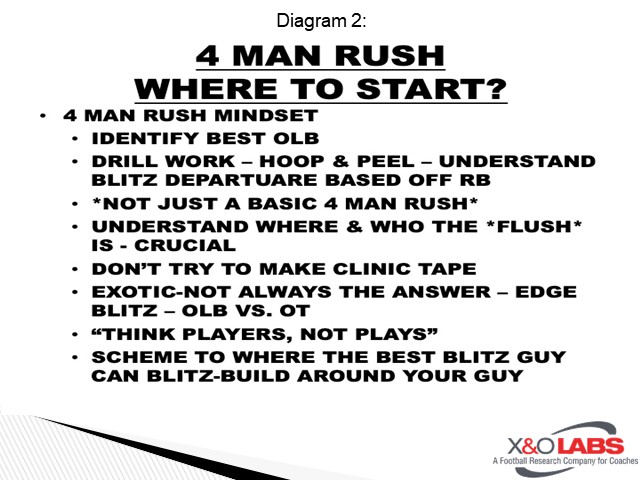
Diagram 1

Diagram 2

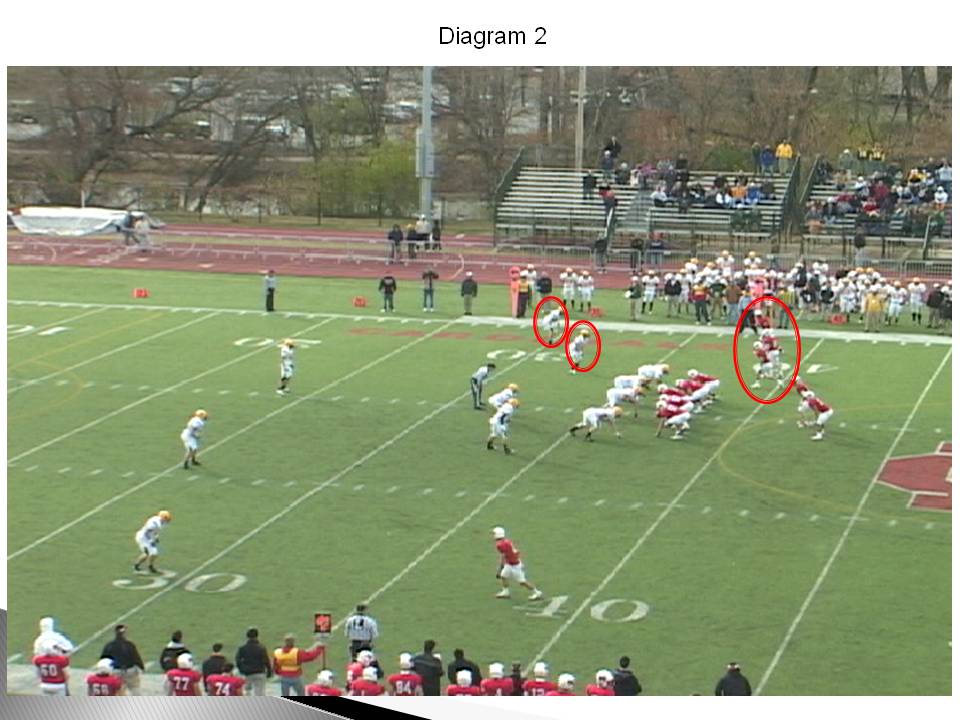
Problem #1. How do we keep our various Cover 4 2×2 and 3×1 checks? We did not want to void “cover down zones.” Meaning – when we 4-man rushed an OLB, we did not want to void his alignment and play 2 over 2. The initial thought was to spin to cover 3, and play a 4 under, 3 deep concepts, but here came a dilemma, we didn’t play much cover 3. That’s just not what we do. We were a two-high coverage concept defense. Yes, we played some cover 3, and do use it to cover down the OLB at times, but we didn’t run it enough to major in the coverage, especially since we wanted to major in a 4-man rush. Thus, we had to figure out how to rush 4 and still play 3 over 2, Quarters concept and not always spin cover 3. We will identify how we covered the OLB later in the article.

Problem #2. We found out that when we want to bring a 4-man OLB rush, we were unable to set a “hard edge” opposite of the OLB rush due to us playing a 4i across the front, thus lacking what we would later determine as a “flush player” to help us with our edge. What we found out was when we install our 4-man OLB rush, we must teach our away side “flush principles” based on the offensive formation. In turn, this gave us the ability to call a 4-man rush from the sideline but allow the kids to add themselves to the rush based on the offensive formations and giving us a 5-man pressure.
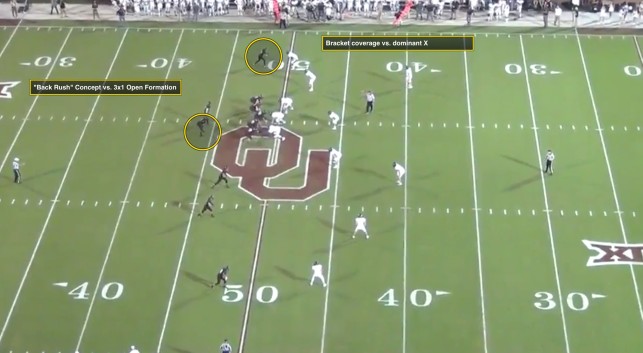
Flush Principles:

Our kids began to love the idea, due to the fact it gives them some freedom to become a rusher/blitzer based off the following:

  1. Knowing who the “flush player” is based on the CALLED OLB rush from the sideline.
  2. Knowing who the “flush player” is based on the offensive formation.


When we called a 4-man OLB rush, we were getting a 5-man blitz based on offensive formation, but again, understand that the 5-man pressure was NOT called. It’s incorporated and understood by our kids and taught during the offseason.

When we start our spring install, we first install our two OLB “blitzes”. Our strong/field OLB is the Nickel and our weak/boundary OLB is the Jack. We don’t necessarily call our 4-man ILB/OLB a true blitz, but rather a 4-man rush, with a 5-man pressure built into the rush based on “flush principles”. Yes, we still implement our 5-man fire zone blitzes, but the absolute first install is our OLB 4 man rush and teaching our kids the flush principles.

Now, when it comes to the technique of the OLB rush, we aren’t doing anything different than anybody else. We work all the leverage drills, hoop drills, rush drills that everyone else does, but where we think we are unique is our research in refining our OLB 4-man rush by adding a 5th rusher with the “flush” concept.

As stated earlier, one of the great things about the 3-4 is the ability to rush any of our 4 ILB/OLB at any time. However, when we start, we want to identify our “hybrid guys”. Who is our Nickel and who is our Jack? After we have identified those positions, we discuss who becomes the “cover down” and who becomes the “flush player.”

Let’s first identify our Nickel and will be the focus of this article. In our defense, and with so much of the game played on the hash, our Nickel is our “catch-all”. He must be a guy whom we feel can cover, buzz to the flat, blitz the edge, play like a corner in certain coverages, make plays in space, and other various ideas we put on him.  Again, out of our Okie front, when we run a Nickel blitz/rush, we feel we can rush him at any time against any formation. Remember the dilemma:

  1. How do we cover him up?

Read More

Multiple Backfield Tags to Simplify 11 Personnel Run Game

By Kahn Chace
Head Football Coach & Offensive Coordinator
Tri-County RVT High School (MA)
Twitter: @kahnchace


Our running concepts are designed to attack a defensive structure, defensive personal, and adapt to our current personal. We found having too many different blocking schemes creates spending more time teaching whom to block, rather than teaching how to block. The defensive schemes we see each week in our area can vary from week to week. So, our philosophy is to have fewer running concepts for the lineman to learn and put more meshes for our backs to learn. Having mesh tags for our backfield action makes our offense multiple, yet simple to learn.

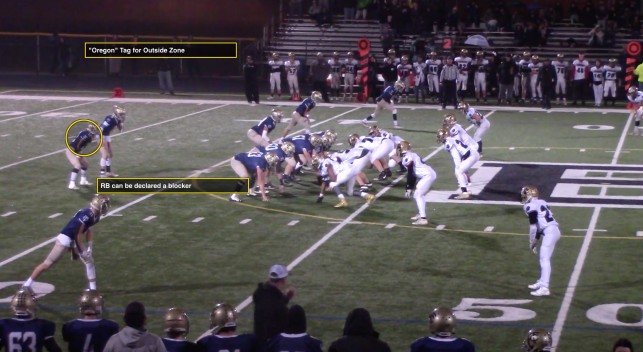
We tag 3 of our main run concepts. Auburn is power, Arizona is the inside zone (pin and pull), and Oregon is the outside zone (pin and pull). Our bubble and fast screens are married to the Oregon concept as well. This reduces the amount of time needed to teach our running game during a full-team period, and players get more repetitions.

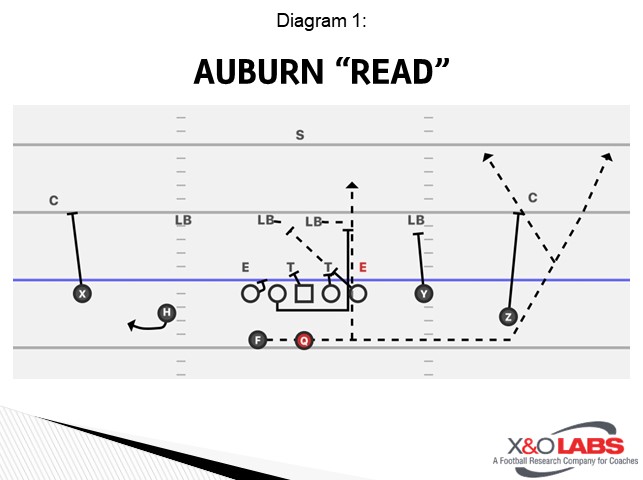
Auburn is the power blocking scheme for the line, and we tag that 3 different ways. Read is power read, Kick is a traditional power, and Speed is an outside option.

Mesh Tags

“Auburn” Tags:

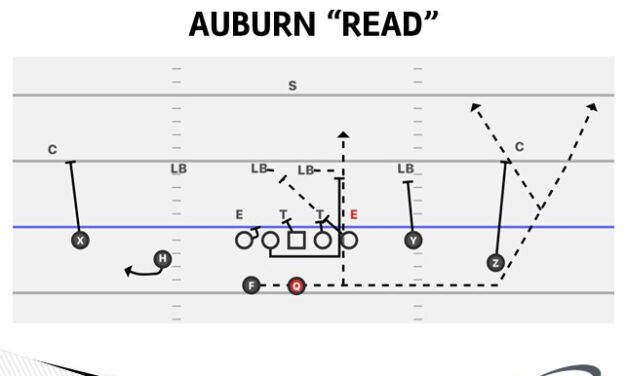
Auburn “Read” (Power Read)

With “Read” the QB will take three shuffle steps with eyes on the play side on end man on the line of scrimmage (EMOL). If the EMOL widens, QB keeps in C-gap. If the EMOL squeezes on the down block by our tackle the QB gives to F back and continues his fake through C-Gap. The F back does not want to look for a turn up until he is at the numbers. We run the play with motion and without motion. Numbering all the backs allows us to have any one of the skill positions run this play with the QB.

Diagram 1

We like to run the “Read” mesh if we feel the EMOL is either too slow to chase down our F back or plays too far upfield. This concept is great for a quicker F and or a downhill running QB.

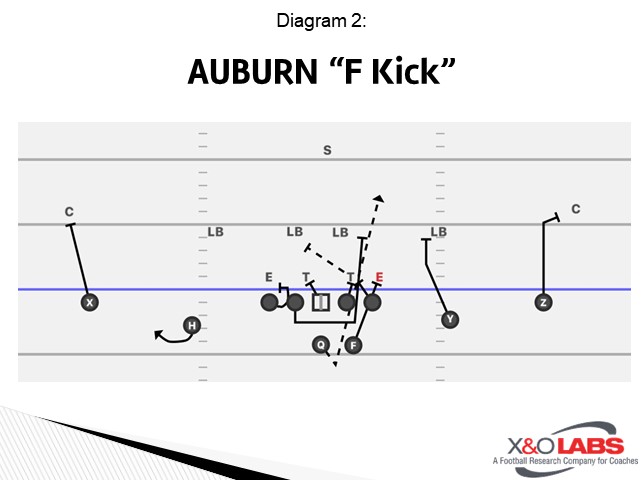
Auburn “Kick” (Traditional Power)

When we want to just line up and run a traditional power at the defense, we use the tag “Kick” That tells our QB he is giving the ball and no longer reading the play. We use multiple formations, so we also tag who is doing the kick-out block. If we wanted to run power with our QB we would tag the F back to kick out.

Diagram 2

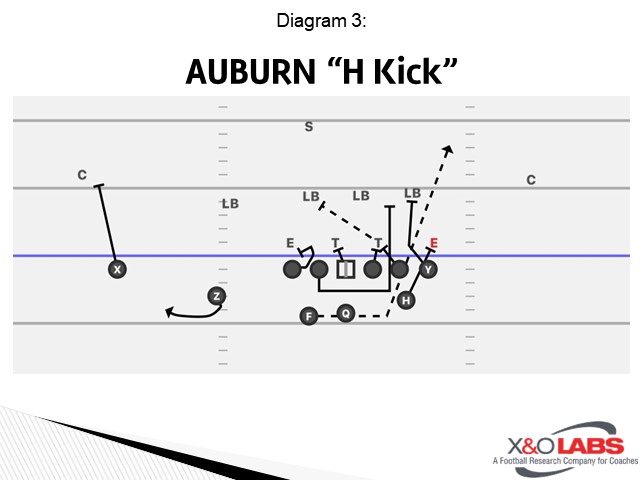
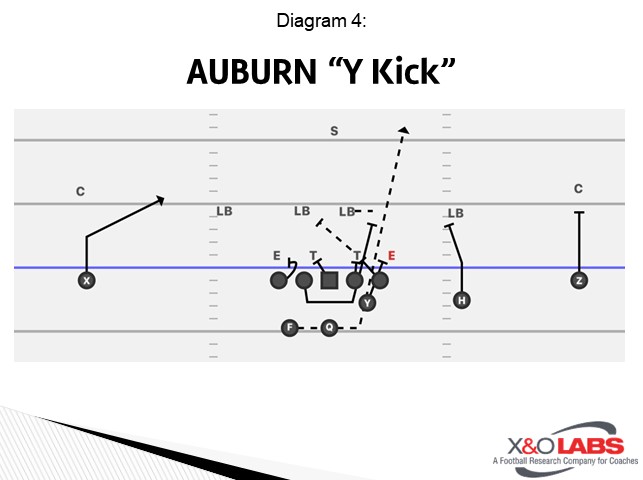
If we want another back to run power, we tag our H back or Y to kick out the EMOL. We teach our RB’s, TE’s and H backs how to kick out EMOL during their individual and group periods. We like to run the “Kick” mesh when the EMOL is not as strong as our players kicking out or plays too far upfield.

Diagram 3

Diagram 4

Auburn “Speed” (Option)

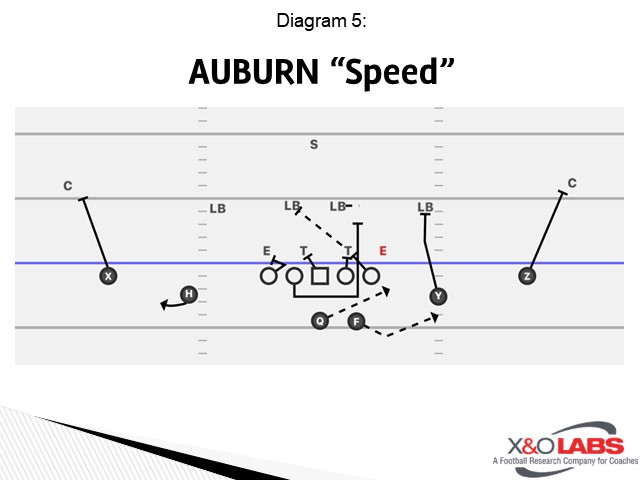
When we want to option the play side EMOL we tag the word “Speed” to Auburn. This tells our QB we are reading the EMOL play side. He attacks the end downhill. If the EMOL plays the QB he pitches to the F back, if the EMOL plays the F back the QB keeps the ball on the same path as Power.

Diagram 5

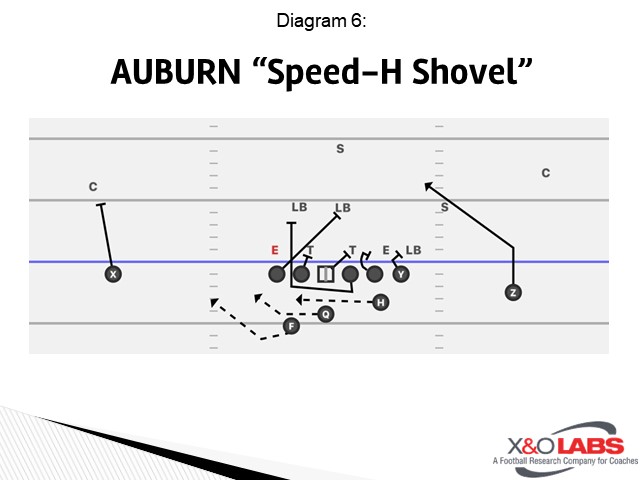
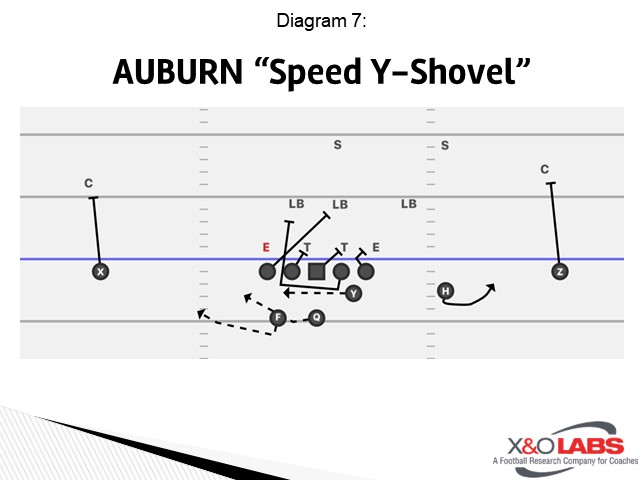
We teach our H and Y backs a shovel technique as well if we want to run Auburn speed out of two-back sets, or from his sniffer position. We tag the word “Shovel” We like to run “Speed” mesh when the EMOL is squeezing on the down block, and or an undisciplined player. We like to run this away from 3×1 when teams over-rotate towards the strength.

Diagram 6

Diagram 7

To study game clips of this concept, click on the video below:

Read More

Re-Aligning Your Program’s Culture Every Off-Season

By Ken Vigdal
Offensive Coordinator
Brookings High School (SD)
Twitter: @kevigdal


Walking off the field in 2014, defeated in overtime of the championship game, I thought to myself “Our football program has arrived.” Nothing can stop us.  We have built a successful program, and next year a state championship. 

Walking off the field after the final game in 2016, I thought to myself, “what just happened?”  It was the first time in school history a team went 0-9.  Just that fast, we went from the top of the league to the very bottom.  As coaches, we had to come up with a plan.  This plan had to incorporate more than just X’s&O’s; it had to improve all parts of the program and the athletes.  This is the plan we spent the next six months developing and implementing.  Over the past two years we have consistently tweaked it, but our mission has been the same: love, serve, and care.


The Turning Point:

After going 0-9, not many people from the student body, players, parents, and community members believed in our program.  We had to give our athletes something positive for them to become part of and gain confidence, so we created a Peak Performance Program. The first aspect of our program was to teach the process of becoming great, the focus on different ways great athletes prepare themselves.  We started in the spring with each grade level reading different books.  Next year’s sophomores read Chop Wood Carry Water by Joshua Medcalf, juniors read The Hard Hat by Jon Gordon, and the next year’s seniors read The Training Camp by Jon Gordon.  As coaches we also read the books and created action plans for each book that we gave the athletes.  Also, we found players from the 2014 team to come back and help with each of the book reads.  Players had to fill out their action plan of improvement.  In addition, parents signed the plan saying they had discussed it with their son.


Secondly, we wanted to create leaders in our football team.  We did this by creating unit leader positions.  We have a Google form, for a player to fill out, to apply to be a Unit Leader.  In the final meeting of the spring, all the grade levels come together for one final breakfast. Coaches printed copies of the applications of the unit leader form, and the forms were handed out to the rest of the team to read and vote for the top eight.  The top eight vote getters become a unit leader. A few weeks later, the unit leaders drafted their teams. Drafting their own team is very important because our program is based on a wide range of competitions, and at the end of fall camp we crown the unit champions. We also met with leaders and discussed leadership qualities and the ones that they most represented. It is important for coaches to help athletes gain leadership characteristics. We used a variety of methods: from Make Your Bed speech, parts of Jocko Wilko audio book, and guest speakers.

The unit leaders review the five core values we live by as a football team.  The brand we created from our core values is Pound the Stone.  Unit leaders review the core values every year and see what ones they want to change.  The values have not changed since the first group of unit leaders and coaches came up with the list in 2017. They are TPW (tough people win), BCD (blame, complain, defend), talk to yourself, don’t listen to yourself, play present, and finish empty.  The coaches reinforce these ideas every day.  We put Pound the Stone and at least one value on every shirt we create.  We use the words Pound the Stone and not core values because athletes like the brand we have created.  When we use the term core values, they perceive that as preaching at them.

Read More

The Fastest Team Wins: Get Professional Speed Training in the Hands of your Athletes

By X&O Labs


For most coaches, it’s hard to be an expert in every area of the job, especially when it comes to training.

We continually see coaches focusing a large majority of their time on one thing: strength. 

Although this is a huge component of developing a high performing program, there is one area in which top programs seem to get an edge over the others: speed.

The motto “speed is king” has never been more true. Successful programs continually work to develop team speed.

Very few coaches consider their programs to be fast. Yes, they may have a few players that have some speed, but as a team if they could just be a little faster, their…

  • OL would get a first step advantage
  • DBs would be faster on the breaks
  • RBs would have that one-step explosion when they hit the hole


The Formula: “Speed is king”

One of the biggest challenges with improving speed has to do with the lack of speed specialists who have a proven track record of results.

In comes Les Spellman

Spellman’s story is personal, as is every element of his approach to helping athletes and programs transform their approach to speed.

His passion for speed has its roots in his own experience as a young athlete who fractured his femur at 17 years old in a near-death car accident. He was left debilitated with a metal rod in his femur and forced to learn how to walk again.

Les wasn’t satisfied with simply walking – he wanted to run – to fly! He immersed himself in the study of advanced biomechanics and speed training techniques. He learned. He re-engineered his speed skills. And he more than walked – he ran his way on to the elite Division 1 program at Temple University.

Years of research in advanced bio-mechanics and speed development led Spellman to open his own high performance athlete development center Spellman Performance, an organization that has trained 5 Olympic teams, 50+ NFL athletes, over 100 Division I athletes, and countless others.

With a track record of helping programs get faster, our friends at MaxOne wanted to find a way to scale Spellman’s knowledge and bring it to high school coaches around the nation.

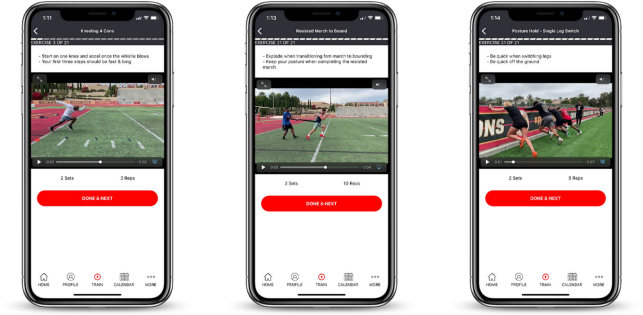
In an effort to help you have your best off-season yet, we’re excited to share that MaxOne is teaming up with Spellman Performance to bring you a highly touted off-season speed program. 

Custom Built Speed Program: What’s Under the Hood?

There are a million speed programs out there, so what makes this one different? 

For starters, it’s proven.

Spellman Performance has spent years researching and developing this speed program. It is comprised of trusted drills that are built from in-depth biomechanics research that have been used with countless D1 and professional athletes.

Teams that implemented the program shaved an average of .2 seconds off each athlete’s 40 yard dash in 6 weeks, allowing every player, regardless of their position and skill level to see improvements.

High performing technology combined with a professional like Les Spellman, is a combination that all coaches around the nation could benefit from.


“My goal has always been to help athletes and teams get faster. By partnering with MaxOne, I now have the ability to deliver my knowledge and experience into the hands of like minded football coaches and athletes around the nation”
– Les Spellman

Read More

Front Side Blocking Progression in the Outside Zone

By Ben Luther
Former Offensive Line Coach
Tusculum University (TN)
Twitter: @Coach_Luther


First and foremost, I would like to thank Jerry Odom for allowing me to coach the offensive line at Tusculum University and also to thank X&O Labs for allowing me to discuss how we teach the front side blocking of our wide-zone play. When it comes to running the wide zone play at Tusculum, we don’t think about footwork and attacking our defenders. As an offensive line, we walk up to the line of scrimmage and the defense presents a front to us, and as an offensive line, we have a toolbox with an approach, appropriate and techniques steps to handle these fronts.  At Tusculum, we start each practice with our approach and steps.


General Info and Key Points About Outside Zone:

Before hitting the field and introducing drills and fundamentals of outside zone play, there are a couple of key points that must be covered and understood in the meeting room.

Our general zone philosophy is that in our zone schemes, the Offensive Line is responsible for moving the down lineman, and the running back is responsible for moving the linebackers.  The aiming point of the running back on the wide zone is the backside of the play side tight end.  The play can hit from the Front side A gap, B gap, C gap to the backside B.

My base rule is to block my front side zone. and my aiming point as a covered offensive lineman is two inches off the midline.  The offensive linemen should always ask “Where is the Defensive lineman located about the framework of my body? It can be any of the following:

  1. Head up alignment
  2. Outside shade alignment
  3. Tight outside shade alignment
  4. Key, clue or indicator of an inside move
  5. Am I a tackle or tight end with a technique who is a gap removed?


Definition of Front Side Rules:

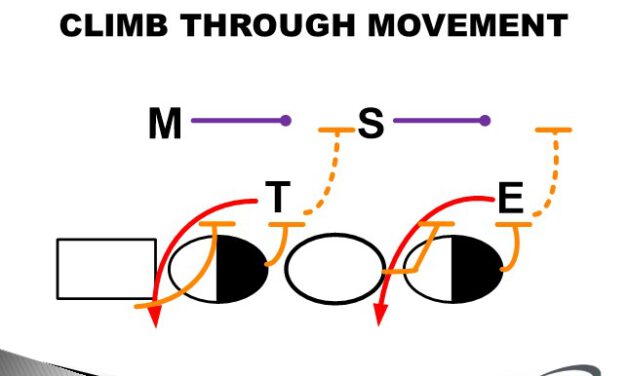
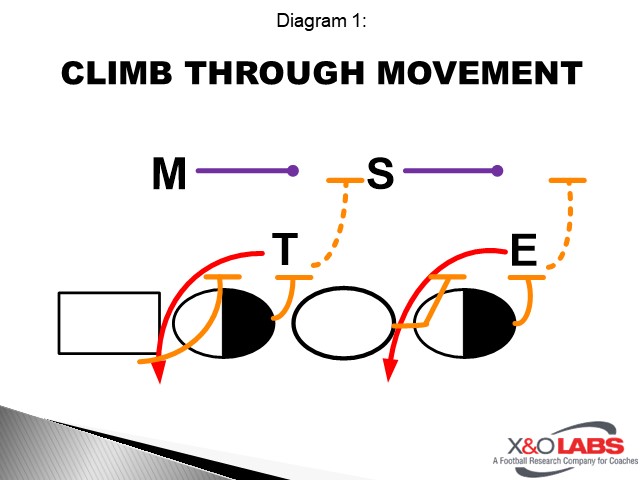
The General rule of our wide zone scheme is that we are responsible for our front side zone. In doing this we will also climb through movement. We at Tusculum define our front side zone as head up to the front side, if A Defensive Lineman crosses your face to your backside, it is no longer in your front side zone. Once this occurs it is in the adjacent offensive lineman front side zone, the original offensive lineman will be able to climb through movement to the 2nd level or collect a different 1st level threat. This principle will allow us to stay square and not get picked off by defensive line movements.

Diagram 1


Postural Blocking Fundamentals:

As an offensive lineman, we want to understand how we must be postural when we are run blocking. We want to have our foot on the ground, with our knees inside our ankles and our weight on our insteps, which creates a “big bent knee”, we want to have a big chest. We believe that this position allows us to efficiently move forward, backward and laterally and gives us the ability to use our double or single under forklift technique when we make contact while striking on the rise. 

Our objective when we take “steps” is to close distance and space between us and the defender and allow ourselves to be square and give the running back a clearly defined read. To arrive in this position, we must understand how to approach each defensive situation and use the appropriate steps. We also will take more steps than big steps to arrive in the proper position


Approach and Steps for Covered Lineman: 

Approach: As an offensive line coach, I don’t coach just footwork and I don’t believe in using that phasing because as an offensive lineman we aren’t just moving and using our feet. An offensive lineman must know his aiming point on the defender, how must he position his body about his aiming point. We know as players and coaches that numerous situations can arise during a game. We must prepare our players for those situations with a clearly defined approach, and appropriate footwork.  When our outside zone play is called in the huddle, we as an offensive line walk up to the line of scrimmage and we access what is in front of us, and we have been given a toolbox for the different defensive line techniques.

Steps: When an offensive lineman takes his steps, his first step is a position step to set his course and path to achieve the goal of being 2” off the midline for the outside zone. On the first step, the backside knee should pivot and continue to be inside of the ankle, the pivoting of the knee indicates that the OL has lowered his center of gravity. 


Versus Head-Up Aligned Defender: 

When the OL is presented with a head-up technique, we know that: A) We must get 2″ off the midline. B) A head-up technique is not going to stay a head-up technique. When we are presented with a head-up technique, we are going to use our Square and Pin technique. An example of a head-up technique would be a center vs 0 technique, Guard vs 2 technique, tackle vs 4 technique, and/or tight end vs 6 technique.

Read More

QB Off-Season Mental Development Part 2: Sprint and Deep Route Design

By William Clay and Charles Steward
Offensive Coordinator/Quarterbacks Coach
Halsom High School (TX)
Twitter: @brandonclay88 @coachstew06


In the previous report, Quick and Intermediate game, we identified four areas we want our QB to be cognizant of in the passing game:

  1. Pass Protection: How am I protected, and where are the threats?
  2. Pre-Snap: What is the defense showing me, where can I attack based on alignment NOW?
  3. Post-Snap: Is what I saw Pre-Snap true? Does my attack change?
  4. Game Situation and Match-Ups: What is the down and distance? Is my guy better than their guy?


If you have not read the previous article and would like more in-depth information on what each entails, please refer to Part 1: Quick and Intermediate Game.  These areas apply to every passing situation that we may face in a game.  In this article, we will discuss Vertical and Sprint Out/Play Action passing.  While very similar, each presents a different set of challenges for QB’s, yet by adhering to our four areas of focus, our QB’s can be successful regardless.   Together with my quarterbacks’ coach, Coach Charles Steward, this is how we teach our QB for each segment of the passing game.


VERTICAL PASSING GAME

Our Vertical game consists of a three-step drop (out of shotgun) and passing routes 12 yards or more.  While Fade is considered a vertical threat, it falls under our Quick game and is discussed in the previous article.  

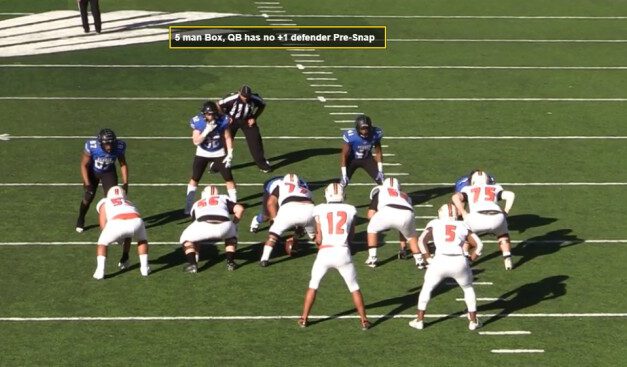
Pass Protection:  Our pass protection consists of man/slide, the QB will relay to the offensive line the man side, which depending on the type of front will designate a three or four-man slide side.  The RB goes to the man side.  As with the quick game, the QB knows he is responsible for any “+1” defender from the man side. 

Pre-Snap Reads: With our Vertical passing game the QB will ID the box as previously mentioned, however now the Safety count is the primary concern, as well as, cornerback leverage.  Our Vertical passing game is not mirrored, and we are calling the concept to the field or boundary, so we have a playside, the QB will be primarily concerned with the Safety and Corner (and any LB) to the playside. 

Post-Snap Reads:  As Coach Steward mentioned in the earlier article, the QB will have an idea of where he wants to go with the ball based on his pre-snap analysis of leverage and safety alignment. 

For our analysis we have three popular concepts that we use:

HI: A Post and Dig combo

Wheel: Double Post with a Wheel Route

Scissors: A vertical switch route, with a post and corner.


HI: Post and Dig Combo

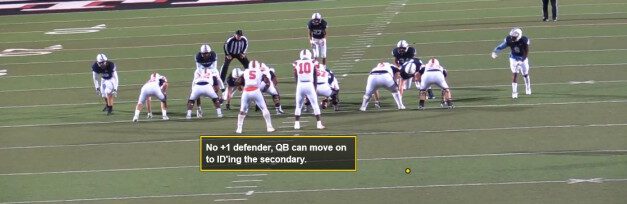
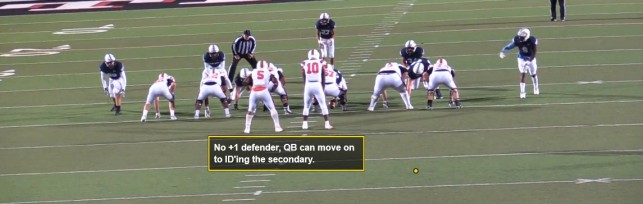
PRE-SNAP:  The QB has identified the box and sees that pre-snap there is no “+1” defender to threaten him.  His protection is adequate, and he can move on to identify the safety alignment.


The QB has identified a 2 High Safety pre-snap alignment.  The TE to the BS will hold the safety in the middle of the field, the QB knows he only must read the safety over #2. 

As you will see in the clip below, the QB has an easy read and throw.

To study game clip of this concept, click on the video below:

Read More

Using Terminology to Align Staff

By Nick Davis
Defensive Coordinator/Defensive Backs Coach
Rose-Hulman Institute of Technology (IN)
Twitter: @Spread_Defense


At Rose-Hulman, we, like most small colleges, have a pretty small staff.  On my side of the ball this year, we will have two graduate assistants, a part-time coach and myself. Two of our four members on the defensive side of the ball will be new for the season. Over my four years as the defensive coordinator, I have had eight different position coaches work for us as either graduate assistants or restricted earning coaches on defense.  Each time a coach leaves for a full-time job I feel that they are ready to go and do a great job at their new program.  How do you train young coaches to know as much as you know in a small amount of time? The simple answer: you can’t.

I have tried to make sure our system in that every question is answered before it gets asked by our coaches and players. This took a lot of time for me as the coordinator on the front end to make sure we had rules in place to teach coaches and thereby the players.  I stress that our whole scheme is a system that makes total sense to our players and coaches and has nothing to do with what anyone coming into the system knew before. An Over front or Cover 2 might be 10 different things to our staff and our players coming in but is a commonly understood term in our system.


Video Playbook

One way to help with this transition of new coaches is to create documents that can help guide your coaches. We do a video playbook so the young coaches, and players, can hear me explain the playbook.  We have all the things we have done saved to a google drive so that coach can refer to past years and former coaches. This season we are going to put one coach in charge of each skill that we will circuit. One coach will be the head on tackling, one coach will be the lead on takeaways, and one coach will oversee getting off blocks. That coach will have to watch the film in his area and create drills that we will circuit every day. Instead of having a different circuit every day, that coach will pick drills from his area to work on and have different focus stations. With having a tackling, takeaway, and getting off blocks focus, this is being preached every day by each of our coaches.


Terminology

Teaching our scheme might be the easiest thing for young coaches.  Our scheme is all a system based on word association.  Our fronts are named by animals, fruits and vegetables. Our coverages are named based on cities and states.  Our movement words tell every player involved where everyone will end up after the play.  Owl Ball California means nothing to anyone other than the Rose-Hulman Defense staff and players. The owl tells our box players we are aligned in our 3 down front with our defensive ends outside the tackles in 5 techniques.  Ball tells our ‘Bob’ linebacker to rush the B gap but tell all the defensive lineman where to end up.  The other two linebackers now know what gap they each own in the run game.  California tells our defensive backs and two linebackers not rushing that we are playing California coverage.  California means we are playing a 4-man rush match man coverage and a city like Los Angeles might mean a different adjustment to the coverage.

Read More

3-3-5 Firezone Pressure Package

Aaron Hancock

Head Coach

Wyoming High School (OH)


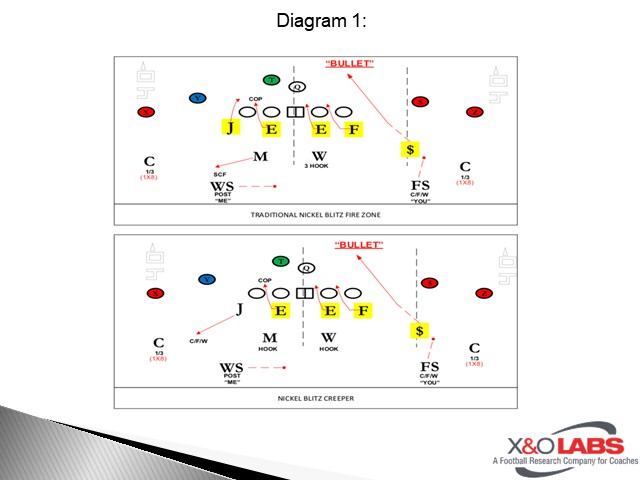
A defense must be able to effectively pressure the QB in today’s offenses. The quarterbacks of today are the best athletes on the field and can make big plays in an instance. That is why we like to be the aggressor on defense, set the tone and never let the quarterback feel comfortable. In 2008, I began to look at various concepts of pressure defenses; man, zone, matchup zone, and fire zones. I wanted to bring the pressure but not risk giving up a big play over the top of the defense by playing man coverage. I wanted a system that was easy to remember and the players could recall the rules very easily in the action of a game. The fire zone concept is what I believed gave us the best advantage to be successful in the 3-5 defense.

Advantages of using fire zone coverage:

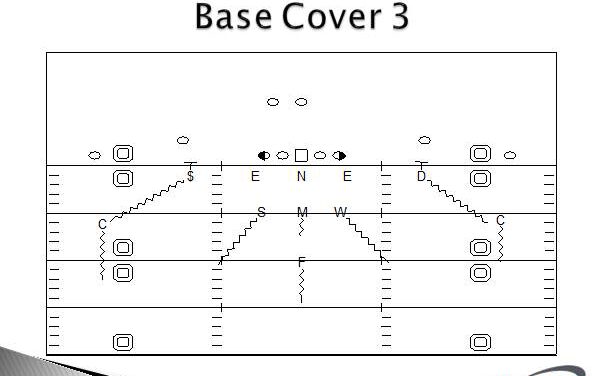
  1. Base Cover 3 principles, no new techniques to teach.
  2. All eyes are on the QB!
  3. Easily adaptable to new pressures.
  4. Secondary can give faster run support than in man coverage.
  5. Easily adjust to offensive formation, and still be able to run your pressure, no need to check off!
  6. You don’t need elite athletes to run fire zone, a less athletic defender can cover an elite receiver.
  7. Less chance to give up a BIG PLAY!

For more information on the basics of Coach Hancock’s Zone Blitz concepts, click the video below:

Read More

Simulated Pressure System – Case 1: Devising Pressure Patterns to Manipulate Protections

By Mike Kuchar
Senior Research Manager
X&O Labs
Twitter: @MikekKuchar


As the University of Louisiana rolls into its first off-season under head coach Billy Napier, there are many positives to build off of. The Ragin Cajuns played for the Sun Belt championship, eventually losing to nationally ranked Appalachian State, earned its first bowl bid since 2016 and eclipsed its first seven win season since 2014. So as the 2019 season approaches, the defensive staff under the direction of defensive coordinator Ron Roberts will continue to hone in on what got them to this point. And, according to Coach Roberts, much of their defensive success is credited to building a simulated pressure package that he calls “replace” blitzes. It’s a name patterned from Coach Roberts former defensive coordinator Dave Aranda, who constructed this system while both were together at Delta State University. These are four-man rushes that attack an aspect of the protection or blocking scheme by overloading that particular player or side. This part of it is no different than any other pressure package. But, the difference in replace pressures is that by only sending four in the rush (and not five), coverage isn’t compromised like a traditional fire zone.

“Blitz used to mean playing zero coverage and getting one guy free on the back,” Coach Aranda told us. “There is an attacking mindset there with those kinds of pressures. You may get a guy that beats a guy but the other five guys are preoccupied with blockers. So, the next progression was to bring an overload of four on one side and two on other side, but the disguise element is gone. It’s difficult to get those guys over to their coverage responsibility. It didn’t seem like it was sound against pass. This pressure package helped alleviate that issue.

When you’re bringing these pressures and playing the appropriate zone there is a pinpoint accuracy because you’re attacking the protection. I would compare a carpet bomb to a laser guided missile. The issue with the laser guided missile at times when you’re trying to disrupt the run game or stress a protection you’re trying to get it specific so you’re keeping that blitz mentality.”

According to Coach Aranda, the allusion of pressure can deter quarterbacks, even in the SEC. “There is a fair number of quarterbacks in this league where their eyes will come down when they see pressure,” said Coach Aranda. “The aspect of simulated pressure and the presentation of a single high look where you can roll to quarter, quarter half and still bring pressure and attack the protection makes the quarterback sense it.”

The replace pressure system that Coach Roberts and Coach Aranda developed was then advanced further at the University of Texas-San Antonio where, under the direction of defensive coordinator Pete Golding (who served at Southeastern Louisiana under Coach Roberts) the Roadrunners finished in the top ten nationally in scoring defense, yielding 17 points per game. The success of the scheme propelled Coach Golding into the co-defensive coordinator position at the University of Alabama where he remains today. And as Coach Aranda, now the defensive coordinator at LSU, enters his fifth season as a defensive coordinator at a Power 5 program, his defenses have ranked in the top 12 nationally in total yards for five consecutive years. His defenses have also ranked among the top 10 in scoring four of the past six years. In that 6-year span, Aranda’s defense has allowed a touchdown or less in 41-of-78 games, which includes three years at Wisconsin, two at LSU, and one at Utah State.

So, it’s no secret that the proficiency of these schemes had a lot to do with the success of all three of these coaches. In 2014, Southeastern Louisiana University under the direction of Coach Roberts finished second in the nation with 21 interceptions, eight of which came from line of scrimmage droppers in replace blitzes and in this past season Louisiana registered 28 total sacks on the season, more than half coming off replace blitz concepts. “It’s the best thing we do,” Coach Roberts told us. “You’re doing more with less.”


Distinction Between Fire Zones and “Replace” Pressures

Diagram 1


Why these are labeled replace pressures is because a defense is replacing a “rusher” with a dropper. In most fire zone pressures, where a defense rushes five defenders, a zone is voided by the number of defenders in a rush pattern. The three under, three deep coverage structure in fire zone schemes are a little easier to be detected, and thus, taken advantage of by an opposing quarterback. It was an issue that the University of Louisiana safeties coach Patrick Toney discovered when working through the Cajuns pressure system this off-season, his first into the program. Coach Toney, a former high school coach, realized there were some talent discrepancies in his secondary which may not allow him to play the man coverage concept of three under, three deep and as a result had to find another way to hold up on the back end. He noticed that the best quarterbacks can easily detect fire zones and throw away from pressure. “Most talented and well coached quarterbacks are good enough to take advantage of the weaknesses of fire-zone coverage,” said Coach Toney. “But if your skill doesn’t match theirs, how do you pressure the quarterback when your front four can’t? We had to find a better option to get to the quarterback another way.”

So, replace pressure patterns have become the answer. While fire zones are built more like pattern match or man principles, replace coverages are true zones. Defenders will spot drop with all eyes on the QB. And instead of rushing five defenders, a defense can rush four. It looks like a fire zone concept to the offense, but the defense is playing the same zone coverage principles (usually three deep four under, or two deep, five under) as it does when playing base defense. “The same (protection) issues you cause with a three deep, three under zone pressure, you can create with a replace blitz but you don’t void a zone,” said Coach Toney. “And you get the same two on one or one on (usually on a back) that you would in a normal fire zone pressure. It’s a great equalizer for us if we are outmatched.”

Read More

Marrying the Speed Option and Trap Game

By Jeff Thorne

Offensive Coordinator

North Central College (IL)

Editors Note:  Jeff Thorne is in his 11th season as North Central’s offensive coordinator and his third year as an assistant head coach. In 2011, the Cardinals established single-season school records for rushing offense (3,383), rushing touchdowns (40) and scoring (524), and led the College Conference of Illinois & Wisconsin in rushing offense (281.9 ypg), total offense (451.1 ypg) and scoring offense (43.7 ppg).?  Jeff, the son of head coach John Thorne, played for his father and was a standout quarterback at Wheaton Central High School, earning All-State honors in 1989. He continued his playing career at Eastern Illinois University, where he was a four-year starter, earning All-Gateway Conference honors as well being named to the 1993 NCAA Division I-AA Preseason All-American Team. Jeff has also assisted at Wheaton Warrenville South with the quarterbacks and receivers.

Special thanks to X&O Labs for allowing me to share some of our ideas in the running game and to the outstanding Offensive Line coaches that I have had the pleasure of working with over the last ten years, particularly Rick Ponx (2004-2009) and Stafford Davis (2010-2011).

Ten years ago we were charged with the difficult task of turning around a program that had not won six games in any one season since 1987.  Our resources were thin, both financially and athletically.  In 2002, our first season, two full-time coaches were on staff, assisted by several part-time and volunteer coaches, myself included.  From a physical standpoint, we did not have the athletes to line up against our conference opponents (College Conference of Illinois and Wisconsin, CCIW) and run the football without finding ways to gain a quick edge or create a quick vertical seam in the defense.   Offensively, we plodded along week by week, struggling to find an identity.  Our first and second string quarterbacks suffered season-ending injuries within the first five games, leaving us with an inexperienced junior to finish off our final five games.   Somehow, we were able to scratch and claw our way to a 6-4 season, giving North Central College its first six win season since 1987.  In 2011, we won our sixth consecutive CCIW Championship!

Our first recruiting class brought us a dynamic quarterback that was physically able to throw the ball effectively and at the same time provide a threat with his feet.  With limited depth and athleticism at the line of scrimmage, we felt that accounting for one less body at the LOS would be in our best interest.  At that time we decided to make Speed Option our signature running play.  We converted the only Tight End body we had in the program to Offensive Tackle and we have been effectively running the play ever since!

The following year we added a quick-hitting Trap play out of the Gun, giving us the ability to stretch the field horizontally with Speed Option and vertically with our Trap scheme.  We have since continued to enhance our running package (IS & OS Zone, Power and Counter) and over the last three years have averaged 5.85 yards per rushing attempt (our 6.78 yards per rush in 2011 led the nation).  In this report, I will detail how and why we couple these two concepts versus the varying fronts that we see with regularity.

Within our Speed Option concept, there are three absolutes necessary for success:

1. Leverage on the 1st box LB to the play-side from our P.S. Tackle or P.S. Tackle / TE Combination.

2.  Equal or plus numbers to the play-side is essential.

3. Perimeter players must embrace the idea of being great without the ball in their hands.

Base Concept

Our Speed Option  concept is a hybrid Man / Zone scheme and is designed to stretch the defense horizontally, similar to that of the Outside Zone play.  However, we are able to get a stretch on the defense much quicker with the Speed Option concept as opposed to Outside Zone.  On our regular Speed Option play (run to a two-man surface), we will be optioning the last man on the LOS.  To run this concept, our QB must confirm that our PSOT can account for the first LB in the box to the play-side.  The objective is to create a vertical wall outside of our tackle working up to the third level of the defense.  It is imperative that our perimeter blockers take great pride in their work as blockers to make this play effective.  It is critical for the RB to assist the perimeter blockers by setting up their blocks with a dip and bounce track, or by simply getting vertical quickly when the defenders are maintaining outside leverage on our perimeter blockers.

Read More

Pre-Snap Screen Rules Off Run Actions

By Mike Kuchar
Senior Research Manager
X&O Labs
Twitter: @MikeKKuchar


Introduction:

Editor’s Note: The following research was conducted as part of X&O Labs’ special report on “Scaffolding a Pre-Snap RPO System.” Continue reading to discover more about this in-depth study.


At Downey High School (CA), anytime Coach Plaa doesn’t tag a pass, the wide receivers know to automatically run what head football coach Jeremy Plaa calls his “screen rules.” These are known as “True/False” concepts. “Our screen rules change weekly based on getting the ball to our fastest wide receiver moving away from the box,” said Coach Plaa. These routes could be bubble, could be outside wide receiver screen, could be a slot screen. The single-side wide receiver runs a win route for screen rules, which could be a hitch, out, go, or inside 9 Breaker route. “If the quarterback sees six in the box or inside blitz against True/False he throws screen rules. Because of the trapping guard, the quarterback knows he must throw the ball quickly (Diagram 34).”

Read More

QB Mental Development in Intermediate and Short Route Design

By Brandon Clay and Charles Steward
Offensive Coordinator and QB Coach
Haltom High School (TX)
Twitter: @brandonclay88 @coachstew06


Training quarterbacks has been an area of interest to coaches for decades, for us, we want to simplify the thought processes for our quarterbacks and maximize their ability to make plays in the passing game. As an offensive coordinator and play-caller, I need to know that my QB’ s are seeing what I am seeing and that we are on the same page mentally. Quarterbacks coach Charles Steward has developed an efficient process by which we can rely on our quarterbacks to make great decisions and allow us to have a singular vocabulary for effective communication.


Off-Season Progression:

First, we will give a comprehensive look at what we are training our quarterbacks to do and how to process and then we will go into specifics for each portion of the passing game; Quick, Intermediate, Verticals, as well as, Play Action Passes and boots.

We start early in the off-season by issuing the quarterbacks our “QB Manual” which contains information regarding training & drills, coverages, alignments, fronts, leadership, and academic and behavioral expectations. We meet with them 1-2 times per week throughout the offseason to cover and expand upon the manual. Initially, we teach techniques, fronts, and coverages from a very basic, non-specific standpoint. Once our kids can confidently teach-back this info, we restart the teaching process, but with the more specific looks, we will likely receive from each of our future opponents. After we feel good about their defensive understanding, we start teaching our offense and execution.

We use coverages and secondary alignment to give the quarterbacks some pre-snap anticipation on how a play may unfold after the snap. We want them to “have an idea” of what lies ahead. However, we teach the quarterbacks to execute our pass concepts using progression reads.

At the end of the day, we ultimately want to make things easier for our guys. I often use the phrase, “Worry less about what THEY do. Worry more about WE do.” Once the ball is snapped, we just want our guys to play fast and make plays within the confines of our system. The post-snap thought process is simple: Is the primary receiver open? If the answer is yes, then we throw him the ball now. If the answer is no, then we move on to the secondary receiver in our progression. And so on. Most of the thinking is done pre-snap. The rest is simply the process of going through a “checklist” mid-play. For our QBs this makes the entire ordeal seem like common sense and far less complicated.

Our process for each of our passing game segments is simple and consistent:

  1. Pass Protection
  2. Pre-Snap
  3. Post-Snap
  4. Game Situation and Match-Ups


As soon as the QB gets the signal from the sideline and relayed the call to our personnel he begins with:

Pass Protection

  1. What are my pass protection capabilities and responsibilities?


With any good QB, he needs to know the ins and outs of the offense, and he better be very sure about the pass protection schemes. Our QB is responsible for calling the pass protection based on the play, we do not use a numbering system, nor do we signal the pass protection. The QB should now base on the play called what pass pro he is relaying to the line.

He should know for each protection:

  1. How many blockers we have for each protection?
  2. Where will the potential +1 blitzer come from?
  3. Who am I responsible for, if they bring more than we can block?


Our QB’s have historically been very good athletes and evading the rush has been a boon for us, teams have to decide if blitzing is worth the chance that we evade and gain yards in the open spots of the defense. By knowing the answers to the questions, we listed our QB often spot the blitz and blitzer, and either make the appropriate throw or find themselves in the open and gaining yards on the ground.

Based on the concept, the QB should know where his check down receiver, or “gift route”, will be in the event of an anticipated unblocked defender in which he is responsible. With that said, I incorporate several pocket escape drills into the individual period of practice to teach our quarterbacks how to take advantage of pass rush angles, break containment, and keep plays alive if or when protection breaks down.


Pre-Snap Reads

As a Hurry Up No-Huddle team, we try to snap the football as fast as we can, limiting what the defense can do in terms of movements, and hoping that we force them to make bad checks or play “vanilla” defense. However, we want our QB to identify several pre-snap factors in order to make post-snap decisions more fluid and effective based on the concept that is being called.

Read More

Complete Installation: The 9-Up Psycho Front

By Clay Iverson
Defensive Backs Coach
Carroll University (WI)
Twitter: @CoachIverson


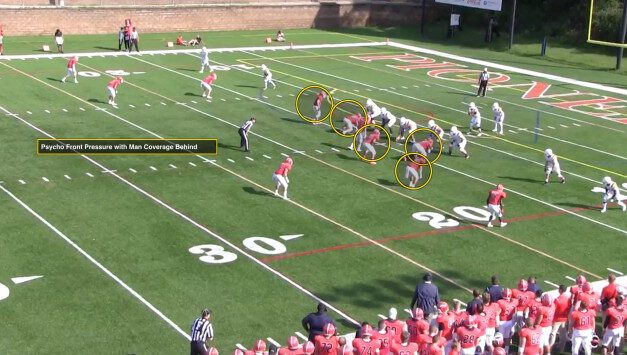
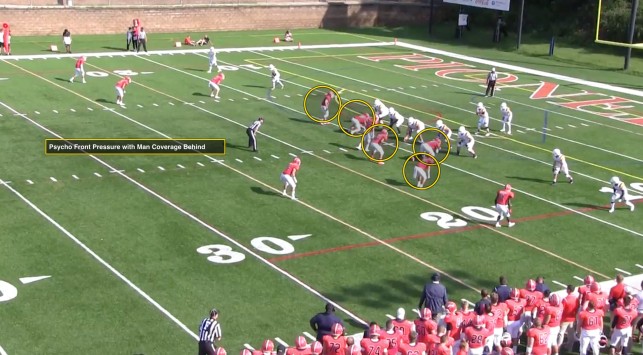
As always it is a pleasure to contribute to X and O Labs.  I know I speak for Coach Krzykowski and the rest of the Carroll University Football staff when I say our doors are always open to you and your program.  I am excited to share some coaching points and film on our “Psycho” package.  A scheme I have used for over a decade at multiple places.  It was a true pleasure working with the great defense staff at Carroll University to find ways to incorporate this grouping in the very tough CCIW Conference.  
When we refer to Psycho we are talking about leaving two defensive linemen on the field and bringing in nine LB’s and DB’s in some fashion, based of course on what our personnel allows.  We began using this, as you might imagine, as a 3rd down package or in end of game situations.  It has evolved, not to an every down defense, but as a great change up to confuse blocking rules, disguise pressure, change RPO and options reads, and to hide coverages.  Hopefully, you can use some of it in your defensive scheme.


Base Psycho Alignment

As in any defensive scheme (or any part of football) you want to make this look complicated for your opponent but easy for you.  I have coached out of a number of base defenses, such as the 3-3, 3-4, 4-2-5 and whenever installing Psycho we have kept our same coverage and block destruction rules.  I would recommend doing the same and then adding your bonus players in.  Here is how we have done it, but you can be creative, just be sound and do what you do best.  Below is the first install – we are rushing two, dropping 9.  After this goes in, we add different coverages and pressures that are already part of our base – this means limited learning and time for our players but gives offenses a totally different look.  As well as something else to prepare for.

Psycho Install – Psycho Cover 9 *note: players need stem around.  Be close to your alignment when the ball is snapped.  We call it cover 9 because we are dropping 9 in coverage vs pass.

Position

Alignment

Run Rules

Pass Rules

DE’s

4 tech – head up (be ready for pinch call)

You are a B gap player, Squeeze all down blocks, play cut back on reach

You are a Heavy C-Gap rusher unless put in a jet call.  Do not worry about a screen or draw if you get pass set.

MLB’er

Zero Tech – 5 to 6 yards off the ball adjust based on D and D

Play Side A gap player to flow.  Read center’s block

Middle hole – Watch Draw, middle screen

Sam and Will

50 Tech – 5 Yards from the ball, adjust to D and D, follow our basic formation alignment rules

Run to: C to B gap – read OT to OG. 

Run away: Back side A to open window.  Can slow play for RPO

Curl Players – don’t drop to wide.  Wall middle. You are contain on QB. 

Rover and Nickel

3X5 off EMLOS, if there is #2 rec. follow alignment rules – inside eye at 5 yards to start.

Run to: Contain – set edge and turn everything back inside.  Outside arm and leg free.  

Read More