
“Row the Boat”: The Off-Season Program That PJ Fleck Used to Build WMU

By Mike Kuchar
Senior Research Manager
X&O Labs
Twitter: @MikekKuchar

Introduction
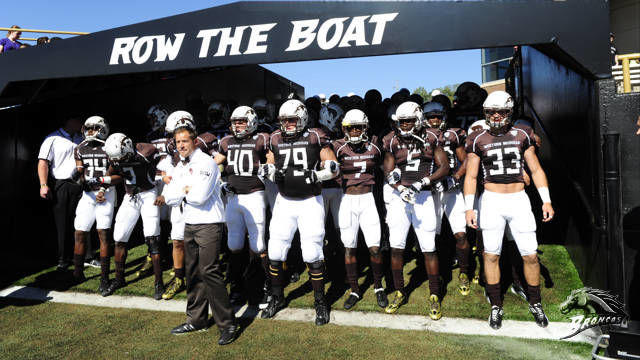
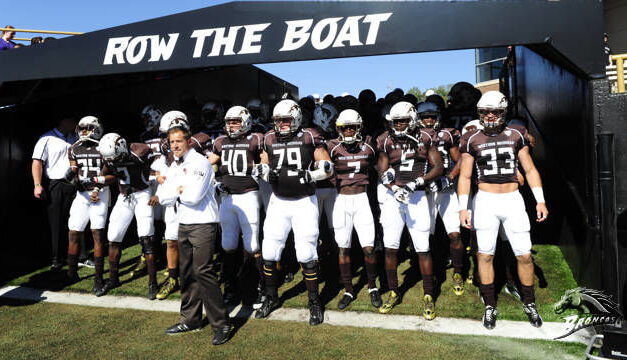
Western Michigan BroncosOver the last four seasons, head coach PJ Fleck and the staff at Western Michigan University has built the Broncos into a top 25 program, an undefeated 11-0 record and on the brink of a major bowl appearance for the first time in school history. It was all part of an off-season plan that Coach Fleck shared during a Q and A with XandOLabs.com’s co-founder Mike Kuchar last spring.

Editor’s Note: The following research was conducted as part of XandOLabs.com research report on “NCAA Player Development.”


On Developing the Off-Season Mentality of your Program…

PJ Fleck, Western Michigan University: “We have a leadership council that is picked by our players. It’s made up of true freshmen; redshirt freshmen, sophomores, juniors and seniors. Every class is represented. There are 26 total players because I think you need a quarter of your team leading your team. Every class has a voice. It’s about a 36-week course. We do it up until spring ball and then we will vote again on our leaders after spring ball. Some guys stay on, some guys stay off. It’s not a right, but a privilege to be in on there. It’s a leadership class that we meet every week for 45 minutes. We do skits, we have readings and they take notes. My job is to take lifetime lessons and teach them in a cultural way. Every lesson is geared to what they know. We will use an example like adapting leadership towards Kanye West and Drake, for example. Or, we’ll use Lebron James and Stephan Curry. I can’t use Michael Jordan and Larry Bird anymore to teach lessons. I need to be up to date. I need to show them I know what is going on. I want them to have the ability to understand me. You have to adapt to your culture. We need to continue to keep up with their culture.”

On Developing the Off-Season Physicality of your Program…

PJ Fleck, Western Michigan University (Dan Nichol, Strength and Conditioning Coach): “We talk about developing energy more than anything else. We tell them that we have no bad days at Western Michigan. Not one. There is nothing negative inside our program. It’s difficult to do because we have days where we don’t’ want to do something. But we define maturity as when doing what you have to do becomes doing what you want to do. You must have energy to mature. That is a sign your program is at an elite level.”

On Developing the In-Season Mentality of your Program…

PJ Fleck, Western Michigan University: “Our position coaches meet every single week with each of their players. It’s an individual meeting, an academic meeting, and a social meeting. It can deal with football or it may not deal with football. It’s a quick 10-15 meeting with that player at breakfast and getting to know any issues or problems he is having. During the season, there are so many different stressors. You’re winning, you’re losing, you’re hurt, you’re girlfriend broke up with you, etc. The draft is approaching. As a coach, you need to have a thumb on all of them.”

On Developing the In-Season Physicality of Your Program…

PJ Fleck, Western Michigan University: “We constantly create competition, but we don’t compete against one another, we compete with one another. There is a big difference there. Competing against one another puts a divide in a team. The more you divide that team, you will struggle. How you compete with each other is you constantly be at your best and beat yourself from yesterday. You may have a matchup that’s not even close. We will pair a lineman with a skill guy sometimes in a competition but we stress the idea of failing before we see growth. It’s how much better are you getting each day individually. We flip the mindset to where we are competing with ourselves and not the other player. Can you make that play better than you did yesterday? It doesn’t matter who is across from you. If you can’t believe in yourself, than you don’t have a shot.”

On His Definition of Leadership…

Read More

Individual Post Season Evaluation Methods

By David Sedmak
Head Football Coach
Desert Mountain High School (AZ)


Introduction by X & O Labs Advisory Board Member, George Karafantis 

Coaching is teaching. Both require the ability to connect with players first.  These connections are essentially the relationships that we have with our players. I believe these connections are what many football coaches do best. When a coach can make those connections, he then must engage his learners/players. The process of engaging those learners (players) is what makes up and defines teaching. Teaching, and hence coaching, includes giving your learner information, concepts and the processes to get there. Bill Belichick is most famous for using the term, process, as an important cog in coaching, however most educators will tell you that how you teach the information is the greatest determinant in if the information is truly learned.

An important and often overlooked part of the process of teaching includes evaluating or assessing the lesson that you are giving both before and after, that lesson. At Desert Mountain HS, Coach David Sedmak and his staff, have created and utilized two evaluation systems that have helped his program evaluate and improve his football program. These evaluation systems are critical in both the identification of learning and the assessment of the application of that learning. Simply put, these evaluation methods put concrete statistical information that Coach Sedmak uses to analyze the learning and performance of his athletes.


Pre-Season & Post Season Application

Coach Sedmak’s evaluation systems include, and assesses, both tangible traits of players and the all-important intangible traits. In an age with greater parental involvement but not necessarily greater parental awareness, this tool is important in helping them determine who is most deserving of playing time. His Quest for Excellence System is used in the preseason and his evaluation tools are used during football camp and in season. It’s highly effective in helping to determine if they made the correct choice as to who plays and starts football games. It also provides some statistical information that is effective to use if anyone outside the program questions why someone is playing over another individual.

This report will focus on Desert Mountain’s player evaluation system and their Quest for Excellence System. That system will help determine who is on the first unit when practice starts in late summer. In this system players earn points in the off-season for a variety of accomplishments that help him to be a better player/person/student, in turn helping the team to improve and earning a starting spot.

In determining which players actually play in the games on a football team, there is a great deal of subjectivity involved.  We as coaches see and coach the players daily, and essentially judge the players based on what we see live in practice and again after reviewing practice video.  One method I have used for many years is an evaluation system that brings more objectivity to the decision and allows the coach to give more detailed feedback to the player regarding his strengths and specific areas in which he needs to improve.  I have created position specific evaluation forms our position coaches use to evaluate the players.  These forms are completed twice a year, at the end of pre-season prior to game week and again after the season (for underclassmen). 

The evaluation forms are divided into two sections – tangible traits and intangible traits.  There are roughly 10-11 tangibles and 8-10 intangibles for each position. Before sharing the various position evaluation forms, we will first look at these traits a little more in depth.


Intangible Traits

While often difficult to quantify, intangible traits are probably the most sought-after traits we as coaches look for in a football player. The intangibles are often the difference in giving a player playing time versus not playing them, usually the difference between a good player becoming great, and very often can be the difference in winning a championship or losing it. Coach Sedmak has identified his top 9 intangible traits which are shared below.

These traits are measured, graded and evaluated using a 10-point scale with 10 being the most positive and a score of 1 being the lowest. Looking at the table below you can see that Hustle is an important intangible that is awarded 10 points if the player is always hustling in practices and games. A score of 1 would indicate the player walks all of the time which we would imagine would lead to him walking off of the football team!


*It is important to note that while these intangibles are somewhat difficult to see and measure, they should be consistent across each position group. Later we will show Coach Sedmaks tangible evaluation traits that vary from position to position.


HUSTLE- the player always hustling, usually, inconsistent in hustling, rarely hustling or always walking.


CONSISTENCY IN EXECUTION OF ASSIGNMENTS- Consistently executes, consistent, inconsistent, rarely executes or never.


GENERAL RELIABILITY/ACCOUNTABILITY/SELF-DISCIPLINE (Attendance, Timeliness, Follows Instructions & Rules, Behavior)- Can Always Count on him, usually reliable, inconsistent, unreliable, or is a real problem.


Read More

Situation: 5 Yard Line Going In… 1 Play to Win

By Sam Nichols
Managing Editor – X&O Labs
QB Coach – West Ottawa HS (MI)
Twitter: @SNicholsXOLabs


Introduction

Few things define a play caller’s success more then how they call plays in crunch time. The best coaches know exactly what they want to do when they are in critical moments. This year at the AFCA Convention in Charlotte, I set out to ask some of our best contributors/coaches how they would address a specific scenario.

So here was the question:

One play to win from the 5 yard line. What do you run?

Below are 10 answers to that question that trick plays, passing concepts, isolation routes, and runs. As you read these responses, consider what your team did or does in these scenarios and then contact me at [email protected] to submit your own response for a follow up report.

Jordan Neal, Offensive Coordinator, Hendrix College, Twitter: @CoachJordanNeal

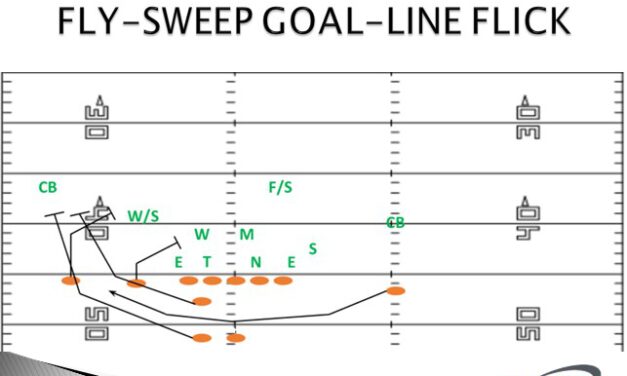
Concept: We like fly sweep goal line flick when it comes to crunch time. It is a hitting play that is simple to execute and only relies on a few key blocks to execute. Since it is an unusual formation, defenses tend to struggle lining up against it as well. This is a high percentage of success for us and keeps the ball safe from the potential of a turnover.

Slide1

Coaching Points:

  1. “Dead” twins formation into the boundary.
  2. You can go ahead and line up in this formation and run it straight up, or you can “burst” motion/shift into the formation to add another alignment issue/challenge for the defense.
  3. Dead twins receivers crack the 2 most dangerous 2nd level players and leave the CB unblocked for the RB and/or TE to arc to.
  4. RB and TE (if you choose to use the TE on the front side of the formation) arc block to take care of the corner-back and any trash that may leak through from the LB level.
  5. OL reach blocks (stretch) to the play-side and set an edge for the ball-carrier.
  6. Fly motion guy receives the “flick” from the QB. Run with the ball in the outside arm and race to the front pylon. Don’t be denied! Punch the ball into the end-zone!
  7. QB sends the motion man and snaps the ball at the latest possible moment to “flick” the ball to the receiver in fly motion.

To study film of this concept, click on the video below:

Read More

5 Ways to Beat Quarters Coverage

By Brian Casey
Head Coach
Aurora Central Catholic High School (IL)
Twitter: @ACCHSFootball

Introduction:

accIt is safe to say that we have all run up against the “bend, but don’t break” defense, who wants to prevent the “big play.” These defenses are trying to force the offense to be patient and string together 9, 10, 11 play drives for scores. In doing so, they are much more likely to play a safe zone-coverage designed to limit the big momentum play. This clinic report will focus on how we attack that Cover 4 or Quarters Coverage.
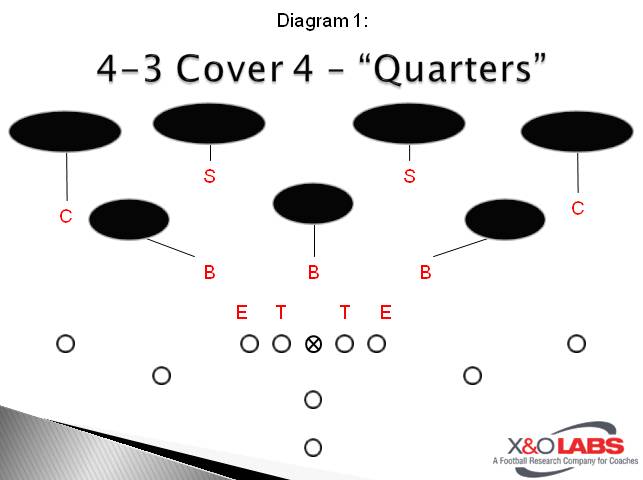
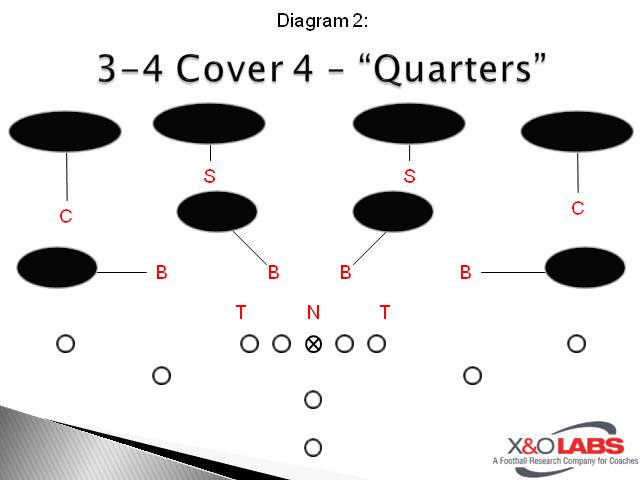
Slide1Slide2


When talking about attacking Quarters Coverage, we have certain concepts and play calls for two reasons:

  1. We are exploiting areas on the field where the offense has a numbers/leverage advantage that will allow us an easy throw and catch and potential run.
  2. We are trying to accumulate enough of those plays to force the defense out of that coverage to open up more area down the field for more aggressive/explosive calls.

We will attack Quarters Coverage in a variety of ways:

  1. Quick Pass Game
  2. Vertical Stem Route Concepts
  3. Levels Concepts
  4. Play-Action Pass
  5. “BDIS” (Best Dude in Space)

While all five of our ways to attack are successful against Quarters Coverage, game situation (time remaining, score, etc.) will play a factor from both the Offensive and Defensive perspectives. Obviously, when trailing later in the game, we will have a lot of easy space in the flats and underneath, but that may not help gain big chunks of yards needed to get a quick score. In those same situations, running the football and throwing quick into the flat does not threaten the defense, so we will utilize the vertical stems and level concepts. In a lot of what you see below, we will utilize the running back in the pass routes. If we are getting Quarters Coverage, we most likely are not going to see any exotic pressures that cannot be picked up by our interior five linemen. However, if the running back is needed, we will check our protection at the line of scrimmage.

Quick Passing Game:

We utilize our Quick Passing Game for a variety of reasons. Most importantly, it typically is a simple read and throw, which can be a confidence booster for a young quarterback. Once we identify coverage (safety alignment), we cut the field in half and have a one person/leverage read to get the ball out of the hands in less than two seconds. Second, we will force the defense to defend the entire field and all eleven offensive players. Finally, it is a “take what’s given” approach. Every Offensive Coordinator wants to be in 2nd and Medium, 3rd and Short situations, the Quick Pass Game, especially on early downs, allows us to stay on schedule.

We do have the ability to run different concepts on either side, but for the sake of this report we will mirror our routes.

Slide3

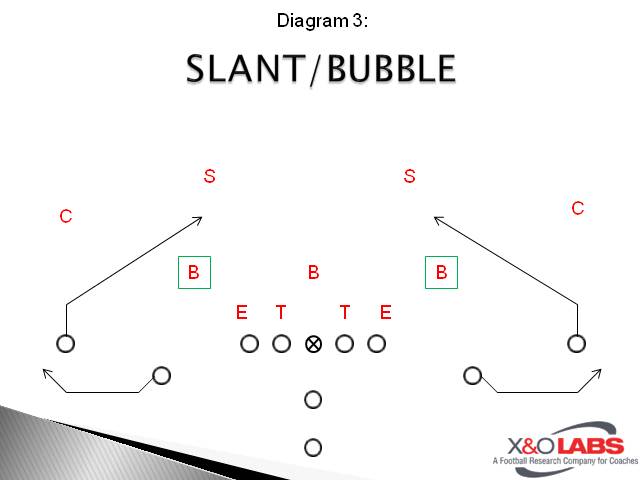
Slant / Bubble

This is the same idea as a two-man Snag concept. We want to max the split of the #1 WR to really put a horizontal stretch on the OLB. The quarterback has decided pre-snap which side of the field he is going to work. Once he receives the snap, he will eye the OLB, and throw off his movement. The OLB will either widen to the Flat with the Bubble leaving the Slant open in space, or he will stay to wall off the Slant, leaving the Bubble alone with open grass.

The important thing we have found here against a 2-high Safety look is the split of the #1 WR. We stress the “max split”, we want him as wide as he will be allowed (outside the numbers). Anything too tight to the middle of the field brings the near safety into play. He can now potentially make a play on the ball, or be in position for a big hit on our receiver. The max split allows the ball to be delivered wide enough to still be an easy throw and catch, and should allow the receiver to potentially make a move on the Safety after the catch.

Read More

Utica College Defensive Line Drill Catalog

By Ben McKaig
Defensive Line Coach
Utica College
Twitter: @McKaig_Ben


Introduction:

Woodman vsFrostburgThe offseason is drill season. At Utica College, we place a heavy emphasis on using drills outside of the season to work on the little things that make winning defensive line play. In this drill report, I am going to share our stance and get off drill progression that we do daily.
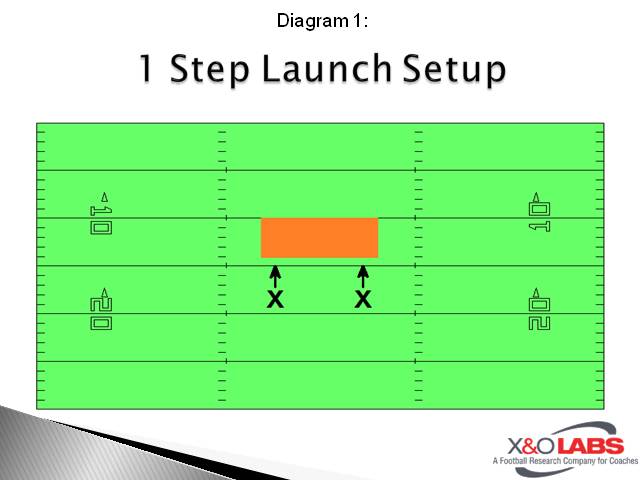
Editor’s Note: Please review the brief drill outlines below and then scroll down for the full 20 minute video featuring these drills.

1 Step Launch

  • DL in a stance across from crash mat
  • On ball movement
    • DL takes first step
    • Push off first step and launch onto crash mat
      • Land on belly
      • Triple extend ankle, knees, and hips
      • Explosive jump through the first step
        • Work to generate power and explosive ability.
        • Roll the hips

Slide1

6 Point Punch Progression

  • Speed punch placement
    • DL are in a 6 point stance, toes of cleats tucked, shading their partner
    • Partner standing in good bent stance with hands on hips and chest exposed
    • On the whistle DL will punch shade with proper hand placement
      • Shade hand on shade number, outside hand clamps shade arm
      • Thumbs up elbows tight
    • Rapid fire
      • On each whistle, quick punch and reset
        • Emphasis on accuracy and speed of the punch
  • Punch extension
    • Punch and grab, hands above eyes
    • Full hip extension, Full arm extension
    • Coach resets the drill each time
      • Emphasis on power and locking out hips and arms
      • OL head will snap back
  • Punch explosion – 2x each shade
    • Punch the shade, pressing thru the toes with full hip extension
      • Emphasize exploding thru toes
      • DL will come off of the ground
    • DL should land on their stomachs

123 Step

  • All players line up on the line facing coach
    • Front foot should have toes touching the line
  • On ball movement, players take 1st step
    • Step should land close to the line players are lined up on
  • Reset – two steps
    • Quick feet, tight hands, thumbs up
      • Avoid the hop – 2 quick steps
    • Flat back, good knee bend, hands above eyes
  • Reset – Full get off
    • Quick feet, roll hips, finish through
  • Can be performed with an OL
    • Incorporate punch, extend, rip and finish

Crash Mat Base Blocks

Read More

Basic Shield Punt Concept and Drill Work

By Gabriel Ostrander
Defensive Coordinator
Elmwood Park High School (IL)
Twitter: @EPTigerFBall


When I became the Special Teams Coordinator I looked at our previous Special Teams packages and our current roster. At Elmwood Park, we generally are not blessed with college athletes or speed and power combination kids. We either have kids that can run and play in space or kids that are physical but don’t move well. After doing research I found the system that I felt would best fit our kids, the Shield Punt. I chose this scheme for 3 essential reasons:

  1. Simple blocking assignments that don’t require size or skill.
  2. 7 immediate cover players to help eliminate 1 on 1 open field tackling.
  3. How do teams line-up to it and pressure?


Diagram 1


Alignment:

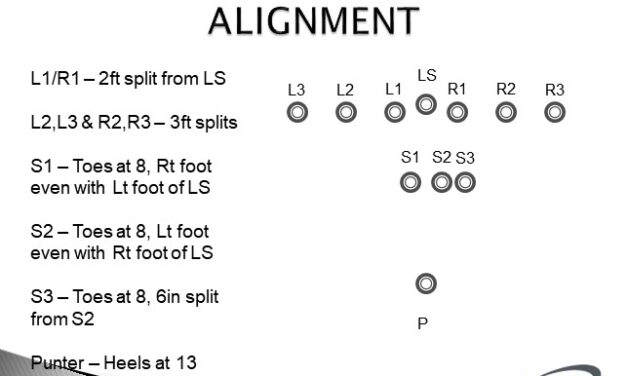
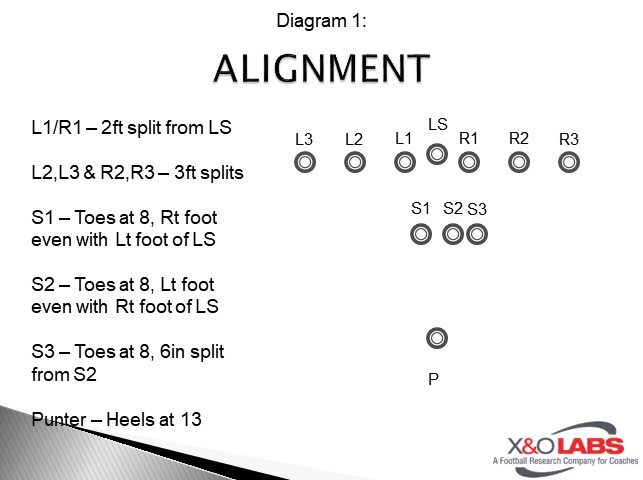
Alignment is fairly simple; the front line involves 7 players in a straight line on the LOS. Players on the left side are labeled from inside to outside L1, L2, L3 players on the right side are labeled inside to outside R1, R2, R3. R1/L1 fit 2 feet away from the long snapper. The rest have 3 foot splits away from the player next to them. We tighten down the L1/R1 splits in order to help with inside pressure as our long snapper immediately releases downfield. 

The Shield lines up toes at 8yds. S1 lines up with his right foot even with the left foot of the long snapper. S2 lines up with his left foot even with the right foot of the long snapper. S3 has a 6inch split from S2.

The Punter lines up in the gap created by the shield and directly behind the long snapper with his heels at 13yds.

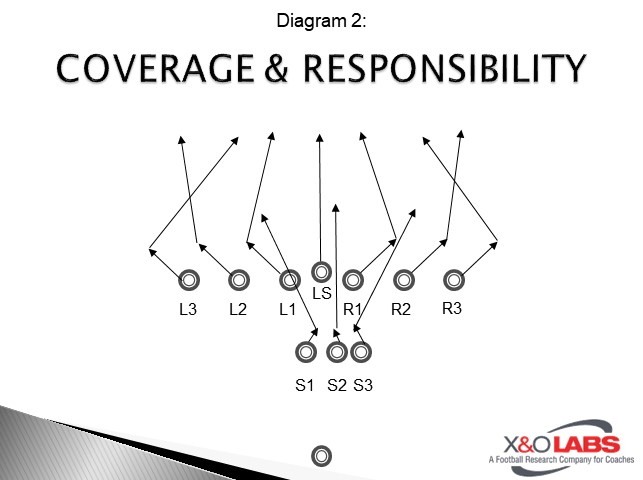
Diagram 2


Responsibilities and Coverage:

As I mentioned previously, one of the major reasons we went to this style is because it gave us 7 immediate ball defenders. We don’t spend time blocking/protecting, the ball is snapped and the expectation is to get on your horse to make a play on the ball carrier.


Front 7:

The long snapper snaps the ball and is a straight ball player. I have explained it as if he has a string tied to the return wherever he goes you follow. When the ball has been snapped, L1-L3 & R1-R3 are expected to “punch across” the face of the 1st defensive player outside of him and then get back on track towards the ball carrier. L3 & R3 are straight ball players, go make a tackle. As for the other 4 defenders they play “soft lanes” with L2 & R2 playing as pseudo contain players and L1 & R1 playing as inside lane players.  L1-L3 & R1-R3 all act as outside-in leverage players, we want them to fit with their inside shoulder or inside number on the outside number/shoulder of the ball carrier.

Read More

Packaging Plays for Post-Season Success

By Sam Nichols

Managing Editor

X&O Labs


Editors Note: Special thanks to Jay Wilkinson, Offensive Coordinator at Broken Arrow (OK), for his help in putting this piece together.

The season is approaching and many coaches around the country are already deep into their initial gameplanning for each game.  This past fall, talked to Jay Wilkinson, OC at Broken Arrow HS in OK, about his unique approach to putting together comprehensive game plans.  

His concept is based on the concept of “packages”.  These “packages” of plays allow your team to make adjustments at the line of scrimmage more efficiently and streamline play calling. Coach Wilkinson says that it “gives them answers” to the different looks. His teams come into the game with three basic types of packages; Quarterback Packages, “Check With Me” Packages, and Formation Packages. Each particular package is employed within the game plan for the week and is based on the most fundamental plays of their offense.

Quarterback Packages

The simplest and fastest of Coach Wilkinson’s packages are the plays that the quarterback reads at the line of scrimmage and executes based on numbers or coverage. This gives the quarterback some control to keep his team in good plays without having to hand over the keys to the entire offense.


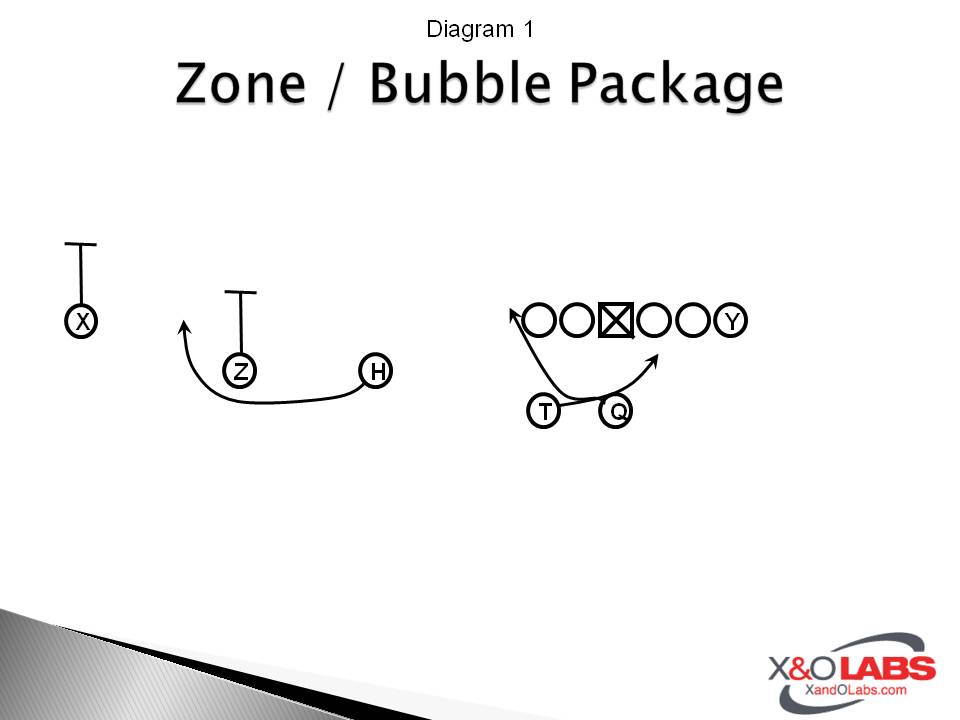
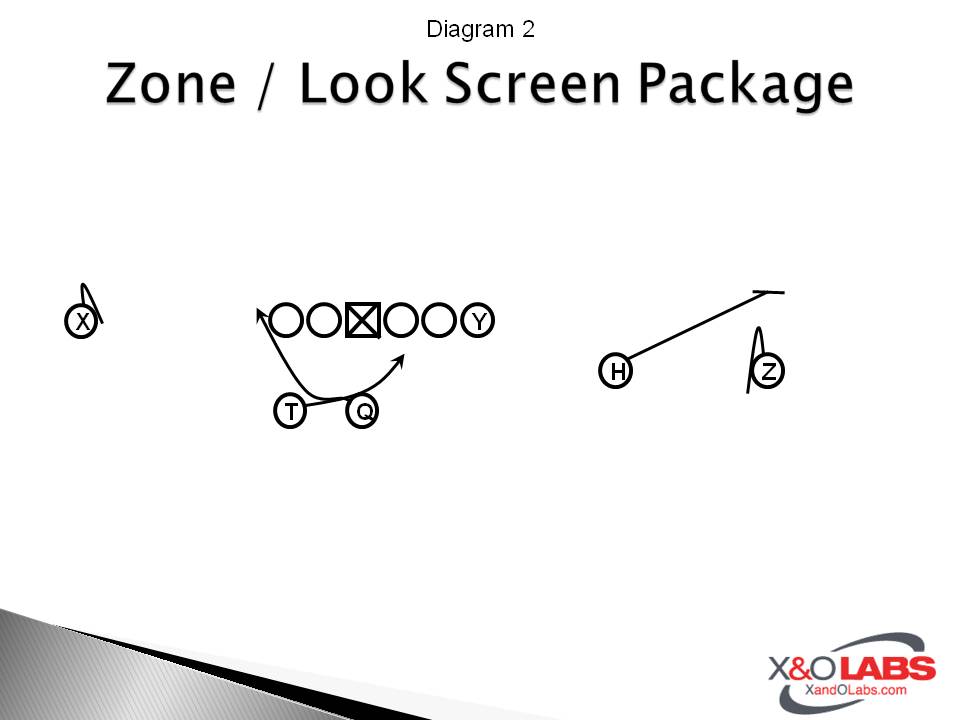
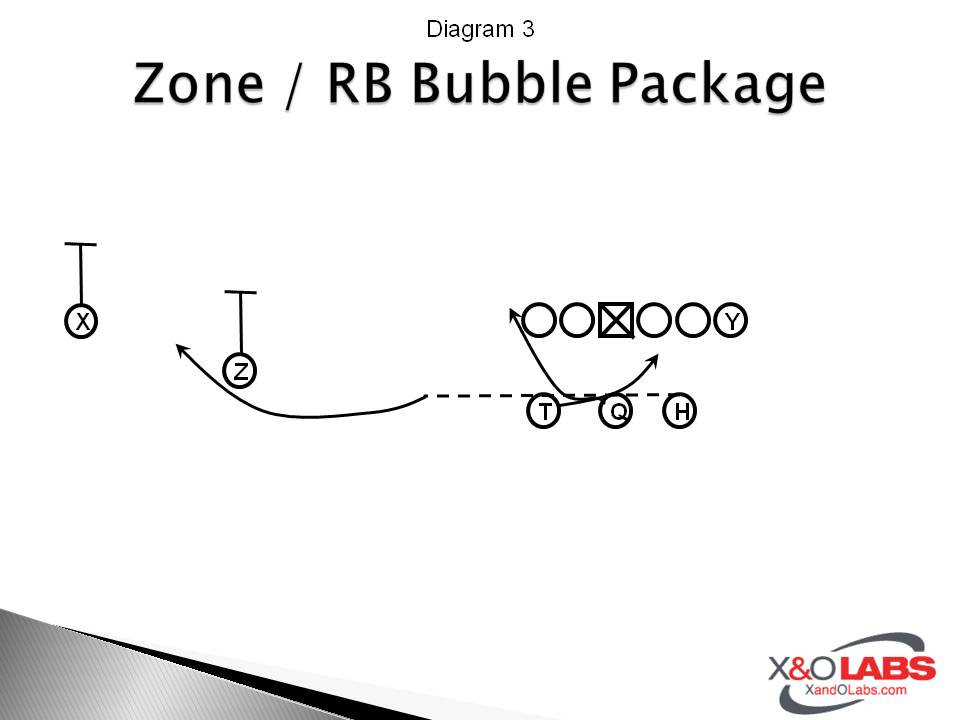
For example, one of Coach Wilkinson packages combines a zone run with a bubble screen (Diagram 1). The quarterback can then focus on identifying the leverage of the linebacker and getting the ball to the player that has the best chance of getting positive yardage. Of course this only works if the quarterback can make good decisions. Coach Wilkinson teaches his guys that if there is any doubt they should hand the ball off.

Here are a few additional looks that Coach Wilkinson has used within this type of package: (Diagrams 2 and 3).

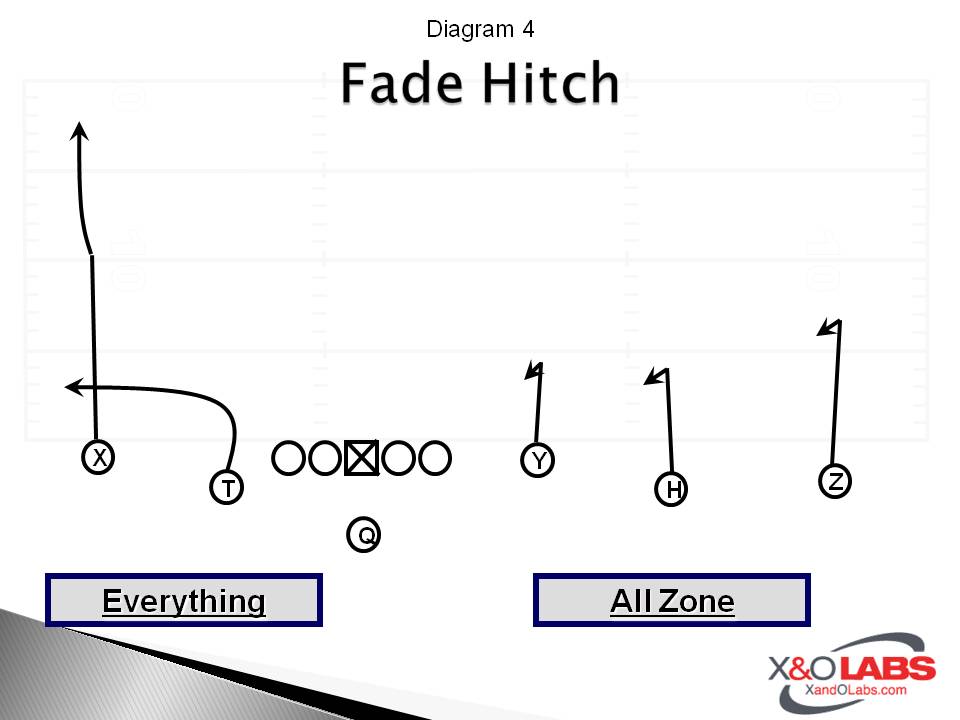
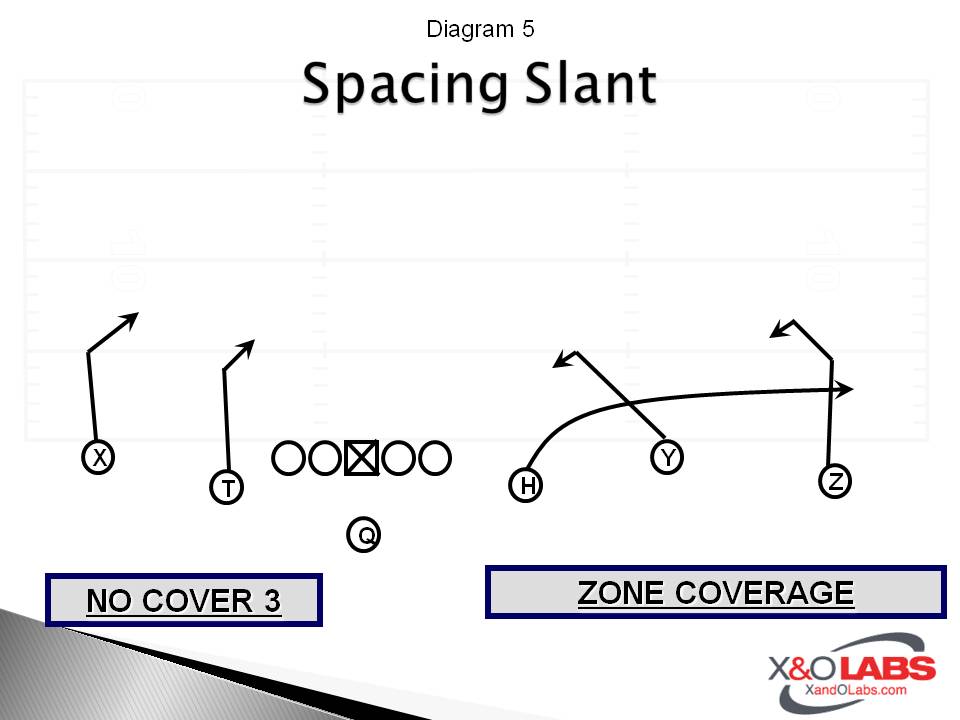
Another way that they give the quarterback options is by pairing passing concepts that attack different defensive schemes on opposite sides of the formations. These packages can include, but are not limited to:

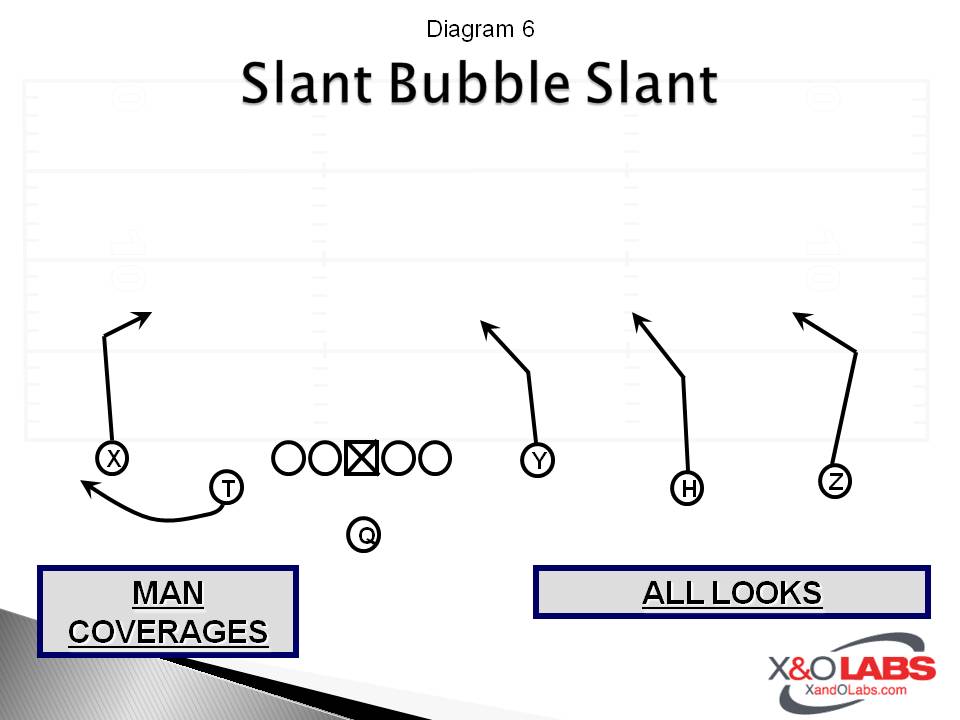
Zone beaters on one side and man beaters on the other (Diagrams 4, 5, and 6). This concept has been around for a long time, but it fits into their packaging concept well and is a simple way to keep the QB from trying to “make a play work.”

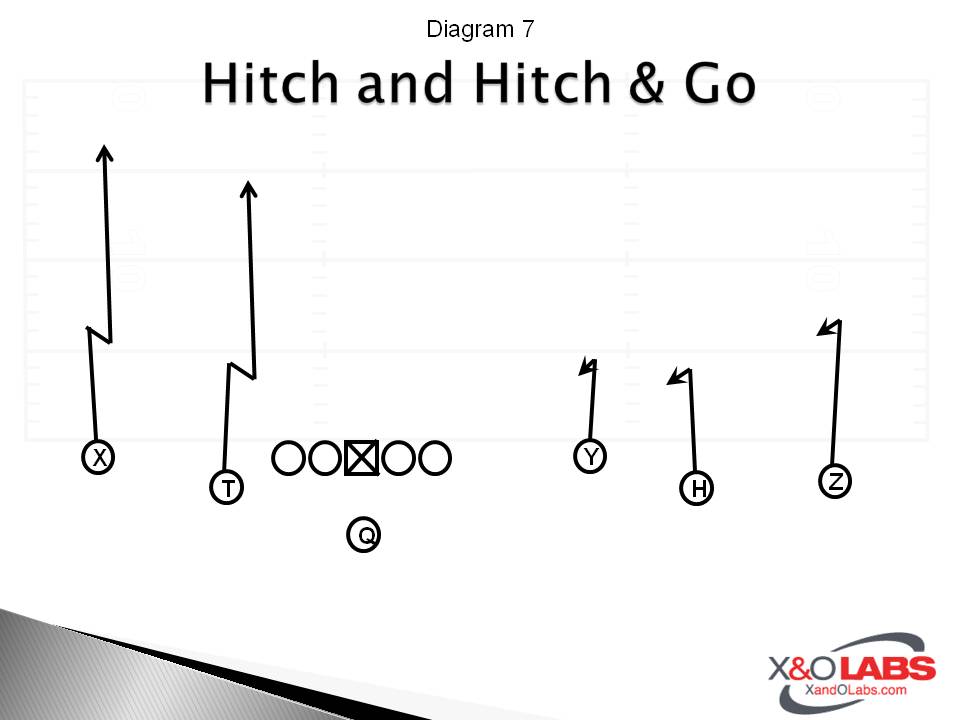
Quick game on one side and double moves on the opposite side (Diagram 7). This addresses situations where teams are try to use man coverage to stop their quick game. This allows the quarterback to read the quick game side and if the play won’t work due to a specific coverage, he can then work the double move concept on the backside.

The beauty of these concepts is that it can all be done without having to make a check at the line since the line will block both of the plays the same way. Coach Wilkinson pointed out that he goes out of his way to make sure that nothing has to change for the line as they create these packages. He says this ensures that even if the concept doesn’t mesh perfectly he knows they will at least have a hat on a hat.

“Check With Me” Packages

Unlike some no huddle coaches, Coach Wilkinson doesn’t believe in giving the QB unlimited control at the line of scrimmage. Instead, his team employs a “check with me” system where the team looks back to the sideline for confirmation of the called play or a change in play based on the defensive look that they are getting. Here are some of the concepts that he and his coaches use with his “check with me” packages:

Read More

Tracking and Applying a Takeaway Reward System for Post-Season

By Brian Mazzone
Head Coach
Stafford/Somers/East Windsor Co-op (CT)
Twitter: @staffordbulldog


We try to create an environment on the practice field that is turnover hungry. Through drills and mentality, we focus days of the week and segments of practice on forcing turnovers and getting our hands on the football of an opponent.


Creating the Hunger for Takeaways

Daily in team periods we focus on a “Loose Change” period. The Loose Change is something that I picked up from the University of Dayton years ago. We took the idea and put our own spin to it. We create this starting the first day of the season when we run team. The veterans know the routine, but the new players need to understand the process. The idea is that every time there is a ball on the ground someone needs to pick it up. It can be an incomplete pass, a fumble, a tipped pass, interception, anything.

The idea behind it is to create an environment where the kids are hungry for the football. This gets defensive players wanting the football at all times because there are rewards. It also gets your players to play beyond the whistle. There are always moments where players “believe” the play is over. In our minds the play is not over at the whistle, it’s over when we have the football.

Each week we have a coach who tallies the recoveries. He keeps track of every time someone picks up the football. At the end of the week we give out team awards that we post to our social media page. They are given a necklace with a giant half dollar on it and a cane with a dollar symbol on it. At the end of the year, we tally all the turnovers that the players have created. The winner of the loose change concept gets a gift card to a place of their choice for their victory.


Focus on turnovers

The same way that coaches harp on tackling technique and tackling drills, we harp on turnovers. When we have our weekly tackling circuits, we sprinkle in turnover stations. For example, we have two tackling stations and two turnover stations. We try to hit this two days a week. The one thing that we want the kids to understand is that we can’t just expect turnovers to happen. We need to believe that we are forcing the turnovers and that we can create them. If we just expect it to happen, we will be left without the football and having missed great opportunities to score.


Peanut Drill Application

This is a drill taken from Charles “Peanut” Tillman. Tillman led the NFL in turnovers many times during his career. His idea was to poke the ball loose. We practice drill work where we have two players going to perform a tackle. The first player is going to pursue and secure the tackle. The second player comes in and “peanuts” the ball. The player focuses on getting an aggressive poke/punch on the football. The idea behind it is to be aggressive on the ball, not just to the ball. By being aggressive on the ball the ball carrier is most likely to lose focus and handle of the football.

By being aggressive on the ball the ball carrier is most likely to lose focus and handle of the football.

Read More

F.A.S.T. System To Develop Offensive Ownership

Jarrett M. Laws, M.Ed.
Head Football Coach
Salem High School (GA)
Twitter: @CoachLaws00


In 2016, when I was hired by the administration at Salem High School in Conyers, Georgia, my immediate goal was to revitalize the program by introducing an up tempo, no huddle form of offense that formerly ran the Wing-T. By year two, we were fortunate enough to reach the Georgia High School Association Class AAAA playoffs for the first time in 4 years. I firmly feel that what made our success unique from other versions of this form of offense has been our embracing the concept of giving ownership to the players, rather than depending upon the play calling of our coaching staff.

We base our teaching on the acronym “F.A.S.T.”, which stands for “FOURmation”, “Answer”, “Selection”, and ” Tempo”. We utilize “F.A.S.T.” as a double entendre of sorts, where, by conditioning, when one hears the word “fast” utilized when discussing offense, it becomes engrained in the psyche of the players to operate at a high rate of speed, while simultaneously reminding them of the order of their implementation of the selected offensive concept. Our play menu is quite reduced when compared to many other offenses, but our belief is that if we can implement what we have, from multiple formations, with built in answers to what the defense presents us, while being decisive in our selection, at a high paced tempo, we can never be wrong.

FOURMATION

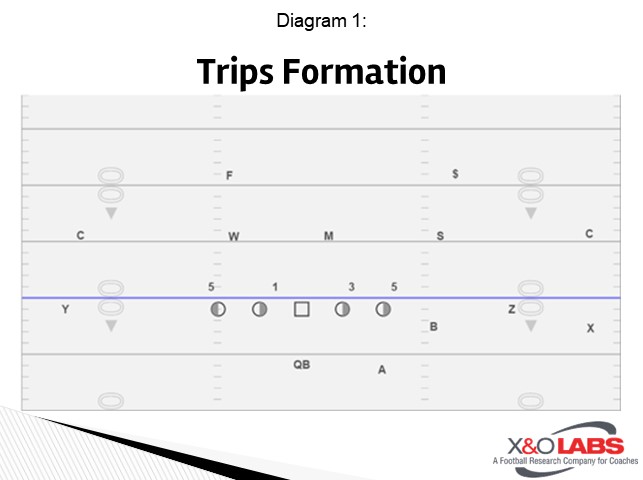
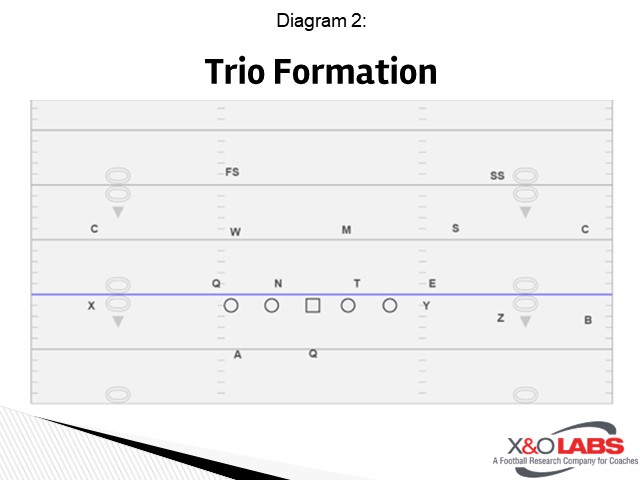
We have four major run concepts (Gap, Zone, Power, Draw) that we run up front, and four major drop back pass concepts (curl/flat, Hitch/Corner, Post/Dig, and Zone Flood) that we implement on the perimeter. When initiating our teaching processes with our kids, the very first thing we tell them is that we only have four runs and four passes that we will run from as many formations that we can create. No matter what the formation, we will always end up running a form of one of these four concepts. EVERYTHING surrounds the number “four”. We explain that being in 2 x 2, whether it be 10 or 11 personnel, will equal us out to four. The same goes for 3 x 1. A small play of words on the concept, but it grabs their attention to the special status of the number. Offensively, we major in 10 personnel 2×2, which will be referred to as “Deuce”, and 11 personnel, referred to as “Doubles”. For 3×1, we title 10 personnel “Trips” (Diagram 1), and 11 personnel “Trio” (Diagram 2). We have the ability to shift and motion to various other forms of 2×2 and 3×1, but for the purpose of this study, we will limit our presentations to our 3×1 formations.

Diagram 1

Diagram 2

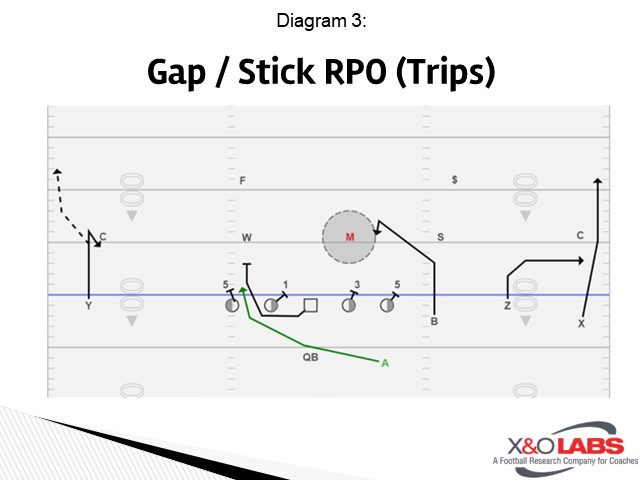
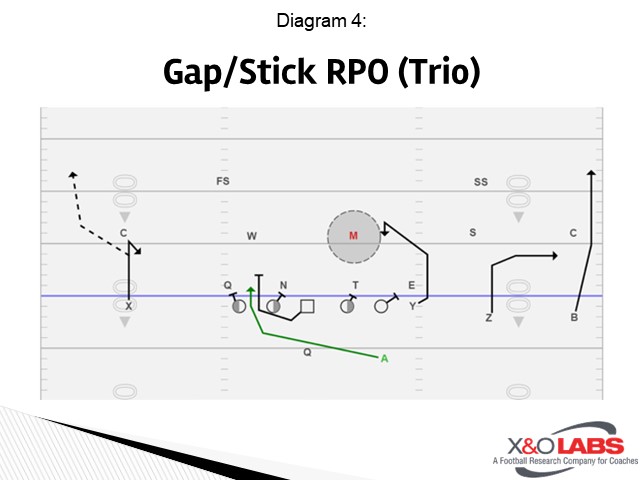
Nearly 70% of our run game is a form of “Gap”. In order to focus on the implementation of the ‘F.A.S.T.” Concept, rather than overview a whole offensive scheme, we will center this information share on it. Whether it becomes a Veer read, Midline read, or RPO is totally dependent upon the decision making of the players as it pertains to the defensive look that is presented to them, as well as the tempo that we have called. For example, if we are in a check at the line tempo, we normally will run a gap RPO. What separates our form of RPO is that the base call is preset according to the formation we are in. If we are in 3×1 10 or 11 personnel and we give a “gap” blocking call away from the multiple receiver side, we automatically tag the “Stick” concept as the pass option. When the play call is signaled, this is where the ownership comes into play as we move into the “Answer” phase of the call.

Diagram 3

Diagram 4

ANSWER

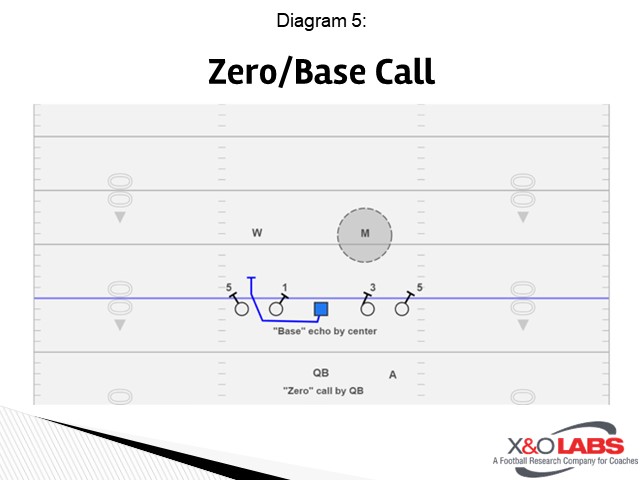
The quarterback alerts the front as to which gap the lead block will fold into. If he sees a pull side 3 technique, he makes a “Zero” call, which indicates that the center will pull into the first available opposite gap. The center looks to see if he has a clear “5” technique, or a tight 5/possible 4 technique. If the 5 is clearly determined, he echoes “Base, Base” to the other linemen. This call tells them to base the attached techniques, allowing the center to pull into the open opposite B gap. It is understood that the conflict player is the linebacker nearest to the pass option.

Diagram 5

To study game film of this concept, click on the video below:

Read More

In-Season Defensive Individual and Unit Goal Setting Objectives

By Jason Brown
Linebackers Coach
St. Charles Catholic High School (LA)


It is truly a pleasure to represent St. Charles Catholic High School and our entire staff as well as share our thoughts on defensive quality control. We don’t have all the answers. We are constantly looking for better ways to do things. Hopefully this article will stimulate thought and lead to better solutions to the more complicated problems that occur as the game of football evolves. When we think of quality control we should think of how we are measuring (statistically) our methodology– which is simply the way we are trying to implement our philosophy of defense.  Our philosophy of defense is to not let the offense move the ball effectively. How we are going to do that is our method. Then we must constantly evaluate if that method is helping us fulfill the philosophy that we have set.

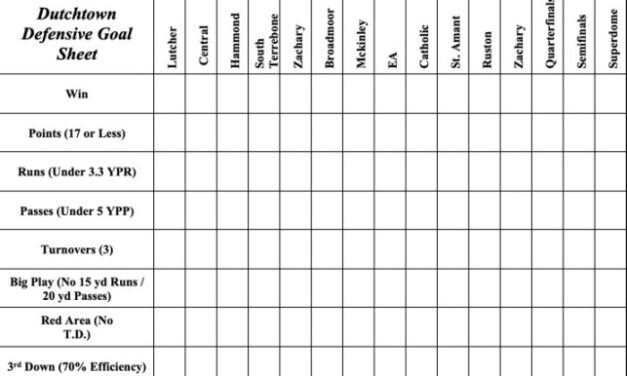
The first thing we came up with to test the method is to identify specific goals that tell us if we had a good game defensively. This goal board is updated weekly so that our players can see how well we are accomplishing our game goals. We need to be able to show them specifically why we are playing defense effectively. Simply saying we aren’t playing well is not good enough. We need to be very specific, with them and ourselves, about the things that we do well and what we need to do to get better. The goals we have on our board tell the players what we think it takes to play good defense.


Specific Goals:

Our first goal on defense is to win the game. That is the number one goal of the whole program and we sell that to our players every day. Some games the offense is going to have to bail the defense out in a scoring fest and other nights the defense is going to have to pick up the offense by putting up a shutout or scoring themselves. Let’s face it! Winning is a very fragile thing and should be appreciated no matter how it gets done.

Our next goal is to limit the opponent to 17 points or less. Years ago this number used to be 13 but with the potency of good offenses the tolerance level of this number had to increase. The next goal is to hold the offense to 3.3 yards per rushing attempt. We feel if we can keep it within our tolerance level we are playing good run defense. The next goal is to limit the opponent’s yards per pass to 5 yards. I know this sounds impossible but for this goal we actually minus true sacks (pass attempts not Q-Runs) off of the passing yards not the rushing yards, therefore creating an attainable goal.

The next goal is to force at least two turnovers a game. If we get this number our chances of winning go up tremendously. We do count wins on 4th down by our defense as turnovers because of the field position gain.

The next goal is no big plays. For runs, that is 15 yards or more and for passes it is 20 yards or more. This goal is getting harder and harder to accomplish will all the things offenses are doing but it is still a standard we hold our kids to on our goal board.

Another goal is no TDs when the ball gets in the Red Zone. We want to be real good in this area and make offenses settle for field goal attempts. We have found that even if good offenses are piling up yards if we can out execute them in the Red Zone it will pay huge dividends for us in winning the game.

The last goal we have is to be 70% efficient on 3rd down. Third down percentage is huge for us and we spend a huge amount of time giving our kids the tools to get off the field on 3rd down. We all know you can be real good on 1st and 2nd down but if you can’t get off the field on 3rd down it will be a long game. If the defense’s 3rd down percentage continues to be low during the year it could be a long year as well.

Read More

Emporia State’s In-Season Tackle Drill Catalog

By Nathan Linsey
Defensive Backs/Special Teams Coordinator
Emporia State University (KS)
Twitter: @CoachLinsey


Introduction

Here at Emporia State University since 2012, we have traditionally finished in the middle of the pack as far as our defensive numbers and statistics. If you look at the numbers over the years, the takeaways were there and the tackles weren’t. Following the 2014 season, when we finished 4-7, I went back through each play from that season and tried to figure out why we weren’t successful. After reviewing the film, the biggest concern was our inability to complete our tackles. Far too often, 3-4 yard check downs/runs were turning into 8-10 yard gains and 10 yard completions were turning into “explosive plays.”

That off-season going into spring ball we decided to focus on tackling in more detail to put our players in a better chance to be successful. Going into spring ball, we decided to break into five groups instead of three we typically did to focus and get into more attention to detail with how we were practicing our tackling. This also allowed us to have smaller groups at each station to allow for more reps. Each coach was responsible for teaching a phase of the “Hornet Tackle” and allow the players to carry out the drill. The five different drills involved with the Hornet tackle was our Leverage/Tempo Drill; Outside-In Hornet Tackle; Inside–Out Hornet Tackle; Roll Tackle; and, Profile Tackle.

Leverage/Tempo Drill

This drill really stressed the importance of your inside-out tempo of the ball carrier. We set up a cone every 5 yards for 20 yards and split up into 2 lines; one line being the ball carrier, the other being the tackler. The tackles starts about 2 yards behind the ball carrier about 10 – 15 yards away. On the whistle, the ball carrier will take off at a moderate pace (60-70%), slowing down and chopping their feet at each cone as if he were to cut back on the tackler. The tackler would pursue always keeping good inside out leverage with eyes on the ball carriers hip, “taking the air out of it.” Once the ball carrier would slow down at the cone, the tackler would square up his feet into the “near foot, near foot” technique to keep good leverage. The tackler should never overtake the ball carrier. Once the tackler reaches the ball carrier, he should tag off on the hip and the next group will continue.

To study film of this drill, click on the video below:

Read More

Double Duty for the Double Screen (Drill)

By Ray Butler
Head Football Coach
Boston Latin School
Twitter: @BLSFootball1635


Governing bodies have become more restrictive on practice time, amount of contact, types of drills and many other things.  Players and I don’t blame them, don’t like to run just for the sake of running during conditioning.  My staff and I, essentially, needed to come up with a way to accomplish conditioning needs and still get X & O football time out of all of our practice periods, no matter what time of year or type of practice. We think we accomplished this through running one of our favorite plays, the Double Screen.

We believe the Double Screen as a conditioner has allowed us to involve all positions to be involved in a meaningful way, work in play related skills and develop a “Big Play” potential play that everyone is confident running.

We also believe that this is one of our most adaptable plays as far as what formations we wish to run it out of and what defenses we like to run it against.

Repping the Double Screen Concept

When we begin on day 1 and go over our practice format for the day, we install our Double Screen out of a 2 x 2 set verse cones.  We do not set the cones up in a particular defense per se, but rather the areas we wish to see the players get to.

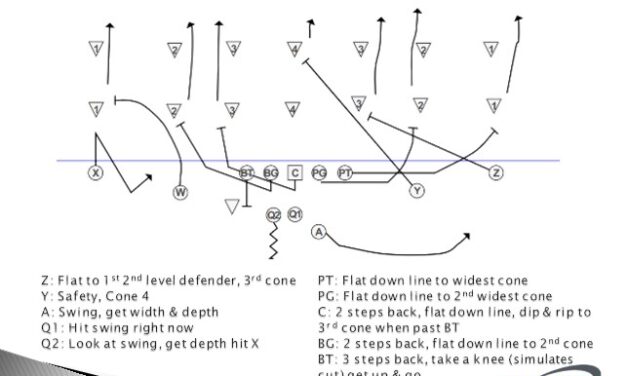
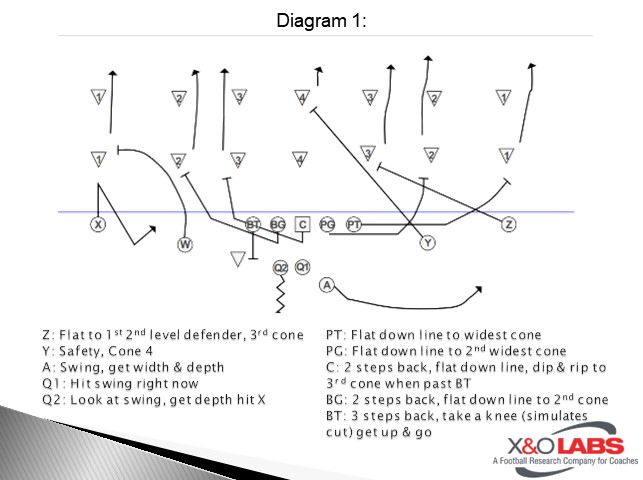
Diagram 1


Coaching Points:

  • We usually run this from the 25 yard line
  • Cones usually go about 5 yards and 10 yards from the LOS
  • After player passes the second cone, they run through the end zone
  • Players peel off to their side of the field so the next group can go right now
  • Q1 has the ball snapped to him and runs the cadence, Q2 has the ball in his hand


Read More

Shotgun Wing T Reverse Package

By Ken Vigdal
Offensive Coordinator
Brookings High School (SD)


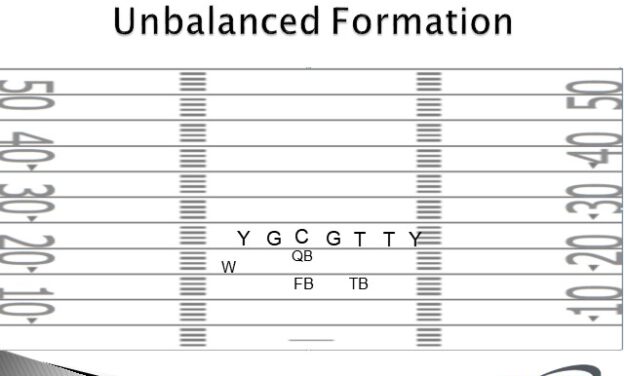
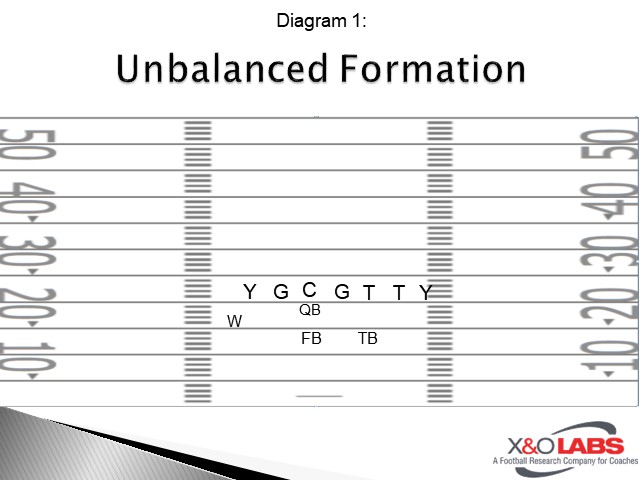
For a large part of my coaching career I have run a Wing T offense.  I started with the double tight formation, through time I implemented the gun, and now we are a spread wing offense.  The reason for the change to the gun was that defenses continued to put more and more defenders in the box.  We then went to the spread to help our running lanes open up.  As defenses have changed and adapted to the spread offense you see more 3-3 or 3-5 defenses.  One formation we have kept throughout our transitions is our unbalanced formation from under center.   We have kept this formation because it forces defenses to practice against a non-traditional spread set.  They have to use their practice time to defend this formation and all it brings with it.  Most, if not all of the teams in our conference run a spread offense. This gives us another opportunity to do something different that other defenses will not see every week.

Diagram 1


Alignment Adjustments

We keep our normal two foot splits for our offensive lineman.  The left tackle moves to a position between the right tackle and the right tight end.  The reason we move the left tackle to this position is that the right tackle and the right guard are used to working together.  We want to keep that consistency when we run other parts of our gap schemes.  The fullback heels are at 4 yards from the ball.  The tailback is slightly ahead of the fullback, usually heels at fullback toes and splits the inside leg of the right tackle.  The wing is in a 1×1 position off the left tight end. 

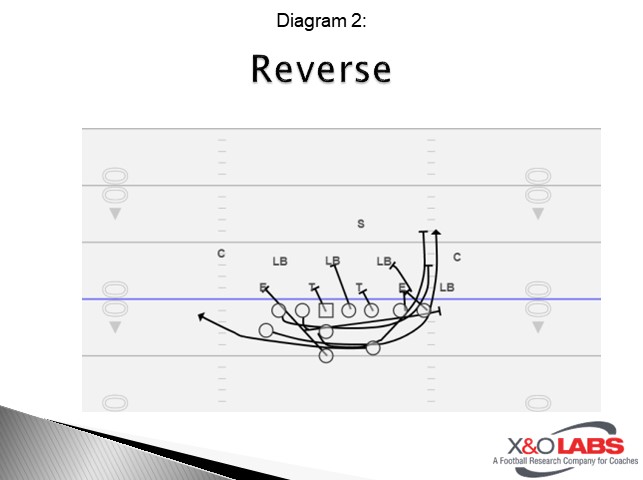
Diagram 2


Blocking rules

  • Play side Tight End gap down to double and on to backer
  • Left Tackle on for double to backer
  • Right Tackle double or gap down to backer
  • Right Guard on gap down to backer
  • Center on or cover for Left Guard
  • Left Guard gain depth on pull and kick out the first defender outside the double team
  • Weak TE pull and lead up the hole inside the kick out block, look inside first, if no one, look for corner or safety
  • Fullback depth of 4 yards, will have to be quick off the ball and cover for the pulling TE
  • Tailback depth of 4 yards, alignment inside leg of right tackle, will work across the formation. If player has great hands, receive it like a handoff and give to the wing, if not have him receive it with the shelf technique. We always find that back the can take it and give it like a hand off.
  • Wing 1×1 off the TE, takes an outside jab step for time to let the fullback get to his blocking assignment. He then gets 2 yards depth and takes the handoff from the tailback, cuts up inside the kick out block.  He will receive the ball on an inside handoff.
  • Quarterback reverse pivot out, to the midline, second step has to be stepping towards the TB. Gives the ball to the tailback and continues on inside the kick out block and lead block for the wing.


Read More

Implementing a Defensive Takeaway Mentality

By Joe Castellitto
Inside Linebackers Coach
Utica College (NY)
Twitter: @CoachJoeCast


To state the obvious, a defense’s main objective is to stop the opposing offense from scoring. Clearly, if this is done, your team has the best odds of winning a football game. But what can a defense truly do to increase the odds of winning a football game? Create turnovers and score on defense.

It almost sounds simple to just stop the offense on a third down or to create a takeaway. The Utica College defensive staff bases our defensive philosophy on third down wins and creating takeaways. Yet, this is easy to discuss amongst football coaches. Our staff has developed a system for turnovers based off of verbiage, drills and game stat percentages. 


The ”Takeaway Mentality”

Implementing a takeaway mentality or philosophy to an entire defense must start from Day One. At Utica College, the first night in preseason camp the defensive coordinator, Will Pluff, has his opening presentation. Each slide in his presentation is also implemented and reiterated in other defensive coach’s player manuals.


First is our defensive philosophy which clearly states who we are and how we will be successful.  A list is provided for the players to visualize.

We will be successful when:

  • We run to the football
  • Tackle with leverage
  • We create turnovers
  • Focus and communicate through the ups and downs of the game.


These points are reiterated by the staff throughout the season.

Next, as a staff, we felt that it is important to have universal verbiage that can be used by the entire defense and staff.  To make these short quotes known we use them regularly in practice and in games.

“Run to the football”

“Finish at the football”

“Numbers score”

“Beat the block”

“Get another play”

“Beat the momentum”

Yes, you will hear these quotes consistently from the coaching staff throughout the season. If you want your team to share the same mentality, you will hear these quotes from players communicating with each other. That is when your defense is on the same page and a takeaway culture has truly been implemented.

Read More

6 Onside Kick Progressions

By George Karafantis
Defensive Assistant
St. Anthony’s High School (NY)
Twitter: @greek42e


Every coach preaches about how specials are one third of the game and are vital to the success of your football program. However, not every program structures its special teams’ practices properly or utilizes special teams’ schemes as effectively as they do for either defense or offense. At St. Anthony’s H.S., special teams has been, and is, treated almost the same as offense and defense. Individual periods for all specials are used in practice and schemes will be added (or removed) based on opponents’ weaknesses (or strengths) in an effort to gain as much of a competitive advantage as possible. In this report, I will share some of the schemes related to our kickoff coverage and our “kickoff offense” that has helped us win games and a semifinal playoff game this past season.

Everyone has always referred to kickoff as a coverage team or a defensive play aimed at pinning the return team, and subsequent offensive team, deep in its own territory. But what do you do when you feel that your kickoff team can not only pin the offense deep, but force a turnover that can essentially change the path of a football game? We have instituted a kickoff “offense” that is essentially a series of onside kicks that are used based on game planning and identifying the oppositions weakness in their kickoff return game.

Would you ever have an offense consisting of only one or two plays? Of course not, so why have only one onside kick in your game plan. Some may argue there is not enough time in a practice to efficiently practice multiple special team plays. However, there is always time if you make it. We are fortunate to have a high number of players in our program and try to use everyone somewhere on the football field. For many players that is on specials.

Our kickoff onside team can sometimes be referred to as a kickoff offense since we are designing the play to give the ball to our offense. We start with the ball on kickoff, so we feel we have some control of where the ball goes and because of that we look for the least athletic player on the return team and study him. If he is on the front line, we have a few options in our onside kick game to take advantage of him. If that weakness is on the second level of the return team, we have a couple answers for that player as well. Through film study we determine if that player is more aware of his right side or left side and what he is better at in fielding a kicked ball. Is it hard for him to handle a ball on the ground or in the air? What about going to his left or to his right? Once those answers are determined we use one of several onside options.


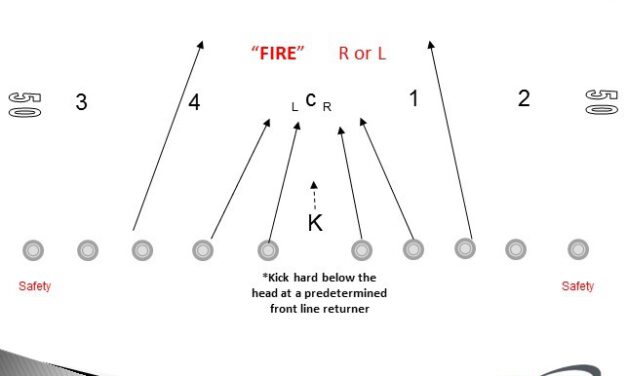
Fire R or L

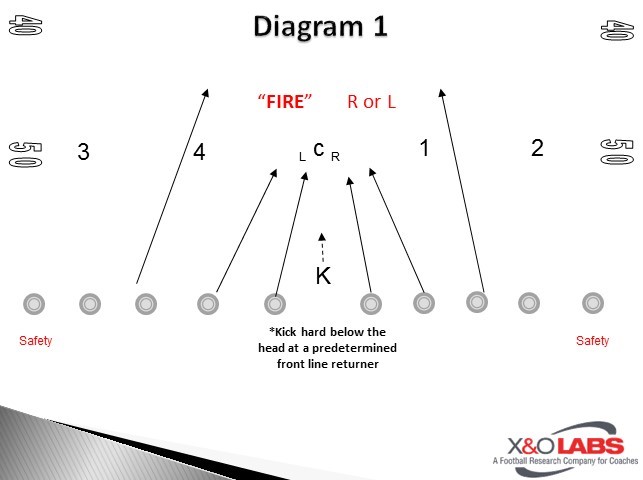
The first kickoff offensive play we will discuss is our “Fire” onside. Fire refers to the kicker kicking the ball on the ground with a lot of speed but not enough to where the ball jumps above the head of the frontline returner. Our fire call is usually done by telling the kicker first a number of a guy on the front line. The head coach, who calls the special team’s plays, will then give a direction. The direction will tell the kicker to fire the ball off of the predetermined returners right side or left side. The kick must not bounce too high and must, at a very minimum, hit the defender in the hopes that it ricochets back to our kickoff team. If the front line moves and the ball goes through to the second or third level, we are still in good shape since their stud returners most likely will not field it. Please refer to diagram 1, which shows a standard even kickoff team with 5 guys on either side of the kicker.

Diagram 1


‘Fire’ Coaching Point: The kickoff team’s inside guys should never go off sides and must have eyes inside to the ball at all times. It happens fast, so they must sprint to the spot and breakdown in a shortstop type position with knees bent and hands in between their feet ready for a bounce or ricochet.

Read More