Mike Leach Praises Sam Houston State Air Raid Study

By Mike Kuchar
Senior Research Manager
X&O Labs
Twitter: @MikekKuchar

Introduction:

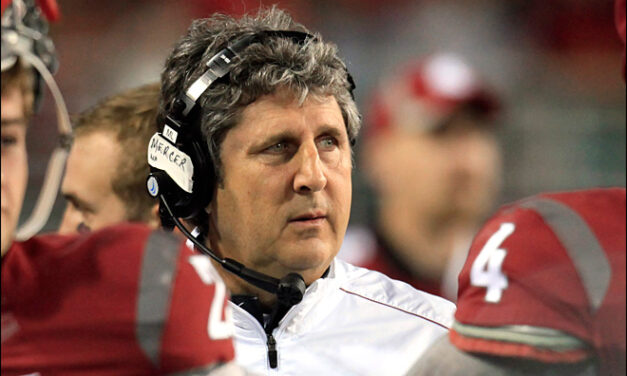
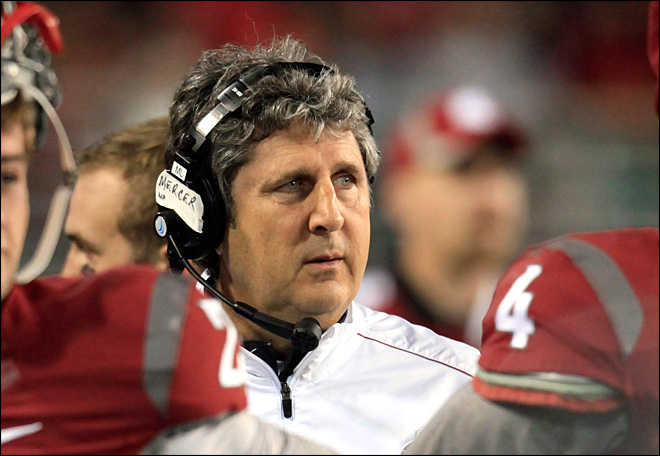
leachLast month, we released our special report on Sam Houston State University’s evolution on the Air Raid offensive system. In order to increase productivity, the Bearkats offensive coordinator Phil Longo places more of an emphasis on wide receiver play, rather than quarterback play, and the numbers spoke for themselves. Sam Houston State finished first in total offense at the FCS level, stockpiling over 531 yard per game.

We were curious to see if this shift was becoming a trend among Air Raid enthusiasts, so we went directly to the source in a first person interview with the grandfather of the system itself, Washington State University head coach Mike Leach.

MK (Kuchar): What is your perspective on Sam Houston State’s version of the Air Raid offense?

ML (Leach): “I’ve had a lot of admiration for what Coach Longo has done with the system. Sam Houston was a solid program for awhile then they exploded and Coach Longo is a huge part of that.”

MK: At Sam Houston State, responsibility is placed more on the receivers than the quarterback to identify coverages and make adjustments. How is that different to what you do in your system?

ML: “That’s very different than what we do. Our quarterback is equipped to call the offense post-snap and it takes constant training to put them in a position to do it. When Coach Longo put less on his quarterback what he did was give him an ‘if/then’ thought process pre-snap where there is an initial concept side and a backside that would complement it if the front side didn’t cooperate. I thought that was excellent.”

Read More

Quick Passing Game With Backside Boot Progression

By Barry Merritt
TE/Wonder Back Coach
AL Brown High School (NC)
Twitter: @coach_merritt

Introduction:

merritWe all like pass plays that gain yards, can be completed at a high percentage, and that involve all of your receivers. This year, the “90 Right/Left” was our go to concept as it combined quick game concepts and boot concepts into one powerful combination. It strained the defense with a pass play that does not have a back side and makes all of our receivers a threat. In turn, they all run hard routes because they all know they could be the guy getting the ball.

This concept involves a 3-step pass to a #1 WR on one side with a 3 level bootleg on the backside. The QB has the option to throw that 3-step pass if the coverage or talent match-up is good for us; then he throws that ball on time. If they take that away then he can boot out the backside. Sometimes we call the specific pass route we want run on the quick pass, other times we will call an option route where the receiver chooses his route based on coverage.

If you already throw a bootleg pass you’re just taking the backside post route and substituting a quick pass. This simple change can be very powerful.

90 RT/90 LT

We like running our “90 Rt/90 Lt” out of 10 personnel, but we can do it out of 11 personnel using our TE or W-Back in the route concept, and we can organize them in either a 2×2 set or 3×1. We teach the 3×1 set first. 

Lt Trips 90 Option Right

QB: He is looking to the #1 receiver to the right for the 3-step pass. We use only a few of our 3-step routes with this concept; hitch, slant, fade. You can add in more, but we like using only a select few so there is less confusion between WR and QB. We do not use a signal to communicate what he will choose, they must be on the same page. He takes this throw if they are playing off coverage and give us the hitch, slant; or if they’re in press coverage and we have a good match-up for the fade.

If he does not like what he sees we teach him to two hand pump fake a throw there to pull the defense and he will reverse out to get depth quickly to 10 yards, and boot out attacking the backside progression. We like for him to work his normal boot progression, looking deep first then working back down to the flats. He must not take a sack if everyone is covered make a play with his legs in space.

Read More

Using Trey and Solo Coverage to Defend Spread Sets

By Jim Cancellari
Defensive Coordinator
John Jay High School (NY)

Introduction:

Offensive coordinators like to use formations and route combinations to get an advantage so we felt that combining man and zone responsibilities was our best answer for handling shifts, motions, and the various route combos that spread teams are now running. We start by teaching our players in “if-than” scenarios and pattern reading and combining man and zone principles in our coverage.  We teach our defenders that receivers can really only do one of three things on pass plays. They can go inside, they can go outside or they can go vertical. Our coverage system is all about teaching the corners, the OLBs, and the free safety how to react when their receiver does one of these three things. 

Base Concept:

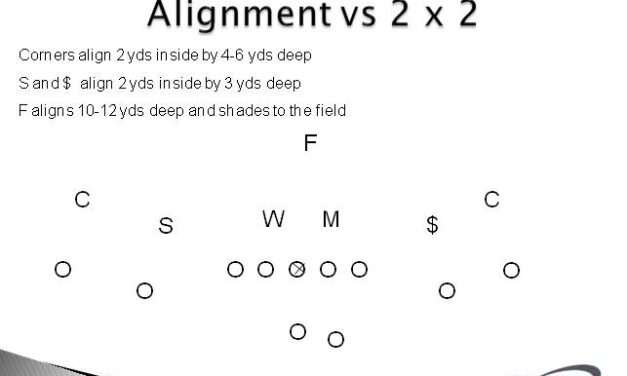
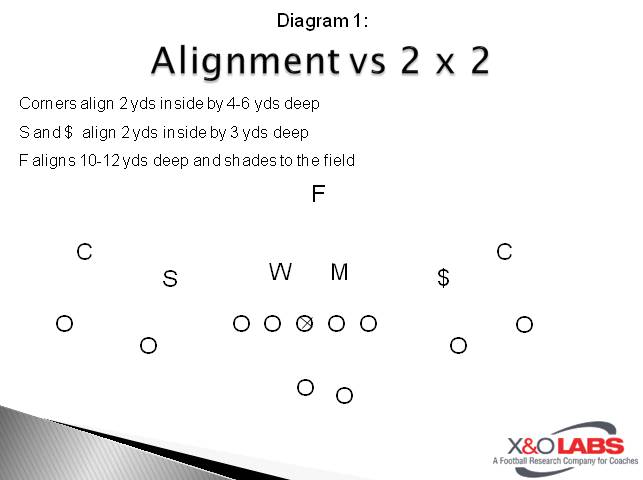
Our base alignment to any 2×2 formation is a 1 high look (Diagram 1). We play all defenders in an inside alignment because we want to force long throws to the outside. Our OLBs are 2 yards inside and 3 yards deep of any split inside receiver. They will be 2×3 to the outside if #2 is a TE. Our corners play at a depth of 6 yards and are shaded 2 yards inside and looking in at the near tackle for their run/pass read. The free safety is aligned over the field side guard at a depth of 10-12 yds. We may play with his depth or width depending on the situation but this is our starting point.

Slide1

SOLO COVERAGE is our 1 high coverage. 

SOLO starts as a man-free Cover 1 concept.  We want to give our free help versus inside vertical routes. Responsibilities in this coverage are as follows:

Outside Linebackers: They have #2 on everything except shallow crossing routes. They must pass crossers off to the ILBs and get depth, looking for a crossing route coming back at them. They must make a “CROSSER” call.  Help on any deep crossing routes. They are responsible to fight across any blockers and be the first defender to any WR screen.                                                                                   

Cornerbacks: Expect to play the receiver man to man on every route. If #1 runs a post, he must make eye contact with the FS. If the FS gives you a “CUT” call, zone turn deep to the outside looking to get over the top of a wheel route. If no “CUT” call is given, continue to run with the post route. If he sees #1 run a Screen, he must make a “SCREEN” call as loud as possible and play deep for any tricks plays off the screen. Once the ball is in the air, he can rally to the screen late.                

Free Safety: He is making his run/pass read off the guards. If he gets a pass read, he will read QB’s eyes and scan the field while getting depth. If a post is coming at him, he must peek to the #2 receiver on that side to check for a post-wheel combo. If there is a post-wheel combo, he must make a “CUT” call alerting the corner to zone turn to the wheel and the FS will then play the post route. If there is no post-wheel combo, he is responsible for the deep middle helping out on any crossing routes deeper than 8 yards.             

Applying the Free’s Rule:

Once our free reads pass, he starts his rule by getting his eyes to #2 to the field.  #2 can do 1 of 3 things. He can release inside (like a mesh route), he can release vertically (like a hitch or a go route) or he can release to the flat (like a slide route or a bubble route).

If the Free sees #2 go to the flat:

We teach the free to snap his eyes to #1. If #1 is running towards him, he will make a “CUT” call to the corner. This tells the corner that the FS will take over #1 and the corner must get back to the deep third. The biggest coaching point is to get the free to recognize post-wheel as quickly as possible so he can make his “CUT” call early and release the corner. We tell our free if he doesn’t like the angle #1 is running or if the corner is running parallel to the LOS, he can get over top of #2 if he wheels. 

If the Free sees #2 go verticle:

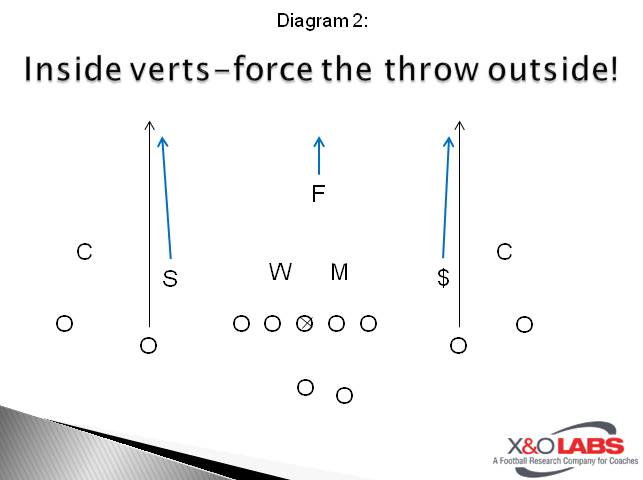
If #2 is climbing vertical, the free must continue to get depth and peek at #2 weak. This tells him if he is getting inside vertical routes. Our free will try to stay in between both inside verticals and react to the ball when it is in the air, he cannot be moved by the QBs eyes. (Diagram 2)

Slide2

Read More

7 Drill Categories Used To Simulate RPO Reads

By Mike Kuchar
Senior Research Manager
X&O Labs
Twitter: @MikekKuchar


Editor’s Note: The following research was conducted as part of XandOLabs.com special report on “Run/Pass Options.”

Even though the majority of coaches choose to rep their RPOs during team sessions, we wanted to explore the methodology of the 30 or so percent of coaches that use other forms of drill work such has half-line drills, mesh reads and group work to rep the RPO reads. We asked them to select one drill that they felt reinforces the reads of the RPO for the quarterback. Some of the more general responses are below, followed by specific types of drills.  

Question: What is one thing (individual work, group work, walk though, etc.) that you do in practice that best teaches the QB to make the right decisions in the RPO system?

Reader Response:

Jeff Russell, Wethersfield High School (CT): “Our first RPO that goes in is a combination of an Inside Zone?play and our Stick passing concept. Our receivers coach will?be working Stick with the receivers during individual, our QBs and RBs will be working on the mesh keep/give concept of our running plays from different alignments, and our offensive line will be working on zone blocking with an emphasis on double-teaming the LOS, and slowly working to the second level. Then we see how it all comes together in team and troubleshoot it. If we see an uncovered offensive linemen flying up to the second level too fast, and putting us in an “illegal man downfield” situation, then our offensive line coach will talk to them about securing the defensive line first and only attacking a LB who is attacking you. The QB reads usually take care of themselves with repetitions. The QB will slowly start to see that he can’t predetermine the read.”  

Mike Martin, Madison High School (OH): “We evolved into using our perimeter game teaching/thud sessions on Tuesdays (outside zone leverages, WR screens, RPO) as the biggest prep on this. As I scripted Tuesday practice, the RPO aspect of it just evolved into being an aspect of the game plan that the kids knew we would be covering and shoring up at that time. Teach the scheme and any adjustments, walk through any coverage/alignment variations, get some full speed repetition, then just make sure that you create a few definitive pull reads in your team scripts to make sure the kids have comprehension and can execute.”

Josh Franke, Edgewood High School (OH): “Film, film, and more film. Using a flip cam, we have a manager film our team sessions from behind the quarterback. We are then able to break down each read he makes, correct him if need be, and explain why. This teaches the QB to ‘read’ the play and not ‘run’ the play. Too many times, my young QBs get anxious, or want to run the ball, or want to throw it, that they don’t read the play, they know what they’re doing before the ball is snapped. Film can help get them out of this habit.”

Doug Taracuk, Dublin Scioto High School (OH): “I think the key is getting quality teaching periods and then putting the offensive unit in as many live/semi-live/run through reps as possible. We may have only run 33 RPO plays during our games. We ran close to 200 live or semi-live reps of the plays during pre-season practice, scrimmages and game prep practices. With the Draw/Stick, we start with a QB, RB and TE working against a linebacker. The line and defensive front gets added next, so the back can read the draw blocks. We finish with the rest of the skilled positions and defense. When working with the whole unit once they ‘get it,’ you need to add the ‘what if’s’ or defensive adjustments. We show them every defensive answer our opponents have used on film and on the field during the pre-season. During week one, our opponent changed the nickel back’s alignment to take the ILB out of his assignment conflict. Our QB simply threw to a different receiver. The more the QB can react and not think, the better you are with these combination plays. As I said earlier, with the Draw/Stick drill, we start with the QB, the RB and the TE working against one LB. We try not to clutter the teaching process up. Here, we can work on footwork, handoff and throw effectively. We add pieces as the practices progress. With the Jailbreak, Bubble, and Shark, we like to work against the defense. It becomes almost an old fashioned ‘Oklahoma or Hamburger’ drill. We work one receiver against a defender. The ball is thrown to a second receiver who reads the block. A second DB comes from depth or and OLB comes from width to tag off on the ball carrier. This is done once a day in pre-season, while inside run is being conducted. We found that this helps us understand safety leverage and OLB leverage and how it affects our decision making.”

Scott Girolomo, Offensive Coordinator, Liberty High School (VA): “We run our RPOs in our SKELE (perfect pass) and it allows the QB to locate the read defender a little easier. We do not have much time for indy during the week, so the RPO did not get indy practice time after pre-season. We rep a specific RPO in SKELE and then call the same RPO from the same script in team.”

Rick Bouch, Waterford Mott High School (MI): “We run a drill we call Triple Drill every day. The drill uses all the skill positions vs. perimeter defenders, including a DE. For example, we can Zone Read with a Bubble. The QB reads the DE first, and then continues to the next read if he pulls the ball. The repetition of the drill helps him make the right decision come game time.”

Read More

St. John Fisher’s X Concept to Defend Read Zone

By Mike Fox
Defensive Coordinator
St. John Fisher College (NY)
Twitter: @sjfcfootball

Introduction:

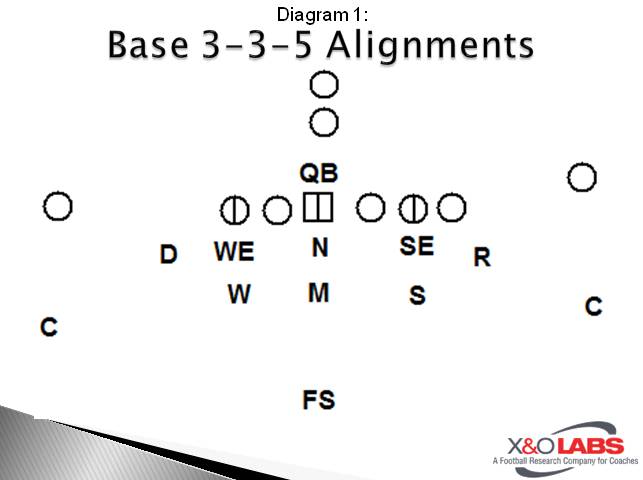
At St. John Fisher College our philosophy is to proactively keep opponents off schedule in the run game by creating negative plays on first down. We take an aggressive approach to this philosophy out of our 3-3-5 base defense by using calculated five-man pressures at the point of attack based on film and tendency study.

In this clinic report, I am going to share one of our favorite base pressures used against a zone read scheme offense. This pressure is simple in concept, but I believe the details and teaching in the run fits are what makes them most effective.

At St. John Fisher, we are a base 3-3-5 defense utilizing two 4-techniques with our defensive ends, 3 true inside linebackers and 3 true safeties. We are primarily a cover 3 or 3 under 3 deep base coverage team, but occasionally being run out of a two high safety shell.

Slide1

It has become common thinking that football has become an offensive driven game. Multiple formations, multiple tempos can create problems for any defensive coordinator. All that said, I believe running the 3-3-5 puts the pressure back on the offense. Preparing for the 3-3-5, duplicating scout looks, and overall scheming against this defense can become a nightmare for offensive coaches.

X Concept

Read More

Individual Mechanics of the Shotgun Rocket Sweep

By Blair Hubbard
Head Coach
Lutheran High School (CO)
Twitter: @CoachHubb2

Introduction:

Since learning the under center Jet Sweep at a clinic in 2003, I have been a believer in having some sort of speed sweep in our offense.  The threat of hitting the perimeter at full speed with lead blockers in front, forces defenses to thin themselves out somewhere, either by alignment or as the motion is happening, to get enough defenders in pursuit to the perimeter.  Identifying where the defense is vacating or leaning is key to knowing where to attack next.

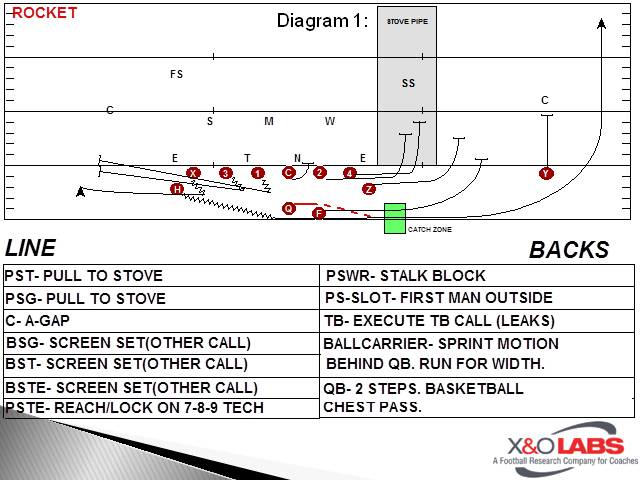
Through the mid-2000’s, we evolved from UC-Jet, to UC-Rocket Sweep, to now attacking with Gun Rocket Sweep. We transitioned to gun in the winter of 2009 to be able to involve our QB more in the running game. When we started in the gym with our QB reversing out in gun and making a toss like we would under center, the ball was all over the gym, and we could not get complement runs into the los with efficient timing. I told our QB, a basketball player, to simply front out and make a basketball chest pass. The pitch was crisp, quick, and on target, and now in an instant we had the ability, from a shotgun set, to hit the perimeter very fast with our Rocket Sweep. We were also still  able to get our complement runs: Powers, G-Schemes, Traps, and Counters into the los with efficient timing. 

From that day in 2009, we have worked hard to build our offense utilizing complement gap running schemes, conflict-creating blocking schemes, screens, quick passing and play action passing, and just enough option to force teams to play assignment defense. The offense is perfect for coaches looking to utilize their QB in the running game without the heavy investment in the option game. In this article, I will share with you how we execute our Gun Rocket Sweep including blocking assignments and techniques by position. I will also share our blocking variations and some of our manipulators.  

Advantages of the Gun Rocket Sweep over the Fly Sweep

  1. It hits the perimeter faster than the fly/jet sweep. With the fly sweep, when the snap hits the QB’s hands, the sweeper is on the back side by 2 to 3 steps of where you want the ball to go.  With the rocket sweep, the sweeper is at least even or 1-2 steps beyond the QB at full speed:  width is the goal. This gives the rocket sweep a 3-4 step advantage over the popular fly sweep, forcing defenses to play that much faster to defend the perimeter.
  2. The rocket pitch is easier to handle at full speed. It’s a catch vs.  a hand-off.  Therefore, it’s no new skill/technique for your players to learn and for you to rep in practice.
  3. It’s less mesh point critical.  Timing issues and bad snaps can easily be overcome by your QB. Timing issues or bad snaps can be disastrous with the fly sweep.
  4. The speed of the sweep, faster than the fly, forces defenses to decide faster, stem or rotate, or simply play unsound defense. This can be taken advantage of through complement runs and play action passes.
  5. Play action and quick passing are enhanced because the QB’s eyes can be downfield seeing any back-end rotation. Because of defensive movement, the screen game can be enhanced.
  6. Pass protection has been enhanced due to softened edge rushers and less blitzing.  Defenses have realized that blitzing defenders lose them necessary sweep pursuit.

Rocket Sweep Breakdown

hubbard1

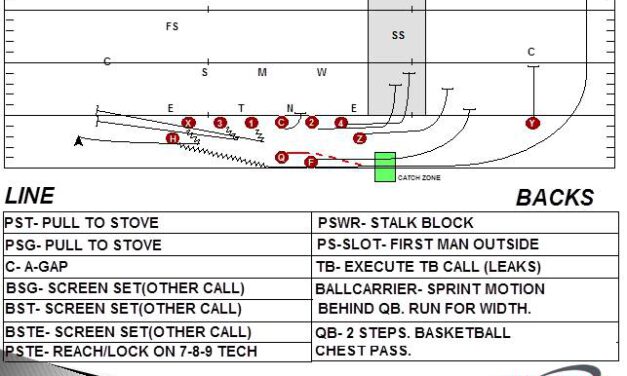
Quarterback – Aligned with heels at 4 yards, the QB secures the snap and opens with the play side foot to the sideline then crosses over with the backside foot. This will position his shoulders completely perpendicular to the line of scrimmage. From here, he simply makes a fundamental basketball chest pass (thumbs down) to the sweeper, hitting him in the hands.

Read More

Multiple RPOs Off Inside Zone

By David Weitz
Offensive Line Coach
Warren Central High School (Indianapolis, IN)
Twitter: @DWeitz7

Introduction:

Our offense is looking to spread the field in order to get the ball into space. For us, getting the ball in space could be throwing to an open man in space or running Inside Zone into a 5 man box. We do this by giving our players the ability, and the skills, to get the ball to the man who has the most space and best opportunity to make a play. Our Inside Zone RPO is the way we feel we can best accomplish this. It allows us to use a sound blocking scheme that can handle 6 in the box while having a passing scheme that can stress the defense both horizontally and vertically.

Box Play

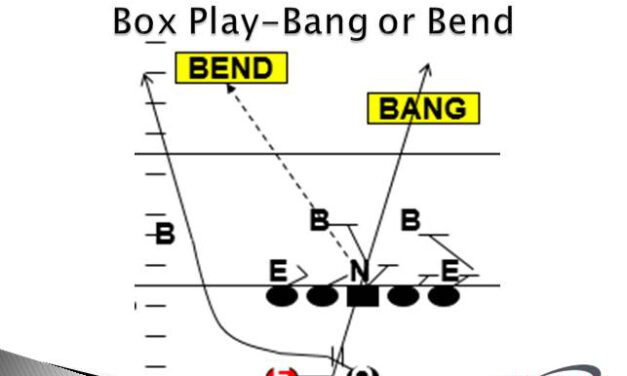
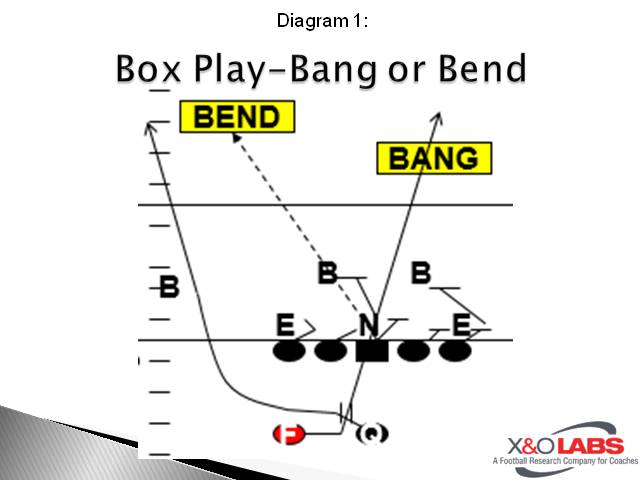
The blocking of Inside Zone could, and has, taken plenty of articles for itself. As an offensive line coach, I hate to breeze by line play but there is no way to do it justice and still include the relevant information for the RPO. We block Inside Zone by leaving the backside end man on the line of scrimmage for the quarterback to read. One concept that we really try to hammer home is that, while our double teams must get vertical movement, we want them to be controlled and methodical in their movement of the defensive lineman to the linebacker. Since our QB has so many options on a pull read, he more time before our lineman get downfield. We’ve also found that our kids do an excellent job of getting a feel for if it is a run or a pass and are able to shut it down around the 3 yard line.

The mesh between our quarterback and fullback is a huge part of this play. From the running back’s perspective he is looking to take the ball coming straight downhill with his shoulder square to the line of scrimmage. There are several coaching points we use to help insure this. The first is the alignment of the fullback. We will have him stagger 1 yard behind the QB. In addition to this we will tell our QB to get perpendicular to the line of scrimmage and reach the ball straight back. This creates a situation where, if the fullback wants to get the ball on a clean path, his natural path is to step directly behind the QB and come straight downhill. From the perspective of the QB, we stole a page from the flexbone coaches and tell him that he is going to give the ball unless the read man can tackle him for less than 2 yards. We tell him to read far shoulder, far hip, near knee and just about any other body part imaginable but in the end we found, with practice and film work, our QBs get a pretty good feel for what the end man on the line of scrimmage is going to do. We also try to stress the idea that the longer the ball is in the running back’s pocket the more time he has to read the intentions of the defender.

Slide1a

We tell our running backs that Inside Zone is a physical play and the physicality starts with their running style. Our fullback is going to get his shoulder pads square to the line of scrimmage and chase the play side hip of the center while looking to bang the ball through the play side A gap. In the event that the play side hip of the center isn’t getting movement, he will plant, lower and bend the play through the backside A gap. Just like with the QB, we’ve found the best way to get the running back to play fast is to give him one way decision making. In this scenario, we are telling him you will bang the ball through the play side A gap unless there is no movement. We also tell him we will never get mad at him for banging it through the play side A gap.

Read More

Twin and Duo Run Concepts

By Bob Wylie

NFL Alumni Offensive Line Coach

Winnipeg Blue Bombers (CFL)

Editor’s Note:  Long time NFL coaching veteran and Winnipeg Blue Bomber (CFL) offensive line coach Bob Wylie details two of the more prominent two-back run concepts that have been a successful complement to gap run schemes in his tenure.  The video at the end of this article is from the COOL Clinic and contains Coach Wylie’s complete clinic talk on this concept.  This years COOL Clinic will be held this year on May 20-21 in Cincinnati, OH.  We hope to see you there!

wylieWhen I was with the Chicago Bears we ran a play that we called 26 Duo. We wanted to figure out how we could get the backside linebacker blocked. This was not a new play. We still wanted to maintain some type of consistency with the back, and how he should read the blocking. The Duo stands for two double teams. Jim McNally came up with the term. We wanted to get two double team blocks where we could. (Diagram #1) Sometimes, if you had a third tight end, you could get three double teams.
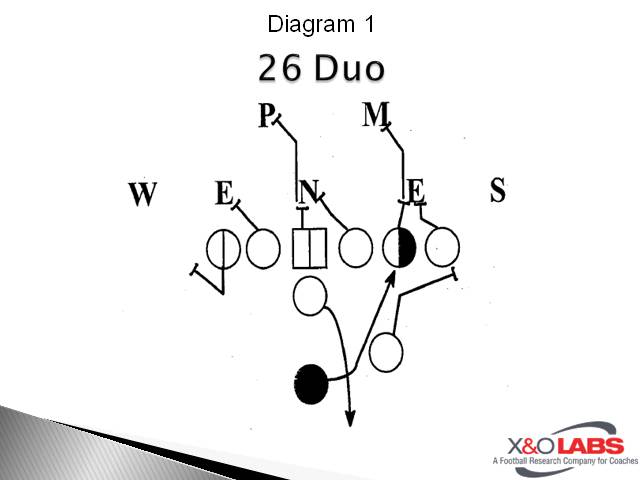
Slide1

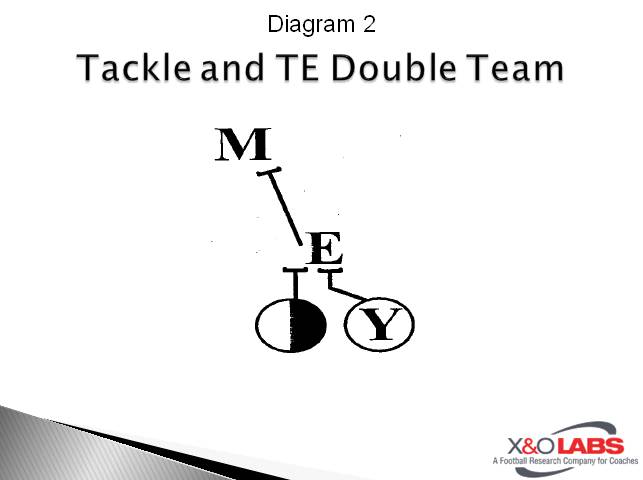
I want to draw the play up against the 3-4 look on defense. We are going to double team, or team block the 5-technique to the front side linebacker. (Diagram #2) The inside post man is going to take a short jab step, and his second step is coming up the field. The tight end is galloping into the line of scrimmage. We are getting hip-to¬hip with the tackle. We are going to double team block on the 5-technique straight back.

Slide2

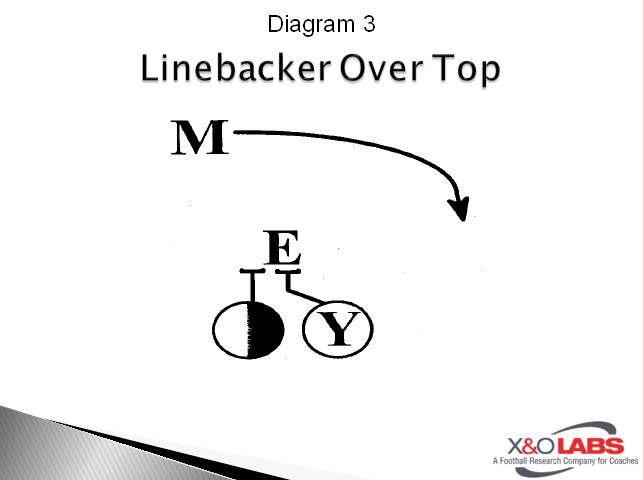
If the linebacker runs over the top we are not getting off the block. We are staying on the double team block. (Diagram #3) If the linebacker attacks the line of scrimmage and tries to penetrate the tackle-tight end area, the tight end may come off the double team block. So, if he runs over the top we let the linebacker go.

Slide3

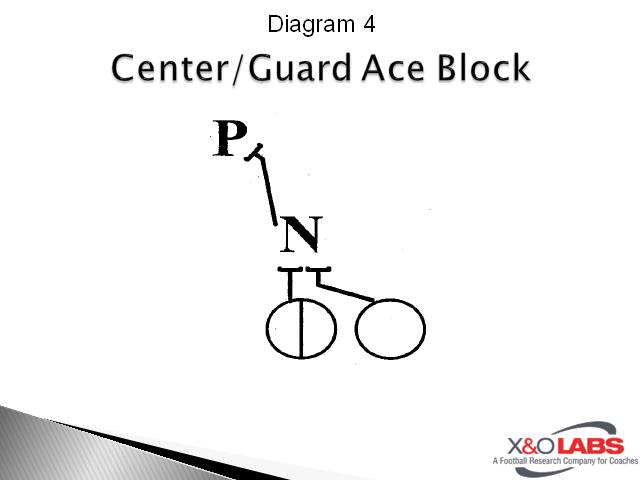
The ace block between the center and the guard is a double team block on the nose guard to the backside linebacker. (Diagram #4) It is the same steps that everyone else teaches on this play. It is a short control step, with the second step down the middleof the defender. The center may take a little more of the nose man. The guard comes down on the nose man and stays square, and drops the inside arm and knocks the nose guard back. He is looking to see what is happening with the Plug or backside linebacker.

Slide4

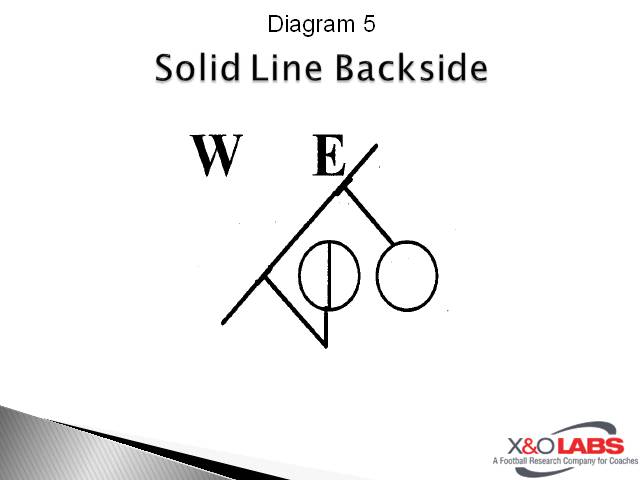
We use a read out technique on the backside. The left tackle posts the defensive end with his eyes on the Will linebacker. Here is where the play changes. (Diagram #5) The left guard picks his outside foot up and puts it back down. He takes the inside foot and he actually crosses over on his step toward the defensive end. The guard and tackle form a wall that looks like a solid line on that side.

Slide5

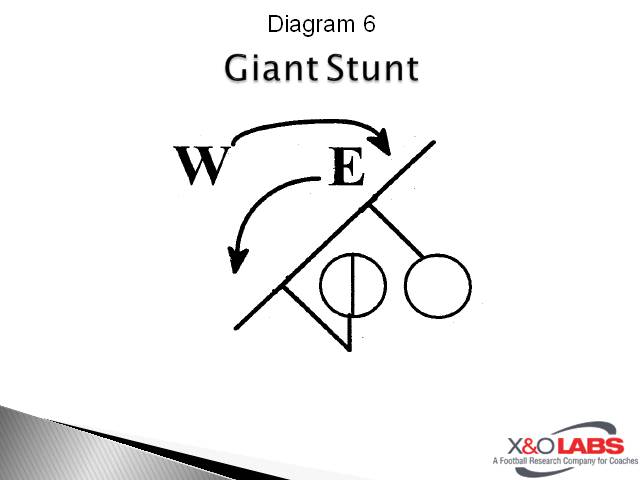
If the defense runs the Giant stunt, they would get picked. On the Giant stunt the end goes outside and the Will linebacker comes inside. (Diagram #6) This allows the guard to climb and pick up the Will linebacker. If the Will is coming off the edge then the end is more than likely coming inside and the guard can still block him. So, if the defense wanted to run the Giant Stunt, we could handle the stunt with the way we blocked on the play.

Slide6

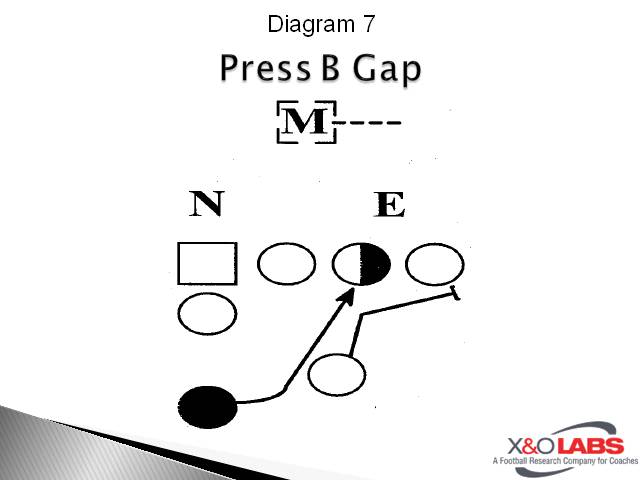
Here is the key to the play. We did not read the down blocks. We read the linebacker. (Diagram #7) We are reading the Mike backer here. If the Mike goes over the top, or stays where he is, we told the back he could cut the play back inside just like the zone play. We stressed for him to press the B-gap.

Slide7

The Fullback bocks the play the same as the power play without the pulling guard. He runs a drop step, crossover, and plant step.

Read More

3 Variations of the Counter Play

By Justin Iske
Offensive Line Coach
Southwest Oklahoma State University
Twitter: @justiniske


Introduction:

Counter is a simple play that has been around for decades. However, there are multiple different ways to run it to make it fit into any offense. While we will not go into a game with more than one or two different ways to run counter, over the course of a season we will use most of, if not all, of the concepts discussed in this clinic report.

There are several reasons we like the Counter concept:

  1. Puts misdirection into your running game. With offenses running predominately one back (and often times four receivers) as their base personnel, zone concepts have become more and more popular. While we like to run Inside and outside zone as much as anyone, we feel like we need to have something in our running game that allows us to end up opposite the direction of flow a play starts with. It is also important to note that the counter can be run to the same side as the back’s alignment in the traditional shotgun.
  2. Gap Concept that you can piggyback on teaching of the One-Back Power. Power is a staple of our offense as we called some variation of Power over 200 times last season. Every run in our offense falls into one of three categories (zone, gap or man). We teach these as concepts before we get into particular plays. Counter is a gap concept just like power. So if our guys understand the power play, they are ¾’s of the way to understanding the counter play.
  3. Gives us another Weakside Run. We are a team that bases out of 11 Personnel and will run a fair amount of 12 Personnel as well. When you run Power 200 times a season, you need something to the weakside besides just zone and/or stretch weak. Counter gives us a great change-up that looks like zone strong initially, but ends up hitting to the weakside.

COUNTER G-T

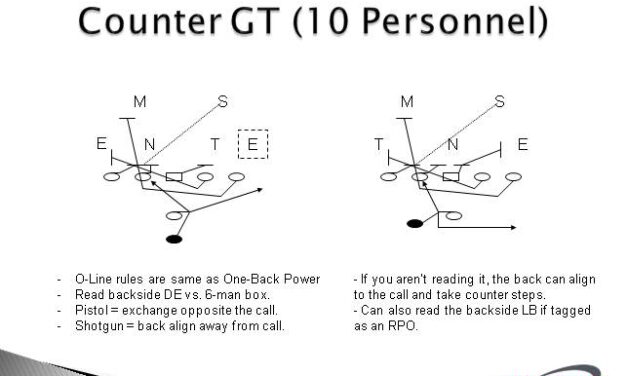
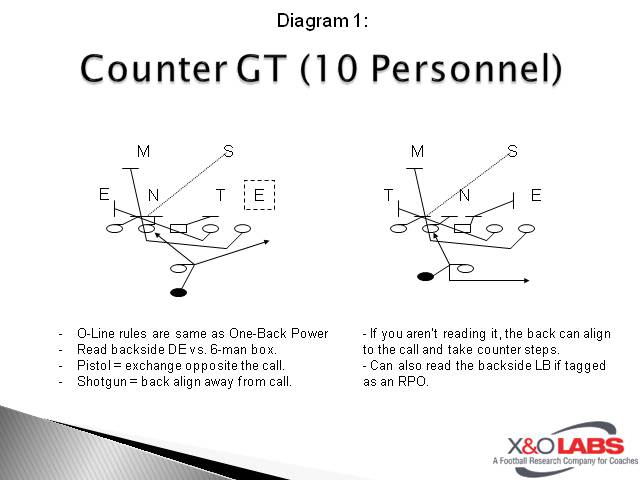
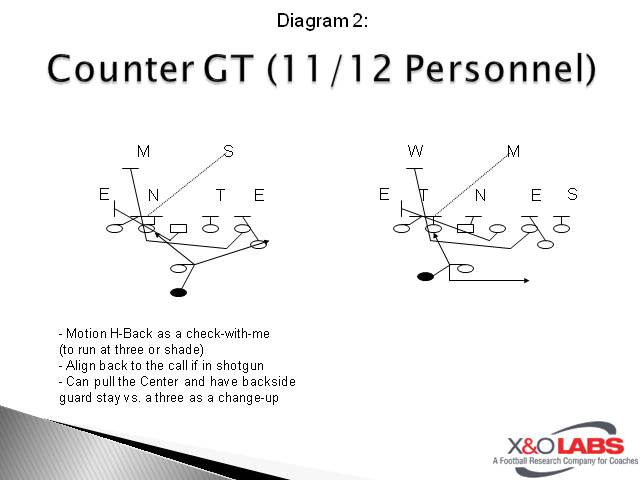
The simplest way to run the Counter play is by pulling the back side guard and tackle. This variation can be run out of 10, 11 or 12 Personnel. If your QB is an athlete, this is a great concept to read the back side defensive end to handle a six-man box. If your QB is not a dual threat, then running any of your existing RPO concepts is an option as well. This is a play that can be run from the Pistol or traditional shotgun.

Slide1Slide2

Assignments for this play are very simple (and very similar to the One Back Power:

Front Side Tackle: B Gap to Second Level (look to double team at the first level

Front Side Guard: A Gap to Second Level (look to double team at the first level

Center: X to Y Gap (Fill for Pulling Guard) / May pull the Center against a back side three technique

Back Side Guard: Open Pull* and kickout the EMOL frontside

Read More

Defending Pressure with Slide Pass Pro

By Mike Slattery
Offensive Coordinator
Huntley High School (IL)

Introduction:

huntleyWe base our pass game at Huntley High School on our pass protection.  We will run quick game, rollout, and play action.  If we cannot protect a route we probably will not put it in game plan for the week.  What do we mean by protect the route?  If we are putting 3, 4 or even 5 receivers out we have to have a very good idea of what we think our opponent is going to do against each particular look.  This is where our weekend game planning session pays off.  We put up each set against the looks we’ve seen on film and decide what we think will best attack the defense.  We start and finish with protection, most of which is based on 6 man protection schemes. We will protect the 6 most dangerous gaps with our offensive line and running back.
Base Rules

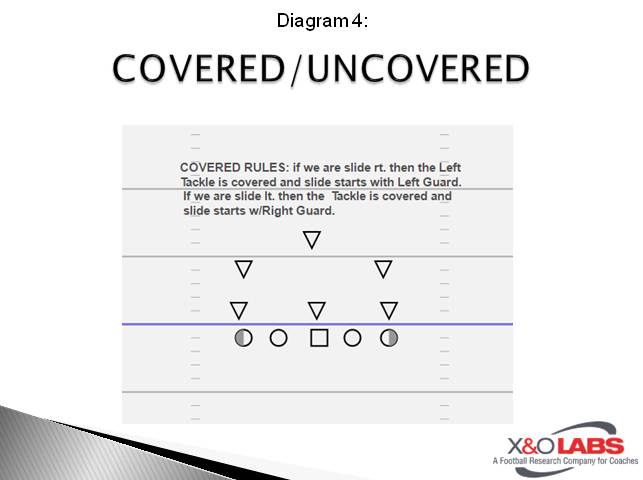
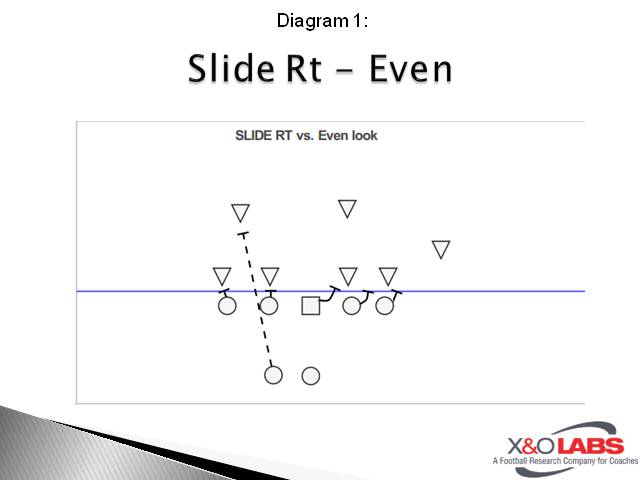
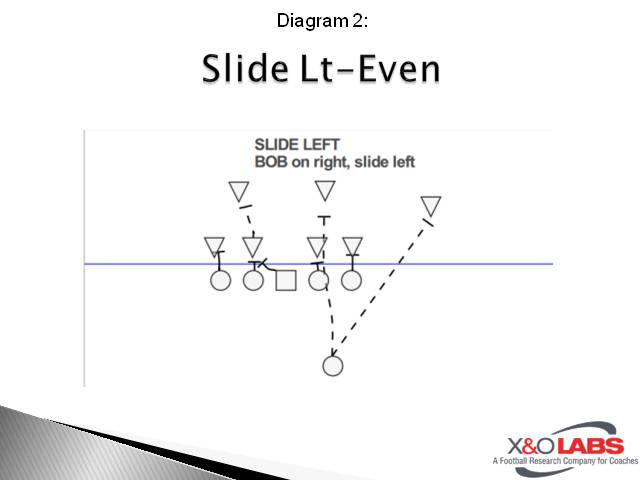
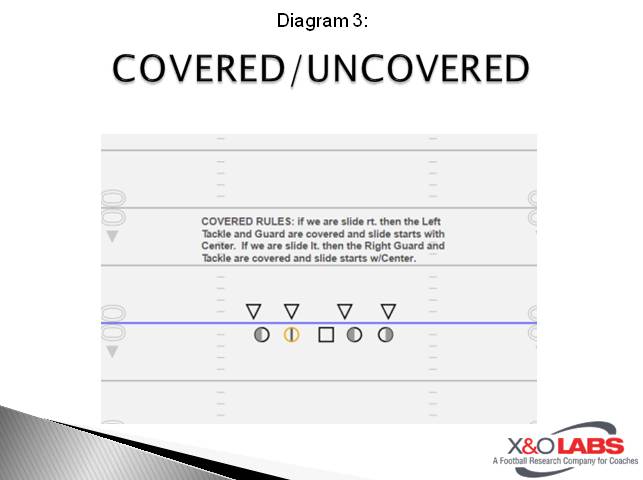
We try to keep our rules very simple for our drop back/quick game which allows for more time to work on technique and recognition.  The protection we will discuss, and one I would bet many others use is our slide protection.  The rules are as follow:  back side (BS) is “Big on Big.” The slide starts with first uncovered lineman away from call.  This means that if the call is to the right then any covered lineman on the left side will block Big on Big and we will start the slide with the first uncovered lineman back to the right.

Slide1Slide2

Defining Covered

How do we define covered vs. uncovered?  For us, if the defensive lineman is in an inside, over, or outside shade we consider our lineman to be covered.  Against a standard even front, this would typically mean that our left tackle and left guard (covered) would be B.O.B. and the slide would start with the center. It is important to note that we will have our TB blocking inside to outside linebacker opposite the call side. Against the typical odd front, our left tackle would be covered and the slide would start with the left guard.

Slide3Slide4

Slide

For us, slide means the line is blocking the gap to the call.  This typically allows us to block 3 to the call (even) and 4 (odd). What we teach our lineman is that if they are covered but still supposed to slide, they step to the slide but stay put if there is no threat to the slide side. For example, the Center against an odd front nose with noone threatening the slide gap, there is no reason to just jump out there. Instead, we coach him to step and wait for the guard to come and help (if no immediate threat). The actual uncovered lineman will make the call so all know where it is starting. For us, it may be as simple as the lineman calling out his own jersey number.

Read More

Va Tech’s “Pad Back” Technique to Defend Zone Read

By Mike Kuchar
Senior Research Manager
X&O Labs
Twitter: @MikekKuchar

Editor’s Note: The following research was conducted as part of XandOLabs.com special report on “Virginia Tech’s Bear Package,” which can be accessed in full by clicking here.

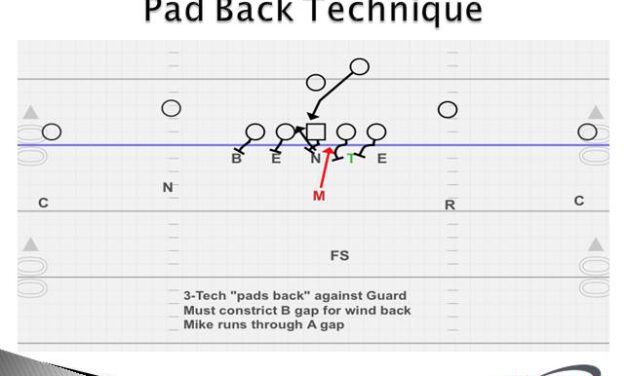
3-Technique Play (Pad Back Technique):

When studying this package, it’s inherently clear how the presence of two 3-techniques can ultimately disrupt blocking schemes and create chaos on in the backfield. Often times watching tape we were amazed with how unblockable these players were. They were getting penetration in their gap play side and not getting cutoff back side. The reasoning is simple: many times these 3-techinques are reduced defensive ends who are working on offensive guards who don’t have the size or strength to handle them.

Read More

RPOs: Case One – System Development

By Mike Kuchar

Senior Research Manager

X&O Labs

Twitter: @MikekKuchar


Introduction:

A bit of clarification is needed before we provide our research. We feel it necessary to provide an explanation of exactly what a run/pass options is. Like many other concepts in football, this has different meanings to different coaches. Some of these terms include run/pass combinations, dual read play calls and run/pass marriages.

This entire special report will be centered around run concepts that involve a pass element where the quarterback must make a post-snap read of a defender and decide whether he is handing the ball off or throwing the football.  Which means that a quarterback is reading a certain defender post-snap (known as a read key) to decide whether the ball is thrown or handed off.

These are not to be confused with run/run options (such as read option concepts) or pass/pass options (such as quick game concepts mixed in with screens).

This special report, The Run/Pass Option Concept Study, could perhaps be the impetus behind some ideas that may drive your offense to become more dynamic. The fact is, we all have run concepts in our offense and we have pass concepts in our offense. A short time ago, a group of smart football coaches decided to package their best runs with their best passes, thus taking the guesswork out of their hands and into their quarterbacks.

Now, that isn’t always a popular choice. We’ve interviewed a good deal of coaches like Charleston South High School (SC) head coach Donnie Mays who said, “If I want to run it, I’ll run it. I don’t want my quarterback making that decision.”

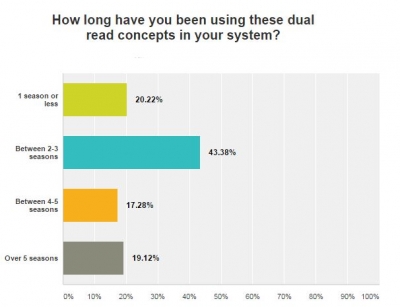
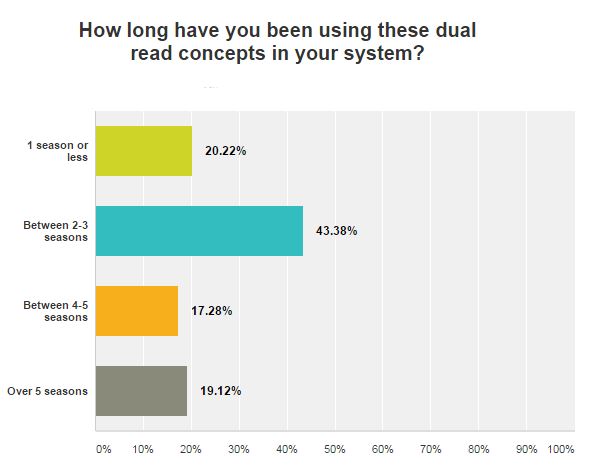
It’s important to note that Coach Mays has contributed to this report, because he does believe in the RPO system. But those coaches who have bought in completely to using run/pass options are a relative new crop. We’ve found that the majority of coaches, 43.3 percent, have been using run/pass options between the last 2-3 seasons.  

chart2

Benefits of the RPO System:

If taught correctly, a run/pass option necessitates you never getting into a bad play.  At its core, if the quarterback makes the right decision (based off his movement key) it’s a positive play. But we all know our quarterbacks don’t always make the right decision, which is why we dedicated a heavy portion of this research to how coaches are training their signal callers to make the right read. There is a lot of teach time that goes into establishing these run/pass option concepts and many of our contributing coaches detail what they do to progress the system further in this report. We selected several contributing coaches and asked them what they felt the benefits of using the RPO system provided.  Here’s what they told us:

Steve Rampy, Offensive Coordinator, Pittsburg State University (RPOs consist of 25 percent of his offense): “Not every run has a pass complement, but many of our runs have an ability to (have a pass off of them). We have some concepts where if we have a run called and we see an extra defender in the box, we will check the play. We have other concepts where if we see the same scenario, we’ll read him post-snap. You don’t want to get in a bad situation if that player comes into the box early, now you’re stuck. The quarterback makes the communication with the receiver to get it worked out. “

Brian Flinn, Wide Receiver Coach, Villanova University (RPOs consist of 30 percent of his offense): “We just try to get apexed players in a bind, either they play run or they play pass. Every run game is based off a smoke, bubble or free access throw for us. There is no three-step drop unless there is a two-minute drill. If you want to move defenders, have receivers run block.  We zone block and run two-yard hitches. It’s pass for the receiver and run for the offensive line. It’s the QB that has to think and make decisions. You eliminate a lot of things in your offense by doing this. You eliminate three-step protection and most of your play action menu.”

Drew Owens, Offensive Coordinator, Western Connecticut State University (RPOs consist of 50 percent of his offense): “We are a no-huddle team that wants to keep a premium on play call. We never want to read a guy that is influencing the run, and if he plays run, have to throw and read another guy. We put guys that are aiding in the run and forcing them to play the pass. He’s our run control guy. The quarterback has the built-in option to throw the ball allowing him to take less hits. It puts an extreme amount of pressure on a defense to prepare for the option and pass in a single play. There are two plays in one. Regardless of what the defense is in, you have the right play called taking out the need to audible. It also accounts for the sixth defender in the box in a 10 personnel formation (seventh defender if TE attached) and it forces teams to play one-high in normal situations.”

Read More

RPOs: Case Two – Manipulating Box Defenders

By Mike Kuchar

Senior Research Manager

X&O Labs

Twitter: @MikekKuchar


Introduction:

villanovaWhen conducting our research on RPOs, we noticed two common threads among offensive coaches who were proficient with the system: either these run/pass combinations attack box defenders or they attack perimeter defenders. These are primarily second level players such as linebackers or drop safeties (posing as linebackers). By definition; a box defender is a defender that is in the framework of a tackle box. 
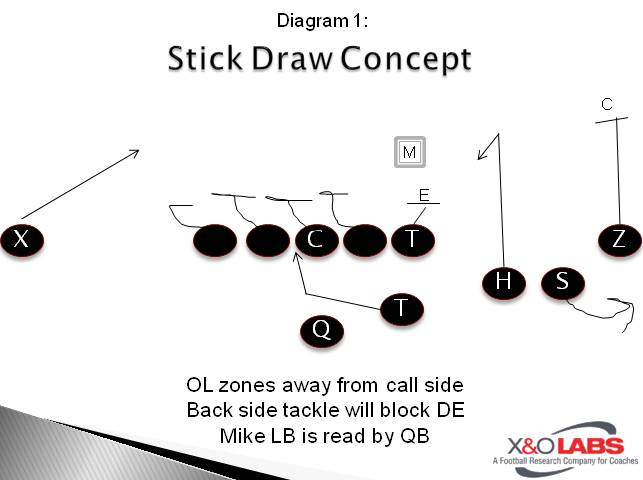
Now, each coach has his own definition of a tackle box, many of which are explained in this report. But, for all intents and purposes, this case will be based solely upon RPO concepts that are used to manipulate those interior linebackers that may have a dual run/pass responsibility in zone coverage. We’ll start with the most popular of these concepts, the Stick/Draw. 


The Stick/Draw Concept:

The main premise of the Stick/Draw is a Draw run concept mixed with a Stick pass concept (simple enough). Typically speaking, the post-snap decision is made by the quarterback off the play side inside linebacker who will either commit to tackling the ball carrier (on the draw) or work to play the stick route in the passing concept.  

The Stick Draw is by far the most common RPO used by coaches and apparently the most efficient as well.  In fact, 53.9 percent of coaches said they averaged between five and seven yards per play on this concept. Since this entire case is centered on the Stick/Draw concept, we will begin with perhaps the most important element of the play, the pre-snap identification process. For research purposes, the most common Stick Draw route progression is as follows:

Base Stick/Draw Concept Receiver Progression: 

  • Z Receiver: Blocks the MDM (most dangerous man) on the edge, just as he would in a bubble screen concept.
  • S Receiver: Bubble screen path. 
  • H Receiver: Runs a stick route. If the ball is on the hash, he gets on the outside edge of the hash. It’s a vertical, no stem, inside hitch.
  • X Receiver: Tagged route based on coverage and leverage.

Slide1

To watch a video tutorial of Villanova University’s base Stick Draw Concept, click on the video below:

Read More

RPOs: Case Three – Manipulating Perimeter Defenders

By Mike Kuchar

Senior Research Manager

X&O Labs

Twitter: @MikekKuchar


Introduction:

Case three of our special report will focus on run/pass concepts that put perimeter defenders in a bind, forcing them to defend both run and pass actions. In most cases, perimeter defenders consist of outside linebackers or drop safeties in zone coverage that have both run and pass responsibilities post-snap. It is these defenders that can be manipulated by showing a fast run action (such as Power, Speed Sweep or Outside Zone) then pulling the ball to throw in the area in which he vacated. Since many of the coaches we spoke with prefer to use the Power Read action as the run complement to these perimeter RPOs, we decided to start there. 

Power and Power Read (Inverted Veer) RPO Concepts:

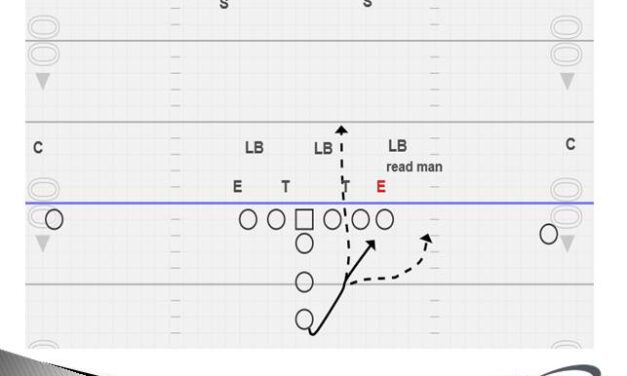
For the last four years (or at least since Cam Newton left Auburn) the Power Read concept has been all the noise among Spread offensive coaches. Since much has been written and reported on this concept, defenses have learned to tighten up their schemes to defend it. As a result, these offensive coaches started getting on the whiteboard to design some lethal play-action concepts off the Power Read action, some of which are the RPOs detailed below. Now instead of the play side defensive end being the read in the run game, the apexed linebacker becomes the movement key. We asked the same set of questions (as we did in case one) to those coaches who are using the Power and Power Read RPO. 

Question: Which kinds of pass route progressions do you utilize in the Power Read RPO concept?

Brett Dietz, Offensive Coordinator, DePauw University: “We are going to run a double post to the number two receiver side with a wheel route with the blocking back coming out of the backfield.”  

Dan Ellis, Great Valley High School (PA): “We choose simple routes that are easy to complete for our quarterback. These consist of hitches, fast screens, bubbles, slots and double slants. The routes must be short so that all throws must be out before the pulling guard can reach the second level. The goal is four yards. But putting horizontal pressure on the defense creates opportunities for short throws to turn into long gains.”

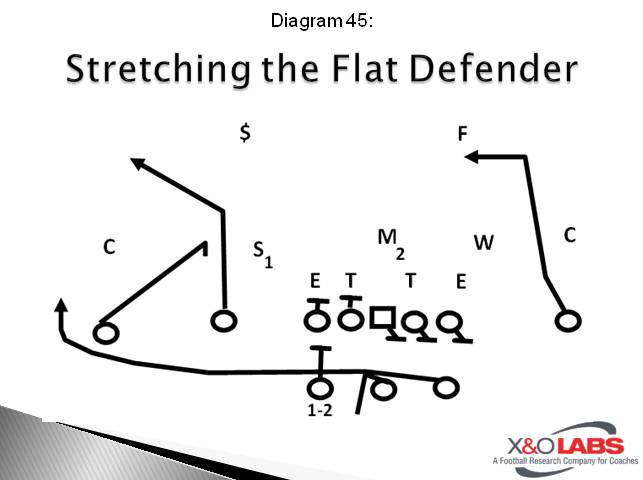
Austin Heaps, Lehi High School (UT):We utilize route concepts that the back we are faking to will hold the flat defender. In the following example, the back is our flat throw, high/lowing the corner in cover-two with the corner route over top. The snag holds the hook defender and then stretches the flat defender against cover-three or Quarters coverage, while the outside receiver sits on the outside linebacker’s outside hip. The corner route clears the deep coverage.”

Slide45

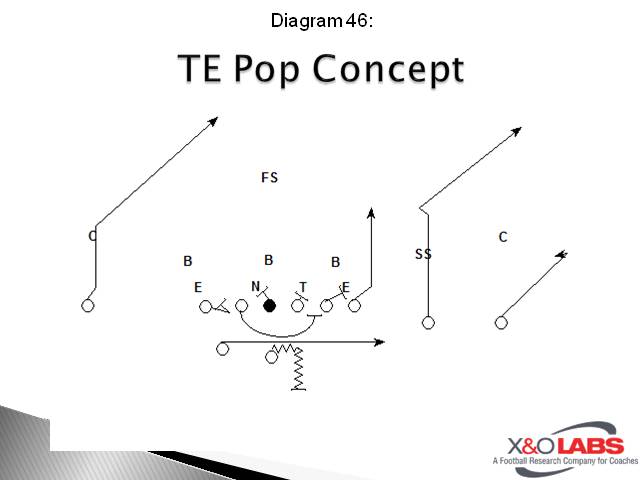
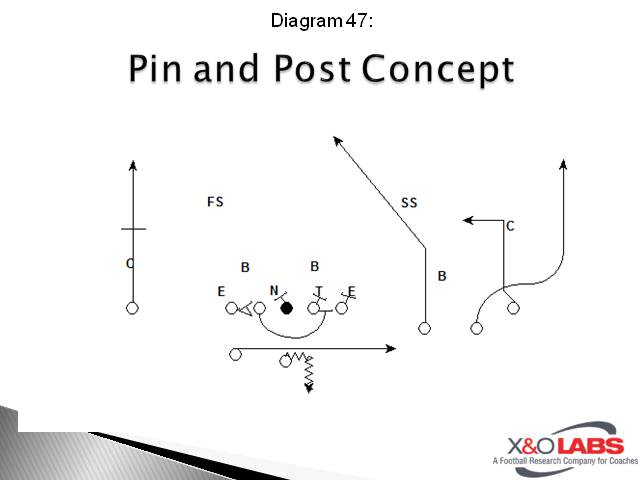
Greg Lauri, Offensive Coordinator, Nassau Community College (NY):“We have two route combinations that we utilize in this series, the first is a ‘pop’ concept with the tight end or number in conjunction with an outside smash concept. The second route combination we use is a deep pin-and-post combination with an outside choice route.”

Slide46Slide47

Question/Request: For those that use pass progressions off this concepts, explain the coaching points you use to teach your offensive linemen not to advance downfield.

Editor’s Note: At the college level, offensive linemen are allowed to advance up to three yards downfield before being called for an illegal man downfield if a forward pass is thrown.

Greg Lauri, Offensive Coordinator, Nassau Community College (NY): As in all of our play-action pass concepts, the most important thing for the offensive line to understand is that it must ‘sound’ like a run play. This means that they need to be aggressive in their initial block and drive the defensive lineman for at least their first two to three steps. We emphasize that they are not to block the linebacker they are responsible for, unless he attacks the LOS. This helps to prevent our guys from going downfield.”

Kyle McKenna, Brooklyn Tech High School (NY): “Our Power Read play-action pass is a perimeter read. If the read fast flows, we throw quick slant to the slot receiver in the vacated area. If the read stays, we run Power to the right side. Our QB takes one crows hop to read the Will, while our offensive line blocks Power with a Y kicking out.”

Read More

Wide Zone Scheme: Addressing Problem Areas

By Phil Vogt
Running Backs Coach
Palm Bay High School (FL)

Introduction:

Here at Palm Bay High School, we are a “wide zone” team that targets the edge of the defense. Unlike the outside zone, which tries to capture the edge, we try to “stretch” the edge with our wide zone scheme. If the defense lets us outside, we will take it, but the primary purpose is to stretch the edge defenders and force them into assignment conflicts. 

I will not get into basic blocking schematics, but rather will focus on the areas that will generally give you problems when running this play as well as how we adjust to defensive fronts. For those of you that want more details on the blocking on the wide zone, there is a massive amount of information right here on xandolabs.com about the blocking schemes and techniques. I also recommend researching anything you can find on Alex Gibbs when trying to introduce this as your primary running scheme. 

Why The Wide Zone

As I mentioned above, we are predominately a wide zone team. We have some other elements to our offense, but our focus is on implementing the wide zone. It is our go to play. Here is the rationale for this focus:

  1. There are more yards on the edge than inside the tackles
  2. The scheme is universal for all linemen, you are covered or uncovered
  3. We can force the defenders into assignment binds
    1. Notice is the clip below that the defender is taught not to get reached so he keeps outside leverage and we cut up behind him. On this same clip, you can see how the linebackers flow with the play and allow for the cut up lane.
    2. There is a conflict for the backside linebackers as well. They are taught to play the “cutback” but this is not a cut back play, ball is not going back there, it is a “cut up” play!

Read More