|
Scout Indy
>> X&O Labs Members: Login here to continue reading
Join X&O Labs to Continue Reading…
When you join X&O Labs, you’ll get instant access to the full-length version of this report — including access to everything in The LAB and Film Room. That’s over 4,000 reports and videos. >>BONUS: When you join today, you’ll also get instant access to X&O Labs’ exclusive A.I. Protocols — showing you step-by-step how to unlock A.I. in your program.

Read More
By Javier Cardenas
Offensive Coordinator
Eagle Pass High School (TX)
Twitter: @Coach_JCardenas
Introduction
RPOs are evolving into a staple for spread offenses for various solid reasons. They give an offense the ability to get playmakers involved in a variety of simple yet creative ways. Defenses must consider additional time to develop and prepare personnel for RPOs, particularly linebackers. Defenses, in many ways, are forced to play assignment football against RPOs, especially at the 1st and 2nd level. We saw many defensive adjustments to our RPOs this past season: Cover 2 (man under), Cover 3, moving/spot coverages to remove the stationary read, straight man coverage and 4-1 box adjustments. The advantage of our style RPO is that it had answers for these and other coverages.
Our offensive identity is simple: Physical, Fast, Execute (PFE). Rather than saturating an offensive playbook, RPO’s allow us to mix our base concepts from week-to-week through personnel groupings, formations, motions, and tempos. We do not want our kids over analyzing situations; we want them to be PFE. RPOs comprise about 40% of our offense and revolve around four base formations: 2×2, 3×1, 2X1 (20 personnel) and Empty with 3×1 being most effective. Again, we do a great job window dressing RPOs from week-to-week, but the base concept never changes.
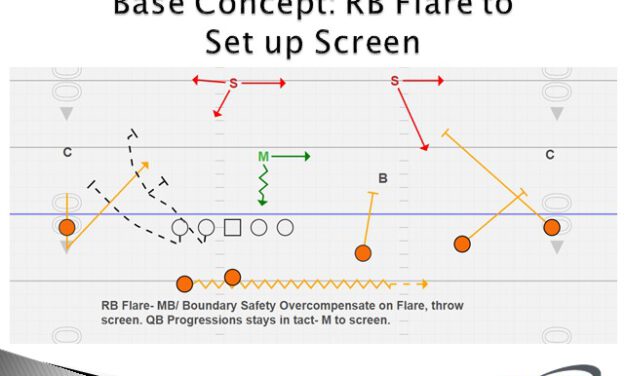
While we are not a true Screen Pass Option (SPO) unit, our screen game mimics the SPO (Screen/Pass Option) system. We embed our best menu run game into our screen game. Our screen game is a unique call based on how a defense aligns. As the defense begins to overcompensate to the run/RPO, we tag the screen. We have a variety of ways of doing this. Essentially, we take away the decision-making ability from our QB and tell him when to throw the screen. However, the run RPO element stays intact and the defense must continue to defend. This simplified our QB’s thought process while allowing our offensive line and receivers to play “PFE.” Hesitation and indecisiveness is a QB’s kryptonite! The base Menu Run/RPO discussed and demonstrated on film in this report will be the following:
- RB Flare concept
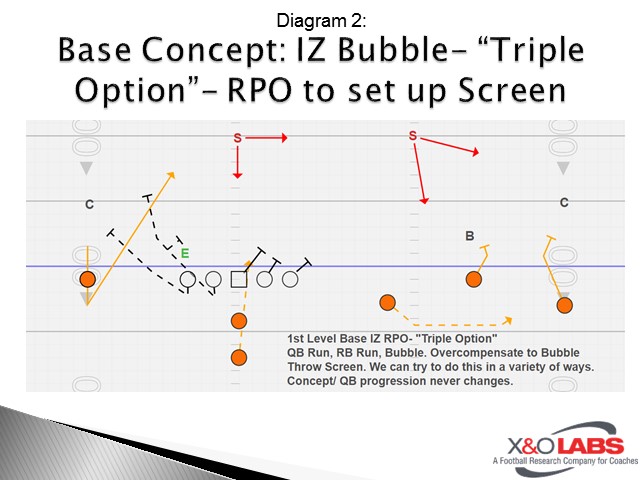
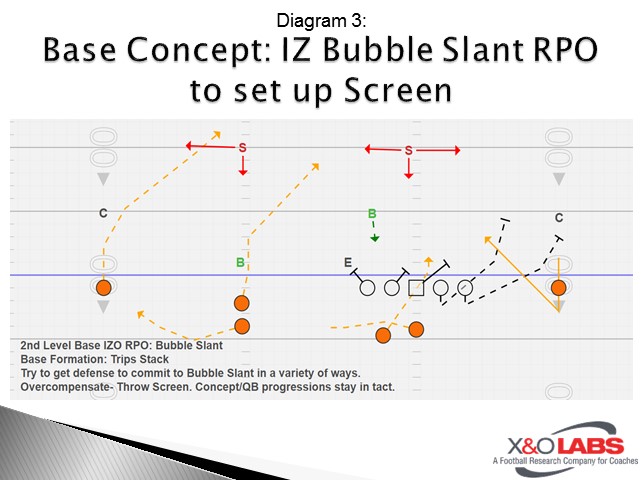
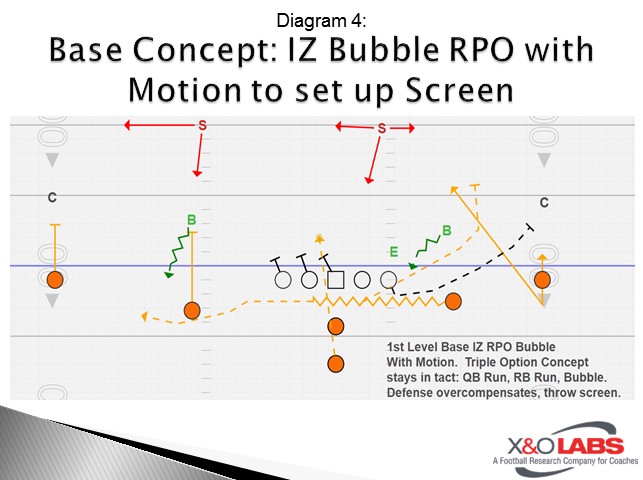
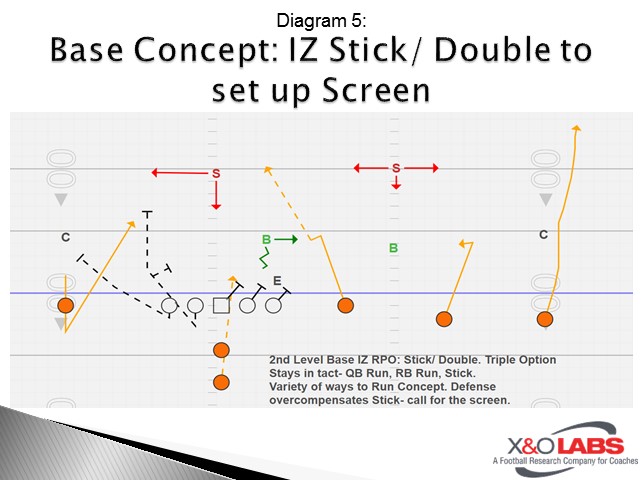
- Inside zone paired with RPO progressions from Bubble, Bubble Slant, Bubble with motion, and Stick
These base concepts then set up our screen game.
RB Flare Screen Progression- If Mike linebacker, corner and safety adjust- throw screen
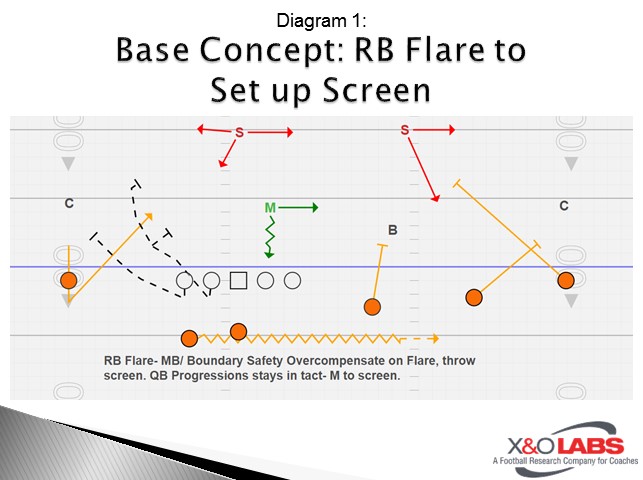
IZ Bubble/RPO Screen Progression- If the defense over adjusts/soft corner- throw screen
IZ Bubble Slant Screen Progression- Defense over adjust to bubble slant- throw screen
IZ Bubble RPO with cross motion Screen Progression- Defense over adjusts to motion- throw screen
IZ Stick RPO Screen Progression- Defense over adjusts to run/ stick- throw screen
Creating Concepts based on Functionality
>> X&O Labs Members: Login here to continue reading
Join X&O Labs to Continue Reading…
When you join X&O Labs, you’ll get instant access to the full-length version of this report — including access to everything in The LAB and Film Room. That’s over 4,000 reports and videos. >>BONUS: When you join today, you’ll also get instant access to X&O Labs’ exclusive A.I. Protocols — showing you step-by-step how to unlock A.I. in your program.
Read More
By Kelly Carrier
Linebacker Coach
Lansing Catholic High School (MI)
Introduction
Run and pass fits are essential to any defense. We feel that the best fits can be accomplished by teaching multiple concepts to our players to help them filter through post snap chaos. Although reading the offensive line is our primary key, we also rely on other concepts like pre-snap gap responsibilities to get the best fit possible.
To accomplish this, we start in the summer and work all season long teaching conceptual gap assignments based on stunt pre-snap and then progress to what happens post-snap when everything moves. When working with the linebackers, I will always include offensive line reads and clear/cloudy fits in individual, group, blitz, inside run and team.
Pre-Snap Gap Concepts
We begin teaching our gap concepts by using barrels to simulate an offensive line. To keep the players honest, we do not include a RB in our drills. Instead, we work on leveraging the ball carrier during our tackling circuit, inside run period and team period. This keeps the LBs focused on our task and does not confuse them with false steps by a back.
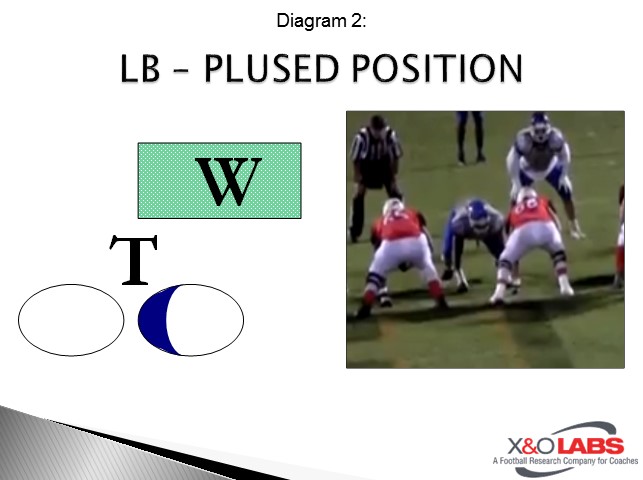
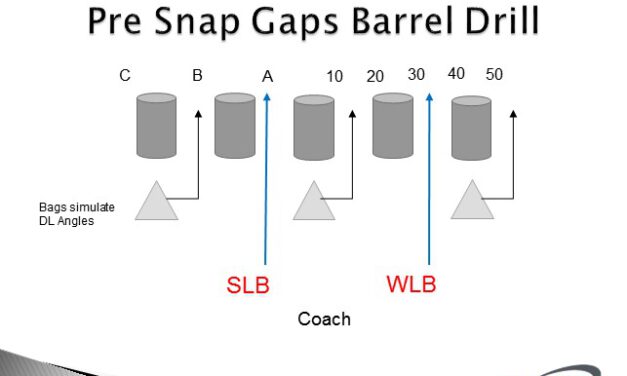
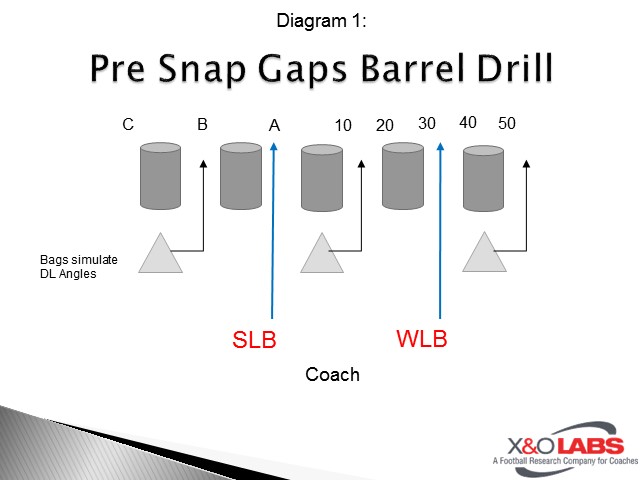
During our individual time, the first drill we introduce is based off our various alignments based on the front (20s, 30s, 40s or 50s) and we introduce alignment depth. We set our heels at 5 yards to give us time to read and react. During this time, the LBs are getting a taste for non-moving offensive parts and gap assignments. Because we angle our defensive line, the linebackers know pre-snap which gap is theirs.
Before the rep starts, linebackers give their pre-snap communication which will include our strength, stunt, and if they are a box or spill player (this is determined by the stunt that is called). I set up about one yard behind and in between the backers during this time so I can have the same view they have. On the “set, go” call, they will fire through their gaps ripping with their left or right arm. This becomes a foundation and a fail-safe as linebackers are instructed to fill their pre-snap gaps if they miss their read.
Post-Snap Gap Concepts: Part 1
After using the barrels, we begin to introduce moving parts/gaps as it is essential that they understand the difference between pre-snap gap responsibilities and filtering through post-snap chaos. The linebackers do this by using three barrels (OTs and center) and two linebackers playing the Guards. To introduce the concept of gaps moving, the linebackers are taught that their primary read as the offensive Guard. Attached to the offensive Guard is a pre-snap gap assignment (either A or B). If the Guard moves or pulls, the offensive Guard moves the gap assignment moves with him. This leads me to ask one OGs to raise his left/right arm to identify the gaps.
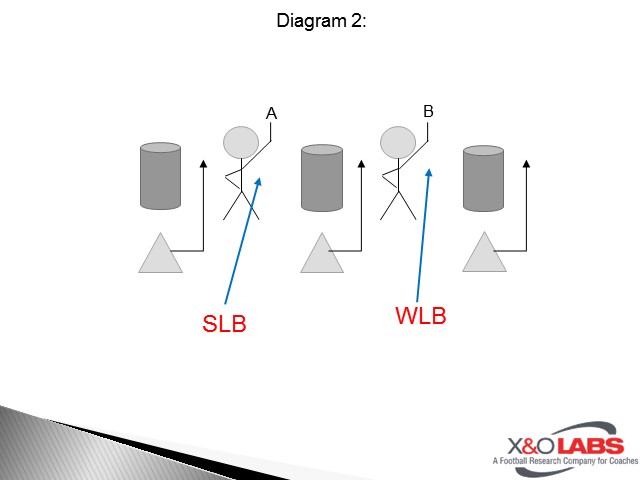
Linebackers can tell me who has the gap based on the stunt called. We go through the same drill as above, but this time we have the OG/LB firing out, pass setting or blocking down/double team. Linebackers will rotate and fill gaps based on blocking. In addition to reading the offensive Guard’s movement, I will also instruct the linebackers to read on the run and find clear and avoid cloudy gaps.
>> X&O Labs Members: Login here to continue reading
Join X&O Labs to Continue Reading…
When you join X&O Labs, you’ll get instant access to the full-length version of this report — including access to everything in The LAB and Film Room. That’s over 4,000 reports and videos. >>BONUS: When you join today, you’ll also get instant access to X&O Labs’ exclusive A.I. Protocols — showing you step-by-step how to unlock A.I. in your program.
Read More
By X&O Labs Research Team
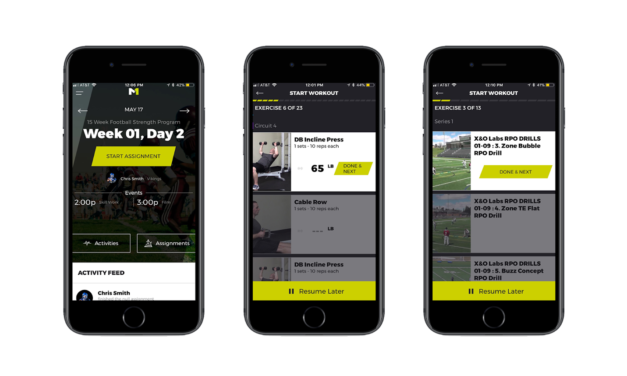
Last month, we featured a report on the growing trend of high school and small college programs “hiring” a digital director of football operations (DFO) by using the coaching tool, MaxOne. The primary duties of a DFO is to manage the logistics of a football program’s operations–things like scheduling, communication, summer-camp sign ups, texting, emailing, preparing and distributing drills and workouts, gathering materials for coaching meetings, tracking individual players’ workouts and progress, manage off-season leaderboards… and the list goes on. MaxOne is a platform that allows you to do all of these things with ONE login.
In this month’s report, we confirm the power of using digital DFOs by asking student-athletes from three different programs what they think of MaxOne. Coach McKenna of Brooklyn Tech High School, Coach Stadem of Sioux Falls Washington and Coach Swift of Gold Beach High School have made the switch to MaxOne and have been actively using the app for several months–and they are eager to share their success story.
From these conversations, our conclusion came to be:
“MaxOne turns smartphones into football coaches, with instant questions and answers right at their fingertips.”
Turning Players’ Smartphones Into Coaches
The reality of how athletes interact with one another and where they spend time taking in information is through their technology and more specifically through their smartphones. The impact technology has in everyday life, but also directly in the coaching and learning experience has seen tremendous growth. It’s time to focus on the future. There’s no better time than the present to start preparing for future success. We asked athletes how MaxOne speaks their language in terms of technology? And specifically, how does it engage them with football? The athletes believe that MaxOne translates smartphones into football coaches. One player from Sioux Falls Washington High School stated:
>> X&O Labs Members: Login here to continue reading
Join X&O Labs to Continue Reading…
When you join X&O Labs, you’ll get instant access to the full-length version of this report — including access to everything in The LAB and Film Room. That’s over 4,000 reports and videos. >>BONUS: When you join today, you’ll also get instant access to X&O Labs’ exclusive A.I. Protocols — showing you step-by-step how to unlock A.I. in your program.
Read More
By Brent Barnes
Defensive Backs
Rhodes College
Editor’s Note: Brent Barnes just completed his 2nd season at the Defensive Backs Coach at Rhodes College. His arrival in 2012 coincided with an uptick in the Lynx’ fortunes on the defensive side of the ball as the unit led the SAA in points against and finished second in total defense. His leadership resulted in first team All-SAA honors for safety Justin Toliver. Prior to his time at Rhodes, Barnes became the Wide Receivers Coach at Middlebury College. For two seasons, Barnes oversaw a passing offense that set numerous passing and receiving records and coached two different players to first team all-conference honors. Prior to his arrival at Rhodes, Coach Barnes was the Offensive Coordinator at Simon Fraser University, a Division II school in Vancouver, Canada. He led an offense transitioning from the Canadian to American game, coaching both the wide receivers and quarterbacks. His offenses finished second (2010) and first (2011) in the conference in rushing in his two seasons at the helm
Introduction
 Our starting point for coaching the secondary is the eyes. We teach eyes more than anything else with the belief that if the eyes are wrong, everything else (footwork, ball skills, etc.) is irrelevant. How many times did you see in bowl season receivers running free down the field for big gains and easy touchdowns. We call those “free yards” because you are simply giving them to the offense regardless of the talent of the players involved. Our #1 goal is to minimize free yards with proper eye technique. In this day and age, defenses are going to give up yards and points. It’s an offensive world. But we want them to make plays and not make it easy for them. Our starting point for coaching the secondary is the eyes. We teach eyes more than anything else with the belief that if the eyes are wrong, everything else (footwork, ball skills, etc.) is irrelevant. How many times did you see in bowl season receivers running free down the field for big gains and easy touchdowns. We call those “free yards” because you are simply giving them to the offense regardless of the talent of the players involved. Our #1 goal is to minimize free yards with proper eye technique. In this day and age, defenses are going to give up yards and points. It’s an offensive world. But we want them to make plays and not make it easy for them.
With that in mind, we use a rather defined teaching progression when we install this concept. We always start with diagrams and film in meetings before we ever step foot on the field, after that we take our time reviewing the routes in individual before ever moving into 7 on 7 and team time. The real key is taking the time needed in the individual time. Here are some points on how we have found that time to work most effectively.
- We use other DBs to mimick the routes at full speed. They know the offensive perspective from our meeting.
- By going full speed and not walking through (already done in the meetings) we can get a lot of reps here in a short period of time.
- We do not rep the routes in isolation. Instead, we line up two DBs as receivers as well as a safety and corner and rep different 2-man route combinations that we see. We feel this is more gamelike and forces them to play together.
- We use cards for the route combination from a student assistant or injured player and work two groups (one to my left and one to my right). The right group goes first and they get coached on their eyes as well as footwork. I move immediately to the left group while a new WR combo sets up to the right.
- We can get 6 reps a minute or 30 reps in a 5 minute span. I can also do this with our 3×1 sets.
>> X&O Labs Members: Login here to continue reading
Join X&O Labs to Continue Reading…
When you join X&O Labs, you’ll get instant access to the full-length version of this report — including access to everything in The LAB and Film Room. That’s over 4,000 reports and videos. >>BONUS: When you join today, you’ll also get instant access to X&O Labs’ exclusive A.I. Protocols — showing you step-by-step how to unlock A.I. in your program.
Read More
By Adam Hovorka
Managing Editor
X&O Labs
Introduction
There is no doubt that today’s offenses have made the jobs of defensive coaches much more difficult. We all have to find answers to combat no huddle, empty, trips, formations into the boundary and RPO’s. Defensive coordinators from all levels of football are trying to be more multiple in defending the multitude of things they will see but still maintain simple rules for their guys to follow.
At George Fox University, Defensive Coordinator John Bates is utilizing his base 3-3 personnel split field coverage defenses to run a three down, cover two robber hybrid to battle all the empty and trips spread schemes he sees in his conference.
The benefits of utilizing Robber coverage concepts against spread offenses are the following:
- In playing cloud support corners are able to have immediate run support for perimeter runs.
- Having a short hole defender eliminates the possibility of scrambles by dual-threat quarterbacks and allows him to break on intermediate routes.
- Having a high hole defender (along with two hash defenders) helps to combat the vertical game synonymous with open formation offenses.
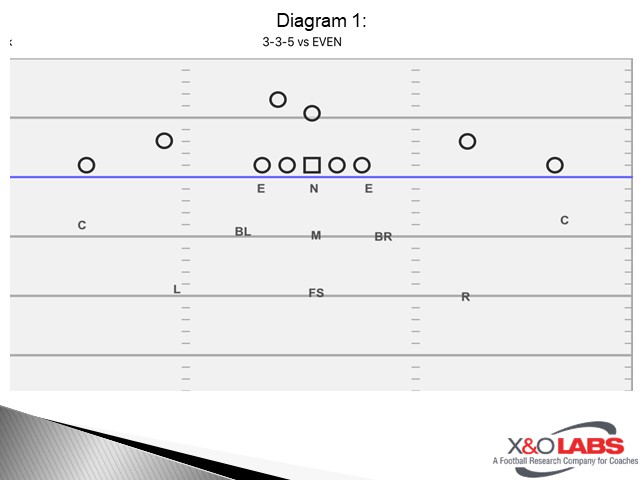
Traditional odd stack schemes consist of a 6-man box with 5 defensive back types aligning based on coverage. Typically there are two flat defenders and a one high safety along with two cornerbacks. Employing this defense as a split field outfit makes it difficult because the two flat defenders never play at depth and have limited deep coverage responsibility. George Fox University will be in a two-high shell almost all of the time. But in order to do that, Coach Bates will rotate the three types of safeties between being the flat players and the deep half, third or quarter player. The nature of his structure is a 3-3 defense, by personnel and alignments. He has taken the traditional one high base coverage that accompanies an odd stack and has found a way to utilize split field coverage defense. He does this by running a 30 front cover 2- robber hybrid, to battle all of the empty and trips formations that they see in his conference.
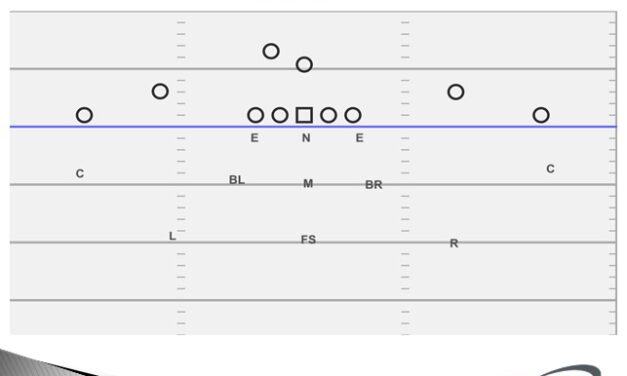
So in Coach Bates’ defensive cover two hybrid, he places those two flat defenders deeper. The diagram below is GFU’s base defense vs. 2×2 formations.
Defensive Personnel
George Fox University will be in a two-high shell almost all of the time. To do that they will rotate one of the deep three safeties between being the flat or curl player and the deep half, third or quarter player. Either the right (Ram) or left (Lion) safeties will be the down safety, responsible for the flat, depending on where they are in regards to field or boundary. If the ball is on the left hash the Ram is the down safety to the right, the free safety is the deep half to the right and the Lion is the deep half to the left (boundary). This is very similar to how 4-2-5 teams rotate their three safeties but Coach Bates chooses to play right and left as opposed to field and boundary. Coach Bates and many other coaches around the country are hesitant to run Cover 2 schemes because of the fact that the Mike backer has to play the middle of the field and match the number three receiver vertically. With so many offenses running variants of empty and trips formations, having the Mike backer on number three would cause a certain mismatch in the offense’s favor. Most high school linebackers and many college players don’t have the speed to be a middle hole player and also play run.
Adapting the “Money” Front
So Coach Bates has countered this problem of having his Mike backer be the middle hole player in Cover 2, by running their Money front. So now instead of the Mike backer being the middle hole player, it is the Free Safety. Coach Bates runs this Money front against teams that will be in 10 or empty personnel who want to throw the ball more than they run it. It’s Coach Bates philosophy is to force teams to do things that they don’t want to do, and this case it is to force teams to run the ball.
Alignment vs. 2×2 Formations
>> X&O Labs Members: Login here to continue reading
Join X&O Labs to Continue Reading…
When you join X&O Labs, you’ll get instant access to the full-length version of this report — including access to everything in The LAB and Film Room. That’s over 4,000 reports and videos. >>BONUS: When you join today, you’ll also get instant access to X&O Labs’ exclusive A.I. Protocols — showing you step-by-step how to unlock A.I. in your program.
Read More
|




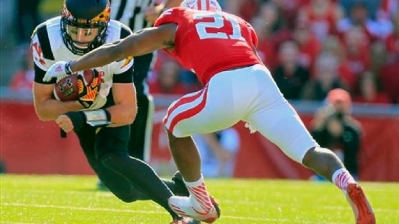
 While coaches have different perspectives on the correct techniques in open field tackling, we found one constant goal: do what you have to do to get the ball carrier on the ground. Usually, this comes in the form of closing space between the defender and the ball carrier, coming to balance before contact and understanding your leverage on the field as it pertains to other defenders and the sideline. We found the following common errors as it pertains to open field tackling: