
Pattern Read Coverage Out of the 3-4 Defense

By Mark Yates
Defensive Coordinator/Secondary
Mustang High School (OK)
Twitter: @thegoldball

Introduction:

mustangFive years ago, we transitioned from a 4-3 to a 3-4 in order to be multiple and defend the up-tempo spread offensive attacks that we’re seeing every week. For the longest time, we taught multiple coverages to our players, but increasingly we felt that calling certain coverages to formations was a guessing game and allowed offenses to somewhat “have the pen last”. As spread offenses became more prevalent, we felt the need to teach a concept coverage that would allow us to fit the pattern as opposed to having potential holes in a called coverage. That is when we moved to a pattern reading system.

When we made the transition to pattern read, our production went up and our points per game allowed went down tremendously. We now fit the route combination and make high school quarterbacks make the decision as opposed to us jumping routes and making that decision for them. So many times when we would call coverage in the past our defensive backs would play more programmed. With pattern read, our DBs learn route combinations and improve their eyes. The better our eyes have become, the more our production in the secondary has improved. This clinic report will cover how we teach our defensive backs how to pattern read at Mustang High School.

Alignment:

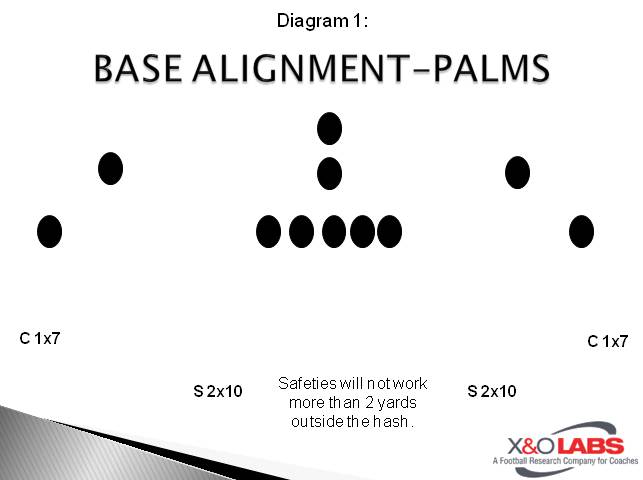
Anytime we have two detached receivers to one side of the formation, we call “palms”, which is our pattern read coverage. Our corners base alignment is 1×7 outside leverage of the #1 receiver. We turn our corners inside at a 45-degree angle. They will slow tempo out with a shuffle as they read their primary key, which is the quarterback. Our safeties alignment is 2×10 inside of the #2 receiver. Our safeties will bounce, as they read they read their primary key, which is the quarterback (Diagram #1).
Slide1

Quick Game:

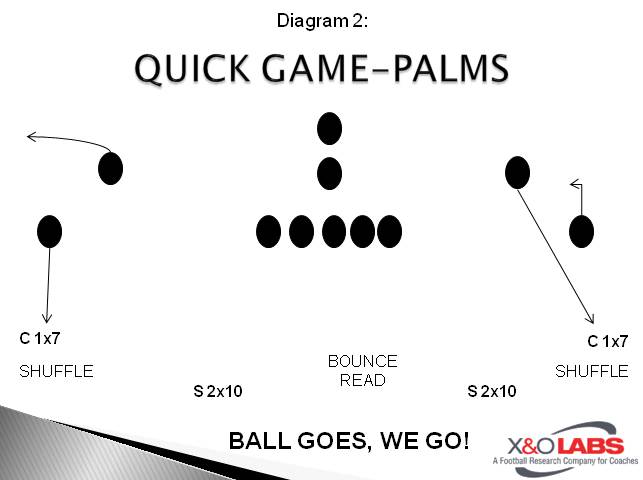
Both the safety’s and corner’s primary key is the QB. We read the QB to clear the run game and the quick game before progressing from there. When he gets a quick game read (bubble, quick throw), our defensive backs know to react and play aggressively (Diagram #2). Our coaching point on quick game is “if the ball goes we go,” meaning we will quickly attack a quick throw. Conversely, “if the ball doesn’t go, we don’t go,” meaning we will be ready for a Bubble and Go or any pump fake and throw. Once we have cleared the quick game, we get into our pattern read progression. Since switching to “Palms,” we have virtually eliminated the Bubble and Quick throws. This is something that we will teach during our individual time in practice on a daily basis so that it is second nature. It is also great training for getting the defensive backs’ eyes right as they must quickly read the QB.
Slide2

Pattern Read: #2 Inside Release

The first day we install “Palms,” we demonstrate to our defensive backs the progression of Ball-2-1. Once we clear the run game and quick throw, we start our progression reading #2-#1. Once the QB shows pass, the #2 receiver can release one of three ways.

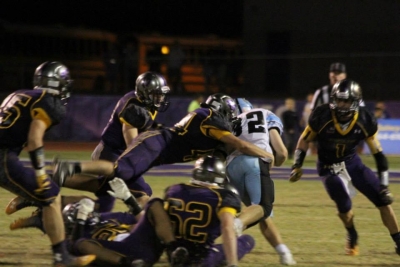
If the #2 receiver gives us an inside release, the safety now knows he is a “robber” and his eyes go from the #2 receiver to the #1 receiver. As the corner reads the #2 receiver and sees the inside release, he now knows he is man on the #1 receiver. The corner knows he will have low wall support from the safety on any inside release in the order of Post, Dig, and the Curl (Diagram #3). The safety looks to “rob” the Post, Dig, and Curl. If the stem of #1 is vertical, our safety will now check backside looking for drags/digs.

Read More

Defending the 3 Phases of RPOs from an Odd Stack

By Ryan Desrochers
Defensive Coordinator/Linebackers Coach
Sunrise Mountain High School (AZ)
Twitter: @CoachRDes

Introduction:

IMG 0037Everyone is scrambling to try and defend increasingly prevalent run pass option schemes. Some coaches feel that playing man coverage eliminates the pass option, but that leaves a good portion of your defense with their backs turned on the play. Other coaches play RPO’s as if they are a triple option play. While this approach assigns one defender to the RB, QB, and receiver, many offenses are looking to create one on one matchups with their athletes in space to exploit these exact situations. As a defense, we do not have a special scheme or call that we use to defend RPO’s, but rather choose what we want to eliminate and rally to the other options.

Overview of Defense

At Sunrise Mountain, we run a 3-3 Stack Defense. As a base, we usually will stunt the line and send one backer. However, against RPO teams, we will often stunt our line without sending a backer. This allows our linebackers to play football fast and use our speed to our advantage. We are a gap responsible defense, meaning that we let our linebackers be fast to the ball because we will have another backer or safety flowing behind them to assist on cutback. As a base rule for our defense, our A and B gap players are responsible for dive while our C gap players are responsible for QB and our dog safeties are responsible for pitchman. As we get into the season and gameplan for our opponents, we will adjust and tweak these assignments to help take away the best players on the other team.

Stopping a Dominant Running QB

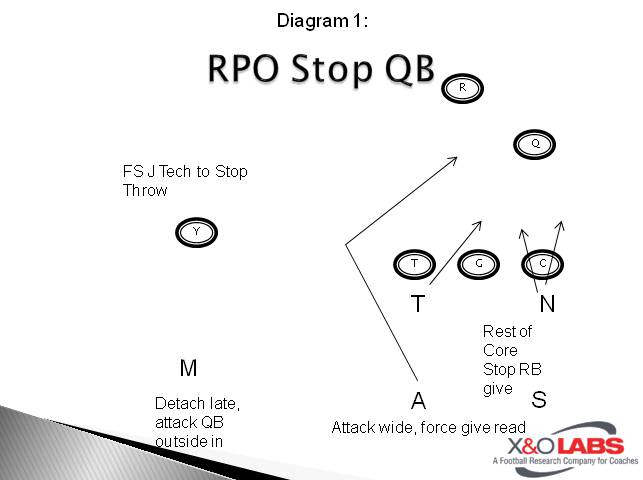
Mobile quarterbacks can be very difficult to stop regardless of the scheme and RPOs tend to give them even more space to work. As a result, we double team the QB run and trust our other 6 defenders in the box to stop the running back and snap throw. We do this by giving a give read with our C gap defender and slow play the running back at the second level. By rule our C gap defender is a QB player on any option play.

We determine the type of option and run by how the RB lines up. If he is even with the QB, the C gap player opposite the RB will play the QB expecting a power read. If the running back is behind the QB, the C gap player to the RB side plays QB on the read option. Our C gap player will not take the air of the OT and instead play the inside shoulder of the QB. Our dog safety will slide in and attack the outside shoulder of the QB when he disengages from the mesh point and attacks. Our angles on the play cause the QB to bubble back, eliminating the throw due to lineman down field. There are times when he does complete the throw on the hitch and we live with 5 yards and a tackle. By our safety running the J technique into the box.

Slide1

Coaching Points

  • C Gap player (A) inside shoulder of QB
  • B Gap Player (End) shock separate and look for RB
  • M – late outside shoulder on QB detach
  • Safety – J Technique to snap throw

When a QB is the team’s playmaker, we are going to do what we need to do to keep the ball out of his hands. Usually, they will get impatient and make a bad read and take tackles for losses.

Read More

Moving The Launch Point In The Passing Game

By Justin Iske
Offensive Line Coach
Southwest Oklahoma State University
Twitter: @justiniske

Introduction:

Capture123Keeping your quarterback upright is the most important aspect of a good passing game. The ability to pick up twists, dogs and blitzes through both protection and hot routes is vital to getting this done. Another option that can greatly enhance eliminating sacks is to move the launch point of the quarterback with sprint outs and bootlegs.
There are several reasons to get the QB out of the pocket. Here is the rationale we use here at Southwestern Oklahoma State University:

  1. OL vs. DL Match-Ups: No matter how well coached your offensive line is, there are occasionally going to be match-up issues up front. There is always that one three technique or edge rusher that your guys just can’t handle one-on-one. While chipping with the back, keeping backs and/or tight ends in the protection, or sliding towards an elite d-lineman are options to help your guys out, making the quarterback a moving target is a great option as well.
  2. Take Advantage of A/B Gap Pressure: If your quarterback is always directly behind the center it makes it easy for a defensive coordinator to bring heat up the middle consistently. This is especially true if you are a team that likes to release your running back and/or run Empty to get five receivers into the route a majority of the time.
  3. Roll Away from Edge Pressure: This is particularly true if you run Empty formations. Simple math tells us that if you are running five-man protections and the defense brings six, your QB must throw Hot off the sixth rusher. The obvious solution is to get rid of the ball quickly. This often looks great on the white board, but defensive coordinators watch film, too. Using film study to teach your QB or offensive line to recognize secondary alignment and rotation pre-snap, you can get your QB to the edge opposite of edge pressure and make him a threat to run or throw with a clear passing lane.
  4. Push the Ball Downfield instead of Hot Routes: As mentioned earlier, hot routes are a common answer to being outnumbered in protection. But if the defense knows they are forcing you to throw the ball quickly, they can break aggressively on three-step routes. Even worse, they can bait you into what you think are open throws by zone blitzing and dropping defensive linemen or sugared up linebackers. Getting your quarterback out of the pocket allows time for routes to develop downfield.
  5. Force the Defense to Defend the Quarterback: If you are blessed with a quarterback that is a threat with his legs, you must take advantage of it. If a defense plays a lot of man zero or man free coverage, defenders often have their back to the football or are focused on their man responsibility. This gives your QB a chance to get easy yardage with his legs. Further, just the threat of a running QB will force defenses to use a defender to spy the QB or stay in more zone concepts to let their defenders face the football.
  6. Give a Short QB throwing Lanes: If your quarterback can’t see downfield well inside the pocket, it is pretty difficult to ask him to read coverages and find open receivers. Batted balls can also be an issue with a vertically challenged QB. Sprint outs and bootlegs get the ball to the edge so that the QB has clear vision and throwing lanes.
  7. Running Plays and Screens to Compliment Sprint Out Action. Sprint draws and counters can open up explosive plays versus teams that over-compensate to sprint action. These are simple concepts with limited added teaching for the offensive line. Throwback screens to a back side tight end (and even tackle) can create big plays also. These are especially effective in the red zone and/or goal line area.

There are also some disadvantages to moving the pocket that you should keep in mind. If your quarterback has trouble throwing on the move it can take a lot of practice time to get this corrected. A right handed QB rolling to his left and vice versa can be an issue as well. If you become predictable in terms of which way you are going to sprint/boot, it defeats the purpose of moving the launch point. The other obvious disadvantage to moving the pocket is it cuts the field in half in terms of threatening the defense.

Read More

7 Versions of Four Verts From the Pistol

By Mike Kuchar
Senior Research Manager
X&O Labs
Twitter: @MikekKuchar

Editor’s Note: The following research was conducted as part of XandOLabs.com special report on “The Pistol Offense,” which can be accessed in full by clicking here. 

Perhaps we found the most success in play-action man protection concepts off the Veer and Midline option run-action. James Vint at Cornado High School (TX) wrote an entire piece below about his play-action pass concept off his Midline scheme from the Pistol formation.

“Our play action game is designed to attack areas the defense is vacating to play the run. With all of our play action concepts, we want the pass to look like the run. On midline, our offensive line will use an aggressive gap set protection. They will attack the near jersey number of the down defender. If you are covered, you will block the defender covering you. If you are uncovered, you will work inside to outside. We keep our protection very, very simple.

Our tackles will typically be blocking the 5 techniques. Versus an odd front, our guards will be uncovered, and they will work inside to out. We always want to block the most dangerous man first, and the inside linebacker is a more dangerous player than the outside linebacker. Versus an even front, our guard to the side of the 3 technique will have him man. Our guard to the shade will work be our dual read or inside to outside player. The center is going to base block the nose. If there is no nose, the center will work inside to outside.

I call it a gap-punch protection because we are going to step and protect our inside gap first.  It’s based on B.O.B. concepts.  The only difference between our gap protection and our Big on Big protection is the first step.  In our gap protection, our first step is to protect inside because we’re not worried about and edge guy- our back and QB handle that.  In B.O.B. our footwork is going to be predicated on the alignment of the defender.  If the defender is head up to outside shoulder, we will power step inside and kick.  If the defender is on our tip, now we are kicking. If the defender is a man removed, we are kick, kick and we read from there.   This protection is a gap-punch, Big on Big combination.  

The backfield action must look exactly like midline to the defense. Our pistol back will run down the brown spot on the center’s backside and sell the dive fake. He is responsible for “swallowing” the mesh point. He then is responsible for any A gap run through. We would essentially like for him to get tackled. The quarterback will push off the midpoint and flash the football. We teach the quarterback to bend his knees on the fake, and shuffle one step. As the back gets to the mesh point, the QB will pull the ball back in and bend his knees as he shuffles one step. The ball is not ever going to be in the belly of the dive back. We put a premium on ball security. We let the action sell the fake. After his shuffle step, the quarterback will then take a 3-step drop. He should end up at 6.5 to 7 yards on his drop.

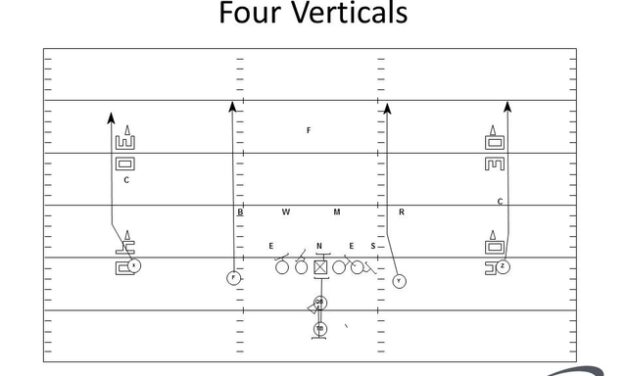
Our play action off the midline is built off our four verticals concept. Because the four vertical concept is versatile, it gives us the opportunity to be versatile with our play action game. Any of our 4 vertical tags can be run off our midline play action.

Read More

Training the Offensive Line in the RPO Game

By Drew Owens
Offensive Coordinator / Offensive Line Coach
Western Connecticut State University
Twitter: @ballcoachDRO

Introduction:

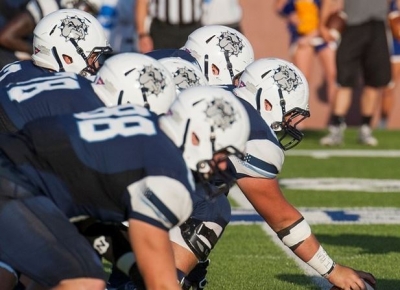
As you can tell from the vast number of reports that X&O Labs has released this winter, RPOs are the hot topic in offensive football. These Run/Pass Option plays are designed to read a certain defender on the field and either run or pass based upon the reaction of that defender.  When reading RPO reports, I have noticed that much of the focus has been concentrated on the QB read process or the contours (WR routes / Screens) attached to the play call. While all of these things are important, I think that it is easy to overlook what I consider to be the most important part of an effective RPO; the offensive line.

RPO Philosophy

Here at Western Connecticut, we have a firm RPO philosophy. We will not attach a run to a RPO unless the timing of the RB’s steps, the OL double teams and the QB mesh can allow the QB to make a true option decision to either throw or hand off based upon the read key. With our RB steps and tempo, we are able to attached IZ, OZ, Power, Counter and Dart to any RPO. Conversely, we do not attach RPOs to any inside quick trap or downhill veer runs because of the quick tempo and faster RB steps. We believe that the reads are too fast or the RB’s steps are too fast, therefore not allowing our QB to make a decision based on the read defender. The additional benefits of our RB base zone and gap steps force a read defender to make a decision during the mesh decision window. Through study, we have found that if our runs are too quick, the read player can flat foot and play both the run and the throw. 

We also have a firm philosophy that our offensive linemen will never know when we are executing a “read” option play or a “run/pass” option play. I never want my OL to come off the ball slower or hesitant for worry that they will be downfield. To make this work and “slow down” our linemen, we stress first level authority. All of our double teams are graded holistically but the prime stress is on the movement of the first level defender. Our uncovered lineman should always have a body presence on the backside defender when they are doubling. We also stress a “duck demeanor” to all of our offensive linemen. This demeanor naturally slows down our uncovered lineman when “duck walking” to the second level.

Run Game Rules

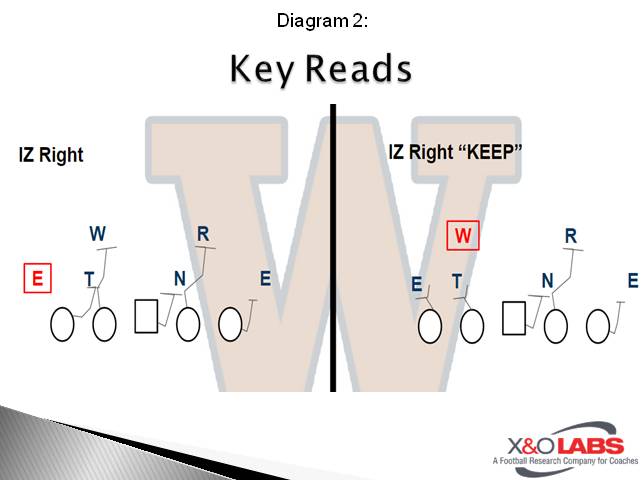
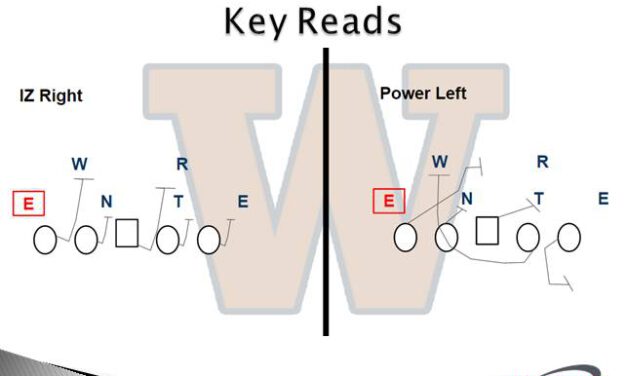
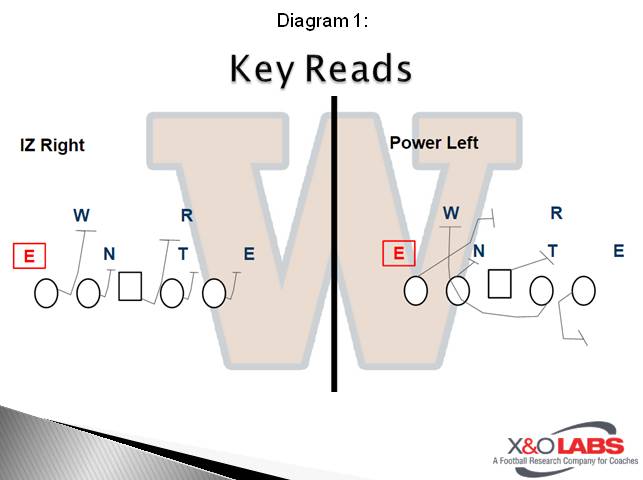
To be successful in the run game, our linemen must be able to play fast and not think. This is another reason that we don’t want the line to know that the play is an RPO. It is just one more thing for them to think about. It is important to note that we still identify who the “read key” is our offensive linemen. While we might not actually be reading that defender, the linemen know to never block or touch the read key. We teach this defender to be invisible to our linemen and to our count system. For example, the backside defensive end is the read key in inside zone and the front side defensive end is the read key in power. Our offensive line also understands if we block all first level defenders then the read must be at the second or third level.  Our running back also understands who these read keys are.

Slide1Slide2

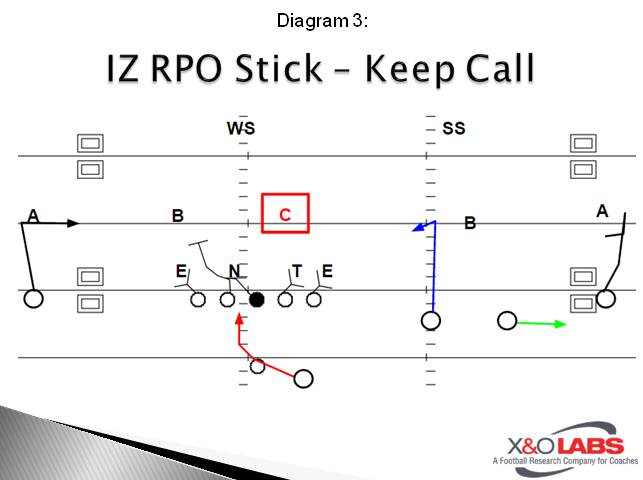
There is a delicate balance with our linemen run game count system and RPO read system. It is critical for these two systems to be in sync. To make sure our QB and linemen are reading the same defender, we will tag our called run play. For instance, the base variation when we call inside zone, the read is automatically by default the backside end. If we want to change the read to a second level defender, we will tag our zone play with a word to tell the linemen to block all 1st level defenders. If we tag our zone play with the word “keep”, our back side tackle and guard understand we must account for all back side defenders on the line of scrimmage (Diagram 3). When our linemen “keep” block, this is always an inside number drive and they are never allowed to have a defender cross their face. We also treat this “keep” side the same as we do for our man side of pass pro. We drill daily on the tagged side to work out twists and reductions.

Slide3

The next way we can account for all first level defenders and read second or third level defenders is by adding a FB or TE into the blocking. When the FB or TE handle the back side end or back side LB, we can now read defenders inside or outside of the box at the second/third levels (Diagram 4). Gap runs do not change anything in the system for the offensive line either (Diagram 5). Our gap runs will never change to account for a new “read” defender. By stressing first level authority, our front side linemen never climb too fast in gap schemes (Power, Counter & Dart).

Slide4Slide5

To study game film on these RPO concepts, click on the link below:

Read More

How 15 RPO Coaches Address Man Coverage

By Mike Kuchar
Senior Research Manager
X&O Labs
Twitter: @MikekKuchar

Introduction

The following is an excerpt from X&O Labs’ bestselling special report, The RPO Study. Continue reading for details on the #1 resource for run/pass option.

Answers to Man Coverage:

In the subsequent cases we devote a great of time on several run/pass option concept that can be integrated into your program immediately. We explain the concept, detail the route progressions, describe the quarterback post-snap read methodology and explain how formations can manipulate the reads. But before we do that, we wanted to address what can be the kryptonite of RPOs, man free coverage. Because chances are, if you are going to implement these RPO concepts in your offense, you will see some form of man coverage for two simple reasons:

  1. There are no apexed (run/pass) defenders; instead there are cover down defenders. There are players who are playing the perimeter and players who are box defenders. No in-betweens that can be influenced by a post-snap read.
  2. There are no eyes on the quarterback, for him to manipulate. Responsibilities are already pre-determined pre-snap. 

 So, what answers do RPO coaches have when seeing some form of man-free coverage? We went right to the source and asked them the question.

Question: What is your answer to man free coverage and cover down alignments?  Will you still use all phases of the Dual Read or will you most likely have a built-in answer?

Reader Responses:

Lee Sadler, Marshall High School (AR): “If we are seeing man free or any type of man coverage (which is usually the first answer teams will try to use to combat our RPO), we will start to use motion and shifts to try and move the eyes of the defender. In the past, we have also had success with switching our pop receiver. For example, out of a 3×1 set, using the #2 receiver as the pop runner instead of the #3 receiver. Small changes like that, or using motion and shifts, causes issues with the defense.”

Read More

Chris Ash Brings Meyer’s “On Edge” Teaching Methodology to Rutgers

By Mike Kuchar
Senior Research Manager
X&O Labs
Twitter: @MikekKuchar

Introduction

ashrutgersAs Rutgers football begins spring practice this week, new head football coach Chris Ash inherits a program that has finished in fourth place or lower in the East division of the Big Ten conference- including one bowl win in the last four seasons- all amidst numerous off the field issues. So in his effort to change the culture at Rutgers, Ash-who has spent the last two seasons as Urban Meyer’s defensive coordinator at Ohio State-has already implemented some of the on the “on edge” coaching methodology that Meyer has used with his programs since his days at the University of Florida. Mike Kuchar, the co-founder of XandOLabs.com, spent time with Coach Ash this winter talking about his plan to change the culture in Piscataway.
On Edge Teaching is a philosophy that forces players to respond in uncomfortable situations (both on the field and off). It teaches them how to handle adversity in extreme circumstances.

MK: What have you done so for this off-season to change the culture of the program?

CA: “The first thing I want to do is develop the culture that I want in this program. A lot of it is modeled after what we did at Ohio State, but there are things that I’d like to do differently that I’ve been exposed to at other places also. I first define to my players what culture means. Many coaches throw that term around a lot including me. But you have to step back and think about what the definition is of culture in that program. To us, culture is ‘the only acceptable way to behave and to perform.’ We talk about the three components of that culture as being the following:

  1. Relentless strain- everything you do in academics or athletics you must strain to be the best that you can be.
  2. Competitive excellence- putting yourself in position that when your number is called to make a play that you’re ready to make that play. To get to competitive excellence, you must have competitive spirit that means you want to compete in everything you do, from the weight room, the meeting room, the classroom, the off-season drills and in the practice field. If you don’t compete in those areas, you will not compete on a Saturday.
  3. Brotherhood of trust- this is where team chemistry is developed. Doing it at the unit (position) level. Our ultimate goal here is to have ten units strong and we want each unit on our team to have a tight chemistry and the relationships must be completely strong.

Players need to be continually communicated, educated and motivated to make it happen. That is the process we are in right now.”

MK: In what ways are these three components of culture continually reinforced during the offseason?

CA: “In the off-season, you want to accomplish some specific things. You want to get them bigger and stronger, you want to build their athletic ability, you want to build their toughness, you want to build leadership, you want to build their football skills and lastly you want to build their football IQ.  You have to do that in 8 hours a week during the off-season. You can’t slack off on any of those things because rest equals rust. You can’t afford to let any of them be underdeveloped. We build toughness at Ohio State through the artificial adversity we created in our off-season workout. You don’t rise to the level of the occasion; you rise to the level of our training. We use the phrase E+R = O which means events plus response equals outcome. We are an event-based program- we train our players to handle adversity. If you don’t train the players to deal with adversity, they will not be ready for it. We will create a special workout to push them to the limit mentally or physically or change a routine where we ask them to be here at 5 am to see how they respond. We are creating that for good events and bad events so they are ready to respond the right way. “

Read More

4-2-5 Study: Case 1 – The Front Six Defenders


The 4-2-5 Study: Case 1

The Front Six Defenders – Keeping the Core

By Mike Kuchar

Senior Research Manager,

X&O Labs

Researchers’ Note: Once you finish reading Case 1 of this study, we would like for you to answer 5 survey questions.  The link to the survey questions are below.  The feedback you provide will go a long way to helping us provide you better research.  Thank you.

In this case study of our 4-2-5 special report, X&O Labs will present the various ways that the coaches that we spoke with utilize the front four in the 4-2-5 defense.  It’s important to note this is NOT a technique oriented report – you can find all you need on this topic by reading X&O Labs defensive line researcher Mickey Mays report on defensive line play (located in our Special Reports section).  Instead, this report is a synopsis of various pre-snap and post-snap movements by defensive lineman in the 4-2-5 scheme.

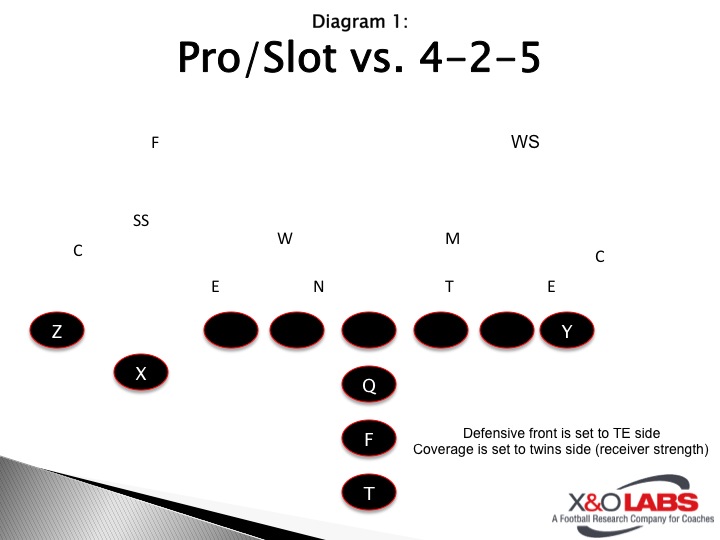
It’s a fact that 68.5 percent of coaches that run the 4-2-5 scheme call their front separate from their coverage.  This means that while the strength call for the front four may be in one direction, the coverage strength (which is usually predicated on the passing strength) could be called opposite.   An example could be a pro/slot set (Diagram 1).  While the strength of the front may be called to the tight end, the coverage strength would be set to the twin receiver side, it is the side with the most eligible receivers.

We’ll start our research with two ways to make a formation call and two ways to make a field and boundary call.


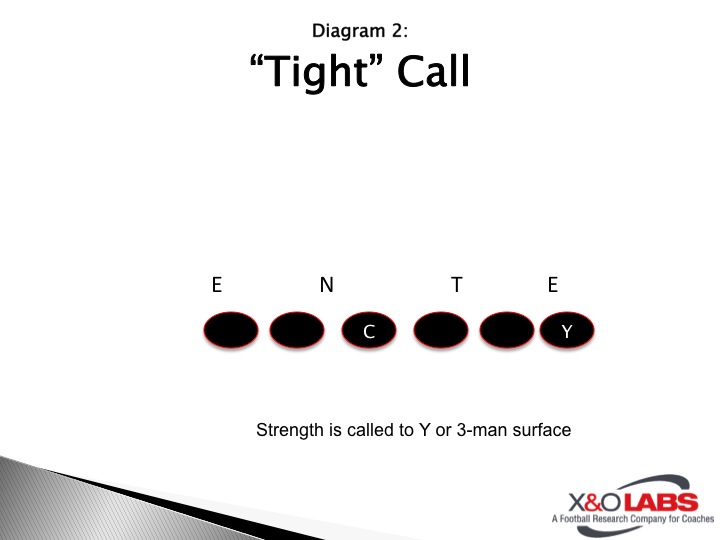
Tight Call: 3-technique aligns to the side of the tight end (Diagram 2).  Our research found 81.9 percent of coaches prefer to set their front this way.

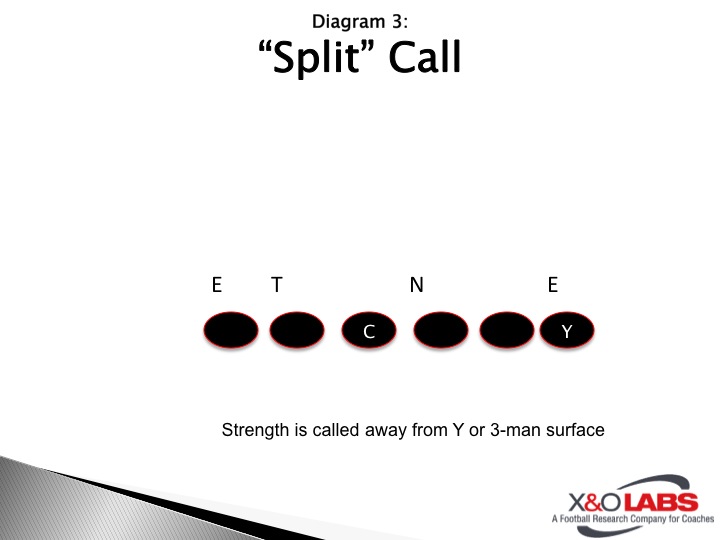
Split Call: 3-technique aligns away from the side of the tight end (Diagram 3).

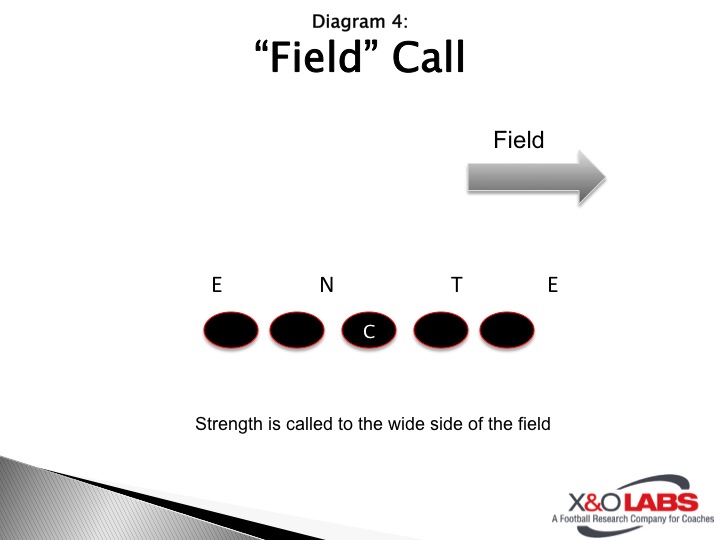
Field Call: 3- technique aligns to the wide side of the field (Diagram 4).  Our research found that 18 percent of coaches prefer to set their front this way.

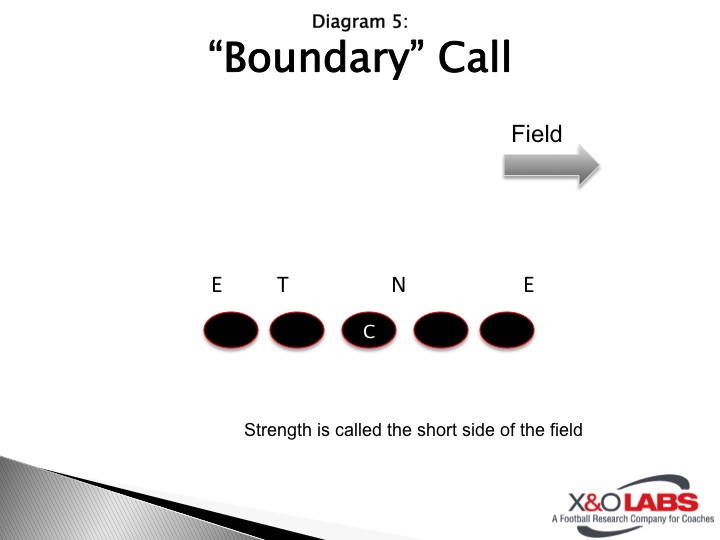
Boundary Call: 3-technique aligns to the boundary side of the field (Diagram 5).

Note:  Any “G” call would tell the Nose Guard will line up on the inside shade of the Guard.


2i Technique vs. a Shade Nose

Using the “G” front is synonymous with 4-2-5 defenses.  Perhaps Bud Foster, the defensive coordinator at Virginia Tech, put the “G” technique on the map with some of the studs he had playing that position in Blacksburg.  While the Hokies made a living by using the 2i technique, not all 4-2-5 coaches use it.  When X&O Labs inquired about how and when to use the 2i technique instead of a shade on the Center, our research found that 67.8 percent play with a 2i technique while 37 percent will use a 2i technique with a strong weak side run tendency.

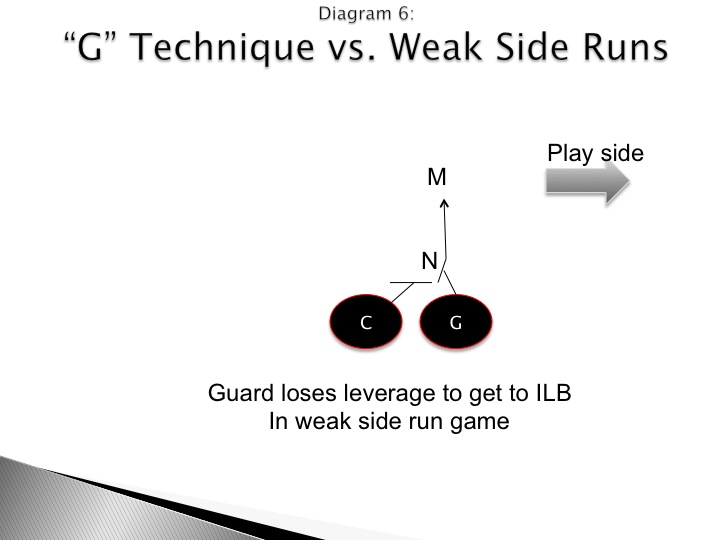
For Chuck Clemens, the defensive line coach at the University of Central Missouri, the use of the 2i technique proved advantageous in a number of ways.  “It gave the nose guard a much better leveraged position vs. the chip block with the center and guard on weak side run plays (Diagram 6),” said Clemens.   “In a shade technique, he could be fighting the Center, while the Guard is able to knock him on the angle and still get to the second level linebacker.

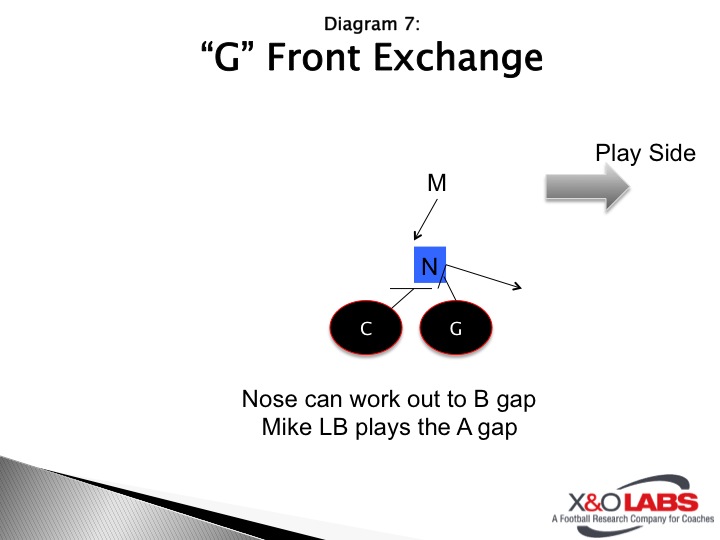
“The Center is always going to spend time on him, so now we can play aggressive on the inside shoulder of the guard in any zone schemes and if the Guard climbs we should be able to take the B gap and have the backer exchange gaps with us by playing the A gap (Diagram 7).”

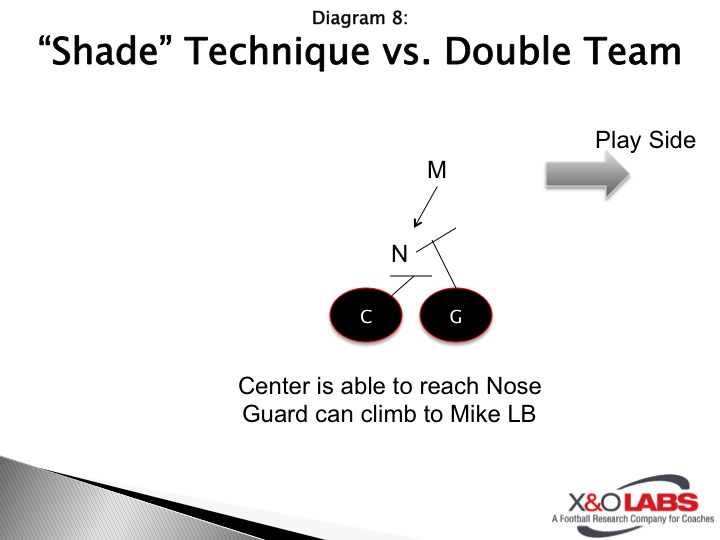
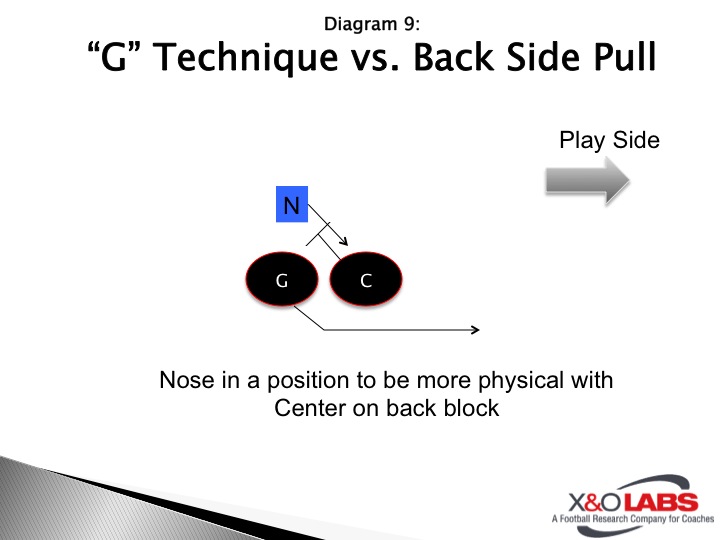
When we played with the shade technique, we’d get the true double team and the linebacker would stick his head in the B gap and get blocked.  “The Center would wind up overtaking our shade technique because he didn’t have a good leveraged position on him (Diagram 8). That 2i technique also gives the Nose a cleaner shot on the back block and pull by the guard on power (Diagram 9).  It gives him leverage to slam that Center on the back block rather than getting pushed up field.   The hardest thing we do as coaches is tell that Nose to switch from a 2i to a shade technique.  He should have to learn one spot so that the Guard only has one choice on combination double teams or gap double teams.


7-Technique vs. a 6-Technique Strong Side Defensive End

We all know the importance of a strong side defensive end in any four-down defensive front, but where that end aligns can differ based on the coach.   Based on our research, 45.2 percent of coaches play their weak side defensive end in a 7-tech on the tight end, including Virginia Tech.  For clarification purposes, a 7-technique defensive end aligns on the inside shade of the tight end (Diagram 10).  Dan Redding, the defensive line coach for perennial NCAA Division II powerhouse Carson-Newman College, strongly believes in the importance of changing up the alignment of his 7-technique in his four down front.  “We will play him heavy on the tight end, then have him move to inside number and even put him on the inside edge,” says Redding.  “We want to make the tight end think, keep him guessing.  It can depend on offensive scheme or game situation.”

Read More

4-2-5 Study: Case 2 – Q&A With Bud Foster, Mickey Matthews, Chris Brown


The 4-2-5 Study: Case 2 

Question and Answer Session 


By Mike Kuchar

Senior Research Manager

X&O Labs


When we first compiled our research on the 4-2-5 defense, you (our readers) had specific questions. So we provided specific answers by going right to the source, selecting three of the more prominent coaches that run the scheme (all of whom you asked us to contact).  Mike Kuchar, X&O Labs’ Senior Research Manager, spoke exclusively with each of these coaches, asking them YOUR questions – their responses are below.  Our goal was to get a FBS coach, an FCS coach and a D-II coach.


Meet the Coaches Interviewed:

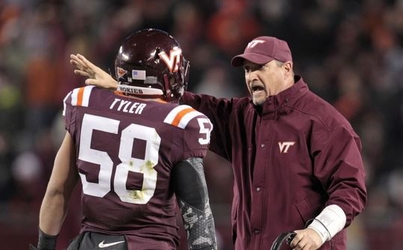
Bud Foster (BF): Regarded as one of the top defensive minds in the game, Bud Foster enters his 26th season at Virginia Tech. The 2006 Broyles Award winner has helped mold nationally ranked defenses on a yearly basis during his 17 years as a coordinator.  Foster, who was a finalist three previous times (1999, 2001, 2005) for the award given to the nation’s top assistant football coach, has gained a well-deserved reputation as one of the nation’s most respected defensive coaches.


Mickey Matthews (MM):During his 13 seasons, Mickey Matthews has firmly established James Madison University football among the nation’s leading Football Championship Subdivision programs. While becoming the winningest coach in JMU football history, he has led the Dukes to an NCAA championship (2004) and to five other playoff appearances (1999, 2006, 2007, 2008, 2011).  Matthews three times has been National Coach of the Year (1999 Eddie Robinson Award by The Sports Network; American Football Coaches’ 2004 award; 2008 Robinson Award and an award by Liberty Mutual) and was Atlantic 10 Coach of the Year in 1999 and CAA Coach of the Year in 2008.

Chris Brown (CB):  Chris Brown enters his second season as head coach of Fort Hays State in 2012. Brown came to Fort Hays State from Washburn University, where he served as the defensive coordinator and defensive secondary coach from 2002-2010 and assistant head coach in 2010.  Before coming to Hays, Brown helped Washburn compile a 62-41 record in his nine-year span with the program, which included two NCAA playoff appearances and two bowl wins. In his time at Washburn, Brown coached the 2009 and 2006 MIAA Most Valuable Defensive Players and guided two players selected in the NFL Draft (defensive tackle Trey Lewis – 6th round 2007, and cornerback Cary Williams – 7th round 2008). Brown also coached six All-Americans, 20 all-region and 41 All-MIAA selections at Washburn. His defense led the MIAA in turnovers gained in three of his final four seasons there, including a school record-tying 23 interceptions in 2007.Brown learned the scheme from sitting down with Jerry Kill, now the head coach at the University of Minnesota and with studying what Bud Foster was doing at Virginia Tech University.  And to take it a step further, Brown is a three-time All-American at Free Safety in the 4-2-5 defense as a collegian at Pittsburg State University.

Questions & Answers: 

Mike Kuchar (MK):  What has changed most in the 4-2-5 defense today from when it was a 4-4 defense?  How has it progressed?


Bud Foster, Defensive Coordinator, Virginia Tech.
Bud Foster (BF):  We’ve gone around and around with this.  The Whip position (Field Safety) has become more of a hybrid for us.  The Rover (Boundary Safety) and Free Safety haven’t changed a lot for us.  We’re playing more with a true safety type guy. We’d like him to be physical enough to force the end run, but with the way offenses are designed now, you can play some man coverage with him and not put up a “red flag” by changing personnel and brining it a Nickel package.  This way, you’re always playing with a Nickel package.  Offenses now just spread you around and match up.  Those outside backer/safety players are most important. 

Mickey Matthews (MM):  We went from a 4-3 to a 4-2-5 because of all the one-back sets we’re encountering now.  It’s easier to adjust with a 4-2-5 than a 4-3.  If you’re in a 4-3, one of your outside backers must become an adjuster, so it ends up being a 4-2-5 anyway against spread sets. 

Chris Brown (CB):  The game on offense has changed; it went from a ‘ground and pound’ philosophy to more of a pass happy game.  Now we have smaller, outside linebackers/safety types that play that position.  Years ago, those players were true rush linebackers with hardly no coverage responsibility.  Now these guys are safeties that can still play man-to-man coverage, play half field coverage and set the edge in the run game. 


MK:  Describe the personnel types of your three safeties.

BF:  When we recruit our Whip’s (Field Safety) those are a variety of skill sets.  We look for guys that can run and have some toughness because you want them to be able to blitz and force the run.  You’re looking for a big safety or a running back in high school because those are your better athletes.   We’d even look for QB’s because those are some of your smarter players and better athletes.  We’ve even had receivers in the past play that position for us.  We spill everything to them, so they need to be open-field players and have the ability to cover people in space.  Our Free Safety is a flat foot reader and alley player.  He must carry number two in the seam as well as play the Drag and Dig routes.  He needs to also be a factor in the run game.  We try to have one more defender than they have a blocker.  Our free hitter must be the Rover, Whip or Free Safety.

Mickey Matthews, Head Coach, James Madison University

Read More

4-2-5 Study: Case 3 – Formation Adjustments and Split Field Coverages

The 4-2-5 Study: Case 3

Formation Adjustments and Split Field Coverages

By Mike Kuchar

Senior Research Manager

X&O Labs

Researchers’ Note:  Before reading any further a simple clarification must be made.  When referring to the 4-2-5 defense, we are referring to the PERSONNEL on the field, NOT the structure.  The 4-2-5 defense consists of four defensive lineman, two linebackers, two cornerbacks and three safeties.  Below you will see some examples of two-safety defenses, one-safety defenses and no-safety defenses, which we’ve found could be employed by using 4-2-5 personnel. 

Like most defensive structures, there are a myriad amount of coverage’s that a coordinator can play behind it, but we’ve found that to be successful coaches must subscribe to the “less in more” theory – get good at a doing a few things right (or playing only a few coverage’s).   Typically speaking, those that consistently use the 4-2-5 structure implement the following coverage’s on a weekly basis.  Because these coverage’s independently can be the subject of its own special report, we’ve decided just to give a brief overview and description of each before going into more depth later in the report.


Robber Coverage

Description:


Split safety coverage where both sides of the coverage relies on a “cheat half” principle by the corner, who will play a half-field principle.  The strong safety plays number two to the flat while the free safety handles number two vertical and “robs” the threat of number one on a curl route.   This is known as Cover 2 in Virginia Tech’s system.

Strengths:

  • With the addition of the Free Safety, the ability to place up to nine defenders in the box against the run game.
  • Direct support to the strong side flat with the presence of the strong safety.
  • Good against short passing game such as the strong side hook to curl area because of the presence of the free safety.
  • Excellent adjustment vs. Trey (Pro Trips) or Trio (Trips Open)

Weaknesses:

  • Cornerbacks can be left one-on-one on an island with wide receivers.
  • Weak side of coverage is vulnerable to flat area because strong safety is opposite.
  • Vulnerable against double width (two wide sets) because of strong safety is opposite, weak side inside linebacker will need to have coverage responsibilities (which we detail later).

Base Rules:

  • CBs: Play a “cheat halves” technique to your side. Our research found that 79 percent of coaches play their corners 1×7 (one yard inside, seven yards off) of the number one receiver.   They will be responsible for any deep post or vertical route of number one.  On the snap, flip hips to middle of the field and get on hash.  In in some systems we found, this player will play more of read principle and will handle the out route of any number two receiver, this includes the “wheel route” which 45.1 percent of the coaches we surveyed agreed that it was the best way to play it.  This will be detailed later in the report.
  • Strong Safety: This player will play the flat responsibility or “swing deep of number three” meaning the out route of the number three receiver.  Our studies have shown that the majority of coaches (42.4 percent) align this player 4×4 (four yards outside and four yards deep) off the tight end.  Although some coaches train this player to handle ALL flat routes, in some coverages we found, he has his corner handle any flat breaking routes of number two with his strong safety playing all flat breaking routes of three.
  • Weak Safety: This player will be responsible for the flat area if there are two backs in the backfield and no number two to his side.  If there is a number two to his side, most coaches will lock this safety man-to-man on number two, which can be a glaring weakness in this coverage.
  • Free Safety: In “Robber Coverage” this player will handle the threat of number two vertical.  If he doesn’t have number two vertical, he helps the corner “rob” number one.  We’ve found that the majority of coaches choose to have him line up “inside the frame” of the number two receiver and play 10 yards deep.
  • Strong side LB: This inside backer is the linebacker to the Robber side or the “read side” of coverage.  His job primarily is to match the vertical threat of number three and becomes the middle dropper.
  • Weak Side LB: This insider backer is the linebacker to the weak side or the “away side” of coverage.  His job primarily is to match the vertical threat of number two, which can be an instant problem area in coverage, particularly in the play-action game.

To see the actual teach tape that Virginia Tech uses to install Robber coverages against various formations, click on the link below.


Video 1:

Read More

4-2-5 Study: Case 4 – Pressure Packages

The 4-2-5 Study: Case 4

4-2-5 Pressure Packages

By Mike Kuchar

Senior Research Manager

X&O Labs

Now, we’ll start to explore perhaps the most intriguing aspect of the 4-2-5 defense (or any defense for that matter) the pressure package.  We’ve found that many 4-2-5 coaches will devise their blitz scheme around both offensive personnel and formation.  Some of these coaches check blitzes based on formation (such as the Tiger Cat package below) where some used “run as called” pressures, meaning the blitz does get run regardless of what the offense comes out in.

When we conducted our research on the 4-2-5 blitz package we found some interesting data on what formations coaches like to pressure and which players they like to pressure with.  The concluding data shows that (these are all majority numbers).

  • 38.6 percent of coaches use five man pressures in their blitz package – playing a three deep, three under coverage principle behind it.
  • 36.7 percent of coaches will blitz the weak side inside LB more than anyone else in the defense.
  • 34 percent will pressure two man surfaces (just a guard and tackle) more than any other offensive formation or place on the field (this includes field side blitzes and strong side blitzes)

We will present all of the variations of these blitzes in this report.


Three Under/Three Deep Pressures


Since this is the most popular blitz package of the coaches we surveyed, we’ll start here.  What better way to start than to analyze the Virginia Tech Hokies blitz package?  The way the Hokies classify their three deep/three under blitz packages are by field and boundary pressures.  But, before we get into who is blitzing, we should give a brief explanation of three-deep, three-under coverage before detailing the blitz.

We know as coaches that you must teach the coverage first, before dialing up the blitz.  This can be a common mistake in installation, particularly if coaches get trigger-happy (and this can happen) by dialing up all the variants of a zone pressure package.  

It is important to note below that these coverage players could be anyone, which is why it’s essential to teach the coverage behind the blitz first so that players understand the “concept” behind their coverage.  Of course, different coaches have different terminology behind their coverages, so our intent here is to provide you with a general rule for each of these coverage players.


Zone Pressure Coverage Responsibilities:

Deep Thirds Player: These two players, usually the corners, are responsible for (not surprisingly) the deep third of the field.  They can start from a press alignment and “bail out” pre-snap or can start in a regular off alignment (1×7 yards) off number one receiver.   This player can also be a safety on a corner blitz (which is shown below).  This player must handle and out-breaking routes, which can be an effective throw against zone pressures, as well as any sail routes down the hash.  They would not be responsible for post routes.


Middle Thirds Player: This player is responsible for the post-area of the defense.  He must be the “center fielder” of the defense and be able to leverage any seam routes down the middle of the field.  He has to make sure to stay deeper than the deepest of any vertical routes.  He can start in a two-deep rotation, but must end up as the middle thirds player once the ball is snapped.

Hot to 2 Players: These two players, most commonly referred to as “SCIFF” players, are responsible for Collisioning the Seam routes, Getting under the Curl routes, and Driving through the Flat routes.  Realistically, they are responsible for handling the number two receiver post-snap and must wall off any crossers.

Hot to 3 Player: This player is responsible for the number three receiver post-snap.  He will open up to the three-receiver side post snap, but end up matching the final number three which will usually be the running back in spread formations.


Zone Blitz Techniques

Before we detail the blitz, there are several specific techniques that must be explained, particularly used by the first level defenders or the defensive line.  Of course, it’s easy to draw up any blitz on paper, but it’s imperative that coaches explain the technique their players need to use to execute the blitz successfully.


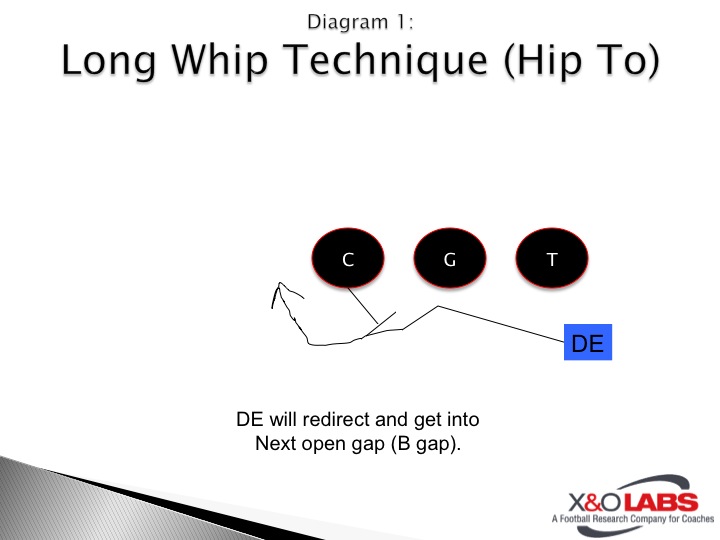
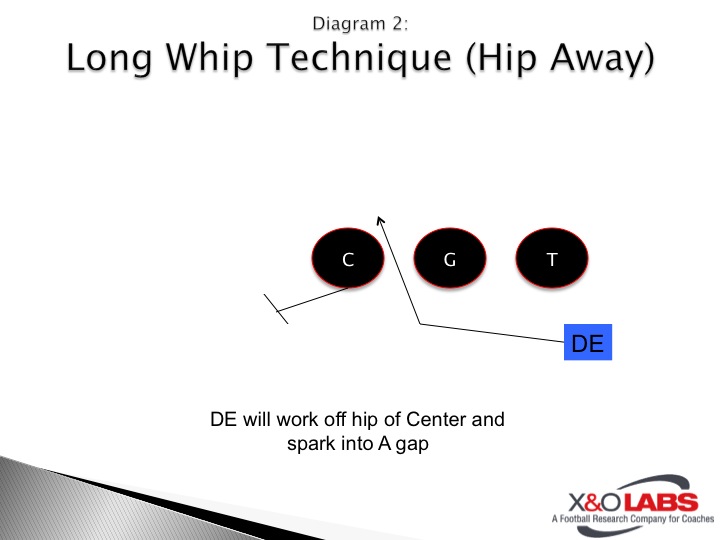
Long Whip: This is used by a defensive lineman to the side of the blitz where he needs to get two gaps inside on the snap of the ball.  Usually, he’ll read the adjacent hip of the defensive lineman in the gap he’s aiming for.  If that hip comes at him, which means the gap is closed, he’ll redirect into the next open gap (Diagram 1).  If that adjacent lineman’s hip goes away, he continues to penetrate the intended gap (Diagram 2).  

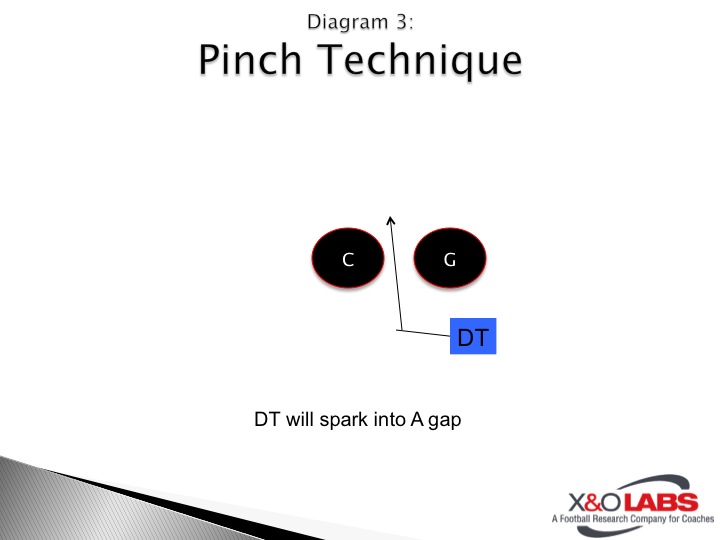
  • Pinch: This is simply a one-gap stunt to the side of the blitz.  Coaches will differ on whether they want a lateral or flat step used by the defensive lineman on the stunt.  Either way, it’s his job to get into the next adjacent gap (Diagram 3). 
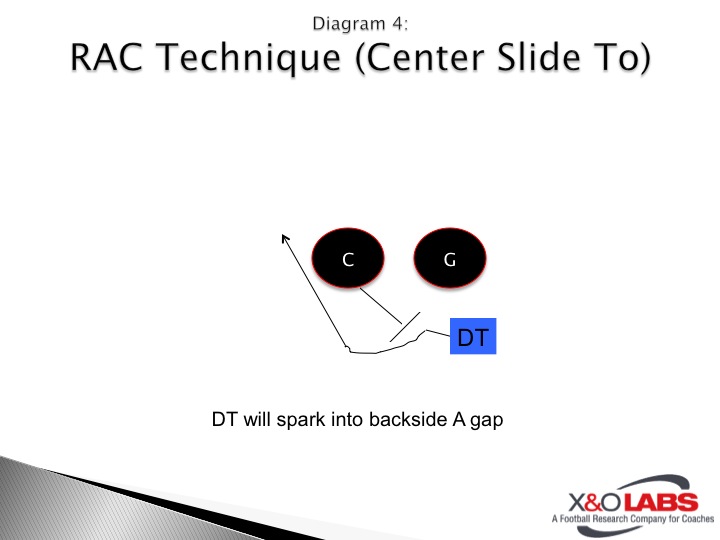
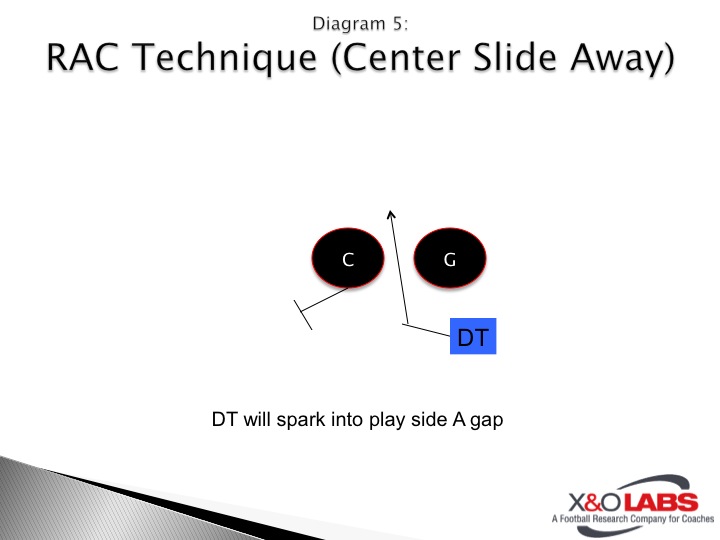
  • RAC (Rip across Center): This is mainly used by a defender to the side of the blitz whose job it is to get across the Center’s face to the opposite side of the blitz.  Sometimes it’s necessary to take a more lateral step as to not get knocked off course.  We’ve spoken to coaches who will monitor which way the Center sets because he is often the key in the slide protection scheme.  If the Center turns toward him, he will cross his face (Diagram 4) with usually a rip move.  If the Center steps away, the defender may stay on track in his gap (Diagram 5).  
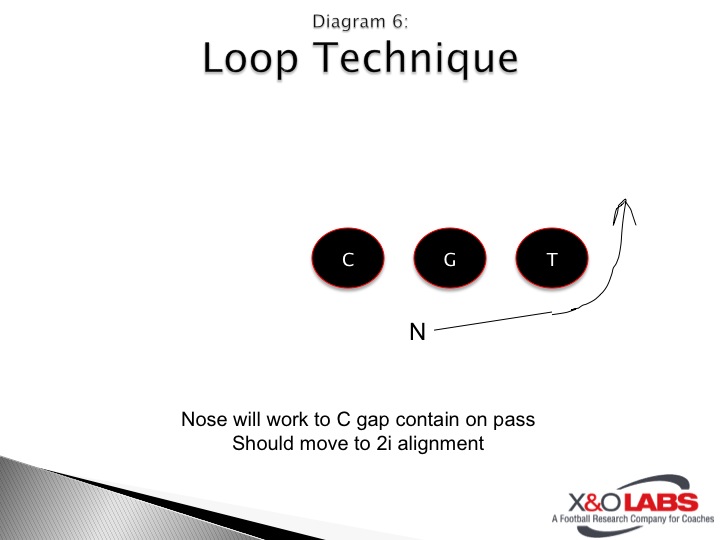
  • Loop: This technique is used by a defensive lineman to the side away from the blitz who is responsible for contain if pass develops.  This player must work to get depth post-snap to ensure the proper angle on contain.  If this is a Nose Guard, he will usually cheat to a 2i technique or a 3-technique can commonly get there from his original alignment (Diagram 6).  
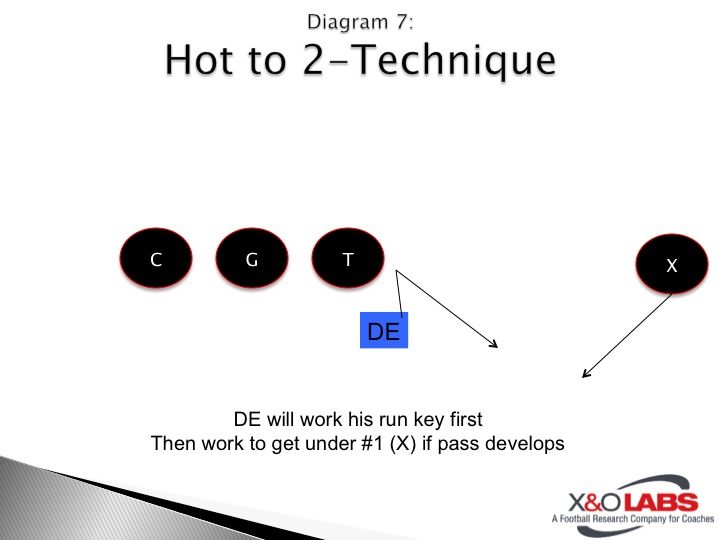
  • DL on Hot to 2 Player: This may be self-explanatory, but any first level defender that is responsible for coverage in zone pressure schemes MUST play run first by getting his run read first off the key he is on, which is the offensive lineman he is aligned on.  If that defender gives a run read, there is no reason for the DL to execute his pass responsibility, instead he should continue on his run technique (Diagram 7)

Field Pressures

Whip Dog (Diagram 8)  

Read More

Turning “Double Screens” into Explosive Plays

By Doug Socha
Head Football Coach
Oxbridge Academy (FL)
Twitter: @coachsocha


Introduction:

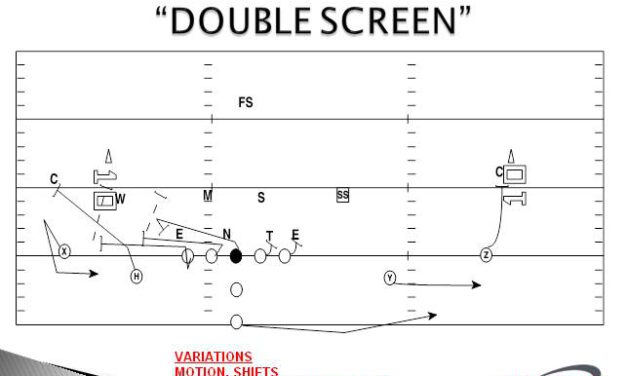
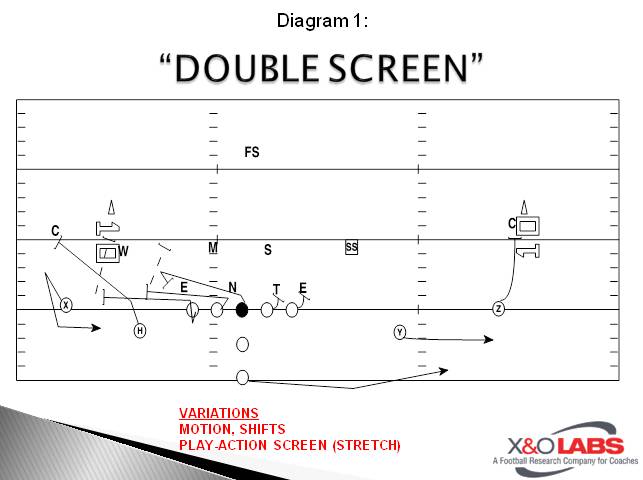
Our screen package became a big part of our offense and we mostly utilized double screens with a fast side (bubble) and slow side (sidewalk). Our most productive screens have been to our receivers. The blocking assignments up front have stayed consistent while we utilized motions, multiple formations, and used different backfield actions to simulate a “play-action screen”. Using motion and different backfield actions gave our linemen an advantage with better blocking angles and leverage.

We have dedicated a “Screen Teach” period to our offensive practice twice a week for continuous teaching/reps and also scripted our screens into other team periods. This period is a half line drill focusing on the “Slow Side” element.

Additional reasons to use screens:

1. Gives a non-running QB options
2. Looks multiple by formations, shifts, and motions
3. Easy blocking assignments for Offensive Line
4. High % Passing Game, No Sacks
5. Explosive play potential (Give your best players ball in space)
6. Slow down pass rush

Screen Elements

The “Double Screen” has two elements. The QB can take the FAST SIDE if the bubble is uncovered or we have leverage. If covered, the QB will retreat and get ball to SLOW SIDE screen runner. Using motions, shifts, and play-action can also help these screens.
Slide1

Quarterback

Pre-Snap – Determine #’s to bubble. Read the “fast side” apex defender to determine if he is taking the bubble.

Post-Snap – Throw bubble to “Fast Side” or pump bubble and retreat 3 steps and attack the slow side. Once QB determines he is taking “Slow Side”, he must quickly get ball to the receiver. He must find the passing lane. If it is not open, we expect him to throw the ball into the defensive linemen’s feet.

Read More

3 Pre-Snap Options for the Gun Double Wing

By Michael Harrison
Head Coach
Wilde Lake High School (MD)

Introduction

At Wilde Lake our offense has made a transition into the gun double wing for approximately 90% of our snaps this past season. We had experimented with the inside zone read from spread sets, but the spread offense did not fit the well with our athletes abilities and skill sets. The decision was made to return to the double wing that we had run in the past, while retaining elements from the spread that were effective for us including the run pass options that place defenders in great reaction conflict. We wanted our quarterback to remain a running threat to the opposing defenses and not just be employed as a lead blocker as we had done in the past with the traditional double wing. The result was the transition to the gun double wing including the ability to run pre snap option plays as part of our concepts.

Blast, Blast Keep, Blast Follow and Blast Pass

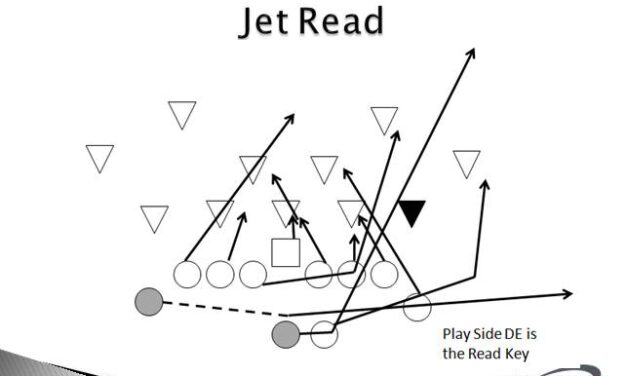
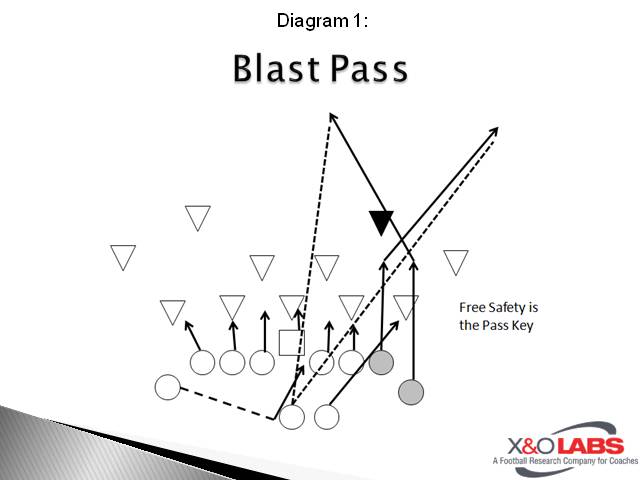
The first pre snap option concept can be run from either the power or blast run plays. When the quarterback was moved into the gun we lost the ability to use the quarterback as a lead blocker on the power or blast. With one less blocker at the point of attack we made the decision to give the quarterback the ability to read the back side edge defender and assigned the backside tight end to reach up to the second level and block the alley defender.

The pass phase of the play occurs before the start of the play with a pre-snap read. If the pre snap read favors the pass then an audible is used to call the play action pass route paired with the blast play. The play action pass will involve the play side wing and tight end running a combination or crossing route with a play fake from the motion wing.
Slide1

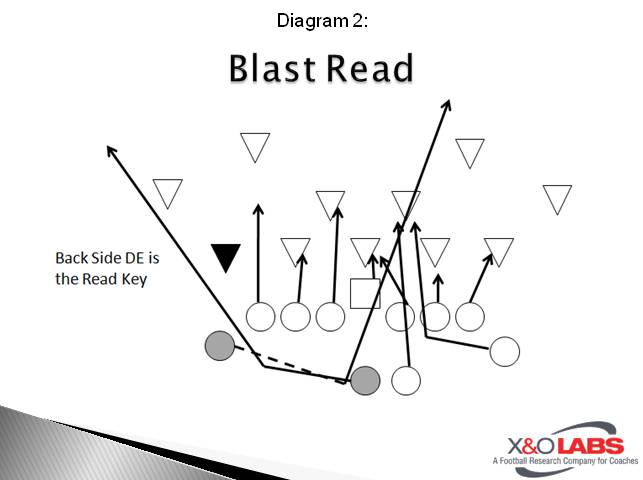
At the snap of the ball, the quarterback’s eyes the back side edge defender usually a defensive end. If that defender is taking an angle of pursuit to catch our wing from behind, then the quarterback pulls the ball out of the mesh and runs off tackle back side. If the edge defender stays home the quarterback simply gives the ball to the motion wing on the blast. The block of the back side tight end becomes important as it is the block on the last defender able to prevent the ball carrier from scoring.
Slide2

Another wrinkle that we add to the blast or power read is the follow play. This is a very simple install with the quarterback faking the blast or power and following the wing through the same point of attack. This change gives the quarterback three lead blockers in the hole and often leads to a big play as we have more blockers at the point of attack than the defense has defenders.

Blast Blocking Rules:

QB: Pre-snap read to determine if the pass option is available. Mesh the ball with the motion wing. Eye the back side DE and pull the ball only if he is chasing the motion wing.
FB: Lead the wing through the hole and block the most dangerous 2nd level defender.
PSW: Step behind the blocks of the play side tackle and tight end. Lead the wing through the hole and block the most dangerous 2nd level defender.
PSTE: Block out on the widest man on the line of scrimmage.
PST: Block out on the first defender head up or outside.
PSG: Block down on the first defender on the line of scrimmage head up or inside.
C: Block any man on you or backside from the point of attack.
BSG: Block out on the first defender head up or outside
BST: Block out on the first defender head up or outside
BSTE: Attack the back side alley defender. Stay on the block.
BSW: Deep motion to the mesh point with the quarterback. Follow the FB and Wing blocks.

To study game cutups of the Blast RPO concept, click on the video below:

Read More

Defending the Pin and Pop/Stick Draw RPO

By Mike Kuchar
Senior Research Manager
X&O Labs
Twitter: @MikekKuchar


Introduction

The following research was conducted as part of XandOLabs.com special report on “Defending RPO and Triple Option.” Continue reading for more details on this brand-new special report.

Coverage: Robber

Constraints Defended: 3×1 Stick Draw, 3×1 backside X routes

Defending 3×1 Sets:
Coach Didier teaches his secondary defenders to use a walkout square, shoulder technique, rather than a foot fire. “This helps to keep inside alignment,” said Coach Didier. “It’s always three walkout steps and than a transition into either a pedal, a man turn or into a zone turn or driving it down into a hitch stick or bubble. It’s based upon that demeanor. We do get a lot of gives to the back (in RPO’s) because of how that safety uses the three walkout steps back. He isn’t tied into support. The walkout steps are used because we use split coverage. It also activates their feet. I’m not a fan of firing feet. I want them moving one direction or the other because I want them being able to run with anything vertical.”

Read More

Quarters Coverage: Case 1 – Concepts and Technique

By Mike Kuchar

Senior Research Manager

X&O Labs 


Shap Boyd, the defensive coordinator at Muskingum College, calls it “the best coverage in football.”  “It’s the mother of all coverages,” says Pat Narduzzi, the defensive coordinator at Michigan State University.  At first we were taken back by these bold assertions – considering they were coming from two of the premier defensive minds in the country. But, after conducting all of the research that you will find in the following pages, you may in fact come to the same conclusion.  We’ve sifted through our surveys, compiled our research and concluded our data and the truth is we’ve found some of the same sentiments echoed by many other coaches we spoke with.

The truth is, Quarters coverage, or Cover Four, is a scheme that, even though its roots date back to the early 1980’s, is just as much en vogue now as it was when former Dallas Cowboys coach Jimmy Johnson was using the scheme over 20 years ago.  But like many coverages, Quarters has its strengths and weaknesses.  Before we go any further with our research, we would be remiss not to at least inform you of both the positives and negatives of using this coverage.  We’ll start with the good.

Benefits of Quarters Coverage:

  1. Strong safety run support to both sides of formations, allows a possibility of nine defenders in the box.
  2. Strong vs. QB run game – particularly those that use option.
  3. Matches up against the four vertical passing game.
  4. Because of safety support, it allows linebackers to run and make plays.
  5. Takes away underneath throws.
  6. Makes releases and routes predictable.

Weaknesses of Quarters Coverage:

  1. Quick passing game is vulnerable against an off-technique Corner.
  2. Play action passes could be an issue.
  3. Typically no deep defending to handle post-breaking routes.
  4. Isolates Corners to play man-to-man coverage.

Before we delve into the specifics on technique, some interesting numbers we’ve found from our surveys:

  • 45.4% of coaches will use Quarters coverage in any down.
  • 67.4% of coaches will use Quarters coverage in first and ten (a traditional run down), regardless of down and distance.

Training the Safeties

Philosophy

“You better have two safeties that can tackle,” is an often-quoted axiom when implementing Quarters coverage.  The reason is simple; Quarters coverage allows the entrance of nine defenders into the box on any given down (Diagram 1).  So, it’s only assumed that you’ll need to have two consummate tacklers on the back-end to make plays.  We asked that specific questions to all of the coaches that participated in our Quarters coverage survey and their responses might surprise you.  Of all that responded, 69.5 percent of coaches said that they don’t have to be the best tacklers on the field, and they have to cover just as well as they tackle.  Only 17 percent of coaches felt they have to be the best tacklers on the field.   What we’ve found is that most programs have one sure tackler at the Safety position – particularly the Strong Safety- and 69.4 percent of coaches will play with a strong and weak safety in Quarters looks. 

Nick Rapone, the secondary coach with the Arizona Cardinals, is one of those coaches that believe his safeties must be better athletes than tacklers.  For many of the open style offenses he used to see weekly while he was a defensive coordinator in the Colonial Athletic Conference, Old Dominion who won the conference used three formations exclusively, 2×2, 3×1 and 3×2 sets, it’s important that those safeties are cover players first and tacklers second.  “The way we do it, those safeties need to play man to man coverage,” said Rapone.  “Our safeties are not eight man front safeties, because once number two splits out they are in a man-to-man coverage philosophy.  We look for them to play man because we don’t play a lot of two-deep coverage.”

Rapone spends five minutes of working one-on-ones during the season every day because that’s what his kids do every day.

Shap Boyd is another believer in not having aggressive, run fitters to play this coverage.  “I’ll find guys and coach my guys to play it effectively enough,” says Boyd.  “They have to be tacklers, but I can teach them to be effective.”  In Boyd’s system at Muskingum, his Safeties fits are going to be off-bounces to the perimeter.   “I’ll never ask my Safeties to fit in the A or B gap,” he says.  “The ball gets spilled outside to them.  You ask them to make plays in space in the open field.  It’s not an ass-kicking thing in the box.”

Getting Nine in the Box

Safety Pre-Snap Reads

It’s important to note that the alignments of Safeties in Quarters Coverage will depend on how many receivers are to their side of the formation.   Remember that Quarters coverage is a “mirrored” coverage, where one side of the secondary is working independently of the other side.  Because the offense can present various looks to each side of the formation, we will detail the changes in alignment in Case 2 and Case 3 of our report.  Here, we’ll start with fundamentals and techniques of those Safeties and how you can get them more involved in the run game.

When we conducted our surveys, we found that 63.4 percent of coaches teach their Safeties to read the EMLOS (End Man on the Line of Scrimmage) for a pre-snap read, regardless of the formation.  According to these coaches, the EMLOS will dictate whether is a run or pass concept by using firing off the ball with a low hat (run) or extending off the ball with a high hat (pass).  Adam Waugh, the secondary coach at the University of Louisiana-Monroe, gives his Safeties the allusion of “a pane of glass” that will indicate whether it’s a run or pass scheme.   “He looks through the “imaginary” pane of glass that rests along the offensive line,” says Waugh.  “If that offensive tackle breaks the pane of glass, the safety plays run.  If that offensive tackle only “bumps” the plane of grass, then he plays pass.  The ‘don’t go if you don’t know’ philosophy tells the player to play pass if there is any indecision.”  Waugh did mention that he would change the reads with his Safeties sometimes on a weekly basis depending on whom they were playing.  “When I was at Army and we used to play some monstrous offensive linemen at Boston College, we would pick the 6’7″ tackle who can’t bend and say that he was our read,” said Waugh.  “But with these quicker, more athletic spread teams it became difficult to decipher.”

Read More