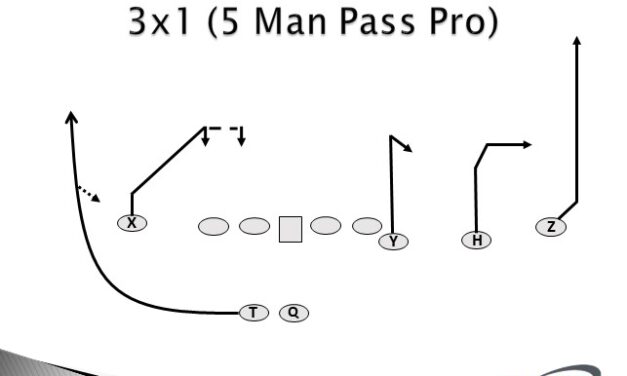
Training the QB in PSOs (Pass/Screen Option) Concepts

By Mike Kuchar 
Senior Research Manager 
X&O Labs 
Twitter: @MikekKuchar 


Editor’s Note: The information presented in this report is from our latest special report, 2018 RPO Evolution. The 3 new trends revealed in this report will bring a new wave of RPO production next fall. Continue reading this special report for more information.

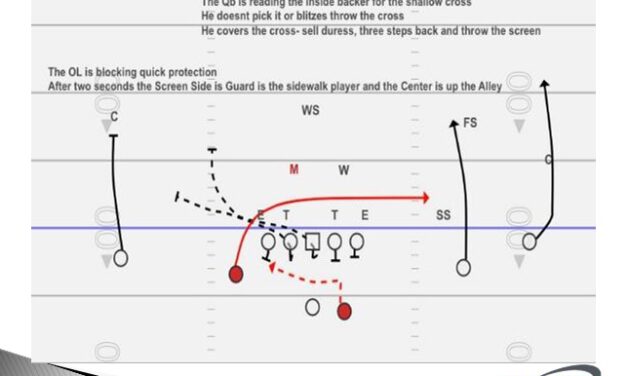
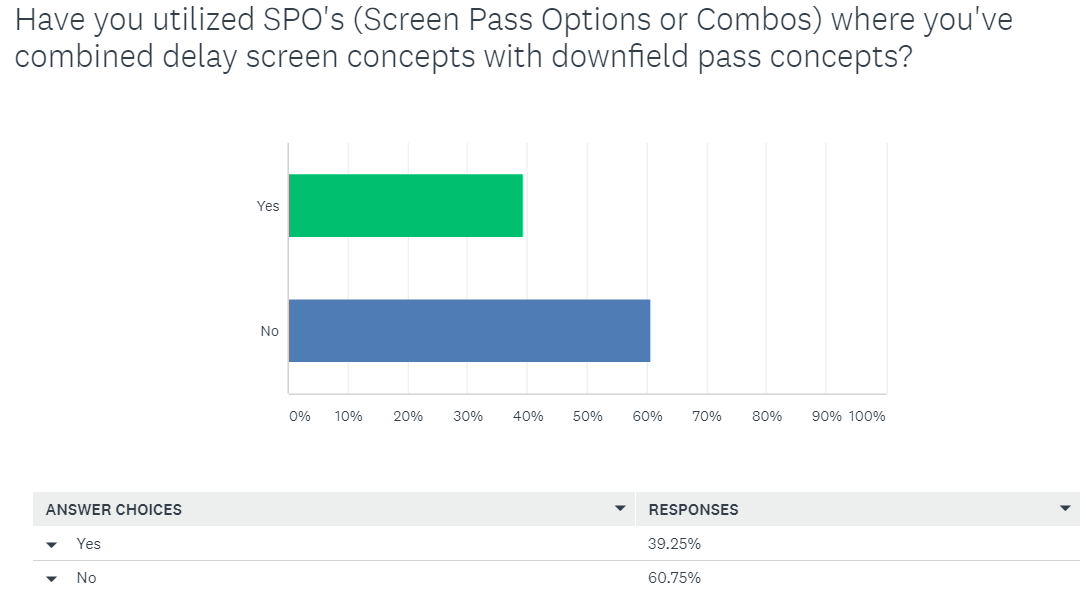
One of the more current branches growing from the RPO tree is the implementation of screen concepts that are attached to the drop back pass game. It’s probably one of the newer trends in the RPO menu. According to our research, only 39 percent of coaches are attaching screens into their pass concept menu.

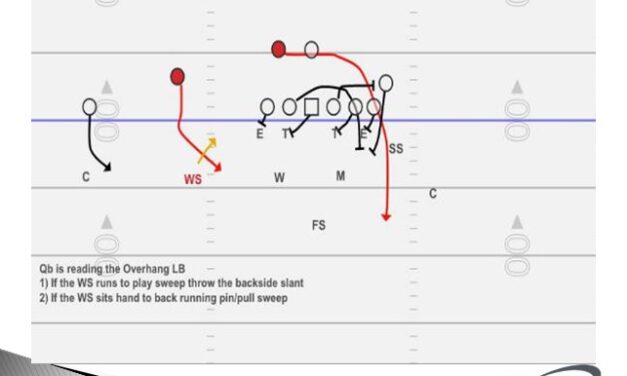
To be clear, a PSO (pass/pass option) couples a quick game to the concept side (such as stick, snag or shallow) with a delay screen to the running back on the backside. These take the place of any other backside options such as a free access throws to the X or a two-receiver mirrored concept progression. According to coaches, there many advantages to attaching backside screens into the pass game menu. Some of the more common benefits we found are below:

Read More

Two Deep Fire Zones That Affect Heavy Personnel Runs

By Steve Erxleben 
Head Coach/Defensive Coordinator 
Southern High School (MD) 
Twitter: @CoachErxleben 


Introduction 

At Southern High School, our defensive staff believes in zone pressure and the ability to bring any combination of inside linebackers, outside linebackers, and secondary players on any down and distance and at any position on the field. We split our blitzes into categories based on what combination of players (ILB/OLB, ILB/ILB, OLB/OLB, or ILB/Secondary player) is built into the pressure.  

Against most 2 back personnel groupings (20,21 and 22) on 1st down and 2nd and 4+, we use a combination of “edge” blitzes (ILB/OLB blitz from the same side) and “staggered’ blitzes (ILB and OLB from different sides) team. We will primarily focus in this article on the 3-man surface in 21 and 22 personnel first then examine the weak side counterpart.  

On heavy run downs, we like to put the “numbers” or the shade/1 technique to the 3-man surface and the reduction to the weak side or the 2-man surface. The reason we prefer this is we feel that putting the “numbers” to their numbers will create two hard edges, one in the C gap and one in the A gap. Our force player outside and two alley players to leverage the FB and TB in a full flow situation. Blitzing the 2-man surface offers the opportunity to trap or close down the cut back and keeps the run front side and hopefully altered to the sideline.  

The main issue with the two back run front side is that if every lineman base blocks to the side of the TE, there are 5 blockers front side and only 4 defenders if the front is sent away and the reduction is put to the TE. We primarily adjust to this with our coverage by adding the safety as a box run defender and allowing the backside ILB to be a true fast flow player. Adding the pressure, however, throws more at the blocking scheme and works in our favor as we work to funnel the ball and get at least one player unblocked.  

All of our “edge” or same side ILB/OLB blitzes are places on a map and begin with the letter “T” to designate what stunt/movement our call side defensive tackle is running and where our ILB and OLB call side are fitting. The side away from the blitz is playing base technique like they would be in a regular base defensive call. All of our “staggered” or opposite ILB/OLB blitzes start with the letter “N” due to the fact the nose guard is primarily involved in the pressure and not just playing a normal read technique. Having a good mix of both edge and staggered blitz on 1st down and any heavy run down and distances keeps our blitzing identity and allows us to play with different styles and abilities with regards to our personnel on the field. 

Base Structure 

To set the foundation, I wanted to talk briefly about our base defense. We look at our blitzes as concepts, so in our verbiage one term can cover the assignments of multiple players and our linebacker’s ability to fit off of the movement of our front is critical to executing each blitz call.  

Our base defense is the only defensive call we have where we are in a read situation. In that case, we are asking our front 7 defenders to key lineman and fit off of blocks to leverage their gap responsibilities. Our base defense is a slanting, 1 gap, odd front with match-up zone coverage principles on the back end. On virtually every snap, our interior defensive tackles are aligned head-up on the OT in a 4-point stance in a 4 technique. Our nose guard is also aligned head up and in a 4-point stance, aligned in a zero technique, head up on the center. We like the head-up alignment due to the fact it establishes some deception and allows us to disguise where pressure is coming from as well as where we are setting the front. The head-up alignment also plays into a lot of the bluffing and bailing we do with our second level players. We also do this with our secondary to creates deception to what coverage we are in. 

When we “set our front” we are telling our 3-interior linemen to take a 45-degree angle of attack. On the snap, our call side DT will move low and hard staying as square as he can from a 4 technique head up to a 4I technique, inside shade of the OT. Now a B gap player, the DT will collision the inside half of the OT getting his inside hand on the inside edge of the OT’s shoulder pad and his outside hand down the sternum of the OT. We give our interior players a pressure key and a read key. In this situation, our 4I DT is feeling the OT he is slanting away from but actually reading the block of the OG. If the OG blocks down and away from the DT or pulls inside, he will get his eyes inside, squeeze and stay square leveraging the B gap. If the guard blocks towards the slanting DT, he will get up the field to the heels of the OL and play the B gap aggressively. Our NG repeats the same movement from his O technique alignment, but his pressure key is the center and his read key is the backside guard as he becomes a 1 technique backside. Our backside DT away from the call is also performing the same technique accept his pressure key and read key are the same unless he is aligned to the TE. If he is to the open side, he is moving from a 4 to a 5 technique and his pressure and read key is the OT. If it is a two TE set or we are slanting to the TE in 21 personnel, the DT’s pressure key is the OT but he is reading the block of the TE. 

Read More

Variations of The Y-Over Route

By Darren Grob 
Offensive Coordinator 
Palmer Ridge High School (CO) 
Twitter: @Coach_Grob 

Introduction 

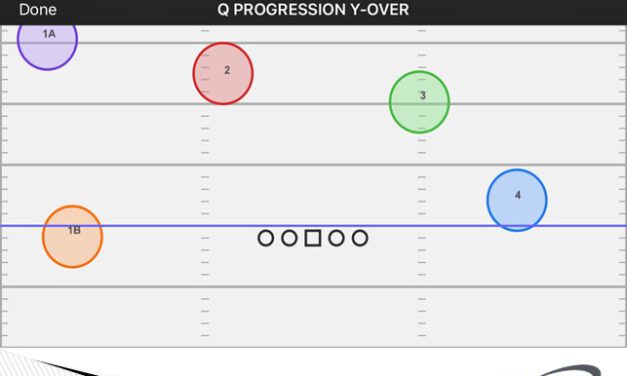
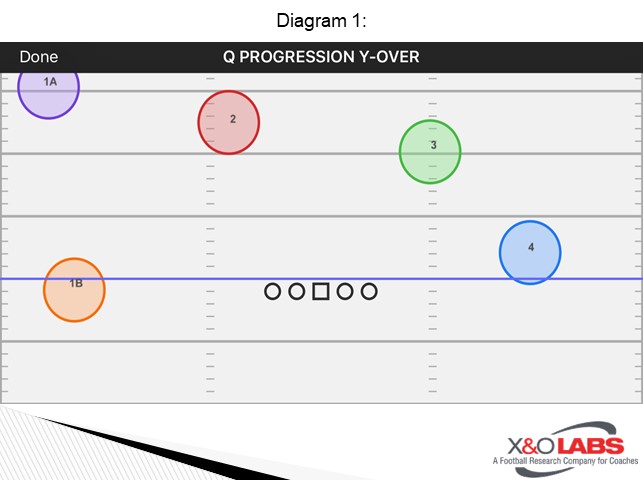
Our bubble Y-over (or Y-Cross) concept is a weak side flood much like the original Air Raid 95. This concept gives us both a horizontal and vertical stretch on the defense as well as built in constraints for our quick screen game. Bubble Y-over has been our most productive play for the last three years averaging just over 23 yards per completion.  

Our version of the bubble Y-over concept is a full field read and the first passing concept we teach to our young or inexperienced QBs because of the ease of the left to right (“windshield wiper”) progression. The read and footwork often come naturally as we run a lot of perimeter screens and rep quick feet in our Indy sessions daily. The ease of the progression helps our QBs develop their understanding of the system we use at Palmer Ridge. 

Slide1Slide1

Front Side #1: Go Route 

The front-side #1 receiver aligns at the top of the numbers and will run a go route stretching the defense vertically. We want the quickest possible release vs the defensive back in order to help the QB identify post snap coverage as fast as possible.  The go route most often comes open against cover 2 Cloud looks or teams that use trap or Read-2 coverage. Against middle of the field open coverage, we want the go route to pull the front-side FS in order to open up grass for the Y-Cross. We want our front side #1 to anticipate coverage and win by stacking his route once he beats the defender in front of him.  

Front Side #2 Receiver Bubble, Arrow, or Out  

The inside slot receiver has the flat route to the front side of the concept. We start this concept with a bubble screen but can game plan to use a 6 yard out if we feel that the secondary is keying the #2 receiver in some match quarters concepts or man under looks. The bubble screen does a good job of enticing both the flat defender and the FS to the front side and with movement creating a clear lane to throw the Y-crossing route behind it. At Palmer Ridge, we will also use some split back sets and have the #2 play side receiver push motion out of the backfield or use a Trey set and motion the #2 receiver across the field and run him on an arrow route to help identify coverage and pick-up easy yards against man coverage. We like to use the flat route from #2 as eye candy to entice the secondary.  

Read More

Using H Motion for Gap Scheme Runs

By Robert Burk 
Head Coach 
Tri-Village High School (OH) 
Twitter: @CoachBurkTV 

Introduction 

I am a first year head coach at a program that is in its third year of existence. When our staff began building our offense we knew that power and power read were going to be the foundation of what we did. By week four, we added counter to the mix and saw some great results. These three plays made up 26% of our offense and we averaged 5.5 yards on power, 5.5 yards on power read and 9.1 yards on counter (13 total touchdowns). In this article, I want to focus on how we used motion to set up these plays and execute them at such a high level.   

Communicating Motion 

When installing our offense, I wanted to limit the verbiage that players had to know. It was important to me to find a simple way to communicate motion that allowed us to move players wherever we wanted. Like all good coaches I stole an idea from Keith Grabowski’s book 101+ Pro Style Pistol Offense Plays. The idea is that you label 10 spots on the field and you can tag any player you want and tell them which spot to motion too.   

Slide1

We developed some simple rules for our receivers and our H. The receiver rules state that if you are motioned left to “9” or right to “10,” you know that you are either getting the ball or in the mesh on power read and may get the ball. If you are motioned left to “3” or right to “4,” it means that we are flash faking to you while running another play. Our H was more of a blocker and not someone we wanted to hand the ball to laterally. If the H was motioned to 3 or 4, he knows he is shuffling to that spot and running whatever run play was called. We can also signal two numbers, such as 4-3. In this case, the H will sprint to behind the right guard and then shuffle to behind the left. This allows us to start in any formation and move whatever player we want to where we need them without a lot of new terms or memorization. I simply hand signal the position that was to motion and the number.  We use locations on the body for a number system where pointing at the ground is 1 and tapping the top of your head is 10.   

Power Read 

Our motion system allowed us to use all 3 possible ball carriers as threats to run power read. We could get the outside receiver, slot receiver and tailback in the mesh for power read very easily.  The tailback had a simple rule. If I signal a motion such as “W-10,” he knows he is a lead blocker. If I did not signal a motion, he knows he is the ball carrier and should line up accordingly. In the first clip of the video below, we run return motion. We used this sparingly but as a change up for team who would roll to our motion.  

To study game film of this concept, click on the video below: 

Read More

Designing RPO’s from 12 and 13 Personnel Groupings

By Mike Kuchar 
Senior Research Manager 
X&O Labs 
Twitter: @MikekKuchar 


Editor’s Note: The information presented in this report is from our latest special report, 2018 RPO Evolution. The 3 new trends revealed in this report will bring a new wave of RPO production next fall. Continue reading this special report for more information.  

When the RPO craze hit the football industry back in 2014, many of the concepts being developed were designed from open, one back personnel groupings. Concepts were devised from 10, 11, 20 personnel from doubles and trips formations. This made sense at the time because many RPO advocates were spread coaches by nature. These formations and personnel groupings were already part of their offensive play menu. So, they were constructing ways to protect their top runs from these structures. 

But the paradigm has started to shift now into how to present these same run/pass conflicts to defenders using heavier personnel sets. Programs with able-bodied full backs and tight ends (that can both block and stretch the field vertically) are creating pass conflicts from their base runs to affect defenders. In this report, we present our research on how a small group of coaches are keeping heavier personnel groupings on the field not just to run the ball on third and short, but to create manipulations in the RPO game by affecting dual read defenders.? 

Editor’s Note: The personnel groupings included in this report include the following: 

12 Personnel: one back, two tight ends 

13 Personnel: one back, three tight ends 

21 Personnel: two backs, one tight end 

22 Personnel: two backs, two tight ends 

Read More

Implementing RB Isolations in the Pass Game

By Philip Vigil
Pass Game Coordinator/Recruiting Coordinator/Quarterbacks Coach
Fort Hays State University (KS)
Twitter: @PhilipVigil

Introduction

Any good offensive mind will tell you that finding mismatches on the football field will give you a clear advantage. Here at Fort Hays State University we have found success using this motto by getting our running backs matched up with either linebackers or safeties. There are several concepts that we use to get our running backs out of protection and into a route, but one of our best has been a Spacing concept that includes a running back Wheel Route. We have run this concept for the past 3 years and it has become a staple for our offense with answers for every coverage. We have been able to modify the concept by using different formations, motions, and protections to disguise what we are doing and to keep the defense guessing.

Slide1

Coordinator Coaching Points

  • We will only call this play on a hash. We have found that this concept is not as good when ran in the middle of the field. This also makes the landmarks for the route runners consistent throughout the game and therefore removes excess thinking.
  • We will use 5 and 6-man protection for this concept. We usually only use 6-man protection if we are facing a heavy blitzing team. By doing this we will allow the QB extra time to get the ball downfield to the RB.
  • Once you get good at this concept defenses will begin to key on your RB when your RB is aligned towards the boundary. We have found it helpful to move our RB right before the snap.

Coaching the Routes

  • Snag Route (#1 WR to concept side)
    • Align at the bottom of the numbers.
    • Press vertical for 2 steps then work inside at 45 degrees to find a window at 6 yards.
    • If you pass a defender on your way inside then sit down immediately and get your eyes to the quarterback.
    • If you see man coverage pre-snap run your route to sit directly in front of the defender who is covering the running back. This essentially becomes a “rub route” for us in man coverage.  We coach them not to make contact with the defender, but to merely get in the way.  If we get the defender in man coverage on the running back to work under our #1 wide receiver on the Snag route, then we should be able to outrun them creating a big play.
  • Wheel Route (RB to concept side)
    • As the running back is running his route he needs to be able to read the defense.
    • We simply teach that if there is an over the top defender to sit his route down and get his eyes to the quarterback.
    • If there is no over the top defender, then he needs to run the wheel route and expect the football.
    • Aiming point on the wheel route is the bottom of the numbers assuming the play is run from the hash. If the running back is able to get vertical by his landmark this should give the quarterback the room to complete the ball down the field on the outside shoulder much like vertical throws to outside wide receivers.
    • There are times in man coverage where the defender who is in man coverage on the running back works over the top of our #1 WR. In this instance the quarterback should throw a back-shoulder ball to protect the running back.
    • Coach your running back to get his eyes back to the quarterback as soon as he has made his read on whether to run the wheel or sit his route down. We drill this in practice during individual time. A coach will be the defender who can play Man Coverage or Zone Coverage and make the running back make a decision. It will take practice, but once the running back gets a feel for the concept it will be difficult for defenses to stop it.
    • I will also drill the QB to key the defender (a coach in practice) that is in man coverage on the running back. If he is taking a flat angle the ball should be thrown down the field, if the defender is taking a deep angle the ball will be a back shoulder throw to protect not only the running back but also the football.

Slide1

Read More

Efficient 3rd & Long Passing Concepts

By Eric Davis
Head Football Coach/Offensive Coordinator
Mankato East High School (MN)
Twitter: @davismn6


Introduction

It’s 3rd & 9. Do you have a plan? Do you know how many times you are likely to face this situation against a quality opponent? The answers to these questions and others like them dictate our approach to game and practice planning for a given week.

Here are some of our operating principles regarding 3rd & long:

Use our best player(s) or the threat of our best player(s): It is our belief that in high school football the “wrong” play with the “right” player is often better than the converse of that. Our most productive plays are usually more related to personnel than scheme. If there’s a throw our QB can’t make and we keep running a great scheme that puts him in a position to make that throw, whose fault is it when we don’t convert?

Evaluate our in-game risk tolerance: We must understand the overall game flow which can fluctuate from possession to possession and snap to snap. Consider questions like:

  • What is our current situation on defense and special teams?
  • Are we in four down territory?
  • How good is our punt team?

Due to some injuries to our punter and long-snapper last year, punting itself was a high-risk proposition and often dictated a more aggressive 3rd & Long approach.

Game planning begins with 3rd down: Many play callers prefer to start with their open field 1st & 2nd down calls as those are going to be the majority of their snaps. While I understand that approach, if 3rd down is as critical as we say it is, why not begin our game planning there and build the rest of our formations and calls around that? We usually choose at least one run, one screen, and a couple of the downfield passes described below. The run play does not need to be a draw.  While casual fans consider 3rd & long runs to be ultra-conservative “give up” plays, but you might be surprised how close your conversion rate is on runs versus passes when you study the data.

Run base plays and subtle variations of base plays:  Watching Alabama win the National Championship by running four verticals on 2nd & 26 in overtime against a strong defense is a reminder to all of us that you don’t need to stray from core plays in unfavorable down and distance situations.

Protections and Built-In Quarterback Draw

We can utilize 5, 6, or 7 man pass pro for the concepts detailed below, depending on our opponent’s personnel and scheme. We incorporate standard half-slide and full-slide protections that will not be a focus of this article. We have included QB draw as an “escape” in some of our 6-man protections and this is a component we are looking to expand in 2018.

In the context of those assumptions, here are some of our favorite 3rd & long passing concepts that we will call if we decide to throw the ball past the sticks in an effort to gain a 1st down.

Read More

Blue Coverage From the 4-2-5 Defense

By Mike Nahum 
Defensive Coordinator/LB Coach 
David W. Butler High School (NC) 
Twitter: @coachnahum60 


Introduction

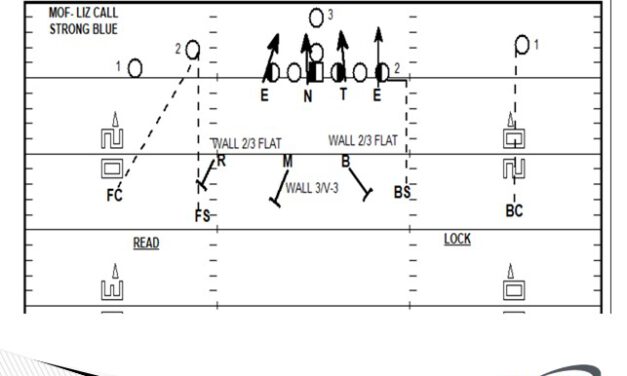
As a Base 4-2-5 defense, we utilize 4 down linemen, 2 linebackers, 3 safeties and 2 cornerbacks.  Our front six is set separately from our back five.  This simplifies the teaching to our players with the use of half-line drills. Since the ball is on the hash at least 80% of the time or more in high school, we focus on teaching from the hash the majority of the time. Our defense is field/boundary based since we declare passing strength to the field the majority of the time. 

We base out of Blue coverage (Quarters concept) using split field principles. Blue coverage is a pattern match defense, which allows your players to play zone coverage with match man principles based on the route distributions. This coverage easily adjusts to handle multiple formations/motions. It allows us to handle 4 verticals and gets us in a 9-man front vs. 21P and an 8-man front vs. 20P.  It also allows us to stay in safety force concepts, which simplifies our teaching as well. 

For the purpose of this report, I will discuss our Blue coverage vs. 10P 2×2, 3×1 and 11P 2×2, 3×1. 

20P 2×1 and Empty 3×2. 

Terminology is the biggest obstacle to learning. I will simply explain our defensive terminology. 

BC: Boundary Corner, Buck: Boundary Inside Linebacker, BS: Boundary Safety. These 3 players line up to the boundary/away from the passing strength. 

FC: Field Corner, Mike: Field Inside Linebacker, Rover: Field Low Safety, FS: Field High Safety. These 4 players line up to the field/to the passing strength.  

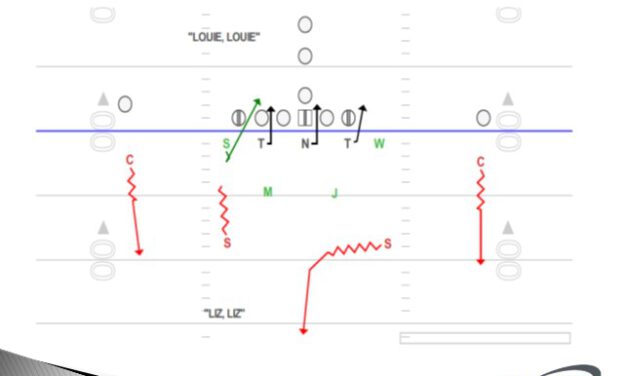
When the ball is in the MOF,  FS declares rip/liz to the passing strength side of the formation based on the # of skill receivers. 

Blue Coverage vs. 10P 2×2, 11P 2×2 

Against 2 detached receivers to the field, we will play read coverage as a standard check out of Blue. FC will align with divider rules 1×7 inside leverage of #1. Our FS will align with divider rules 1×10 inside leverage of #2. Our Rover will align by game plan, but generally inside leverage of #2 at 5-7 yards deep. Mike will gap align to the field. FC/FS read the release of #2. If #2 is out before the Rover then the FC will leverage #2 and break on him when the ball is delivered. The FS will flat foot read and open to #1. The FS will gain depth and play curl/dig/post of #2. If #2/#1 are vertical past the Rover, the FS/FC lock on man. If #2 is in before the Rover, the FS will shuffle and rob the direction #2 went. The Rover will wall #2 and play #3 to the flat. The Rover is the force player. The Mike is a wall #3/MV#3 player in 2×2. He will always open to #3 and he is a spill player. 

Against a pro-set to the Boundary, we will play Lock coverage as a standard check out of Blue. BC will align with divider rules 1×7 Inside Leverage of #1. The BC will play all of #1 except the shallow cross. The BS will align 2×7 outside leverage of an attached #2. The BS will play all of #2 except the shallow cross. The BS is the force player. The Buck is a Wall #2/#3 to the Flat player. The Mike is a wall #3/MV#3 player in 2×2. He will always open to #3 and he is a spill player. 

Read More

High School Coach “Hires” Digital Director of Football Operations: See What Happened Next…

By X&O Labs Research Team


When you talk with thousands of coaches every year, you get a sense what they want and need. The common denominator in our experience: coaches want more time. 

Consider for a moment what you could do to improve your program or impact your athletes if you had more time to plan, strategize, watch film, or just to invest into the culture of your team. Time is the most important resource you have, and yet the one thing you probably don’t have nearly enough of.  

This begs the question; how can you make more time? The simple is answer is delegate. More specifically, what can you delegate and to whom? 

What if there was a way for every high school football program to hire a Director of Football Operations (DFO)? Now there is… and we’re going to show you one coach who did just that. Keep in mind, until recently only colleges or high school with big-time budgets could afford DFOs. That’s not the case anymore… 

The primary duties of a DFO is to manage the logistics of a football program’s operations–things like scheduling, communication, summer-camp sign ups, texting, emailing, preparing and distributing drills and workouts, gathering materials for coaching meetings, tracking individual players’ workouts and progress, manage off-season leaderboards… and the list goes on.  

But now, every high school football program can afford a Director of Football Operations. We’ve heard from many of you that have already done so with MaxOne. Full disclosure, MaxOne is a partner of X&O Labs, but we only partner with the best of the best. 

MaxOne is a platform that allows you to organize, communicate, and train your players and program all with ONE login. Instead of having to hire a full-time DFO — let MaxOne solve this problem for you, and for much less money. No catches or gimmicks; just a proven way to free up more of your precious time–while not having to sacrifice quality management of your program.  

To help you better understand what MaxOne could do to save you time and enhance your productivity, we will be providing monthly spotlights that share the experiences of real coaches like you.  

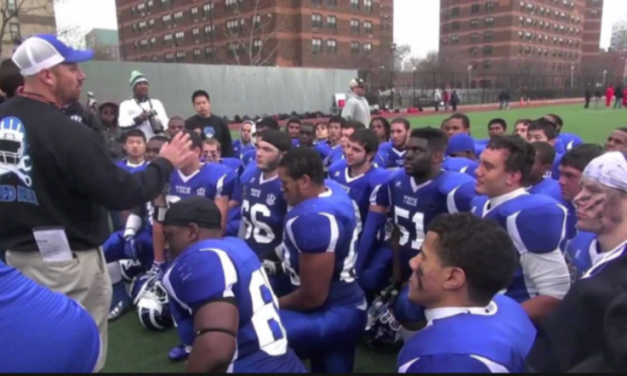
Our first Q&A features an interview with Coach Kyle McKenna of Brooklyn Tech High School in Brooklyn, NY. Coach McKenna has been using MaxOne for 2-months and was eager to speak with us about the impact the platform has made within his program.  

What spiked your interest in using MaxOne as your DFO? 

Read More

RPO Drills to Help Train Your Quarterback’s Eyes, Rhythm, and Delivery

By Stephen Wasil
Quarterbacks and Wide Receivers Coach
Albion College (MI)
Twitter: @CoachWasil4


Introduction:

The concept of this report is to provide a handful of drills that I use for our quarterbacks to help keep them consistent with their RPO techniques. I believe these drills help train the quarterbacks eyes, rhythm, and delivery during our called RPOs. In our system, the quarterback’s eyes must first take him to the correct area on the field with the defenders for him to read. At the same time, he must get into the rhythm of the play and mesh point with the running back. From there, the defenders will tell him when and how to deliver the ball.

We have general rules for the delivery of each RPO, but all are subject to change based on the leverage of the defender. Any routes thrown as timing routes to the sideline (hitch, quick outs), we want delivered as possession throws towards the sideline. We will take the 5-7 yards and move on to the next play. If the receiver can break a tackle or make a defender miss, that is a bonus for us on these types of RPOs.

In a similar fashion, routes that work off the LBs or make a more aggressive path towards the tackle box must be looked at as possession throws with a chance for an explosive play. With more defenders in the middle of the field (linebackers, strong safeties, drop-down safeties), we want these throws delivered as body throws. We want the ball in an area on the receiver’s body so he can protect himself if needed, but also helps the receiver catch the ball with confidence in both the QB’s read and the opportunity to turn this into an explosive play.

We us a systematic approach to setting up our RPO read drills. During the early stages of fall camp, we will install the basics of our offense as well as going against basic looks from our defense. So, I try and use individual time to work on some of the throws I have seen our quarterbacks make in the past and adjust the individual drills from that point. During the season, we will only work the RPO reads and defenders we are trying to manipulate based on the game-plan for that week.

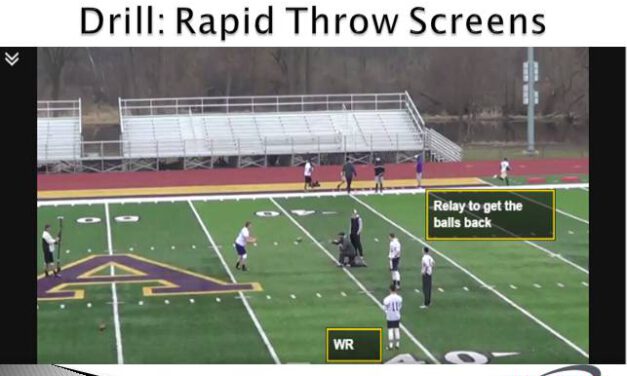
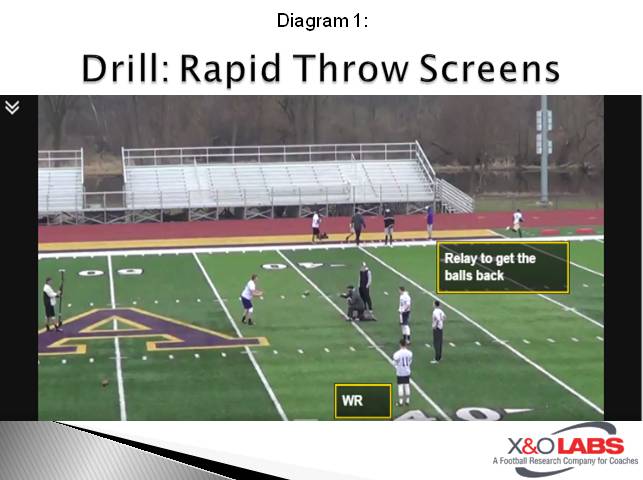
Drill: Rapid Throw Screens

I use this drill early and often during pre-practice in fall camp. It helps the quarterbacks understand how fast we need the ball thrown in certain situations, while also placing a premium on accuracy.

For this drill, there will be a center (usually me to control the tempo), quarterback, and stationary receiver (usually a QB, during pre-practice I try and get the receivers catching depending on their pre-practice schedule). Each quarterback will get 5 throws in rapid succession to one of our quick screens (I generally try to throw only the screens we have called for that practice plan). The center will snap the ball, quarterback will throw the quick screen, and almost as the ball leaves the quarterbacks hands the next snap is coming. If you have your receivers catching for you, have them tuck the ball away quickly and then relay the ball to a quarterback waiting his turn. I will have the QBs work quick screen throws into the boundary, from the middle of the field, and to the field (while working throws to the left and the right).

Slide1

This is a simple set up for a pretty simple drill. Again, this is to get the quarterbacks used to getting the ball out of their hand quickly when we get a pre-snap read to throw the ball.

Coaching Points:

WHY: The defense aligns in a manner that gives us an automatic throw read to the screen (both LBs in the box and we have them out numbered on the perimeter). The ball needs to be snapped as quickly as possible and the quarterback must get the ball out of his hands as quickly and as accurately as possible.

FEET: I talk about “setting the pitcher’s mound” or “set the mound” when getting my quarterbacks feet aligned. Just as a pitcher sets his back foot on the mound parallel to the catcher and pushes off the mound with his back foot to throw, I want a similar set up with my quarterback’s back foot set parallel to his target. This task becomes a much more conscious effort and involves more discipline when a right-handed QB is throwing to the right and a left-handed QB is throwing to the left. In both scenarios, they must work hard to “set the mound.”

THROW: I talk about two aiming points with the QBs when it comes to throwing our quick screens based on our receivers. For two of our screens the receiver’s chest will be facing the QB. During these throws, I talk about aiming for the up-field shoulder. This gives the receiver the ability to get a little momentum towards gaining positive yards. When running a true bubble screen or swing screen, I talk to the QBs about aiming for the front of the facemask. This keeps the ball in front of the receiver so he can catch the ball while continuing to gain width and keep their momentum going towards positive yards.

Variations:

RIDE AND PULL: There will be times the defense gives us a look where the quick screen throw may come during or after the mesh point with the running back (ex: LB maybe walked outside of the box or we must see how the perimeter sorts itself out). We do this drill two different ways; with and without a running back. I usually just have the QB visualize the scenario and why we are doing this drill.

Read More

“Steal” Coverage Concepts to Defend Trips

By Mike Giancola
ST Coordinator/Defensive Line Coach
Westfield High School (VA)

Introduction:

Offenses today work hard to manipulate into formations that force defenses into stressful situations. Trips (3×1) concepts, in particular, pose a number of problems to defensive coordinators as they “load” zones to one side of the offensive formation while creating potential matchup problems. So what can defenses do to gain the upper hand against offenses that create the stressful situations with trips formations?  We think defenses are best advised to take a week by week approach.

For us, success can be cultivated into the weekly game plan by having multiple coverage schemes to combat 3×1 formations. However, diversifying the game plan too much can result in a break in communication and execution between coaches and players. There is a fine line that needs to be walked.

The approach that will be outlined here allows us to both manipulate and disguise multiple coverage concepts to defend 3×1 formations, while approaching it in such a way that it can be easily relayed and taught to players. This will help to keep offenses on their toes and guessing at how the defense is playing them. This, in turn, regains the upper hand for the defense.

Verbiage

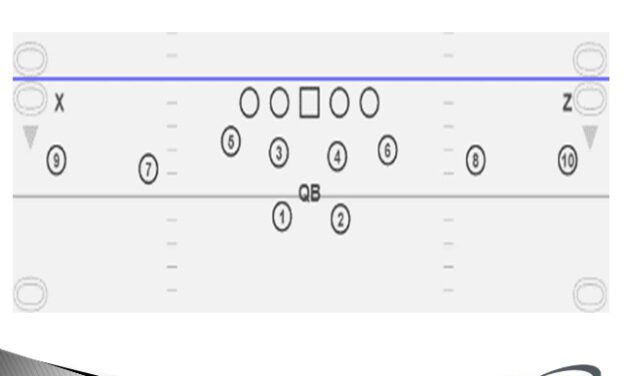
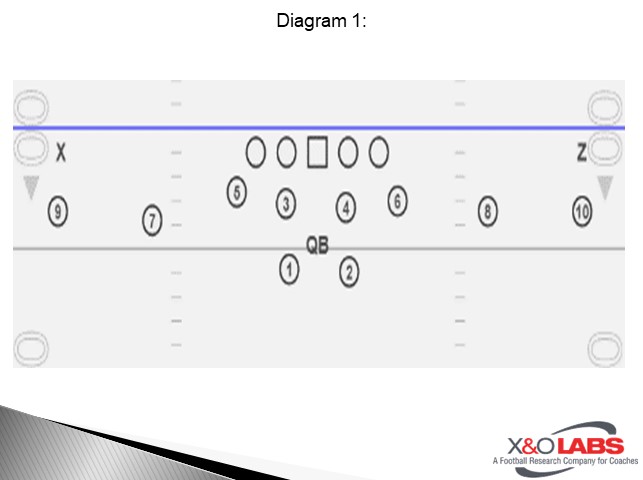
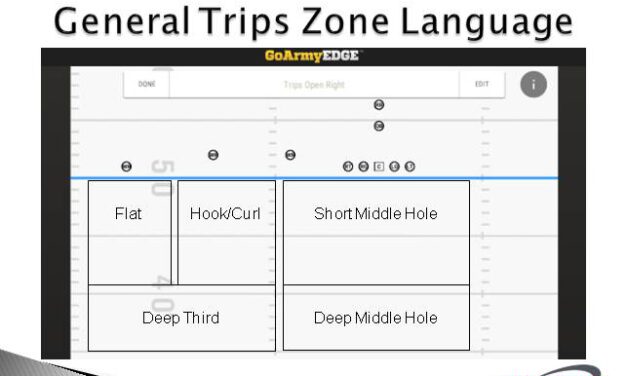
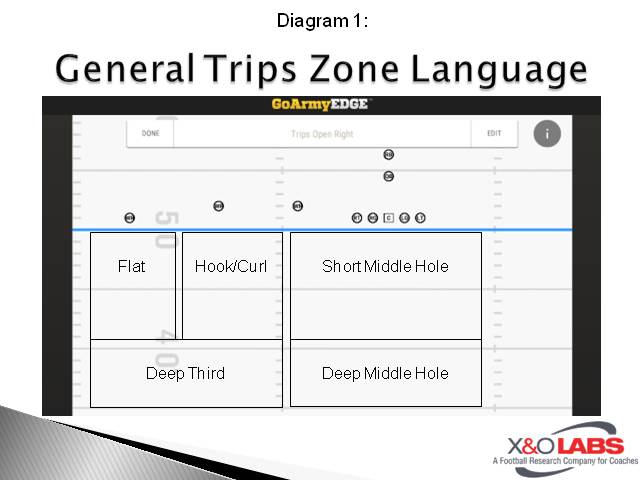
Many approaches to defending 3×1 formations consist of playing 5 defenders over the 3 eligible receivers to the Trips side of the formation. This allows the defense to be sound numbers-wise, even if the tailback shows up as a 4th Receiver. General terms for these 5 defenders are Flat, Hook/Curl, Middle Short Hole, Deep Third and Middle Deep Hole. These terms correspond to the zones these players are responsible for (Diagram 1):
Slide1

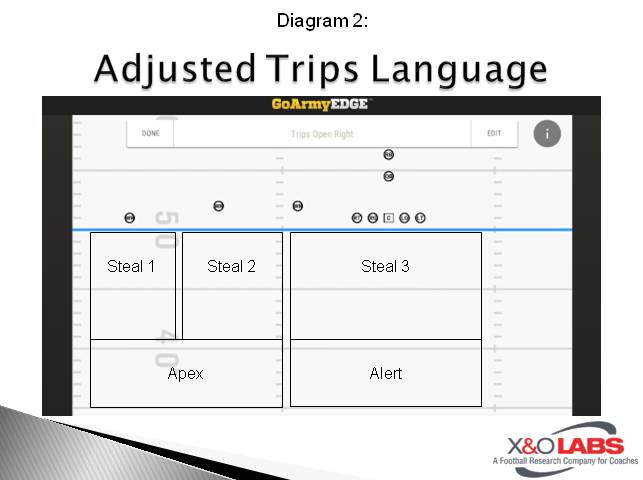
This terminology is sufficient when discussing football with those that regularly speak “the language”, but for those that are not as familiar it can be very confusing. We found that simplifying the verbiage we used when teaching our 3×1 coverage concepts enabled us to better teach the coverages we were installing, allowing us diversify our approach. The basic premise and location of the zones being covered are the same, except the language is adjusted (Diagram 2):
Slide2

Coaching Points

Here is a breakdown of how we teach these five Trips side defenders discussed above:

Steal 1: Initially, the job of Steal 1 player is to take away the Slant, or inside, of the #1 receiver. If #1 drives inside or sits down the Steal 1 player reads through the QB’s release, making a play on the ball or carrying #1 to the next zone before he passes #1 off. If #1 stems and continues vertically, the Steal 1 player plays underneath #1 until work comes outside to him.

Steal 2: The Steal 2 player is responsible for taking away the Slant of the #2 Receiver. If #2 disappears outside, the Steal 2 player sluffs off (drops vertically) with eyes finding the route of the #1 Receiver. If #2 drives inside or sits down the Steal 2 player reads through the QB’s release, making a play on the ball or carrying #2 to the next zone before he passes #2 off. If #2 releases and continues vertically, the Steal 2 player carries #2 to 10 yards underneath and looks for work coming to him.

Steal 3:  The Steal 3 player not only needs to steal the Slant of #3, but also carry him vertically to 10 yards if #3 continues up the field. Since there is not close help to the single receiver side of the 3×1 formation, it is imperative that #3 does not cross the face of the Steal 3 player after 3 yards up field. We allow shallow drags across the face as we consider those “low hanging fruits” that we can easily rally to. If #3 disappears outside, the Steal 3 player sluffs off and looks for work coming in to him.

Apex:  The job of the Apex player is to play in between #1 and #2 vertically, slightly favoring #2 as that is the easier throw for the QB.  He needs to read release of both receivers and should be the last player to the party on plays like Bubble, Rocket and Tunnel. He is ultimately responsible for anything over the top, including the fakes built in off those plays. If #1 and #2 sit down or disappear the Apex player should continue to get depth, looking for #3 coming into his zone.

Alert:  The Alert player is looking to work over top of #3. If #3 goes vertical, it is the Alert player’s responsibility (we declare vertical if he has gone past 10 yards) unless he breaks out to the corner into the Apex player’s zone. If #3 disappears the Alert player looks to rob the next receiver coming to him. 

The beauty of using this terminology is you can apply it to all your players in an easily explainable way depending on the coverage concept you are using. This allows you to be multifaceted in the way you coach and teach a number of coverages to defend 3×1 sets. This also lends itself to disguising what coverage you are using by giving your players “man” principles while keeping true to zone concepts. Alignments of the defenders remain relatively the same, posing the problem to the offense of appearing you’re in same coverage all the time while playing number of different coverages.

Alert Concepts

The following coverage designs will range from Cover 2, Roll 3 and Robber with the defenders holding similar alignments to give the perception that the defense is playing the same coverage the entire time. Each coverage incorporates the rules outlined above, but the player executing each rule changes. The commonality between these coverages is the weak side Safety (the one aligned away from the passing strength) is the Alert player.  We spend considerable time on teaching the players how to hold their pre-snap movement as long as possible to disguise what coverage we are actually in.

NOTE:  The backside coverage will be handled with the weak overhang and the weak corner, playing with one under and one over the #1 receiver with a pass read.

Spoke (Cover 2 Concept)

We call our 3×1 Cover 2 sche

Read More

The 20 Personnel Run/RPO Package

By Mike Kuchar
Senior Research Manager
X&O Labs
Twitter: @MikekKuchar


Case 1: Optimizing Skill Sets of Players and Building Formation Packages


Editor’s Note: This research report is comprised of three individual cases. All three cases can be found on this page along with all video and diagrams.


Introduction

Why play with one back if you can play with two? It’s a simple question that perhaps drove coaches to start building two-back personnel groupings into their offense. After all, one dynamic back can pose serious threats to defenses, so two can be catastrophic for the defense. The two-back structure is certainly nothing new. Perhaps it originated in the single wing offense at the turn of the century and was further cultivated by the flex bone and Wing T artists who have been using it for years. But what has made it even more popular has been the utilization of that F/H/Y player who, as an “off the ball” player, can be distributed in several different ways.

There is no doubting the popularity of this grouping. It was the most well-read topic among all our research this off-season, so we figured why not present an in-depth report on how coaches are using 20 personnel to drive their entire offensive outfit? And whom else could we get to chair this report than Texas A&M University offensive coordinator Noel Mazzone? Coach Mazzone has made a living- a very good living- by devising his entire offensive system around this grouping.

So, before we present our findings, it’s important to note that although our research is catered to 20 personnel groupings there are certainly some synergies between this grouping and 11 personnel groupings. As we explore the skill set and prototype of that F/H player, we found that he can be a true back, a true blocker, a true receiver or an “all in one” type player. Finding him in your system or in your hallways can take effort, but once you do there are limitless possibilities for what you can do with him. 

Advantages of 20 Personnel Groupings

Like most offensive concepts or personnel groupings, committing to utilizing 20 personnel groupings will take a full scale “buy in” to the system. While we realize that offensive coordinators can implement several different groupings during the game week, we wanted to work with contributors who “major” not “minor” in this grouping by using it at least 40 percent of their offensive snaps. We asked them why they use it. Their responses are below:

“To me the advantages are four-fold: it produces a six-man blocking surface without changing personnel, it produces the ability to build 2×2 or 3×1 formations quickly with motion, it creates match-up advantages with linebackers and it produces seven man pass protection against pressure teams.”- Noel Mazzone, offensive coordinator, Texas A&M University (45% of offensive system is based off 20 personnel groupings).

“I believe it gives you a couple of things.  Number one, it gives the look like we are doing things completely different, but we are likely to get some speed match-ups on linebackers because teams are less likely to sub out into dime or nickel packages against the double A Back look.  We have been more frequently using a tight end type body as the B gap that allows us to do many different formations, without changing our personnel.  It really keeps the defense on their heels.  It allows us to get a 6 man blocking surface with the B back, while continuing to run our RPO’s and helps our QB not have to make the 100 percent correct decision on an RPO.  Therefore we tell him when in doubt hand it off and we will have a 6 man blocking scheme to protect you.”- Dustin Beurer, offensive coordinator, Albion College (MI).

“20 personnel allows to you create an extra gap on either side of the offensive line. The H/F can insert into A, B, C, or D gap on either side of the football, as opposed to a hand down tight end who is only allowed to block the C or D on one side.”- Brent Dearmon, offensive coordinator, Arkansas Tech University (75% of offensive system is based off 20 personnel grouping).

“I like the flexibility of it especially when we use a ‘wing’ type player. Even with two backs in the shotgun we have good flexibility and it adds variety to our offense. You also get to see how the defense plans to attack these heavier, but flexible, formations. Will they add a hat to the box, near the box, play a different coverage, and maybe play man to one receiver side? It can open so many new doors for your offense.”- Kyle Ralph, New Palestine High School (IN).

“I like 20 personnel because it gives the offense control of the box. We want a six-man box. 20 personnel spreads the field out enough to give us a good look into what the defense is giving us. We have the versatility to run the ball with gap scheme run plays that utilize our fullback or get a favorable 1-on-1 or 2-on-2 passing match ups. We see a lot of 4-4 cover 1/3 defenses and running 20 personnel makes it easy for the QB to read the overhang defenders and know what to do with the ball.”- Dallan Rupp, New Plymouth High School (ID).

“We feel that this grouping adds a tougher running formation to combat heavy high school run boxes, but let’s us still keep our spread offense identity we have had for nine years.”- Derek Pennington, head football coach, Zeeland East High School (MI).

Read More

Fast Screen Variations from Doubles, Trips and Empty

By Jordan McGowan
Head Coach
Brookside Christian HS (CA)
Twitter: @coach_bdba

Introduction:

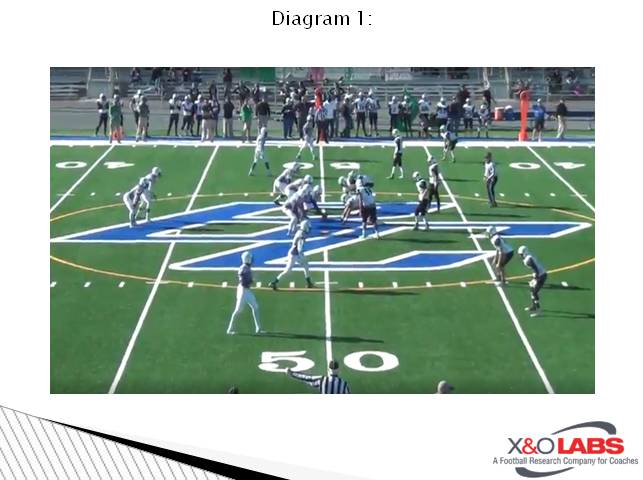
unnamedHere at Brookside, our brand of the Air Raid offense mixes traditional Air Raid concepts, several RPOs and our own variation the ever-popular fast screen. Our offense is designed to get the ball out as fast as possible to our athletes in space, whether it be through speed option, toss, RPOs or fast screens. We really stress yards after catch with our receivers. Their goals are to have at least 40% of our receiving yards being after the catch (YAC).
Base Concept

We are vanilla in our formation looks, spending about 35% in 2×2, 40% in 3X1, and 20% in empty. Very rarely do we go with 2 backs or with a TE set. Our goal is to use these formations to indentify where we have space or an advantage athletically and then to attack that space. The majority of the teams that we faced ran 4-2 with Cover 1, but we also saw some 4-1 box with man under 2 behind it.

Slide1

The fast screen has a number of benefits. Not only does it give our QB an easy completion, but it also gives us big play ability and helps us get our receivers involved in the game. We had success throwing the fast screen to the 1 receiver side away from trips or away from motion. We like to run zone away from the fast screen (even giving it a few times) to freeze the screen side flat player. We also like to run our double slant combo away from the screen. This gave the QB an option if he saw better grass away from the screen or if the defense wanted to overplay the called fast screen.

We rep our fast screens daily in practice for at one or 2 five minute periods. To do this, we would set out landmark cones for offensive line as well as the receivers. As we began to show that we could hit those landmarks, we would slowly progress the receivers into reading the most dangerous man (MDM).

Coaching Points:

The key phrases that we use when teaching fast screens are “flat & fast” then “find him.” It is imperative that the lineman come off the ball flat to their land mark before looking to find their “him” who is the MDM. Typically, our play side tackles are able to get out to the slot defender and our play side guards end up catching an inside backer if they are able to get out. Sometimes our play side guards get caught up with the defensive line, preventing them from being able to climb. This isn’t ideal, but it also isn’t the end of the world.

Slide1

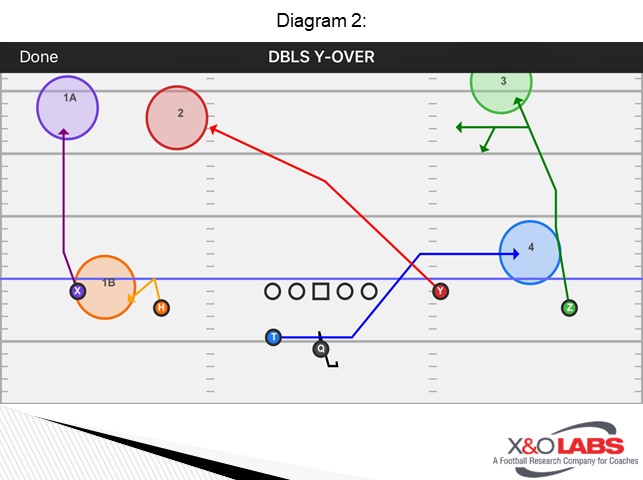
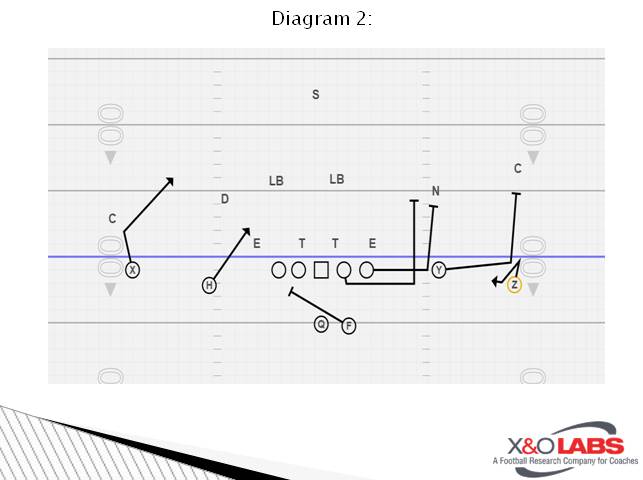
Our most effective fast screens are the ones when our receivers handle their business in the blocking aspect. Diagram 2 (above), shows the Y attacking flat at the feet of the Z then getting vertical to the corner giving the Z a two way go once he has the ball.

Read More

The 2018 RPO Evolution – Case 1: “Big” Personnel RPO’s

By Mike Kuchar 
Senior Research Manager 
X&O Labs 
Twitter: @MikekKuchar 


Special Reporting by X&O Labs Contributing Writer Adam Hovorka 

Introduction 

When the RPO craze hit the football industry back in 2014, many of the concepts being developed were designed from open, one back personnel groupings. Concepts were devised from 10, 11, 20 personnel from doubles and trips formations. Made sense at the time because many RPO advocates were spread coaches by nature. These formations and personnel groupings were already part of their offensive play menu. So, they were constructing ways to protect their top runs from these structures.

But the paradigm has started to shift now into how to present these same run/pass conflicts to defenders using heavier personnel sets. Programs with able-bodied full backs and tight ends (that can both block and stretch the field vertically) are creating pass conflicts from their base runs to affect defenders. In this case, we present our research on how a small group of coaches are keeping heavier personnel groupings on the field not just to run the ball on third and short, but to create manipulations in the RPO game by affecting dual read defenders. 

Editor’s Note: The personnel groupings included in this report include the following:

12 Personnel: one back, two tight ends

13 Personnel: one back, three tight ends

21 Personnel: two backs, one tight end

22 Personnel: two backs, two tight ends

Benefits of Using “Big” Personnel RPOs

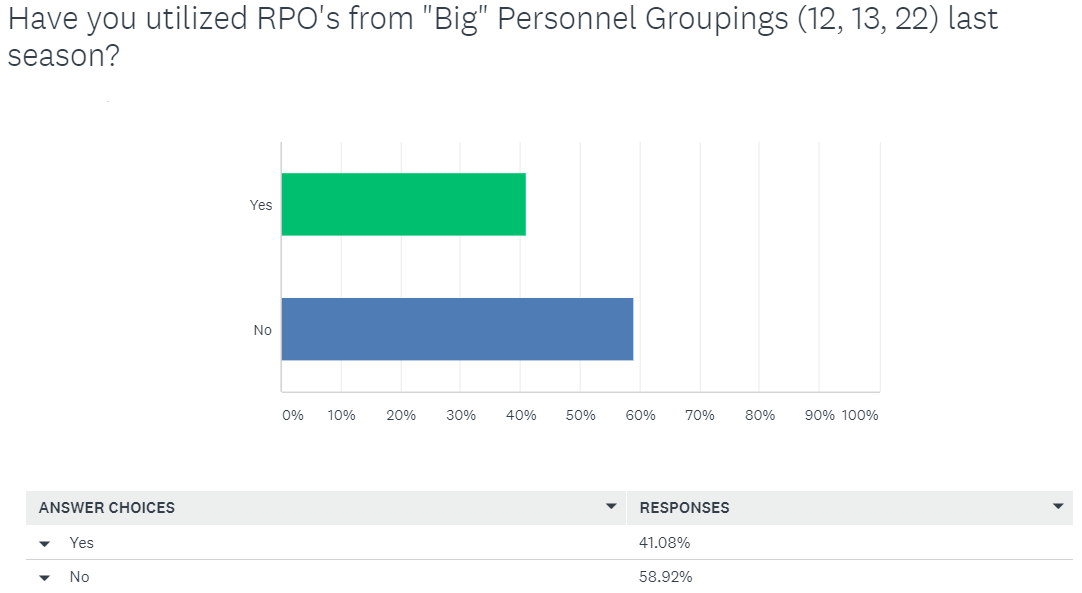
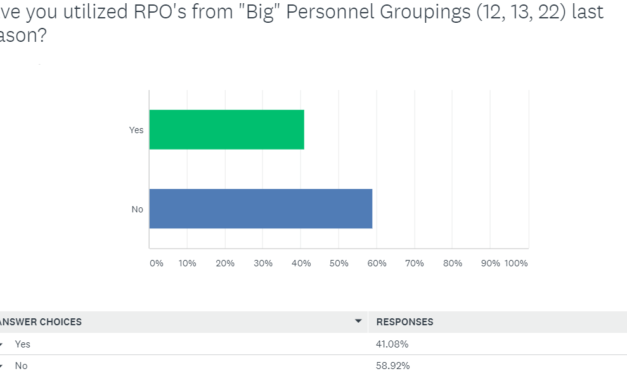
According to our research, only 41 percent of coaches dabbled with using RPOs from these personnel groupings last season. But the ones that did saw a vast improvement in offensive production.

d6

Two of our sources were quick to extol their statistics since using these groupings:

Ocean City High School (NJ): Offensive Coordinator Paul Callahan

  • 56% completion percentage at 13.0 yards per attempt
  • Averaged 5.6 yards per carry in the run game.
  • Averaged 9.5 yards per play on RPO from 12 personnel

Whitehall High School (PA): Head Coach Brian Gilbert and OC Chris Kinane

  • 11-17 for 214 yards 7 TDs and 1 INT (all on one concept)
  • 7 times it was an explosive play (15 yards or more)
  • 0 times was it no gain or a loss

While these numbers may not seem as explosive as other concepts in an offensive play menu, it’s important to note that our contributors use these RPOs as change-ups. Many of these coaches do not major in these “big” personnel groupings. So, while the sample size may not be extensive, the benefits are hard to ignore.

When we asked our sources why they are using RPOs from these groupings, we found several common denominators:

  • It was a way to utilize a very good Tight End.
  • More defenders in the box led to more RPO opportunities outside.
  • It is extremely difficult for a defense to be gap sound and coverage sound.
  • It forced a safety either to make a decision in the box or in coverage. It eliminated the element of disguise.
  • Allows the use of a tight end as both blockers and receivers.
  • It’s a perfect complement to red zone offense.
  • Teams that loaded the box early had to lighten to defend the pass option. This in turned opened the run game.
  • The tight end created an extra gap in run game.

Like any other offensive probability of success, it all came down to numbers. Having two tight ends (or one tight end and a FB) creates two advantages:

Read More

The 2018 RPO Evolution – Case 2: PSO’s: Pass/Screen Option Concepts

By Mike Kuchar 
Senior Research Manager 
X&O Labs 
Twitter: @MikekKuchar 


Special reporting by Adam Hovorka, X&O Labs Contributing Writer 

Introduction 

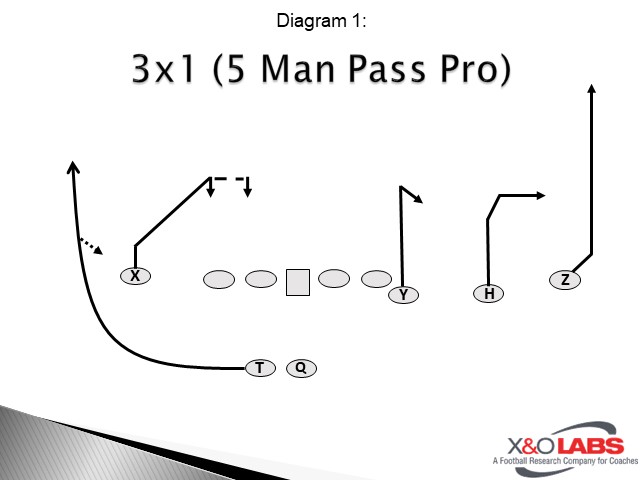
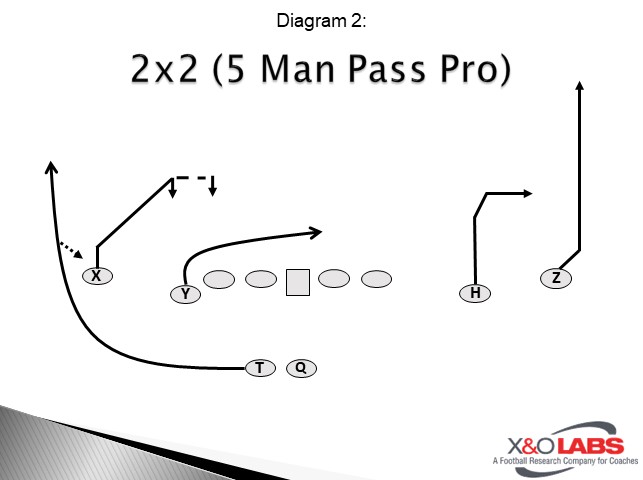
One of the more current branches growing from the RPO tree is the implementation of screen concepts that are attached to the drop back pass game. It’s probably one of the newer trends in the RPO menu. According to our research, only 39 percent of coaches are attaching screens into their pass concept menu.

d81

To be clear, a PSO (pass/pass option) couples a quick game to the concept side (such as stick, snag or shallow) with a delay screen to the running back on the backside. These take the place of any other backside options such as a free access throws to the X or a two-receiver mirrored concept progression. According to coaches, there many advantages to attaching backside screens into the pass game menu. Some of the more common benefits we found are below:

Benefits of Utilizing PSOs:

  • It takes advantage of pass rush and pressure.
  • It slowed the rush down and provided a big play without throwing the ball down field.
  • It allowed the QB to have multiple options without having to run.
  • It helped with having younger QBs in gaining their confidence to throw an easy pass.
  • It helped the QB to read more quickly and kept the tempo of the offense move smoother and more efficiently.
  • It allows for a plus one advantage when the QB makes the right decision.
  • It forces defenses to play vanilla defense.
  • It forces the QB to not hold onto the ball too long and gives a play with good coverage a higher percentage throw.
  • It’s a way to protect the base runs or RPOs already implemented in an offensive system.

Editor’s Note: The PSO concept is embedded into the offensive system developed by University of Arizona offensive coordinator Noel Mazzone. All of our sources for this case are NZone members. To access more information on Coach Mazzone’s system, click here: http://nzonefootball.com/

Best Practices: Ideal Situation

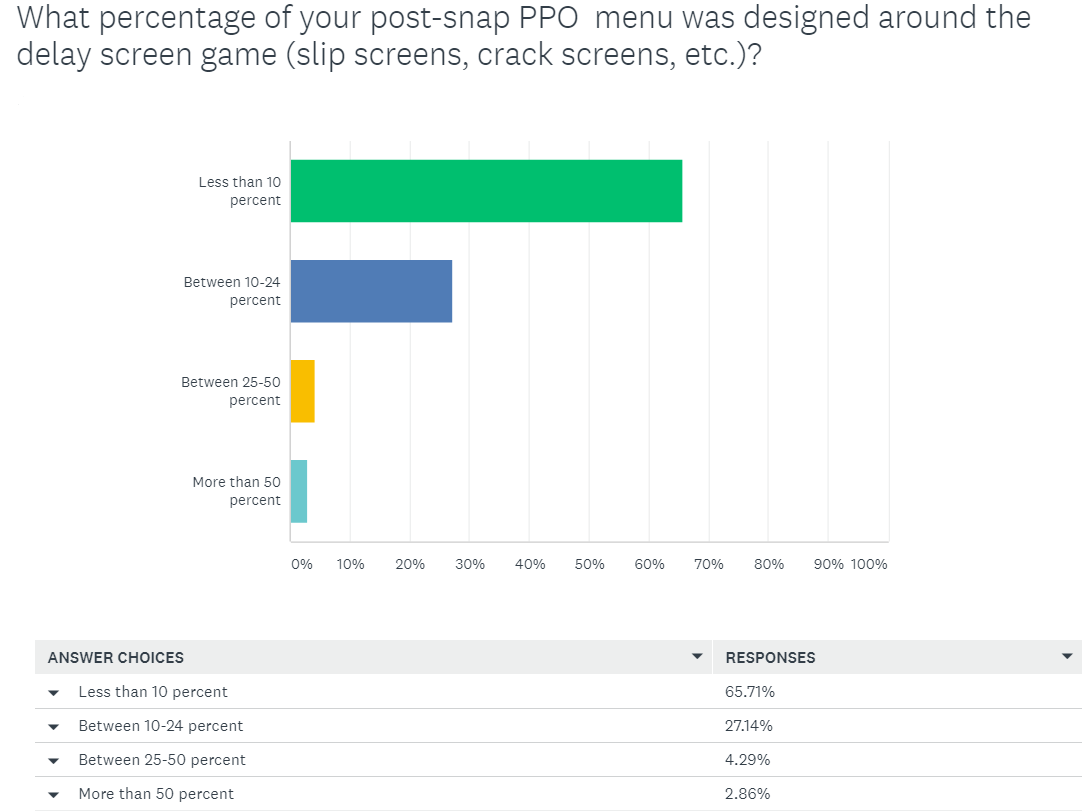
Our research has shown that 65 percent of coaches use PSOs on 10 percent of snaps or less.

d221

But when utilized correctly, PSOs can provide an easy catch and throw for the quarterback to the quick game side or a big hitter on the screen. Victor Valley College (CA) head coach John Teuscher boasted about a 79 percent completion percentage on these concepts, much higher than any other concept he had in his arsenal. One would assume the high completion percentage can be useful anywhere on the field, but we did find certain circumstances were more beneficial than others when using PSOs among our sources. Here’s what they told us:

Noel Mazzone, offensive coordinator, University of Arizona: “It’s good as an opener on first and ten and good in the mid-red zone, inside the 20-yard line or inside the 25 yard line. But you don’t want to call it against man teams. You need to run the boundary or crack screen against those situations. If it’s pure man coverage, we’ll tie in a man beater and attach a screen to it.”

Bobby Acosta, offensive coordinator, Bucknell University (PA): “For us this is a man beater when RPOs are not working. When our RPOs are dead, we lean on PSOs. We attach them to our bubbles, meshes and quick game. But usually we call the screen because we have thrown the pass concepts a few times and we see the defense has adjusted or done a great job reacting to the pass concept. We also see more man, so the screen is a man beater for us.”

John Teuscher, offensive coordinator, Victor Valley College (CA): “Everything goes with how we decide to attack that team that week with our base runs and RPO game. It’s an extension of our run game. We want to protect our base pass things that we do. It is a way to protect what we do, teams will be slower to how they run our base things. Teams know we will run these concepts and we find ways to be able to run them. This is great stuff against even fronts that will run two high coverages like 4-2-5, 4-3 is great. We will run this against everything primarily against any two high. We love this against pressure, the screen makes that very advantageous, even the pass part is good against pressure because of how quick it is.”

Read More