
Varying Boot Routes and Protections: An Alternative to RPO’s

By Gabe Fertitta  
Head Football Coach 
Catholic High School (LA) 
Twitter: @fertitta_gabe 


Introduction

Boots and pocket moving plays have always been a very important part of our offense at Catholic.  Each game, we try to have about 4 or 5 different boots in our game plan.  Initially, in Spring and Fall camp, we will teach the basic boots that surely all of you have run in the past.  These boots act as the starting point for the variety that we seek throughout the season.  Over the last 4 years, we have averaged calling about 4 to 5 boots per game.  We feel that boots accomplish a few things:   

  1. They help to keep the defense honest in their run game/pass game conflicts.
  2. They act as great drive starters or ways to get the quarterback back on schedule.
  3. Boots also allow us to break tendencies and play with the eyes of the defenders.
  4. They help protect some of our mostimportant runs. 

General Design Philosophy 

When we look at designing boots for a game plan, we generally are looking to get the ball into the flats relatively quickly and put defenders who have run/pass responsibilities in conflict.  We are not a heavy “post-snap” RPO team.  We love the “pre-snap” RPO game and will run some very simple post snap RPO reads.  We see the boot game as our way to conflict defenders with run and pass responsibilities and not ask too much of our quarterback in terms of quick decisions to hand off the ball or throw a pass. 

Once we have figured out how we want to get the ball into the flats relatively quickly, we will then develop the rest of our triangle read.  Typically this involves a deeper comeback type of route from an outside receiver and a crossing route from the backside of the formation.   

In years past, we tried to come up with a steadfast rule for boots.  If you were the #1 receiver to the boot you ran this route, #2 this route, etc.  However, in getting creative with our boot game, we realized that trying to fit boots into this type of system was extremely restricting.  Now, we simply call boots by a family of similar objects.  The basic idea for us in calling/naming boots is to not make it complicated.  Give the boot a name and call it a day. 

Other areas we consider when planning to incorporate boots are tendencies by formation or personnel group.  We know that we create some heavy tendencies when it comes to certain personnel groups or formations.  As long as we know about these tendencies, then we can choose to break them when it benefits us.  We generally try to add boots into our game plan out of formations and personnel groups that scream run to the defense.   

For the purposes of this report, I will assume that you already are running some of the staple boots in your offense.  Hopefully, the examples below will help you to add some variety into your boot game. 

Solid Boots 
Slide1

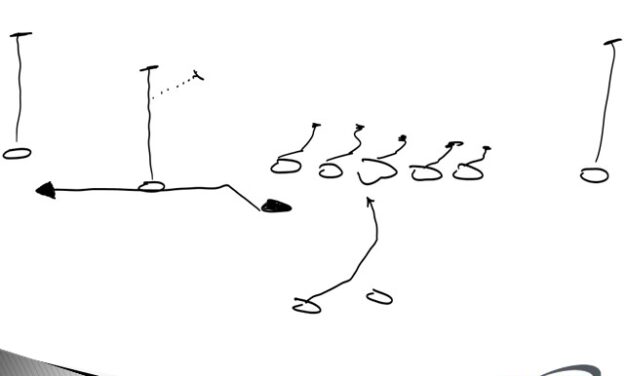
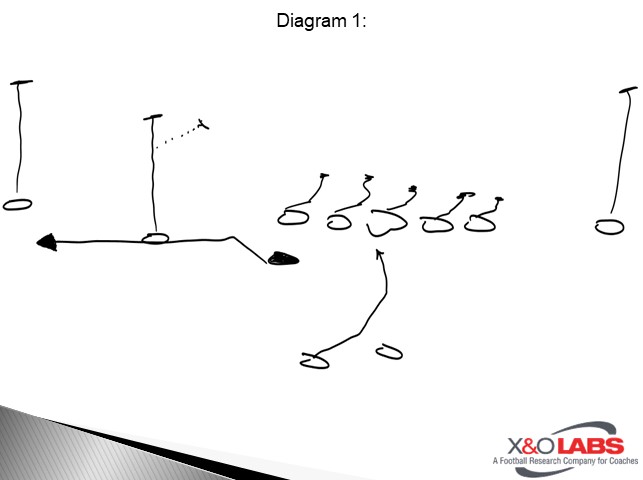
One of the popular ways for offenses to get the ball on the perimeter lately has been what we call “solid” plays.  These plays are when receivers are blocking downfield and the ball is thrown on the line of scrimmage to a player in flats.  You can see many offenses that utilize this in the zone read game.  These plays allow the offense to read and control the extra defender that can play in the box and still relate to perimeter passing game.  We teach these reads as pre-snap decisions to our quarterback.  Here is an example of a “solid” zone run from our offense.  Notice the extra defender outside the box that widens with the H when he runs the arrow route.  The quarterback hands the ball off and we have controlled the extra defender.   

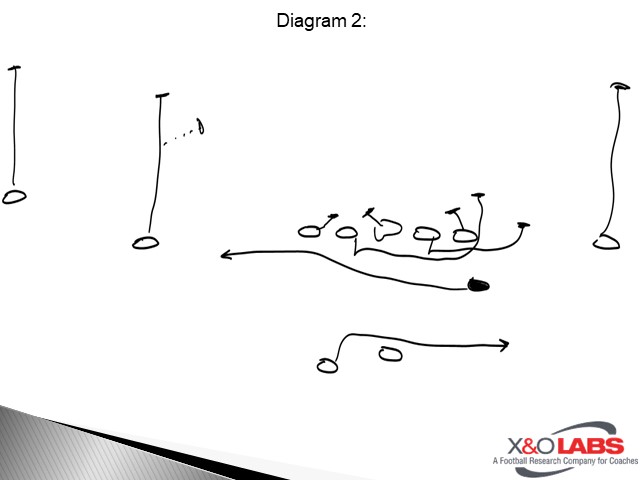
One variation to this type of boot that we have found very effective is a solid boot we run off of our buck sweep action (Diagram 2).  We tell our offensive linemen to block buck sweep but to not go downfield.  The receivers on the “solid” side of the boot will block the man on or over them.  We slide the H or fullback out into the flat and tell him not to cross the line of scrimmage until he catches the ball.  This allows our receivers to block downfield similar to a screen.  We like this version of the solid boot because it protects one of our best runs, buck sweep. 
Slide1

This first example is the most basic way that we run the play.  We pull both Guards toward the fake and slide the H underneath to a two-receiver surface.  Notice that the officials threw a flag on us for blocking downfield.  Remind officials in your pregame conference that you will be throwing these boots and catching them on the line of scrimmage.  They eventually picked up the flag.   

Read More

Option Routes from Bunch/Stack Alignments

By Danny Freund 
Wide Receivers Coach 
University of North Dakota (ND) 
Twitter: @dfreund7 


Introduction

We will detail our 5-yard option routes and concepts from the wide receiver position in this report.  The option routes give us a chance to get the ball out quickly and allow our wide receivers to get open against different coverage looks. We will talk about some of the details we teach in reading the coverage and how to run the route to maximize yards after catch. 

We had success running the option routes out of a stack (2 WR) and bunch (3 WR) alignments. We will discuss the concepts and adjustments against zone and man coverage. The first thing we ask the receivers to identify pre-snap is man or zone coverage. Determining man or zone gives them a good idea of how they will best run their routes. 

In a stack or bunch set, they think man coverage if there is press coverage on one of the receivers. Another thing to look for to determine coverage is number of defenders – if it’s three defenders defending a 3 WR bunch look, then it’s most likely man coverage. If it’s two defenders versus the 2 WR stack, then it’s some sort of man. If the defense plays four-on-three against a bunch or three-on-two versus a stack, then we assume zone.  

In our option route concepts, reading the zone coverage is important because a Cover 2 or “cloud” corner in the flat will adjust the option route. We typically ask our option route to read an “open” or “closed” flat versus zone coverage. A “closed” flat would mean the receiver sees a zone corner playing Cover 2 or Cloud technique, taking away our access to the flat. 

Stack WR Option Route Concept 

Slide1Slide1

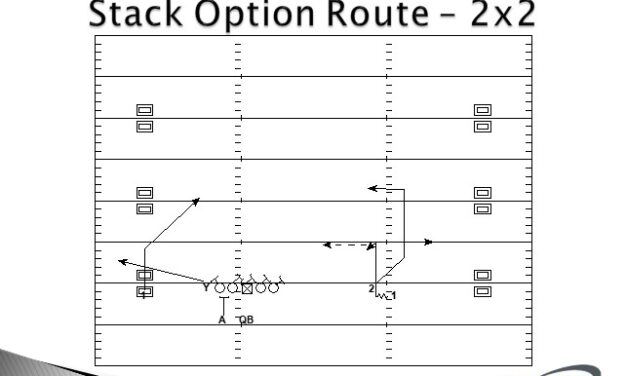
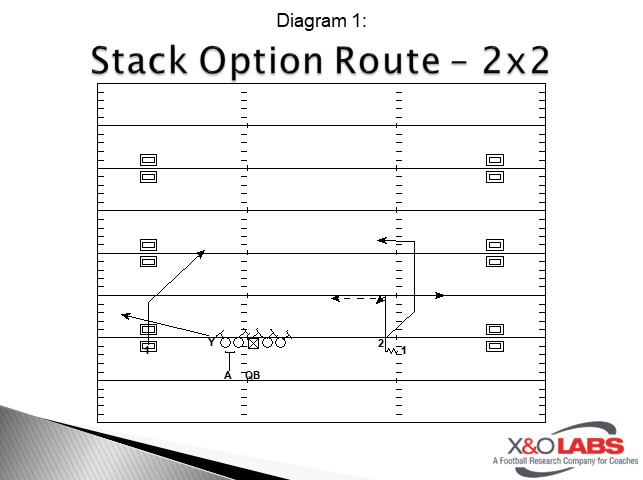
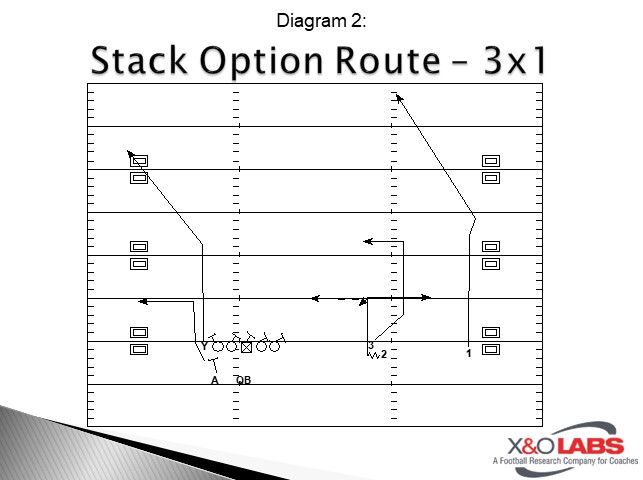
This concept we run from 2×2 or 3×1 formations. Our inside wide receiver in the stack runs widen departure Dig route at roughly 12 yards. He needs to stay flat at the top of the route. We widen departure for three to four steps based on our tighter alignment. If the concept is coming from the field side, we prefer the Dig to be caught around the hash. 

If the ball is on a hash, we want the split of the Dig receiver to be 1-2 yards inside the hash.  If we put the “stack” into the boundary, we want the split of the Dig receiver about 2 yards on top of the numbers. The split is critical because it helps spacing and throwing windows for both routes.  

Read More

Complementing Zone Iso with QB Counter

By Chris Weber 
Offensive Coordinator 
Rockford Christian High School (IL) 

Introduction

Prior to the 2017 season, as a staff, we wanted to look at the personnel on the offense and also decide what we needed to do or be able to run effectively to have more success. As with most teams we wanted to run the ball more and based on the players we had coming back we decided we needed more of a down-hill run game. We felt that adding in Iso would allow us to run between the tackles more effectively and maximize the potential of the players we had. Once we established how we wanted to run Iso we knew we would need a counter play off of it and a chance to get the defense to second guess the flow of the backfield. One of the most important factors of these plays was the blocking rule we gave to the offensive line. For game one, the team did not play the front we expected. However, we simply told the players to follow their blocking rules and everything worked just fine.   

Why Iso?  

We run a no-huddle system on offense so having Iso allows you to not only wear down the defense with tempo but also wear them down physically by running down-hill. Iso gives you the opportunity to have a short yardage play that can break open. For the opposing defense, it forces their linebackers to come up against the run and play physically with the lead back and puts the safety in a one-on-one situation for an open field tackle.  

Setting Up-Iso: 

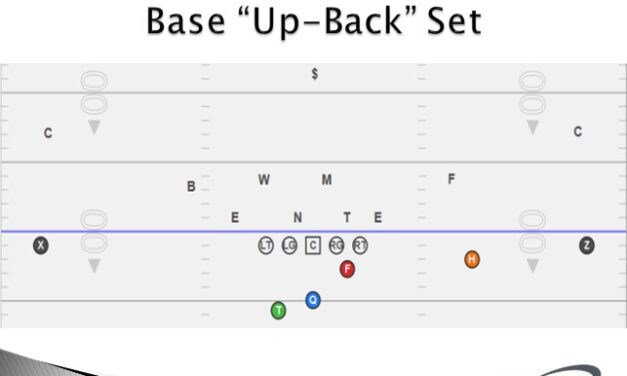
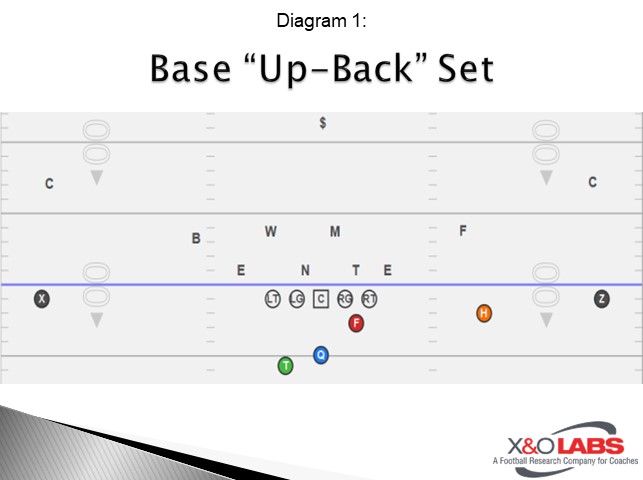
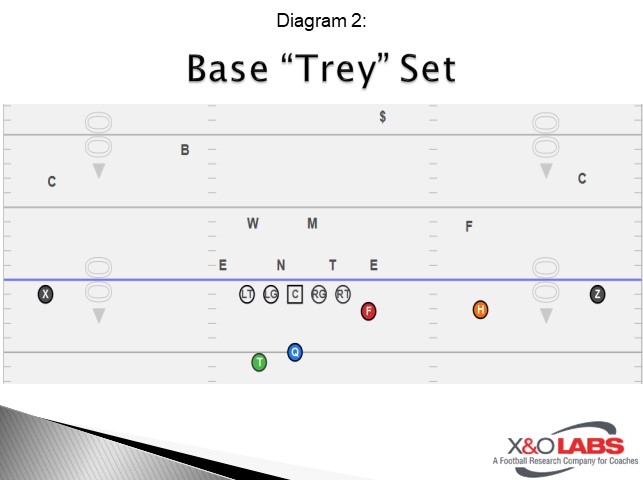
There are two formations that we mostly use when running Iso and QB Counter which is a version of our “up-back” set (Diagram 1) and what we call “Trey” (Diagram 2). Trey gives us more of a spread look without making the lead back cover too much ground to get the iso block and the up-back set still gives the defense 3 wide outs to contend with.  

Slide1Slide1

Blocking Rules and Procedures for Iso: 

On the perimeter, the Wide Receivers (X and Z) have a simple stalk blocking rule of taking the man that is “head up to inside”. This rule also applies to the slot receiver (H) or we may tell them to take the near threat to the ball. For example, they may have a Safety lined up over top and an Outside Linebacker splitting the difference between the near OT and their alignment. In this case, the H would take the OLB since he is more of a threat to the ball carrier. 

In the play call, we do not designate a ball carrier number and hole number to run to. We simply call the play as either “T Iso Right” or “T Iso Left”. Once the Offensive Line, Up-Back, and Tailback know where Iso is going, they next have to identify where the “bubble” in the defensive line is. We identify the bubble as the gap on the declared side for the run where there is not a down lineman. The lead back with taking the “bubble” and all Offensive Linemen will block away from the “bubble”. This is very simple for the OL, as they just need to determine if they are to the left or right of the bubble and then block “Down and Away” from the gap/bubble.  

Playside Tackle/Right Tackle on Iso Right – If the play side tackle has a shade technique on his outside shoulder (5-technique), he will simply block out or “away” from the bubble. However, if the play side tackle has a 4 technique head up, he will step inside on the snap to get inside leverage on the head-up defender and drive the block out away from the bubble. 

Read More

3 Palms Coverage Variations to Defend 3×1 RPO’s

By Mike Kuchar 
Senior Research Manager 
X&O Labs 

Introduction

The following research was conducted as part of X&O Labs’ special report on “Defending RPOs from Four Down, Two High Spacing” defenses. The full-length report can be accessed in the Insiders membership website.  

Palms Coverage Families to Defend Trips RPO Concepts

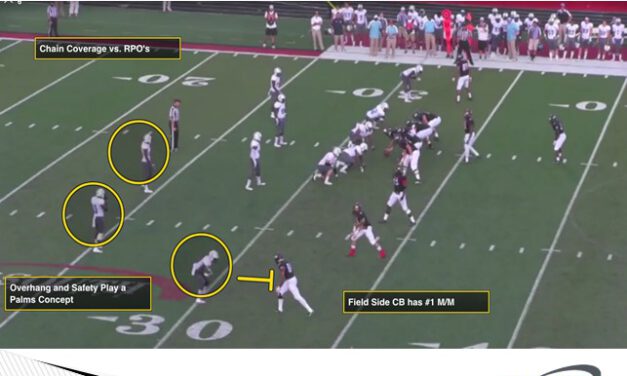
There are several adjustments that defensive coordinators are making to defend trips formation RPOs. Some of the more common ones are below:?? 

Read More

Training the Modern Day TE in 11/12 Personnel Offensive Systems – Case 1: System Overview/Alignments, Formations and Motions

By Mike Kuchar 
Senior Research Manager 
X&O Labs 
Twitter: @MikekKuchar 


Introduction

The offensive system being developed at the University of Texas is a run-heavy system; that has been the intent since head coach Tom Herman got the gig in late 2016 and a run-first offense has been his blueprint since his earliest days as an OC at Texas State in 2005. It’s a system rooted in the A and B gap run game, often using the quarterback’s role as a runner more than a passer. When he is asked to throw, he’ll rely on more play-action or push the pocket concepts to present a dual threat on the perimeter. The national audience got it’s first taste of this with the success of Ohio State University quarterbacks J.T. Barrett, Cardale Jones and Braxton Miller who thrived as dual threat players when Coach Herman was an offensive coordinator in Columbus. Now he’s working to replicate that same success in his second year in Austin and he is equipping himself with the assets to do so with dual threat quarterbacks Sam Ehlinger and Shane Buechele competing for the job. They both combined for over 700 yards rushing last season.

In the hierarchy of importance is in this system, the tight end sits a step, albeit a small one according to Coach Herman, behind the quarterback. Coach Herman is an 11 personnel disciple; it’s a grouping he coveted since he began studying film of his later protégé Urban Meyer while Meyer was the head coach at Utah. He has made it clear that he wants to play with a tight end (current starter Andrew Beck told us so in spring meetings this April). In fact, he thinks playing without one is senseless. “With true zone read being a dying play because the ends are so well coached, I don’t know how you run the ball without a tight end,” Coach Herman told us. “We are going to align in a two back set or we are going to create a two back running game with the use of a tight end. We are an A gap to B gap run team.” But one thing is certain; if you’re going to commit to keeping your tight end on the field, you better find one that is versatile.

With the healthy crop of tight ends that Texas has coming into this spring, using at least one of them shouldn’t be a problem. When Tom Herman got the job in Austin, he said he wanted to be in 11 personnel about 98 percent of the time. Injuries at that position may have limited that possibility in 2017, but consider the following as an indicator of what’s to come this fall: Let the following information serve as an indicator heading into the fall: the Longhorns were in 11 personnel in over 94 percent of snaps this spring. It seems now they have the tight ends to do it.

But in order to play that many downs during the course of a game, the Y must have a broad based knowledge of the entire system, because he will often be the adjustor to line up in different formations. “You can line up the first three plays of the game and play three different positions,” tight end coach Derek Warehime told us. “You need to be pretty good at all that stuff.” All that stuff is essentially every concept in Coach Herman’s system.

The good news is that the staff at Texas makes it easy for this player to learn and retain information. Each concept has a name, and each of those names is tied to a concept. They lump their run game into three types of concepts: tight zone, wide zones, gap runs and man runs. The pass game is separated into quick game; drop back, play action and pocket escapes. Sure, this may not be different than other offensive systems, but how many of those systems account for the tight end being asked to handle the following job descriptions all within the course of one game?

  • Know the 56 formations in Texas offensive system that the Tight End is on the field.
  • Know the 12 run concepts that are most commonly used in Texas offensive system, including the dozen tags that correspond with it.
  • Know the 6 pass protections that Texas uses with the tight end involved.
  • Know the 10 route concepts that involve the tight end.

Coach Herman wasn’t kidding when he said how important it was that this player be versatile. He would know; in his 12 years as a coordinator, he coached three that ended up in the NFL: James Casey (Rice), Collin Franklin (Iowa State) and Jeff Heuerman (Ohio State). The purpose of this study is to help coaches provide their tight ends with the necessary tools to be successful in this type of system, where much is put on their plate. We were impressed with the ways in which these players absorbed information in the short time we were there this spring considering many of these players were either hurt or played an entirely new position last season. Of the top three Y’s on the depth chart this spring only one saw significant playing time last season. The other two were redshirts. But the learning curve has been sharp. The unit has nearly doubled their catches (from 18 to 34) from last season seven practices into spring.

In this case, we wanted to present a general overview of the Longhorns’ system and transition into the role that the tight end plays in it. We will detail the formation classifications, the kinds of motions that this player is expected to know and the tempo in which he is asked to execute these rules. In subsequent cases, we’ll detail the specific types of blocks he’s asked to learn and the techniques he’s taught to execute them.

Read More

Training the Modern Day TE in 11/12 Personnel Offensive Systems – Case 2: Insert Blocking Rules and Fundamentals for Interior Runs

By Mike Kuchar 
Senior Research Manager 
X&O Labs 
Twitter: @MikekKuchar 


Introduction

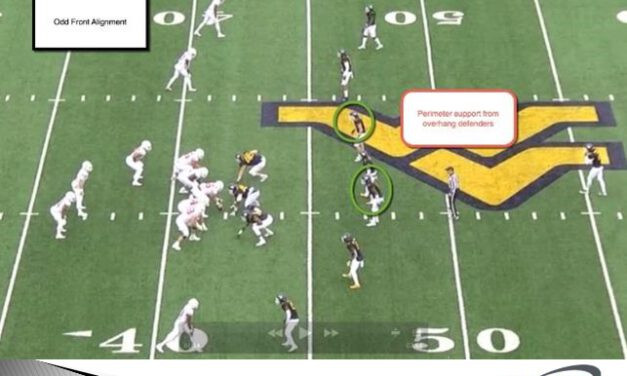
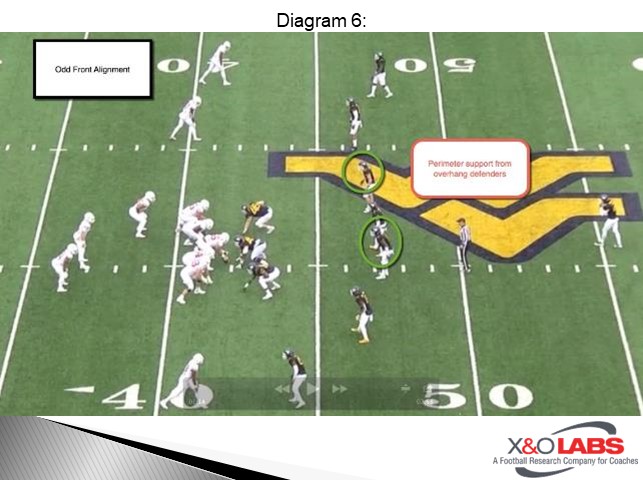
According to co-offensive coordinator Tim Beck, part of the reason why Texas is utilizing the Y so much in its run game is to attack the odd fronts synonymous in the Big 12 conference. Aside from Kansas State, the prototypical four down, two high defense, every other program in this conference bases out of a three-down front. This means there are no-open B gaps or A gaps along the line of scrimmage with perimeter support coming from overhang defenders (Diagram 6). So, if you want to run the ball against this spacing, it almost becomes necessary to insert another blocker along the line of scrimmage to create another gap. Of course, that blocker naturally becomes the tight end.

Slide6

The advantage is that Y can insert anywhere along the front, from C gap to C gap. The downside is that he has to know exactly where to fit based on play concept and he has to be prepared to block any defender, from defensive end, to zero nose to box linebacker. The job description is extremely versatile. In this case we detail the top interior A/B gap runs in this system, what blocks that tight end is expected to make and what techniques he’s taught to make them. We also explain the drill work that is used to teach this technique. First, we segment our research based off the concepts that Coach Herman has prided this offense on since its inception, the A/B gap run game.

Mantras in Run Game

If you hang around offensive line coach Herb Hand and tight ends coach Derek Warehime long enough (as we did) you’ll hear two common phrases uttered on the daily. “Get the play started” and “don’t pass color.” These are the two most frequent maxims both of these coaches use in teaching their players the run game. In fact, they are written all over the meeting rooms in Austin. We did our best to define them below:

“Get the play started”: This means that there is always one blocker that is asked to generate momentum for the play at the point of attack. It varies based on concept, but basically if this player doesn’t make his block the play is over. An example could be the tight end on the Longhorn’s speed sweep or Maserati concept (which we detail in case three). If he doesn’t block the overhang at the point of attack, the play is over.

“Don’t pass color”: This one is a little more obvious. It simply means that blockers cannot pass up a different color jersey (opponent) before carrying out their assignment. This rule trumps whatever responsibility is expected of them on the play call. An example could be the tight end passing up an edge rusher that the pulling guard missed on the play side of the Longhorn’s counter or Fiat concept (which we will detail in case three).

Box Count Relevance

We wanted to know that the tight ends are expected to know as far as box count goes in the run game. Since they are asked to do so many things, we were curious to see if Coach Warehime trains their eyes to scan the box when runs are signaled. As it turns out, there are only a couple items the Y needs to understand and much of it is predicated on the Center identification. The tight ends block in the run game is directly tied to the Center’s ID. In the Longhorns’ system, the Center will verbalize only two types of front identification (Even or Okie) and gesture with this fingers- raising four or three respectively, so the tight end can see them in the commonly crowded venues in the Big 12. His eyes go from the Center to the ID count to the defender he needs to block.

Teen vs. Deuce Identification Protocol

Like most offensive systems, the Center makes his identification count based on two things: whom the combination is working to in the run game and whom the protection is working to in the pass game. But, the identification can change based on the following: run concept, which is carrying the ball and what front the defense presents. For the most part, the Center will identify the play side linebacker in zone runs and the backside linebacker in gap runs (because that is where the combinations are occurring). In the quarterback run game, the identification can be pushed a defender back because the offense can attain an additional blocker to the play side (in the form of the running back). The Longhorns will use both a teen identification (runs that start with “1”) and a deuce identification (runs that start with “2”) to alert the Center on which he should use.

In order to keep things consistent vs. odd fronts, the Center will identify the backside linebacker in both zone and gap schemes. This is done to keep things consistent for the backside Guard and Tackle whom will be asked to block the ID and the defender past the ID, respectively. The adjusters are the play side blockers. The play side Guard and play side Tackle always double team to one past the identification play side.

Editor’s Note: In each of the diagrams presented in this report, the circled defender indicates the identification of the Center- both for run and pass.

Inside “V” vs. Outside “V” Aiming Points

Read More

Training the Modern Day TE in 11/12 Personnel Offensive Systems – Case 3: Blocking Rules and Fundamentals for Perimeter Runs and Screens

By Mike Kuchar 
Senior Research Manager 
X&O Labs 
Twitter: @MikekKuchar 


Introduction

Like most offensive systems, the runs being packaged in Austin complement each other. Power is married to pin and pull, divide zone is married to divide zone option, insert zone is married to cutoff zone. The concepts are meant to look the same to the defense, particularly the defensive end that will get a myriad of different visuals when defending this scheme. This means the onus is on the tight end to be the manipulator on these runs and continually execute different blocks based on the play concept.

In this case, we are going to present our research on how tight ends coach Derek Warehime and the offensive staff train the tight end to adjust his footwork, blocking angles and strike points to block both interior and perimeter runs in this system. It starts with understanding the aiming point and landmark needed to execute these blocks.

Inside “V” vs. Outside “V” Aiming Points

Once the identification is determined and ball is snapped, the technique kicks in. We will detail all of the techniques needed to make the blocks the tight end needs to make in this system. But before carrying out the necessary techniques, and underlying premise is the landmark in which these blocks have to be made. These landmarks fall in the realm of two categories: and outside ”V” landmark and an inside “V” landmark. Each play concept requires the tight end to block one of these landmarks:

Inside V Landmark: this means the tight end (blocker) needs to maintain inside out leverage on a defender.

Outside V Landmark: this means the tight end (blocker) needs to maintain outside in leverage on a defender.

Since understanding landmarks is so important in any run game, a great deal of emphasis is placed by Coach Warehime in teaching these tight ends to get to their landmark before making a block.

Identifying Potential “Rockets”

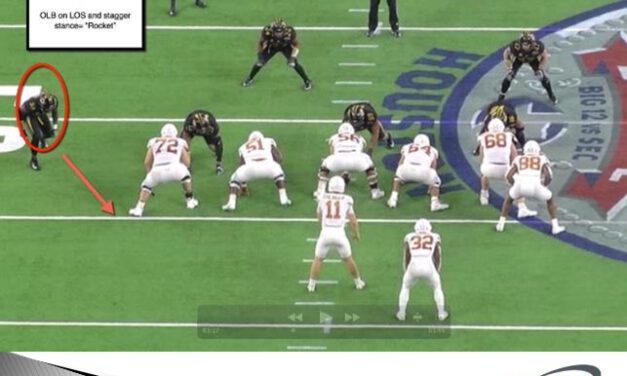
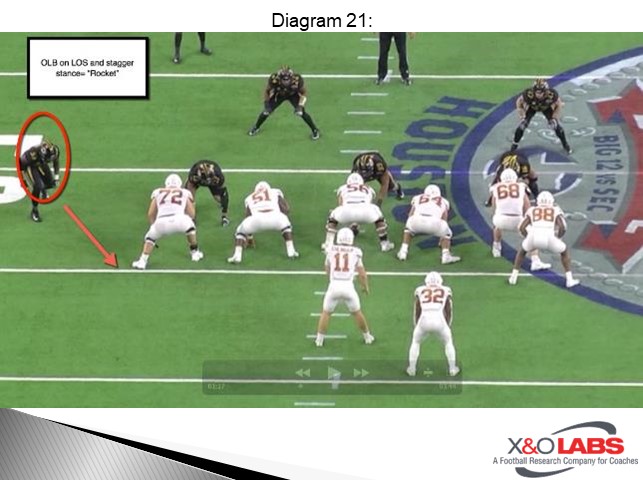
There is a code word in this system to identify a potential edge pressure that can disrupt the run game. That code word is “rocket.” Again, it’s challenging to spend five minutes within any offensive meeting without hearing that word. It resonates with quarterbacks, offensive linemen and wide receivers alike for good reason: edge pressure can severely fracture any run concept. In fact, the “rocket” adjustment is built into each of the Longhorns play concepts in the playbook. So, not surprisingly a great deal of time is spent on the tight ends not only recognizing a potential rocket, but also on how to block them. For definition sake, a rocket is classified as a defender who is in a speed stance (stagger) creeping down towards the line of scrimmage before the ball is snapped.

Slide21

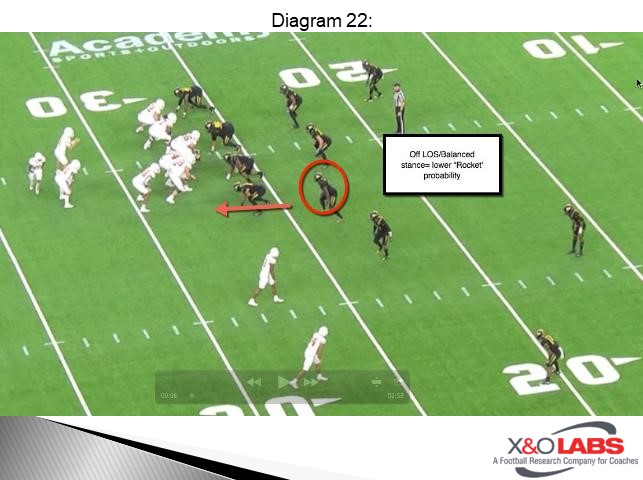
Traditionally, “rocket” in the playbook means he’s on the line of scrimmage or he’s an overhang player. And for the vast majority of the Longhorns schemes, the Y is responsible to block him one way or the other. There are some plays (like speed option which we detail in case three) where he is responsible for a late rocket defender because there are perimeter aspects to those plays. For the most part, off the line of scrimmage is a non-rocket look (Diagram 22). “Whenever that defender is in a stagnant position and not in a speed stance we can usually tell he’s not a potential blitzer,” said Coach Warehime. “But when the Y is moving with action coming out him it gets a little more difficult to determine. It’s a discussion because you get rocket to two-man blocking surfaces more than three-man surfaces because of the shorter edge.”

Slide21

“Push” vs. “Heavy” Calls

These two calls are also foundations in the Texas run game, which can change the entire blocking progression along the front. These are adjustments to deal with someone on the line of scrimmage that is not the count to the open side. Both push and heavy are also used against pressure to pull off any double team calls and are full zone principles. “Sometimes we need to pull everyone over on the play side track to block the play side rocket,” said Coach Warehime.

“Heavy” Call: The heavy call is a call used against any internal pressure such as double A gap pressure. It’s a “square shouldered” call to get linemen going north and south when double teams are required. It pulls the double teams off.

“Push” Call: This is used against play side pressure that is not in the count. Here, linemen are taught to “track” out to that defender. “That defender is not in our original count,” said Coach Warehime. “So we plus the count out on paper, but we actually track it on the football field.”

Read More

Training the Modern Day TE in 11/12 Personnel Offensive Systems – Case 4: Pass Game Responsibility – Protections and Routes

By Mike Kuchar 
Senior Research Manager 
X&O Labs 
Twitter: @MikekKuchar 


Introduction

There is no sense having a tight end on field if he can’t be a threat in the pass game. If that’s the case, you might as well bring in an extra offensive Tackle. It is Texas’ philosophy to have a tight end that cannot only pass protect but be a viable threat in the passing game. Because his offense is a downhill A/B gap system, much of Coach Tom Herman’s pass game is based on play-action concepts that complement these runs. Remember, this system produced three NFL caliber tight ends in James Casey (Rice), Collin Franklin (Iowa State) and Jeff Heuerman (Ohio State) all of which had the ability to not only pass protect but also catch footballs. And there is no better run/pass disguise to the defense than keeping this player on the field. It’s one of the goals of co- offensive coordinator Tim Beck who told us he’d like his tight ends to be on the field more than 80 percent of snaps this coming season, that includes third and long.

In this case, we are going to present our research on the main protections in Texas’ system and the tight end’s responsibility in those protections. We are also going to uncover the main routes in this system, particularly the ones that the tight end is expected to know.

Editor’s Note: Many of the nearly 200 football play diagrams in this report were drawn by FirstDown PlayBook, a digital football playbook website that has over 33,000 football plays all drawn by coaches with NFL backgrounds. For more information on this product, go here:  http://blog.firstdownplaybook.com/editing-tool

Just as footwork is put at a premium in the run game, it’s also stressed in the pass game. Although Coach Warehime doesn’t have the amount of time devoted to pass protection as the rest of the offensive line does, he focuses his teaching on some core drills in pass protection. There are the EDD pass protection drills he will work his tight ends through:

Demeanor Drill-This is more of a demeanor drill that emphasis leverage, and keeping feet under the body. It’s essential fundamentals in working against bigger offensive linemen.

To study drill film of this technique, click on the link below:

Read More

Training the Modern Day TE in 11/12 Personnel Offensive Systems – Bonus Case: 3-Day Installation and Practice Model for Game Week (NCAA and H.S. Source)

By Mike Kuchar 
Senior Research Manager 
X&O Labs 
Twitter: @MikekKuchar 


Introduction

It’s no secret that one of the biggest obstacles in developing the versatile tight end in an 11 or 12 personnel system is time. This player is entrusted with learning a great deal of information in a small time period. His time is torn between working with offensive linemen in the run game and pass protection only to be tossed over to the receivers for route progression work. It’s a daily carousel that must be honed in an organized fashion so that these players are prepared to accomplish everything that they are asked to.

At an FBS level program like Texas with ten paid assistant coaches on staff, one might not think this to be a problem. But according to Longhorns tight ends coach Derek Warehime it’s an issue he has to deal with daily. Because he’s only given 25 minutes during game week and can’t steal time from special team segments (tight ends are involved), he must be creative in how to add time to get done what he needs to. So, in this case we wanted to provide whatever coaches with a formulized plan on how to accomplish everything they need to, including drill work. We’ve even enlisted the help of a high school program that runs a similar system, Waverly High School (OH), and offensive line coach Jacob Knight who will spend a good deal of time working with this player during game weeks.

For a frame of reference, Waverly High School is a district with about 220 boys at the high school, 55 of who are football players aged 9-12. This past season their player was much more of a fullback than a tight end, so they spent a lot more time with him in the run game than pass game. According to Coach Knight, this season’s model is a converted wide receiver so he anticipates more of a 50/50 balance with run and pass to him. “Because of this you have to have a coach that is dedicated to this position and for us this guy is our tight ends coach/Special Teams coordinator Daniel Sand,” said Coach Knight. “For us knowing we have to balance this player we felt it was ultra important to have a coach dedicated solely to this position.” 

Our research is segmented into a three-day work schedule during game weeks. In most college design, Sunday is day one (players are off Monday), Tuesday and day two and Wednesday is day three. By the time Thursday rolls around it’s travel time for away games or more times spent in walk through. At the high school level, Tuesday is day one, Wednesday is day two and Thursday is day three.

Day 1 Schedule

UT Model

For Texas this is a general drill workday with 25 minutes of pure individual time. This time consists of hand placement, insert reads and basic rules. Coach Warehime will also mix in some pass protection drill work and whatever “game corrections” he needs to go over from the previous game.

Waverly High School Model

Monday is a big workday for Waverly. The tight end work is broken down into the following segments:

2 Minutes Stance Segment

On line of scrimmage off the line of scrimmage and split out as slot.  

6 Minutes Kick Out Progression

Tight end will start on a line, and the coach will give them a verbal cue to take their first drive (step). Tight end then works his first and second drive step with emphasis on getting on their proper kick out angle for power schemes.

10 Minutes Routes on Air

Tight Ends are working on running their routes appropriately as they fit into route concepts.

Read More

Streamlining Gap Scheme Teaching with the Spot Method

Matt Drinkall
Head Coach
Kansas Wesleyan University (KS)
Twitter: @DrinkallKWU


Introduction

Every offense is looking for effective and efficient ways to run the ball. A good gap system is a tremendous concept to carry because it facilities an offensive system in many ways. This report will detail the value and details of carrying a gap series, our base gap concepts, variations, and complimentary plays.

Why Gap Runs?

Our gap system is one of the most critical components to our offense. The reason I have chosen this package to detail in this article is because I believe any offense can incorporate this series and benefit from it. My favorite aspect of this play series is it is completely quantifiable. Each component of the play has easy measurements to determine correct vs incorrect. Our gap system facilitates an offense in a number of different ways:

  • Multiple personnel groups
  • Multiple formations
  • Easy to shift & motion to
  • Flexible to personnel
  • Fits most down & distance
  • Useful in any field zone
  • Excellent against movement
  • Easy to add variation to scheme
  • Outstanding for complimentary plays

Unique Teaching System

We have come up with a simple and all-encompassing way to teach our gap system to our players. I have coached in multiple systems and this is, far and away, the most effective and efficient means of communication and learning style. Our communication system totally simplifies assignments and removes the need for defensive recognition. Our system utilizes one-word assignments and teaches defensive alignment by theory. By coaching the system our way, we have built-in answers for any front we face. It has helped the most against 3-4 defenses that pressure and replace by dropping safeties into the box. It is an airtight, clean; concise manner of teaching that I am certain will be beneficial to your program.

Base Gap Terms

We have developed an outstanding teaching system that allows our gap system to operate seamlessly between plays, players, and defensive fronts. We have developed a unique terminology system that has made a gigantic impact on the effectiveness of our Gap plays. The most important aspect of our gap system is learning the terminology in our teaching, and then the play defines assignments. 

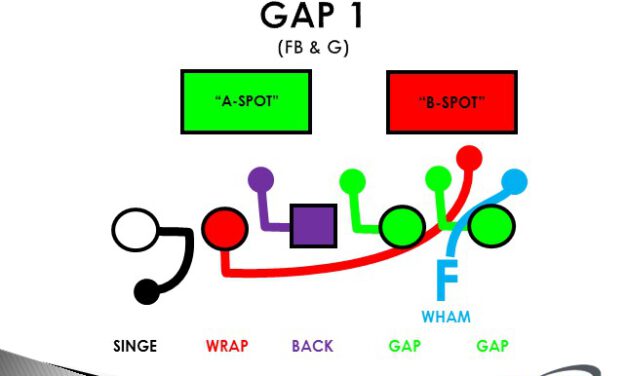
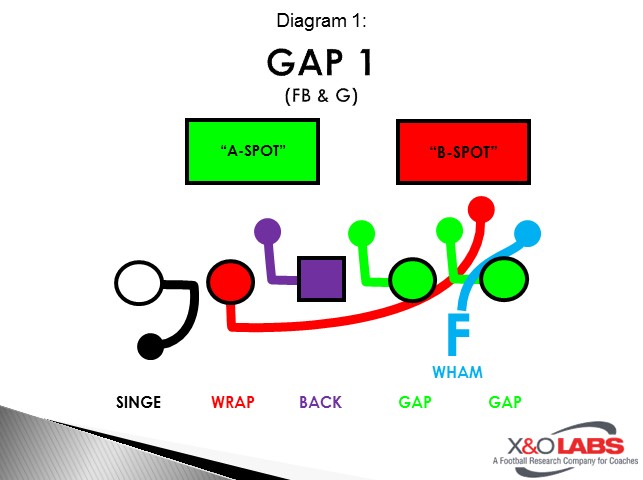
  • A-Spot: first level-two defender head-up, to back-side the center
  • B-Spot: first level-two defender play-side of the center
  • Wham: the block on the play-side C-gap defender
  • Wrap: back-side player working up B-Spot

The play side three offensive linemen always have the same assignments. Our play series determines which player is the Wham and which player is the Wrap.

Gap 1

Gap 1 is the first play of our three-play gap series. Gap 1 uses the FB as the Wham and the BSG as the Wrap. It is commonly referred to as the Power Play.

Slide1

Blocking assignments are as follows:

PST: Gap to A-Spot

PSG: Gap to A-Spot

C: Back

BSG: Wrap to B-Spot

BST: Singe

FB: Wham

Gap 2

Read More

Rip/Liz Match Coverage to Defend RPOs

By P.J. Gibbs
Defensive Coordinator/DB Coach
Gulf Coast High School (FL)
Twitter: @coachpjgibbs


Introduction

The RPO and the spread offense is constantly evolving. Defenses have to adapt and find different ways to attack the RPO and give the QB’s and their OC’s different looks and reads. As a defense, you need to adapt to your personnel and what type of pressures work best for you with your players. In this report, we will look at different coverages and pressures that have been effective for us at Gulf Coast in the past two seasons.

Match Coverage vs. RPO’s

We employ multiple coverages against the RPO’s that are common here in southwest Florida but the first coverage, and the most efficient, that we teach is Match Coverage. We use Rip/Liz Match to defend RPO’s because it confuses the QB’s RPO Read. We must force the QB to hand the ball off and not have the option to pass. That is why we always start in a 2-high to give an illusion of open middle of the field and uncovered slot. It is imperative to drill your secondary into being disciplined and become great open-field tacklers in this defense scheme because the QB may throw the ball anyway. Your secondary needs to understand landmarks and angles to ensure the defense is played correctly.

Slide1

Pattern Match Cover 3 can turn into man coverage based upon the releases of the receivers. There are many benefits to matching routes post-snap after the pattern distribution. The first benefit is that it allows you to take the “air” out of the zones. The zones are no longer based upon areas on the field, but are now based upon the pattern distribution and the receivers releases and spacing on the field. No longer are defenders “spot” dropping and covering areas. They are playing tight coverage on the receiver in their zone. It forces the QB to be more accurate and precise with his throws.

Benefits of Playing Match Coverage vs. RPO’s

  • Allows defenders to contest balls through receivers’ hands
  • Gives answers to all different route patterns
  • Allows a defense to handle vertical routes with a single high safety coverage structure

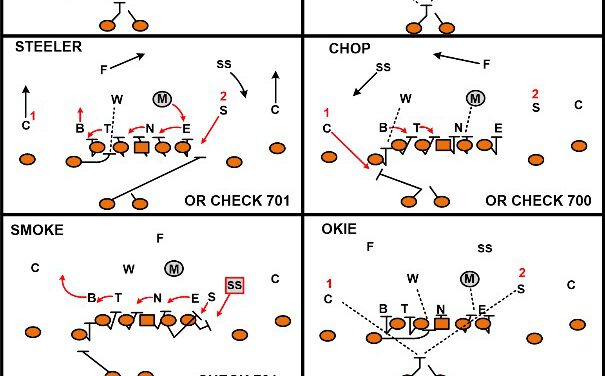
This is a split safety coverage that is pattern matching what routes the offense runs at you in a game. Since we are a 4-2-5, we play with a Viper, who is our hybrid player, he can play the run as well as cover a slot or a tight end. If we see 10 personnel in match, we will send the Viper to the passing strength, which generally is our defensive left, due to a right-handed QB. If the QB you’re facing is a lefty, then send him to the defensive right. Our two linebackers will be in “30” techniques, with the Viper will be head up to inside leverage on the #2 receiver. The Corners will be 1×5 outside leverage, pre-snap, they will then slide to a head up technique on the snap. The Safeties will be at 10 yards on the Hash, pre-snap. Our two Safeties will make a “Rip” or “Liz” call depending where the Viper is against 10 personnel. If the Viper is to our defensive left, we will then make a “Rip” Call, meaning on the snap the right safety will come down to LB depth over the #2 Receiver.

Read More

Vertical-Dig Concept: Attacking M.F.O. Coverages

By Josiah Sears
Former Offensive Coordinator/Quarterback Coach
Wheaton College (IL)
Twitter: @CoachJSears

Introduction:

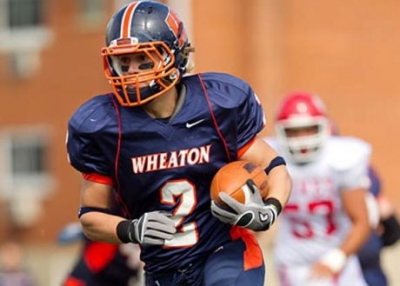
wheatonThe vertical dig concept has been a staple of our offense here at Wheaton for a few years. This is a concept we now generally use from a 3×1 formation, but can also fit in a 2×2 set. This article will discuss how we install the concept by talking about each individual route, the QBs pre-snap thought process and post-snap progression and some basic progressions and variations to the concept.
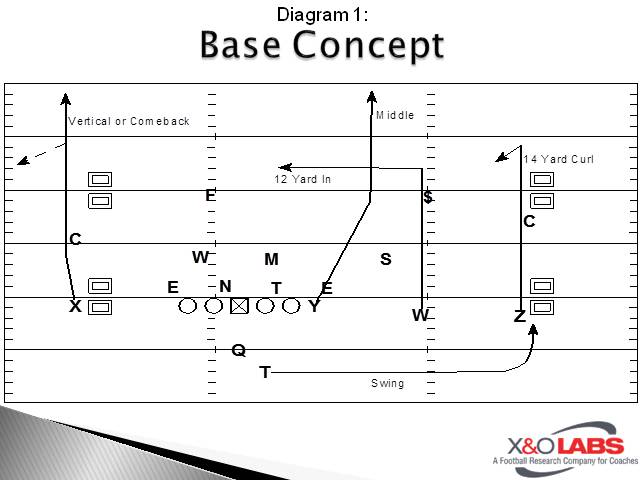
There are several reasons we use this drop back passing concept at Wheaton College. First and foremost, we feel there is a great opportunity to attack the middle of the field if a defense chooses to play open coverage versus our 3×1 formations. We also believe there is a great opportunity to stress the middle and outside linebacker to the 3 receiver side based on the responsibilities in most open coverages. Lastly, it creates a difficult scenario where a defense must commit to defending our single receiver side with two defenders or risk giving up an easy throw and catch to our best receiver.

Route Descriptions by Position

Slide1

X – Vertical or Comeback Route.

This route is coached to be an outside release on the cornerback with the goal of beating him deep. The receiver must determine by a depth of 10 yards as to whether he is going to be able to beat the corner deep or not. If the receiver does not think he can win deep, he will plant on his inside foot at 14 yards and work back to the sideline with an aiming point of 12 yards. On his release, the receiver must be aware of the sideline and remain 5 yards or more away from it at all times. This allows him room to adjust to a wide ball from the QB if he runs vertical or room to work away from the corner if he runs a comeback. His sideline spacing is vital to ensuring he has room to catch the ball when thrown in his direction.

Y – Middle Route.

This route is designed to occupy the middle of the field versus open coverage defenses. The receiver is coached to attack the inside hip of the field safety ($) and run vertical to his inside. I believe teaching a receiver to simply run down the middle of the field can lead to involvement from the backside safety (F) and make the throwing window smaller for the QB. Whereas, teaching the receiver to attack the field safety ($) gives the QB the ability to lead the receiver away from the field safety with more space to complete the pass before the backside safety (F) can get involved.
W – 12 Yard In Route. This route is self-descriptive. The receiver is taught to push vertical to a depth of 12 yards and the put his outside foot in the ground there. He will then make a square cut to the inside and work into an open window. The 12 yard depth of the route is important in relation to the QB’s progression and timing.

Read More

Teaching Same Side Footwork For RBs in Gap Runs

By Mike Kuchar
Senior Research Manager
X&O Labs
Twitter: @MikekKuchar


Introduction

The location of the offset back in the run game can be a viable tell for defensive game planning. In many situations, defenses can access the location of the run by his depth off the line of scrimmage and his width from the quarterback.  This is why so many pressures are designed away from the back in the run game and to the back in the pass game to attack protections. So it’s important now for offenses to design their run game to attack the same side that the back starts on.

Mark Holcomb, the head coach at Oak Grove High School (NC) is in the minority of coaches who actually prefers to put the ball carrier on the same side of the Counter scheme. His base alignment is splitting the guard and 2-3 steps behind the quarterback. According to Coach Holcomb, Zone should look the same as Counter and Isolation because they are all downhill schemes.

“All these downhill plays should look the same. When we run Pin/Pull and Outside Zone, we will flatten him out even with the quarterback pre-snap. All we do is tell him to take a step across the quarterback’s face and get to the midline of the quarterback’s body. As he is doing that, he is looking at the backside linebacker. All he is doing is fitting in the back pocket of the pulling tackle and making him right. We tell him it’s just like Zone. We tell our running back do not move until the QB opens the ball. When the QB opens the ball, it’s just like Zone. It’s Zone and then you run to the backside.

For example, if you’re running Counter to the right, and you are aligned to the right, you are stepping left, right and then plating that left foot in the ground and pushing off of it to get back across. It’s not difficult to do. We have our freshman and JV players doing the same thing. It’s not that difficult to do in terms of footwork.”

The clip below best illustrates this coaching point:

Read More

Creating a Buck Read and Power Read Check System

By Clay Iverson
(Former) Head Football Coach
Mukwonago High School (WI)
Twitter: @CoachIverson


Introduction

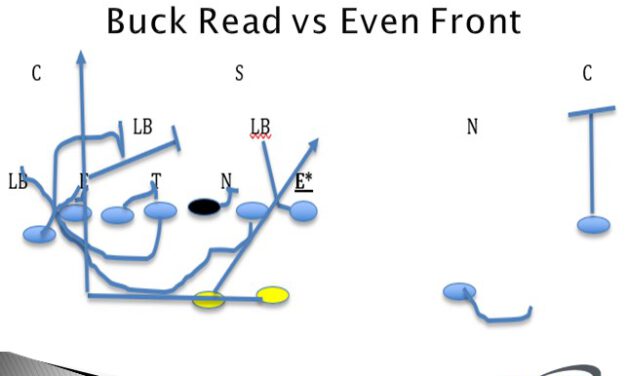
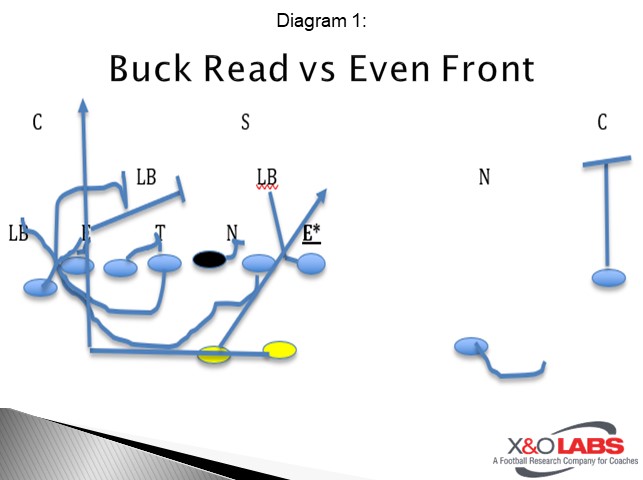
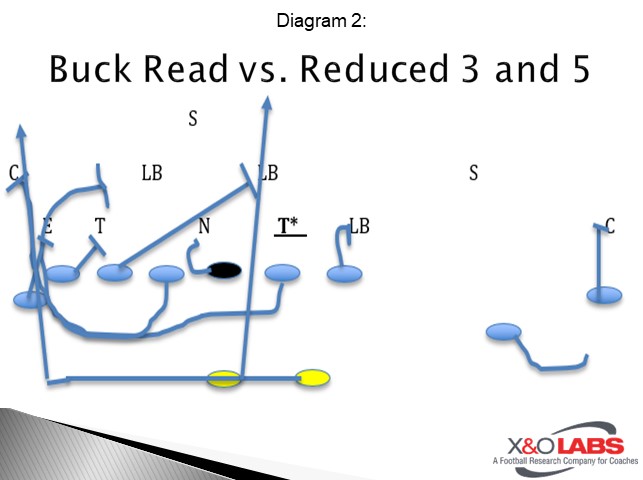
Having been a proud owner of my wing-t decoder ring for many years (yes, we have run counter criss cross and pitched it to the quarterback down field) all of the gun, spread, check and read games were never really part of my offensive tool box. That was of course until I actually started looking at how some of the really good running football teams were starting to evolve.  We started to realize that shotgun was not a dirty word and maybe there was another R.P.O other than waggle (although in my opinion none better).  So as a program that wanted to run the ball and do what we know but also start to use some of the really sound spread formations and check concepts we knew had to adapt.  So we started with our best play the buck sweep and our fastest improving play power.  Pretty soon 2X2 and 3X1 were more than just terms used when building a house.

Why Read the Buck Sweep?

For as long as we have run the Wing T, buck sweep has been my favorite and most successful play within any of the Wing T series. It is an intricate play that takes a lot of time to develop. To try and run it out of the gun and read the backside frighten to me to say the least.  However, the more we watched teams in our state and around the country do it, the more intrigued we became. While we continue to run it under center, backing up and reading it out of the gun has become more of the norm.  There are some trade-offs of course, but below are some of the advantages we found once we committed to reading the tried and true buck sweep.

  1. Formations – by getting into some 3 and 4 receiver sets and spreading people out we could create a few more natural seams in a defense. Teams could no longer load up the box.  
  2. We could stay in two backs – our QB now is a runner – we are a two back running team with 3 or 4 receivers that must be accounted for. Before we knew were going to see a lot of defensive linemen and downhill backers. We now see more traditional defensive personnel.
  3. Make teams pay – Teams were starting to follow our guards with linemen and linebackers. We had answers in the past, but not many tendency breakers other than false pulls.   Reading this play solved that in a hurry and made teams play for keying guards.
  4. Rules didn’t change much – other than the center we could keep everything the same as our traditional buck sweep – a lot of times the center’s rule stayed the same as well.
  5. Series didn’t change – we could run read sweep, jet, trap, power, waggle, and counter out of the same gun formation.
  6. We started to improve our passing game – being out of the gun cleaned up some protection rules and gave our QB better vision.
  7. Kids loved it – we showed them clips of Auburn and Clemson and other big time programs running it and the kids bought in. Football has to be sold to kids sometimes.

Slide1Slide1

Why Power Read?

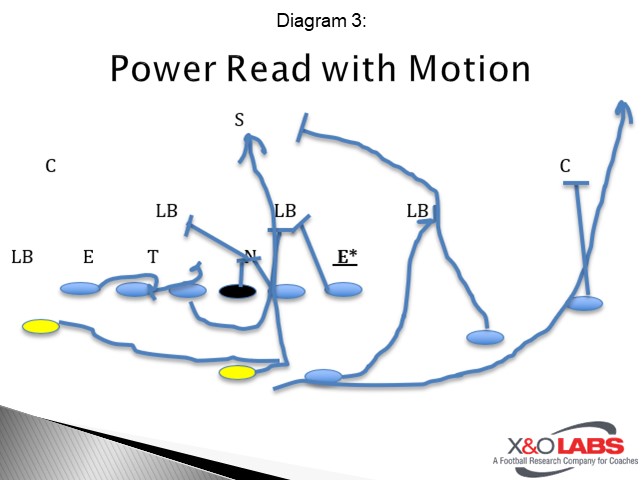
Traditional Power was starting to become a very good complement to traditional buck sweep. If we were having a hard time gap blocking the EMLOS due to him coming up field, we could now base him or even false reach him. We can also create double teams and run the ball in the A or B gap. 

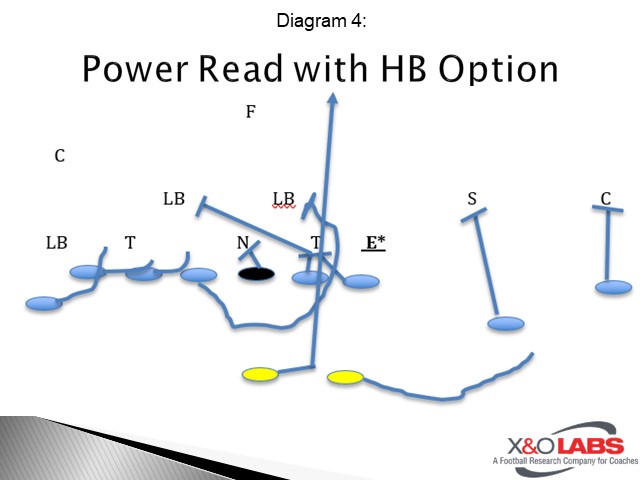
Now that we had made the commitment to use our QB as a runner and a reader, we felt we needed to be all in. To do this we wanted to be able to run our best plays in this fashion. This meant running power with the QB. The more we researched this, the more we saw people were running power with the QB and reading it with jet motion.  This intrigued us since jet was such a big part of our offense.  It allowed us to get to the perimeter fast, not have to win as many battles to be successful and the P/A and counter game fit with Wing T principles.  The motion alone gave people fits as we were using jet motion as window dressing for Wing T trap, belly and down in the run game. The advantages to stepping out from center and reading power were as follows (you could add many of the advantages of buck read as well).

  1. Formations – Once again we were able to spread people out and not have to block as many people.
  2. Conflict – Both power and jet are plays that challenge a defensive run fits – once you make them defend both you are putting at least one of their defenders in conflict.
  3. Didn’t need a dominating Tight End or Tackle – By reading the EMLOS we didn’t need to worry if we could handle him with a Tight End or Tackle.
  4. Slowed down pursuit – Again the play side linebackers could not run outside and the safeties couldn’t run the alley on jet right away or step up to play power
  5. Allowed for another second level blocker – with reading the EMLOS we could get a Tight End, Offensive Tackle or H back to the second level and outnumber defenses regardless of the read.

Slide3Slide3

Read More

The Flexibility of a Heavy GL/SY Defensive Package

By Kenny Ratledge
Defensive Coordinator
Gatlinburg-Pittman High School (TN)


Introduction

Before a team can design a goal line defensive package it must first decide where the red zone starts. What yard line is the point of demarcation? Some teams look at the -10 as that point. Others see the -5 or even the -3 as that point. Also, the offense’s personnel grouping must be a deciding factor. The use of 00, 10, 11, or 12 personnel limits the defense’s ability to get more size and defensive linemen into the game.

The package explored here is fashioned for a back and tight end heavy personnel groupings such as 22, 23, 30, 31, and 32 personnel combinations. The point of contention we are using is the -5 yard line. An added point here is that the Heavy package can be used against loaded offensive personnel groupings on other parts of the field. Its flexibility allows it to be more than a red zone defense. We base out of a 4-3 quarters coverage system. To get into the Heavy package we insert an extra defensive lineman and take out a defensive back. This gives us a 5-3-3 configuration. On the back end we can choose to play two corners and one safety or we can decide to play with three safeties considering our corners are more suited to play man coverage and, as a result, are not inherently good run defenders.

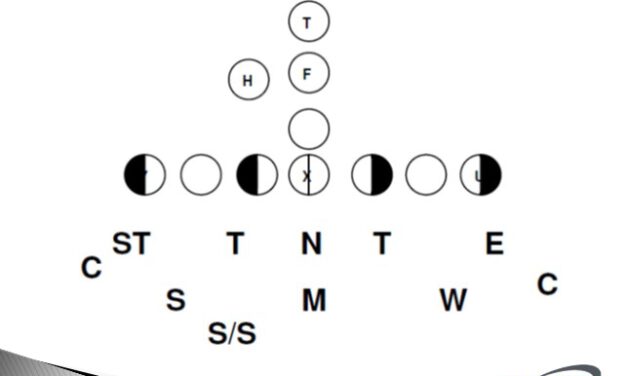
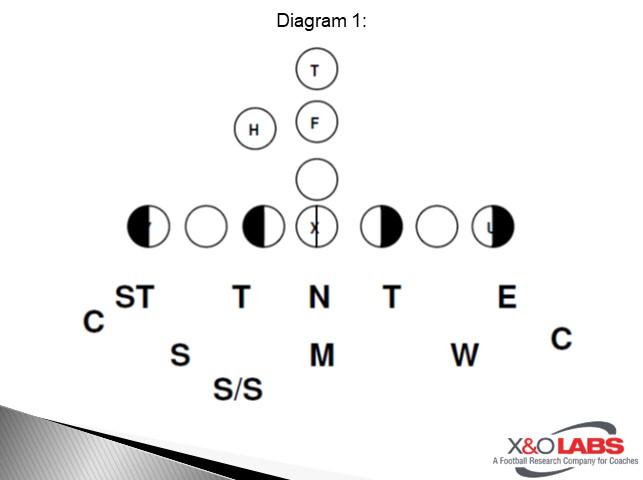
Diagram 1 shows Heavy personnel.

Slide1

Those positions include:

  • ST: Stud (defensive end to the call. 9 technique)
  • T: Tackles (right and left tackles who play 3 techniques)
  • N: Nose (0 technique)
  • E: End (defensive end to the weak side. 9 technique)
  • S: Sam (strong side outside linebacker. 50 alignment)
  • M: Mike (middle linebacker. Stack with the Nose. He may shade to the strong side in a 10 alignment)
  • W: Will (weak outside linebacker. 50 alignment)
  • C: Corners (right and left corners. Possible flip flop to get the best run defender of the two to the strength of the formation)
  • SS: Strong Safety

The base call in this package is Heavy Cover 0. This is shown in Diagram 1. With the base call the tackles align in 3 techniques and the ends line up in 9 techniques. We do have the capability to shade the Nose with a Strong or Weak Heavy call. The ends, as a changeup, line up in 7 techniques with a Heavy 7 call. With a Cover 0 call the corners take #1 to their side man to man and the Strong Safety is responsible for #2 to the strength. The outside linebackers, Sam and Will, take a back releasing to their side.

Read More