
Defending RPOs Using Assignment Football

By Kyle Bakken
Defensive Coordinator
Concordia College (MN)
Twitter: @KCBakk31


Introduction:

ccWhen we prepare to defend (triple) option, we want to be gap and assignment sound. The majority of the time, we are preparing for zone read offenses that do not incorporate a pitch player. Our approach with the RPO is to take the zone read concept and apply the pitch player responsibility to the #2 or #3 WR.

Each week we face RPOs, we break down the opposing offense and design our calls /stunts and coverages against the give, pull and pitch (pass). In this clinic report, I will describe how we have defended a 2×2 set while playing a cover 2 and cover 3 concept to specifically defend common RPO concepts.

Note: For the purposes of this report, the term “pitch it” will also include the pass as it pertains to run pass option plays.

Defining the Give, Keep, and Pitch Threats/Responsibilities

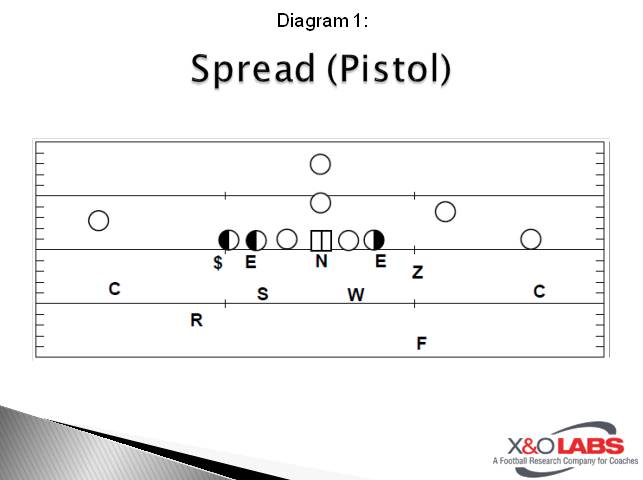
When we are preparing for an RPO opponent, the first thing we look at is the formation and backfield set. In this example (Diagram #1), we see an 11 personnel set with both pistol and offset backfields.
Slide1

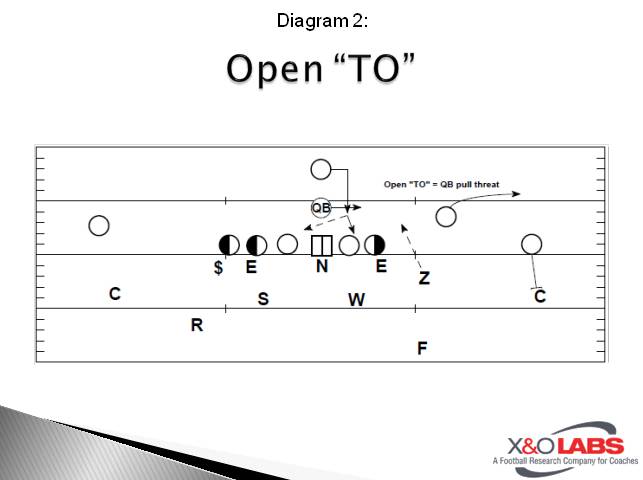
We treat a pistol backfield as a balanced backfield with an option threat in either direction as the QB has the option to open either way. From there, we identify the bubble/pass threat side in the formation which will lock in the defenders keys based upon which way the QB opens. Against the pistol, the keys must be post snap and will be based upon which way the QB opens. We give our LB’s a QB “to” or QB “away” triggers out of a pistol set to help define for them responsibilities both to and away from the run threat. When the QB opens to a particular side, there will now be QB threat with a pull and pitch option to that side and the players will respond accordingly (Diagram #2).
Slide2

When the QB opens away, the players know that they do not have a QB pull threat. (Diagram #3).
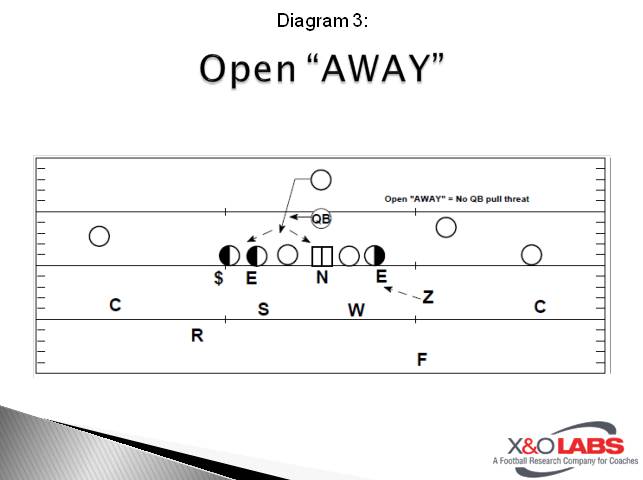
Slide3

To study game film of this concept, click on the video video below:

Read More

Structuring QB’s Pre-Snap Options

By James C. Gower
Offensive Coordinator & QBs Coach
James Madison High School (Houston, TX)
Twitter: @gower_james


Introduction:

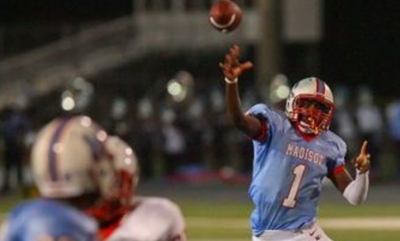
madisonMy offensive philosophy, as well as the topic of this clinic report, is calling the next play as quickly as possible, while giving your QB as many options as possible. We all hate calling a play that we think will work only to see that the defense has changed, making the play you called a bad play. To get out of the bad play, you either have had to teach your QB all kinds of audibles, or you call a time out. I want my players, and our QBs especially, to just play the game. Therefore, I do not teach them to do any kind of audibles. Instead, I teach our QBs, “the offense is like going to a restaurant; they give you a menu, and you order what looks good.” 

Scan (Pre-Snap)

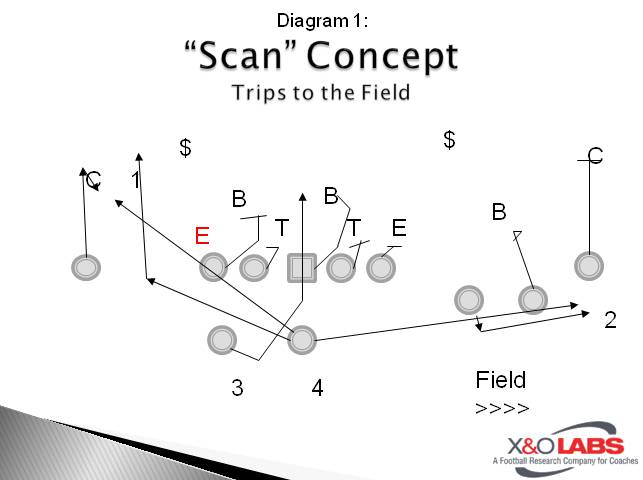
90% of our run game is the inside or outside zone. In addition, we like to match our quick game passes and screen game to our inside zone to give the QB pre-snap options. By simply adding a tag onto our run game call, we give our offense multiple opportunities to take what the defense gives us. With a simple “Scan” call, our QB/WRs have pre-snap options.

Our WR rules on “Scan” are as follows:

  • Multiple Receiver Side – The inside receiver runs the bubble and the outside receiver(s) block most dangerous man. It should be noted that we do not count an attached TE whether he is on/off the line of scrimmage. The TE is involved in the run game called.
  • Single Receiver Side – He will run a six yard Hitch. Again, we do not count an attached TE as he is involved in the run game called.

Slide1

I teach the QB the following pre-snap progression:

  1. Hitch
  2. Bubble
  3. Inside Zone (reading the end man on the line of scrimmage)

Therefore, on our inside zone to the right call with a “Scan” tag, four different people can get the football.

Read More

Eight 4-2-5 Pressures to Defend Wing T Run Schemes

By Mike Kuchar
Senior Research Manager
X&O Labs
Twitter: @MikeKKuchar

Introduction

The following research was conducted as part of X&O Labs’ special report on “Defending Unconventional Offenses.” Insiders members can access the full-length special report, login here.

Movements to Defend Wing T Run Concepts:

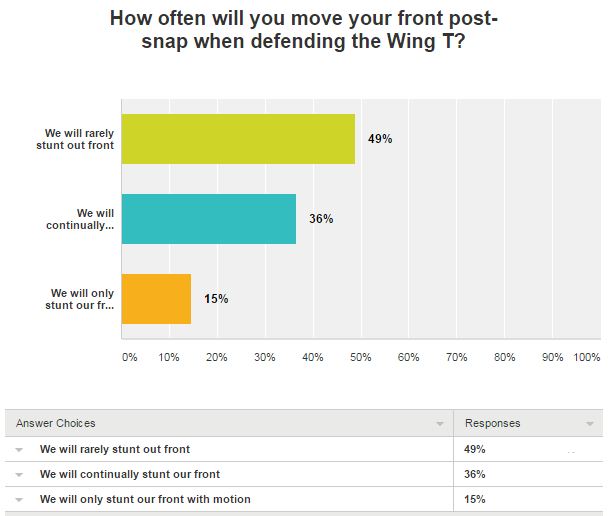
There seems to be conflicting opinions on whether or not to move the defensive front post-snap when defending the Wing T. According to our research, 49 percent of coaches choose not to move their front post-snap when defending the Wing T run game. While 35 percent will continually move their front and 16 percent will only stunt with motion.

graph11

Movements in Four Down Fronts:

Sparta High School, a perennial public school powerhouse in New Jersey has had success defending Wing T run game from its 4-2-5 front by mixing in several post-snap run movements by its first level defenders. On almost every play, Defensive Coordinator Christopher Kappelmeier will make sure one or more of his defensive linemen will be stunting into the adjacent gap or across the face of the offensive man and he’ll teach the proper stunt technique early in the preseason and practiced regularly. Many of them are gap exchanges which include second level linebackers as well.

“The linebackers need to know which gaps the defensive linemen are stunting into at all times because they will need to fit those gaps that are opened by stunting linemen should the flow head in that direction,” said Kappelmeier. “By moving our defensive linemen and linebackers on most plays, we make it very difficult for offensive linemen to execute their blocking schemes, particularly man or gap blocking schemes like the Wing-T.

“At Sparta when we practice our gap exchanges we do it during the inside run period. It is vital that the stunting linemen and linebackers be able to read and react while moving. Defensive linemen learn by repetition to read the offensive linemen toward whom they are stunting. Linebackers learn by repetition how to fit open gaps and not get caught between stunting defensive linemen. We have found that the movement of the defensive front, even if it doesn’t seem to be fundamentally sound on paper, very often creates situations in which defenders are totally unblocked and in position to make big plays. Pre-snap we try to look the same every play. The only player who may need to change his alignment is the nose. If he is stunting into the B gap, he aligns in a 2i-technique. This does not telegraph his intention to stunt because that is his alignment in the tight G front which is used often.”

Read More

Spread Gap Schemes Study – Case 1: Blocking Concepts

By Mike Kuchar
Senior Research Manager
X&O Labs
Twitter: @MikekKuchar


Introduction

bcfbIt may have been last spring when sitting at an exclusive “high school coaches” only clinic with Boston College head coach Steve Addazio when I was enlightened into the origins of utilizing gap schemes from open sets.

Coach Addazio, who won two national championships as Urban Meyer’s offensive line coach at the University of Florida, recalled a conversation he once had with Coach Meyer before the first championship season in 2006. “I remember thinking that we didn’t have the size up front to go toe-to-toe with some of the defensive units we faced in the SEC that season,” Addazio recalled. “We couldn’t just hang our hat on the Inside Zone play. So, I called Urban and told him we’ll need to do something different. We knew we had an abundance of speed on the perimeter and at our skill positions, so we didn’t want to commit to a whole sale change of bigger personnel groupings. But, we had to create angles and generate misdirection up front.”

The answer lied in using down/kick principles up front, but at the same time keeping speed on the field. So, Coach Addazio and Coach Meyer went to work in keeping 10 and 11 personnel groupings to run concepts like Power and Counter.

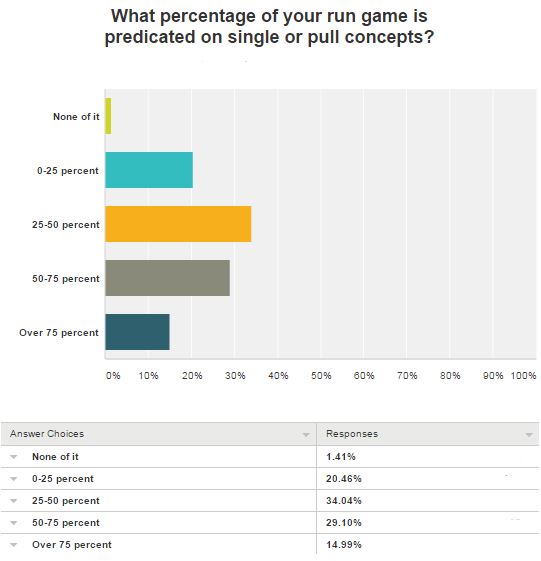
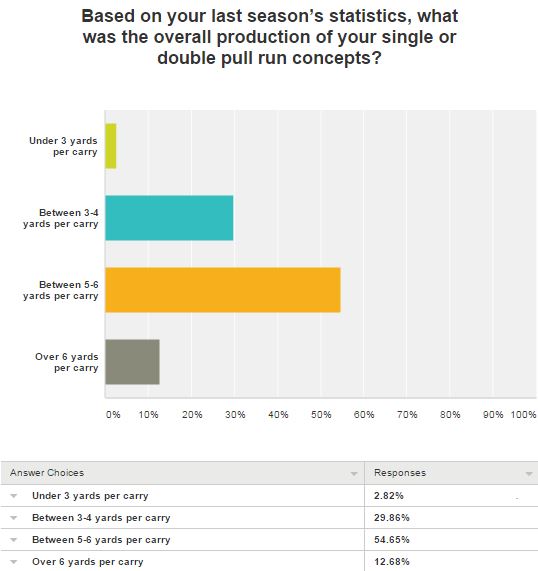
The results spoke for themselves. Two rings later, Urban Meyer and Steve Addazio’s Gators created another viable options for spread offenses to effectively run the ball. Fast forward nearly a decade later and FBS programs such as Auburn University, University of Mississippi, University of Houston (to name a few) and Coach Meyer’s new staff at The Ohio State University have used these Gap concepts from single digit personnel groupings to establish a dynamic run game. The fact is, Gap run schemes from Spread personnel groupings account for over 50 percent of the run game implemented in Spread coaches’ menus (Graph 1 Below). Of these coaches, 54 percent averaged between 5-6 yards per carry on their single and double pull Gap concepts (Graph 2 Below).

graph1

graph49

This study is centered around the three main Gap schemes offensive coaches are using from Spread personnel groupings, which we classify as the following groupings:

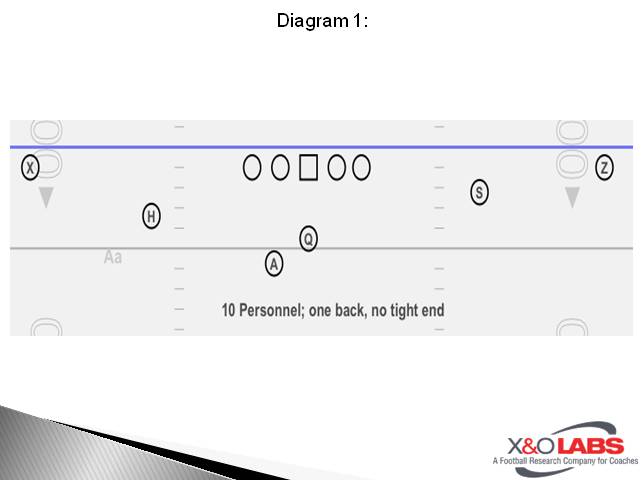
  • 10 personnel (one back, no tight end) (Diagram 1)
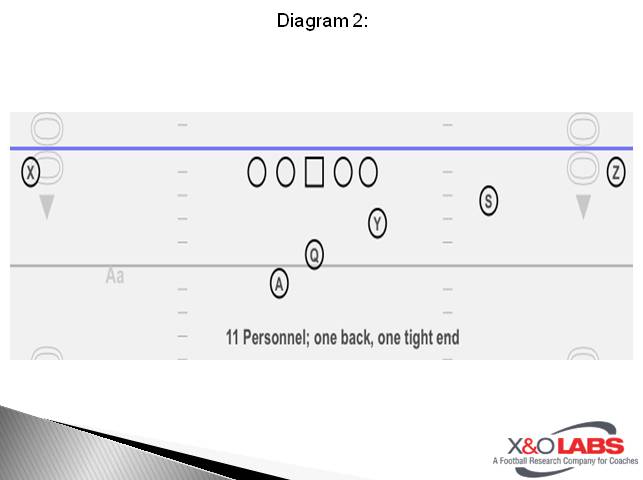
  • 11 personnel (one back, one tight end) (Diagram 2)
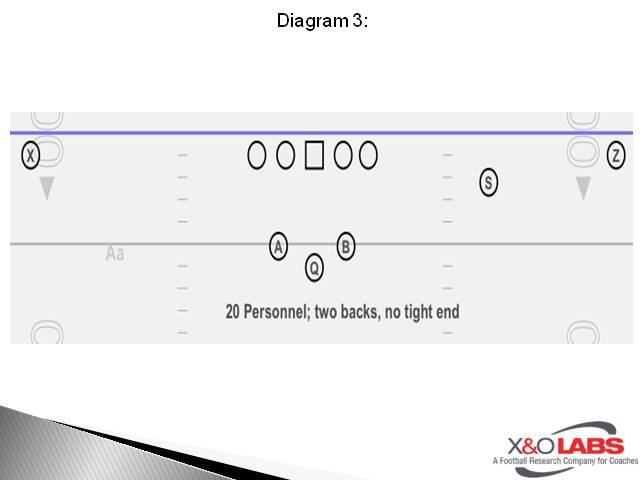
  • 20 personnel (two backs, no tight end) (Diagram 3)
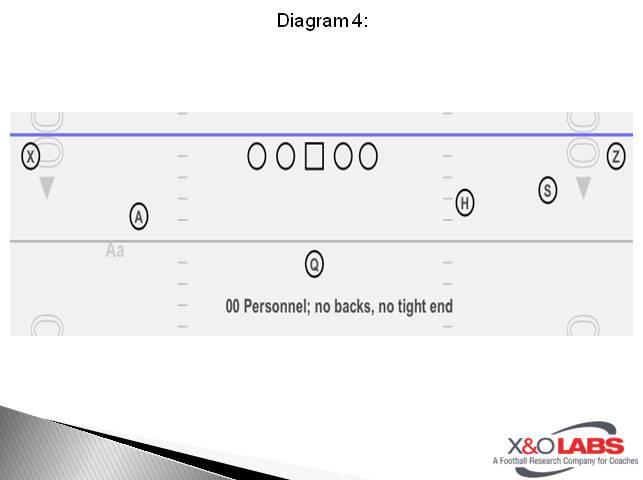
  • 00 personnel (no backs, no tight ends) (Diagram 4)

Slide1Slide2Slide3Slide4

These run concepts consist of:

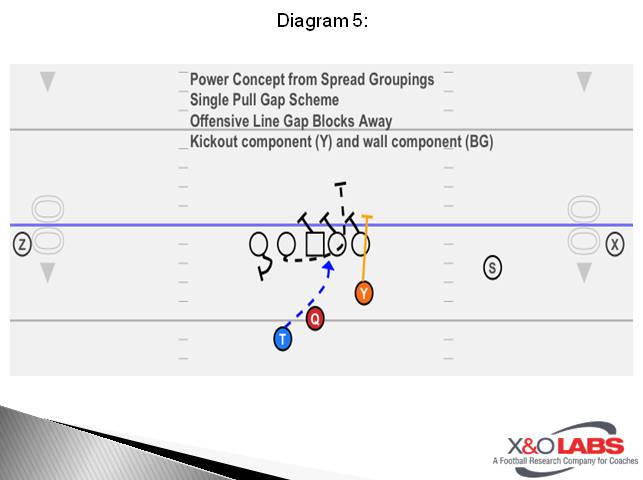
  • The one-back Power concept (Diagram 5)
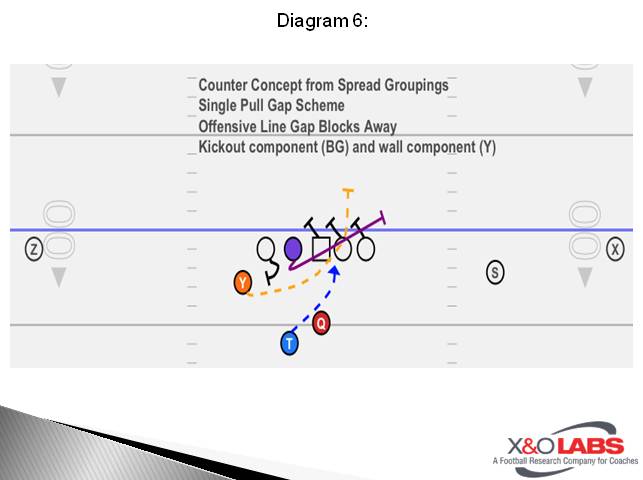
  • The one-back Counter concept (Diagram 6)
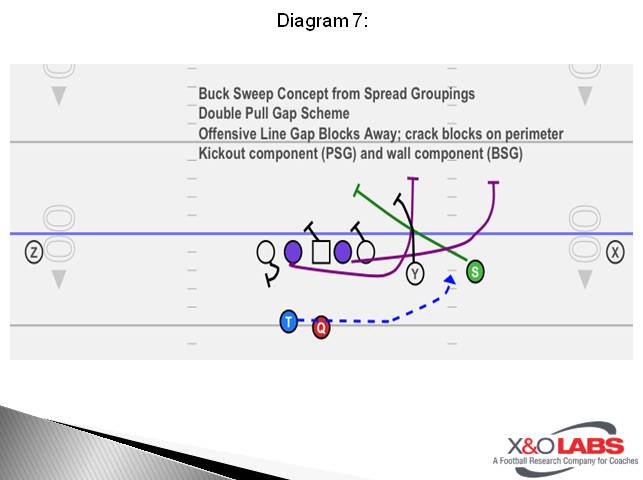
  • The Buck Sweep concept (Diagram 7)

Slide5Slide6Slide7

While each of the following cases in this study deal specifically with these particular run concepts, we wanted to compartmentalize our research in this case by singling in on the types of blocks that these Gap concepts utilize and how successful coaches are teaching these types of blocks to their players. Some of the coaches we spoke with use all of the three run concepts above, while others use one or two of them. Whatever gap concept is utilized, the following types of blocks must be utilized:

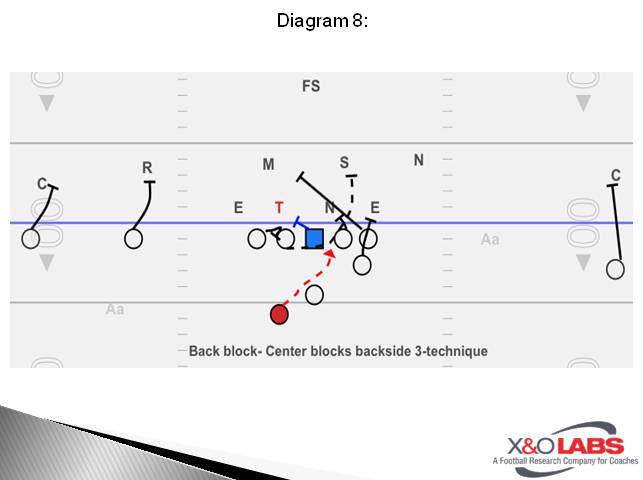
  • A single down block or back block such as Center would execute on a back side 3-technique (Diagram 8).
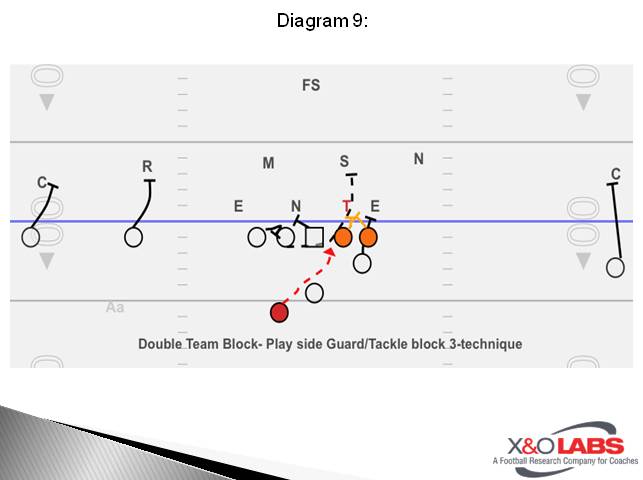
  • A double team block at the point of attack such as guard and tackle on a play side 3-technique (Diagram 9).

Slide8Slide9

Read More

Spread Gap Schemes Study – Case 2: The Single Pull Power/Power Read Concept

By Mike Kuchar
Senior Research Manager
X&O Labs
Twitter: @MikekKuchar


Introduction:

noufbThe single pull Power concept was the most utilized run concept out of Spread personnel groupings, with 89 percent of coaches using this scheme. What’s more is that over half of the coaches that responded to our survey have averaged between 5-6 yards per play on this concept alone. While the power scheme may be one of the eldest run concepts in football, how these spread coaches are formationing the scheme to reach maximum efficiency continues to be of interest. The Power concept is the truest in the form of a gap scheme because it produces the “down, down, kick” component that these gap concepts employ.

General Blocking Assignments:

Before presenting our research on what we found to be the most advantageous formations to run the one-back power concept, as well as the mesh points and reads that encompassed with the scheme, we felt it necessary to present the general blocking rules of the scheme from each of the programs that we researched.

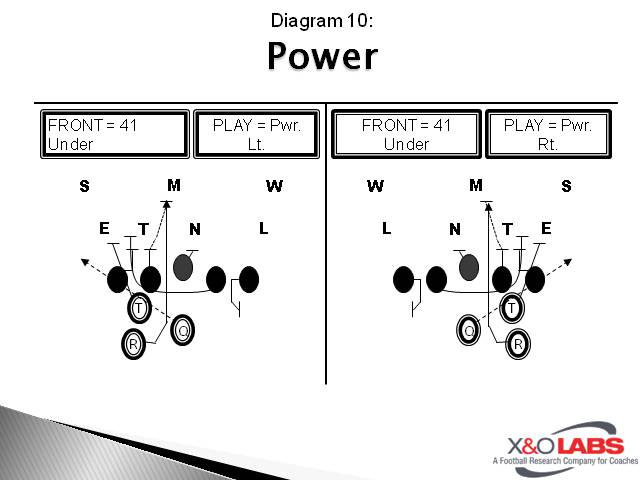
Ohio Northern University (Diagrams 10 and 11)

Slide10Slide11


PST (play side tackle): B Gap responsibility/Double 2-3 technique/Gap climb v. 2I-1-0 technique… stay square.

PSG (play side guard): A Gap responsibility/Double 2-2I-3 technique with PST/Block down on 1 technique/Double 0 with OC.

OC: Back side A Gap responsibility/Block back on 1-2-3 technique/Double 0 with PSG.

BSG (back side guard): Lead Pull/1st Defender outside widest down block.

BST (back side tackle): Back side B Gap/Gap hinge.

PSTE (play side tight end): If PST Covered (4-5 technique) C Gap responsibility/Double team with PST. PST uncovered (7-8 technique) D gap responsibility. Block first defender outside Level 1 or Level 2.

PST uncovered (9) C gap responsibility…Gap step – climb square…Block 1st gap threat…anticipate run thru.

H: Kick first defender outside widest down block.

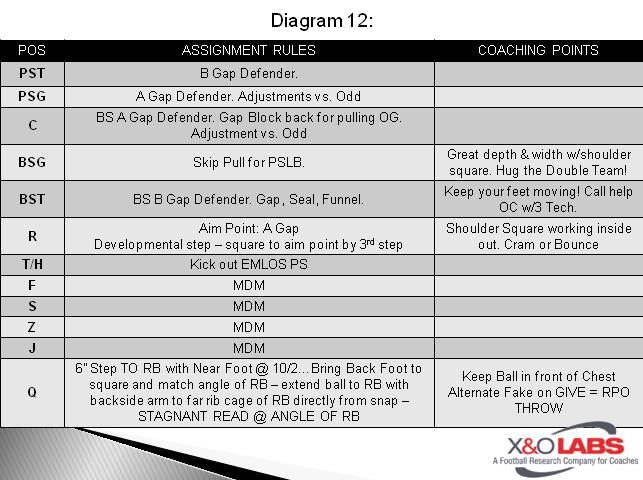
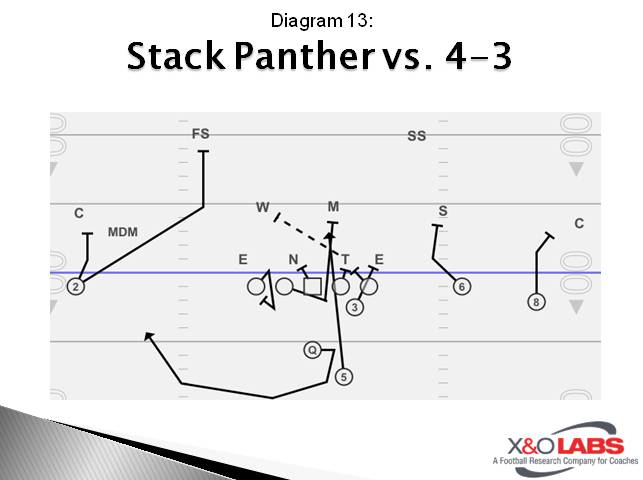
Shiloh Christian High School (AR) (Diagrams 12-13)

Slide12Slide13

X: Split: Top of the numbers (as tight as 6 yards from tackle). Dig out backside flat defender.

H: Alignment: Rip/Lip; Kick out the C gap defender using 3 step kick footwork aiming at inside number.

Y: Split: -2 (as tight as 6 yds. from tackle); Dig out play side flat defender.

Z: Split: 2 above the numbers; stalk cornerback.

PST: Down B gap to 2nd LB in the box (Deuce Back).

PSG: Down A gap to 2nd LB in the box (Deuce Back).

C: Down 1st defensive lineman backside.

BSG: Skip pull (shoulders parallel) and wrap for first LB in the box.

BST: Zone fill B gap (pick and hinge).

Choate Rosemary Hall (CT)

PSY (play side Y or H back): Block play side C gap player.

PST: B gap or backside ILB, sift if odd.

PSG: Block A gap or backside ILB.

Read More

Spread Gap Schemes Study – Case 3: The Double Pull Counter/Counter Read Concept

By Mike Kuchar
Senior Research Manager
X&O Labs
Twitter: @MikekKuchar


Introduction:

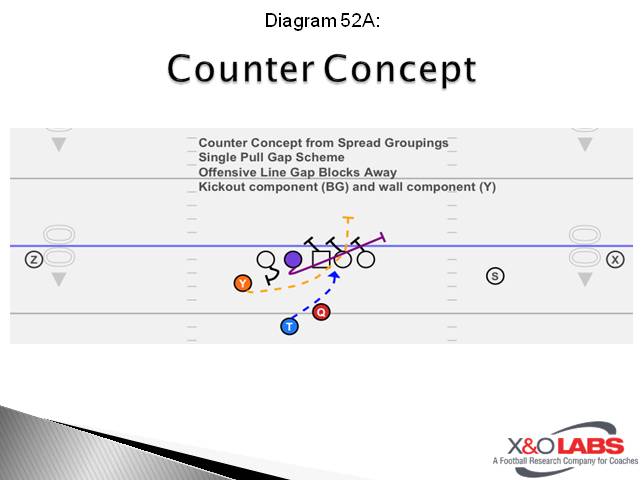
Chances are if you’re an offensive coach that utilizes the Power concept, you also have the Counter concept on your menu. It makes sense, particularly if you are using sniffer formations. While some offensive coaches feel that the Counter concept is the stepbrother of the Outside Zone scheme, formationally it marries up with the Power scheme because of the positioning of the sniffer, or B back, in one back offenses. In the Power scheme, that player is responsible for kicking out the C gap defender to the play side whereas in Counter schemes, this same player is assigned as the lead puller to the backside (Diagram 52A). We found that nearly 67 percent of coaches use the single pull counter concept in Spread personnel groupings. In this case, we will research the blocking assignments of the concept, the most preferable formations to run the scheme, how coaches are tying the sniffer into the formation as well as mesh points, ball carrier aiming points and the read concepts coaches are marrying into the counter scheme.

Slide52A

General Blocking Assignments:

For the most part, the Counter concept is similar to the Power concept because it’s a “down, down, kick” gap scheme that leaves the C gap player to be kicked out (mainly by the back side guard) and the play side inside linebacker to be walled (mainly by the Y/H). While we’ve found that there are some coaches like Lance Parker, the offensive coordinator at Bryant High School (AR), who prefers to pull the backside tackle based on defensive personnel or front, most coaches will stick to using the backside guard as the kick out block. We detail the coaching points that coaches are giving that player later on in this case.

“Leave Two” Blocking Scheme:

We’ve spoken with several coaches who use the “leave two” principle in blocking the Counter scheme. This means that the offensive line will leave the last man on the line of scrimmage and the next defender inside to be kicked and walled respectively. According to Nassau Community College (NY) quarterback coach Greg Lauri, this helps the offensive lineman for identification purposes. “The last man on the LOS will either be kicked out by the fullback or the TE, or we can read him as part of our RPO package” said Coach Lauri. “The first play side linebacker is for the pull player.”

Sprint Blocking Rules:

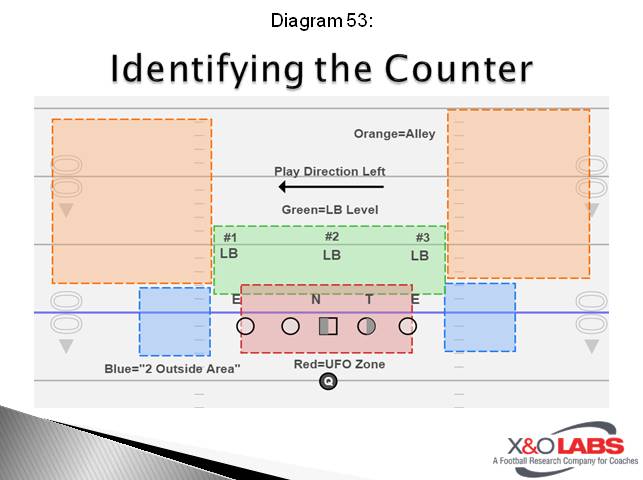
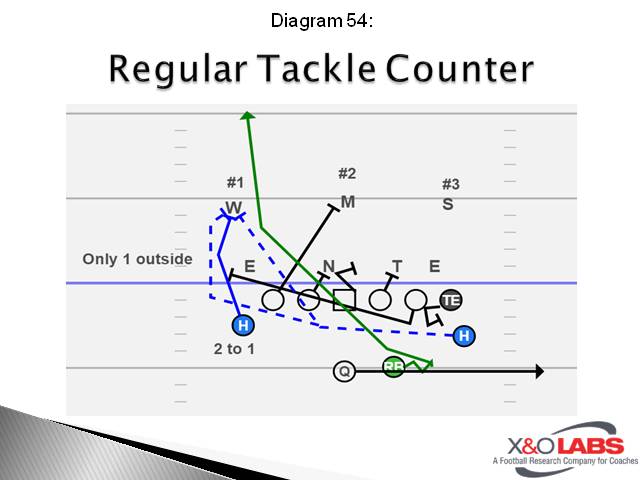
One of the more interesting ways we’ve researched how to block the Counter concept is what Coach Parker is doing at Bryant High School (AR). Rather than blocking the Counter as a gap scheme, Coach Parker prefers to use sprint out blocking rules along his front. The illustrations below are how Coach Parker looks at a Counter play to the left (Diagrams 53-54). The line down blocks and works up to the number two linebacker in the box while someone always pulls to kick the end man on the line of scrimmage. To the front side, his rules are common and he follows the “gap, down, backer” moniker. But to the backside of the scheme, Coach Parker has his players block it like sprint protection instead of gap hinging. It meshes with sprint out protection which he uses a good deal of in his offenses. It maintains continuity up front. “When we gap hinge, I feel like if you try to cut the gap off, you give them the short edge where if they want to pin their ears back and chase you down on a slow developing play the can,” said Coach Parker. “The Mike can get to you and ruin the play. We force them to ‘run the hump’ more than anything else. Not everyone is going to get there.”

Slide53Slide54

At Bryant, Coach Parker uses both a guard and tackle kicking the end man on the line of scrimmage. “Our guard kicking version netted more on our runs to our running backs,” said Coach Parker. “But I think the tackle kicking version works out better for our protection rules and for our Q draw scheme. There are advantages and disadvantages to different varieties of Counters. Your choice will largely be on what you’re trying to accomplish, defenses you face, and your personnel. Maybe our opponent that week reads guards and you could pull a linebacker off a route. Maybe the safeties read tackles and will bite down on the run. Depending on what we were trying to accomplish against our opponent, we used both versions. We called regular counter runs 8 to 10 times a game averaging about 8 yards a carry. We have to protect the effectiveness of that play.”

His line rules for Counter are gap, down, backer. The backside tackle pulls to kick the end man on the line of scrimmage. “Our line works to number two at linebacker level,” said Coach Parker. “Depending on whose gap is uncovered determines who works up. The key to us getting on the right guys is identifying where number two is. We also tell the lineman working up to number two, ‘if you have an angle for number one, you may get him but do not chase him out.’ This scenario comes up with 3-4/4-2-5 teams that play their backers tight over the guards. When in doubt, our linemen know they will always be right blocking number two.”

Read More

Spread Gap Schemes Study – Case 4: Double Pull Buck Sweep Concept

By Mike Kuchar
Senior Research Manager
X&O Labs
Twitter: @MikekKuchar


Introduction:

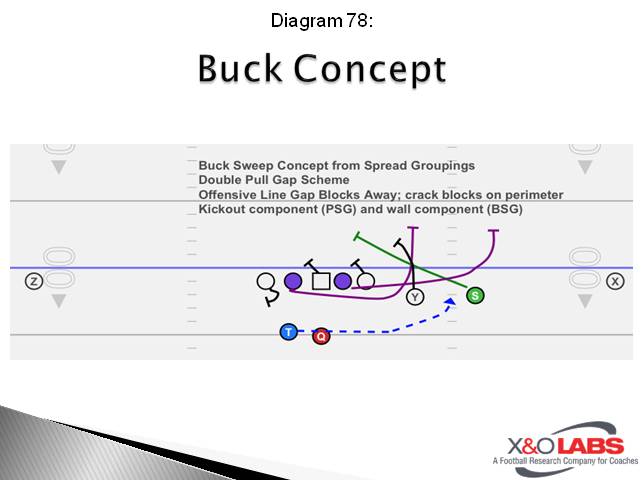
afbOne of the more popular Double Pull run concepts that has started to gain traction among Spread coaches is the ageless Buck Sweep, first originated in the days of Tubby Raymond and University of Delaware units. What once was purely a two to three back run concept has found itself into the menus of many Spread-based systems including Auburn University head coach Gus Malzahn who has been using the run since his days at Shiloh Christian High School in Arkansas. At it’s core the Buck Sweep toes the line between a gap and man run concept that combines crack and down blocking at the point of attack with the pulling of both guards (Diagram 78). Now after conducting extensive research on this concept, which we present below, we did find that some coaches are shifting from the traditional means of crack blocking into more pull/kick elements.

Slide78

According to our research, we found that 41 percent of Spread coaches run the Buck Sweep as part of their run game. We did notice that this concept continues to gain popularity considering the success of programs such as Auburn University, Clemson University and the University of Mississippi, which use this scheme frequently as part of their offensive arsenal.

In this case, we present our research on the varying blocking assignments of the scheme, how coaches are formationing the concept to attain optimal results, the preferable QB/RB alignments and mesh points, the technique behind the crack and pull blocks as well as the Read concepts that coaches are using off the base run.

General Blocking Rules:

As mentioned previously, we found a discrepancy between coaches that decide to use crack blocks at the point of attack in their Spread sets and coaches that don’t. There are, of course, Coach Raymond disciples such a George Najjar the former head coach at Sayreville High School (NJ) who choose to formation the scheme to outflank the defense which may alleviate the necessity of a kick. There are others like Mike Schmitz, the offensive coordinator at Ohio Northern University, who feel that the block of the H on the crack “ignites the scheme.” Below are the general blocking assignments on the Spread Buck Sweep concept from various contributors.

Ohio Northern University: (Diagram 79 and 79A)

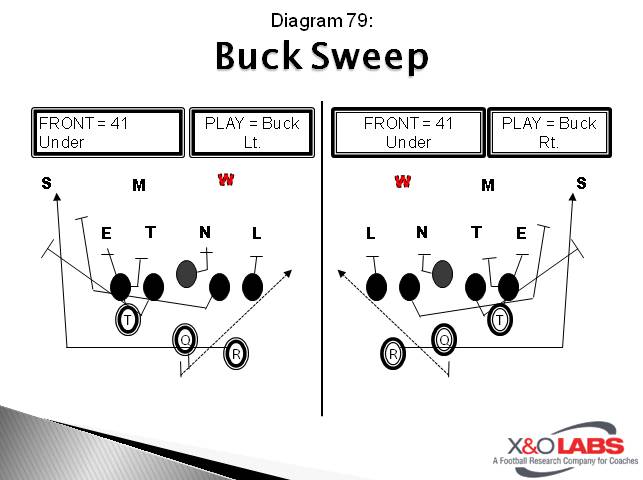
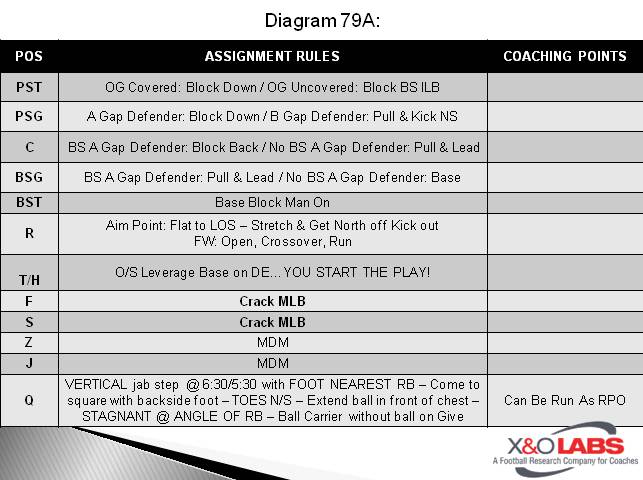
Slide79Slide79A

PST (play side tackle): PSG (play side guard) covered: Block down/PSG uncovered…B gap and climb.

PSG: Block down on A gap defender/No A gap defender…pull and kick apex defender.

OC: Backside A gap defender: Block Back/0 technique: Block Base/Uncovered: pull and lead through alley.

BSG (back side guard): Backside A gap defender or 0 technique: Pull and lead through alley/No backside A gap defender: Base.

BST (back side tackle): Base or cut backside 3-technique.

H (or tight end) Block – outside leverage base block.

Shiloh Christian High School (AR):

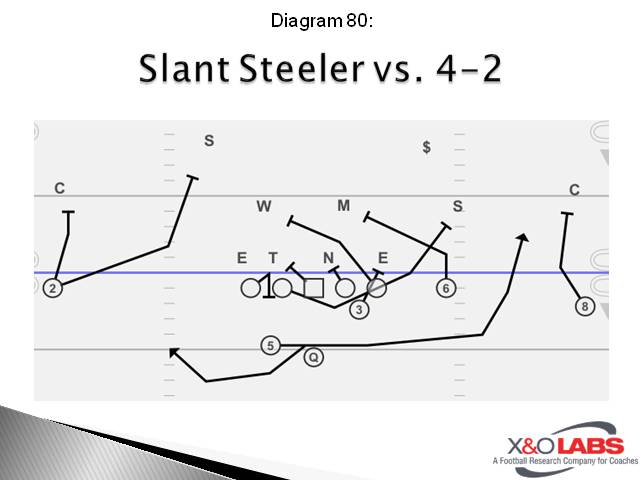
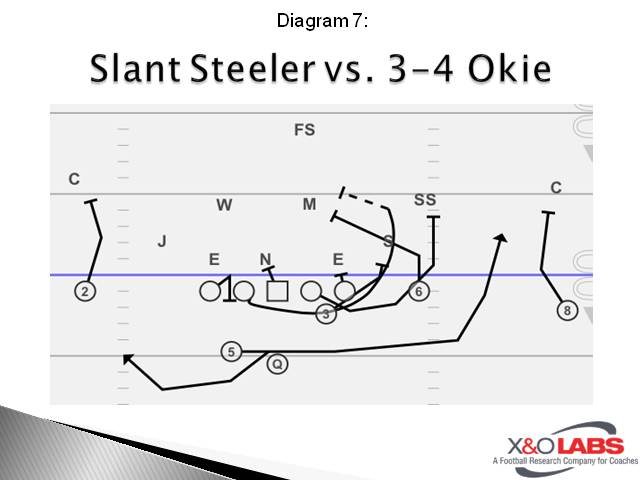
Jeff Conaway, the head coach at Shiloh Christian High School (AR), studied under Coach Malzahn and he feels that Buck Sweep is another “downhill attitude” play in his system, particularly if the defense is attempting to crowd the box. Below is how Coach Conaway blocks the concept from his Stack formation. He calls the concept “Steeler.”

Slide80Slide81

QB: Flash-mesh, hand ball, naked away.

X: Split: Top of the numbers (as tight as 6 yds. from tackle) dig out backside flat defender.

H: Alignment: Rip/Lip; Attack the midline of the C Gap defender, working to seal. Must not give up any penetration or allow C gap defender to stretch it horizontally.

Read More

Altering Blitz Angles to Defend 10/11 Personnel Run Schemes

By Steve Erxleben
Defensive Coordinator
South River High School (MD)


Introduction:

srhsThe ability to utilize fire zone blitz concepts on any down and distance is a powerful asset for any defense. It allows the defense to be multiple and defend numerous blocking schemes out of virtually any formation due to its balance and ability to adjust. With such a variety of zone schemes, gap schemes, and man schemes out of multiple formations and at much faster tempos, having a system that applies pressure and dictates tempo has been critical to our success. It also allows defenses with different levels of personnel the ability to play fast while staying sound and not having to worry about bending but not breaking.

We have also found that the ability to adjust blitz paths when bringing pressure to and away from the play is critical to successfully stopping the run. This concept adjusts the angle of the run play and spills it to safety support and/or the unblocked defender as gaps close or cancel themselves out. As a 76% blitz team at South River High School, we found that giving our defenders the ability to readjust their blitz angles by keying the hips of down lineman assignment was critical in getting our defenders unblocked. This allowed our players to play gaps across the LOS and effectively attack the offense.

Structure:

Even though this is a discussion on adjusting blitz angles versus various 1 back runs, it is warranted to briefly discuss our base defensive structure and some basic technique of our down linemen. We look at our blitzes as concepts, so in our verbiage 1 term can cover the assignments of multiple players. Our linebacker’s ability to fit off of the movement of our front is critical to executing each blitz call.

Our base defense is the only defensive call we have where we are in a “read” situation and we are asking our front 7 defenders to key lineman and fit off of blocks to leverage their gap responsibilities. Our base defense is a slanting, 1 gap, odd front scheme with match-up zone coverage principles on the back end. On virtually every snap, our interior defensive tackles are aligned head-up on the offensive tackle in a 4 point stance in a 4 technique. Our nose guard is also aligned head up and in a 4 point stance, aligned in a zero technique, head up on the center.

We like the head-up alignment because it establishes some deception and allows us to disguise where pressure is coming from as well as where we are setting the front. The head-up alignment also plays into a lot of the bluffing and bailing we do with our second level players and our secondary. This creates additional deception to what coverage we are in as well as where we will set our 1 and 5 techniques to the backside and our 4I/3 and 5 techniques to the call side.

When we “set our front” we are telling our three interior lineman to take a 45 degree attack step in the direction of the call and leverage the gap nearest to the slanting call. On the snap, our call side DT will move low and hard staying as square as he can from a 4 technique head up to a 4I technique, inside shade of the tackle. Now a B gap player, the DT will collision the inside half of the tackle getting his inside hand on the inside edge of his shoulder pad and his outside hand down the tackle’s sternum. We give our interior players a pressure key and a read key. In this situation our 4I DT is feeling the tackle that he is slanting away from while reading the block of the near guard.

  • If the guard blocks down and away from the DT or pulls inside, the DT will get his eyes inside, squeeze and stay square leveraging the B gap.
  • If the guard blocks towards the slanting DT, he will get up the field to the heels of the linemen and play the B gap aggressively.

Our NG repeats the same movement from his O alignment but his pressure key is the center and his read key is the backside guard as he becomes a 1 technique backside. Our backside DT away from the call is also performing the same technique accept his pressure key and read key are the same unless he is aligned to the TE. If he is to the open side, he is moving from a 4 to a 5 technique and his pressure and read key is the tackle. If it is a 2 TE set or we are slanting to the TE in 21 personnel, the DT’s pressure key is the tackle but he is reading the block of the TE.

In our base defense, we will set our front either to the field or the boundary, to or away from the multiple receiver side, to or away from the TE, or to or away from the back in the shot gun. Where we are setting the front is a weekly game plan decision. Every snap we make either a “Roger” or “Louie” call which dictates where the 4th rusher is coming from and, if we are in a 3 deep situation, where safety support is spinning. Our interior linemen always slant away from the front call (Roger/Louie) as the 4th rusher (our call side OLB) becomes the C gap player/5 technique call side (Diagram 1).

Read More

Adjusting the “Dump” RPO vs. Man Coverages

By Clay Patterson
Head Coach
Northeast Oklahoma A&M
Twitter: @NEO_Patt


Introduction:

neoHere at Trinity Valley Community College, we are a RPO based team with our base run play being the inside zone. We have quick passes tagged off of virtually every run play that we can call. The dump pass concept, which is an RPO play on the classic pop pass, is a tag that we had great success with when it was paired with our inside zone.

One of the best aspects of this concept is its versatility. We basically have the ability to run this off of any run play or anytime there is an uncovered tight end, running back, or wide receiver. The base concept is designed to be run to a three receiver side, but can be run any time you have an uncovered man. Over the last two years, we have averaged 15 yds per pass and 6 yds per run on plays that are include the dump concept.

Dump Concept

Slide1

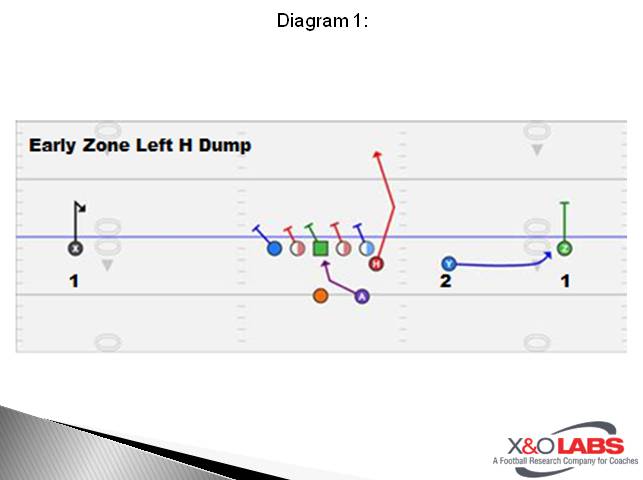
As I mentioned, normally we call inside zone and tag the dump concept for the #3 eligible player on the backside. We always have our tackles scoop or sift to the linebackers. We want the LB’s to fill their gaps with conviction. Here are the assignments of the receivers in the play:

#1 Receiver (Dump Side) – Block head up to first threat.
#2 Receiver (Dump Side) – Runs a crawfish route. For us, that is where the receiver takes one step towards the line of scrimmage and then back pedals to the sideline.
#3 Receiver (Dump Side) – Runs the dump route. The dump route is first and foremost a hot route. He will outside release away from the inside linebacker. If he is uncovered, he will slow down in the hot window while staying outside and away from the near safety. If the play side safety is directly over the top of the dump route and the backside safety is out of the picture, will run turn the dump into a bender at 8-10 yds. The Dump Route is best executed when players understand to coverage and how to run to grass.
#1 Receiver (Zone Side / away from the dump) – Runs a three step Now route (also called a Hitch).

Read More

Shake Concept in GL/SY Situations

By Davide Giuliano
Head Coach /Offensive Coordinator
Italian National American Football Team
Twitter: @ItaliaBlueTeam


Introduction:

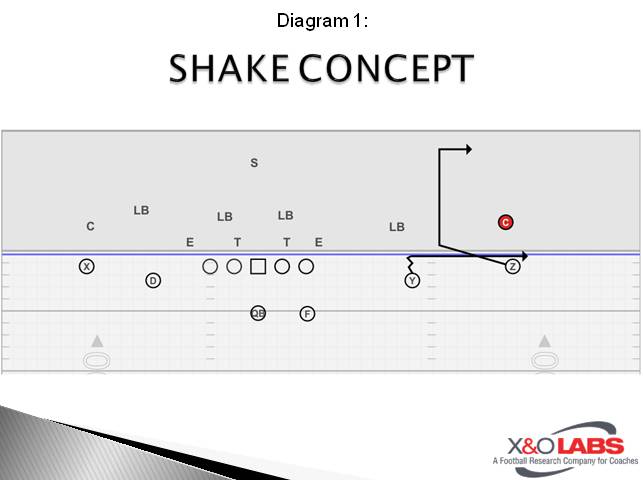
helmetsThe “rub” concept is our go to play inside the 5 yard line. We know our opponent will isolate our receivers on a man to man coverage and we use the run to take advantage of this coverage. This fits within our 1 back spread no huddle offense and gives us simple answers in the red zone.

The name of this concept is from the Shake concept made famous by the Air Raid offense. The two concepts actually look very similar to each other with the exception being that we run it in a very compressed part of the field, essentially against tight man coverage and with no post threat.

Shake is a part of our rub concepts package, often known as pick concepts. We emphasize that picking a defender is technically illegal, so we prefer to use the word rub. All we want to achieve with our rub plays is leverage, referring to the receiver being able to win the route side space and position his body so he can protect the ball from a defender covering him. Once we get leverage, all we need is to put the ball into the hands of the player with best leverage.

Slide1

Protection:

Before we get into the routes, we should briefly discuss our protection scheme.

We are a vertical set pass protection offense, our base protection is a Slide/man concept with the side of the RB blocking MDM (most-dangerous-man) and the opposite side blocking their outside gap. In each of our quick passing plays, our vertical set technique consists of two drop back steps and punch with the main goal of not letting any free rusher coming from the inside.

We also run some of our short yardage goal line plays out of a rollout protection, so we can get an additional option for the QB to keep the ball and run.

Receivers Assignments

Alignment:

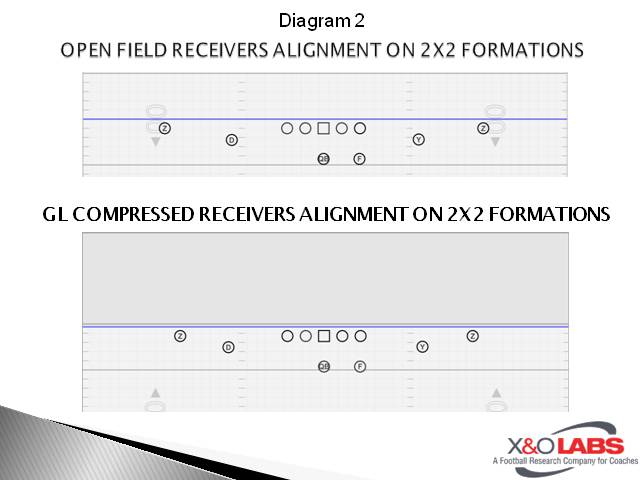
Our standard receiver alignment on a 2×2 formation is as follows:

  • Ball spotted on the opposite HM or middle of the field
    • Outside receiver lines up on the ball and just inside the numbers
    • Inside receiver lines up off the ball and splits the distance between the outside receiver and the EMOL
  • Ball spotted on the same HM
    • Outside receiver lines up on the ball and 1 yard outside the numbers
    • Inside receiver lines up off the ball and splits the distance between the outside receiver and the EMOL

When running most of our goal line pass plays, we tighten up our receivers alignment asking our outside receiver to line up 2 to 3 yards closer to the ball than usual while our inside receiver will line up 41/2 to 5 yards inside of the outside receiver. We use this alignment for the majority of our goal line pass plays not to give the defense any hint on what play we will be running.

Slide2

Read More

Man Pass Pro Drills: Case 1 – Drilling the Feet

By Mike Kuchar
Senior Research Manager
X&O Labs
Twitter: @MikekKuchar

Introduction:

When we initially began conducting our research on this topic, we were presented with a dilemma. We knew both the hands and feet were vital in pass protection, but we were curious to see which of these two components offensive line coaches placed more of an emphasis on. Of the ten contributors in this study, almost all of them suggested that the feet are more important than the hands and the reasoning is simple: The feet put an offensive lineman in the best position to stop an inside or an outside charge in man pass protection. While many offensive line coaches teach different techniques on the punch, the footwork to get him there remains vital. We started our research process by asking our contributors what the most important techniques are when coaching the feet in pass protection. Before we delve into the techniques these coaches use and the drill work that corresponds with it, a brief background on who our contributors are:

The Contributors (in alphabetical order):

  • Chennis Berry (CB), Offensive Line Coach, Southern University (8 sacks allowed in 2014, 4th in FCS).
  • Brian Callahan (BC), Offensive Line Coach, Western Michigan University (allowed 1.8 sacks per game in 2014).
  • Vin Giacalone (VG), Offensive Line Coach, Valparaiso University (5 sacks allowed in 2014, 1st in FCS).
  • Herb Hand (HH), Offensive Line Coach, Penn State University.
  • Art Kehoe (AK), Offensive Line Coach, the University of Miami.
  • Brandon Jones (BJ), former Offensive Line Coach at East Carolina University (371 passing yards per game in 2014, 3rd in FBS), currently at Cal Berkeley.
  • Jonathan Leibel (JL), Offensive Line Coach, Central Connecticut State University (11 sacks allowed in 2014, 10th in FCS).
  • Cameron Norcross (CN), Offensive Line Coach, Fresno State University.
  • Ryan Stancheck (RS), Offensive Line Coach, Alcorn State University (7 sacks allowed in 2014, 3rd in FCS).
  • John Strollo (JS), Offensive Line Coach, Ball State University (13 sacks allowed in 2014, 12th in FBS).

We started by asking a general question on footwork. Our contributors’ responses are categorized by their initials.

MK: What are some of the most important coaching points you emphasize when teaching the feet of offensive lineman in pass protection?

BC: “We spend a lot of time talking about the various kinds of alignments defensive linemen will be in pre-snap. We talk about head-up alignment, outside eye alignment, outside shoulder alignment and wide shade alignment. Our coaching points for each are as follows:

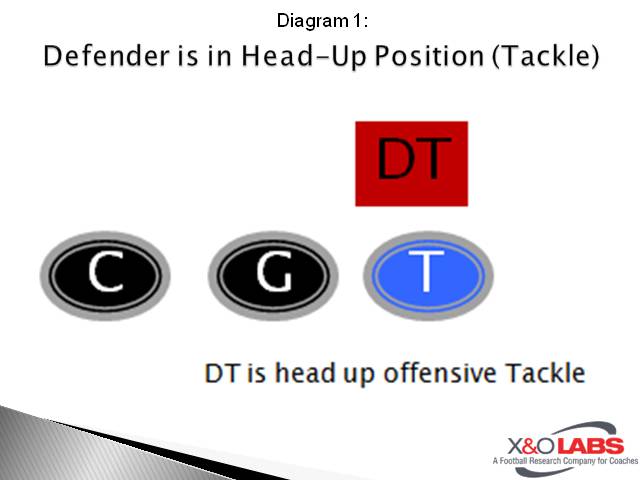
Head Up Alignment (Diagram 1): Here the offensive line short sets to the inside and takes away the inside charge of the defender. The inside power foot is moved about six inches to the inside to secure the inside against the rush that way.

Slide1

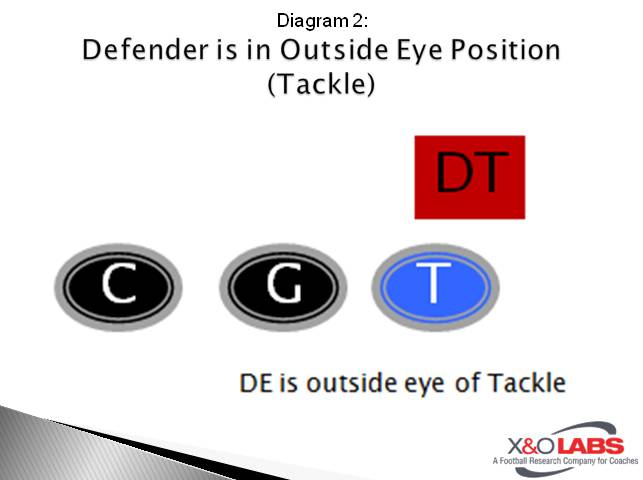
Outside Eye Alignment (Diagram 2): Here the offensive lineman moves his feet in the set but he doesn’t travel with the foot movement. He picks up the power foot, puts it down in the same spot and takes the defender in a short set. With the outside eye defender, the tackle is already in the right aiming point and doesn’t change his alignment. On an outside eye alignment, the tackle will vertical set and work the line. The line is the imaginary line drawn on the outside foot of the tackle seven yards deep. The tackle kicks one step straight back with his outside foot and drags the inside power foot. This allows the offensive tackle to react to the defenders movement inside. If there is no inside move, the tackle kicks again down the line. It gives him enough depth so he will not turn before the defensive end passes the quarterback’s set point. If he gives too much width as he works down the line, he gives up the inside and lets the defender have a two-way go. Giving up too much width allows the defenders to run twist stunts more effectively.

Slide2

Outside Shoulder Alignment (Diagram 3): Here the blocker sets short and outside and makes sure he does not give up an inside gap with his set. If he sets too wide, he gives up the inside gap to a counter move. The set is a step drop and skate back for the tackle. Tackle still works the line here. He takes two steps straight back and repeats that movement as he retreats. In the eye alignment, he sets one step because of the inside threat movement.

Read More

Man Pass Pro Drills: Case 2 – Drilling the Hands

By Mike Kuchar
Senior Research Manager
X&O Labs
Twitter: @MikekKuchar

Introduction:

While the feet come first, the hands come second. In this case, we researched the various ways in which offensive line coaches were teaching the placement and strike force of the hands in pass protection. Some taught breastplate aiming points, while others taught armpit aiming points.

Western Michigan offensive line coach Brian Callahan emphasized the “aim small, miss small” mantra while Ball State offensive line coach John Strollo has his linemen lock their thumbs together to generate force when creating a punch.

This section is devoted to the techniques and drill work associated with hand placement in man pass protection. Before we delve into the techniques these coaches use and the drill work that corresponds with it, a brief background on who our contributors are:

The Contributors (in alphabetical order):

  • Chennis Berry (CB), Offensive Line Coach, Southern University (8 sacks allowed in 2014, 4th in FCS).
  • Brian Callahan (BC), Offensive Line Coach, Western Michigan University.
  • Vin Giacalone (VG), Offensive Line Coach, Valparaiso University (5 sacks allowed in 2014, 1st in FCS).
  • Herb Hand (HH), Offensive Line Coach, Penn State University.
  • Art Kehoe (AK), Offensive Line Coach, the University of Miami (allowed 1.6 sacks per game in 2014).
  • Brandon Jones (BJ), former Offensive Line Coach at East Carolina University (371 passing yards per game in 2014, 3rd in FBS), currently at Cal Berkeley.
  • Jonathan Leibel (JL), Offensive Line Coach, Central Connecticut State University (11 sacks allowed in 2014, 10th in FCS).
  • Cameron Norcross (CN), Offensive Line Coach, Fresno State University.
  • Ryan Stancheck (RS), Offensive Line Coach, Alcorn State University (7 sacks allowed in 2014, 3rd in FCS).
  • John Strollo (JS), Offensive Line Coach, Ball State University (13 sacks allowed in 2014, 12th in FBS).

We started our research by asking a generic question. Our contributors’ responses are marked with their initials below:
MK: What coaching points do you emphasize to teach the hands of offensive linemen in pass protection?

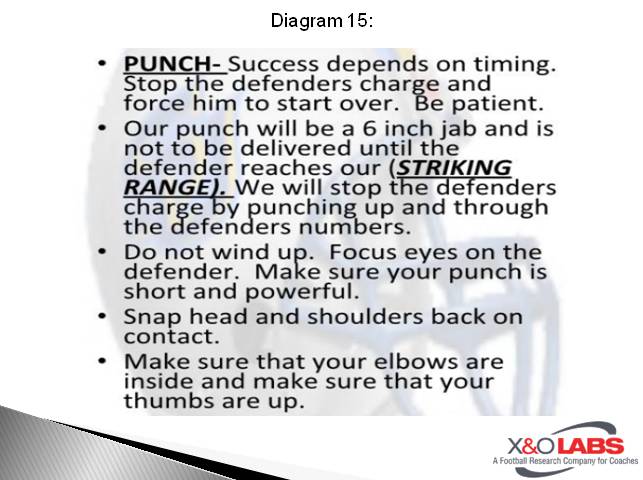
BC: “We try to have a quarter sized target on the inside number of defenders to eliminate any distractions and so that we are less susceptible to head bobs, etc. We will get elite at stabbing and punching before anything else. If I can’t punch, it doesn’t make a difference what he does. We talk about ‘set and stab’ as the hat and hands in the actual set of the offensive lineman. The stab is the punch from the hands. The coaching points are thumbs up and elbows close to the body. We want the hands on each number of the opponent’s jersey. We want to strike upward blows with the hands. I want to get a slight upward blow with a partial roll of the hips. We want to sit and separate from the defender. We do not want the defender grabbing the offensive lineman.”

CB: “We talk more about the hands than the feet. We talk about, of course, being lower than our opponents on the initial set. We don’t use a specific landmark for the hands although we do try to get them in the breastplate. Instead, we emphasize our hands touching each other. As long as they touch, that gives us a good frame of reference for the punch (Diagram 14).”

Slide15

JS: “We want to play long to increase our striking radius and protect our chest. To us, the definition of long is to get our hands on the defender first before you get your head or shoulder on him. If you anchor your hands quickly and properly, you may not have to apply your head or shoulder. When your hands are anchored to the man and your feet are rooted to the ground, you can transfer force to him in order to affect change. Stability is the function of posture, equilibrium, roots and anchors, while instability is usually created by taking big steps or having too narrow of a base. Our goal is to change the opponent by destabilizing him. We want to ‘push him into the pool’ without falling into the pool ourselves.

Hand Placement Drill: East Carolina University

Read More

Man Pass Pro Drills: Case 3 – Blocking First Level Twists

By Mike Kuchar
Senior Research Manager
X&O Labs
Twitter: @MikekKuchar

Introduction:

While many of the techniques in the previous two cases can be applied when blocking stagnant or stationary targets, the greater issue in pass protection is coaching players on how to defend movement, particularly at the first level.

This section is devoted to the techniques and drill work associated with defending E/T and T/E games, zone pressures and man pressures in pass protection. We researched not only how offensive line coaches are teaching their players to identify pressure, but more importantly, how to block it when it does come. Before we delve into the techniques these coaches use and the drill work that corresponds with it, a brief background on who our contributors are:

The Contributors (in alphabetical order):

  • Chennis Berry (CB), Offensive Line Coach, Southern University (8 sacks allowed in 2014, 4th in FCS).
  • Brian Callahan (BC), Offensive Line Coach, Western Michigan University,
  • Vin Giacalone (VG), Offensive Line Coach, Valparaiso University (5 sacks allowed in 2014, 1st in FCS).
  • Herb Hand (HH), Offensive Line Coach, Penn State University.
  • Art Kehoe (AK), Offensive Line Coach, the University of Miami (allowed 1.6 sacks per game in 2014).
  • Brandon Jones (BJ), former Offensive Line Coach at East Carolina University (371 passing yards per game in 2014, 3rd in FBS), currently at Cal Berkeley.
  • Jonathan Leibel (JL), Offensive Line Coach, Central Connecticut State University (11 sacks allowed in 2014, 10th in FCS).
  • Cameron Norcross (CN), Offensive Line Coach, Fresno State University.
  • Ryan Stancheck (RS), Offensive Line Coach, Alcorn State University (7 sacks allowed in 2014, 3rd in FCS).
  • John Strollo (JS), Offensive Line Coach, Ball State University (13 sacks allowed in 2014, 12th in FBS).

We started by asking our contributors two questions. Their replies are marked with their initials below:
MK: What are some pressure “tells” you work with your offensive linemen in recognizing?
BJ: “We talk about blitz demeanor more than anything. We don’t use a vertical set to the man side. We read the linebackers blitz demeanor. If he is heavy on his toes and he’s hugged up we will make sure we protect the inside. We will get a lot of Bluff fronts where teams will line up in two 3-techniques. We want to get big-on-big if they are mugged up, our running back has to earn his keep. So they will slide to the Mike. We used to try to gap it and put the back on the DE, but instead we did it another way. My rules for the tackles are if the defensive end spies (drops), your eyes have to go outside in case they bring a corner or outside backer. If all else clears, we come back inside and body presence and find work. They used to mug him up and drop him because you didn’t want the running back on the backer.”

RS: “Much of it is by game plan. We will know before we play them if they are either a back blitz team, a boundary blitz team or a field blitz team percentage wise. I put it on the tackle, but this year I had a smart center. We read safeties, one high vs. two high. If that safety is rolling down we have to be aware of it. If we have two receivers out there and three defenders we need to know something is coming there. We can change pressure if it shows late, but it’s on the quarterback. Six-man protection is harder to change because you already have your wall side (slide side). We will set the wall side to the side of the pressure. A shade technique is a big indicator for us as well. If he’s been a 2i-technique and he lines up in a shade, then we need to be aware of it to cross face. If a 5-technique is always loose and then he lines up as a tight 4-technique, than that’s something we need to be aware of. Anytime you have a standup, you need to be aware of it. You want your wall to be there. We will often get teams mugging the center, where the backers walk up on the line of scrimmage then bail out. We would have to make a man call in this situation and often times you get one-on-one blocking. It’s a three down look but it’s Bear. Now you have to man it up. It’s hard because you’re man against a player running a 4.6 forty. Those linebackers walk up.”

BC: “Many times teams they will either give it away or come from a distance which will allow us to react back to it. The secondary players will try to hold to see our indicator but it’s our job to make sure we’re not telegraphing our protections.
The quarterback will handle this most of the time, but I do think linemen should know it. Teams that run fire zone pressures give the offense some certain indicators. The first hint is the alignment of the Mike linebacker who widens to an almost a 5-technique stack position when pressure is coming from his side. The 3-technique could be wider than normal and, in some cases, his stance reverses. Instead of having his ball hand on the ground, his outside hand is down to aid his outside movement. We try to look at all of that.”

Read More

Third-Level RPO Concepts Off Inside Zone and Jet Sweep

By Joe Whipple
Head Coach
Schalmont High School (NY)
Twitter: @coachwhip

Introduction

whippleWe run Inside Zone, Veer, Buck Sweep, and Jet Sweep as our core plays. In order for us to run these plays successfully we add “pops” to these plays. These pop concepts serve as RPO options for us that allow us to read second and third level defenders. There are countless options once you have your core plays down. These pop tags have allowed us to average 60 points a game this year. In this clinic report, I will break down our favorite third level-reads as they are less common and have been particularly potent for us this past year.

Play-Calling Progression

Before we get into the details of our RPOs, here is how we call these plays in our system. The quarterback will call the run side of the play first; then, if there is a second call, that call will be the pop side or screen side of the play.

This helps the line know which way to work their techniques. For example, “red” is jet sweep to the right. That means that the right side of the line will execute jet sweep with the skill players on the right and the running back. If the second call is “light,” that indicates that the left side will run our WR screen to the Left.

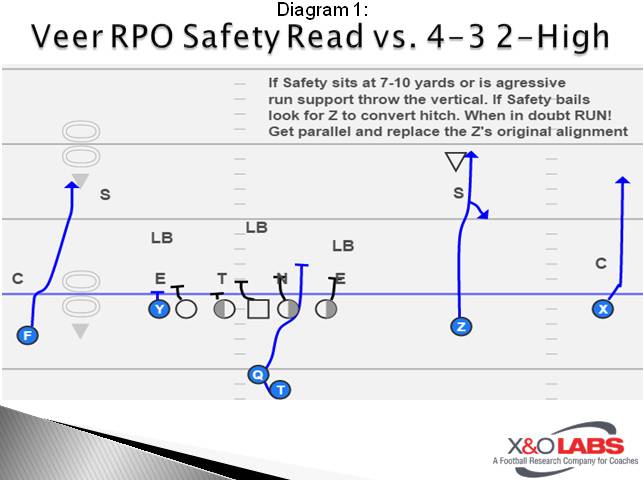
Veer Safety Read

Slide1

Q – This is a double option play. If the QB reads pre snap that the LB is outside the DE to the side of the run, he will hand the ball off to the T. If he isn’t, he will move on to the RPO option after the snap. At the snap, the quarterback will mesh with the T and read the safety. If the safety sits and supports the run, he will throw the vertical to the Z. If he drops with the Z, the QB will pull the ball from the mesh and replace the Z. Our other option with the safety will be the hitch read. If the safety bails, then we will tag the run with the Hitch. The Z will then run the hitch at 7-9 yards.

T – Run mesh with QB. He must expect to get the ball. If he does not get the ball, he will stay on his path and look to block first wrong color jersey that appears.

X – Get vertical and attack the outside number of the corner.

Z – Attack the safety vertically. If he sits at a depth of 7-10 yards, then attack his outside number and stay vertical. If his hips open and look to take away deep 1/4-1/12 then pull up between 7-9 yards and convert hitch.

Read More

Designing a Pressure Plan to Attack 11 Personnel

By Mike Kuchar
Senior Research Manager 
X&O Labs
Twitter: @MikeKKuchar

Editor’s Note: The following research is excerpted from XandOLabs.com special report on Developing a Pressure Check System.


11 Personnel Pressure Checks

Essential Questions/Answers on how to attack 11 personnel:

vtfbQ: What if the tight end is not tied into protection?

A: We’ve found that many defensive coaches aren’t seeing tight ends that are tied into protection. It usually is six-man protection with the back. If that is the case, five to six man pressures can be effective. Keep in mind, a three-by-one closed set does give the opportunity for outside linebackers to get on pressure tracks, because inside linebackers are able to work to number three (the tight end) in coverage. So it may be beneficial to bring perimeter pressures.

Q: What if the tight end is tied into protection?

A: Now with the tight end tied into protection, defenses have a choice to bring pressure to the tight end to get some sort of exterior rush or bring it away from the tight end, if teams are sliding in that direction. We’ve heard many coaches talk about getting that exterior pressure to the tight end side, particularly against sprint out concepts.

Q: How much of the offenses run game are predicated to the three man surface?

A: Some coaches are choosing to design their pressures to the three-man surface side in run-downs. One back power teams or one back zone teams may be affected by a check system designed to bring pressure to the tight end.

Where to Attack

Bud Foster specifically uses an 11 check in his pressure system where he may be having five different calls based off his 11 checks. “The back could be at home, he could be weak or could be strong and we can play three different coverage’s based off of it,” said Foster. “We won’t change the front. If they detached a TE, we may pressure now to the side of the Tight End.”

Scott Donaldson is one of those coaches who prefer an exterior pressure against tight end or three-man surface structures. Although he mentions he doesn’t see many teams that keep the tight end in protection, when he does it negates any opportunity for an outside backer to be an interior rusher. “It really screws up the timing of the blitz when you have a tight end there,” said Donaldson. “The OLB can get cut off. When the tight end is on the field and we are blitzing a tight end, we will limit the blitzes to the ones that we know time up with a tight end. Anytime the SS has to go inside, its’ no good. Instead we’ll send him outside.”

Garrett Gillick, the former defensive coordinator at Bentley College and now the linebackers coach at the University of New Hampshire, spends more time analyzing where the back is in 11 personnel. “If they come out in 11 personnel with the back weak and we want to run Seattle (detailed below), then we come off the weak side,” said Gillick. “If the back is strong we want to attack the back. We will say check ‘Seattle’ to the back.”

Read More