Pre-Snap Hitch Controls in the Run Game

By Mike Kuchar
Senior Research Manager
X&O Labs
Twitter: @MikeKKuchar


Introduction:

The following research was conducted as part of X&O Labs special report on “Scaffolding a Pre-Snap RPO System,” which can be accessed in full below.

Hitch Concept Controls

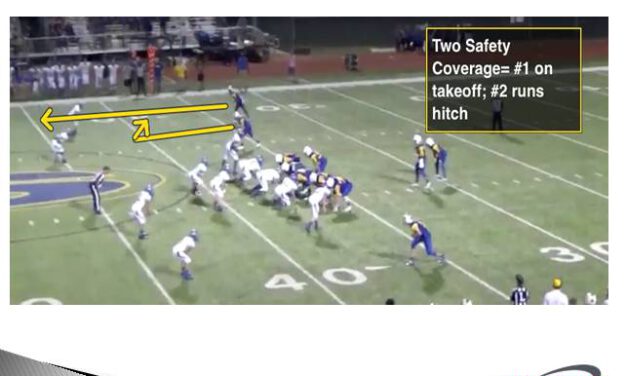
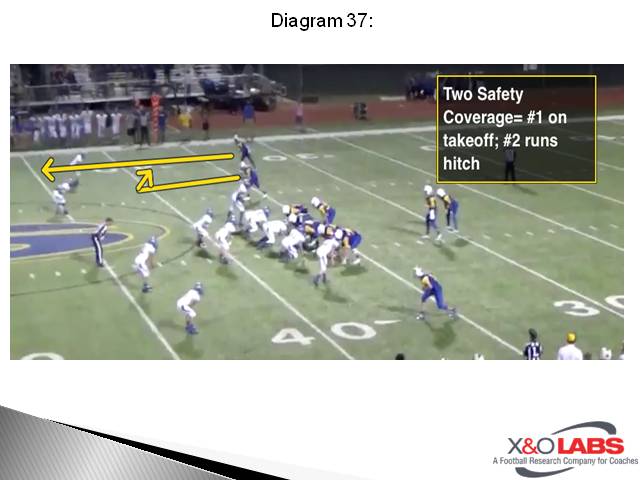
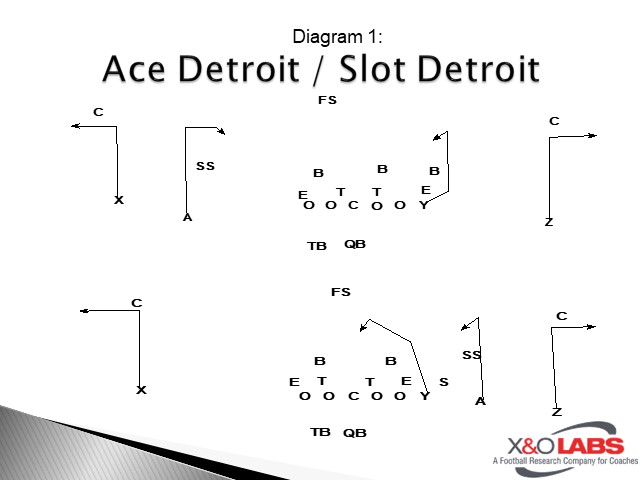
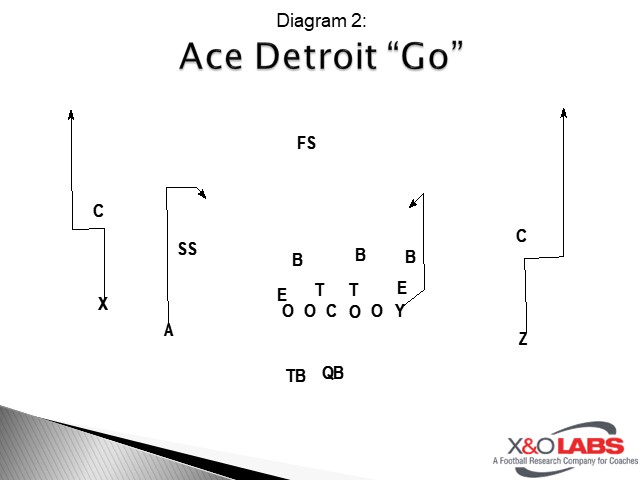
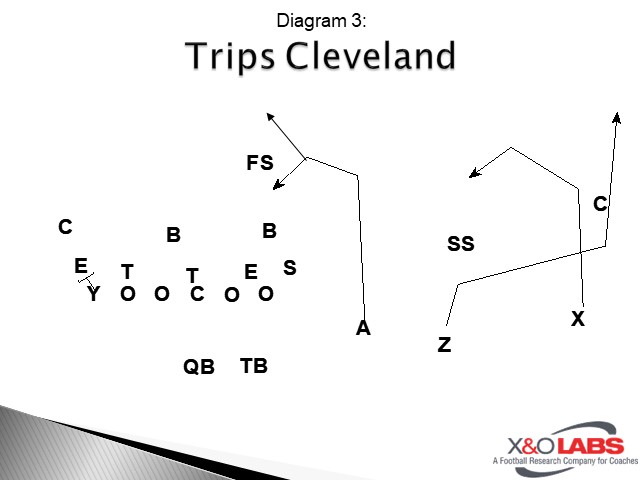
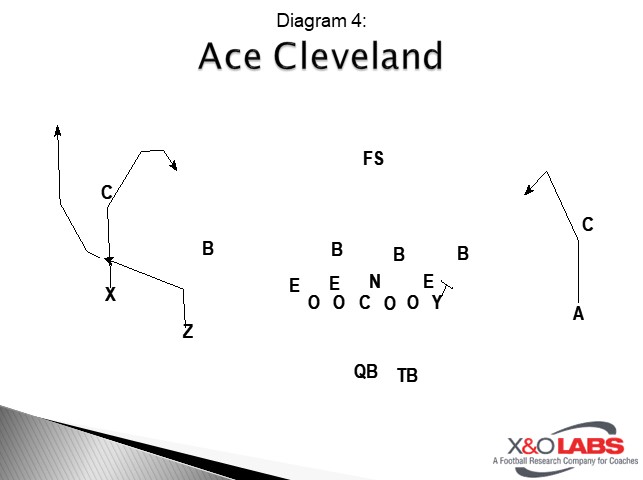
Against pure quarters coverage concepts, both receivers will hitch up. If the safety drops in hole the inside receiver stays vertical (Diagram 37).

Slide36

Read More

“Locked Route” Passing Concept

By Brian Grady
Head Football Coach
Fair Haven Union High School (VT)


Introduction

The Locked Route pass concept allows us to be able to run 6 base pass plays without receivers or tight ends having to learn to many concepts. The idea is we can run 1 play out of 3-4 different formations per game, which gives the defense a lot of looks, and gives us answers to different coverages. At the same time, our players only learn 1 route on that play, as they run the same route no matter where they are formational aligned. These base pass plays are very quick to install on the high school level. 

Out / Curl Concept

No matter the formation, our Z and X receivers will run a 10-yard out route and our A and Y receivers run 10 curl routes. We are trying to isolate our outside receivers to get 1 on 1 coverage with the corners.

Slide1Slide1

Coaching Points:

  • All 4 receivers need to sell they’re going vertical.
  • QB must use the pre-snap read to decide which side we’re throwing to in 2 x 2 formations. He will take the best match up by scouting report or the receiver that is getting the biggest cushion.
  • In 3 x 1 formations, the QB will decide if he likes the 1 on 1 match up. If so, he will take take it. If he doesn’t like that matchup, the post-snap read will be to attach the curl to the out. If the defender on inside receiver stays inside, throw the out route.
  • This a play we run in all situations.

Out / Curl Variation

When cornerbacks start to jump the out route because we throw it so much we tag “GO” call to it. This creates the chance for explosive plays with the Z and X running out and up routes. If teams play cover 2 and press outside receivers, we will automatically convert to 4 verticals.

Curl / Slide Concept

This is a play we run a lot because it is an answer to all coverages and can be run in a variety of down and distance situations. The routes are as follows:

  • X has a 13 to 10-yard curl
  • Z has a slide route (1 step then angle to sideline to get to a depth of 7 yards)
  • A has Curl or Post depending on formation.

Slide3Slide3

Coaching Points:

  • The QB must take the following pre-snap read in 3×1 formations.

    • First, is the middle of the field open? If so, he should look at taking the shot in the middle of the field.
    • Next, he must decide if he likes the 1 on 1 match up on single receiver side. If he does, he should look that way.

  • The QB’s post-snap read from 2×2 of 3×1 formations should be as follows:

    • First, read the flat defender. If he is not jumping the slide route, take 1 step and throw now. If he does jump the slide route, continue on the 3 stop drop.
    • Is the curl route open? If so, throw the curl. If the CB is jumping the curl, the QB should hitch up.
    • Lastly, he should look for the wheel route. The Z receiver is taught that as he looks back at the QB and he is continuing to take a 3 step drop, then he should turn his route into a wheel when he is six yards from sideline.

  • The biggest coaching point for our QB’s is to stay with the read progression as it happens, don’t predetermine what is going to happen. He must take the first open receiver in the progression.

Out / Vertical Concept

This is a shot play for us that has worked very well against cover 3 by throwing the verticals. It has also been effective on 3rd down and long by throwing the out routes. Before we call this play, we normally know by film study or as the game goes on how our opponent is defending 3 x 1 formations. The routes are as follows:

  • Z always runs a seem route
  • X and Y always run Out Routes
  • A always runs a post route.

Slide5Slide5

Coaching Points:

  • The QB’s pre-snap read is to see if the middle of the field is open. If it is, he should look their first post snap.
  • If the middle of the field is closed (C3) the QB reads flat defender to see if he staying over the top of the inside vertical. If he is, throw the out route. In the second diagram, we formational switch the alignment of the receivers to add a little confusion to the defenders, but as in all locked route plays the routes don’t change.

Read More

Using Man Pressures to Defend Quick RPOs

By Rob Busmente
Head Coach
Sterling High School (CO)
Twitter: @TigerFootball2, @norlito27


Introduction

Throughout the years we have always been a primary fire zone team with our pressure game. While this is still the basis of our blitz package, we needed to find ways to combat the quick throw and RPO game that many teams have begun to utilize to gain the advantage over the defense. The problem we were running into was that offenses were able to take advantage of the windows in our zone drops whether we would bring pressures or just line up and play. In addition, we would get stuck in the “we have always done it this way” rut and possibly became predictable to our opponents who know we always play zone in our base looks and behind pressures.   

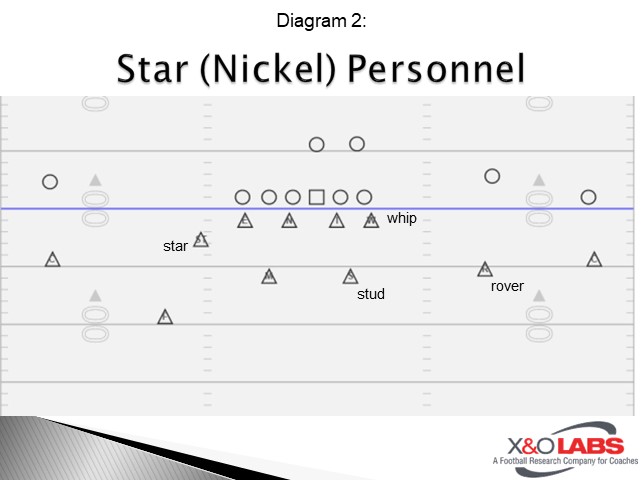
In football, the word “pressure” is one often associated with blitzing and in most cases, it is true. That said, we began looking for ways to pressure the offense with a combination of what we would call “sight pressure” and our normal blitz game. We work hard with our kids on the concept of presentation. Our goal is to present the offense with a base zone look and use late movement to help deter the quick throw or RPO adjustment when we would bring a blitz. This is why we decided to incorporate some of the man coverage principles to combine with our zone coverages to keep the offense in limbo while maintaining the integrity of our run fits. While certainly not perfect, we feel these adjustments have been a great benefit to us defensively. This report will present ways that we have adjusted using our base personnel and our nickel (star) personnel.

Base Defensive Scheme

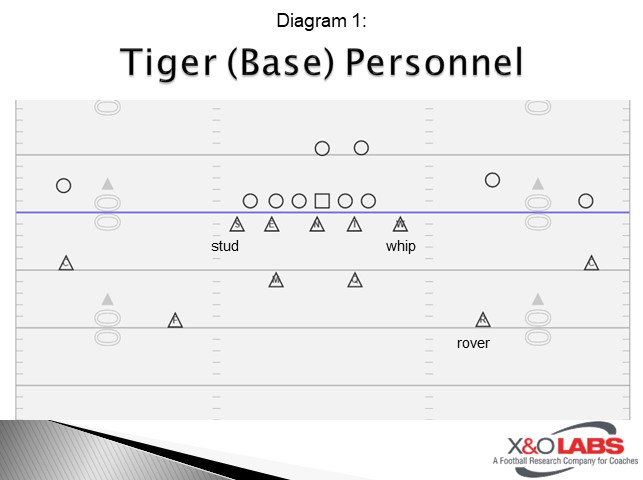
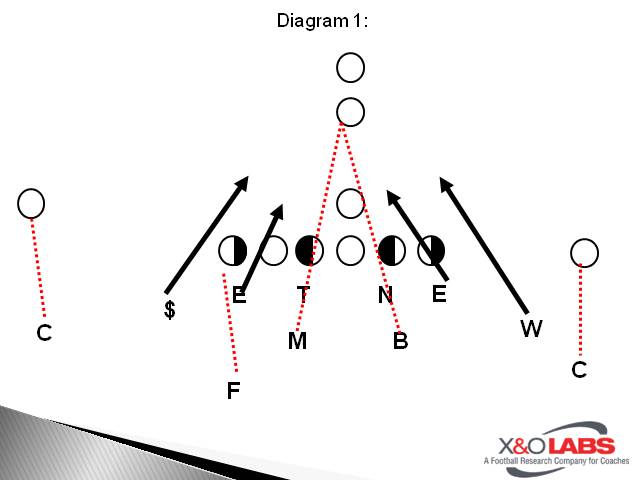
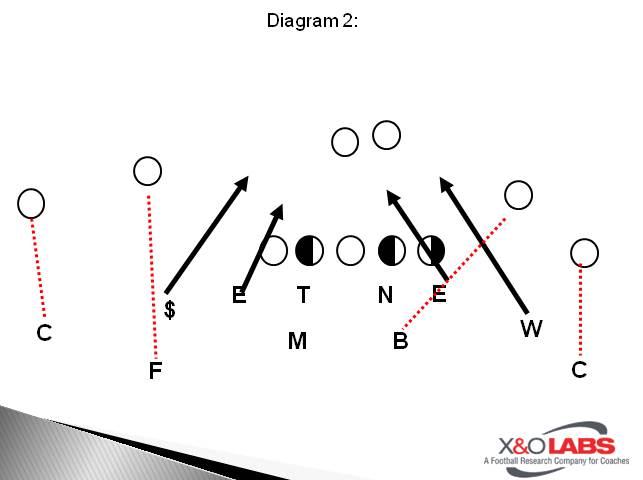
Our base defensive scheme is a hybrid 3-4/4-2-5. The following diagrams will show our base and nickel personnel aligned versus a 2 x 2 formation.

Slide1

Coaching Points Diagram #1:

  • Stud: For us, this player is a hybrid LB/DB type. He would travel with the Nose, End, Mike, and Free Safety versus formations. He is more of a LB that is physical enough to set the edge against a TE or tackle but athletic enough to cover a slot receiver.
  • Whip: This is a hybrid LB/DL type. He would travel with the Tackle, Quick, and Rover versus formations. He is athletic enough to drop into zone coverage (we try to avoid him playing too much man) but physical enough to play with his hand in the dirt.
  • Rover: This is our hybrid DB/LB type. He would align to the weak side of the formation. He is more of a safety with the ability to cover a slot receiver but is physical enough to play in the box like a LB.
  • Star: This is an extra DB we would bring into the game in a Nickel type situation.

Note: Our Rover and Stud would be similar to the Star/Money types respectively in that system.

If we don’t like the match up with our Stud and the Slot receiver we would bring in our Star (nickel) to replace an inside LB. What this does for us is gets a better match up with the slot receiver while keeping our athletic Stud player in the game to match up with the RB in man situations.

Slide1

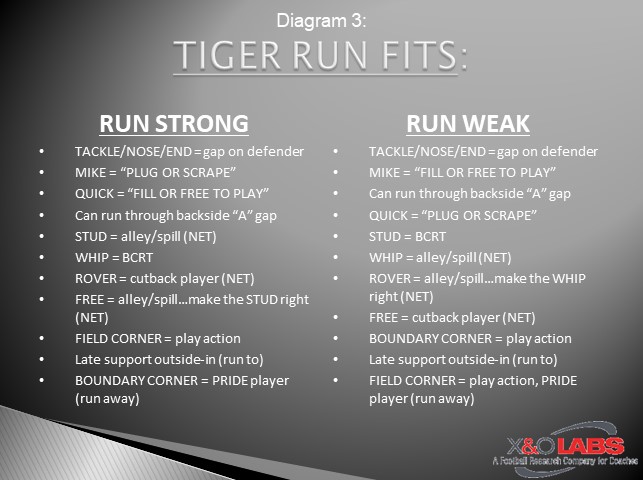
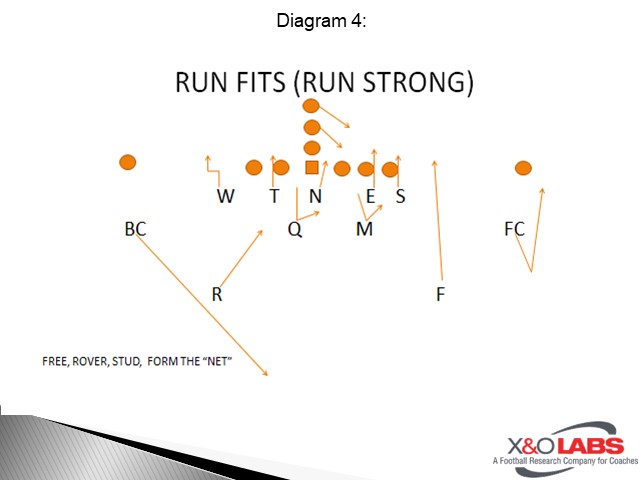
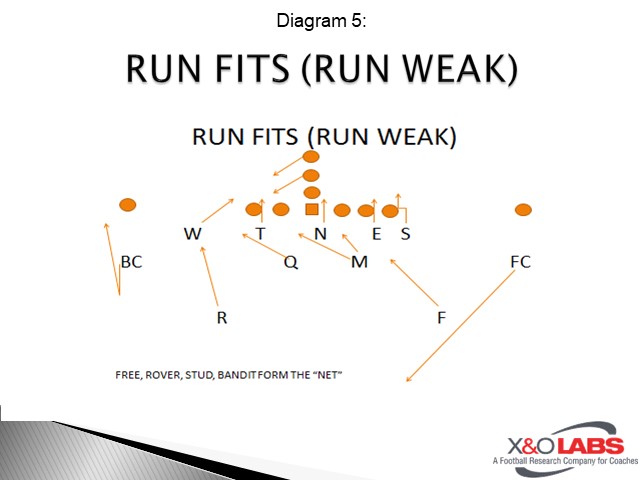
Run Fits          

The next diagrams will explain our run fit terminology. We feel this is an important aspect of installing our pressure packages so our players know that their fit doesn’t change with the call. In every way possible, we like to live by the mantra “alignment doesn’t change assignment.” While the offense can create a few “trouble areas” by formation against some of our man/zone schemes, we nonetheless feel we have remained as consistent as possible. 

Slide3

Slide4Slide4Slide4

“Sight” Pressure Schemes (Tiger/Star Personnel)   

As previously stated, we try to present the offense with our base quarters looks as long as we can before moving into our man schemes. We tell our players to move as late as possible and if it happens post snap then so be it. The intention is to “pressure” the offense by changing looks and affecting the quarterback. There are also times where we decide to “show” the offense right away what our intentions are just to create potential smoke and mirrors. In the film cutups, you will see us aligned in the look right away but understand the intent is to always present a zone quarters look.

Read More

Pattern Match Coverages to Defend 2×2 and 3×1

By Alex Place
Defensive Coordinator
Dublin Scioto (OH)
Twitter: @dmsmrplace

Introduction:

placeThis past offseason, we transitioned from a 4-2-5 to a 4-3 in order to be multiple with our coverages and blitzes while disguising the coverages to the offense by lining up the same every snap. The previous year, we struggled as a team to have an identity. We seemed to be designing our defense each week to match what offenses were trying to do to us instead of having an identity that our kids knew and trusted. We see a bunch of 2×2 and 3×1 formations each week, so we decided to convert from a 1 high safety Cover 3 team to a 2 high safety Cover 4 / Pattern Match Cover 2 team.

Converting our defense to a 2 high safety team allows us to have an identity at all times. We no longer have to rotate our coverages to match up to what the offense gives us. Our kids know where to line up on every play and this defense allows to kids to react and fly to the ball. I will go through the alignment and assignments of the defensive backs and linebackers for each formation we see on a regular basis with the focus being on our “Cloud” pattern match coverage.

Alignment:

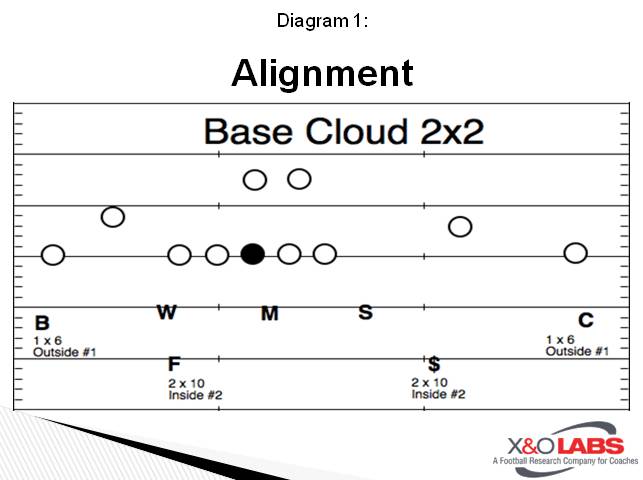
Anytime we have two detached receivers to one side of the formation, our corners and safeties lineup the same no matter what coverage we are in (Sky or Cloud). Our corners base alignment is 1×6 outside leverage of the #1 receiver. We turn our corners inside at a 45-degree angle. They will slow tempo out with a shuffle as they read their primary key, which is the quarterback. Our safeties alignment is 2×10 inside of the #2 receiver. Our safeties will slow backpedal, as they read their primary key, which is the quarterback (Diagram #1). Our outside linebackers are told to split the ball and #2. Their job is to be a curl player in the pass game unless otherwise noted in the report.

Slide1

Quick Game:

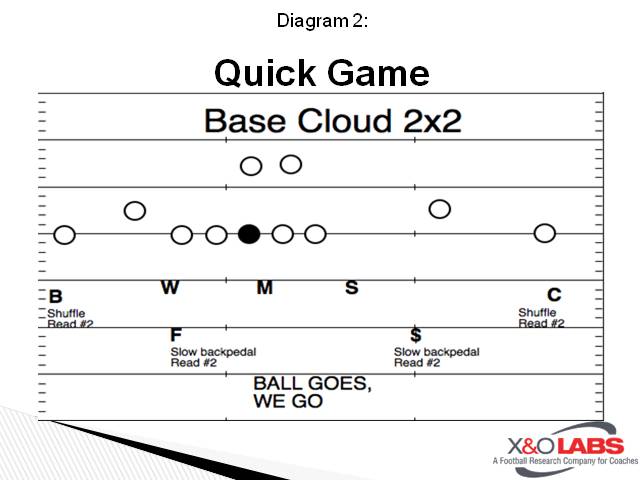
Both the safeties and corners primary key is the QB. We read the QB to clear the run game and the quick passing game before progressing to matching routes. When they get a quick game read (bubble, quick throw), our defensive backs know to react and play aggressively (Diagram #2). Our coaching point on quick game is “if the ball goes we go,” meaning we will jump a quick throw. Otherwise, “if the ball doesn’t go, we don’t go,” meaning we will continue to sink with the deeper route. Once we have cleared the quick game, we get into our pattern read progression. Switching our “Cloud” coverage to a pattern read, virtually eliminates the Bubble and Quick throws by having our Corners as outside leverage players and our Sam and Will as inside leverage players. This is something that we teach during our individual time in practice. It is also great training for the defensive backs’ eyes to quickly read the QB.

Slide2

Pattern Reading

The first day we install “Cloud,” we need to demonstrate to our defensive backs the progression of the QB, to #2, #1. Once we clear the run game and quick throw, we start our progression reading #2 to #1. Once the QB shows pass, we need to find the #2 WR.

Read More

Protecting Two-Back Runs with Flood and Naked PAPs

By Ryan Turnage
Head Football Coach
Lee-Davis High School (VA)
Twitter: @ldpride

Introduction:

Our offense at Lee-Davis High School begins with our running game. Our main staples in the run game include power, inside zone and outside zone. We have been very effective in our ability to run the football in recent years. Much of the success of our ability to run the ball is largely due to our play action passing game. Our goal with our play-action passing game is to put run defenders in as much conflict as possible. We want to slow defenders down as much as possible. Our most effective play action passes are off of our power play and inside zone play. Our philosophy is to be able to run these concepts from multiple formations.  We spend a great deal of time in the off-season and during practice teaching the fundamentals of these concepts. 

Flood Play Action

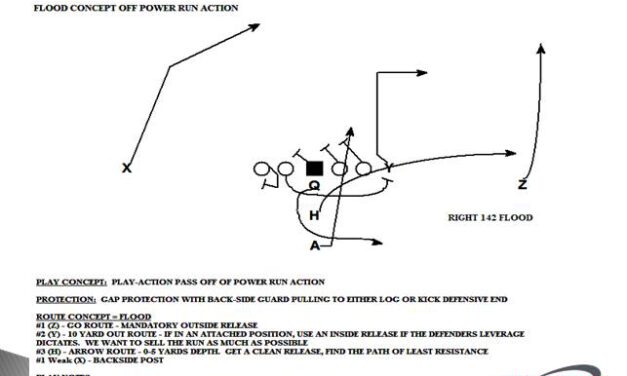
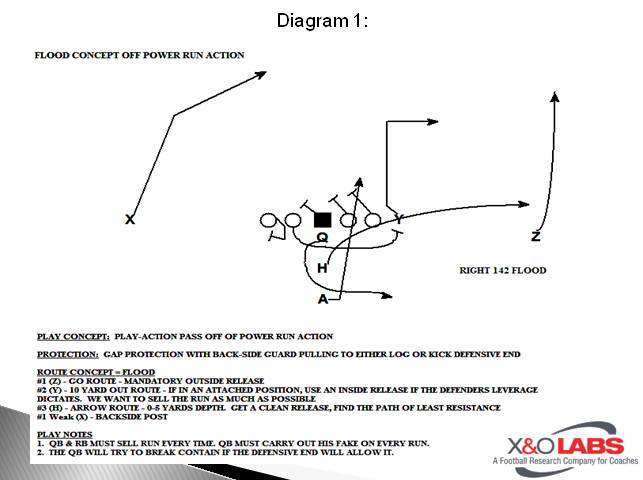
The play-action pass that we use frequently comes off of our power run play which is our 100 series.  We have the ability to use multiple pass concepts with this play-action pass but the concept we use the most is Flood.  This is a basic flood concept.  In our offense, we teach the flood concept the following way (Diagram #1). 

Slide1

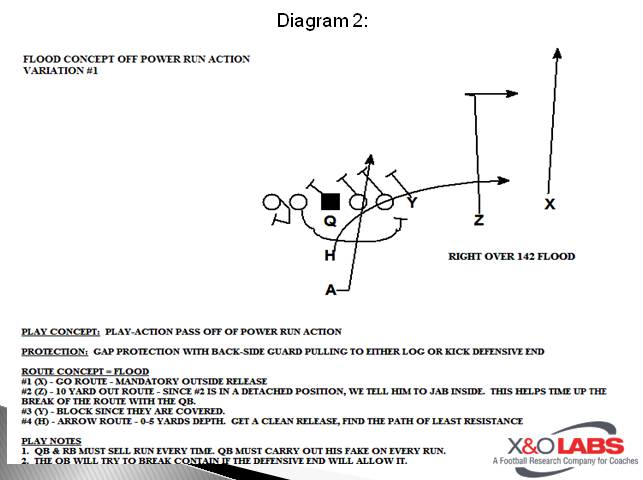
This allows us to use the flood concept in any type of pass action we choose. (play action, sprint out, or drop back).  We can also add tags to the concept if we want a specific player to run a certain route.  Our play action pass off power is called by stating the Formation, Protection, Run-Action, Pass Concept in that order (ex: Right 142 Flood or 143 Flood). 

Slide1

In this play, our QB will attempt to break contain and throw on the run.  The only situation in which he would not try to break contain is if the DE to the play-side is up the field not allowing him outside.  In this case, he would pull-up and deliver the ball accordingly.  The progression for the QB is deep, middle, short.  We are looking for big gains in the play-action game but we tell the QB not to pass up player who has green grass in front of him.  We do not try to attack a particular coverage with this concept rather than attacking defenders that are assigned to playing the run and pass in their responsibilities.  The player that typically is most effected is the flat defender.  

It is important to note that sometimes QB’s will fall in love with the short throw and not look down the field. We will drill the progression of the play during practice.  Our focus in doing this are the fundamentals of the play. We want to make sure the QB is getting proper depth off his fakes and his ball handling mechanics are sound. We also stress proper route depth and releases by the receivers.  In the drill we will also add the pull of the backside guard and vary his block to force the QB to make his adjustment to his launching point.   

The protection for this pass concept is a gap protection in which we do pull the backside guard. We have protected the play both ways in that we pull the backside guard and sometimes we do not.  This is typically a game plan decision. The pulling of the backside guard makes the play look more like the run thus having more influence on the defense. The protection is as follows, the offensive line will step down aggressively and block the first defender inside that shows. Offensive lineman will step aggressively with their inside foot and block the first defender that shows on their path.

  • Play Side Tackle will step hard to the B gap defender, versus an even front this is most likely a 3 technique or 4i versus an odd front.
  • Play Side Guard will look to protect A gap. If A gap is uncovered he will help on the B gap defender with his eyes on the 2nd level.
  • Center will protect the back-side A gap, in most cases the back-side guard is pulling. If the back-side guard is not pulling they will protect the back-side A gap together.  We want to make the action to look as much like to run play as possible.
  • Backside Guard will pull. His rule is to log or kick based on how the DE is reacting to the play.  We drill this with our guards regularly. Our thought is if the DE is up the field regularly then chances are the run play is very effective.
  • Back Side Tackle will execute a gap hinge technique.

We like to call this play versus hard crashing DE’s, hard filling safeties, and OLB’s that are getting too involved in stopping the run.  We are not as concerned with the coverage the defense is playing when we call this play.  Our main goal is the affect the defenders that are making the tackle on the run action.    

Read More

Trap and Cloud Coverages to Defend Trips

By Erik Speakman
Defensive Coordinator
Opelika High School (AL)
Twitter: @erik_speakman


Introduction

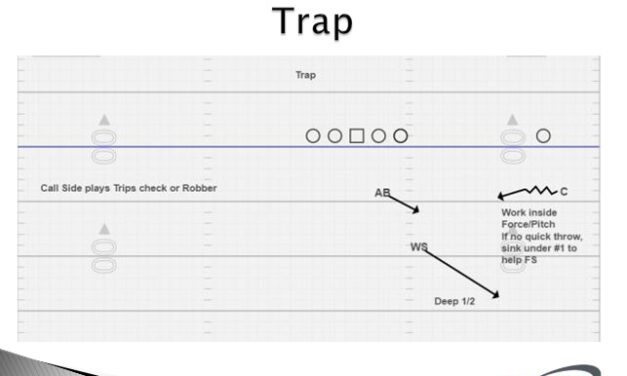
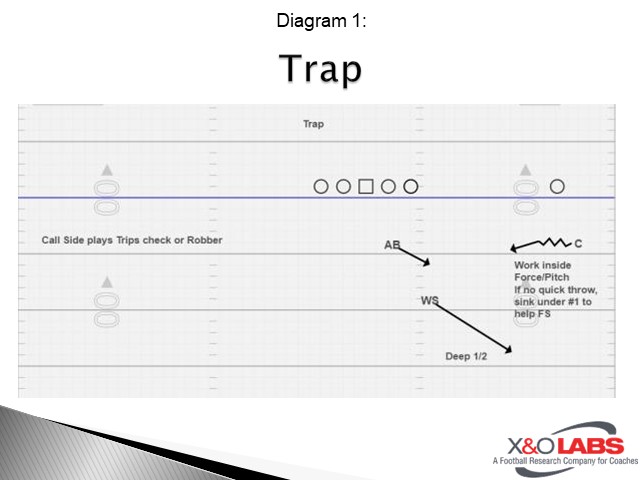
In this report I am going to discuss two coverage concepts that we use against trips sets. In short, we like to use a “trap” coverage away from trips and “cloud” coverage to the trips side.  We are starting to see more perimeter run game to our away side, which really puts stress on our away backer and our weak safety. By running trap to that side, we can get quick run support from our corner (usually the boundary corner). Cloud is a check we use if we are facing an offense that incorporates RPOs and runs to the trips side. We are constantly trying to find a way to get an unblocked defender to the ball and we feel both of these coverages help achieve this goal.

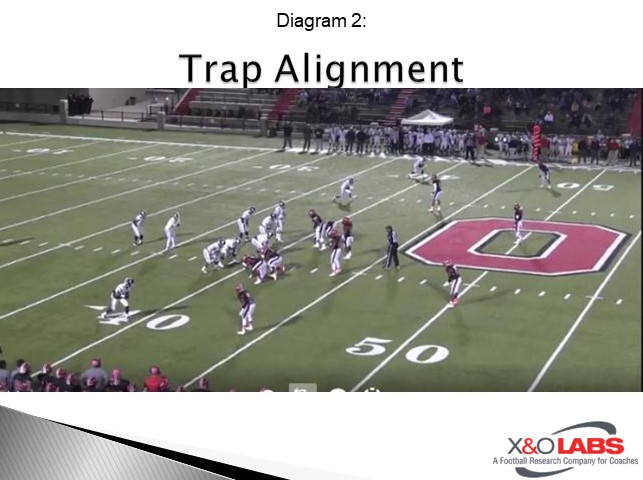
We are a split field coverage team, so we are always trying to give the opposing QB/OC different looks to our away side. Our away side is side with our weak safety, away backer and one of the corners and our call side involves our strong safety, free safety and the other corner. The WS and AB are always tied together and are usually aligned to the boundary unless the formation takes them to the field. The FS and SS are together and line up based on the passing strength. 

Trap has become our way of running a version of an old school Cover 2. It also helps us with our “cowboy”(corner blitz) because they end up looking very similar. Trap also gives us an opposite coverage to our “sky” coverage with the WS rolling down. We teach the WS and Corner that trap and sky are essentially the same coverage with the two players exchanging responsibilities.

Cloud is a trips check that helps us when we are facing an offense that has a perimeter run game to the field/trips side and uses bubbles or stand screens off of a zone/power look (RPO). Cloud is going to involve the FS, SS and field corner unless the offense aligns trips to the boundary. If trips is aligned to the boundary, the BC will now have to play cloud.

The way these two coverages are tied together is the techniques and rules for our corners. We play with a boundary and a field corner, but we also cross train each corner so that they can play either side in case of injury or if they can’t get lined up in time. Corners for us must know how to play to the away side and the call side.

Coaching Points for Trap Coverage

Slide1Slide1

Defensive rules for each position boil down to alignment, assignment and run to ball. We give each position the following three categories for what can happen on a play:  run to you, run away from you, and pass.

Corner – Alignment will start with our base alignment of 1 x 5 outside. When the ball is snapped, he should be inside the #1 receiver far enough that he can’t be blocked by #1. The corner will now read the QB for run/pass.

Read More

Mid-Season Wrinkles for Tempo Inside Zone RPOs

By James C. Gower
Offensive Line Coach
Tomball Memorial High School (TX)
Twitter: @Coach_Gower

Introduction

Zone read is no longer the new thing. Over the past 10 years, defenses have done a good job of catching up with the play and forcing offenses to look elsewhere to steal yards. While I still feel the zone read is a play that can consistently get your offense a consistent four yards per play, I think that offensive coaches need to add more wrinkles to slow the defenses recognition of the play. The “Wrong Way Inside Zone” has been our main wrinkle and this article will go over multiple ways you can incorporate it into your scheme.

Wrong Way (Inverted) Inside Zone

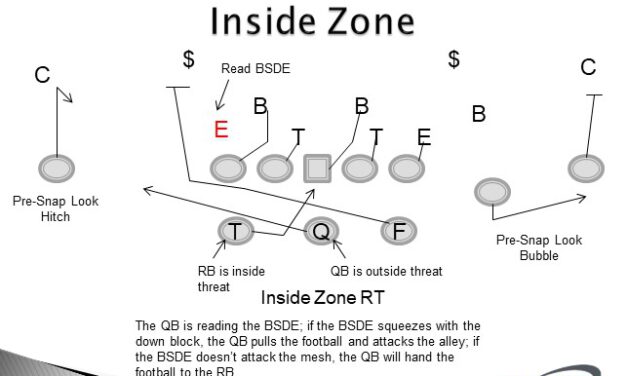
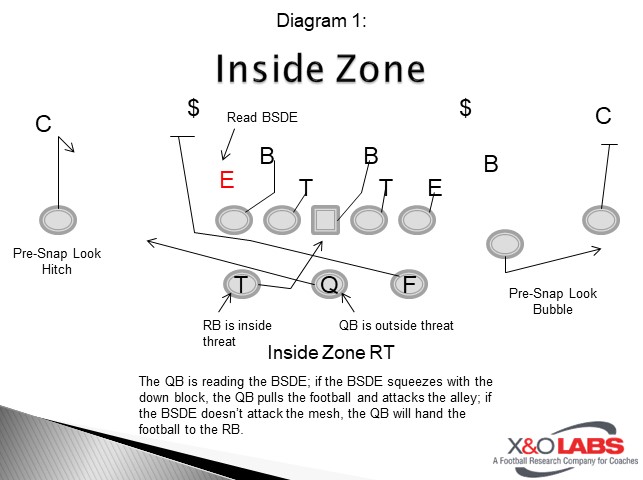
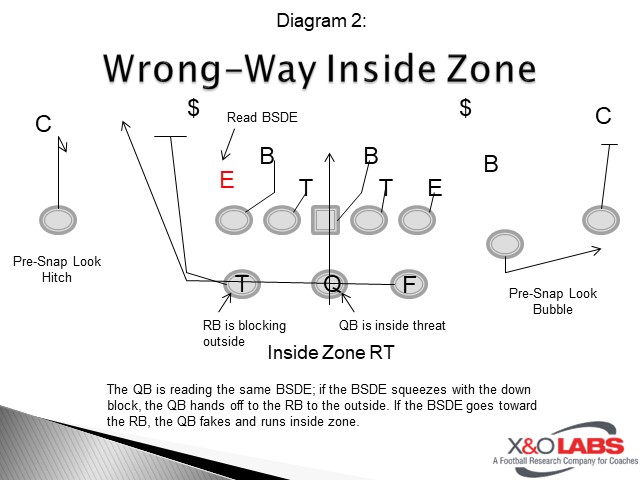
The Wrong Way Inside Zone is simply inside zone blocking with the RB and QB exchanging responsibilities. In the normal inside zone, the RB is the inside running threat and the QB is the outside running threat. Conversely, in wrong way inside zone, the RB is now the outside running threat, and the QB is the downhill, inside running threat.

Slide1Slide1

As you can see in the diagrams, we use a “numbering system” to block our inside zone. The rules are as follows:

Blocking vs Even Front

Play Side Tackle– Base block the play side #2 down lineman. He will double with the TE to alley defender if he has a TE or Slot with him.

Play Side Guard and Center – “CAGE” double team (center and guard) the play side #1 down lineman to the play side linebacker.

Backside Guard and Backside Tackle – “TUG” double team (backside tackle and guard) the backside #1 down lineman to the backside linebacker.

Blocking vs Odd Front

Play Side Tackle and Play Side Guard – “TAG” double team (play side tackle and guard) the play side #2 down lineman to the play side linebacker.

Center and Back Side Guard – “COG” (center and backside guard) the nose (#1 either play side, head up, or back side) to the back side linebacker.

Read More

4-3 Blitz Checks to Attack Protections

By Adam Hovorka
Head Coach/Defensive Coordinator
Schreiber High School (NY)
X&O Labs Contributing Writer

Introduction: 

Defensively, our philosophy is to put pressure on the opponent’s quarterback and make the offensive play caller worry about how often his quarterback is going to get pressured. We will marry this with our man coverage. With today’s offenses being so multiple in terms of formations, motions and personnel, it was getting harder and harder to predict which blitzes would work vs. different game situations. To make this situation better, we did what the offensive side of the ball has been doing for years and just created a blitz-on-me system. 

Blitz Problems

In the past we would call a blitz, and hope that the pressure matched the formation called or our kids could adjust quick enough to still get the blitz to come from where we wanted it to come from and have everyone covered. For example, we would call for a pressure with a blitzer off each edge. Thinking that a two-back formation was coming, we would practice against a two back set all week. However, during the game when the blitz was called; the offense wasn’t in two-backs any more but a two-by-two open look.  Since, we are 4-2 box with one high at all times, the pressure vs. two backs would be easy to teach and install. 

Slide1

In this example, the outside safeties would come of the edge and the FS would lock on the TE or #2 and the inside backers would be man on the backs.

Slide1

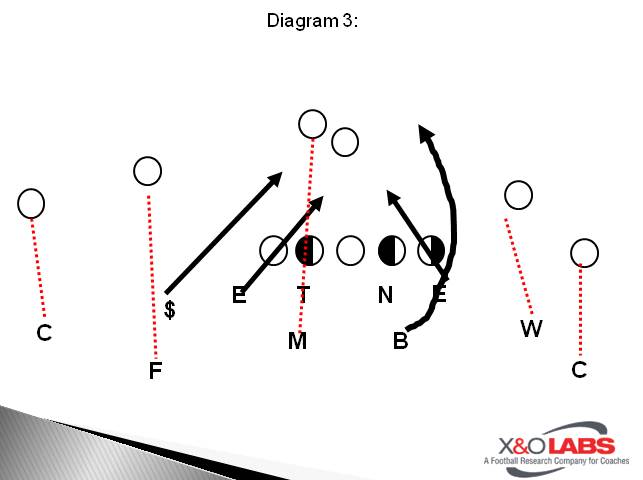
Instead if they came out in a one-back two by two set both outside safeties couldn’t come unless you put an inside backer on one of the inside receivers, and that was something that we didn’t want to do. 

Slide3

So to rectify the above situation, we would have adjustments to the blitz called based on the formation that the players saw and the inside backer would blitz off of the edge instead of the safety. If we called both outside safeties to blitz, but they came out in one-back, it would be one adjustment and if they came out in trips it would be another adjustment. We were spending so much time in our blitz period just adjusting to formations and hoping the kids could figure out the right blitz. We also found out that kids were thinking too much and not blitzing aggressively or not blitzing at all, there was a classic case of paralysis by analysis.

Rain/Lightning

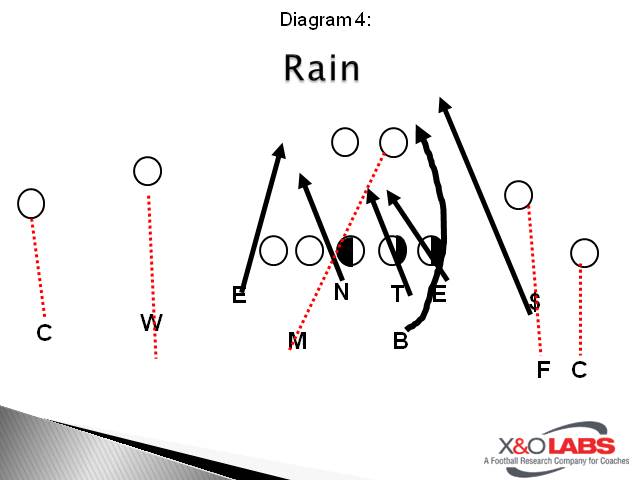
Just to be clear, we are not blitzing every down or having an automatic to every formation. We are using a buzzword to mean we want to blitz this down. Based on formation or hash the players would perform the blitz that we wanted for that week. Let the kids come up with the buzzword. This year the word for us was NASA. Come up with a word that means blitz and the formation will dictate what type of blitz you will be in that week. To create a blitz-on-me system, you need to have a good idea of what teams will try to do based on formation, down and distance and hash. Film study and use of data is invaluable in determining this information. Once you have a good idea of what offenses’ tendencies are in certain formations and down and distances, you can go ahead and make your pressure system based on what the offense is doing and their protections schemes in those formations.   

Against teams that predominantly sprint out from a two-by-two look, we would send an outside backer and an inside backer off of the same edge always to the side of the back. The defensive end to the call side would slant inside also. Most offensive tackles would just lock onto that slanting end and leave two edge rushers vs the back.     

Slide3

Rain meant the blitz was coming right and the defensive line slanted away from the call. This is a very important point, the defensive end opposite the call had to really get a good up field pass rush because the QB would see two rushers off of the edge and try to scramble opposite. 

Slide5

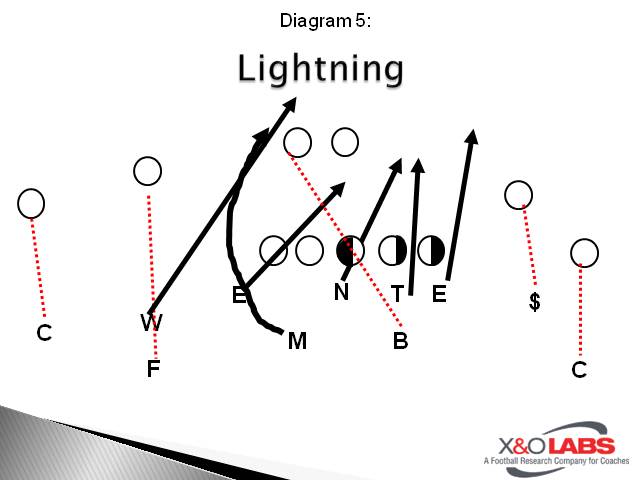
Lightning was two off of the left side and the defensive line slanted opposite. We would also have a word that meant the blitz was also coming from the field. We would also do this vs. teams that we knew from film study would use a six-man protection with half slide and half man protection. The alignment of the back usually showed which side was the man side of the protection and would be the side we send the two off the edge from. Teams have struggled to account for four rushers from the same side. 

Read More

4×1 Triple Post Concept

By Rich Holzer
Head Football Coach
Mount Saint Joseph High School (MD)
Twitter: @CoachRichHolzer

Introduction:

Here at Mount Saint Joseph High School, we as a staff adapt our version of the “Air Raid” offense to what our personnel dictates on a yearly basis. However, one of our new concepts just installed this year, is our version of the Triple Post concept. It was developed off of a similar concept run by the well-known Head Coach of Pulaski Academy in Arkansas Kevin Kelley. This play is adaptable to beat any and all coverages. Since it is run primarily out of 4×1 it places a lot of stress on defenses. It has been my experience that when aligning in 4×1 offense are either trying to isolate the single receiver, execute QB runs or throwing quick game/ fast screens to the 4 receiver side. We use this concept to counter act those tendencies.

Base Concept

Slide1

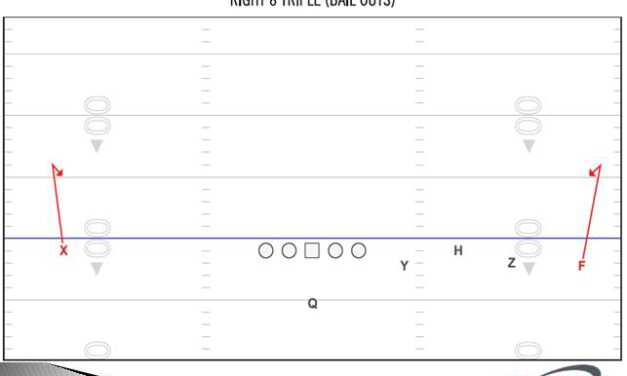
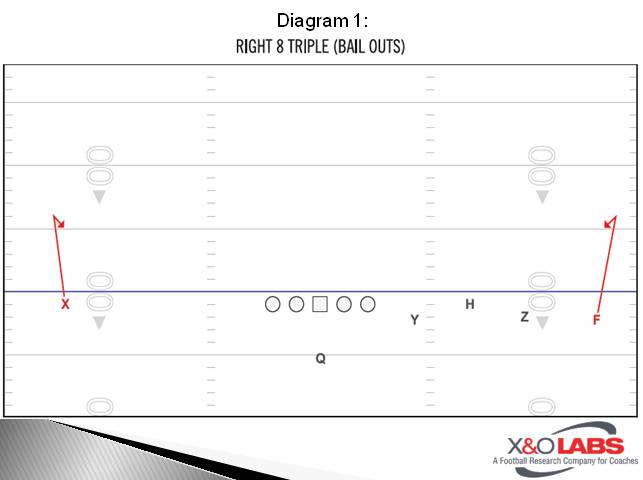
The Triple Post concept can be expensive to teach because of how we adjust our route running based off safety structure. However, our staff feels it has been worth the investment. We start with the outside routes we call a “Bail Out” route. We always have one to each side of the field represented by the Hitch routes of the X and F in the above diagram. We then have our three Posts coming from one side of the field usually the wide side.

Slide1

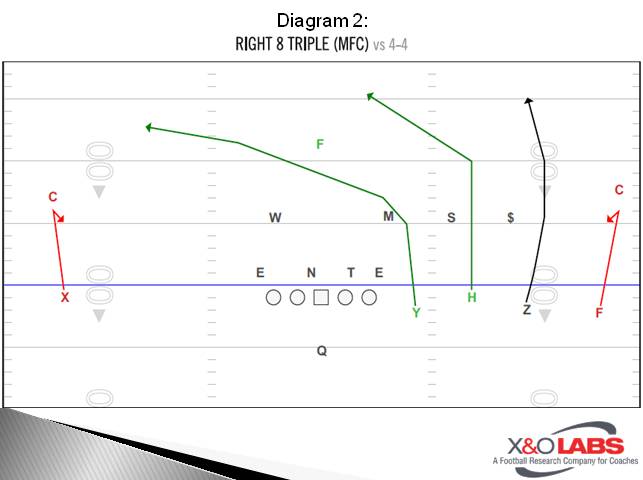
Against a single high look or MFC, we are going to have the QB read the MOF safety. The general rule of thumb for us is whenever the FS crosses the ball regardless of the SS alignment we treat it as 1 high and he becomes the read.

Slide3

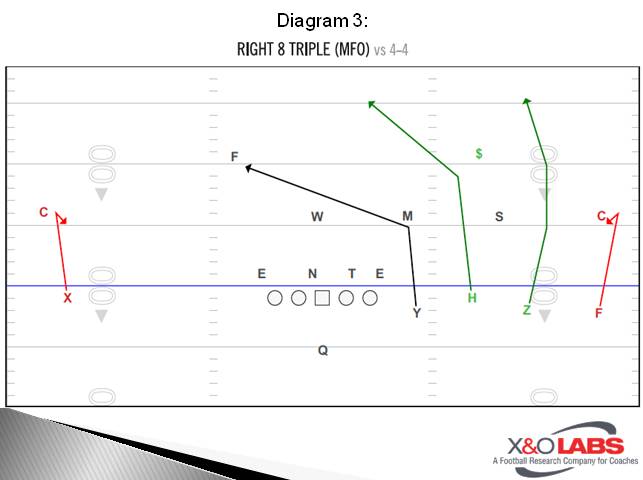
Whenever we get a 2 high or MFO, we read the strong safety. Our QB operates under the premise that the inside post will pull that backside safety as he works across his face.

Read More

Fitchburg State’s Shoulder-Leverage Tackling Progression

By Matthew Popino
Former Linebackers Coach
Fitchburg State University (MA)
Twitter: @CoachPop2015


Introduction

Our tackling philosophy is based off of rugby tackling and shoulder-leverage. Rugby tackling affords our players a safer and more efficient tackling method. It enables players to play fast, physical and fundamentally sound defense without the fear of injuries. This tackling philosophy doesn’t just address the tackling in itself, but gives a simple and clear understanding of where players fit into the defense. Shoulder-leverage tackling communicates how force and scrape players work together. No matter what defense you may run, there are players who are forcing the ball outside-in (force) and inside-out (scrape). We break up these fundamentals into four categories:

  1. Leverage
  2. Tracking
  3. Fit
  4. Finish

Coaching Leverage

We first teach our players leverage and understanding how their leverage fits into the defense. They must understand the importance of keeping their leverage on the ball carrier. Most missed tackles are caused by players losing their leverage. This is seen when an inside-out (scrape) defender over runs the ball carrier and allows a cutback or an outside-in (force) defender goes inside and allows the ball carrier outside. These common mistakes can be eliminated by the use of shoulder-leverage.

We preach near foot and near shoulder of the defender to the near hip of the ball carrier. Everything is predicated on the near hip. The near hip is our target and their eyes must be locked in on this point. Our players must keep their eyes on their target as they approach. We preach to keep the ball carrier on your near shoulder and to force him to the help, creating a vice. As you can see below in diagram #2, we have a right shoulder tackler and a left shoulder tackler or a force and scrape player. This now puts the ball carrier in a bind.

Read More

Kansas Wesleyan’s Sprint-Out Concepts


Matt Drinkall
Head Coach
Kansas Wesleyan University (KS)
Twitter: @DrinkallKWU


Introduction 

Every offense is looking for a package that serves a wide variety of purposes. Any play series that provides multiple resources for your offense is a package worth looking in to. Sprint out passing is an extremely valuable component to offensive production. This report will detail the value of carrying a sprint out series, our base sprint-out concepts, variations, and complimentary plays.


Why Sprint Out?

Our sprint out package is one of the most critical components to our offense. The reason I have chosen this package to detail in this clinic report is because I believe any offense can incorporate this series into an already-existing system and benefit from it. Our sprint out package facilitates an offense in a number of different ways:

  • Multiple personnel groups
  • Multiple formations
  • Easy to shift & motion to
  • Flexible to personnel
  • Fits any down & distance
  • Useful in any field zone
  • Excellent against pressure
  • Changes launch point of QB by moving the pocket
  • Excellent against zone or man coverage
  • Efficient form of passing
  • Outstanding in the Red Zone


Base Sprint Out Package 

Our sprint out series is a “Practice #1” install and it is carried throughout the season. We carry this in every game we play.  Our base sprint out package has a couple of staples that never change:

  • Call-side is a two-man “Smash” concept (dictated by call)
  • Back-side is a single receiver running a “Pig” route
  • Protection is always protected with a seven-man “Waterfall” protection 


Our base sprint out series is a two-play series that are both “Smash” concepts. We define “Smash” as one route is occupying the flat and the other route is running a corner route. We differentiate the two concepts by defining who is occupying the flat. This is communicated by the name of the play. Essentially, we are telling the “Outside” or “Inside” receiver on the call-side which needs to end up in the flat. If you are the receiver not working to the flat, you must run the corner route.


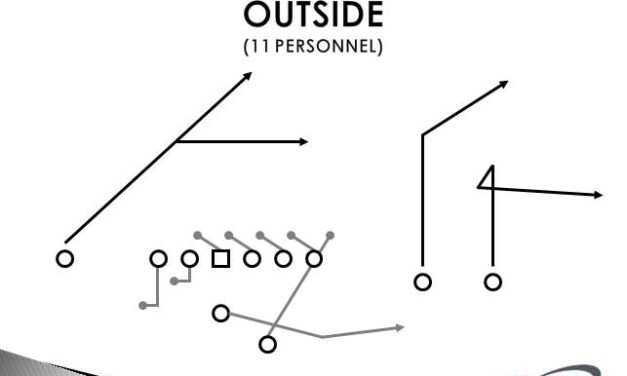
Outside Sprint Out 

“Outside Sprint-Out” is our first install. We prefer this versus zone coverage. This tells the outside receiver to occupy the flat and the inside receiver to run the corner route.

Read More

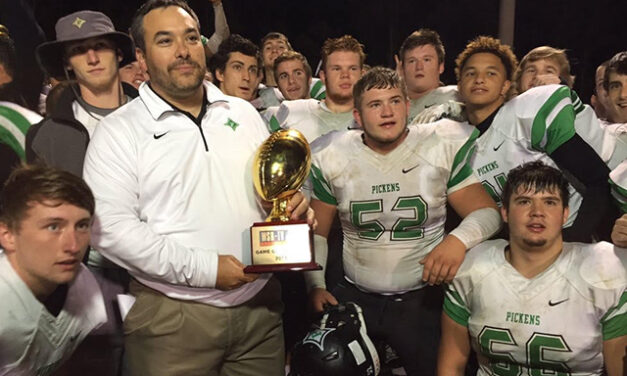
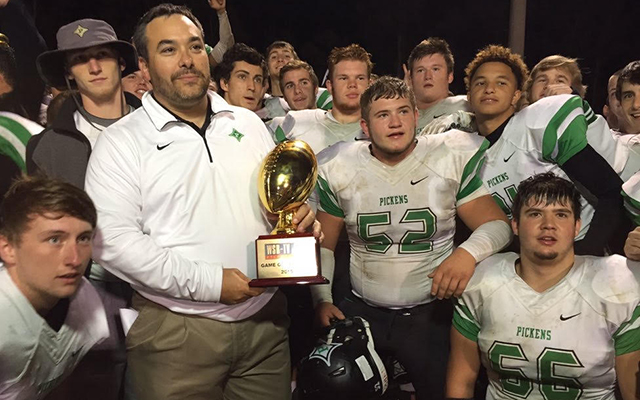
The Bunch Red Zone Package

By Chris Parker
Head Football Coach
Pickens High School (GA)
Twitter: @PickensFootball

Introduction:

parkerLike a lot of people, we run RPOs and try to take advantage of what the defense gives us.  As we get into the Red Zone, we have found that the RPOs can be a little less effective.  To work against this, we have utilized our Bunch package more in the Red Zone to create favorable matchups when the spacing is not as helpful as it is in the middle of the field. 

Establishing the Flank

When utilizing a Bunch formation, you should start by understanding how to attack the flank and force the defense to defend the flank. Some people do this through the run game and others through passing. The quickest ways to establish the flank for us in the running game is to run Power Read or Buck Sweep. In the passing game, we establish the flank by running Scat.

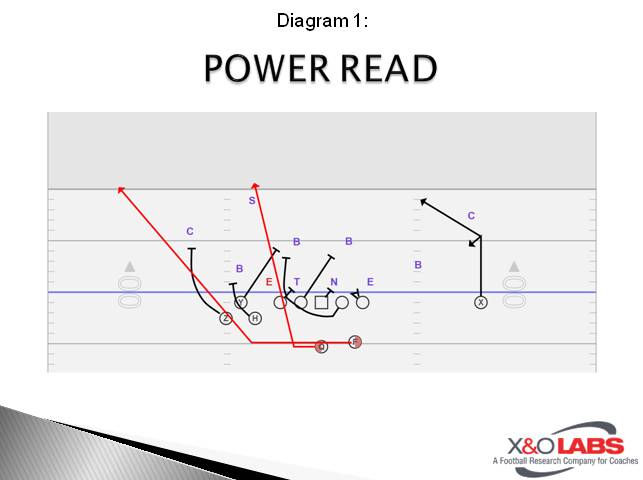
Power Read

Slide1

Power Read is a base play for us.  We like it in space in the open field but as the defense get closer in the red zone, the secondary force becomes a problem.  Running the play out of bunch can create different alley runs for the secondary and cause confusion that will allow this play to still attack the flank.

Assignments & Coaching Points

Y: The Y should crack the 1st inside linebacker.  If he gets up-field before the Y can get there, he should go on to the next most dangerous man on that same path (backside backer, safety, etc.). His block on the ILB only matters if we give the ball on the Flank run. Getting this block is key to getting big yards on this play.

H: He is responsible for the outside linebacker. This is the hardest block. When we executed this block we have always gotten an efficient play. He should attack the defenders outside shoulder and keep running his feet. Ideally, he will hook him and we will run outside, but if the defender stretches the play, he should push him out and allow cutback by the runner.

Z: The Z is responsible for the Corner or whoever is the outside force defender. He needs to attack wide and be ready for quick support from the Corner. If he gets quick support, he has to take the same approach as the H and try to hook him but stretch him if he can’t hook him. If the corner sits, he can use a traditional WR stalk techniques.

To study game cutups of this concept, click on the video below:

Editor’s Note: Coach Parker provided commentary and coaching points on each clip below:

Read More

Tulane’s Push, Point, Pull Tech to Teach WR Breakpoints

By Derrick Sherman
Offensive Analyst
Tulane University (LA)
Twitter: @CoachSherms


Introduction:

Each offense has dozens of different routes and there is never enough time to get all the necessary reps to perfect each one. Luckily, there are enough similarities in the routes and concepts that we do have enough time to focus on the fundamentals then put it all together on the field (90 degree cut, 45-degree cut, speed cut). Here at Tulane, we use a series of drills to become better route runners by concentrating on the different breaks that are common throughout our route tree.

We are very away that all of our receivers are different. That means that these breaks will be different from man to man. It is up to us as a coach to make sure each individual is efficient, quick, and explosive as he can possibly be. Our goal is to master the technique and do it faster each day.

The 3 P’s Push-Point-Pull

Everyone has their own buzz words. Here at Tulane, we use push, point, and pull in every break to create a common language that gets the players focused on the keys to running great routes.

PUSH: The receiver will push his plant step into the ground while dropping his hips. He will need to keep his shoulders over his knees, and his knees over his toes. This helps to provide proper balance in the cut.

POINT: The next step in the progression should point the receiver toward his next destination. This ensures that there are no wasted steps going somewhere other than exactly where he should be aiming.

PULL: Lastly, the receiver should pull his inside elbow to pull and turn his hips, shoulders and head around all in unison. This ensures that we are efficient and explosive while ready to make catch

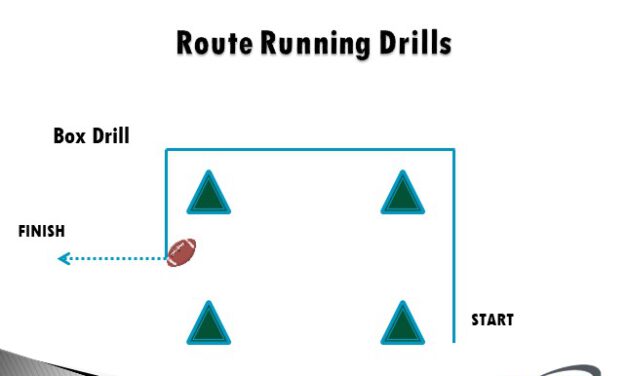
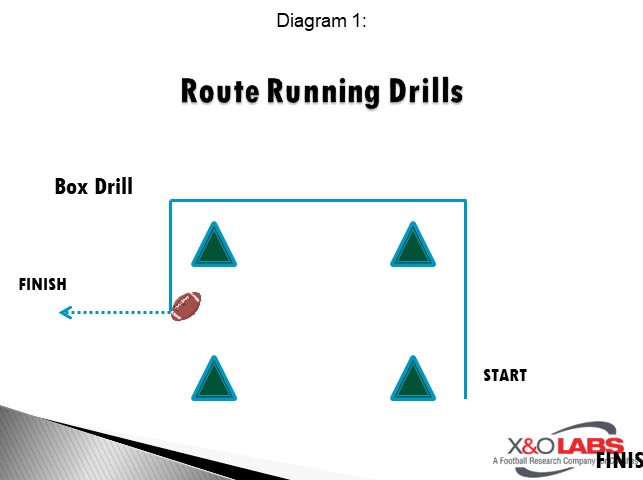
The drills that follow all help us rep and prefect these techniques on a daily basis. Each of these drills requires 4 cones and footballs.

Box Drill

Process/Coaching Points

  • Start with cones in a square 5 yards apart. (Work to get them further apart as your group progresses)
  • Simulates any routes with 90 degree cut
  • Shoulders over Knees over Toes
  • Push, Point, Pull
  • Violent Arms
  • Don’t turn shoulders early
  • Don’t over extend trying to reach the cone

Slide1

Read More

Drill Work to Teach Spot Drops in Cover 3

By David Mastroianni
Defensive Coordinator/Secondary Coach
Hand High School (CT)
Twitter: @DMastro79

Introduction

In the age of man coverage and cover 4, the concept of spot dropping has gone by the wayside in favor of pattern reading.  While pattern reading has its merits; we have found that it has slowed our players’ ability to react quickly and break on thrown balls, thus defeating the purpose of playing zone coverage. We have experimented with coaching cover 4 more than once but, have found that it just doesn’t suit our skill or our defensive philosophy. Our head coach summed up our pass coverage philosophy best by saying, “We need to be willing to trade a catch for a headache.”  Meaning, we are willing to give up a completion and then deliver a blow that will deter the receiver from wanting to catch a ball later in the game. By coaching eyes, body placement, and drop zones, we aim to create a player who is clear on his assignment thus allowing us to play multiple coverages without having to teach new concepts and allow for quicker reactions to the thrown ball. 

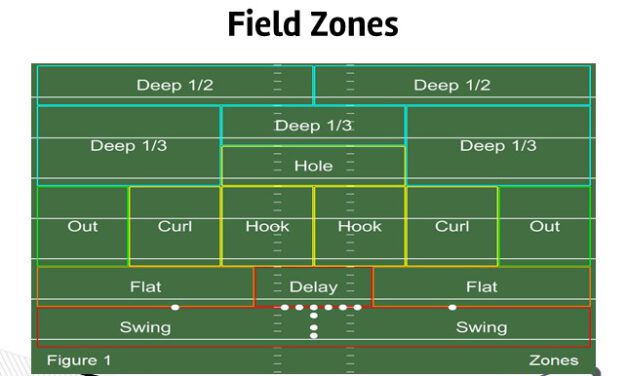
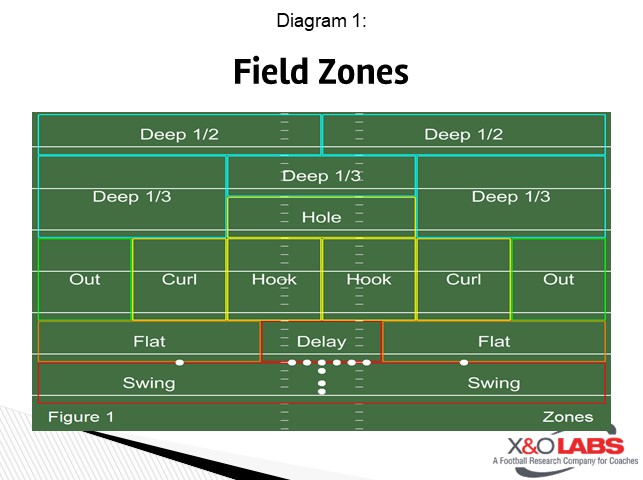
Identifying Zones of the Field

The first step in being a spot drop team is identifying zones of the field. We are a cover 3 or a quarter quarter half team so we teach the hook/curl, curl/flat, deep thirds concept to start.  Linebackers and secondary alike are responsible for knowing each zone on the field (Diagram #1). The benefit to this is that when we teach various coverages it allows our players to quickly grasp their piece of the puzzle in the grand scheme of the coverage itself.  This allows installs of cover 3 and most of our ¼ ¼ half coverages to be done in a two day install period.

Slide1

Establishing Awareness

The next phase of teaching spot drops is by establishing “threat awareness” as well as a basic understanding of pass route depths. Before the start of each snap (both in practice and in games) we ask all second and third level defenders to identify their nearest “threat,” or WR that can get into their zone the fastest, pre-snap. By getting their minds ready to address a potential quick threat, we believe we can encourage a sense of focused urgency in our pass drops. The other piece of establishing awareness in our players is by reminding them the 3 most common levels (in yards) of pass route depths (5, 15, 25). This will come into play later when we discuss our actual pass drops.

Intersecting Routes

Language in coaching is everything. If you tell a player to “collision” a receiver, he will go out of his way, usually at the expense of an effective drop, to hit that receiver. A few years back we decided that we were going to change the verbiage to “intersecting” the route. The way we explained it was that we did not want to go out of our way to collision a WR because it could be sacrificing the integrity of our coverage. Instead, we wanted to intersect a WR on the way to our drop zone. This change in wording accomplished two things for us:

  1. It helped control the tempo of our drops. Instead of our LB’s buzzing to their zone too quickly or too slowly, they have learned to drop at the speed of the WR. If the WR released quickly (i.e. any type of vertical routes), then our LB would drop to his zone quicker in order to disrupt four verticals. If the WR released more slowly (i.e. Out/Drag/ Hitch) then our LB’s would drop to their zones in a more deliberate fashion, all the while looking to “intersect” the route and disrupt timing.
  2. It helped our second level defenders get hands on WR without having to pattern read. This helped to keep our defenders eyes on the QB as much as possible while still affecting the timing of the pass game.

Zone Depth & Responsibility

Read More

Adjusting Fire Zone Coverages to Defend 2×2 and 3×1 Pass Concepts

By Steve Erxleben
Defensive Coordinator
South River High School (MD)

Introduction:

The ability to utilize Fire Zone Blitz concepts on any down and distance allows a defense to be multiple and defend numerous formations and blocking schemes without checking out of most calls. In our league, each of our opponents present diverse formations, motions, run schemes, pass protections, and pass combinations out of a variety of personnel packages and tempos. As a defensive staff, we feel being a heavy zone pressure team gives us an opportunity to dictate the game and concern ourselves more with what we are running versus having to have a litany of checks per formation, motion, personnel, etc.

As a 76% blitz team, we primarily use a 3 under 3 deep coverage scheme behind our zone blitzes. We feel it is the most important part of our blitz scheme in that it allows us to blitz while focusing on eliminating big plays and dictating how the ball will be leveraged from the outside-in as well as creating turnovers to get the ball back to the offense. Unfortunately, a 3 under/3 deep scheme is sometimes referred to as a “cheat” coverage because it is relatively unsound in the immediate flat areas, the deep seam, and in the middle of the field between 15 and 20 yards. We stress match up principles in our fire zones and getting our eyes eventually back to the QB to give our back 6 defenders a fighting chance if the ball is thrown. We believe that defending route combinations and not grass eliminates some of the “hot” throws that we have to rally to. It also ultimately improves the effects of our pressure schemes and eventually the success of the offense. Having a vertical line rule, like in quarters schemes, rerouting and physically delivering receivers, and the communication between the hole player, seam players, and corners are everyday skills we stress to strengthen our fire zone coverage.     

Base Front/Secondary Calls

In our base defense, we will set our front either to the field or the boundary, to or away from the multiple receiver side, to or away from the TE, or to or away from the back in the shot gun. Where we are setting the front is a weekly game plan decision. Every snap we make either a “Roger” or “Louie” call which dictates where the 4th rusher is coming from and, if we are in a 3 deep situation, where safety support is spinning. Our interior linemen always slant away from the front call (Roger/Louie) as the 4th rusher (our call side OLB) becomes the C gap player/5 technique call side. The reduction side call correlates with a coverage call to establish who the force player is to the reduction side as well as who the seam player will be. All of our same-side ILB/OLB or “edge” blitzes correlate with a Roger or Louie call, which we feel makes it easier for our players to identify and gives them a chance to focus more on disguise and triggering the blitz from a proper depth and angle.

We align in a 2-high shell with our safeties leveraging #2 to their side at 10 yards and our corners aligned 2 yards deep and on the inside eye of #1 every down. Before or after every snap, depending on the alignment of #2 and the game plan for the week, we will roll our secondary and bail our corners to create a 1 high MOF when we get into our odd or MOF-closed coverages.

We feel that pre-snap movement is key to effecting the calls and execution of the protection. It also has an effect on the decision making of the QB if he is in a situation of having to find some sort of hot read in a limited amount of time. We like the spinning and bailing of our Secondary in a no-huddle or tempo situation because it could eventually effect a check from the sideline and a possible delay of game, unwanted timeout, or lack of execution by the 11 players on offense. Additionally, all of our pre-snap movement helps our players play faster due to they are not sitting “static” and are ready to trigger as soon as the play develops.  

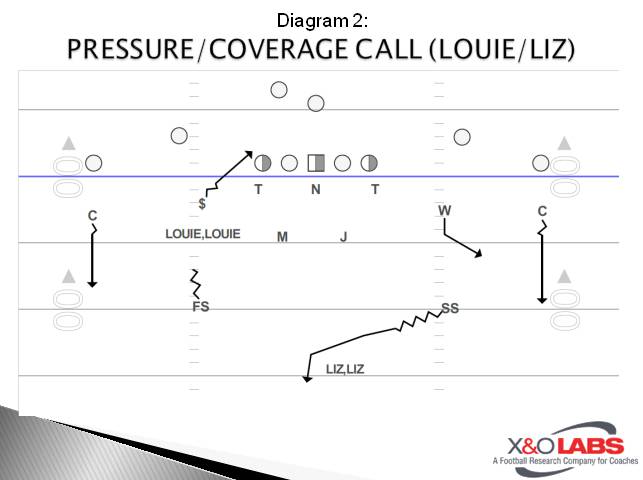
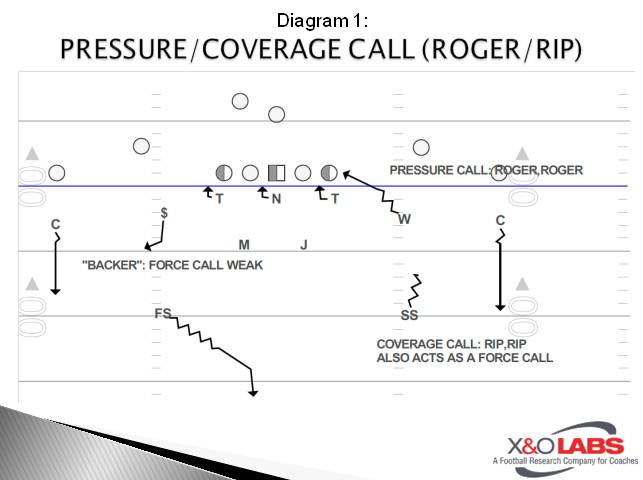
If we roll our coverage and set the reduction and down safety right we will echo the “Roger” call from the front with a “Rip” call (Diagram 1). This tells the front that the safety aligned to the right will be rolling or “spinning” to the right and is now the force player and Seam Player to that side. If the front is setting the reduction the left, we echo the “Louie” call with a “Liz” call to set the force player/seam player to the left (Diagram 2). We feel like making 2 calls gets everybody talking and communicating so that we have gap integrity and the 3 underneath defenders are aware of who is playing what.  
Slide1Slide2

Base 3 Under/3 Deep Zone Structure

As was stated earlier in the article, a 3 under/3 deep zone structure is what is sometimes referred to as a “cheat” coverage due to the fact the 3 underneath droppers are responsible for more than 1 underneath zone. In effect, we are “cheating” players either inside or out to play more zones than we have players for. For sake of argument, we do split the field into zones however within our match up principles, we do not spot drop into these areas, which will be discussed later in the article.

We assign our 3 underneath droppers to three underneath zones (Diagrams 3-4). Our two seam droppers are assigned the curl/flat areas that stretch from just inside the hash, roughly 2 yards, all the way to the sidelines at a depth of 12-15 yards. Our hole player is assigned the immediate hook to hole area favoring the side and release of #3 at a depth of 12-15 yards. Any route under 5 yards is in what we call “no cover” which means we will leverage and only jump when the ball is thrown.

Read More