
Unbalanced Line Structures in the Spread Offense

By Thomas Hotmer
Head Coach
Princeton High School (MO)
Twitter: @coachhotmer, @PrincetonTFbal

Introduction

The unbalanced line in our spread offense allows us to create more leverage space on one side for our passing game and the other side for our running game. The idea is to create confusion on the defensive alignment up front. Diversifying the spread in a new way to create spacing and matchup advantages creates nightmares for opposing defensive coordinators. At the same time, our players enjoy the creativity each week learning a new wrinkle and enhances their focus on play design with individual responsibilities. While we did not use this in every game, the threat of using it requires opponents to use practice time learning how to line up to it rather than only focusing on our base plays.

Rodeo/Lasso (Tackle Over)

When implementing our tackle over package, the main priority is to ensure your tackle understands the run blocking rules from the tight end position. In our system, we have base blocking rules determined from the defensive alignment. We coach our lineman from the idea of where the run play is called and if they are covered or uncovered by a defensive lineman. Beyond this simple blocking concept, our tackles can go unbalanced as a tight end and still be effective blocking in our run game.

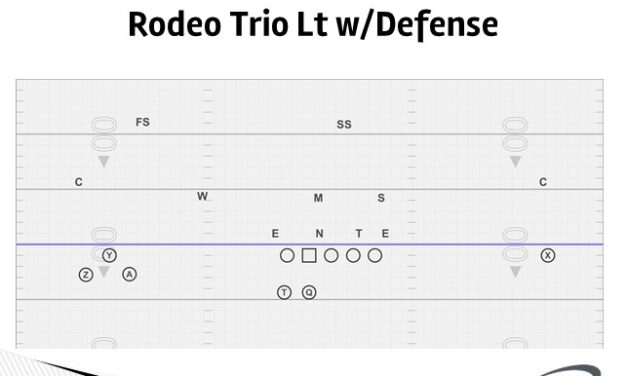
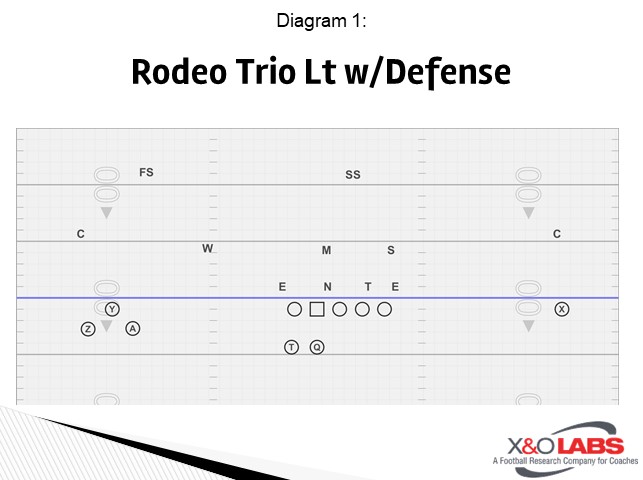
Once we started doing this, we noticed the extra spacing to the opposite side of our call based on the defensive shifts. We mainly utilized this to create more space for our passing game on the backside with all players keeping their eligibility and creating an extra gap for our running game on the overload side. The extra gap and 4-6 extra yards of space on the backside has given us the freedom to keep all of our plays the same with the ability to make the defense have to tackle well in more space. If we call a pass play, we run it as called. If we call a run play, we always tag it with an RPO so our quarterback can read pre-snap leverage. The following diagrams will present a few formation ideas that gave us leverage advantages for both our run and pass game RPO’s.
Slide1

Rodeo Trio Lt Coaching Points:

When using this formation, the main thing I want to know is how they will defend us up front and the space they will allow to the trips receivers. If they do not shift with our tackle over, we will run the ball to that side. If the defense over shifts and gives us more space, I like to throw bubble or now screens as well as all verticals.
Slide1

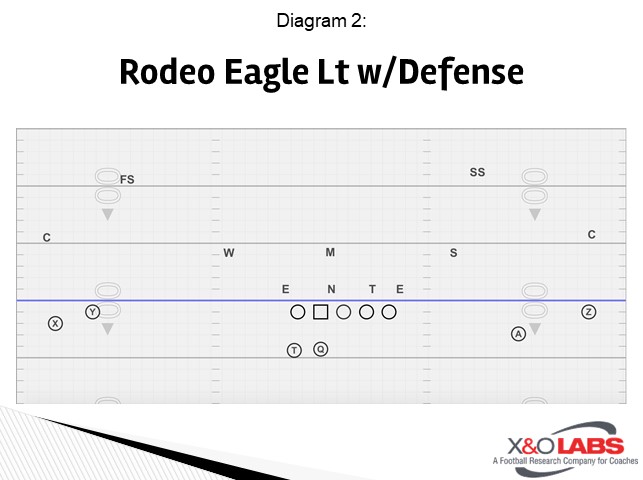
Rodeo Eagle Lt Coaching Points:

This formation allows for us to get into a spread look with our two best receivers on the same side. This allows us to avoid brackets on our two best receivers and create the one on one mismatch we like with the space they give us.
Slide3

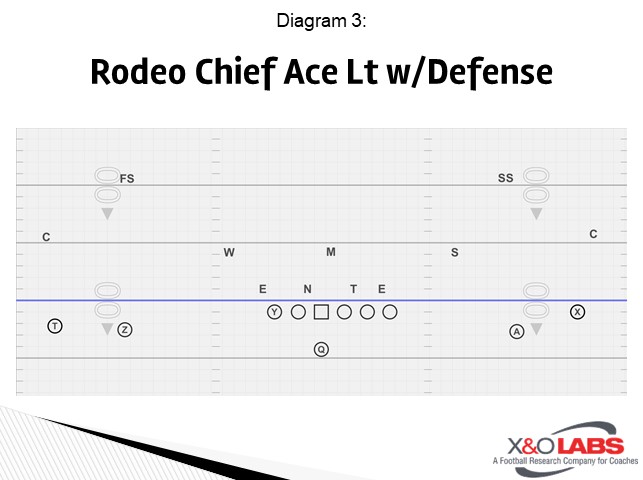
Rodeo Chief Ace Lt Coaching Points:

This formation allows our tight end to look like a left tackle in a trips set while maintaining eligibility. We can still run the ball with any run play we like as well as tag run pass options with this balanced line. We can get mismatches with a slot receiver on a linebacker or our tight end on a linebacker to take advantage of in the passing game.

To study game film of this formation structure, click on the videos below:

Editor’s Note: Coach Hotmer has provided clip by clip narration for each of these plays:

Clip 1: On this play, the defense does not shift to the tackle over. They choose to shade to the tight end that has been hurting them in the pass game with their defensive line, a linebacker, and a safety creating for an easy QB Iso to the tackle over. The key to this is maintaining eligibility with our receivers and tight ends so that the however the defense aligns, we can make them wrong.

Read More

Defending Tight vs. Wide Bunch Formations

Michael Donnelly
Cornerback Coach
Michigan Tech University (MI)
Twitter: @M_Donnelly21


Introduction

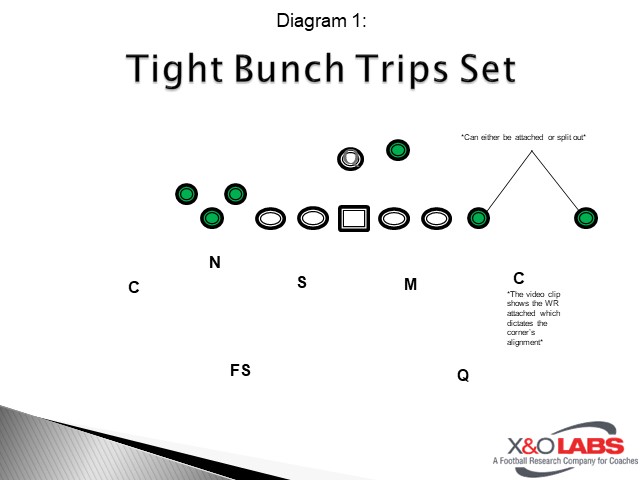
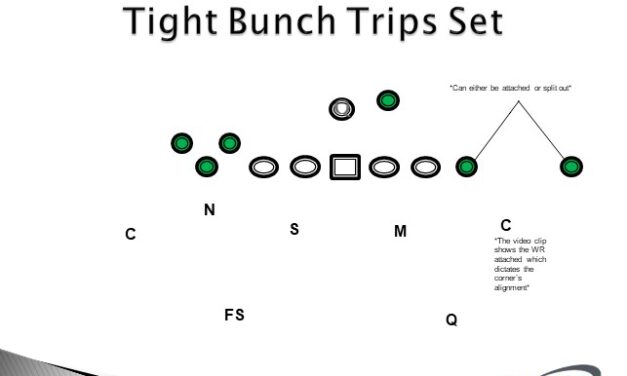
Bunch formations are becoming a popular tool by offenses to muddy the reads for defensive backs in coverage or create a mesh by alignment for man to man coverage. Teams are lining up (or motioning) to stack formations which helps create a free release or rub route for the WR in the back of the stack. Dealing with a trips bunch formation puts an extreme amount of pressure on the DB’s eyes. The secondary must recognize where the bunch is located and what to expect out of the different alignments through film study. Not only will teams use trips bunch formations to pass the ball, but it also can create gap integrity issues in the run game pending distance from the end man on the LOS.   

Tight Bunch Formations

RUN

Slide1

For running purposes, the tight bunch gives the offense the ability to try and gain an edge (block down the point man on DE) or slice/pull #3 to create an extra hat play side.

 This clip is more to show how an offense can use the alignment of the bunch to run a gap scheme play away from the bunch, but still utilizing the bunch.  We are treating this bunch different than the variations I will get into so the way we are playing this is not important.  It is important to recognize if your DE can be affected by the bunch so he must recognize the type of block he has to defeat or be alerted from the backend. 

Read More

Teaching the Back-Shoulder Fade Route

By Danny Freund
Wide Receivers Coach
University of North Dakota (ND)
Twitter: @dfreund7

Introduction

A well thrown back-shoulder fade is a major weapon. We believe in throwing back-shoulder because it is hard to defend when executed, and usually gives the receiver a chance to make a play on the ball or draw a pass interference call. We throw a quick game back-shoulder route against press man in the open field and red zone. We also ask the quarterback to read the defender and throw back shoulder on go routes, wheel routes and fade routes from the slot. 

This isn’t an easy throw or route. We practice it every day in some fashion because the concept depends heavily the tempo of the throw and speed/adjustment/separation of the receiver. These daily reps develop the confidence and timing it requires to execute on game day.

We threw more back shoulder balls last season because our wide receivers had good size and athleticism, but lacked the speed to consistently run past defensive backs in our league.

Types of Back-Shoulder Throws

We break this concept down into two types back-shoulder throws. The first is what I typically think of as a back-shoulder throw; a quick fade ball in the red zone or open field. The second version is where the quarterback and receiver making adjustments on certain deep routes based on the leverage and eyes of the defender.

3-Step Back-Shoulder

This is a ball that is thrown versus tight or press man coverage. There are a lot of factors that go into making this work, but the most important being the placement and tempo of the throw. A perfect ball can potentially make up for a poor release by the receiver and good defense by the defensive back. As a general aiming point for the quarterback, we tell him a foot above and a foot behind the wide receiver’s back shoulder. It is really important this type of throw has some tempo to it. We want the receiver to flip his hips and adjust late to the throw, leaving the defender with little reaction time to make a play on the ball or receiver’s hands.

It is very difficult to complete this throw if the quarterback misses inside. It no longer becomes a “back-shoulder” if the ball is thrown to the front of the receiver! The ball is more likely to be caught if it is at shoulder level or above. If the throw is lower, then it should be a little more behind the receiver to clear the defender’s body.

More often than not, this is a ball thrown into the boundary. It is a higher percentage throw because the ball travels a shorter distance. It is a precise throw and the shorter distance allows for better accuracy. It is also typical to see more press man coverage into the boundary, which is the only coverage we attack with the three step-back shoulder.

Coaching Points:

  1. The wide receiver should work a release and get three to four steps vertically into the defender before looking. If he looks too early or doesn’t get vertical, he can get squeezed into the sideline and allow the defender a better angle to play the route and ball.
  2. The receiver should avoid leaving space between him and the defender. He must stay tight and vertical for as long as they can. He will also hold the line and leave room for the quarterback.
  3. The receiver will use his upper body at the top of the route. Bigger wide receivers usually have longer arms and they can use that length to create separation with a slight push off just before the ball arrives.
  4. The catch, tuck and finish of this route is the most important. Defenders are not looking for interceptions in man coverage. They want to break up the pass. They will play the ball aggressively and attempt to punch or rake it out. The receiver needs to execute a quick catch and tuck, and not leave the ball exposed for the defender. We coach them to catch, tuck and rip it away as we try to flip our hips completely.

Deep Back-Shoulder

Read More

Adapting a 13 Personnel Package for a H.S. Spread Offense

By Steve Monninger
Head Coach
Norfolk Academy (VA)


Introduction

As we prepared for the 2017 football season, we did not consider ourselves a team that would ever use three tight ends in one offensive set. Our overall identity is that we are a spread offense (using 1 or no TE’s) that utilizes RPOs and focuses on having a high completion percentage. 

After a successful preseason camp and beginning the season with a record of 2-0, we soon found out that our tight ends were better than we thought. Therefore, we decided to install a 13 personnel package that included two formations and still utilized our base plays. From Week 3 to Week 10, our 13 personnel package became a very important part of our offense. During that span of the season, we ran our 13 personnel package for about 25% of our snaps each game. Here are the top reasons why we installed it during the season:

  1. We liked our TE’s. We had confidence in the talent and depth of our TE’s in terms of blocking and receiving. We understood that our X’s and Z’s would be on the bench more, but we still felt it was worthwhile. 
  2. We liked our RB’s. We felt that this package could highlight their skills and their toughness.
  3. Broad Blocking Surfaces. 13 Personnel formations present broad blocking surfaces. If defenses do not adjust, uncovered gaps can be created in the tackle box while at the same time, tight ends and wings can out leverage the flank. 
  4. Defenders are taken out of their “comfort zone.” Since we can switch back and forth between spread sets and 13 personnel sets, our opponents would typically keep their base defense on the field. We felt that this was an advantage for us. Corners like to play in space, but we made them play off a nub TE or Wing. Safeties like to play deep, but we made them move into the box and that would set up play action passes.     
  5. Easy Install. We felt like we could use our base plays using the same principles and rules. For the run game, our OL learned nothing new. For the pass game, our patterns follow a 1, 2, 3 concept. Our TE’s and Wings just had to know their placement within the formation in order to determine their route.
  6. Easy Motions. We love to create matchups using motion. Using our standard rules, it was easy to motion our key players for certain plays. Generally, we use motions in this package to change the strength of the formation or to create a sniffer.  
  7. Usable in Several Gameday Situations. Our 13 Personnel package helped us with important gameday situations including short yardage, 4-minute offense and in the coming out zone. This package was also used to help us sustain a longer drives to give our defense a rest or just eat some clock to keep our opponents electric offense off the field. This fall, time of possession became an ally for us because of using this personnel package.

Formations

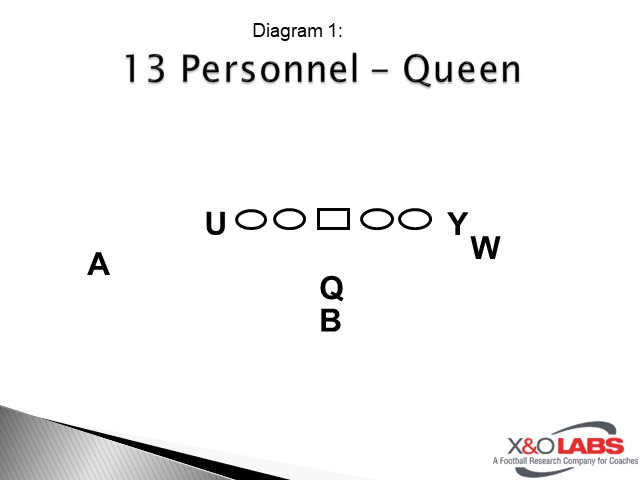
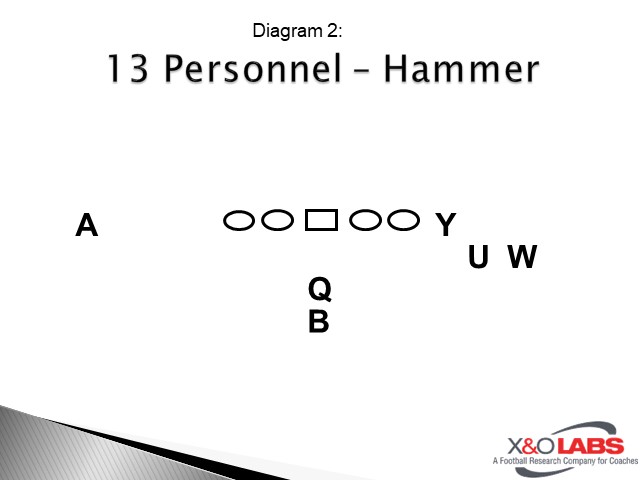
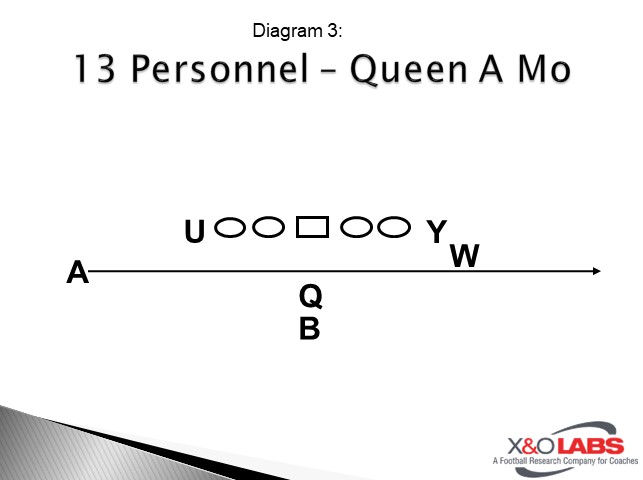
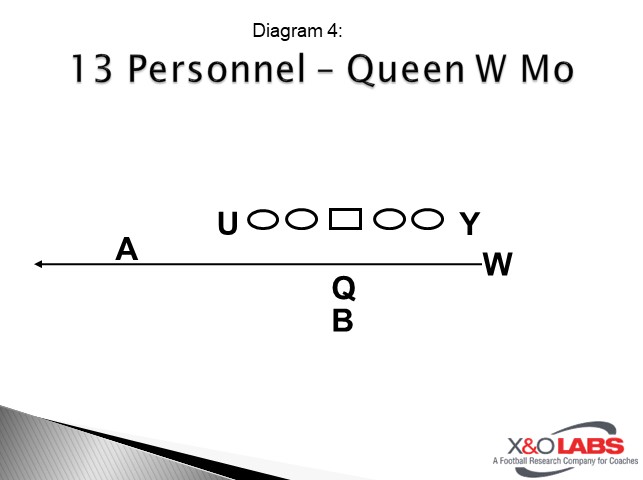
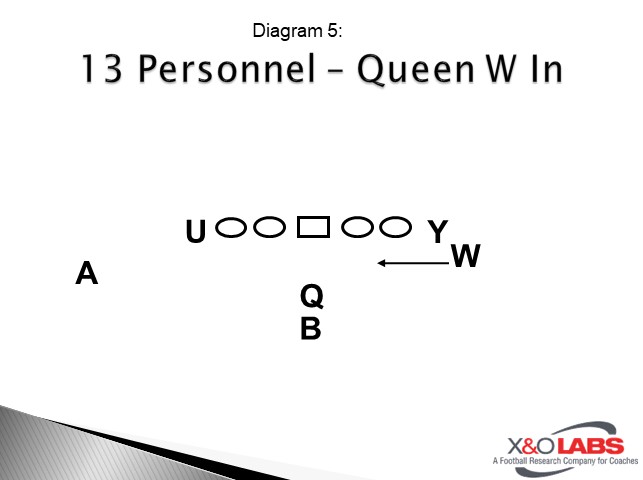
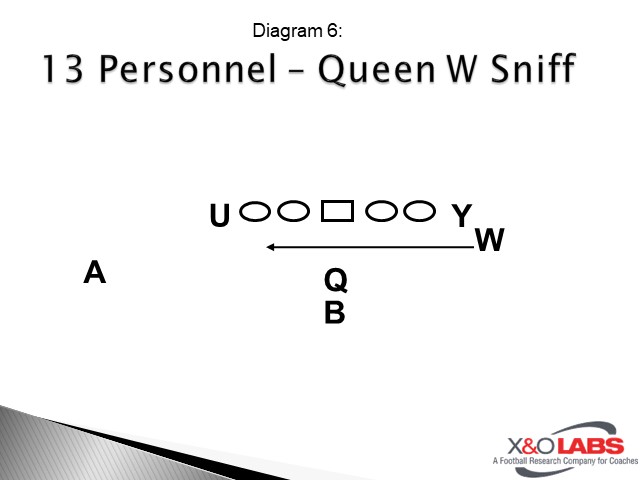
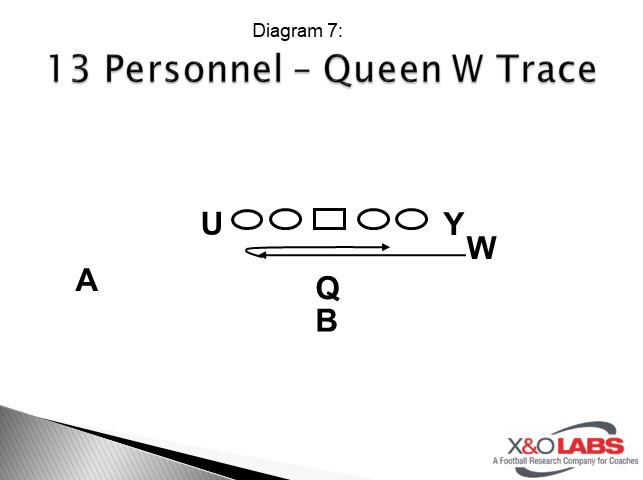
Here are some diagrams of our formations and motions from 13 personnel. The A is our best slot WR who has the most shake, but you certainly could use your best X. Our Y is the home TE that aligns to the strength of the call. The W is the Wing that aligns to the strength of the call. Our U is either the backside home TE or the extra wing in Hammer (Diagram 2).  

Slide1Slide1

Queen Motions

Slide3Slide3Slide3Slide3Slide3

Read More

Rat Coverage Principles to Defend Third Down

By Mike Giancola
Defensive Line Coach
Bridgewater College (VA)
Twitter: @CoachGiancola


Introduction

The chess match that is played on the field during a game is one that comes down to a few critical moments that will ultimately determine the outcome. Because of the high value nature of these situations, we call them “money situations.” While certain downs are more critical than others, all downs that give us an opportunity to get off the field are categorized as money for us.

As such, the game plan each week has a unique set of fronts and coverages for third down. We put a lot of effort into dissecting an offense in those situations to come up with a plan that will give us the best chance to get off the field. This article will discuss a few different coverage concepts that helped us maximize our third down efficiency over the last two seasons.

3rd Down Coverage

On third downs, the three most successful coverage concepts were utilized were Rat, Thud and Punch coverages. 

Rat Coverage

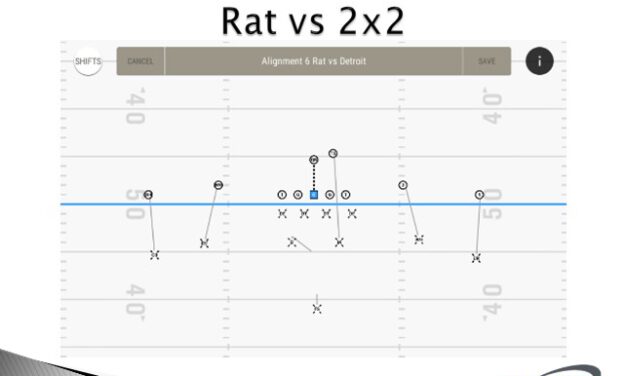
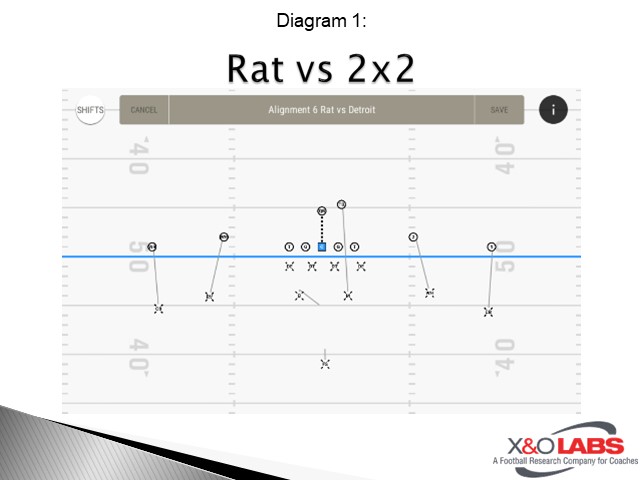
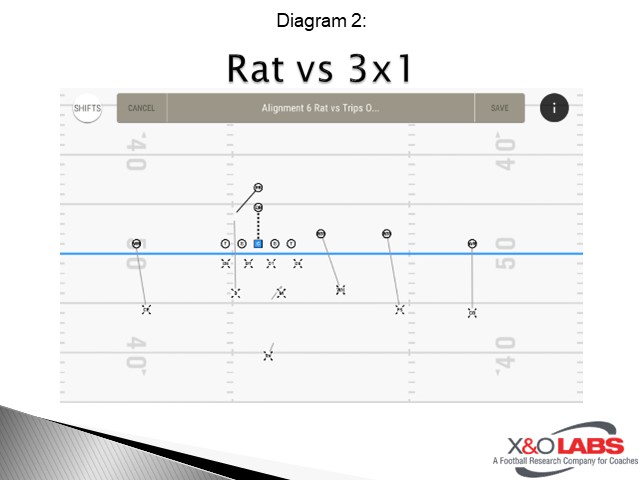
Rat coverage is a single high man concept we use to take away the outside stem of pass routes, and funnel receivers to our two rat players in the middle of the field. Depending on down and distance, we will have short and middle hole rats, or middle and deep hole rats. The purpose of the rats is to take away shallows, digs, and posts.

Rat coverage also puts stress on offenses as it is designed to create five-man pressure if the back stays into block. The ILBs are responsible for the TB. Whichever LB the TB steps to has him, and the other becomes rat player. That LB that gets the back will insert, keeping the possibility of screen in mind as he goes.

The rat players will always be a linebacker and a safety. The funnel players will be the corners, the other safety and the OLB.

Slide1Slide1

Using Rat Coverage
Rat Coverage can be utilized in any down and distance, and is our primary man coverage concept we like to use on third downs. Tag the coverage with different calls to indicate where the rat players should play (short, medium, deep holes).

Rat Coverage Coaching Points

Corners

  • Left alone on island on outside receivers
  • Inside leverage, pressed or six to seven yards off receiver
  • Late help over the top ONLY IF there is a deep hole player
  • Funnel Players

Man coverage, but help inside from rat players

  • Pre-snap outside leverage, take away outward breaking stems
  • Squeeze near hip of inside stems, eliminate dead space, maintain leverage
  • Routes can be passed off once you see your own color running with it
  • Pedal or shuffle technique

Rat Players

  • Must read run/pass. Needed in run fit no matter formation
  • Look to rob crossers and inside stems
  • Short/Middle hole rats don’t back up
  • Deep hole rat must gain depth in the middle of the field and read eyes of QB

Editor’s Note: Coach Giancola has provided a clip by clip analysis of each of the plays below:

RAT COVERAGE CLIPS

Clip 1: 3rd and 6.  Rat coverage with short and middle hole players. QB quickly looks to #2 on skinny post/dig, sees rat safety color and forced to pull ball down because of good coverage.

Read More

Designing an Empty RPO Package

By Zach Turner
Offensive Coordinator
Kenton High School (OH)
Twitter: @Zach_Turner1


Introduction

At Kenton High School we have had a long history of being an empty team. Our base passing DNA comes from the Mouse Davis Run and Shoot system where the receivers based on the coverage make sight adjustments. We start every year with teaching our kids as much about coverage’s and defensive structures as we do with the ins and outs of our offense. Over the past few years, we have discovered that we are getting far less of the “base” generic man coverages (cover 0, cover 1, or cover 2 man). We are also seeing fewer pure zone coverages like spot drop cover 2, cover 3, or cover 4. We see more pattern matching, bracket coverages, and split field coverage’s.

Since we do not have the time to teach our players the ins and outs of each new coverage, we have learned with an exotic offense often comes exotic defenses and multiple looks. Rarely do we see the same defense 2 weeks in a row. We found that RPOs gave us the answers we needed to these different coverages.

Development of RPOs

In 2016, I thought our QB was getting hit too much. We were not giving him the answers with in our play calling for all the different looks he was given and that was on us as coaches. We put together some empty RPOs that we would hang our hat on and develop throughout the season. They are all one-word calls that involve a pre-snap side. The pre-snap side is always based on a yes or no scenario. Along with the pre-snap side, there is a post snap side which involves a read key to either run or throw the ball.

Advantages of RPO’s in an Empty Set

RPO’s have given us a number of advantages. The first being it has always given us an answer. We started using the RPOs as openers to get us into a rhythm. It gave our quarterback some comfort ability knowing there was a guarantee. We get this guarantee because the defense just cannot match numbers. It also gave us as coaches a chance to see alignments and structures to adjust to what we are seeing. That said, the biggest advantage was it kept us ahead of the chains and detoured the defense from bringing pressure.  

The Difference

In 2016, we had 3997 yards of total offense through 10 games. In 2017, we had 4746 including 3529 through the air and 1217 on the ground. We increased our points per game by more than four points a game, but more importantly, we decreased our quarterback knockdowns and sacks. In 2016, we were knocked down 87 times and sacked 56 through 10 games. In 2017, we were knocked down only 21 times and sacked 9 times. I contribute that to two things. One is our RPO system we developed but the other is we hired a great offensive line coach this off-season. This season RPOs consisted of 20% of our offense. Our completion percentage was 67% when running an RPO and we averaged 8 yards per play. The biggest number to me is when an RPO scheme was called only twice did we have a negative play of minus yardage.

RPO Structure

The structure of our RPOs is very simple. We have a pre-snap side and a post snap side. It is crucial to the success of the RPOs to make sure all players understand what determines the pre-snap side getting the ball, or not getting the ball. For the post snap, we must understand the read key. With the pre-snap and post snap side, we attach one of two of our base run plays.  

When we begin to teach the RPO system, we start with the pre-snap side. The pre-snap side to use is always the screen game side. When looking at the RPOs we wanted a system that could guarantee us we were moving forward and for us the easiest throws are with in our screen game package. We stress 100% completion when throwing the screens so it must be automatic.

Pre-Snap

When looking at the pre-snap side, we tell our players it is a yes or no scenario. Yes we can throw the screen or no we cannot throw the screen. To get to that yes or no answer we have a two step criteria our QBs must go through to determine if it is yes or no. The criteria go as followed:

  1. Number of force defenders (defenders below the hard deck 7 yards) – We played with the depth we considered a force defender. We started at five but we saw that most defenders at six to seven yards still have the ability to put their foot in the ground and play down hill quickly. This makes tough blocks for our guys especially since we are usually smaller on the perimeter (5’7” 145) on average.
  1. Leverage – Leverage is an over used term in football at times because we just tell our players have leverage, use leverage, gain leverage but never tell them what it is or why it is important. For us, we want our blockers to have leverage on the force defenders, if we are going to throw the screen. We use two terms in teaching this. The first is catch point and the second is rendezvous point. They easily work together. To define each, the rendezvous point is the meeting point where our receiver meets their defender to block them. The catch point is where the receiver will catch the football. The bubble screen and our now screen have two different catch points. Now screen is the numbers and the bubble screen is two yards outside the hash.

Post Snap

Read More

Shotgun Buck Sweep PAP

By Cameron Cox
Offensive Coordinator
Refugio High School (TX)
Twitter: @CoachCamCox

Introduction

The play action pass off the shotgun buck sweep is a staple of our offensive scheme at Refugio High School. It’s an effective concept that not only takes advantage of overly aggressive defenses, but it creates mismatches on the edge. The quarterback is able to get out of the pocket, out leverages the defense, and floods a portion of the field for a chance at a big play. It also is a play that has lots of potential options for complimentary plays including a built-in throwback.

The Buck Sweep Running Play

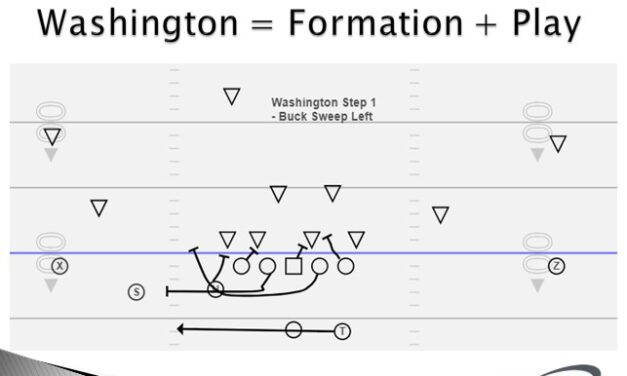
To make any play action work, it starts with the base running plan. This is a look at our shotgun buck sweep play. As you can see, we pair the buck with the reverse motion to get the defense moving and to set up the play action later.

Slide1Slide1

Play Action Pass Off Shotgun Buck Sweep

Offensive Line Play 

One of the many benefits of this play is that the protection looks almost identical to the run blocking scheme we use on the buck sweep play. The more resemblance your play action protection has to the run play from which it is derived, the more effective it will be. This is a six man protection, in which we pull both guards. The action of the guards pulling, coupled with the backfield action, will trigger the linebackers and safeties to come stop the run. When done correctly, he down blocks and pulling guards are almost indistinguishable from the blocking scheme on our buck sweep play.

The play side tackle and center must have great footwork to pull this off. The must step flat enough to not allow early penetration to cut off the pullers while not stepping so flat that they let the defender cross their face or roll out of their block for a free shot to chase down the quarterback. Ideally, the play side guard will pull and log the defensive end that is closing with the down block of the play side tackle. A common reaction by defenses to try and stop the shotgun buck sweep play is to widen their defensive ends so that the sniffer back cannot block them down. If this is the case, the play side guard needs to notice a wide defensive end before the snap and know that he will need to get more depth on his pull with the goal of at least squaring up the defensive end and not allowing him to pressure our quarterback. The back side guard will pull and gradually gain depth. As he gains depth, he will turn inside and pass block. He is responsible for any backer run through or back side edge pressure. The back side tackle will pass set and block the back side defensive end.

Slide3Slide3

Backfield Action

The backfield action is identical to our buck sweep running play. Let’s assume that we are running the play action pass to the right. We will end up with our sniffer back set 1 yard back and directly behind the right tackle. The running back will be set to the left of the quarterback, directly behind the left tackle, with his “heels on QB’s toes”.

Read More

Defending RPOs from Four Down, Two High Spacing: Case 1 – Box Defender Reads & Fits vs Option Runs

By Mike Kuchar 
Senior Research Manager 
X&O Labs 
Twitter: @MikekKuchar 


Special Reporting by Adam Hovorka, X&O Labs Contributing Writer 


Introduction 

Playing a four down front, two-high defense can place a good amount of stress on the box defenders. In most 4-2-5 structures, these box defenders consist of the front four linemen plus the strong side and weak side inside linebackers. In 4-3 looks, the presence of the Sam/Nickel or strong safety is added into the equation. How a coaches trains those defenders can have a major impact on defending the first level option principles most associated with RPO offenses. After all, RPOs are option offenses at the core, and taking away the first two threats (dive and pull) usually equates in defensive success. Like defending flexbone schemes, the more the ball gets pitched the better off a defense is, the quickest way to gash a unit is north to south. And the while the onus of that responsibility falls on the box defenders, it’s the defensive line that has to be able to cancel gaps along the front.  

This case is devoted to how coaches are training their front four to react and defend the more common run sequences associated with RPO football (zone, single pull and double pull concepts). But before we uncover our research on how these coaches are defending them, we thought it necessary to briefly summarize the type of personnel each of our contributors are using in their base defensive outfits.  

Editor’s Note: Our contributors to this report all base out of a four down front, some are 4-3 in structure, while others are 4-2-5.  

Personnel  

Chris Endress, Co-Defensive Coordinator, Seneca High School (MO): “We play with a field defenisve end and a boundary defensive end. Our defensive tackles adjust to and from the call.  We always call our fronts to where the Eagle (3-technique) will go such as Eagle left or right. Tite or open is based off the tight end placement and field and boundary. We will also use back and bop, which is to or away from the running back. Our linebackers are the same. The Eagle linebacker goes with the 3-technique and the Hawk LB goes with the Shade. In our 2×2 looks, the Hawk LB is the one who leaves the box, but he is always to the boundary. He will have less ground to cover. Overhangs are similar. The Gorilla (SS) always goes to the field. The Willie (WS) always aligned to the boundary. So they can align pre-snap. It also allows me to cross-teach the reads, fundamentals, alignments, etc.” 

Rob Everett, (@nineinthebox) Defensive Coordinator, Bridgewater College (VA): “We play with a true quick defensive end and a guy who is more suited to go against the tight end.  Our 3-technique is the more athletic of the two tackles. We rotate many defensive linemen. Our Field Strong Safety we call our Whip. Our Rover is the weakside safety and he always travels with the backer, the weak-side inside backer. When we play against 2-2, we basically become 4-3 so that backer is a hybrid player. “ 

Adam Hovorka, Head Football Coach, Schneiber High School (NY): “We always play quick athletic types at defensive end as we want kids that can get off the ball and bend and chase. We will play with one bigger tackle as our 3-technique and one quicker kid at the Nose. We will play one true middle linebacker (Mike) and he is an old school plugger. Our other box linebacker is the Bandit and he is a hybrid inside backer and 4-3 OLB. He has to be able to run and be a great blitzer. We already play with quicker defensive end types to begin with. We want long quick kids that can pass rush and bend and chase. We play a field defense with a strong safety (Strike) that will go the field 90% of the time. He aligns with the FS and they are in split field coverage to the read side.   

“On the opposite side we play a weak safety (Whip) that will determine the coverage to his side. Verse tight formations, the Mike aligns to the strength and the Bandit opposite. In open formations, the Mike goes to the read side and the Bandit will go to the away side with the Whip. At times, we will sub out our Strike and put a pure pass cover player there also. If we do this we are probably moving our Strike either to Mike or defensive end. In obvious pass situations, we will play with the four best pass rushers and as much speed on the field as possible. If we are doing this we are either blitzing or we are expecting an obvious pass situation. We will have our Strike get some reps at walling of #2 or #3 in trips just like our Mike would.”  

Chris Kappelmeier, Defensive Coordinator, Sparta High School (NJ) 

“We play a field defense versus open formations. We will read the wide side of the field. The Strong Safety and Free Safety align to the wide side of the field regardless of the formation. The Free Safety makes a reading right or a reading left call to call the passing strength of the formation. He then makes a coverage call for his side of the formation which will be the corner, strong safety, and one of the linebackers. The Weak Safety now makes a coverage call for his side, which is the away side, for himself, the corner and the other linebacker. Our defensive ends are generally linebacker type players to start with so we do not sub them out. We will play our regular strong safety who is a linebacker/defensive back hybrid.” 

Read More

Defending RPOs from Four Down, Two High Spacing: Case 2 – Designating Run First vs. First Overhangs Based Off Formation

By Mike Kuchar 
Senior Research Manager 
X&O Labs 
Twitter: @MikekKuchar 


Special Reporting by Adam Hovorka, X&O Labs Contributing Writer 

Introduction 

In defending the RPO game, a decision has to be made by defensive coordinators on whether or not they stay in two-high or one-high safety structures. While the protocols of this decision can be influenced by several variables—running ability of the quarterback, a potential mismatch on the perimeter—essentially it will boil down to what facet of the option game a defensive coordinator wants to commit to defending. While we will analyze this decision making process further, we’ve found that the philosophy behind making this decision relies on the following: 

  • If the quarterback is a running threat, it’s essential to equal numbers in the run game so that there is a player responsible for tackling the quarterback. 
  • If the running back is the most proficient element in the RPO game, gap exchanges need to be made to make sure the ball is being pulled by the quarterback in the run game.  
  • If a particular receiver is the most proficient element in the RPO game, coverages need to be dictated to defend him. 

Many coaches still believe that playing a single high man structure, such as cover one, provides for an adequate answer in the RPO game because a defense has equal numbers to defend each potential receiver along with a single high safety that can be tied into either playing the quarterback in the run game or giving help to any potential receiver in the pass game.  

But the coaches we researched with in defending the RPO element believed that equal numbers is a detriment, particularly if your defenders are not as talented as those on the other side of the ball. Then what? It becomes necessary to find a way to get a plus one or a plus one and a half numbers advantage to whatever element of that option game a defensive coordinator is choosing to defend. That is being done by playing two-high safety structures where help is given to both the run and pass equally.  

So, now the dynamic has shifted to defending the RPO game with two-high safety structures and the thought process is to keep those two safeties high so they can trigger quicker on the run or pass game by studying a pre-snap (or post-snap) visual cue rather than being tied to the reaction of a particular receiver as they would be in man coverage. It allows them to be an extra player in the run game or an extra defender in the pass game based on the formation presented by the offense. While we will detail the pre-snap cues that trigger these reads by the safeties in a later case, the roles of the overhang defenders (or invert players) become even more prominent. These are the dual read defenders, the ones that the quarterback is reading to make his choice to run or throw the football.  

It is a defensive coordinator’s job now to protect those overhangs. In this case, we are going to study the means in which these defensive coaches are protecting those overhangs, either by defensive structure, pressure or by adjusting to the offensive formation.  

Editor’s Note: For teaching purposes, the techniques and fundamentals of the overhang defender will be presented in 2×2 open formation. We will detail how coaches are adjusting to other formations later in this report.  

Identifying the Overhang Defender Based on Coverage 

In order to keep two-high safety structures, there will be an overhang defender responsible for playing either run or pass and it is this same overhang defender that the quarterback will look to manipulate based on his movement. This is the defender that is tied to both a gap in the run game and a responsibility in the pass game. Consider the following formations and the overhang defenders that can be influenced. While there are a multitude of formations that can be presented by the offense, we wanted to present the most common ones associated with RPOs, according to our research and the stress they place on a defense.  

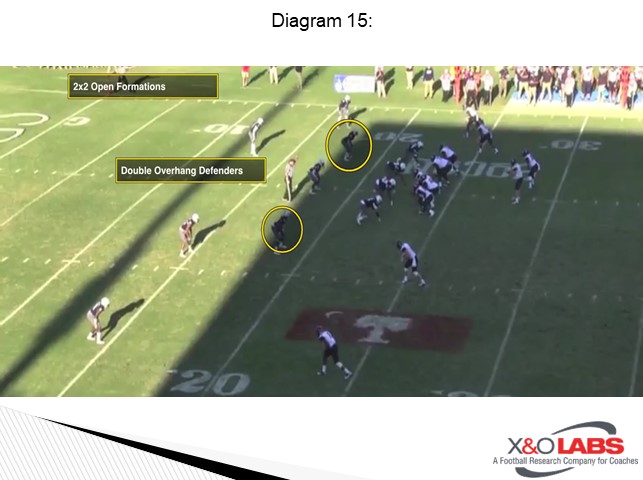
10 Personnel Doubles Formations (Diagram 15) 

Slide15

The challenge in defending 10 personnel doubles formations is that the width of the receivers can solicit a five-man box to defend six potential gaps in the run game. This is nothing new; defending this formation has become an ageless paradox that has plagued defensive coordinators since the early 2000’s when then West Virginia head coach Rich Rodriquez was dicing opponents with the zone option with running back Steve Slaton and quarterback Pat White. 

Read More

Defending RPOs from Four Down, Two High Spacing: Case 3 – Full Field and Split Field Coverage Concepts that Protect Overhangs

By Mike Kuchar 
Senior Research Manager 
X&O Labs 
Twitter: @MikekKuchar 


Special Reporting by Adam Hovorka, X&O Labs Contributing Writer 


Introduction 

RPOs are formation-based concepts particularly when they are designed to attack four down, two-high safety structures. Defensive coordinators that use these structures ask a lot of their safeties to be able to fit in the run game and help on the pass game. So, when offensive coordinators design their RPO concepts, they are looking to manipulate what defender is responsible to play both run and pass. They find which defender is stressed by formation and they work to manipulate that defender with a run read. While we already detailed who those defenders can be in the previous case, in this case we are going to share our research on the coverages that defensive coordinators are using to protect these possible manipulated defenders.  

TwoBack Formation Fits: 

Not surprisingly, most of RPO formations explained in this report are one-back formations by nature. 2×2 and 3×1 structures are the more popular formations offensive coaches are implementing in their RPO game. However, there is a contingent of coaches that have chosen to use two-back personnel groupings, such as 20 personnel and 11 personnel H/Y off structures, to design their RPOs. While some of these diagrams are displayed in this report, most defensive coaches use the following protocols in defending RPOs from these two-back formations: 

  • Two-Back offenses doesn’t always require a safety to be tied into the fit; it’s possible to defend 20 personnel groupings with the seven box defenders.  
  • For H/Y off 11 personnel outfits, the inside backers will be tied to the post-snap direction of the H/Y off. He creates an additional gap that needs to account for. 

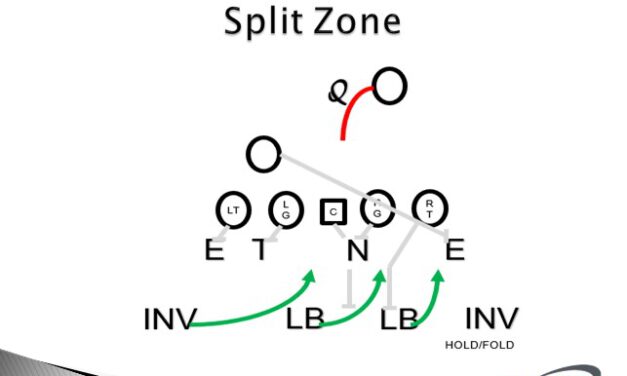
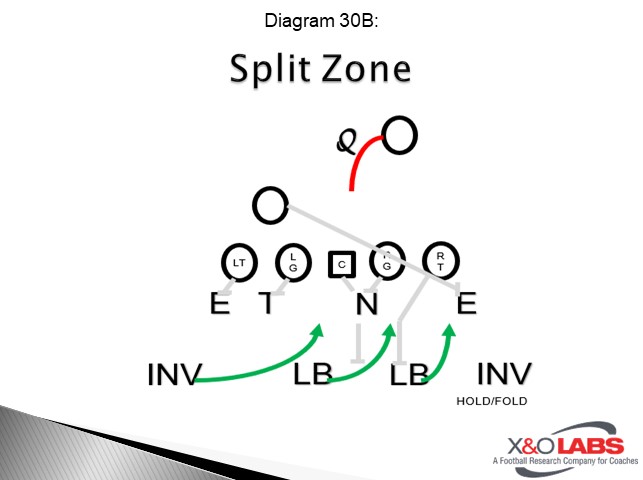
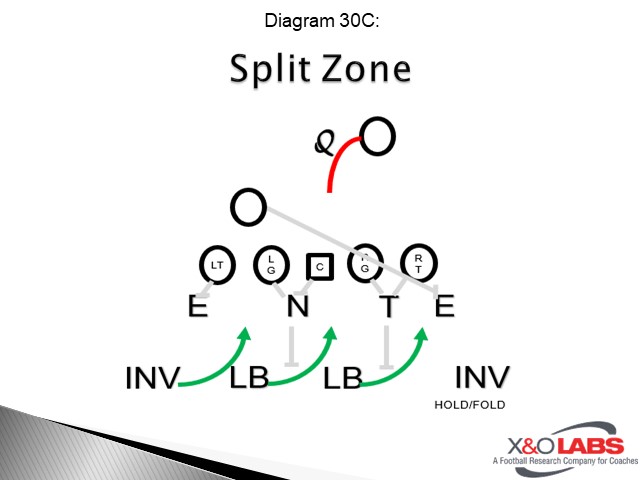
In either case, the pre-snap alignment of the Y/H and the direction of the mesh will be the primary indicator in which defenders will be run first or pass first defenders. The diagrams below detail the day one run fits four down, two-high safety defenses will utilize against the H/Y split zone schemes that are popular today. 

diagram30bdiagram30b

Two-High Coverage Methodologies in Defending RPO 

Quarters (Cover 9) Coverage 

Why It’s Effective Against RPO 

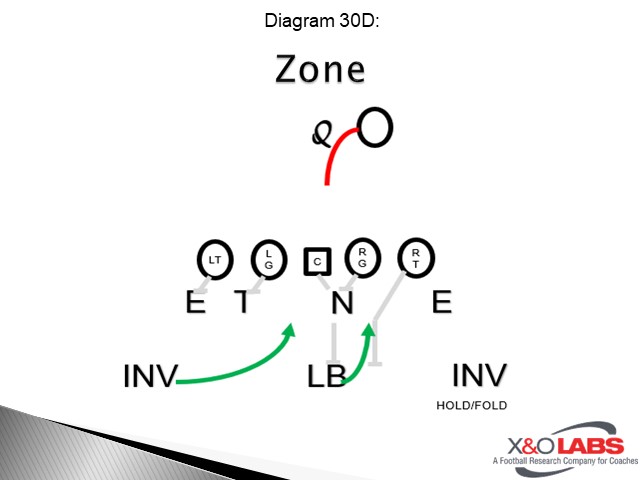
Playing pure cover nine allows for a two-high look to defend the possibility of downfield vertical threats while also providing for a solid run surface against 10 personnel teams. Against RPO teams, cover nine allows for a possibility of 8.5 defenders to the run game and 2.5 defenders to the pass, depending on the formation. It’s best served in clouding the read of the QB to make a decision because of the uncertainty of the two overhang defenders. Coaches will utilize quarters coverage structures either by setting the 3-technique to the field, to the back or as base call against Pistol formations. It’s also effective because it can essentially become cover zero with underneath help, which provides assistance on the interior RPO game such as slants replace routes.  

Quarters Coverage Fits with 3-Technique set to Field: 

  • 3-Technique set to field  
  • Mike: B gap defender 
  • Overhang to field – Run to, A gap defender; Run away – hold and fold player 
  • Overhang to boundary – Run to, B gap player; Run away – hold and fold player 

diagram30d

Read More

Trap Coverage to Defend 3×1 RPO Concepts

By Klint King
Defensive Coordinator
Richland High School (TX)
Twitter: @klintking

Introduction

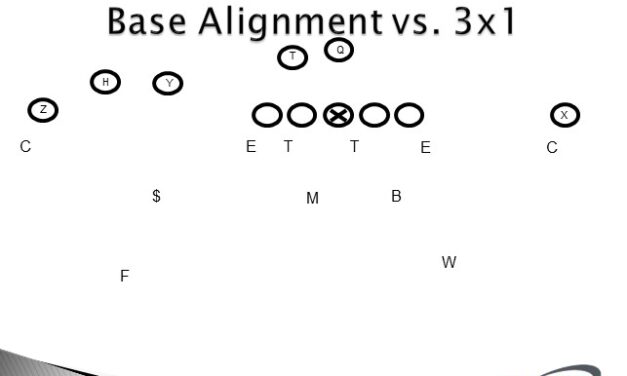
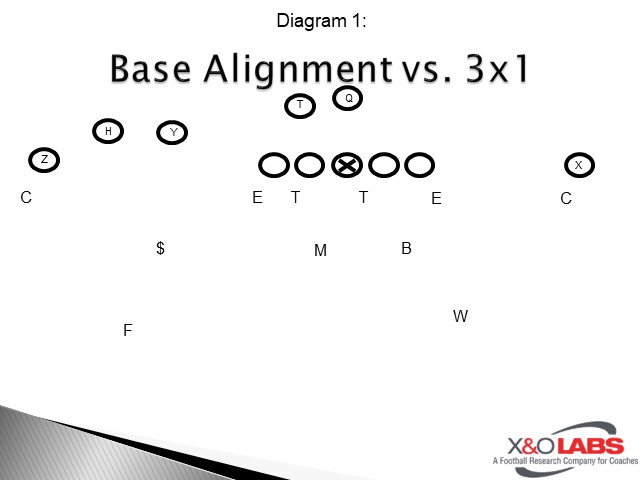
Our “trap” trips coverage is just one call we use to help defend an offenses RPO concept. This call allows our conflict defender to be in a better position to defend the run and pass. Shortening the space and number of receivers our outside linebacker is responsible for allows him to be a better run support defender. Trap is best when expecting a bubble/stick or stop route concept. However the rules we have in place make it is still safe to run if the offense runs a 4 vertical concept. We are a split field coverage team against any two by two set, but normally we flip to a full field coverage against any 3×1 sets. Our base alignment as a 4-2/4-3 defense to a 3×1 set is shown below (Diagram 1).

Slide1

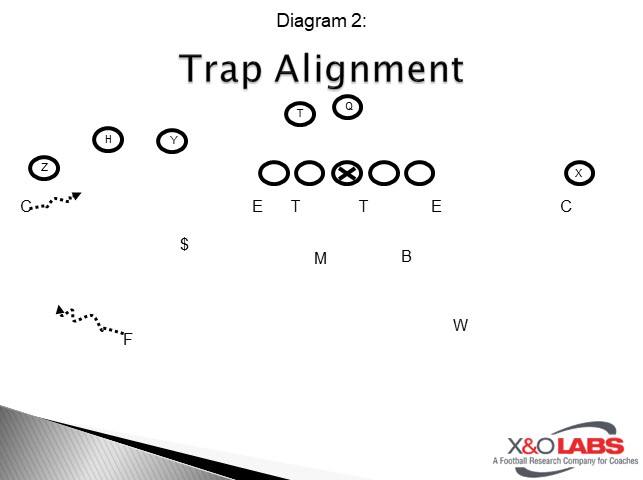
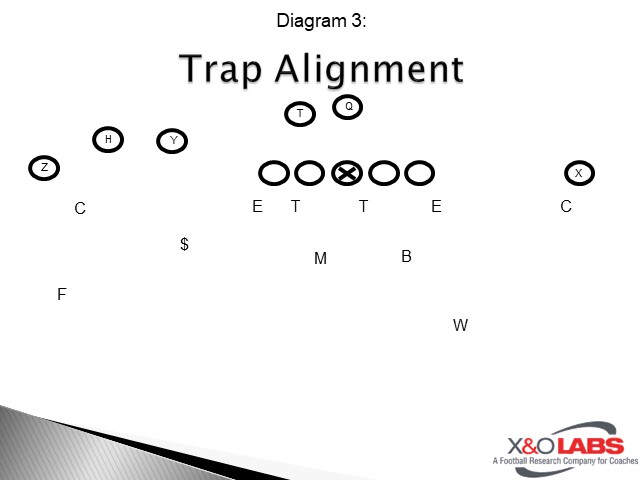
Our base alignment is an over front to the trips. The alignment of our run/pass conflict player ($) is 4 yards on the outside shoulder of the number 3 receiver. This alignment is to try and put doubt in the quarterback’s mind. We want the QB to be unsure of whether the number three receiver will be open or not. We base out of a cover two concept to the three receivers. This means the $ could be responsible for any of the three receivers in pass responsibilities. Our trap alignment is show below (diagram 2).

Slide1

As you see in the diagram above, we will work out of our base alignment immediately before the snap to shorten the formation.

Alignment Rules

Slide3

Above you see where the base alignments should be as the ball is snapped. We want the corner and free safety to hold their movements as long as possible. The longer we can disguise the movement of our secondary, the better off we will be.

Strong Safety: The $ moves his alignment from outside the number 3 receiver to the inside shoulder.

Corner­: The corner moves, according to the snap count, to trap the outside hip of the #2 receiver.

Free Safety: The free safety moves his alignment from 10×2 inside the #2 receiver, to 8×1 inside the #1 receiver.

Weak Safety: The weak safety base alignment is 10×2 outside the end man on the line of scrimmage.

Strong Safety ($) Coaching Points:

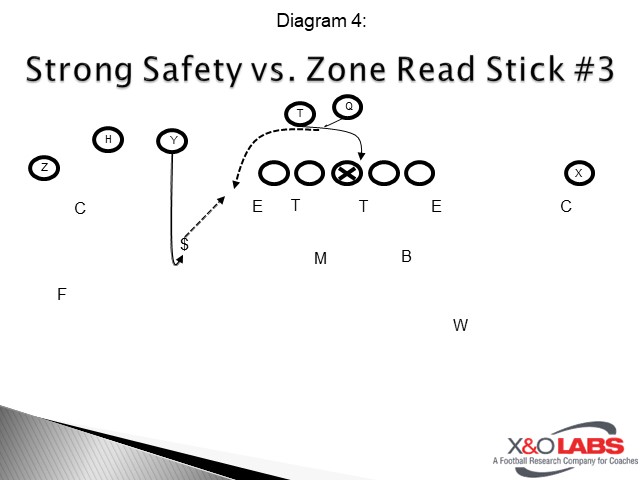
The strong safety is a run/pass defender. He is responsible for the quarterback on zone read, and will work 3 to 2 on pass. Moving the strong safeties alignment to the inside shoulder allows him an unimpeded path to the quarterback on zone read. It also allows him the ability to sit underneath the stick route of the #3 receiver in an RPO concept.

His first pre-snap key is offensive tendencies based on running back location. Before the development of the RPO for offenses, the key for reading run/pass was usually end man on the line of scrimmage (E.M.O.L.). Now our strong safeties run/pass key is the backfield action. The option you want to eliminate most will ultimately decide how quickly he triggers on run. Allowing him to sit on the stick route is crucial to eliminating big plays.

Slide3

Read More

One Word RPO Verbiage for Tempo Offenses

By Matt Rosati
Head Football Coach 
Perry High School (OH)


Introduction

In the game of football, every revolutionary concept that has success leads to extremely creative coaches researching and scheming ways to beat it. In the past five years, RPOs have impacted the game at all levels. As so many great defensive minds have found ways to disrupt many RPO concepts, the RPO world is evolving and taking another step forward. 

Like many RPO centric offenses, our program at Perry High School has been able to take our best run plays and package them with our most efficient pass concepts. In 2015, we established ten RPO concepts into our offense and our scoring average went from 29 points per game (PPG) in 2014 to 40 PPG in 2015. We continued to implement more RPO concepts and our average increased to 41 PPG in 2016 and 48 PPG in 2017 through the use of 32 one-word RPO concepts in a no-huddle format. To take this to the next level, we have taken some of our base RPO concepts and have implemented a variety of trick plays into the system.  

The Problem

Ninety percent of our offensive schemes incorporate RPOs. We only have two passing concepts that do not have a run option (vertical route and mesh route concepts). We have found that one of the best ways that teams are defending our normal RPOs is not necessarily related to great defensive schemes but more so by using the rules of the game against us. Many teams discuss the rules with the officials prior to the game to induce more illegal man downfield infractions. On most Friday nights, I witness opposing coaches bend the ear of the officials about our linemen being downfield on every pass play. 

While the opposing coaches were often right, the flag was very seldom dropped. That said, I am seeing that trend change. We have utilized an RPO system for three seasons and our number of penalties for illegal man downfield have jumped from three (out of 606 plays) in 2015, seven (out of 781 plays) in 2016, and thirteen (out of 716 plays) in 2017. In three years, twenty-three illegal man downfield calls have been issued out of a total of 2105 plays. Painfully, of the twenty-three penalties, eight resulted in a touchdown being called back. 

Let me be clear. There is no argument. We were guilty all twenty-three times. The fact of the matter is that even though we were hardly penalized for it, the officials were looking to make the call now more than ever before. With that in mind, we had to make a decision.  Our options are:

  1. Hope the officials don’t call it
  2. Stop running RPOs
  3. Do a better job of coaching and adjust to what was stopping us at an annoyingly high rate?

We choose to go with the third option and examined how our guys were getting too far down field and made some necessary adjustments. The self-analysis led us to a new concept in the RPO scheme that will keep us a step ahead of the defensive adjustments.

One Word Offense

Prior to going to our RPO philosophy, our players were versed in the traditional odd and even number schemes, with odds going left and even going right. Most of these systems implement a back numbering system (1 QB, 2 FB, 3 TB, 4 SB) so a play call like “24” would be the full back running the ball through the four hole (B-gap on the right). When we went to the one word RPO system, we kept the odd and even direction concept utilizing the second number but the major change we made was that the first number now dictated which defender we were going to read. This gave a greater flexibility to the play type and formation. Here is how it worked:

First number

1 = Reading backside DE

2= Reading backside Inside LB

3 = Reading frontside DE

4= Reading frontside Outside LB

5 = Must run (no pass option)

Second number

0/1 = Full Inside Zone

2/3 = Guard wrap

4/5 = Power

6/7 = Counter

8/9 = Full Outside Zone

For example, the play could be called is “10.”  The first number denotes that we are reading a defensive lineman and the second number gives the direction of the play as well as the run scheme.  In this case, it means the offensive line will zone block to the right leaving the EMOLOS as the read key to the left. We then essentially create a story surrounding the call. For a 10 call, I simply asked the players the name of the prettiest girl they knew because she is a “10.” After the players would argue, they would agree on a name: Wanda. Wanda now became the RPO one-word call. The naming becomes a mnemonic device to help the players remember the call.

Read More

21-Hour Football Program: Creating an Off-Season Character Development Program

Jeff Tomlin
Head Football Coach
Grand Island High School (NE)


Introduction

More and more, coaches are realizing that having a character development component present within their football program is important to developing players both on and off the field. The game of football is a tremendous platform for teaching the “game of life.” In my 30 years of coaching, I have always understood the importance for developing character, but I wasn’t always the best at implementation. The challenge was always when I would be able to squeeze in character development around the other demands of preparing a team and running a program. For that reason, character development for us was a “grab bag” approach with a quote here and a story there. 

Although I worked hard to teach the core values of honor, courage, commitment and loyalty, I wasn’t as impactful as I could have been because I lacked a systematic approach to making character development an established part of our program. As Coach Urban Meyer is quoted as saying, “average leaders have a quote, good leaders have a plan and great leaders have a system.” I wholeheartedly agree.  

The goal of this article is to outline the process we use in establishing and implementing our character development system and share with you how this has impacted our program. I am sure many of you have similar and perhaps superior systems in place, but it is my hope that I can share at least one idea with you worth including in your program. 

Element 1:  Establish Your Culture

The first step toward implementing character development into your program begins with establishing the culture of your program. Culture is nothing more than a program’s core beliefs, values, traditions, identity and ways of behaving. I am not here to tell anyone what type of culture to establish but instead to encourage coaches to figure out the “purpose” of your program and what you believe in. In short, your culture is “who you are” and “what you do”.  Without an established culture, it will be difficult to communicate and teach character. In many ways, culture and character are one and the same. 

We base our culture on a Code of Excellence. We believe in the relentless pursuit of excellence in the areas of attitude, effort, discipline, fundamentals and team unity. We believe that we have complete control over these five pillars and feel like, if we are excellent in these five areas, winning will take care of itself. We have also built our program upon the four core values of honor, courage, commitment and loyalty. We pride ourselves on being “blue collar” and in being a close-knit brotherhood. 

Element 2: Establish Clear Expectations

It is hard to have an effective character development program if you don’t clearly communicate policies and expectations. This is an obvious point, but an important one nonetheless. Everyone, including players, parents, football staff, boosters, administrators and support staff must have a clear idea of the vision, mission, policies and expectations of the program. 

Read More

Three-Level Sail Concept: New Trends Create a High-Low Stretch on the Flat Defender

By Lee K. I. Boyd
Wide Receivers Coach
Saint Louis High School (HI)

Introduction:

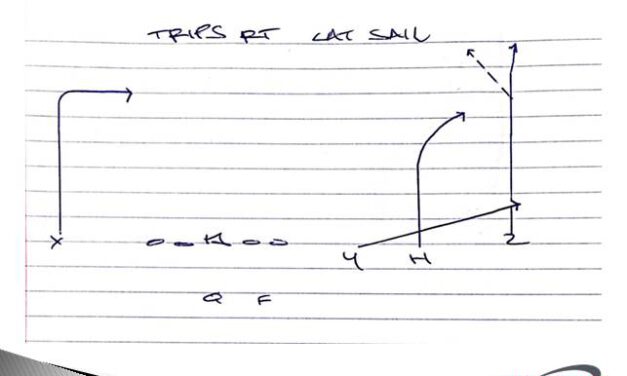
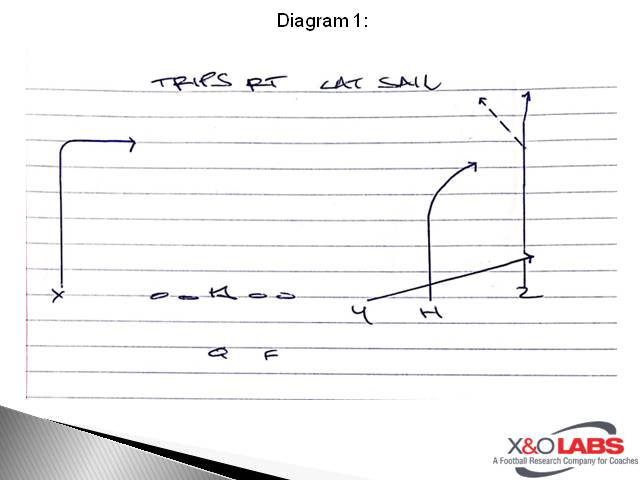
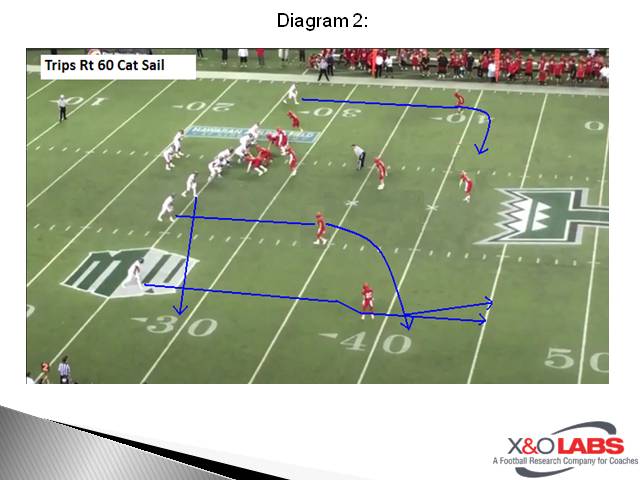
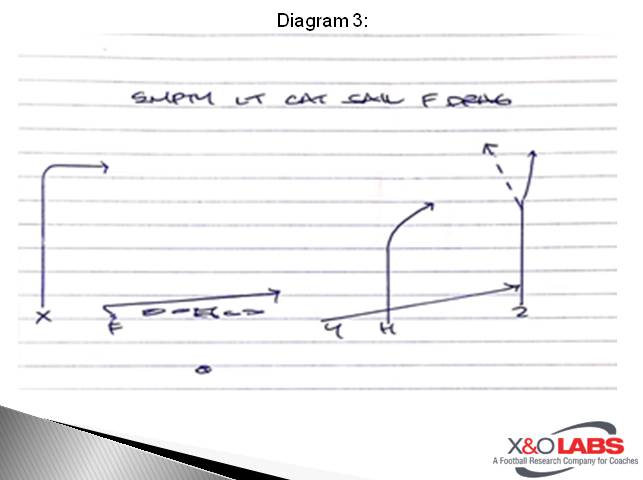
Our sail concept presents a three-level flood of the outside third of the defense, placing receivers deep, middle, and short, applying maximum pressure on the third level defenders and creating a clear high-low stretch on the flat defender.  This is our constraint play designed to counteract coverages that cheat in order to fit the routes of the “Go” concept (link to previous article).   

Slide1Slide1Slide1Slide1

Back Side #1 Receiver “In Route”

The back side receiver will align at the bottom of the numbers and execute an in route. We want to speed cut out of the break at 14 to 16 yards, working downhill to the quarterback, or at worst parallel to the line of scrimmage. If we get man coverage we accelerate across to get separation. If we see zone drops in front of us, we come across under control looking to find a window between defenders. This route becomes a home run if the defense takes away the design of the flood concept by aggressively fitting our strong side route combination.

Front Side #1 Receiver “Go Route/Post Option”

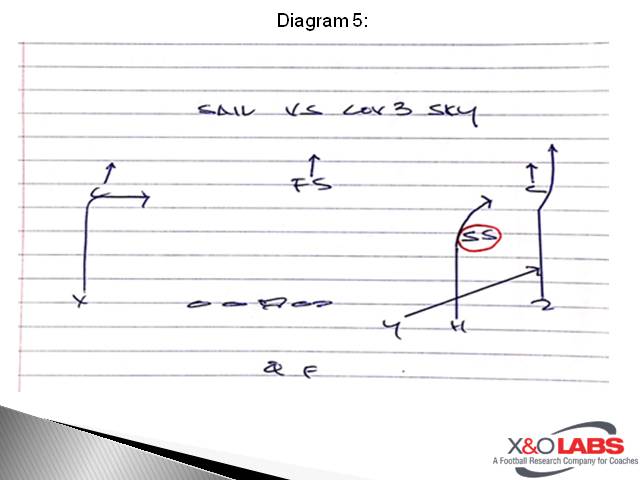
The front side outside receiver will align 3 yards from the top of the numbers if the ball is on the opposite hash mark. He will take a quickest release and run a go route with the option to post. His primary responsibility is to create a vertical stretch on the defense and protect the sail route from the most dangerous secondary defender.

I have the receiver start their pre-snap thought process by identifying the middle of the field as open or closed.  Disciplining the receivers thought process helps to control their heart rate, and increases execution of route options, which for the flood concept is the possibility of posting.

VS Middle of the Field Closed (MOFC) Zone Coverage (Cover 3) – The receivers’ job is to close the cushion on the corner quickly, staying tight to his outside shoulder. If the defender doesn’t fully transition as the receiver becomes a vertical threat, or if he hangs his eyes in the backfield disregarding his deep zone responsibility attempting to play the sail route, our receivers expect to get the ball for a walk in touch down. Releasing outside of the corner helps the quarterback distinguish if he’s going to be a true threat to the sail, and staying tight as the receiver runs past the corner forces the defender to commit to covering him because of his proximity and vertical drive.

Slide5

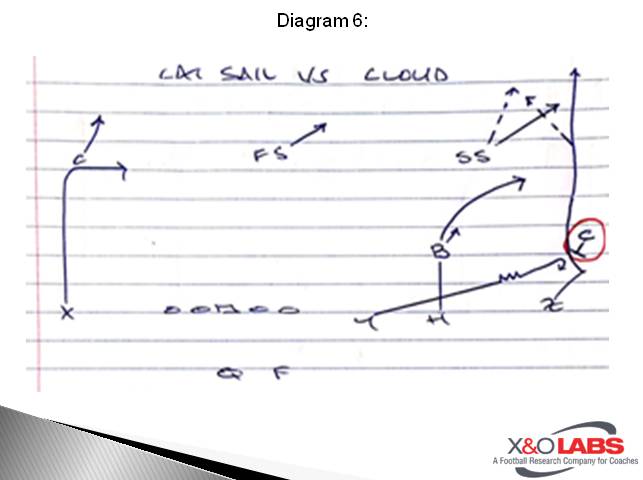
VS Middle of the Field Open (MOFO) Zone Coverage (Cover 2/Cover 8) – Against a cloud corner (cover 2 or cover 3 cloud), the receiver will do one of two things. 

  1. If the safety expands off the hash the receiver will push hard vertically to lift the coverage.
  2. If the safety is tight in relation to the hash the receiver will angle inward in an attempt to pin his near shoulder and increase the space outside for the sail route.

Slide5

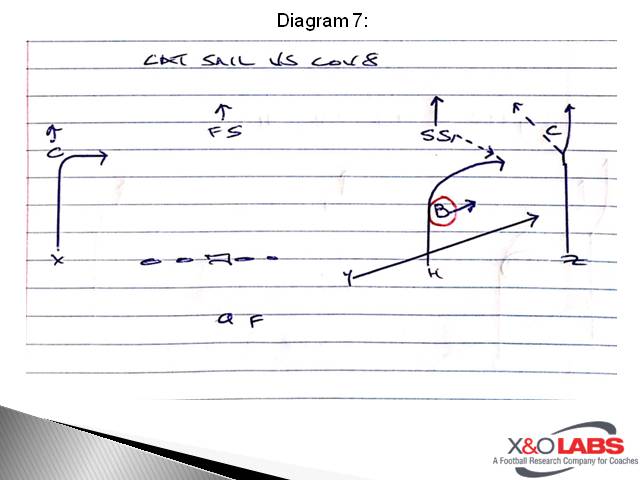
If we get an aggressive safety that is locking up on our sail route as cover 8 defensive structures sometimes do, our outside receiver will run a post at the level of the safety. The coaching point is to close the cushion on the cornerback, then establish his angle to the post as soon as he feels the safety flatten his drop. Doing this in addition to having the sail route break slightly sooner and flatter, presents a cleaner picture for the quarterback. The receiver should take a high angle, allowing the quarterback to put air under the ball and throw him to the middle of the field.

Slide7

Read More

Wyoming A Gap Power Concept

By Mike Kuchar
Senior Research Manager
X&O Labs
Twitter: @MikekKuchar


Introduction

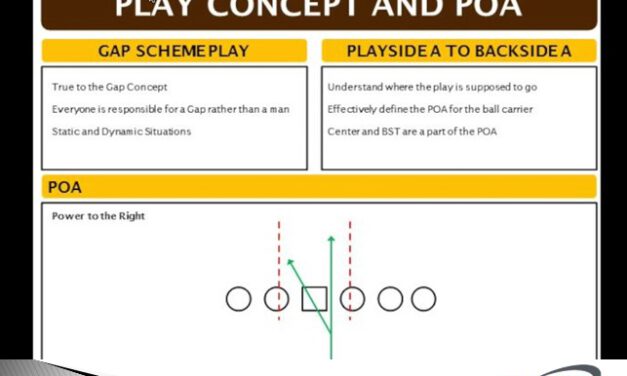
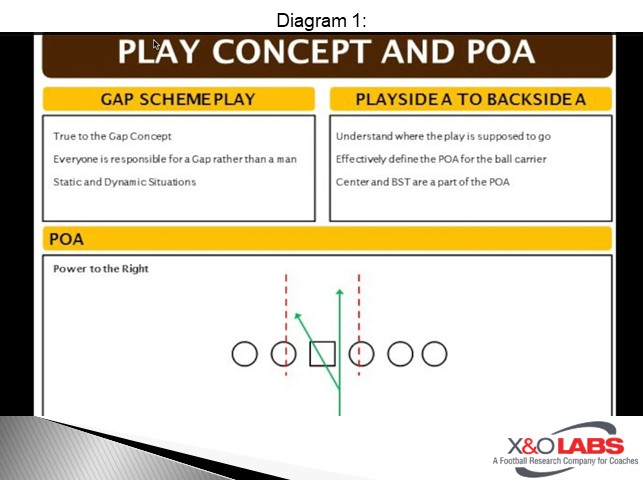
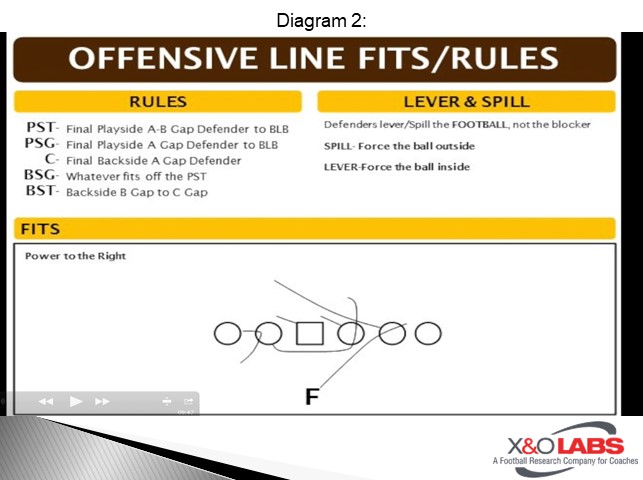
The power concept is to Midwest football as five octave harmonies are to Mariah Carey. It’s tied into the culture, born out of the necessities of pounding the ball in colder climates at the end of the year. So, when Scott Fuchs took the offensive line position under former North Dakota State head coach Craig Bohl, let’s say it was “suggested” that he learn the nuisances of how the Bison were running its A gap power play. Now nine years later at the University of Wyoming, Coach Fuchs is still finding ways to gut defense by getting the play to run as north to south as possible. And he’s doing so by coaching his linemen, and the back, several techniques to enforce an A gap entry point.

Slide1Slide1

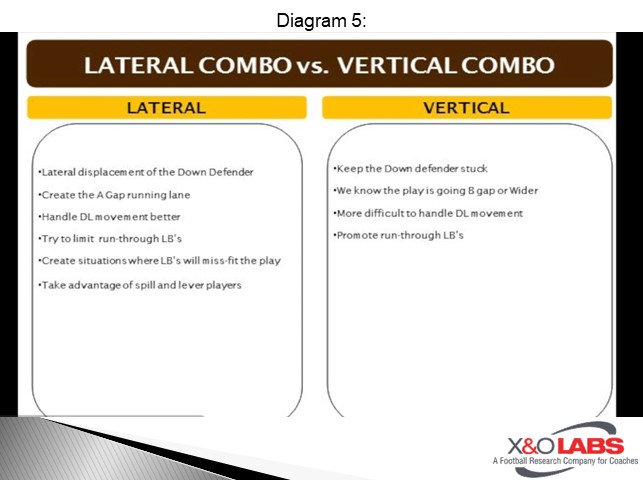
Lateral vs. Vertical Combination Blocks

The focus of this report is on Wyoming’s “baby,” the A gap entry power concept, which coincides the lateral double team. While this concept is certainly not foreign to most programs, Wyoming does supplement it with a C gap power play. “We use the C gap play if our FB is getting his butt spilled, then we will take it outside,” said Coach Fuchs. “We want to make them defend the A gap first which makes them more vulnerable to the C gap scheme. We need to have the C gap play ready if they are filling it.”

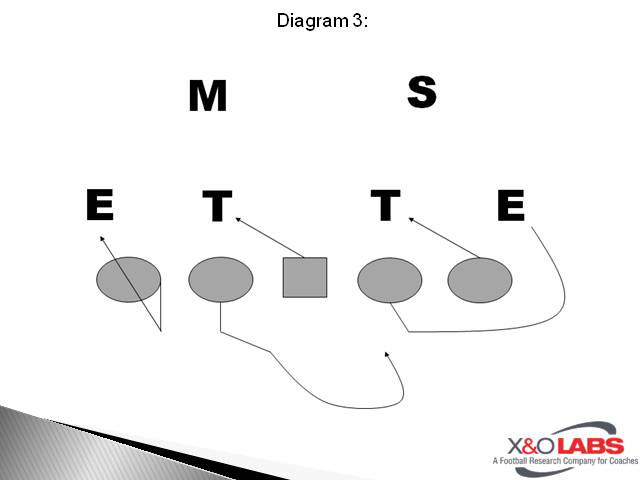
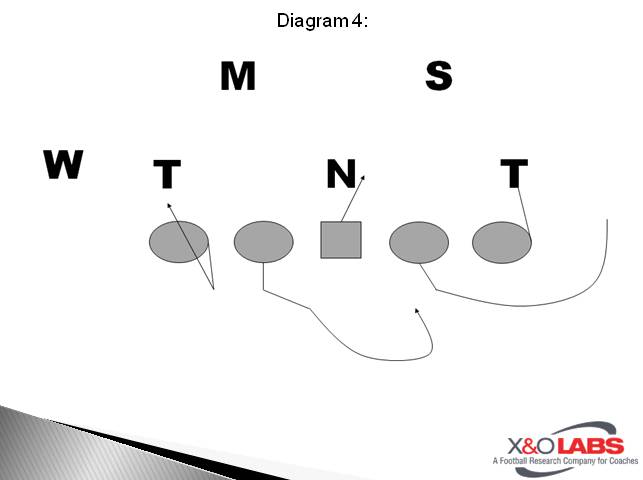
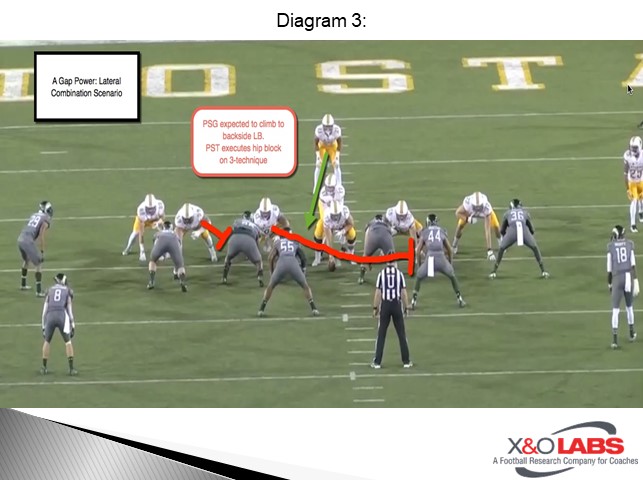
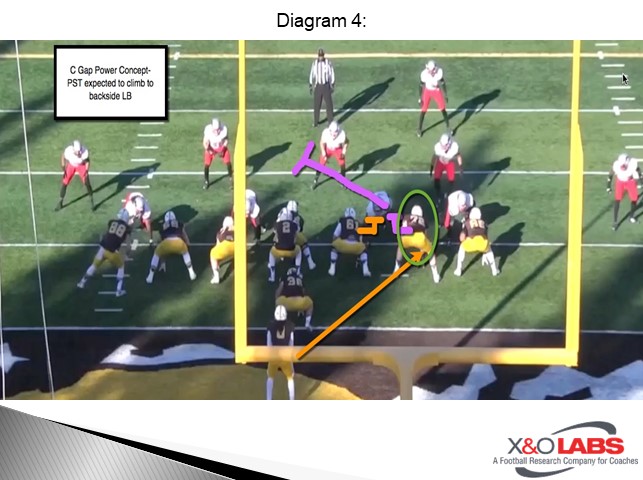
But in order to utilize both versions of power, Coach Fuchs has to use two different types of combination blocks to the play side, a lateral combination block and a vertical combination block. “When we run the A gap power, the play side guard may be the climb player for the backside linebacker (Diagram 3) whereas in the C gap play, the tackle is expected to be the climber (Diagram 4). “On the lateral double team, the post blocker is making sure he’s in the center mass area and the hip area of the down defender,” said Coach Fuchs. “If he’s hitting the shoulder pads, we tell him don’t bother. If the guard has to climb, the backer is going to be over the top and making the play in the C gap or wider and can’t make the play. If it’s not going in the A gap, we prefer the tackle to be the climb player for the linebacker on the double team. That gets us into the vertical combination scenario.”

Slide3Slide3

Coach Fuchs details the difference between both these combination blocks below:

Slide3

Lateral Double Team Progression

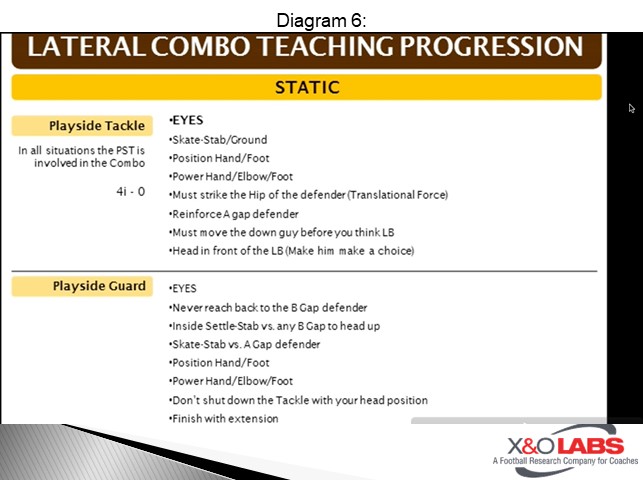
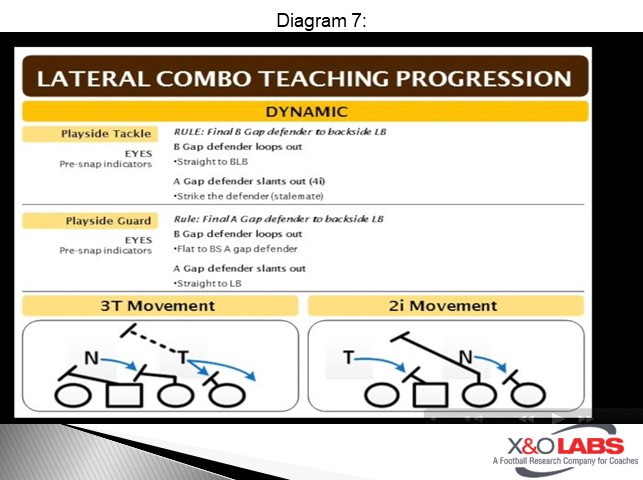
So, in order to enforce the A gap entry point, Coach Fuchs teaches a lateral combination block at the point of attack. While we will detail the specific fundamentals of the lateral combination block, the teaching progression is explained below:

Slide6Slide6

Skate, Stab and Ground Footwork for Play Side Tackle

In order to create the horizontal push needed to clear the play side A gap, Coach Fuchs teaches the play side tackle to use what he calls “skate, stab, ground” footwork. “I got sick of teaching types of steps on double teams, so now we teach a full body movement,” Coach Fuchs told us. “We used to call it an ‘open’ step but we had problems with getting our hips too extended and falling down. We had to widen the base in some way. So, skating to us this means driving my right foot away from my left foot. I’m not actually picking my right foot up and taking a step. I’m driving it away from the other foot, like ice staking to use your blade.”

“Grounding means keeping our feet as close to the ground as possible, because we cannot get overextended,” said Coach Fuchs. “The ground is about position and the stab is about power, the angle that they need. The stab is about striking the defender and accelerating.” The stab and the ground come simultaneously. “For example, if I’m the right tackle, I would take position with my left foot so I’d skate and get my other foot in the ground as quick as possible because that is when I’m striking the guy,” said Coach Fuchs. “The goal is to put both feet in the ground and had more power like a power clean. Both feet would instantaneously snap to the ground. We brought more power to the double team with two feet in the ground.”

To study drill film of how Coach Fuchs teaches the Stake, Stab and Ground technique, click on the video below:

Read More