The 11 Most Effective Open Field Tackle Drills

By Mike Kuchar
Senior Research Manager
X&O Labs
Twitter: @MikekKuchar


Introduction

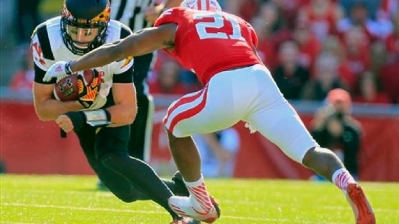
wiscWhile coaches have different perspectives on the correct techniques in open field tackling, we found one constant goal: do what you have to do to get the ball carrier on the ground. Usually, this comes in the form of closing space between the defender and the ball carrier, coming to balance before contact and understanding your leverage on the field as it pertains to other defenders and the sideline. We found the following common errors as it pertains to open field tackling:

  • Coming to balance to early on ball carrier: It seems that more coaches are using the term “come to balance” rather than the archaic “break down.” So many tackles are missed because defenders are not coming in with their eyes at ball level.
  • Losing leverage as a force defender: Whether it’s a squat corner, alley safety or apexed linebacker, these players are responsible for turning the ball into their help. In order to do this, they must be able to stay in a leveraged position to get the ball back to their help.
  • Overrunning the ball carrier when playing cutback: Another way in which defenders are missing tackles is by overrunning the ball carrier in the open field, providing him with cutback lanes that can gash the defense.

We presented the best way to fix these issues by producing what we felt were the eleven most effective open field tackling progressions complete with coaching points and video. We classified them into which of these problem areas they alleviate.

Editor’s Note: The following drills are cataloged in our drill film library. Insiders members can gain access to our entire drill and game film library, which contain more drills done by these programs.

Issue 1: Coming to Balance too Early on Ball Carrier

Regardless of whether you’re teaching the breakdown or shimmy before contact, a decision has to be made on when you start this technique. If you start this technique too early, you can give the ball carrier too much room to make a move and get by you. If you start this technique too early, the higher the chances are of not bringing your hips through contact, resulting in an arm tackle. These are the best drills we’ve found to reinforce this fundamental.

Read More

6 Drills to Teach Triple Option Mesh Mechanics

By Greg Webster
Offensive Coordinator
Springfield College (MA)
Twitter: @coachgregweb


At Springfield College, we utilize an under-center triple option offense. The foundation of our offense is the inside veer. To effectively run the inside veer, we must drill individual and team techniques numerous times. Through hundreds of repetitions, we look to build confidence in the execution of the offense so that when the play is called in a game, the players react rather than think. In order to build this confidence, we incorporate a drill progression that focuses on each individual aspect of the offense, with one drill building on the previous, working towards full team execution. The progression is as follows: quarterback footwork, mesh, ride/decide, pitches, and perimeter.


Drill 1: Quarterback Footwork

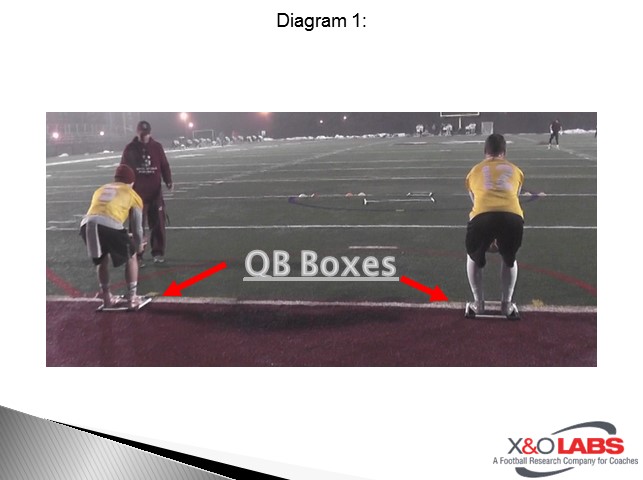
Diagram 1


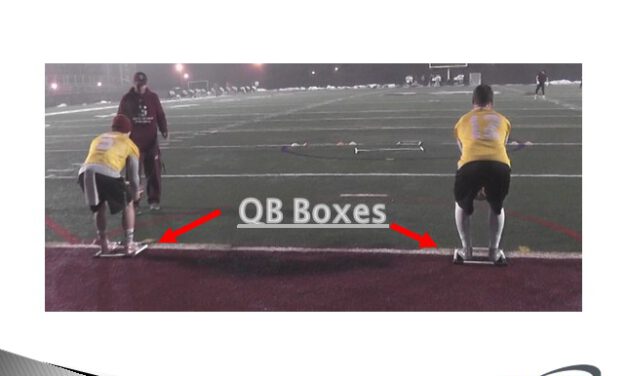
The purpose of this drill is to work the quarterbacks’ footwork, hand placement, eye progression as well as cadence. Equipment needed for the drill: PVC pipe box and footballs (can also incorporate medicine balls as well as weighted footballs). Utilizing a two-foot-by-two-foot PVC pipe box we will have the quarterbacks start with their feet inside the box with the football in hand as if they are under center. One quarterback will start the cadence, with the rest following his lead, similar to a choir, in order to practice having each quarterback’s cadence sound identical. This is essential because all motions are predicated off the quarterback’s cadence. Once the quarterbacks simulate the snap they will execute a toe replace heel step so that the heel of their left foot (if running the play to the right) is in-line with the back-right corner of the PVC pipe box. The quarterbacks will freeze after their first two steps to ensure proper footwork, body position and eye placement. After the first two steps have been executed, the coach can add the entire phase of the mesh, so that it simulates the QB replacing the dive key’s heels and attacking the alley. Also, a visual key can be added to train the QB’s eyes by having a coach or player stand in the place of the dive key. On the snap, the coach or player will hold up a number with their fingers which will have to be read aloud by the QB. This helps to train the QBs eyes to be on the dive key every time. Important coaching points; pigeon toe the feet, mental weight on drive foot, hands beat the feet, pin the chin, eyes to the dive key, Z’s in the hips, knees and ankles.

To study drill film of this technique, click on the video below:

Read More

Building Player Accountability in Weekly Game Planning

By Rob Everett
Defensive Coordinator
Bridgewater College (VA)
Twitter: @NineintheBox


A consistent game planning process is the foundation of a successful practice week and leads to achievement on game day. Each part of the week, on and off the field, should be familiar for the players and coaches in order to reduce anxiety of the unknown, which allows all involved to focus on the opponent.

Using the free simulation GoArmy Edge technology, coaches are able to interact with each other and their teams in a controllable and accessible environment. Game plan installations and assessment of understanding is now taken to the players on their own time and in their own space. This allows instruction to occur at the frequency, pace, and setting each individual player needs.

In this report, we will outline how the GoArmy Edge football simulation program will streamline your coaches game plan process and enhance your teams understanding and accountability. We now have the ability to recreate the practice field in detail from the jerseys your team wears, to the view your players see. 


Part 1: Organization of Installations and Scouting Reports

Installation efficiency and clarity is required for the players to reach their full potential on the field. Most of the players do not see the backs of their teachers writing on a chalkboard in their classrooms, so the football classroom should emulate that experience. At Bridgewater College, we use the flipped coaching model of instruction to give the players the information they need in advance, in order to maximize the face to face time we get in meeting rooms and the practice field.

Using the GoArmy Edge technology, our scout reports and installations are sent out in advance containing the important tendency numbers of our opponent, as well as how we will align and move based on these numbers. What makes this vehicle unique to the traditional paper report and diagrams, is the players have the ability to interact with the plays, from the view from their own helmet. Defensively, we talk about fitting properly with the players in front, beside, and behind the players, and this tool allows them to see it first person. In addition, they are able to see it as many times as they need to. Think about how many times you have a player who has all the ability but could never grasp the game plan. Maybe they needed a different form or frequency of instruction. Using simulation and flipped coaching, these players have the tools to absorb the knowledge on their own time. 

The exact content of each installation varies on the opponent, but each contains at least:

  • Alignment of fronts based on formation (including backfield set and field zone)
  • Full fits of top plays (frequency and production)
  • Synthesized recap of important numbers and tendencies

Read More

9-Technique Play vs. Run Schemes

By Mike Kuchar

Senior Research Manager

X&O Labs


Researchers’ Note: You can access the raw data of this report – in the form of graphs – by clicking here to read: 9-Technique Statistical Analysis Report.


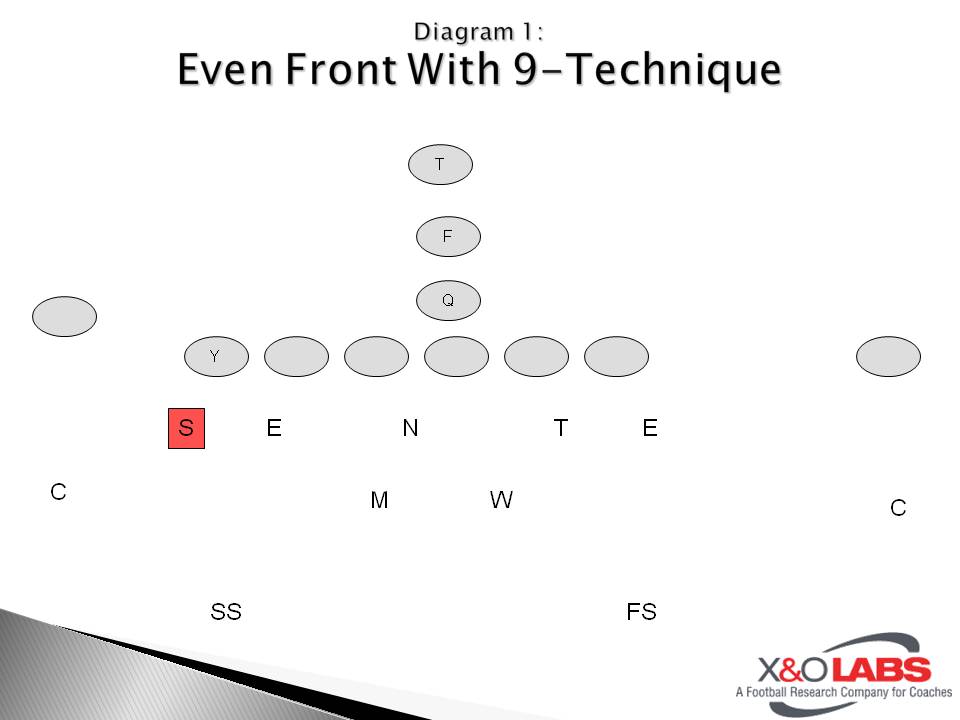
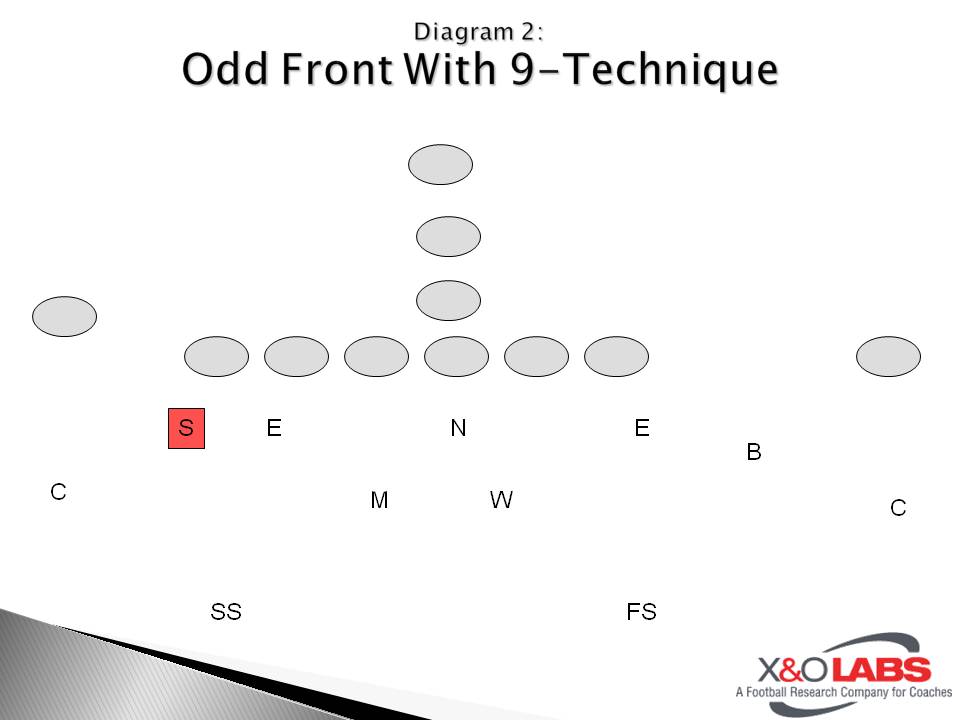
This report will focus on our research findings regarding the play of the 9-techinque defender.  What we’re calling a 9-technique defender is the player that lines up on the outside tip of the tight end or three-man surface.  While we realize this player can be a defensive lineman, we chose to detail the linebacker technique exclusively. This week our focus will be on how coaches train their 9-technique LB’s to play various blocking schemes.  These are the main defensive structure’s we will focus on for the report:

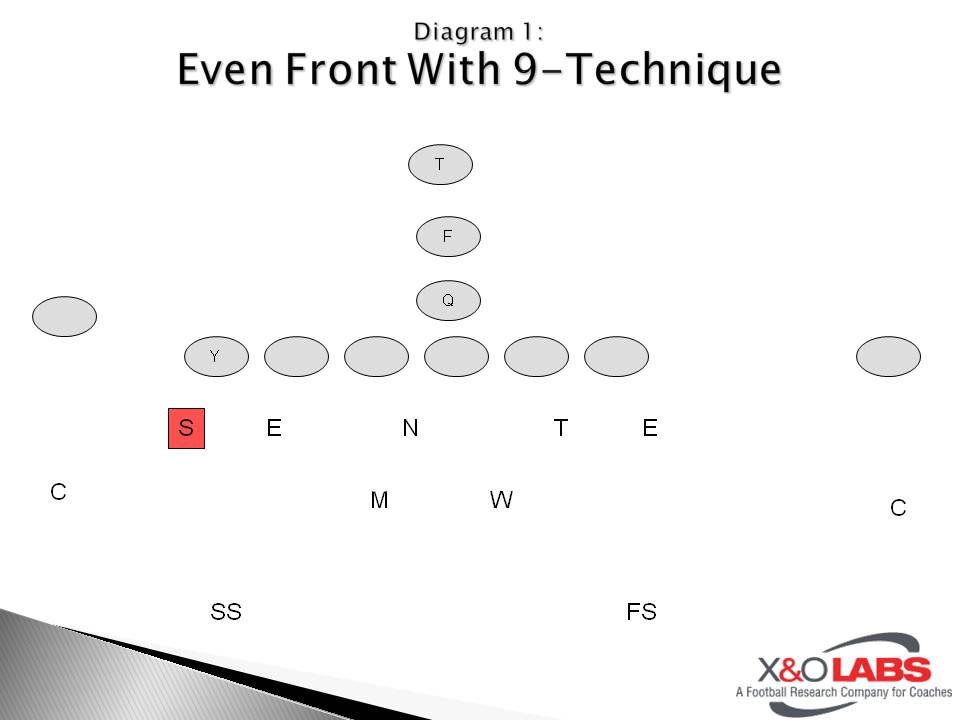
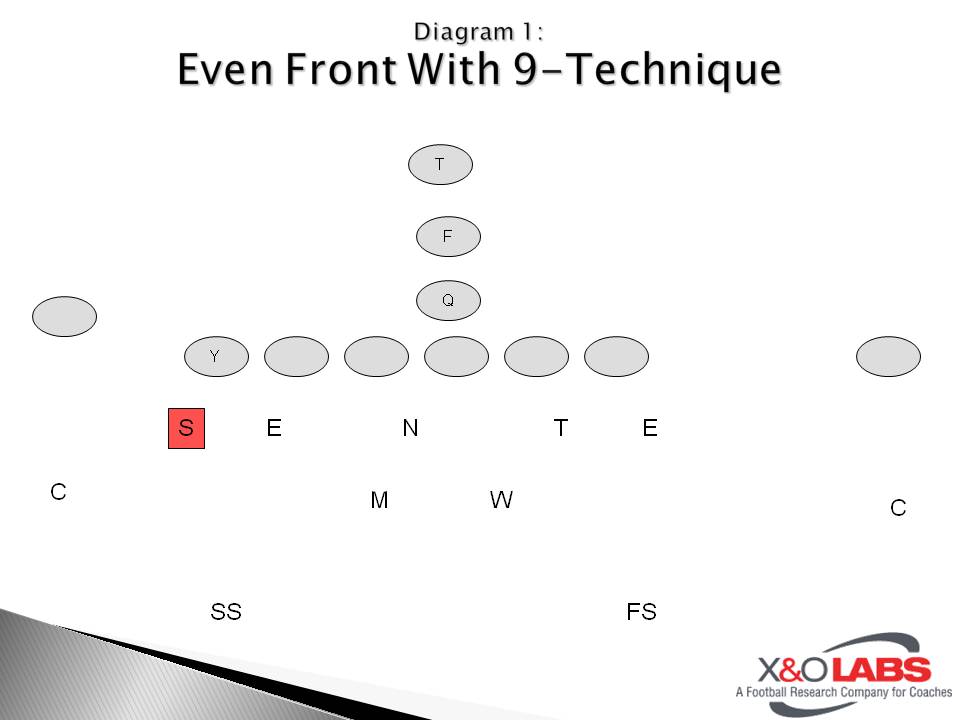
  • Even Front: Mainly an Under or Eagle defense with a walk-up outside linebacker playing the 9-techinque (Diagram 1)
  • Odd Front: a 3-4, 3-3, or 5-0 structure with an outside linebacker playing the 9-technique (Diagram 2)

It’s important to note that the 9-technique survey generated the most responses that we’ve ever had at X&O Labs with 2,457 high school and college coaches completing the survey. When we get responses like that, not only does it prove the validity of the responses, but also provides for a broader spectrum of coaches to share their knowledge.  We appreciate your feedback and hope that you’ll continue to be active participants of these surveys.

Before we get into the specifics of what we found, we thought we’d share some interesting statistics based on the survey.

  • 50.6 percent of coaches will use a 9-tehnique defender any time there is a three-man surface present, regardless of the front structure. Just goes to show how important it is to put immediate pressure on the tight end.  You don’t need X&O Labs to tell you that most run schemes are three-man surface oriented.  The presence of the 9-technique puts a first level player in the D gap for immediate force of the football.
  • 57.8 percent of coaches will use a traditional defensive lineman type IN THE EVEN FRONT to play the 9-technique, more so than an outside linebacker type. The teams that do use a linebacker to play the 9-technique will be more of an Eagle or Under front by nature thus making a five-man front.  It’s not as common to see a four down front with a 9-technique defender.  Teams that run a four-down structure will mainly utilize a 7-technique defender.  But, for now, we’ll focus on the 9-technique. 
  • 63.3 percent of coaches will use an outside linebacker type in THE ODD FRONT to play the 9-technique, more so than a defensive lineman type. We didn’t find this surprising, but what we did find interesting was the fact that these same coaches will spend more time training this defender to rush the pass than anything else.  It’s something we’ll detail in next week’s report.
  • 54.4 percent of 9-technique linebackers work with the DL in practice, while 45.6 percent work with the LB’s. This surprised us.  While we knew it wasn’t uncommon for these types of perimeter linebackers to get work with the defensive line, we certainly didn’t think it would be in the majority.  In fact, most coaches that utilize a 9-technique linebacker train him to use the same fundamentals that a defensive lineman would in the run game.   The only thing that separates their job description to that of a defensive lineman is the linebacker’s responsibility to cover receivers.  At least we thought, until we found that 67.1 percent of coaches will not even use that player in coverage schemes, he will rush the passer.  But again, a topic to be covered next week.

Case 1: Variations of Stance and Alignment

We’ve found that deciding between a two-point and a three-point stance is relative to whether your 9-technique is a defensive lineman in nature or a linebacker.  Today, we’ll focus on that player being a linebacker.

We’ve found that the stance of the 9-technique linebacker will vary based on the support structure of your defense.  If that 9-technique is the primary force player, he will use more of a tilted stance in order to maintain leverage on the perimeter.  Conversely, if that player is not a force player, his shoulders may be more square to the line of scrimmage.

Regardless of what responsibility the 9-technique defender, we’ve found that 58.1 percent of coaches teach the inside foot up in the stance.  This ensures a quicker read on the player’s visual key, who is mainly the tight end.  As it pertains to horizontal alignment, 46.4 percent of coaches will have their 9-technique split the crotch of the tight end, while 40.5 percent will play with their  inside foot further than outside foot of tight end in a wide alignment.  While it seems like coaches are split on this matter, Mike Eddy, the head coach at Gallia Academy High School (OH) doesn’t do either.  He has his outside linebacker line up in what he calls an “ability alignment.” 

“If the 9-tech is a better athlete we use a tight alignment of inside eye to outside eye,” says Eddy.  “If they are close to ability we align shoulder pad to shoulder pad.  If the TE is the better athlete, we align even wider at the tip of pad to tip of pad.  We align as wide as needed to defeat a possible reach block while still being able to squeeze a down block and keep the tight end off our inside defender.  Stance is slightly staggered with inside foot toe to instep.  This allows him to balance his step when he executes his read step on the offense’s initial movement.”

Read More

Backside B-Gap Block Fundamentals in Zone Runs

By Ben Luther
Offensive Line Coach
Tusculum University (TN)
Twitter: @Coach_Luther


First and foremost, I would like to thank Jerry Odom and Brian Ferguson for giving me the opportunity to coach the offensive line at Tusculum University and also to thank X&O Labs for allowing me to discuss how we at Tusculum University teach and execute combinations on the backside of our tight & mid-zone schemes. The combination, in particular, that we would like to discuss, is the backside “B-block” and drills to help reinforce the fundamentals to achieve the desired outcome. The “B-block” occurs when we run our zone scheme to the inside playing tackle (shade / 1 technique) on the front side, and there is an outside playing tackle (3-technique) on the backside guard, which is your traditional under front look. At Tusculum, we spend a lot of time in our individual periods on combo blocks and believe in emphasizing the details of individual skills in a part-part-whole teaching sequence to achieve a desired outcome on all of our combo blocks.


General Info & Key Points

Before hitting the field and introducing drills and fundamentals of the “B-Block,” there are a couple of key points that must be covered and understood in the meeting room.

  • Our general zone philosophy
    • In our zone schemes, the offensive line is responsible for moving the down lineman, and the running back is responsible for moving the linebackers.
  • What type zone scheme are we running? (tight vs mid zone)
    • The OL must understand the types and difference of each zone scheme that is being called. They must understand the goal and what the running back’s aiming point is for each type of zone.
      • Tight zone aiming point: RB = Play side leg of the center.
      • Mid zone aiming point: RB = Play side leg of the guard.
    • The importance of understanding these components will help the OL predict what type of Linebacker flow could occur, which will dictate how much time we can spend on the double team.
  • Linebacker Location
    • One of my mentors taught me, “Linebackers are like real estate. It’s all about location.” As an offensive lineman, knowing Linebacker location is crucial. The location of the Linebacker allows the offensive lineman to:
      • Determine defensive gap responsibility.
      • Set the correct angle of the play side hip and eyes, make appropriate calls based on if the linebacker is.
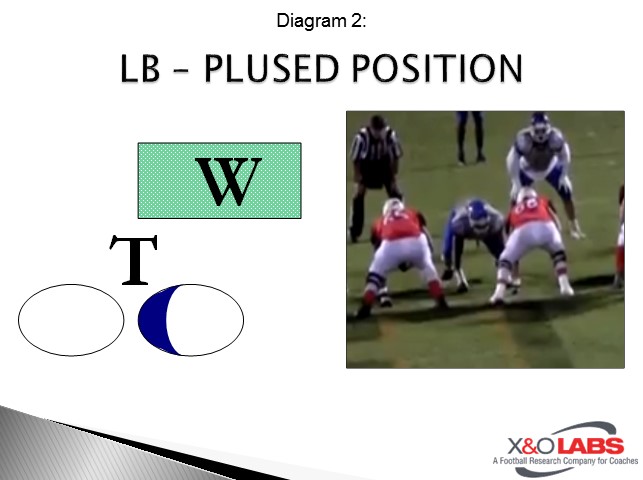
        • Plussed alignment- LB is lined up on the front side of the 3-technique)
          • Will make a “Quick” Call
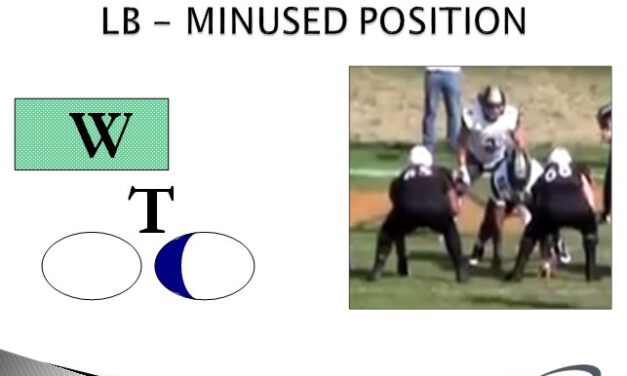
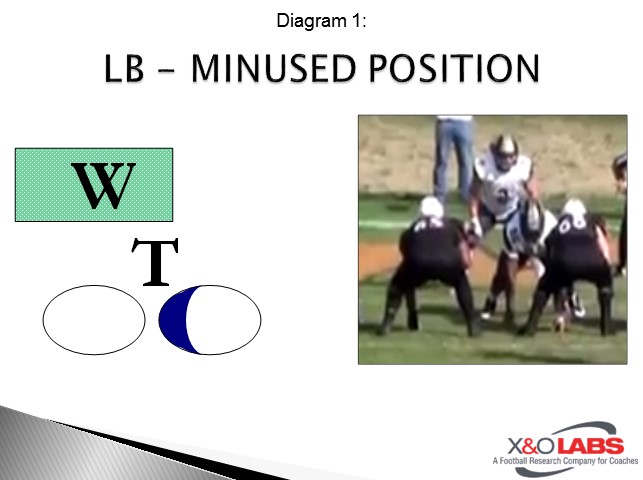
        • Minused alignment- LB is lined up on the backside of the 3- technique)

Diagram 1
Diagram 2

  • The Components of the “B-block”
    • The Post player: In the “B-block,” the post player will be the backside guard. The post players job is to step with his play side foot & stand up the defensive lineman.
    • The drive player: In the “B-block,” the drive player will be the backside tackle. The drive player’s job is to deliver force and continue driving into the defensive lineman, helping create vertical movement.


The Rules of the “B-Block”

The General rules of the “B-block” are that we never leave a down lineman to chase a linebacker. As the offensive line, we are responsible for creating vertical movement at the point of attack and for securing the first level before we come off to a linebacker when he flows. We will not come off until he unstacks or threatens our front side gap.  Next, if the 3-technique slants across our face, we must collect and two-hand overtake with a strong play side hand, and the adjacent offensive lineman will foot fire up to the declared Linebacker. Lastly, when a linebacker flows and come off we must understand where we are trying to run the football.


The Components & Fundamentals of the “B-Block”

In the “B-block,” the backside guard, who is covered by the 3-technique, is responsible for lifting (posting) the down lineman.  Whereas the uncovered backside tackle is the drive player. He is responsible for delivering force into the down lineman and to continue driving into him to help create vertical movement. Both the post and drive player will use different techniques depending upon linebacker location.

Read More

Five Solutions to Run the Ball vs. Loaded Boxes

By Casey Miller
Offensive Coordinator
Herriman High School (UT)
Twitter: @cqmiller4


Introduction:

In any run-oriented offense, defenses will load the box with an 8th defender to help stop the run game. There are a few offensive strategies you can utilize to combat this defensive tactic and still be able to stick to your offensive philosophy of being a physical running team. There are five ways we try to do this, and we always build them into the gameplan at Herriman High School. Depending on what the defensive coordinator does to adjust to our base run game, we can move to any of them at any point in the game to counter-adjust.

Loaded Box Solution #1: Remove the 8th Defender from the Box

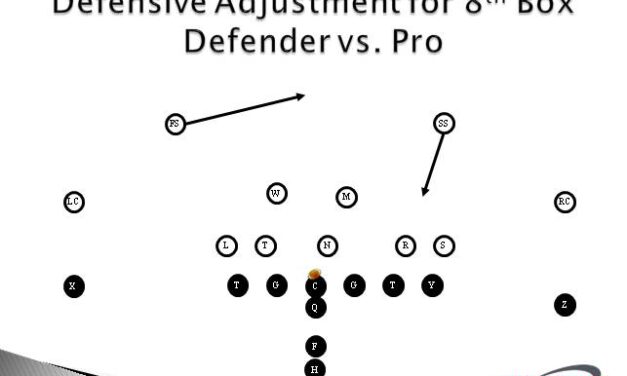
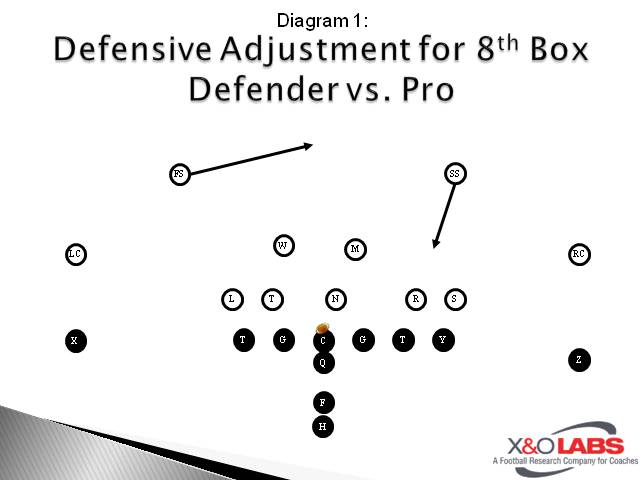
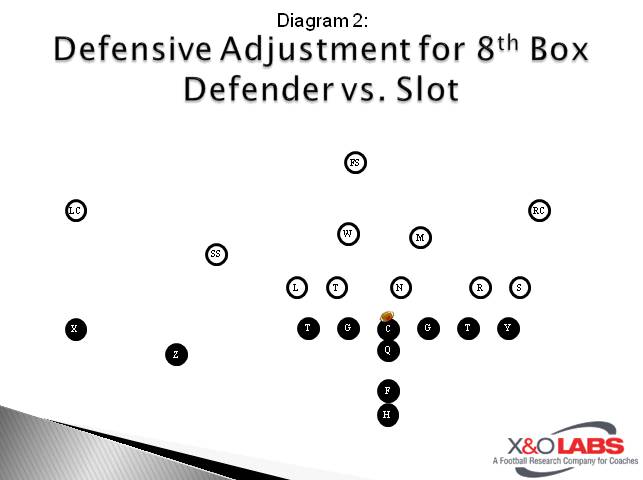
Most teams who face a run-heavy team will drop a safety down into the box to get an 8th defender in the box. For any stack-defenses (3-3-5, 3-5-3, 4-2-5, 4-4), it usually means the overhangs come up and play really tight, or they come all the way up on the line of scrimmage and come off the edge. For traditional 4-3 and 3-4 teams, this is usually dropping the “strong safety” down into the box on the multiple receiver side. By using formations with both WRs on the same side, most teams will put the strong safety on the side with both WRs, and he will have to leave the box to account for the slot receiver. In the box, this keeps the offense with the same run formation they always have, but it removes the 8th defender from the box because he has to widen out to the 2-WR side to continue to play zone coverage. You have now turned the 8 man box into a 7 man box, or at the very least, you are now running the ball at a corner that now has to be the primary run support on the TE side.

Slide1Slide2

To study game film on how Coach Miller removes the 8th defender from the box, click on the video below:

Editor’s Note: Coach Miller provides the following coaching points for each of the following clips below:

Vid #01 – Remove Defender

  • 1st Play = This is a 3-4 team that rolled their strong safety (#41) down into the box if the offense lined up in a pro formation. If the offense lines up in a slot formation, the SS moves to the weakside and must APEX out of the box leaving a 7-man box to defend the run. We wanted to run power to the TE side this week, so we were able to remove the extra box defender by lining up in a slot formation.
  • 2nd Play = This is against the same opponent as the previous play. We run Iso on this one, but it gives an example of how we give our running back a 2-way-go with our backside blocking. The weakside guard and tackle both block out and the double-team on the nose will stay on the nose if the backside LB goes over the top. If the RB sees the FB is going to get the outside shoulder of the Iso-LB, he stays to the playside and the backside LB can’t get to him because of the FB block. If the Iso-LB keeps his outside-arm-free, the RB will cut into the A-gap not occupied by the backside LB. If the LB gets to the playside, the RB will cut off the backside of the double team, but if the LB stays backside, the RB will just hit the playside A-gap and get to the 3rd level of the defense. On this particular play, the FB gets the outside shoulder so the back stays on the playside and picks up about 10 yards.
  • 3rd Play = This is a 4-3 team that would get their quarters safeties close to the LOS vs. a pro formation, but in a slot formation with the threat of 2 vertical routes to the same side, they would back the safety to that side off the ball. This gave us an opportunity to run the ball to the weakside away from their run defenders on the TE side.
  • 4th Play = This is the same opponent as the previous play. We caught their LBs filling inside very quickly so we removed the safety from the box and ran stretch back to the slot side.
  • 5th Play = This is our rival school that plays a 3-4 and has coverage-rules based on the offensive formation. Slot formation will again move their strong safety over to the slot side, which allows us to run back to the TE side without a force player to help the box-defenders until the FS. The corner and FS end up combining to bring down the RB, but it is 10 yards downfield. Just as the Iso play earlier, the back knows the FB will get the playside shoulder of the LB so he stays to the playside and hits the hole.
  • 6th Play = Same concept and same play as the clip before. We ran this play from this formation over 20 times in the 2nd half in this game. Turned a 3-point deficit at half into a large margin of victory by the end of the game
  • 7th Play = Same team, same concept, but this time the back sees the FB isn’t going to seal the Iso-LB, so he cuts back to the backside and slips thru the gap opened up backside.
  • 8th Play = Same team, same concept, but this time we ran it to the TE side because the defense had adjusted their defense to prevent us from running the weakside Iso play. Back knows the seal will happen, so he just stays playside and he has no force until he hits 3rd level
  • 9th Play = We get caught running this play to the side the defense has their extra defender to the playside, but the RB recognizes presnap that there is no backside LB, so he is going to cut backside the entire way. The force filling outside-in never has a chance to get there so we end up with a big gain.
  • 10th Play = In our 2nd round playoff game, we faced a 4-4 team that had 8 in the box

Read More

Attacking Protections Using Odd Front Pressures

By Wallie Kuchinski

Defensive Coordinator

University of St. Thomas (MN)


Editor’s Note:  St. Thomas University is coming straight off a 14-1 record and was a Division 3 national championship runner up and the Tommie defense was a big reason why Kuchinski’s defense yielded a mere 15 ppg this season and was ranked 15th in the country in scoring defense.  Kuchinski has developed a reputation for developing dominant defenses in his five years with the Tommies, which earned him the 2011 footballscoop.com award as the top Defensive Coordinator of the year. 

Please note:  The following report is written solely about attacking protections, therefore the coverage component of these pressures is not stressed.   It is centered only around the players involved in the blitz, not in coverage. For all intents in purposes, each of these pressures are covered with a three under, three deep principle. 

There are multiple successful units used in football  throughout the years. Whether we are talking about the Miami Hurricanes in the ‘80s using their dominant 4-3 cover 2 package or the old 4-6 fronts used by the Chicago Bears and Buddy Ryan in the ‘80s.  Dominant units have evolved over the past three decades just as fast as offenses have evolved. We are now seeing 3-3 Stack defenses put their stamp on history as well as the dominant 4-2-5 units TCU and others have been running for the past few years.  Meanwhile, 4-4 units have been having a high level of success in high school for years as well.

I’ve always thought if your scheme is sound and you get your players to buy in to your system, any form of defense can be successful. I am biased however and truly believe the 3-4 Okie defense is a superior scheme for a lot of reasons. At the University of St. Thomas we have implemented the 3-4 multiple pressure front for the past 4 seasons when our staff arrived in 2008. We have shared much success both in defending the run game and pressuring the passer the past few seasons. Statistically we have ranked at or near the top in the country in multiple statistical categories. Not limiting to scoring defense, rush defense, 3rd down percentage, 1st downs gained, sacks, tackles for loss, takeaways, pass defense efficiency, and red zone defense.

Let’s face it…we coach in a pass driven game these days and while our staff is committed to stopping the run with proficiency, affecting the passer is paramount in establishing a dominant unit. We have some impressive offensive minds at St. Thomas. If our head coach Glenn Caruso got on the white board and asked me how are you going to defend this pass concept vs. Cover 3 or how are you going to defend this pass concept vs. Cover 2 I’m not going to have some great answers. I played defensive end in high school and college. I am smart enough to know, however, that if you give the QB more than 3 seconds to throw the football consistently it doesn’t matter whether the kid plays high school, D3, D1 or in the NFL he’s probably going to complete that pass. Instead of dreaming up different ways to cover all these crazy route concepts our staff instead focuses on attacking different protections with our zone blitz concepts to get players coming free at the QB.

At the University of St. Thomas we have been employing multiple zone blitz concepts that attack protections out of our base 3 man front. While it’s difficult to find an offensive coordinator out there that is willing to take the flats for 5 yards all the way down the field, I would contest it’s equally difficult to find a good zone blitz defensive coordinator to pair his package down to a few pressures.  After our staff determines what we need to use to stop the run effectively and get our opponent in a one dimensional passing situation we need to determine what type of protections they are using. As a 3-4 there are a few different 3 step, 5 step, and play action protections we see on a regular basis. Our staff categorizes protections as Full Slide, Insert (half slide, half man), Man, 7 man protection, and Rollout. We do categorize rollout in 3 sub-categories such as: Sprintout, Boot (naked), and Waggle (usually an uncovered puller). For purposes of this article we will focus primarily on insert, man, and sprint out as those are the ones we see the most.  Nonetheless, in this article, I present 5 zone blitz concepts that attack various protections I feel everyone should take a look at.  But before we address the different types of pressures, it’s important that I define some “buzz words” we using in our pressure terminology.

Blitz Concept Buzz Words

Stab rusher-In a wide 5 tech a Stab Rusher is a vertical speed until he gets near even with the QB. He then transitions into Power (screws of his facemask under the chin of the OL) extends his arms to lockout and collapse the pocket, slipping inside or outside based on where the QB flushes.

Bull and Pull– Nose cheats his alignment to a slight shade (between crotch and foot of Center). The Nose takes a vertical step and bull rushes the Center and physically pulls him away from the pressure for a 2 count. His responsibility is not to let the Center get to the pressure side. After a 2 count (so he doesn’t get called for holding) the Nose finds his way to the facemask of the QB on his pass rush.

Read More

Adapting R4 QB Mechanics to RPO Design

By Taylor Kolste
X&O Labs Contributing Writer
@TaylorKolste
With Dub Maddox
Head Coach
Victory Christian High School (OK)
@CoachDubMaddox


Dub Maddox is no stranger to quarterback play. As a former assistant at prep powerhouse Jenks High School (OK), Coach Maddox has been part of the Trojans’ six state championships. He was offensive coordinator for four straight title teams (2012-15) and passing game coordinator for titles in 2006-07. Just this April he was hired as head football coach at nearby Victory Christian High School. An author of two books- From Headset to Helmet (2011) and Adapt or Die (2018), Coach Maddox spends the off-season traveling across the country teaching and training quarterbacks. He is also an R4 system coaching consultant for football programs on offensive scheme design and implementation. This month, he spent some time talking with X&O Labs contributing writer Taylor Kolste (TK) on how his R4 system for QB’s can be adapted into RPO design.


Taylor Kolste (TK): For those who have yet to read Adapt or Die, can you explain how the rhythm, read, and rush framework applies to RPOs?


Dub Maddox (DM): Basically what we did is we took the infrastructure for the rhythm, read, rush, release portion of passing progressions and applied that same concept to RPO’s. So, within the RPO, our rhythm concept is going to be the best run that are we are going to use to attack the most anticipated front. What we do with game planning is establish what the base front that we expect is and what runs are tailored best to attack that front and personnel. That’s where we spend a lot of our time. It could be one-back power, inside zone, outside zone variation etc. We’re going to have those conversations and that’s the rhythm portion.

The read portion of the R4 progression is determining who that conflict defender is going to be, and that can change week to week too. As we game plan and as we watch film we’re trying to isolate that one defender who we can put in a bind. A lot of times you pick on the weakest defender, but the thing about RPOs and the conflict defender is that with a very aggressive guy who is a very good athlete, you can use those strengths against him, if he’s a very fast pursuit player, very aggressive, you can use those strengths against him. So that’s kind of what determines the next conversation we’ll have is who are those defenders who we want to put in conflict, is it a weaker guy or is it a stronger, maybe a better athlete who we can use those strengths against him, so that’s the read portion. And the rush portion is going to be the best pass route or pass concept that we’re going to attach with the rhythm run. That will change week to week as well based on the coverage structures they’re going to play, or maybe the anticipated movements that those defenders will execute post-snap. The release portion will be that set-up play that were establishing off that run, or off those passes that we attach. That release portion is kind of that shot play that you’re trying to set up to protect those concepts. So, each word is just a decision-making bucket and each word has a specific meaning that basically, asks the right question that will lead to the answer in our game plan and in-game process.


TK: What are some of the advantages to using this framework to design and teach RPOs?


DM: I think that it just organizes the decision-making process. I think a lot of time, as coaches, it’s easy to get lost in the details, or go on rabbit-trails or chase ghosts, where we end up having 4 or 5 plays when we only really need one. We try to have answers for everything when it’s impossible to have answers for everything. So, I think having a consistent framework and a common language helps us build out the most anticipated adjustments that we will see, and then obviously gives us a framework to know where to go to next under pressure and allows us to really play the game before it’s been played. If you look at military strategy and how they train soldiers in war in performance under pressure, that’s what they’re doing. It’s that brevity language and that sequential process that provides buckets to know an answer to the question that matters most. So, I think without that framework, or infrastructure, we waste a lot of time with staff members and confuse a lot of our kids as well.


TK: How many run concepts do you carry and approximately what percentage of your run game are RPO concepts?


DM: The number of run concepts we carry from year to year is based on our personnel. We have to determine what our concept capacity is for our kids. I think certain kids have a little bit higher football IQ some years, and then other kids have more talent to do more things, like pull better, or move into space Really what we have to do is during spring ball sit down and establish what we are able to do physically and mentally and then from that, that determines how much we carry in. We’re not going to always be an inside zone team year in and year out, some years we may be more pin-pull, one-back power, or sometimes it might be more outside zone based. So, it’s all based on personnel and that’s what football is, so that kind of determines how much we carry.

Read More

6 Drills to Progressively Improve Pass Protection

By Matthew Keith
Offensive Line Coach/Strength & Conditioning Coordinator
College of St. Scholastica (MN)
Twitter: @CoachMattKeith


Several components go into becoming an elite offensive line. It requires the knowledge and understanding of the game, great technique, the ability to recognize and react, and a gritty mentality. Obviously, when it comes to pass protection the offensive line’s job is to give the quarterback as much time as possible, so he can make the correct read and throw.

This report will cover the drills you can incorporate in practice on a daily basis to improve the offensive line’s ability to successfully do their job. The drills below are set up as a progression, working on separate parts of pass progression technique and building on top of each other.

Fast Backs

This drill is designed to work on creating separation and snapping the upper body back out of a stance. Out of a three-point stance, have a bag close to touching the head of the player that is up. On the go signal, the player will get a big chest while punching the bag and creating separation without moving their feet. The will feel their weight transition from the front to foot to the back foot. We work both right handed and left-handed stances with all our guys and go two to three reps before rotating.

Once this drill is introduced it can be a high tempo drill and a good warm-up that allows for each player to get a lot of reps in a short amount of time.

Coaching Points:

  • Feet should stay in the ground as much as possible.
  • Punch with palm of the hands, thumbs pointing up.
  • Punch at a slightly upward angle
    • If the punch angle is down, there’s most likely too much forward lean. If the angle is up too far, it is most likely due to too much bend in the knees. This is not in a good position to be able to move.
  • Back should be straight with a slight arc back and weight balanced with all cleats in the ground.
  • Bag should be closer to guys with shorter arms (adjust position accordingly).


To study film of this drill, click on the video below:

Read More

Developing a Weekly Pressure Plan

By Nick Davis
Defensive Coordinator & LB Coach
Rose-Hulman Institution of Technology (IN)
Twitter: @Spread_Defense


We feel that if you emphasize something that your players will respond. Our linebackers and defensive linemen practice getting pressure on the quarterback every day. It is because of those efforts we were able to get 80 sacks over the last two seasons which equates to 3.8 sacks per game.

Being able to get pressure starts with our coaching staff. Our breakdowns for each opponent starts way before the Sunday before next our game. We have experts for each of the three main areas of the game. Our defensive back coach breaks down the skill player aspect of the opponents passing game, our defensive line coach breaks down all of the run game, and I break down all the pass protections. This allows us to be an expert in our area and allows us to break down every game they have played.

On Sunday and Monday, we choose six to ten calls we would like to do during the week to get pressure on our opponents. We want to present a few different things to figure out how the team is going to protect against our plan. We want to be able to bring 3, 4, 5, and 6 man rushes each week. We want to rush out of Odd, Even, Bear and everyone walked up looks. We feel that both pressure and the allusion of pressure are import parts of our plan. Below is a look at the percentages of the four areas in each category where our sacks came from.

  • 3 Man Rush- 10 Sacks: 24% of our Sacks
  • 4 Man Rush- 28 Sacks: 67% of our Sacks
  • 5 Man Rush- 4 Sacks: 9% of our Sacks
  • 6 Man Rush-0 Sacks


  • 3 Down Fronts-26 Sacks: 63% of our Sacks
  • 4 Down Fronts-11 Sacks: 27% of our Sacks
  • Bear Fronts-0 Sacks
  • Everyone Walked up-3 Sacks: 7% of our Sacks

The most important part of getting pressure is practicing our plan. Every padded practice we start with a pass rush emphasis drill in period one. Our defensive line will work on different hand and hip drills. Our linebackers will work on our first three steps vs every block we can possibly see for the line of scrimmage or linebacker depth. In period two, we come together to do our movement on bags drill. We are working on the get off aspect of pass rush. Here both our defensive line and linebackers get reps with each side of the ball and get to use different stances.


Practice 1 Example

DL

LB

DB

Per

Hands & Hips

3 Step

Read Step

1

MOB

Block Destruction

2

Flex

3

Score Team vs Block Team

4

Double Team vs O

5

Punt

6

7

Punt Rush

8

Double Inside vs O

1v1 WR

9

Double Pass Rush vs O

Blocking vs WR

10

Double Rush vs Self

Press/Catch

11

Block Reaction

Hands & Hips

12

Cover the Routes

13

Scout Tackle Drills get reps

14

Double Blitz

Scouts 1 on 1

15

16

Scout Indy

Read More

Pairing Screens with Top Run Concepts

By Javier Cardenas
Offensive Coordinator
Eagle Pass High School (TX)

Twitter: @Coach_JCardenas


Introduction

RPOs are evolving into a staple for spread offenses for various solid reasons. They give an offense the ability to get playmakers involved in a variety of simple yet creative ways. Defenses must consider additional time to develop and prepare personnel for RPOs, particularly linebackers. Defenses, in many ways, are forced to play assignment football against RPOs, especially at the 1st and 2nd level. We saw many defensive adjustments to our RPOs this past season: Cover 2 (man under), Cover 3, moving/spot coverages to remove the stationary read, straight man coverage and 4-1 box adjustments. The advantage of our style RPO is that it had answers for these and other coverages.

Our offensive identity is simple: Physical, Fast, Execute (PFE). Rather than saturating an offensive playbook, RPO’s allow us to mix our base concepts from week-to-week through personnel groupings, formations, motions, and tempos. We do not want our kids over analyzing situations; we want them to be PFE. RPOs comprise about 40% of our offense and revolve around four base formations: 2×2, 3×1, 2X1 (20 personnel) and Empty with 3×1 being most effective. Again, we do a great job window dressing RPOs from week-to-week, but the base concept never changes.

While we are not a true Screen Pass Option (SPO) unit, our screen game mimics the SPO (Screen/Pass Option) system. We embed our best menu run game into our screen game. Our screen game is a unique call based on how a defense aligns. As the defense begins to overcompensate to the run/RPO, we tag the screen. We have a variety of ways of doing this. Essentially, we take away the decision-making ability from our QB and tell him when to throw the screen. However, the run RPO element stays intact and the defense must continue to defend. This simplified our QB’s thought process while allowing our offensive line and receivers to play “PFE.” Hesitation and indecisiveness is a QB’s kryptonite! The base Menu Run/RPO discussed and demonstrated on film in this report will be the following:

  • RB Flare concept
  • Inside zone paired with RPO progressions from Bubble, Bubble Slant, Bubble with motion, and Stick

These base concepts then set up our screen game.

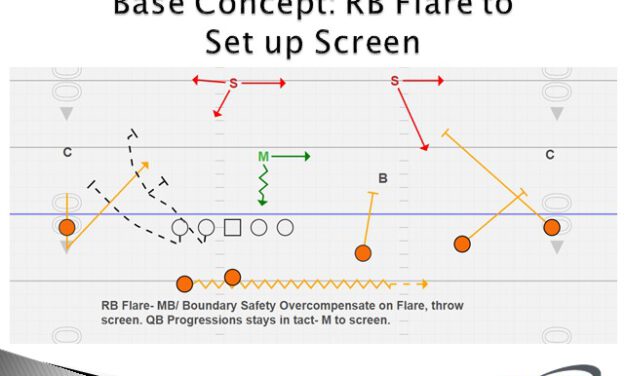
RB Flare Screen Progression- If Mike linebacker, corner and safety adjust- throw screen
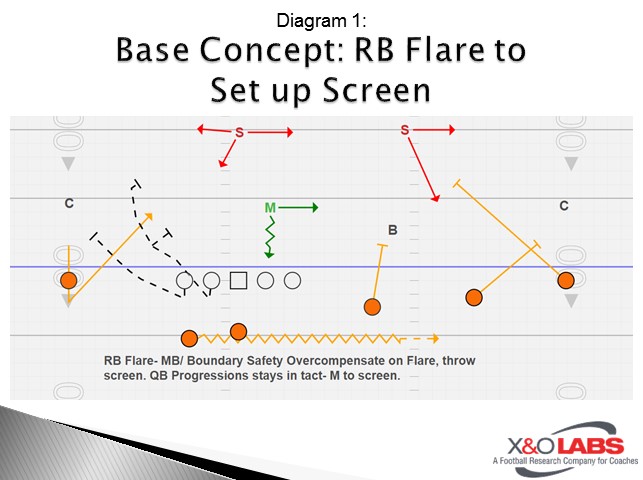
Base Concept: RB Flare to Set up Screen

IZ Bubble/RPO Screen Progression- If the defense over adjusts/soft corner- throw screen
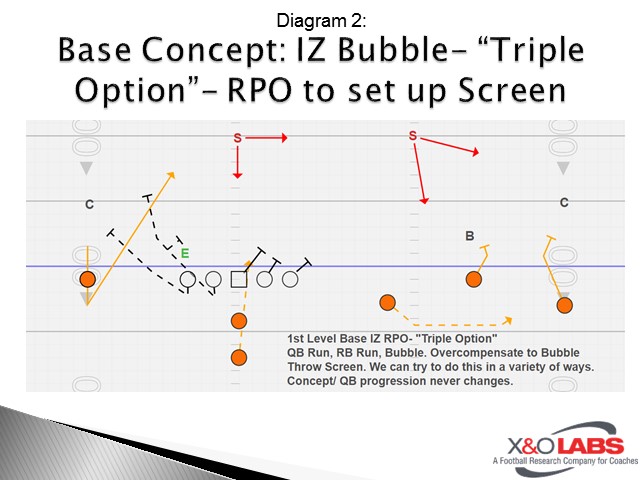
Base Concept: IZ Bubble- Triple Option- RPO to set up Screen

IZ Bubble Slant Screen Progression- Defense over adjust to bubble slant- throw screen
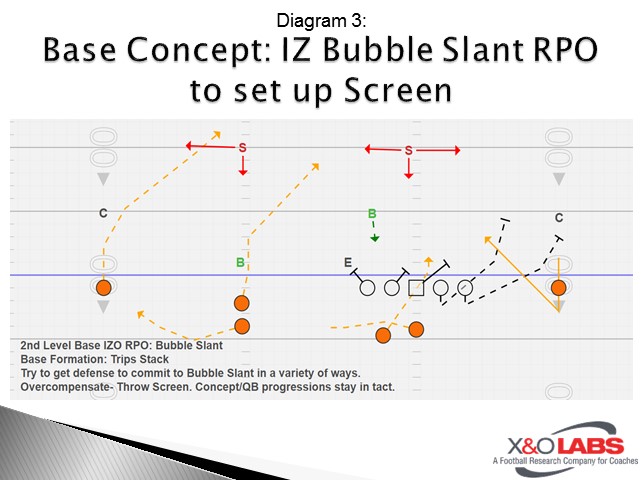
Base Concept: IZ Bubble Slant RPO to set up Screen

IZ Bubble RPO with cross motion Screen Progression- Defense over adjusts to motion- throw screen
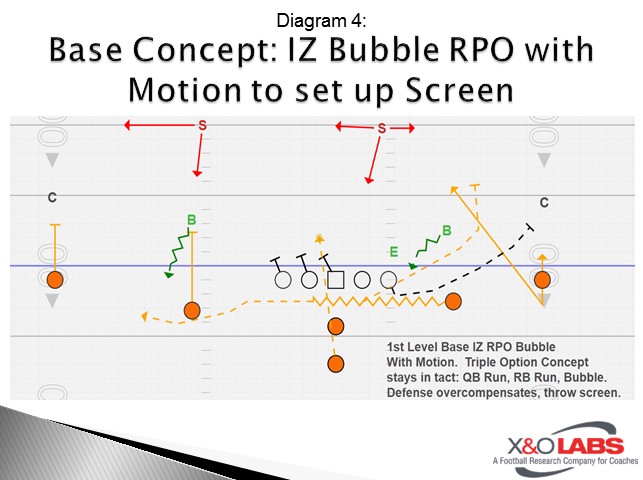
Base Concept: IZ Bubble RPO with Motion to set up Screen

IZ Stick RPO Screen Progression- Defense over adjusts to run/ stick- throw screen
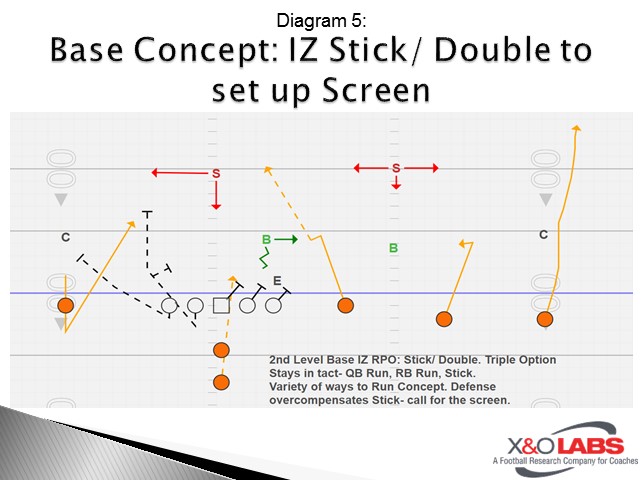
Base Concept: IZ Stick/ Double to set up Screen

Creating Concepts based on Functionality

Read More

Box LB Reads in the Odd Front

By Kelly Carrier
Linebacker Coach
Lansing Catholic High School (MI)


Introduction

Run and pass fits are essential to any defense. We feel that the best fits can be accomplished by teaching multiple concepts to our players to help them filter through post snap chaos. Although reading the offensive line is our primary key, we also rely on other concepts like pre-snap gap responsibilities to get the best fit possible.

To accomplish this, we start in the summer and work all season long teaching conceptual gap assignments based on stunt pre-snap and then progress to what happens post-snap when everything moves. When working with the linebackers, I will always include offensive line reads and clear/cloudy fits in individual, group, blitz, inside run and team.

Pre-Snap Gap Concepts
We begin teaching our gap concepts by using barrels to simulate an offensive line. To keep the players honest, we do not include a RB in our drills. Instead, we work on leveraging the ball carrier during our tackling circuit, inside run period and team period. This keeps the LBs focused on our task and does not confuse them with false steps by a back.

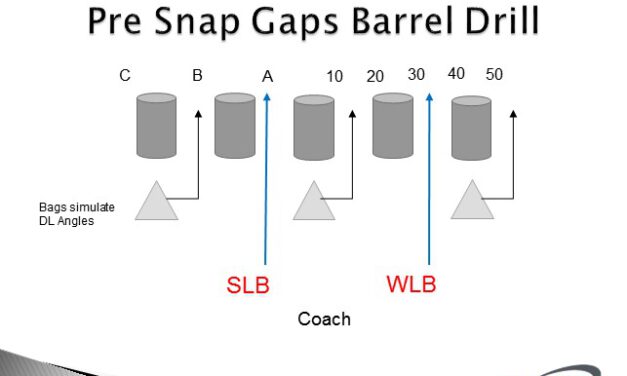
During our individual time, the first drill we introduce is based off our various alignments based on the front (20s, 30s, 40s or 50s) and we introduce alignment depth. We set our heels at 5 yards to give us time to read and react. During this time, the LBs are getting a taste for non-moving offensive parts and gap assignments. Because we angle our defensive line, the linebackers know pre-snap which gap is theirs.

Before the rep starts, linebackers give their pre-snap communication which will include our strength, stunt, and if they are a box or spill player (this is determined by the stunt that is called). I set up about one yard behind and in between the backers during this time so I can have the same view they have. On the “set, go” call, they will fire through their gaps ripping with their left or right arm. This becomes a foundation and a fail-safe as linebackers are instructed to fill their pre-snap gaps if they miss their read.
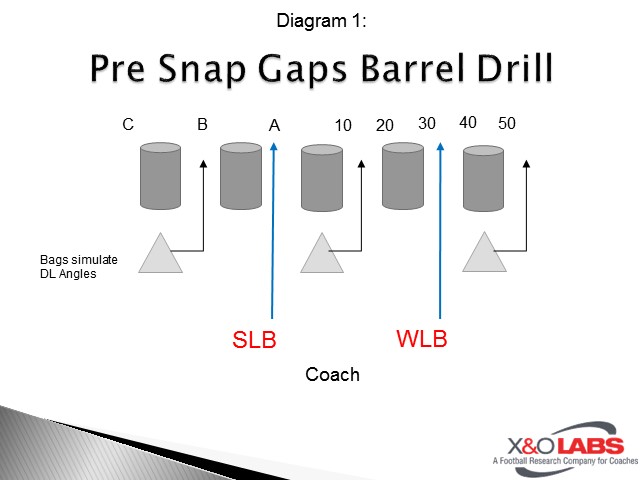
Pre Snap Gaps Barrel Drill

Post-Snap Gap Concepts: Part 1
After using the barrels, we begin to introduce moving parts/gaps as it is essential that they understand the difference between pre-snap gap responsibilities and filtering through post-snap chaos. The linebackers do this by using three barrels (OTs and center) and two linebackers playing the Guards. To introduce the concept of gaps moving, the linebackers are taught that their primary read as the offensive Guard. Attached to the offensive Guard is a pre-snap gap assignment (either A or B). If the Guard moves or pulls, the offensive Guard moves the gap assignment moves with him. This leads me to ask one OGs to raise his left/right arm to identify the gaps.
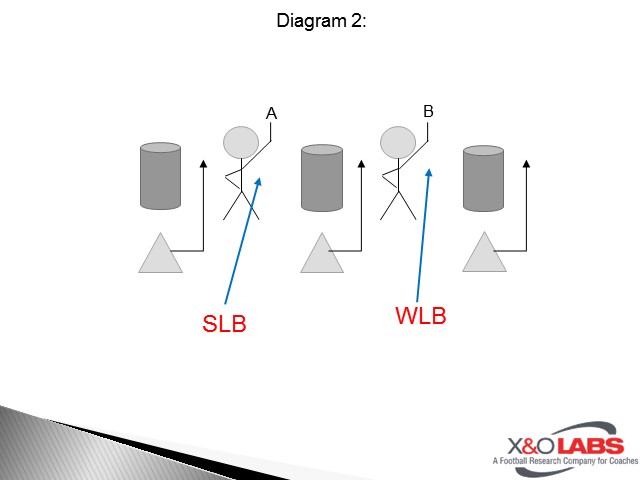
Diagram 2

Linebackers can tell me who has the gap based on the stunt called. We go through the same drill as above, but this time we have the OG/LB firing out, pass setting or blocking down/double team. Linebackers will rotate and fill gaps based on blocking. In addition to reading the offensive Guard’s movement, I will also instruct the linebackers to read on the run and find clear and avoid cloudy gaps.

Read More

What Players Really Think of Using Digital DFOs

By X&O Labs Research Team


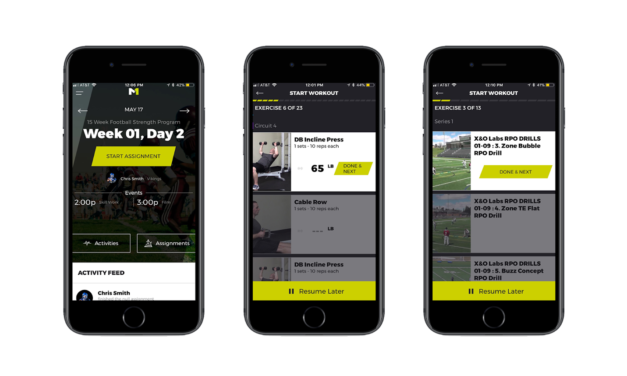
Last month, we featured a report on the growing trend of high school and small college programs “hiring” a digital director of football operations (DFO) by using the coaching tool, MaxOne. The primary duties of a DFO is to manage the logistics of a football program’s operations–things like scheduling, communication, summer-camp sign ups, texting, emailing, preparing and distributing drills and workouts, gathering materials for coaching meetings, tracking individual players’ workouts and progress, manage off-season leaderboards… and the list goes on. MaxOne is a platform that allows you to do all of these things with ONE login.

In this month’s report, we confirm the power of using digital DFOs by asking student-athletes from three different programs what they think of MaxOne. Coach McKenna of Brooklyn Tech High School, Coach Stadem of Sioux Falls Washington and Coach Swift of Gold Beach High School have made the switch to MaxOne and have been actively using the app for several months–and they are eager to share their success story.

From these conversations, our conclusion came to be:

MaxOne turns smartphones into football coaches, with instant questions and answers right at their fingertips.”

Turning Players’ Smartphones Into Coaches

The reality of how athletes interact with one another and where they spend time taking in information is through their technology and more specifically through their smartphones. The impact technology has in everyday life, but also directly in the coaching and learning experience has seen tremendous growth. It’s time to focus on the future. There’s no better time than the present to start preparing for future success. We asked athletes how MaxOne speaks their language in terms of technology? And specifically, how does it engage them with football? The athletes believe that MaxOne translates smartphones into football coaches. One player from Sioux Falls Washington High School stated:

Read More

Training DB’s Eyes in Quarters Coverage


By Brent Barnes

Defensive Backs

Rhodes College


Editor’s Note: Brent Barnes just completed his 2nd season at the Defensive Backs Coach at Rhodes College. His arrival in 2012 coincided with an uptick in the Lynx’ fortunes on the defensive side of the ball as the unit led the SAA in points against and finished second in total defense. His leadership resulted in first team All-SAA honors for safety Justin Toliver.  Prior to his time at Rhodes, Barnes became the Wide Receivers Coach at Middlebury College. For two seasons, Barnes oversaw a passing offense that set numerous passing and receiving records and coached two different players to first team all-conference honors. Prior to his arrival at Rhodes, Coach Barnes was the Offensive Coordinator at Simon Fraser University, a Division II school in Vancouver, Canada. He led an offense transitioning from the Canadian to American game, coaching both the wide receivers and quarterbacks. His offenses finished second (2010) and first (2011) in the conference in rushing in his two seasons at the helm


Introduction
CaptureOur starting point for coaching the secondary is the eyes. We teach eyes more than anything else with the belief that if the eyes are wrong, everything else (footwork, ball skills, etc.) is irrelevant. How many times did you see in bowl season receivers running free down the field for big gains and easy touchdowns. We call those “free yards” because you are simply giving them to the offense regardless of the talent of the players involved. Our #1 goal is to minimize free yards with proper eye technique. In this day and age, defenses are going to give up yards and points. It’s an offensive world. But we want them to make plays and not make it easy for them.

With that in mind, we use a rather defined teaching progression when we install this concept.  We always start with diagrams and film in meetings before we ever step foot on the field, after that we take our time reviewing the routes in individual before ever moving into 7 on 7 and team time.  The real key is taking the time needed in the individual time.  Here are some points on how we have found that time to work most effectively.

  • We use other DBs to mimick the routes at full speed.  They know the offensive perspective from our meeting.
  • By going full speed and not walking through (already done in the meetings) we can get a lot of reps here in a short period of time.
  • We do not rep the routes in isolation.  Instead, we line up two DBs as receivers as well as a safety and corner and rep different 2-man route combinations that we see. We feel this is more gamelike and forces them to play together.
  • We use cards for the route combination from a student assistant or injured player and work two groups (one to my left and one to my right). The right group goes first and they get coached on their eyes as well as footwork. I move immediately to the left group while a new WR combo sets up to the right.
  • We can get 6 reps a minute or 30 reps in a 5 minute span. I can also do this with our 3×1 sets.


Read More

Cover 2 Robber Concepts from Odd Fronts

By Adam Hovorka  
Managing Editor 
X&O Labs 


Introduction

There is no doubt that today’s offenses have made the jobs of defensive coaches much more difficult. We all have to find answers to combat no huddle, empty, trips, formations into the boundary and RPO’s. Defensive coordinators from all levels of football are trying to be more multiple in defending the multitude of things they will see but still maintain simple rules for their guys to follow.   

At George Fox University, Defensive Coordinator John Bates is utilizing his base 3-3 personnel split field coverage defenses to run a three down, cover two robber hybrid to battle all the empty and trips spread schemes he sees in his conference.  

The benefits of utilizing Robber coverage concepts against spread offenses are the following: 

  • In playing cloud support corners are able to have immediate run support for perimeter runs. 
  • Having a short hole defender eliminates the possibility of scrambles by dual-threat quarterbacks and allows him to break on intermediate routes. 
  • Having a high hole defender (along with two hash defenders) helps to combat the vertical game synonymous with open formation offenses. 

Traditional odd stack schemes consist of a 6-man box with 5 defensive back types aligning based on coverage. Typically there are two flat defenders and a one high safety along with two cornerbacks. Employing this defense as a split field outfit makes it difficult because the two flat defenders never play at depth and have limited deep coverage responsibility. George Fox University will be in a two-high shell almost all of the time. But in order to do that, Coach Bates will rotate the three types of safeties between being the flat players and the deep half, third or quarter player. The nature of his structure is a 3-3 defense, by personnel and alignments. He has taken the traditional one high base coverage that accompanies an odd stack and has found a way to utilize split field coverage defense. He does this by running a 30 front cover 2- robber hybrid, to battle all of the empty and trips formations that they see in his conference.  

So in Coach Bates’ defensive cover two hybrid, he places those two flat defenders deeper. The diagram below is GFU’s base defense vs. 2×2 formations.   
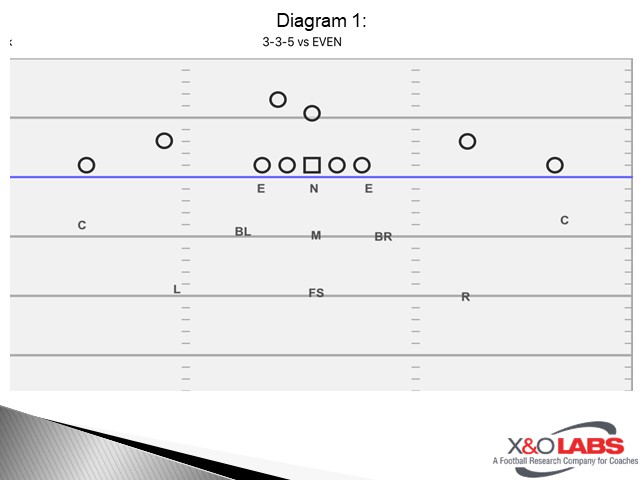
Slide1

Defensive Personnel  

George Fox University will be in a two-high shell almost all of the time.  To do that they will rotate one of the deep three safeties between being the flat or curl player and the deep half, third or quarter player. Either the right (Ram) or left (Lion) safeties will be the down safety, responsible for the flat, depending on where they are in regards to field or boundary. If the ball is on the left hash the Ram is the down safety to the right, the free safety is the deep half to the right and the Lion is the deep half to the left (boundary).  This is very similar to how 4-2-5 teams rotate their three safeties but Coach Bates chooses to play right and left as opposed to field and boundary.  Coach Bates and many other coaches around the country are hesitant to run Cover 2 schemes because of the fact that the Mike backer has to play the middle of the field and match the number three receiver vertically. With so many offenses running variants of empty and trips formations, having the Mike backer on number three would cause a certain mismatch in the offense’s favor. Most high school linebackers and many college players don’t have the speed to be a middle hole player and also play run.    

Adapting the “Money” Front 

So Coach Bates has countered this problem of having his Mike backer be the middle hole player in Cover 2, by running their Money front. So now instead of the Mike backer being the middle hole player, it is the Free Safety. Coach Bates runs this Money front against teams that will be in 10 or empty personnel who want to throw the ball more than they run it. It’s Coach Bates philosophy is to force teams to do things that they don’t want to do, and this case it is to force teams to run the ball. 

Alignment vs. 2×2 Formations 

Read More