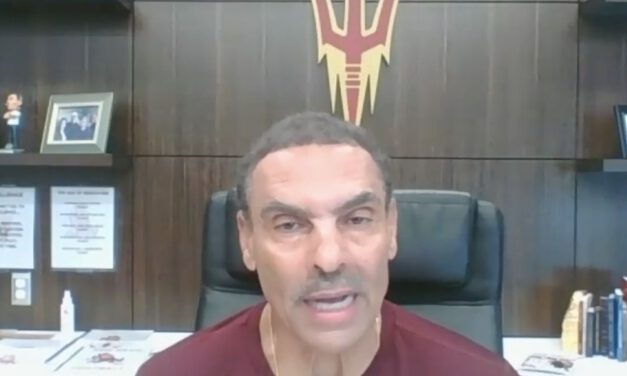
Building a Player Driven Culture Interviews: Coach Herm Edwards (Arizona State University)

By Mike Kuchar with Herm Edwards
X&O Labs Exclusive Interview


Coach Herm Edwards talks about the distinctions between rules and standards and why he believes in standards not rules. Players are willing to accept standards because the standard tells you something you need to live up to. When you give players rules it basically tells you I am denying you this. Players don’t want rules.

Read More

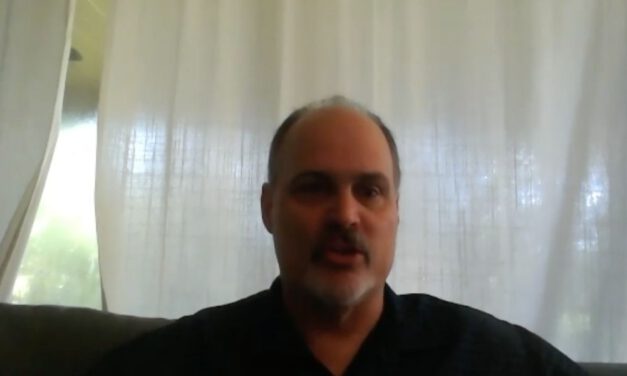
Building a Player Driven Culture Interviews: Coach Pete Shinnick (University of West Florida)

By Mike Kuchar with Pete Shinnick
X&O Labs Exclusive Interview


Coach Shinnick talks about the methods he uses to understand potential stressors in each of his players so that he and his staff can go about alleviating them. This comes with getting to understand where they come from, what their background is, who’s important to them, and who’s influenced them. How do they handle emotion? Are they an introvert? Are they an extrovert? Are they a problem solver? Are they a visual learner? He and his staff goes into that extent and then just try to find out how they handle conflict.

Read More

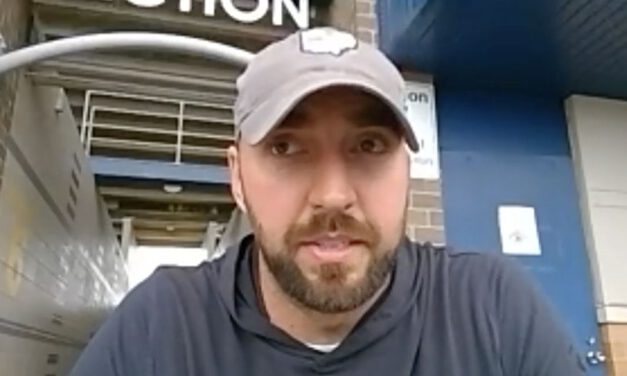
Building a Player Driven Culture Interviews: Coach Sean Lewis (Kent State University)

By Mike Kuchar with Sean Lewis
X&O Labs Exclusive Interview


Coach Sean Lewis talks about the importance of creating an atmosphere where players can fail and learn from failure. He says you only fail, or you only lose when you stop and when you quit. The key is to learn from it, you take a lesson from it, and you keep pushing forward and you’re a great success if you’re able to do those things.

Read More

Building a Player Driven Culture Interviews: Coach Dave Clawson (Wake Forest University)

By Mike Kuchar with Dave Clawson
X&O Labs Exclusive Interview


Coach Dave Clawson talks about the importance of teaching successful behaviors and the fact that successful people leave clues, and their clues our behaviors and habits and routines which allow successful people and organizations to continuously be successful.

Read More

Building a Player Driven Culture Interviews: Coach Mack Brown (University of North Carolina)

By Mike Kuchar with Mack Brown
X&O Labs Exclusive Interview


Coach Mack Brown talks about connecting your program with your community and the importance of an all-in process. If you’re not connected to your university, your faculty, your Grass Roots fans, your very wealthy fans then you’re not doing your job because they’ve got to buy in.

Read More

Building a Player Driven Culture Interviews: Coach Neal Brown (West Virginia University)

By Mike Kuchar with Neal Brown
X&O Labs Exclusive Interview


Coach Brown talks about being the best player developmental program in the country and build around the two non-negotiable things in his program: discipline and accountability and how he’s able to teach player advocacy without infringing on those two main standards.

Read More

Building a Player Driven Culture Interviews: Coach Sonny Dykes (SMU)

By Mike Kuchar with Sonny Dykes
X&O Labs Exclusive Interview


Coach Sonny Dykes talks about the importance of teaching players how to express themselves and to create an environment where they can express their needs freely. This is done through various methods such as Leadership Councils and open forums so that coaches can address those needs.

Read More

Building a Player Driven Culture Interviews: Coach David Shaw (Stanford University)

By Mike Kuchar with David Shaw
X&O Labs Exclusive Interview


Coach Shaw talks about building culture as a multi-pronged approach. It’s on the coaching staff to set standards and to teach those guys but it’s almost as important, if not more important, that players continue to reinforce the standards of the program in the locker room, in the dorms, and walking around campus.

Read More

Short Yardage Pin/Pull from a Tight Bunch

By Tony Shiffman
Offensive Line Coach
Elmhurst University (IL)
Twitter: @CoachShiffman


During my time at Lake Forest College, we had only a few things that were guaranteed. One was we were going to run the football effectively and the other was we were going to do that while running Pin/Pull. Head Coach and offensive coordinator Jim Catanzaro implemented the Pin/Pull as their outside run play when he took over in 2009. This play has allowed them to shorten down the edge with down blocks and given space for pullers to get the alley defenders. At the time Lake Forest had bigger backs with less speed to threaten the edge so this scheme allowed them to attack the line of scrimmage quicker. Lastly, the down blocks are very similar to power and counter gap schemes so it was far easier to install Pin/Pull than a more traditional stretch outside zone.

It’s important to note that in any of these big personnel pin and pull concepts, the ball carrier’s initial landmark is the outside leg of the first tight end. We usually try to keep it tight rather than spill wide.


Compressed Formations:

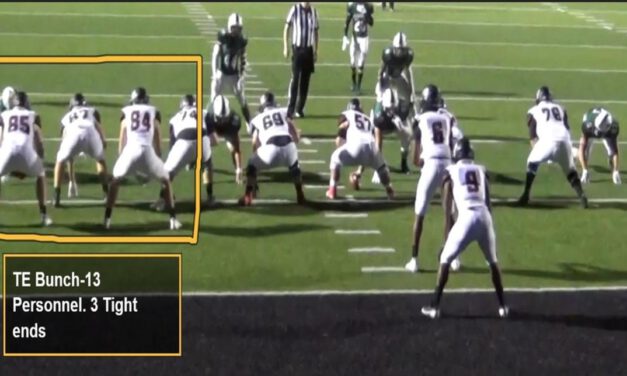
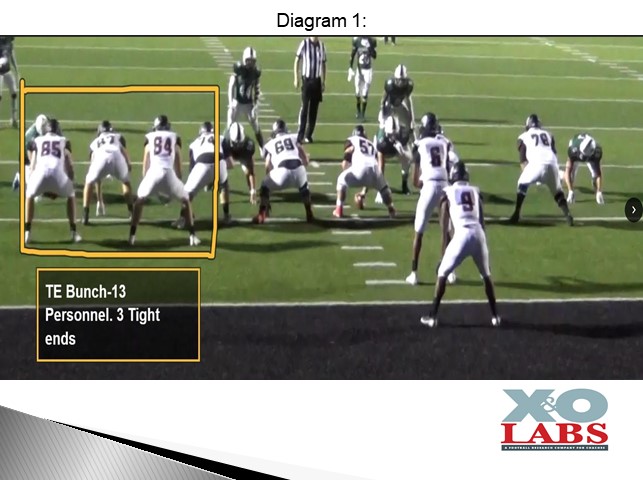
As with everything in football there are always adjustments and adaptations being made to plays and we felt like running a tight formation for our Pin/Pull would be a necessity moving forward. We felt like we had a strong, athletic offensive line to pair with physical tight ends and running backs that would hit the hole and get vertical before worrying about running horizontally. We also felt that by certain defensive structures we knew that the alley player would end up being a smaller corner or safety. That put us at an advantage to having our pullers against that defensive back. Those are matchups that we would much rather have. Because of these things we decided to adapt this play to be run from a tight bunch 13 personnel.


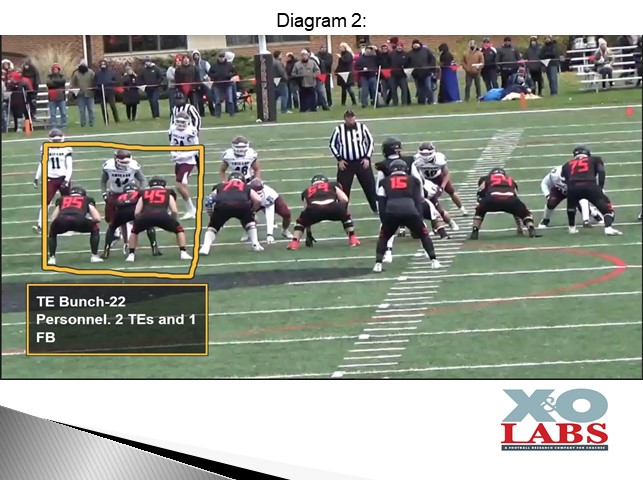
We also used it in 22 personnel groupings


We knew that if we came out in a bunch look with our best WR isolated away from the bunch we would get either numbers to the bunch or single coverage on the WR. To us, that was like being a kid in a candy store. We would get the matchups we desired and we could take advantage of the fronts. This is also a great formation for short yardage as we would get more of ours to the party than yours. This was especially helpful since we would pull players out in space and force the defense into bad situations.

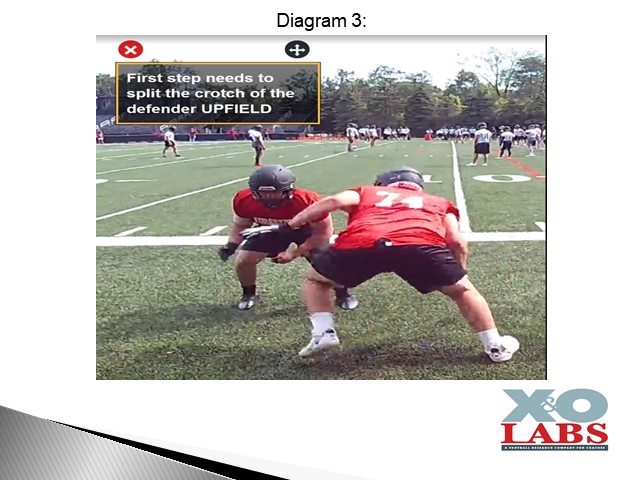
When we are installing and working on pulling the easiest and best drill we can do is having the defense line up and our players make their proper calls based upon the defense. That way we know what to expect from certain fronts and we can get all players involved in the action of pulling downfield. At the college level we are allowed to cut in open space and we will have every player work on cutting the defender by using a tackling ring. I have found that if every player knows how to cut it will then be up to their discretion to use that skill or not. Some players are far more comfortable with cutting than others so they are allowed to choose. We also would work down blocks almost every day. This was an incredibly important block in all gap schemes and we felt that if we could master the down block the rest of our schemes would benefit.

Our two coaching points for the down block are as follows:

  1. Make sure that the first step is upfield into the crotch of the defender.


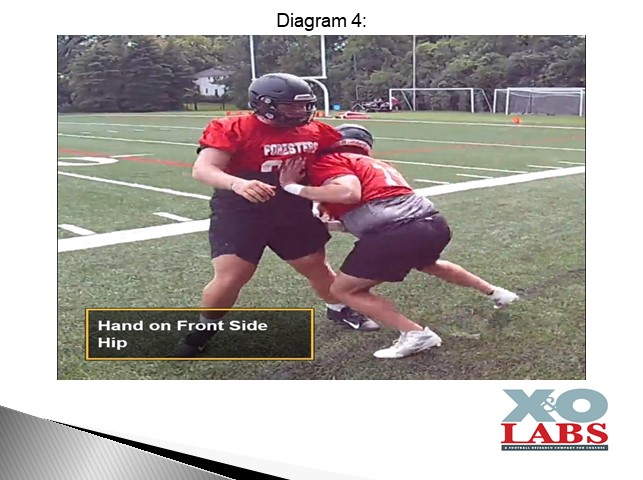
  1. The inside hand caves in the front side hip of the defender.


Read More

“Captains Need Apply”: Teaching Responsibility Through a Selection Process

By Mike Kuchar
Co-Founder/Senior Research Manager
X&O Labs


Editor’s Note: The following is an excerpt from X&O Labs report “The Player Driven Culture System.”


Logan High School (OH) head coach Mike Eddy takes it one step further by having those that want to be captains, apply for the position. Nothing is assumed, regardless of a player’s seniority, ability, or previous accolades. If a player wants to be captain, he has to go through the process of applying for it, just as he would with any other endeavor after his football career has ended. The benefits are two-fold: one, it serves as an identifier for individuals that are interested in what could be a demanding leadership role within the program; and two, it teaches players the important life skill of self-advocacy. According to Coach Eddy, it is a necessary model to replace both player selected and coach selected nominations. “Players voting on captains often plays into a popularity contest or voting for their friends,” he said. “I believe that often being the leader causes you to be in positions to say and/or do unpopular things. Players who have been selected by their peers are on occasion less likely to make tough decisions when needing to hold others accountable.”

In his opinion, when coaches select captains they will very likely select players that have demonstrated leadership skills or players that they believe should be in a leadership position based solely on on-field performance. “The conflict with this approach is, often we don’t even know if the player wants to be a captain,” he said. “If the position is simply a reward for a player’s dedication and commitment to his team and his only responsibility is the opening coin toss; then fine, anyone you select will make sense. But if you are asking your captains to be examples for your team, hold others accountable to a set standard, and be a resource to those around him; then it better be someone who wanted the position or they will not take the responsibility seriously, or be willing to make a stand in tough situations.”

So, two weeks before his first practice Coach Eddy makes captain applications available upon request. He created a document mirroring a basic job application format, where personal information, contact information, and “work” experience is included.

In addition to the application, candidates are asked to write a response detailing if they have ever quit or been removed from a team. There is a section for specialized training, experience, and skills they possess that they feel qualifies them as a captain. Lastly, they must write a response if they have received any school discipline. References are required, just as they would be in the traditional application process format. Both the player and a parent/guardian are asked to sign the application to verify that they are aware of the expectations. If it isn’t signed by the parent/guardian, or the letter of interest is missing then he does not even review the application and they are not considered for an interview.

Not everyone that applies gets an interview and not everyone interviewed is hired as a captain. Coach Eddy schedules all interviews to be held in the school conference room the day before the first practice. “It is a formal (shirt and tie) environment and all assistant coaches help to conduct the meetings,” he said. “We work our way around the table with each coach asking a question and then possible follow up questions after the response. I have a series of questions scripted to guide the interview but coaches are free to ask questions of their own if they wish to.” After the meeting, there will be an open review session discussing posture, eye contact, body language, and interview techniques with each player. “We do not use this process exclusively when making our selections, but it often provides us with more insight into the player’s belief systems, standards, expectations, and leadership techniques,” he said. “In addition, it is a great life experience for our players.”

The morning before the first practice of the season, Coach Eddy meets with all of the applicants to inform them of the selections. He then announces the captains to the team right before heading onto the field. “I believe that announcing it just moments before the first practice begins allows the players not selected to begin to overcome the disappointment in a positive atmosphere,” said Coach Eddy referencing the behavior of resilience, which I write about in Competency 6. “They are in a supportive environment, surrounded by their teammates, and participating in a long-anticipated event.”

The event doesn’t end there. The coaching staff volunteers to be a mentor for each player that participated in the process. The reasoning is simple: even though a player may not be selected as a captain, they see themselves as a leader or at the very least aspire to be one of the leaders of the team. Throughout the season, each mentor (coach) will meet with his player a minimum of once a week to offer advice, discuss concerns, provide feedback, or sometimes just simply improve relations with the player. They then provide Coach Eddy with a summary of their meeting so that he can stay up to date on the player’s progress and/or team concerns.


All the documentation that Coach Eddy uses during this process – including the interview questions and the application itself – can be found in X&O Labs special report on the Player Driven Culture System.

You can begin reading this study by clicking here

You can purchase a copy of the best-selling book, The Player Driven Culture System, in X&O Labs’ bookstore: Go here.



Read More

10 Personnel QB Run/RPO Menu

By Hunter Evans
QB Coach
Ware County High School (GA)
Twitter: @CoachH_Evans


2×2, 3×1 and Empty formation structures usually provide an offense with the light box it needs to execute QB run game effectively. But which QBR concepts a coordinator choses to develop in his menu is based on several factors- such as the ability of the A back to block and potential of the QB to be a downhill runner. Over the last several seasons, we’ve used these 10 personnel QB run/RPO menu to produce over 8 yards per carry for his quarterback in the run game and a 65% efficiency in the pass game. Our base concepts and RPO package off them are detailed in this report.


QB Power Concept:

We called the QB power last year 23 times and ended up with 65% efficiency with eight yards per play. This was including throwing now screens and RPO’s off of QB Power.

In our quarterback power concept, we have the ability to do both pre and post snap reads. It would depend on the RPO tag that was added and also any motions we may have added. When we run it with the RB fast motion, it is treated the same way we would run base power with a slot bubble. The quarterback plays the perimeter numbers game pre-snap and then has a keyed defender based on that week’s game plan for possible post-snap movement. Most of the times we are just looking to get one guy slightly out of where we think he can be an effective player for either the pass or the run.

As it pertains to game planning, it is something we will always carry with us. We will change up the look and presentation at times, but we will use some form of QB Power with either pre or post snap RPO will be in every week. It is something we liked to run if we felt defenses were playing a little too downhill to just line up and run Power. If we felt like they were trying to sneak a backer or safety into the fit, we would start presenting it just to get numbers we liked running the ball. Like you said, it really was all about getting the box numbers down to 5 or 6.

Read More

Identifying and Blocking Leverage in Multiple Screen Concepts

By Blair Hoenk
WRs Coach/Pass Game Coordinator
Caledonia High School (MI)
Twitter: @CoachHoenk


At Caledonia High School, we are primarily a 20 personnel spread football team on offense. We pride ourselves in being a balanced attack that is versatile and able to combat the variety of defenses we see in a given year. One of our core offensive tenets is to equate numbers in the box by attaching perimeter bubble screens to our run game and throw them when we have the defense out-numbered and/or out-leveraged to the perimeter. This article will go in depth on the coaching points and techniques we coach in those schemes. In addition, we utilize a variety of slow screens to combat active defenses that are giving us pressure looks or are over-pursuing.


Perimeter Blocking Identification

All blockers are taught to block the most dangerous. Never pass up a defender in your area.  Our process for Identifying who to block goes as follows –


Pre-snap:

We simply count all offensive and defensive players on all levels within 8 yards of the line of scrimmage from the outside-in. So that our #1 blocks their #1, #2 blocks #2, etc.

Note: 8 yards is a general rule. If you are facing an active defense that has lots of post snap rotation or has very aggressive safeties that week, you may modify it to 10 yards or more.


Post-snap:

Most of the time, our pre-snap read is reliable and players are correct to block who they identified pre-snap. Remember, we cannot pass up any immediate threats. All blockers must have active eyes checking for new threats inside of them if their # is soft or bailing.

The one major adjustment is a push-crack that we rep when drilling perimeter blocking. This means if the defense’s #1 is soft or bailing, our #1 receiver will check inside to see if any defender in his vision is firing on the bubble. This is common in defenses whose safeties are responsible for forcing run plays inside.  If this is happening, we run the push-crack. Once the decision to crack has been made, that is who you are blocking.


Technique – Perimeter Blocking

We want this block to happen as far downfield as possible. If the defender is in man coverage, we simply teach our receivers to run them off as far downfield as possible. If the defender is in zone or peaking in the backfield, we will burst out of our stance and press vertical down the field. This gives us the best opportunity for the block to occur downfield and not too early. Continue to press until there is a 3-yard cushion. Once in position –

  1. Basketball-guarding position: Your feet and hips should be the same is if you were guarding a point guard at the top of the key in basketball. Lower your center of gravity and feet should be just under or outside your hips. This position keeps us athletic and in position to be physical.
  2. Mirroring: Stay square, not turning your shoulders and maintain position between the defender and the ball carrier giving the runner a two-way go. When the defender fires to tackle the ball carrier, continue staying square and basketball shuffle laterally to get your head across and cut off their pursuit.


  1. Engage: The first two components are the more important aspects of having good perimeter blocking. Without those, we cannot be in position to be physical. We work a Shock-pull technique.
    • Squeezing grapes underneath our armpits to keep hands inside, strike defender with tight elbows and thumbs up fitting up in the lower portion of their breastplate.
    • Maintain hands inside, grab cloth and shock/pull defender into you so you stay attached.


Read More

The 12 Personnel Gap Scheme and Complementary RPO Package

By Robby Snelling
Head Coach/Offensive Line and TE’s Coach
Butte Community College (CA)
Twitter: @Coach_Snelling


At Butte Junior College, we use multiple personnel groups to help set up advantages we can build in the run game.  We often use multiple tight end sets to help create extra gaps and to gain an edge in the numbers game.  More recently, we have used a lot of motion to help set things up.  This also allows us to set up opportunities for big plays in the pass game.  We build our play action game plan directly off formations being used in the current or past game plans to create the same look against the defense.


Formation Groupings:

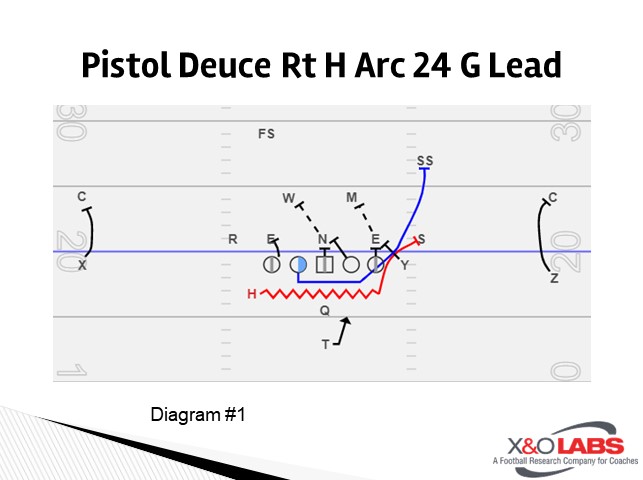
The first formation is a 2×2 set out of 12 and 21 personnel.  We call it Deuce.  The H (off the ball) can be a fullback or tight end.  The H’s alignment is off the ball with his inside foot stacked behind the weak side tackle’s outside foot.  His feet are even, and he is in a two-point stance.  The first five plays are the same formation and motion. 


The above illustration is what most offenses call Power, but we call it G Lead.  We are blocking down on the front side of the play and kicking out with H.  The biggest coaching point for our H is to keep himself a little bit tighter on his motion when the ball is snapped to create a good kickout angle for himself on the end man on the line of scrimmage.  Our Y is blocking down or man in terms of his progression.  In this look, the defense alignment will create a double team with the Y and the playside Tackle.  Our Y needs keep his outside arm free on the double to keep his hips and shoulders more open.  This puts him in a good position to come off to the linebacker at the second level.  In this clip, we got our outside hand too involved and it put us in a bad body position to get to the second level.  Our backside Guard is leading up the hole and is looking to come off the double team at the point of attack.  He is skip pulling and tracking his eyes inside/out to catch any potential run through.


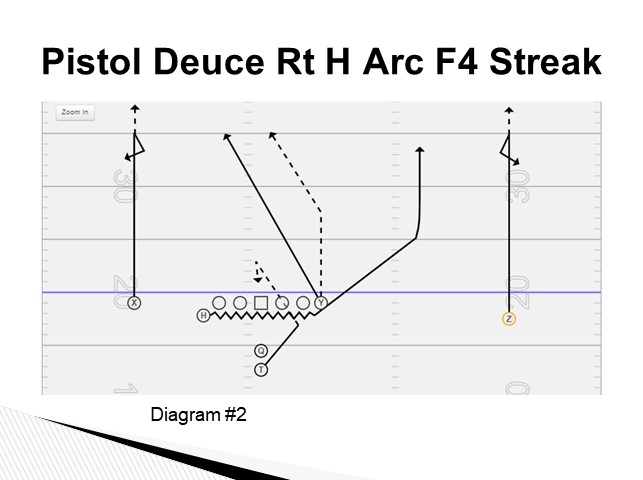
The above illustration is a play action off the same look.  It is a run action toward the motion and the route concept is four verticals.  Our Y is called the “bender”.  He is reading the middle of the field for a one or two safety look.  In this clip, it is a one safety (we call it middle closed) look and that converts his route to the other hash mark and his aiming point is 15 yards and 2 yards outside the opposite hash.  If it were a two-safety look (we call it middle open), he would split the safeties.  The route for the H a locked route and he is working to get width right away and his landmark is 2 yards outside the near hash.  We are trying to create a two on one on the safety and put him in a bind.


The above illustration is Inside Zone.  We are working zone blocking to the left and our H is coming back to his initial alignment for a kickout block.  We tell him to scrape the heels of the offensive line on his way back and to stay inside/out for the block.  The Y is blocking man in this look with a defender walked up on the edge.  On this block, we coach him to work to get push and focus on keeping his inside arm strong (get long) and to drive his hips at the inside hip of the defender.

Read More

Multiple Pre-Snap Pass Tags off Top Runs

By Scott Chisholm and Grant Powell
Offensive Coordinator/QB Coach
Cushing High School (OK)
Twitter: @chisholm_scott @GPowell3_GP3


We have always had the ability to use the perimeter quick game, but this season more than most it was our most effective passing concept. Last season we graduated three offensive linemen that had started since their sophomore season. So, this year we brought back two starters and finished the season with only one of those starters. Needless to say, we were undersized and inexperienced up front. Our offensive philosophy is to have a throw/run ratio of 60/40, and we like to stretch the defense vertical as much as possible. Although we found out early we were going to have to adjust our play calling to help our offensive line in pass pro. So, we committed to using our quick perimeter passing game tagged with our inside run concepts.

We have three perimeter quick game tags.

  • Bubble = Bubble route ran by the inside receiver. (#2 WR in 2×2, #3 WR in 3×1)
  • Look = Now (quick) screen to the #2 WR in trips.
  • Now = Now (quick) screen to the #1 (outside) WR.


Linemen Rules:

Our base runs are Gap and Zone(mainly Inside or Wide zone). We really like to pair our perimeter quick game to a gap scheme, like Counter(GT), Trap, or Dart. We do this because it affects the eyes of the defense. When OLB’s and Safeties see pulling linemen their feet stop. This might give us the step we need to get the defense out leveraged. The linemen have no idea if the ball is being handed off or not.


QB Reads:

These are not RPO’s (we run true RPO’s), the QB is not reading anything post snap, all decisions are made prior to the ball being snapped. So, we are telling the QB to first count the box, do we have numbers? If we have numbers we will hand it off. We ask our QB to read the back side end on counter, so his next read would be is the end chasing, can I pull the ball? Those are basic rules that everyone has. Where the perimeter quick game comes into play is when the box is heavy, or when the box is lite and the QB pulls the ball(triple option).

What is Leverage?

So, leverage can change depending on the tagged route and based off the offensive formation. This is how we teach leverage based on our most commonly used formations.

Read More

Non-Pressure Side Run Fits in a Multiple Fire Zone System

By Steve Erxleben
Head Coach
South River High School (MD)
Twitter: @CoachErxleben


In today’s modern challenge of defending offenses that feature multiple formations made up of multiple personnel groupings with multiple forms of tempo, Defensive schemes have to be sophisticated enough to challenge the run, pass, and protection schemes while also be simple enough to allow players to play fast. As a defensive staff here at South River High School, we decided years ago to transition from more of a base front and coverage team to a scheme rooted in zone pressure and match-carry-deliver principles on the backend.

Within our culture defensively and as a staff we believe with the personnel we have and the style of offenses within our league, hanging our hat on zone pressure allows our scheme to be balanced, have specific force and alley rules, has a reduced amount of checks, is highly adjustable, and allows us to prevent explosive plays, all allowing our players to play fast. Furthermore, we fee that being a high pressure team on early downs allows our front and second level defenders to successfully funnel the ball to an unblocked defender if we do not get a clean run through.

This past season in 2021, out of 631 plays in 11 games, we zone pressured 71% of the time in multiple down and distance, personnel, and +/- situations out of multiple fronts, pre snap movements, and coverages. Specifically, in what we refer to as heavy run down and distances, we were an 83% blitz team but these percentages could vary based upon the personnel on the field. “Run Heavy” can also be very comparatively speaking based upon the opponent but for the sake of argument we refer to heavy run downs as 1st and 10, 2nd and 3-1, and 3rd and 3-1.

In these “Run heavy” down and distance situations, we feel confident our litany of Fronts, Pressures, and pre-snap movements match up well versus 10 and 11 personnel runs (zone, power, duo, etc.).

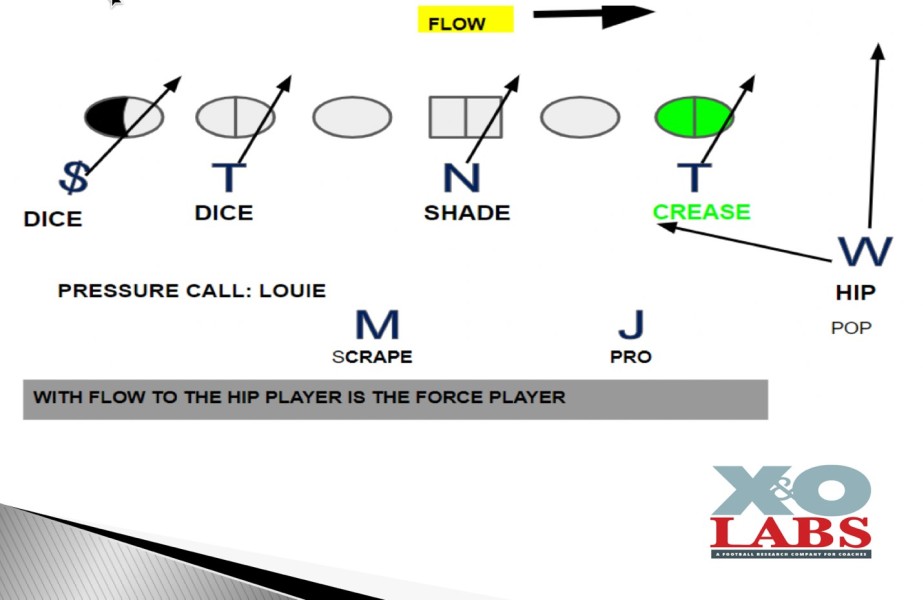
However, when teams utilize 20 or 21 personnel, our mentality does not change but how we handle force, especially to the weakside of the formation, is critical to getting stops and forcing a longer 2nd or 3rd down situation. Looking at forcing the run in a more “worst case scenario” mentality, we expect runs to be cut back away from the side of the pressure, which creates the need for varying ways to set the edge, force the ball, and create B gap integrity. Having multiple ways to attack an unbalanced grouping like 20 and 21 has created multiple ways to force the ball and successfully rely in alley fits and pursuit to “cage the run”.


BASE FRONT TERMINOLOGY AND HOW IT RELATES TO PRESSURE

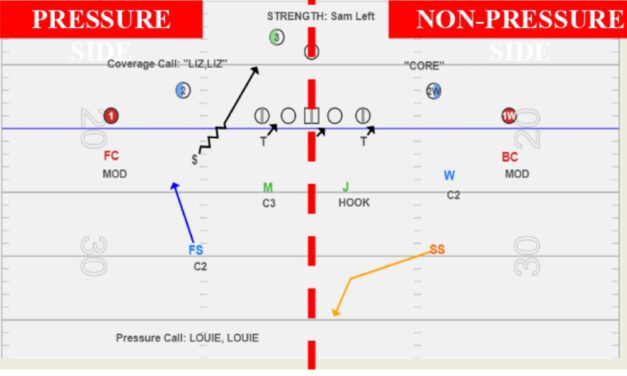
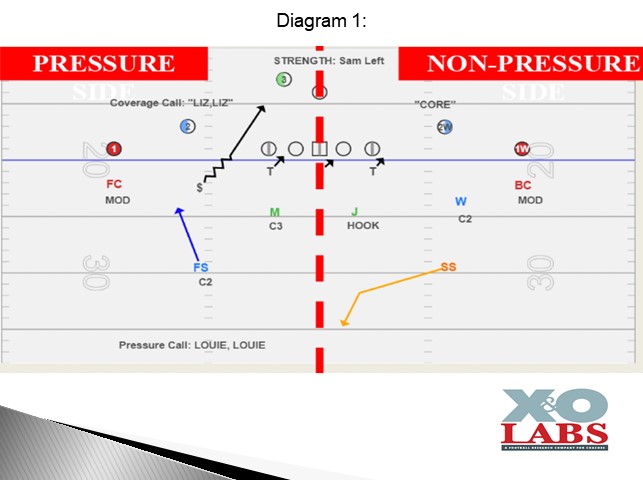
Since this report is about effecting runs and corresponding Force elements, it is warranted to first touch on our Base verbiage and what the Blitz and non-pressure sides are doing (DIAGRAM #1). In our base defense, we will set our front either to the field or the boundary, to or away from the multiple receiver side, to or away from the TE, or to or away from the Back in the shot gun. Where we are setting the front is a weekly game plan decision. Every snap we make either a “Roger” or “Louie” call which dictates where the 4th rusher is coming from and, if we are in a 3 deep situation, where safety support is spinning. Our Interior linemen always slant away from the front call (Roger/Louie) as the 4th rusher (our call side OLB) becomes the C gap player/5 technique call side. The reduction side call correlates with a coverage call to establish who the force player is to the reduction side as well as who the seam player will be. All of our same-side ILB/OLB or “edge” blitzes correlate with a Roger or Louie call, which we feel makes it easier for our players to identify and gives them a chance to focus more on disguise and triggering the blitz from a proper depth and angle.


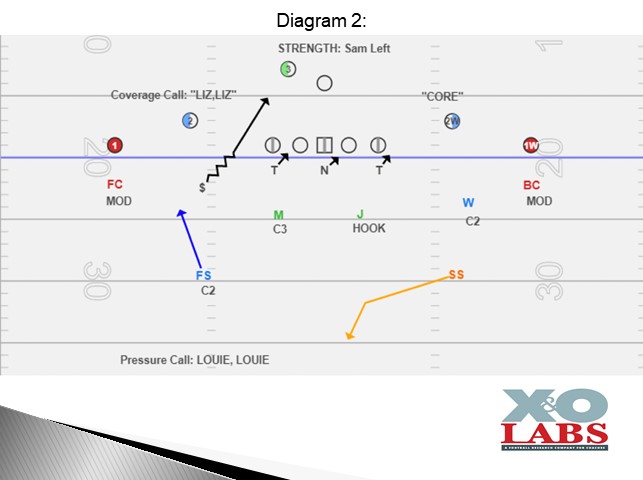
In our terminology, any front that begins with the letter “S” determines the pressure side is to our “SAM” backer. Our SAM backer is our hybrid OLB/DB kind of player and is the adjustor to the field and formation. If our front call is an “S” front  the SAM now is the 4th rusher and the reduction is to that side as well (DIAGRAM 2).


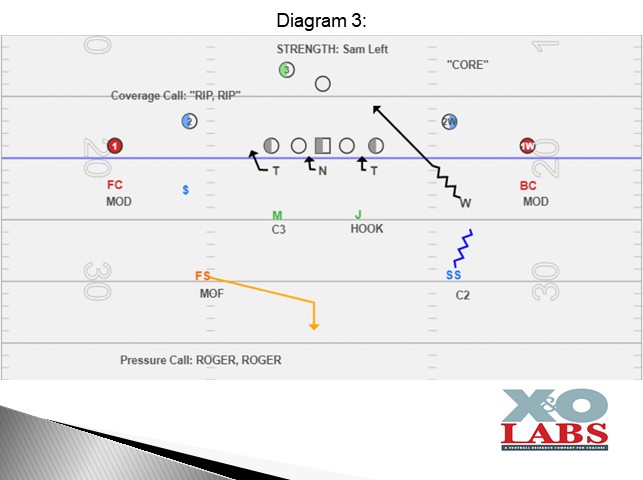
Conversely, if the front begins with an “A” we are setting the pressure and reduction AWAY from the SAM, so now our WILL OLB is the 4th Rusher and the pressure side is set away from the SAM. (DIAGRAM #3)


FORCE ELEMENTS

In diagrams 4, 5, 6 and 7 our Force and Leverage rules are explained from our initial install each Spring. For this report, we will be applying pressure to either the “SAM” side or “WILL” side of the formation, but forcing the ball in space weak will be through the eyes of the WILL backer primarily.

Read More