

Delegating Staff Assignments for Weekly Offensive Game Planning

By Justin Iske
Offensive Line Coach
Southwestern Oklahoma State
Twitter: @justiniske 


Introduction

In January 2015, I was blessed with the opportunity to join the coaching staff at SWOSU. Our head coach, Dan Cocannouer, our passing game coordinator, Jon Garfield, and myself all had coordinator experience and our own ideas on how to fix the struggles that we had on offense in 2014. Meshing our three separate, but similar, philosophies and incorporating nine new starters on the offensive side of the ball was our challenge. The purpose of this report is to go through the game planning process that was the results of our meetings. This is the process that we use for a typical game week and communication on game day. Note that this report will assume that game day is Saturday.

Sunday: Here at SWOSU, Sunday is our players’ day off. Our coaches will grade their position and special teams segment, and complete our self-scout during the day. We will meet as a staff at 5:00 PM to go through the highlights and/or lowlights from Saturday. We also use Sunday as a day to watch film of our upcoming opponent on our own. We split up our self-scout and opponent breakdown as follows.

  • QB/WRs Coach: Breakdown (Coverages) / Self Scout (Personnel / Passing Game)
  • RBs Coach: Breakdown (Fronts / Depth Chart) / Self Scout (YAC / 3rd & 4th Downs)
  • TEs Coach: Breakdown (Fronts) / Self Scout (Run-Pass Tendencies / Red Zone / Backed Up)
  • OL Coach: Breakdown (Blitz / Stunt) / Self Scout (Overall / Run Game / Protections / Goal Line)

Monday: In the morning, we will get together as a staff and determine what personnel groups / formations we are going to stress for the week. The two biggest things we use to make this decision are our self-scout from the past three to four weeks and our opponent film from the past three to weeks. It is important that we continue to do things that our players do well, but at the same time, we have to make sure that we are not too predictable based on formation, down and distance, etc. In the afternoon, we will watch Saturday’s game with our players and begin to introduce our upcoming opponent’s base fronts and coverages. By the end of the day, we will create a ready list of our base runs and passes for the week. The key to this process is having enough offense to keep the defense on their toes, but not so much that we can’t practice everything that we have for the week.

Tuesday: The offensive staff will watch film of our opponent in the red zone, goal line and backed up. We will then put together our game plan for these situations. In practice on Tuesday, we work 60% of our team time on first and second down (open field) and 40% of the time on red zone, goal line, and backed up. We also work good on good against our defense on red zone and inside run.

Read More

Simplifying Communication to Defend High Tempo Offense

By Bart Bruner
Defensive Coordinator/Inside Linebacker Coach
St. Xavier High School (KY)
Twitter: @bbruner4

Introduction:

Have you ever confused a player you are coaching because you used too many words? 

Has one of your coaches ever slowed down practice because he is explaining something to one player? 

Has one of your players ever been confused because two coaches gave him conflicting instructions?

Have two coaches on your staff ever tried to call the same formation or play two different names?  

These and other questions are issues our defensive staff at St. Xavier High School (Louisville, KY) has tried to address by attempting to improve our communication. Many staffs have turnover in coaches from year to year and also decide to change or alter their scheme which ultimately leads to challenges in communication between coaches and consistency in coach-player communication.   

Over the past two years, our defensive staff has worked extensively to improve our structure and system of communication and teaching. Our goal is to have a scheme and techniques that are simple, as well as a system of communication that is efficient for coaches and players. We have evaluated everything to ensure we are talking the same language with each other and with our players. We also have attempted to streamline our communication so we can coach faster. Our scheme calls, techniques, checks, teaching progressions, and coaching points have all been evaluated, scrutinized, and sometimes adapted to reach these goals.

Many of our opponents are multiple in scheme, formation, motion, shift, and personnel groups, as well as various tempos. This has made our goal of simplicity more challenging as we are forced to check defensive calls and adjust alignments sometimes multiple times in one play. This article will attempt to explain our process and purpose.

Who We Are:

Like most other staffs, all of our decisions are based upon a philosophy that we have developed and believe in. Our defensive philosophy is simple:

  1. Be More Physical than the Offense
  2. Be Gap Sound & Zone Sound
  3. Keep the Passing Game in Front of You
  4. Fanatical Effort 4-6 Seconds, Point A to B: Full Speed.  (Borrowed from Ohio State)

Our scheme is 3-4 Slant/Angle Front with multiple zone coverages. Our personnel and call system are field and boundary based. We believe our calls and communication must be simple and efficient to defend the best offenses we face. We focus on emphasizing great technique, block destruction, pursuit, and tackling as opposed to multiple schemes and calls.   

Many of our opponents’ offenses, especially our biggest two rivals, are multiple in scheme, formation, motion, shift, and personnel groups, as well as various tempos.  We use our two rivals’ offenses as a litmus test for all we install on defense. They have had extremely successful programs, especially offensively, for many years.  They are known for their complexity and multiplicity, as well as for their great execution.

Will our scheme hold up?  Can we easily recognize all formations, motions, and shifts?  Can we keep our call vs. Empty, Quads, or Unbalanced formations?  Can we clearly and quickly communicate any and all necessary checks before the ball is snapped?  How much practice time will it take to get all the above executed with a high level of confidence?   These are all questions we ask ourselves as we continue to evolve defensively each off-season.  We continue to evaluate the answers to these questions as we install in the pre-season and in game planning from week to week during the season.  We often use our philosophy stated above to remind ourselves and our players of what is most important and how we ultimately want to be playing defense.  We strive to insure that communication lines are open on both ends.  We ask our players questions constantly and demand answers, as well as attempt to recognize difficult concepts and plan for them accordingly.

Simplifying Communication:

Read More

North Dakota’s 7 Drills to Teach WR Separation

By Danny Freund
Wide Receivers Coach
University of North Dakota (ND)
Twitter: @dfreund7

Introduction:

We use the following seven drills to emphasize creating separation and attacking the ball at the top of routes. We also want to drill catching the ball, tucking it and turning upfield quickly. We believe in these techniques and want to drill them as much as possible in individual drills and winter/spring/summer season work. Much of our practice time as wide receivers is dedicated to running full routes on air, 1-on-1 or against the defense. These seven drills allow us to save legs and focus attention on the details that give us an advantage getting open and maximizing yards after catch.

Drill #1: Burst Drill

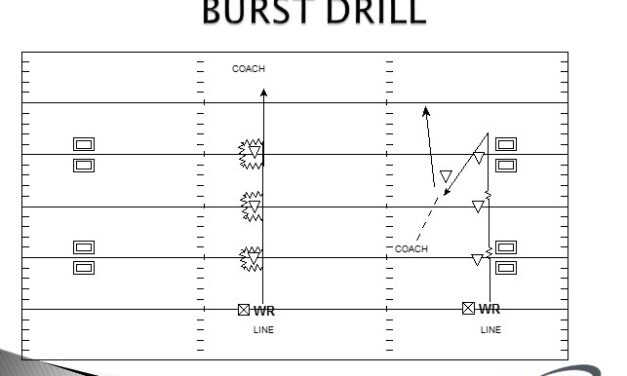
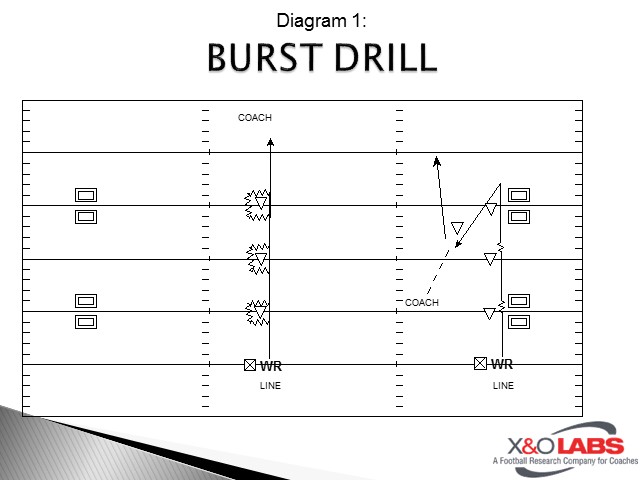
We use this drill to work changing speeds in and out of breaks. The focus is on keeping eyes up and arms tight to the beltline. It is important to emphasize sinking the hips at the top of the route and keeping our feet alive. The players should be on the balls of our feet and keep spacing in our feet to maintain balance. Exploding out of the break and changing speeds fast is important to create separation. We want to work this while maintaining the proper arm drive, eye focus and pad level.

We don’t anything to “tell” the DB when we are breaking our route off. These include looking down with our eyes, decelerating before the break point, having arms get away from our body or beltline, and changing our shoulder pad level drastically. I like to stand at the finish of the drill to determine if anything the receiver is doing is telling the defensive back that he is about to make a break. We talk about selling vertical with speed in most routes we run. They must attack the DB’s cushion and make him uncomfortable. As a change-up to train violent hips and simulate a double move, we will also work a quick one-two stutter at each cone while sinking hips and maintaining balance. At the final cone, we work the top of a curl or comeback working back to the QB.

Slide1

To study film of this drill, click on the video below:

Read More

Implementing a Takeaway System for Game Week

By Tunde Agboke
Defensive Coordinator & Assistant Head Coach
SUNY Cortland (NY)
Twitter: @CoachAgboke


Introduction

When I was player, my coaches always use to say, “the ball is the thing, the ball is the thing.” As a player, I understood to an extent what they meant. They were preaching the importance of getting turnovers and possessing the ball. That part was clear, what I didn’t realize at that part of my football career, is there was a subliminal part to his message.

The words themselves are clear. “The ball is thing!” He who possesses the ball possesses the power. There are no rules on the books that say the football belongs to the offense. Every time the ball is snapped, possession is a 50/50 proposition. The moment defensive players come to grips with that general concept, the more likely the defense is to create and secure turnovers.

The subliminal part of the message wasn’t so easy to parse as a player. We heard the message on a daily basis, “the ball is the thing, the ball is the thing.” Looking back now, I realize what they were doing was planting seeds. The more they talked about turnovers, the more we as players would think about turnovers. The more we thought about turnovers, the more likely we were to secure them.

Turnovers aren’t some magical guarantee that you will win the game. We have all been a part of games where we won the turnover margin but lost the game. However, they do give you a better chance to win. As a coach, I’ve taken that same approach. We want turnovers, so we are always going to talk about turnovers. Not just on the field at practice and on game days, but in meetings rooms and anywhere we can. Gaining turnovers requires a whole hearted cultural shift and adoption of that mantra.

Forcing & Recovering Fumbles

In the last two seasons, we have forced a combined 35 fumbles. While this is an impressive stat, it has also been a tricky undertaking. In trying to force fumbles, at times players will sacrifice making the tackle. We have tried to maintain and reiterate the importance of both, since they are not mutual exclusive. When coaching the pursuit of fumbles, we focus on the following three techniques; edge rushers bending, the 2nd man into the tackle stripping, and recovery. Below is game film and drill film as well as coaching points for these techniques.

Bending Edge Rushers – Burst, Bend, Stay Tight, Drop, & Swat

To study film of this, click on the video below:

Read More

Sam Houston State’s Bubble/X Screen Run Tag

By Mike Kuchar
Senior Research Manager
X&O Labs
Twitter: @MikekKuchar


Introduction

case3picThe following research was conducted in part of XandOLabs.com special report on “Sam Houston State’s Air Raid Evolution.”
Bubble/X Screen Tag

This is a trips concept where the bubble screen is paired with a trips screen concept to the single receiver side. It is usually paired with an interior run scheme like inside zone or power. The quarterback makes the pre-snap decision based off leverage.

Read More

Using Read Coverage to Defend Three-Man Surface Runs

By Zach Davis
Head Football Coach
Riverside High School (WV)
Twitter: @zachdavis24

Introduction:

Read coverage is one of the base concepts of our defense because it can adapt to many different formations. It allows us to get our safeties and corners involved in the run game while adjusting the run support based on the formation. It handles every formation an offense can use while giving you max numbers against the run and being able pattern match in the secondary. We really like it versus TE runs to the field because it puts our safeties into the run fit based on the release of the TE.

Base Concept

We use a traditional 50 defense where we are rushing 5 defenders on the majority of our snaps. We have the ability to drop our Ends (OLB’s) into coverage, but it is not something we do often. We also use a variety of blitzes with our inside linebackers to attack the A, B, C and D gap.

The run fits remain the same for our Ends, ILB’s, Tackles, and Nose regardless of what coverage is called, which allows our players to play fast! Our Ends are force / BCR (boot, counter, reverse) players that will squeeze all down blocks and play the quarterback versus option.  The ILB’s read the triangle (Center, Both Guards, to the near back). The Tackles are spill / dive players and the Nose plays a 2 – gap technique. 

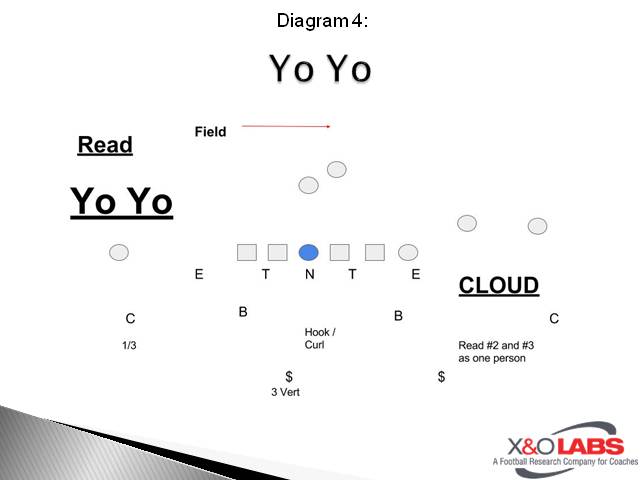
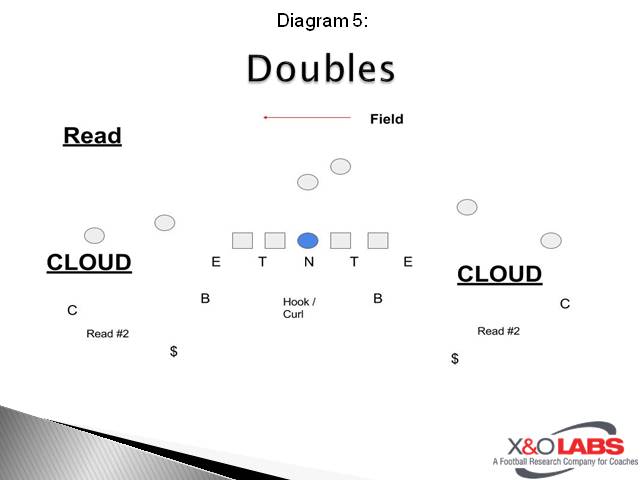
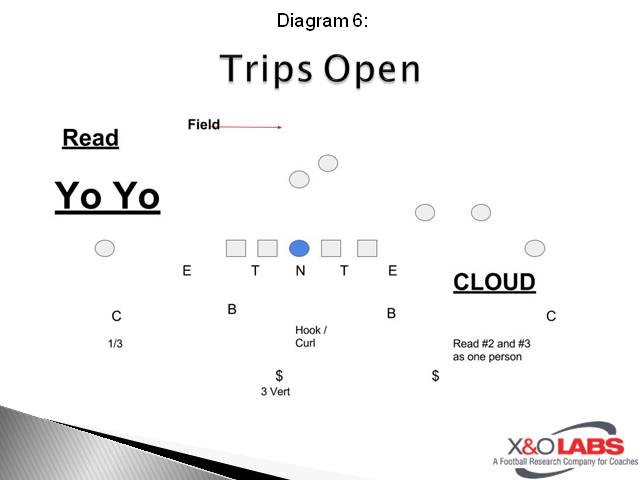
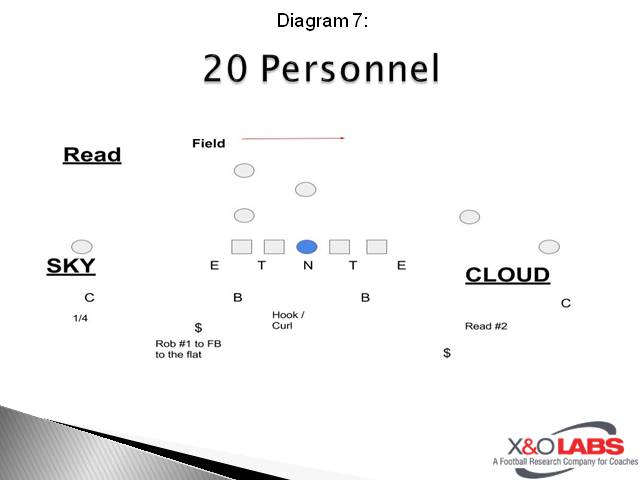
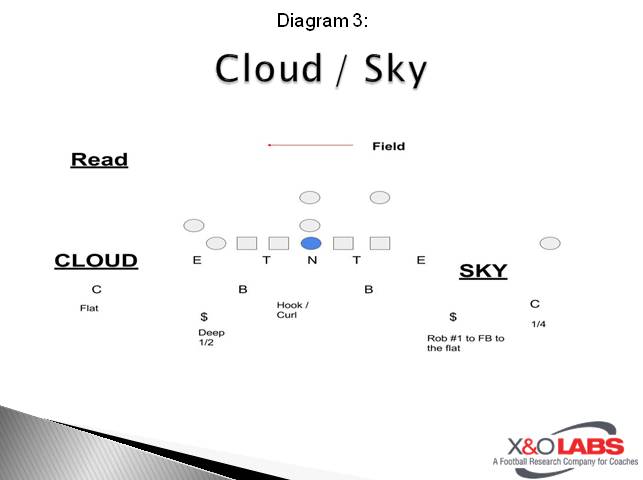
Our secondary adjusts to the different formations. They are further from the football, so they have time to process. There are three calls that can be made based on the offensive formation: Sky, Cloud and Yo – Yo.

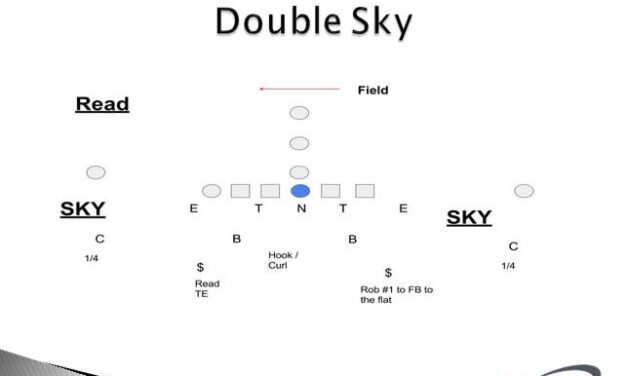
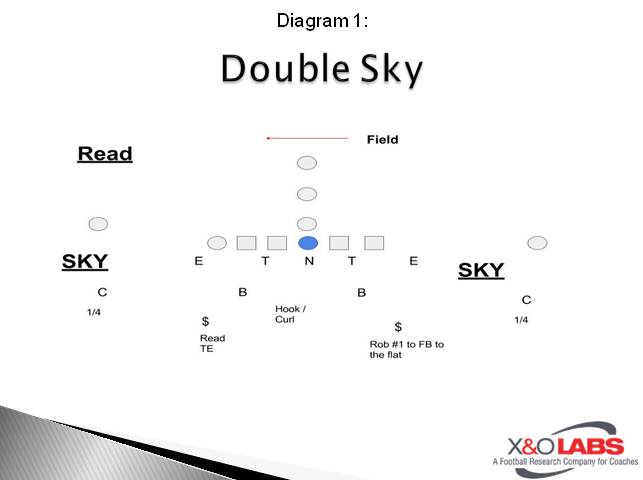
Sky Call

Slide1

Sky is used when there is single removed receiver and a TE or Tackle. This is a version of quarters coverage where the corners have all of #1 vertical and the Safeties have #2 vertical and out. The ILB’s are hook / curl players that need to expand if a back threatens them to the flat. They will play everything from deep to short.

The safeties are looking at the EMOL for their run / pass key and the corners are pass first players that guard against play action and half back pass. This allows the safeties to be the 8th and 9th defender in the box, allowing us to get max numbers against the run.  The safeties’ job is to fit off of the defenders in front of them.  

As a change up, you can also call double could to this formation if you want your safeties to be able to help on the vertical by #1 or if you want your corners in a good position to play toss or jet sweep. The ILB to the TE would have to carry the TE vertical.

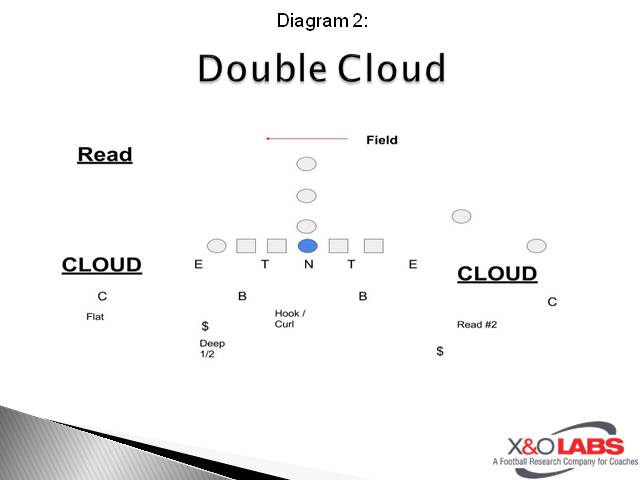
Cloud Call

Slide2Slide2

We use Cloud when there are the following situations: TE / wing, nub TE, or 2 removed receivers. This allows us to play 2 read on the #1 and #2 receiver, so we do not get picked or rubbed in the passing game.

Both the corner and the safety to the Cloud side will read the TE / wing area for their run / pass key. When then get run, both of them will fit off of the defenders in front of them.

Yo-yo Call

Slide2

We use Yo – Yo when we get trips, so the boundary safety will poach 3 vertical and he can be an extra hat in the run game if #3 blocks. The corner to the single receiver side will play a third and the corner and safety to trips read #2 and #3 as one person. Meaning, if #2 or #3 work out, the corner will settle and the field safety will play over the top of #1.

Coaching Points:

The majority of the coaching in Read coverage comes with formation recognition. The secondary must understand when to use each of the calls (Sky, Cloud, Yo – Yo) because they are the ones that are responsible for making the coverage adjustments. They will ensure that we can get a secondary player into the run fit so we can be plus 1 in the box.

As with any defensive structure, we practice block recognition and destruction more than anything else. Your players have to be able to identify blocks and destroy blocks on defense if you want to be successful on game day. We make this scheme simple so our players can play FAST and focus on the fundamentals.

Variations:

The variations that you could see in this concept would be 10 and 20 personnel where you don’t see a TE. Read coverage is still very effective because you will get a 7-man box versus 10 personnel and an 8-max box versus 20 personnel. This coverage allows you to pattern match as well, so when a team throws the football you are in good position to match the different route concepts you will see in a game. Below are examples of how we align to 10 (Doubles and Trips) and 20 personnel.

Slide5Slide5Slide5

To study game film of these coverage concepts, click on the video below:

Read More

Developing an Explosive Play “Culture”

By Jared Hottle
Offensive Coordinator / Wide Receiver Coach
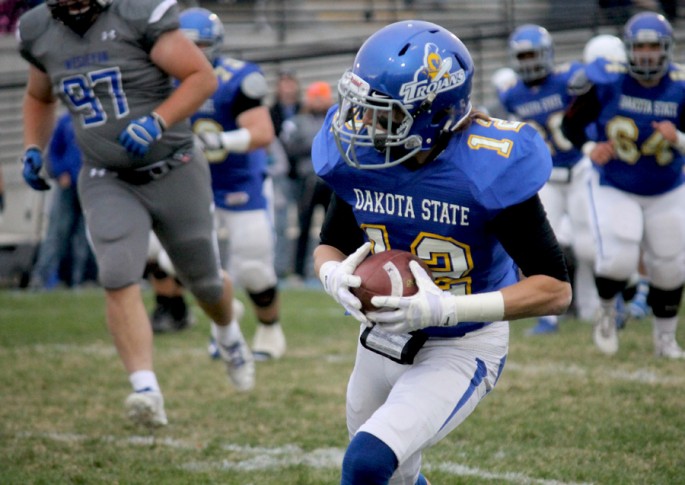
Dakota State University (SD)
Twitter: @CoachHottle

Introduction:

It is well documented that explosive plays lead to points, success, and winning. Brian Billick in Developing an Offensive Gameplan, Bill Connelly in his article “The Five Factors: College football’s most important stats” and the Football Outsiders and their tracking of explosive plays in the NFL all have reached one conclusion. Explosive Plays equal wins. My study in the success of Dakota State University Football reaches the same conclusion. Obviously, every college coach in America wants explosive plays on Saturday but at Dakota State we believe there are ways to manufacture explosive plays through specific processes in scheme, practicing, game planning, and recruiting.

hottle

The Study

The first thing we must do is define explosive plays. Many programs and coaches have many different definitions and classifications for explosive plays. I decided to classify an explosive play as a run 12 yards or over and a pass 18 yards or over. These numbers are similar to the classifications used by others for the professional game (Developing an Offensive Gameplan). I have tracked the explosive plays at Dakota State over the last four years which gave me a significant sample size to run regression analysis. Most analysis on explosive plays and success is a comprehensive team view. Explosive plays are seen more on a net scale with explosive plays gained by the offense less the explosive plays given up by the defense. For my study, I wanted to view explosive plays and success through a purely offensive lens. To do this I used points instead of wins as the dependent variable. I found explosive plays to be highly significant with a p-value well under .001. The coefficient on explosive plays is 3.57. For every run 12 yards or more, or pass play 18 yards or more a team can expect 3.57 points.

Explosive Plays

As a football coach, it is obviously very intuitive to believe that the bigger plays you have the more points you will score. This data is also backed up by statistical analysis. Some coaches believe explosive plays are purely coincidental. Low-percentage plays born from a play-caller or a quarterback just taking a chance. Although there are some inherent risks when it comes to vertical passes down the field there are also other ways to generate explosive plays. Furthermore, I believe a lot can be done to help sway the percentages in the favor of the offense.

Scheme

From a scheme stand-point there are a lot of things you can do to create explosive plays. You do not need to be an exclusively or even favor a vertically passing team to create explosive plays. Although this might sound counterintuitive our focus on scheme is on that of creating efficient positive plays. You may ask how can a coach so focused on explosive plays be creating an offense focused on efficient plays?

To answer this question, we must go back to the statistics. 62% of our explosive plays happened on the 4th play of the drive or later and 60% of explosive passes and 78% of explosive runs occured in the 2nd half. I attribute this distribution of explosive plays, at least in part, to the confusion and stress a defense might feel with an offense driving and getting at least one first down, and to the fatigue of the defense over the course of a game and the tendency of a defense to miss tackles and miss assignments as they become fatigued. As an offense, to get the defense to this point, one needs to get 1st downs, take snaps, and stay on the football field.

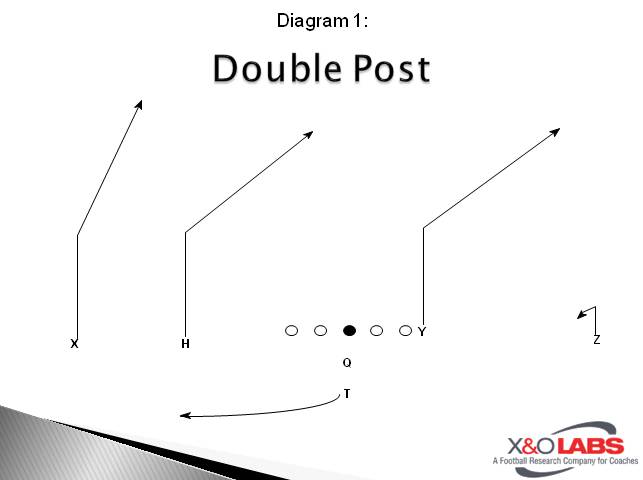
There are many philosophies of an efficient offense at Dakota State we attempt to do this with a balanced run to pass ratio which incorporates quick passes, 5-step intermediate to deep passes, and a predominately zone running scheme. Two passing concepts that we have had luck with both in creating explosive plays against all coverage looks are our Double Post Concept and our Post and In Concept.

Double Post

Slide1

Read More

Slide-Step Off Man Technique Teaching & Drill Work

By Steven Dudley
Defensive Backs Coach/Special Team Coordinator
Fort Hays State University (KS)
Twitter: @CoachDudleyFHSU

Introduction:

Throughout my coaching and playing career, I had always taught the traditional back pedal off man technique. I was confident in my ability to teach it, it was always what I had used, and I knew it worked if executed correctly. A few years ago, I could not help but notice the rise in popularity in higher levels of college football of the slide-step technique and my players were noticing as well. With our defensive philosophy moving to more of a quarters scheme and my players wanting to use the technique, I decided to start researching the technique to make the switch.

Once we made the change, I ran into an issue. There is not a lot out there on teaching this technique. I spent a lot of time going to different FBS camps that I knew used the technique and poured over a lot of All-22 film. From there, I was able to piece together enough information to create my own ideas on how I thought it was best to teach it and after some trial and error in my first spring of implementing it, I’m very confident in the final product of the way I teach this technique. The change made a big difference in the play in our cornerbacks and the results reflected this. We rose to the second best pass defense in our conference, our CB’s interceptions rose from 5 to 9, both of our starters were all-conference, and one was first team all-region. The technique is now a staple in our system and will continue to be as long as we are a quarters based defense.

Overview

Before I get into the specific details of the technique, I want to cover a few philosophical points of why I teach things the way I do. In my mind, good DB technique is all about being in the proper position to transition into your next movement. Back pedal technique has little to do with how fast a kid can go backwards. If that’s all we were concerned with, we’d just teach them to do a backwards run. It’s all about pedaling with tempo while trying to main the technical integrity to be able to have the best break/turn possible. The same applies to the slide-step technique. The benefit of playing a slide-step technique is that it’s easier to break on anything in front of you because of the position the body is in. I always want to maintain the position to be able to break properly at all times. We also man turn all outside vertical releases, so I want to maintain a position where we can make a clean man turn to the outside.

Stance & Alignment

I always teach stance with the guys standing on a field line. This helps make sure they’re cocked in at the right angle and their feet are placed correctly. They want to have their outside foot forward and their inside foot back. They should be facing in to the ball. Now, I teach to have them slightly angled in to the ball. I always refer to it as having your belt buckle pointed to the ball. The best way that I’ve found to do this is to use the field line where their front toes should just be on the outside of the line and their back heel should be just inside of the line.

Their toes should be pointed in to the ball just as their body is. Some coaches will teach to have the front foot pointed to the line of scrimmage, but I prefer that it be pointed to the ball because it makes it easier to adjust to the stem of the WR once we start sliding. Their feet should be slightly wider than shoulder width apart. The width of their feet should be the same as if they were going to shuffle laterally. Their eyes and their chest should be turned in to their man. This upper body position helps them keep their hips slightly cocked in. Maintaining this position is so important because if the hips get opened up, it becomes very difficult to man turn. The arms should be relaxed, although some of my guys like to have a little flexion in their arms. That’s not something is get too concerned about.

I always teach my guys to play 5-7 yards off and to play with inside leverage. The guys that are very good with this technique I let get up to 5 or 6 yards, but I always start the young guys at 7 yards. For leverage, their outside shoulder should be matching the inside shoulder of the WR. 

Stance Coaching Points:

  • Facing into the ball
  • Belt buckle to the ball
  • Feet slightly wider than shoulder width apart
  • Toes pointed to ball
  • Comfortable bend at the hips, chest over toes
  • Eyes and chest turned into the WR
  • Relaxed upper body

Frequent Issues to Look For:

  • Too open or too closed

Footwork

On the snap, they should push off the front foot. The push off should start at where the front pinky toe is. Once they push off, they should be up on the balls of their feet so they’re light on their feet and are quicker to react to stems. The slide technique is not a true slide. It’s a push-step-step cadence. They push off the front foot, step with the back foot, then step with the front foot to get in position to push again. They should never be dragging their feet on the turf.

Read More

Building Blocks of LB Block Destruction

By Jason Thier
Defensive Coordinator
University of Mary (ND)
Twitter: @jasonthier

Introduction

When it comes to defensive football, there are base fundamentals that hold constant regardless of the era the game is being played in, the level at which it is being played, or the scheme that is being implemented. When we talk to our defensive players about these fundamentals, we are referring to the things that we get to control on defense. These are the components that the offense cannot dictate. 

It all starts with the pre-snap fundamentals, like alignment and stance, that place the defense in a position to be successful before the ball is put into play. Once the ball is snapped, it is about being relentless in three basic fundamental groups:

  1. Getting Off the Ball: The fundamentals of a great first step and keys.
  2. Getting to the Ball, The fundamentals of pursuit and block destruction.
  3. Getting After the Ball: The art of tackling and taking the ball away from the offense.

Whether a player is on the line of scrimmage or playing in the secondary, these pre- and post-snap fundamentals must be present on every play in order for the defensive unit to have success. For this clinic report, I will focus on the post-snap defensive fundamental that often gets over looked, block destruction. I plan to outline how we teach our linebackers here at the University of Mary to attack and beat blocks and when we want them to “get dirty” vs “stay clean.”

Block Destruction

Next to tackling, block destruction is the most important fundamental skill every linebacker must master. With the exception of when a linebacker is being read on an option play or RPO, a linebacker is assigned to be blocked by an offensive player on every run play. With the primary responsibility of linebackers being to stop the run, block destruction is a skill that must be practiced every day until it becomes an unconscious reaction by your linebackers. For the purpose of teaching, I break down block destruction into these simple parts; mentality, base, hit, and escape.

Block Destruction Mentality

It all starts with the mentality. They have to want to do it and they must build the mentality over time. Here are the coaching points we use to develop the mentality that we expect.

  • “He comes, I come”: The linebackers must work to attack the blocker the same way they would attack a ball carrier.
  • “Be a hammer, not a nail”: Linebackers must be the ones delivering the blow, not receiving it. We want to be able to see the body of the blocker jolted or rocked back upon contact. Block destruction takes a certain level of physicality in order to be successful.
  • “Can’t go one for one with part time blockers”: If a running back or wide receiver is assigned to block a linebacker, it must take more than one of them to get it done. It is not ok to be occupied or blocked by part time blockers.
  • “Holding doesn’t exist”: If a linebacker is being held it is because he is allowing himself to be held. It is our job to make it so obvious that the ref has to throw the flag.

Building the Base

The most important part to a linebacker beating a block is having the proper base on contact. Without a proper base when making contact the linebacker is likely to get over powered on the hit or not be able to escape. Nothing else matters if the base is not correct. Here is the proper base on contact coaching points:

  • Feet should be shoulder width apart in a slight stagger no more than heel to toe relationship. The majority of your weight should be on the ball of the front foot.
  • The near foot toward the blocker is in front with the toe pointed at the crouch. Your hips will follow the direction the front foot is pointing. If your toe is pointed to the outside of the blocker all your power on the hit will not transfer to the blockers body.
  • The far foot away from the blocker should be back in the stagger. Your toe again should be pointed at the crouch of the blocker for the transfer of power on the hit.
  • The linebacker needs to be in a low compact position ready to explode. There should be enough bend in the knees and waste to have the crown of the linebacker’s helmet just under the chin of the blocker. The chest should be over his toes, with his shoulders back.

Going hand and hand with building a good base is being able to get to that base off a full speed approach. A linebacker must be under control when attacking a blocker in order to finish with the proper base on contact. Attacking a block on a full speed approach is where most of the common base issues will occur. Here are a few of the most common base issues that we see:

Read More

SHSU’s Quick Game Tags off its Run Concepts

By Mike Kuchar
Senior Research Manager
X&O Labs
Twitter: @MikekKuchar


Introduction:

The following research was conducted in part of XandOLabs.com special report on “Sam Houston State’s Air Raid Evolution.”
 

Slant/Bubble Tag

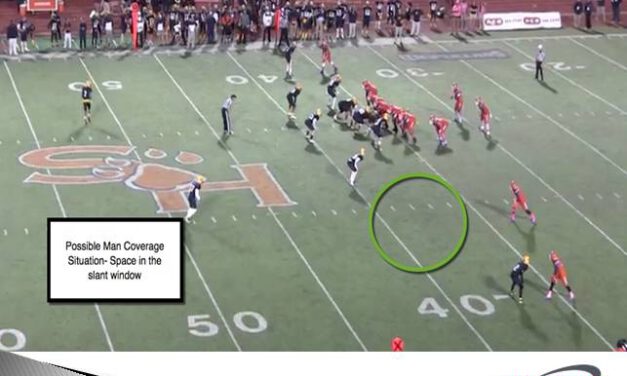
This tag is designed to attack man coverage teams where corners will run hard to defend the slant route. Number one runs a slant and number two runs a bubble route.

Where Space is Best Accessed:

Read More

10 Feet and Hands Drills for OL in Pass Pro

Anthony Vitale
Offensive Line Coach/Recruiting Coordinator
Southwest Baptist University (MO)
Twitter: @vitale_64

Introduction

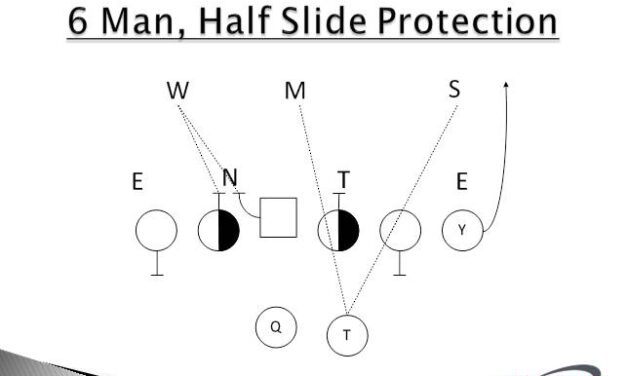
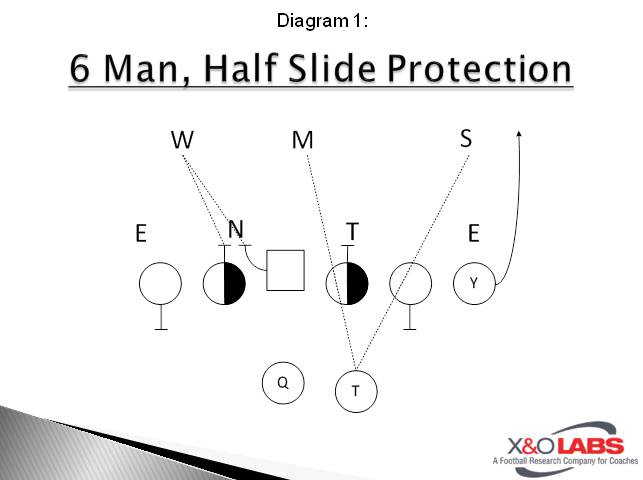
SBU utilizes a variety of protections within our passing system. One protection that the offense uses often is a 6 man, half slide, drop back protection. This concept, founded primarily in the principles of the 2/3 Jet protection concepts, is a basic scheme that allows for simple blocking rules (see Diagram 1). The protection relies heavily upon fundamentals, technique, and execution by both the Offensive Line and the Running Backs. Our staff feels that in order for the passing game to be successful while utilizing this protection, the Offensive Line must be physical and fundamentally sound in their execution. We are able to achieve this aggressive posture and technical execution through a heavy reliance upon a series of protection drills that cover not only the fundamentals of the position, but also the situations that Offensive Line must be aware of and prepared to handle.

XO Labs PPT Template1

Hips & Hands

We utilize a version of the Hips & Hands drill almost every day. We use this series of movements to emphasize both the movement of the hips as well as the pass protection strike and body position. The only movement we will get the hip all the way through is the first phase (6 PT start). In this phase, we are coaching the Offensive Line to explode through the bag and drive his belt buckle to the turf. While there is a slight hip roll that accompanies the pass protection strike in the second and third phase, the emphasis is more on a violent hand strike while keeping tight hands and elbows. 

To study film of this drill click on the video below:

Read More

Using Exercise Balls to Teach Core Tackling Fundamentals

By Joey Mariani
Defensive Coordinator
University of Redlands (CA)
Twitter: @UR_CoachMariani

Introduction

In teaching tackling, we emphasize what we call the “Three Rules of a Bulldog Tackle.” First, you must be able to see what you are hitting. This point of emphasis prevents our players from hitting with the crown of their helmets. Second, we tell them to lower your target. We coach that your eyes should be on the ball. This helps prevent the helmet to helmet contact that we are all aware of and teaches safer tackling. Lowering the target also gets our defenders closer to the ball and therefore, leads to more turnovers. Third, we teach them to finish through the ball carrier with a low to high wrapping up motion with your arms.

At the University of Redlands, we use alternative methods to teach basic fundamentals, keep players engaged, keeps players safe and maximize learning in a limited time frame. The following drills are used by us in the spring (because we aren’t in pads), or at the end of week when we still want to practice tackling fundamentals without the violence so close to game time.

The drill that we use for our safeties is designed to teach them to come to balance out of a full speed run in multiple directions and situations while using an exercise ball to finish the drill.  We have found that the exercise ball forces players to sink their hips, to run through the ball carrier, to wrap up and it is a very non-violent way to practice tackling. The ball is also a very inexpensive piece of equipment. Conversely, the other tackling devises out there are expensive and just don’t have the ability to be utilized in a fast / effective manner. The use of the exercise ball can be utilized to finish any drill that a coach has that will have the player finish with a tackle. For example, our players will learn to cut-to-tackle, block destruction to tackle, bag drill to tackle, get-off with a slant to tack, etc. I think that the possibilities are endless with the use of the exercise ball in multiple defensive positions.

Read More

Arkansas Tech University’s 9 RPOs from 20 Personnel

By Brent Dearmon
Offensive Coordinator
Arkansas Tech University

Introduction:

At Arkansas Tech University, we are a run first offense that mixes in complimentary RPOs to replace quick game. We base out of 20 personnel formation, so we see 6 guys in the box every snap. Most of our RPOs are designed to control the 7th and 8th hats in the run fit.

With every RPO we run, we have to figure out the following questions:

  1. Who is the extra run fitter to the side of the field we want to read? Which secondary player is designed to get his hat in the run fit to the field and to the boundary? Since we are a run first offense, our RPOs are based upon getting an extra hat out of the run fit each week.
  2. Are we protected? We rarely like to let DE’s run free in our protection unless the QB has a run option. If the RPO is designed to stay in the pocket, then we will read Safeties or Linebackers.
  3. What do we do verses blitz or man coverage? Do we have built in hots to serve as answers verses blitz to get us out of bad plays?

Below we will outline 10 different ways that we use scheme our RPOs as guided by these fundamental questions.

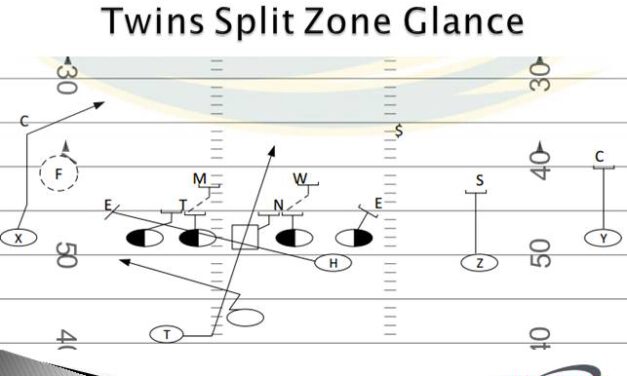
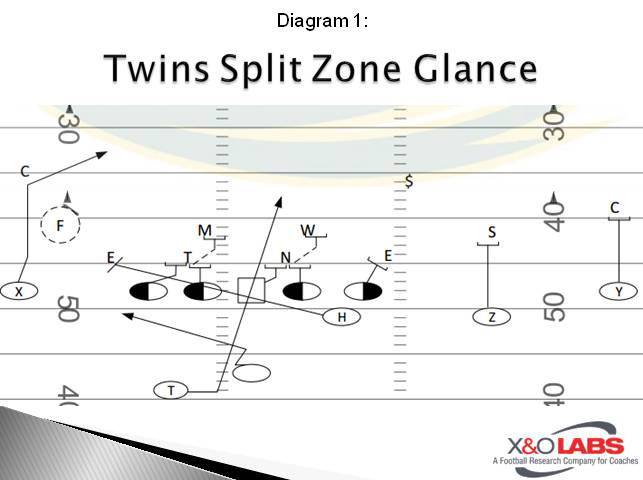
Concept #1: Split Zone with Glance Post (20 personnel)

This is a boundary ‘run fitter’ read attached to split zone. We see a lot of invert coverage into the boundary so this run concept is designed to read the boundary safety. So we had to ask ourselves the three questions from above.

  1. Who is the extra run fitter? With this concept it would be the boundary safety. If he fits the fun, we will pull and throw the glance post.
  2. Are we protected? Yes we are protected because we are running zone to the field with our HB blocking the backside edge on the split zone.
  3. What is our blitz answer? Because it is an inside zone scheme and we are blocking the backside edge, no pressure can hurt this run scheme so no blitz answer is needed.

Slide1

To study game film on this concept, click on the video below:

Read More

Deuce Coverage to Defend RPO Concepts

By Mike Kuchar
Senior Research Manager
X&O Labs
Twitter: @MikekKuchar


Introduction

The following research was conducted as part of XandOLabs.com special report “Defending RPO and Triple Option.”

Quarters/Split Field Coverage Families:

Source 1: Henderson State University (AR)

Co-Defensive Coordinator Jeff McInerney

Methodology:

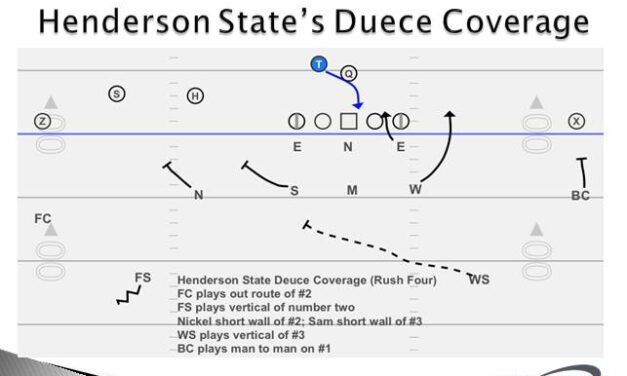
Henderson State University finished third in the country among Division II schools with 29 interceptions and did so by teaching their secondary to read the eyes of the quarterback even in zone concepts. They play their corners in the off position at eight yards and read the quarterback to determine run or pass. According to co-defensive coordinator Jeff McInerney, it’s a concept he learned from TCU’s head Coach Gary Patterson that has made a world of difference in them breaking to the ball. “Yeah, it can be scary,” he told us. “But if you do it right, you will confuse him and more importantly bait him into making a poor throw.” Henderson State is a 3-4 outfit that will rush an additional fourth defender at times. They play split field, matchup zone coverage structures, but will choose to play with at least two deep safeties to limit the vertical gains. “We will rally and tackle,” said Coach McInerney.

Read More

How Coaches Are Addressing the 4 Most Common Errors in Tackling

By Mike Kuchar
Senior Research Manager
X&O Labs
Twitter: @MikekKuchar

Last month, X&O Labs researched the most common issues in missed tackles (scroll down to more this special report). Because let’s face it: regardless of what level you coach or what offense you’re defending, we all face the same issues in missed tackles. What we found is that many coaches are devising a tackling system, not a series of drills, tailor made to address each of their tackling needs. Our research dictated the following four most common issues in missed tackles:

  • Improper body placement in open field tackling situations
  • Losing one-on-one leverage (or tracking) points on the ball carrier
  • Losing multiple defender leverage points on the ball carrier, or what is commonly referred to as “keeping the cup”
  • Lunge tackling or leaving feet in strike phase

These issues are best illustrated in the video below, submitted to us by Temple University:

Read More