
Sprint Out Game in the Run and Shoot Offense

By Justin Clark
Offensive Coordinator
Ridgeview High School (SC)
Twitter: @JustinYClark

Introduction

One of the greatest offenses ever created was the Run and Shoot offense by Glen “Tiger” Ellison. Over the years you see coaches like Mouse Davis, John Jenkins, and June Jones take this offense to the next level. One of the critiques of this offense is that it doesn’t work at the high school level because we do not have the time to dedicate to making this system work. People also suggest that it is too complicated for high school players to understand all the route conversions that we use in the “shoot.” I tell them that the proof is in the stats. In eight years running this system, we have averaged 2,279.75 yards per season and 27 TDs per season.

Coaching the run and shoot gives defenses problems, even in the modern era of zone blitzes and bracket coverages. When people hear that we are a “shoot” team, I always get people asking about the core concepts that we run (examples: Go, Choice, Read, Hook, Slide). However, I am quick to remind them that moving the pocket with our sprint game is a vital part of our offense that often times gets overlooked. Our Follow concept has been particularly successful in our sprint out game recently and that is what I will focus on for this report.

Dash Protection

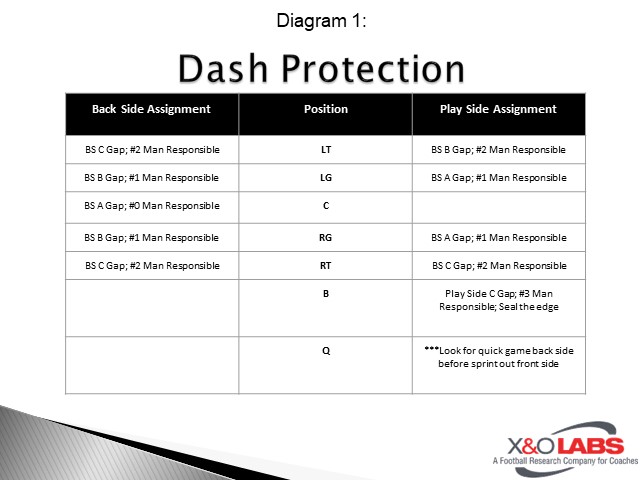
While we have three different sprint protections, this article will focus on the “dash” protection. I like using a Dash protection because it allows us to have a quick game route built in as an easy access throw to the single wide receiver into the boundary. If it is there take pre-snap, we expect the QB to take it right away. If it is cloudy, the Quarterback then will get into his sprint progression.

Dash Protection Rules
Slide1

The rules for the offensive line are very simple. We tell them to run outside zone away and do not go downfield. If we call Dash Lt, the offensive line will block outside zone right and if we call Dash Rt, the offensive line block outside zone left.

The RB knows that in our Dash protection, that he is not gaining the edge as fast as our other two sprints. What we ask our back to do is to act like he is blocking our drop back protection and give the edge defender grass to the inside. We want have the defender go inside so our back to pin/seal the edge for the quarterback in the event that he sprints to that side.

Dash Follow Concept
Slide1

Slide3Slide3Slide3

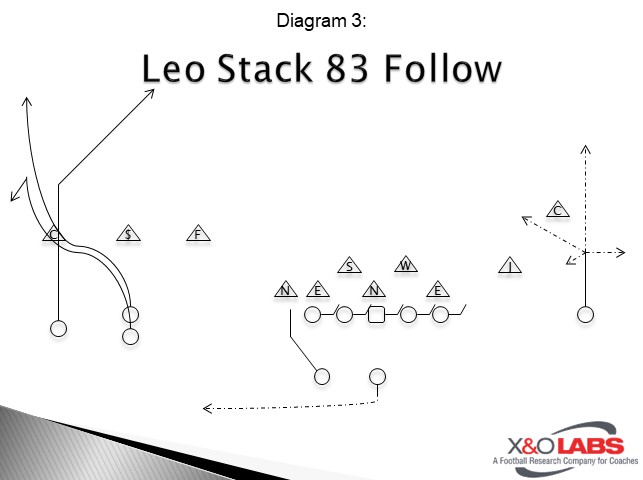
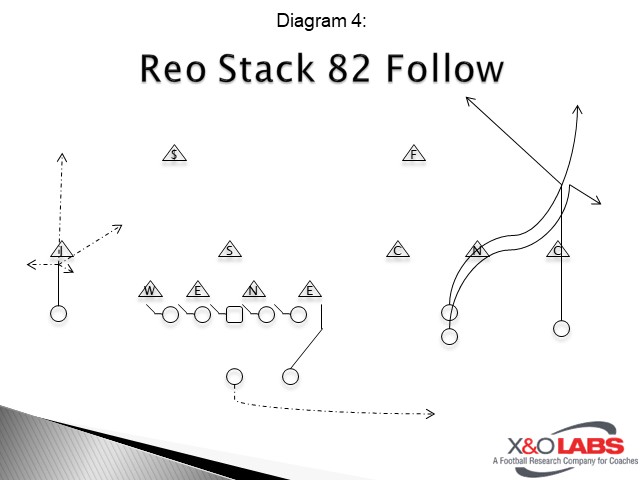
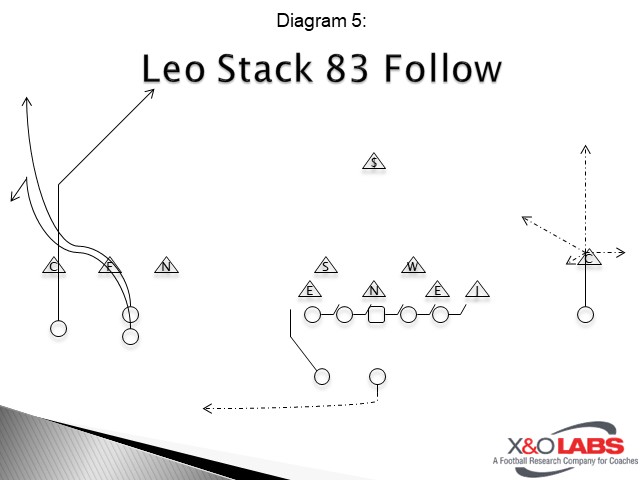
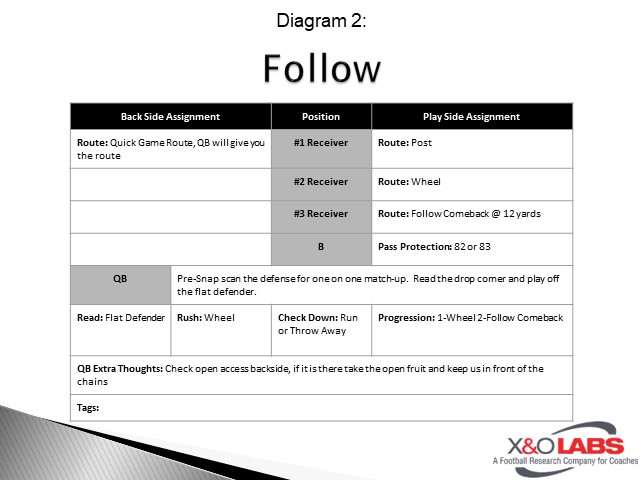
Everyone we play will run a version of sprint flood. We see Flood like (Go, Flat/Bubble, Corner/Bench), Flood like (Curl, Wheel, Flat), or Flood like (Curl, Corner, Flat). We created our Follow concept because we were getting a lot of bracket and man coverages. We needed a sprint concept that was a little different than what other teams ran and were not used to seeing. This was so that those defenses would have to devote extra time to defending the concept. In doing so, we came up with Follow and it has been a great change up when we want to move the pocket and get a deep to intermediate throw. We love throwing this concept against teams that like to play some sort of bracket or man against our trips packages.

Coaching Points

The big thing for us in our Follow package is having the post WR get the attention of the near safety and take the top off of the coverage. He doesn’t know right off that he is used mainly as a decoy but after running the route they tend to recognize that. You must get that player to recognize the importance of what the post does for this play.

Read More

Defending Trips and Quads Out of 4-2-5

By Garrett Schmidt
Defensive Coordinator/DBs Coach
Huron High School (SD)
Twitter: @CoachSchmidt17


Introduction

Today’s offenses are all about spreading defenses out so they become unsound in the running game. In response, our coaching staff had to figure out a way to defend Trips/Quad sets while still keeping our defense sound up front. We are able to do that, partly due to being a 4-2-5 team, by allowing our Mike and Will LBs to remain in the box at all times; even against Quad sets. First, we want to first take away the run game with our alignment. Secondly, we want to take away any bubble/flat routes. When teams take their number one receiver and put him on an island, we can leave our best corner on an island with their best receiver or give him help over the top if we need to.

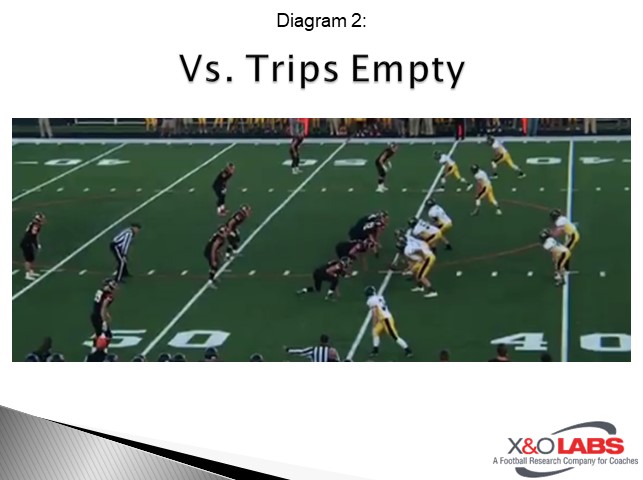
Defensive Backs Alignment vs. Trips/Empty

Slide1Slide1

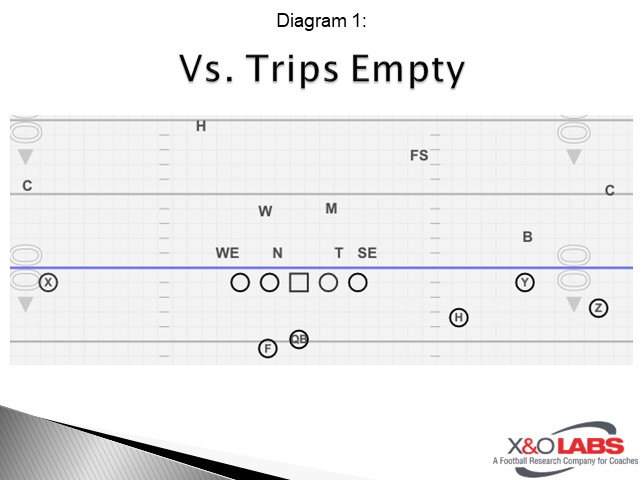
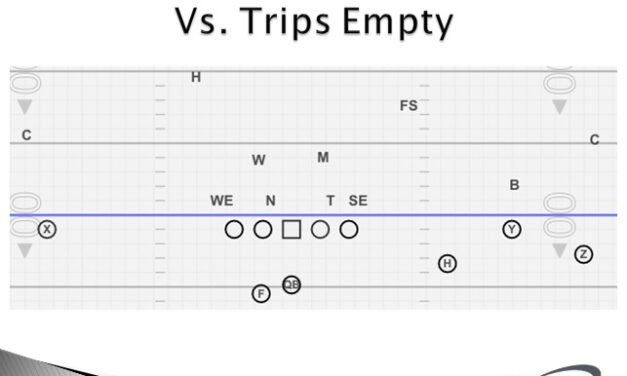
Against Trips or Empty sets, we run like to run cover 6. For us, that means that we are running cover 4 on the passing strength side and on the weak side we are running Cover 2. This year, we also experimented with a read cover 2 and had some success on the back side with that concept. The main difference in this is if the #1 receiver goes deep (X in diagram 1). If he does, then the corner goes with him and the hybrid will then get deeper and play as a deep safety reading the entire field. In that situation, the FS needs to be aware of the #2 receiver in the coverage, which is most likely a back coming out of the backfield. Everybody still maintains their same run fits against Trips/Empty and the hybrid has weak side force and bandit has strong side force.

Coaching Points

  • The weak side cornerback must maintain outside leverage on #1 receiver and is looking for any routes coming his way from the running back or #2 receiver. If #1 receiver goes deep then he goes with him and the Hybrid will look for anything out of the backfield or any crossing routes.
  • Hybrid needs to get depth, we have him align at 10-12 yards, so he can see the entire field and get overtop of #1 if need be.

Defensive Backs Alignment v. Quads

Read More

Managing Off-Season Communications and Scheduling

By X&O Labs
Twitter: @XandOLabs 


Over the past couple of years we’ve highlighted the many ways MaxOne is striving to make football coaches’ lives easier and become more effective coaches.  

From being an all-in-one communication system for your entire program, to managing your program’s multi-layered schedules and calendars, to sport specific workouts that track results of individual players—MaxOne has given many of our readers an organizational advantage during the off-season.  

In fact, we’ve profiled many of our readers who use MaxOne in their programs and, as many of you will remember, we also conducted an RPO Summer School Course, highlighted how Communication Drives a Winning Culture, and co-developed the best practices for summer. 

With the off-season upon us, we’re excited to bring you the latest update from MaxOne. The MaxOne athlete facing Apple and Android app is complete and ready for your athletes and parents to download! 

Read More

21 Hour Football Program – Case 1: Creating a Culture of Participation Growth

By Mike Kuchar
Senior Research Manager
X&O Labs
Twitter: @MikekKuchar


Introduction: Defining the 21-Hour High School Football Program


The game of football is changing—and so is the rest of the world.

Pick up a newspaper—or check Facebook—and you’ll see all the latest reports about how participation in football is in decline. Outsiders cite concussions and injuries as the main driver of this trend, while coaches point to sport specialization as the real cause. As football researchers, we set out to better understand the real “why” behind the decline—and bring solutions back to the industry that could grow the game.

That was 18 months ago—and what we actually found during our research was far greater than what we had hoped to discover.

Just like any problem in football, there are thousands of coaches who face the same issue. And within those thousands of coaches, there are true innovators who see these problems as opportunities—opportunities to absolutely crush the ‘roadblock’ and build something bigger and better.

Yes—we found solutions to these problems. Real solutions that can grow the game of football. That was not surprising being we have a network of over 60,000 football coaches—most of which are at the high school level.

The truly exciting development we discovered through our research was a small group of coaches who are re-building their programs to achieve higher levels of success in an ever-changing culture, society and world—and, here’s the fun part, they’re winning more games!

In this book, you’ll learn how these programs are growing participation numbers, building strong partnerships with administrations, parents, the community—and inning more games!

How are they doing it?

Simple. It’s a new shift in thinking. These coaches are spending more time developing their programs to win in the 21 hours before and after practice. Don’t get us wrong—practice is a very critical part of building a successful program, but these high school coaches have found to truly reach the peak levels of success, you have to win in the hallways, administration offices, parents’ living rooms, and down on main street.

Is it easy? No, but neither is winning.

It doesn’t matter how well your program is functioning right now. It doesn’t matter if you’re barely holding on or you’ve just won consecutive state championships—use the ideas in this book to re-build your program into one that can face all the headwinds that our ever-changing world will throw at it—and, here’s the fun part, win more games!

Here is what you are going to find in this exclusive Special Report. (Note: Links for each case are provided at the end of this page.)

Case 1: Creating a Culture of Participation Growth

  • Chapter 1: “Having an Anticipatory, Not Reactionary Mindset”
  • Chapter 2: Retaining Freshmen Football Players
  • Chapter 3: Combating Sports Specialization
  • Chapter 4: Winning Over the Moms
  • Chapter 5: Team Building: Developing the “Family Dynamic” of a Football Program

Case 2: The Movement to Make the Game Safer

  • Chapter 1: The Reality Behind the Perceived Concussion Problem in High School Football
  • Chapter 2: Educating Parents on Current Safety Advancements
  • Chapter 3: New Practice Methodologies That Are Less Taxing on Players
  • Chapter 4: Products That Promote Safety

Case 3: Developing Staff & Community Buy-In

  • Chapter 1: Protocols of Staff Development
  • Chapter 2: Protocols for Coaches That Work Out of District
  • Chapter 3: Community Outreach
  • Chapter 4: Reflections on Football in the Community

Case 4: Who Are You? The First Step to Building a Program

Case 5: Build Accountability by “Vesting” Players

Case 6: 3-Step Plan to Develop an “Uncommon” Program Identity


Chapter 1: Stilmulating Participation and Program Growth

Read More

21 Hour Football Program – Case 2: The Movement to Make the Game Safer

By Mike Kuchar
Senior Research Manager
X&O Labs
Twitter: @MikekKuchar


Chapter 1: The “Reality” Behind the Perceived Concussion Problem in High School Football


Introduction

Coaches know that the game of football has never been safer. But we also know that it’s never been harder to coach. It’s no longer the on-field endeavors that consume us. That’s become the easy part. These days our time is torn between taking CPR/first aid certification, heat acclimation courses and becoming versed on concussion protocols. But do the parents know how well versed we’ve become in these issues? We can’t assume they do. So it becomes necessary for us to tell them. While some coaches use a single spring parents meeting to do so, other chose to develop a consistent, streamlined method as a form of constant communication. As Bedford High School (VA) head coach Chris Watts told us, “Coaches are doing a great job of protecting their players, but a poor job of protecting their sports’ reputation.  Parents need to hear about the measures that coaches are taking to keep players safe, and it’s just not happening.”

So what do you say? How do you communicate the vision of your program? Before we detail how successful coaches educate parents on how their program is promoting safety, we wanted to provide the hard facts behind why football is safer than ever.  We wanted to profile two recent studies related to this topic as well as provide tangible evidence from world-renowned neurosurgeons on this topic.

“No Association Between Playing High School Football and Brain Injuries”

Source: JAMA Neurology, July 3rd, 2017

According to a report published in JAMA Neurology on July 3rd, there is no statistically or clinically significant harmful association between playing football in high school and increased cognitive impairment or depression later in life. The study was designed to estimate the association of playing high school football with cognitive impairment and depression at the age of 65. A representative sample of male high school students who graduated from high school in Wisconsin in 1957 was studied. In this cohort study using data from the Wisconsin Longitudinal Study, football players were matched between March 1 and July 1, 2017, with controls along several baseline covariates such as adolescent IQ, family background, and educational level. For robustness, three versions of the control condition were considered: all controls, those who played a non-collision sport, and those who did not play any sport.

Among the 3,904 men in the study, after matching and model-based covariate adjustment, compared with each control condition, there was no statistically significant harmful association of playing football with a reduced composite cognition score. After adjustment for multiple testing, playing football did not have a significant adverse association with any of the secondary outcomes, such as the likelihood of heavy alcohol use at 65 years of age.

According to the report, “For men who attended high school in the late 1950s, playing high school football did not appear to be a major risk factor for later-life cognitive impairment or depression. For current athletes, this study provides information on the risk of playing sports today that have a similar head trauma exposure risk as high school football played in the 1950’s. Cognitive and depression outcomes later in life were found to be similar for high school football players and their nonplaying counterparts from mid-1950s in Wisconsin. The risks of playing football today might be different than in the 1950’s, but for current athletes, this study provides information on the risk of playing sports today that have a similar risk of head trauma as high school football played in the 1950’s.”

The full-length report on this can be read by clicking here.

“Female Soccer Players Suffer the Most Concussions in High School Sports”

Source: American Academy of Orthopedic Surgeons, March 14, 2017

It is also a known fact that girls suffer more concussions than boys when competing in high school sports per participation rates. Girls soccer in particular is the most dangerous sport for head trauma, according to a newly released study by the American Academy of Orthopedic Surgeons. Three researchers studied data from 100 American high schools spread across 11 years to track the number of concussions reported against all other injury types. Overall, the researchers counted 6,399 concussions against 40,843 total injuries, with girls suffering a “significantly higher” rate of concussions than boys and girls’ soccer standing out as the single most common sport for head trauma. “The study authors hypothesize that girls may face a greater risk of concussions and other injuries in soccer due to a lack of protective gear, an emphasis on in-game contact and the practice of ‘headers’—hitting the ball with your head,” the study reads.

“While American football has been both scientifically and colloquially associated with the highest concussion rates, our study found that girls, and especially those who play soccer, may face a higher risk,” said lead author and Northwestern University Feinberg School of Medicine orthopedics professor Dr. Wellington Hsu. “The new knowledge presented in this study can lead to policy and prevention measures to potentially halt these trends.”

Read More

21 Hour Football Program – Case 3: Developing Staff and Community “Buy-In”

By Mike Kuchar
Senior Research Manager
X&O Labs
Twitter: @MikekKuchar


Chapter 1: Protocols of Staff Development


Culture starts at the top. It’s instituted by the head coach, then trickles down to the players. But the key liaison between the players and the head coach are the assistant coaches. They are the ones that need to carry the philosophy forward. If they are all in-line, the chances of success improve. If they are providing mixed messages, the program can falter, and falter quickly. We all know this as coaches. But as a head coach, how do you get them in line with your beliefs? How do you get them to “buy in” to what you’re selling? In the ever-transient high school coaching world, many times assistant coaches are leaving to take administrative jobs, spend more time with their family or decide to part ways with the sport altogether.

So, we decided to research how coaches retain their staff after they build it and asked the tough questions like, is it even important to retain the staff? One thing we did find is that 76 percent of coaches that won at least 50 percent of their games the last three seasons said they’ve had zero or one coach leave the program each year.

We wanted to research how these successful coaches were retaining their staff year after year. Because let’s face it, familiarity does breed success. Once players get to know the staff, and those faces don’t change, a culture of comfort and trust will ensue. “Many coaches, one message” is what we call it. What we found that two components were key in keeping coaches: involvement and accountability.

Involvement in aspects of the program, aside from just the physical domain and accountability to affirm that there is a constant give and take between the staff and players. In order to validate our research, we asked one question to these coaches:

How, specifically, have you given your assistant coaches accountability (either on or off the field) in the development of your program?

Their responses are below:

Tom Wilson, Head Football Coach, Dowling Catholic High School (IA):

“My coaches have a say in many of the things we do. To list a few:

  • “Position groups
  • Social media promotion
  • Involved in setting the culture and teachings of our program.
  • Senior book read
  • Newsletter
  • Share weight room responsibility
  • Share speed work responsibility”

Mike O’Donnell, Head Football Coach, Archbishop Stepinac High School (NY):

“Our assistant coaches are very involved in every aspect of program. We use them in game planning and in scouting. We use a no huddle offense so numerous coaches are involved in getting signals in and are not just standing around on sidelines. We have an offensive coordinator and defensive coordinator who I trust to call the games. We have another coach who is fully in charge of special teams. By setting up this system, our kids really get coached and are ready to move on to college level.

Our practice plan is one that has a 5-minute clock on each session. It keeps the kids attention. It forces coaches to be organized when going onto field.”

Rodney Saulsberry, Head Football Coach, Whitehaven High School (TN):

“75% of my staff are alumni of the program, so they have a vested interest in our development of young men. Also, I believe in coaching my coaches and giving them responsibilities and freedom to lead their position groups and units on offense, defense and special teams.”

Denny Diduch, Head Football Coach, Forreston High School (IL):

“My coaches all have position responsibilities that they are responsible for devising the drills to master technique at their positions. All coaches have access to Sunday prep meetings where they can voice concerns, ideas, etc. We open every game with a 12-play script that influences how we run practice all week. After week three, the assistant coaches come up with the script. All coaches are given specific roles and assignments that they are in charge of and can develop their own strategies to improve. On game nights, coaches are given a specific position to watch on both sides of the ball. They are then to report what they see to the OC/DC. Coaches are encouraged to continue presenting new ideas and strategies no matter how many times they get shot down.”

Coach/Player Mentor Programs:

While some assistant coaches responsibilities are relegated to on-field roles, other programs implement off-field mentorship models to develop the player/coach relationship. While this is not uncommon for college programs, where coaches are full time employees, organizing this at the high school level takes some coordination and follow through. For Ken Leonard, the Head Football Coach at Sacred Heart Griffin High School (IL) it became a necessity to implement these programs. He designed it two years ago, where each coach is assigned to 5-6 athletes. They will meet with each of them for only five minutes per week to discuss anything that is happening in their lives. “We are a private catholic school,” Coach Leonard told us. “We mentor and make players as great husbands and people. A coach has more influence in one year than anyone else has in his or her whole lives. Parents send their kids here for a purpose and it’s because of football. Our things carry over from the field. We needed to do more than just character development.”

The way the

Read More

21 Hour Football Program – Case 4: The First Step to Building a Program

By Brian Hill
Head Football Coach
Garden City High School (KS)
Twitter: @coachbhill


Introduction:

Eight years ago I had the privilege to receive my first opportunity to be a Head Football Coach at Garden City High School (KS). Garden City, KS sits in the Southwest corner of Kansas, 70 miles from the Colorado border and 75 miles from the Oklahoma border. We participate in the largest classification in Kansas (6A). We are one of 32 teams in our classification and 30 of them are at least 200 miles away from us. The majority of the teams in our classification are in or around the Wichita and Kansas City areas. I had spent the previous 15 years coaching in the Kansas Junior College system as an assistant. This coaching experience provided opportunities to visit and watch from afar how successful Kansas high school coaches ran and developed their programs.

During the decade of the 1990’s were the best years that Garden City High School had ever had, winning 70% of their games and the State Championship in 1999. Then with the departure of the coach and an ever-changing world, Garden City went through many changes within our community. The next decade would see a shift in the economy and change of demographics. During the 2016 school year at Garden City High School, there were 22 languages spoken by students from 25 different nations. Over 30% of our students are English Language Learners and 65% of our population is considered economically disadvantaged. Our enrollment during the 2016 school year was 68% Hispanic, 23% white and 9% other. Eight years ago, when I got the job I was told that it was going to be difficult to compete in such a large classification with a small pool of athletes to choose from compared to many other schools our size. Our isolation in far western Kansas was also going to be a challenge as school funding in our state has become a major factor and fewer and fewer schools have the funds to travel to fill our schedule. I heard a lot of reasons why I shouldn’t be successful but no one was looking for solutions to lessen the impact of these factors. 

The first action step was to sit down with my assistant coaches and have them tell me all the reasons in their opinion why we weren’t being successful and what the other schools had that we didn’t. I took notes and typed up every single reason and began looking for ways to compensate for them. As many of the great athletes and coaches have said, it was time to turn negatives into positives. Since that spring in 2010 we have won 65% of our games, won three conference championships and made it to the 6A state semi-finals where we lost to the eventual champions. This past season we completed the first undefeated regular season in 25 years. Below are four areas that are not uncommon practices to turn a program around, but maybe unorthodox methods to achieve them.

Family Culture:

First and foremost, all good coaches know that they can’t do it alone and hiring a quality staff is critical. I wanted to find guys who wanted to be here because not everyone wants to live and raise a family in Garden City, Kansas. Secondly, I wanted guys I can trust and share the same passion and vision as I did. I was very fortunate that when I took the job here there were two assistants that I had coached in junior college already on staff, which made for an easier transition because they knew me and my personality. Going into this fall, I now will have 7 of my 11 assistants at the high school level that are guys that I have coached at some point in my career. I think it is critical with today’s athletes to present a coach to them that they can relate to. Fortunately for me, many of the former players that I have hired are former college athletes as well. Young coaches with energy and the experience of being in their shoes provide a great platform for high school athletes.

The second most important part of creating a family culture with so many kids with different backgrounds is team building activities. With so many of my kids that don’t get many family vacations or opportunities to see the bright lights of big cities, we try to take advantage of every opportunity we can to provide that experience. For example, one summer while we attended a team camp in Oklahoma, we took a tour of the athletic facilities at Oklahoma State University on the way home, even though it was slightly out of the way. Most of my kids have never been on a Division I school campus, nor will ever get much of an opportunity to play at that level. Getting to walk thru the locker room, onto the field and thru meeting rooms allow them to dream a little bit which creates possibilities in their minds. We have also attended Major League baseball games, gone to water parks and even played paintball on our camp trips. These create great opportunities for players and coaches to get to know one another on a more personable level, rather than just the traditional coach-player relationship on the football field. We take the time to discuss issues about how and why it is important to becoming leaders on our team, in our school, and in our community. The relationships our coaches have with our players feed into all areas of their lives on and off the field. They provide the leadership and discipline in a young athlete’s life to help set them up for success in the future.

Read More

21 Hour Football Program – Case 5: Build Accountability by “Vesting” Players

By Kyle McKenna
Head Football Coach
Brooklyn Technical High School, Brooklyn, NY
Twitter: @CoachMcKenna


Introduction

In 2012, in an effort to create a measurable way to track accountability, Brooklyn Tech Football began the Vesting Program. It was very important to us to increase football intelligence and emotional intelligence during the upcoming offseason because we thought we had lacked both in the previous post-season. We wanted to know, with certainty, who we could count on to be an “all-in” player, especially when things were tough. We knew our team would be one of our most talented in years and wanted to prepare them for both the adversity and the success of the next season. 

The time period we had to implement the program was six months during the off-season, ranging from January through June. We wanted to have one or more milestones along the way, to re-evaluate and measure the success of the program. This would also serve to break up the monotony of the off-season by giving players incentives to put in maximum effort and improve. Our team lifts on Monday, Wednesday and Friday in the afternoon and has twenty days for spring football practice (non-contact) in May. We are also a very rigorous academic school, so time must be allotted for tutoring. 

The original program we created was influenced by similar programs at Temple University under Head Coach Al Golden and Wagner College under Walt Hamline. In 2011, Coach Golden had been sharing his Temple TUFF program in off-season clinics. Coach Golden’s program held the individual accountable and made sure the group working towards climbing the levels of commitment. Coach Hamline’s system divided the program into teams that competed against each other in the off-season and were graded on every drill in their winter workouts. We looked to combine these two approaches into what would become our Vesting Program and subsequent off-season competition. 

In our program, players that were “vested” would receive patches to be displayed on their jerseys. The idea came from my pension as a teacher and the concept that you had to work for ten years in order to be vested in the system. The idea for the patches came from the tv show Sons of Anarchy; to be a member of their crew, you had to be a prospect and earn your cut. Only then were you “patched” in.

vested

Application

We believe that what gets measured, gets managed, so we set out to construct a quantifiable way to measure whether a student-athlete could be trusted to come to work and give maximum effort each day. We decided to use hours as our main unit of measurement and set a minimum requirement for being on the team. We also wanted to have components that measured academic progress and service. Within the program, we also wanted to have leadership training, fundraising, investment in program administration and participation in the Parent’s club. What we came up with focused on the individual by requiring that each player complete 60 hours in the weight room by April 1st. In addition, each player had to complete four hours of community service, two hours of program service, and 12 hours of film study on Hudl. Also, the players needed to arrive on time to school, maintain academic accountability and disciplinary accountability. On March 31, they would apply for Vesting with proof of all requirements. At that time, our leadership council would review all applications and refer them for vesting, vesting probation, or removal from the team.

Read More

21 Hour Football Program – Case 6: 3-Step Plan to Develop an “Uncommon” Program Identity

By Luke Mertens
Head Coach
Lake Zurich High School (IL)

Editor’s Note: This is one of our most popular reports. At the time of writing this report, Coach Mertens was head coach at Lakes Community High School (IL), a position he held since 2005. This 3-step plan helped Mertens build Lakes into a highly competitive program going 72-50 and qualify for the post-season each of the last eight years. In the spring of 2017, Coach Mertens was asked to lead the Lake Zurich High School (IL) program after a hazing incident the previous year. Again, he’s using his 3-step plan to build a special kind of program. In his first season at Lake Zurich, the Bears went 13-1 and were ranked #7 in the state. 

Introduction: 

Being the first and only head football coach in the short history of Lakes Community High School has proven to be one of the most unique experiences in my career. It was my first experience working in a public, co-ed school, and although I thought I had all the answers as a first-time head coach, I was quick to learn that I was not as ready as I had originally thought. For the first couple of years, I did all of the things “good” programs do: year-long lifting program, an extensive summer camp, strict discipline, holding players to high standards – all that I had learned from being a product of Chicago Catholic schools. We had some success with this blueprint, but not enough to satisfy my competitive spirit. I knew something was missing, so I started to really evaluate my program, and I concluded that two vital components were missing: tradition and spirituality. My next challenge became ‘How do I incorporate tradition and spirituality into a new public school?’ 

My first action step was to create an identity for the program that would encapsulate the tradition and spirituality I felt were missing, and Tony Dungy’s book, Uncommon, held the answer. Since adopting that simple word, “Uncommon”, we have qualified for the state playoffs 7 straight years, won 5 consecutive conference championships, and haven’t lost a conference game since 2011. More importantly, we have created a program that teaches our players lessons that they carry with them for years to come. Below are three examples of what we do to make our program “Uncommon.” 

1. Don’t Make It About Football 

I knew that if my players were to believe in “Uncommon” we would need to create something that was not ordinary – something that would not be found in other programs. Consequently, I authored a book that teaches our players not about football, but rather how and why being uncommon will help them to be successful in life. 

The book I created is broken up into chapters, such as Attitude and Effort, Confidence, Discipline, Excellent Character, Failure, I in Win, Leadership, No Excuses-No Explanations, Passion, Preparation, Pressure, Together, and Vision. In addition to my own thoughts, each chapter has quotes, anecdotes, interactive questions, and even poetry. Starting in the off-season and continuing through the end of the season, we are teaching our players what it means to be “Uncommon”. 

In the off-season, we typically cover one lesson per month. During summer camp, we will move to bi-weekly lessons, and once the season begins, we meet with our players twice per week. How each lesson is presented varies too greatly to adequately cover, so I will only describe what we typically do in-season; however, what we do works for us. Each year I survey my seniors, and they always talk about the impact of the lessons. It is what they remember most, which is a very telling sign. Their comments never focus on wins/losses, play calling, etc. but always on how we are teaching them to be uncommon. 

By the time the season starts, our players have a solid understanding of what being uncommon means, so I then have them take ownership of the weekly lessons. They are assigned to groups, an assistant coach volunteers to be the moderator, and that group presents a chapter of their choice on game day. Earlier in the week, I will have introduced the weekly theme, but other than that, I purposely do not give any instructions or parameters for their presentations. I want them to sculpt it to their vision, and they usually exceed my expectations. Their presentations have included movie clips, musical lyrics, PowerPoints, and even very personal background stories related to their topic. I LOVE Friday nights, not due to the game, but rather to see what the groups have prepared. 

Following their presentations, we break into small, coach-led groups to further discuss. I give my assistants complete autonomy on how to run their small groups. Some coaches will have players share their answers to the discussion questions in the book, while others just let the conversation go wherever it leads. Either way, both the coaches and players enjoy this time together. It really unites and allows us to truly understand each other. After the small group discussions, we meet as a whole team to view highlights from the previous game. Although the creation of the weekly highlights is an onerous task, it is well worth the time. Each video contains cutups, pictures, heart-pounding music, along with embedded messages highlighting the week’s topic. Players really enjoy watching themselves performing at high levels from previous games, and the entire organization exits the meeting feeling confident and ready for the next opponent. 

Read More

Defending RPOs with Split Coverage Out of the 3-4

By Isaac Sturgis
Defensive Coordinator and Linebacker Coach
Guerin Catholic High School (IN)
Twitter: @IsaacSturgis

Introduction

We play in a very competitive conference with four teams playing for state championships in the past three years (Roncalli High School, Brebeuf Jesuit High School, Lafayette Central Catholic High School, and Indianapolis Chatard). All of these teams use RPOs as a significant part of their offense so we have been forced to come up with answers to compete with these powerhouse programs.

This report is going to explain how we combat RPOs from our slant angle 3-4 using split coverages. I will primarily outline the concept that we use to defend 2×2 formations especially if the back is in the pistol. Later, I will get into a few different concepts to defend 3×1 RPOs that I will briefly touch upon.

Game Planning for RPOs

Before I get into our concepts, I think it is important to understand how we scout these types of teams. The very first thing I do is run the following reports on HUDL. Note that some of these reports are custom, while others are the HUDL templates.

  1. Down and distance
  2. Field zone
  3. Formation
  4. Motion
  5. Offensive play (top plays)
  6. Offensive play by backfield
  7. Offensive play by down and distance
  8. Offensive play by down and distance and personnel
  9. Offensive play by offensive formation
  10. Offensive play by option choice (3 step, 5 step, play action pass, screen, draw, sprint out, play action rollout, give, keep, pitch)
  11. Passing Zone
  12. Summary

With these reports in hand, I then look for the following things in the data (in no particular order):

  1. Are they spreading teams out to run or are they spreading teams out to pass? If the answer is run, then we will play more cover 3 or some variation of it. If they are spreading us out to pass, then we will play more cover 2 or some form of it.
  2. Is their QB a running threat or a passing threat? I like to have two defenders (an inside player and an outside player) for every option in the run game. My inside player on the dive is the chase OLB and my outside player on the dive is the back side LB. My inside player on the QB is the play side ILB and the outside player of the QB is the OLB.
  3. Who is their RPO Guy? Do they target one receiver more in the RPO game then others? Most of the time, it’s the slot or the flanker to the side of the back. Once it is determined, I look to see how I can get him doubled if possible. This could be by using an over the top safety in Cover 2 or an underneath LB and an over the top corner in Cover 3.
  4. Who do I have to stop? The RB, the QB, or the receiver? With that information in hand, the Front/Veer/Coverage are dictated on that answer.
  5. Run Game or Play Action? We like to determine whether their inside/outside run game or their play action pass off of those scheme is most dangerous.
  6. What formations do they use most to run their RPOs? 2×1, 2×2, or 3×1? Against 2×2 looks, I really like split coverage. Against 3×1, I like Cover 2 or 3 cloud. Against 2×1, I like both Cover 2, Cover 3, and or Cloud.
  7. In their 3×1 formations, are they trying to attack the high hole or the deep middle? If so we need to be in more Cover 3 cloud. If not, then play more Cover 2.
  8. In their 3×1 formations is their single WR a stud? If so, we will run less 3 Cloud and more Cover 2.
  9. Is their back offset? If so are we going to veer to the back or away from the back? The answer depends on a lot of variables. Can both of your OLB’s get the job done against the run and the pass? Who do you want defending the WR who is being targeted in the RPO passing game a safety or OLB? If the back is in pistol, you really have to look at field tendencies.
  10. What part of the field are they attacking with their RPOs? If it is the flats or the vertical seams, then Cloud and Cover 2 are good against both. You close the flats with your corner and your OLB and ILB can hang on the seam and you still have over the top help with the safety. 
  11. What other passing concepts do they run out of 2×2 and 3×1 that can hurt your coverage? We chart those concepts and rep them all week in practice. This also helps determine which side is the Cover 2 and which side is the Cover 3 if using split coverage against 2×2.
  12. What do I do if they motion? Our answer is to keep the front the same meaning we never change the veer and which OLB is coming. We only change our coverage and most of the time we just check Cover 3 (3 deep 4 under).
  13. What answers do we have if they start hurting us with the RPO’s or start hurting us in our split coverage? Our answer is to zone blitz with 2 deep 4 under or 3 deep 3 under coverage. We might also sprinkle in some of our 2-ma

Read More

A Seasonal Plan for Off-Season Training

By Noel Piepgrass, MA, CSCS, CiSSN
Assistant Coach
Exeter High School (CA)
Twitter: @noelpiepgrass, @OmniStrong


Introduction

As sad as it can be to have your hopes of a championship season end in disappointment, the start of the off-season brings with it a new-found optimism for the season to come. If you’re anything like me you spend December and January evaluating where you are weak and what you need to do to improve for next year. You set up your spring clinic schedule, your off-season team calendar, and you start to think about what to do with your off-season strength and conditioning regimen. 

It is that last component, the strength and conditioning regimen, that I have been commissioned to write about in this article. The particular area that I want to focus on is how to create a comprehensive plan for your off-season training.  After a decade of work as a high school strength coach, teacher, and on-field coach, I have learned a thing or two and I’m excited to see if I can offer any help. 

Mapping Out the Calendar

The first task of creating a comprehensive strength and conditioning regimen is mapping out the different phases of the year. It’s a little different for everybody but here’s how I do it. 

Winter

Essentially, this is the time from the end of our last game up to Christmas break. Depending on how deep you’ve gone in the playoffs, this can be anywhere from 2-6 weeks. During this time, I have always focused on testing, recovery, and informal training. 

Testing 1 Rep Maxes (1RM’s) in the Hang Power Clean, Squat, Bench, and Deadlift is important to see how strength has developed or diminished during the in-season period. However, we have also always assessed performance skills like Vertical Jump, 5-10-5 Shuttle, and either the 10 or 40 yard dash depending on weather and our ability to get outside. Not only are these great for getting a beginning of the off-season baseline, but they are competitive, and tend to build camaraderie as your student-athletes compete against and cheer for one another. 

Once you’ve got testing completed, if there is still time before Christmas break, you can begin some sort of informal training. I’ve used timed body weight circuits, boot camp style training in the stadium, and games like ultimate frisbee, soccer, and touch football during this block of time. My goal is to keep their bodies from completely detraining but also have some fun and do some things that we won’t ever do again. 

Finally, in the winter, you’ve got to give their bodies a chance to recover from the stresses and strains of a long season. Also, I think kids need a mental break from the stress of practicing and performing at a high level. We ask a lot of our kids from May to November and I feel like a little down time during December can go a long way. One of the ways this has always been expressed in my program is by not opening the weight room over Christmas break. I just think it’s important that coaches and players take breaks when they’re allotted and since we’re out of school and it’s supposed to be a time for family and celebration, it’s a perfect time to give the kids some time off. 

Read More

3×1 Counter Trey/Glance RPO

By Nick Coleman
Offensive Coordinator
Itawamba Community College (MS)
Twitter: @QB_CoachColeman

Introduction:

colemanMost RPO concepts involve quick game tags off of the run game. While these can be very effective concepts, we also wanted ways to stretch the field with RPOs as well. The offensive philosophy behind our Trey concept is to make the defense cover the field vertically. This not only gives us a chance at larger chunk plays, but it also serves to control the safeties that are looking to stick their nose into the run game.
Base Concept:

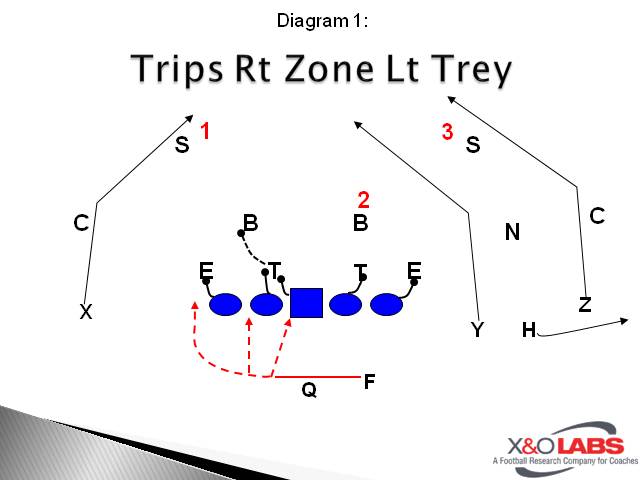
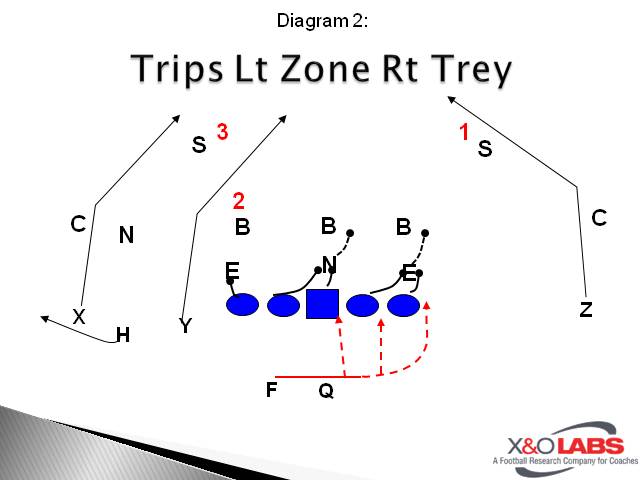
This concept is based out of 3×1 and allows the QB to have five options on any given play. We can run the play both towards and away from trips in this formation. The routes are as follows:

  • The #1 receivers on both sides are running 5 step glance routes on the outside.
  • The #2 receiver in trips runs a bubble route.
  • The #3 receiver in trips is also running a 5 step glance concept in the middle of the field.

While we predominately ran this piece away from the trips this season, there certainly are opportunities to be had running it trips and out of other formations.

We like to pair this concept with our inside zone, power, and outside zone with an RPO action. To modify the play for the RPO, we will use our back side tackle as a “lock player” instead of the full zone concept. This gives our QB more protection to make this throw.

Slide1Slide1

Read More

Lateral Stretch & Swing RPO Concepts

By Jordan Neal
Offensive Coordinator/QB Coach
Hendrix College (AR)
Twitter: @CoachJordanNeal


Introduction:

Lateral space is the name of the game these days and we here at Hendrix have made it a huge focus as we have built this program to a playoff contender. Our RB stretch and the RB swing pass with a read-option while blocking power and GT counter have been staples of our horizontal attack. Here are some advantages of pairing the RB Stretch/Swing Pass with either Power/GT Counter run-action:

  1. Versatile concepts that can be run from multiple personnel groupings and formations. Can also implement fly-sweep motion.
  2. Simple to teach, simple to call, simple to execute, high percentage play, and can be run in a wide variation of downs/distances.
  3. Can build an entire offense around it, and is favorable for teams with inferior athletes/linemen—explosive for teams with superior athletes.
  4. Forces the defense to account for the entire width of the field.
  5. Easy to play-action pass or screen off of it.

Procedure & General Points:

Offensive Line – The first thing you must do as a coach when running these plays is identify what you can block up front most effectively. Our players at Hendrix are proficient with down-block schemes, so we tend to use more Power/Counter with the lateral backfield action more so than inside zone. The overall concept of the play creates false reads and misdirection for LB’s, as well as favorable angles for our offensive line to execute their blocks.

Running Back – Secondly, we get our fastest guy at RB. He either runs stretch or swing based on which side of the QB he is lined up. The RB does not concern himself with what run play has been called. Just go lateral!

Quarterback – Third, we teach the QB to identify his read key and make that player wrong. The QB only has to know what run play is called insomuch as when he does keep the ball, he knows what aiming point he is looking for (in many cases simply find the puller).

Receivers / Tight End – Fourth, we teach our WR’s and TE to ID the most dangerous players in the perimeter space and block them. WR’s and TE are not concerned with what run play is called. Simply get on your block and stay on your block.

Power w/ RB Swing and Stretch

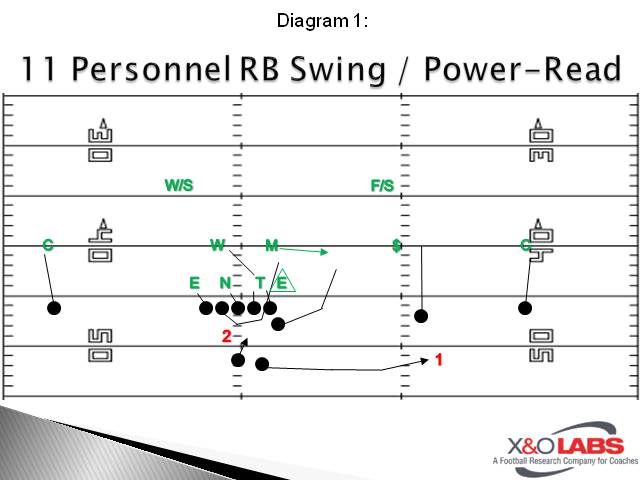
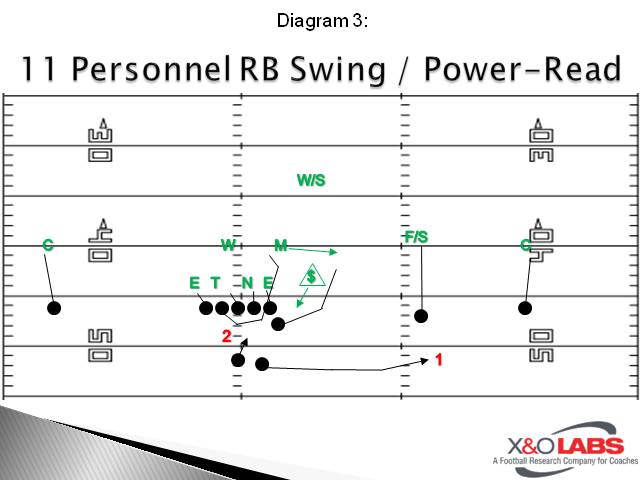
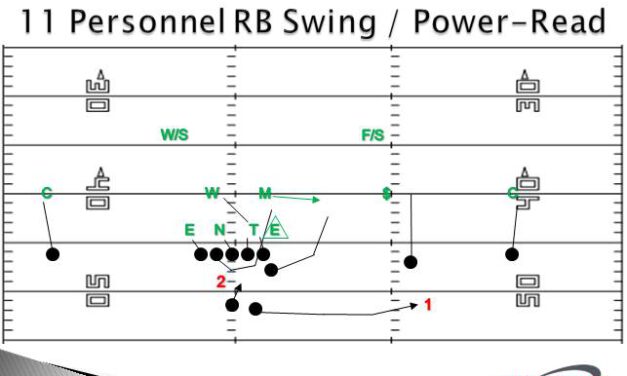
The QB will always read the end man on the line of scrimmage. In this case, versus an even front, the QB reads the DE. If the DE cannot make the play on the RB, the QB swings it out. If the DE goes lateral right now to take the back, the QB keeps it on the power. The receivers identify the most dangerous threat and block leverage. The TE arc releases and works to circle the scraping play-side LB.

Slide1

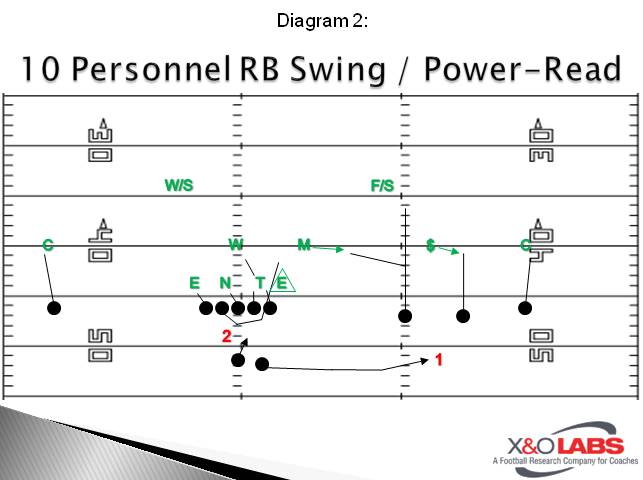
Here it is from 10 personnel. In this case the #3 receiver must determine if the scraping LB or the play-side safety is the most dangerous threat. Typically, the LB is in better position to pursue the swing. Therefore the #3 slot usually ends up with this man in his lap.

Slide1

If we see blitz from an edge player, such as the nickel, the QB must treat him as the end man on the line of scrimmage and read him. If the nickel can reach the RB, then the QB keeps on the run play the same as he would normally, and now the play-side offensive tackle must account for the DE as the new B-Gap player. Sometimes we will see teams line up in a “Bear” front (50 front). The QB simply sticks to his plan of finding the end man on the line of scrimmage and reads him. The offensive line simply makes a “Down! Down!” call and all front-side linemen block down to their inside gap.

Slide3

To study game cutups on this concept, click on the video below:

Read More

Man Free Concepts to Defend RPOs

By Grant Caserta
Defensive Coordinator, Defensive Backs Coach
Husson University (ME)
Twitter: @gcaserta1

Introduction:

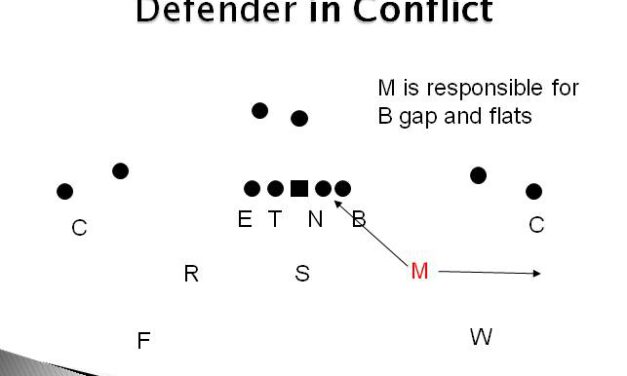
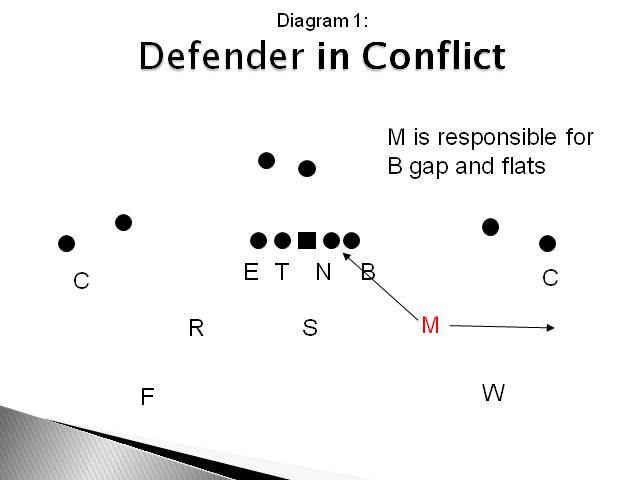
You can always spot a defender in conflict. He is the one sprinting in from the outside to fill his gap on an inside zone play. Only, it’s not a run – the QB pulls it and throws to the perimeter. This defender is now turning and sprinting back to the outside, while his pass responsibility is gaining an easy first down. Run-pass options have been effective in recent years by exploiting defenders that are “in conflict”, or asked to do two jobs. A linebacker that is responsible for both an interior run gap and also an outside passing zone is “in conflict”. He cannot fill his gap and also simultaneously fulfill his pass responsibility. It is one or the other. In the past, defenses could get away with teaching defenders to have a run gap and also a pass zone, because a run was a run, and a pass was a pass. As long as the defender made the proper run-pass read off his initial key, he would get to where he needed to go. However, the RPO has exposed the flaw in having defenders tied into both the run game and the pass game.

Slide1

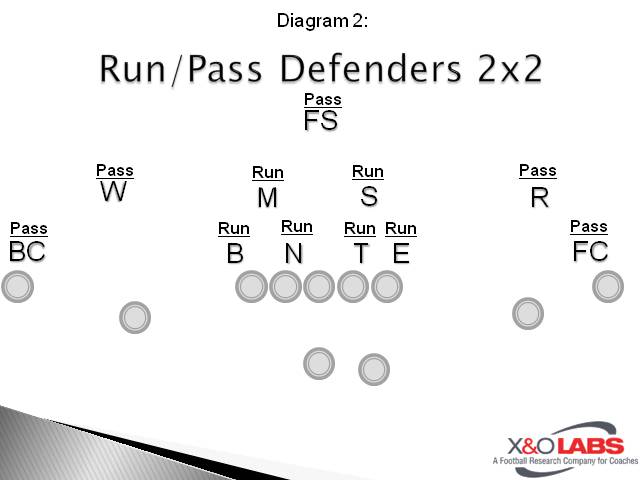
Recently, offenses have taken advantage of defenders in conflict by optioning them. This causes that defender to be wrong no matter what he does. If he stays back for the pass, his run gap is open. If he fills his run gap, his pass zone is vacated. At Husson, we have eliminated conflict in our defenders. Each position on our defense is either a “run first player” or “pass first player”. The four defensive linemen and the two inside linebackers are always run first players. The two corners are always pass first players. The three safeties will be either a run first player or pass first player, depending on the formation.

Slide1

Slide3

By identifying who is responsible for run and who is responsible for pass, we prevent anybody from being in conflict. We will always have all run gaps covered and we will always have all receivers covered down. This system allows our players to aggressively play their responsibility with no conflict. Run defenders can focus on eliminating the run, while pass defenders can focus on stopping the pass. This concept is certainly nothing new or revolutionary that I’ve come up with. Everything I know and teach, I stole from someone else. However, I hope to be able to share some of these things I’ve learned and that you can find them useful as well.  

1 High Coverage Alignments

At Husson, we are geared toward stopping the run. We will deploy six in the box, at a minimum, nearly all the time. With our remaining five defenders, we will go 1 for 1 on any receiving threats (receivers or tight ends). In a 2×2 set, we will have our Free Safety working the middle of the field (MOF). In a 3×1 set, we will have our Free Safety over #3 and our weakside safety, or Whip, working the middle of the field (MOF). This alignment allows us to give a Cover 1 (man free) look at all times. The advantage to a one high safety look is having everyone “covered down” at all times. This is especially useful against RPOs.

Although we have changed alignments in the past, we now align our slot defender (on #2) in outside leverage at five yards depth, keying #2. I believe that if a DB is to be pass first, he should have his eyes there to begin with. Since we have at least six defenders dedicated to the run inside, we do not need the slot defender to have his eyes on the EMOL for a run/pass read. Pass first defenders are late to the run game. We align in outside leverage because we want to force vertical routes inside to our MOF defender.

Our corners will almost always be in press alignment with inside leverage. Press is particularly helpful against RPOs because quick or short passes to #1 are much harder to complete. We align with inside leverage because we want to force vertical routes to the sideline.

Most Commonly Defended RPOs

Although there are many different types, the RPOs that we see the most are what we call “zone read triple”. The interior mechanics of the play involve zone blocking, with the backside end being unblocked (and read by the QB). The outside part of the play usually involves a vertical release by #2 (pop pass, hook, etc) or a bubble by #2 (which could be accompanied by #1 blocking or running a slant). For this article, we will focus on this type of RPO.

Read More

How Mount Union, NDSU and Temple Talk Tackling

By Mike Kuchar
Senior Research Manager
X&O Labs
Twitter: @MikekKuchar

Editor’s Note: The following research was conducted as part of XandOLabs.com special report on “Designing Tackling Systems.”


Introduction

Football is a game of short bursts and shorter words, so in this case we wanted to provide coaches with the specific verbiage our contributors are using to teach tackling. While some of these words may be familiar, there are different ways to say the same thing to your players and a coach never knows which words will stick. We asked our coaches the following question:

Which common buzzwords do you use to teach tackling with your players?

Mount Union University Buzzword Catalog (Chris Kappas, Defensive Coordinator)

“Full Speed as Long as Possible: “We talk about going full speed as long as you can to close out the space (between you and the ball carrier). You can’t give defenders a landmark because it’s a feel thing. It’s not three yards, etc. The goal is to get that near foot shimmy to step on that ball carrier’s toes. You have to break down close enough where he can make moves but you need to be far enough where he can’t run straight through you if you miss the arm tackle.”

Lindenwood University Buzzword Catalog (Jamie Marshall, Defensive Line Coach)- Rugby Style Emphasis

“Tracking the Near Thigh”: “We talk about tracking the near thigh (instead of the near hip) because as you track the ball carrier the near thigh always tells you where the receiver or the ball carrier is going. Your eyes can get lost if it’s up on the hip because that can lead to the belly button. We went to the near thigh. Wherever your eyes are looking your body is going to take you. We talk eyes to the thigh, wrap and squeeze. You can’t look at the hip if you’re asked to contact the thigh.”

“Shoulders Through Thighs”: This pertains to the finish component of the roll tackle where a defender’s shoulders makes contact with the ball carriers thighs.

“Run or Roll”: This pertains to the decision that the defender makes post contact on whether or not to run through the tackle or roll through the tackle.

North Dakota State University Buzzword Catalog (Matt Entz, Defensive Coordinator)

“Hit Up Position”: “We don’t use the phrase coming to balance because I think it brings out some different thought processes for kids. If I just said ‘be careful to keep your balance,’ the general player will widen his feet and drop his center of gravity where his footwork is outside of his frame. Now if that ball carrier changes direction I’m going to have to step underneath myself to recover. What we talk a lot about is getting to a hit up position where my feet are under my armpits.”

“Near Foot, Near Foot”: “We are always attacking the near number or near pec of the ball carrier. We want to make sure we maintain the stagger position on the swoop (inside out) tackle.”

“Finish”: “We want our defenders to have eyes on the ball carrier’s throat with his hands in the holsters and grabbing cloth.”

“Head to Near Pec or Near Number or Near Armpit”: “We never teach having the head across. We tackle with our chest.”

“Keeping the Cup”: “We will have a pursuit player, force player and fill player in the cup always. For example, if we are playing a coverage such as Tampa two with the Mike and the back runs the check down because the Mike is dropping. The Will or Sam work a compression tackle with the Mike linebacker filling the cup. We should have three on one in our tackling situations. They have to understand where my leverage is and where my help can be coming from. They have to know if they are leverage players are spill players.” 

“Suck the Air Out”: Used in open field tackle situations where the defender must close ground (suck air) on the ball carrier.”

“Jump off the Diving Board”: Used as a metaphor when defenders lunch at ball carriers without moving their feet.

Temple University Buzzword Catalog (Linebackers coach Mike Siravo)

“Grab Skin”: Rather then teaching to grab cloth, Coach Siravo teaches his players to grab the skin of the ball carrier to emphasize the clamp in tackling.

“Yell at Your Feet”: This emphasizes the quick feet movement needed after contact on a tackle.


Read More