
Zeeland East Counter Variations and GT Read Play

By Derek Pennington
Head Coach
Zeeland East High School (MI)

Introduction:

Our Counter and Counter Trey (GT) variations represent two of our core gap scheme run concepts at Zeeland East High School. We utilize these two blocking schemes out of a variety of formations and backfield action. In some instances, we attach an RPO to the play to protect the box from second level defenders squeezing the play. Additionally, our GT read concept allows us to block one less defender in the box and also provides significant challenges to second level defenders that have been taught to read pulling lineman. This concept also slows defensive linemen that have been taught to chase pulling linemen down the line of scrimmage. These two schemes have been very successful for us as part of our spread run game and have continued to evolve over the last 8 seasons.

Quarterback GT Concept
Slide1

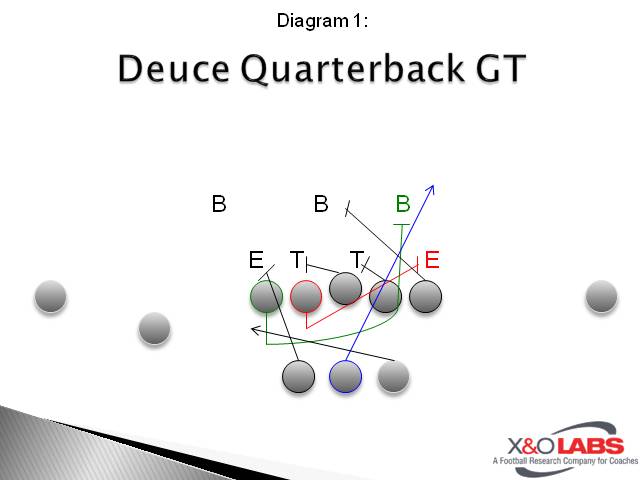
Our Quarterback GT play began as a pre-determined play with no read. Our backfield simply faked our stretch play to provide misdirection and the quarterback ran the ball on an A Gap track behind the pullers.

We have always felt two backs in the backfield allow us to run the ball more effectively and 20 personnel gives us a real advantage with this concept. We have evolved into more h-back sets because this allows us to add a hat wherever we want him to fit in the blocking scheme. We can cross flow him post snap or leave him on the side he aligns giving us more misdirection and, at times, pushing the QB to third in the order of  threats in the backfield.

Deuce GT Read
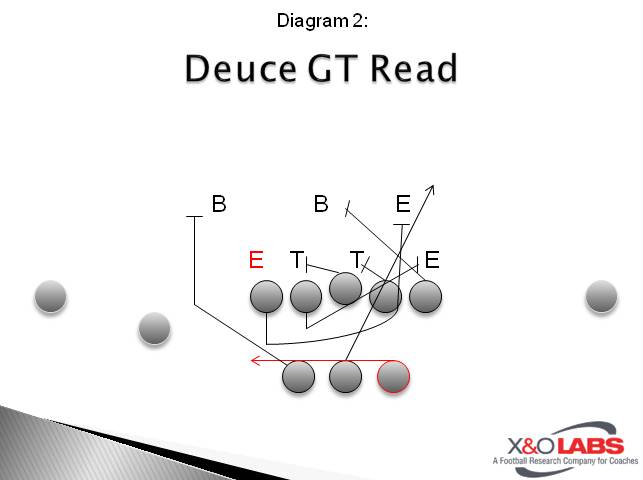
Slide2

Over the past couple seasons, the quarterback GT play evolved into a read play in our offense. This helped combat defensive linemen chasing the pullers and second level defenders keying the pulling lineman. The quarterback reads the backside DE and either hands off the ball to the sweeping running back or carries the ball behind the pulling lineman into the A Gap. We tell the quarterback that he is to give the ball to the back unless the End gets up the field and can tackle the ball carrier. With that rule, any time a defense end squeezes or sits or does the surf technique would result in a give read. This is a quick read and the QB only gets one shuffle to either give or keep. He has limited time as he must stay behind the pulling lineman if he decides to keep the ball. The play has resulted in some big gains over the past couple seasons as it is especially tough on defensive ends that are taught to chase pullers and second level players reading pulling lineman.

H- Back GT Read
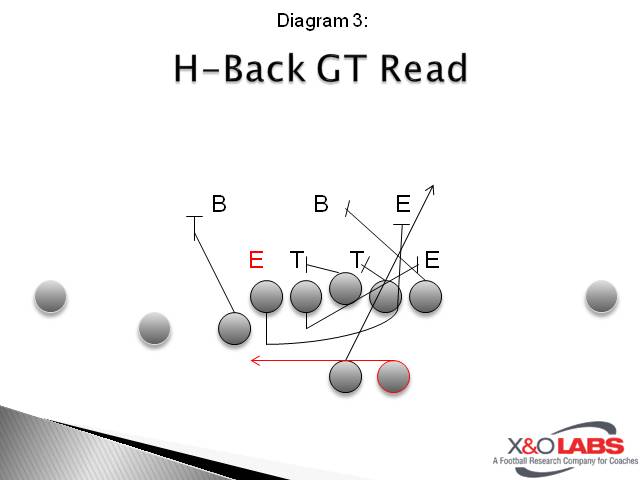
Slide3

This is essentially the same premise as the concept above, but in this formation we use the H Back to arc block the second level for the sweep while still reading the defensive end. People often ask if we will ever have him slice away from the play side. While I am sure that could work, on this play we always have the H arc block for the second level defender to the sweep side of the play. Our change up has been to invert the play and the running back runs the trey and the quarterback runs the sweep. These plays represent our most effective ways we have utilized our GT blocking scheme 

Counter w/ Sweep
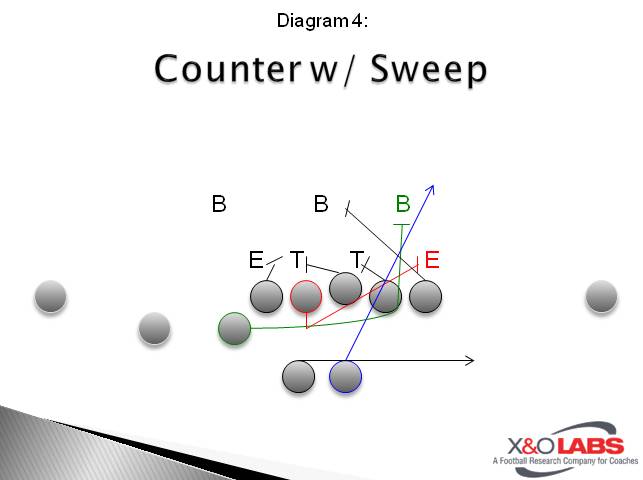
Slide4

Our most effective way to utilize our counter scheme in 2015 was using the running back as a sweeper fake to put the Defensive End in conflict. On this play, the defensive end has a sweeping back approaching and a guard kicking him out for the counter scheme. The play looks very similar to our power read concept, but instead of reading the defensive end we are kicking him out. We averaged over 8 yards a carry with this concept in 2015. 

Counter w/ Bubble
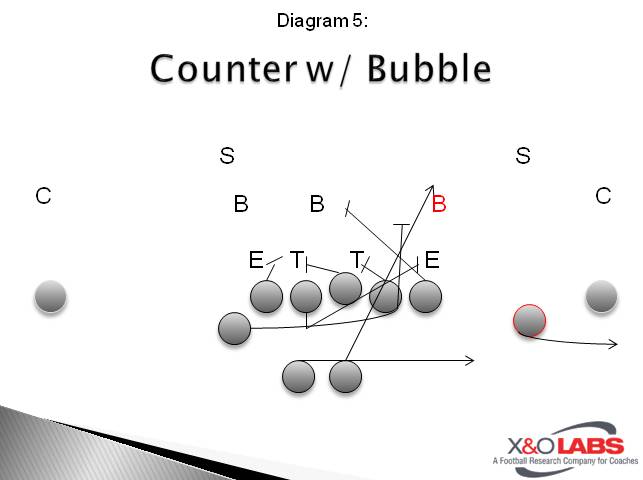
Slide5

We will also use the bubble to protect the gap we are running in from heavy boxes and squeezing second level defenders. Week to week the quarterback is given a defender to key and read pre-snap. Since there is no run read on the counter scheme, the QB is able to focus on the bubble read even post snap if defenders squeeze the box.

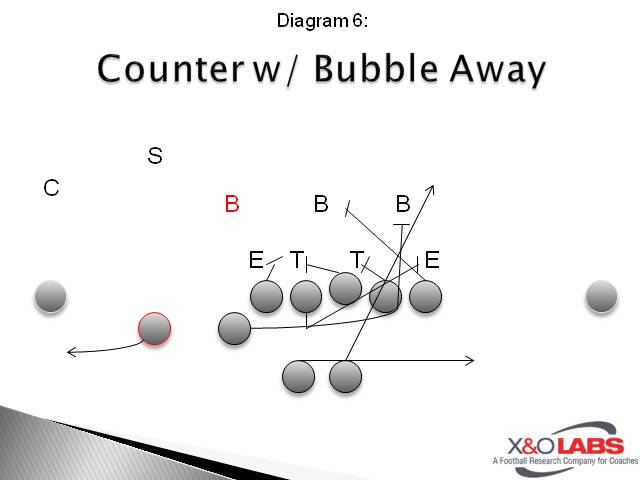
Where we align to run the bubble depends on where we feel we will get a grey area defender that week. This is determined with film analysis. Sometimes it is to the side of the bubble as shown here, but we can also run it away (below).

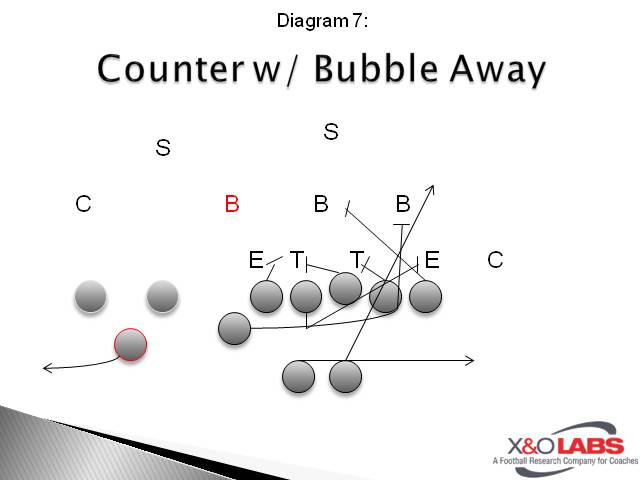
Counter w / Bubble Away
Slide61

Slide7

Another manipulation of the defense that we have liked is to overload the wide side of the field with 3 receivers and throw bubble away from the counter scheme . The quarterback counts hats and determines pre snap whether to give the ball on the counter or throw the bubble to the grass. 

To study game film of these concepts, click on the link below:

Read More

Cal University (PA) 4-2-5 LB Flow Reads

By Mike Kuchar
Senior Research Manager
X&O Labs
Twitter: @MikekKuchar

Introduction:

calpa

The following research was conducted in part of X&O Labs’ special report on “LB Play in the 4-2-5 Defense.” Continue reading for more information on this special report.


Linebacker Post-Snap Protocol:

Coach Lopez talks to his linebackers more about fit concepts, rather than fitting gaps in his system. Each fit concept is tied to a specific technique. He did make it a point to decipher whether or not that linebacker is playing with a shade or a 3-technique in front of him. “If you’re playing with a shade Nose in front of you you have to be more aware of the probablity of cutback as opposed to having the 3-technique. So we tell that backer if the B gap is exposed, he needs to slow down. If the B gap is not exposed, he can go faster.” Coach Lopez uses the following terminology in fitting the one back run game:

Scrape: Used against outside (fast) flow when the play side linebacker has a 3-technique in front of him. “We try to play over the top and get fast to the ball,” said Coach Lopez. “Help is inside you whether it’s the Will or the Safety. It’s used in Outside Zone schemes (Diagram 61).

Read More

Empty Triple Option Package

By Cory Kitchen
Offensive Coordinator/Quarterbacks Coach
Fort Wayne Bishop Dwenger High School (IN)
Twitter: @ckitchen11

Introduction:

The Triple Option has been a staple at Bishop Dwenger High School for more than a decade. We have found that running Inside Zone-Triple Option from an Empty formation is a way to modernize an old-school scheme. This clinic report will discuss how we run this concept, as well as introduce a complimentary “QB Wham” run and an explosive “Stretch” play action pass, all from the same Empty Triple Option look.

Inside Zone – Triple Option

We try to make things as simple as possible for our players so they can react and play fast without having to think about their assignment. We believe “if you think, you stink.” Our Inside Zone scheme fits that premise as we use a simple “Count System” with our offensive line. Pre-snap, the Center will identify the A gap defender on the play side as “0”, and our other linemen will count off from there. 

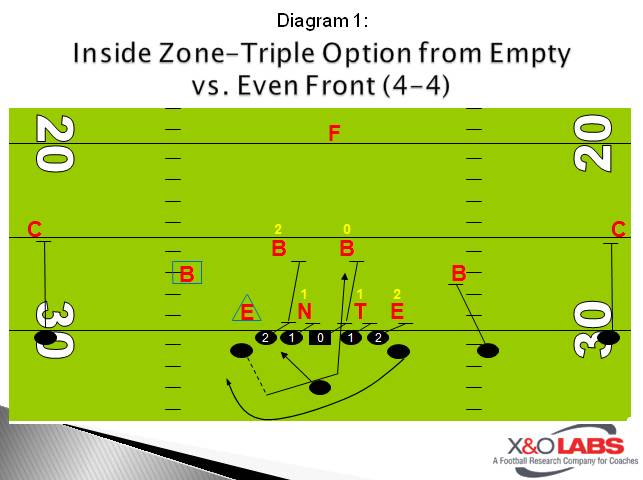
In Diagram #1, you will see our offense against an Even Front. In this scenario, the Center will identify the play side ILB as the “0”, since he is the play side A gap defender. The Center is responsible for the “0”.  The right guard is responsible for the play side B gap defender, or the “1”, which in this case is the 3 technique.  Finally, the right tackle is responsible for the play side C gap defender, or the “2”, which in this case is the play side DE. On the weak side, the LG is responsible for the weak side A gap defender, or the weak side “1”, which in this case is the 1 technique. The left tackle is responsible for the weak side B gap defender, which is the weak side ILB.  The weak side DE is our unblocked handoff key, and the weak side OLB is our unblocked pitch key for our Triple Option.

Slide1

As you can see from the diagram, once our offensive linemen get comfortable with their blocking assignments in the count system, we allow them freedom to communicate with their fellow linemen. They can decide to combo-block up front, in case the defenders swap gap responsibilities.  If the zone blocking schemes are new to you, we would recommend teaching the “count system” as a man scheme first, then working your way up to combination blocks as your linemen get comfortable with it.

We ask our dive back to begin his orbit motion, then come across the QB’s face upon the snap of the ball. If given the ball, he will continue pressing horizontally until he finds daylight, then will stick his back foot in the ground and get vertical. The play side A gap is his hopeful aiming point, but he will cut anywhere he can find daylight. The QB will catch the ball, step off the mid-line and stare down the handoff key, in this case the weak side DE. We teach him to “give” unless he believes the hand-off key can make the tackle on our dive back. If the QB pulls it, he is instructed to replace the feet of the handoff key and attack the inside shoulder of the pitch key. If the pitch key turns his shoulders toward the QB, he will “come to balance”, step to his pitch man, and deliver the pitch. We teach a “heart to heart” pitch technique. The ideal pitch relationship should be 5 yards between the QB and the pitch man, and 1 yard behind the QB.

Diagram 2 (below) shows the Inside Zone-Triple Option play against an Odd front. Again, using the “count system”, the Center identifies the 0 technique Nose Guard as the A gap defender. The right Guard is responsible for the B gap defender, or the play side “1”, which in this case is the play side ILB. The Right Tackle is responsible for the play side B gap defender, or the “2”, which is the 4 technique DE. On the weak side, the Left Guard is responsible for the weak side A gap defender, or the weak side “1”, which is the weak side ILB.  Since the weak side 4 technique DE is the handoff key and the weak side OLB is the pitch key, there is not a “2” for our Left Tackle to block versus this Odd front. In this case, we tell our Left Tackle to release inside to the weak side ILB and perform a “Veer Block” to seal off the backside for the QB or a RB cut back.

Read More

Using Tampa Coverage to Defend Vertical RPOs

By Mike Kuchar
Senior Research Manager
X&O Labs
Twitter: @MikekKuchar


Editor’s Note: The following research was conducted as part of XandOLabs.com special report on “Defending RPO and Triple Option,” continue reading for more on this exclusive study.


Source:
Mike Giancola
Defensive Line Coach 
Westfield High School (VA) 


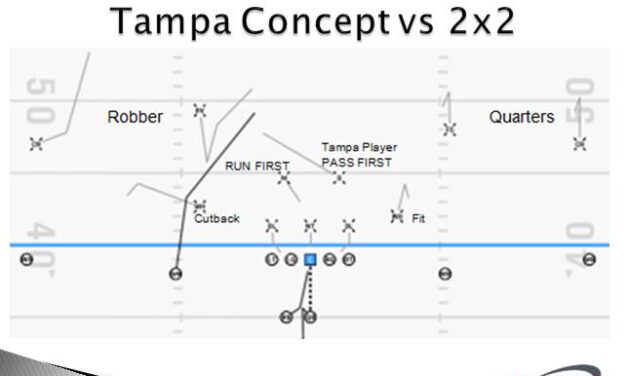
Run First/Pass First Methodology:
According to Coach Giancola, where it all got challenging in defending RPO concepts is with teams that started recognizing players that were responsible for the run and the pass. “We had to struggle with the number of adequate guys in the box and an adequate number of guys in the secondary playing pass,” said Coach Giancola. “So teams started running RPOs like fade out and not only picking on an overhang, but seeing what our second level flat defenders were doing. We’ve also seen teams letting the window open up more off the read player and taking a shot on us 15 yards down the field.”

Read More

University of Missouri DL Drills

Insider Exclusive: The Process for Training Mizzou’s NFL Ready Defensive Lineman

It’s no secret that former University of Missouri defensive line coach Craig Kuligowski knows how to produce NFL ready talent. When edge rusher Charles Harris went 22nd overall in April to the Dolphins, it marked the fifth defensive lineman since 2009 that he has mentored to go off the board in the first round. It’s the most of any program since that time. Now as the defensive line coach at the University of Miami, Coach “Kool” shares the methodology and drill work he uses to get his players ready to play at the highest level of football.

Read More

Finding Ways to Create Separation in Route Running

By Buddy Blevins
Wide Receiver Coach & Recruiting Coordinator
Oklahoma Panhandle State University
Twitter: @coachb_blevins5


Introduction:

panhandleGetting open or creating separation at the wide receiver position, in one form or another, is often relegated to three simple factors; size, strength, or speed (indeed, those do help). Unfortunately, all of us in the coaching world realize, you are not always fortunate enough to have guys that were born with, or have been able to create, those traits. Today we are going to discuss how coaches who may not have the personnel they desire can still have a chance to win with whoever, whenever by using my systematic approach.
Creating Separation:

The main situation I am going to address is an off man type of scenario. This will consist of off man, or any zone scenario when at the top of your route you have a defender nearby that is attached to you.

We teach that creating separation is a simple two part process:

  1. Recognizing the leverage of the DB by the top of your route (right before your break)
  2. Utilizing 1 of two methods to create separation
    1. Using a deceptive move
    2. Using an angle adjustment

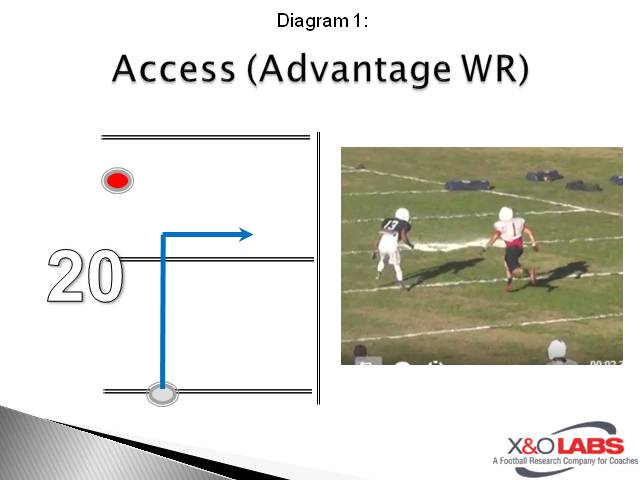
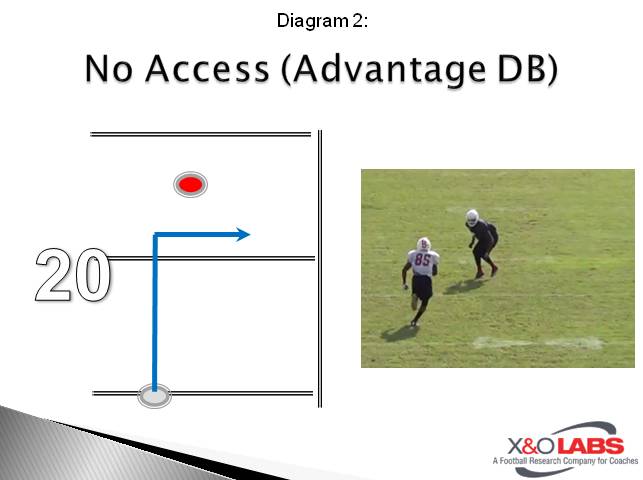
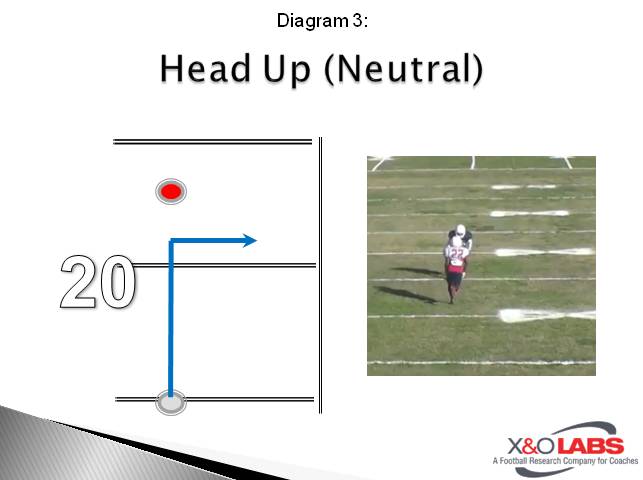
Understanding and recognizing leverage is extremely simple. Football is a fluid and constantly evolving game, we understand that. However, we decided to simplify things and categorize any DB’s position to fit into three basic scenarios.

Consider these relative to an “out breaking route”

  1. Access (Diagram 1)
  2. No Access (Diagram 2)
  3. Head up (Diagram 3)

Slide1Slide2Slide3

The receiver assesses the DB’s leverage while in the vertical portion of the route. To us, this vertical portion of the route is known as the “stem” (just like the stem of a plant- it is the straight part). By the time the receiver reaches the last step or two if his stem, the DB’s leverage should be final and the receiver will know what he is going to do.

Each of the three leverages is attacked a different way. Here are two types of breaks/routes we will use to illustrate this point:

1)Angled Break: Burst Route (10-12 yd out/corner route from the outside) (Diagram 4)

Read More

Block Destruction to Defend the Screen Game

By Zach Turner
Defensive Backs Coach
Kenton High School (OH)
Twitter: @Zach_Turner1

Introduction

The screen game has become a huge part of the spread offense attack. Screens put our players in a situation where they must defeat a block on the perimeter and tackle an athlete in space. That is a challenge for most defenders and in turn, for all defensive coordinators.

Here at Kenton High School, we do not change our scheme based on what screens a team runs. We just align our defense to make sure we are never outflanked based on the offensive formation. In addition, we have incorporated a series of drills that teach our defensive backs and outside linebackers proper technique and screen fits to shut down our opponents’ screen game. We teach that screen fits are just like run fits in any defense. This allows our players to understand their leverage and how to pursue the football. Our defense has been in the top 3 in pass defense three of the last four years and a lot of that has to do with our ability to defend the screen game.

Teaching Block Destruction

When teaching block destruction we focus on using our hands properly and being the aggressor. We believe you cannot defeat blocks unless you are the aggressor, the more physical player. Much like offensive and defensive line coaches talk about the “low man wins,” we say the player whose hands strike first wins the battle. Whether it be an offensive player blocking or a defensive player destructing the block. We also never use the terminology of “beat the block” that is not good enough. You can beat a block by running around it or dodging it. We say “destruct the block” because this implies destroying the block through aggression and technique.

“The Difference”

First, I have to say we did not create it this. This idea came from Ohio State and they called it “the difference.” It blended so well with our core values of destructing blocks that we had to use it. The difference is split into two separate drills. The first drill is what we call “The Difference” the second drill is called “Strike and destruct”.

The difference is a competitive drill for us. Sometimes we use this drill as an offensive vs defensive drill and sometimes we will pair up our defensive players. No matter how we incorporate it, we want to have our defensive players be extremely physical and win the battle.

We start this drill by having player’s toes on the line and facing one another. We then have our players get into an athletic position and on the whistle both players compete to get their hands inside and lock out their hands. The player whose hands our inside and have locked their arms out is the winner. We will do this several times during the drill. On average, the drill lasts five to ten minutes and is a great practice starter because it sets a completive tone for the practice.

When working this drill, we always have these coaching points for our players:

1: Eyes on Target

2: Hairline to chin

3: Wrist Close Together

4: Elbows tight to rib cage

5: Violent Strike and Extend

We start out with the difference at least three times a week in pre-season and once during season. After introducing that drill and working it for a few weeks, we will move on to strike and destruct with our defense only.

Our strike and destruct drill is set up the same way as our difference drill but we take it one step further. Instead of just striking their opponents and extending their hands, the players will now strike, extend and destruct the block. While destructing the block they will replace the offensive player to the side of their screen fits. For example if they are an outside in player they will destruct the screen to their outside arm. Once the screen is destructed we tell our players to replace the offensive player. This allows no angle for the offensive player to come back and block our players unless it is in the back.

Additional Block Destruction

Along with the difference, we teach additional block destruction in our individual time. We believe you cannot just rely on one way to destruct blocks. It is also important to remember that not all high school players are strong enough to strike and snag defenders in order to destruct blocks. Therefore, in our indy time we teach and work a number of different techniques. Each position is different and I will discuss how we break down block destruction with our defensive backs and outside linebackers.

Defensive Backs

When teaching defensive backs proper block destruction, we focus on a few feature moves to go along with the difference and the strike and destruct. We always work a progression with our screen fits.

Read More

Summer is Coming: Build More Champions

By X&O Labs Staff

A very wise person—no doubt a coach—once said, “The best athletes are made in the offseason.”

Coaches know that hard work in the summer pays dividends. That’s why the best ones have a plan to engage, motivate, and challenge their athletes to put in work during the summer months. Whether it’s lifting weights, conditioning, camps, or passing leagues, they know that the off-season is when individuals and teams improve.

At the same time, coaches understand that not all athletes have the dedication and discipline to complete the off-season work on their own. In a world of distractions, some athletes live in the gap between intent and action.

Getting these individuals to take action during the summer months can be a challenge. When plans fall short, coaches need something extra to help engage these athletes. Programax may be just the thing to bridge the gap.

Here’s What We Like About Programax—And How It Can Make Your Summer Much More Effective and Efficient

A few months ago XandOLabs.com highlighted Programax, a coaching app with a wide range of functionality to help football coaches lead a better program. We had a number of readers check it out and it’s made a really positive impact on their programs. As Coach Yashinsky from Onalaska, WI said – “It’s like Hudl for managing the details that are a pain to keep track of.”  We included feedback from some others below.

As summer approaches, we wanted to revisit Programax because it provides a bunch of helpful tools for summer. 

As a coach you can:

  • Deliver texts and emails to players and parents from one place
  • Create live schedules that sync to everyone’s personal calendars
  • Deliver daily workouts with videos and tools to track
  • Generate live leaderboards right on your athletes’ phones
  • Manage your camp-sign up process

…and so much more. Check out a brief demo video here.

We at XandOLabs.com love the tool, and recommend you try it out. For a limited time, our readers can receive 10% off with this special offer from Programax (Sign up here and enter code “xandosummer” at checkout).

Communication Made Convenient

Read More

No Huddle: Case 1 – System Philosophies and Play Calling

By Sam Nichols
Managing Editor
X&O Labs
Twitter: @SNicholsXOLabs


Introduction:

When we released our no huddle survey, it quickly became one of the most extensive to date. We surveyed over 1,000 coaches nationwide, from all levels of football, and found some incredible results that shed light on what works in no huddle systems and, more importantly, why it works. This special report will provide insight to even the most veteran of no huddle coaches while helping rookies as they look to get their own no huddle system off the ground.

In some ways, a report on the no huddle can be extremely broad. There are a myriad of angles from which we could research. In the end, we decided to follow our instincts and start where the research led us. That is to a very simple, yet layered question… Why run the no huddle?

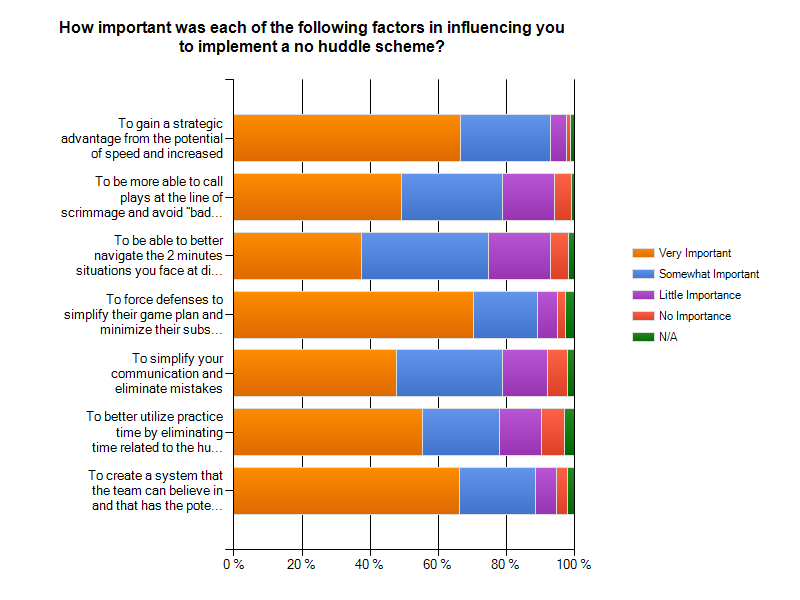
We start here because it was a consistent thread in every interview that we conducted throughout this process. We heard countless times how important it was for the teams that run no huddle schemes to have an unwavering belief that adding the no huddle to their offensive system would help them reach their offensive and team goals. The coaches that responded to our survey gave us some insight into those goals by rating the importance of different potential reasons for implementing the no huddle.

Below are the results:

Here are a few things that we ascertained from this chart…

“Very Important” was the top response for each of the seven reasons given. This shows just how motivated coaches were to install these systems and how vital they saw them to helping their teams succeed.

The highest number of “Very Important” and “Somewhat Important” responses connects to the strategic advantage gained by a faster pace of play. This implies that while not all no huddle teams are moving at a breakneck speed, many of them at least want the option to do so if needed.

One of the top reasons that coaches choose to use the no huddle was because of its power to bring identity to their football program. Coaches told us how the no huddle and all that comes with it gave their kids and coaches more confidence and allowed them to create more excitement around their program.

Many teams went to the no huddle to simplify their communication and eliminate mistakes. To those who have not used no huddle schemes, this may seem counter intuitive. Hopefully the next section on Communication Systems Analysis will help clarify the simplicity argument.

While the vast majority of those surveyed spoke positively about their no huddle experience for the reasons above, they also cautioned that the transition to the no huddle should not be taken lightly. We were repeatedly told how important it is for the no huddle to become part of the team’s culture and identity for it to really have an impact. Coaches also stressed the need for the entire coaching staff to understand the impact of a no huddle tempos on the different parts of their game be it defense, special teams, or off-season preparation. Once everyone is on the same page, teams can then start to dig in to the different ways that they can install and operate their no huddle concept.

Production:

According to our research, no huddle offenses score more points than traditional huddle teams. One could argue that this would be the case regardless of any strategic advantages that are garnered by the no huddle. There also is a certain amount of scoring that increases because of increased opportunity. In other words, teams that run more offensive plays and have more offensive possessions have more chances to put points on the board. Many of the coaches we talked to in creating this report cited the desire to increase opportunities as a reason for their particular brand of no huddle.

One great example of this focus comes from Chuck Markiewicz the longtime head coach of Arundel High School (MD). When asked about his no huddle scheme Coach Markiewicz explained that…

“Over the years our off season evaluation told us that we averaged a touchdown for every 3 possessions, which averaged 36 points per game. This was roughly our average until 2005 when we made a conscious decision to find some ways add three more possessions per game to try and up our average to 42 points per game. The project became trying to add things that would enable us to find those 3 more possessions.

“We didn’t try to do this all in one year. Our goal was to try to add something every year, test out our theory to see if it held up and add more the next year. We feel like our ideas have some merit because since we started to implement the changes in 2005 we have averaged over 42 points per game. We are still actively engaged in trying to find are still ways to add more possessions.”

Read More

No Huddle: Case 2 – Use of Tempo

By Sam Nichols
Managing Editor
X&O Labs
Twitter: @SNicholsXOLabs

libertyOne buzz word that came up repeatedly in the surveys and interviews we conducted for this report was the word “tempo.”  Through that research, we found that this term has different layers of meaning to no huddle coaches depending on what they are trying to do.  Here is the working definition we derived from the research:

Tempo = a methodical approach to creating a strategic advantage for the offense by controlling the pace of play in a football game.

In short, “tempo” is more than just going fast.  It can mean doing slow at times, short spurts of speed, or even creating a rhythm for the defense so their increase comfort can be used against them.  It all comes back to the teams game plan and having the tools in place to take advantage of the defense through the pace of play.

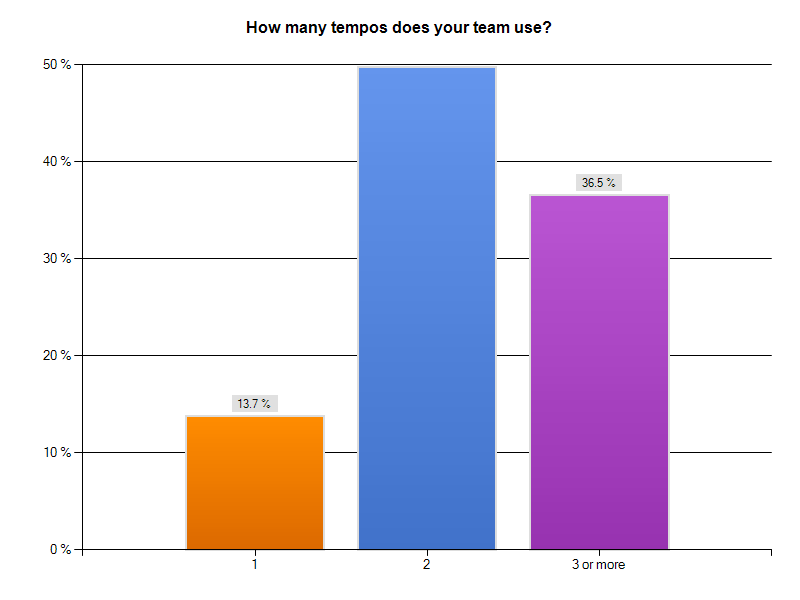
Before we get into the different strategies that teams use to control the tempo, let’s take a look at the data.  Our research shows that 86% of schools are intentionally running multiple tempos in games with 36% using 3 or more tempos commonly.  In addition, coaches in our survey identified “creating a strategic advantage” and “forcing the defense to simplify” as the top two reasons for adopting the no huddle in the first place.  This shows just how important the concept of “tempo” is to no huddle teams.


One buzzword that came up repeatedly in the surveys and interviews we conducted for this report was the word “tempo.” Through our research, we found that this term has different layers of meaning to no huddle coaches depending on what they are trying to do. Here is the working definition we derived from the research:
Tempo = a methodical approach to creating a strategic advantage for the offense by controlling the pace of play in a football game.

In short, “tempo” is more than just going fast. It can mean going slow at times, short spurts of speed, or even creating a rhythm for the defense so their increase comfort can be used against them. It all comes back to the team’s game plan and having the tools in place to take advantage of the defense through the pace of play.

Before we get into the different strategy that teams use to control the tempo, let’s take a look at the data. Our research shows that 86% of schools are intentionally running multiple tempos in games with 36% using three or more tempos commonly. In addition, coaches in our survey identified “creating a strategic advantage” and “forcing the defense to simplify” as the top two reasons for adopting the no huddle in the first place. This shows just how important the concept of “tempo” is to no huddle teams.


One could argue that without utilizing some sort of “tempo” philosophy, a team might as well still be huddling. One coach we spoke two during the research process explained how his head coach was so slow calling the plays that they went from “no huddle” to “slow huddle” (minus the huddle of course). Unfortunately, that coach is not alone. We received many additional comments from coaches who felt that they were not able to really take advantage of the potential “tempo” advantages of the no huddle.

That is where studies like this are crucial. We have dedicated the next several pages of material to showing coaches how coaches around the country are managing “tempo” for their teams and ways that any coach can refine and implement those concepts today.

The Power of Tempo:

“Tempo” may not mean “fast,” but the coaches that participated in this study suggest that increased offensive speed sets up the team to change the tempo in different ways. In many cases, these coaches argued that the tempo was almost as important as the offensive scheme itself.

They would inevitably go on to list some, if not all, of the following advantages:

  • Makes Conditioning a Factor: An increased speed that leads to a longer game rewards the team that is prepared physically for those extra reps. Teams can then use that concept as a motivator for their own players and create a culture of endurance.
  • Ability to Read the Defense: Reading a defense isn’t just about x’s and o’s. It is also about their demeanor and their conditioning. Teams that have mastered the art of using tempo in games are always looking to see if the defense is getting tired, changing personnel, or getting too comfortable and then reacting with the appropriate tempo change to take advantage.
  • Triple the Reps John Konecki from Crete-Monee High School (IL), said it best in our survey when he responded, “The secret sauce of the no huddle is the number of reps a team can run throughout a practice session.” Some coaches said they were literally getting three to four times the reps since eliminating the huddle. That not only creates better conditioned players, but it allows for a significant more opportunities to get better at what you do.
  • Engagement and Excitement: The ability to engage the players in a practice and team philosophy can’t be underestimated. In our research, coaches mentioned repeatedly the positive impact that more reps in practice has had on team moral citing more reps for non-starters, faster pace, and shorter practices as the things that the players liked the most.
  • Create Rhythm: Aaron Sauter, Northwest High School (IN): “We use tempos to get our primary playmakers active in the game from the beginning of the game. If we feel that going at a specific tempo will give us a significant advantage we will begin with that tempo to start the game. If we find that our playmakers are not getting in a rhythm during the game or if we do not gain an advantage, we will use the tempo that our team feels most comfortable working at regardless of opponent. A key advantage that we gain is th

Read More

No Huddle: Case 3 – Practice Planning

By Sam Nichols
Managing Editor
X&O Labs
Twitter: @SNicholsXOLabs


This section of the No Huddle Study will focus on the different changes that can occur as part of implementing a no huddle system. It should be noted that many of the coaches we polled went out of their way to explain that their system of practicing the no huddle has been a journey. Like many things in life, these coaches experienced both pros and cons because of the switch. For most coaches, it has been a long process of discovering exactly how to make this all work best for their team. Fortunately for you, they were willing to share their experiences and resources with us as part of this special report to help coaches avoid some of the trial and error experience that many no huddle pioneers experienced.

Coaches that responded to our survey made one point exceedingly clear: Running the no huddle will change the way your practice forever. At the very least, the simple act of NOT huddling saves a significant amount of time that coaches can use in other ways to benefit their teams. That is only the tip of the iceberg when it comes to the impact of the no huddle on the way coaches run their practices.

So, we segmented our research into providing what we found where several differences in coaching in the no-huddle system.

Difference #1: New Definition of Coaching

Football, more than any other sport, requires all of the coaches on the field to be on the same page. That concept is even more true on no huddle teams that look to maximize the opportunity to change the way they practice. Unfortunately, many no huddle teams run into issues early in the installation process because they don’t properly prepare their coaches for the new way of practicing. The comments we received in our research suggest that coaches will be more successful in preparing their coaches if they focus on initial buy-in and stress “coaching on the run” from the start.

We repeatedly heard from coaches that if one coach isn’t on board with a fast practice, it will not work. That means it is even more important that the head coach and offensive coordinator make the expectations very clear early in the process that they expect everyone to coach in a very specific way. Of course, that is easier said than done, but coaches told us that they have been able to make even the most skeptical coaches fall in line.
Here are some ideas coaches suggested to help get the staff on the same page:

  • Involve ALL Coaches In the Process: By bringing everyone into the conversation, the coaches will feel they are choosing to be part of the change as opposed to feeling forced.
  • Start With the End In Mind: Instead of starting with the scheme (no huddle), start the conversations with the goals (ex: What are we trying to do? Score more points? Create more possessions?). From there you can set the goals and then work back to how that affects the way each individual coach practices.
  • Hold Them Accountable: We all want accountability. Early in the process, coaches are likely to revert back to old practices, and this will happen quickly if not addressed. Maintain early, honest communication with your coaches to help them do what you are asking.

Coaching on the Run:

Perhaps the most important element in creating continuous reps and tempo in practice are the coaches’ willingness to “coach on the run.” No huddle “gurus” will tell you that if you ever stop practice for any reason you are costing your team reps. These experts suggest that coaching on the run is essential for a no huddle team to be successful.

The problem is that this idea is very difficult for some coaches to implement because it is very different than what they are used to. One coach shared that, “some of our older coaches had to get used to coaching on the fly because they were used to an hour of team time and running a play and talking about it for 5 minutes.”

Now this may be an exaggeration, but we all know what he is talking about. The issue is that a team can only practice as fast as its slowest coach so teams must have a clear plan if they are going to try to coach on the run.

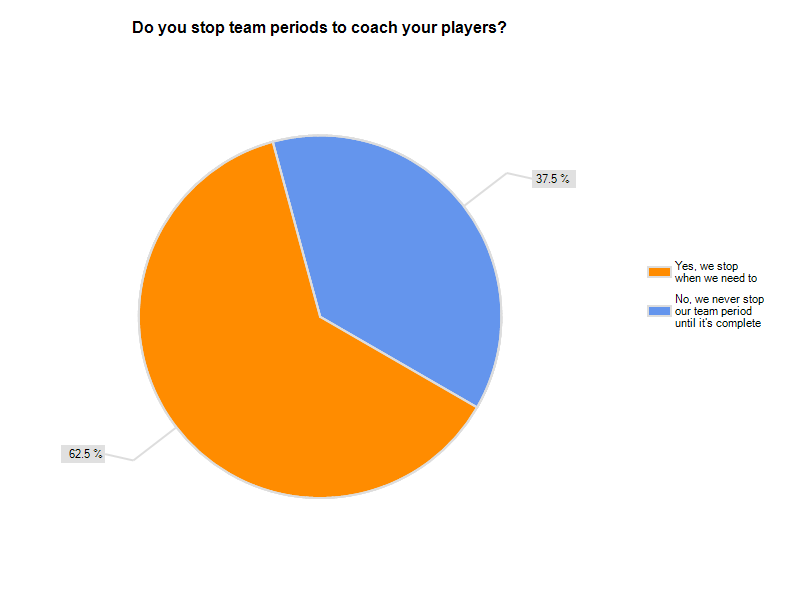
Having said that, many coaches do feel it is necessary to stop practice to instruct players if necessary. According to our polling, 60% of coaches said that they do stop team periods to coach their players, a thought that makes other no huddle coaches cringe.

Team Periods:


Read More

No Huddle: Case 4 – Communication Systems Analysis

By Sam Nichols

Managing Editor

X&O Labs


At its core, the no huddle is about streamlining communication. Each of the coaches that responded to our survey has their own twist on what works best to communicate with their entire team from the sideline. Sure there are some who are part of no huddle systems, but even within those teams you will find slight variations. Each was created as simply and effectively as possible to communicate the next play’s formation, direction, type, motion, and responsibilities to the players on the field.

From the outside these communication systems appear to be quite complicated and even random, but our research has shown the truth to be quite the contrary. The research shows that teams’ communication methods are often directly linked to the goals they have for their offense. For example, if a team is looking to maximize the impact of increasing tempo it would be focused on using the fastest method of communication. These teams are willing to give up complexity for speed. Another team might focus on communication methods that are more flexible so that they can attack the defense by checking the play at the line of scrimmage. Either way, they have made their system fit their needs.

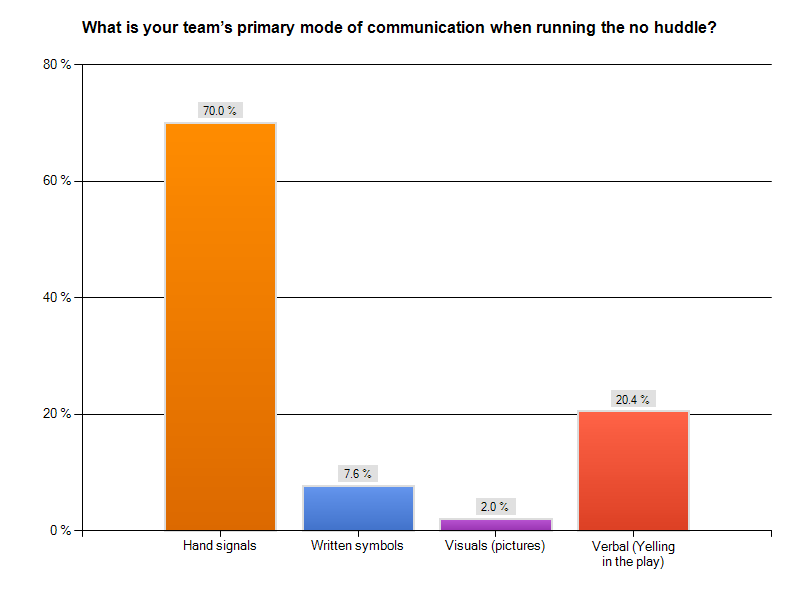
As part of our survey, coaches were asked to categorize their communication system as one of four distinct types; hand signals, verbal relay, written, and visual.

Here are the raw results:


The results show that the overwhelming majority of coaches are using hand signals are their primary method communication. While these systems vary greatly, they have many concepts in common. These systems are discussed in much more detail in the following sections.

Primary Communication Methods:

As you can see from the above data, hand signals are the preferred choice by the vast majority of those surveyed. Further analysis shows that within this broad category, there are two distinct camps. One group of coaches uses hand or body signals for the players that tell them all of the information that they need for that play. The second group uses similar signals to point the players to information that they have on their wrist cards.

Before we get into the differences and advantages of these two approaches, it should be noted that both coaches on both sides of this argument provided strong and justifiable responses. On one side, countless comments stated how helpful the wrist cards are in making their team function and win. Still others argued that the cards slowed them down and caused more problems than they are worth. These differing opinions show just how important the individual team circumstances in determining the best communication approach. For that reason, we have set up the reviews of the individual signal systems to clearly lay out the pros and cons that coaches shared with us.

The Symbol System:

In contrast to the wrist card hand signal, the symbol system can be as complex as you want. Coaches are not restrained by a limited number of digits or colors in the spectrum, but only by his imagination in developing new signals. The signals that the team uses are unique to their team and, in most cases, have developed over time to fit the needs of the team. This approach is used by roughly 30% of teams including most collegiate programs we surveyed.

Since this system often carries many more signals than wrist card systems, coaches take great care to ensure that all of the players know the entire signal catalog.
Here are a few of the tactics that coaches suggested:

Symbol System “Musts”

  1. Involving the players in the initial creation of the signals.
  2. Teach the signals at lower levels (middle school and even youth levels).
  3. Using signals exclusively during practice with no verbal reminders to reinforce the importance of comprehension.
  4. Test players on the sidelines (in practice) on the signals.
  5. Removing players from the field that do not know the signals. Reward those who do.

The detail associated with these signal systems makes them much more difficult to share in their entirety. With that said, a few coaches were willing share some of their rationale for their individual systems.

Read More

No Huddle: Case 5 – X&O Labs Exclusive No-Huddle Interviews

By Sam Nichols
Managing Editor
X&O Labs
Twitter: @SNicholsXOLabs


Throughout this research process, we were fortunate enough to talk to some great coaches from all over the country. Some of those coaches were willing to give us an even closer look at how they run the no huddle. In this case, you will find the following interviews:

  • Pac 12 Offensive Coach: This no huddle veteran explains how his team’s culture is built around their no huddle philosophy.
  • Phil Longo: Championship college coach explains the no huddle concepts that have made his teams successful at multiple stops.
  • Joe Osovet: Veteran no huddle coach explains how his system helped increase their plays per game by 15 over the course of the 2012 season.
  • Jason Thomas: This former Chip Kelly assistant outlines how he has taken his brand of no huddle to the high school ranks.
  • Brian Tabatabai: Southern California coach outlines how the no huddle changed the culture of his football team and helped them break countless records in the process.

Each coach in this section has a unique perspective that I felt would help readers better understand how the no huddle can change the way a team operates.


Using Pre-Snap Tempo to Manipulate Defenses:

An Interview With Joe Osovet, Offensive Coordinator, Nassau Community College (NY)


Editor’s Note: Coach Osovet is serving his second stint as offensive coordinator at Nassau Community College in New York. Prior to coming back to Nassau, he served as the wide receiver coach at LIU-Post from 2010-11. This past season, Coach Osovet’s offense ranked 11th nationally averaging 40.8 points per game. His team also boasted two 1,000 yard rushers and a rushing offense that ranked 6th in the nation. X&O Labs’ Managing Editor Sam Nichols had the opportunity to talk with Coach Osovet about his no huddle system.


Sam Nichols (SN): Coach, thank you for taking the time to talk with us today. I know you have been successful with the no huddle for years now and we look forward to hearing some of the keys that you have found to make that happen year-to-year. So let’s start with this question…why do you stick with the no huddle?

Joe Osovet (JO): I think the biggest thing as I have been at different levels, be it D2, Junior College, whatever, is that the no huddle forces the defense so show their hand. Very rarely in a game are you going to be stuck in a bad play because you have so much time at the line to make the changes. The quarterback has more time to scan the field and get you in the right play and over time those seven and eight-yard runs add up and you bust those into 50 yard explosive plays in the second half. I think those factors combined are dangerous for an offense.

SN: I agree coach. The no huddle can be hard to stop if you aren’t prepared. Tempo is an important part of making that happen. Tell us how you use tempo to control the game offensively?

JO: First of all, just so you understand where we are coming from, you need to know that we are all hand signals. That said, anything that is a lot of verbiage we put it on the wrist card. We will take the card with those 10 to 12 plays and use it to keep us moving fast even if we want to run a more complicated play.

We keep it really simple with tempo. We use a snap variance cadence so predominantly have one snap count. From there, we will use a freeze cadence that gives us a chance to get out of something that we have called. That is sent in with the play as a code word. If we just want to get the defense on their heels, the center will signal to the QB he is ready by flashing his hand between his legs, the QB then says “Hut, Hut,” throw his hands up, and then look back at me.
What a lot of teams have started doing is they look back to their sideline and change the play as well during that time. To counter this, we have another code word that tells our guys to fake the look to the sideline and catch them looking over for a new play. We aren’t necessarily snapping the ball on one, two, or three. It is all based on the center and quarterback. The other thing we can do is use a few words to speed things up. The first word, “copy,” tells the players to get lined up in the same personnel and run the exact same play. If the defense adjust to that we have code words, like “Oregon” that mean flip it too the other side. The opposite play can be made in the prior to the previous play as well. When we do this, we can get it snapped in about seven seconds, as long as refs cooperate.
In the end, we think the combination of the same play quickly, the false cadence, and the freeze or “look” cadence is all we really need to adjust the tempo. We don’t have an “indy” or “nascar” call like some teams.

Read More

No Huddle: Case 6 – Exclusive Clinic Reports

By Sam Nichols
Managing Editor
X&O LabsTwitter: @SNicholsXOLabs


In creating this special report, we set out to make the most complete review of the no huddle to date. As part of that plan, we reached out to coaches across the country (and the world) and had them write about areas of the no huddle where they have a particular expertise.
Each of these reports is included in this case and they cover the following topics:

  • Utilizing a Comprehensive “Check with Me” System: Jay Wilkinson, Offensive Coordinator, Broken Arrow High School (OK)
  • Play-to-Play Mechanics of an Efficient No Huddle Offense: Matt Kerstetter, Offensive Coordinator, Trinity High School (FL)
  • No Huddle Philosophy and How to Go Fast: Chuck Markiewicz, Head Coach, Arundel High School (MD)
  • How to Coach On the Run: Dan Ellis, Head Coach, W.C. East High School (PA)
  • Implementing a Communication System: Zach Harrod, Offensive Coordinator, Prague Lions (Czech Republic)

Utilizing a Comprehensive “Check With Me” System

By Jay Wilkinson, Offensive Coordinator, Broken Arrow High School (OK)


How many times have you reviewed film the day after the game and said that a play you called was dead before it started  because of the defensive look you got? The freeze and check with me methods are a way to eliminate dead play calls. We use the freeze and check with me methods to take a quick picture of how the defense is lining up and making the best play call we have versus that look. Some of our biggest plays have come from these methods.

On its most basic level, the “check with me” concept allows an offense to make the play call or change the play at the line of scrimmage. We have two different ways that we have this built into our offense.

Here is a more in-depth look at each concept:

Freeze Concept:

When using the freeze concept, we will signal in the formation and no play. The QB will go through the pre snap process and signal for the snap. If we don’t draw the defense off sides, then we will call a play from the sidelines. This allows us to look over the defense and call a play based on the look we are getting.

Check Concept:

The check starts with us calling a formation and a play and tag a check to it. The QB will dummy signal for the snap and look to the sidelines. If we like the play called, we will leave it on and the QB will call for the snap and run the play. If we don’t like the play we have called, we will tell the QB to erase it. He will then tell the team to look to the sidelines to get the new play and we will signal the new play and run it.
We prefer this method as opposed to the ‘fast as you can’ model because it helps us from running a play into a look we can’t be successful against. We do have some plays that we feel like we can run vs. any look. We include these plays in our fastest tempo mode.

Benefits:
We have found that checking at the line of scrimmage gives us many advantages. It allows us to look at the defense and call a play based on the look we are getting. For example, if it is 3rd and 7 and we don’t know if we are going to get base defense or coverage. We can freeze it, see how the defense is going to play us, then call a play that give us a chance to be successful. Similarly, if we want to run the zone at the 3-technique, we can call zone right and tag check. If the 3-technique is on the left, we can just flip the play.

Implementation:

Building either or both of these check concepts into your system is really just a matter of mechanics. We use our normal play calling as the base and build from here. Here is what our kids expect to see on a normal play:

1. Set personnel (if changing)
2. Signal formation
3. Signal play
4. QB will make sure everyone is set and then signal for the ball
5. Center will call snap count and snap the ball when he is ready

Read More

Identifying and Attacking Pass Protections

By Jason Bornn
Head Football Coach
Saugus High School (CA)
Twitter: @JasonBornn1

Introduction:

shsvsventuraWe are a 3-4 multiple blitz scheme team which means that we will see subtle differences in pass protections to the standard even front static fronts that some teams employ. One of the challenges we have as an odd front defense is identifying the type of pass protection a team is going to use against us. I sat down with Tim Tulloch, the defensive coordinator at San Mateo CC (CA) and discussed this problem. It was after reading his material and discussion with him that we were able to better understand pass protection schemes and how to best attack them.
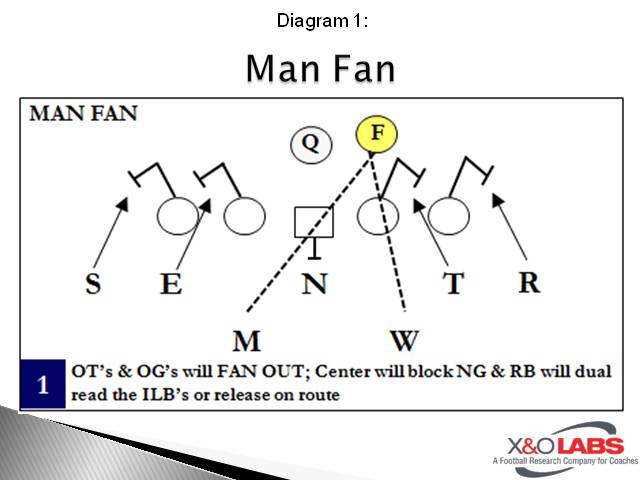
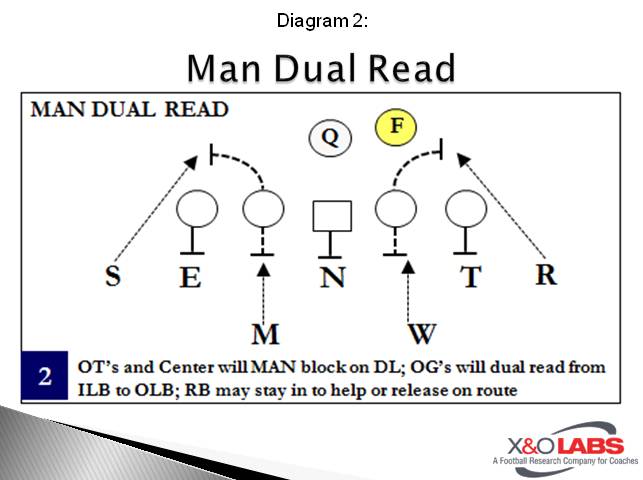
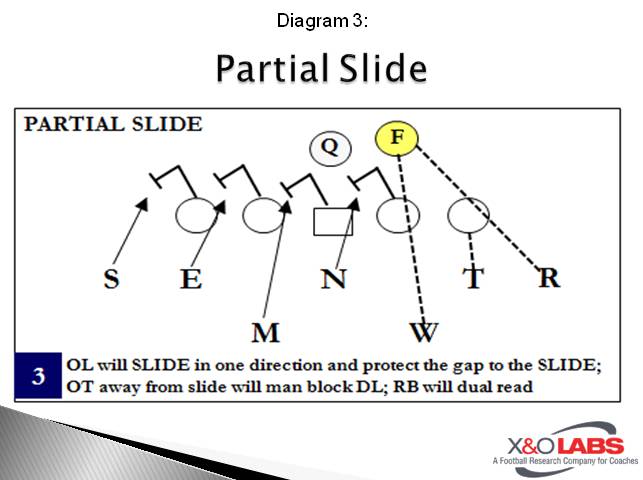
We have several ways to determine which one a team will employ versus us. We classify the pass protections we most often see into eight categories. The first four are:

1. Man Fan (Diagram 1)

2. Man Dual Read (Diagram 2)

3. Partial Slide (Diagram 3)

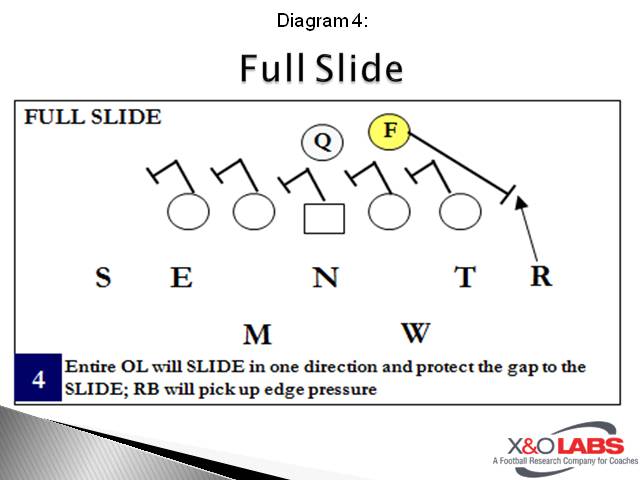
4. Full Slide (Diagram 4)

Slide1Slide2Slide3Slide4

In each of these, the RB can be utilized as either a blocker or receiver.

The other categories we designate are:

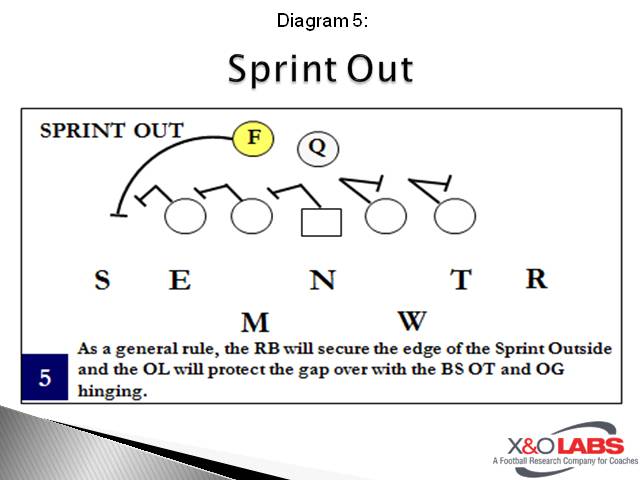
5. Sprint Out (Diagram 5)

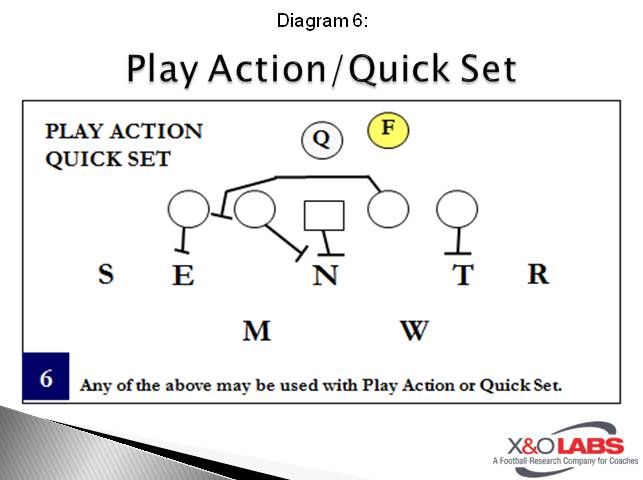
6. Play Action (Diagram 6)

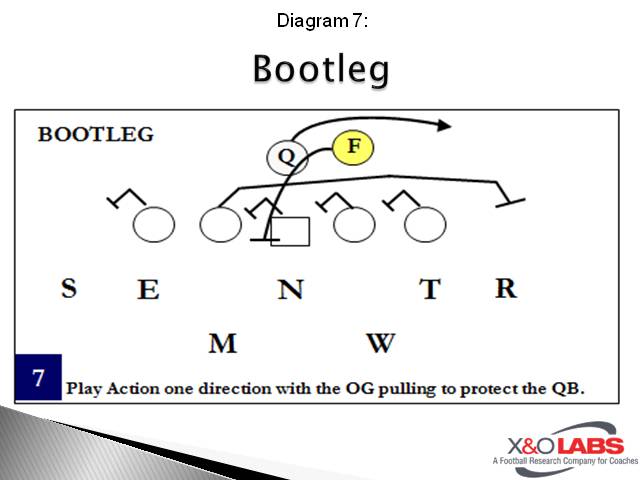
7. Bootleg (Diagram 7)

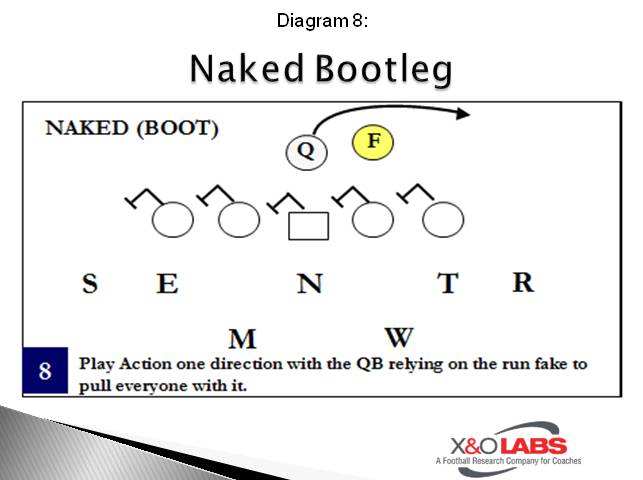
8. Naked (Diagram 8)

Slide5Slide6Slide7Slide8

In each of these four, there are specific rules and actions of the OL and RB that apply. We do you have certain attacks we will employ versus these but for the purpose of this article, we will focus on the four we see the most of (Man Fan, Man Dual Read, Partial Slide, and Full Slide).

For each of these protections, we will have a 4 man, 5 man, and 6 man attack that we will utilize. Once we identify the pass protection that we will face each week, we will create a menu for each of the attacks (4 man, 5 man, and 6 man) that will employ. For example, if a team is a Man Fan Pass Protection team, we will have two or three 4 man schemes, two or three 5 man schemes, and two or three 6 man schemes. We will go over one of each for the four pass protections we see the most of each week.

Read More