
“Plus” vs. “Minus” Tags in the Dart Run Concept

By Steven Alesi
Offensive Coordinator
Longwood High School (NY)
Twitter: @CoachAlesi


Here at Longwood, our entire offense is broken down into families.  In the run game, we have 4 frontside families and 4 backside families.  Before teaching any concept we teach these 8 families.  When teaching a concept, the players first learn which frontside and backside family the play is a part of.  Each family will always have the same rules.  This allows the players to immediately know the core rules of the concept based on the family it falls in.  We feel that this greatly increases the player’s ability to not only increase the rate in which they learn but retain more information.

Dart for us is a day 1 install.  This is because of how few rules the concept has and its adaptability to so many different looks.  It also provides great blocking angles and is sound vs interior pressure.  It is the core of our offense and we spend a great deal of time and effort protecting this play.  We also feel that it is one of the most forgiving plays in football.  With the back on a tight inside aiming point and the backside puller taught to clean up any opposite color that shows up.  We have found it much easier to collect those difficult run-throughs and correct any missed blocks on the line of scrimmage compared to other run concepts.  This concept can be utilized as a 1 back or a multi-back concept that can also be a great compliment to many common 2-back run schemes such as power.  This article will consist of many clips where we had made a mistake somewhere and we were able to sort it out and gain yards.

The OL rules are broken up into playside and backside.


Front-side Rules “Over – Down” (Man Scheme)

  • Over- Block the defender over you on the line of scrimmage
  • Down- Second LB play-side


Adjustments

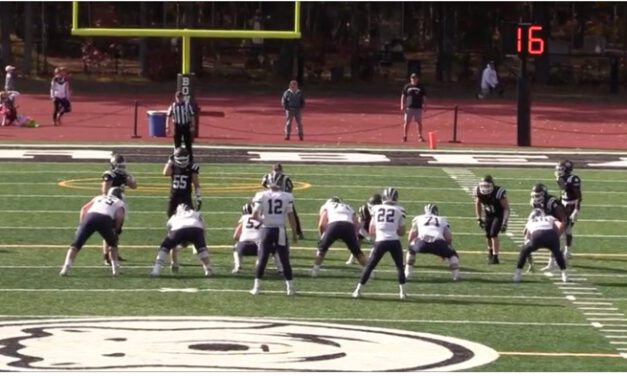
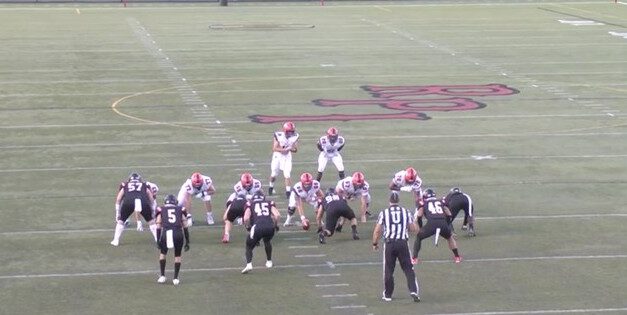
  • Minus- when every inside gap is covered playside
  • Plus- when the EMLOS is double covered


Backside Rules- Assume Frontside Rules (Tackle Pull)

  • Over- Down


BS Tackle Rules

  • Peak pull for the first LB front-side “Backer”.
  • Keep your head inside and make contact with your outside (play-side) shoulder. Near foot-near shoulder.  Velocity!!
  • Make your linemen right, never bypass a free defender!


The Backfield Mesh

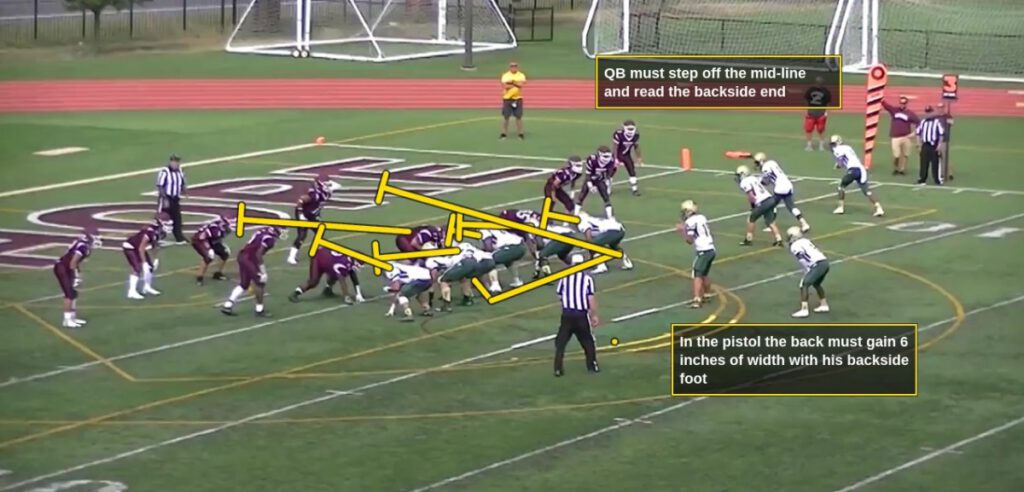
The QB has the same footwork if the ball carrier is in the pistol or sidecar position.  His primary goal is to give the back the midline and point his belt buckle at his backside read.  He will step with his backside foot first and step toward the play side, pointing it at his backside read.  He will next step with his play side foot squaring up to his read and reestablishing his shoulder width base.  The QB will push the ball back as far as he can and make his decision by the time the ball reaches his belt buckle.  The ball carrier in the pistol will take a 45-degree, 6-inch step with his backside foot and then press his aiming point of the play side hip of the center.  If the A gap is open, he will hit it.  If it is closed, he will get on the inside up hip of the puller and follow him into the next available gap.  In the sidecar position, only the 1st step is different.  The back will shuffle keeping his shoulders square and dropping his inside foot back.


Tail Back Rules

  • Aiming point- playside foot of the center (inside out)
  • If the frontside A gap is open hit it! If not follow your lead blocker
  • 1 cut
  • Expect the ball to hit inside
  • If a defender comes free get downhill now and get positive yardage. No negative plays!


Fullback Rules

Since this is a 1 back run you will be tagged to block a specific player


Quarterback Rules

  • Step off the midline with the backside foot
  • Read the backside EMLOS unless tagged to read an interior defender
 

Read More

Quarterback Run/RPO Manipulations from Empty Formations

By Eric Struck
Offensive Coordinator/Quarterback’s Coach
Lincoln High School (SD)
Twitter: @EricStruck


Over the last two seasons, the empty formation has become a big part of what we do offensively at Lincoln High. It has given us the ability to get our best athletes on the field and be able to attack with the pass as well as the run. We ran some Jet Sweep from empty, but we wanted/needed something in the run game that would be able to attack the middle of the defense. Versus empty we generally see an Odd Front from the defense and a 4 or 5 man box. When we see a lot of Odd Front defenses our go-to run play from 3×1 or 2×2 is our Power scheme. When we run it from open sets, we tag a “Base” call so our playside tackle knows he must stay on the end man on the line of scrimmage and not block down like he would in our regular Power scheme.

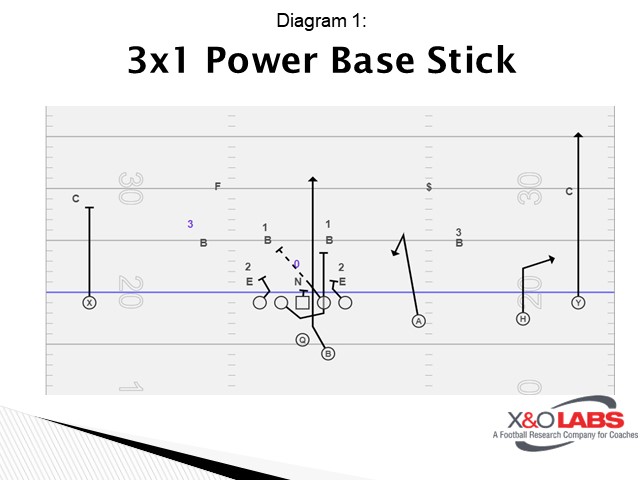
Struck Diagram 1


Our go-to RPO when we are running this scheme from 3×1 is our Stick RPO. It was an easy transition for us to incorporate this running scheme and RPO scheme into our Empty Package.

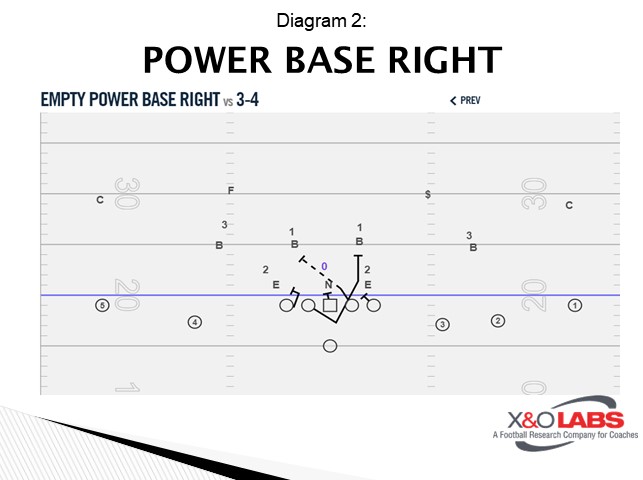
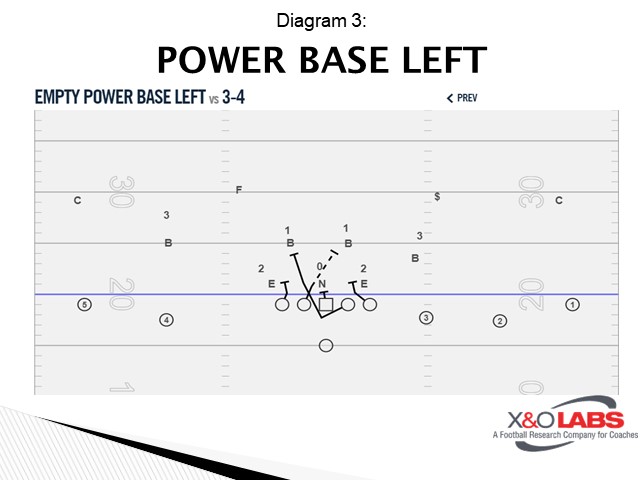
As was stated earlier, we like this scheme versus Odd Fronts. It allows us to double team on the Nose to the Backside Linebacker with our Playside Guard and Center. Both of our tackles will base out the end man on the line of scrimmage.

Struck Diagram 2

Struck Diagram 3


We typically put the three-receiver side away from the side we will be running the ball. To the three-receiver side, our #1 receiver or the farthest receiver outside will be running an outside release fade route. Our #2 receiver will run a three-step arrow route towards the sideline. Our #3 receiver will run a 3-5 step hitch route, settling in the open grass between the inside Linebacker and the outside linebacker. If a linebacker is covering our #3 receiver and the next linebacker inside is in the box, our receiver will look to run his route in the space between the two defenders.

Read More

Creating and Communicating “If/Then” Controls for an Empty Package Menu

By Jeff Thomas and David Carskie
Head Football Coach and Offensive Line Coach
University of Puget Sound (WA)
Twitter: @jeffthomas4 @CoachCarskie


What does a team that throws the ball nearly 70% of the time have in common with a wing t or option attack? We believe a lot at the University of Puget Sound.  Our approach to offensive football is to have a rationale for calling plays based on putting a specific player in conflict.  This loosely based approach to Wing T football applies to all personnel groupings in both the run and pass.  We build our playbook with If/Then statements like what you see a Wing T or option system use.  Our core belief is to always have complementary answers to whatever a defense gives us. Over the last two seasons, we have lined up in 5-Wide Receiver sets nearly 50% of the time. In our offense, we will always have a screen component in every scenario.  We will cover one screen or rub play and one drop back play per If/Then statement. Ideally, these calls are made by me from the sideline in normal down and distance situations. However, we have progressed towards teaching our quarterbacks to make these calls at the line of scrimmage. The scope of this report is to go through one of our decision trees of why we call what type of play at a specific time.

For this report, we will break down our If /Then statements working from Cover 2, to Cover 3 to Man coverage. This report will not cover each scenario or cover specific coverages we might face from specific opponents. Since we line up in 5 Wide Receiver sets so often, we get a myriad of “special” coverages each week. However, the base premise is the same as how we go through to figure out the best form of attack rather than picking a random play.


Control 1: If 5 man or less box…then run the ball

The first area we look at is to count how many players are in the box.  We define the box as horizontally from TE to TE (whether we have one on the field or not) to 5 yards deep.  If there is less than 6 in the box, we will determine if we have angles and space to run the ball with the QB. Often, we will have only 5 in the box but an outside linebacker close enough to get a hit on our QB if we called a designed run play for him. In our designed QB run plays, the QB must get 5 yards before an unblocked player can get to him or we have better options.

Diagram 1


Editor’s Note: The staff at Puget Sound has provided narration for each clip below:


Clip 1: Notice how there are only 4 in the box. This is a best-case scenario to run the QB.  We get this look often, especially when teams are playing any version of 2 man in a 4 DL look.

Clip 2: Even though they end up bringing pressure, they only have 4 in the box pre-snap.


 “If/Then” Protocols to 3 Receiver Side:

We are going to focus this part of the report on working the 3 WR side of the formation.  Later we will discuss throwing the ball to the 2 WR side. We also in our offense have full-field reads that have multiple ways to get WR’s across the field. For this report, we will leave full-field reads out of the report. The primary point is to develop a thought process to fit your offense, rather than specifically copy what we have come up with at Puget Sound


Read More

2-Under, 3-Deep Pressures from 2-4-5 Spacing

By Adam Hovorka
X&O Labs Managing Editor

with BJ Hammer
Head Football Coach/Defensive Coordinator
Bowdoin College (ME)
Twitter: @CoachBJHammer


Coach Hammer utilizes what he calls a 2-4-5 defense. Even though he mixes in 4-man and 3-man fronts he is playing with only two traditional down-lineman on the field. This was born of necessity as it is tough to recruit Defensive Lineman at the DIII level. This is also true at the high school level and playing this style of defense will get your better athletes on the field.


Philosophy:

Coach Hammer, the Head Football Coach and Defensive Coordinator for Bowdoin College, says his defensive philosophy is based on three components:

1) Get the ball back to the offense by forcing turnovers or getting three and outs.

2) Stopping the run by forcing all runs to bounce to the outside by mixing fronts, stunts, coverages, blitzes, and emphasizing run fits, tackling and pursuit.

3) Pressuring the Quarterback by bringing 5,6,7 and 7+ form all different angles and paying attention to blitz fits.  Attacking protections from the inside out and bluffing pressure.  Coach Hammer and Bowdoin want to force their opponents to make mistakes and feel by bringing pressure this will force the opponent into mistakes.


The focus of this report is Coach Hammer’s Texas pressure family, which is a pressure characterized by sending six defenders, with the ability to send three A-Gap rushers and play Cover 5 (Hot Coverage) behind it.


Personnel:

Look at the following chart to see what Coach Hammer names his position and the qualities he is looking for in those positions.

R Traditional 3 Tech – DT
E Traditional 3 Tech – DT
H Strong Side Hybrid OLB – Looking for a 3-4 OLB type
V Weak Side Hybrid OLB – Looking for a 3-4 OLB type
W Weak Side ILB – More of a down-hill run stopper
M Strong Side ILB – Bigger FS type
S Strong Safety –Run Stopper and Ability to play the Post
FS Weak Safety – Run Stopper and Ability to play the Post
SS Slot Corner
CB Cover Guy
CB Cover Guy


Communication:

Coach Hammer uses wrist coaches to communicate his blitzes and feels that enables his guys to be comfortable in their assignments.  Coach Hammer will call pressures to the open side (away from TE), to the TE, from the field or boundary, and to the RB and away from the RB.  A key component of this pressure family is the fact that it will not change based on the offensive formation or motion.  Coach feels strongly that if calls pressure he wants that specific pressure and doesn’t want to check out of it.  The only check they will need to make is if the offense comes out in empty.  Coach Hammer will have specific pressures that the players will check to just for empty. Coach Hamer will go into a game with two or three pressure checks for empty along with some form of drop 8 coverage.

Read More

“Inside out to Down” Read Progression in Double Post Concept

By Joe Gerbino
Offensive Coordinator/Quarterback’s Coach
Utica College, (NY)
Twitter: @CoachGerbino


Double posts have been a great addition to our offense. The concept allows us to be aggressive and read a third-level defender, but also have a shallow component for completions. It is a “shot play” with a built-in check down (without using the back).  Double posts have been compatible with our 10, 11, 12, and 21 personnel packages. The concept meshes well with our play-action and drop back pas protections. We have clips of completing this play versus every coverage, whether it be man, one high/two high zones, or split field variations. We have run a variety of double posts since 2015. Over the years we have built the concept to help us every week, regardless of opponent. We have grown to like it so much, that in 2019, it was our most frequently called pass play.


Why Run Double Posts?

Many Offensive Coordinators are looking for a “high completion percentage play” but also understand “big plays” help you win. At Utica, we think Double Posts accomplish both. There is a component to take a shot versus one high structures, split the safeties of two high structures, or get the ball underneath to “throw short, run long.” Our quarterbacks and skill players love this concept because they feel every route can be thrown.


QB

First, three-step footwork. We coach our QB’s to always check our back-side receiver to see if that ball can be completed. We tell our quarterbacks a defense must “pay the price of admission,” and force us to make a read and take a drop. Anytime we can take our X receiver we will. We determine the depth and leverage of the boundary CB, along with the pre-snap alignment of the weak safety regarding the hash.  Once we have determined we cannot take the “free access” throw, we will then get into the concept itself. We will read our double posts inside-out to down. This is base installed out of 2×2 formations – low post by the play side #2, high post by the play side #1, and then shallow cross from our backside #2 – that will eventually get into our play side vision (should not have to move “the stripe on our helmet”).

When talking coverage with QB’s, they know which routes are ideal versus specific looks, but the read will ultimately remain the same, inside-out to down. For a given opponent we will quicken the reads based on the game plan. For example, against a cover three defense, we will be quicker progressing from the high post to the shallow, keeping in mind that the safety is splitting the hashes. Against a cover 4 team, we will be quicker on our first read to the low post, knowing that safety will play it, man, past a certain point, and opens up the high post over top. Ideally, these are the routes we want versus specific coverages.

Cover 2: Low post splitting safeties.

Cover 3: High post convert vs squeeze corner or shallow underneath LB.

Cover 4: High post behind strong safety.


Man Coverage:

0 high man: Low post is closest to us and will press toes and cross face vs man defender.

1 high man: High post convert to the field or shallow cross with man defender trailing.

2 high man: Which post wins? Most likely shallow cross – let’s not be in third and long for teams to get into this.

Read More

The Player Driven Culture System: Introduction

“Every time you’re in front of your team everything you say matters and it has to be intentional.”
-Dabo Sweeney, head football coach, Clemson University


By Mike Kuchar
Senior Researcher/Co-Founder
X&O Labs
Twitter: @MikeKKuchar


This wasn’t the introductory team meeting that players were expecting. It was 2004 and Louisiana native Ed Orgeron has just been hired to lead the program at Ole Miss, one of the gems of southern college football. In his deep Cajun-like drawl, instead of projecting how physical his team was going to be, he pontificated on how tough he was. Before players knew it, “Coach O” was ripping off his shirt and challenging some of them to a fistfight. Luckily, no one obliged. “It was the strangest thing I’ve ever seen in my life,” a former player said. “I mean, we had plenty of guys on that team from some really bad places. He would’ve been jumped or shot or both. I still can’t figure out if he knew that, that no one would try and fight their new head coach.”

Turns out his coaching staff wasn’t spared this brunt of tirades either. During that first season in Oxford, he’d wear them down both emotionally and physically, treating each as if they were defensive linemen—the only position he coached before getting the promotion. Ultimately, he strangled the life out of the program, finishing 10-25 over three seasons from 2005 to 2007. In hindsight, he says going 100 mph, on and off the field, “broke people, it broke the team.” He was using the wrong messaging and it had a catastrophic consequence on the progression of the program.

Now the 2020 version of “Coach O” has made a 180-degree transformation, thanks in part to the experiences he had in that first go around. Coming off a national championship campaign at Louisiana State University, Coach Orgeron told me it took him over a decade to learn two very important lessons: number one, don’t have kickers and quarterbacks compete in the Oklahoma Drill (seriously) and two, never take for granted an opportunity to message the core values of the program.

Read More

The Player Driven Culture System Case 1: Collaboration

The Pathway: Teaming


“Tell me and I will forget, show me and I may remember; involve me and I will understand.”
– Confucius


By Mike Kuchar
Senior Researcher/Co-Founder
X&O Labs
Twitter: @MikeKKuchar


“Nobody washes a rented car.” If you spend enough time around North Forney High School (TX) head coach Randy Jackson, you’ll probably hear that gem on more than one occasion. A layman’s translation: if something isn’t owned, what responsibility do people have to take care of it? A football program’s culture must be owned, not rented, and it must be owned by every player and every staffer that associates with it. And if the landing is ownership, then the launch must be a collaboration, where players are given the opportunity to work with coaches in protecting the culture. For those like Coach Jackson, this competency is more about accommodating a lifestyle inherent in this generation more than any generation that came before it. “Kids have information available to them now everywhere,” he says. “They don’t need us for information. Their voice is heard by liking and sharing things all day on social media. How can we not give them a voice, but they are getting it everywhere else?” How players are given this stake will be the focus of this competency. So, for many reasons, I felt impelled to begin my research with this collaboration. Without collaboration, there is no ownership. And without ownership, there is no player-driven culture.


Collaboration as a Competency

One of the base foundations of establishing a player-driven culture system is generating ownership through collaboration. While the head coach and his staff are responsible for building the program’s culture- which I elaborated on in the Prologue- in order for players to feel as if they have an investment in the culture, they need to be entrusted with the process of defending it. The behavior of collaboration is without question more relevant now than it has ever been. The players that coaches are working with now are used to having a voice. It’s the social media generation, where every “like” is quantified and every voice, regardless of source, is equitable.


Why Collaboration is Essential to Creating Player-Driven Culture

Coaches are now using collaboration to empower players with various ways in which they can have ownership in the program, all of which I present in this study. The science behind the positive effects of collaboration is overwhelming, and perhaps too lengthy to go into detail here. Quite simply, collaboration is one of the prime behaviors that lead to ownership, and this collaborative effort between a coaching staff and its players is developed through an act known as “teaming.” The Harvard Business Review defined teaming as the process of identifying and briefing essential collaborators to work together in accomplishing a goal. Consider the “goal” as the core values described in the Prologue. While this competency of “teaming” may be a mainstay in the business world among adult professionals, it has only started garnering traction in football programs. It’s the goal of any player-driven model to build a culture where teaming expected and begins to feel like a natural part of the developmental culture.

Read More

The Player Driven Culture System Case 2: Connectivity

The Pathway: Vulnerability


“Culture, by definition, is connecting people.”
– PJ Fleck, Head Football Coach, University of Minnesota


By Mike Kuchar
Senior Researcher/Co-Founder
X&O Labs
Twitter: @MikeKKuchar


Back in 2014, longtime assistant football coach Brent Myers sat with his hands clenched into fists under the table, finding it hard to control his true feelings. It was nighttime, mid-way through a late July training camp and he was exhausted. While every player and coach in the Weber State University program got up to address the entire group about what the program means to them, Coach Myers kept wondering when this was all going to be over. “I kept asking how this crap is going to help us win?” he recalled. “I just wanted to go out and practice.” The exercise was called “testimony and commitment,” and had become a staple in head coach Jay Hill’s pre-season routine. A former assistant at the University of Utah under coach Urban Meyer, Coach Hill put his spin on the activity by having both players and coaches tell their life stories in front of the entire program each night in pre-season camp. Flash forward five years later and Myers, the old grinder of a football coach of 30+ years has been transformed. Perhaps uncoincidentally, this personal transformation runs parallel with the program’s success. After going 2-10 in 2014, the Wildcats finished with 11 wins in 2019, one win shy from playing for the FCS national championship. While the tangible proof of the transformation results in wins, the intangible and perhaps more important factor lies in the connection the team and coaches created in that mountainous terrain in Utah.


Connectivity as a Competency

The competency of connectivity is directly aligned with psychologist Abraham Maslow’s philosophy which revealed that once behind the satisfaction and security of basic needs—safety, food, water, shelter, warmth, comfort—people are no longer driven by purely extrinsic motivations. Instead, they turn their attention to deeper needs such as safety, love and belonging, esteem, and self-actualization. Deeper needs like a sense of belonging and love often supersede assumed motivations such as money, possessions, or recognition. In other words, if players and staff feel like their values are in line with the values of a football program, they will work harder in assimilating themselves to the culture of the program. And coaches who understand these desires, work harder to create a sense of connection with anyone associated in the program. The shared emotional connection between a group of people is a stronger motivator than anything else.


Why Connectivity is Essential to Creating Player-Driven Culture

Many coaches, like the University of Minnesota head football PJ Fleck, believe that culture, by definition, is connecting people. Coaches are in the people business and most psychologists will argue that a feeling of connection is one of the more primal desires for human beings. Ask any social worker and they will explain that the ability to feel connected is neurobiologically how we’re wired. People yearn to be connected in any way, shape, or form with one another. This behavior of connectivity answers existential questions like “why are we here?” and “what is our purpose?” Connectivity defines purpose and produces clarity in groups. It’s what gives purpose and meaning to our lives. But like culture, connectivity is always a work in progress. It’s an evolving process where individuals continually seek to find their place in a particular environment.

Read More

The Player Driven Culture System Case 3: Self-Advocacy

The Pathway: Empowerment


“Once players realize that their opinion matters and it’s important, they will contribute more to the advancement of the program. And that’s how you develop educated football players.”
– Fergus Connolly, performance coach


By Mike Kuchar
Senior Researcher/Co-Founder
X&O Labs
Twitter: @MikeKKuchar


“David” was the type of kid many of us have in our programs. He did everything right: never in an ounce of trouble, a meticulous student, and an extremely hard worker. He was what most coaches would call a program kid. But, there was one potential glitch in David’s personality: he wasn’t a very good communicator. Like most teenagers, it was hard to get a beat on anything that was bothering him. David internalized and suppressed his beliefs, that was up until they no longer could be controlled. And that’s where the explosion ensued. This explosion could take place in many forms, poor behavior on the field or classroom and even destructive or illegal, behavior off the field. Either way, it could have a catastrophic effect on an individual’s demeanor and in turn, a team’s development. And in most cases, coaches wouldn’t know what he was feeling until it was too late. As disruptive as it was personally for David, it was even more disruptive for the team. He knew what was bothering him, yet had trouble communicating it. It’s a scenario that plays out every season in every program. Yet what if David was placed in an environment more conducive to self-expression? An environment where players were empowered to communicate their needs? Could this have been prevented?


Self-Advocacy as a Competency

The story of David is the result of players not being empowered to express themselves and their self- interests. Self-advocacy is a behavior that enables players to understand their strengths and weaknesses, know what they need to succeed, and be able to communicate that to other people.

It’s a competency that gets broken down into three important elements:

  1. Understanding specific needs
  2. Knowing what help or support will address those needs
  3. Communicating those needs (both to other players and coaches in this case)


Why Self-Advocacy is Essential to Creating a Player-Driven Culture

Self-advocacy is the action of representing oneself or one’s views or interests. But for young players who may be inherently reserved, asking for help can be intimidating. So, they need to be equipped with multiple strategies to address their needs. The development of self-advocacy is a byproduct of an educational process provided to players by coaches, that perpetuates the intent of whole-person development. I found that this competency of self-advocacy to be one of the more difficult to attain because it exists through empowering players with the opportunity to express their personal views and outside interests, which can be a struggle for many reasons. For one, young student-athletes grapple with vocalizing their needs because it contrasts with the masculine culture football is embedded in. For coaches to create an environment conducive to promoting self-advocacy, they need to not only accept self-expression but promote it. While the mantra “open door policy” may sound cliché, many of the coaches in this study live by that philosophy and spend more of their time working on off-field pursuits to develop the players in their program. Secondly, young players are still in the developmental process of learning about themselves, and may not be entirely aware of their social needs; proving the assertation that “they don’t know what they don’t know.” Often players develop an identity that links themselves directly and solely to their football prowess.

Read More

The Player Driven Culture System Case 4: Emotional Awareness

The Pathway: Mindfulness


“We made a conscious decision about getting into our kids’ heads and getting into other aspects besides football. We wanted to be part of the solution and not the problem.”
– Steve Specht, Head Football Coach, St. Xavier High School (OH)


By Mike Kuchar
Senior Researcher/Co-Founder
X&O Labs
Twitter: @MikeKKuchar


Mike McElroy didn’t know what to think. The twenty-something defensive coordinator transplant from Minnesota Concordia thought he was interviewing for a coaching position at Bethel University (MN), but the setting resembled more of what one would experience on Oprah Winfrey’s couch. Yet the interviewer was not the former queen of daytime talk, it was a 31-year veteran head coach Steve Johnson. Looking back, Coach McElroy remembers more about the emotional exchange between the two that day than he did about the questions being asked. “He cried in front of me three times talking about the kids in the program and his career path,” said Coach McElroy. “It was in a way that I was taken aback by it.” Coach McElroy was sold immediately; not on Coach Johnson’s football acumen but on how genuine he was. Coach Johnson’s success as a football coach is hard to ignore. Taking over his alma mater at the age of 33, he eclipsed more wins in his third season than the program did the entire decade before. Now, at 64 years of age, his authenticity as a man that has left a lasting impression among the many that he’s coached.

A couple of years after being hired, Coach McElroy recounts a Bethel University football Gala with former players and was floored by the lifelong connection Coach Johnson made with them. “One guy that played in the early 90’s stood up and told the story of a recent struggle he encountered and some of the difficult choices he made during that time period. Throughout his talk, he kept reflecting on Coach Johnson’s core values of being grateful, tough, and devoted. He used the same language we still use today. I was shocked by the consistency of the language and the message.”

This authenticity isn’t just saved for Coach Johnson’s closest associations. During the recruiting process, he meets with every potential student-athlete that comes into the facility. Not to persuade them to come to the school that has made him what he is today, but to educate each on the process of picking a school that best fits their needs. His purpose is strictly guidance: to make each player know that he cares about them, regardless of their choice. Coach Johnson serves as an invaluable contradiction that separates the conventional association of being “football tough” with the progressive role of being emotionally expressive with no reservations or no pretense. He’s okay with wearing his emotions on his sleeve at all times, and not afraid of complete strangers seeing it. Perhaps, he’s completely gone against the grain of what Coach McElroy and the rest of the staff playfully calls “the Tommy tough nuts,” of the coaching profession, those pumping their chest on their Twitter handles. “It’s weird, it’s different but it’s special,” said Coach McElroy. “That attracts a certain type of person. No fake tough guy stuff. We are going to hit you in the mouth on Saturdays, but we’re trying to be this type of man every day.” Oh, and Coach McElroy makes sure to prime recruits for the piece of advice that he wasn’t prepared for during his first meeting: get ready, he’s going to cry.

Read More

The Player Driven Culture System Case 5: Responsibility

The Pathway: Accountability


“A player run locker room was always the ones that had the most accountability, both to themselves and to their teammates. Any successful team that I played on or coached on was a player-driven locker room.”
– Herm Edwards, head football coach, Arizona State University


By Mike Kuchar
Senior Researcher/Co-Founder
X&O Labs
Twitter: @MikeKKuchar


PJ Fleck often quips about the chaos surrounding his first off-season at the helm of the University of Minnesota football program in 2016. “Only half the team showed up at the first team meeting,” he says. “There were more lawyers than there were football players.” It got to the point that first spring when graduate assistants had to line up at left tackle just to give the defense a decent look in recognition drills. And this was a major Big 10 program coming off a 9-win season. For a time, it seemed as if Coach Fleck’s ultimate desire of having a player-driven program was just a mirage, at least to outsiders. During those first two years,  all operations had to be coach-led as he rushed to mature over 80% of starters that were playing for the first time (his theme in 2017 was “Rush to Maturity”). However, by the end of a 2019 campaign, which produced 11 wins, there were only two players leaving the program that off-season. The shift in culture from coach-led to player-led transpired. Now, the next phase of his player-driven culture is teaching these veterans to learn the importance of responsibility of defending the culture, which is the focus of this competency.


Responsibility as a Competency

At its core, responsibility is accountability, both individually and collectively. By definition, responsibility is the moral obligation to behave correctly toward, or in respect of, the program and the foundation of a team-first dynamic. Ideally, any player-driven culture begins with guidance from the head coach and staff. But, to complete the transformation from a coach-led to a player-driven culture, players need to begin to take ownership of the program. And the quicker players trust in the culture, the more they take ownership of it.

During the course of my research, I found there to be a difference between authoritative responsibility, when a coach is telling a player what to do and assumed responsibility, where ownership of the program develops organically. While coaches do need to create the initial vision of the program, eventually they need to turn the keys over to a particular unit or group of people to hold others accountable, letting them drive the bus. “When you give players ownership, that’s when they become problem solvers,” performance coach Fergus Connolly told us. “It’s not just about the game. It has to do with culture, organization, and self-management.” Yet understanding the struggle of bestowing too much responsibility can sometimes have devastating consequences. We’ve all been in the position as coaches when we’ve given responsibilities to players that perhaps weren’t worthy of it. We get wrapped up in the potential optimism of having our best players lead when they simply are not ready. So, when is the right timing to endow this absolute leadership? Many of the sources to this study didn’t talk of a watershed moment. In fact, they believed that like most aspects of culture, responsibility eventually fermented itself over a significant period of cause and effect using the methods detailed below. Players begin to learn their path as leaders, much as coaches do.

Read More

The Player Driven Culture System Case 6: Resiliency

The Pathway: Adversity


“Allowing players to continually work through failure promotes comfortability in pressure-filled experiences.”
–Mike Norvell, Head Football Coach, Florida State University


By Mike Kuchar
Senior Researcher/Co-Founder
X&O Labs
Twitter: @MikeKKuchar


Will Healy was only three games into his head coaching career and this was certainly not the vision he had for himself. His Austin Peay State University football team had already been outscored 154 to 59, and things weren’t getting better. As he went to seclude himself  in the corner of the Eastern Illinois University baseball team’s dugout after this last drubbing, he questioned his purpose as a head coach and mentor. “I remember just crying,” he said. “I asked myself what did I do to deserve this? Where is the light at the end of the tunnel? I hurt so bad. It killed me for the coaches I hired that they weren’t having a great experience. It killed me for the players that bought into what we were asking them to do that they couldn’t enjoy some semblance of success. I took it hard.”

He originally believed that his identity as a football coach was not based on results but on the process of developing young men. So, why was losing a game hurting this much? He questioned what was really important. Call it a watershed moment, call it what you want, but it was at that moment where he made a conscious decision to teach the value of appreciating wins rather than lamenting about losses. Although he would have to wait an entire season to put this new philosophy in order, the Governors finished 0-11 that season, this shift in mindset started to produce tangible results. He led Austin Peay to an 8-4 record in 2017 and five wins in 2018, the first back to back five-win seasons since 1984-85.

Now as the head coach at UNC Charlotte, he built upon the mentality of celebrating wins by incorporating what is known as “Club Lit,” a fictional club-style party dynamic hosted in both home and visiting locker rooms alike. The lighting is dimmed, illuminated solely strobe lights as the bass pumps from a local DJ’s digital turntables. It’s a reward for winning but more importantly a lesson in the hard-fought world of Power 5 football.


Photo Courtesy of UNC Charlotte Football

Read More

The Player Driven Culture System: Epilogue: Sustaining A Player-Driven Culture: Surmounting the 6 Main Constraints

By Mike Kuchar
Senior Researcher/Co-Founder
X&O Labs
Twitter: @MikeKKuchar


During the course of my research, I found that sustainability of culture may be even more difficult to obtain than creating it. As Clemson University head coach Dabo Sweeney told us after his initial success, he had to train players how to fight complacency. So, I wanted to make sure I addressed all the obstacles that coaches may encounter when working to sustain a player-driven culture. Player-driven culture is without question the healthiest form of culture, yet it has its risks and may not always be attainable due to the various circumstances presented in this section. There can be several obstacles, I refer to them as constraints, that may prevent complete establishment of these competencies. How coaches navigate these waters of uncertainty is at the crux of developing sustainability in culture and as one of my sources told me, “the soil needs to be ripe to build your culture.” Quite simply, he meant that all components, time, resources, support, etc., must be completely aligned to create your culture.

This Epilogue is about the six roadblocks or constraints, I found coaches were having in building and sustaining a player-driven culture. Of course, these constraints can vary based on the level you are coaching. For example, many coaches at larger collegiate programs may not have to work through financial issues, while high school programs may not need to be concerned too much with recruiting. What makes creating player-driven culture so difficult is that all parts of the program must be on board, or aligned, with the cultural initiatives. High school coaches have the liberty of time to establish this—many can stay at their current post for several years. But at the collegiate level, the administration is not as patient. There are no more five-year plans, so to speak.

Remember, the end game in a player-driven culture is always ownership, where players and coaches are given some form of autonomy to defend the core values of the program. Some coaches, like Tim Rulo, the head coach at Chillicothe High School (MO), refers to this progression as impact teaching, while others refer to it as “whole person” development, as I explained in Competency 4, Emotional Awareness. Impact teaching comes in the form of developing players in every aspect of their lives—athletically, academically, and socially. It’s a need that many feel this younger generation is thirsting for. “I see young men struggle,” Coach Rulo said. “I see grown men struggle. The struggle in dealing with conflict, how to lead, and how to get people to get on board. I feel like a lot of times I see men being passive in areas of their life as they get older because honestly, they’ve been spoon-fed how to do things.”

Read More

Communication System Protocols for Odd Pressures

By Steve Erxleben
Defensive Coordinator
South River High School (MD)
Twitter: @CoachErxleben


In today’s modern challenge of defending offenses that feature multiple formations made up of multiple personnel groupings with multiple forms of tempo, Defensive schemes have to be sophisticated enough to challenge the run, pass, and protection schemes while also be simple enough to allow players to play fast. As a defensive staff here at South River High School, we decided years ago to transition from more of a base front and coverage team to a scheme rooted in zone pressure and match-carry-deliver principles on the backend. Within our culture defensively and as a staff, we believe with the personnel we have and the style of offenses within our league, hanging our hat on zone pressure allows our scheme to be balanced, have the specific force and alley rules, has a reduced amount of checks, is highly adjustable, and allows us to prevent explosive plays, all allowing our players to play fast.

This past season in 2019, out of 666 plays in 11 games, we zone pressured 72.8% of the time in multiple down and distance, personnel, and +/- situations out of multiple fronts, pre-snap movements, and coverages. Specifically, in what we refer to as heavy run down and distances, we were a 56% blitz team, but these percentages could vary based upon the personnel on the field. “Run Heavy” can also be very comparatively speaking based upon the opponent but for the sake of argument we refer to heavy run downs as 1st and 10, 2nd and 3-1, and 3rd and 3-1.

With these situations being more run-heavy, we expected and intended to see a variance in personnel, formations, blocking surfaces, splits, and schemes designed to create as many double teams as possible. To eliminate some of these threats and to increase the probability of our run pressures getting vertical penetration, create 1 on 1 matchups, and eventually make the ball spill to unblocked defenders we committed to incorporate pre-snap movement in the form of stemming from head to shaded fronts and stemming back to a base front to our already established blitz patterns and pressure terminology. In the end, can we make the OL think twice before the ball is snapped?


Base front terminology and how it relates to pressure

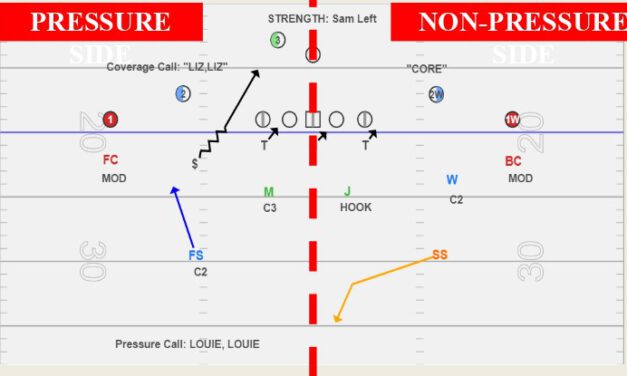
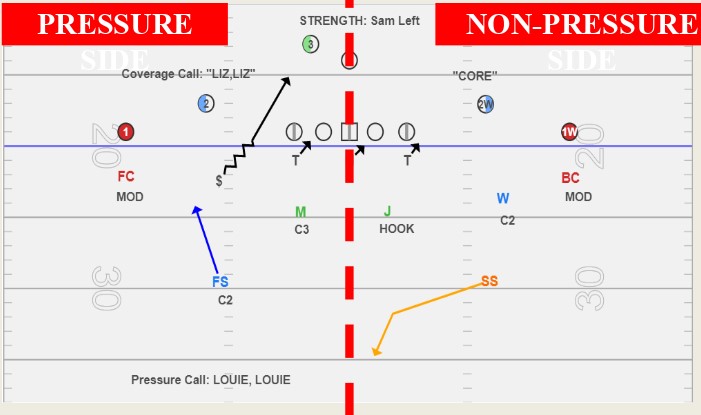
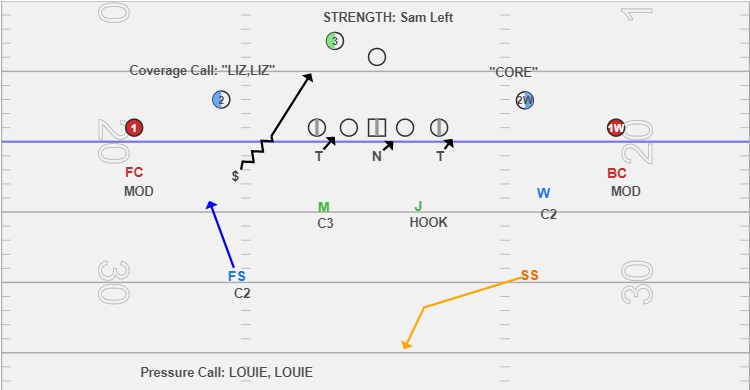
Since this report is about effecting runs and run fits in blitz patterns with pre-snap movement, it is warranted to first touch on our Base verbiage and what the Blitz and non-pressure sides are doing (DIAGRAM #1). In our base defense, we will set our front either to the field or the boundary, to or away from the multiple receiver side, to or away from the TE, or to or away from the back in the shotgun. Where we are setting the front is a weekly game plan decision. Every snap we make either a “Roger” or “Louie” call which dictates where the 4th rusher is coming from and if we are in a 3-deep situation, where safety support is spinning. Our Interior linemen always slant away from the front call (Roger/Louie) as the 4th rusher (our call side OLB) becomes the C gap player/5 technique call side. The reduction side call correlates with a coverage call to establish who the force player is to the reduction side as well as who the seam player will be. All of our same-side ILB/OLB or “edge” blitzes correlate with a Roger or Louie call, which we feel makes it easier for our players to identify and gives them a chance to focus more on a disguise and triggering the blitz from a proper depth and angle.


DIAGRAM #1

Diagram 1


In our terminology, any front that begins with the letter “S” determines the pressure side is to our “SAM” backer. Our SAM backer is our hybrid OLB/DB kind of player and is the adjustor to the field and formation. If our front call is an “S” front the SAM now is the 4th rusher and the reduction is to that side as well (DIAGRAM 2)


DIAGRAM #2

Diagram 2


Conversely, if the front begins with an “A” we are setting the pressure and reduction AWAY from the SAM, so now our WILL OLB is the 4th Rusher and the pressure side is set away from the SAM. (DIAGRAM #3)


DIAGRAM #3

Diagram 3


Read More

RSOs (Run/Screen Options) and PSOs (Pass/Screen Options) From 10/11 Personnel

By Jeff Fischer
Offensive Coordinator/QBs Coach/Recruiting Coordinator
Ventura College (CA)
Twitter: @coachfischer7


At Ventura College, we want to stretch the defense both vertically and horizontally on any given play. These concepts are meant to widen the field and use all 53 and 1/3rd, with simple quick “Candy” screens. We use these quick screens as a part of our run game, giving our athletes the most space possible with the ball. We all want an honest box for our run game, or we are going to “Take the Candy” on our quick screen game. The great thing is it is an easy concept for our players to understand and it forces the back end of defenses to either play tighter in coverage or must make a lot of tackles in space.

We run the quick screen game to both sides of the field if the run is intended to be between the tackles. Anything that is designed to be run outside we will stalk block to that side and we can run the quick screen backside.

We try to make the reads as simple as possible for the QB (counting). Including the QB read to run rules, do we have numbers to block the box? Or do we have numbers in the Quick Screen Game? The only time the QB needs to alert and possibly change the play is vs Cover 0 and pressed across the board.


10 Personnel:

5 or 5 ½ in the box = Run the ball!

6 in the box = Run or Throw depending on the depth of secondary or apex defender. (If they give you the candy, take the candy)

6 ½ or 7 in the box = (Depending on Run Scheme) Have to throw!  Press Cover 0 Quick Screens aren’t great (likely to change play).


11 Personnel (TE in Run Scheme):

6 or 6 ½ in the box = Run the ball!

7 in the box = Run or Throw depending on the depth of secondary or apex defender. (If they give you the candy, take the candy)

7 ½ or 8 in the box = (Depending on Run Scheme) Have to throw!  Press Cover 0 Quick Screens aren’t great (likely change play).


We do not play fake and we make the decisions pre-snap, giving us the ability to get the ball outside as quickly as possible. We want to play fast and not let the defense move around after we have made our decision, so we do not tell the RB if we are throwing when in the gun (RB takes regular run tracks). QB must take one clear step by throwing foot backward, so we do not hit the RB while throwing. From pistol, QB must tell RB if we are going to throw the ball (usually with hand signal right before the ball is snapped).


Read More