
Offensive Line: 4 Ways to Improve Pass Protection

By Justin Iske

Offensive Line Coach

Fort Hays State University

Justin Iske, Offensive Line Coach, Fort Hays State University (KS)

One of my favorite sayings is “you never stop learning.” That is why we try to do as much research as possible every off-season and why we remind ourselves often that there are many ways to do things. We do not claim to have all the answers, but our hope is that this article gives you a pointer or two that will help you.  Most of the ideas that appear below have been stolen from other coaches. However, we have also gotten many great ideas from our players as far as what is productive for them and what is not. We have exit meetings with our players after every season and every spring practice to ask them questions about what they like and don’t like about what we do.  While we don’t suggest making major changes every year, there is always something that can be improved upon.

General Fundamentals:

We wanted to share a couple of general thoughts on pass protection before we get into the nuts and bolts of our pass pro technique.

  • Eyes on the target (middle of chest):  We use the phrase “Aim small, miss small.”  We work to keep our eyes open throughout the duration of the play in order to react to pass rush moves, slants, twists, etc.
  • It is important that our steps mirror each other (and are the same distance) so that we maintain our base at all times. We must lead with the foot in the direction we are going.  For example, if setting to the right, the right foot must move first.
  • We want to keep both feet on the ground as much as possible. You wouldn’t throw a punch in a boxing match with one foot in the air, just as you don’t want to make contact with a defender with one foot in the air. That is why we drag our second step to keep in contact with the ground.
  • If you have a player that is having a problem with false steps (stepping with the wrong foot or not gaining width on that first step), have them shift their body weight opposite the direction they are going to force the first step. For example, if most of your weight is on your right foot, it is impossible to step with that foot and vice versa.
  • Finally, we teach our players the concept of the pocket. It is our center and guards’ responsibility to ensure the depth of the pocket (keeping defenders on the line of scrimmage) and our tackles’ responsibility to ensure the width of the pocket (pushing rushers as wide as possible). Obviously, if you are a turn or slide protection team, the guard to the slide side has some gray area on this in terms of staying on level with their tackle, but that is the general idea that we want to get across to them.

The Punch:


We teach our linemen to set with their hands low. In our kick or post set, the thumbs are together with the hands at belt level six inches from your stomach with the elbows in tight to the ribcage. When the defender is within range, the punch should be executed on the rise at the bottom of the defender’s numbers.

  • We talk about “lifting him out of his shoes.”  As the arms are extended to a lockout, the head and shoulders must be kept back and there is a slight roll of the hips.
  • The feet must stay alive and we must stay square and in front of the defender.
  • Keep the hands active until you have established inside hand leverage with the thumbs up and elbows in. Grab cloth within the defender’s framework.

Once we have become efficient with the punch, we will use a few change-ups to keep defenders off-balance:

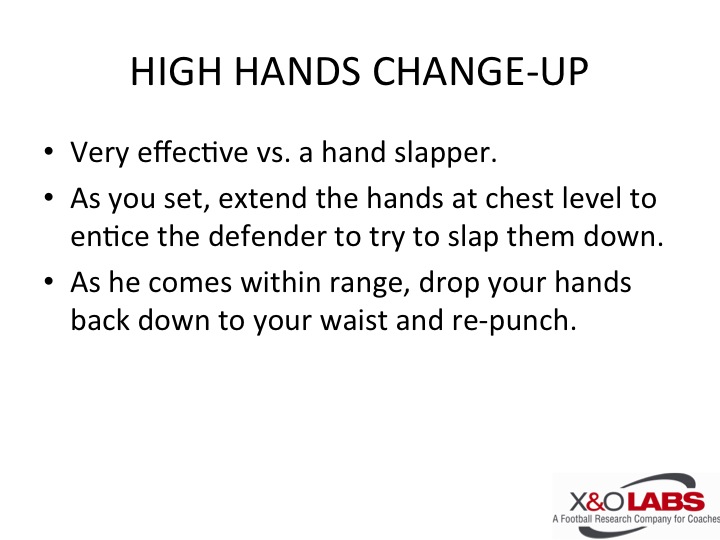
  •  The first is to show the defender high hands. This is especially effective versus a defender that is a hand slapper. As you set, extend the hands at chest level to entice the defender to try to slap them down. As he comes within range drop them back down to your waist and re-punch.
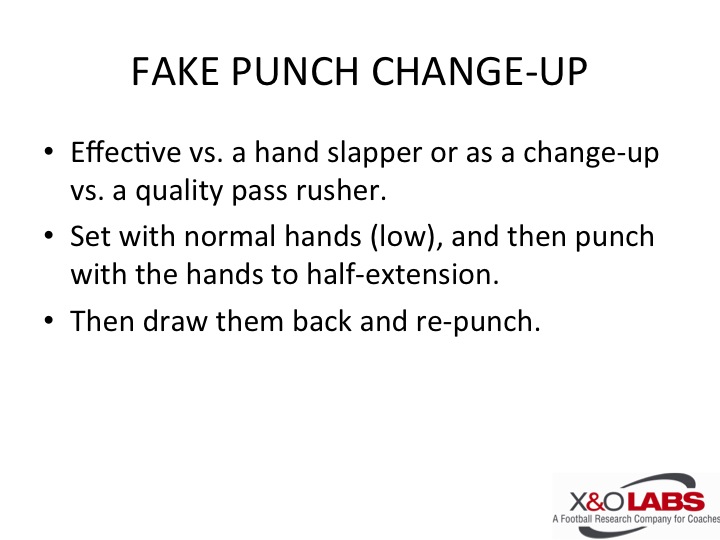
  • The second change-up we use is called a fake punch.   This would be used anytime we face a quality pass rusher as a change-up to keep them off-balance.We will set with low hands initially, then punch with the hands to half-extension, draw them back, and then re-punch. Our film evaluation that week will determine which of these techniques we will incorporate and how much of each we will use. 
The following examples are the drills I use in practice to teach hand placement:


Thumblift:
Stalemate:
Punch-Reset:
Click below to see Coach Iske’s hand placement drills in action.  His drill tape and tutorial is below.

Read More

Zone Read Concept Study: Case 1 – Structure and Schematics


The Zone Read Concept Study:

Part 1 – Structure and Schematics (59 minutes, 36 seconds)

Please Note: For a better viewing experience we recommend you close out other programs you are using on your computer prior to playing the video.  If you have any buffering issues, just click the pause button and allow the video to download for a few minutes before clicking the play button.

Read More

Zone Read Concept Study: Case 2 – Play of the Skill Positions


The Zone Read Concept Study:

Part 2 – The Play of the Skill Positions (58 minutes, 50 seconds)

Please Note: For a better viewing experience we recommend you close out other programs you are using on your computer prior to playing the video.  If you have any buffering issues, just click the pause button and allow the video to download for a few minutes before clicking the play button.

Read More

Zone Read Concept Study: Case 3 – Play of the Offensive Line


The Zone Read Concept Study:

Part 3 – The Play of the Offensive Line (42 minutes, 25 seconds)

Please Note: For a better viewing experience we recommend you close out other programs you are using on your computer prior to playing the video.  If you have any buffering issues, just click the pause button and allow the video to download for a few minutes before clicking the play button.

Read More

Zone Read Concept Study: Case 4 – Variations of the Read Zone


The Zone Read Concept Study:

Part 4 – Variations of the Read Zone (46 minutes, 33 seconds)

Please Note: For a better viewing experience we recommend you close out other programs you are using on your computer prior to playing the video.  If you have any buffering issues, just click the pause button and allow the video to download for a few minutes before clicking the play button.

Read More

Stretching the Boundary with the “Slash” Concept

Keith Grabowski

Offensive Coordinator

Baldwin-Wallace College

Keith Grabowski, Offensive Coordinator, Baldwin-Wallace

Bio: Keith J. Grabowski enters his fourth season on the Yellow Jacket coaching staff in 2012 and his third as its offensive coordinator. Grabowski served as quarterbacks coach in 2009 and was promoted to offensive coordinator in July of 2010. The Yellow Jackets finished with an 8-2 record last season.

In 2010, we included the use of a TE in our spread offense, and adapted more of a pro style run game and approach to our offensive attack. We still maintain many of the principles we learned when executing a spread offense, but our personnel and philosophy dictated a different approach, which gave us more flexibility in developing our attack from year to year with different types of personnel. While evolving as an offense, we looked for components that allow us to maintain a multiple attack without relying purely on spread formations. Using personnel and formations we expand and contract to put stress on how defenses must play us.

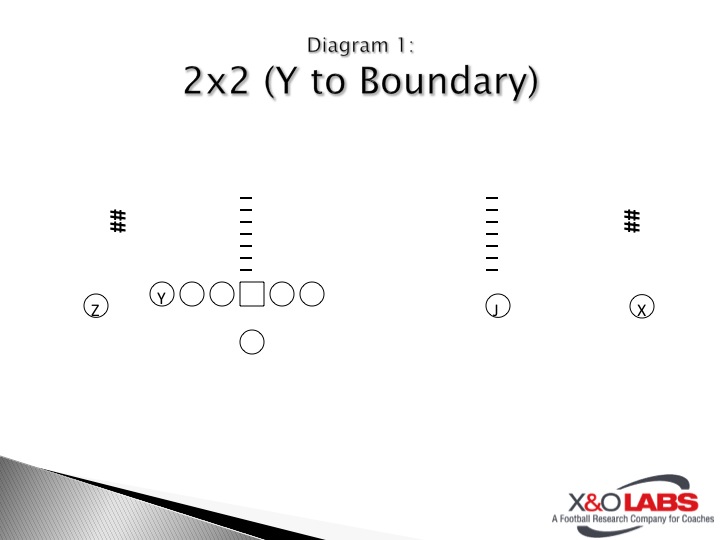
One of our favorite formations was a 2×2 with a TE into the boundary, which gave us a strong running attack, and still allowed us to spread the field (diagram 1).

However, we had only a few answers in the passing game that we felt allowed us a high percentage passing attack to the boundary- and those answers didn’t have the simplest progression for the QB to work to the field to find open receivers when the defense took away the boundary side routes.


In doing research and looking for different answers for our offense, we were directed to Dub Maddox, an assistant coach at Jenks High School (OK) who had been developing an idea on how to attack the boundary. Meeting with Dub allowed the two of us to collaborate on some of the ideas we each had and fit the concept- particularly the component that attacks the boundary. We felt that the concept overlaid well with some of what we were doing in our four verticals package, and from a teaching perspective much of what was needed in the package was already taught to our receivers and quarterback.

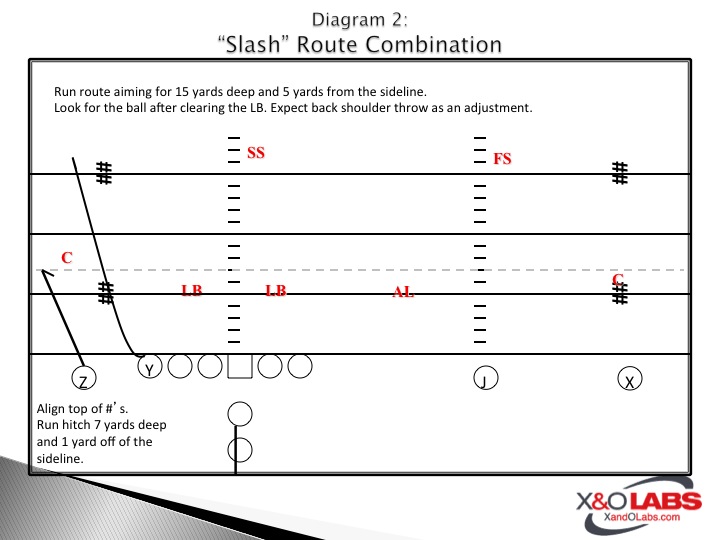
The “Slash” concept. “Slash” attacks the boundary on quick rhythm with a hitch executed at 7 yards deep and 1 yard from the sideline, and a route we call “Bow” for the TE which is an angled seam route that aims for 15 yards deep and 5 yards from the sideline. This combination is where the quarterback will start his progression. We label this combination as “Bow” which from a structural standpoint allows us to incorporate this with different field combinations as we progress through the season and add a wrinkle to our offense (diagram 2).

Read More

OLB Drill Article – Drills to Develop “Hybrid” Players in the 3-4 and 4-3


By William Lund

Columnist


X&O Labs

William Lund, D-Line Columnist, X&O Labs

Editor’s Note: Please welcome William Lund to the X&O Labs team.  Coach Lund is a veteran college football coach with a high level of expertise on coaching defensive line. We are excited to have him on board.  Every month Coach Lund will bring you some of the best insights, drills and strategies on developing your defensive line.  And the best part is, Coach Lund will answer any and all of your questions.  Just post your questions or comments below and Coach Lund will respond shortly.  

Coaches are always trying to find a new edge in defending offensive schemes. Much of the change occurs when a coach decides to use a 3-4 defense to replace a 4-3 defense or a 3-3-5 defense to replace a 4-2-5 structure. Defense is not so much scheme, but players’ understanding and belief in that scheme. Whether a coach choses to be a four-man front or a three-man front, more often than not he will have a “sub” package incorporating one or the other fronts.  If you don’t decide to change personnel, you may have a player that is a “hybrid.” A hybrid player is one you need to have on the field as a rusher in pass situations, but also one you want to use in coverage. This hybrid player may be necessary because you cannot afford to pull him off the field no matter what the situation, but still may want to incorporate a 3- or 4-man front. My column this month will discuss the ways you can effectively train your hybrid player to be sound as a coverage man or as a rusher.

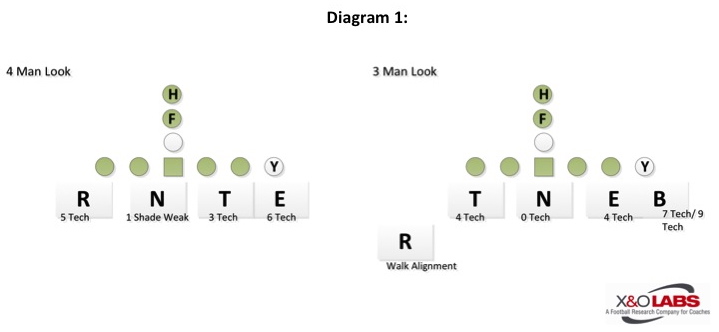
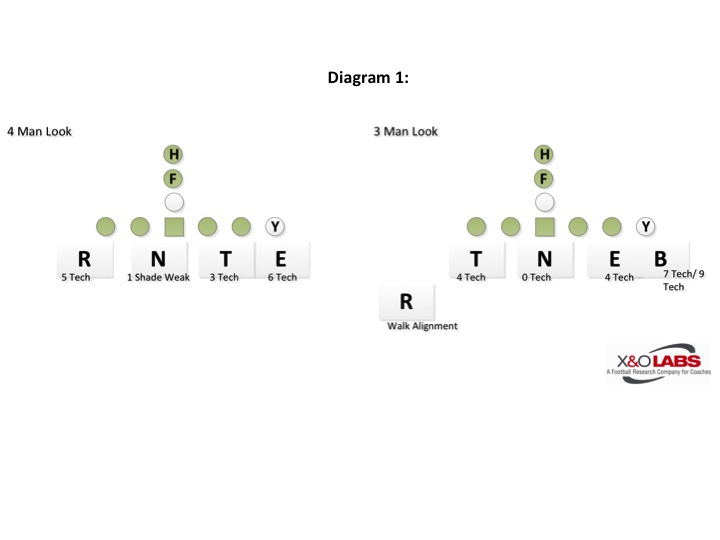
For the purpose of this column we will use a 3-4 and 4-3 scheme as our template in developing a plan for our hybrid player.  When training a player, you need to make sure he can handle the multiple details that a player needs to know as both a rush end and drop end.  Pass Rush moves, drop zones and man responsibilities are all parts of being a hybrid player. Because of all the responsibilities that fall within this player’s domain, the tendency of coaches is to take a player that “athletically” looks the part and try to force him into a “hybrid” role. As coaches, we must not try to “force a square peg into a round hole.”  In order to be an effective hybrid, the player must be savvy, with the understanding of a larger scheme of things. It is my opinion that the easiest place to train your hybrid begins with aligning him as the defensive end or outside linebacker weak or away from the formation strength (or away from the tight end or passing strength.) From here you can limit the number of assignments and coverage responsibilities he has to know. Remember this is a starting point to build on your player’s knowledge base. (Diagram 1)

Note:  The hybrid player is the “R” in both scenarios

 First Level (DE) Keys and Reads

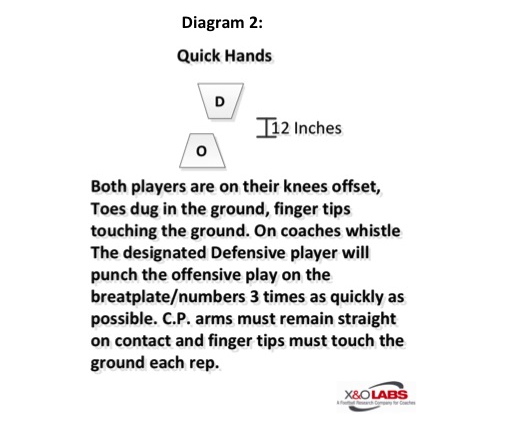
As a pre-snap, we will key the “V” of the neck of the EMLOS.  In most cases, this will be the OT.  We do an every day drill called “Quick Hands” that emphasizes this technique (diagram 2).  Quick Hands Video:

Read More