


2025 Screen Game Research and Development – Case 2: Brown University’s Shovel Screen
“It’s been one of our best early down possession plays because you’re going to get stagnant looks.”
– Eddy Morrissey, offensive line coach, Brown University (RI)
By Mike Kuchar
Senior Researcher/Co-Founder
X&O Labs
@MikeKKuchar
Some of the brightest young minds in the country are enrolled at Brown University (RI), so it seems a bit paradoxical when offensive line coach Eddy Morrissey talks about the threat of “over-coaching” the Bears’ shovel screen concept. It has been its most efficient screen concept the last few seasons under the direction of head coach and offensive play caller James Perry. It’s been an early down staple in the Bears’ menu and is utilized from open personnel groupings such as 2×2 and 3×1. And according to the offensive staff, the reason why it’s been so successful is that it’s not overcoached. It’s been an extension of the run game and so inexpensive that the Bears will often “call it and run it” on early downs. The reason is the opportunity to get stagnant defensive looks with the purpose of getting ahead of the chains.
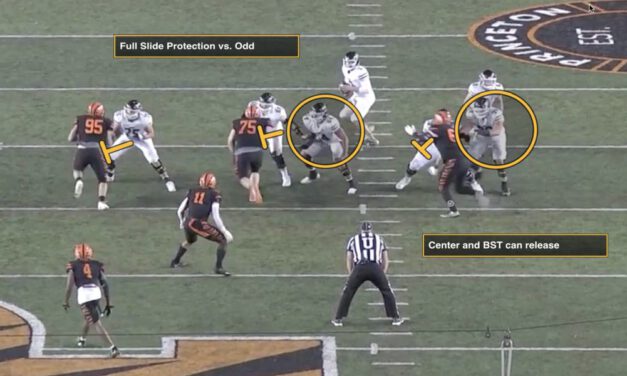
The shovel screen is based on six-man full slide and half-slide drop-back protection and manipulates the space on the second level generated when coverage defenders get depth. It’s even been used as a solid two-minute drive starter at the end of the half and end of the game. It’s great vs. zone coverage but can also have a good amount of success against man (providing a blocker can handle the defender responsible for the back in protection). And when you’re competing against some of the “hair-raising” fronts in the Ivy League like the ones at Dartmouth and Yale, it completely took them out of their pass rush rhythm.
We spent time talking with offensive line coach Eddy Morrissey to talk about why this screen is so effective and why it’s been a foundational principle in Coach Perry’s menu.
Why it Works:
While Coach Morrissey affirms that you can couple bubbles, nows, and quick game packages on the perimeter with this concept, at Brown, the receivers are purely taught to run defenders off, making them non-essential components of the screen. It’s the A-back where the play is targeted. He is taught to block his initial protection rules- whether it be half-slide or full-slide and then work directionally in the line of sight of the quarterback. Coach Morrissey talks about it being a two-second count clock but admits there is an art form to it. “He has to have an internal clock where he realizes he has to surrender the (pass rush) defender,” said Coach Morrissey. “It’s mainly about being inside out on the defender first, then turning up field to make the catch.
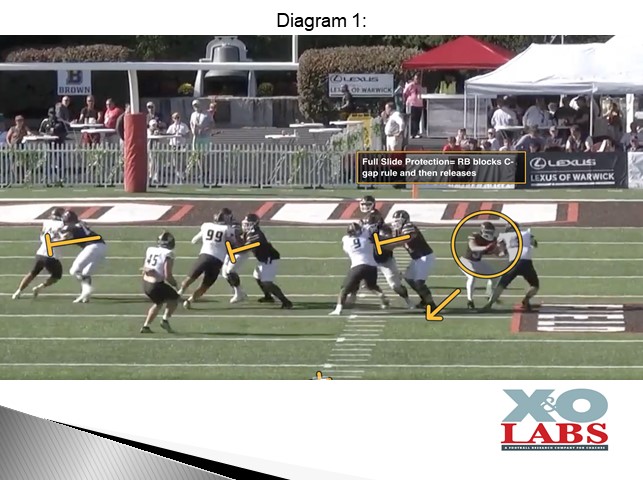
In full slide protection, the back needs to secure the edge for his count before working his head around to receive the ball.
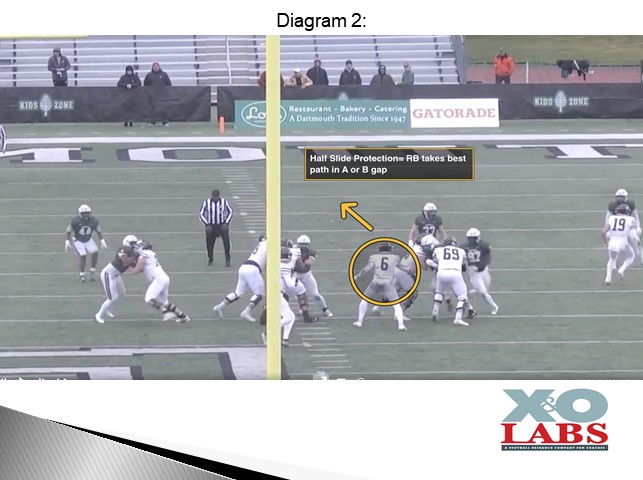
In half-slide protection, the running back is tied into the man side of the protection. So, here he works his dual inside out, read first before snapping his head around to receive the ball.
It’s the quarterback’s job to get him the ball the best way possible after taking his three-step drop, then delaying off the line of scrimmage. He has to keep his eyes downfield and not stare at the rush. “He may have to shovel it or drop it over the top to him,” said Coach Morrissey. “You have to be creative. There is an art to it; you have to suck the defense to you. The earlier you throw it, the worse it is.”
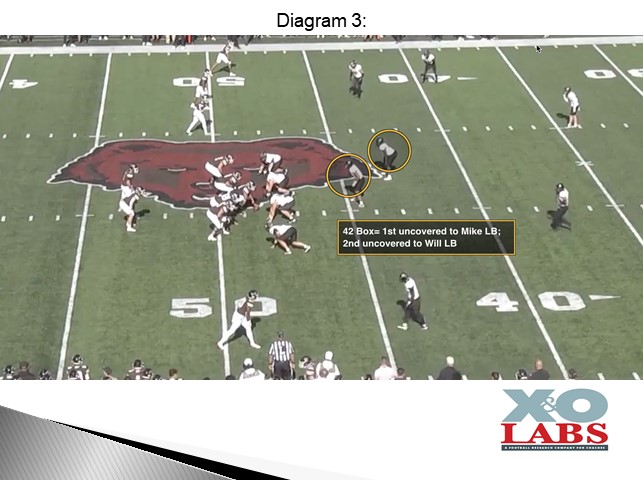
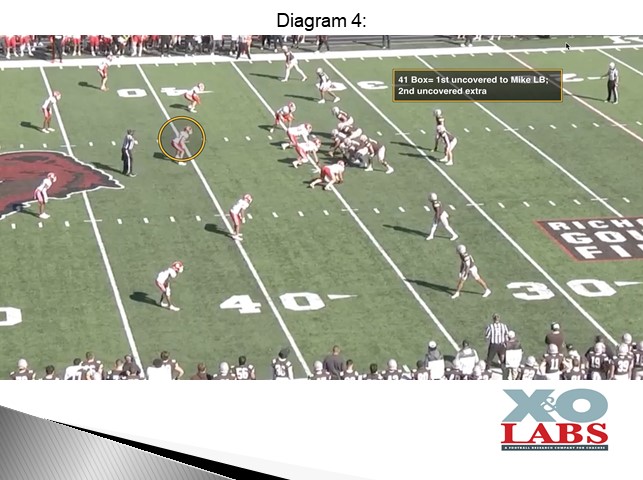
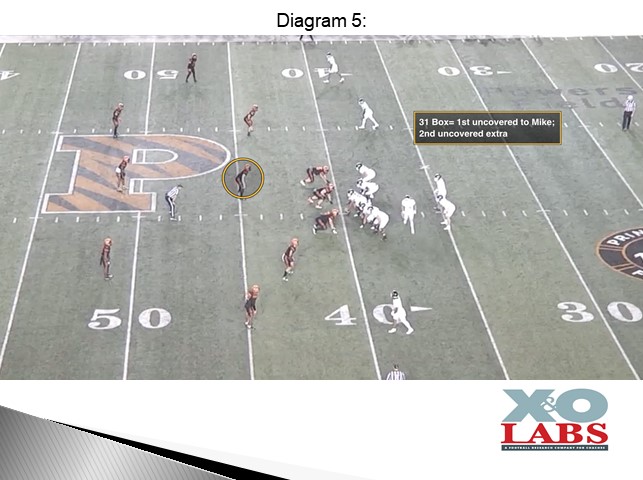
The beauty of the shovel screen lies in the process of manipulating the defense into light run boxes. Since it’s considered to be an extension of the run game, Coach Morrissey talks about “minusing” the box down to five defenders. This can be done with 3×1 open and 2×2 open sets. “We want to get them into a four-man or five-man box where it’s clean so that we can declare who you are working with up front,” he said. We will get into rules later in the report, but essentially, there are only three boxes that the staff at Brown prepare for staying in vanilla 2×2, and 3×1 can only give a defense a couple of options.
“42” Box
“41” Box
“31” Box
Editor’s Note: In this report, Mike reveals the details of how this works, and best practices, and he identifies who else is using it. And, as always, Mike includes a lot of video and diagrams — as well as shares where to find more game film in X&O Labs’ Film Room. Login below to get unlock the full report (and if you’re not a member, click the ‘Join’ button in the upper right-hand corner of this page).