





By Bob VanHoesen
Defensive Line Coach
Union College (NY)
In the current era of mobile quarterbacks, defensive coaches are challenged to find ways to keep opposing QBs in the pocket. Defensive coaches have to find effective methods to maintain an aggressive pass rush while controlling the QB as a running threat. Of all current methods, CAGE is widely considered the most effective approach.
TWO KEY ELEMENTS OF CAGE
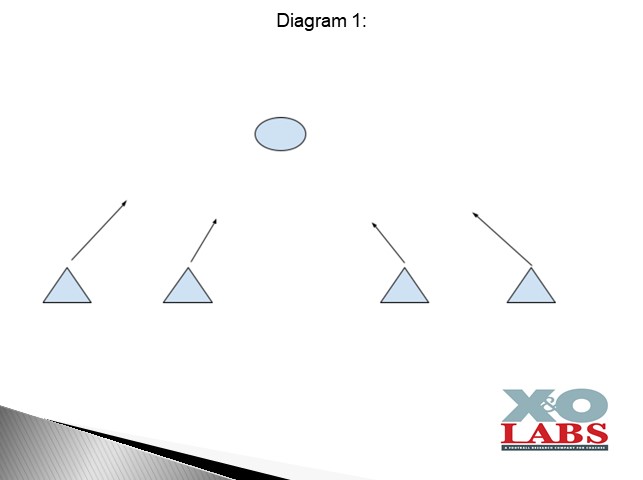
Two key elements of CAGE are rush lanes and aiming points. These elements work together to give defenders a clear understanding of their individual pass rush responsibilities. When executed correctly, pass rushers create a CAGE or net that the QB cannot escape from.
RUSH LANES
Rush lanes are the “highways” that pass rushers take to get to the QB. These “highways” are determined by a defensive player’s pre-snap alignment. For example, a defensive tackle aligned in a 3 tech pre-snap would have a lane that takes him through the B gap. In a base rush he would be expected to win through that gap. We use the phrase “win in your lane” to give our defenders an initial direction for their pass rush.
AIMING POINTS
Aiming points are spots on the QB that rushers must converge on. Rushers with interior paths (low cage) converge on the front hip of the QB. Rushers with edge paths (high cage) converge on the back shoulder of the QB. After defeating the opposing OL, rushers bend and get their eyes and toes directed to their aiming point. Our eyes lock on our aiming points like “radar” to take us to the QB like a guided missile. If the QB moves, rushers must adjust their paths in order to maintain the CAGE. For example, if a QB sprints to his right, our left edge rusher must widen his path to stay on his aiming point. Aiming points allow the CAGE to adapt to any movement by the QB.
In this report, you will see the full install — including the run-fit vocabulary VanHoesen uses to make CAGE click for his players, the drill he runs all season to reinforce it, and a film breakdown with four live game clips showing exactly how it holds up against a mobile QB:
- Why VanHoesen borrowed "VICE" and "HAMMER" from his run-fit system — and how these two words give low-cage and high-cage rushers an instant visual reference for their QB containment role.
- The triangle concept that locks in your interior rushers — how to teach them to keep the QB at the top of the triangle while they form the base — no more guessing on fits.
- The edge rusher "counter rule" that prevents outside escapes — HAMMER isn't just a direction, it's a standard: the QB should never cross your face. VanHoesen explains exactly when and how to counter.
- The full QB CAGE drill setup — field dimensions, bag placement, scout QB rules, and why the low-impact design makes it repeatable all season without beating up your guys.
- Four film clips with VanHoesen's own narration — see CAGE working against a live mobile QB, including a stunt concept that forces defenders to swap high and low cage assignments mid-play and still finish with a sack.
- How to run CAGE with your linebackers, not just your D-line — Clip 3 shows a blitzing LB functioning as a low-cage rusher and helping collapse the pocket from the inside out.
- The 3-down CAGE challenge — keeping containment with only one true low-cage rusher and what happens when a DE takes his eyes off his aiming point (Clip 4 shows both the mistake and the recovery).