
Maximizing the Impact of Your Pre-Snap Reads

By Sam Nichols

X&O Labs

The “Pre-Snap” read is far from an innovative concept.  Every quarterback is taught to do it in some way as he prepares to run the next play.

The difference between “making a read” and “making a purposeful read” all goes back to teaching.  Coaches that tell the QB to “look at the defense and take what they give you” will find that this only works if you have a coaches son at the helm.  Furthermore, many coaches stop short of teaching the rest of the offense how to use the information that they gather in conjunction with what the QB communicates to maximize the potential of every single play.

For that reason, I have always found it best way to create consistency for all players is to have a standardized approach to identifying and communicating pre-snap information. This means we will use the same format every play for all positions.  Here is a look at how I have taught this concept.

What is a pre-snap read?

  • Definition:  A survey of the defense to determine the play / scheme that they are going to run.
  • Objective:  Identify their play to speed up the decision that we must make once the ball is snapped.
  • Result:  Allows us to better attack our opponents weaknesses and avoid their strengths forcing them to change their plans and giving us control.

From there, we outline for our guys what that means to them on a play-by-play basis.

What are they reading?

Every snap, the players will identify pieces of information that will define the defense and allow us to “play fast”.  This information is, of course, different for the various positions.  For instance, the Offensive line is very interested in understanding who is in the box, but they likely don’t need to be concerned about the depth of the corner.  To simplify this whole process for the players, we have broken down the diagnosis into four distinct areas.  They are as follows:

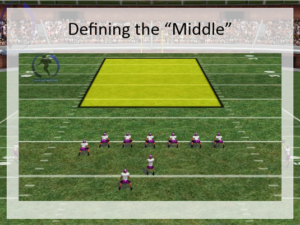
#1:  The Number of players in the “Middle”
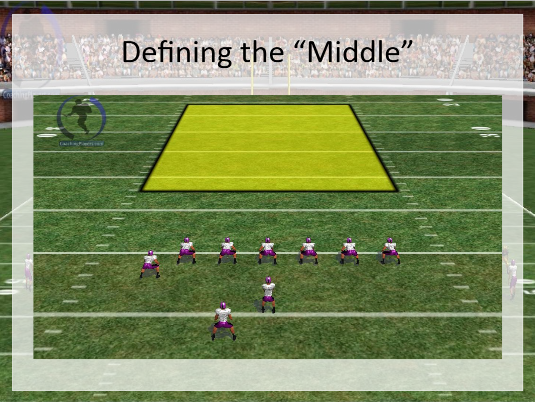
The middle of the field is defined as the area from hash to hash and over tackle to tackle This read is basically telling the Quarterback and receivers how many safeties are involved in the defense allowing them to fit their routes, stems, and blocking concepts to fit that alignment.  It also helps us eliminate coverages and check into better vertical passing concepts.  The quarterback communicates the box information as part of the snap count.

#2:  The Number of players “Box”

The box is the area between the tight ends to the heels of the deepest linebacker.  This tells us how many players are dedicated to the run / are in a position for a quick blitz at the snap of the ball.  The line and backs need to be aware so that they can diagnose where their lanes and landmarks might be depending on the number of defenders and their arrangement in the box. The quarterback also uses this number to determine if the play can be run or if a check needs to be made to get us out of a bad play.

#3:  The Edge

The tackles, tight ends, and wide receivers must understand how the defends plans to play the edge of our alignment.  That means identifying and communicating the technique of the end man on the line of scrimmage and the force defender on that side.  This information effects blocking assignments and route angles.

Read More

Zaunbrecher: Developing QB’s Hands and Feet

An Exclusive Interview With Ed Zaunbrecher

Coach Zaunbrecher coached 34 years at the FBS level, including a three-year stint at Marshall as the Offensive Coordinator where he tutored QB Chad Pennington and Byron Leftwich and spent a five-year duration at the University of Florida in the same role while developing Rex Grossman.  He currently runs the Ed Zaunbrecher QB School (http://www.ezqbcoach.com) developing young QB’s into leaders.

X&O Labs Senior Research Manager Mike Kuchar was fortunate enough to conduct a two-part interview series with Coach Z.  Part two of Mike Kuchar’s interview with Coach Zaunbrecher, developing a red zone offense, will be published in next Tuesday’s report.

Mike Kuchar (MK):  What are 3 to 5 must have qualities for a successful QB at any level?

Ed Zaunbrecher (EZ): You need intelligence to make good decisions, pinpoint accuracy and quick twitch in that order.  You could play in a lot of different offenses if you’re intelligent.  If you’re accurate you improve your chances of completions against tight coverage.  You need quick twitch to be able to react fast enough to situations, both mentally and physically.


MK:  In your research, what is the ideal grip for a young QB on the football?  Why? At what point in his development would you change your QB’s grip?

EZ: As long as the middle finger is perpendicular to the laces and the size of the hand relative to the football will determine how far up on the ball they can grab it.  The fingers don’t want to be to the center of the ball, but if a player has giant hands they may be close to it (center of ball).  You want to have something to push against where the curve of the ball is.  The key thing is to make sure when you hold the ball, it’s still in the fingers and not in the palm of the hand. The other thing is not to grip it too tightly.  Anytime you compress the muscles to hold something tightly, you’re not fluid in your motions.

As far as changing throw patterns go, if they can repeat their motion and they are accurate with it, I don’t want to mess with them.  If they are not repeating it, then they have to work on setting the ball consistently.  If it’s a fifth grader who doesn’t know too much you’ll work on a few more things.  If you got a guy who is a senior and is already a good thrower, I’m working mostly with the feet and the head.  Some guys get in and set the ball differently every time they throw it so we need to work on that.  There’s a great drill to work on that.  Everyone has a mirror in the bathroom.  The kid puts a piece of tape down on the floor where he lines up and he practices stepping with the front foot and setting the ball.  He sets it in the right position and he gets another piece of tape up on the mirror at the bottom of the ball where it’s set correctly.  He will stand there in front of the mirror and step and set repeatedly.  I tell them everytime they go to the bathroom do ten of these drills.


MK:  What is the biggest mistake you see young QB’s make when gripping the football?

Read More

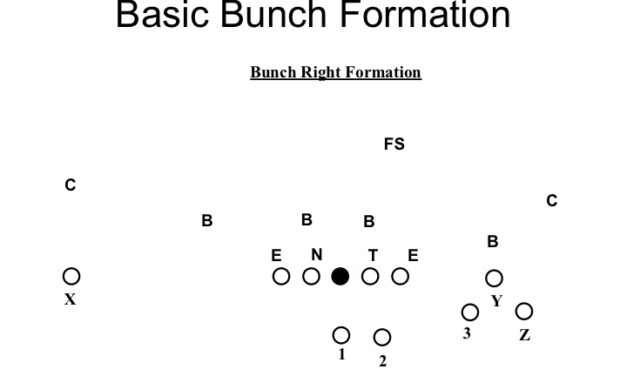
The Bunch Pass Game

By Greg Lauri

Offensive Coordinator

John Glenn High School

I would first like to thank X&O Labs for the opportunity to contribute to the study of the bunch formation on their Insiders website.  I think that this website is representative of all the good that football coaches do.  The sharing of information is critical to the development of coaches and the advancement of the great game of football.

I would also like to thank Dave Shanahan, our Head Coach, for the opportunity to develop our offense.  Over the past four years we are 43-3, with back-to-back County and Long Island Championships.  Over the past two years, as the offensive coordinator, along with the support of Coach Shanahan, we have moved our offense to a new level.  We are a spread team, then we implemented our empty package, which helped us obtain our first championship.  This past season we continued to develop our empty package and added some bunch formations, which helped us obtain our second championship.

Read More

14 No-Huddle Do’s and Don’ts

By Sam Nichols

Wide Receivers Coach

Hope College (MI)

Sam Nichols, Wide Receivers Coach, Hope College (MI)

Like many things in life, much of what I have learned about the no-huddle I learned from trial and error.  But the older I get the more I don’t feel I have the patience or time to deal with failures on my path to success.

This fall thousands of teams across the country will be installing No Huddle concepts as part of their offense, so I thought this would be a perfect time to share what I have learned through years of using and consulting on the no huddle to help you avoid the common mistakes and encourage important concepts.

#1:  Don’t Change Just to Change 

Too many coaches add or re-tool offenses without understanding why they are doing it.  Make sure that you know exactly what you are hoping to get out of the no huddle and be prepared to make sacrifices to reach those goals.  Obviously, I believe that it can help your offense, but it will not fix an offense that is poorly run in the first place.  If you are to this point and you cannot convincingly explain why and how the no huddle is going to take your offense to the next level, it might not be worth your time!

#2: Do Use a Preset Formation

Another way to take precious seconds off your time between plays is to set a default formation.  Even better at the HS level where most of the game is played from the hashes, you can set defaults from the left middle and right to help eliminate the movement between plays.  This coming year, will be having our players pre-align in a trips formation to the field when we are on the hash and a 2×2 formation in the middle of the field.  The default formation will be determined weakly based on the defense we plan on seeing that week.  This eliminates the extra movements and speeds up our rate of play.

#3:  Don’t Add No-Huddle to an Already Bloated Playbook

Chapter two discussed how to trim your offense to fit within the Full Throttle  system.  While most people will take that advice, there are a few people who will insist on keeping every single formation, motion and play into their new system.  This may work, but you will likely not get the most out of the system.  Remember the K.I.S.S. principle and use this as an opportunity to focus your offense on what you do best.  You can always add once the system is up and running.

#4:  Do Use Your Personnel Wisely

Here are a few things we know:

  • We all know that receivers in a pass centered offense can get tired and not run great routes.
  • We also know that defenses usually only scout 1 deep and know little about the subs you bring in.
  • We know that DB’s are always told to not let anyone behind them.

So what does this mean in the No Huddle?  Well, teams will usually be playing their studs against your studs and they likely will not change when you send in a sub.  Therefore, you will have their starting TB, for instance, against your 5th, 6th, or 7th best receiver.  No contest right?  Wrong.  If you shift your mentality from beating that defender to wearing him out, you will make real hay with the 7th receiver of yours.  Here is what you do.  Tell him to run to the end zone every play.  Gas that TB and force them to sub.  If they don’t, you just killed their running game in the 4th quarter.  If they do then not you put your stud back in and throw right over their backup.


Read More