By George Penree,
Offensive Line Coach
Utica College (NY)
Editor’s Note: The following clinic report was written by Utica College (NY) offensive line coach George Penree, a post he has held since 2007. In 2010 Utica broke more school-records including points in a single game (78), pass completions (231), passing a receiving yards (2,742), passing yards per game (274.2), total offensive yards (4,007), total yards of offense per game (400.7), and all purpose yards (5,049). Coach Penree will be happy to answer any comments or questions by leaving them below.
I would like to thank X&O Labs and all the great coaches who have influenced me over the years. I would like to discuss how we at Utica College teach the inside and outside zone using three-person groups, which is something we do once a week for a ten-minute individual period (five minutes for inside zone and five minutes for outside zone).
Before getting into the actual drills, a few things must be understood. The inside and outside zone blocking concepts are based on the teaching that in any inside or outside zone play there are “covered” and “uncovered” linemen.
- Covered linemen are those that have a defender in an alignment directly across from them.
- Uncovered linemen are exactly that, they do not have a defender aligned across from them.
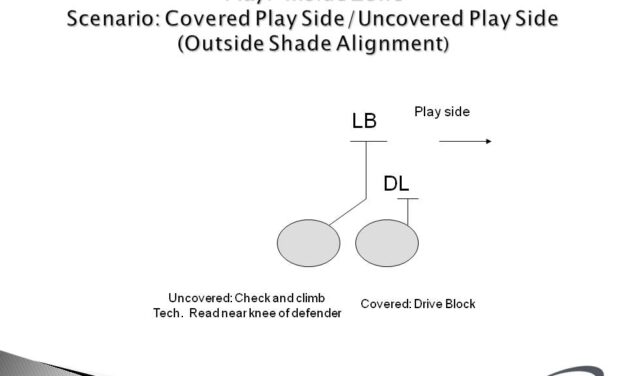
I talk to my players about the different covered alignments a defender can have. The defender can either align to the play side (the side the ball is being run to), or backside (the side the ball is being run away from.) The covered lineman will first diagnose if he is covered play side, or covered backside. The uncovered linemen’s universal rule is to work with the next covered linemen to the play side. They have to diagnose what alignment the defender is in on the covered linemen they are working with. The covered lineman will make the call. If the uncovered lineman will look to the play side to identify the player and technique he is using. Once our guys understand these alignments, they then perform the technique best suited to block defenders in the different alignments.
I use these tables to organize all the techniques I have to teach in meetings and practice. It also gives our guys the ability to quickly recall the technique best used to block the defenders aligned across from them.
The table below explains the four situations we encounter on inside zone.
| Covered / Uncovered |
Play side / Backside |
Technique Used |
| Covered |
Play side |
Drive Block |
| Covered |
Backside |
Stab and Demeanor |
| Uncovered |
Play side |
Check and Climb |
| Uncovered |
Backside |
Lateral Drive |
The table below explains the four situations we encounter on outside zone.
| Covered / Uncovered |
Playside / Backside |
Technique Used |
| Covered |
Play side |
Reach |
| Covered |
Backside |
Reach, Stab, Climb |
| Uncovered |
Play side |
Reach, Check, Climb |
| Uncovered |
Backside |
Reach, Run, Takeover |
Blocking Technique Coaching Points:
Drive Block
- Get helmet on play side number of defender.
- First step is the lead step, so set distance – landmark outside number.
- Second step is the power step. The backside leg should get back underneath shoulder pads (regain leverage).
- Engage with defensive lineman with inside hand placement.
- Gradually climb the block. Start low and finish high.
Stab and Demeanor Block:
- Step with play side foot, pick it up and put it down.
- Second step is a “crotch step.” Drive back side foot through midline of defender (splitting his crotch).
- Inside arm should engage somewhere near play side number. Keep elbow tight and tucked to your body.
- Have good demeanor, knees inside ankle, ankle inside feet; duck walk defender back by keeping outside arm free in case of widening linebacker.
Get X&O Labs’ Research Reports, Clinic Reports and Video Reports Sent to Your Email Every Tuesday. Just Enter Your Name and Email in the Sign Up Box in the Right Hand Margin of This Page >>>>>>>>>> Above our Facebook Fan Box. It’s FREE!
Check and Climb Block:
- Take lateral step with play side foot, but shoulder should be squared.
- Get back side foot to shoulder pad (regain leverage).
- Get eyes go to near gap.
- If no first level defender in gap, duck walk to second level.
- First level defender: drive block through back side number of defender.
Lateral Drive Block:
- Take lateral step to close gap by keeping shoulders square.
- Second step comes back underneath shoulder pads (regain leverage).
- Use two hand drive through backside number of defender.
- Climb the block.
Reach Block:
- Aiming point is play side shoulder
- First step – depth and width step. Loose ground, but gain width.
- Second step – predicated on how hard DL fights towards ball
- If DL is even with OL – (stack the feet) take backside leg, don’t crossover, point toe at end zone, bench press with outside arm and torque him back inside.
- If DL widens – crossover and run, so head to get to play side shoulder
Reach, Stab and Climb Block:
- “Hold defender up” so uncovered player can reach him.
- First step – get depth and width on play side foot and put inside arm on near shoulder pad; shock (stab) defensive lineman with inside hand and work to second level defender.
- If second level defender is head up, our lineman will block him; otherwise look backside. Don’t chase second level players over the top.
Reach, Check and Climb Block:
- Same footwork, but no stab.
- Uncovered lineman is reading the near knee of defender.
- If near knee comes at us – work reach block.
- If near knee goes away – climb to second level.
Reach, Run and Takeover Block:
- Uncovered lineman will run laterally to get his head on the play side shoulder of defender.
- Once head is on play side number, execute reach block technique.
Determining Covered/Uncovered




 X&O Lab’ Mike Kuchar will meet with the staffs of 10 colleges in just 8 days this spring. Keep reading www.XandOLabs.com for all t