
The Bunch “Rub” Study


Variations of the “Rub,” the Most Popular Pass Concept in Compressed Formations

By Mike Kuchar Senior Research Manager X&O Labs

Researchers’ Note: You can access the raw data – in the form of graphs – from our research on the bunch rub/compressed formations: Click here for the Statistical Analysis Report.

X&O Labs originally designed our latest research report on using compressed (tight) formations to take advantage of defenses.   But, once we started to compile our results, we found an abundance of coaches that wanted to learn more about “bunch” formations, where three receivers are stacked within three yards or less of each other.  While the formation structure has been around since the days of the Bill Walsh era in San Francisco in the early 1980’s, perhaps the bunch formation didn’t trickle down to lower levels until high school coach, Andrew Coverdale (Trinity, LA), detailed in his book The Bunch Passing Attack (read more about this book here).  Although the book was published in 1997, it continues to gain credibility within its schemes as more coaches are finding ways to attack defenses using it.  Now, according to our research 70 percent of coaches use the bunch formation more than any other compressed formations. 

Before we get into the nuances of the bunch schemes, we just wanted to recap some of the reasons our coaches had for using the bunch formation.  While it may be a “spread” scheme in nature, 42.6 percent of coaches will utilize bunch out of 10 personnel, more than any other personnel grouping.  It’s important to note, bunch concepts can be delegated to any personnel grouping.  In fact, schools like Boise State have found ways to use the same concepts out of 21 personnel and still be effective.

Advantages of running the bunch:

  • Creates Space: Talk to any offensive coordinator and he will tell you this is the biggest factor in running the bunch scheme.  Over 30 years ago, Tubby Raymond said the quickest way to get to flank (perimeter) is to shorten the edge.  And he was the master of the Wing T.  It’s still effective today.
  • Makes Defenses Declare: Since this is a non-traditional set, defenses will need to adjust.  Some will check to a man concept, while some will roll to zone coverage.  Either way, you’ll know how they’re playing it.  If you see a safety roll to the bunch, it’s some form of single high (cover three or cover one) and if that corner widens to stay in the flat (it’s some form of cover two).  In any case it doesn’t matter, because as Coverdale states in his book, there is an answer for everything.
  • Productive Against Any Coverage: Because the bunch passing concepts have elements of a zone and man beater already designed (as we will detail later in the report) you’ll see that once a QB recognizes the coverage, he’ll know where to go with the ball.
  • Defenses Get Uncomfortable: A bunch scheme changes the picture for a defense.  It changes the environment in terms of angles that coverage players need to break and how to leverage offensive players.  There in a position of space that they are not familiar with.
  • Causes Match-Up Problems: Our research staff feels this is the biggest advantage of running bunch, because you can put your best receiver anywhere.   We tried to get a beat on where coaches will place their best receiver, but our research didn’t find a pattern.  Some coaches liked to put their best receiver as the point man in bunch (the number two receiver) while some preferred to line him up as the inside receiver.  Some coaches chose to use their best receiver at the X spot, the player away from bunch, because of a possible defensive coverage overload.  In any case, one common thought process was discovered among the coaches we spoke with: decide what coverage defenses are playing to defend bunch and line your best receiver up where their deficiency is (we explain this below).

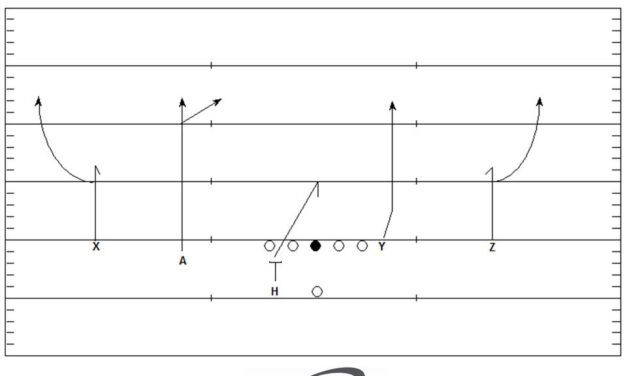
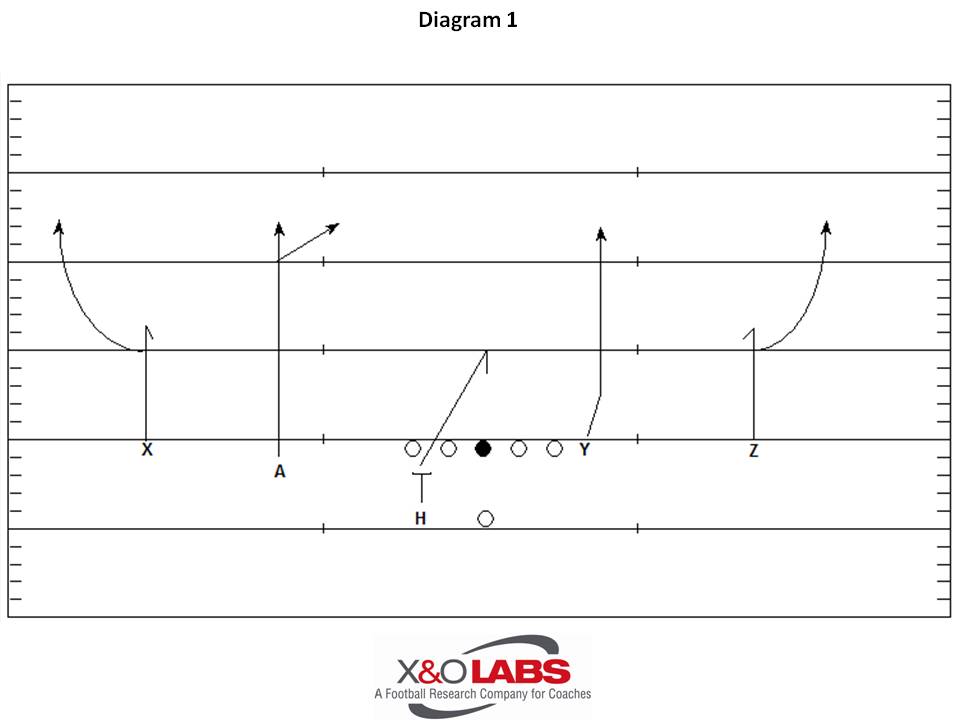
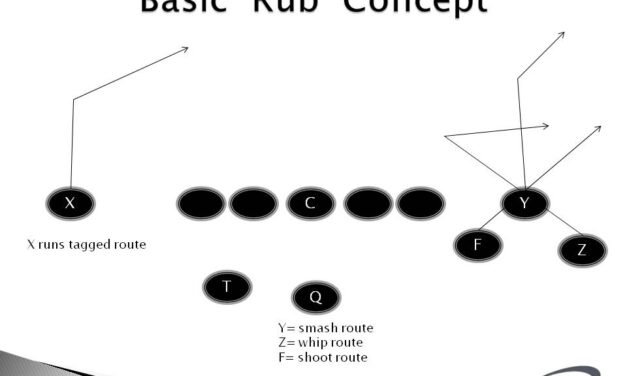
Case 1: The “Original” Mesh Concept In this report we will focus solely on one of Coverdale’s original designs, the “mesh” or “rub” concept (Diagram 1) and how various coaches have found ways to tinker with it.  We’ve found that 38.2 percent of coaches use this rub concept more than any other pass concept in bunch. 
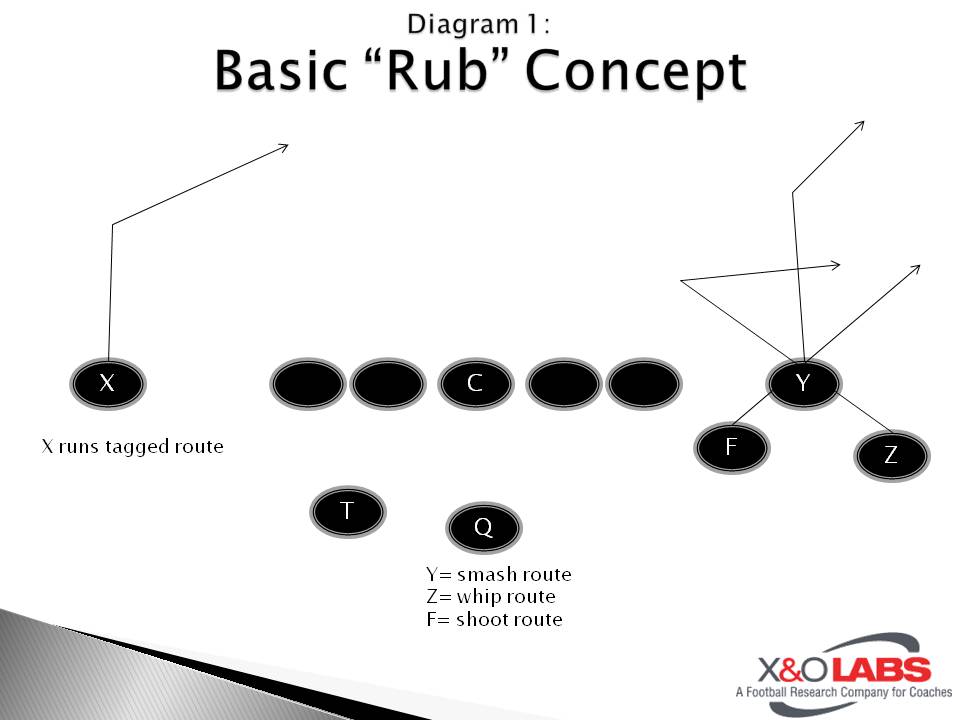
The original route progression is as follows:

  • PS#1 (outside receiver): Whip route, start in and break out
  • PS#2 (point man): 10 yard corner route
  • PS#3- (inside receiver): Flat route or shoot route
  • BS #1 (back-side receiver): Tagged route; could be vertical, slant, hitch or post depending on coverage

When Coverdale first designed this concept, the primary throw was the flat or shoot route.  He would change the QB’s launch points continuously, from play-action to sprint out to plain ole three-step drop.  “Against zone coverage, if the defender didn’t align himself outside of the bunch and play with leverage he might be outflanked by the flat so we went there,” said Coverdale in a recent online interview.  But against man coverage, the whip was the more viable option.  “It was very difficult for defenders to fight through traffic and play that route,” said Coverdale.  “Finally, if teams played some form of cover two, you had the built-in corner route over the top.”

So, quite frankly where you place your best receiver could be dictated on the following:

  • Vs. Cover 2: Number two man running the corner route
  • Vs. Cover 3: Number one man running the flat route
  • Vs. Man coverage: Number three man running the whip route
  • Vs. Coverage shift or overload to bunch side: Iso the back-side X on a tag route

Now, we realize that defensive coaches get paychecks too, and X&O Labs will detail how these coordinators defend bunch in an upcoming report, so there may have to be other adjustments that offensive coaches make.  Our goal in this report is to provide offensive coaches with answers, so that they can be decisive and effective, when running their bunch package.

Case 2: Attacking Cover Two:  Variations of the Smash Concept This shows how easy it is for an offense to dictate to the defense where the match-up problem is, and where an offense can displace its best receiver.  As Phil Longo, at Division II Slippery Rock University says, “We won’t even practice it against any other coverage because we get two 99 percent of the time.”  Once you discover how defenses are playing it, you know where to go with the ball.  Because of this, Longo developed his “Star” concept when he was the offensive coordinator at Southern Illinois University, who for two years in a row lead the Missouri Valley Conference in scoring.

Get X&O Labs’ Research Reports sent directly to your email inbox. Enter your email in the “Stay Informed” sign up box above our Facebook box in the right hand margin of this page >>>>>>>>>>>>>>> It’s FREE!

Because of what he does in the run game, Longo has his players align a little tighter than most coaches.  His point man (number two) is four yards from the offensive tackle, while his outside receivers are about a yard and a half on each flank of the point man with their toes on his heels.

The “Star” concept is a co

Read More

The Hitch Concept


Using the Quick Game to Win First Down

By Dan Ellis Head Coach W.C. East High School


Throwing the football is something we did this past season with enormous success.  We threw it often and threw it well.  However, it is not necessarily the number of attempts you try in a game, but it’s the efficiency with which your QB executes the passing game that matters.  When you choose to call passing plays, completing the ball is of the utmost importance.  The first play we install in the passing game is our Hitch Concept.  The reason behind that is simple – if teams allow us to throw the hitch, we will take advantage of it all day.  We tell our QB’s it’s a steal if they allow us to throw it consistently. 

The Hitch Concept carries both a horizontal and vertical stretch.  It has multiple coverage beaters imbedded.  In this report, I will explain the concept, QB footwork and progressions and the different ways we have to run the play.

Hitch Concept: With the Hitch Concept, our goal is to get the ball out of the QBs hand as quickly as possible and to win first down.  Like any offensive coordinator, we want to get into 2nd down and short and keep the playbook wide open.  Short passing game on first down is a great way to do it, especially if defenses are playing the run with a middle closed coverage (Cover 1 or 3).  Here is the basic concept(diagram 1):

Rules:

  • QB – Middle of Field Open (MOFO) – 5-step.  Middle of Field Closed (MOFC) – 3-step.
  • X – 5 step hitch (will convert against press/hard corner)
  • Z – 5 step hitch (will convert against press/hard corner)
  • A – Post to Get Open or Bender.  If the MOFO (cover 0, 2, or 4), the A will run to the open space.  If MOFC, the A will run a seam.
  • H – Ball route
  • Y – Seam

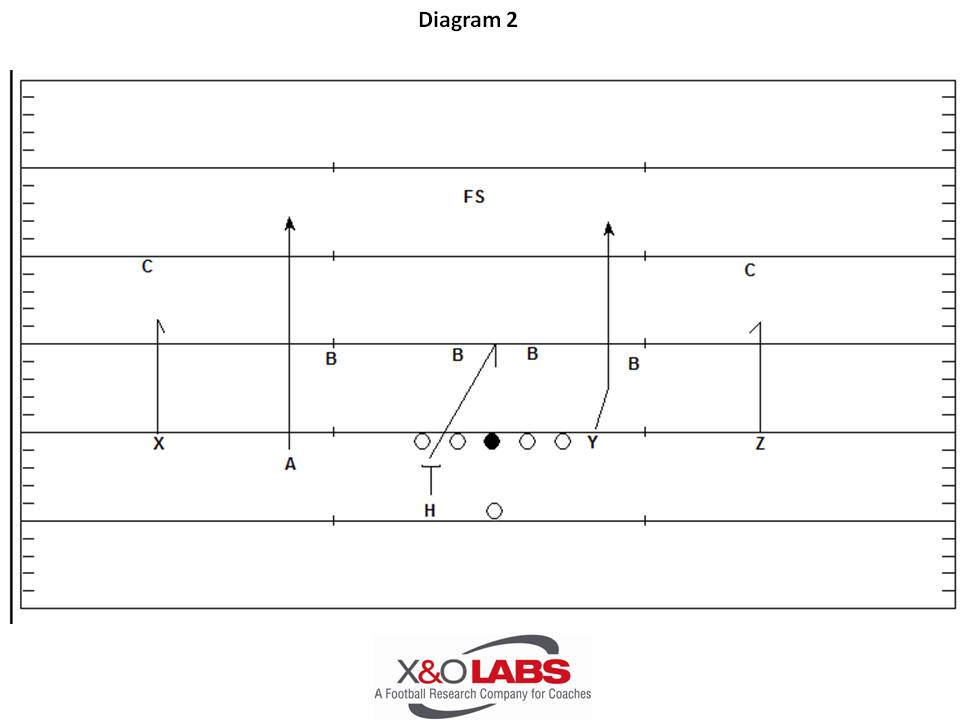
 MOFC – Middle of Field Closed (Cover 1, 3) – Horizontal Stretch: Against MOFC coverages, we are looking at a scheme that will horizontally stretch the defense (diagram 2).


With the middle of the field closed, the X and Z will be most likely running hitches and the A and Y will be running seems as shown in diagram 2 against cover 3.  We teach the QB to take the most advantageous side because we have mirrored routes.  In this case against cover 3 with the MOFC, we know that we can get the hitch.  So whichever side the QB feels easiest to get the hitch, to work that side of the field (based on alignment OLB, depth of CB, etc.).

Read More

The Iso Study: Variations of Running the Isolation Play

By Mike Kuchar Senior Research Manager X&O Labs

Researchers’ Note: You can access the raw data – in the form of graphs – from our research on the Iso play: Click here to read the Statistical Analysis Report.

First off, we’d like to congratulate all coaches for putting in countless time and sometimes thankless energy into another successful season.  Regardless of our win/loss record (we all know there are too many variables that can account for that), we’ve spend another three months motivating and influencing the lives of our players.  We all know how straining the duration of a football season can be, both physically and emotionally.  So, now that the off-season is officially here, it’s time to get back to researching  what worked this season and evaluating why things didn’t work.  Sure, taking a hiatus from football may sound appealing, but if you’re anything like us you’re motivated to get better each off-season and there’s no better way to spend downtime than to continue to learn.

Which is why for our first research report of this off-season, we wanted to focus on an ageless offensive scheme – the isolation play.  Chances are you run it, and if you didn’t run it, there was a reason why you got away from it.  We’re hoping that after your comb through our research you’ll find a way to implement it back into your package.  After conducting our research before the season started, we found that for the majority of coaches, 37.7 percent, the isolation run scheme consists of 10-25 percent of their run game.  We also found that many coaches were “banging their head against the wall” trying to run the old fashioned isolation play into an eight or nine man front.   But, we’ve also found evidence of a good deal of coaches that still utilize the concept of the isolation play as a staple of their offense.  The truth is 80.6 percent of coaches feel that the isolation scheme is a productive play for any situation and any circumstance on the field.  We’re going to detail how these coaches are successful in running the play in any situations.  Factors such as B gap bubbles in the defense, numbers advantages on the line of scrimmage, and techniques of the insert blockers all factor into the equation of how you can run the play with a good deal of success.

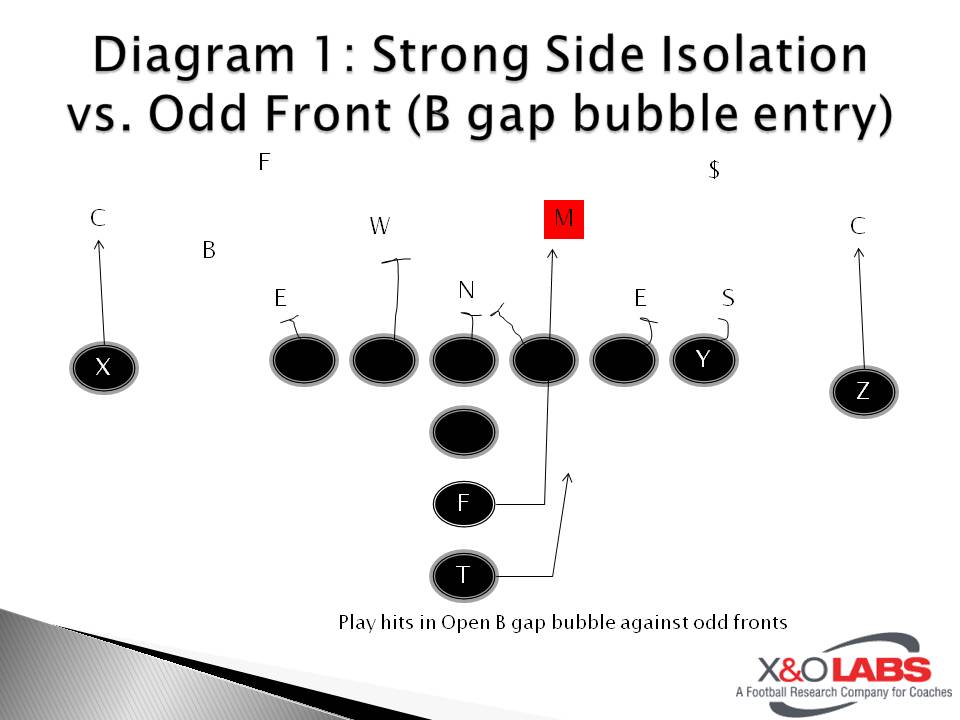
Case 1: The Strong Side Isolation (Using Tight End or Closed Formations) By definition, an “isolation” play is just as it says, typically a man blocking scheme where an offense will insert their second level player onto a defensive second level player at the point of attack.  Where you bring that second level player could come from anywhere, and we’ll show you examples.  But in most cases, that second level player will come from the backfield.  Even with the advent and perpetual evolvement of the spread run game, 56.6 percent of coaches still run the isolation play out of 21 personnel (two backs, one tight end) and 62.2 percent of those coaches use the fullback as the lead blocker.   Later in the report, we will detail the fundamentals needed for the insert blocker, for now we’ll focus on running the scheme to the tight end side.  It seems the tight end, or three man surface; creates the numbers advantage needed to run the scheme, because aside from the three blockers you have at the line of scrimmage, the insert blocker (or fullback) equals four players at the point of attack.

Get Our Next Report Free! Enter your email in the “Stay Informed” email sign up box in the right hand margin of this page >>>>>>>> right above our Facebook box.

Where you insert that fullback is clearly open to interpretation, but many of the coaches we surveyed like to insert him in the first open gap to the play side of the scheme, which typically is an A or B gap bubble.  Of course, this may change depending on the front.  Against odd fronts (those most susceptible to inside isolation schemes) the open gap is the play side B gap which is where the fullback will insert (diagram 1).  But against, four down front (4-3/4-4 teams) the question is not only where you insert the fullback but how you block the front.


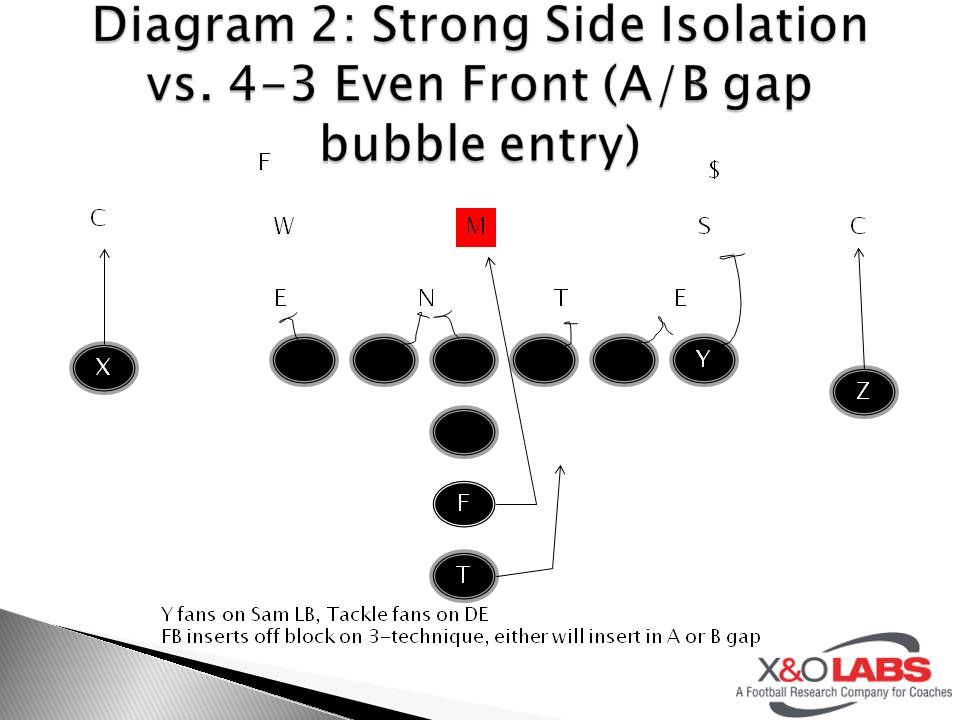
We were curious to find out how most coaches handle a closed B gap on the line of scrimmage and still run the isolation play, so we surveyed coaches on how they would block the isolation against a four down front.  Of the various fronts we presented in our surveys such as an Over 4-3, an Under 4-3, 50 Stack, 3-4 Front or 3-3 Front, 43.7 percent of coaches prefer to run the scheme to an over 4-3 front.  Despite their preference, there usually is an issue not only handling a dominating three-technique defender (which most four down fronts have) but also cutting off a 7-technqiue defensive end that is sitting in the C gap.   We figured you have two options here, either base block the three-technique with the guard, and fan out the tackle and the tight end on the defensive end and the play side linebacker or base block the defensive end with the tight end and double team the three-technique with the play side guard and tackle.  Apparently, 54.2 percent said that they will base block the three-technique with the guard and fan out the tackle and tight end (Diagram 2) sending the insert blocker or fullback on the Mike linebacker.

Read More