
The Sight Adjustment Study

The following research report was written by X&O Labs’ newest offensive researcher, Mike Kelly.  Coach Kelly is the former head coach of the Winnipeg Blue Bombers and has worked for the Philadelphia Eagles and Washington Redskins.  In this report, Coach Kelly discusses what he found when studying how coaches are using sight adjustments to combat pressures.  He also adds his own experiences and advice that you can use to take advantage of an aggressive defense.

By Mike Kelly, Offensive Researcher, X&O Labs

Researchers’ Note: You can access the raw data – in the form of graphs – from our research of sight adjustments: Click here to read the Statistical Analysis Report.

Today, offenses are faced with a plethora of defensive alignments and a multitude of pressures and coverages, but the integrity of

X&O Labs’ Offensive Researcher, Mike Kelly, discusses his findings on how coaches are using sight adjustments to combat pressures.

defensive play remains constant.  A defense must maintain gap control and if one player vacates, another must replace.  It’s that simple.  Don’t get overwhelmed, just find the inherent weakness of each concept and prepare your players to read and react accordingly with what we like to call the “unspoken communication” of throwing the football.

With this in mind we posed the question of whether you ask your receivers to “sight adjust” their routes and do you incorporate structured “hot” throws into your passing schemes?  Over 300 coaches responded to the survey with nearly 80% currently coaching at the high school level.  The majority of the respondents (40.2%) possess the title of offensive coordinator and 26.5% are head coaches. 5% of the coach’s work on the defensive side of the ball leaving the remaining 27% as offensive positional coaches giving us a good perspective as to what presents difficulties in each aspect of offensive play.

The survey revealed that 40% of the respondents only incorporate “hot” schemes in 10% of their passing game with nearly identical percentages pertaining to a free release by the running back into the pattern.  These numbers coincide with the responses that 74% of high school coaches are seeing additional pressure players deployed in less than 10% of their passing situations.

So, obviously with these numbers, it is not an alarming rate at which additional pressure players are causing conflict to the pass game.  However, when blitz is presented, it is a tremendous opportunity for the offense to take advantage and make a quick strike.

I have always felt it is important that the receiving corps and the quarterbacks are educated in the same manner in terms of reading additional pressure players with pre-snap alignment and understanding the inherent weaknesses present in every coverage utilized.  The “eyes” need to be the same looking back as looking out to and from the secondary.

To keep this in its most simplistic form, the receiving corps and the quarterback need to locate the free safety and recognize his alignment.  Is he lower than usual?  Is he creeping over an area outside defender to assume that player’s coverage responsibility?  These triggers will alert your players to possible dog or blitz.  The receiver can verbalize the threat by yelling, “Possible, Possible!” As your receivers develop, the verbalization will no longer be necessary and they will adjust in unison.  Regardless of the play called in the huddle, a quick strike is executed upon the snap as pressure is immediately being executed.
“Smoke”: It is noted that several coaches used a “west coast” style response to a coverage defender playing at depth with “smoke.”  The receiver will immediately turn his numbers to the quarterback on the snap. It is imperative that the receiver does not “drift” away from the throw or on either side of the line of scrimmage.  If anything, a step into the throw is what you’ll want.  Eighty-five percent of the respondents noted that they align their quarterback in the shot-gun in potential pressure situations and this allows for a better downhill throw providing the receiver with an opportunity to turn his shoulders up-field more readily.  The QB, who’s heels should be no deeper than four yards, must “grip it and rip it” urgently positioning his non-throwing shoulder towards his target with the side of the knee, side of the foot, short striding into the high elbow throw.

Read More

Developing In-and-Out of Pocket Presence for Your Quarterback

By Mike Kuchar, Senior Research Manager, X&O Labs

Video Report: Steve Canter, Quarterbacks Coach, Norfolk State University, gives X&O Labs complete access to his daily quaterback drills.

We’ve reached the “crunch time” of the season. That daily grind where one or two games might decipher whether you’re playing in games that count in the early winter months or you’ll be putting together your off-season program workout program earlier than expected.  

So at X&O Labs, we thought what better time than now to prepare the most important player on your roster, your quarterback, for the challenges that lie ahead the next few weeks.


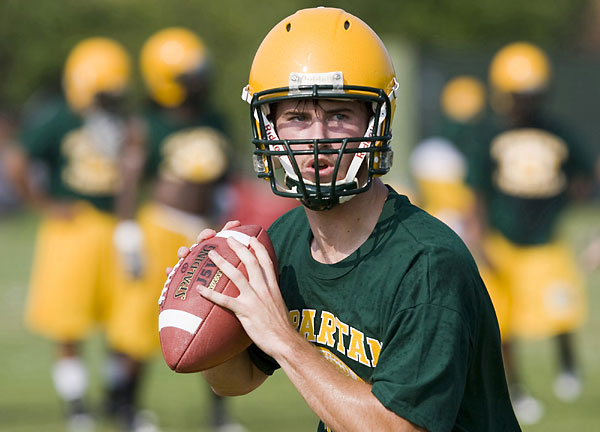
This week, we’ve been given access to how the staff at Norfolk State University (VA) trains their quarterback during the season.  Steve Canter, the quarterback coach for the Spartans, contributed his every day drills that he uses to develop his signal caller.  These are the core techniques and corresponding drill work that Canter uses to emphasize productivity in the following areas:

  • QB in pocket presence
  • QB out of pocket presence
  • Ball security

Steve Canter, an X&O Labs email subscriber and former graduate assistant at FBS power Virginia Tech University, has led the Spartans to a 6-1 record (as of 10/17/2011) with an offense that has been averaging over 400 yards per game.  We all know that the key to a successful pass offense is training the quarterback to be decisive.  How coaches train their quarterback’s to be decisive is by executing drills on a daily basis that emphasize in pocket movement, out of pocket movement and most importantly having ball security.  Having only given up four sacks this entire season, Norfolk State has shown these drills are a proven commodity. 

Read More

Dictating Coverage Based on Offensive Field Position & Personnel

By James “Mac” McCleary Defensive Coordinator, Notre Dame High School (LA)

Researcher’s Note: This report was prepared by Coach James McCleary of Notre Dame High School (LA). McCleary shares his innovative way of instructing his defensive secondary to play coverage based on offensive spacing and personnel. It’s important to note that McCleary’s system is a “check system” made by his corners and safeties pre-snap and is entirely predicated on how and where an offense lines up its personnel. Although this may seem to be consuming to teach your players (he draws up 200 cards a week complete with detailed hash marks so his kids can make the proper calls), once it’s mastered your players develop a complete understand of how offenses plan on attacking spacing and leverage in a defense.

The ultimate goal of any defense is to take away what opposing offenses do best. Our philosophy at Notre Dame High School has been to use our fronts and coverages to do that. It is our desire to outflank offenses with these fronts and coverages. Anytime we defend an offense, we look at five key components of what offenses are doing:

  • What type of formation is on the field?
  • What part of the field are they placing formation?
  • Which type of personnel is in the formation?
  • Where is their best personnel lined up within the formation?
  • What is the spacing between the receivers?

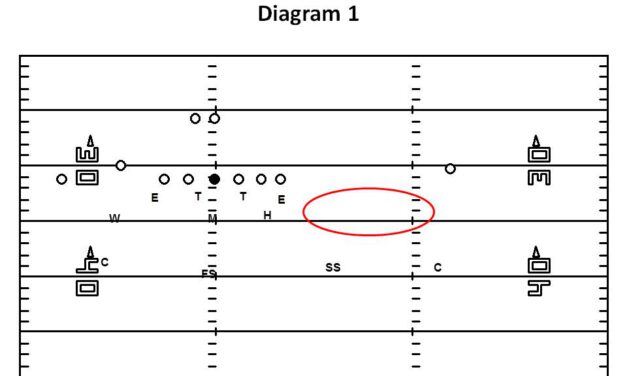
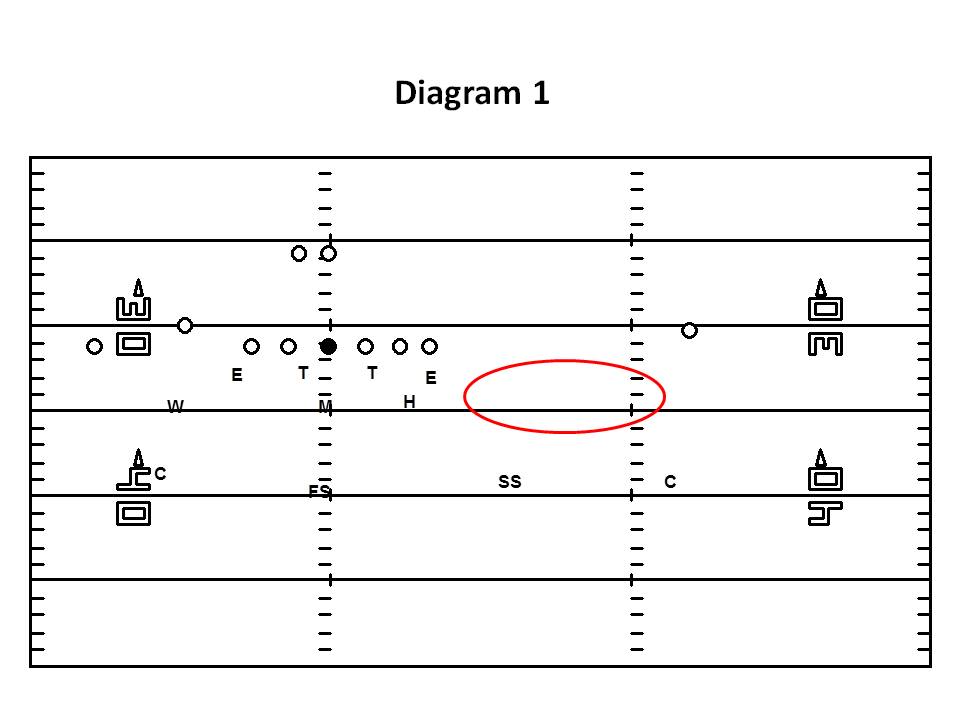
Spacing and Personnel We try to teach our kids the game by understanding receiver spacing and where QB’s want to throw the ball based on that spacing and personnel placement. For example: When looking at a formation with wide spacing of the receivers, we tell our players that the space in between is where they are looking to throw the ball (diagram 1).


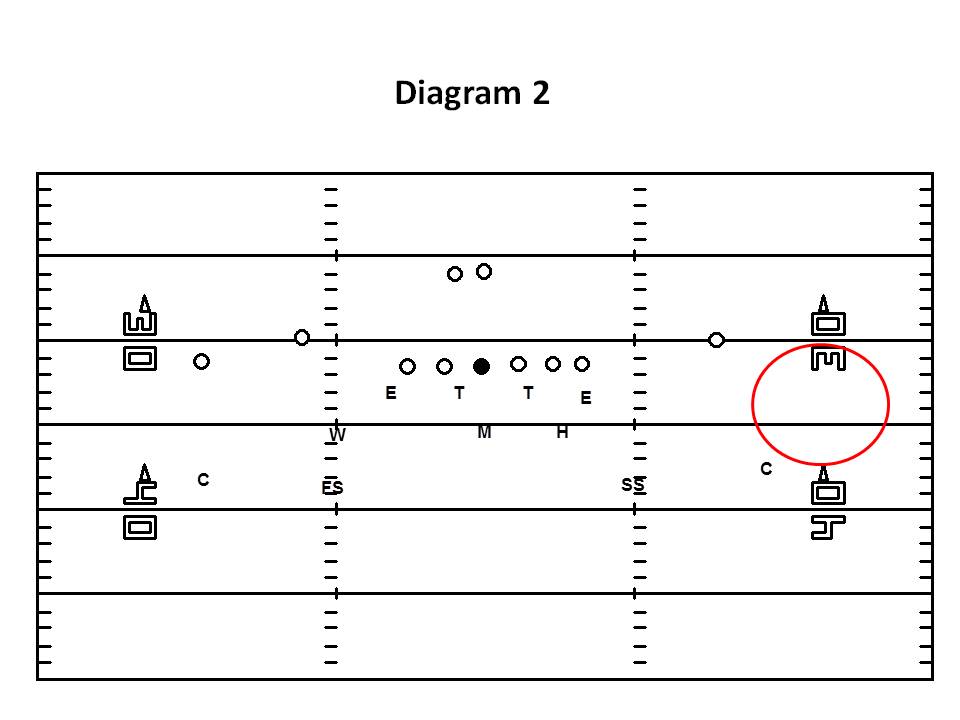
When formations have a receiver spacing that is tight, we tell them that they want to throw it to the space outside (diagram 2).

When defending offenses, the primary idea is to take away were they want to go by body position first. When an offense places its best personnel into the boundary, we tell the players that they will most likely throw the ball short into the boundary. When they are to the field, they will most likely throw wide to the field. An example of this is when we might be playing a team that throws a high percentage of screen passes. Usually, there is that one player that they like to move around the formation in order to get him the ball. We may get into a press position with the corners to get in his pocket on the inside screens to make it difficult for the blocker to pick him off on schemes such as rocket or bubble screens. Another example might be when we play a team with a significant vertical threat. We will make sure the coverage is designed so that there is always someone over the top of him.

Get X&O Labs’ new Research Reports sent directly to your email inbox. Sign up now, it’s FREE! In the right hand margin of this page >>>>>>>> above our Facebook box, there is a “Stay Informed!” email sign up box.  Just enter your name and email and click the “GO” button.

Once you teach body position, now it’s necessary to design scheme to counter what offenses are doing. By teaching spacing and where the formation is on the field (middle or hash), the players become great predictors of what can happen, thus putting themselves in a position to take away what an offense wants to do just by lining up where offenses want to place the ball, and it’s our jobs as coaches to get us there. How we do this at Notre Dame High School is to have our corners and safeties change their alignment to take away the void areas (the space where they want to throw the ball) in the defense.

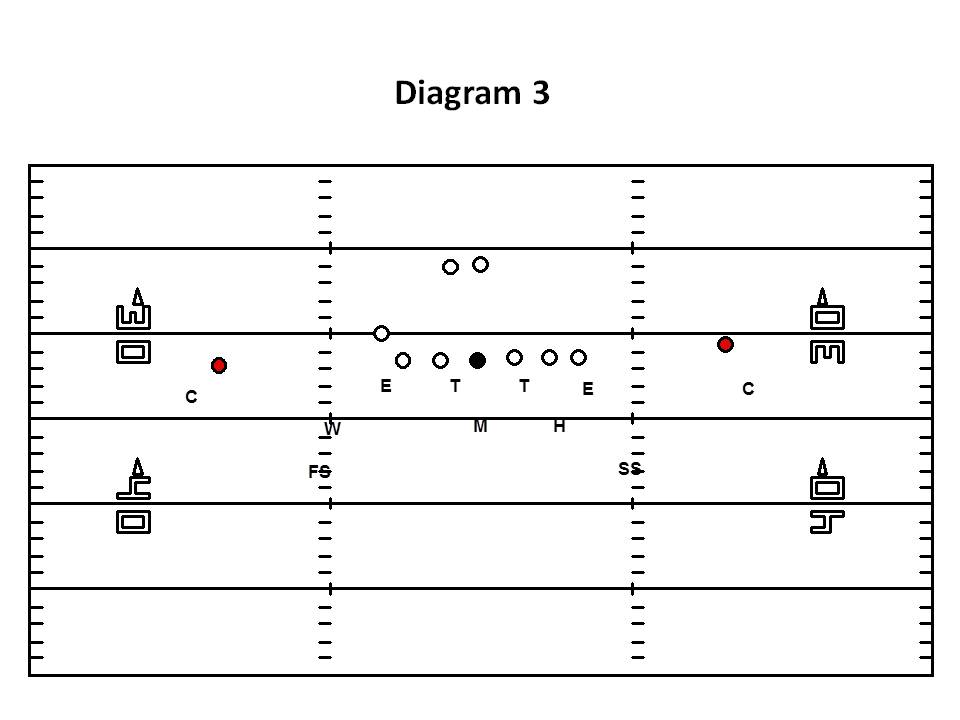
Take typical cover two for example, our corners will have three possible alignments that they can get into in cover two in order to take away what the offense wants to do. The first is the typical pressed outside leverage position. We use with average spacing of receivers to deny outside release and funnel to the safety (diagram 3).

The second spacing we will teach the corners are deep inside leverage or what we call choke technique (diagram 4). We use the choke technique when the receiver is on, or outside, the numbers. When a receiver is on, or outside the numbers there are only two things he can do. Go vertical or get inside. We take that away with our choke technique. Notice in diagram 4, we have taken his body position away just by lining up deep and inside. The corner still plays cover two, he just does it from a deep and inside leverage. He is now in a better position to take away any slant or vertical by his alignment.

Read More