
OL Drills – Pin and Pull Schemes – University of Wisconsin
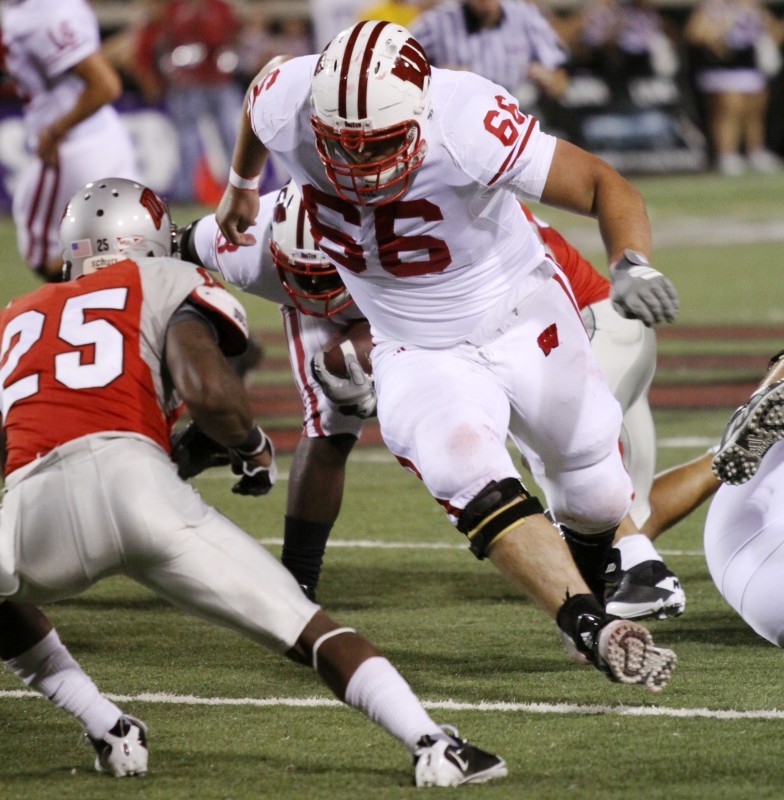
Video Presentation: X&O Labs’ Senior Research Manager, Mike Kuchar, explains Wisconsin’s pin and pull scheme in this exclusive video below.

By Mike Kuchar Senior Research Manager X&O Labs

Since over half of the country is knee-deep in two-a-days this time of year, X&O Labs didn’t want to produce a long drawn out report. We know how precious your time is during the start of the season.  Instead, we wanted to produce a quick tutorial on the pin and pull scheme, particularly the practice drills needed to incorporate the scheme.  Commonly referred to as an outside zone/perimeter concept, the pin and pull play has been used by major programs across the country.  It’s a variant of the outside zone scheme, but instead of combination blocks at the point of attack, teams will man block the scheme.  The premise is for any uncovered lineman to pull while any covered lineman will block down. 

Instead of putting together an entire report on the scheme (we’ve done that with our outside zone report) we wanted to give you a couple drills that you can use to incorporate the individual blocks into your routine.  It’s already the end of August, and chances are you have your offensive package installed already.  So instead, we’ve decided to showcase the drills of two of the best college programs that run it: Wake Forest and Big Ten Champion, Wisconsin Badgers.

Because this research report is all on video, there isn’t a ton of copy, facts or figures tied into our material.  Instead, we’re providing you with what we all know is important…video.  This way you can see for yourself how these major college programs drill their players to execute the pin and pull scheme.  But before we show our offensive line drill tapes, we did want to provide an overview of the pin and pull scheme.  Below is a PowerPoint video presentation on exactly how Wisconsin and Wake Forest teach the pin and pull concept.


Read More

DB Drills – Cover 4 Run Read Drill – Union HS (IA)

By Jared Pospisil, Defensive Coordinator, Union High School (IA)

“The drill described here assumes that our safeties have made a run call based on the offensive formation before it. For the most part, because our safeties are the run-first players in this call, much of the drill focuses on their reads and reactions.” Jared Pospisil, DC, Union High School (IA)

We use a version of Cover 4 as our base coverage because it helps us get as many players defending the run as possible. Out of a base 43 defense, Cover 4 allows our safeties to be very active in run support while ensuring that we have at least two pass-first, deep pass defenders. Therefore, because the run fit for the safeties is so important to our defense, we incorporate the Cover 4 Run Read Drill as the cornerstone of our defensive practice. We have set up our in-season weekly practice schedule to include one day devoted entirely to defense and two days that split offense-defense evenly. We incorporate the Cover 4 Run Read Drill into the defense-only day so that we can devote as much time to the drill as possible.

In our version of Cover 4, before each play begins, each side of our secondary makes one of two calls based on the offensive formation that comes out before it. Certain formations allow the safety to stay tighter to the tackle box, allowing him to be a key player in the run. Other formations pull him out wider and deeper to allow him to play the pass more effectively.

The drill described here assumes that our safeties have made a run call based on the offensive formation before it. For the most part, because our safeties are the run-first players in this call, much of the drill focuses on their reads and reactions. The corners, who assume the pass-first responsibility during a run call, basically go through their alignment, stance, and start when the ball is snapped, and finish each repetition with their late fill technique. When we play teams that crack heavily, however, we incorporate the crack-and-replace concept into the run read drill.

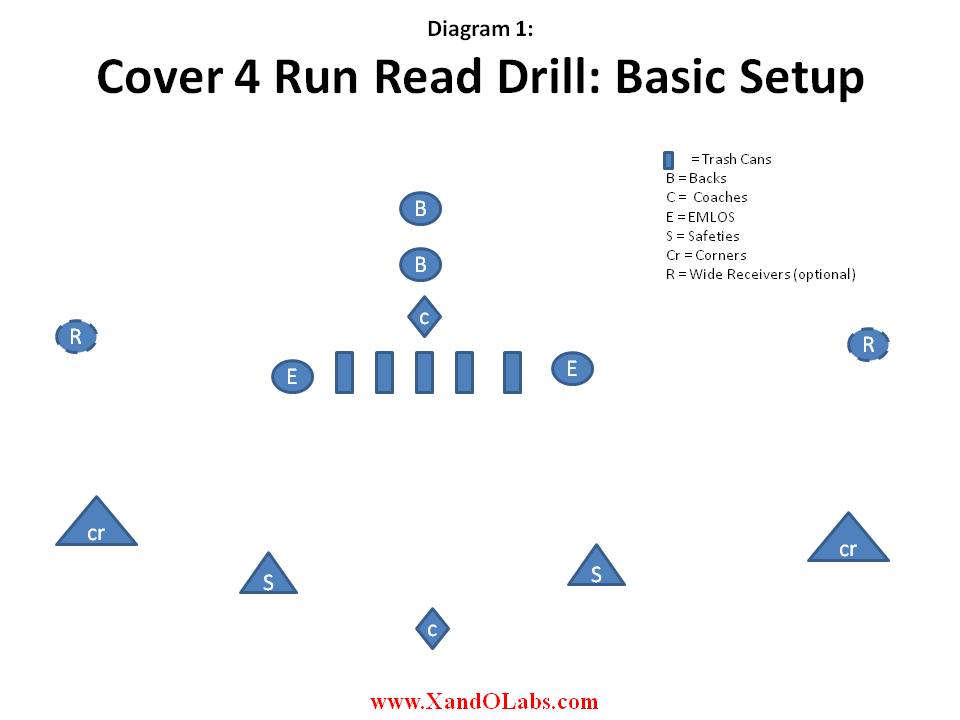
Although we set up the Cover 4 Run Read Drill to mimic the unique offensive look and blocking scheme we will see each week, the standard set up for our drill consists of the following: 4 or 5 trash cans that represent 5 offensive linemen, 2 players representing end men on the line of scrimmage (EMLOS), 2 or 3 players representing offensive backs, 2 safeties, 2 corners, and 2 coaches (one acting as the QB and one giving blocking/running assignments) (diagram 1).

We start each drill with three things in mind that we hope the athletes carry over into games: alignment, stance, and key. Generally, when our safeties make a run call to their sides, they align at 8-10 yards deep, on the outside shade of the EMLOS; in most cases, this is a tight end or an offensive tackle, depending on the offensive set we see that week. For the stance, we ask our safeties to use a square stance, with knees and hips flexed, back slightly flat, hands loose in front of the body. During a run call, we want our safeties to keep their eyes out of the backfield. As a result, we tell them to key the EMOLS solely. We find that, in most cases in high school offenses, the tight end or open side offensive tackle tip off the type of play. At the snap of the ball, we tell our safeties take a couple pop steps in place as they key the EMLOS; this gets their feet moving without losing ground.


Read More

The QB Trap Off Jet Action

“Our goal for this trap play is to get people thinking jet, get the defense moving laterally, and use the QB trap away from that motion.” Dan Ellis, Head Coach, W.C. East High School

By Dan Ellis Head Football Coach W.C. East High School

Researcher’s Note: This is the second report in X&O Labs’ QB Runs Series by Dan Ellis.  Coach Ellis is documenting his most effective QB runs: The QB Power Read, QB Trap and QB Midline.  

We are a shotgun, fast pace, no-huddle offense with a zone scheme – and we also will add pistol in as well. This allows us to take advantage of our athleticism and numbers at the skill positions and it uses our supposed “weakness” – smaller, more athletic lineman – to our advantage.


With our offense, our QB must be able to run the football and be a weapon that the defense must account for. He does not need to be a 1,000 yard rusher; he just needs to keep the defense honest with his feet.

One of our key QB runs is our trap off of jet action. We run jet motion and jet a lot throughout a game.  Our goal for this trap play is to get people thinking jet, get the defense moving laterally, and use the QB trap away from that motion.  This gives us a great counter.  Our QB series of runs hits to the same side of the action with our QB Power, the QB Midline hits the middle of the defense, and now our QB Trap hits away from the action.  All three plays give the added benefit of using the QB as a true threat.

Read More

Exclusive: Utica College’s One Back Power Run Game


By Curt Fitzpatrick Offensive Coordinator/QB Coach Utica College (NY)

“Over the past few seasons our offense at Utica has been effective at throwing the football out of our one back formations. Therefore, we have faced more and more defenses that employ a 2-high safety structure, leaving fewer defenders in the box at the line of scrimmage. When we see this, our eyes light up because we know that we’re going to get the count we’re looking for to run the football effectively.” Curt Fitzpatrick, Offensive Coordinator, Utica College

On behalf of our Head Coach Blaise Faggiano and the rest of the staff here at Utica College, I’d like to thank X&O labs for giving me the opportunity to contribute this clinic report to the new website.  The work that X&O Labs does in researching and sharing information with football coaches around the country is tremendous.  It is truly an honor to be a small part of all that they do for our profession.  For this report, I’d like to share with you the best way we utilize the Power O play; the one back Power. 

The Power O scheme has been a proven winner in the game of football for many, many years.  However, long gone are the days of everyone running this play out of strictly two back formations.  More recently the Power O has evolved into a scheme that is utilized by both pro-style and spread offenses alike.  With many teams moving towards an offensive philosophy that utilizes the skill set of a more athletic quarterback, the Power scheme is being seen more and more as a “read” concept, which adds to its reputation as being an effective “attitude-type” run play.  The point being, Power is a versatile blocking scheme that can be used in a variety of ways, as well as in the red zone and goal line scoring areas.  In 2010, the Power O scheme accounted for approximately 35% of our run game out of various formations and personnel groupings.  About 20% of our runs were of the one back Power variety.  For us, the one back power gives us a physical down-hill run play that can be run out a variety of traditionally “pass heavy” formations. 


As a back drop for this report, I think it’s important first to know what our offensive style is and how the Power play fits into our overall scheme.  While we do use bigger personnel groupings at times, we are primarily a one back offense that utilizes a mixture of 12, 11, and 10 personnel.  From a player standpoint, we currently do not have a QB that we feel comfortable running “read” type plays with, therefore the new age Power front and back side read schemes that many spread teams run do not apply to us.  I believe that this is an important point in solidifying the use of this blocking scheme in any offense.  You can find a way to utilize the Power O with whatever type of personnel that you have!  Over the past few seasons our offense at Utica has been effective at throwing the football out of our one back formations.  Therefore, we have faced more and more defenses that employ a 2 high safety structure, leaving fewer defenders in the box at the line of scrimmage.  When we see this, our eyes light up because we know that we’re going to get the count we’re looking for to run the football effectively.  Formationally speaking, we run our one back Power play out of both 2×2 and 3×1 sets, however there are a couple different criteria that must be true out of any formation in order for us to run this play:

  1. We must run the play to a TE side (at least a 3 man surface).  We also could choose to add a slot receiver (TE Trips) via formation or motion to create a 4 man surface so that we can account for a possible 4th defender to the play side. 
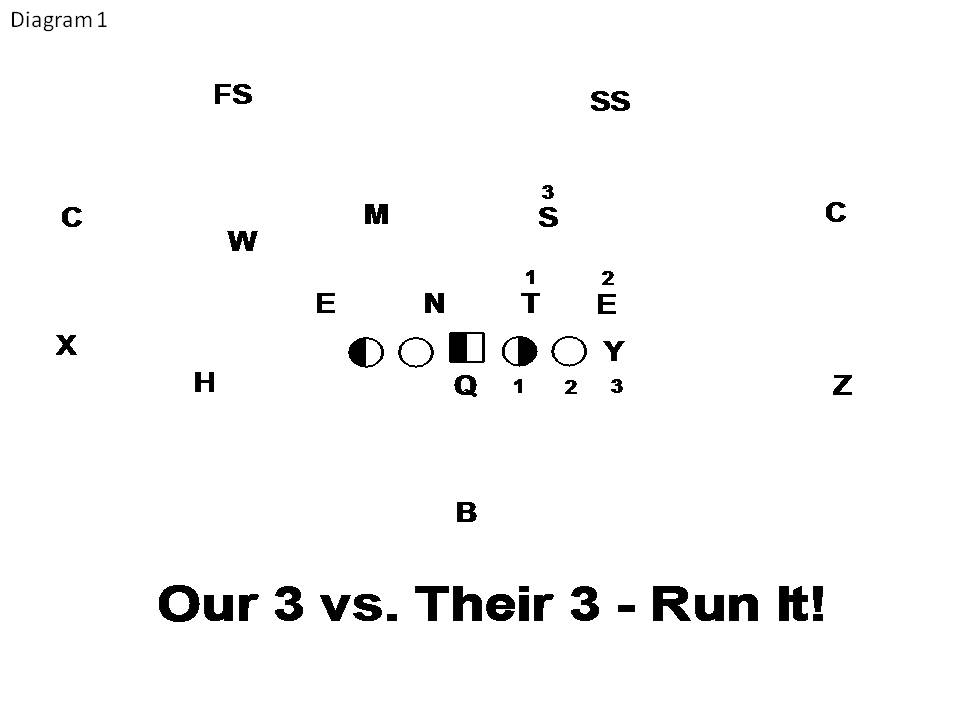
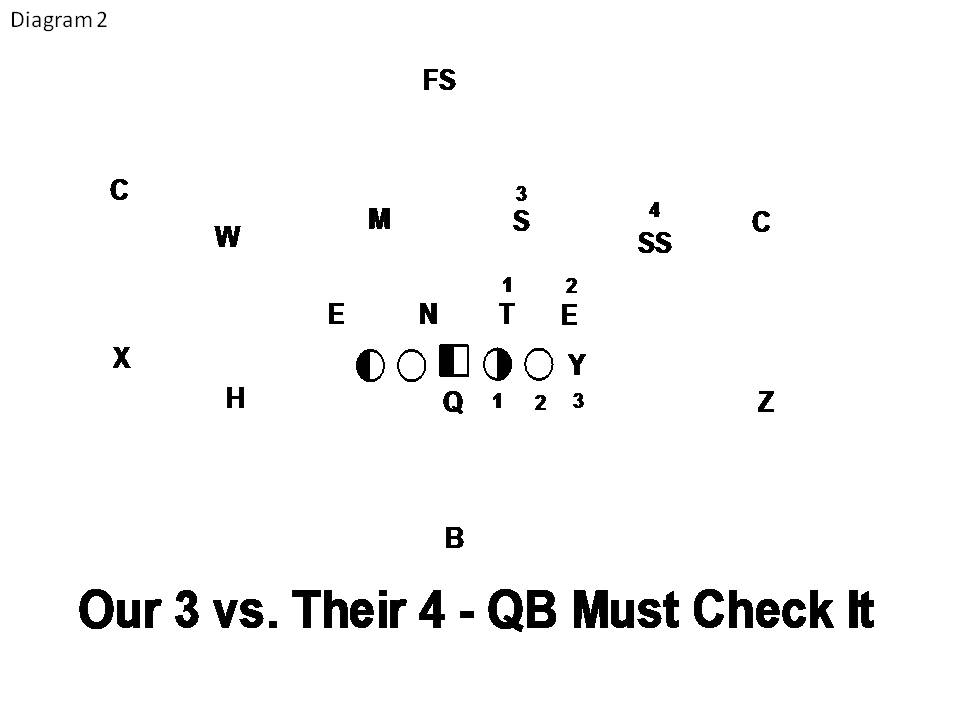
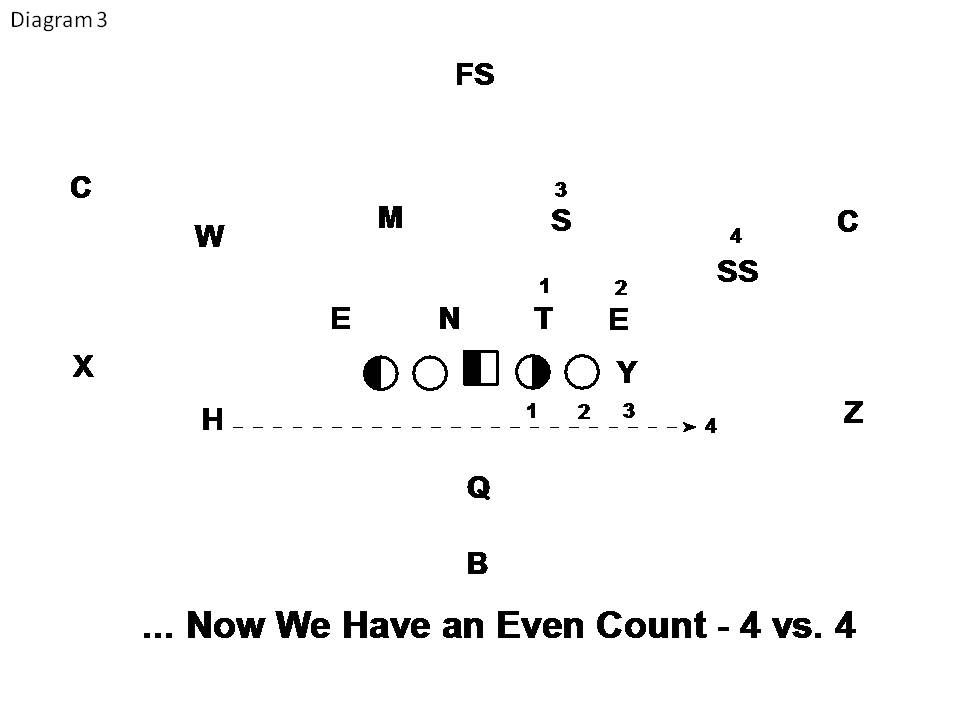
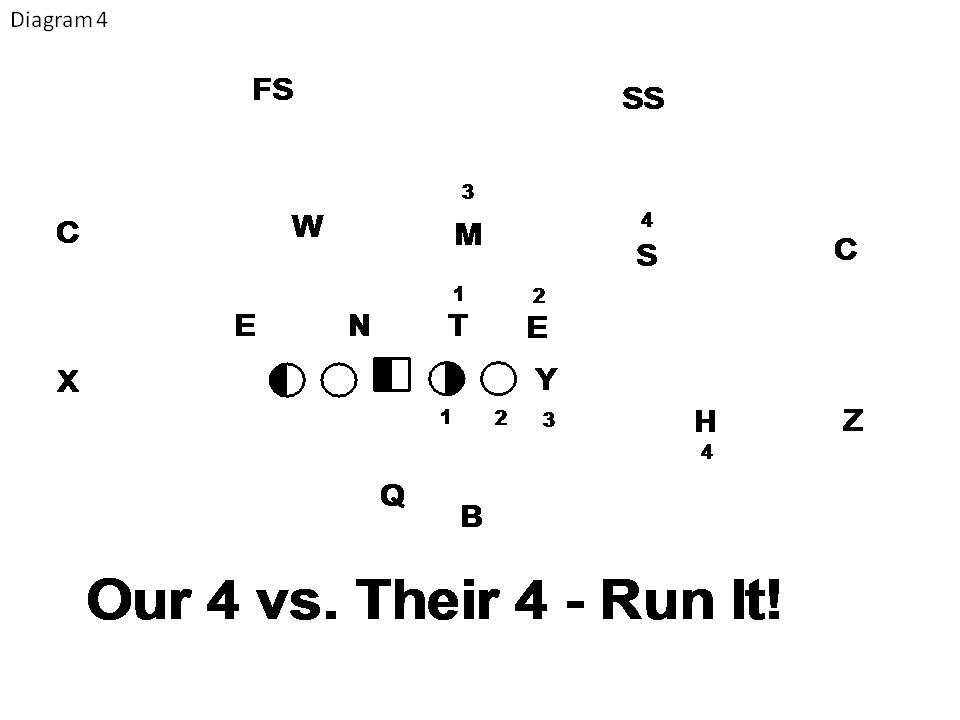
  2. We must have an even count to the play side in order for us to keep the play on.  For example, if we have the play called to a 3 man surface the QB must verify that we are getting an even amount of defenders to that side – our 3 vs. their 3 (See Diagram 1). Conversely, if we are out-numbered at the point of attack the QB must recognize this as a bad situation and check the play into a more advantageous run or pass based on the game plan for that given week – our 3 vs. their 4 (See Diagram 2).  As I mentioned earlier, one way that you can account for that 4th defender is to create a four man surface to the play side by motioning into a 3×1 formation so that the slot receiver can account for that edge player (See Diagram 3).  You could also call the play out of a 3×1 formation to begin with, giving you a 4 man surface to work with right off the bat (See Diagram 4).  If you have a slot WR that is a physical blocker this could be a great matchup for you, or it could be a nightmare if that guy isn’t willing to be physical blocking an OLB/Safety type player. 
Now that we’ve looked at some different formations, motions, and defensive structures that are conducive for running the one back power play, let’s talk about the overall emphasis of the play and some of the blocks at the point of attack that make this play successful.  The thing that I like best about this play is that it brings with it a “nastiness” up front like the Power O scheme always has.  For our offensive line, we install this play just like if we were running it out of 22 personnel or on the goal line, with a physical mindset.  Our goal when running the one back Power is to remove defenders from the box by formation, then separate the defense with a physical gap scheme that allows for a double team at the point of attack.

Read More